
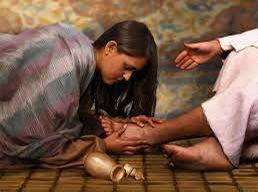
A dialogue between two slaves at the house of Lazarus, Martha and Mary, written by Elizabeth Raine, presented at Tuggeranong Uniting Church on Sunday 3 April.
Boaz is a strict Jew and has a firm idea of custom and law. Phoebe is of Jewish Hellenistic origin, more liberal in her views and very interested in the message of Jesus. They have been serving dinner to the guests, including Jesus, after Lazarus’ was mysteriously raised from the dead.
*****
Boaz: It still find it creepy, I confess, being at the home of a dead man who somehow isn’t dead any more. Oh, I can understand the gratitude that Martha and Mary must have felt, and why they wanted to thank Jesus for restoring their brother to them. But you have to admit, the whole thing was strange. And that Jesus fellow, he is rather strange as well, don’t you think?
Phoebe: I thought it very kind of Martha and Mary to honour Jesus. I don’t find it strange at all. Everyone knows he is a holy man withwonderful powers from God. Lazarus’ raising was a miracle, a blessing from God. How can you think holiness in someone is a problem?
Lots of reasons. Holy men have a habit of coming to sticky ends. And I thought Mary’s gratitude was a little excessive. Fancy wasting all that expensive perfume. Where did she get the money from?
Well, I thought Mary’s anointing Jesus with that perfume was a beautiful demonstration of gratitude, and devotion. And surely you are not suggesting that she came by the perfume dishonestly.
No, of course not. But with a household to run, it seems an unnecessary expense to incur. And you must have heard the argument between Jesus and one of his disciples about it. You know, the one who keeps their accounts. Judas, I believe his name is. Judas wasn’t impressed by Mary’s action.
Well, I don’t think it is any business of Judas, or ours, or anyone else’s if Mary wished to thank Jesus in this way. How she spends her money is surely her concern and her business only.
I suppose so. But Judas had a good point. A whole jar of that perfume would be worth a year’s wages. Imagine how much good all that money could do for the poor. After all, we were commanded as Jews to give relief to the poor. Deuteronomy specifically states that we should ‘Open your hand to the poor and needy neighbour in your land’”. And look at the teachings of Jesus himself. He is always on about helping the poor. I heard he even advised one wealthy young man to sell everything he had and give it to the poor. Yet here he is accepting perfume worth a king’s ransom be wasted on his feet!
I can see what you are saying. But Jesus and the disciples have given lots of money to the poor over the last few years. You know they have. And inspired others to do the same. And Mary has a right to spend her money as she wishes. She clearly offered this gift out of her gratitude and great love for Jesus. After all, what price her brother’s life?
Well, I am not sure Jesus should have allowed a whole year’s wages to simply evaporate into thin air. Yes, it was a nice gesture and it did make the house very fragrant and pleasant. But what business has Jesus got to ask other people to be giving away or selling their things in aid of the poor when he allows such waste on himself? I still think Judas had a good point. All those denarii could feed a lot of hungry people. How can you be sure that Mary was doing the right thing?
I say if you are going to be generous, then do it properly. And this is also an important part of all our traditions, to be generous in hospitality to our guests and to take care to show our appreciation for the favours of others. After all, the proverb says, “Some give freely, yet grow all the richer; others withhold what is due, and only suffer want.” Mary has given freely and didn’t withhold the appropriate thanks due to Jesus.
You sound just like that Rabbi Hillel with your liberal notions. I am sure this was not the intent of that proverb. But it wasn’t just the expense. It was what Jesus said in response to Judas, you know, about the poor always being around. You must admit that it was a very odd response for someone who says they are all for the poor and alleviating their suffering. He said that the poor would always be with us, but that he would not. This is not the attitude of a holy man. A holy man would think first of the poor.
I just told you that no one can accuse Jesus of ignoring the poor. Look at his recent actions. Apparently he managed to feed a whole crowd recently with only five loaves and two fish. In addition, I have heard some of the other followers of Jesus speak poorly of Judas. They say that Judas was not really concerned about the poor at all but was a thief who used to steal money from their common purse. Surely we cannot take his remarks seriously. Mary was motivated by love and gratitude,and Judas by selfishly wanting the money for himself. Mary, however, has surely given away a most precious possession with total selflessness.
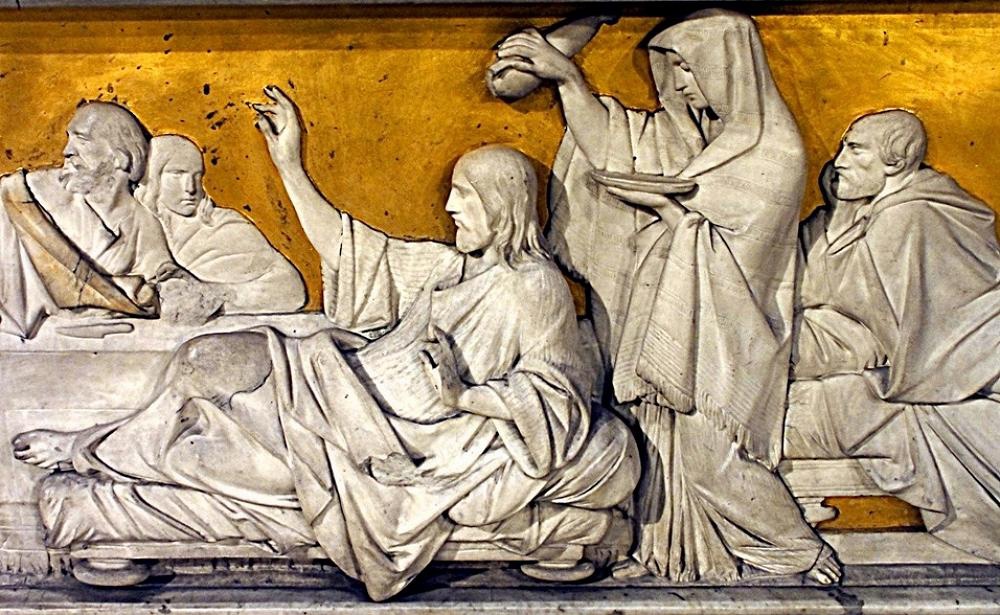
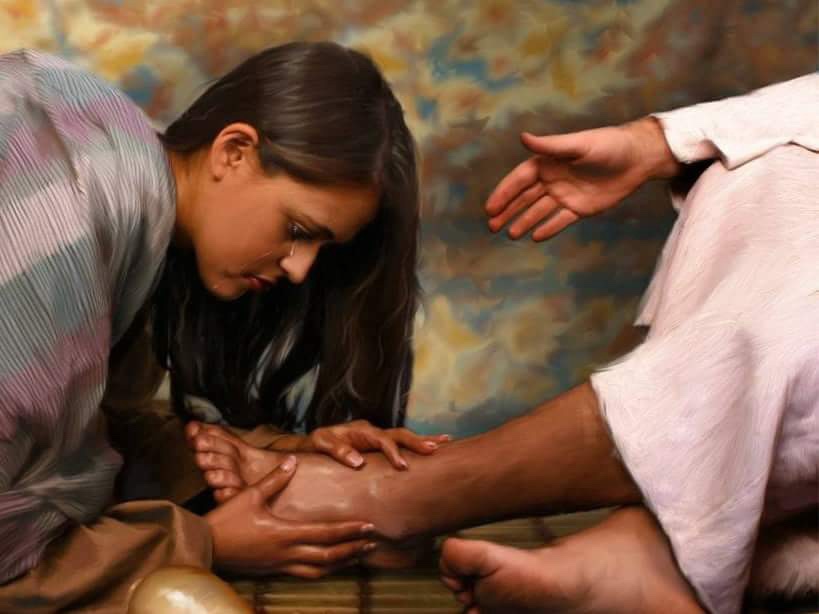
Oh, you make it all sound very noble indeed. But just think about the way she went about it. Anointing his feet instead of his head. This isn’t customary. And letting her hair down in public like that, just like she was a prostitute. Whatpossessed her to do such a thing? She acted like she was repenting of something, not thanking the saviour of her brother. Or worse, making an offer of herself.
Oh, surely not. But I agree, it wasn’t the best image she presented of herself. I was a little shocked myself to see her kneeling at the feet of a man who wasn’t related to her, hair all over the place, wiping herself on his feet. I know they are good friends and all, but still – yes, there certainly was a breach of proprietary there. I just assumed she had forgotten herself in her great outburst of gratitude.
Well, though there is some truth in what you say, I wouldn’t want to make such an exhibition of myself. Wouldn’t a simple and heartfelt thank you in addition to the dinner be enough?
But you are forgetting just how great a miracle had been performed here – no wonder she knelt in worship at his feet. Jesus speaks about being humble and serving others. I am sure he wouldn’t be above anointing or washing feet himself. And only prophets anoint the heads of the great.
Hang on a minute. You are making it sound like Mary was recognising Jesus as the Messiah! Surely you are not suggesting this. Such ideas could be seen as blasphemous in certain circles. There have been whispers about this very thing.
Yes, I have heard the rumours as well. Apparently the chief priests are not happy at all with all the attention that Jesus has drawn to himselfsince the raising of Lazarus from the dead. I heard that they were trying to say that Lazarus wasn’t really dead; it was a stunt to suggest to the common folk that Jesus was the Messiah. You know, to drum up support from the peasants and get a movement going.
Yes, after Lazarus came alive, I did hear that the chief priests had called an emergency meeting of the Sanhedrin. They wanted to discuss what had happened, I suppose. After all, everyone is talking about the many signs that Jesus has performed. I guess they would be thinking that if they let him keep going on like this, that soon everyone will be believing he is the promised kingand messiah. And any mention of ‘king’ and the Romans would be sure tocome and destroy both the temple and us.
I did hear that Caiaphas, the high priest, had made some sort of plan. Someone did whisper to me that he got fed up with all the debate, and told the Sanhedrin they were all fools. I heard that they decided it was better to sacrifice Jesus. You know, better to just have one man killed to appease the Romans rather than the whole nation be destroyed.
Hmmmmm, do you think Jesus has heard about this? Might explain the very strange remark he made at the time Mary was wiping his feet. He said to Judas that the perfume was for his burial. I thought to myself at the time, ‘Who is he to be planning such an expensive burial ritual? And he is only young. Why would Mary be getting ready for his burial now?’ But if he had heard the rumours too, then that remark suddenly makes sense.
Do you really think that the priests have made up their mind to actually have Jesus put to death?
I think it possible, and what’s more, I heard that they had let it slip that anyone who might know where Jesus was should let them know, so that they could arrest him. Even heard there was a reward. If you are right about Judas being a money grubbing thief, then maybe he will try and claim it.
Oh, surely not. He and Jesus are so close. Don’t even think that. But Jesus needs to be careful. I thought I heard him say at the dinner that he was going to Jerusalem soon, and Jerusalem is a hotbed of unrest with Passover coming up. There was also some talk that the priests were planning to kill Lazarus as well, because everyone keeps coming to have a look at him. It isn’t every day that you can look at someone who has come back from the dead.
Well, Jesus wants to hope that the priests don’t hear of this latest extravagance and interpret Mary’s gesture and Jesus’ acceptance of it as some sort of symbolic anointing of Jesus as a royal Messiah. Otherwise he will be looking for a tomb, not a throne.
*****
See also https://johntsquires.com/2022/04/01/jesus-anointed-as-a-sign-of-his-fate-john-12-lent-5c/


 An Informed Faith