
The land on which the house that we currently own and live in, on Brown Street, Dungog, was part of the original area of land in the town of Dungog that was made available in 1838 to settlers by the Governor of the Colony of New South Wales, Sir George Gipps.
Of course, this land and the surrounding region had been the land of the Gringai people for millennia; but once the British government started sending convicts to this continent, and began the process of claiming the land from the Indigenous people, the British system of law, and of land and property, became dominant as new settlements were opened up for the incoming settlers.
A bundle of documents which we received when we purchased the property provides information about the sequence of owners, from 1842, when the land was bought by James Fawell, up to 1969, when it was bought by Victor Jack and Wendy Elizabeth Finney. These documents show that it was owned by a series of men in the middle of the 19th century: James Fawell (1852), Barnet Levey (1852), William Hopkins (1855), John Maberly (1857), and then Daniel Bruyn (1858).
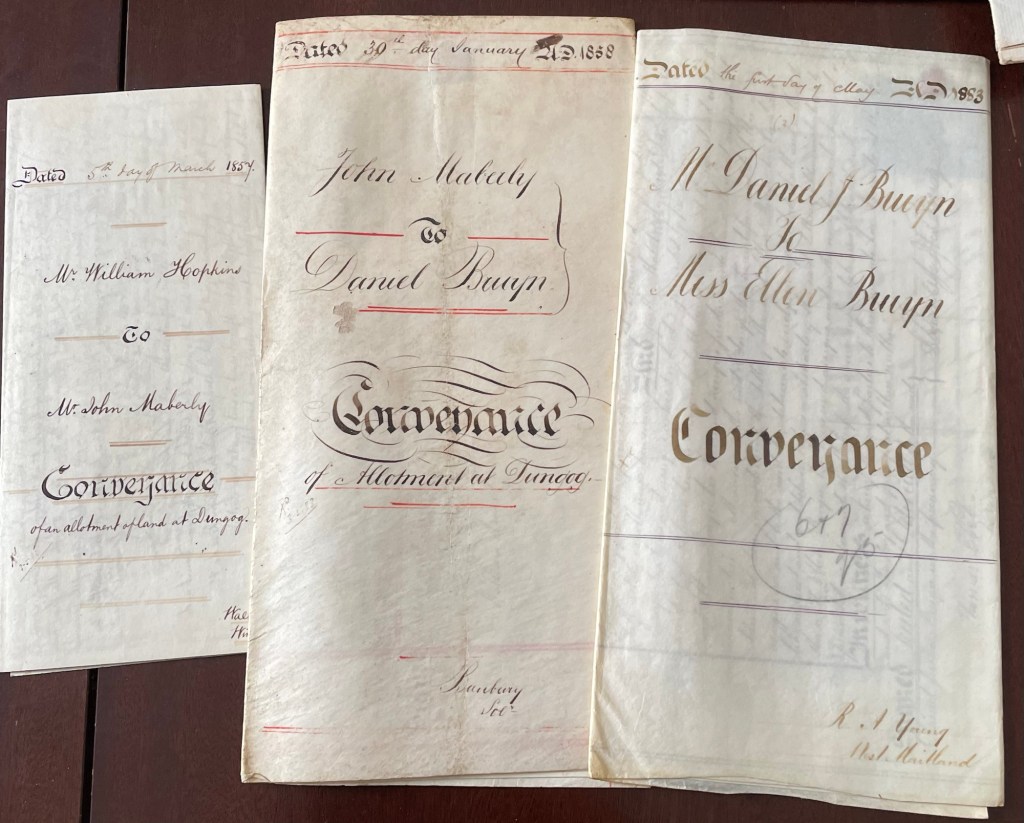
relating to the land in Brown St, Dungog
Daniel Bruyn obtained ownership of the land in 1858. A Conveyance dated 30th January 1858, between John Maberly of Windsor, Boot and Shoe Maker, and Daniel Bruyn of Dungog, Blacksmith, reports that “Allotment No. Seven of Section No. Five in the Town of Dungog” changed hands for the price of Fifty three pounds ten shillings. The land would stay in his hands until he died.
What do we know of this man and his family? Daniel Joseph Bruyn was born in Roscommon, Ireland, in the closing years of the 18th century. He migrated to England, and married Sarah Ellen Nichols on 5 February 1837 in West Bromwich, Staffordshire. Sarah had been born in 1807. Daniel’s occupation was Blacksmith.
A number of children were born to Daniel and Sarah in England: Joseph (1837—1905) and Margaret (Dec 1837—1928), both in Birmingham, Warwickshire; Ellen Esther (1839—1927) and Elizabeth Ann (1842—1929), both in Smethwick, Staffordshire.
At that point of time, the current County boundaries were different; Smethwick today is a suburb of the huge city of Birmingham, population now 1.142 million; but in the 1830s it was a small village four miles away from the centre of the town of Birmingham, population then 183,000.
The family travelled to France, where two children were born. A daughter, Mary, arrived in 1845 but died within a year. A son, Daniel Jnr, was born on 26 May 1847, at Graville, Le Havre, Seine. After four years the family returned to England, due to a surge of unrest in French society. Some claims have been made that people were upset about foreigners taking the jobs of French Citizens; many foreigners sought to escape and it is said that most left without their belongings and being paid. Certainly, unemployment and the cost of living was rising, fuelling such unrest.
The Library of Congress Guides contains the following report about the broader political situation of the time:
“The Revolution of 1848, or February Revolution, ended the Orléanist rule and brought in the period of the Second Republic. During this time, many countries in Europe were undergoing revolutions that sought to topple conservative monarchies with liberal democracies … This era also coincided with a deep interest in socialism in France. The Saint Simonian movement was at its height by now. There was a mood of general discontent … Paris became a battleground between numerous factions … equally opposed to one another.
“Election results were not to the satisfaction of the radicals (the popular vote elected moderate and conservative candidates) and as a result the so-called “June Days” erupted, a short-lived civil war in Paris. The rebellion was put down by General Cavaignac, but it took months for the Assembly to come up with a constitution. When it was finally agreed upon it was quite liberal and provided a four-year term President chosen by universal male suffrage. They chose Louis-Napoléon Bonaparte (nephew to Napoléon I) to be president of the Second Republic.”
Back in England, another daughter, Malvenia (1850—1938) was born in Smethwick, Staffordshire. It seems that Malvenia was also known as Sarah; at her marriage to John Landers of Dungog in 1871 she is identified as “Sarah Malvina Bruen”. They moved to the New England region, and the Electoral Roll for 1930, 12 years after John’s death, lists “Landers, Sarah Malvina, Castle Doyle road, Armidale, home duties”.
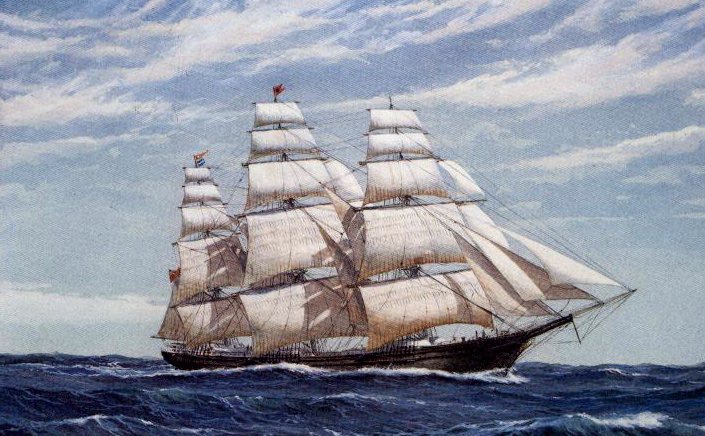
in 1856 it brought immigrants to Australia and returned to England with gold and wool. The February 1856 voyage which brought the Bruyn family to the Colony was completed in just over 72 days, an excellent time for those times.
The family came to the Colony of New South Wales in 1856 as assisted migrants. Daniel and Sarah arrived on board the Commodore Perry on 1 May 1856 with their five children. The list of immigrants on this ship lists “Daniel Bruyn age 43, Sarah Bruyn age 49, Margaret age 18, Ellen age 16, Elizabeth age 14, Daniel age 9, Sarah age 6”.
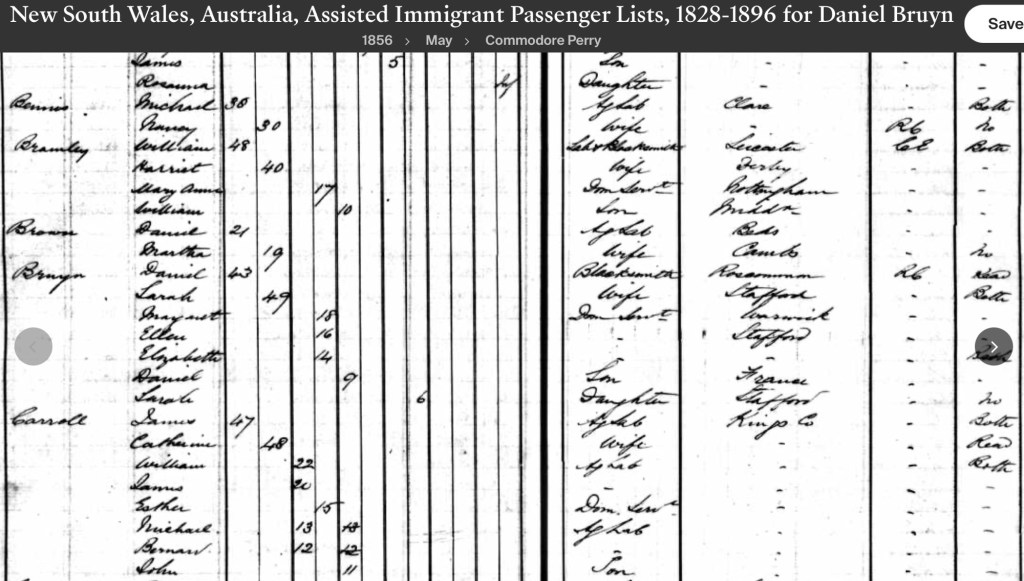
Their eldest child Joseph (then aged 19) did not travel with them, although he does appear in New South Wales a few years later. Joseph had been born to Daniel and Sarah prior to their marriage. He was born with his mother’s surname, as Joseph Nichols, and later married under that name.
Joseph Nicholls was 22 when he and his wife and children arrived on the Daphne 1859 as the Nicholls family (Daniel Bruyn was the person who assisted this immigration). Once off the ship Joseph, his wife and children changed their name to Bruyn. Sadly, Joseph and Mary lost four of their children to Diphtheria in March 1866 (Sarah Jane, Ellen, Frederick, and Thomas).
Within two years of arriving in Australia, the Bruyns had moved to Dungog and settled in the town. Some comments in the Dungog Chronicle of Tuesday 4 October 1927, p.2, report that on arrival in Sydney in 1856, “the family came direct to Dungog, arriving here on May 24th.” However, in an interview with Ellen, one of the daughters, conducted many decades later in the last year of her life, the Sydney Daily Telegraph of Tuesday 14 June 1927 reported her as saying that when they came to Australia “they all joined in the gold rush at Hanging Rock” (p.18).
At Hanging Rock in the Armidale region to the northwest of Sydney, gold had been discovered in 1851; by February the next year, 27 cradles were operating with some 200 diggers searching for their fortune. Panning continued for some decades; at its peak there were several thousand people living at Hanging Rock. It is entirely feasible that the Bruyn family had gone there for a brief period in 1856—1857, but I have found no other evidence to substantiate this claim made by Ellen in this 1927 interview.
The same report continues, reporting that the Bruyn family “occupied a house, long since demolished, then owned by Mr. Campbell that stood at the rear of Mrs. M. A. Dark’s present home, and almost opposite the residence that Miss Bruyn occupied for the past few decades.” (This extract is from an obituary to Miss Ellen Bruyn after her death in 1927.)
The residence of Mrs. Dark which is noted in this report would be Coolalie, on Dowling Street; it is referred to as her house because her husband, Henry Charles Dark, had died in 1901, and so it would be known in 1927 as “Mrs Dark’s home”. The house to the rear would have been opposite the land on Brown Street that is the focus of our explorations.
The Mr. Campbell referred to here could be Dougall Campbell, who was a convict assigned in 1828 to Mr. John Hooke. (Hooke gave his name to Hooke St on the northern end of the town; he had been granted 2560 acres in 1828.) If so, we may presume that by the 1850s, Campbell had received his Certificate of Freedom and had become a reputable citizen of the town, as many former convicts have done across the continent.
Just two years after arriving in Dungog, Daniel Bruyn became the owner of “Allotment No. Seven of Section No. Five in the Town of Dungog”. In a Conveyance dated 30 January 1858 between John Maberly of Windsor, Boot and Shoe Maker, and Daniel Bruyn of Dungog, Blacksmith, the transfer was effected for a price of fifty three pounds ten shillings.
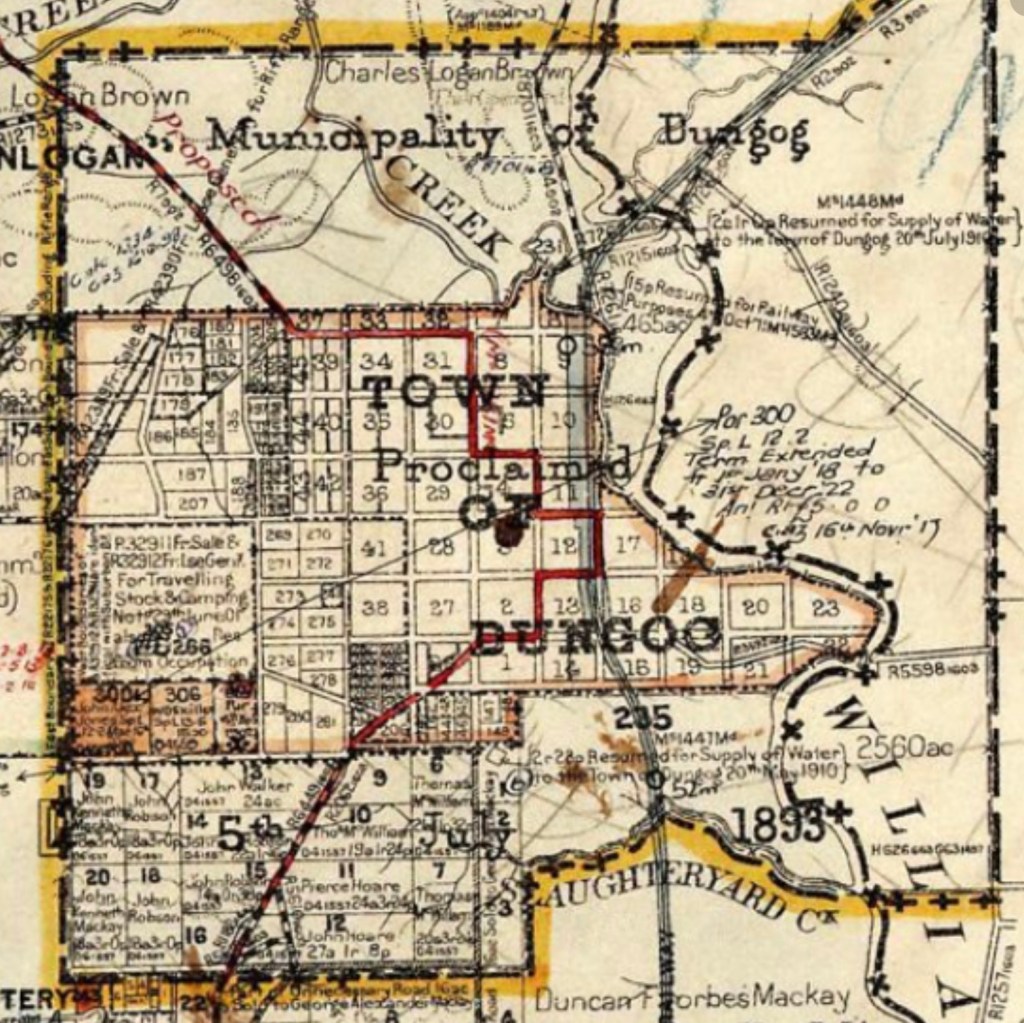
The land, facing Brown Street, would stay in the hands of the Bruyn family for over a century—from 1858 to 1968; although, as we shall see, members of the Bruyn family lived there only until 1927. There is good evidence that Daniel conducted his business as a Blacksmith on this property during the two decades or so that the family lived here.
It is not clear when the family moved from the residence behind Mrs. Dark’s home, mentioned in the 1927 obituary of Ellen Bruyn, onto the property across the road where there was a “residence that Miss Bruyn occupied for the past few decades” (until her death in 1927). It is reasonable to hypothesise that the family came to Dungog, found housing in Mr Campbell’s property, purchased the land in Brown Street, had a house built on that land, and then moved in to that building. How soon after the 1858 purchase of this land this move took place, is not known.
It is certainly clear that at some stage Joseph Bruyn also had a foundry built where he could carry out his business as a Blacksmith. One mention of Bruyn’s blacksmithing business comes in a 1934 report of reminiscences by “Mr. Hewlitt Tate, of Lithgow”, in the Dungog Chronicle of Friday 5 January 1934, p.5, entitled DUNGOG’S FIRST BLACKSMITH.
Mr Tate recalls that “The first blacksmith in Dungog, I was led to believe, was Thomas Smith, father of Johnny Smith who was wheelwright in Dungog 70 years ago. He has been dead between 80 and 90 years. Mother used to tell us boys about her grandfather riding over to Stroud when he was sent for by the A.A. Company, to do any special blacksmithing. Mother was then 12 or 13 years of age.
“I remember the late Mr. Kehoe, an old blacksmith, of Dungog, telling us boys that he was in Dungog before the late Mr. Bruyn. Then there was an old Mr. Arrowsmith who used to live along the Stroud road about half a mile the other side of the river.”
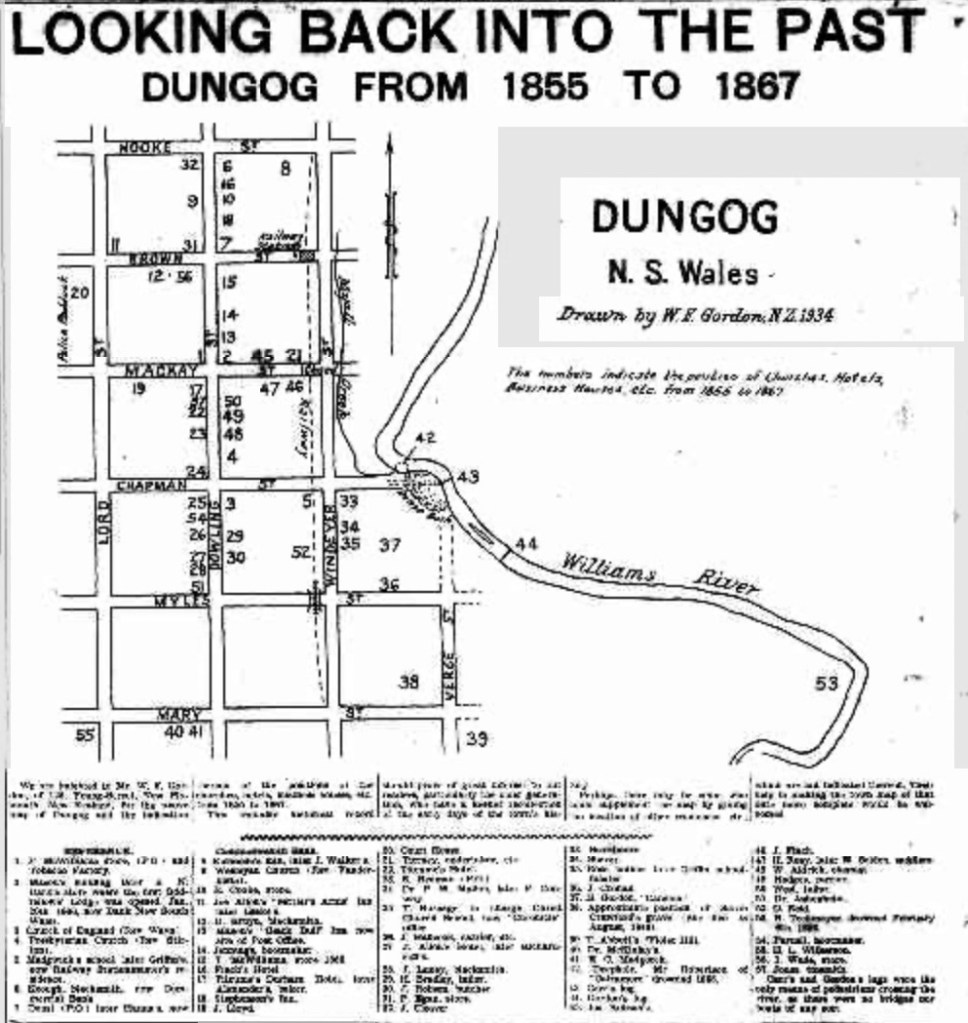
Some months later, on Tuesday 17 July 1934, the Dungog Chronicle published a hand-drawn map entitled LOOKING BACK INTO THE PAST: DUNGOG FROM 1855 TO 1867. Key businesses are indicated on the map by numerical coding. In the relevant block of Brown St, on the corner of Dowling St, #56 designates “J. Wade, store”, which was established by John Wade in 1866.
An article in the Australian Dictionary of Biography describes Wade as “an active member of the Methodist Church, Wade was conference representative and circuit steward at Dungog, and later at Ashfield and Mosman. He helped to found the Dungog School of Arts with an abiding friend Rev. Dr J. E. Carruthers who served at that town in 1871–73. Wade was also a founder (1881) and chairman of the Williams River Steam Navigation Co. Ltd. As a Protectionist, he twice unsuccessfully contested the Legislative Assembly seat of Durham.”
Wade’s store was later bought by H.C. Dark and was developed to become the largest general store in Dungog. The present long and imposing two-story building was built in 1897 and extended in 1917.
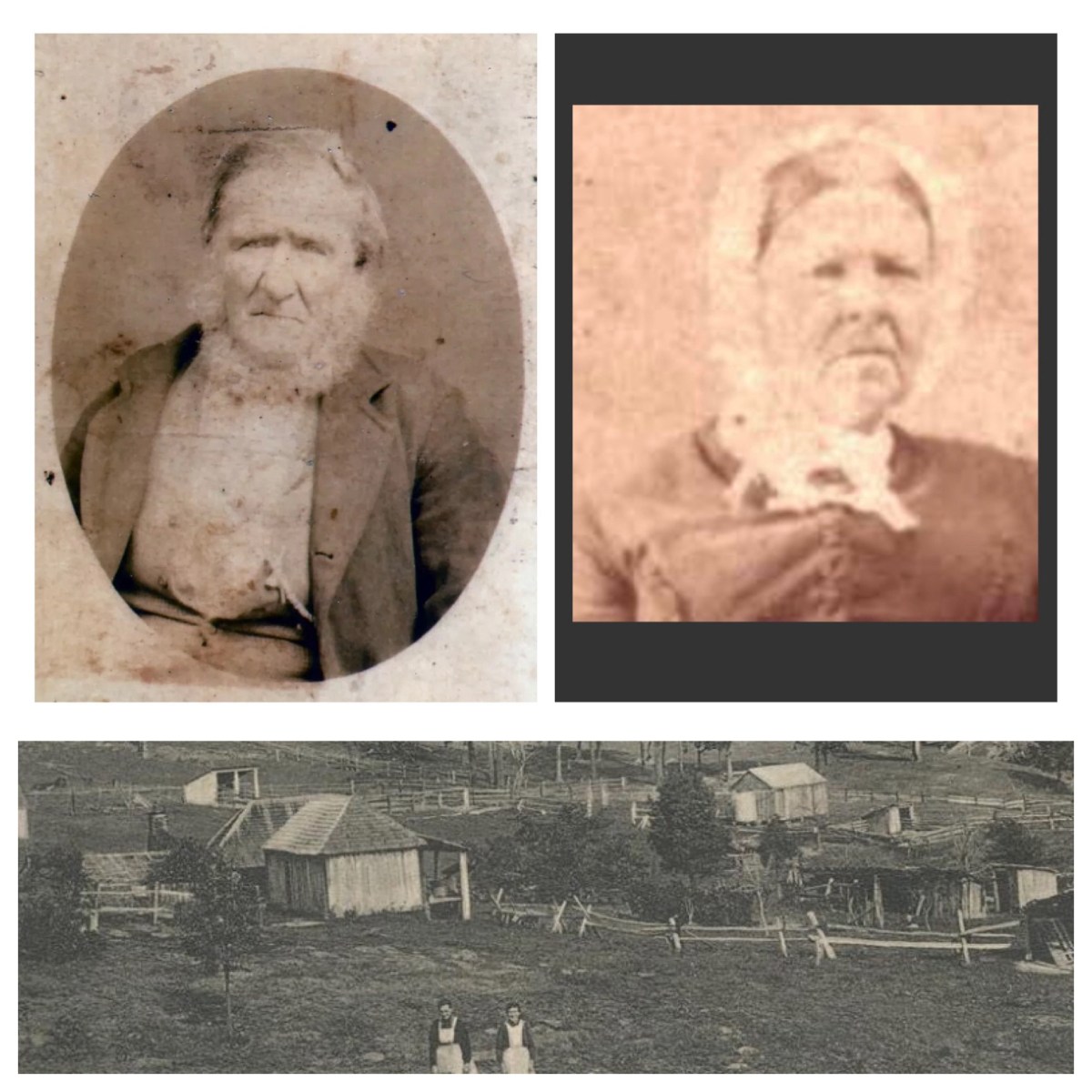
In 1866, however, Wade’s store would have been a much more modest building. Immediately adjacent to that on the LOOKING BACK INTO THE PAST map is #12, “D. Bruyn, blacksmiths”. An undated image entitled “Bruyn’s Cottage in Brown Street where the park is now” appears to show a family house with white posts, next to a building that most likely was the foundry for Bruyn.
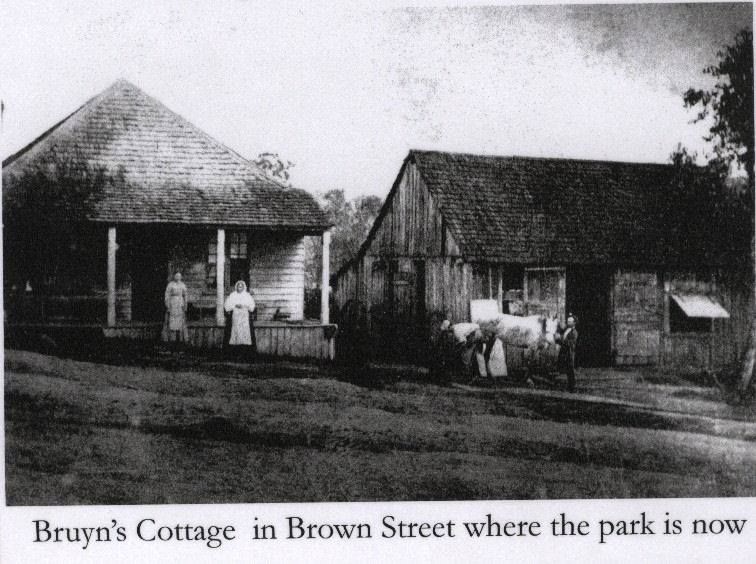
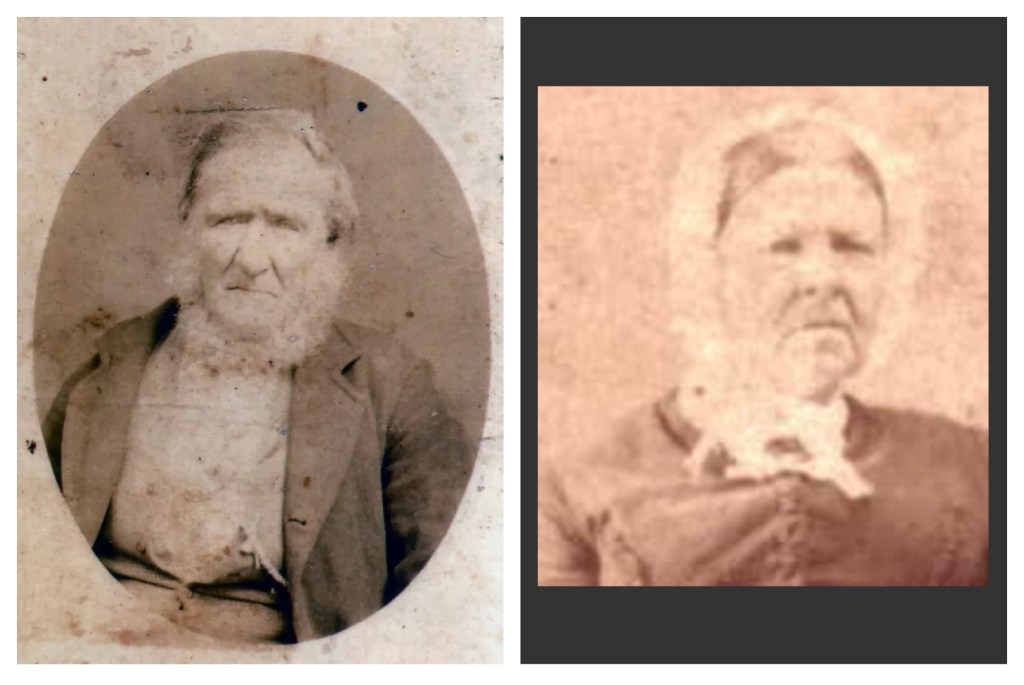
Outside the house are two women (perhaps Sarah and one of her daughters?), while outside the putative foundry are two horses, one held by an apparently-bearded man (perhaps Daniel Bruyn himself?). Certainly, and unsurprisingly given the fashion, a photo of Daniel Bruyn late in his life shows him sporting a generous set of muttonchops and beard.
A decade later than the 1934 publication of this map, the Dungog Chronicle Friday 19 October, 1943 (p.5) published an article entitled “Early Recollections of Dungog” by a person styling themselves simply “Ex-Dungogite”. The recollections in this article includes a discussion of trades in the town. The author notes that “Mr. J. Tierney carried on wheel-wrighting in a general way with which he combined the undertaking business. Mr. Jno Smith, succeeded by Mr. Thos. Gurr, was also in the wheel-wrighting trade in another part of the town.”
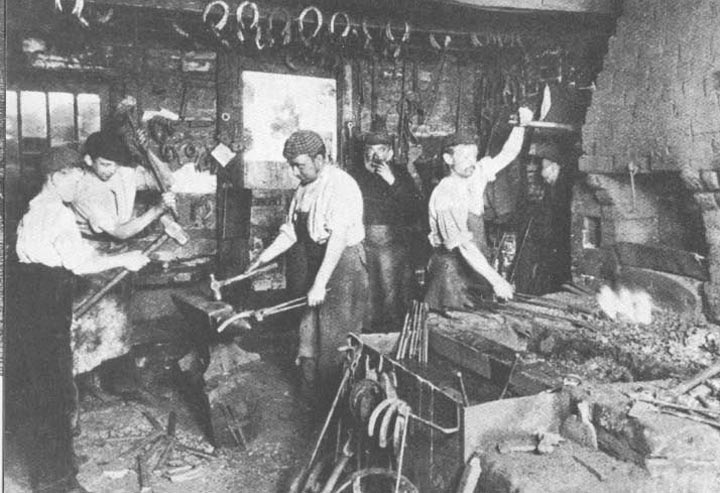
A photograph of a Victorian Blacksmith’s Shop, from The Victorian Web at. https://victorianweb.org/history/work/blacksmith.html
The commentary attached to this photograph notes that “blacksmiths had a place among the working classes, and these men worked with their hands and arms in a hot, grimy smithy. Blacksmiths, who have a history that goes back thousands of years, however, had a far higher economic and social position than farm or factory workers. As highly skilled artisans, they also managed to remain independent and in demand until well into the twentieth century when the automobile destroyed many of their opportunities for work. Even then, these skilled iron workers often morphed into auto mechanics just as a century earlier some had become pioneeering engineers.”
With regard to blacksmiths, the author notes that “Mr. J. Keogh was a general blacksmith in the Main Street, while Mr. D. Bruyn carried on a similar business in the hollow in Brown street … Mr. J. Luney first conducted a blacksmithing business in the allotment occupied at present by the newspaper office. He afterwards removed farther up the street.” The town was well-served by blacksmiths—including Daniel Bruyn “in the hollow in Brown street”, on the property he had bought in 1858.
(The writer also speculates that “Miss Ellen Bruyn, if still existant as I trust she is and still well, notwithstanding her sum of honorable years — must be the oldest Dungog resident.” Writing in 1943, the “Ex-Dungogite” appears unaware of Ellen Bruyn’s death, at the age of 88 years, some 16 years earlier.)
To be continued … … …
*****
See earlier posts at
and subsequent posts at

 An Informed Faith