
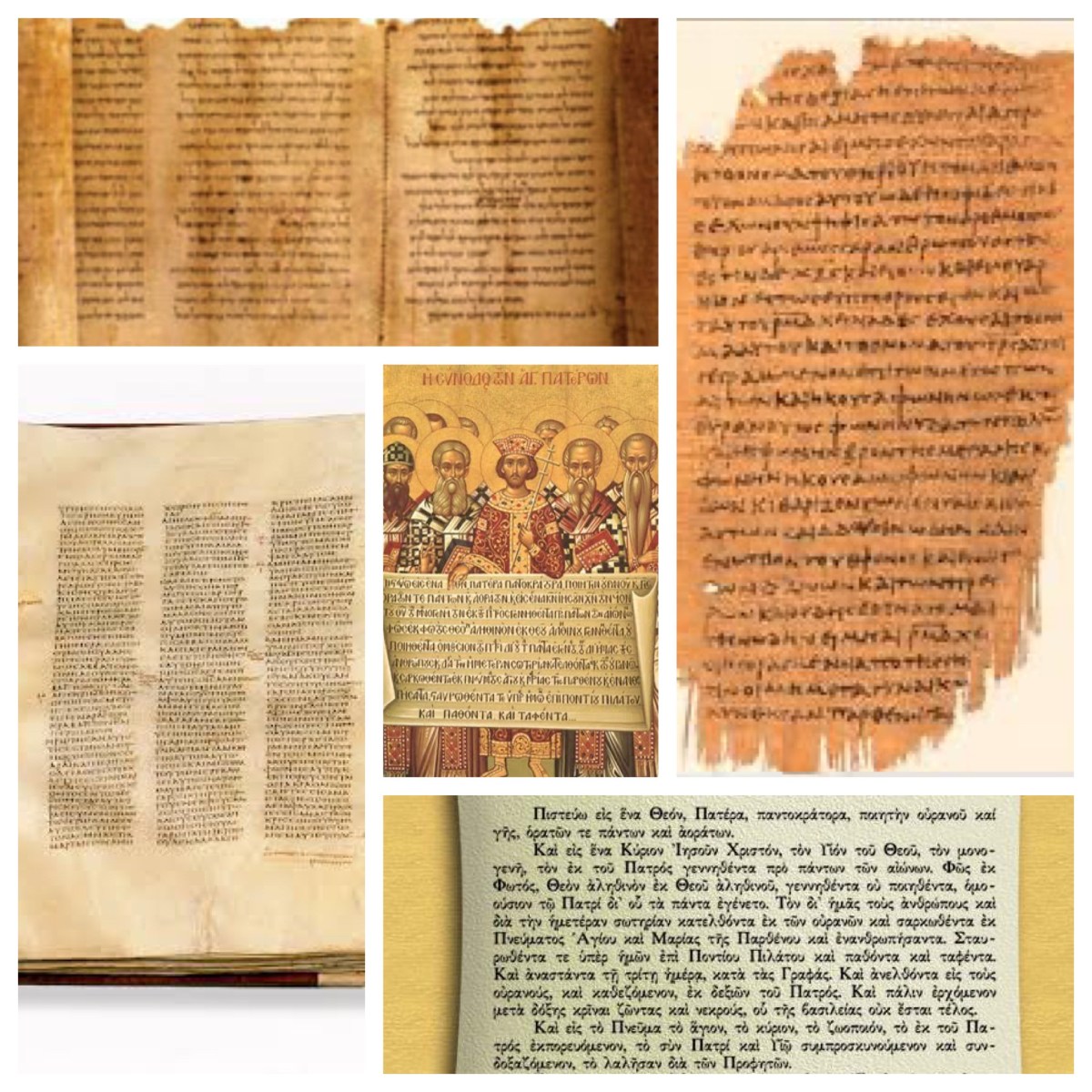
This year, 2025, marks 1700 years since the Council of Nicaea was held. I am posting a series of blogs about the way that the New Testament texts contributed (or didn’t contribute) to the formulation that emerged from that First Ecumenical Council, as it is often styled. In earlier posts I explored affirmations in Paul and the Synoptic Gospels, a section of the letter to the Colossians, and the opening verses of the letter to the Hebrews and the Gospel attributed to John.
In this blog I turn to the Pastoral Epistles, which are often cited in support of a Christianity which is grounded in doctrinal statements about “the faith” These three letters contain regular references to “the faith” (1 Tim 3:9, 13; 4:1, 6; 5:8; 6:10, 12, 21; 2 Tim 2:19; 4:7; Tit 1:1, 4, 13; 3:15) and “the truth” (1 Tim 2:4; 3:13; 4:3; 6:5; 2 Tim 2:18, 25; 3:7–8; 4:4; Tit 1:1, 14). In 2 Timothy there are references to “the word of truth” that needs to be “rightly explained” (2 Tim 2:15) and “the standard of sound teaching that you have heard from me” (2 Tim 1:13), and an injunction to “guard the good treasure entrusted to you, with the help of the Holy Spirit living in us” (2 Tim 1:14).
Sound teaching is also referenced in 1 Timothy, “the sound teaching that conforms to the glorious gospel of the blessed God” (1:Tim 1:10–11; also 4:6), while the letter to Titus refers to “the word that is trustworthy in accordance with the teaching” that Titus is told will ensure “sound doctrine” (Tit 1:9). These three letters clearly envisage a truth that can be conveyed in proportional statements.
So we find that “the mystery of our religion” can be summed up in six succinct claims about Jesus: that he was “revealed in flesh, vindicated in spirit, seen by angels, proclaimed among Gentiles, believed in throughout the world, taken up in glory” (1 Tim 3:16).
Whilst the Nicene Creed affirms that Jesus “became human”, the only other element of this six-part credal statement that it reflects is the final clause, which underlies the statement that Jesus “ascended into heaven and is seated at the right hand of the Father … [he] will come again in glory to judge the living and the dead”. There’s nothing here about the salvation that Jesus brings, despite this being a central Pauline theme (Rom 5:9–10; 10:9–10; 1 Cor 1:18; 15:1–2; 1 Thess 5:9–10) which is referenced in the Nicene Creed in the phrase “for us and for our salvation he came down from heaven”.
The credal declaration of 1 Tim 3:16 declares that Jesus was “vindicated in spirit”. Although the word used is the same, these seems quite different from the way that the Spirit is referred to in the Nicene Creed, “we believe in the Holy Spirit, the Lord, the Giver of life” (and more). Again, the description of the Spirit in the Nicene Creed has taken various isolated scriptural “proof texts” about the Spirit and woven them into a cohesive “systematic theology” of that person of the Trinity.
It is noteworthy, though, that in 1 Timothy the Spirit has elsewhere been co-opted to become the guarantor of orthodoxy (“guard the good treasure entrusted to you, with the help of the Holy Spirit living in us”, 2 Tim 1:14), and the agent of an ecclesial ritual (God saved us “through the water of rebirth and renewal by the Holy Spirit”, Tit 3:4–6). The Spirit gifts “power … and self-discipline” (2 Tim 1:7), quite a different role from the gifts that are noted in the authentic letters by Paul. Whilst the Nicene Creed declares that the Spirit “has spoken through the prophets”, there is nothing to indicate that the Spirit has a role in guaranteeing orthodoxy.
The two letters Timothy each contain another short credal-like passage, both of which have some loose relationship to the Nicene Creed. The first is “there is one God; there is also one mediator between God and humankind, Christ Jesus, himself human, who gave himself a ransom for all” (1 Tim 2:5–6a). One God, the title Christ Jesus, and the affirmation of his humanity are each reflected in the Nicene Creed, but other phrases have no clear and direct correlation.
The claim that Christ gave himself as “a ransom for all” most likely echoes the saying attributed to Jesus at Mark 10:45, “the Son of Man came not to be served but to serve, and to give his life a ransom for many”. This, in turn, is believed to be echoing a description of the function performed by “the righteous one, my servant” in the fourth of the four Servant Songs. At the end of this song, the claim is made that the servant “shall make many righteous bearing iniquities or being a ransom and he shall bear their iniquities” (Isa 53:11).
Although there is no direct reference in the Nicene Creed to bearing iniquities or being a ransom for sin, it is said of Jesus that “for us and for our salvation he came down from heaven”, and that “for our sake he was crucified”. The phrase “for our sake” is considered by various commentators to have an allusion to the process of salvation.
Perhaps the inclusion of this phrase in the Creed was intended to pick up Paul’s affirmation that “for our sake he made him to be sin who knew no sin, so that in him we might become the righteousness of God” (2 Cor 5:21). This, in turn, has statements behind it like “Christ died for our sins in accordance with the scriptures” (1 Cor 15:3), he “loved me and gave himself for me” (Gal 2:20), and he “gave himself for our sins to set us free from the present evil age” (Gal 1:4). So it does allude in a weak way to a scriptural idea.
The motif of salvation is, of course, at the very centre of Paul’s authentic writings (1 Cor 1:18; Rom 5:9–10; 10:9–19) and in later letters written in his name (Eph 2:5, 8; 1 Tim 2:3–4; 2 Tim 1:8–10; Tit 3:5). In the Creed, by contrast, whilst it is offered as a bare statement, the words move on quickly to other matters. Salvation receives but a passing note; quite a contrast to the way that Paul places it at the heart of his message. He tells the Romans that “now that we have been justified by his blood, will we be saved through him” (Rom 5:9), and the Thessalonians that he was “speaking to the Gentiles so that they may be saved” (1 Thess 2:16).
The second credal-like passage, in 2 Tim 2:11–13, begins with a concept that is more closely related to Paul’s own ruminations on baptism (Rom 6:1–11) than to any element in the Nicene Creed. “If we have died with him, we will also live with him”, the statement in 2 Tim 2 begins; “if we endure, we will also reign with him; if we deny him, he will also deny us; if we are faithless, he remains faithful—for he cannot deny himself.”
This poetic fragment, introduced with “the saying is sure”, sounds more like a sermonic reflection on and extension of the Romans passage. Perhaps “we look for the resurrection of the dead and the life of the world to come”, in the Nicene Creed, might point to some of this sermon in reflection, but the Creed is tighter and more focussed in its statement. Again, the allusion is weak and brief.
But perhaps the intention of those who formed the Creed was simply to note, but not expand on or explain, these central elements of the faith? Perhaps the Creed is actually a fourth century dot-point style bulletin, a list of keynotes that are to be mentioned and that require more detailed and expanded exploration? In which case, it is is study sessions exploring these central,elements of “the faith” which ultimately have much more value, in my opinion, that the rote reciting of these dot-points on a regular basis. Or is my reformed bias showing here??
*****
See previous posts at
and subsequent posts at
 An Informed Faith