
It’s hard not to look at what has been happening in the Middle East—and particularly in Gaza—over recent years, and make some very harsh decisions from afar. For a start, after the series of attacks that Hamas and some other Palestinian groups made two years ago yesterday, on 7 October 2023, it seems easy to condemn the violence of terrorists fighting for Palestinian rights. The firing of 4,300 rockets, the slaughter of 1,195 Israelis, mostly civilians, and the taking of around 250 hostages, some still held today, all deserve to be condemned.
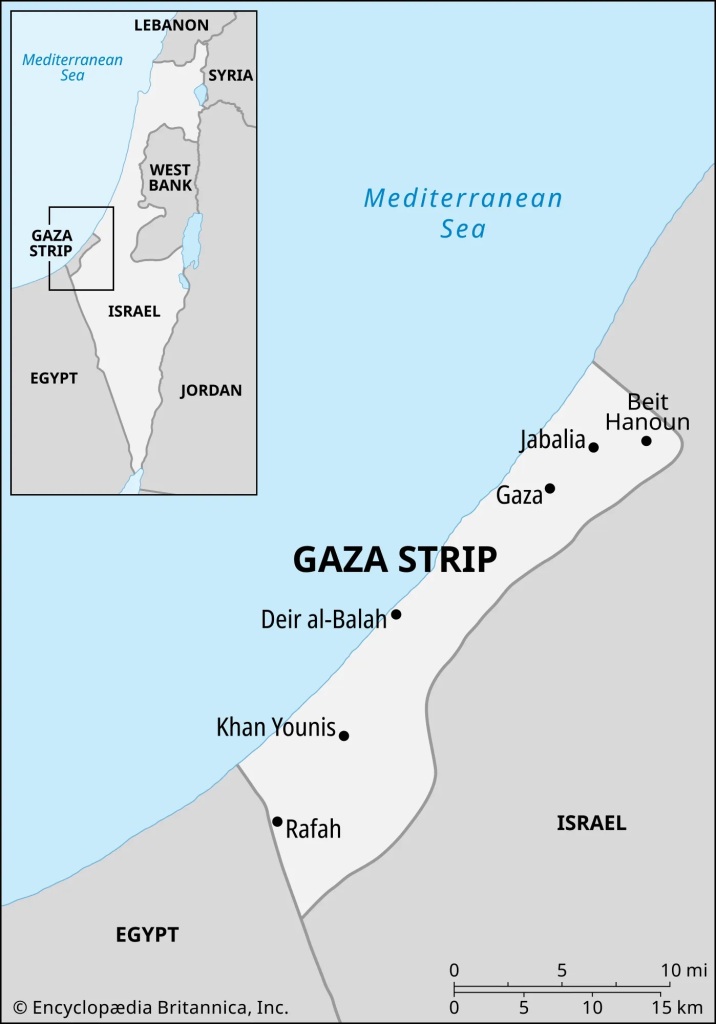
from a map in the Encyclopedia Britannica
But it is also hard not to decide that all Israelis should be condemned for the aggressive militaristic actions taken in response to the 7 Oct attacks. On 8 Oct, the Israeli government declared that the nation was “in a state of war”. That “war” has continued each day since then, with consistent attacks across Gaza.
Current estimates by the Hamas-run Gaza Ministry of Health are that around 67,000 residents in Gaza have been killed, including 18,000 children; 170,000 people have been injured, and 1.9 million people displaced. Amongst the deaths, Al-Jazeera estimates that around 300 journalists and media workers have been killed. They say that across Gaza, the destruction includes 92% of all residential buildings, 88% of all commercial facilities, and more than 2,300 educational buildings have been destroyed.
The clearest accusation that has been made for some time now is that Israel is committing genocide. The World Council of Churches asserts that “the Government of Israel’s military campaign in Gaza has entailed grave breaches of the Fourth Geneva Convention which may constitute genocide and/or other crimes under the Rome Statute of the International Criminal Court (ICC)”. This council has denounced “the system of apartheid imposed by Israel on the Palestinian people, in violation of international law and moral conscience”. It’s clear that Israel,is acting outside the agreed international laws and customs. Yet the USA and other countries continue to provide Israel with all manner of materials and products to sustain their genocidal aggression.
However, it’s important not to not tag all Israelis with the one brush. The Israeli Defence Forces are carrying out the policies implemented by the right wing Prime Minister and his far right fundamentalist coalition of parties. They are committed to the Zionist ideal of ensuring the security of Israel, and of removing all opposition to this nation within the region. They are prosecuting this with vigorous zeal. The bombs and buckets continue each day. But as they oversee this policy, we should remember that they are not representative of everyone in Israel.
Elizabeth and I have a friend in Israel who is faithful and deeply committed to justice; they have been working with others for peace in their country for decades, and they are currently most distressed by their government’s callous fundamentalist actions. And we have a friend in Australia who served in the IDF who is now campaigning vigorously to stop the genocide, lobbying our government to push this message internationally.
They are not all “the same”—what the army is implementing is a government policy that is incredibly divisive within Israel. Not all Israelis support what has been happening; many disagree with the genocide happening in Gaza. Jeremy Bowen, of the BBC, reports that “Israelis are war-weary and polls show that a majority want a deal that returns the hostages and ends the war. Hundreds of thousands of reservists in the armed forces, the IDF, want to get back to their lives after many months in uniform on active service.”
In like fashion, it’s not fair to label all Palestinians as terrorists. Some are, but many are not. Good Palestinians of integrity do not support the actions of organisations like Hamas.
It’s a complex situation which is not helped when people adopt the simplistic media language that paints all XXs as evil people or all YYs as good people. Indeed, the actions of warfare, terrorism, and genocide that we see playing out each day are held in disdain by millions of people in the region. Like them, we should hope for, yearn for, and pray for peace.
I wrote this blog on what happened two years ago today:
In today’s blog, I have drawn on the following sources:
https://www.bbc.com/news/articles/cvgqyj268ljo
For other related blogs, see

 An Informed Faith