Once again: affirming our diversity, celebrating joyous marriages

Last year, the Assembly resolved to allow Uniting Church ministers and authorised celebrants the freedom to conduct or to refuse to conduct same-gender marriages. Some within the church were not happy with this decision. Many councils of the church across the country reviewed the decision. Most affirmed it strongly or unanimously. Some questioned it. A few asked for it to be revisited. In the end, the decision stood, and still stands today.

There are some within the church who are not able to let go of their angst about this decision. They hold on to old understandings and continue to fight past battles. Most recently, we see that they are feeding sympathetic journalists in the media misinformation, making misleading and mischievous claims. But the decision has been made, and stands firm.

It was a good decision, and it provides a good expression of our faith. We recognise that there is a diversity of opinion across the church. The Assembly explicitly affirmed that, amongst the members of the Uniting Church, there is “a diversity of religious beliefs and ethical understandings” in relation to marriage. Nobody is excluded. Nobody is being forced out. Nobody is being pressured to act contrary to their beliefs.

The Assembly determined that “the Church is able to accept this diversity within its life and make the decisions necessary to enable its ministry and members to act with integrity in accordance with their beliefs”. We continue to hold to that affirmation.

This affirmation of diversity is strategically significant. It speaks of who we are—as people of the church, and as people in the wider society in which we live. In making this decision, the Uniting Church remains faithful to its commitment, as articulated in the Basis of Union. We are, indeed, a pilgrim people, on the way towards the promised goal of the kingdom that God has in view.

The decision about marriage involved so many difficult conversations and challenging moments for many people. The decision of Assembly steps out in a new direction. Some are not able to let go of their angst about this decision. They hold on to old understandings and past battles.

In my view, this decision demonstrates how the Uniting Church continues, today, to look for a continuing renewal. Last year, I wrote that, in that search, we clearly affirm our readiness to go forward together in sole loyalty to Christ the living Head of the Church. This decision is one that many people believe is a faithful response to what God is today calling the Church to be and to do. It is a signal that we seek to remain open to constant reform under his Word.

Throughout this process, I believe that we have continued daily to seek to obey his will, and to discern ways by which we might confess the Lord in fresh words and deeds. We continue to do that now, as Ministers across Australia implement the decision of the Assembly and rejoice in the celebration of joyous marriages, within the church, of couples of the same gender.

As this takes place, I am certain in holding to the belief that we are not apostate, we have not betrayed our faith, as some critics stubbornly maintain. We continue to hold to the essence of the Gospel in all good faith. The marriages of people of the same gender serve to remind us, in a fresh way, of the grace which justifies [us] through faith, of the centrality of the person and work of Christ the justifier.

As our President has reminded us, we are all included in that abundant grace and we look with anticipation to the promise of liberating hope.

And, as my Anglican colleague Chris Bedding has affirmed, “The Uniting Church in Australia, in its very foundation, has already offered an ecumenical witness to the church. I believe The Assembly decision to offer marriage to all couples is an evolution of this witness. The impact of this decision will be felt by people across all Christian traditions in this country for many years to come, because, every LGBTQIA+ Christian will know that somewhere out there is a church that will affirm them, and marry them.

“If the ‘ecumenical question’ is ‘What if marriage of same-gender couples in Uniting Churches is a gift to other Christians, which can foster unity and strengthen evangelism?’,  I think the answer is a resounding yes. When the histories are written, this pioneering decision will be seen as one of the signs that the snow is beginning to melt, as together we fulfil the great commission.” (See https://johntsquires.com/2018/10/26/marriage-of-same-gender-people-a-gift-to-the-whole-church/)

For the Uniting Church’s affirmations on human sexuality and same gender relationships, see https://johntsquires.com/2018/10/20/seven-affirmations

For the President’s statement about the inaccurate and misleading ABC report (dated 26 May 2019), see https://assembly.uca.org.au/news/item/3015-statement-on-abc-news-report

And see also https://johntsquires.com/2018/07/31/in-celebration-of-diversity/

https://johntsquires.com/2018/07/30/marrying-same-gender-people-a-biblical-rationale/

Discovering new futures … letting go of the old

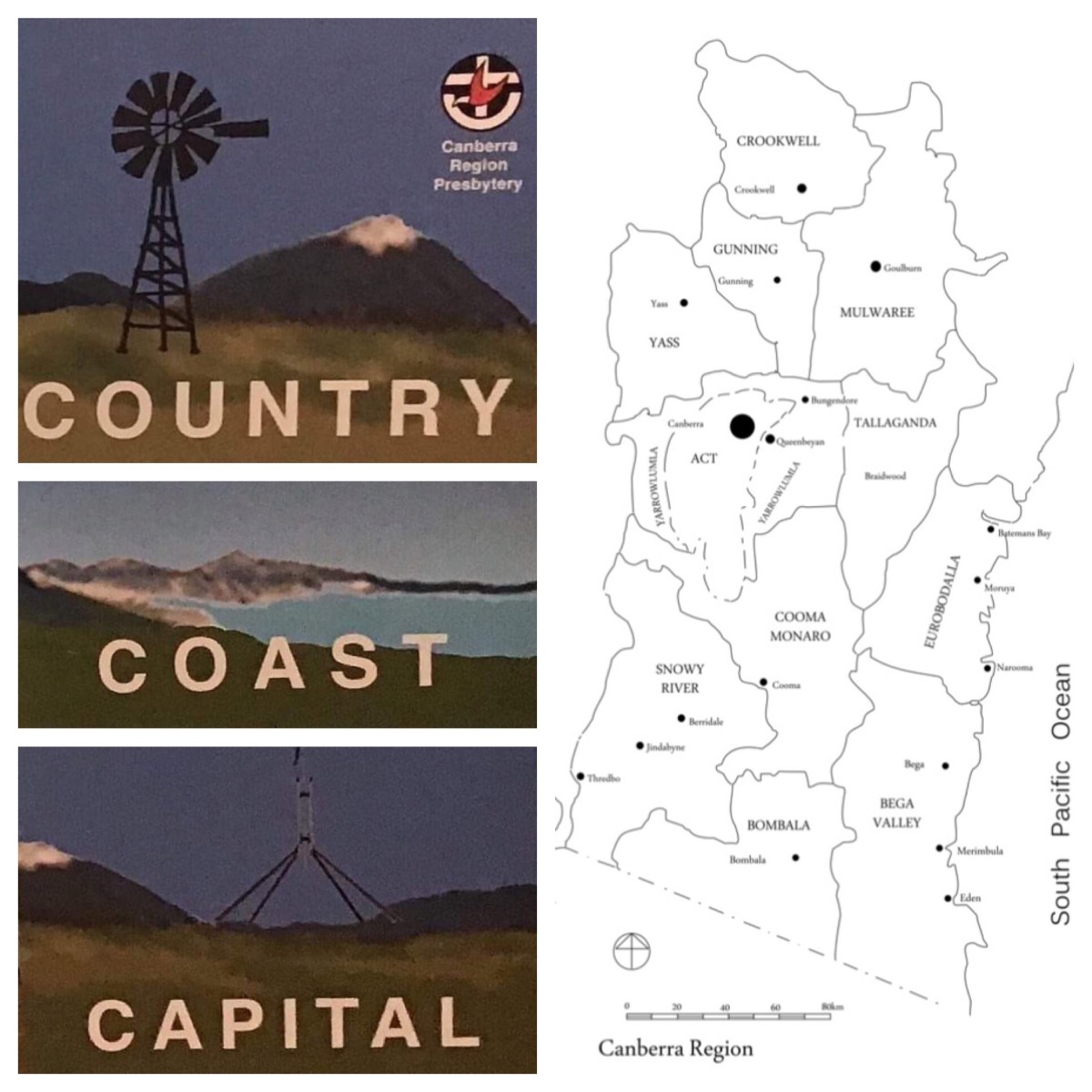
This month, I am taking up a portion of my future placement in the Canberra Region Presbytery, in a 25% supply role, alongside of my 75% IIM Placement. This will run through into early next year, when I will move into the full time role as Presbytery Minister—Wellbeing in the Canberra Region.

I was asked to offer some reflections on the theme for the May meeting of Presbytery, when we will be considering what it means to be discovering new futures and letting go of the old. So, here goes …..

From time to time I hear people reminiscing about “the ways things used to be”. Often, the narrative is one of “things just aren’t as good now as they used to be”. You might know the script; it goes something like: “not enough people ‘come to church’ on Sunday mornings … we have no Sunday School … there is no Youth Group … the Women’s Fellowship has closed … the rosters have empty spaces … nobody wants to do the flowers … there aren’t enough greeters.”

I hear these things. I listen. I nod and make empathic noises.

I start to talk about how things are, indeed, different now. How the church is in a different place in society. How society itself is different, now, from 30 years ago, 50 years ago, 60 years ago. How people are looking for different things, now. How the Sunday morning four-hymn sandwich, sitting quietly and listening to a 20 minute monologue, is not what “younger people” accept as valuable, any more. (And some “older people”, too!)

I might push back a little more. What does this congregation offer, to people who are looking for a place to connect with their faith? How do we welcome people? How do we disciple people? How do we connect with people in the ways that they best appreciate and look for? What are we doing to grow our own sense of what it is that people in the community around us are hungering for?

I wonder whether this is the right line to take. I wonder whether this just reinforces the resistance and strengthens the frustrations of those who express these things to me.

So, could there be a different line of approach to take? From time to time, I mull over a different kind of response. One that goes something like this, instead:

The challenge that faces the church as our numbers decline, is in fact a wonderful opportunity. It is an opportunity for us to renew ourselves. It is an opportunity to become deeply incarnational. It is an opportunity for us to contextualise the way we express and live out our faith. It is an opportunity to discover new futures.

To be incarnational, means to enter fully into the reality of human life that we find all around us. It means to “take on the flesh” of the society of which we are a part.

(Don’t freak out—that is entirely biblical. That is what, we say, Jesus did, when he “became human” and “pitched his tent in our midst”—to paraphrase John 1:14.)

To be incarnational, means to live in this world, amongst our fellow human beings, as one of them, bringing into this situation a sense of the “more than” that the Gospel offers; a sense of the “dimension beyond” the immediate that we proclaim.

To be incarnational is to be contextual. To be immersed in the context. To be part of the community that lives, sleeps, eats, shops, works, plays, and relaxes, within the very neighbourhood where the church is.

Instead of yearning for more people to come to church on Sunday morning, perhaps we should become more active in engaging with people out there in the parks, the shopping centres, the gathering places, in our local community. These are the new futures waiting for us to discover them.

Instead of lamenting decline, perhaps we need to be seizing the day, grasping the opportunity, becoming deeply incarnational, ensuring that we are thoroughly contextual, as we discover the new futures that God has in store for us.

The church, in many places, has lost contact with people in the wider community. Long ago, the church was at the centre of society. Every local church was a community hub. People from the community, with minimal or no religious commitment, were regularly in the church, on the premises, interacting with church people.

Over time, the church lost those connections. We gradually moved closer to the edges. We lost this strong central position, this robust community engagement. Slowly, but surely.

So now, the challenge is to recapture that central position, to re-engage with the community, to reconnect with people across the spectrum of society, to be incarnate within the community, to let go of the old and discover our new futures.

The challenge of the moment is the incarnational opportunity. Can we hear the call, to let go of the old, and discover new futures? Let’s seize it with enthusiasm!

A prayer for Mother’s Day

One of the delights of the worship that takes place each week in my current placement, is that the Prayers of the People are led by a range of people from within the Congregation. This provides prayers which are “grounded” as well as reflecting the diversity of perspectives found within the people.

Today, Mother’s Day, Marg Cotton led with this thoughtful prayer. I share it with her permission.

******

Creator God, as we come to you in prayer help us to pray in your spirit and truly enter into a time of stillness and simplicity.  Give us courage to be open to your unfathomable goodness, and imponderable light.  While we cannot ever know the depths of your being help us to see enough of what is truly mysterious to break down our pride and recognise that we need to rely on your grace and mercy.

We have much to be thankful for.  Living in freedom in this land.  Having access to education and health care, food and water, warmth and friendship.  Being able to worship in peace and security.  We give thanks for the many blessings you have given to us and the many people who have been part of our lives.

On this Mothers Day we particularly acknowledge the role that those who nurture us have had in our lives.  For some of us we have fond and happy thoughts about our mothers: their love and support, sacrifice and hard work, compassion and teaching.

For others, perhaps our experiences and memories are not so sweet.  The difficult mother or embarrassing mother, the times when our mums could not cope, the absent mother, the one who was addicted self obsessed, or struggling with mental illness.  

As we think of our mother on mothers day let us show her the respect of acknowledging that she was always more than we ever understood.  Like the God we worship she came before us and she labored to bring us into this world.  Let us acknowledge in the words from Deuteronomy 32:18 “You were unmindful of the Rock that bore you, and you forgot the God who gave you birth.”  

In the same way we have been often been unmindful of the women who gave us birth and of those other nurturing figures who supported us in many steps in our lives. Help us to acknowledge appropriately those who have helped make us who we are.

But as we acknowledge this help us not be complacent.  Help us to see that some of our own struggles may have come in part from our upbringing and our expectations.  Help us to turn to you and see that our lives can be transformed and made more whole as we seek a path of hope and reconciliation.

We are aware that there is much darkness in our world.  We hear every day of terrible injustices, of violence, of hatred, of feuds, of greed. We see this both at the personal level, at the political level and at the global level.  Break through our complacency and help us see when we are jealous or spiteful, not prepared reconsider our own prejudices, not able to acknowledge the hurt we caused. 

Help us to be aware of the needs of others and take our part in caring for those who are facing difficulties.  We know that there are some people in our midst who struggle to find hope and justice in our community.  For people living with illness or disability, let us ensure that our health system and the NDIS are available to provide the best kind of help available.

For those struggling to find employment let them not be disheartened by the complex structures that sometimes make a secure job seem unattainable.  

For people who are seeking to exercise leadership.  Please grant clarity of thought and honesty of purpose as to all who are involved in important decisions.

For the forgotten people who toil without recognition or thanks.  May we sometimes notice and give thanks for their work and commitment.

As we join together and to share praying the Lord’s prayer I invite those of you who would like to acknowledge the non-gendered divinity of our God to begin this prayer

Our Mother in heaven….

Hallowed be your name,

Your kingdom come,

Your will be done,

on earth as in heaven.

Give us today our daily bread.

Forgive us our sins,

as we forgive those who sin against us.

Save us from the time of trial

and deliver us from evil.

For the Kingdom, the power, and the glory are yours 

now and forever. Amen


To care for, honour, and respect the creation, we need to #StopAdani

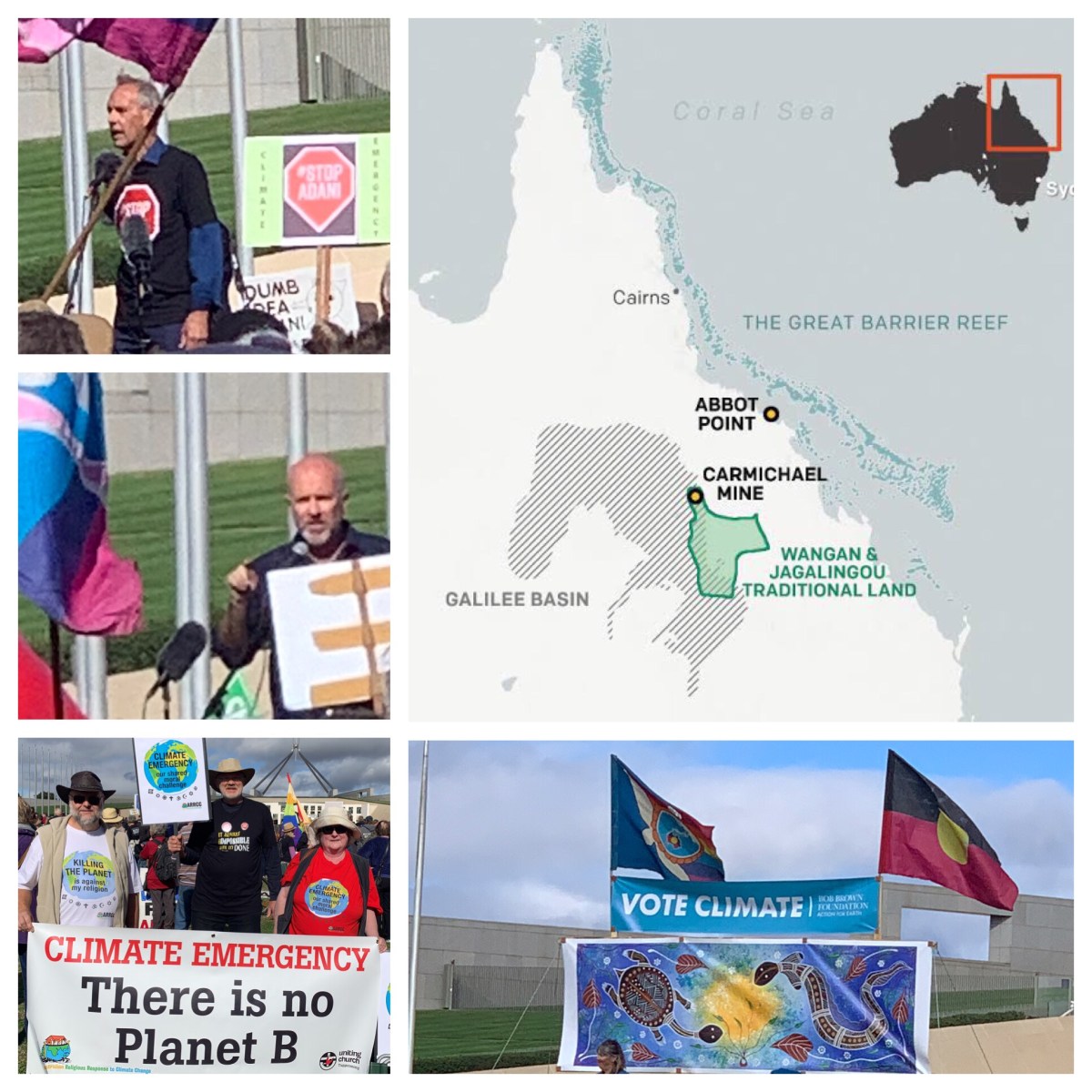
Elizabeth and I attended the #StopAdani climate crisis rally outside the Federal Parliament this morning. The crowd present was estimated at around 5,000 people. There were people from churches, schoolchildren, union members, as well as members of many community organisations and climate change action groups participating.

Author Richard Flanagan addressed the crowd in his inimitable poetic manner, marking the issues and telling the truth:

“Jabbering ‘jobs, jobs, jobs’ in a hi-vis shirt does not make you a leader”

“The Franklin was more than a river. Adani is more than a mine.”

“Was there hope with the Franklin!? Yes, there was. Is there hope with Adani? Yes, there is!”

Two young female school-age climate strikers stirred the crowd with pointed rhetoric and a call to action. “Change is never implemented by the oppressors. Change must always be demanded by the oppressed.”

Other speakers from various organisations urged the large crowd to hold fast, stand firm, and work for change. “We are on the right side of history. We will Stop Adani.”

Adrian Burragubba, an elder of the Wangan and Jagalingou people of the Galilee Basin in central western Queensland, reminded the crowd that Adani does not have the consent of the First People of the area, whose ancestral lands, waters and culture would be destroyed by the mime if it went ahead.

Paul Kelly sang two song, including “My island home”, and then Bob Brown brought the rally to a climax with his clarion call: “There will be no divine intervention. The onus is on us. And we will take it.” He noted that there was “a bigger crowd here today, than Bill Shorten will have in Brisbane, than Scott Morrison will have, whenever he has his campaign launch.” Popular opinion is clearly against the development of this mine.

Why is it important to protest against this mine, and to petition our leaders to ensure that the Adani mine and associated works do not go ahead?

The Great Barrier Reef. The mine will see ships travelling through this unique World Heritage Area each year, risking ship groundings, coal and oil spills; and it requires further dredging within the World Heritage Area causing water contamination, destruction of dugong habitat, impacts on Green and Flatback turtle nests, and more.

The Great Artesian Basin is our greatest inland water resource, covering 22% of the Australian continent. Putting control of all that land, and water, into the hands of a foreign commercial enterprise, is foolhardy. The mine will take at least 270 billion litres of groundwater over the life of the mine; put aquifers of the Basin at risk; and dump mine polluted wastewater into the Carmichael River.

It will threaten ancient springs and 160 wetlands that provide permanent water during drought, and leave behind 6 unfilled coal pits that will drain millions of litres of groundwater, forever. Adani’s associated water licence allows unlimited access to groundwater for 60 years for free. Putting control of all that land, and water, into the hands of a foreign commercial enterprise, is foolhardy.

The Great Coal Swindle. Pollution from burning coal is the single biggest contributor to dangerous global warming, threatening our way of life. In Australia, ‘black lung’ disease has recently re-emerged among coal miners, with at least 19 workers in Qld identified with the disease. The coal from the Carmichael mine will be burnt in India where 115,000 people die from coal pollution every year. Developing renewable energy is more responsible for the environment and more energising for the economy.

The Great Employment Myth. There are 69,000 tourism jobs related to the Great Barrier Reef, which rely on a healthy Reef. There are thousands of farming jobs in the inland areas under threat. The Adani mine and associated works will pollute, despoil, and degrade both the land area and the associated offshore seas, impacting hugely on the Reef. Adani claims the mine will bring employment opportunities to the region, but in reality there will be far fewer jobs if the mine goes ahead. The mine will decimate local employment opportunities.

The Great Commercial Swindle. Adani companies are under investigation for tax evasion, corruption, fraud, and money laundering. Nine of the 20 Adani subsidiaries registered in Australia are ultimately owned by an entity registered in the infamous Cayman Islands tax haven. That is beyond the regulatory reach of the Australian Government.

Adani Group companies have an appalling environmental track record with a documented history of destroying the environments and livelihoods of traditional communities in India, and failure to comply with regulations. They will do the same in Australia if the mine goes ahead.

There are other reasons—environmental, economic, political—that mean we should not go ahead with the mine.

And, for me, there is a fundamental theological principle undergirding this issue: God’s good creation is in our hands; we are called to act responsibly, to care for, honour, and respect that creation. That means that we act to lessen our carbon footprint, restructure our energy infrastructure to grow renewable sources, and refresh our national policies so that we prioritise the planet over personal preferences.

The Uniting Church has affirmed, “We seek the flourishing of the whole of God’s Creation and all its creatures. We act to renew the earth from the damage done and stand in solidarity with people most impacted by human induced climate change. Government, churches, businesses and the wider community work together for a sustainable future.” (See https://uniting.church/visionstatement2019/)

The Church has issued a Vision Statement which sets out the following desired Key Actions:

1. A national climate policy that drives down greenhouse gas pollution, including no new coal or gas mining in Australia and investment in renewable energy.

2. Just and sustainable transition for communities currently dependent on fossil fuel industries for employment, towards more environmentally sustainable sources of income.

3. Equitable access to renewables for all Australians.

4. Policies which support people and nations that are most vulnerable to climate change.

There is No Planet B. We have no choice but to #StopAdani.

See also https://wanganjagalingou.com.au/our-fight/

https://d3n8a8pro7vhmx.cloudfront.net/stopadani/pages/1816/attachments/original/1497939723/factsheet20.06.17.pdf?1497939723

https://d3n8a8pro7vhmx.cloudfront.net/lockthegate/pages/5429/attachments/original/1521596433/Adani_Water_Factsheet.pdf?1521596433

https://www.unitingjustice.org.au/environment

Friendship in the presence of difference: a Gospel call in a world of intolerance and hatred


In recent weeks, we have seen Muslims murdered as they gather for Friday prayers; Jews murdered as they meet for Sabbath prayers; and Christians murdered as they congregate for Easter worship. These tragic events point to the intolerance, even hatred, held by individuals who identify with a faith “other” than the one where people have been killed. They indicate that, even in this contemporary world where we recognise that there are people of different ethnicities, nationalities, and religions, this intolerance and hatred remains strong and incessant.

The Uniting Church has been advocating for some decades, now, that as we live in a multicultural society, we need to recognise and engage constructively with people of other faiths. There are some keynote resources that deserve our attention and ongoing reflection.

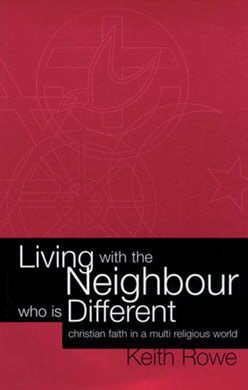
The Ninth Assembly (2000) adopted a statement prepared by the Doctrine Working Group, entitled Living with the Neighbour who is Different: Christian Vocation in Multi-faith Australia.

It set out the following theological affirmations as the basis for the way that we are to relate to people of other faiths:

God is calling us to engage in conversation with people of other faiths. The development of hospitable and respectful relationships with those of other faiths is a proper response to Christ” who “calls us to live in harmony with all other people and so contribute to a world of peace, justice and hospitality.

Christians are called to love the neighbour who is different. The movement from exclusion to the embrace of neighbours who are different is of the essence of the gospel of Jesus Christ. Christians discover the will and power to enact this gracious embrace of the neighbour as they become more deeply immersed in the indiscriminate love of God.

God has placed the contemporary church in an ideal situation to engage in genuine dialogue with those of other faiths. We no longer relate to those of other faiths from a position of assumed political and social superiority. From nearer to the margin of society we are free to relate to other people as servants of the unifying, reconciling purposes of God revealed and embodied in Jesus.

God delights in diversity and seeks unity. Diversity, woven into the heart of creation, is a gift of God. The unity God intends for humanity does not destroy difference but weaves difference into a single human mat.

The Spirit is present in all of life. No part of life, no person is without the influence of the Holy Spirit…the Holy Spirit is present through the whole fabric of the world, yet is uniquely present in Christ and in the fellowship of Jesus’ disciples. It does not follow, however, that the life and work of Jesus exhaust the work of the Spirit or exclude the presence of the Spirit in other faiths.

The Centrality of Jesus Christ in Christian believing is not to be compromised when we engage in interfaith dialogue. Christ is the foundation of Christian believing and living. We live “in Christ” and our way of being with others should be consistent with the way pioneered by Jesus.

In 2010 the Relations with Other Faiths Working Group commissioned Keith Rowe to write an updated statement. The title of this statement, Friendship in the presence of difference, is carefully chosen. Real differences do exist in humanity. The gospel imperative calls us to live in friendship.

Individual and corporate friendship robs difference of its power to divide, to foster distrust or to sanction violence. Friendship in the presence of difference is a gift greatly needed both in the Christian community and within the human family as a whole.

The word ‘friendship’ is chosen because it includes a sense of growing relationship, empathy, warmth and care for others. While we may rejoice in similarities among the affirmations and wisdom of the various religions we do not want to deny the existence of very real and important differences. World religions differ in their understanding of the Divine dimension within life, the purpose of our living, the nature of human fulfilment and what it means to live together in a world of many faiths.

Our Christian uneasiness in the presence of difference is something we need to recognise and address. Rabbi Jonathan Sacks puts it well: “In our interconnected world, we must learn to feel enlarged, not threatened, by difference”. (The Dignity of Difference, Continuum, 2003, p. vii). The possibility of the religions and people of religion being able to contribute to peace rather than conflict in our world depends on the capacity to relinquish the desire for uniformity based on what serves our comfort or power.

The Thirteenth Assembly (2012) adopted a statement prepared by the Working Group on Relations with Other Faiths, entitled Friendship in the Presence of Difference: Christian Witness in Multifaith Australia.

In introducing this theme, the statement said:

Friendship in the presence of difference is regarded as being a central Christian attitude and value. Engagement with those of other faiths is welcomed as a pathway on which we may rediscover the heart of the Christian way while also being enriched by wisdom others have to share. Distortions that have crept into Christian living and believing often become apparent in informed conversation with those who believe differently. Friendship in the presence of difference can be a significant doorway into the renewal of Christian discipleship and theology.

It offered the following Conclusion:

As a church we are grateful for our developing friendship with those of other faiths. Christians have deepened their understanding of God and of the tasks we face together in our divided world in friendship and conversation with people of other faiths. We look forward to developing deeper friendships and discovering ways we can live together generously and work together for the common good.

We encourage politicians, decision makers and opinion shapers in commerce, industry and the media to grow in sensitive and accurate knowledge of the faiths within our society. Where religious beliefs contribute to conflict and division, we ask our national leaders to strive for understanding and reconciliation among those whose beliefs differ. We believe that lasting peace in our world is not possible unless the religious dimension of life is recognised.

Each part of the Uniting Church is invited to make the building of friendship in the presence of religious and cultural difference a priority missional objective. Whatever theological or spiritual stream of the church’s life we belong to we all have a positive role to play. Trusting in Jesus Christ as Lord and in the power of the Holy Spirit, the Uniting Church commits itself to cultivating friendship in the presence of difference.

Clearly, the call that the Gospel places before us at this time, is to offer and receive friendship in the presence of difference.

See https://assembly.uca.org.au/images/Ministries/ROF/images/stories/theology/livingsummary.pdf

https://assembly.uca.org.au/rof/about/theology/item/1876-study-guides-for-living-with-the-neighbour-who-is-different

https://assembly.uca.org.au/fipd

https://assembly.uca.org.au/images/Ministries/ROF/images/stories/resources/appendix_1_-_Friendship_in_the_Presence_of_Difference-Christian_witness_in_Multifaith_Australia.pdf

https://johntsquires.wordpress.com/2019/03/22/hello-thank-you-we-are-with-you-we-support-you/