In the wake of the verdict about Pell …

There has been a lot of media discussion in recent days about the convictions handed down against Cardinal George Pell. Articles that I have read have ranged across the validity of the sentence, the quality of the evidence provided, the rhetoric of the defendant barrister, and the perception that Pell was targeted in a “tall poppy syndrome” or as part of a wider vendetta against the Church.

I have been thinking, not just about this particular case, but about the various elements of our culture that are involved in these discussions. There are many elements that deserve attention and careful consideration.

Fundamental to these discussions, should be the basic principle of respect for another human being. If an alleged victim raises an accusation, that person deserves to be heard with respect and integrity. It is not fair to label or accuse such a person, especially if the claim has not yet received measured and fair consideration in the courts. Disrespectful descriptions and negative labelling of victims should never be published by any media outlet.

Second, I sense, is a concern about the way that we demonstrate trust in institutions — whether those institutions are the justice system, religious bodies, or leadership in society. It is clear that, in modern Australian society, any institution is “fair game” for suspicion and distrust. That might well be justified in some instances—the banking and finance industry, for instance; or political parties, when it comes to “jobs for the boys” and (as we have seen lately) “goodbye to the girls”. But should it be the default setting when considering any institution in society?

A factor that I see running through all considerations relating to sexual abuse, is the pernicious influence of secrecy—whether that is secrecy by church leaders, concerned to maintain the good name of their church; or secrecy by perpetrators, seeking to quieten the noises made about their alleged activity. Perpetrators are particularly good at impressing the need for secrecy on their victims. That’s one of the main warning flags in a sexual abuse scenario. It is not a healthy trait.

Of course, there is a different between when something needs to be held as confidential, and when it has become a secret. Knowing the difference between secrecy and confidentiality, is an important process of discernment. Some matters do need to be held in confidence, while further investigations are undertaken, for instance. And knowing when it is inappropriate to hold on to a secret, is also important to discern.

The discussion raises questions, for me, about styles of leadership within our society. Cardinal Pell exercised a particular style of leadership. It may well have contributed to the surge of opposition to him, both in his role as a leader of the Roman Catholic Church, and as a person in the spotlight. Certainly, while his style of charge-through-and-win-at-all-costs, might have garnered him support from those who agreed with his ideological stances, it also generated a mountain of opposition to him. Is this really the best way to exercise leadership in society?

Of course, the recently-concluded Royal Commission has shone a spotlight in the culture and ethos which has been dominant in a number of institutions in our society, including the Roman Catholic Church, other church denominations, and other institutions dealing with children. The Roman Catholic Church has been carefully scrutinised and a number of the commission’s recommendations do deal with changes that need to be made, to create a more healthy culture with an ethos that values integrity and transparency above arcane processes and secrecy.

I found myself, again and again, coming back to the priority that should be shown (but which often has not been shown), to demonstrate authentic care and compassion for victims. There are too many examples, that I am aware of, where people who have been victims are saying that the way the issues are discussed in the public arena provides a trigger to their hurts and fears, to their anxieties and depressive feelings. We owe them more than this; we need to prioritise a way of discussing matters that does not replicate past abuses and reinforce negative emotions.

That leads to another matter; the importance of language. Nothing demonstrated this more, than the unfortunate and ill-chosen rhetoric of the defence lawyer representing Cardinal Pell. It carried an inference that the kind of sexual assault experienced by the victims in this particular instance, was a lesser grade of assault. The swift apology and withdrawal of the terrible phrase that Robert Richter used, is a clear indication of the power that is carried in the words we use. I know this from my experience in leading worship and interpreting texts, within my church roles. It is something that needs to be recognised in people right across society, in the public discourse.

In terms of my faith, the message that I hear pressing on me, again and again, is that the Gospel call to faithful discipleship is far more important than the matter of preserving the institutional reputation. The deeply sad fact at the heart of so many instances of sexual abuse by priests, ministers, and pastors, is that the Gospel call has been subordinated (and ignored) in favour of protecting the institution. That is completely wrong.

I guess that the culture of “let’s stick together”, “this is not who we are”, “don’t criticise us, we do lots of good things”, must have been strong within the Catholic Church. That explains why there was such a concerted effort by many, to protect their fellow priests. The same went on in the Anglican Church, and there are indications of it in other denominations and organisations.

There is something positive in looking out for your fellow priest, or minister, or believer. (Although I really dislike it when someone says to me—as they do, from time to time—“ah, but you Ministers always stick together”.) But, sadly, this sense of a priestly brotherhood, all looking out for one another, has contributed to this distorted culture. It is clear that the culture of the Catholic Church has actually fostered misogyny and secrecy in relation to abuse. The sense of belonging to “a brotherhood” has contributed to that culture.

I have noted a tendency, in some faith-based commentary, to look for conspiracy theories about the criticism of churches that is abroad in society. I don’t think it is helpful to become defensive in this way, and I certainly don’t think it is at all useful to label those who criticise the churches as demonic or guided by the devil. Such negative, condemnatory language is completely unhelpful. The church needs to be able to defend itself through reasoned argument, and not resort to judgemental stereotypes.

A final point needs to be made. There is a need to distinguish “The (Roman) Catholic Church” from other church denominations. There are things about the Catholic Church which are distinctive, and which set it apart from other denominations, such as the Uniting Church: the all-male priesthood, the lack of females in leadership, the power of episcopacy in setting the culture, the requirement of celibacy amongst the priesthood, the centralised bureaucracy in Rome, and the strongly bonded nature of “the brotherhood” amongst religious (men). These factors have contributed to create the kind of culture that has protected, and also fostered, abusers. The Catholic Church needs to work hard to dismantle that culture. And all denominations need to be on the alert for signs that secrecy and protection of abusers is continuing.

There is a fine prayer for the current situation, written by my colleague Avril Hannah-Jones, at https://revdocgeek.com/2019/02/27/prayer-for-the-survivors-and-victims-of-child-abuse/

This is a well-argued piece which focuses on the damage done by a Pell, to an individual as well as to the church:

https://www.smh.com.au/national/history-will-judge-george-pell-the-cardinal-who-sought-to-crush-me-20190227-p510ma.html

Frank Brennan offered this analysis immediately after the verdict:

https://www.eurekastreet.com.au/article/truth-and-justice-after-the-pell-verdict

However, Daniel Reeders has provided this careful critique of Brennan, and of others seeking to vindicate Pell:

https://badblood.blog/candle-lighting-the-catholic-response-to-the-pell-conviction/

Called to discern new ways of relating

The General Conference of the United Methodist Church (UMC) is currently meeting in St Louis, USA. This is a gathering of nearly 1,000 delegates, elected by annual conferences of the Methodist Churches from around the world. Half of the delegates are laity (non-clergy members), half are clergy. A description of this body can be found at http://www.umc.org/who-we-are/general-conference

The Conference is meeting in Special Session, for the specific purpose of discussing (once again) human sexuality. There is a report from the Commission on the Way Forward, which specifically considers the way to maintain the unity of the church in the face of the polemical disagreements that have been occurring with regard to marrying people of the same gender.

Continue reading “Called to discern new ways of relating”

Living with Heatwaves

We know that climate change is a reality, and we are seeing more frequent and more intense extreme weather events (floods, fires, heatwaves). This is a blog from a guest blogger, Vivian Harris, on how to cope with heatwaves.

Vivian blogs from Bega on the south coast of NSW, where she writes the Climate Action Blog (Sharing our journey to a low carbon future and fighting for climate action) at https://climateactionbega.blogspot.com/2019/01/climate-migration.html She was previously an active member of the Queanbeyan Uniting Church, which recently reposted this blog.

******

We have just sweltered through another heatwave with climate change making them more frequent and more intense. It can be tempting to retreat to our house, turn the air conditioning (if you have it) up full bore and binge watch on Netflix.

However, the extra load on the electric network not only increases the amount of carbon emissions, thus making climate change and heatwaves worse, but the heat emitted by your air conditioner increases the heat experienced by your neighbours and the electricity network can be overloaded leaving people without any electricity.

Heatwaves need to be taken seriously. They kill more people than any other natural disaster in Australia (including bushfires). They kill older people, children, people with chronic diseases, outdoor workers and bush walkers.

So how can we keep ourselves cool without contributing excessively to even more and worse heatwaves?

There are immediate, medium-term and long-term solutions. We all need to start putting the long-term solutions into place because this summer is only the beginning of the new normal.

Immediate

Pay attention to heatwave warnings and prepare with salads and plenty of ice blocks and ice cubes.

Close up the house in the early morning. Close windows and curtains/blinds in the entire house.

Turn off lights and any appliances that don’t need to be on. All electric appliances emit heat as they work (including televisions). Plan not to cook anything because that puts a lot of heat into the house. Put boiling water in a thermos for later.

Close off all rooms you don’t need be in, particularly those on north or west side of the house. Minimise the space you need to cool.

Don’t put air conditioning (if you have it) on until it is uncomfortable and when you do set it to 25 degrees Celsius not 18. Turn it on for short burst only rather than all day. Evaporative air conditioners are much cheaper to run and these work more efficiently by turning them on low early on the days that are forecast to be hot, than running them on high and trying to bring the temperature down.

Put off doing anything that requires you to go outside in the hottest part of the day.

Use fans and wet clothing to cool yourself.

Don’t have cold showers. Cold showers close down your surface circulation which is how your body cools the core temperature. Have a warm shower it will cool you better long-term.

Drink lots of cold water. High sugar drinks actually pull water out of your body.

Ice packs on your neck can help drop your core temperature.

Open up the house at night to get air flow and cool the house down. Open windows, curtains, leave doors on screen doors.

Find public places, like libraries, public buildings, movie theatres and shopping centres with air conditioning to spend the day in.

Move mattresses to the coolest part of the house to sleep.

Sleeping with a wet tea towel on you and a fan can drop your core temperature enough to get you to sleep.

Check on vulnerable people without air conditioning and invite them to spend the day with you if you have air conditioning.

Medium-term

Stop the heat getting into your house by blocking it before it gets to your windows or walls. Use greenhouse material in front of windows/walls.

Long-term

Plant more trees. We have all felt the drop-in temperature when you walk into a park with old mature trees on a hot day. Plant non-deciduous trees on the western side of your houses and deciduous tree on the north (we still want to get heat in in winter). Planting trees is the best way to reduce the urban heat island effect that can see temperatures of 70 degrees Celsius in areas with lots of concrete and roads.

Build a pergola with a deciduous vine on the north side of the house.

Insulate the walls and ceiling. Install a ceiling fan.

Don’t build a house that depends on air conditioning to keep it cool. Houses can be built that use insulation and air flow to keep them comfortable in heatwaves and winter.

Put on solar power so you can turn on air conditioning without contributing to further heatwaves.

Campaign to get your local council to plant more trees along your street.

Heatwaves are here for the long term. We need to learn to adjust our behaviours and houses to cope with it.

Vivian Harris

https://climateactionbega.blogspot.com/2019/01/living-with-heatwaves.html

Learning from the land (4): Naiame’s Nghunnhu—fishtraps at Brewarrina

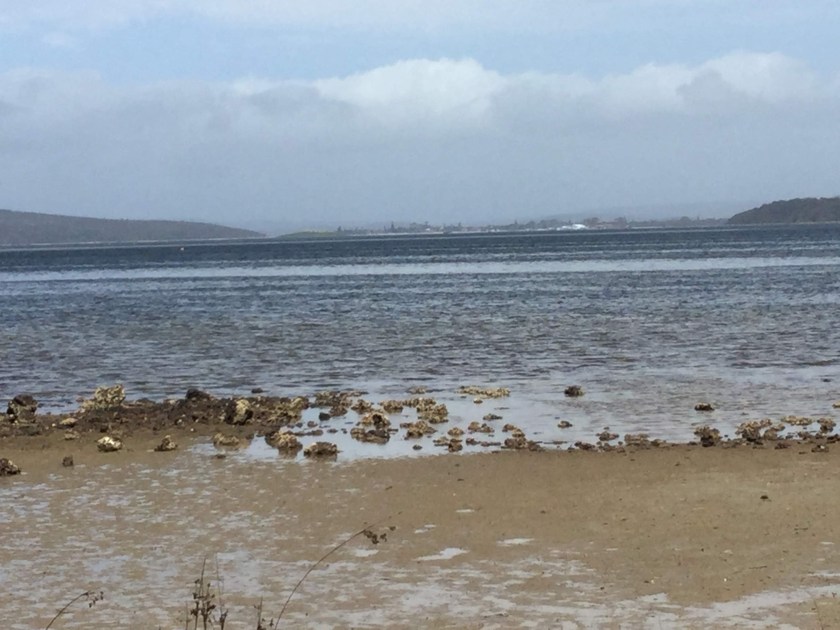
Last year, Elizabeth and I visited a site in southwest WA, where the remains of some ancient Aboriginal fishtraps could be seen. They were on the shoreline of Oyster Harbour, near the mouth of the Kalgan River just east of Albany. They were built and operated by the Menang people of the Noongar nation.

In 1790, three decades before the British established the Swan River Colony (on the site that is now  Perth), British explorer George Vancouver arrived on the southern coast of Western Australia. Despite naming King George Sound, various inlets and bays, and mapping the area, he did not encounter any Noongar. But he reported evidence that Noongar were there. 

Vancouver wrote that he found a “native village; fresh food remains near a well-constructed hut; a kangaroo that had apparently been killed with a blow to the head; a fish weir across what is now called the Kalgan River; and what appeared to be systematic firing of the land.” (This citation is sourced from https://www.noongarculture.org.au/wagyl-kaip-timeline/)

8A0267BC-B025-46E4-9DC7-E3F90EC07B92

The traps (one of which is pictured above, from our visit in 2018) were constructed by the Menang peoples and are dated at over 7,500 years old. As the tide moved out, the fish would be stranded inside the courses of the stones, which were topped with brush, then collected at low tide. They provided food for the regular gatherings of the peoples each year.

There are eight separate weirs shaped as crescents, each of which is believed to consist of thousands of stones. They are now protected under local indigenous oversight. They are an amazing testimony to the ancient skills of the Menang people.

These fishtraps are one part of the evidence which demonstrates that the Aboriginal people were not “primitive nomadic hunter-gatherers”, but rather, settled people, who cared for country and developed the technology which enabled them to build structures which assisted them in harvesting the natural resources of the land. 

Western society has done the same, and we congratulate ourselves on our technological capacities. This evidence indicates that Indigenous peoples had done this very thing, many thousands of years before “Western civilisation” had developed.

These fishtraps were obviously sustainable. They lasted over thousands and thousands of years, being used to catch regular harvests of fish. The Menang people came back each year to gather what they needed, and then allowed the fish to replenish. Would that our modern ways showed the same, respect to the land and its rivers, and that we farmed and harvested in a sustainable way.

We can learn from the land, by attending to features such as these, and reflecting on what they tell us about the First Peoples of this continent, who have lived here for millennia—and pondering how we, today, might relate respectfully to the land, care for the creation, and live in ways that are sustainable.

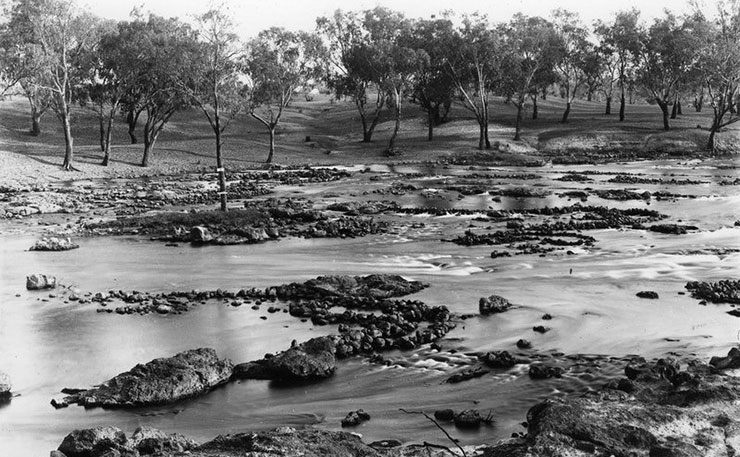
I recently read a fascinating account of Baiame’s Ngunnhu [pronounced By-ah-mee’s noon-oo]. These are stonewall fishtraps at Brewarrina in NSW, created by the Ngemba people. They are similar in technology and purpose to the ones we saw in WA. (See https://newmatilda.com/2019/02/05/australia-one-oldest-human-made-structures-earth-meh-nmfhpotae/)

These fishtraps are possibly the oldest known human-made structure on earth. The Australian Government’s National Heritage Register notes, “The structure of the Ngunnhu demonstrates the development of a very efficient method for catching fish involving a thorough understanding of dry-stone wall construction techniques, river hydrology and fish ecology.”

(See http://www.environment.gov.au/heritage/places/national/brewarrina)

8C50B976-4B5D-40C8-A12C-301BF35FAE1F

You can find a discussion of these fishtraps and many other such ancient Indigenous features, in Dark Emu: Black Seeds: Agriculture Or Accident? (Magabala Books, 2014), by Bruce Pascoe.

There is an excerpt from Dark Emu, with a description of how the fishtraps were worked, at https://www.foreground.com.au/environment/decolonising-agriculture-bruce-pascoes-dark-emu/, and there is a fascinating discussion of Pascoe’s book, some related works, and the implications for modern agricultural practices, at https://theconversation.com/friday-essay-dark-emu-and-the-blindness-of-australian-agriculture-97444 

Debate concerning the age of this particular construction, the Ngunnhu, is not settled; it may well be up to 40,000 years, which would make it more than 10 times older than Stonehenge!  That is certainly worth honouring, and protecting.

The National Heritage Register also notes that this location, in Brewarrina, was the place where people from the various indigenous groupings of the area could draw their own supply of fish on a regular basis, and where they would all meet together, on a regular basis, to celebrate, and to trade.

It notes: “While the Ngemba people are the custodians of the Ngunnhu, it was Baiame’s wish that other tribes in the region, including the Morowari, Paarkinji, Weilwan, Barabinja, Ualarai and Kamilaroi should use it in an organised way. He allocated particular traps to each family group and made them responsible under Aboriginal law for their use and maintenance. 

“Neighbouring tribes were invited to the Ngunnhu to join in great corroborees, initiation ceremonies, and meetings for trade and barter. The Ngunnhu were, and still are, a significant meeting place to those Aboriginal people with connections to the area and continue to be used.”

So, as well as a sustainable lifestyle, the Ngunnhu demonstrate how different groups can live together peaceably and co-operatively, sharing natural resources, and enjoying respectful relationships with each other. That, surely, is another lesson that we can learn!

https://johntsquires.wordpress.com/2019/01/30/learning-of-the-land-3-tuggeranong-queanbeyan-and-other-canberra-place-names/

https://johntsquires.wordpress.com/2018/12/18/learning-of-the-land-2-ngunnawal-namadgi-and-ngarigo/

https://johntsquires.wordpress.com/2018/12/17/learning-of-the-land-1/

https://johntsquires.wordpress.com/2018/10/13/on-covenant-reconciliation-and-sovereignty/

https://johntsquires.wordpress.com/2018/08/13/affirming-the-sovereignty-of-first-peoples-undoing-the-doctrine-of-discovery/

https://johntsquires.wordpress.com/2018/08/10/the-sovereignty-of-the-first-peoples-of-australia/