The beginnings of the birth pangs (Mark 13; Pentecost 25B)

The Gospel reading for this coming Sunday (Mark 13:1–8) offers an excerpt from longer speech, a block of teaching which Jesus delivered to his disciples (13:3–37), some time after they had arrived in the city of Jerusalem (11:1–11). It’s a striking speech, with vivid language and dramatic imagery. As Jesus’ last long speech in this Gospel, it certainly makes a mark!

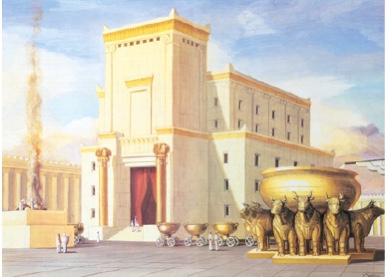
The speech is delivered beside the towering Temple, built under Solomon, rebuilt under Nehemiah (13:1, 3). That temple was a striking symbol for the people of Israel—it represented their heritage, their traditions, their culture. The Temple was the place where the Lord God dwelt, in the Holy of Holies; where priests received sacrifices, designed to enable God to atone for sins, and offerings, intended to express the people’s gratitude to God; where musicians led the people in singing of psalms and songs that exulted God, that petitioned God for help, that sought divine benevolence for the faithful covenant people
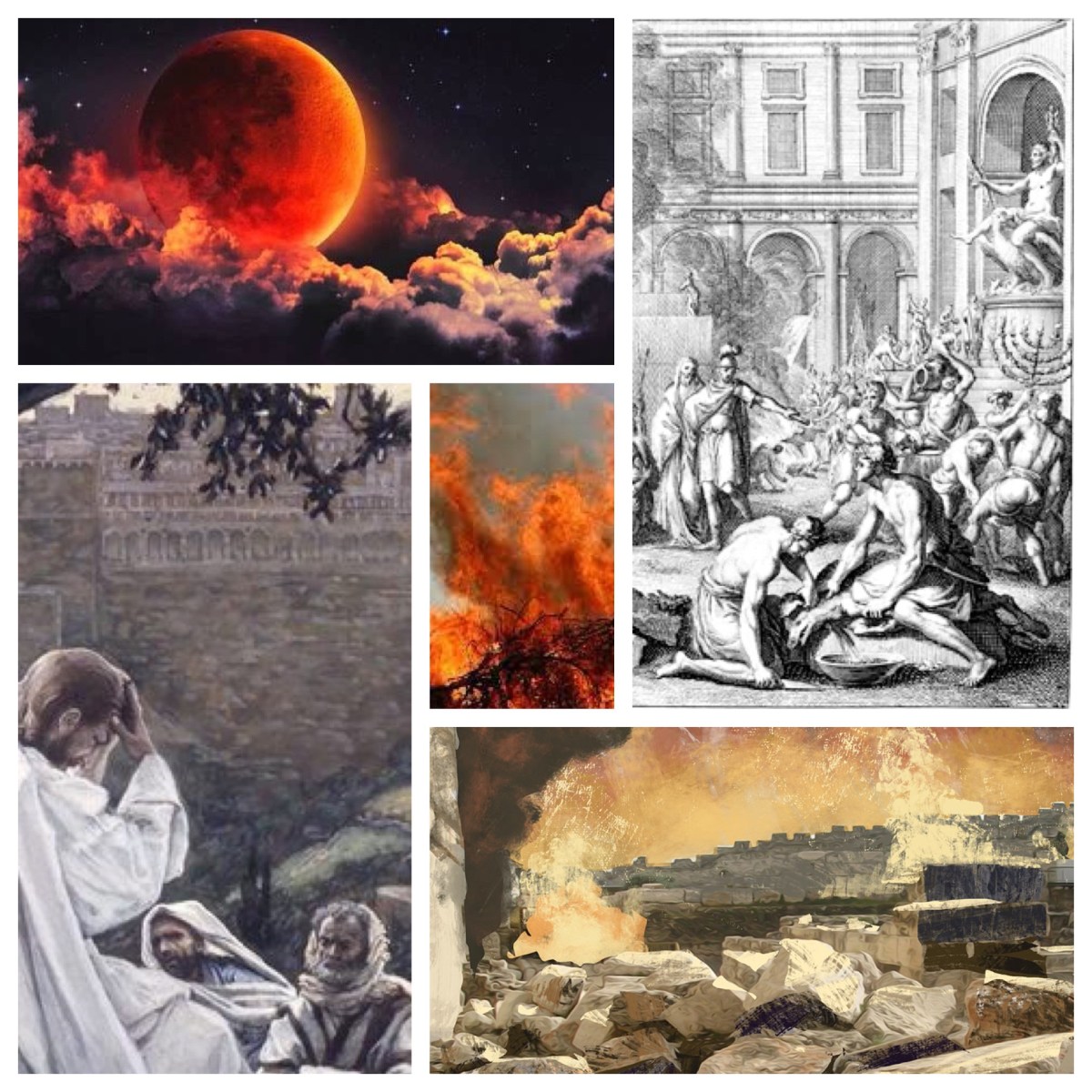
Or so the story goes; so the scriptures said; so the priests proclaimed. The holiest place in the land that was holy, set apart and dedicated to God. Yet what does Jesus say about this magnificent construction? “Not one stone will be left here upon another; all will be thrown down” (13:2). Jesus envisages the destruction of the Temple. Not only this; he locates that destruction within the context of widespread turmoil and disruption: “nation will rise against nation, and kingdom against kingdom; there will be earthquakes in various places; there will be famines” (13:8). And then, to seal this all, Jesus refers directly to the fact that “the end is still to come” (13:7).

The End. Eight centuries before Jesus, the prophet Amos had declared, “the LORD said to me, ‘the end has come upon my people Israel; I will never again pass them by’” (Amos 8:2). Amos continues, declaring that God has decreed that “on that day … I will make the sun go down at noon, and darken the earth in broad daylight. I will turn your feasts into mourning, and all your songs into lamentation; I will bring sackcloth on all loins, and baldness on every head; I will make it like the mourning for an only son, and the end of it like a bitter day” (Amos 8:9–10).
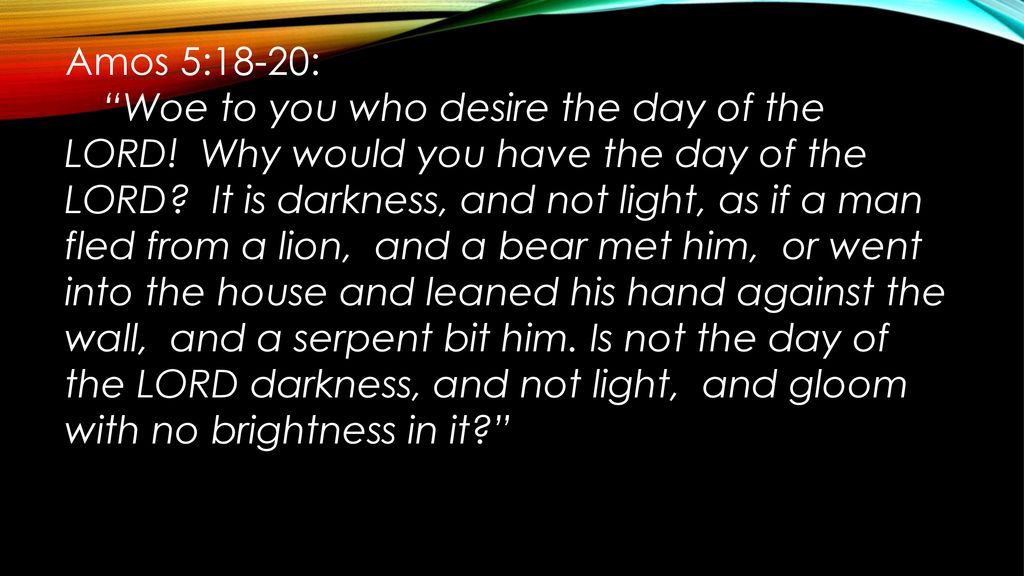
That image of The Day when the Lord enacts justice and brings punishment upon the earth, because of the evil being committed by people on the earth, enters into the vocabulary of prophet after prophet. Amos himself declares that it is “darkness, not light; as if someone fled from a lion, and was met by a bear; or went into the house and rested a hand against the wall, and was bitten by a snake. Is not the day of the LORD darkness, not light, and gloom with no brightness in it?” (Amos 5:18–20).

Isaiah, just a few decades after Amos, joined his voice: “the Lord of hosts has a day against all that is proud and lofty, against all that is lifted up and high … the haughtiness of people shall be humbled, and the pride of everyone shall be brought low; and the Lord alone will be exalted on that day” (Isa 2:12, 17). He warns the people, “Wail, for the day of the Lord is near; it will come like destruction from the Almighty!” (Isa 13:6).

Isaiah uses a potent image to describe this day: “pangs and agony will seize them; they will be in anguish like a woman in labour” (Isa 13:7). He continues, “the day of the Lord comes, cruel, with wrath and fierce anger, to make the earth a desolation, and to destroy its sinners from it” (Isa 13:8), and later he portrays that day as “a day of vengeance” (Isa 34:8).

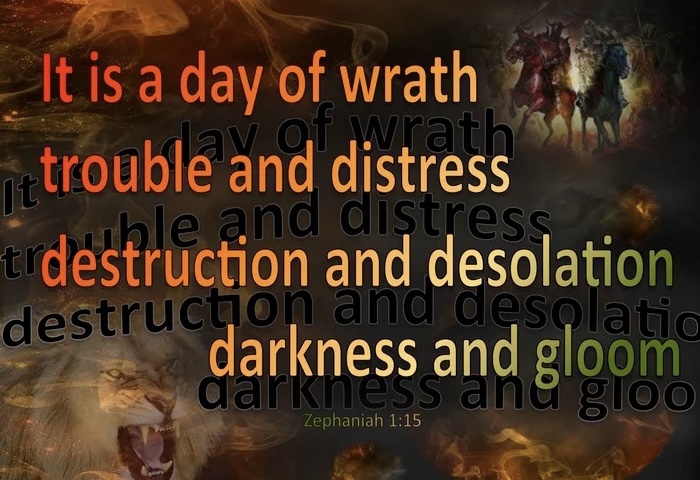
Zephaniah, who was active at the time when Josiah was king (640–609 BCE) declares that “the day of the Lord is at hand; the Lord has prepared a sacrifice, he has consecrated his guests” (Zeph 1:7); “the great day of the Lord is near, near and hastening fast; the sound of the day of the Lord is bitter, the warrior cries aloud there; that day will be a day of wrath, a day of distress and anguish, a day of ruin and devastation, a day of darkness and gloom, a day of clouds and thick darkness ” (Zeph 1:14–15).
Habakkuk, active in the years just before the Babylonian invasion of 587 BCE, declares that “there is still a vision for the appointed time; it speaks of the end, and does not lie” (Hab 2:3); it is a vision of “human bloodshed and violence to the earth, to cities and all who live in them” (Hab 2:17).

Later, during the Exile, Jeremiah foresees that “disaster is spreading from nation to nation, and a great tempest is stirring from the farthest parts of the earth!” (Jer 35:32); he can see only that “those slain by the Lord on that day shall extend from one end of the earth to the other. They shall not be lamented, or gathered, or buried; they shall become dung on the surface of the ground” (Jer 35:33). He also depicts this day as “the day of the Lord God of hosts, a day of retribution, to gain vindication from his foes” (Jer 46:10).

And still later (most likely after the Exile), the prophet Joel paints a grisly picture of that day: “the day of the Lord is coming, it is near—a day of darkness and gloom, a day of clouds and thick darkness! Like blackness spread upon the mountains, a great and powerful army comes; their like has never been from of old, nor will be again after them in ages to come. Fire devours in front of them, and behind them a flame burns. Before them the land is like the garden of Eden, but after them a desolate wilderness, and nothing escapes them.” (Joel 2:1-3).

Later in the same oracle, he describes the time when the Lord will “show portents in the heavens and on the earth, blood and fire and columns of smoke; the sun shall be turned to darkness, and the moon to blood, before the great and terrible day of the Lord comes” (Joel 2:30–31). Joel also asserts that “the day of the Lord is near in the valley of decision; the sun and the moon are darkened, and the stars withdraw their shining” (Joel 3:14–15).

*****

The language of The Day is translated, however, into references to The End, in some later prophetic works. In the sixth century BCE, the priest-prophet Ezekiel, writing in exile in Babylon, spoke about the end that was coming: “An end! The end has come upon the four corners of the land. Now the end is upon you, I will let loose my anger upon you; I will judge you according to your ways, I will punish you for all your abominations.” (Ezek 7:2–3).

And again, Ezekiel declares, “Disaster after disaster! See, it comes. An end has come, the end has come. It has awakened against you; see, it comes! Your doom has come to you, O inhabitant of the land. The time has come, the day is near—of tumult, not of reveling on the mountains. Soon now I will pour out my wrath upon you; I will spend my anger against you. I will judge you according to your ways, and punish you for all your abominations.” (Ezek 7:5–8). This day, he insists, will be “a day of clouds, a time of doom for the nations” (Ezek 30:3; the damage to be done to Egypt is described many details that follow in the remainder of this chapter).

Obadiah refers to “the day of the Lord” (Ob 1:15), while Malachi asserts that “the day is coming, burning like an oven, when all the arrogant and all evildoers will be stubble; the day that comes shall burn them up, says the Lord of hosts, so that it will leave them neither root nor branch” (Mal 4:1).

Malachi ends his prophecy with God’s promise that “I will send you the prophet Elijah before the great and terrible day of the Lord comes; he will turn the hearts of parents to their children and the hearts of children to their parents, so that I will not come and strike the land with a curse” (Mal 4:5–6). This particular word is the final verse in the Old Testament as it appears in the order of books in the Christian scriptures; it provides a natural hinge for turning, then, to the story of John the baptiser, reminiscent of Elijah, who prepares the way for the coming of Jesus, evocative of Moses.

Another prophet, Daniel, declares that “there is a God in heaven who reveals mysteries, and he has disclosed to King Nebuchadnezzar what will happen at the end of days” (Dan 2:28), namely, that “the God of heaven will set up a kingdom that shall never be destroyed, nor shall this kingdom be left to another people. It shall crush all these kingdoms and bring them to an end, and it shall stand forever” (Dan 2:44).

Whilst the story of Daniel is set in the time of exile in Babylon—the same time as when Ezekiel was active—there is clear evidence that the story as we have it was shaped and written at a much later period, in the 2nd century BCE; the rhetoric of revenge is directed squarely at the actions of Antiochus IV Epiphanes, who had invaded and taken control of Israel and begun to persecute the Jews from the year 175BCE onwards.

The angel Gabriel subsequently interprets another vision to Daniel, “what will take place later in the period of wrath; for it refers to the appointed time of the end” (Dan 8:19), when “at the end of their rule, when the transgressions have reached their full measure, a king of bold countenance shall arise, skilled in intrigue. He shall grow strong in power, shall cause fearful destruction, and shall succeed in what he does. He shall destroy the powerful and the people of the holy ones.” (Dan 8:23–24). This seems to be a clear reference to Antiochus IV.
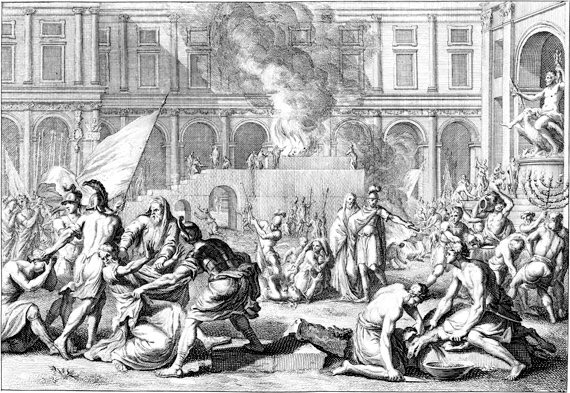
An engraving by David Martin (1639-1721) which depicts
Antiochus IV Epiphanes, the king of the Seleucid Empire (r. 175-164 BCE),
desecrating the Temple in Jerusalem.

Still later in his book, Daniel sees a further vision, of seventy weeks (9:20–27), culminating in the time of “the end” (9:26). In turn, this vision is itself spelled out in great detail in yet another vision (11:1–39), with particular regard given to the catastrophes taking place at “the time of the end” (11:1–12:13; see especially 11:25, 40; 12:4, 6, 9, 13).

This final vision makes it clear that there will be “a time of anguish, such as has never occurred since nations first came into existence” (12:1), when “evil shall increase” (12:3) and “the wicked shall continue to act wickedly” (12:10). The visions appear to lift beyond the immediate context of the Seleucid oppression, and paint a picture of an “end of times” still to come, after yet worse tribulations have occurred.

***

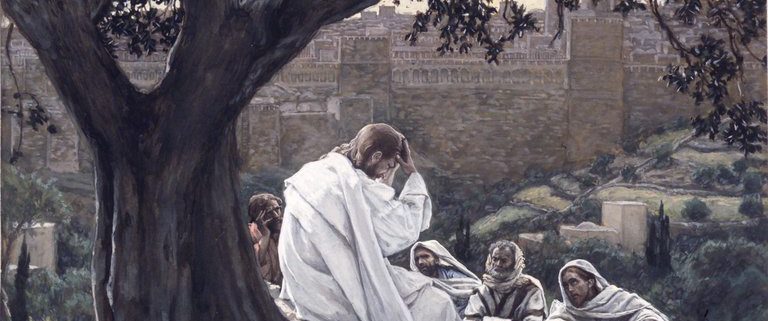
Could these visions of “the end” be what Jesus was referring to, as he sat with his followers on the Mount of Olives, opposite the towering Temple? Later in the same discussion with his disciples, he indicates that “in those days, after that suffering, the sun will be darkened, and the moon will not give its light, and the stars will be falling from heaven, and the powers in the heavens will be shaken” (Mark 13:24). This picks up the language we have noted consistently throughout the prophetic declarations, in Amos, Joel, Isaiah, Habakkuk, Zephaniah, Ezekiel, and Daniel.

The judgement of God, says Jesus, with the “gathering up the elect from the four words, from the ends of the earth to the ends of heaven” (13:27), will be executed by “the Son of Man coming in clouds with great power and glory” (13:25)—language which draws directly from the vision of Daniel concerning “one like the Son of Man, coming with the clouds of heaven” (Dan 7:13).

So the resonances are strong, the allusions are clear. Jesus is invoking the prophetic visions of The Day, The End; the judgement of God, falling upon the wicked of the earth. And he deliberately applies these vivid and fearsome prophetic and apocalyptic traditions to what he says about the Temple. By linking his teaching directly to the question of four of his disciples, Peter, James, John, and Andrew (Mark 13:3), enquiring about the Temple, Jesus appears to be locating the end of the Temple—its sacrifices and offerings, its psalms and rituals, its wealth and glory … and perhaps also its priestly class—in the midst of the terrible, violent retributive judgements of the Lord God during the days of the end.

The language also resonates with the end section of 2 Esdras, in which God informs “my elect ones” that “the days of tribulation are at hand, but I will deliver you from them”. Those who fear God will prevail, whilst “those who are choked by their sins and overwhelmed by their iniquities” are compared with “a field choked with underbrush and its path overwhelmed with thorns” and condemned “to be consumed by fire” (2 Esdras 16:74–78). (This book claims to be words of Ezra, the scribe and priest who was prominent in the return to Jerusalem in the 5th century BCE, but scholarly opinion is that it was written after the Gospels, perhaps well into the 2nd century CE.)

All of the happenings that are described by Jesus in his teachings whilst seated with his followers outside the Temple (Mark 13:3) can be encapsulated in this potent image: “this is but the beginning of the birth pangs” (13:8). This is imagery which reaches right back to the foundational mythology of Israel, which tells of the pains of childbirth (Gen 3:16). It is language used by prophets (Jer 4:3; 22:23; 49:2; 49:24; Hos 13:13; Isa 21:3; 66:7–8; Micah 4:9; 5:3).
This chapter in Mark’s Gospel, along with the parallel accounts in Luke (chapter 21) and Matthew (chapter 24), are regarded as instances of apocalyptic material. The meaning of apocalyptic is straightforward: it refers to the “unveiling” or “revealing” of information about the end time, the heavenly realm, the actions of God.

Such a focus does not come as a surprise to the careful reader, or hearer, of this Gospel. This style of teaching is consistent with, and explanatory of, the message which the Gospels identify as being the centre of the message proclaimed by Jesus: “The time is fulfilled, and the kingdom of God has come near; repent, and believe in the good news” (Mark 1:14); “repent, for the kingdom of heaven has come near” (Matt 4:17); “I must proclaim the good news of the kingdom of God to the other cities also; for I was sent for this purpose” (Luke 4:43). Each of these distillations of the message is apocalyptic—revealing the workings of God as the way is prepared for the coming of the sovereign rule of God.

Apocalyptic is the essential nature of Jesus’ teachings about “the kingdom of God”. This final speech confirms the thoroughly apocalyptic character of Jesus’ teaching. The parables he tells about that kingdom are apocalyptic, presenting a vision of the promised future that is in view. The call to repent is apocalyptic, in the tradition of the prophets. The demand to live in a way that exemplifies righteous-justice stands firmly in the line of the prophetic call. Such repentance and righteous-just living is as demanding and difficult as giving birth can be.

Mark’s Gospel has drawn to a climax with the same focussed attention to the vision of God’s kingdom, as was expressed at the start. The beginnings of the birth pangs are pointers to the kingdom that Jesus has always had in view. Jesus was, indeed, a prophet of apocalyptic intensity.
Of course, that still leaves the basic interpretive question: how do we make sense of this apocalyptic fervour in today’s world??? So to grapple with that, there’s more posts coming …..

https://johntsquires.com/2021/11/10/faithfulness-in-the-turmoil-of-the-time-the-historical-context-of-mark-13-pentecost-25b/

https://johntsquires.com/2021/11/10/the-political-function-of-the-apocalyptic-speech-of-jesus-in-mark-13-pentecost-25b/

*****

See also https://johntsquires.com/2020/11/24/towards-the-coming-the-first-sunday-in-advent-mark-13/

https://johntsquires.com/2020/11/04/discipleship-in-an-apocalyptic-framework-matt-23-25/
https://johntsquires.com/2020/11/16/a-final-parable-from-the-book-of-origins-on-sheep-and-goats-on-judgement-and-righteous-justice-matt-25/
https://johntsquires.com/2020/12/04/revelation-a-complex-and-intricate-world-of-heavenly-beings-and-exotic-creatures/
Jesus, the widow, and the two small coins (Mark 12; Pentecost 24B)

This week, we draw near to the end of the stories told about Jesus which we have encountered most Sundays during the year past. Since early December last year, we have been in Year B, and the book we know as the Gospel according to Mark has provided the majority of the Gospel passages for reading and reflection each week.

The beginning of the good news of Jesus, the chosen one (which is how this work styles itself—see Mark 1:1) does not pull any punches. It begins with the rough and ready character of John, who was dunking people in the river to signify that they had repented of their sins (1:2–8). It ends with the sombre scene of two men laying the crucified body of their leader in a tomb (15:42–47), soon after he had cried in despair that his God had abandoned him (15:34).

In the intervening period of time (unspecified in this account—although by tradition we talk about “the three years of Jesus’s ministry”) we have seen Jesus encounter people in need and people who had a vendetta against him. We have heard him debating the details of Torah requirements with other scripture interpreters, and berating them for their hardness of heart and their wilful ignoring of the commands of God. We have heard him condemn his own followers as having little faith, of being incapable of understanding him, of not comprehending even when he performs miracles in front of them.

We have heard, perhaps with horror, his interaction with a foreign woman from Syrophoenicia, in which he called her a dog, and then listened on as he went for the jugular with one of his closet followers, Peter, calling him “Satan”. We have listened to harsh words of condemnation, when he told another follower, John, that it would be better if he were thrown into the ocean than get in the way of Jesus’ mission.

Jesus in Mark’s gospel does not suffer fools gladly—in fact, he does not suffer them at all! At so many points, it seems that he just doesn’t have time for people who don’t get what he is on about. It is a wonder, is it not, that he managed to maintain a loyal following for the amount of time that he did!

And yet, woven throughout those same stories in this very work, there are moments of tender compassion and unlimited grace, incidents which show that Jesus had deep insight into the situation of others and that he was willing to go the second mile—and more—in order to attend to people in need.

He confronted evil spirits and cast them out of people who were possessed. He healed multitudes of people who were ill. He taught, patiently, provocatively, with insight into the ways of God. He provided dramatic pictures in word-form (parables, he called them) which drew simple comparisons to demonstrate the nature of the realm of God. He provided for those who were hungering, both physically and spiritually. He spent himself in word and deed, sought his God in prayer, continued incessantly on his journeying, and in the end, set his face towards the fate that he somehow seemed to sense was sliding its tentacles around his very being.

It is this Jesus, complex and multi-faceted, whom we encounter in the reading from Mark’s account, this Sunday (12:38–44). Jesus is in Jerusalem, the place where fate awaits him. He has been debating one opponent after another in the outer courtyard of the Temple: chief priests, scribes and elders; Pharisees and Herodians; Sadducees; and then another group of scribes (11:27–12:34).

Jesus bests many of these opponents; he ends this sequence of encounters with a typically harsh denunciation of the last group he was debating. “Beware of the scribes”, he is reported as saying; their pretentiousness and pomposity is evident, their condemnation awaits (12:38–40). The vulnerability of widows in the face of the power exuded by the scribes is evident, and Jesus calls them out for this,.

We hear these striking words in the Gospel passage offered by the lectionary for this coming Sunday. They come as a climactic concluding moment in the long stream of adversarial encounters, debates, disputes, and arguments that have taken place along the way, from his public announcement beside the Jordan, through the towns and villages of Galilee, on the road towards Jerusalem, in the city beside the Temple. A fitting finale, perhaps.

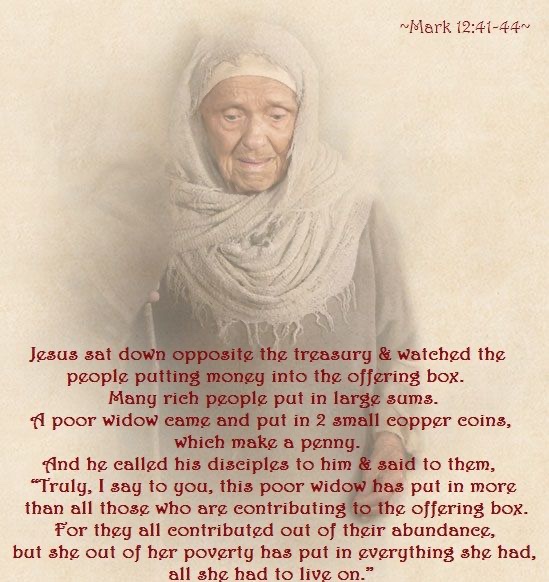
Yet this is not the final word. That final word, before we leave this Gospel for this year, belongs to another scene. A short, succinct, enigmatic scene. A scene in which Jesus utters no words of condemnation; by contrast, he offers affirmation, encouragement, and support for a poor widow (12:41–44).

It is a simple observation, a short reflection; not complex, not confronting, but a gently irenic end to a long sequence of interactions involving Jesus: healings and exorcisms, teaching by speaking sayings and telling stories in parables, engaging in public discussion and debate, as well as times of prayer and rest.

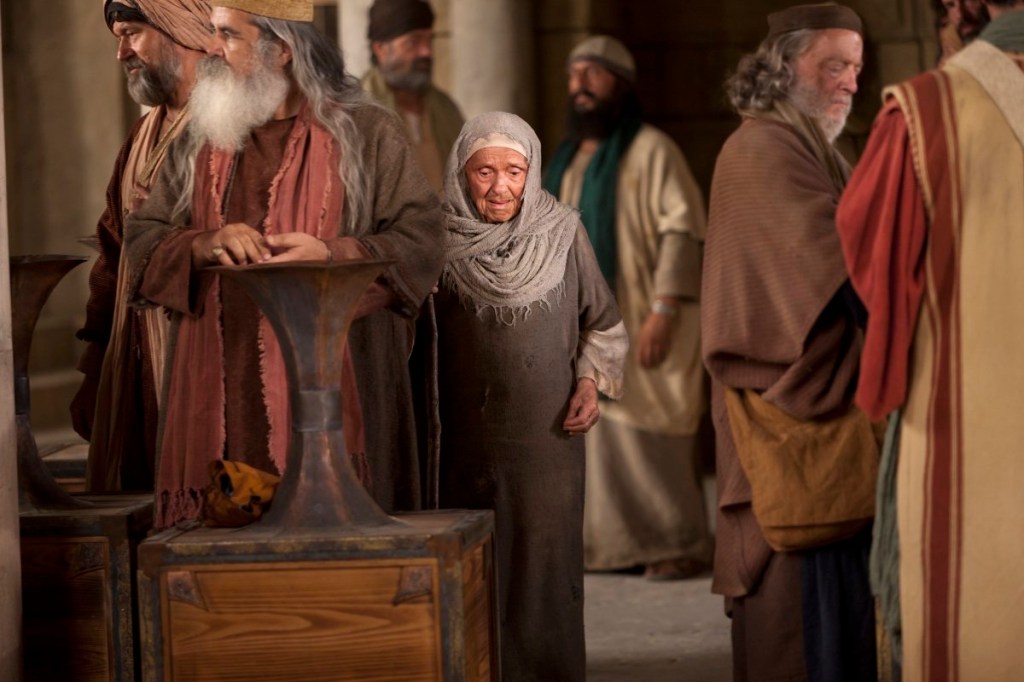
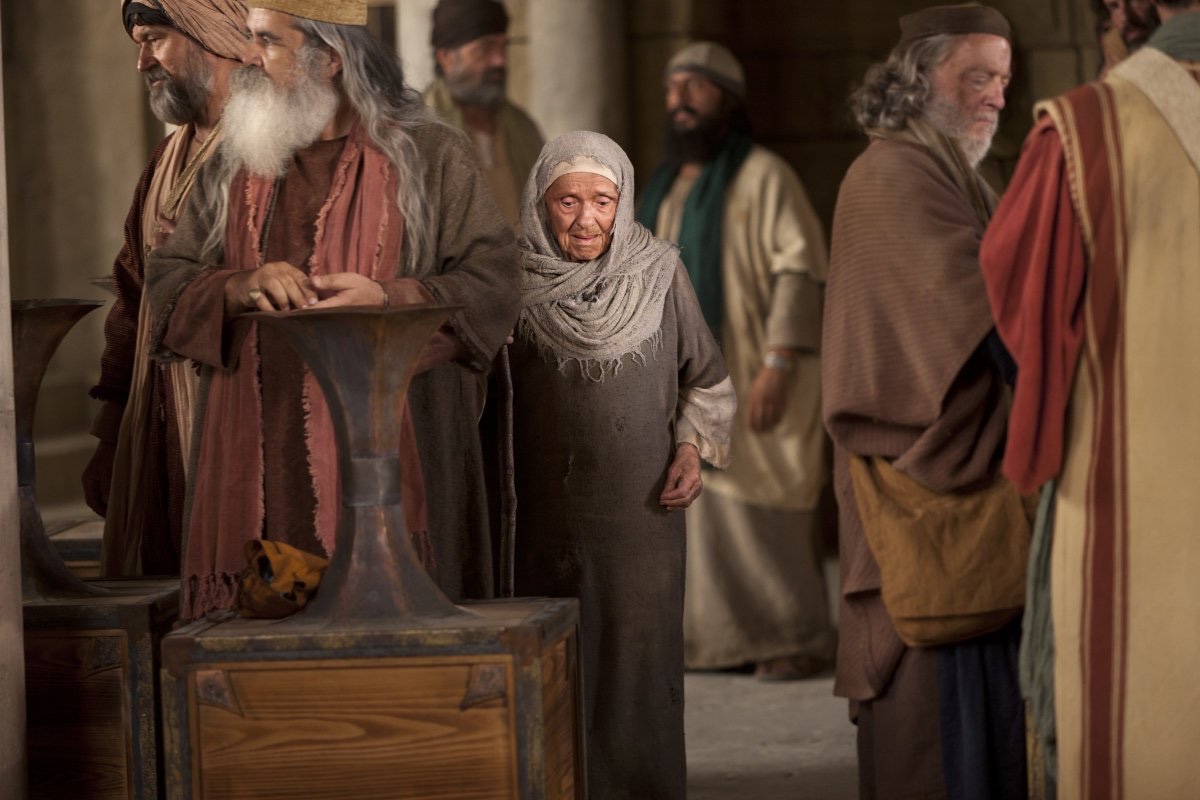
The widow was in the Temple; most likely in the Women’s Court of the Temple, just inside the structure, past the outdoors Court of the Gentiles. The widow was not in the Court of the Priests, where the actual liturgical processes of the Temple took place, for no females were allowed into that space. The “treasury” into which people were placing their money (12:41) refers most likely to the horn-shaped offering boxes in that courtyard.

By highlighting the widow, Jesus refers to the well-established strand within the legal and prophetic and strands of Hebrew Scriptures which underlined the importance of caring for widows, amongst others. According to Torah, the widow and the fatherless child were to included along with the sojourner in celebratory moments in Israel—when tithing (Deut 14:28–29), at the Feast of Weeks (16:9–12) and the Feast of Booths (16:13–15), when gleaning (24:19–22), and when tithing once more (26:12–13).

A widower’s brother was expected to marry a widow (Deut 25:5–10), for it was the duty of a widower’s kin to provide a widow with children if she didn’t have any. If it was not possible for a widow to remarry, it was the duty of the community to care for her (Exod 22:22–23; Deut 10:18; 24:17; Isa 1:17). The men harvesting fields were to leave a portion of the harvest behind to be gleaned and collected by the widows (Deut 24:18–21). Beyond the biblical period, in the Diaspora, a portion of the offering collected in the synagogues was be given to the widows and poor, on the analogy of the gleaning provision whilst living in the land.

The vulnerability of widows and the I,portable of providing for them is evident in many passages in the Hebrew Scriptures. Among the prophets, Isaiah proclaims God’s judgement on those who “turn aside the needy from justice … and rob the poor of my people”, including the way that they exploit the fatherless and widows (Isa 10:1–2).

Likewise, Ezekiel includes those who “have made many widows” in Israel amongst those who will experience the full force of God’s vengeance (Ezek 22, see verse 25). He observes that “the sojourner suffers extortion in your midst; the fatherless and the widow are wronged in you” (Ezek 22:7).

Jeremiah assures the people of Edom, to the south of Israel, of God’s care for them: “leave your fatherless children; I will keep them alive; and let your widows trust in me” (Jer 49:11). He encourages the people of Jerusalem with a promise that God will allow them to continue to dwell in their land if they “do not oppress the sojourner, the fatherless, or the widow, or shed innocent blood in this place … or go after other gods” (Jer 7:5–7).

In a later chapter, Jeremiah is instructed to tell the King of Judah, “do no wrong or violence to the resident alien, the fatherless, and the widow, nor shed innocent blood in this place” (Jer 22:1–3). The prophet Zechariah speaks similarly: “do not oppress the widow, the fatherless, the sojourner, or the poor, and let none of you devise evil against another in your heart” (Zech 7:10).

Accordingly, the people of Israel would regularly have sung, in the words of the psalmist, “the Lord watches over the sojourners; he upholds the widow and the fatherless, but the way of the wicked he brings to ruin” (Ps 146:9). Care for widows was central to the life of holiness required amongst the covenant people. Jesus knows this commitment amongst his people, and holds firm to it.

Here in the Temple, observing the action of the widow, Jesus reinforces this central aspect of covenant life. It has been a strong thread, running through the narrative from earlier chapters. Jesus is calling the people around him to care for the weak and vulnerable among them. He has told his disciples to give up their lives (Mark 8:35) and to welcome children (9:37; 10:14–15).

He instructs men that it is wrong to abandon their wives onto the community to care for (10:5–9) and informs those in power that they ought not to abdicate their responsibility to care for the powerless (10:42–45). He criticises those who distort the functions of the Temple (11:15–17) and advises continuing adherence to the two central commandments of Torah (12:28–31).

Immediately before affirming the action of the widow, he condemns the scribes who seek public honour and yet act to “devour widow’s houses” (12:38–40)—a clear demonstration of the kind of hypocrisy that he previously criticised so vehemently (7:6; 12:5; and see the succinct saying of Matt 7:5 and Luke 6:52, and the long diatribe of Matt 23:13-31). It is a potent counterpoint: glory-seeking scribes and humbly serving widows; the one falling from a great height, the other being raised up in the estimation of Jesus.

In this scene, Jesus condemns those who would tell the weak and vulnerable to pull themselves up by their own boot straps. His words remind those in authority that their power comes with an obligation to use it for good. He provides the widow as a clear example of the kind of care that is needed. It is a message that contemporary society would do well to heed.

Love with all that you are—heart and soul, completely and entirely (Deut 6 in Mark 12; Pentecost 23B)

In this week’s Gospel passage, Jesus engages with a teacher of the Law, discussing the priorities amongst the many laws that are to be found in the Torah scrolls (Mark 12:38–34). The discussion moves quickly to the words of the Shema, from Deuteronomy 6:4–5, as the first commandment to be identified as worthy of priority.

(There is a second commandment, from Leviticus 19, which isn’t in view in this post. See https://johntsquires.com/2021/10/26/love-god-love-neighbour-prioritising-the-law-mark-12-pentecost-23b/)

The exact wording used is interesting. The commandment is to love, with God as the one to be loved. In Deuteronomy, that love is to be manifest from the whole of the person. Most English translations render this commandment as “love the LORD your God with all your heart, and with all your soul, and with all your might” (Deut 6:5).

The Hebrew word translated as heart is לֵבָב, lebab. It’s a common word in Hebrew Scripture, and is understood to refer to the mind, will, or heart of a person—words which seek to describe the essence of the person. It is sometimes described as referring to “the inner person”. The word appears 248 times in the scriptures, of which well over half (185) are translated as “heart”.

Many of those occurrences are in verses which contrast heart with flesh—that is, “the inner person” alongside “the outer person”. For example, the psalmists declare that “my flesh and my heart may fail, but God is the strength of my heart and my portion forever” (Ps 73:26), and “my heart and my flesh sing for joy to the living God” (Ps 84:2b), whilst the prophet Ezekiel refers to “foreigners, uncircumcised in heart and flesh” (Ezek 44:7,9). When used together, these two terms (heart and flesh) thus often refer to the whole person, the complete being.

The Hebrew word lebab, heart, is rendered by the Greek word, kardia, in Mark 12:30. That word can refer directly to the organ which circulates blood through the body; but it also has a sense of the central part of a being—which is variously rendered as will, character, understanding, mind, and even soul. These English translations are attempting to grasp the fundamental and all-encompassing. It seems that this correlates well with the Hebrew word lebab, which indicates the seat of all emotions for the person.

The second Hebrew word in the commandment articulated in Deut 6:4 is נֶפֶשׁ, nephesh. This is another common Hebrew word, appearing 688 times in Hebrew Scripture, of which the most common translation (238 times) is “soul”; the next most common translation is “life” (180 times). The word is thus a common descriptor for a human being, as a whole.

However, to use the English word “soul” to translate nephesh does it a disservice. We have become acclimatised to regarding the soul as but one part of the whole human being—that is the influence of dualistic Platonic thinking, where “body and soul” refer to the two complementary parts of a human being. In Hebrew, nephesh has a unified, whole-of-person reference, quite separate from the dualism that dominates a Greek way of thinking.

Nephesh appears a number of times in the first creation story in Hebrew scripture, where it refers to “living creatures” in the seas (Gen 1:20, 21), on the earth (Gen 1:24), and to “every beast of the earth, and to every bird of the air, and to everything that creeps on the earth, everything that has the breath of life (nephesh hayah)” (Gen 1:30). It is found also in the second creation story, where it likewise describes how God formed a man from the dust of the earth and breathed the breath of life into him, and “the man became a living being (nephesh hayah)” (Gen 2:7). The claim that each living creature is a nephesh is reiterated in the Holiness Code (Lev 11:10, 46; 17:11).

The two words, nephesh and lebab, appear linked together many times. One psalmist exults, “my ‘heart’ is glad, and my ‘soul’ rejoices” (Ps 16:9a), whilst another psalmist laments, “how long must I bear pain in my ‘soul’, and have sorrow in my ‘heart’ all day long?” (Ps 13:2). Proverbs places these words in parallel in sayings such as “wisdom will come into your ‘heart’, and knowledge will be pleasant to your ‘soul’” (Prov 2:10), and “does not he who weighs the ‘heart’ perceive it? does not he who keeps watch over your ‘soul’ know it?” (Prov 24:12). In Deuteronomy itself, the combination of “heart and soul” appears a number of times (Deut 4:29; 10:12; 11:13, 18; 13:3; 26:16; 30:2, 6, 10), where it references the whole human being.

In each of these instances, rather than taking a dualistic Greek approach (seeing “heart” and “soul” as two separate components of a human being), we should adopt the integrated Hebraic understanding. Both “heart” and “soul” refer to the totality of a human being. The repetition is a typical Hebraic style, using two different words to refer to the same entity (the whole human being). The repetition underlines and emphasises the sense of totality of being.

The third Hebrew word to note in Deut 6:5 is מְאֹד, meod, which is usually translated as “might” or “strength”. Its basic sense in Hebrew is abundance or magnitude; it is often rendered as an adverb, as “very”, “greatly”, “exceedingly”, or as an adjective, “great”, “more”, “much”. The function of this word, “might” or “strength”, in Deut 6:5 is to reinforce the totality of being that is required to love God.

In light of this, we could, perhaps, paraphrase the command of Deuteronomy as love God with all that you are—heart and soul, completely and entirely. Love God with “your everythingness” (to coin a word). There’s a cumulative sense that builds as the commandment unfurls—love God with all your emotions, all your being, all of this, your entire being.

We find the same threefold pattern in the description of King Josiah, who reigned in the eighth century (640–609 BCE): “before him there was no king like him, who turned to the Lord with all his heart, with all his soul, and with all his might, according to all the law of Moses; nor did any like him arise after him” (2 Kings 23:25). Most often, however, it is used as an intensifier, attached directly to another term, providing what we today would do in our computer typing by underlining, italicising, and bolding a key word or phrase.

Rendering this Hebrew word in Greek—as the translators of the Septuagint did—means making a choice as to what Greek word best explicated the intensifying sense of the Hebrew word, meod. The LXX settled on the word δύναμις, usually translated as power (the word from which we get, in English, dynamic, and dynamite). Dynamis often has a sense of physical strength and capacity, and that resonates well with the sense of the Hebrew term as it is used in Deut 6:5. So the LXX has dynamis as the third element in the Shema commandment.

*****

What happens when we turn to the New Testament? Jesus refers to this commandment in his dialogue with the teacher of the Law. That conversation is reported in each of the three Synoptic Gospels. Comparing the wording of the commandment across those three synoptic accounts is illuminating.

Matthew seems to retain the greatest fidelity to the Jewish text, with a threefold formula, citing “heart, soul, and mind” (Matt 22:37). By contrast, Mark, the earlier Gospel, has chosen two words to render meod (dynamis), expanding the threefold formula to include a fourth element, “heart, soul, mind, and strength” (Mark 12:29). Luke, using Mark as one of his sources, reorders the final two elements to “heart, soul, strength, and mind” (Luke 10:27).

Curiously, none of the Gospels use the Septuagint’s choice (dynamis) for translating the Hebrew word meod into Greek. Perhaps this might be because, elsewhere in the texts of the New Testament, this word is reserved for describing a quality of God: “the power of the Most High” (Luke 1:35), “the power of the Lord” (Luke 5:17), “the great power of God” (Acts 8:10), the good news which is “the power of God” (Rom 1:16), the message of the cross which is “the power of God” (1 Cor 1:18), that divine power which is extolled in heavenly hymns (Rev 7:12; 12:10; 19:1).

In place of dynamis, Mark’s version offers two different words, when compared with the Septuagint—ἰσχύος, and διανοίᾳ. The use of ischuos (usually translated as power or strength) seems closest to the intention of the LXX (dynamis), although the primary reference of ischuos is to brute physical strength. That relates to, but does not exactly correlate with, the sense of power in dynamis.

The second word chosen by Mark to render meod, the Greek term dianoia, appears also in Matthew’s account of the conversation. This is a word that refers to the mind. It is one of a number of Greek terms that refer to the rational element of the human being. Earlier dialects of Greek (prior to the Koine Greek of the first century CE) had two stem words to refer to mind: φρήν, plural φρένες, and νοῦς, from which the compound dianoia is formed.

According to Pythagoras, phrēn was a mental activity that he considered to be one of the intellectual capacities that constitute the soul (psychē), along with nous (mind) and thumos (passion). Nous was the overarching organising principle of the mind; it came to refer to the full range of rational functions—perceiving, understanding, feeling, judging, and determining. The addition of the prefix dia-, to form dianoia, intensifies the sense of understanding in an intellectual way.

So it is striking to note this Greek influence, focussing on the importance of the mind, the reasoning component of humanity—even at the very early stages of the formation of the traditions about Jesus, even prior to these two early written accounts. The author of the earliest Gospel (unknown to us; designated as Mark in the developing patristic traditions) writes an account about the Jewish man, Jesus, and his Jewish followers, that is already oriented towards Gentiles. His way of reporting the words of the man from Nazareth is already influenced by Greek notions (dianoia in place of dynamis).

But then, in Mark’s account—and only in Mark’s account—the scribe responds, affirming what Jesus has said (Mark 12:32) and paraphrasing him back (12:33)—although he reverts to a threefold formula, repeating kardia and ischuos, omitting psychē, and replacing dianoia with another Greek word for the activity of the mind, σύνεσιν (synesin). What is the force of this substitution? This would seem to underline the focus that is evident, already, in Mark’s use of the term dianoia. Both words (dianoia and synesin) emphasise the activity of the mind in the process of the loving that is commanded.

Mark’s decision to orient the commandment towards the actions of the mind (using synesin) is followed by Matthew, writing not much after Mark’s account had begun to be circulated. And Matthew’s reversion to three terms, instead of Mark’s expanded fourfold statement, reflects stronger awareness of the Deuteronomy text.

Paradoxically, Mark’s account of the response to Jesus offered by the thoroughly Jewish scribe, teacher of Torah, intensifies the Greek influence (synesin in place of psychē and dianoia). We have a pointer to the growing attraction towards the Jesus movement amongst Gentiles, even in this early, pre-written stage of the Gospel tradition. His Jewish words, and the Jewish words of his scribal conversation partner, are already being transferred into Greek conceptual terms by the time the earliest two Gospels are written.

By contrast, the later Jewish text, the Targum Jonathan on Deuteronomy (written in Aramaic) renders the command of Deut 6:5 as “Mosheh the prophet said to the people of the house of Israel, Follow after the true worship of your fathers, that you may love the Lord your God with each disposition of your hearts, and also that He may accept your souls, and the (dedicated) service of all your wealth”.

Wealth! That is a surprise! This version heads in yet another direction, taking meod as a reference to the capacity that a person has in life by virtue of the possessions and physical resources that they have at their disposal. An interesting direction to take!

*****

In preparing this blog, I have made use of a number of resources: the Greek New Testament UBS 4th edition; Rahlfs’ Septuaginta; Strong’s Concordance; the Hebrew Bible Interlinear; Aland’s Synopsis Quattro Evangeliorum; Targum Jonathan; and Brown, Driver, and Briggs’ Hebrew and English Lexicon of the Old Testament. Thanks also to Elizabeth, Elise, and Andrew, for a stimulating discussion on this topic.

Love God, love neighbour: prioritising the Law (Mark 12; Pentecost 23B)

“You shall love the Lord your God with all your heart, and with all your soul, and with all your strength, and with all your mind” (Deuteronomy 6:5). “You shall love your neighbour as yourself” (Leviticus 19:8). These two commandments are cited in a story about Jesus engaging in a discussion with a scribe, a teacher of the Law, which ends with Jesus saying, “there is no commandment greater than these” (Mark 12:31). We hear this story in our Gospel reading for worship this coming Sunday (12:28–34).

Of course, Jesus hasn’t answered the question precisely in the terms that it was asked; he doesn’t indicate what is “the first” commandment, but which two are “greatest”. It’s like a dead heat in an Olympic race: a race when even a finely-tuned system can’t differentiate between the two winners, even down to one thousandth of a second. Both love of God and love of neighbour are equally important. Joint winners!

Both commands are biblical commands, found within the foundational books of scripture within Judaism. They were texts that Jewish people, such as Jesus and his earliest followers would have known very well. Each command appears in a significant place within the books of Torah, the first five books of Hebrew Scriptures.

The command to “love God” sits at the head of a long section in Deuteronomy, which reports a speech by Moses allegedly given to the people of Israel (Deut 5:1–26:19). The speech rehearses many of the laws that are reported in Exodus and Leviticus, framing them in terms of the repeated phrases, “the statutes and ordinances for you to observe” (4:1,5,14; 5:1; 6:1; 12:1; 26:16–17), “the statutes and ordinances that the Lord your God has commanded you” (6:20; 7:11; 8:11).

After proclaiming the Ten Commandments which God gave to Israel through Moses (Deut 5:1–21; cf. Exod 20:1–17) and rehearsing the scene on Mount Sinai and amongst the people below (5:22–33; cf. Exod 19:1–25; 20:18–21). Moses then delivers the word which sits at the head of all that follows: “Hear, O Israel: The LORD is our God, the LORD alone. You shall love the LORD your God with all your heart, and with all your soul, and with all your might. Keep these words that I am commanding you today in your heart” (Deut 6:4–6). This, it would seem, is the key commandment amongst all the statutes and ordinances.

These words are known in Jewish tradition as the Shema, a Hebrew word literally meaning “hear” or “listen”. It’s the first word in this key commandment; and more broadly than simply “hear” or “listen”, it caries a sense of “obey”. These words are important to Jews as the daily prayer, to be prayed twice a day—in keeping with the instruction to recite them “when you lie down and when you rise” (Deut 6:7). As these daily words, “love the Lord your God” with all of your being are said, they reinforce the centrality of God and the importance of commitment to God within the covenant people.

See further discussion of the way that this commandment appears in the Synoptic Gospels at https://johntsquires.com/2021/10/26/love-with-all-that-you-are-heart-and-soul-completely-and-entirely-deut-6-in-mark-12-pentecost-23b/

The command to “love your neighbour” in Leviticus 19 culminates a series of instructions regarding the way a person is to relate to their neighbours: “you shall not defraud your neighbour … with justice you shall judge your neighbour … you shall not profit by the blood of your neighbour … you shall not reprove your neighbour … you shall love your neighbour” (Lev 19:13–18).

These instructions sit within the section of the book which is often called The Holiness Code—a section which emphasises the word to Israel, that “you shall be holy, for I the Lord your God am holy” (Lev 19:2; also 20:7, 26). Being holy means treating others with respect. Loving your neighbour is a clear manifestation of that ethos. Loving your neighbour exemplifies the way to be a faithful person in covenant relationship with God.

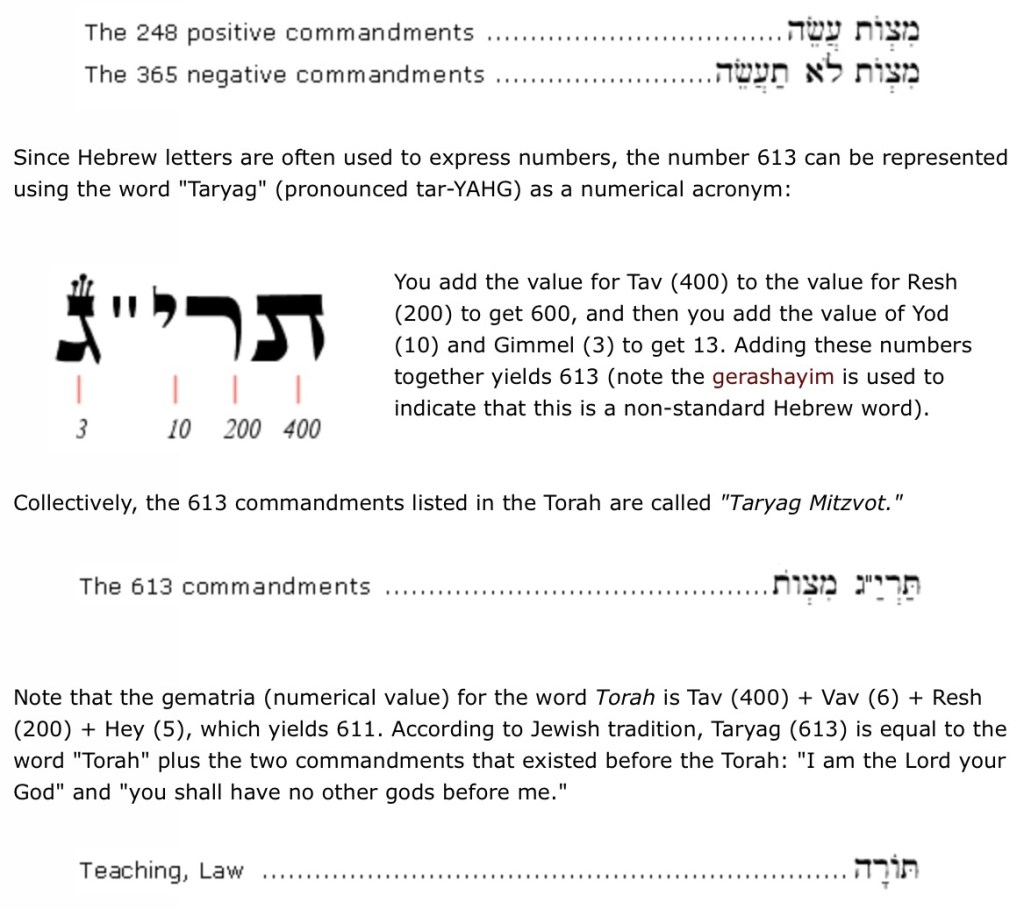
So it is for very good reasons that Jesus extracts these two particular commandments from amongst the 613 commandments that are to be found within the pages of the Torah. (The rabbis counted them all up—there are 248 “positive commandments”, giving instructions to perform a particular act, and 365 “negative commandments”, requiring people to abstain from certain acts.)

Jesus, of course, was a Jew, instructed in the way of Torah. He knew his scriptures—he argued intensely with the teachers of the Law over a number of different issues. He frequented the synagogue, read from the scroll, prayed to God, and went on pilgrimage to Jerusalem and into the Temple—where, once again, he offered a critique of the practices that were taking place in the courtyard of the Temple (11:15–17).

Then he engaged in debate and disputation with scribes and priests (11:27), Pharisees and Herodians (12:13), and Sadducees (12:18). Each of those groups came to Jesus with a trick question, which they expected would trap Jesus (12:13). Jesus inevitably bests them with his responses (11:33; 12:12, 17, 27). It was at this point that the particular scribe in our passage approached Jesus, perhaps intending to set yet another trap for him (12:28).

So Jesus, good Jew that he was, is well able to reach into his knowledge of Torah in his answer to the scribe. The commandments that he selects have been chosen with a purpose. They contain the essence of the Torah. His answer draws forth the agreement of the scribe—there will be no robust debate now! In fact, in affirming Jesus, the scribe reflects the prophetic perspective, that keeping the covenant in daily life is more important that following the liturgical rituals of sacrifice in the Temple (see Amos 5:21–24; Micah 6:6–8; Isaiah 1:10–17).

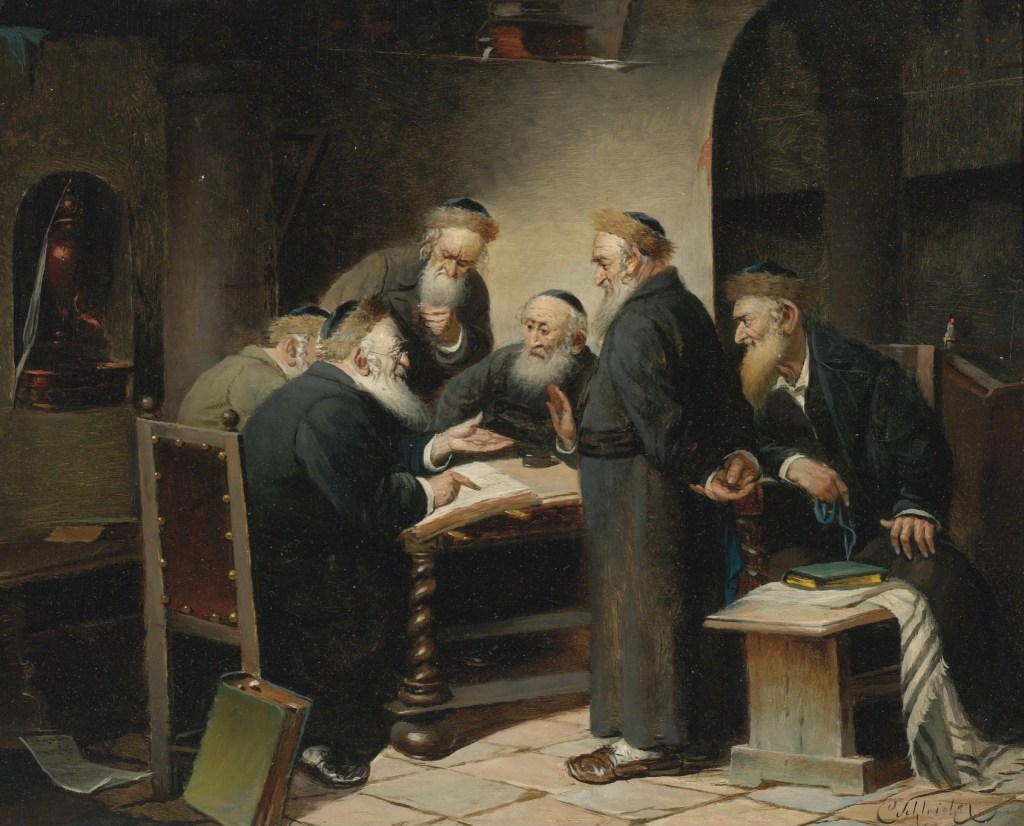
The scene is similar to a Jewish tale that is reported in the Babylonian Talmud, a 6th century CE work. In Shabbat 31a, within a tractate on the sabbath, we read: “It happened that a certain non-Jew came before Shammai and said to him, ‘Make me a convert, on condition that you teach me the whole Torah while I stand on one foot.’ Thereupon he repulsed him with the builder’s cubit that was in his hand. When he went before Hillel, he said to him, ‘What is hateful to you, do not to your neighbour: that is the whole Torah, the rest is the commentary; go and learn it.’”

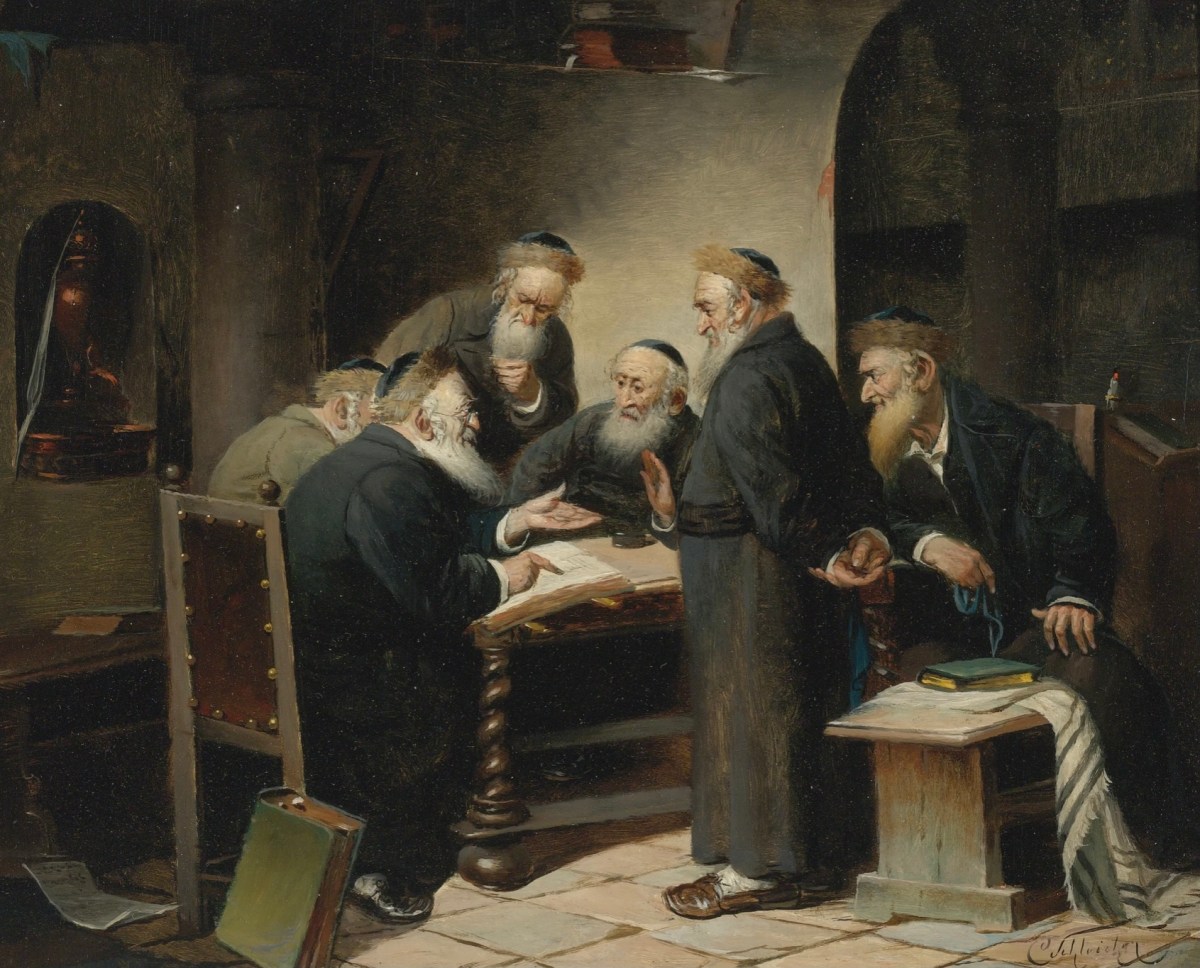
Carl Schleicher (1825–1903)
“A Discussion of the Talmud”

Hillel, of course, had provided the enquiring convert, not with one of the 613 commandments, but with one that summarised the intent of many of those commandments. We know it as the Golden Rule, and it appears in the Synoptic Gospels as a teaching of Jesus (Matt 7:12; Luke 6:31).

Some Jewish teachers claim that the full text of Lev 19:18 is actually an expression of this rule: “You shall not take vengeance or bear a grudge against any of your people, but you shall love your neighbour as yourself: I am the LORD.” Later Jewish writings closer to the time of Jesus reflect the Golden Rule in its negative form: “do to no one what you yourself dislike” (Tobit 4:15), and “recognise that your neighbour feels as you do, and keep in mind your own dislikes” (Sirach 31:15).

Paul clearly knows the command to love neighbours, for he quotes it to the Galatians: “the whole law is summed up in a single commandment, ‘You shall love your neighbour as yourself’” (Gal 5:14), and James also cites it: “you do well if you really fulfill the royal law according to the scripture, ‘You shall love your neighbour as yourself’” (James 2:8). Both writers reflect the fact that this was an instruction that stuck in people’s minds!

And I wonder … perhaps there’s a hint, in these two letters, that the greater of these two equally-important commandments is actually the instruction to “love your neighbour”?

Seeing and believing as Jesus passes by (Mark 10; Pentecost 22B)

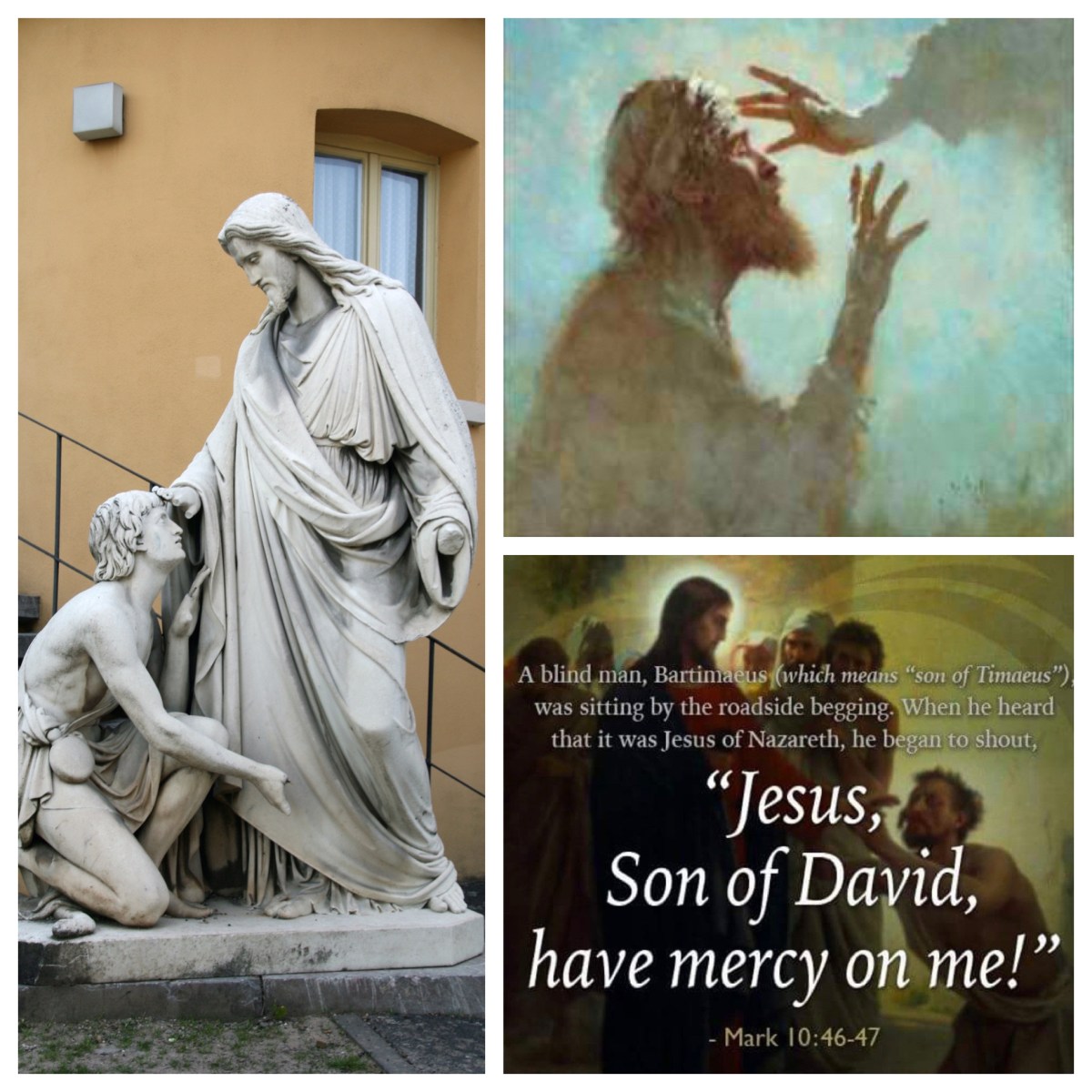
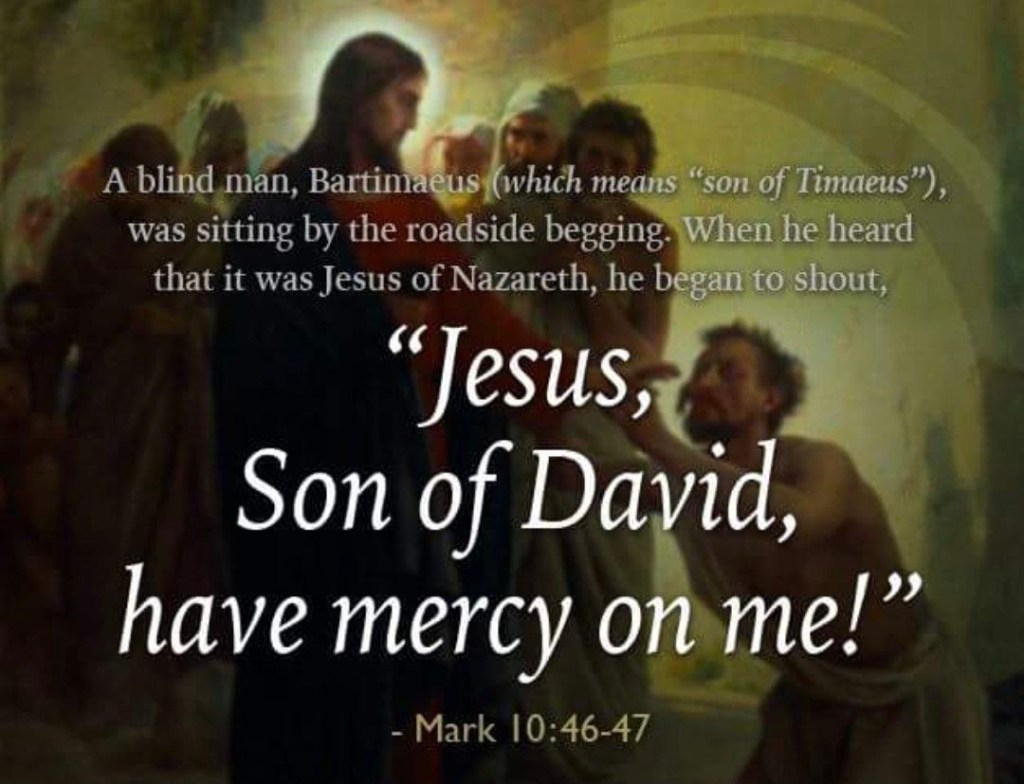
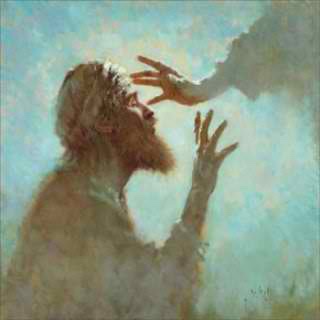
The man sits on the ground, beside the road leading into Jericho. Sensing what was happening, who was passing by, what was being spoken about; unable to use his eyes, he was undoubtedly attentive through his listening ears, through the sounds he could hear, as well as the fragrances he could smell. Because of this, he knew the identity of the person passing by, so he calls out with confidence, “Jesus of Nazareth, Son of David, have mercy on me” (Mark 10:47).

Jesus pauses, engages with the man, and responds to his plea. “Go; your faith has made you well” (10:52). The man, all of a sudden, could see; all was clear, so he took his place among those following Jesus on the way (10:52).

The scene is familiar. Some chapters earlier, in Bethsaida, another blind man also engages with Jesus; and Jesus heals the man. “He saw everything clearly” (8:25), just as the second man “immediately regained his sight” (10:52). Yet the two scenes are remarkably different. The first man healed is not named; whilst the man outside Jericho is identified as Bartimaeus (10:46).

The unnamed man is brought to Jesus by some friends, begging Jesus to heal him (8:22). By contrast, the later man is initially is hindered from engaging with Jesus by the crowd, demanding that he remain silent (10:48). And whilst the restoration of sight takes place immediately in the Jericho scene (10:52), in the Bethsaida scene it takes two attempts by Jesus before the man can see.

First, Jesus performs the actions of a traditional healer, placing saliva on his eyes and touching him (8:23; on the traditional healing practices of the time, see https://johntsquires.com/2020/03/19/in-the-most-unlikely-way-touching-the-untouchable-john-9/). After that, because the man can only see imperfectly, Jesus touches his eyes for a second time; after this, the man can see clearly (8:25).

A number of interpreters have commented on the similarities and contrasts in these two scenes. They provide, it is felt, bookends to the important central section of this earliest Gospel (8:27–10:45). There are some key events that take place within these two bookends.

First, there is Peter’s confession that Jesus is the Messiah (8:29). This is one of the high moments at the mid-point of the whole narrative of this work. It serves to remind the readers what was already declared to them at the very start of the gospel: that it was about the good news of Jesus, Messiah, Son of God (1:1).

The other key moment in this section comes almost immediately after Peter’s confession: the scene of Transfiguration (9:2). This takes place on the top of a mountain, a traditional place for encountering the divine in Israelite stories (think Moses on Mount Sinai, Solomon’s Temple on Mount Zion, the vision of the prophet Isaiah that all the nations would stream to Mount Zion, and the place where Matthew locates the teaching of Jesus in the “Sermon on the Mount”).

This key mountaintop moment contains the words from the heavens about Jesus, “This is my Son, the Beloved; listen to him!” (9:7). These words link back to the initial baptism of Jesus, when the same words were heard (1:11) and forward to the final scene of crucifixion, when a centurion at the foot of the cross witnesses Jesus’ death, and declares, “Truly this man was God’s Son!” (15:39). All three scenes contain the foundational statement, recognising Jesus as Son of God, reiterating the other important element in the opening verse (1:1).

There are other significant components within this central section of the Gospel. Three times, Jesus makes clear predictions of what lies in store for him in Jerusalem (8:31; 9:31; 10:32–34). This triple passion prediction is actually the central spine of the whole narrative. The cross is the climax of the story; the road to the death of Jesus has been in view since early in the narrative, when “the Pharisees went out and immediately conspired with the Herodians against him, how to destroy him” (3:6). From that moment onwards, the likelihood that Jesus would be caught and dealt with was strong.

Finally, after each one of these predictions of his fate, Jesus provides clear and direct teachings about the cost of discipleship. We hear “take up your cross” and “lose your life” in the first set of teachings (8:34–9:1). “Whoever wants to be first must be last of all and servant of all” is spoken in the second set of teachings (9:33–37), followed by guidance about taking care of “the little ones” (9:38–50).

“Whoever wishes to become great among you must be your servant and whoever wishes to be first among you must be slave of all” is uttered in the third set of teachings (10:35–45), an expanded saying with synonymous parallelism reflecting back to the earlier teachings. And the final set of teachings ends with a clear statement about the role of the Son of Man as the model and the means of redemption for his followers (10:45).

So this story of Jesus, blind Bartimaeus, and the crowd in Jericho (10:46–52) brings to a close a rich and deeply significant sequence of scenes, which began back in Bethsaida with Jesus, an unnamed blind man, and the crowd in that town (8:22–26). The two outer scenes provide a carefully-crafted literary framing for the central sequence of scenes.

The symbolism is significant: two scenes with people unable to see, reaching out to Jesus, experience the piercing light after their years of blindness—these two scenes surround the confession of Jesus as Messiah and his transfiguration, the three predictions of what lies in store for him in Jerusalem, and the three blocks of teaching about the way of discipleship.

What was not able to be seen, is now made manifest. What was hidden, incomprehensible, is now revealed. For the disciples, there can be no excuse, and no turning back. Jesus no longer will ask, “do you not understand?” (4:22, 13; 6:52; 7:18: 8:17, 21; 9:32), for understanding has been provided. The pathway is set. The way of discipleship is clear. As Bartimaeus joins with the disciples to follow Jesus on that way, so we who hear the story are invited also to “follow him on the way”.

See also https://johntsquires.com/2021/10/13/not-to-be-served-but-to-serve-the-model-provided-by-jesus-mark-10-pentecost-21b/

https://johntsquires.com/2021/10/14/a-ransom-for-many-a-hint-of-atonement-theology-mark-10-pentecost-21b/

https://johntsquires.com/2021/09/21/giving-priority-to-one-of-these-little-ones-mark-9-pentecost-18b/

https://johntsquires.com/2021/09/28/boundary-lines-and-the-kingdom-of-god-mark-9-10-pentecost-18b-to-20b/

https://johntsquires.com/2021/09/06/the-paradoxes-of-discipleship-mark-8-pentecost-16b/

A ransom for many: a hint of atonement theology? (Mark 10; Pentecost 21B)

When Jesus instructed his followers to tread the pathway of humility and submission (Mark 8:34–38; 9:35–37; 10:38–44)—the same pathway that he himself has been following as he walks towards Jerusalem (8:31; 9:31: 10:32–34)—he speaks about laying down his own life, just as he urges his followers to lay down their lives (10:45). This has been a regular refrain throughout his teachings. See https://johntsquires.com/2021/09/21/giving-priority-to-one-of-these-little-ones-mark-9-pentecost-18b/

However, in this particular saying, Jesus indicates that the laying-down of his life is to be seen, not just as the model for his followers to emulate, but as “a ransom for many” (10:45). Each word needs some exploration.

Ransom is a term that we associate with the forced kidnapping of a person and the demand for a payment in order for them to be released. This is not the way the term is used in biblical texts, where payment in return for release of a captive is not in view. Rather, the orientation is towards the idea that there is a significant cost involved in the process of ransoming.

The Greek word used in Mark 10:45, lutron, comes from a verb, lutrein, which means “to release”. It was a common term for the payment needed to secure the release of slaves, debtors, and prisoners of war. The noun, translated as ransom, occurs in the Septuagint. It identifies the price paid to redeem a slave or captive (Lev 25:51–52) or a firstborn (Num 18:15). It also indicates the price to be paid as recompense for a crime (Num 35:31–32) or injury (Exodus 21:30). In these instances, it translates the Hebrew word kipper, which has the basic meaning of “covering”, from the root word koper.

Another form of the word koper appears in the name of the Great High Holy Day in Judaism—Yom Kippur, the Day of Atonement (see Lev 16:1–34; Num 29:7–11). On that day, as the cloud of incense covers the mercy seat (kapporeth, Lev 16:13), the mercy seat is smeared with the blood of the sacrificed bull (16:14) and then the blood of the goat which provides the sin offering (16:15). According to Leviticus, it is these actions which “shall make atonement (kipper) for the sanctuary, because of the uncleannesses of the people of Israel, and because of their transgressions, all their sins” (16:16).

The process of atonement in the Israelite religion was to cover up, to hide away from view, the sins of the people. This is developed to some degree in the fourth Servant Song of Deutero-Isaiah, when the prophet honours the servant because “he was wounded for our transgressions, crushed for our iniquities” (Isa 53:5). His life was understood as “an offering for sin” (53:10) which “shall make many righteous” (53:11).

Indeed, as the Song ends, it affirms that “he bore the sin of many” (53:12). The Song resonates with the language and imagery of righteous suffering as the means of dealing with, and perhaps atoning for, sins. In addition, it indicates that this function deals with “the iniquity of us all” (53:6), and through his role, “he shall make many righteous” (53:11); “he bore the sin of many” (53:12).

The notion of one atoning for many is further expounded in a later text which provides an account of the way that a righteous man, Eleazar, was martyred during the time of upheaval under Antiochus Epiphanes (175–167 BCE). The death of Eleazar was understood as a ransom; “be merciful to your people, and let our punishment suffice for them”, he prays; “make my blood their purification, and take my life in exchange for theirs” (4 Macc 6:28–29).

The Greek for “my life in exchange for”, antilutron, is a compound word, joining the same preposition anti and the same noun lutron which we find in Mark 10:45. The preposition clearly denotes a process of exchange, in which one person performs an action on behalf of, or in the place of, another. That notion feeds into a theory of atonement known as substitutionary atonement—that one person (Jesus) stood in place of many people (humanity). However, this isn’t a strong motif in either the fourth Servant Song in Isaiah or in New Testament passages.

However, there has been debate with regard to the word “many” in both the saying of Jesus, and the Servant Song of Isaiah. Does this refer, quite literally, to lots and lots of people, or does it refer to every human being? The way that “many” appears in the Servant Song (Isa 52:14–15; 53:11–12) places it in parallel with “all” (Isa 53:6). Here, the “many” quite clearly has a universal reference, to all human beings.

The interchanging of “many” with “all” can be seen, also, in Paul’s discussion of Jesus and Adam, where “all” (Rom 5:12, 18) and “many” (Rom 5:15, 19) have the same point of reference—the totality of humanity. Indeed, this is consistent with the overall argument running throughout Romans, where the Gospel is a universal good news of righteous-justice for all. (See https://johntsquires.com/2020/07/11/the-righteous-justice-of-god-a-gift-to-all-humanity-romans/) The same universal scope, by analogy from Isa 53 and Rom 5, is applicable to the words of Jesus in Mark 10:45.

In another later Jewish text, Philo of Alexandria observes that “every wise man is a ransom for a worthless one” (Sacrifices of Abel and Cain 121). The idea of an act of one person which serves as a ransom for another then appears in New Testament texts which describe the effect of the death of Jesus for those who have placed their trust in him. Paul uses ransom language tells the saints that they were “bought with a price” (1 Cor 6:20; 7:23).

Paul also uses apolutrosis, a compound word but from the base word lutrein, to describe the redemption which was accomplished by Jesus, both in a formulaic way (1 Cor 1:30) and in a more discursive manner (Rom 3:24; 8:23). The term recurs in later letters which likely were not written by Paul (Col 1:14; Eph 1:7, 14; 4:30), as well as in the Lukan redaction of the final eschatological speech of Jesus (Luke 21:28).

In another later letter attributed to Paul, most likely written by one of his students, we read of “one mediator between God and humans, the man Christ Jesus, who gave himself as a ransom for all” (1 Tim 2:6), using the term lutron. In another later work providing guidance an account of Paul by an author at some remove from him, the book of Acts, Paul was said to have declared of the church that God “obtained [it] with the blood of his own Son” (Acts 20:28).

At the start of the book of Revelation, Jesus is identified as “the one who loves us and released us from our sins” (Rev 1:5). The verb translated “released” or “freed” in English versions is the participle lusanti, from the root verb luō, which is cognate with the noun lutron, meaning ransom.

It was the combination of such passages that led the third century scholar, Origen of Alexandria to develop an idiosyncratic theory of the atonement (the way that Jesus enables God to deal with human sinfulness). Origen’s ransom theory of atonement reads Genesis 3 as an account of Adam and Eve being taken captive by Satan; this state was then inherited by all human beings. The death of Jesus is what enables all humans to be saved; the means for this was that the blood shed by Jesus was the price paid to Satan to ransom humanity (or, in a variant form, a ransom paid by Jesus to God to secure our release).

However, none of these texts—and particularly not Mark 10:45—require this overarching theological superstructure to make sense of what they say. Origen’s ransom theory held sway for some centuries, but was definitively rejected by the medieval scholar Anselm of Canterbury. It is not a favoured theory of atonement in much of the contemporary church (though it is still advocated in various fundamentalist backwaters). Certainly, none of this should be attributed to the saying of Jesus in Mark 10:45. It is far more likely that he is drawing on the Jewish tradition of the righteous sufferer in his words.

*****

To explore the concept of atonement further, there is a very helpful study at https://www.turramurrauniting.org.au/aceaster/ace2main/ace2conv1/ and a clear summary of the seven main theories of atonement at https://www.sdmorrison.org/7-theories-of-the-atonement-summarized/

There is an abridged historical survey at https://www.thegospelcoalition.org/essay/history-theories-atonement/ and another helpful assessment of various theories at https://www.churchtimes.co.uk/articles/2018/29-march/features/features/is-there-one-doctrine-of-the-atonement-ransom-substitute-scapegoat-god

Not to be served, but to serve: the model provided by Jesus (Mark 10; Pentecost 21B)

“The Son of Man came not to be served but to serve, and to give his life a ransom for many” (Mark 10:35-45). So Jesus instructs his followers, after a bruising encounter with James and John, two of the leading followers of Jesus (10:35-40) which enraged the rest of the disciples (10:42).

The dispute was over status; James and John wanted to claim the places next to Jesus: “one at your right hand and one at your left, in your glory” (10:37). This was not unusual in the world of that time (indeed, this is still the case in our own times). Public debate that was intended to best the other person was common in ancient Mediterranean societies. Seeking greater honour (higher status) by getting the upper hand, or the last word, in public debate, was common.

In an honour—shame society, such as that in which Jesus, James, and John lived, the culture was characterised by a constant and ongoing “challenge—riposte,” enacted in the public arena. Jesus engaged in such challenges on a regular basis; see the disputations of 2:1-3:6, early in Jesus’s time in Galilee, and later in Jerusalem, in 11:27-12:34.

Such challenge—riposte encounters typically involved the challenger setting forth a claim, through either words or actions; a response to the challenge by the persons who was challenged; then, after further back-and-forth amongst the participants, once the challenge and riposte has run its course, the verdict is declared by the public who was watching the encounter. (See a clear description of this process, as it applies in Mark 11:27–12:34, using the analysis of Jerome Neyrey and Bruce Malina, at https://www.etsjets.org/files/JETS-PDFs/43/43-2/43-2-pp213-228_JETS.pdf)

At this moment, Jesus critiques the common process of public disputation; he distances himself from the common cultural practice of seeking honour and working for a higher status. Those who lord it over others, who act as tyrants, are not to be the role models for his followers; “it is not so among you; but whoever wishes to become great among you must be your servant, and whoever wishes to be first among you must be slave of all” (10:43–44). Indeed, Jesus rubs salt into the wound by inferring that James and John were acting like Gentiles (10:52). That was an insult, to be sure, for good Jews (see the sayings attributed the Jesus at Matt 5:47; 6:7, 32).

This was the third time, after demonstrating their misunderstanding of what Jesus was teaching, that his disciples were directly rebuked for their attitude. First, Peter represents the disciples’ lack of clarity about Jesus (8:27–38); then a number of the disciples arguing about being great, and John fails to welcome the activity of a person casting out demons (9:33–48); and now, James and John demonstrate their continued inability to understand the attitude of Jesus towards status (10:35–40).

At least in this last scene, the other ten disciples are angry about what James and John have asked for (10:41). Far too often, on earlier occasions, Jesus has lamented that the disciples failed to understand (4:22, 13; 6:52; 7:18: 8:17, 21; 9:32). It seems that finally, at this moment, things had fallen into place for the disciples. (Or were they simply annoyed at the way the brothers promoted their own interests over the hopes of the other disciples?)

On each of those three occasions of misunderstanding, Jesus responds by correcting the inadequacies displayed by his followers: he refers to the fate that is in store for him in Jerusalem (8:31; 9:31: 10:32–34), and then he indicates that his followers must tread that same pathway of humility and submission (8:34–38; 9:35–37; 10:38–44). See https://johntsquires.com/2021/09/28/boundary-lines-and-the-kingdom-of-god-mark-9-10-pentecost-18b-to-20b/

On this occasion, Jesus goes one step further. His own life—or, more precisely, the laying-down of his own life—is to be seen, not just as the model for his followers to emulate, but as “a ransom for many” (10:45). There are important observations to make about this short statement. Those matters will be the focus of a subsequent blog post.

Boundary lines and the kingdom of God (Mark 9–10; Pentecost 18B to 20B)

Last week (Pentecost 18) we heard a Gospel passage in which Jesus affirmed that “whoever is not against us is for us” (Mark 9:40). He refused to draw strong and clear boundaries around his “inner group” simply on the basis of explicit identification with him—rather, he affirmed that it is the actions of people that define where people are to be placed in relation to him. Deeds, not words, define the followers of Jesus.

That line of argument would be take up by his brother, James, in his “letter” affirming that “faith without works is dead” (James 2:26), and by another follower (by radiation, the evangelist Matthew), who quoted him as saying, “not everyone who says to me, ‘Lord, Lord,’ will enter the kingdom of heaven, but only the one who does the will of my Father in heaven” (Matt 7:21). It is a strong theme in the testimony to Jesus in Christian scripture: actions, not words, define allegiance to Jesus.

This week (Pentecost 19), we hear a Gospel passage in which Jesus becomes indignant with his closest followers, rebuking them for hindering children from gaining access to him. In contrast to the attempts of the disciples to keep the children at a distance, Jesus drew children close to himself and blessed them, saying, “whoever does not receive the kingdom of God as a little child will never enter it” (Mark 10:15). The boundary line which Jesus draws is clearly not based on age. The ability to articulate a complex theological affirmation is not the key criterion. Rather, it seems that a willingness to search out Jesus, a desire to be with him, is the key criterion.

Jesus has already affirmed the central significance of a child in his consideration of this issue. Mark notes that “he took a little child and put it among them” (9:36), speaking the very clear affirmation that “whoever welcomes one such child in my name welcomes me, and whoever welcomes me welcomes not me but the one who sent me” (9:37). Still earlier, Jesus had placed the health of a child at the centre of his focus, when approached by a synagogue leader, who pleads with Jesus, “my little daughter is at the point of death; come and lay your hands on her, so that she may be made well, and live” (5:23).

We have noted that the child was a person with no authority, no status, no prestige or power, in the society of the day; yet the low-status, not-important child is the exemplar, not only of Jesus, but of God, “the one who sent me” (9:37). Welcoming the child is a clear manifestation of the paradox that lies at the heart of the Gospel. Jesus is the one who will walk resolutely towards death (8:31: 9:31: 10:34), becoming “the slave of all” (10:44) who will “give his life a ransom for many” (10:45).

Those who follow Jesus on this pathways will need to take up their crosses (8:34), lose their lives (8:35), be “last of all and servant of all” (9:35), “receive the kingdom of God as a little child” (10:15), sell all that they possess (10:21), leave their families (10:29), and become “last of all” (10:31). (See https://johntsquires.com/2021/09/06/the-paradoxes-of-discipleship-mark-8-pentecost-16b/)

Next week (Pentecost 20), we will hear a Gospel passage in which Jesus sadly informs a man of means who prides himself on keeping all the commandments, that still “you lack one thing: go, sell what you own, and give the money to the poor, and you will have treasure in heaven; then come, follow me” (Mark 10:21). The man left, shocked and grieving; he could not do what Jesus instructed. Jesus here draws the line of belonging or being alienated from him on the basis of whether a person is able to implement radical actions of obedience.

We have seen the way that the author of this account of Jesus (by tradition, Mark the evangelist) redraws the boundaries of the people of God, by his actions in relating to people in need (see https://johntsquires.com/2021/06/24/on-not-stereotyping-judaism-when-reading-the-gospels-mark-5-pentecost-5b/) and by the geography that he traverses, as he edges outside of the land of Israel (see https://johntsquires.com/2021/08/24/stretching-the-boundaries-of-the-people-of-god-mark-7-pentecost-14b-15b/).

We have also seen that it was the courageous rhetorical challenging of Jesus by a Gentile woman which provoked him to be absolutely clear about this more inclusive boundary (see https://johntsquires.com/2021/09/02/on-jesus-and-justa-tyre-and-decapolis-mark-7-pentecost-15b/) And again, in this incident, it is the health of a young child which draws action from Jesus (7:26, 29).

The passages in our current stream of lectionary readings reinforce the perspective already developed in these earlier sections of the Gospel (chapters 5 to 10). Jesus is not an exclusivist, drawing hard boundary lines close around his group. He is an inclusivist, looking to welcome those from beyond the traditional inner group, inviting in those on the fringe or outside this conventional group.

That’s the consistent message about Jesus in the stories that we read through the central chapters of this account. It’s the consistent theme that followers of Jesus in the 21st century need to ensure are the key markers of the Christian church today.

Giving priority to “one of these little ones” (Mark 9; Pentecost 19B)

Two weeks ago, we read and heard the passage where Jesus berated Peter: “Get behind me, Satan! For you are setting your mind not on divine things but on human things” (8:33). Jesus went on to teach about the need for those who follow him to take up their cross and lay down their lives (8:34–37). The hubris that Peter demonstrated, when he rebuked Jesus for what he was teaching, is met head-on by Jesus. He rebukes Peter for his focus on “human things”.

The nature of those “human things” is made clear in the passage that we read and heard last Sunday. “What were you arguing about on the way?”, Jesus asks his followers (9:33). No answer comes; those followers of Jesus were shamed into silence “for on the way they had argued with one another who was the greatest” (9:34). Arguing about who is the greatest is a clear manifestation of a focus on “human things”. It’s what human beings do, all too often–we see it demonstrated in our politics, in domestic violence, in sexual assaults, and in the constant stream of uprisings, civil wars, and international wars that are never-ending.

Jesus has been with his followers since the start of his public campaign in Galilee (1:14). By this point in his time with these followers, Jesus no time left for such matters. He teaches them here, as he has already done in the previous passage, about what lies in store for himself as he heads towards Jerusalem—betrayal, and death (9:31; see also 8:31). These are the heart of the “divine things” that he has encouraged his followers to set their minds on. Jesus is resolutely fixed on what is important to God, not what is the focus of humans.

The story we read and heard this coming Sunday (9:38–50) contains further insights into this distinction. The disciples want to exercise their authority by forbidding an unknown person from casting out demons from those possessed by them. “We tried to stop him, because he was not following us”, the disciples report (9:38), expecting to be congratulated by Jesus. (Did you notice the pronoun: following US!!)

But their expectations fall flat. Jesus, once again, rebukes his followers: “Do not stop him; for no one who does a deed of power in my name will be able soon afterward to speak evil of me” (9:39).

Such manifestation of authority will receive a further rebuke from Jesus yet again, at a later point in the story that is being told in this Gospel. Returning to the theme of authority, two of his followers petition Jesus: “Grant us to sit, one at your right hand and one at your left, in your glory” (10:37). Jesus gives them short shrift: “You do not know what you are asking” (10:38). By this time, surely, he must have been seething with frustration—will they never understand? “Do you not understand?” Is a question that Jesus has already posed to his followers, no less than four times previously (4:13; 7:18; 8:17; 8:21).

Three times, in chapters 8–10, Jesus rebukes his followers. Three times, they have acted in ways that indicate their fixation is on authority, prestige, power. Three times, Jesus has responded with a clear explanation. Each time, as they journey southwards towards Jerusalem, he recounts what will take place to “the Son of Man”; a prophetic circumlocution for describing oneself (Ezek 2:1, 3, 6, 8, 3:1, 3, 4, 10, etc). Each time, the fundamental purpose of his mission is explained in short, staccato phrases.

That purpose, and the fate that lies in store for Jesus in Jerusalem, is that he will “undergo great suffering, and be rejected … and be killed” (8:31); there, he “is to be betrayed into human hands, and they will kill him” (9:31); there, he will be “condemned to death; handed over to Gentiles; they will mock him, and spit upon him, and flog him, and kill him” (10:33–34). The end in view is surely sobering, cautionary, worrying, for those who follow with him. Yet each time, they revert to a focus on authority—“human things”.

This threefold description of the imminent fate of Jesus, increasing in detail at each restatement, provides an intense focus on the journey ahead. Jesus will arrive in Jerusalem (11:11) with a cohort of followers who have repeatedly failed to understand that, instead of a focus on their own authority, leading to a seat in glory, they are in company with the one who will take up his cross (8:34), lose his life (8:35), “be last of all and servant of all” (9:35), and ultimately be the slave of all (10:44). “For the Son of Man came not to be served but to serve, and to give his life a ransom for many” (10:45).

This final, definitive affirmation of his role comes after the three instances of the misguided orientation of his followers, and the three corrective teachings offered by Jesus (8:31; 9:31; 10:32–34). This sequence is surrounded by two stories of healing, symbolising the need for the followers of Jesus to open their eyes and see the reality of Jesus. In Bethsaida, a blind man seeks healing from Jesus (8:22–26). In Jericho, blind Bartimaeus cries out to Jesus for mercy (10: 46–52). The two healings clearly symbolise the need for the followers of Jesus themselves to open their eyes to see Jesus.

Despite their physical blindness, these two men have a deeper sense of the presence of Jesus as he passes by, and reach out in hope. Yet those travelling along with Jesus are impervious to what he offers, and blind to the fate that Jesus is walking towards. The irony, the penetrating incongruity, of these juxtapositions, is searing.

It is within this context that the story of the unidentified exorcist (9:38–41) is to be understood. Indeed, the sense of irony is clearly present in this story. The ministry of Jesus has incorporated the casting out of demons alongside his teaching, preaching, and healing. “Proclaiming the message and casting out demons” is how the activities of Jesus have been characterised from the start of his public activity (1:39).

In fact, the casting out of demons was integral to the charge that Jesus had given his followers earlier in their time with him: “he appointed twelve…to be with him and to be sent out to proclaim the message and to have authority to cast out demons” (3:14–15). And these very activities had formed the basis for the mission of the twelve as it is reported at 6:7–13. They model their words and deeds on Jesus: “they proclaimed that all should repent … they cast out many demons and anointed with oil many who were sick and cured them” (6:12–13).

So there may be some sense of self-assured certainty when they report to Jesus that “we saw someone casting out demons in your name, and we tried to stop him, because he was not following us” (9:38). (Yes—notice the pronoun: following US! Not Jesus—but US.) But were they not aware that Jesus was not interested in this claim to authoritative ownership of the franchise of “casting out demons”? The irony, surely, is that Jesus is more interested in the wellbeing of the person possessed, than in the delegated authority of his followers as the ones who should rightly cast out the demon.

Those following Jesus have heard his teachings explaining that his focus is on the cross, losing your life, becoming a servant, drinking the cup of suffering, and being the servant of all who “gives his life as a ransom for many” (10:45). Yet they have not understood. “Whoever wants to be first must be last of all and servant of all”, he has just informed them (9:35). Yet they act as if they can continue to be first, lord over all. So again he will need to underscore his views: “whoever wishes to become great among you must be your servant” (10:43), “whoever wishes to be first among you must be slave of all” (10:44).

The irony is intensified by the placement of this incident involving the unidentified exorcist immediately after the previous parable-in-action, in which Jesus took a child into his arms, and declared, “whoever welcomes one such child in my name welcomes me, and whoever welcomes me welcomes not me but the one who sent me” (9:37). A child was a person with no authority, no status, no prestige or power; yet the low-status, not-important child is the exemplar, not only of Jesus, but of God, “the one who sent me”.

So Jesus teaches that how “one of these little ones” is treated, is the benchmark of faithfully following in his way (9:42–48). Not the one with authority, power, glory. But the “little one”, the child. In his characteristic parabolic-hyperbolic style, Jesus instructs his followers to respect “one of these little ones” by cutting off their hands, cutting off their feet, tearing out their eyes, placing the millstone around their necks and drown in the sea of they cause “one of these little one” to stumble. These are hyperbolic exaggerations, of course, about the importance of respecting, caring for, and prioritising “ one of these little ones” (9:42–48)—not literal instructions!

(**Caution: Do not try this at home. Do not take these words literally. But learn the lesson that they teach.)

In this passage, as we hear it this Sunday, the irony is intense. It is the child, the little one, the unidentified exorcist, who has priority, in the eyes of Jesus, ahead of those who seek authority, status, power, glory. The challenge is clear. The word is proclaimed. The Gospel is enacted. The way of the cross awaits …

The paradoxes of discipleship (Mark 8; Pentecost 17B)

The section of the beginning of the good news of Jesus, the chosen one that is offered in the lectionary this coming Sunday (Mark 8:27–38) contains two striking paradoxes.

It reports the paradox that the fundamental identity of Jesus was recognised by Peter—followed by a command silencing Peter from telling anyone else about this. It also includes the paradox that Jesus anticipates the public shaming that he will experience on the cross—followed by his call to his followers, to take up the cross themselves. Each paradox invites considered reflection.

The first paradox: the silence about the central identity of Jesus

Mark reports that Jesus asked his followers, “who do you say that I am?”; to which Peter answered, “You are the Messiah” (8:29). The identification of Jesus as Messiah (or Christ) is central to this book. (Messiah is from the Hebrew word to anoint; Christ is from the Greek word with the same meaning.) This identification appears in the very first sentence of the work, in what may well be regarded as the title of the book: “the beginning of the good news of Jesus, Messiah, Son of God” (1:1).

The identity of Jesus continues as a motif running through this Gospel. It is reiterated in a variety of ways in statements made at crucial moments in the story (see 1:11; 8:29; 9:7; 10:45; 14:62; 15:39). But it also forms a recurring question, asked by many characters throughout the story.

We can’t read Mark’s Gospel without being confronted, again and again, by this question, in whatever guise it comes: “what have you to do with us, Jesus of Nazareth?” (1:24, from a possessed man); “who then is this, that even the wind and the sea obey him?” (4:41, from the disciples); “what have you to do with me, Jesus, Son of the Most High God?” (5:6, from the disciples); “what have you to do with me, Jesus, Son of the Most High God?” (5:6, from the Gadarene demoniac); “where did this man get all this? what is this wisdom that has been given to him?” (6:2, from his extended family in Nazareth).

Once he is in Jerusalem, Jesus encounters the same question from the High Priest: “are you the Messiah, the Son of the Blessed One?” (14:61); and from the Roman governor: “are you the King of the Jews?” (15:2). So, the key question remains for us: “who do people say that I am?” (8:27, asked by Jesus)—a question which he immediately sharpens into “who do you say that I am?” (8:28).

The question of the identity of Jesus is posed once again in the trial of Jesus before the Jewish authorities in Jerusalem. Mark reports that the high priest asked him, “Are you the Christ, the Son of the Blessed?”, to which Jesus replied, “I am, and you will see the Son of Man seated at the right hand of Power, and coming with the clouds of heaven” (14:61–62).

And at the midpoint of the Gospel narrative, at the central climactic moment of conversation at Caesarea Philippi, the question is put by Jesus to his followers. The question posed by Jesus comes at the high point in his public ministry—just before he is transfigured, before he makes his fateful decision to turn towards Jerusalem, in the Synoptics.

The scene is located at Caesarea Philippi, at the foot of Mount Herman, to the northeast of the Sea of Galilee, in the Tetrarchy of Philip. It was the northernmost point in ancient Israel (in modern terms, it is in the Golan Heights, the Israeli-occupied territory overlooking Syria). It is as if the story needs to take us to the very edge to hear the clarifying conversation about Jesus.

And in this clarifying conversation, Peter goes to the heart of who Jesus is. Not simply one of the prophets—although he clearly stands in the tradition of the prophets. Not Elijah, the one charged with preparing the way for the Messiah, the anointed one, specifically chosen by God amongst all of humanity. Rather, it is Jesus himself who is that chosen, anointed one.

Peter has identified him accurately; Jesus is the Messiah. Yet immediately we hear the paradoxical note that Jesus “strictly charged them to tell no one about him” (8:30).

Yet, it is a striking fact that, in this gospel, Jesus never himself claims that he is the Christ. (The irony, of course, is that the term used to describe the followers of Jesus throughout the centuries, Christian, is based precisely on the claim that Jesus is the Christ.)

The closest Jesus gets to this self-identification is his clipped response to the question put to him by the chief priest, when he is asked, “are you the Christ, the Son of the Blessed?” (14:61). Jesus admits this in two short words, “I am”, before proceeding immediately to speak about the Son of Man coming in glory.

Indeed, in his final set of teachings given to his followers outside the Temple, when he speaks about the time still to come, Jesus explicitly warns against those laying claim to such a title: “if anyone says to you, ‘Look, here is the Christ!’ or ‘Look, there he is!’ do not believe it; for false christs and false prophets will arise and perform signs and wonders, to lead astray, if possible, the elect” (13:21–22). The implication is that these other claimants are false, because Jesus is the true Messiah; yet he never specifically says this.

And Jesus persists in instructing people not to spread the news about him after he has healed them or cast out demons from them. He gives this instruction directly to demons (1:24; 1:34; 3:12), as well as to a healed leper (1:43), a healed blind man (8:26), crowds who have witnessed healings (5:43; 7:36), and the disciples (8:30; 9:9). (These verses provide the basis for the so-called “Messianic Secret” in Mark’s Gospel.)

There is one place where Jesus is acclaimed as Messiah, with no come-back from Jesus: when the crowd of onlookers cry out to Jesus as he hangs on the cross: “let the Christ, the King of Israel, come down now from the cross that we may see and believe” (15:32). This isn’t an affirmingly positive acclamation of Jesus; rather, the term is used to mock and deride him in his helpless state.

The second paradox: the shame of the central dynamic of crucifixion

The cross is, in fact, the place where the second paradox appears in the Gospel passage set for this coming Sunday. The cross is introduced by Jesus himself, when he teaches his followers: “the Son of Man must undergo great suffering, and be rejected by the elders, the chief priests, and the scribes, and be killed, and after three days rise again” (8:31).

So important is this teaching, that Jesus repeats it twice more: “The Son of Man is going to be delivered into the hands of men, and they will kill him. And when he is killed, after three days he will rise” (9:31) and “the Son of Man will be delivered over to the chief priests and the scribes, and they will condemn him to death and deliver him over to the Gentiles; and they will mock him and spit on him, and flog him and kill him; and after three days he will rise” (10:33-34).

I don’t think that three predictions were spoken, historically, by Jesus, as he made his way towards Jerusalem. Rather, the author of the beginning of the good news of Jesus, Messiah placed them in this strategic place in the centre of his narrative. They mark the turn on the story from Galilee, where the earlier activity of Jesus took place (1:14–9:50), towards Jerusalem, where the final days of Jesus will play out (10:1–16:8). The dynamic of the narrative indicates that, as Jesus leaves behind the days of preaching and teaching, healing and casting out demons, his focus turns to the confrontation that he knows lies in store for him.

The public nature of crucifixion was humiliating and shaming. The typical process of crucifixion involved moment after moment of humiliation, undermining any sense of honour that the victim had, increasing the sense of public shame that they were experiencing. In the Roman world, crucifixion was variously identified as a punishment for slaves (Cicero, In Verrem 2.5.168), bandits (Josephus, War 5.449-451), prisoners of war (Josephus, War 5.451), and political rebels (Josephus, Antiquities 17.295). These were people whose situations or actions had generated shame.

In the case of Jesus, he is accused of treason through the inference that he is King of the Jews—a claim that was anathema to the Romans (John 19:12)—and he is crucified in the company of political rebels (Mark 15:27; Matt 27:38; the term used, lēstēs, is the one most often found in the writings of Josephus to denote a political rebel).

A public trial, followed by a public execution on the cross, was a ritual in which the accused person was shamed, through a public ritual of status degradation. Cicero, in speaking as the counsel of Rabinio, a man accused of treason, asserted that “the ignominy of a public trial is a miserable thing” and described a public execution as “the assembly being polluted by the contagion of an executioner … [exhibiting] traces of knefarious wickedness” (Pro Rabinio 11, 16).

See https://johntsquires.com/2021/03/26/reading-the-crucifixion-as-a-scene-of-public-shaming/

And yet, immediately after he spoke this prophetic word, Jesus issued his disciples with a call to take up their crosses themselves: “if any want to become my followers, let them deny themselves and take up their cross and follow me” (8:34). He invites them—indeed, he commands them—to enter into the public shame that he will experience in his own crucifixion.

In the narratives that recount the crucifixion of Jesus, it is not so muchk the physical torment of Jesus which is highlighted (although, admittedly, a slow death by suffocation whilst hanging on a cross for hours, even days, was a terrible fate). Rather, it is the various ways in which Jesus was shamed: he was spat upon, physically struck on the face and the head, verbally ridiculed and insulted, and treated contemptuously.

This is the way of Jesus; and the way of his followers. Instead of saving their life, the followers of Jesus are instructed to lose their life (8:35). Instead of aiming to “gain the whole world”, and thereby “forfeit their life”, a follower is, by implication, to let go of all hopes of “gaining the world” (8:36–37). To gain the world was presumably referring to occupying a position of power, prestige, and popularity—precisely the kind of issues that later writers, Matthew and Luke, reflected in their more detailed accounts of the testing of Jesus in the wilderness.

(See https://www.google.com.au/amp/s/johntsquires.com/2019/03/05/a-testing-time-forty-days-in-the-wilderness-1/)

Then, Jesus specifies the sense of shame that is involved in “taking up your cross” and “losing your life”, but he turns the tables as he declares that “those who are ashamed of me and of my words in this adulterous and sinful generation, of them the Son of Man will also be ashamed when he comes in the glory of his Father with the holy angels” (8:38).

This declaration of shame reflects the shame, in God’s eyes, of rejecting Jesus. Here is the paradox: to gain honour, Jesus had to be subjected to the shame of the cross. Likewise, to gain honour as a disciple following Jesus, a person must take up the shameful instrument of punishment (the cross), lay aside all desire to gain prestigious and powerful positions of honour, give up any claim on life itself, and (as Jesus later asserts), live as a servant, being willing to be dishonoured for the sake of the shame of the Gospel.

And that’s the second paradox of discipleship that the passage illuminates.

See also https://johntsquires.com/2021/02/22/2740/