Image of the invisible God, firstborn of creation (Pentecost 6C; Col 1)

The lectionary continues to offer us passages from epistles attributed to Paul. After working our way through Galatians—which Paul, I believe, most definitely did write—this coming Sunday we continue the sequence of passages from Colossians, which I am not convinced was written by Paul, even though the letter claims that it was written by Paul (Col 1:1).

The passage for this coming Sunday (1:15–28) is one of the places in this letter where there are significant theological developments beyond the theology found in the seven “authentic” letters of Paul: Romans, 1 & 2 Corinthians, Galatians, Philippians, 1 Thessalonians, and Philemon (this order, by the way, moves from the longest to the shortest of these letters).

The letter has begun with the expected words of greeting (1:1–2) and prayer of thanksgiving (1:3–8). The prayer morphs into a prayer of intercession for the Colossians (1:9–12), cycling back into an expression of thanks to “the Father” (1:12) for what he has done through “his beloved Son” (1:13–14). All of this adheres to the pattern that is found in most of Paul’s letters (although Galatians has omitted any thanksgiving from the beginning of the letter—Paul is too angry with them!).

This thanksgiving for the Son then morphs seamlessly (in the original Greek, there is no sentence break) into an extended affirmation about Jesus, “the image of the invisible God, the firstborn of all creation … the head of the body, the church … the beginning, the firstborn from the dead …[in whom] all the fullness of God was pleased to dwell” (1:15–20).

This is quite an extension to the expression of thanks; the sentence in Greek actually begins in v.9 and continues through multiple subordinate clauses to v.20! It has a lovely structure beauty, which is clearly evident in the Greek text; not so much, unfortunately, in most English translations. (Indeed, it is nigh-impossible to convey the structure in a poetic manner in a language other than the original.) The best structure exposition I have found of it looks like this:
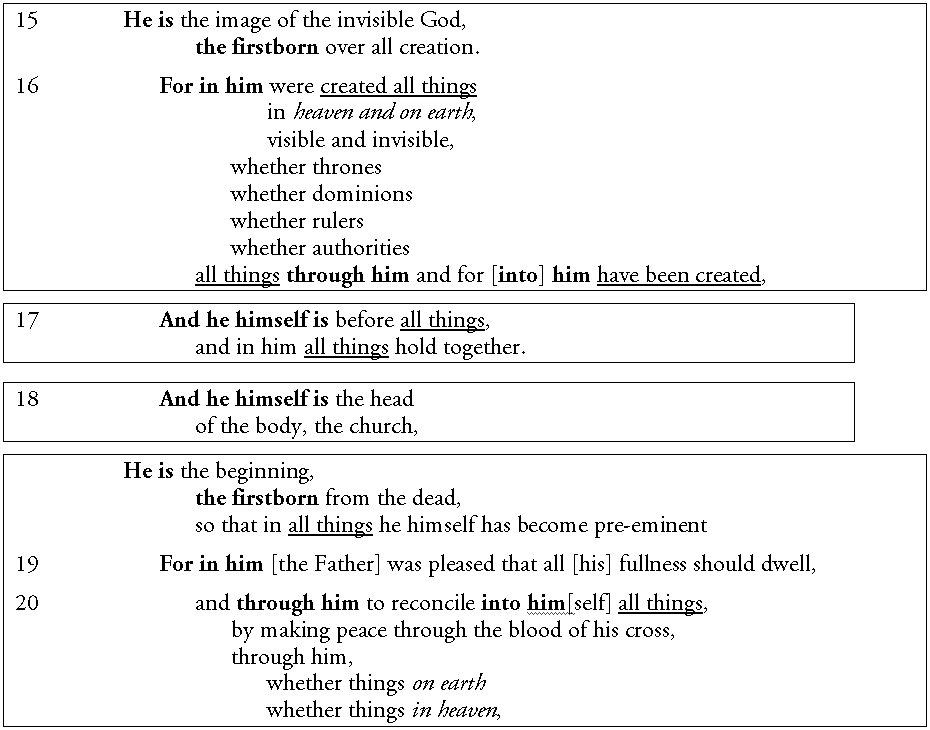
The structure of Col 1:15–20, as outlined by Andrew Fountain
in “The song hidden in Colossians”, Newlife Church Toronto;
see https://nlife.ca/audio/colossians-pt4

This poetic passage also stands as significant theological affirmation. It offers a relatively early consideration of “the person and work of Jesus Christ”, a crucial theme which later systematic theology writers would explore and develop, using this and other passages of scripture as foundations for a complex and intricate affirmation of this key element of Christian faith.

The main thrust of this passage can best be understood by giving consideration to the way this it draws on Jewish elements—specifically, the Wisdom material found in parts of Hebrew Scripture. Jesus is portrayed very much in the manner of Lady Wisdom, as we encounter her in scripture in Proverbs 8, and then in the deuterocanonical works of Ben Sirach (Ecclesiaticus) and the Wisdom of Solomon. In Colossians, of course, the attributes of the female Wisdom are applied directly to the male Jesus.

Jesus is here described as the agent of God’s creative powers: “in him all things in heaven and on earth were created … all things have been created through him and for him” (Col 1:16). In the same way, in Proverbs Wisdom herself is said to have declared that “ages ago I was set up, at the first, before the beginning of the earth … when [the Lord] established the heavens, I was there … when he marked out the foundations of the earth, then I was beside him, like a master worker” (Prov 8:22–31). 

The creative power of Wisdom

In the Wisdom of Solomon, Wisdom is described as “the fashioner of all things” (Wisd Sol 7:22), “a breath of the power of God” who “pervades and penetrates all things”(7:24–25), who was “present when you [God] made the world” (9:9), whose “immortal spirit is in all things” (12:1). 

Jesus, son of Sirach, declares that “Wisdom was created before all other things” (Sir 1:4), that at the very first she “came forth from the mouth of the Most High, and covered the earth like a mist” (Sir 24:3), and “compassed the vault of heaven and traversed the depths of the abyss” (24:5) as she undertook her creative works, distinguishing one day from another and appointing “the different seasons and festivals” (33:7–8).

Jesus Christ, as the one who is “before all things” (Col 1:17), reiterates what Wisdom declared, that “before the mountains had been shaped, before the hills, I was brought forth—when [the Lord] had not yet made earth and fields, or the world’s first bits of soil” (Prov 8:25–26).

So Jesus is the one who has “first place in everything” (Col 1:18), just as the works of Wisdom can be traced “from the beginning of creation” (Wisdom Sol 6:22). The importance of these Wisdom writings for what is stated in Col 1 is clear. (The same writings underpin the theological affirmations made about Jesus in Heb 1:1–4 and John 1:1–18.)

The passage in Colossians also indicates that believers are “transferred … into the kingdom of [God’s] beloved son” (Col 1:13); they are rescued (1:13) and redeemed (1:14) by the work of Jesus. In similar fashion, the Wisdom of Solomon contains a long section praising Wisdom who was actively involved in human affairs from when “she delivered him [Adam] from his transgression” (Wisd Sol 10:1), saved the people at the Exodus, and guided the Conquest and settlement in the land. It was Wisdom who punished the Canaanites (12:3–11), sinful Israelites (12:19–22), and the Egyptians (12:23–27), as well as all idolators (13:1—14:31). A similarly lengthy poem praising the works of Wisdom occurs in chapters 44 to 50 of Sirach, extending all to the way to Simon, son of Onias (high priest in the early C3rd BCE). 

So Jesus brings to a high point much of what had been hoped for, and spoken about, in the figure of Wisdom. All of this is now seen to reside in him, “the image of the invisible God, the firstborn of all creation … the head of the body, the church … the beginning, the firstborn from the dead …[in whom] all the fullness of God was pleased to dwell” (1:15–20). It’s a remarkable testimony.

Wisdom, by Sara Beth Baca

This year we are to celebrate 1700 years since the Nicene Creed was created. The development in theological understanding of Jesus that is found in these verses in Colossians, drawing from Hebrew scriptures of past centuries, continues apace in the ensuing centuries, as Christian writers draw more and more from neo-platonic philosophy to develop what eventually becomes a full suite of Christian doctrines—including a series of affirmations about Jesus.

It is worth noting that, just as the creative work of Jesus is noted in the Nicene Creed (“through him all things were made”), so his salvific work is also briefly described (“for us [all] and for our salvation he came down from heaven“). These fleeting references draw on the way in which scripture has used the Wisdom literature— although, of course, all four Gospels and many Epistles note the forgiving, saving, delivering work of Jesus. Colossians plays its part in attesting to this. It is, in fact, part of the bedrock of the developing patristic theology which emerged over the centuries between the New Testament and the early Ecumenical Councils. 

I’m planning to write some more blogs about credal affirmations found within scripture, and how they inform (or not) the Nicene Creed, in the context of this global celebration of 1700 years since Nicaea. Stay tuned!

Beginning Lent with a message of belonging: shaping the identity of a people of faith (Deut 26; Lent 1C)

During Lent, the lectionary sets before us a string of passages that canvass key theological elements in the story of Israel. These stories, of course, also resonate also with the story of Jesus and his followers (and that is largely why they have been selected, I assume). We begin this coming Sunday with the promise of the land (Deut 26), and then follows passages focussed on the covenant with Israel (Gen 15), the provisions of God for the people (Isa 55), the renewing moment at Gilgal (Josh 5), the promise of “a new thing” (Isa 43), and the gift of The Servant (Isa 50). It is a stirring and inspiring sequence!

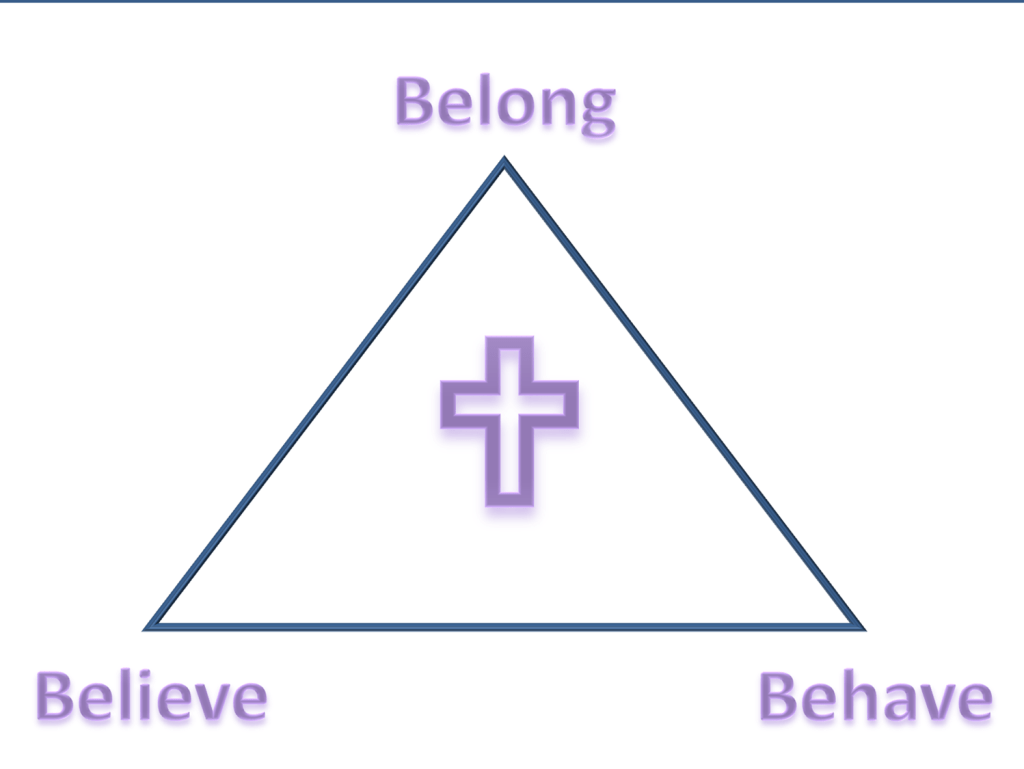
There is much debate amongst Christian thinkers, these days, about what comes first as we invite people to be a part of the church. Do we say, “this is what we believe, expressing our fundamental understanding of life; do you want to sign up to show you have the same beliefs?” Or do we say, “this is how we behave, guided by our fundamental ethical principles; would you like to act the same way and join us?” Or perhaps the invitation is simply, “come along, join in with us, see what we believe, what we are on about, and soon you’ll feel like you belong”?

Is it believe first? Or behave? Or simply, belong? The tendency to put a creed at the forefront of our invitations—to show that we are a people who believe, first and foremost—is widespread and deeply ingrained. Whether it be affirming The Apostles Creed in baptism, or saying The Believer’s Prayer at conversion, or working out a new Mission Statement for the Congregation, giving priority to belief is a very familiar pattern for us. We tend to think that, whatever formula we are repeating, that is exactly what declares and confirms our identity as people of faith.

So it’s no surprise that when we read Deuteronomy 26 (the Hebrew Scripture passage in next Sunday’s lectionary), we gravitate to the middle part of the passage, and lay claim to what looks to be an early affirmation of faith that sets out the identity of the people of Israel: “A wandering Aramean was my ancestor; he went down into Egypt and lived there as an alien, few in number, and there he became a great nation, mighty and populous” (Deut 26:5). This affirmation seems to go right back to the start, affirming what sets the people of Israel apart as a distinctive entity.

This way of reading this passage gained influence from the analysis of Gerhard von Rad, a German scholar of the 20th century. Von Rad claimed that the credal statement in verses 5 following was most likely a formula much older than the era when the book of Deuteronomy was written. And the origins of this creed, he claims, most likely lay in ancient cultic remembrances of the origins of the people. The wandering Aramean (Jacob, grandson of Abraham of Aramn) and the time in Egypt (leading up to Moses) reflect those times of origin.

*****

But the whole of this “creed” is not actually a “statement of faith”. It is more a narrative that tells a story. Such was the way of the ancient world; central beliefs were not articulated in crisp propositional statements (for this is the way of the post-Enlightenment western world); rather, a story was told, in the course of which key events pointed to central affirmations for the people. The ancients were story-tellers, more concerned to tell the story than state the faith. This is the story of the people; it is their saga.

God is important in the story that is told, nevertheless. God is the one who “heard our voice and saw our affliction, our toil, and our oppression … who brought us out of Egypt with a mighty hand and an outstretched arm, with a terrifying display of power, and with signs and wonders” (26:7–8). The rescue of the people by their powerful God is central to the story. This, of course, if the story of the Exodus, which stands at the heart of Israelite identity and later Jewish identity. It is the central story of the people of Israel.

More than this, God is the one who “brought us into this place and gave us this land, a land flowing with milk and honey” (26:9). The land of Israel is the second aspect of ancient Israelite life that is central and fundamental; and so it continues to be, in the 20th and 21st centuries, in which the land of Israel has been one of the most contested pieces of land in the world.

The story is told, however, for a purpose. Not just to remember—although remembering is important, for it recurs as a regular refrain in the book of Deuteronomy (7:18: 8:2, 18: 9:7, 27; 11:2; 15:15; 16:12; 24:9, 18, 22; 25:17; 32:7). The story is told, also, to inculcate the ethos, the values, the very identity of the people. And central to that ethos, taking prime place amongst the things that were seen to be important to affirm about who the people of Israel were, is this: giving back to God the first fruits produced by the land.

“So now I bring the first of the fruit of the ground that you, O LORD, have given me”, are the words that the people are to say, each time a harvest is produced. “You shall set it down before the LORD your God and bow down before the LORD your God”, the instruction declares (26:10). Gratitude is to the fore; gifting back the beginnings of “the fruit of the ground” to the God who gave the people the land to grow this fruit.

*****

Of course, there is a dark story submerged, for the most part, underneath that celebratory action. The land was “given” by God over the resistance of the people who were already IN the land, producing fruit, settled and content with their lot in life. The battles recounted in the book of Joshua—most likely not actual historical events, but reflecting a reality of submission to the Hebrews who took control of the land—reflect this dark story.

This dark story does not figure in the “received tradition” and “authorised affirmation” that we read in Deut 26. Nor do we find this in the affirmation of Deut 6:20–24, which begins “we were Pharaoh’s slaves in Egypt, but the Lord brought us out …”. Mention of the Exodus jumps straight across to life in the land—no mention of the conquest that (in other biblical texts) is reported in detail.

This conquest is part, by contrast, of the larger recitation of Josh 24:2–13, “I brought you out of Egypt … and I handed the Amorites over to you, and you took possession of their land, and I destroyed them before you … and also the Amorites, the Perizzites, the Canaanites, the Hittites, the Girgashites, the Hivites, and the Jebusites; and I handed them over to you … I gave you a land on which you had not labored, and towns that you had not built, and you live in them; you eat the fruit of vineyards and oliveyards that you did not plant.” At least this version of the affirmation is honest about the cost to the earlier inhabitants, and the benefits enjoyed with relative ease by the invading Hebrews.

*****

Yet the affirmation of Deut 26 highlights the central importance of gratitude for the gift of the land; and not only that, for it especially indicates the importance of making this celebration inclusive: “you, together with the Levites and the aliens [or, sojourners] who reside among you, shall celebrate with all the bounty that the LORD your God has given to you and to your house” (26:11). So the instructions for the annual festival of the first fruits provide.

The inclusion of the aliens in this annual festival reflected a gracious openness to others in the developing people of Israel. These texts differ from the xenophobic antagonism of earlier texts, recounting the conquest of Israel. They reflect a later understanding of the identity of the people, as they were collated during and after the Exile, centuries after the formation of Israel. People designated as aliens (non-Israelites), sojourners in the land, were welcome to bring offerings to the Lord (Lev 22:18), to adhere to Israelite food prescriptions (Lev 17:12), to keep the Sabbath (Exod 20:8–11; 23:12), to have gleaning rights (Lev 23:22), and to join in the annual process of atonement (Lev 16:29–31; Num 15:29).

The foundational Passover narrative indicates that aliens, or sojourners, were able to join (under certain conditions) in the Passover celebrations (Exod 12:47–49); a second narrative (Num 9:14) is much less restrictive. Aliens were to be subject to the same laws regarding murder (Lev 24:17–22), able to have right of access to cities of refuge (Num 35:13–15), and indeed to enter into the covenant at the annual covenant renewal ceremony (Deut 29:10–13; see also 31:10–13). The voice of the alien even sounds appreciation for the Law: “I live as an alien in the land; do not hide your commandments from me” (Ps 119:19).

Because Israelites were once “an alien residing in the land” of Egypt, the people were instructed, “you shall not abhor any of the Edomites, for they are your kin; you shall not abhor any of the Egyptians” (Deut 23:7); by the third generation, the children of aliens “may be admitted to the assembly of the Lord” (Deut 23:8).

This meant that “the alien who resides with you shall be to you as the citizen among you; you shall love the alien as yourself, for you were aliens in the land of Egypt: I am the LORD your God” (Lev 19:34; a similar affirmation is made at Num 15:14–16).

The principle of equality is clear: “you shall not deprive a resident alien or an orphan of justice; you shall not take a widow’s garment in pledge” (Deut 24:17; see also Jer 7:5–7; 23:5–7; Zech 7:9–10; Mal 3:5). The alien, or sojourner, deserves the same measure of justice as all residents of Israel.

Accordingly, amongst the curses at the end of Deuteronomy, we read, “cursed be anyone who deprives the alien, the orphan, and the widow of justice. All the people shall say, ‘Amen!'” (Deut 27:19). The curse outlines the negative consequences from not adhering to the positive principle of welcoming and including those sojourning for a time innIsrael, the “alien”. That is integral to the celebrations each year, when the harvest produces its fruit from the land.

Gratitude. Belonging. Celebration. Inclusion. All of this is embedded in the story; and all of this comes before believing, repeating doctrinal claims, affirming credal statements. We are a people of welcome, including, belonging. This much is embedded in the ancient Hebrew tradition. This much should be living, still, in Christianity today.

See also