So how did your bloke go?

“So how did your bloke go?” Have you been asked this question in the weeks since the election? Recently a group of local leaders and volunteers in the Jeremy Miller for Lyne campaign met with members of the central campaign team to look at the future for an Independent candidate in Lyne. As part of that exploration, we heard an overview of what the polling in the booths reveal about how “our bloke” Jeremy actually went in the 2025 election.
1 The overall result

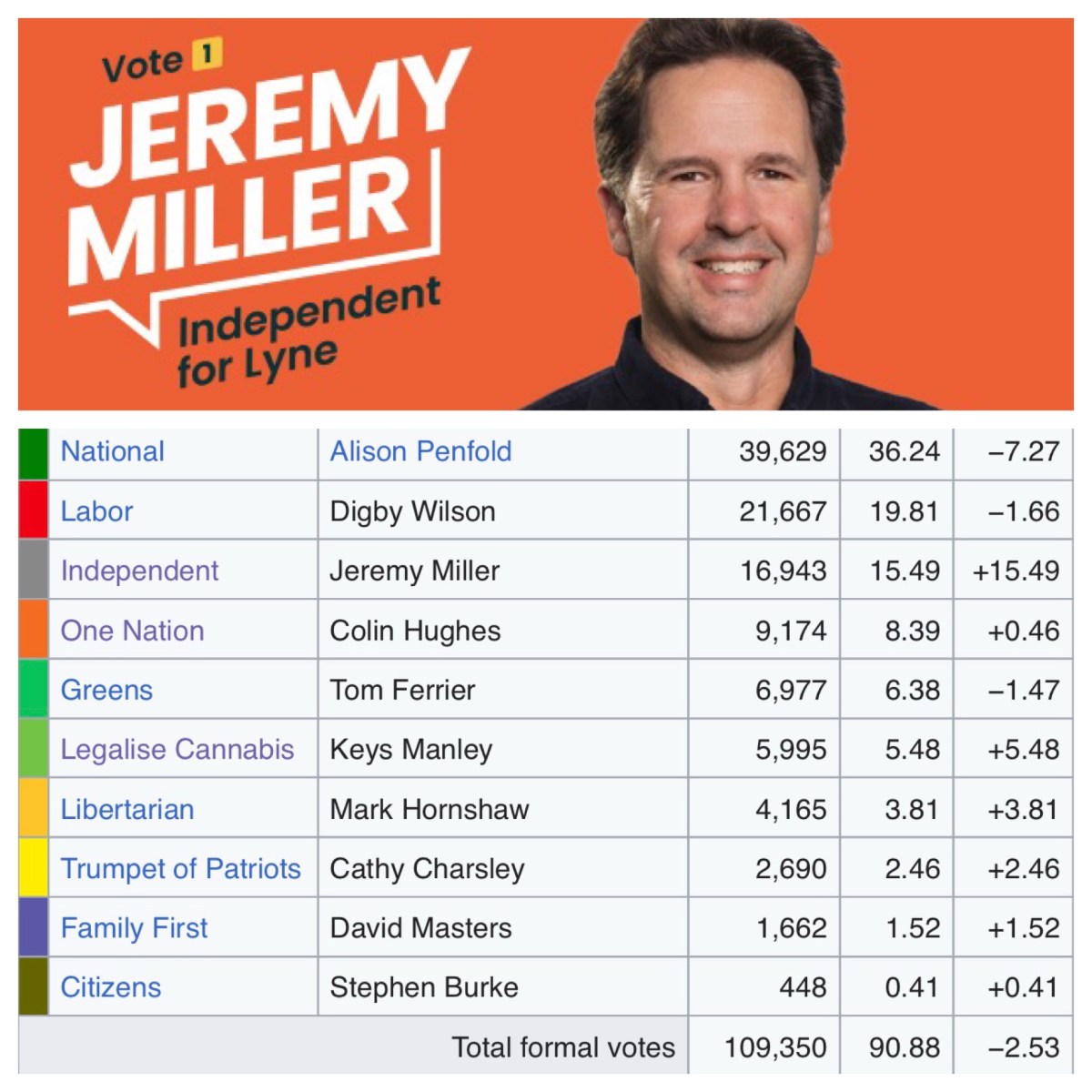
Now that the poll has been declared, we know the big picture: he didn’t win the seat—but, realistically, that would have been a huge achievement, which was somewhat unexpected. Yet, he did do remarkably well for a first-time community-supported candidate. Jeremy gained just under 16% of first preferences across the whole electorate, which was about 8% more than the votes that independent candidates gained in the 2022 election. 

And by the way: that 8% came from an 8% swing away from the Nationals candidate, for the 36.24% of first preference votes for the Nationals candidate was a healthy 7.27% less than the first preference votes for the Nationals in the 2022 election— and a massive 20% less than the 56.31% of first preferences that voters gave to the National Party way back in the 2004 federal election. That’s been a significant drop in the Nationals votes over the past two decades. Do they really think they are serving the electorate well, if one in five voters has stopped supporting them?
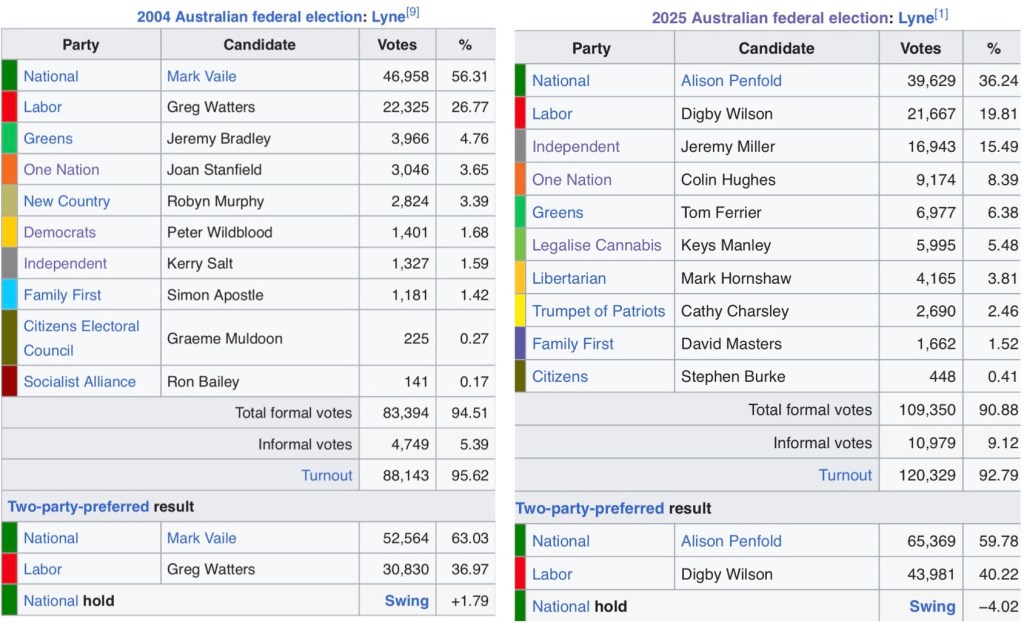
Looking at the longer-term trends, like this, as well as the detailed votes from booths across the electorate (discussed below) certainly indicates where our attention needs to be focussed in the next election in 2028: on “soft” Nationals voters who are open to being persuaded to change the way they vote. Are they happy with how the electorate is being represented in Canberra? Or are they discontent with the way the Lyne electorate is being treated? Might they be open to a different way of seeing things? After all, “if you want things to change, you need to change the way you vote”.

2 Where Jeremy polled best of all

If we look at the first preference votes cast booth-by-booth, we can see that in a good dozen or so booths, Jeremy’s vote was over 20%. He did best at Tinonee, with a wonderful 28.82% of first preference votes (more than the Labor vote and just under the Nationals votes) and at Old Bar, with 27.6% of first preferences there (ahead of both Labor and Nationals). At Taree West, where he attracted 26.2% of first preferences, he received the same number of votes as the Nationals and almost double the votes for Labor. 

A more detailed breakdown of statistics indicates that Jeremy did indeed gain votes “where it matters”—in the larger population areas of Greater Taree and Forster—Tuncurry, where 40% of the voters live.

That detailed breakdown (which you can skip if figures befuddle you) is: in the Taree area, where Jeremy’s recognition is high, he attracted over 20% of the vote at Tinonee (28.82), Old Bar (27.6), Taree West (26.28), Cundletown (25.31), Purfleet (24.00), Chatham (22.08), and Taree (21.85). The exception in this area was the lower vote of 18.5% at Taree North. Nevertheless, all of these booths are significantly higher than the 15.8% primary vote across the electorate.

Further south, in Forster—Tuncurry, the best results were achieved at Pacific Palms (24.17, higher than each of Labor and the Nationals), Coomba Park (21.67), Forster East (21.67), Forster (21.50), Bungwahl (20.55), and Tuncurry (17.09). Other good results in this part of the electorate were at Hallidays Point (23.11) and Diamond Beach (24.78). At Lansdowne, Jeremy received 19.69, and at Coopernook 16.81, whilst at the two booths in Wingham, Jeremy secured 16.84 and 14.20. Again, these booth results are higher than the average.

So this is further cause for reflection: what was it in these particular areas that helped Jeremy to push his vote up, higher than the 15.8% average for the whole electorate? Clearly, the fact that he lives in the area and that he is a very active Councillor on the MidCoast Council must both have helped in securing that higher vote. Being “known” in these areas was a strong positive for Jeremy. These results again point to an area where our energy might best be focussed in the time leading up to the next election (presumably in 2028). 

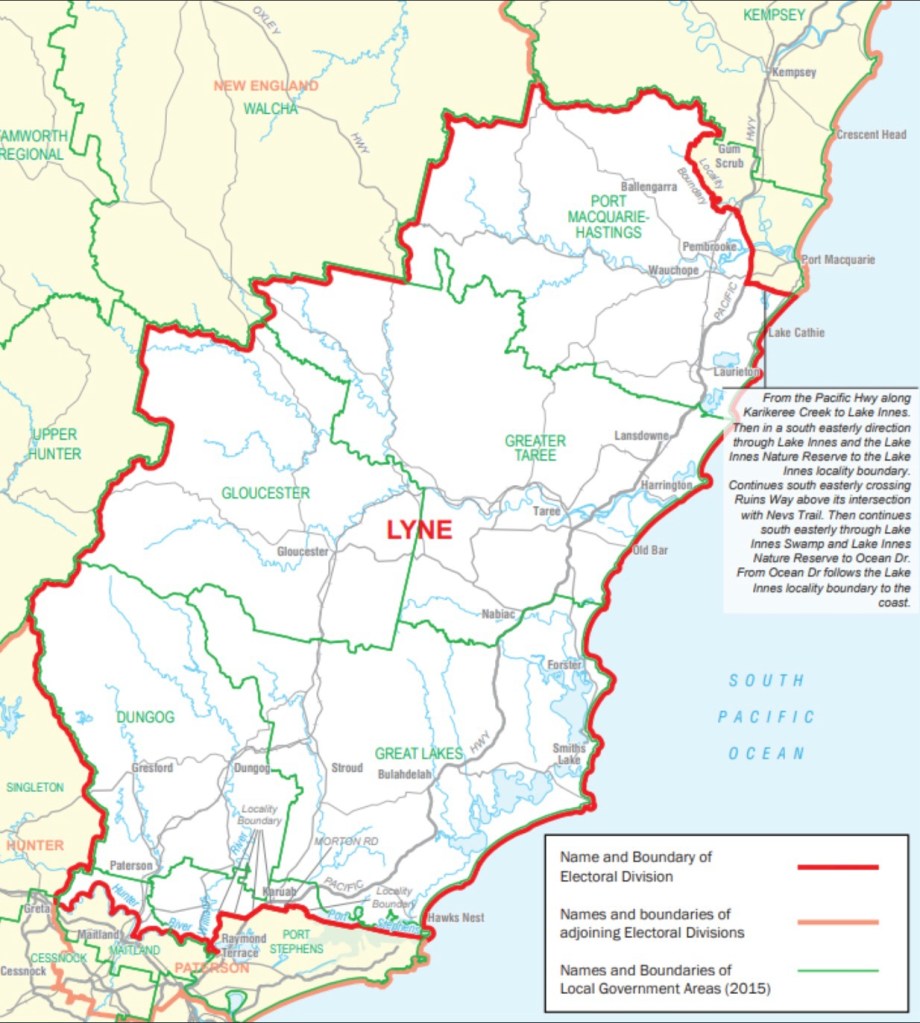
The largest blocks of voters live in the two main urban areas—Greater Taree (including Wingham, Old Bar, and surrounds) and Forster—Tuncurry. This is where the influence of the National Party is less, by comparison, than it is in the inland rural areas. And these are amongst the areas in the electorate where we might expect population growth in future years. How do we plan and implement effective campaigning in these areas in the next few years?
3 In other places across the electorate of Lyne

In the north of the electorate, at Barrington, Jeremy secured 20.99, and in Gloucester itself 16.38. In Wauchope, he obtained fewer votes: 11.28 at Wauchope and 10.53 at Wauchope South. Nearby in Beechwood, the vote was 13.26, and in King Creek 15.27. These are promising results, offering a good base for future campaigning.

In the Dungog Shire, there was a good result at Paterson (16.46), and less at Seaham (12.59), Dungog (12.57), and Clarence Town (11.92). Closer to the coast, Jeremy’s share of the votes ranged from Krambach (17.00) to Bulahdelah (11.01) and Karuah (10.19). In polling places in the Port Stephens Council, votes ranged from Hawks Nest (16.74) to North Arm (14.13) and Tea Gardens (12.60).

4 Votes for Jeremy and votes for Labor

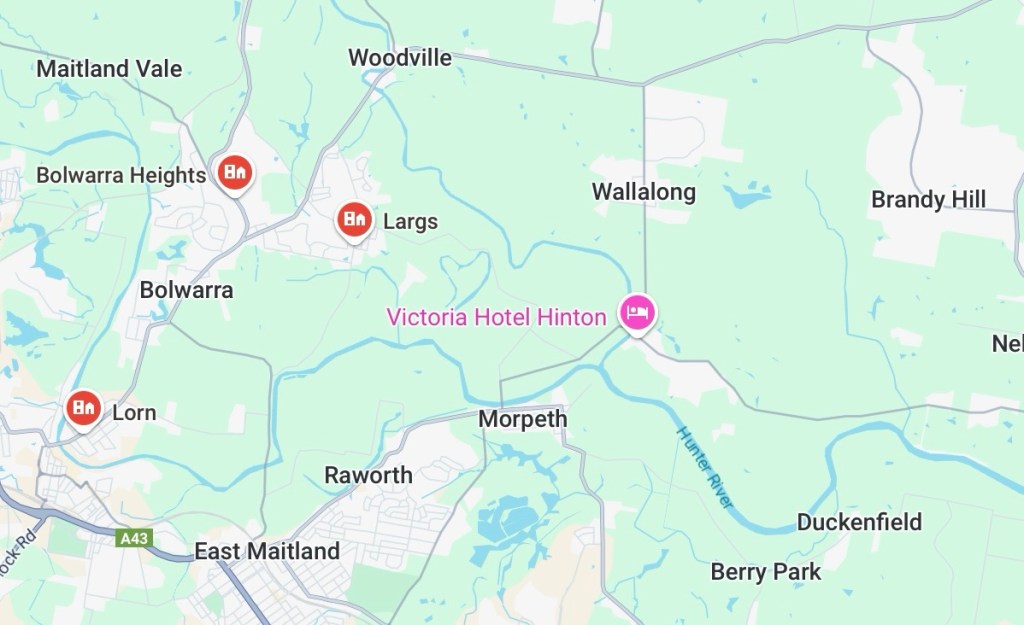
Another area of particular interest is in the area immediately to the north of Maitland which are currently included in the very southern end of the electorate. Whilst some votes for Jeremy were under 10% (in the more rural locations), better results were gained at Largs (10.81%), Lorn (11.67%), and Bolwarra (11.86%). These percentages are still below the average vote across the whole electorate. But a significant factor in this area is the support for Labor.

At these three polling booths, Labor’s share was consistently over 27%, although in Lorn it was 40.14%, the highest of all the booths in Lyne. This reflects the strong Labor base in Maitland itself (where the seat of Paterson saw a swing of 4.2% to Labor, despite the massive resources allocated to this seat by the Liberal Party). Making any headway in this area by attracting hesitant Labor voters would need a sustained campaign leading into the 2028 election.
And finally, if we look to places where Jeremy polled better than Labor, we can see some striking margins. At Old Bar, the 27.66 primary vote for Jeremy was greater than Labor’s 18.59. There were good margins also at other eight booths in this region: Taree pre-polling (21.93 to 16.47), Taree (21.85 to 14.94), Taree West (26.28 to 14.46), Cundletown (25.31 to 10.05), Chatham (22.08 to 15.35), Tinonee (25.82 to 13.64), Taree North (18.50 to 17.22), and Wingham West (16.84 to 13.46).

Jeremy also secured more votes than Labor at another seven polling booths: Hallidays Point (23.11 to 16.49), Diamond Beach (24.78 to 16.34), Pacific Palms (24.17 to 21.87), Krambach (17.00 to 14.41), Beechwood (13.26 to 12.80), King Creek (15.27 to 14.34), and Barrington (20.99 to 14.36). In all cases except for Old Bar and Pacific Palms, however, the Nationals still out-polled both Jeremy and Labor at these booths.

5 The future

So we can see from this just how well “our bloke” Jeremy did, and also just what work lies ahead for an even more successful campaign in 2028. I hope that lots will stay on board and even more sign up for that ride!

***** ***** *****

Written by John Squires, Member of the Central Campaign Team for Jeremy4Lyne, drawing on data prepared by James Foster, Polling Coordinator, Central Campaign Team, and data on the website of the Australian Electoral Commission.

See also
A growing presence of Independent candidates and Members of Parliament

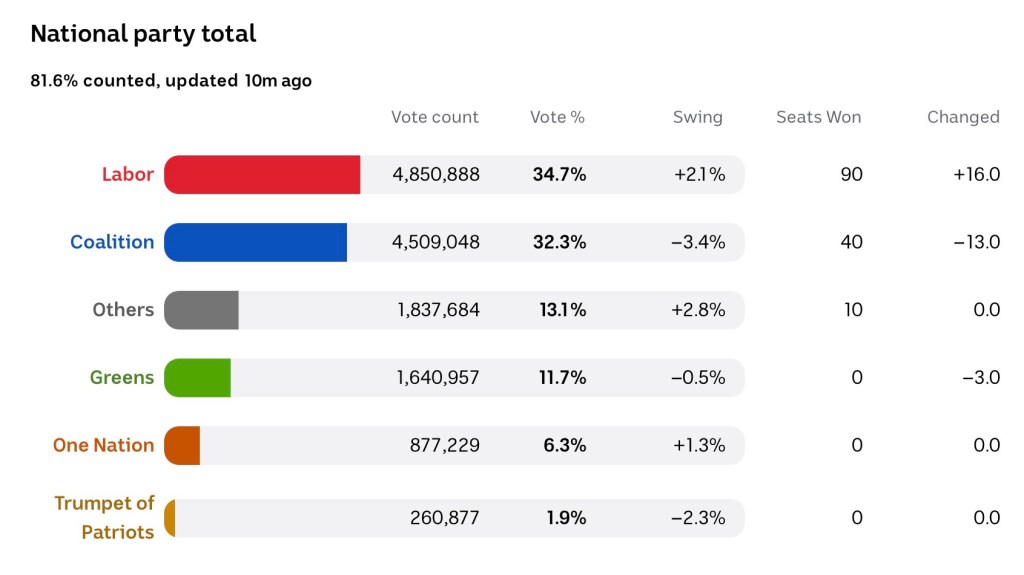
National results as of late afternoon, Thursday 8 May,
as displayed on the ABC website Australia Votes

People standing as Independent candidates have done very well in the recent federal election. While Labor attracted 34.7% of the national vote and the Coalition dropped to 32.3% of the vote, Independents collectively secured 13.1% of the national vote—a rise of 2.8% compared with 2022. On the left flank, the Greens had a small drop of 0.5% in their votes, to 11.7%, while on the right flank, One Nation rose by 1.3% to 6.3%. 

While Labor has more than twice the number of seats in the lower house than the Coalition, and neither Greens nor One Nation now have any seats (nor the Trumpet of Patriots and the Libertarian parties, for that matter), Independents look set to hold at least 10 seats in the House of Representatives. 

A number of Independent candidates have clearly been returned to their seat in the current election. Allegra Spender returns to Wentworth, former seat of John Hewson and Malcolm Turnbull, with an increase in primary votes of 7.7% from the 2022 result. Kate Chaney has also returned in Curtin, WA, where Julie Bishop had long been member; she has a 3.2% swing to her on primary votes. Both of these candidates come from long-established Liberal families; they have well exemplified the disenchantment, over a number of years, with the veer to the right that Abbott, Morrison, and Dutton engineered in the Liberal Party. 

Other seats once considered safe Liberal seats are now in Independent hands. Dr Sophie Scamps returns to be the representative for Mackellar, NSW, where Bronwyn Bishop once held sway, with an estimated gain of 2.0% after the distribution of preferences. To her south, in Warringah, the old stamping ground of Tony Abbott, Zali Steggal has been returned for a third term, with 40.2% of the primary votes (an increase of 0.4%), substantially outpolling the Liberal candidate, who dropped 1.9% of the votes gained in 2022. Two more blue-ribbon Liberal seats where Independents are now ensconced!

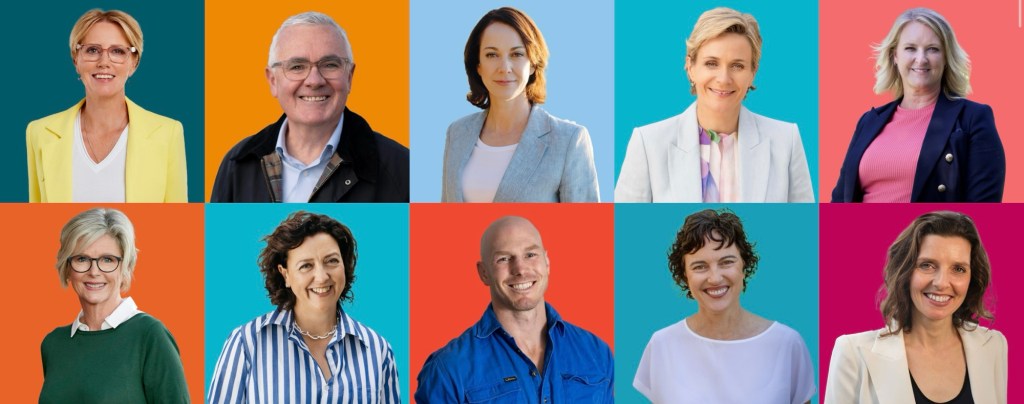
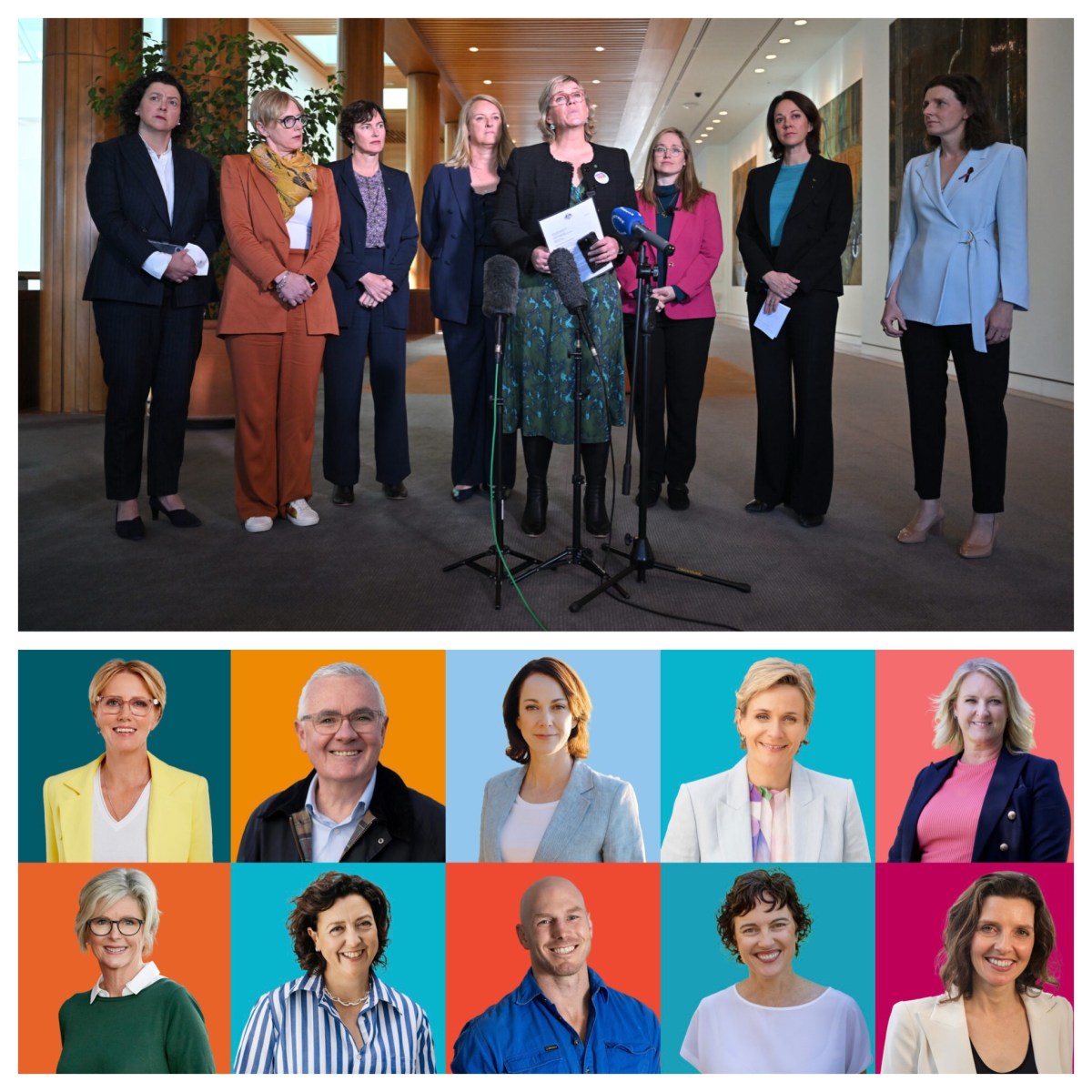
The group of eight community-supported Independents
at the start of the 2022 Parliament

The Queen of the Independents, Dr Helen Haines, who was elected to the seat of Indi after Cathy McGowan had served two terms (2013–2019) and has held the seat each time, was returned this election with a swing of 2.1% on the primary votes. Always returning a conservative member before this, long ago Indi was held by Isaac Isaacs (later a High Court Justice) and “Black Jack” McEwen (Country Party leader and briefly acting Prime Minister). 

Alongside her, in the seat of Clark in Tasmania, Andrew Wilkie retains his seat with an increase of 3.8% in his primary votes. He has held the seat since 2010, when he was a surprise winner, coming from third in the primary vote to win the seat. He was only the sixth House candidate in seventy years to win an election from third position in the vote! This seat is named after Andrew Inglis Clark (1848-1907) a lawyer and politician who introduced proportional representation in Tasmania using the electoral system that has come to be known as Hare-Clark. If this excellent system was used in federal elections, we would have a very different configuration of members in the Federal Parliament!

Another candidate who could possibly move up from third place in the primary vote once preferences are distributed is the Independent candidate Kerryn Jones, in Fisher, Qld. Although she has only 16.5% of the primary vote, Labor has 22.2% and the front runner, the Liberal-National Party candidate, has 37.8% of the vote, which puts him in the “danger zone”. The ABC notes that the Independent candidate “could yet move into second place which will create an interesting final count” because of the low LNP primary vote. Interesting! 

There’s a similar scenario in Grey, in SA, where first-time Independent candidate Anita Kuss has secured 18.4% of the primary vote. She is only4% below the votes for Labor, and the leading candidate, the Liberal, is also in the “danger zone” with 35.2% of the primary vote. The Independent would need a good proportion of the 24.3% of votes gained by the Greens and four rightwing minor parties.

Similarly, in Forrest, WA, Independent Sue Chapman has 18.4 of the primary vote, again only around 4% behind the Labor candidate, on 22.7%, and the Liberal candidate, who is very much in the “danger zone” on 31.7% of the primary vote. The 27.2% of the votes gained by the Greens, Legalise Cannabis, and three minor parties from the rightwing will be determinative. Accordingly, the ABC is calling this as a win for the Liberals.

In the seat of Bean in the southern part of Canberra, an Independent candidate with 26.9% of the vote is running close to unseating the Labor member, who suffered a swing of only 0.7% against him. We previously lived in this seat and know that David Smith is a very popular local member. The Liberals dived down 6.7% and the Greens 5.7%, so the Independent candidate, Jessie Price, has attracted votes from all directions—she is a good chance to win.

Alongside this, in the ACT as a whole, Independent David Pocock has decisively won a seat in the Senate, attaining a massive 18.59% increase in primary votes when compared with 2022. That gives him a primary vote of 39.8%, ahead of Labor on 31.6%, with 1.19 quotas on his primary vote alone. That’s a ringing endorsement!

In the seat of Calwell on the northwestern outskirts of Melbourne, three Independent candidates have run. They have secured 30.9% between the three of them, with Labor suffering a swing of 14.2% against it and the Liberals dropping by 8.1%. It is not yet clear who will emerge as the final winner in this seat, although the ABC is leaning towards Labor, with 30.9% of the primary vote, over the Liberal candidate, with 15.6% of the vote.

In Flinders in Melbourne, where the Liberal candidate scored 41.7%, there is a possibility that an Independent might take the seat. The Independent currently has 21.6% of the vote, just behind Labor on 22.2%. The ABC website says “Flinders remains in doubt as it is unclear who will finish second. A Labor second place win would deliver victory to Liberal MP Zoe McKenzie. But if Independent Ben Smith finishes second, he will attract a big majority of Labor and Green preferences. The AEC is currently trying to resolve who might finish second.”

In Kooyong, also in Melbourne, the sitting Independent candidate sits on 34.5%, a swing of 3.7% to her. The Liberal candidate drew a small swing of 0.6% but this may not be enough to enable her to take the seat from Independent Dr Monique Ryan. This seat is mighty close!

In Bradfield in northern Sydney, Independent Nicolette Boele has also almost made it over the line, with a swing to her of 4.6% taking her to 27.5% of the vote. With a possible preference flow from Labor, the Greens, and another Independent candidate, she may well just win this seat.

Dai Lee, a longterm Councillor and former Deputy Mayor of Fairfield Council has been returned in Fowler, NSW, with a 6.2% increase in primary votes, while Andrew Gee, a former Nationals MP for Calare, looks set to take the seat, with a massive 17.2% swing against his old party, the Nationals. A second Independent running in this seat obtained 15.8% of the votes, so together the Independents have 39.6% of the votes. 

In Adelaide, Rebekah Sharkie of the Centre Alliance will retain the seat of Mayo, with a projected swing to her of 1.5% after distribution of preferences. And, of course, in far North Queensland, the maverick Bob Katter is returned in the seat of Leichhardt with 40.8% of the primary votes.

In the Melbourne seat of Goldstein, Tim Wilson has claimed victory, to regain the seat he lost in 2022. He has 44.2% of the primary votes, against 31.7% for Independent Zoe Daniel, who is currently tracking about 1500 votes behind Wilson after preferences are distributed.

In two rural seats, pundits were tipping wins by two strong community-supported Independents, but these did not materialise. In Wannon, in western Victoria, Alex Dyson ran for the third time against the Liberal incumbent. Although he increased his vote by 12.9%, preferences in this seat are set to deliver it to the Liberal incumbent. In Cowper, on the mid north coast of NSW, Caz Heise ran for the second time against the Nationals incumbent. She increased her vote by 3.5%, but also in this seat the preferences are pointing to a win for the Nationals incumbent.

Just to the south of Cowper, in Lyne, Jeremy Miller ran with the support of the community organisation, Independent Lyne. A primary vote of 15.84% was not enough to put him into second position, so the likely outcome will be that the new Nationals candidate will keep this as a Nationals seat. There is, however, a rather slim hope that he may receive enough preferences from the Greens (6.0% primary vote) and assorted minor party candidates in the seat (with 22.3% between them) to “catch” and then overtake the total number of votes (primary plus preferences) for the Labor candidate. There are just under 4,000 votes (not quite 4% of the votes cast) between the two candidates. 

If the preferences distributed from all the minor party candidates largely avoid the Independent, he remains in third place, so his preferences would then be distributed amongst Labor and Nationals. Given the rightwing leanings of all but one of those minor parties, this seems most likely.

Or: if, perchance, the Independent candidate has attracted enough preference votes from those minor parties to put him ahead of Labor, then the preferences of the 20,000 plus votes for the Labor candidate will be distributed—and that could well push Jeremy Miller close to the 50% mark; although obviously he won’t reach that. Just how far short he falls, ultimately, is an interesting feature for those of us involved in the campaign to watch in the coming week.

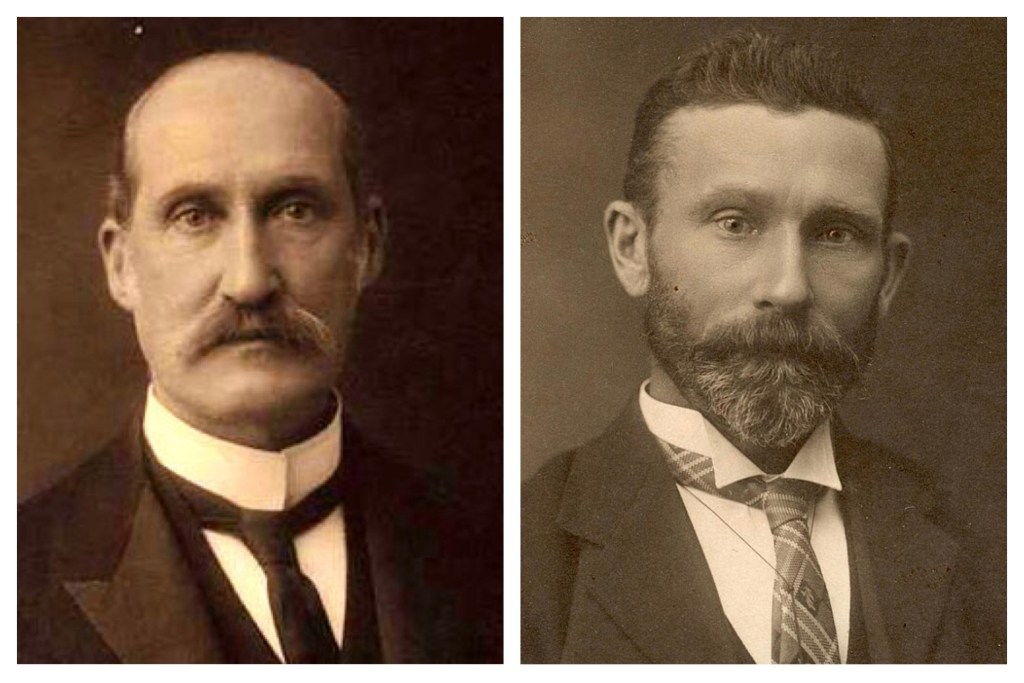
Whatever the result, it is clear from this national overview that the movement to elect community-supported Independent members of parliament is strong. As Joshua Black of the Australia Institute notes, “Australia is a world leader in electing Independent MPs”. He points to the two elected to the first federal parliament—both from electorates in Queensland. Alexander Paterson was elected as an Independent Free Trade member, and James Wilkinson, elected as an Independent Labour member. 

Alexander Paterson, left, and James Wilkinson, right

Black then notes that “between 1980 and 2004, 56 Independent MPs were elected to parliaments across Australia”. As well as those noted above, the list includes Ted Mack, Phil Cleary, Peter Andren, Pauline Hanson (for less than a year, before she formed her party), Bob Katter (still counted as an Independent although he also formed his own party), Tony Windsor, Rob Oakeshott, Kerryn Phelps, and Kylea Tink (whose seat was abolished ahead of this election). It’s a strong, enduring, and growing movement!

See

https://australiainstitute.org.au/post/election-entree-australia-is-a-world-leader-in-electing-independent-mps/

and

https://www.indiewins.com.au