
In the name of the apostle … (2 Timothy, Pentecost 17C to 21C)

In this latter part of the season after Pentecost, in Year C, the Revised Common Lectionary is taking us through a tour of a number of letters attributed to Paul—which most likely, for various reasons, were not actually written by Paul himself. We’ve read a couple of excerpts from 1 Timothy and launch into 2 Timothy this coming Sunday, after which we move on to 2 Thessalonians.

Many scholars consider that the apostle Paul did not actually wrote any of these letters (along with some others also attributed to Paul—Titus, Ephesians, and perhaps even Colossians). They have been able to come to this view because of what is known about the widespread practice, in the ancient world, of circulating letters and other documents in the name of an eminent person from an earlier age—a great scholar, or philosopher, or religious leader, or teacher. This was done by a writer who wished to “borrow” the authority of the older figure, believing that this would give greater weight to the views and teachings included in their work.

The suggestion is that members of the church in the later decades of the first century did this, using the name of Paul, because they regarded him as a teacher of note and an apostle of the church. There were already many works like this in Jewish circles, and a number amongst the gentiles also; so this was a well-known practice. And the ancient world did not have the strict laws of copyright and intellectual property which characterise the twenty-first century!

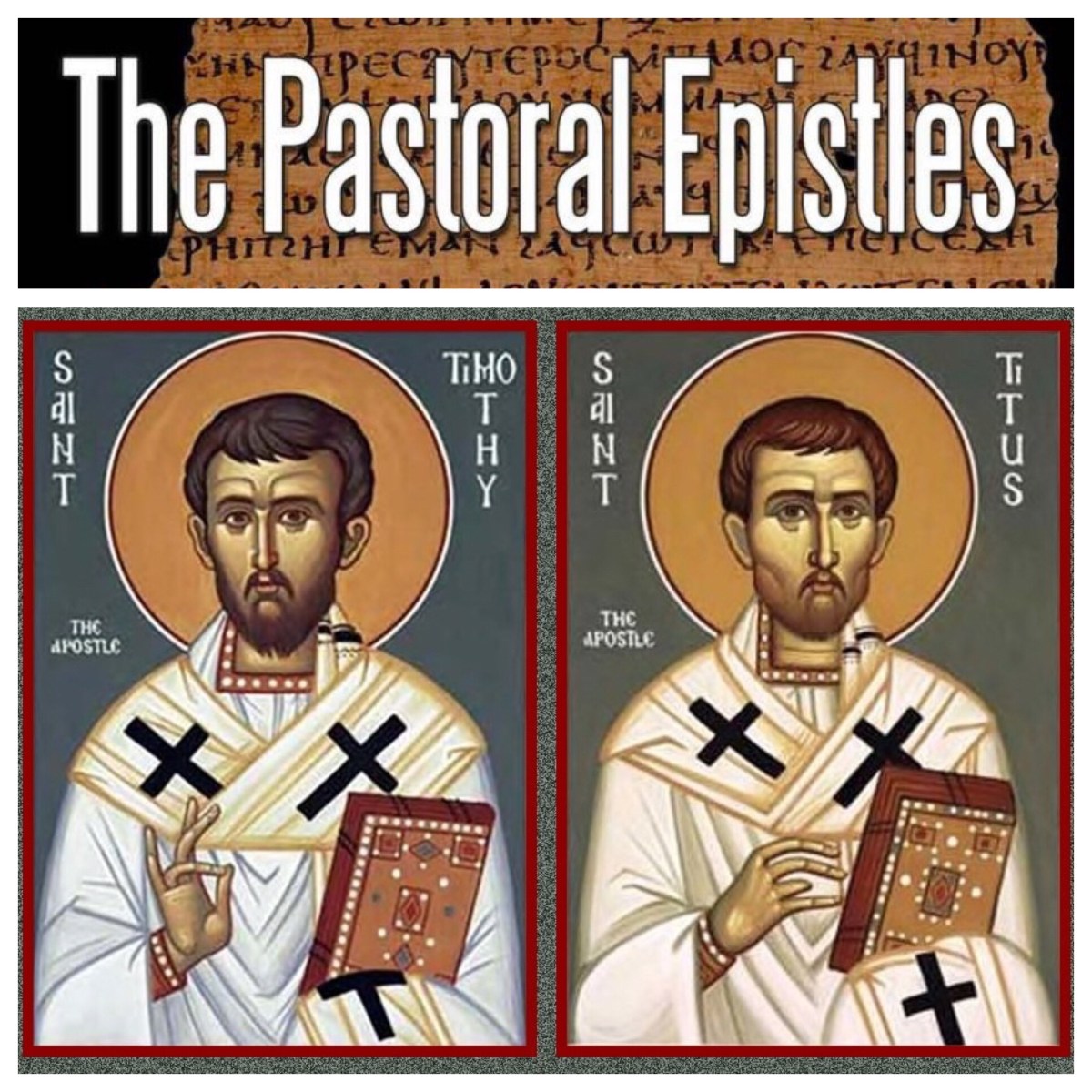
1 and 2 Timothy are two of the three letters written in the name of Paul which are addressed to two individuals whom Paul valued as co-workers and employed as ambassadors to his churches—Timothy and Titus. The letters are commonly referred to as the Pastoral Epistles because, it is felt, they are concerned almost entirely with matters internal to the structure and governance of the churches.

Whilst Paul’s authentic letters reflect the dynamic nature of the community of faith, these letters reflect a move towards a more developed organisational structure. They point towards the institutionalised church of the second century and beyond, in which the way of Jesus would become determined by the authority of the apostle and his local representative, the bishop.

Each of these letters is addressed to a fellow-worker of Paul who is known from other references in Paul’s authentic letters. Titus accompanied Paul and Barnabas to Jerusalem (Gal 2:1, 3) and was a fellow-worker with Paul in ministry to the Corinthians (2 Cor 2:13; 7:6, 13–15; 8:6, 16, 23; 12:18).

Timothy also accompanied Paul as “co-worker” (Rom 16:21) and fellow- preacher (2 Cor 1:19) and was a regular intermediary between Paul and believers in Thessalonica (1 Thess 3:1–6), Corinth (1 Cor 4:17; 16:10) and Philippi (Phil 2:19–24). Timothy is described as the co-writer, with Paul, of three authentic letters (2 Cor 1:1; Phil 1:1; 1 Thess 1:1) as well as two debated letters (Col 1:1; 2 Thess 1:1). In Acts, he appears regularly as an associate of Paul (Acts 16:1–2, 14–15; 17:5; 19:22; 20:5).

Each letter begins with a familiar assertion that it was written by Paul, but modern scholars have identified various doubts about this claim. Indeed, strong arguments can be advanced for dating these three letters after the lifetime of Paul. Clearly, these letters were written by someone with good knowledge of Paul and his teachings.

Yet the format of the letters and the distinctive vocabulary used throws doubt on the claim that Paul was the author. Whilst they each have a traditional framework for a letter, the body of the letter often reads more like a sermon or a moral treatise.

Over one third of the words found in these three letters are not found in the authentic letters of Paul. Many words found frequently in the authentic letters do not appear anywhere in these three letters.

In addition, the situations addressed, the theology of the letters and the ecclesial structures envisaged reflect many differences between each of these three letters and the seven authentic letters of Paul.

Together, all of these elements point to the conclusion that the author wrote these letters after the lifetime of Paul. He reaches back in time to the figure of Paul in order to validate the teachings given to the community of faith in his own time. The figures of Timothy and Titus represent the leaders in the communities of faith in this later period.

As we hear excerpts from the Pastoral Epistles in worship, and reflect on what they are saying to us today, we might ask:

How important is it, for you, to affirm that Paul himself wrote each of these letters?

Can you be comfortable with the idea that a follower of Paul wrote them in his name?

What message about the life of the church comes through these letters?

Harness the passion, but restrain the rhetoric. Musing on the role model which Paul offers in Galatians.

For the next few weeks, the Revised Common Lectionary includes sections from Paul’s letter to the Galatians. I am interested to explore this text in relation to our contemporary context, and particularly consider what sort of role model Paul offer us, as he writes this short but potent letter.

The letter to the Galatians begins in a dramatic, striking fashion. There can be no doubting the passion that is driving Paul as he writes (or, more likely, dictates) this message to the Galatian believers. The very way that this letter starts is instructive.

Almost all of his letters begin with a prayer of thanksgiving, designed to strengthen the relationship between Paul and those to whom he writes. Not so in Galatians: in place of a friendly thanksgiving, Paul launches straight into a devastating criticism of the Galatians, with the wordsI am astonished that you are so quickly deserting the one who called you …[that you] are turning to a different gospel … [that] some are confusing you and want to pervert the gospel of Christ.

In quick succession, he criticises their activities, attacks the beliefs they have adopted from their teachers, and invokes a curse on their heads (1:6-9). That is quite a dramatic opening section! As the letter proceeds, he accuses the Galatian believers of being fools who have been bewitched by deceivers; he accuses them of biting and devouring one another; he criticises them for urging Gentile converts to be circumcised and to adopt full adherence to the Torah. This is no gentle, reflective spiritual meditation; this is full-on partisan polemics!

What do we make of this language used by Paul?

Strong language is not uncommon in Paul’s letters. It was also widespread amongst the educated class of the day, who had been taught how to mount a strong and effective criticism by the careful use of rhetorical techniques. Rhetoric was taught to privileged young (male) members of Greco-Roman society—which would have included Paul. Many of the techniques taught in those schoolrooms are in evidence in the letter to the Galatians.

Paul uses familiar rhetorical techniques to address the situation in Galatia, to expose his concerns, and to articulate his point of view. Other teachers had visited the Galatian community, and had taught them things that were at odds with what Paul was teaching. Paul uses rhetoric to persuade the Galatians to dissociate themselves from the teachings which apparently had been so effective amongst them. 

If we knew precisely who the Galatians were, what group of teachers had been active amongst them, or what specific matters caused Paul to write this letter, we might be better placed to adjudicate on this matter. Unfortunately, we don’t have this kind of information.

The letter is sent to communities of faith in a whole region (Galatia, 1:2), not a single city or town. Acts indicates that Paul visited there with Barnabas he visited Pisidian Antioch (Acts 13:14–14:23) and later with Timothy (18.23). But we learn no further specifics of the Galatian churches from Acts. There is a similar vagueness about the date of the letter; “late 40s or early 50s” is most often cited. So the specifics of the origins of this letter are not entirely clear.

Nevertheless, the dynamic that we can perceive within this letter, between its author, Paul, and the disciples in the region of Galatia, are quite interesting. Perhaps, even, disturbing. Certainly, to be sure, challenging. Not only with his dramatic language at the start, but also in the middle of the letter, Paul is in full flight: “You foolish Galatians! Who has bewitched you? … Are you so foolish? Having started with the Spirit, are you now ending with the flesh?” (3:1, 3).

And towards the end of the letter, he launches into the Galatians yet again, providing a long list of “the works of the flesh”, those negative things that they are doing (5:19-21), and then seeking to persuade them to change their behaviour , “Let us not become conceited, competing against one another, envying one another.” (5:26).

The letter is peppered with such robust, assertive, even aggressive polemic.

In the church today, as in the wider society, we regularly encounter similarly robust conversations, in which aggressive name calling and simplistic sloganeering abound. In the Uniting Church, debates over sexuality have, for decades now, often lapsed into accusations of heresy, advocacy of progressive views, reinforcement of allegedly orthodox stances, and charges of being inspired by Satan. Such is the way of our discussions together, sadly.

In reflecting on such discussions in the context of this letter from scripture, I think we can validly affirm the model that Paul provides, at least in this: articulating what we hold as important, in ways that are clear, through advocacy that seeks to be compelling, in terms that aim to be persuasive. We all need to implement this in our lives. Be clear about what we believe, stand firm for what we value. Those are valuable elements in the model that Paul provides for us.

At the same time, I want to quarrel with the apostle in terms of the manner by which he does this. Aggression which feeds conflict, confrontational polemic which becomes vituperative hate speech, serves nobody any good. Let us not take this element of the model that is provided in Galatians; let us steer away from personalised name-calling and theological sloganeering wherever we can.

Was Paul effective and successful in convincing the saints in Galatia to turn from the pathway they were travelling, to adopt new practices and implement new patterns of discipleship? We don’t actually know. We have his powerful words of persuasion as a testimony to his passion, but no follow-up communications indicating how the Galatians responded.

I suggest that it is good for us to hold to that passion which Paul exhibited, but we need to work hard to ensure that our discussions remain constructive, that our debates demonstrate respect for the other, that our words to one another will build up rather than tear down.

See also https://johntsquires.com/2018/11/17/let-your-gentleness-be-known-to-everyone/