For many years, people have come to church for key festive days of celebration. You may know the old saying about people who are “C-and-E Christians”—that is, they come to church at Christmas and Easter. And churches welcome this influx of irregular visitors—it is good to celebrate the key moments of our faith with those who choose to join in on those days.
In more recent years, a third festive day has emerged as a time when churches are filled with people joining in the celebrations. The Day of Pentecost is taking its place alongside Christmas and Easter as a key festive day in the church’s calendar. Pentecost, of course, is fifty days after Easter (the name itself signals that fifty-day marker). This year, it took place last Sunday, 28 May.
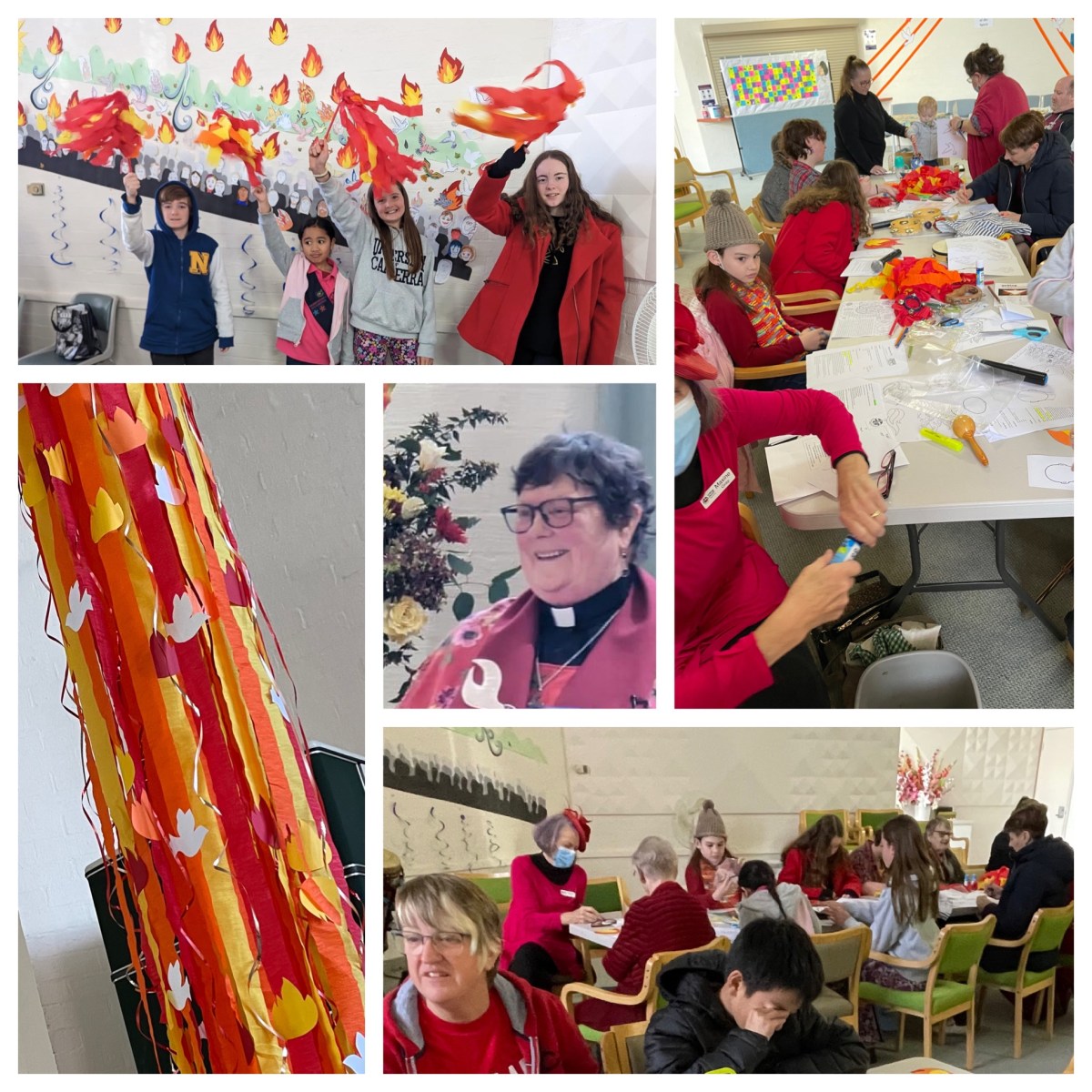
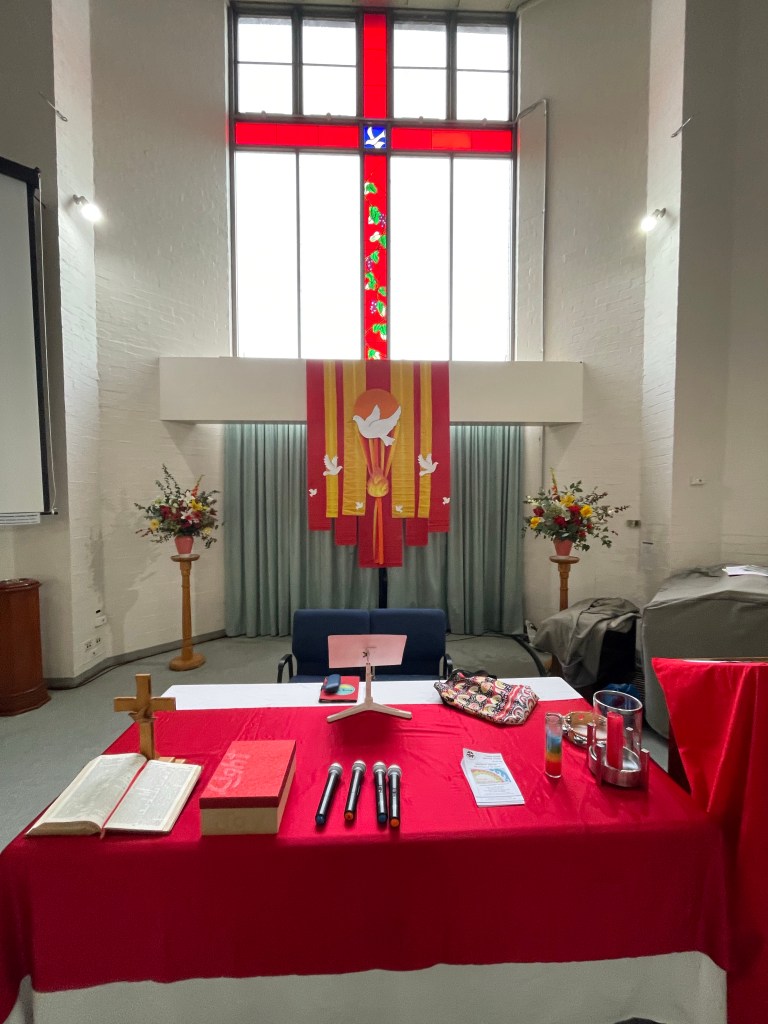
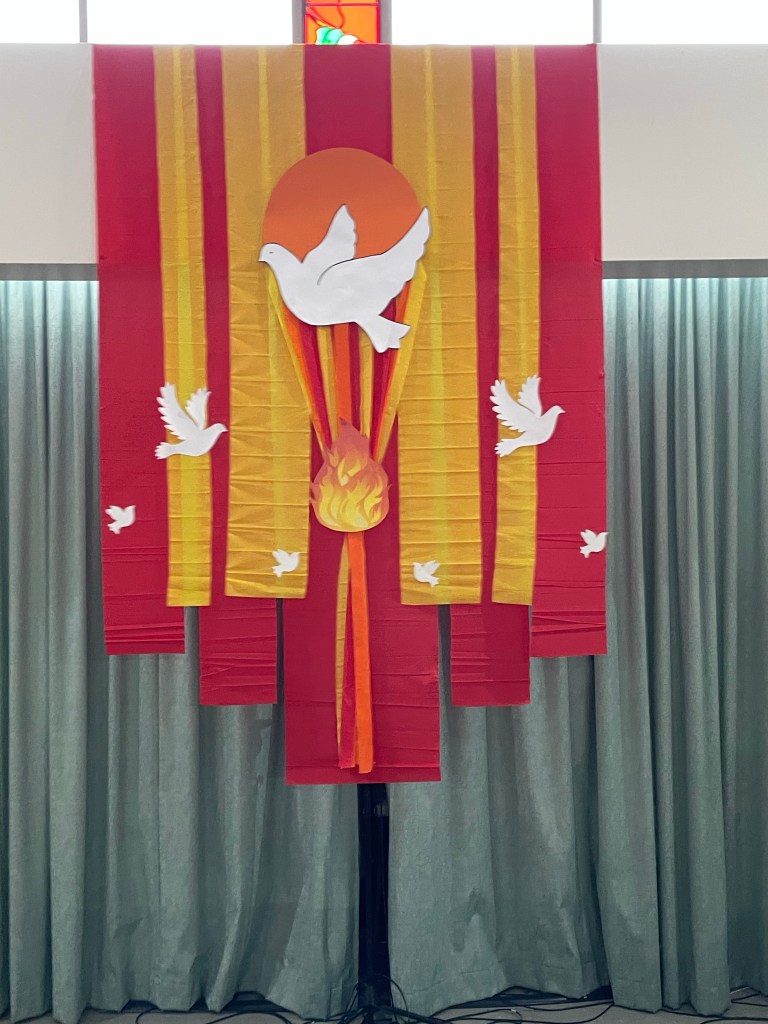
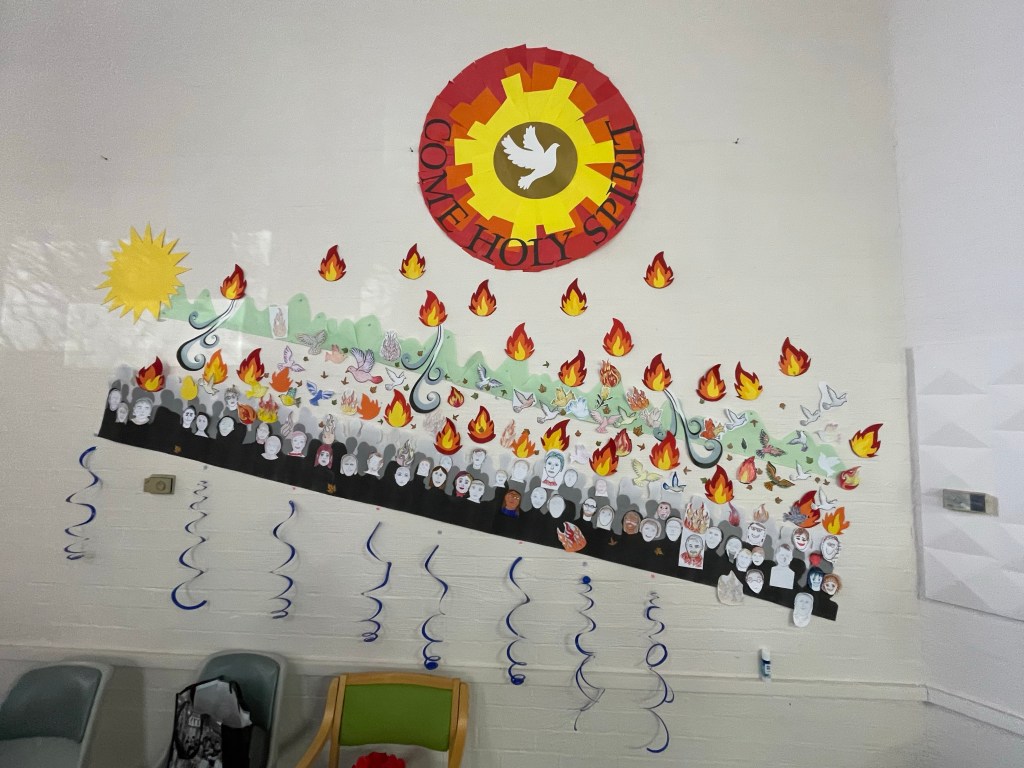
Tuggeranong Uniting Church (ACT, Australia) prepared for worship on Pentecost Sunday
Pentecost offers a wonderful opportunity for celebrating what is best about our faith. Remembering the coming of the Holy Sprit amongst the early followers of Jesus means that we can celebrate the openness to change, the joy of new developments, that we see around us in the church today. As the Spirit swooped with power amongst those early followers, so too the Spirit is energising the church today to new ways of serving.
Red is the colour for the day, signalling the flames of fire by which the Holy Spirit rested on each of the believers who were gathered in the story told by Luke. At Tuggeranong Uniting Church, Pentecost Sunday has become one of the days when the Tuggeranong 15th Girls Brigade shares in leadership of the service. Girls Brigade Captain Elizabeth Moglia and a crew of enthusiastic helpers decorated the church with striking red-orange-yellow streamers and banners; the scene was set for a fine time of worship!
As the Rev. Elizabeth Raine gathered the congregation with an Acknowledgement of Country, members of the Girls Brigade led in prayer and presented a dramatic “radio news” account of the day of Pentecost. The regular group of five musicians led the congregation for the singing of joyful Pentecost songs, and one member of the congregation offered the Prayers of the People, praying for people in need locally and around the world.
The church was set up for people to sit at table groups, and as the service progressed, each person present was invited to draw their face and pin that face, along with some fiery flames and doves, onto the side wall under a sign inviting “Come, Holy Spirit”. This symbolised the empowering of each member of the congregation for mission in their lives.
Present for this worship service was a strong contingent of younger members who brought energy and enthusiasm to the worship, inspiring all to join in enthusiastically. There was even a line of “cheer squad leaders” waving bright red-orange-and-yellow streamers during the joyful songs!
Elizabeth invited the congregation to consider: “does the Spirit still sweep through the church today, in the same way she did on that first Pentecost”? People responded by saying together an affirmation of the Spirit: “We believe in the spirit. She is extraordinary and wonderful; unknown and mysterious. She is always whirling, always animated; powerful and intense. She is magnificent and amazing; the fantastic, happy, joyful, golden, expression of God” (affirmation from Spill the Beans).
And, because it was the birthday of the church, there was a birthday cake to share at morning tea (and some smaller cupcakes for those with lactose or gluten intolerances); and a box with “gifts of the Spirit” for the young people present—gifts of joy, love, patience, courage, compassion, and more.
What a wonderful celebration! What a fine way to remember a central aspect of our Christian faith! What a great way to be motivated to live our neighbour, share our compassion, and serve those in need in our communities!
We have already noted that the Spirit is explicitly absent from the narrative of Acts, from after Paul is arrested in Jerusalem (21:22–28:31). It is only in the closing scene, in Rome, that the Spirit is again mentioned. This is quite unlike the earlier concentrations of references to the Spirit, both in the Gospel and in earlier sections of Acts.
We have explored—and dismissed—some possible explanations for this mysterious disappearance of the Spirit in this final section of Acts. What other explanations might there be?
Perhaps the notion of a divine spirit, so integral to Jewish thinking, was strange and incomprehensible in the hellenistic world? Could this have led Luke to be reticent to refer to the spirit in this later, more strongly hellenistic section of his work?
The key problem with such an hypothesis, however, is that belief in spirits was actually widespread throughout the hellenistic world; there is indication of this from centuries prior to the first century in works such as Cicero’s De Natura Deorum (and see a comprehensive survey of occurrences in Greek literature in https://www.academia.edu/8368040/The_Term_Demon_in_Greek_Literature)
Further, as already noted, the interactions that Jesus had with unclean spirits during his ministry in Galilee indicates that this perspective held strong during the first century even within Judaism. In an earlier post, we noted that Jesus confronted the spirits in a man in the synagogue in Capernaum (4:33), in a demon-possessed man the country of the Gerasenes (8:29), in the daughter of Jairus, a leader of the synagogue (8:55), in the boy convulsing because of an unclean spirit (8:39, 42), and in the woman crippled for eighteen years (13:11). See https://johntsquires.com/2022/06/02/towards-pentecost-2-the-spirit-in-the-story-of-jesus/
*****
Another possible explanation for the disappearance of the Spirit after chapter 21 could be in the fact that the missionary activity of Paul came to an end with his arrest in the Jerusalem Temple. From this point onwards, there is no reporting of the speeches that Paul made to persuade people to believe in the good news of Jesus; rather, we hear series of apologetic speeches which Paul delivers to the various Roman authorities who are charged with dealing with him once he has been brought before them.
Paul speaks apologetically—that is, he defends himself and his beliefs, and also advocates for a better understanding of the beliefs and practices of The Way—in speeches that he delivers before a large crowd in Jerusalem (22:3–21), the Jewish Council and Roman Tribune in Jerusalem (23:1–6), Governor Felix and his wife Drusilla in Caesarea (24:10–21), Governor Festus in Caesarea (25:8–12), and finally King Agrippa, his consort Berenice, and Governor Festus in Caesarea (26:1–32). Luke explicitly notes that Paul offers a “defence” at (22:1; 14:10; 25:8, 16; 26:2, 24). His final speeches to the Jewish leaders in Rome (28:17–20, 25–28) also have the nature of a defence.
The techniques evident in these speeches (attributed to Paul, but clearly written and shaped by the author of the orderly account) reflect a high level of educational attainment and rhetorical finesse. Why would the Spirit be needed, we might ask, when the education of the speaker (mediated via the educated writer of the work) sufficed?
So a reasonable explanation could be that, because of the prowess that Paul demonstrated in his apologetic speeches, the inspiration of the Spirit was not needed. Certainly, the crowd in Jerusalem interrupted him to mock him: “up to this point they listened to him, but then they shouted, ‘Away with such a fellow from the earth! For he should not be allowed to live’.” (22:22). But Felix was persuaded by what Paul said (24:22–23); Festus was convinced by his argument (25:12, 25), noting the great learning that he displays (26:24); Agrippa wonders, “Are you so quickly persuading me to become a Christian?” (26:28), and then determines that “this man is doing nothing to deserve death or imprisonment” (26:31). Paul is presented as a most persuasive orator.
So perhaps we might argue that this whole section of Acts, where Paul speaks with rhetorical finesse and convinces Roman authorities, provides a strong vindication of words that Jesus spoke, much earlier in the Gospel, when he assures his followers that “when they bring you before the synagogues, the rulers, and the authorities … the Holy Spirit will teach you at that very hour what you ought to say” (12:11–12). Suchpublic speaking is both spirit-inspired and learned.
Finally, we might observe that, whilst it is true that Paul is no longer on the front foot, travelling freely, preaching and establishing churches in numerous locations, and nurturing new believers, Paul is nevertheless still actively pursuing the theological agenda that Luke has outlined from early in his writings.
Simeon has declared that the child Jesus will bring “a light for revelation to the Gentiles” (Luke 2:32) and Luke has cited Isaiah’s words that “all flesh shall see the salvation of God” (3:6, quoting Isa 40:5). Gentile receptivity to the good news is affirmed in many places: in the report that Jesus attracted “a great multitude of people from all Judea, Jerusalem, and the coast of Tyre and Sidon” (6:17; the people from the coast would clearly have been Gentiles); in the instructions that Jesus gives in his parables to “go out into the roads and lanes, and compel people to come in, so that my house may be filled” (14:23); in the closing declaration of Jesus, “that repentance and forgiveness of sins is to be proclaimed in his name to all nations” (24:47); and in other places in between these key markers.
Even though Paul is now prisoner, he is continuing the commission first given centuries before to The Servant: “I have set you to be a light for the Gentiles, so that you may bring salvation to the ends of the earth” (13:47, citing Isa 49:6). The narrative trajectory, as Paul travels from Jerusalem via Caesarea to Rome, is integral to Luke’s perception that the story demonstrates how Peter and John, Paul and his companions “will be my witnesses in Jerusalem, in all Judea and Samaria, and to the ends of the earth” (1:8). This geography reveals the theology at play: when Paul reaches Rome, he is at the centre of the Empire that reaches “to the ends of the earth”.
The story ends with Paul in Rome, spending two years proclaiming, debating, persuading, and we might well assume also guiding, nurturing and discipling. The fact that he is a prisoner under Roman arrest, not a travelling preacher, does not matter. The work of the Holy Spirit is continuing. The offer of salvation to the Gentiles (28:28) fulfils the ancient promise of the Spirit (28:25). Are we right, then, in deducing that the Spirit, barely mentioned explicitly in the final eight chapters, has been implicitly at work in all that has transpired? It seems the best possible understanding, to me.
Yet the Spirit is explicitly absent from the narrative after Paul is arrested in Jerusalem (21:22–28:31), apart from a brief note at 28:25. This is quite unlike the earlier concentrations of references to the Spirit, both in the Gospel and in earlier sections of Acts.
One obvious way to explain this is to refer to the pattern of occurrences of the Spirit in the Gospel: a concentration of activity by the Spirit in the opening chapters, some further references to the Spirit in the next half dozen chapters, but then silence until the scene where the dying Jesus hands over his spirit to the Father. The pattern in the Gospel, it would seems, is to establish that the life of Jesus as a whole is Spirit-led, and then leave that as assumed in the ongoing narrative.
Could that pattern then be followed in Acts? The early concentration of activity by the Spirit in Jerusalem establishes that the life of discipleship is similarly Spirit-led in what is told in the ensuing chapters.
This may be an attractive explanation; but it doesn’t deal with the observation we have made, that there are many explicit references to the activity of the Spirit, not just in the first few chapters, but right through the first three sections of Acts (into chapter 21). If Pentecost was to inform all that followed, why do these references to the Spirit still occur in the narrative?
A second explanation might be drawn from the fact that the story after chapter 21 moves explicitly and entirely into a hellenistic context.
Paul’s earlier activity had seen him regularly engaging with Jews in their synagogues: in Antioch (13:14–15, 43, 44), Iconium (14:1), Thessalonians (17:1–3), Beroea (17:10–11), Athens (17:16–17), Corinth (18:4) and Ephesus (18:19 and again in 19:8–10). The “place of prayer” by the river in Philippi (16:13) was, most likely, also a place of gathering for Jews. This section of Acts culminates with Paul visiting the Jerusalem Temple and taking part in a purification ceremony there (21:17–36, when he is arrested).
From this point onwards, as Paul is under Roman arrest, he is arraigned before various local authorities: first before Claudius Lysias, the tribune in Jerusalem (21:31–3, 22:23–29), then the High Priest Ananias, his lawyer, Tertullus, and Governor Felix, in Caesarea (23:31–23), then Felix and his wife Drusilla (23:24–26), then two years later before Governor Festus (25:1–12), and finally, still in Caesarea, before King Agrippa, his consort, Bernice, and the Roman Governor, Festus (25:13–26:32).
Eventually, he is sent to Rome, because of his claim to be a Roman citizen (22:25–29; this was already signalled earlier in the narrative, in Philippi, at 16:35–39). The preponderance of Roman officials and scenes where Paul’s case is being considered by these authorities may militate against references to the Holy Spirit in these scenes. Paul is a prisoner, under Roman authority, being scrutinised as to his ultimate fate. The Spirit is absent from this process. The scenes are secular, it might be claimed, not related to the mission of preaching the good news.
However, it should be noted that the context of chapters 13–21 was not exclusively Jewish. Paul engages with Gentiles in various locations: early on, with Gentiles in Antioch (13:48), “a great number of both Jews and Greeks” in Iconium (14:2), a priest of Zeus in Lystra (14:13), and “the Gentiles” throughout the regions traversed in chapters 13–14 (14:27: 15:3); on a later journey, with “a great many of the devout Greeks and not a few of the leading women” in Thessaloniki (17:4) and “not a few Greek women and men of high standing” in Beroea (17:12).
In two cities (Athens and Ephesus), Paul’s primary interaction is with Gentiles: with Epicureans and Stoics in Athens (17:18–21), with Demetrius the silversmith and others of that trade in Ephesus (19:24–27), with a large crowd of Artemis worshippers (19:28–34), and eventually with the town clerk of Ephesus (19:35–41).
It is true that, in both cities, Paul also visits the synagogue (17:17; 19:8). However, no Jew living in the Diaspora could escape the ubiquitous influence of hellenistic culture and customs. As the tribune in Jerusalem poses the question to Paul, when he addresses him, presumably in Greek: “Do you know Greek?” (21:37). Of course Paul did—as did countless thousands of other educated Jews!
The Jews in the synagogues in Athens and Ephesus—and, indeed, in every synagogue which Paul and his companions visited in chapters 13 to 20—were Diaspora Jews, living in ways that had been markedly influenced by the dominant hellenistic culture of the past three centuries. These were not “Jews of the homeland” (and even there, hellenistic influences were evident); they were Jews who had accommodated and acculturated to life in the Greco-Roman Diaspora.
So proposing a clear cut dichotomy to differentiate between Jews and Gentiles, between Jewish contexts and Hellenised contexts, does not hold water. Applying such an analysis to Acts fails to explain the absence of the Spirit in chapters 21–28.
How else might this be explained? See the next blog post …
A critical moment in the narrative that Luke shapes in the second volume of his orderly account (the Acts of the Apostles) comes when the spirit falls on the Gentile believers in Caesarea (10:44–45; 11:15–16). This event is specifically portrayed as a complementary event alongside the falling of the Spirit on Jews in Jerusalem on the Day of Pentecost (2:1–4). In his initial report of this event in Caesarea, Luke states that “the circumcised believers who had come with Peter were astounded that the gift of the Holy Spirit had been poured out even on the Gentiles, for they heard them speaking in tongues and extolling God” (10:45–46).
The activity of the Spirit is noted at various places in this sequence of events. The Spirit guides Peter to meet the men sent by Cornelius and travel with them to Caesarea (10:19; 11:12). In reporting the arrival of messengers from Cornelius (11:11-12), Peter notes simply that “the spirit said to me to go with them without criticism” (11:12; cf. 10:19-20). His omission of many details (character traits, travel details, conversation and personnel; even, surprisingly, the name of Cornelius) places the focus on the role of the spirit.
Peter’s version of the outpouring of the holy spirit is short on factual reporting, as it were; he simply states that the spirit fell on them (11:15). His report abounds in interpretation of the significance of the event, however. The earlier narrative of this event has already noted that the spirit was given as a gift (10:45); Peter now reinforces the divine source of this gift as that which God gave them (11:17; see 10:45).
This gift fulfils the prophetic word of Jesus, that “John baptised with water, but you will be baptised with holy spirit” (11:16, quoting 1:5; cf. the similar, but longer, saying of John at Luke 3:16). Twice Peter parallels this act of the spirit on “them” (Gentiles) with the events that happened to “us” (Jews) at Pentecost, when he notes that the spirit “fell on them just as on us at the beginning” (11:15), and when he states that “God gave them the same gift that he gave us who believe” (11:17). This leads to the clear conclusion, “God has given even to the Gentiles the repentance that leads to life” (11:18).
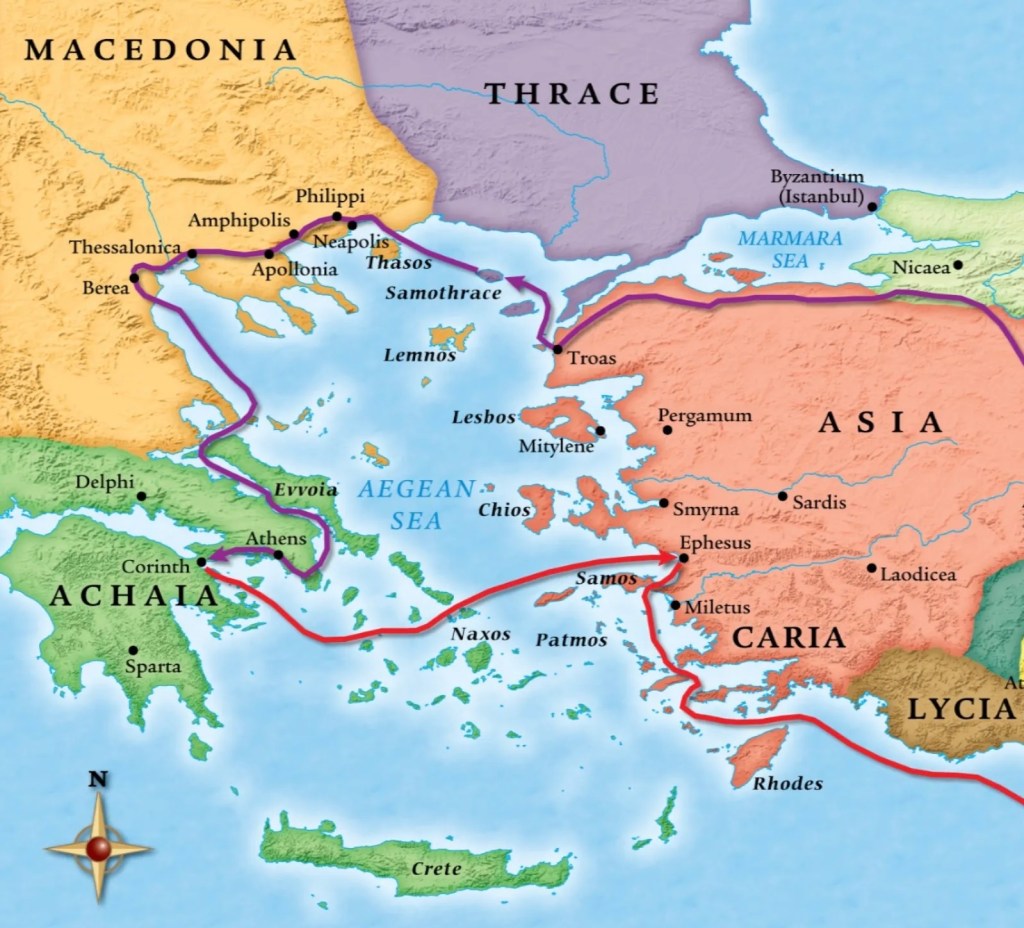
After Peter’s sermon in Caesarea and the gifting of the Spirit to the Gentiles (Acts 10-11), the Spirit guides Barnabas and Paul to Seleucia and onwards (13:2) and then later guides Paul away from Asia Minor, towards Macedonia (16:6–7).
At this key moment of decision, three injunctions are given; each one is from a divine source. The first of these, an instruction not to speak in the southern region of Asia, comes from the Holy Spirit (16:6). The second direction, a prohibition against any attempt to head north and enter Bithynia, comes from the same spirit, here described as “the spirit of Jesus” (16:7).
The third divine interjection takes place at Troas, where a vision is seen in the night with a petition to “come across into Macedonia” (16:9). Being guided by the Spirit and seeing visions are common occurrences in Acts. The nature of such phenomena has already been established as divine in origin (2:14-21); the move into Macedonia is thus in accord with the divine will. What takes place, as Paul travels relentlessly with various companions (13:4–21:17) is all driven by the Spirit (13:2, 4).
Much later, Paul’s final visit to Jerusalem and his subsequent arrest takes place under the guidance of the Spirit (20:22–23; 21:11). The story of this movement, then, is of multiple events inspired and propelled by the Spirit over these years.
It is curious, then, that the Spirit is explicitly absent from the narrative after Paul is arrested in Jerusalem (21:22–28:31). It is only in the closing scene, in , that the Spirit is again mentioned—and here in terms of the Spirit being the source of the prophetic oracle (28:25) which Paul quotes from Isaiah (28:26–27, citing Isa 6:9–10). This is quite unlike the earlier concentrations of references to the Spirit, both in the Gospel and in earlier sections of Acts.
What is the explanation for this mysterious disappearance of the Spirit in this final section of Acts?
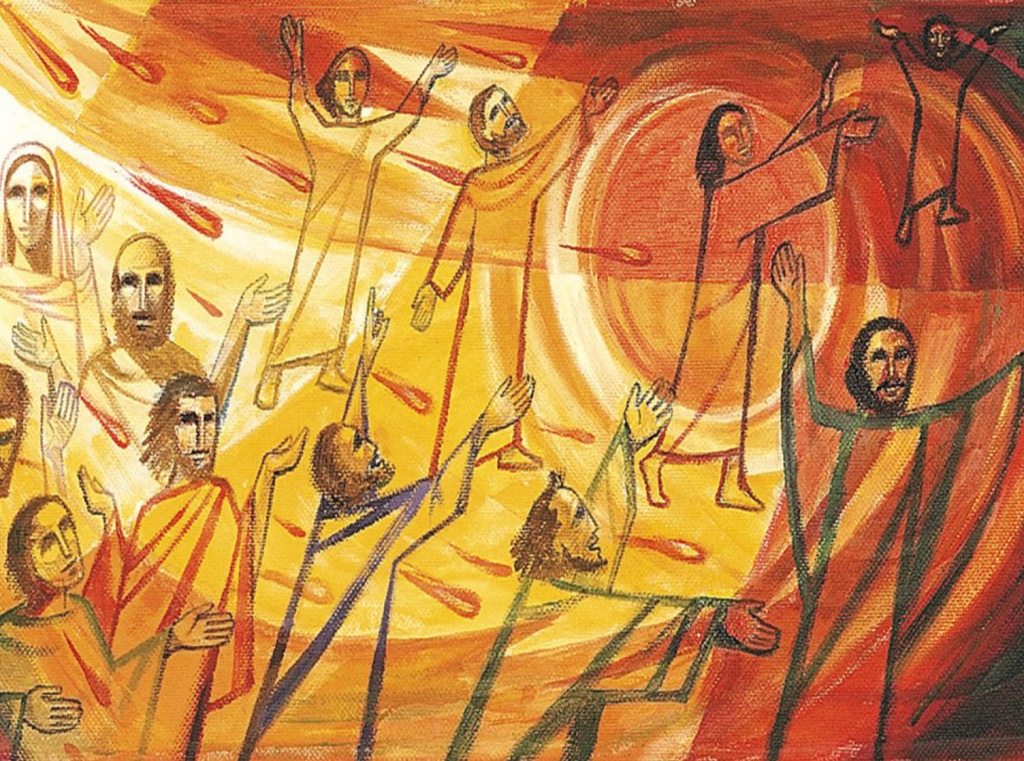
The Spirit is the motivating, energising force that lights the fire of enthusiasm amongst the followers of Jesus in the early days after his ascension (Acts 1:6–11). In his orderly account of the things coming to fulfilment, Luke makes this clear when he reports what takes place on the Day of Pentecost, when the Spirit fell upon the followers of Jesus “gathered in one place … all of them were filled with the Holy Spirit and began to speak in other languages, as the Spirit gave them ability” (Acts 2:1–4).
Soon after that experience, Peter speaks to the gathered crowd, interpreting the portentous events of the day by relating them to Joel 2:28–32, “God declares, I will pour out my spirit upon all flesh” (Acts 2:14–21). Later in this speech, Peter affirms that Jesus, “being exalted at the right hand of God, and having received from the Father the promise of the Holy Spirit, he has poured out this that you both see and hear” (2:33).
From Pentecost onwards, the Spirit is active; Luke regularly and consistently notes the presence of the Spirit throughout the events that follow. Specific leaders within the early church are said to be “filled with the Spirit”: Peter (4:8), Stephen (6:3, 5; 7:55), Paul (9:17; 13:9), and Barnabas (11:24). This phrase signals the reactivation of the Spirit in ways that evoke the time, before the birth of Jesus, when key figures were “filled with the Spirit” (1:35, 41, 67), and at the start of the public activity of Jesus, when he was “filled with the Spirit” (4:1, 14).
Indeed, in the early period, the whole community in Jerusalem is filled with the spirit: “they were all filled with the Holy Spirit and spoke the word of God with boldness” (4:31). Beyond Judea, the Spirit guides Philip to travel with the Ethiopian eunuch on the wilderness road to Gaza (8:29, 39), inspires Agabus to prophesy in Antioch (11:28), and probably also is active through the “burning enthusiasm” of the preaching of Apollos in Ephesus (18:25).
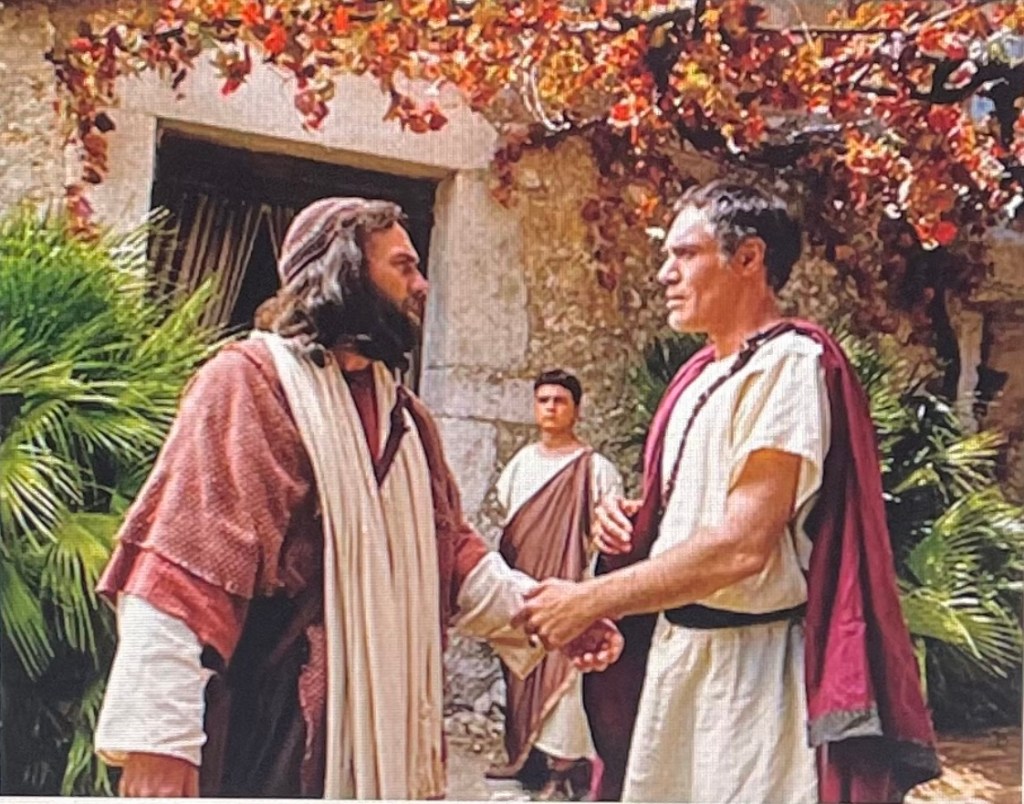
When the persecutor Saul has his dramatic encounter on the road to Damascus, a disciple in that city named Ananias is pivotal in the story. In a vision, he is commanded to go to where the blinded Saul is staying, and say to him, “Brother Saul, the Lord Jesus, who appeared to you on your way here, has sent me so that you may regain your sight and be filled with the Holy Spirit” (9:17). As Saul regains both sight and appetite (9:18–19), so he is now open to the work of the Spirit in what he does.
Later on, in Antioch, “while they were worshiping the Lord and fasting, the Holy Spirit said, ‘Set apart for me Barnabas and Saul for the work to which I have called them’” (13:2). Accordingly, “being sent out by the Holy Spirit” (13:4), Barnabas and Saul begin their travels, preaching and performing miracles to people in the eastern Mediterranean.
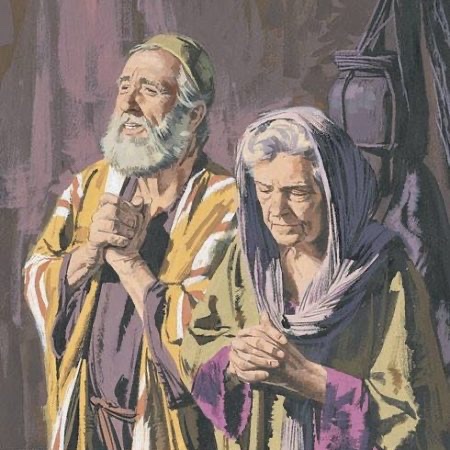
As we read the whole story that has been compiled by Luke, in his orderly account, we note that the Spirit plays a key role from the very beginning. The first person we meet in Luke’s narrative is Zechariah the priest, a man devoted to the service of God in the Temple (1:8–9). Zechariah himself will later be filled with the Spirit (1:67) and sing of what God will do through his son, John (1:68–79)—although first he will be struck dumb (1:20, 22), because he did not believe the words of the angel, that his son would be “filled with the Holy Spirit” (1:15) and go before God “with the spirit and power of Elijah” (1:17). Zechariah’s spirit-filled song is possible after he is miraculously able to speak once more (1:64).
His wife, Elizabeth, expresses an attitude of deep faith in God, accepting her surprise pregnancy as “what the Lord has done for me” (1:25). They are both described as “righteous before God” (1:6). Elizabeth maintains her faith throughout her pregnancy; she herself is “filled with the Spirit” (1:41) as she sings a blessing over her relative Mary (1:42–45).
Mary, demonstrates a similar faith as she submits to a similar fate, bearing a child, with the words, “here am I, the servant of the Lord” (1:38). She articulates the traditional hopes and expectations of the people in a spirit-inspired song known as the Magnificat (1:46–55; compare 1 Sam 2:1–10). Mary is “overshadowed” by the Spirit (1:35), just as Zechariah and Elizabeth had both been “filled” with the Spirit (1:41, 1:67).
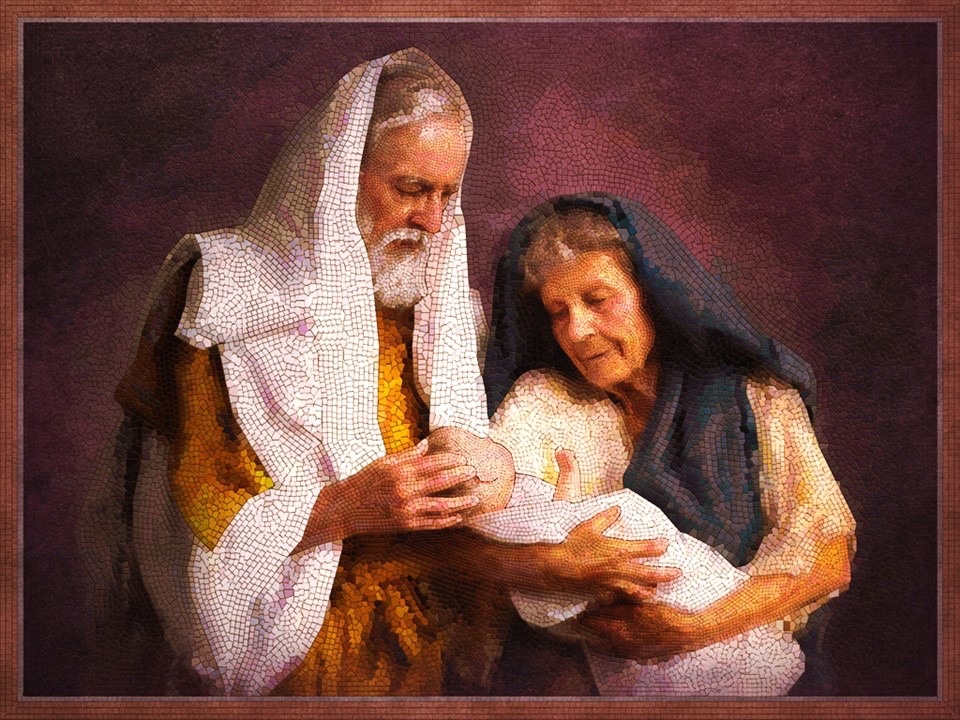
After Mary’s child is born, he is taken to the Temple where Simeon sings another song (2:29–32, known as the Nunc dimittis, or the Song of Simeon). His song continues the strongly Jewish tone of the earlier songs of Zechariah, Mary, and Elizabeth. Simeon is “righteous and devout, looking forward to the consolation of Israel” (2:25); the Spirit “rested on him” (2:25), then “revealed to him” the words he then speaks (2:26) before “guiding him … into the temple” (2:27).
Alongside Simeon in the Temple, Mary and her husband Joseph encounter the prophet Anna (2:38). As she is a prophet, her words (although not reported directly by Luke) are likewise spirit-inspired (as are all prophetic utterances), as she “began to praise God and to speak about the child to all who were looking for the redemption of Jerusalem” (2:38). The hopes of the Jewish tradition are strong and clear.
The sense of deeply devoted and strongly conventional Jewish piety continues in the reports of the early years of Jesus. It is only in Luke’s Gospel that we find the information that Jesus was circumcised after eight days (2:21), that his mother was subsequently purified and brought offerings to the Temple (2:22–24), that the family made Passover pilgrimage to Jerusalem (2:41) and that Jesus showed an early interest in discussing matters of the Law (2:42-51). The child, Luke reports, grew in wisdom and divine favour (2:40, 52)—surely indications that the Spirit has been active in these scenes which provide an entry into the story that Luke tells in the following chapters.
This is the same Spirit that has been active since the moment of creation (Gen 1:2), that was breathed into human beings (Gen 2:7), and that infuses every one of the creatures brought into being in God’s wonderful creation (Ps 104:24–30). It is this Spirit that has endowed individuals with leadership (Exod 31:2–3; Num 11:25–26; Deut 34:9; and a number of judges) and which has inspired prophets to proclaim the word of the Lord (Isa 61:1; Ezek 2:2; Joel 2:28–29).
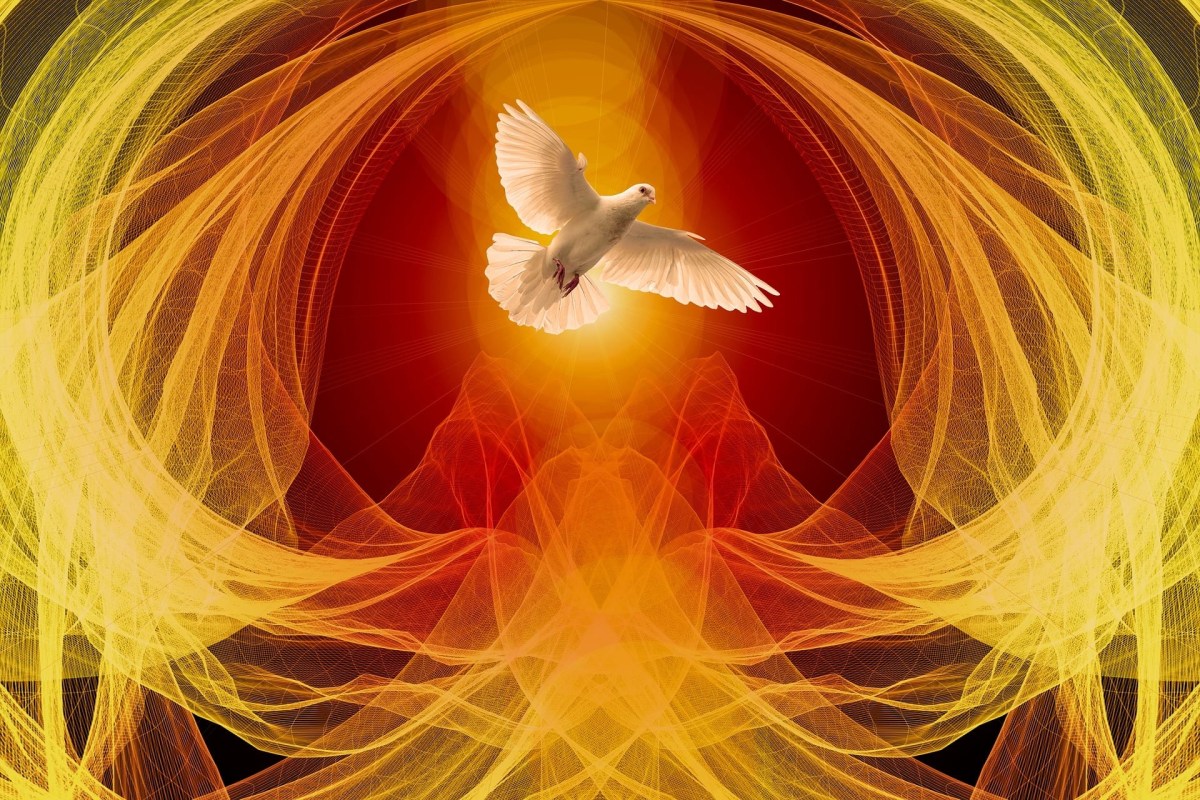
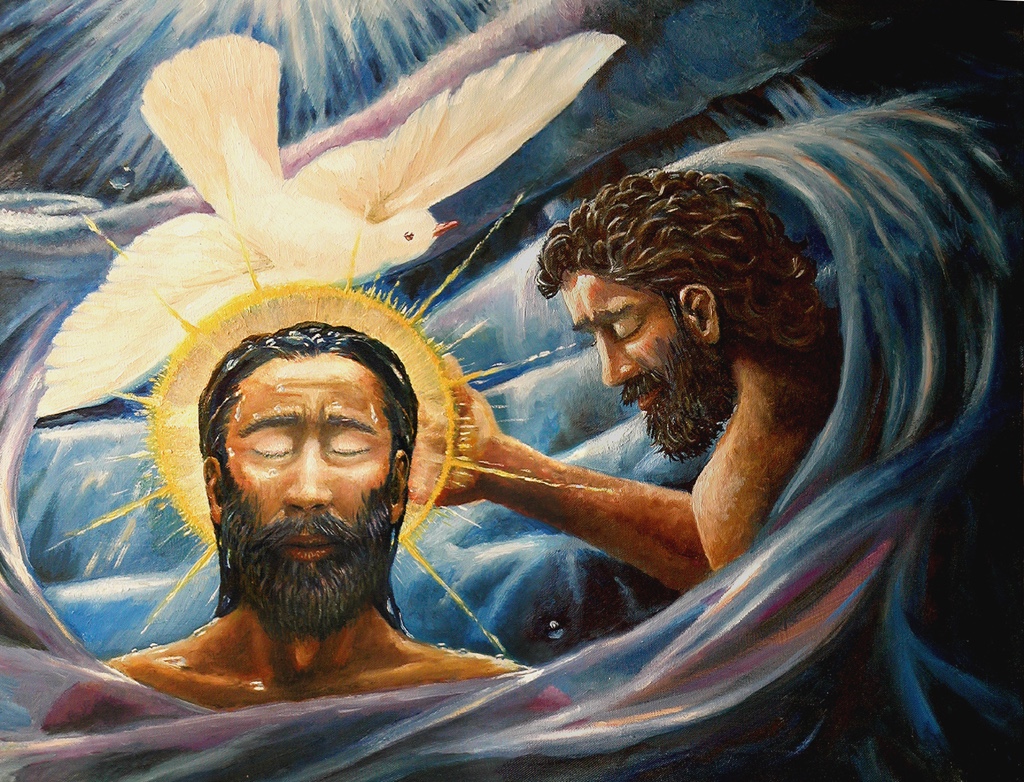
And it is this Spirit which impels the adult Jesus into action. John the baptiser declares that the one coming after him will baptise ”with the Holy Spirit and with fire” (3:16); soon after, Luke reports that “when Jesus also had been baptized and was praying, the heaven was opened, and the Holy Spirit descended upon him in bodily form like a dove” (3:21–22).
Almost immediately, “Jesus, full of the Holy Spirit, returned from the Jordan and was led by the Spirit in the wilderness, where for forty days he was tested by the devil” (4:1–2). After those forty days, “Jesus, filled with the power of the Spirit, returned to Galilee” (4:14), where he taught in synagogues. In the synagogue in Nazareth, Jesus read from the prophet Isaiah, claiming that the prophetic words applied directly to him: “The Spirit of the Lord is upon me, because he has anointed me to bring good news to the poor … today this scripture has been fulfilled in your hearing” (4:18, 21).
The opening chapters of Luke’s long narrative clearly put the Spirit on centre stage. The Spirit has not been quenched, as Josephus appears to indicate. The Spirit is still active!
2 The Spirit throughout the story of Jesus
We have noted the concentration of references to the spirit in the opening chapters of Luke’s orderly account. The guiding presence of the spirit in Luke 3:16–4:21 indicates that the public activities of the adult Jesus that follow are all to be understood as being guided, impelled, and shaped by the activity of the Spirit.
References to the Holy Spirit in the body of the Lukan story of Jesus (from 4:31 to 24:53) are, by comparison, relatively sparse. More frequent are the references to the evil spirits with whom Jesus engages, at least in the earlier stages of the story that Luke tells: the spirits in a man in the synagogue in Capernaum (4:33), in a demon-possessed man the country of the Gerasenes (8:29), in the daughter of Jairus, a leader of the synagogue (8:55), in the boy convulsing because of an unclean spirit (8:39, 42), and in the woman crippled for eighteen years (13:11).
Jesus understands that what he hears about from the seventy that he sent out to “cure the sick who are there, and say to them, ‘The kingdom of God has come near to you’” (10:9) is, in fact, the cosmic conflict of which these individual exorcisms are an integral part: “I watched Satan fall from heaven like a flash of lightning. See, I have given you authority to tread on snakes and scorpions, and over all the power of the enemy; and nothing will hurt you” (10:18–19).
Luke reports that Jesus “rejoiced in the Holy Spirit” on hearing reports from the seventy (10:21). He understands that “if it is by the finger of God that I cast out the demons, then the kingdom of God has come to you” (11:20). The conflict with spirits and demons is integral to the Spirit-inspired mission that he had announced in his programmatic sermon in Nazareth (4:18–21). That conflict continues throughout the ensuing chapters, as the spirit-filled Jesus grapples with the unclean spirits possessing human beings.
The gift of the Spirit which Jesus knew is, he says, available to those who ask in faith: “if you then, who are evil, know how to give good gifts to your children, how much more will the heavenly Father give the Holy Spirit to those who ask him!” (11:13). It is not just Jesus who is endowed by the Spirit; those who follow Jesus and ask in faith will also be spirit-gifted. So Jesus assures his followers that, “when they bring you before the synagogues, the rulers, and the authorities … the Holy Spirit will teach you at that very hour what you ought to say” (12:11–12).
There is just one further reference to spirit in Luke’s Gospel, at the very end of Jesus’ life, when his final words from the cross (quoting a psalm) are, “Father, into your hands I commend my spirit” (23:46, quoting Ps 31:5). Jesus goes to his death with certainty, knowing his fate, assured that he will be received by God as he seemingly chooses his time of death at the climactic moment in the story.
Complementing that handing over of the spirit is the promise by the risen Jesus, speaking to his disciples just before he ascends into heaven, declaring to them that “you will receive power when the Holy Spirit has come upon you” (Acts 1:8). The Spirit then returns to the forefront of the narrative concerning the early movement of followers of Jesus and the communities of messianic believers that they establish around the eastern Mediterranean world. We will trace that in a subsequent blog post.
Towards the end of the first century CE, the Jewish historian and apologist, Flavius Josephus, wrote a two-volume treatise rebutting the criticism of Judaism which had been made by ApionPleistoneices, an Egyptian writer of the early first century, who was famous for his breadth of knowledge and ostentatious oratory.
In the course of his analysis of the claims of Apion, Josephus deals with the works that form scripture for the Jews—22 books “which contain the records of all the past times which are justly believed to be divine” (Josephus, Against Apion 1.38). Josephus makes the claim that the authors of these works were “prophets that have written the original and earliest accounts of things as they learned them from God himself by inspiration; and writing down what happened in their own times in a very exact manner also” (1.37). These works, says Josephus, cover the time from Moses to Artaxerxes; he regards them as divinely-inspired, accurate and reliable.
He distinguishes them from a series of later works, which set out events in subsequent decades. Of these, he makes this claim: “our history has been written since Artaxerxes very thoroughly, but it has not been considered of equal authority with the earlier records by our forefathers, because there has not been an exact succession of prophets since that time” (Josephus, Against Apion 1.41). This last claim–the lack of prophets in recent centuries–has resonated in the histories of Judaism, and Christianity; it led to the notion that prophecy ended because the Spirit had become inactive.
In this context, it is striking to note the way that Luke starts his orderly account of the things that have come to fulfilment amongst us (the two volumes we know as the Gospel according to Luke, and the Acts of the Apostles). The Holy Spirit plays a central, active role in these writings. In the first volume of his orderly account, Luke highlights the Spirit at key places in the narrative, beginning even before the conception and birth of Jesus.
The events reported in the second volume are generated from the dramatic intervention of the Spirit into the early community formed by the followers of Jesus after his ascension. The story of that intervention—known to us as the coming of the Spirit on the Day of Pentecost—is told early in Acts (2:1-42). Jews from around the eastern Mediterranean are gathered in Jerusalem for the annual festival (2:1-13), when the Spirit comes upon them. This is the event that is remembered each year, in the calendar of the church, at Pentecost (this year, on Sunday 5 June).
A second story of the coming of the Spirit is told at a later point in Acts—after Peter sees a vision in which God declares all food clean, and he is summoned to the home of the Gentile centurion, Cornelius, in Caesarea (10:1-33). As Peter preaches to the Gentiles, the Spirit falls on them, “just as it had upon us [Jews] at the beginning (11:15). The importance of the Spirit in Luke’s account of the early movement cannot be underestimated. The significance for the church today of the Spirit’s empowering presence at Pentecost is likewise high.
The Spirit, of course, was not a new concept to the people,of Israel, for the Spirit had already been active throughout the stories told by the people of Israel about their ancestors. It was the same Spirit who was seen to be active in the creation of the world (Gen 1:1–2; Job 33:4; Ps 104:30; Isa 42:5) who then guides selected leaders within Israel. The Spirit is active in stories about Moses (Num 11:16–17); Joshua (Deut 34:9); Othniel (Judg 3:10); Gideon (Judg 6:34); and David (1 Sam 16:17).
The Spirit inspires prophecy (1 Sam 10:6, 19:23–24; Ezek 37:1; Joel 2:28–29; Mic 3:8), enables the interpretation of dreams by Joseph (Gen 41:38) and Daniel (Dan 4:8,18, 5:1), and gives other specific gifts to Israel (Num 11:25; Deut 34:9; Dan 4:8–18; Prov 1:23).
The qualities of the Spirit will characterise the coming Messianic figure envisaged by the prophet Isaiah (Isa 11:2–5). This idea is taken up later in Isaiah in descriptions of the Servant (Isa 42:1–4; 61:1–7). In second Isaiah the Spirit is promised as a gift to the people who are led by the Servant (Isa 42:5; 44:3; 48:16; 59:21). Third Isaiah recalls the time of Moses as a period when the Spirit was given to Israel (Isa 63:11–14).
So Luke stands firmly within the tradition of the people of Israel—the tradition of Jesus himself—as he narrates the story of Jesus, and his followers, in the two volumes of his orderly account. The story of Pentecost is a climactic and pivotal moment in that narrative. We need to see it in relation to what has come before it, and also what follows on after it.
This is the first in a series of posts relating to Pentecost, exploring the role of the Spirit in the two volumes of Luke’s orderly account (Luke-Acts). Stay tuned for more each day … … …







 An Informed Faith