In following the Revised Common Lectionary through the year, each year the Gospel reading has a focus, for a large part of the year, on one of the Synoptic Gospels. So this year we have been following stories in Mark’s Gospel (with the obvious exception of the past five weeks, when we took a detour into John 6).
Mark’s Gospel majors on discipleship, on what it means to follow Jesus as a faithful disciple. “Follow me” is an early exhortation of Jesus; to the four fishing disciples (Mark 1:16–20), to Levi the tax collector (2:13–14), to the crowd following him on the road (8:34), and to a rich man (10:17–22). One of my ministry colleagues, Peter Hobson, coined the term “followship” (blending following and discipleship) to characterise this focus.
So it is no surprise to receive a book focussed on Mark’s Gospel, with the clever title Following Mark. The subtitle, A commentary for people on the road, also picks up on the repeated motif of Jesus and the disciples being “on the way” or “on the road” (3:23; 7:31; 8:27; 9:33–34; 10:32, 52; 11:8). The book is written by William Loader, professor emeritus at Murdoch University, Perth, a minister in the Uniting Church in Australia, and an internationally recognised New Testament scholar with extensive publications.
Bill Loader, as I know him, always writes with an open, inviting style that encourages thoughtful engagement with the biblical text. This short book is no exception. The pages brim with lucid explanations, grounded in thorough scholarship; vivid images, designed to bring the story to life; and provocative questions, to deepen the life of discipleship of those who read this book.
There are five main sections to the book, each with a title that encapsulates the key focus of the stories in that part of the Gospel: The Beginning (1:1–4:41), The Expansion (5:1–8:26), The Identity (8:27–10:52), Jesus and the Temple (11:1–13:37), and The End? (14:1–16:8). These are the logical groupings of sections of text which many commentators have recognised. You can compare it with my own brief analysis of the nature and structure of Mark’s Gospel at
Within each of those sections, there are four or five subsections in which a translation of the passage is given under the heading Listening to Mark, followed by three to five pages of discussion under the heading Thinking about Mark, and a short conclusion called Reflection, which offers two or three questions designed to stimulate ongoing thinking, or perhaps as the basis for a small group discussion of the relevant section.
Loader’s own translation of Mark that is included is peppered with some wonderful turns of phrase that reflect how Australian ears hear the stories about Jesus. He maintains the Markan use of present in the midst of past tenses, which gives the whole narrative a much less formal style, more in the manner of telling stories while gathered around a campfire, perhaps. John is baptising in the outback instead of the wilderness (1:4, 12); the healed leper, in his rejoicing, “began to blab all about it” (1:45). There is a man with a shrunken hand (3:1, 3), a more prosaic description; “a great crowd” becomes “a great mob” (3:8).
When Jesus encounters some unclean spirits, “he had to tell many of them off” (3:12), while when the disciples encounter Jesus walking on the water, he says “Cheer up. It’s me. Don’t be scared!” (6:50). At one point, people from the synagogue remonstrate with Jairus, saying, “Why keep hassling the teacher?” (5:35). In Gethsemane, Jesus tells the disciples, “I’m terribly sad enough to die” (14:34). All of this adds a fine Aussie touch to the work. (But I did notice that denarii are still denarii.)
For those preaching from the Gospel text each Sunday, there are many comments which will spark further thinking and provide material to enrich their thinking as they develop their sermon. For those reading through Mark’s Gospel in the midst of their already-busy lives, this book provides a concise, handy guide for negotiating the stories it contains.
This book is a fine piece of work which I was invited to recommended, along with others who are teaching New Testament or are engaged in ministry formation processes. Assoc. Prof. Robyn Whitaker, of the University of Divinity, notes that Loader’s “deep knowledge of the text and its historical setting shines through”.
Prof. Paul Foster, of Edinburgh University, says that the book “distills the insights of a seasoned scholar and brilliant communicator into a highly readable format”. Cathie Lambert, formation coordinator in the Uniting Church in Western Australia, comments that “Loader’s clear and accessible explanation of nuances of translation, cultural and geographical contexts, and links to the Hebrew Bible provide the reader with a firm foundation for contemporary interpretation”.
At this time of the year, every Year B, the lectionary strays away from choosing the Gospel readings from the beginning of the good news of Jesus, the Gospel of Mark. Next week, we will launch into a series of five weeks of readings drawn from John 6. That chapter revolves around the motif of Jesus as “the living bread which came down from heaven” (John 6:51). Because of this looming focus, the Gospel passage provided by the lectionary for this Sunday is curiously shaped. It takes two separate sections of Mark’s Gospel, and omits a large section that sits in between these two passages.
The story of the feeding of the crowd of “about 5,000 in all” (John 6:1–14) which we will read next Sunday replicates the story omitted from this Sunday’s reading, where the Jesus was able to feed a crowd comprising “5,000 men” (Mark 6:44).
The lectionary provides the surrounding sections (Mark 6:30–34, 53–56) and omits the feeding narrative (Mark 6:35–44). It also omits the account of Jesus walking on the water (Mark 6:45–52)—a story paralleled in Matt 14:22-33). Thus, we have a curiously disrupted passage for consideration.
We need, then, to consider, both what’s in, and what’s out, in this week’s lectionary selection.
What’s in: three key terms
The selection offered by the lectionary includes reference to Jesus taking his followers aside, to rest (6:31). We know well the words that Jesus spoke, offering rest to his followers (Matt 11:28–30). But we perhaps give little thought to the need that Jesus had, along with this followers, to rest from the bustling business that he engaged in. Mark states it well: “many were coming and going, and they had no leisure even to eat” (6:31).
Jesus moves away to a deserted place with his followers. He goes into the wilderness. The Greek word used here, eremon, is significant. This is where Jesus goes when he is tested by God (1:12), immediately after he had been completely immersed in the water by John the baptiser, resident in that wilderness (1:3, 4).
It was in the wilderness that Israel came to know its essential identity: a people, beloved by God, rescued from slavery, called into covenant, equipped for the battles of entry into the land, as the great myth from the past declared. It was, likewise, in the wilderness that Jesus came to know his mission in life, and where he came to know his identity as the Son of God, chosen for that mission. So it is fitting that he moves to a deserted place, seeking respite from the crowds.
Yet the crowds will not let the healer and his followers rest; they continue to press on Jesus, and as they saw him, with his followers, in the boat, they hurried on foot to that deserted place, “and arrived ahead of them” (6:33). This had been going on since early in the Gospel; large crowds had followed Jesus since early in Galilee (2:13; 3:20, 32; 4:1; 5:21; 24, 30–31) and would continue on in Galilee (7:14; 8:1–2, 34; 9:14–15, 25; 10:1, 46) and into Jerusalem (11:18; 12:37).
The response of Jesus is instructive. Here we find a second significant term. He “had compassion for them”, the NRSV reports (6:34). The distinctive Greek term used (esplangnisthē) appears here, and in the parallel of Matt 14:14 (as well as an editorial comment at Matt 9:36).
The term refers to that deep-seated churning in the gut that takes place when an emotional cord is struck. It is a profound and penetrating feeling. The same term is found in the paired story of the feeding of the 4,000, where Jesus tells his followers, “I have compassion on the crowd” (Mark 8:2, par Matt 15:32).
Such compassion is characteristic of Jesus on many occasions. The term has already appeared in Mark’s report of the leper who came to Jesus, seeking to be made clean, where it describes the way that Jesus responds to him (“moved with pity” in the NRSV, reflecting a textual variant in Mark 1:41, par Matt 10:6). It’s also used to characterise the way Jesus deals with two blind men near Jericho (“Jesus in pity touched their eyes”, NRSV Matt 20:34).
Other places where the word appears are in the story of the mute boy who suffers convulsions (Mark 9:14–29). The father of the boy begs Jesus to cast out the spirit which possesses the boy, imploring him, “if you can do anything, have compassion on us and help us” (9:22). Jesus responds by rebuking the spirit, which leaves the boy (9:25–27).
In the orderly account which we attribute to Luke, the compassion of Jesus is noted when he interacts with a widow who is mourning her dead son (Luke 7:13), and is also found within two of the parables told by Jesus, reported only in this Gospel. The Samaritan has compassion (Luke 10:33), as does the father when he sees his prodigal son returning home (Luke 15:20).
A third important idea is found when the author implicitly draws an analogy between Jesus, and a shepherd (6:34). In the book of signs, Jesus explicitly calls himself “the good shepherd” (10:1–18). This evokes the scriptural imagery of the good shepherd as the true and faithful leader in Israel (Num 21:16–17; Ezek 34:1–31; Jer 23:4). The phrase also alludes to the people as the sheep who are cared for (Pss 95, 100; Ezek 34:31).
People who are “sheep without a shepherd” recall the description of Israel in Hebrew Scriptures (Num 27:17; 1 Kings 22:17, par 2 Chron 18:16; and Judith 11:19). The narrator’s reference in Mark 6:34 contains these deep scriptural resonances. The compassion demonstrated by Jesus fits with his role as shepherd of the sheep.
A third key idea is contained in the brief statement that the compassion of Jesus is expressed as “he began to teach them many things” (Mark 6:34). The teaching activity of Jesus runs through this Gospel. Jesus teaches beside the sea (4:1), in the synagogue (1:21–27; 6:2), beside the lake (2:13; 4:1–2; 6:34), in the villages (6:6), and as he and his followers walk along the way towards Jerusalem (8:31; 9:31).
When Jesus reaches Jerusalem, he is said to be teaching the crowd in the courtyard of the Temple (11:15–18). A little later, some Pharisees and Herodians approach him, observing that “you are not swayed by appearances, but truly teach the way of God” (12:14). “Day after day I was with you in the Temple teaching”, he says to the armed crowd sent from the Jewish authorities to arrest him (14:43–49).
The same emphasis on his teaching is found on the other Synoptics. Matthew reports that “Jesus went throughout Galilee, teaching in their synagogues and proclaiming the good news of the kingdom” (Matt 4:23; see also 7:28–29; 9:35; 21:23; 22:33; 26:55), while Luke notes that when Jesus went to Capernaum, “he was teaching them on the sabbath; they were astounded at his teaching, because he spoke with authority” (Luke 4:31–32; see also 5:17; 6:6; 10:39; 13:10; 13:22; 19:47; 20:1; 21:37; 23:5).
What’s out: two substantial scenes
So much for what’s in this week’s selection. What about what’s out?
First, the Gospel offering provided by the lectionary includes the surrounding sections (Mark 6:30–34, 53–56) but omits what it surrounds—the feeding narrative (Mark 6:35–44). I think this is because the lectionary picks up that incident next Sunday, but it uses the account found in the fourth Gospel (John 6:1–21) before tracing the long (and repetitive) speech of Jesus in the rest of the chapter John 6:24–69).
This feeding story is also retold by the other two synoptic evangelists. In the book of origins (Matt 14:15–21), the crowd comprises “about five thousand men, besides women and children (Matt 14:21). In the orderly account of things fulfilled (Luke 9:12–17), the crowd is recorded, as in the Markan source, as being “about 5,000 men” (Luke 9:14).
The scene is reminiscent also of the parallel scene of feeding “4,000 men” recounted at Mark 8:1-10 and also at Matt 15:32-39; although Matthew indicates that there were “4,000 men, besides women and children”. (Luke omits this story.)
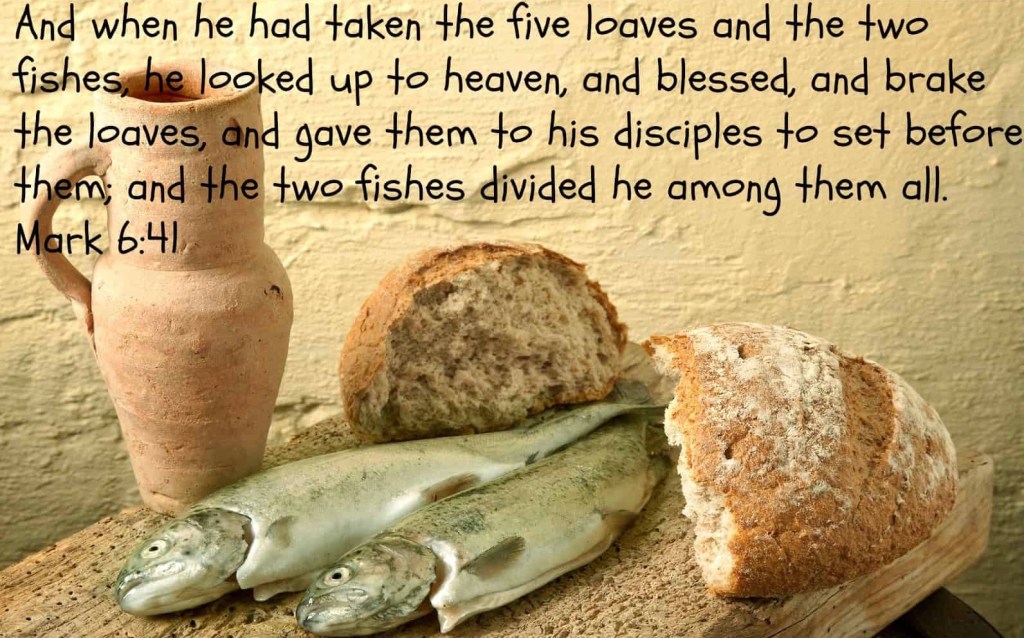
In each of those cases, the accounts provide the opportunity for Jesus to model the traditional pattern of a Jewish meal, as he “looked up to heaven, and blessed, and broke the loaves, and gave them to the disciples to set before the people” (Mark 6:41; Matt 14:19; Luke 9:16; and again at Mark 8:6 and Matt 15:36). This prefigures the familiar pattern from the last supper (Mark 14:22; Matt 26:26; Luke 22:19; 1 Cor 11:24; and see also Acts 20:7, 27:35).
So Mark recounts the scene: “And taking the five loaves and the two fish, he looked up to heaven and said a blessing and broke the loaves and gave them to the disciples to set before the people. And he divided the two fish among them all. And they all ate and were satisfied. And they took up twelve baskets full of broken pieces and of the fish. And those who ate the loaves were five thousand men.” (Mark 6:41–44).
And the resonances with the central Christian ritual, the remembrance of the last supper, are surely strong and deep.
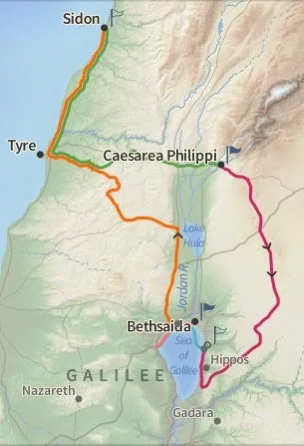
Second, the lectionary omits the account of Jesus walking on the water (Mark 6:45–52) which plays an important role in Mark’s account. By omitting this, the lectionary has excised the important reference to Jesus crossing over “to the other side”, from the Decapolis across to Bethsaida (Mark 6:45).
In this earliest Gospel, Jesus had left Jewish territory earlier, when he crossed “to the other side of the sea, to the country of the Gerasenes” (5:1), then returned “to the other side” (5:21), where he visited “his own country” (6:1) before venturing again across “to the other side” (6:45–52).
This maritime movement makes an important symbolic point for the the author: the ministry of Jesus incorporated not only territories in Jewish areas (to 4:41, then 5:21 to 6:44) as well as the Gentile territories. Jesus firstly crosses into the Decapolis (5:1–20), where he cast out multiple demons from the tomb-dwelling man, sending them into the nearby pigs. (This story is also omitted by the lectionary during this particular year.)
One of the striking aspects in this story is that this man, possessed by an unclean spirit, fettered in chains, dwelling beside tombs, self-harming and acting inappropriately (5:2–6), becomes the first active missionary in this Gospel; after the encounter with Jesus, “he began to proclaim in the Decapolis how much Jesus had done for him, and everyone marvelled” (5:20). A pity we missed that this year.
Jesus is active on “the other side” again from Mark 6:53, when he enters the regions of Gennesaret (6:53). Subsequently, Jesus is located at Tyre and Sidon (7:24), and then “the region of the Decapolis” (7:31), before returning to Bethsaida (8:22) and Caesarea Philippi (8:27), in Jewish territory.
These geographical references are treated variably in the later accounts which used Mark as a source. Matthew retains Genessaret (Matt 14:34) and Tyre and Sidon (15:21), but removes the reference to the Decapolis (15:29). The geographical references from Caesarea Philippi onwards then appear in his ongoing narrative. Luke omits the whole section containing these earlier references (Mark 6:53–8:26), removing the clear indication that Jesus spent quite some time on Gentile soil.
Omitting the “crossing over” movement in the narrative lessens the significance of this observation: much of what takes place in the ensuing four chapters, takes place on Gentile soil. This is very important for our understanding of the stories that Mark reports. We need to hear that in mind as we read the later stories in this section of the Gospel: Jesus is “on the other side”, moving amongst the Gentiles of the Decapolis.
The Gospel reading which the Narrative Lectionary proposes for this coming Sunday (Mark 13:1–8, 24–37) is an excerpt from a longer speech, a block of teaching which Jesus delivered to his disciples (13:3–37) some time after they had arrived in the city of Jerusalem (11:1–11). It’s a striking speech, with vivid language and dramatic imagery. As Jesus’ last long speech in this Gospel, it certainly makes a mark!
The speech is delivered beside the towering Temple, built under Solomon, rebuilt under Nehemiah (13:1, 3). That temple was a striking symbol for the people of Israel—it represented their heritage, their traditions, their culture. The Temple was the place where the Lord God dwelt, in the Holy of Holies; where priests received sacrifices, designed to enable God to atone for sins, and offerings, intended to express the people’s gratitude to God; where musicians led the people in singing of psalms and songs that exulted God, that petitioned God for help, that sought divine benevolence for the faithful covenant people.
Or so the story goes; so the scriptures said; so the priests proclaimed. The holiest place in the land that was holy, set apart and dedicated to God. Yet what does Jesus say about this magnificent construction? “Not one stone will be left here upon another; all will be thrown down” (13:2). Jesus envisages the destruction of the Temple. Not only this; he locates that destruction within the context of widespread turmoil and disruption: “nation will rise against nation, and kingdom against kingdom; there will be earthquakes in various places; there will be famines” (13:8). And then, to seal this all, Jesus refers directly to the fact that “the end is still to come” (13:7).
The End. Eight centuries before Jesus, the prophet Amos had declared, “the LORD said to me, ‘the end has come upon my people Israel; I will never again pass them by’” (Amos 8:2). Amos continues, declaring that God has decreed that “on that day … I will make the sun go down at noon, and darken the earth in broad daylight. I will turn your feasts into mourning, and all your songs into lamentation; I will bring sackcloth on all loins, and baldness on every head; I will make it like the mourning for an only son, and the end of it like a bitter day” (Amos 8:9–10).
That image of The Day when the Lord enacts justice and brings punishment upon the earth, because of the evil being committed by people on the earth, enters into the vocabulary of prophet after prophet. Amos himself declares that it is “darkness, not light; as if someone fled from a lion, and was met by a bear; or went into the house and rested a hand against the wall, and was bitten by a snake. Is not the day of the LORD darkness, not light, and gloom with no brightness in it?” (Amos 5:18–20).
Isaiah, just a few decades after Amos, joined his voice: “the Lord of hosts has a day against all that is proud and lofty, against all that is lifted up and high … the haughtiness of people shall be humbled, and the pride of everyone shall be brought low; and the Lord alone will be exalted on that day” (Isa 2:12, 17). He warns the people, “Wail, for the day of the Lord is near; it will come like destruction from the Almighty!” (Isa 13:6).
Isaiah uses a potent image to describe this day: “pangs and agony will seize them; they will be in anguish like a woman in labour” (Isa 13:7). He continues, “the day of the Lord comes, cruel, with wrath and fierce anger, to make the earth a desolation, and to destroy its sinners from it” (Isa 13:8), and later he portrays that day as “a day of vengeance” (Isa 34:8).
Zephaniah, who was active at the time when Josiah was king (640–609 BCE) declares that “the day of the Lord is at hand; the Lord has prepared a sacrifice, he has consecrated his guests” (Zeph 1:7); “the great day of the Lord is near, near and hastening fast; the sound of the day of the Lord is bitter, the warrior cries aloud there; that day will be a day of wrath, a day of distress and anguish, a day of ruin and devastation, a day of darkness and gloom, a day of clouds and thick darkness ” (Zeph 1:14–15).
Habakkuk, active in the years just before the Babylonian invasion of 587 BCE, declares that “there is still a vision for the appointed time; it speaks of the end, and does not lie” (Hab 2:3); it is a vision of “human bloodshed and violence to the earth, to cities and all who live in them” (Hab 2:17).
Later, during the Exile, Jeremiah foresees that “disaster is spreading from nation to nation, and a great tempest is stirring from the farthest parts of the earth!” (Jer 35:32); he can see only that “those slain by the Lord on that day shall extend from one end of the earth to the other. They shall not be lamented, or gathered, or buried; they shall become dung on the surface of the ground” (Jer 35:33). He also depicts this day as “the day of the Lord God of hosts, a day of retribution, to gain vindication from his foes” (Jer 46:10).
And still later (most likely after the Exile), the prophet Joel paints a grisly picture of that day: “the day of the Lord is coming, it is near—a day of darkness and gloom, a day of clouds and thick darkness! Like blackness spread upon the mountains, a great and powerful army comes; their like has never been from of old, nor will be again after them in ages to come. Fire devours in front of them, and behind them a flame burns. Before them the land is like the garden of Eden, but after them a desolate wilderness, and nothing escapes them.” (Joel 2:1-3).
Later in the same oracle, he describes the time when the Lord will “show portents in the heavens and on the earth, blood and fire and columns of smoke; the sun shall be turned to darkness, and the moon to blood, before the great and terrible day of the Lord comes” (Joel 2:30–31). Joel also asserts that “the day of the Lord is near in the valley of decision; the sun and the moon are darkened, and the stars withdraw their shining” (Joel 3:14–15).
*****
The language of The Day is translated, however, into references to The End, in some later prophetic works. In the sixth century BCE, the priest-prophet Ezekiel, writing in exile in Babylon, spoke about the end that was coming: “An end! The end has come upon the four corners of the land. Now the end is upon you, I will let loose my anger upon you; I will judge you according to your ways, I will punish you for all your abominations.” (Ezek 7:2–3).
And again, Ezekiel declares, “Disaster after disaster! See, it comes. An end has come, the end has come. It has awakened against you; see, it comes! Your doom has come to you, O inhabitant of the land. The time has come, the day is near—of tumult, not of reveling on the mountains. Soon now I will pour out my wrath upon you; I will spend my anger against you. I will judge you according to your ways, and punish you for all your abominations.” (Ezek 7:5–8). This day, he insists, will be “a day of clouds, a time of doom for the nations” (Ezek 30:3; the damage to be done to Egypt is described many details that follow in the remainder of this chapter).
Obadiah refers to “the day of the Lord” (Ob 1:15), while Malachi asserts that “the day is coming, burning like an oven, when all the arrogant and all evildoers will be stubble; the day that comes shall burn them up, says the Lord of hosts, so that it will leave them neither root nor branch” (Mal 4:1).
Malachi ends his prophecy with God’s promise that “I will send you the prophet Elijah before the great and terrible day of the Lord comes; he will turn the hearts of parents to their children and the hearts of children to their parents, so that I will not come and strike the land with a curse” (Mal 4:5–6). This particular word is the final verse in the Old Testament as it appears in the order of books in the Christian scriptures; it provides a natural hinge for turning, then, to the story of John the baptiser, reminiscent of Elijah, who prepares the way for the coming of Jesus, evocative of Moses.
Another prophet, Daniel, declares that “there is a God in heaven who reveals mysteries, and he has disclosed to King Nebuchadnezzar what will happen at the end of days” (Dan 2:28), namely, that “the God of heaven will set up a kingdom that shall never be destroyed, nor shall this kingdom be left to another people. It shall crush all these kingdoms and bring them to an end, and it shall stand forever” (Dan 2:44).
Whilst the story of Daniel is set in the time of exile in Babylon—the same time as when Ezekiel was active—there is clear evidence that the story as we have it was shaped and written at a much later period, in the 2nd century BCE; the rhetoric of revenge is directed squarely at the actions of Antiochus IV Epiphanes, who had invaded and taken control of Israel and begun to persecute the Jews from the year 175BCE onwards.
The angel Gabriel subsequently interprets another vision to Daniel, “what will take place later in the period of wrath; for it refers to the appointed time of the end” (Dan 8:19), when “at the end of their rule, when the transgressions have reached their full measure, a king of bold countenance shall arise, skilled in intrigue. He shall grow strong in power, shall cause fearful destruction, and shall succeed in what he does. He shall destroy the powerful and the people of the holy ones.” (Dan 8:23–24). This seems to be a clear reference to Antiochus IV.
Still later in his book, Daniel sees a further vision, of seventy weeks (9:20–27), culminating in the time of “the end” (9:26). In turn, this vision is itself spelled out in great detail in yet another vision (11:1–39), with particular regard given to the catastrophes taking place at “the time of the end” (11:1–12:13; see especially 11:25, 40; 12:4, 6, 9, 13).
This final vision makes it clear that there will be “a time of anguish, such as has never occurred since nations first came into existence” (12:1), when “evil shall increase” (12:3) and “the wicked shall continue to act wickedly” (12:10). The visions appear to lift beyond the immediate context of the Seleucid oppression, and paint a picture of an “end of times” still to come, after yet worse tribulations have occurred.
***
Could these visions of “the end” be what Jesus was referring to, as he sat with his followers on the Mount of Olives, opposite the towering Temple? Later in the same discussion with his disciples, he indicates that “in those days, after that suffering, the sun will be darkened, and the moon will not give its light, and the stars will be falling from heaven, and the powers in the heavens will be shaken” (Mark 13:24). This picks up the language we have noted consistently throughout the prophetic declarations, in Amos, Joel, Isaiah, Habakkuk, Zephaniah, Ezekiel, and Daniel.
The judgement of God, says Jesus, with the “gathering up the elect from the four words, from the ends of the earth to the ends of heaven” (13:27), will be executed by “the Son of Man coming in clouds with great power and glory” (13:25)—language which draws directly from the vision of Daniel concerning “one like the Son of Man, coming with the clouds of heaven” (Dan 7:13).
So the resonances are strong, the allusions are clear. Jesus is invoking the prophetic visions of The Day, The End; the judgement of God, falling upon the wicked of the earth. And he deliberately applies these vivid and fearsome prophetic and apocalyptic traditions to what he says about the Temple.
By linking his teaching directly to the question of four of his disciples, Peter, James, John, and Andrew (Mark 13:3), enquiring about the Temple, Jesus appears to be locating the end of the Temple—its sacrifices and offerings, its psalms and rituals, its wealth and glory … and perhaps also its priestly class—in the midst of the terrible, violent retributive judgements of the Lord God during the days of the end.
The language also resonates with the end section of 2 Esdras, in which God informs “my elect ones” that “the days of tribulation are at hand, but I will deliver you from them”. Those who fear God will prevail, whilst “those who are choked by their sins and overwhelmed by their iniquities” are compared with “a field choked with underbrush and its path overwhelmed with thorns” and condemned “to be consumed by fire” (2 Esdras 16:74–78). (This book claims to be words of Ezra, the scribe and priest who was prominent in the return to Jerusalem in the 5th century BCE, but scholarly opinion is that it was written after the Gospels, perhaps well into the 2nd century CE.)
All of the happenings that are described by Jesus in his teachings whilst seated with his followers outside the Temple (Mark 13:3) can be encapsulated in this potent image: “this is but the beginning of the birth pangs” (13:8). This is imagery which reaches right back to the foundational mythology of Israel, which tells of the pains of childbirth (Gen 3:16). It is language used by prophets (Jer 4:3; 22:23; 49:2; 49:24; Hos 13:13; Isa 21:3; 66:7–8; Micah 4:9; 5:3).
This chapter in Mark’s Gospel, along with the parallel accounts in Luke (chapter 21) and Matthew (chapter 24), are regarded as instances of apocalyptic material. The meaning of apocalyptic is straightforward: it refers to the “unveiling” or “revealing” of information about the end time, the heavenly realm, the actions of God.
Such a focus does not come as a surprise to the careful reader, or hearer, of this Gospel. This style of teaching is consistent with, and explanatory of, the message which the Gospels identify as being the centre of the message proclaimed by Jesus: “The time is fulfilled, and the kingdom of God has come near; repent, and believe in the good news” (Mark 1:14); “repent, for the kingdom of heaven has come near” (Matt 4:17); “I must proclaim the good news of the kingdom of God to the other cities also; for I was sent for this purpose” (Luke 4:43). Each of these distillations of the message is apocalyptic—revealing the workings of God as the way is prepared for the coming of the sovereign rule of God.
Apocalyptic is the essential nature of Jesus’ teachings about “the kingdom of God”. This final speech confirms the thoroughly apocalyptic character of Jesus’ teaching. The parables he tells about that kingdom are apocalyptic, presenting a vision of the promised future that is in view. The call to repent is apocalyptic, in the tradition of the prophets. The demand to live in a way that exemplifies righteous-justice stands firmly in the line of the prophetic call. Such repentance and righteous-just living is as demanding and difficult as giving birth can be.
Mark’s Gospel has drawn to a climax with the same focussed attention to the vision of God’s kingdom, as was expressed at the start. The beginnings of the birth pangs are pointers to the kingdom that Jesus has always had in view. Jesus was, indeed, a prophet of apocalyptic intensity.
*****
I have written another blog that sets this apocalyptic teaching of Jesus into its literary and historical contexts, at





 An Informed Faith