This is the claim that the suffering and death of Jesus was the very essence of his task. The whole narrative of Mark’s Gospel is shaped to direct attention to the events that take place in Jerusalem at Passover. The death of Jesus assumes central importance.
Shaping the story to focus on the passion
Of course, some decades before this Gospel took shape as a written work, the preaching of the early followers of Jesus — all Jews — had drawn on Hebrew Scripture. If the accounts in Acts offer any reliable insight into that preaching, then telling the story of a Jesus and explicitly referring to his death in early sermons was par for the course. (But we have all of this mediated through the author of this Gospel, so we cannot be certain about this claim.)
Some letters of some of those early followers survive, and these letters provide clear and direct evidence for what was the practice of believers in the 40s and 50s. Some of the authentic letters of Paul give indications that even before him, there were simple credal-like statements which focussed on an understanding of the sacrificial nature of the death of Jesus (Gal 2:20; 1 Thess 4:14, 5:9-10; 1 Cor 15:3; 2 Cor 5:14-15; Rom 3:24-25, 5:8).
In the last three chapters of Mark (where the final sequence of events for Jesus in Jerusalem are recounted), we can see further pointers to this central theme.
The prelude to the Passion Narrative recounts two significant meals (14:1–31): one, when a woman anointed Jesus in anticipation of his burial (14:8), the other, the last meal of Jesus when he foreshadowed his death. After the first meal, the betrayal of Jesus by Judas is foreshadowed (14:10–11); after the second meal, the denial of Jesus by Peter is predicted (14:26–31).
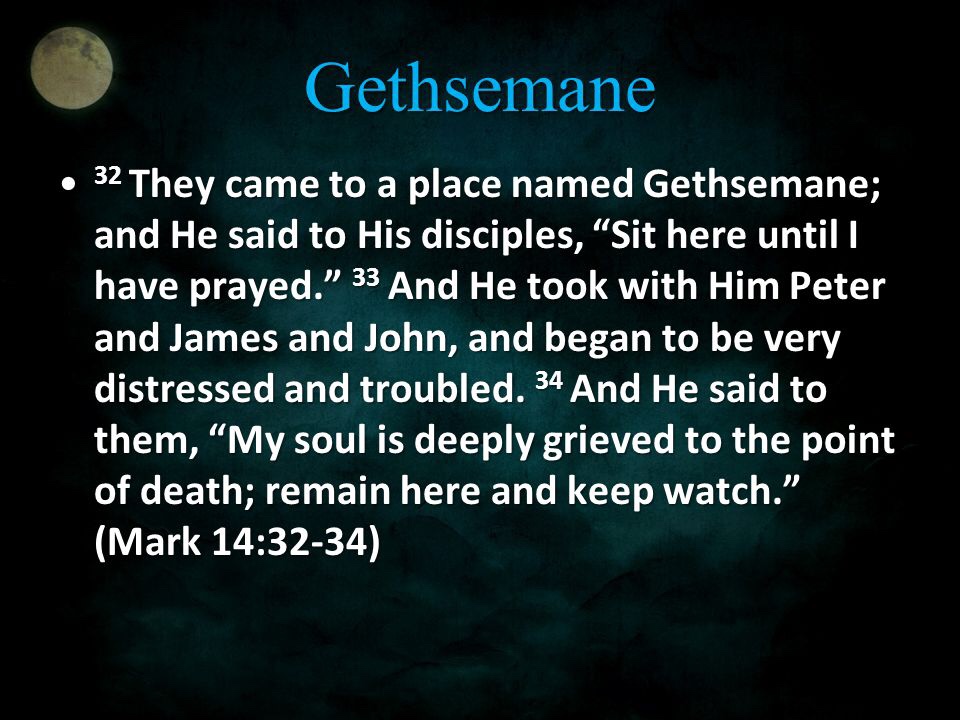
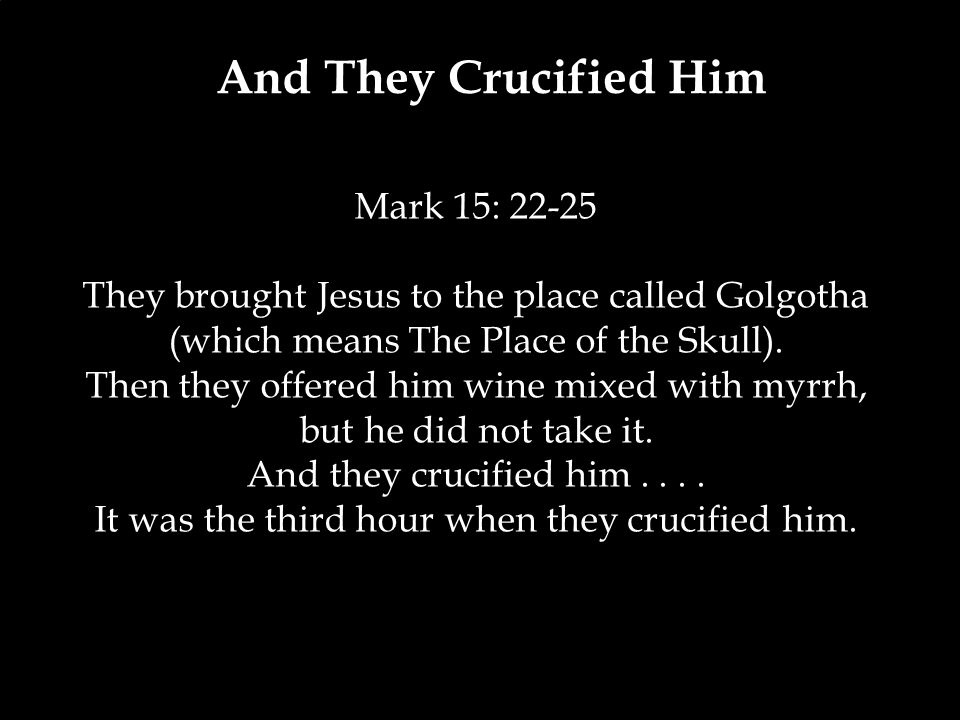
The Narrative itself has three main sections, each with two parts. Section One (14:32–52) is based in Gethsemane, where Jesus prays before he is arrested. Section Two (14:53–15:20) revolves around the trials of Jesus, first before the High Priest and the whole Council and then before Pilate, the Roman Governor. In between these trials, Peter denies any knowledge of Jesus. Section Three (15:21–41) is based at Golgotha, where Jesus is crucified and dies.
As a postlude to these scenes, Mark recounts the burial of Jesus and the discovery of the empty tomb on the third day (15:42–16:8). The whole narrative contains a slowly building sense of the inevitable which climaxes in the death of Jesus. All has pointed to this moment; and at the climactic moment, the centurion declares the essential nature of Jesus (15:39).
Table: The Passion Narrative in The Gospel of Mark
Prelude (14:1–31) Two meals: at Bethany, at Jerusalem
Section One (14:32–52) Jesus in Gethsemane
Section Two (14:53–15:20) Jesus on Trial
Section Three (15:21–41) Jesus at Golgotha
Postlude (15:42–16:8) The Tomb: burial, discovery
How are we to make sense of this death? The Passion Narrative of Mark (as, indeed, in all four canonical gospels) relates it to the figure of righteous person who suffers injustice. He takes great pains to show that Jesus remains faithful to his calling despite the pressures he faces.
Jesus, the righteous sufferer
In this Passion Narrative, the author of the beginning of the good news recounts the death of Jesus by relating it to the figure of righteous person who suffers injustice. The author of this Gospel takes great pains to show that Jesus remains faithful to his calling despite the pressures he faces.
The Gethsemane scene draws on imagery from Hebrew Scripture to underline this. The narrative evokes the suffering of the faithful righteous person, a figure found especially in the Psalms.
Like the righteous sufferer, Jesus laments that he is “deeply grieved” in the face of his death (14:34), using the same language as the psalmist (Psalms 42:5,11; 43:5; also 42:6; 55:4; 61:2; 102:9–10; 116:3; and most graphically, 22:14–15).
Jesus continues in prayer, using the language of the prophets who pointed to the divine judgment which Israel would suffer (“remove this cup” evokes the cup of divine judgment; see Psalm 75:8; Isa 51:17; Jer 25:15–16; Ezek 23:31–34; Hab 2:16–17; Lam 4:21). Thus the prophets are used to interpret the suffering which Jesus faced.
Yet this image is transformed from vindictive revenge, to vicarious suffering, in the context of Mark’s Gospel—”the cup” has already been identified with the passion of Jesus at Mark 10:38–39.
The Golgotha scene also contains this orientation. What takes place is interpreted with reference to scripture; here, the allusions are both subtle, and more direct. The cry which Jesus utters at the ninth hour, “Eloi, Eloi, lama sabachthani” (15:34), is a clear reference to Psalm 22, by quoting its first verse.
As Jesus approaches his death, the psalm focuses attention on the stark moment of utter dereliction. Here, Jesus identifies with the righteous sufferer, who hopes for salvation but still experiences utter desolation. (It may also be important to observe that the psalm moves from the despair of lament (22:1–21) to the hope of thanksgiving (22:22–31). Is this what was intended by the author of the Gospel?)
Indeed, the Golgotha narrative draws extensively on Psalm 22 to express what Jesus experienced on the cross. The dividing of garments and casting of lots (15:24) alludes to the same actions endured by the righteous sufferer at Psalm 22:18 (this is made explicit at John 19:23–24).
Those passing by mock Jesus, wagging their heads at him (15:29), in the fashion of Psalm 22:7, “all who see me mock me”. The taunt, “let him save himself” (15:31–32) reflects the prayer of the righteous sufferer (Psalm 22:8, “he committed his cause to the Lord; let him deliver him, let him rescue him, for he delights in him”).
The offer of wine mingled with myrrh (15:23) evokes Psalm 69:21, which once more is made explicit at John 19:28–30a (this is explicitly “to fulfil the scripture”).
Later reflection, within the early church, recognized that what took place at Golgotha could be understood in the light of the understanding of suffering in the Hebrew Scripture; what happened to Jesus was recognized as fulfilling scripture, as the later addition of 15:28 (added in some ancient version of Mark’s Gospel) indicates (referring to Isa 53:12).
The scenes at Gethsemane and Golgotha are thus steeped in the language and imagery of the Hebrew Scriptures. It is through this Jewish heritage that understanding of this death can be found.
The stories which were originally told about Jesus were individual stories. Over time, however, some of the story tellers began to make collections of similar or related stories. Instead of just one story of a miracle, a particular story teller might have a repertoire of four or five such stories. Rather than speaking a random assortment of individual wise sayings which seemed to have little relation to one another, another story teller might collect a number of sayings which relate to a common topic, or have certain words or ideas in common. Such collections were undoubtedly made at the oral stage—that is, by those who were well-practised at telling stories in the market place, in a courtyard, at the synagogue or at a gathering in a large house.
So it is quite likely that various collections of stories about Jesus made their way around the scattered groups of Jesus followers, still by word of mouth, before they were eventually written down. It is also quite likely that oral collections were known and used by the writers of the Gospels found within the New Testament. There are various signs of such oral collections of stories in each of the canonical Gospels—not the least in Mark’s Gospel, the shortest of the four Gospels.
Stories in Mark’s Gospel
In the first half of Mark’s Gospel, many stories of healing and exorcism can be found. A careful look at the structure of Mark 1–8 reveals two obvious clusters of miracle stories. Mark 1:21–2:12 is a collection of miraculous deeds performed by Jesus in Galilee, beginning and ending in Capernaum (see 1:21 and 2:1). Mark 4:35–5:43 links a pair of intertwined miracles in Galilee (5:21–43) with another pair of miracles performed across the Sea of Galilee in Gentile territory (4:35–5:20).
Immediately before this second collection of miracles stories, there is almost a full chapter devoted to the parables of Jesus (Mark 4:1–34). Another later chapter contains a collection of sayings which each relate to the coming apocalyptic era, when the kingdom will be ushered in (Mark 13:1–37). Whilst there are both parables and apocalyptic sayings elsewhere in Mark’s Gospel, these particular sections appear to hold together very strongly, suggesting that they came to the author of Mark’s Gospel already in this interrelated form.
Just before this apocalyptic chapter, there is a string of incidents which reveal how Jesus engaged in honour-shame contests; that is, verbal combat with a number of opponents. Mark 11:27–12:41 contains stories which tell how Jesus was able to better his opponents on a number of matters. It is highly likely that this also was an oral collection of ‘conflict stories’ gathered around the theme of conflict between Jesus and the authorities in Jerusalem.
Mark 9:33–50 is yet another section of the Gospel which contains a collection of individual stories that seem to have little in common with one another. Indeed, verses 40–50 are simply short sayings of Jesus linked together rather abruptly. This might be an example of the tendency to gather together many small, isolated sayings of Jesus to form a larger collection which can be told by the story teller.
The narrative of the passion of Jesus
It is highly likely that, alongside these collections, there was another collection of materials made about Jesus, before the Gospels we know were actually written: the story of Jesus’ last days in Jerusalem: his arrest, trials, crucifixion, and burial.
This collection was probably made in the early decades after Jesus had been crucified, so that later followers of Jesus could know what took place years before in the last days of Jesus’ life. It reads as a flowing whole, rather than as a collection of isolated stories thrown together for convenience. It follows Jesus through a series of interrelated events.
This part of the Gospel story (chapters 14–15 in Mark) is known as the passion narrative, as it tells about what Jesus suffered in his final days. (“Passion” comes from the Latin word passio, meaning suffering.)
The writer of Mark’s Gospel seems to have been the first person (as far as we know from the evidence) who drew together a number of expressions about the way of Jesus, and worked them into a single, cohesive whole, in a continuous narrative style. The distinctive contribution of the author of this work is that all of these stories are incorporated into the larger story which Mark tells—the story of how it was that Jesus came to be arrested, tried, crucified and buried.
Mark’s Gospel is structured with two main parts: telling stories about Jesus in Galilee and on his journey to Jerusalem (Mark 1–10) and telling what happened to Jesus in Jerusalem (Mark 11–16). The second part forms the climax to the whole work. Indeed, the author of Mark has shaped his account so that the passion narrative, placed in the concluding section of his work (telling what happened to Jesus in Jerusalem), forms the climax to the whole work.
Likewise, the author of Mark has shaped the first part of his account (telling stories about Jesus in Galilee and on his journey to Jerusalem) so that there are many short, but significant, pointers to the fate that lies in store for Jesus in Jerusalem. So important is the role of the passion narrative as the focal point for the whole work, that the Gospel of Mark has been described as “a passion narrative with an extended introduction”.
It is this pattern—collections of stories about Jesus in Galilee followed by a journey to Jerusalem and the account of the passion of Jesus—which was adopted (but also adapted) by the authors of the the book of origins (the Gospel of Matthew) and the orderly account of the things fulfilled among us (the Gospel of Luke). Along with the belief that Mark was the first Gospel to be written, there is a widespread belief amongst scholars that a version of Mark’s Gospel was actually used as a written source by the authors of these other two Gospels.
These three Gospels are known as the Synoptic Gospels, from the Greek word syn-opsis, meaning “looking together”. They have this name because it is possible to lay them out, side by side, and look at the same time at the same story in all three Gospels. These Gospels (along with John’s Gospel) are also called Passion Gospels, because they all come to a conclusion with the passion of Jesus.
So the author of Mark’s Gospel makes some important contributions to Christian literature—writing the earliest Gospel and influencing the authors of the other early Gospels. He also places his mark on Christian history by shaping the way that the story of Jesus would be remembered throughout Christian history.
Outline of the storyline of The Gospel of Mark Jesus is baptised by John (1.1–11) and tested in the desert in Judea. (1.12–13) He then moves to Galilee, (1.14–15) where he preaches, teaches, heals and exorcises. (1.16–9.50) When Jesus returns to Judea, (10.1–52) he comes to Jerusalem and enters the Temple, (11.1–25) engages in controversy with the authorities (11.27–12.44) and instructs his disciples. (13.1–37) After sharing a last supper with his disciples, (14.1–25) Jesus is arrested, tried and crucified. (14.26–15.41) Then he is buried in a tomb (15.42–47) which is subsequently found empty. (16.1–8)
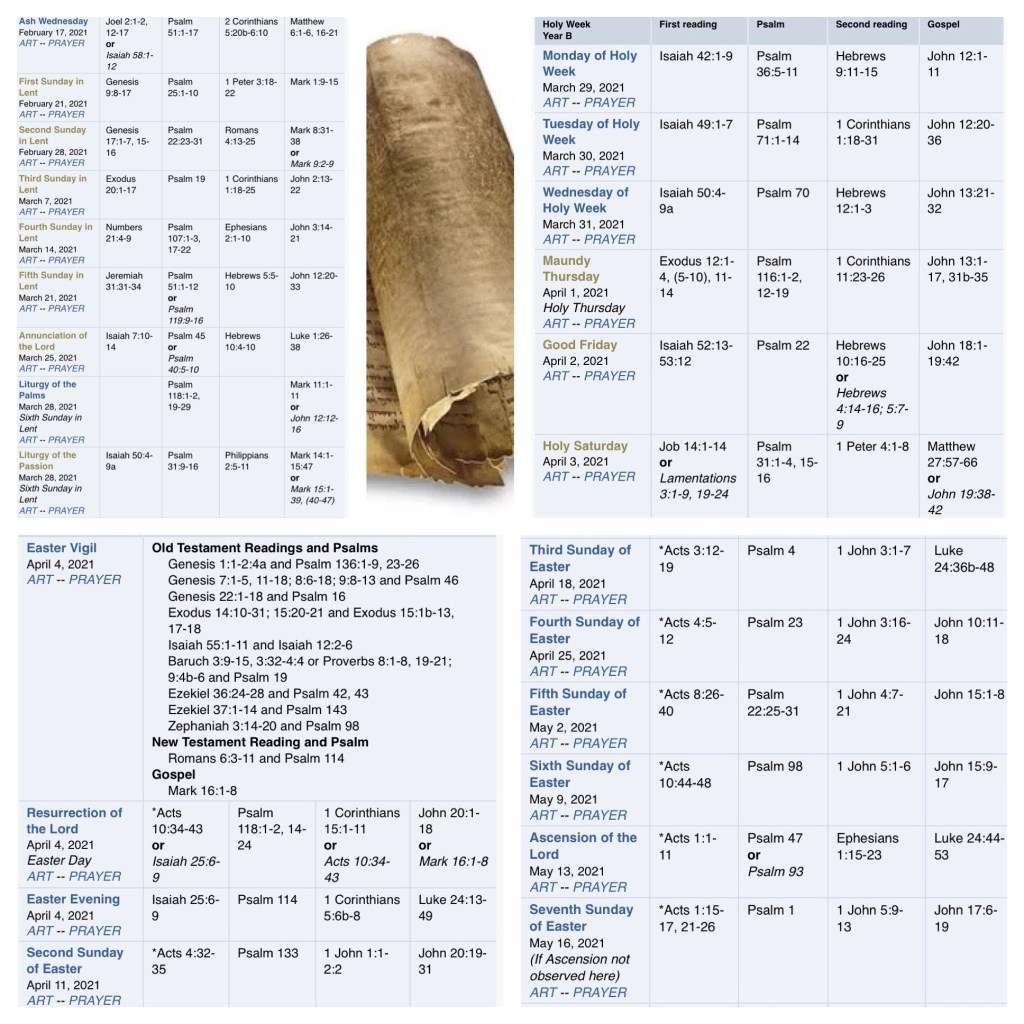
This year in the calendar of the church is what is called Year B. That means that, for the most part, the Gospel reading will be drawn from the earliest, and shortest, account of the life of Jesus that we have in our Bibles: the work that starts, the beginning of the good news of Jesus, which we call, by tradition, the Gospel according to Mark. (In Year A, we have passages from Matthew; in Year C, selections from Luke.)
Except that, with one notable exception, Sunday readings from some weeks ago, right through until Pentecost (this year, falling on 23 May) are not drawn from Mark! Where has Mark gone?
We are in the midst of readings, during Lent, from John (7—28 March); then there will be readings, during Holy Week, once again from John (29 March to 2 April). We will hear an excerpt from Matthew on Holy Saturday (3 April); stories from John and Luke on Easter Sunday (4 April); and then another string of passages from John during the season of Easter (11 April to 16 May).
Pentecost Sunday designates part of John 15, and then Trinity Sunday offers John 3. Stories from Mark are nowhere to be seen. Where has Mark gone?
(To be fair: the lectionary has to do this, if it is to provide a good selection from the Gospel according to John, as that Gospel doesn’t have it’s own year. So its passages are spliced throughout Lent and Easter in all three years.)
The one exception to this Mark-drought is Sunday 28 March. If you celebrate this as Palm Sunday, then a passage from Mark is offered (Mark 11:1-11)—although an alternative from John is provided! If you celebrate this as Passion Sunday, then the whole passion narrative in Mark’s Gospel is offered (Mark 14:1—15:47)—with an alternative being a shorter excerpt from that extended narrative (Mark 15:1-39, with 40-47 as an option).
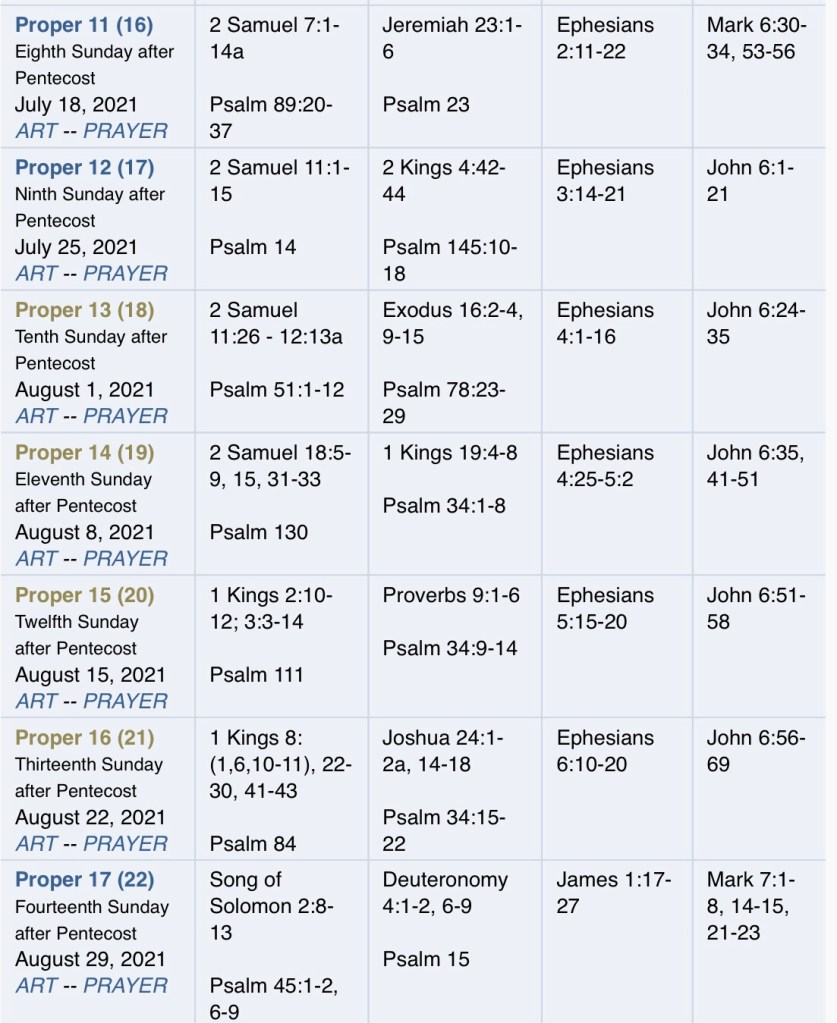
So it will not be until June before we return to the weekly diet of stories from the beginning of the good news—6 June, to be precise, where we pick up the narrative with Jesus in his home town, surrounded (as is usual in this Gospel) by a crowd, being criticised by his family and accused by some Jerusalem scribes (Mark 3:20-35). Hardly a propitious place to rejoin this early Gospel story.
(And even then, there is a five-week interruption in August, when we hear all bar a handful of the 71 verses in John 6 !)
So: I plan on offering a series of blogs leading up to Passion Sunday (28 March) which deals with elements in the story that Mark first told—at least in written form—about what transpired in Jerusalem, at Passover, during the governorship of Pontius Pilate.
But first, some general comments about this earliest and shortest Gospel.
*****
We know that Jesus did not write an account of his life; in fact, we know of nothing enduring that he wrote. In the New Testament, we have four accounts which relate how Jesus called followers to travelled with him around Galilee, and then to Jerusalem, where they witnessed his arrest, trials, crucifixion, and burial of their leader. Subsequently, they attested that he had been raised from the dead and had appeared to them to commission them for their ongoing task. We have four of these accounts. They each have their own distinctive features.
The story of Jesus is told, first, in thebeginning of the good news of Jesus the chosen one, the shortest account. We know this, because of Church tradition, as the gospel according to Mark. This work, it is clear, forms the primary source for two subsequent accounts of Jesus: the book of origins of Jesus, chosen one (the gospel according to Matthew) and an orderly account of the things fulfilled amongst us (the gospel according to Luke).
In this earliest written account of Jesus, we find stories told by Jesus, and stories told about Jesus, which had already been circulating in oral form for some decades. It is likely that some of these stories had already come together in short collections.
The distinctive contribution of this collated story was twofold. First, it places side-by-side a number of different traditions, or collections of stories, about Jesus. Second, these stories are arranged in a dramatic way, beginning with the stories about Jesus in his native area of Galilee, and culminating in the account of Jesus’ passion in Jerusalem.
This work thus provides a much fuller ‘story of Jesus’ than any of the individual oral stories about him. Isolated incidents are placed within a larger context. Individual sayings and deeds of Jesus are grouped together with similar sayings or deeds. Episodes are linked together to form a coherent account of who Jesus was and what it meant to follow his way.
There are two main parts this account of the beginning of the good news of Jesus the chosen one: telling stories about Jesus in Galilee and on his journey to Jerusalem (Mark 1–10) and then telling what happened to Jesus in Jerusalem (Mark 11–16).
But this account of Jesus is more than just a compilation of existing stories. It is infused with vigour and intensity. The story moves from one incident to the next; yet the whole Gospel is a carefully-crafted piece of literature. A sense of drama runs through the Gospel. You might be forgiven for thinking that this is a movie script!
*****
Central to this narrative is a story of conflict. Jesus is set into conflict with the authorities from early on. It is hinted at in the claim that Jesus speaks blasphemy (2:7), and then is revealed in full in the plot that is initiated (3:6). The shadow of destruction hangs over Jesus from the beginnings of his activity.
The tension mounts, from the early days in Galilee, towards the events that will take place in Jerusalem. His own family called him crazy (3:21), the people of his own town took offense at what he was preaching (6:3), and even his closest disciples seemed unable to grasp what he was teaching them (see 8:21; 9:33; 10:35–40).
The popularity of Jesus as he entered Jerusalem was fleeting, even though he acquitted himself so well in arguments with the leaders in Jerusalem (11:27–12:40). His actions in the Temple forecourt were controversial (11:15-17) and it is clear that this incident raised opposition to him to a high level (11:18). The final teachings he gave his disciples begin with a prediction of the destruction of the Temple before recounting the apocalyptic woes that are in store (13:3–37).
The plot hatched by the authorities (12:12; 14:1-2) led them to stir up the crowd to call for his death. Jesus was betrayed by one of his closest followers (14:10, 43-46), all knowledge of him was denied by another (14:30; 14:66-72), and all abandoned him at his point of need (14:50). The tragic climax of Jesus’ death is a scene of utter abandonment: “my God, my God, why have you forsaken me?” (15:34). Only some—a group of faithful women—watched from afar (15:40) before they came to provide an honourable burial for the man who was condemned and dishonoured (16:1)—but precisely there, a surprise awaits them (16:2-7).
*****
Yet the account found in thebeginning of the good news is still more than a dramatic account of a tragic death; for this work appears to be a kind of political manifesto, advocating the way of Jesus in a situation of deep tension and widespread conflict. The whole Gospel conveys the significance of Jesus and his message about the kingdom: “the time is near!” (1:15).
This story reveals the key fact that faithful discipleship will mean enduring suffering, as Jesus did. He writes to help believers understand what it means to follow Jesus and to take up the cross (8:34). These were potent words in the Roman Empire; death by crucifixion was the fate in store for criminals, especially those engaged in any political activities which the Roman authorities perceived to be a threat to the peace of the Empire.
Jesus’ injunction to “take up your cross” was advice which was loaded with danger. Was he advocating resistance against an oppressive Roman rule? The story which is told in this Gospel addresses issues which were pressing on the lives of those who told it, read it, and heard it.
Almost all of this work, the beginning of the good news, appears in basically the same order, in the two following accounts—the orderly account of the things that have been fulfilled among us and the book of origins of Jesus, chosen one. (We know these works as the Gospel according to Luke, and the Gospel according to Matthew.)
Both of these accounts expand the story, incorporating additional material—some is found in both accounts, other stories are recounted in one or the other of the orderly account and the book of origins. So the contribution made by the beginning of the good news is significant, and enduring.
“The hour has come for the Son of Man to be glorified” (John 12:23). So Jesus says to Andrew and Philip, who come with a request from “some Greeks” who were in Jerusalem for the festival of Passover (12:20; see 12:1). See https://johntsquires.com/2021/03/15/we-wish-to-see-jesus-john-12-lent-5/
Two terms in this declaration by Jesus require exploration; two terms which are key ideas in this Gospel, the book of signs.
The story which John’s Gospel reports contains a contrast between the largely public activities of Jesus, and a secret element, described as “the hour”, which does not come until the climax of the story is reached. There are pointers to this contrast from the very first sign, at a wedding in Cana, when Jesus declares, “my hour has not yet come” (2:4).
What is this hour? The first part of the Gospel leaves it as a mystery, for the time being (see 7:30 and 8:20). Then, after the seventh sign, events in Jerusalem show that the hour has come (12:23, 27); the narrator explains that “Jesus knew that his hour had come to depart from the world” (13:1).
Thus, at the beginning and at the end of the public activities of Jesus in this Gospel narrative, the focus is firmly on “the hour”.
Then, some time later on, at the end of his last meal with his followers, Jesus finally prays: “Father, the hour has come: glorify your Son” (17:1). In what will take place after this prayer—the arrest, trial, crucifixion, burial, and resurrection of Jesus (John 18–21)—this “hour” is realised.
The Johannine Jesus describes these events, the fulfilment of “the hour”, as the means by which God is glorified (11:16, 23–33; 13:31–32; 17:4).
The word “glory”, in Hebrew Scriptures, signals the divine presence (Exod 16:1–12; 24:15–18; 40:34–39; Lev 9:22–24; Num 14:10–12; 16:19; Deut 5:22–27; 1 Sam 4:19–22). In the book of signs, it is God’s glory which is now made manifest in Jesus (John 1:14; 2:11; 12:27–28; 17:5).
The language of “hour” and “glory” thus provides a framework for interpreting the events in chapters 2–12 as steps on the way towards a full understanding of Jesus, and the events of chapters 13–21 as the realisation of God’s presence in the world in all its fullness. This is the heart of the incarnational theology that is advocated by the writer of this Gospel.
The story of the Gospel fills out the details as to how it is that “the Word became flesh and lived among us”, which means that for human beings, “we have seen his glory, the glory as of a father’s only son, full of grace and truth” (John 1:14).
The passage offered in this Sunday’s lectionary readings provide part of the Johannine account of the final public moments of Jesus before his arrest (12:20–50). Here, Jesus speaks of this imminent glory (12:20–26), an angel testifies to God’s glory in the death of Jesus (12:27–33), Jesus explains that he comes as light into the world (12:34–36), the scriptures join as witnesses (12:37–43) and Jesus asserts that he speaks God’s commandment of eternal life (12:44–50).
This scene sums up what has come before and opens the door to the events which follow, culminating in the cry of the crucified Jesus, “it is fulfilled” (19:30; the NRSV translation, “it is finished”, downplays the sense of fulfilment in the verb used, teleō). The author of this Gospel thereby indicates that the deepest fulfilment of the hour of Jesus comes on the cross, as the glory of God is revealed in its entirety.
The words echoed down Federation Mall in Canberra, as thousands of people–many, many women, as well as many men–gathered outside the Australian Parliament House to express their anger and hurt about recent very public revelations about the toxic work environment in the parliament and the alleged criminal behaviour of a prominent federal leader.
I was present at this event in Canberra–one of 42 places across Australia where marches were held–along with the ministers of the Gungahlin, Kippax, and Tuggeranong congregations, as well as the Congregational Chairperson, the Church Council Chairperson, and other members of the Tuggeranong Uniting Church.
As one of the men at the March, I was present to express my solidarity with women in this current circumstance.
Women are rightly angry. Far too many women have been hurt–shamed and sacked, experiencing discrimination, abuse and even rape. Their anger is rightly warranted.
So many women bear deep scars from abuse they have experienced at the hands of men. They are disturbed and damaged. Some women have been driven to suicide by the pressures they have felt from toxic masculinity. This is deeply tragic, and completely unacceptable.
Things cannot continue as they have been–not in the Federal Parliament House, not in the various State and Territory parliaments, not in the many workplaces around the country where sexual abuse is rife. The call for Justice, clearly articulated by speaker after speaker at the Canberra rally, is one that must be heard, and responded to, by people in leadership in the federal Parliament, and in businesses and other workplaces across the country.
The call for Justice is grounded in our scriptures, and derived from the fundamental view of the world that is expressed there.
Right at the start of scripture, the very first word about God is that God created (Gen 1:1). The very first word about humanity is that we were created “in the image of God—male and female” (Gen 1:27).
Those first words then shape and drive an understanding of humanity that values the equality of all people, that honours women as equally gifted, equally capable, equally responsible, and equally important, as men.
Hebrew Scripture includes narratives of strong, capable, women: Hagar and Sarah the matriarchs, Miriam the prophet, Zipporah the saviour of Moses, Deborah the judge, Huldah the prophet, the divining woman of Endor, Abigail the advocate of her husband Nabal, Athaliah the Queen of Judah, the unnamed hospitable woman of Shunnem, Ruth the Moabite, Esther the queen, and so many more …..
Jesus lives out this vision in what he says and does: valuing woman as much as men, calling women as well as men, teaching women as well as men. Think of Martha and Mary, Joanna and Susanna, Mary from Magdala–and, of course, his own mother, the fiery feminist icon who sang the Magnificat and stayed strong through to the cross. Strong women, contributing equally to the vitality and growth of the early movement.
The early church continued this way of operating, with leadership being given by Priscilla and Phoebe, Junia the apostle, Mary of Jerusalem, Euodia and Syntyche of Philippi, Tryphosa, Julia and Olympus of Rome, and many more unnamed. The prominence of women leadership in the ongoing church (much to the consternation of some prominent male leaders!) attests to the valuing of female leadership in the movement that became Christianity.
And in subsequent centuries, we can think of Hilda of Whitby, Clare of Assisi, Heloise the philosopher, Julian of Norwich, Hildegard of Bingen, Brigid of Ireland (said to be a bishop), Catherine of Siena, and more … right through to Mary McKillop and Teresa of Calcutta in recent times.
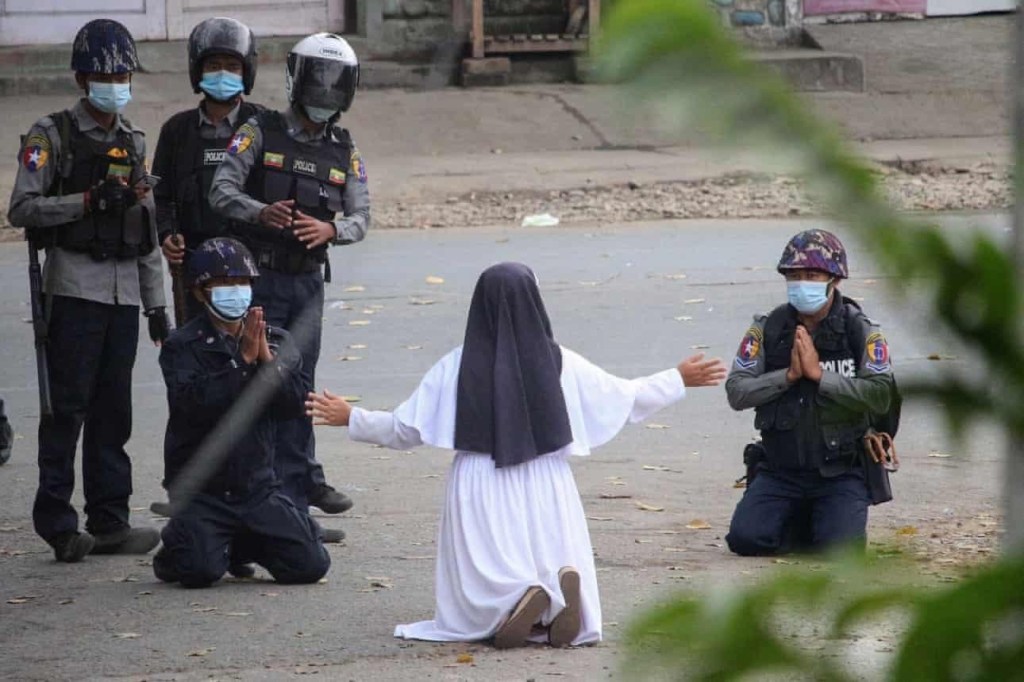
Women continue to serve and lead in so many ways–witness the recent sight of a nun on her knees, pleading with Myanmar military to shoot her, not children. All of this is integral to our faith heritage.
Hebrew scripture also attests to the long and enduring witness of prophetic voices, reminding the people of Israel of their covenant with God and the responsibilities this brought for living justly. Jesus continues this prophetic vocation as he calls his followers to “seek the kingdom of God and God’s righteous ways”. We stand in this stream, called to live out our faith in daily life, commissioned to stand for Justice in our society.
Standing against injustices committed by men against women should simply be second nature for people who are followers of Jesus, disciples within the church, people of Christian faith. Behaviour that is bullying or discriminatory, actions of sexual misconduct and rape, are all completely unacceptable.
Brittany Higgins, speaking at the Canberra March4Justice, said, “The system is broken, the glass ceiling is still in place, injustices continue to occur.” Australian of the Year, Grace Tame, told the March in Hobart that “Silence allows evil to thrive.” We cannot allow that silence to continue. We must work to fix the system.
Today in Australia, we look for leadership that is willing to address the many injustices, to give voice to those who have been silenced for so long, and to work hard to ensure safe places of work, healthy structures and processes, viable pathways to accept and support those women who have been victims.
As people of faith, we rightly belong in the movement that is advocating and agitating, marching and calling for change, to remove ingrained injustices and show that we value women equally in every way. As we do this, we are bearing witness to the Gospel and live out its values in our lives.
“Now among those who went up to worship at the festival were some Greeks. They came to Philip, who was from Bethsaida in Galilee, and said to him, ‘Sir, we wish to see Jesus’” (John 12:20-21).
The fourth Gospel, the book of signs, is distinctive in many ways. One way that it is different from the other three canonical Gospels (the Synoptic Gospels), is that it is the only work that refers specifically to Greeks coming into contact with Jesus.
Mark refers to Jesus coming into contact with a Gentile woman (Mark 7:26). Matthew reports Jesus pointing to the scripture that exclaims about the servant of the Lord, “in his name the Gentiles will hope”(Matt 12:21)—although this account includes the firm instructions of Jesus to “go nowhere among the Gentiles” (10:5), and delays right until the penultimate verse of the book any command to “make disciples of all Gentiles” (28:19).
Luke, of course, signals from the very start of the story that Jesus brings “a light for revelation to the Gentiles” (Luke 2:32), and from early days the crowds that gather to hear Jesus include people from the gentile regions (6:17). It is clear from the following volume that the intention was always for the good news to be shared with the Gentiles (Acts 10:45; 11:1,18; 13:46; 18:6; 28:28).
But Gentiles encompass far more than Greeks. And only the book of signs specifically names that Jesus comes into close contact with Greeks. Although, it could be argued that the way the text describes things, we are never told that the Greeks who have come to Jerusalem for the festival actually engage directly with Jesus. It is only through the intermediaries, Philip and Andrew, that communication with Jesus takes place.
Nevertheless, this (near) encounter appears to provide a resolution of a sort, to the question asked earlier on by the Pharisees: “does he [Jesus] intend to go to the Dispersion among the Greeks and teach the Greeks?” (7:35). Although Jesus does not “go to the Dispersion”, he is engaged (at one remove) with people from the Dispersion who have come to Jerusalem.
At the minimum, this scene in Jerusalem indicates that the significance of Jesus spreads more widely than just amongst Jews. In fact this Gospel includes a number of pointers to the development of a faith community which looked beyond the parameters of Judaism as it was being shaped by the Pharisees, towards other forms of Jewish faith and life—and perhaps beyond. The Gospel is being painted on a wider canvas.
However, the early prominence accorded to John the baptiser, the fact that the first large–scale success enjoyed by Jesus was in Samaria, and the appearance of Greeks in Jerusalem, seeking Jesus, each point to a wider canvas. Sometimes this is defined as “heterodox Judaism”, in contrast to the dominant Pharisaic stream within “formative Judaism”.
Formative Judaism is one way to refer to the version of Judaism that developed in the decades and centuries after the destruction of the Temple in 70 CE. This was the historical precursor of current Rabbinic forms of Judaism. The separation of Christianity from that trajectory within Judaism goes back to the early followers of Jesus, interpreting his words and actions in a certain way.
John the baptiser is prominent at the start of each canonical gospel; scholars wonder if there was originally a link between the Jesus movement and the movement led by John the baptiser. Evidence for this link is also drawn from places such as Acts 19:1–7, and the Q passage in Luke 7 (par Matt 11).
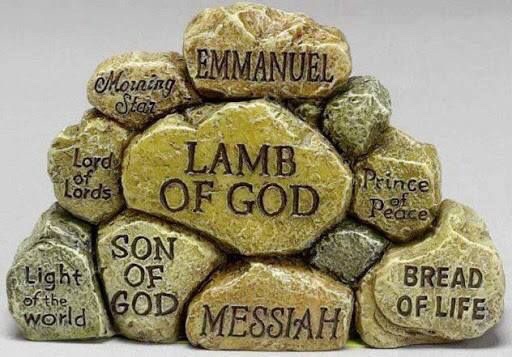
It is John’s Gospel which provides the clearest evidence, when it recounts that the earliest followers of Jesus were drawn from the followers of John (1:35–42). John, in this gospel, does not call for repentance; rather, he bears witness to Jesus (1:6–8, 15; 1:29–36; 3:25–30; 10:41), testifying that Jesus is the light (1:7), of greater rank than John himself (1:15, 30), the Lamb of God (1:29, 36), the Son of God (1:34), the bridegroom (3:29), and, by implication, the Messiah (1:20; 3:28).
This emphatic depiction of John as deflecting attention from himself, to Jesus, indicates that there was, at an early stage, some competition between the two figures—or, at least, between their respective followers.
This link is confirmed, for some scholars, by the nexus of ideas that flow from Johannine Christianity into the Mandean literature of the third and fourth centuries CE—including, amongst other things, the prominence accorded to John the baptiser.
Thus, the reform movement within Second Temple Judaism headed by John is seen to have had some influence on the gospel, in its early stages, at least. John stands outside the Pharisaic–rabbinic stream of Judaism which would become dominant after 70 CE. This is the first indication of the influence of “heterodox Judaism” on this Gospel.
*****
Likewise, the prominence accorded to Samaria in John 4 can be seen as a significant indicator of an important influence shaping the gospel. This scene (like all others in this gospel) is not a straightforward historical narrative, but rather a remembering of an important part of the beliefs of the community, conveyed through the narration of a “typical” incident.
The encounter at the well (4:5–8) leads into a long scene where Jesus engages in deepening theological reflection with the Samaritan woman (4:9–28a), climaxing in the first successful missionary venture within the Jesus movement (4:28b–30, 39–42)—at least, as John recounts it. The first missionary is this anonymous Samaritan woman, and the first body of converts to Jesus are inhabitants of the Samaritan village. This story has a powerful function within this particular community’s traditions.
Samaritans are depicted as sharing a common Jewish ancestry (“our father Jacob”, 4:12) and holding an eschatological hope in the Messiah (“I know that Messiah is coming”, 4:25). They are not utterly different groups.
Yet embedded in the story are clear indications of the tensions between this northern form of Judaism and the dominant southern mode. Ordinary dealings between Jew and Samaritan are unusual (4:9), and liturgical–theological differences mark them off from one another (4:20–21). The success of Jesus’ message in this context indicates its attraction to those outside the “mainstream”.
The words and ideas found in the Prologue to the gospel (1:1–18) have led to a further hypothesis that Hellenistic Judaism had been influential in the context in which the gospel was shaped. The role of the Logos is akin to the role of Wisdom within Hellenistic Jewish literature —both as the agent by which God created the world, and as the means by which God reveals knowledge and truth to the world.
We know that Judaism had long been influenced by the Greek–speaking world. Hellenistic culture is reflected in numerous Jewish writings. In this gospel, the account of the Greeks who wish to see Jesus (12:20–22) is a clear indication of the interaction between the community of the gospel, and the wider hellenised world.
The issue is explicitly raised by the question of the Pharisees at 7:35; “does he [Jesus] intend to go to the Dispersion among the Greeks and teach the Greeks?” The signs we have noted above point to this influence at various points throughout the gospel.
These elements need not necessarily be reflecting events in the ministry of Jesus himself, but more likely point to the context in which the Gospel was shaped, and the factors that influenced the way the story of Jesus was presented.
The community which received this Gospel indicates that the kind of Judaism which has influenced the gospel was not of the dominant, Pharisaic–rabbinic kind. It had become open to the wider world; perhaps the community which first received this Gospel had already become somewhat diversified in its composition.
This blog draws on material in JOURNEYING WITH JOHN: an exploration of the Johannine writings, by Elizabeth Raine and John Squires (self-published 2014)
“Just as Moses lifted up the serpent in the wilderness, so must the Son of Man be lifted up” (John 3:14). So begins the section of the book of signs, the Gospel according to John, that is offered in the lectionary this coming Sunday (John 3:14-21).
The allusion to Moses is clear, referencing the time when “Moses made a serpent of bronze, and put it upon a pole; and whenever a serpent bit someone, that person would look at the serpent of bronze and live” (Num 21:9). The Numbers passage is included in this Sunday’s lectionary, as the reading from Hebrew Scripture (Num 21:4-9).
The brief allusion to the “fiery serpents” (or should that be the seraphim?) in John 3 forms part of an important motif running throughout the whole Gospel, in which Jesus is linked to scripture–often as “the fulfilment of scripture”. It’s a feature that is common to all four canonical Gospels. In the book of signs, this interpretive stance is hinted at as early as the Prologue, in the comparison drawn between Jesus and Moses: “the law was given through Moses; grace and truth came through Jesus Christ” (1:17).
It is stated explicitly in the claim put on the mouth of Philip, “we have found him of whom Moses and the prophets wrote” (1:45), and in the words attributed to Jesus, “You search the scriptures, because you think that in them you have eternal life; and it is they that bear witness to me” (5:39).
There are fifteen clear quotations from Hebrew Scriptures in this Gospel. There are eight explicit references to scripture in the early chapters (1:23; 2:17; 6:31; 6:45; 7:38; 7:42; 10:34; 12:13–15), while a “fulfilment formula” is used in later chapters, to introduce seven such scriptural quotations (12:38–40; 13:18; 15:25; 18:9; 19:24, 28, 36–37). There is also a passing note that Judas died after betraying Jesus “so that the scripture might be fulfilled” (17:12).
However, the total significance of the Hebrew Scriptures in this Gospel is much greater than these sixteen occurrences, as the Gospel contains numerous allusions to specific scripture passages, such as references to Jacob’s ladder (1:51) and the sacrificial lamb (1:29, 36), as well as more generalised allusions to scripture. Chapter 6, a long chapter on the theme of “the living bread”, functions like an extended midrashic exploration of this important scriptural theme.
These allusions are much freer in their form and indicate that, for the author of this Gospel, the Hebrew Scriptures had become an integral part of his mind and heart, for he treats them with a freedom born from intimate familiarity.
In like fashion, a series of Jewish titles is embedded in the narrative as confessions by key characters of the significance of Jesus. In the extended preface of 1:19–51, Jesus is addressed as “Rabbi” (1:38, 49), “Messiah” (1:41), “King of Israel” (1:49), and “Son of God” (1:49). These claims about Jesus, drawn from Jewish traditions, are all made also within the Synoptic traditions.
The Johannine Jesus himself refers, in the allusive synoptic fashion, to the “Son of Man” (thirteen times, from 1:51 to 13:31), which we must presume to be a self–reference. That’s another clear Jewish term drawn from scripture (Dan 7:13; Ezek 2:1,3,6,8, 3:1,3,10, etc).
In later scenes, Jesus is also called “prophet” (4:19), “Messiah” (4:29; 11:27), and “Rabbouni” (my teacher, 20:16). The ultimate Christological confession of the Gospel is uttered by Thomas, when he moves beyond this viewpoint in the phrase, “my Lord and my God” (20:28), echoing the perception of the Jews, that Jesus was “making himself equal to God” (5:18). (Lord, of course, was one of the Jewish terms for addressing God.)
For the most part of this Gospel, Jesus is presented in terms drawn from within a Jewish context. Indeed, even the confession by Thomas (20:28) can be understood within a particular stream of Jewish tradition, for the hellenistic Jewish author Philo uses the terms “Lord” and “God” to designate the two major divine powers of creation (signified by “God”) and eschatological judgement (signified by “Lord”).
And there is much more to be said about the I Am sayings, unique to the book of signs, for each of them draws deeply from the language and imagery of the Hebrew Scriptures. But that’s another blog sometime.
So the allusion in John 3:14 offers a doorway into a complex and rich world of scriptural imagery, story, and language—the very world in which the author of this Gospel lived for many decades.
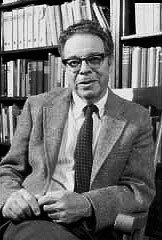
Thinking about this way of writing reminded me of one of my teachers during the years that I was undertaking doctoral studies at Yale University in the USA—Professor Hans Frei. I took a semester-long seminar with him on hermeneutics, wrote a long essay on how his work shaped the “New Yale Theology”, and had him as one of my assessment panel when I submitted my doctoral thesis proposal. He had an utterly incisive mind along with a gentle eirenic nature.
Prof. Frei used to say “we should not read the Bible in such a way as to make it make sense on our lives; we need to live our lives in the text of the Bible and that way we find its deepest truths”. Or something like that—it is 35 years since I took that seminar with him!!
Here are two of his quotable quotes about this, that I have found online:
“For many centuries before the modern age, most Christian theologians had read the Bible primarily as a kind of realistic narrative. It told the overarching story of the world, from creation to last judgment. Moreover, the particular coherence of this story made “figural” interpretation possible: some events in the biblical stories, as well as some nonbiblical events, prefigured or reflected the central biblical events. Indeed, Christians made sense of their own lives by locating their stories within the context of that larger story.” He argued, in his writings and in his teaching, that we needed to recover something of that way of reading the Bible—living in its world, rather than dragging it into our world.
Another rich quote is:
“A Christian theology that respects the meaning of the biblical narratives must begin simply by retelling those stories, without any systematic effort at apologetics, without any determined effort to begin with questions arising from our experience. The stories portray a person — a God who acts in the history of Israel and engages in self-revelation in Jesus of Nazareth. They help us learn about that person in the way that a great novelist describes a character or that a telling anecdote captures someone’s personality. They provide insights that we lose if we try to summarize the narrative in a nonnarrative form. No abstract account of God’s faithfulness adequately summarizes Exodus. The Gospels surpass any abstract account of God’s love.”
And he quotes Erich Auerbach, a literary critic whom Frei much admired, as he wrote of the Bible:
“Far from seeking . . . merely to make us forget our own reality for a few hours, it seeks to overcome our reality: we are to fit our own life into its world, feel ourselves to be elements in its structure of universal history. Christians who tell these stories, stories that are rich, enigmatic, sometimes puzzling and ambiguous, can find that their lives fit into the world they describe — indeed, that our stories suddenly seem to make more sense when seen in that context.”
It seems to me that the ethos of the book of signs and the writings of Hans Frei, separated in time by two full millennia, nevertheless share this common feature, of immersing themselves into the ancient scripture so that it shapes the way they live in the world of their own time.
*****
The earlier part of this blog draws on material in JOURNEYING WITH JOHN: an exploration of the Johannine writings, by Elizabeth Raine and John Squires (self-published 2014)
“Just as Moses lifted up the serpent in the wilderness, so must the Son of Man be lifted up” (John 3:14). So begins the section of the book of signs, the section from the Gospel of John that is offered in the lectionary this coming Sunday (John 3:14-21).
The allusion to Moses is clear, referencing the time when “Moses made a serpent of bronze, and put it upon a pole; and whenever a serpent bit someone, that person would look at the serpent of bronze and live” (Num 21:9). The Numbers passage is included in this Sunday’s lectionary, as the reading from Hebrew Scripture (Num 21:4-9).
The Brazen Serpent Monument on Mount Nebo in Jordan
Of particular note in the Numbers passage, before we head into the Gospel passage that alludes to it, is the fact that there is a crucially important Hebrew word which appears in Num 21 and which in most current English translation, is not accurately rendered. (This is a favourite of my wife, Elizabeth—she often refers to the translation issues inherent at this point. In this blogpost I am dependent on many of her insights and our discussion of this passage.)
In Num 21:6, the Lord sends creatures often described as “fiery serpents” or “poisonous serpents” amongst the people, who are grumbling about the food and water available to them in the wilderness. In Num 21:8, the Lord commands Moses to put a “fiery serpent” or a “poisonous serpent” on a pole. In both verses, the crucial word is saraph — a word that appears just seven times in the Hebrew Bible.
On three occasions (twice here, and again at Deut 8:15), saraph is translated as “fiery serpent”. In two instances, it is rendered as “flying serpents” (Isa 14:29 and 30:6). But in one very well-known story (the call of Isaiah), the word appears in its plural form, seraphim—and here, it is usually transliterated, letter for letter, as “seraphim” (Isaiah 6:2, 6).
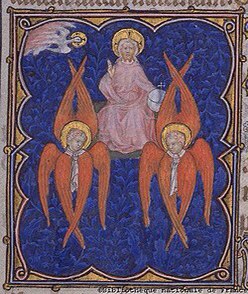
The seraphim, of course, were one of three forms of angels known to the ancient Hebrews—the malachim, or messengers (from which Malachi gets his name), the cherubim (depicted on the ark, according to Exodus 25:18-22), and the seraphim (six-winged creatures who are the heavenly attendants of God).
And as Isaiah indicates, these seraphim were certainly able to fly (Isa 6:2), and they clearly dealt with fire, taking a coal from altar with a pair of tongs and delivering that to the prophet (Isa 6:6-7). In fact, the word saraph derives from a word that literally means “burning”.
Alongside this word, the more usual Hebrew word for serpent, nehash, is found in the Numbers story. It occurs once in what the narrator reports in Num 21:6, where the word stands right alongside seraphim; here the double barrelled hanehashim haseraphim appears to designate the serpents that bit the Israelites as “fiery serpent-like seraphim”, or even “flying serpent-like fiery-seraphim”.
Then the simple nehash appears once in what the people say (21:7), asking Moses to “take away the serpents from us”; and then twice in the actions of Moses (21:9). What Moses makes is a nehasnehoset, “a bronze serpent”; and what Moses places on the pole is a nehashanehoset, “the bronze serpent”—that is, a serpent figure forged from bronze metal (21:9). But what God had commanded him to place on the pole was a saraph, a “fiery serpent” (21:8).
So there is a curious element in the Numbers story—did Moses use an image of a serpent, or an image of a seraph, to ward off the seraph-serpents who bit the people? (Num 21:9). The Hebrew actually refers to the image on the pole using both terms!
This brief (and complex) allusion to the “fiery serpents” (or should that be the seraphim?) in John 3 forms part of an important motif running throughout the whole Gospel, in which Jesus is linked to scripture–often as “the fulfilment of scripture”, but in many more ways as well.
The Johannine account of the incident in the Temple (John 2:13-22), which appears in the lectionary as the Gospel passage for this coming Sunday, concludes by indicating that Jesus, the northerner from Nazareth in the Galilee, is intent on confronting the southern Judeans and their degrading of the Temple.
“Destroy this temple, and in three days I will raise it up”, Jesus had said to his disciples (2:19); and the author concludes, “after he was raised from the dead, his disciples remembered that he had said this; and they believed the scripture and the word that Jesus had spoken” (2:22).
Indeed, the previous story in this Gospel, the miracle of Jesus turning water into wine whilst at a wedding in Cana of Galilee (2:1-11), also flags this confrontational aspect. It infers that the water of the Jewish purification system (2:6) is inferior to the “good wine” which Jesus offers (2:10).
Wedding at Cana by Duccio di Buoninsegna (1308-1311)
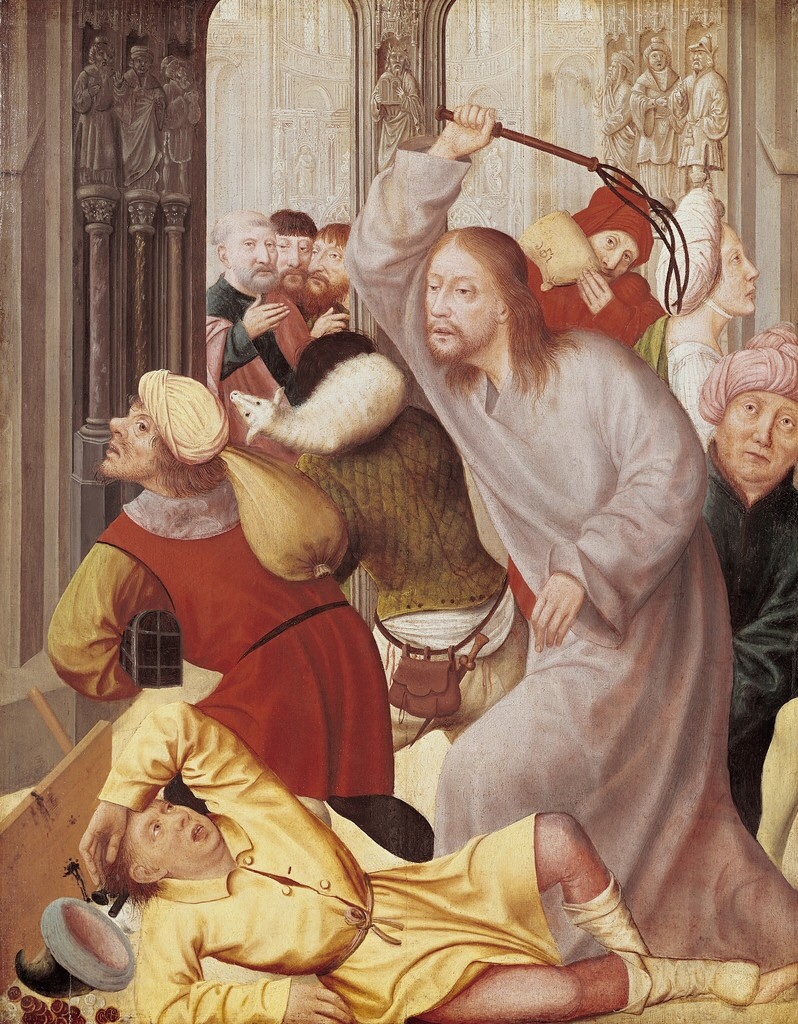
The dynamic of confrontation continues in the scene in which a zealous Jesus, whip in hand, speaking with righteous anger, expels traders from the temple courtyard, quoting the prophets to support his actions (2:13–17).
The programmatic purpose of these two passages, placed at the very start of the long narrative section about the public activities of Jesus (2:1-12:50), is that they introduce this dynamic of conflict and opposition. This is a motif that runs throughout the whole of the book of origins.
The supremacy of Jesus
In the first Jerusalem controversy (5:16–47), Jesus makes a grand claim for himself in relation to Jewish history: by healing on the Sabbath, he continues to do “the works which the Father has granted me” (5:36). This controversy reaches its culmination with Jesus’ claim that no less an authority than Moses supports his understanding of his role (5:45–47); for indeed, “he [Moses] wrote of me” (5:46).
The issues in this first controversy are resumed throughout 7:10–10:39, and the claims of Jesus come to a further climax when he claims support from no less a figure than Abraham (8:53–58); indeed, “your father Abraham rejoiced that he was to see my day” (8:56).
Then, a similar claim is made by the narrator concerning the prophet Isaiah at the very end of the first half of the Gospel, in the aftermath of the raising of Lazarus (12:36b–43). The response of many people to Jesus was one of disbelief, in direct fulfilment of the words of Isaiah, who “saw his glory and spoke of him [Jesus]” (12:41).
Thus, three venerable witnesses from Hebrew scripture (Moses, Abraham and Isaiah) give personal testimony to the supremacy of the words and deeds of Jesus.
Criticisms of Jesus
The situation which lies behind the recounting of these words, and the retelling of controversy narratives, is one of high tension between the followers of Jesus and the Jewish authorities. The cry of the crowd, that Jesus has “a demon” (7:20; 10:20), is repeated by the Jews at 8:48–52, with the added insult that he is “a Samaritan” (8:48). A demon-possessed Samaritan could not be more of an outsider!
A third criticism levelled against Jesus is that he was born illegitimate (8:41). The words of the Jews represent a tense argument which was taking place within the Judaism of the first century, as Jewish followers of Jesus debated with the authorities in their synagogues about the status of Jesus of Nazareth.
The threat of persecution
This tension is increased by the ever–present threat of persecution which runs throughout this Gospel. Jesus highlights this in his discourse on the sheep and the shepherd, with references to the threat posed to the sheep by thieves and bandits (10:1, 8, 10), strangers (10:5), the hired hand (10:12–13), and wolves (10:12). The menace posed by these figures leads Jesus to infer that some of his sheep will be “snatched” out of his hand (10:28–29).
A fuller and more explicit exposition of this theme is given in the second farewell discourse, under the rubric of “the world hates you” (15:18–25). Jesus here predicts that his fate will set the pattern for the fate of his followers; “if they persecuted me, they will persecute you also” (15:20).
At this, the Jews prepare to stone Jesus for the second time (10:31; the earlier instance was at 8:59). This enacts the revelation made by Jesus in an earlier discourse, that his fate is to be hated by the world (7:7); and already in the Prologue the narrator has spoken of the rejection of the Word (1:10–11).
The Passion Narrative details the course of this rejection: betrayal (18:1–9), denial (18:15–18, 25–27), abandonment by his own people (18:38b–40, 19:7–8), and crucifixion (19:16–30). The ultimate fate of martyrdom, suffered by Jesus, is quite explicitly the same fate in store for those who follow Jesus: “They will put you out of the synagogues … whoever kills you will think he is offering service to God” (16:2–3). This, presumably, is what was meant by the allusion to their being “snatched out of the Father’s hand” (10:28–29).
Fear of “the Jews”
Who is it that perpetrates this persecution? Running throughout the storyline of this Gospel is a refrain concerning “the fear of the Jews”. This note is first sounded after Jesus’ second visit to Jerusalem (5:1). Upon returning to Galilee, Jesus refuses to return to Judea (7:1); but when his brothers travel there, he follows “not publicly but in private” (7:10). Obviously his presence in Jerusalem is known, as there is a divided opinion about Jesus – again, in private, for “no one spoke openly of him for fear of the Jews” (7:13).
Later in this same visit to Jerusalem, after Jesus has enabled the man born blind to see once more, the parents of this man distance themselves from their cured son, claiming not to know of the details of the healing, “because they feared the Jews” (9:22).
Likewise, after the crucifixion of Jesus, his body is requested of Pilate by Joseph of Arimathaea, who is described as being “a disciple of Jesus, but secretly, for fear of the Jews” (19:38). Finally, when the disciples gather after the crucifixion, not yet aware that the tomb is empty, they meet with “the doors locked, for fear of the Jews” (20:19). In each case, fear of the Jews leads to deeds and words which take place in secret; any desired confession of allegiance to Jesus is muted and repressed, because of this fear.
Even Pilate, in the Johannine account of the trial of Jesus, trembles before the Jews; “he was more afraid than ever” (19:8). This would seem to be a highly implausible historical possibility, given what is known of the rigour of Pilate’s rule. It seems reasonable to conclude that the theme of the fear of the Jews is functioning as a significant Johannine motif at the level of the readers of the narrative.
Who are “the Jews” ?
The opposition to Jesus which runs throughout the first half of this Gospel often comes from the group described, indiscriminately, as “the Jews” (2:18–20; 5:16–18; 6:41, 52; 7:1; 8:31, 48; 9:18, 22; 10:19, 24, 31). Who are these people who evoke such fear?
The Greek word used (Ioudaioi) can point to a geographic entity (the Judeans, from the southern kingdom), or a religious entity (Jews, as opposed to Samaritans or Gentiles). The identity of the Ioudaioi in this Gospel is a critical matter. They appear to be clearly identified with the Judaeans at 7:1; but not every usage of the term must necessarily bear this geographical meaning.
Some scholars see this term as a typically Johannine symbolic cipher—a code word for “the world”, since “the world” parallels “his own people” at 1:10–11, and the actions of “the Jews” is consistent with what is said of “the world” at 15:18–16:4.
More plausible is the view that “the Jews” are simply to be equated with the Judaean leaders. Midway through the Gospel, the specific opponents of Jesus are identified as “the chief priests and the Pharisees” (11:57). Soon, this grouping broadens its opposition to Jesus, to include Lazarus (12:9–11).
Yet a clear contrast is drawn between the “great crowd of the Jews” who had come to see Jesus and Lazarus (12:9), and the “many Jews” who believe in Jesus (12:10), on the one hand; and the leadership of the Jews, who were planning the persecution: the chief priests who plot his death (12:10), and the Pharisees, who initially appear unable to act (12:19), but who ultimately join with the priestly group to effect the arrest of Jesus (18:3). The opponents of Jesus are here described quite specifically from the moment that Lazarus is raised from the dead.
The Synoptic Gospels indicate that throughout his public activities, Jesus had engaged in controversy with the Pharisees (Mark 2:16, 24; 3:6; 7:1, 5; 8:11, 15; 10:2; 12:13 and parallels; Matt 5:20; 12:24, 38; Luke 7:30; 11:37–44, 53; 12:1; 15:2; 16:14). It was only from the time of his arrival in Jerusalem that there was any priestly opposition (Mark 11:18 and parallels).
In John’s Gospel, the position is somewhat different. Opposition to Jesus from the time of his last visit to Jerusalem comes not only from the Pharisees, in particular (4:1; 7:47; 8:13; 9:13, 40), but also from the chief priests and the Pharisees (7:32, 45; 11:47, 57).
Expulsion from the synagogue
In the Synoptic accounts, the Pharisees fade from view once Jesus enters Jerusalem, whereas in this Gospel, when Jesus is arrested, it is at the hands of the military police from the chief priests and the Pharisees (18:3), in conjunction with the Roman soldiers. The role of the Pharisees, as opponents to Jesus, is thus expanded in this Gospel. More than any other identified group, it is the Pharisees who become the focus of the opposition and persecution of Jesus.
J. Louis Martyn has argued that the Pharisees stand as representatives of the Jewish leadership in the situation after 70 CE, when the final form of this Gospel took shape. This was different from the situation at the time of Jesus’ earthly life. Scholars now refer to this period as the time of formative Judaism—a period when Pharisaic leadership began to form the kind of Judaism which could survive the destruction of the Temple.
This period was marked by sectarian dispute and division—including the development of the Jesus movement away from Judaism, towards its eventual identity as a predominantly Gentile religion. A vacuum had been opened up by the destruction of the Temple and the expulsion of Jews from Jerusalem, and this meant that the Pharisees were struggling to assert their dominance in a new, unsettled, and unfamiliar context.
The book of origins contains three references to the expulsion from the synagogue of the followers of Jesus (9:22; 12:42–43; 16:2–3). This is one point at which the “partings of the ways” begin, for believers within this stream of the Jesus movement became completely alienated from their Jewish religion.
Martyn argues that the experience of the man born blind reflects the situation of those Jews of some decades later on, who had come to faith in Jesus (9:38), in that when they attempted to declare that he was the Messiah, they were expelled from the synagogues (9:22). This expulsion was enforced by the Pharisees (12:42), who instigated persecutions of Jews (16:2) when they refused to adhere to the position which they were putting.
Thus, the beginnings of the development of a sectarian community can be seen; when Jews who confessed Jesus as Messiah were expelled from the synagogue, they formed their own community with their own developing beliefs. Into that context, decades after Jesus, the account of the book of signs is crystallised into a full Gospel.
Placing blame on “the Jews”
The Johannine passion narrative (18:1–19:42) contains further indicators of the sectarian nature of the community. Although Jesus dies by crucifixion, under Roman jurisdiction, the blame for his death is placed amongst the Jerusalem leadership, through a sequence of events uniquely highlighted in this Gospel.
First, the plotting of the priestly leaders, reported immediately after the raising of Lazarus (11:49–53), is briefly rehearsed (18:14).
Then the Jewish authorities in Jerusalem declare Jesus to be a criminal (18:30) and hand him over to the Roman procurator, Pilate (18:34), who is reluctant to accept the case (18:31). Yet Roman justice is not permitted to run its course; indeed, had this been so, Pilate would certainly have released Jesus (18:38; 19:6, 12).
The Synoptic version of the trial scene notes the interference of the priestly rulers in the “Barabbas” incident (Mark 14:8–15 and parallels). The Johannine version intensifies the role of the Jews by their persistence in calling for the death of Jesus (19:7, 12, 15).
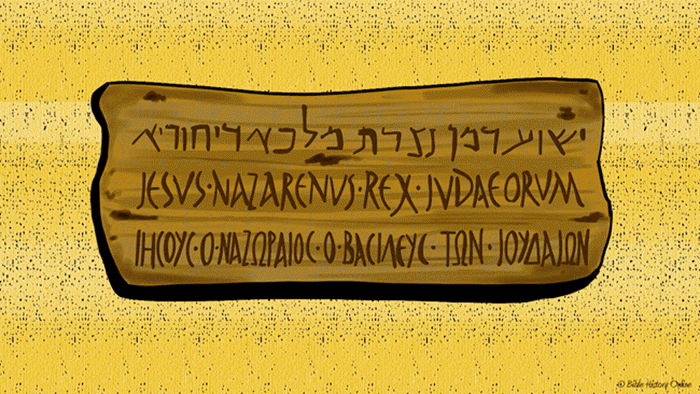
It is only when Jesus hangs on the cross that Pilate is able to stand up to the priests—on a matter of negligible consequence (the wording of the inscription, 19:21).
Thus, the apologetic against the Jews is heightened in the Johannine passion narrative, giving clear reasons for the disciples’ later decision to meet behind locked doors, “for fear of the Jews” (20:19).
And so, the book of origins provides fertile grounds for later developments that pitted Christians against Jews with such ferocity—and that led to medieval pogroms, then the development of ghettos, then the systematic persecutions leading to the horrors of the Shoah under the Nazis.
The thread of antagonism and conflict, present at the start of the book of signs (2:1-22), has grown and developed throughout the Gospel (and beyond). We must take great care in how we use and interpret this text.
*****
This blog draws on material in JOURNEYING WITH JOHN:an exploration of the Johannine writings, by Elizabeth Raine and John Squires (self-published 2014)
How might we characterise what Jesus wants all of his followers to exhibit? Loving kindness, gracious acceptance, patient servanthood, self-effacing humility? If we take seriously the disturbing teachings we heard last week (Mark 8:34-38), these will be the central characteristics we will exhibit. And such characteristics are, as we noted last week, disruptive and destabilising!
However, in yet another instance of such disruptive instability, the lectionary this week offers a story about a time in the life of Jesus when he was anything but humble, gracious, and self-effacing. The infamous story of “Jesus cleansing the Temple”, set for Lent 2, is found in all four canonical Gospels. It occurs at the very end of the public activity of Jesus in the three Synoptic Gospels, where it provides the catalyst for the arrest and trial of Jesus.
By contrast, and quite strikingly, in the fourth Gospel, the book of signs, it is recounted very early on, immediately after the very first miracle that Jesus performed (2:1-11). It stands as a kind of “programmatic statement” which declares what Jesus is on about in the whole of his ministry (in much the same way that Luke 4:16-30 provides a “manifesto for mission” in the Lukan presentation of the story of Jesus).
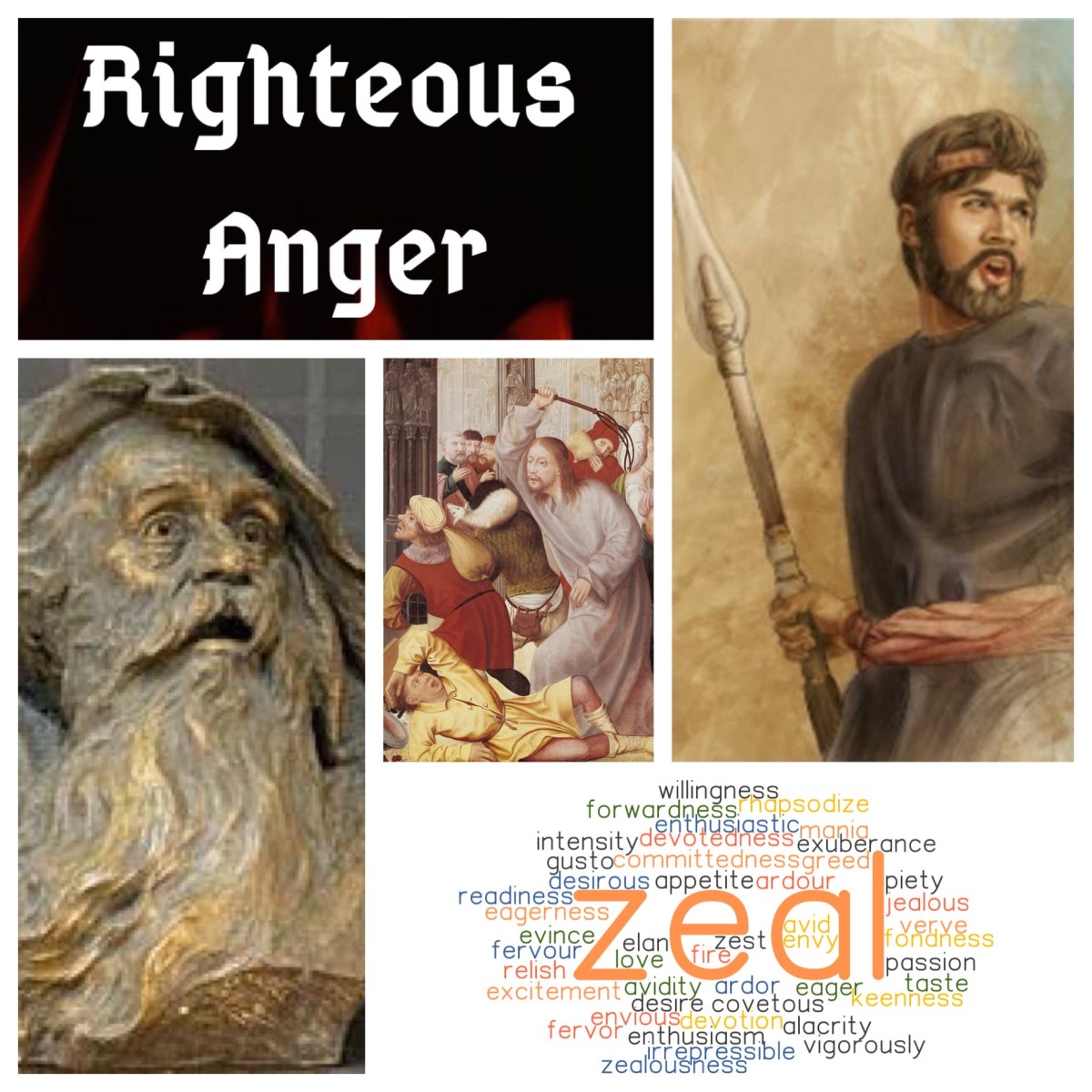
And the Jesus who is portrayed in this striking account demonstrates very little gracious, self-effacing humility. Rather, he acts out his righteous anger, embodies zealous piety, and provides an intensity of focus on the role to which (according to this author) he has been called: “destroy this temple, and in three days I will raise it up” (2:19).
I. Righteous anger. First, this story depicts Jesus as manifesting “righteous anger”, both in his actions (2:15) and in his words (2:16).
The actions of Jesus include overturning the tables of the money changers (as noted when this story is reported in Mark 11:15 and Matt 21:12) and driving them out of the temple area (as is also noted in Mark 11:15, Matt 21:12, and Luke 19:45).
They also include tipping out the coins of those money changers (not reported in other accounts), and knitting together cords to form a whip, by which he carried out these actions (also absent from the Synoptic accounts of this scene). The fact that this would take some time to do indicates that, at least in John’s eyes, Jesus was entering the area with intention and purpose.
James McGrath notes that “both the selling of animals for sacrifices and the payment of the temple tax were activities required by Jewish law and central to the temple’s functions” (see https://www.bibleodyssey.org/en/passages/main-articles/jesus-and-the-moneychangers). What Jesus does is therefore not an incidental act of anger; it is part of a deliberate plan of action.
McGrath suggests that the reference to the Temple as a marketplace might be an allusion to the eschatological prophecy of Zechariah, that “there shall no longer be traders in the house of the Lord of hosts on that day” (Zech 14:21). Is Jesus enacting this prophecy through his actions in the Temple forecourt?
Certainly, the words of Jesus (2:16) are sharp and accusatory. There is both the sharp command to take the elements of money changing out of the precinct, as well as the accusation that what the traders are doing is “making my Father’s house a marketplace!” Jesus commands them directly to “stop”.
This is similar to, but not the same as, the Synoptic accusation that the money changers are making the temple “a den of robbers” (Mark 11:17, Matt 21:13, and Luke 19:46). That most likely references the rhetorical question of the prophet Jeremiah: “Has this house, which is called by my name, become a den of robbers in your sight?” (Jer 7:11).
Gail O’Day considers that “by going to the Jerusalem temple and disrupting the practices that were necessary for the celebration of Passover, Jesus places himself in a long line of Israel’s prophets who go to Jerusalem, the center of religious and political power, and announce and enact the word of God.” (see https://www.bibleodyssey.org/en/passages/related-articles/cleansing-or-cursing)
In this dramatic prophetic action, Jesus acts and speaks carefully, deliberately, with “righteous anger”. This concept is explicitly is named in an earlier Jewish text, telling of the moment when Mattathias exploded in anger at the desecration of the land that he was witnessing by the foreign powers that held Israel under their power.
Mattathias the Maccabee: bronze head (1894) by Boris Schatz
Mattathias watches a Jew come forward to make a sacrifice on the pagan altar erected in Modein, in accordance with the command issued by Antiochus. It is said that Mattathias “burned with zeal and his heart was stirred. He gave vent to righteous anger; he ran and killed him on the altar” (1 Macc 2:24).
Does Jesus stand in this tradition, when he enters the Temple, is disturbed by what he sees there, and acts to purge the forecourt of the activities taking place there? Is this an expression of righteous anger? (Not to the extent of killing a person; but still, enacting vigorous actions and speaking striking words.)
Of course, anger—presumably, justified, or righteous, expression of anger—is a characteristic of God throughout Hebrew Scriptures. Moses experienced the anger of the Lord (Exodus 4:14), as did all of Israel in the wilderness (Num 11:1,33, 12:9, 25:1-5, 32:9-15; Deut 6:15, 11:17, 29:19-28, 31:17, 29, 32:22), and then this divine anger is present as a regular and consistent element through the narratives of the ongoing story of Israel.
Certainly, there are places in Hebrew Scripture which repeat the formulaic claim that God is “slow to anger” (Exod 34:6; Num 14:18; Ps 86:15, 103:8, 145:8; Joel 2:13; Jonah 4:2; Nahum 1:8). Nevertheless, scripture contains invocations to God to put aside his anger, such as that by Moses (Deut 9:19) and the prayer of Daniel, “O Lord, in view of all your righteous acts, let your anger and wrath, we pray, turn away from your city Jerusalem, your holy mountain” (Dan 9:16). God’s anger was well known.
So in this incident in the temple, Jesus is manifesting, not just the righteous anger of the revolutionary Mattathias, but the anger of the righteous one himself, the Lord God. And this anger is directed at those who debase the Temple, the house of God, through their actions.
II. Zealous piety. Second, the incident is interpreted as a manifestation of zealous piety from Jesus. Interestingly, it is not Jesus himself who directly expresses this; rather, the author indicates that this interpretation was made after the event by the followers of Jesus. They understand the actions of Jesus in the terms of a verse from the Psalms, “zeal for your house will consume me” (Ps 69:9, quoted in John 2:17).
The expression of zeal is linked with anger in the same extract from 1 Maccabees that we saw above: “Mattathias burned with zeal … and gave vent to righteous anger” (1 Matt 2:24). There are further examples of intense zeal amongst the people of Israel–most notably Phinehas, son of Eleazar, son of Aaron the priest, of whom God said: “he has turned back my wrath from the Israelites by manifesting such zeal among them on my behalf that in my jealousy I did not consume the Israelites” (Num 25:11). That shows the power of zeal, to restrain God’s wrath!
A depiction of Phinehas
Zeal for the Lord is expressed by Jehu the king: “Come with me, and see my zeal for the LORD” (2 Kings 10:16). Later, in the time of return and restoration in the land, Ezra notes, “Whatever is commanded by the God of heaven, let it be done with zeal for the house of the God of heaven, or wrath will come upon the realm of the king and his heirs” (Ezra 7:23)
Like righteous anger, intense zeal is attributed to God at a number of places in scripture. For instance, “the surviving remnant of the house of Judah shall again take root downward, and bear fruit upward; for from Jerusalem a remnant shall go out, and from Mount Zion a band of survivors. The zeal of the LORD of hosts will do this.” (2 Kings 19:30-31)
That refrain recurs elsewhere. Most famously, as the prophet Isaiah says of the one promised by God, “His authority shall grow continually, and there shall be endless peace for the throne of David and his kingdom. He will establish and uphold it with justice and with righteousness from this time onward and forevermore. The zeal of the LORD of hosts will do this.” (Isaiah 9:7).
And again, later in Isaiah: “from Jerusalem a remnant shall go out, and from Mount Zion a band of survivors. The zeal of the LORD of hosts will do this.” (Isaiah 37:32).
In the period of the Maccabees, zeal for the law was highly valued. The instruction found at 1 Macc 2:50, “now, my children, show zeal for the law, and give your lives for the covenant of our ancestors”, led directly to the movement which became known as the Zealots—revolutionaries who would go to any length to stand up for the Law. Josephus later describes this “fourth philosophy” (alongside Pharisees, Sadducees, and Essenes) as being characterised by precisely this characteristic—a zeal for the Law—to the extent that Zealots were willing to put their lives on the line in defence of their traditions and customs.
A later Jewish document describes such people (Jewish political rebels) in this manner: “a common zeal for nobility strengthened their goodwill toward one another, and their concord, because they could make their brotherly love more fervent with the aid of their religion” (4 Macc 13:25-26). And the key figure from earlier Jewish stories, for these zealous rebels, is Phinehas, whom we noted above (Num 25:11) as exhibiting zeal that changed the mind of God.
Jesus, entering the Temple precincts, seeing what is taking place in the outer courtyard, is filled with the zeal of the Lord and expresses the righteous anger of the Lord, as he confronts the money changers.
Christ Driving the Money-changers from the Temple oil painting by Quinten Massijs (1514) (Museum: Royal Museum of Fine Arts, Antwerp)
The conclusion of the Johannine account of this incident makes it clear that Jesus, the northerner from Nazareth in the Galilee, is intent on confronting the southern Judeans and their degrading of the Temple. “Destroy this temple, and in three days I will raise it up”, Jesus had said to his disciples (2:19); and so, “after he was raised from the dead, his disciples remembered that he had said this; and they believed the scripture and the word that Jesus had spoken” (2:22).
This distinctive Johannine interpretation of the incident in the Temple points to a major theme that runs through the book of signs: the conflict between Jesus and “the Jews”. Which needs a blog in its own right …..
This blog draws on material in JOURNEYING WITH JOHN: an exploration of the Johannine writings, by Elizabeth Raine and John Squires (self-published 2014)































 An Informed Faith