Christ suffered for you, leaving you an example (1 Peter 2; Easter 4A)

Another excerpt from the letter we know as 1 Peter is offered by the lectionary this coming Sunday (1 Peter 2:19–25). This letter as a whole envisages the community of faith in terms drawn from the household, and this particular passage sits within a section of the letter which is known as a “household table” (2:18–3:7).

Believers within the communities of faith which are addressed are said to comprise a “spiritual house” (2:5), the “household of God” (4:17), a “family of believers” (2:17) who are intimately related to their “brothers and sisters in all the world” (5:9). Hospitality is important (4:9), as was the case in all ancient societies. Both husbands and wives are “heirs of the gracious gift of life” (2:7); they are called to “inherit a blessing” (3:9) and have already been born into their inheritance (1:4).

As befits life in the patriarchal society of the day, there is also an emphasis on matters of honour and shame. Whilst honour is viewed as an eschatological goal, to be expected “when Jesus Christ is revealed” (1:7), it remains the benchmark for daily living, as the firm exhortations of 2:12 and 2:17, just before our chosen passage, clearly indicate. Shame is alien to the life of the believer (2:6) and even a husband must show honour to his wife (3:7)

These two features—the language of the household and the concepts of honour and shame— coalesce in the use that is made in this letter of the familiar household table, a form of ethical instruction which we have seen used in some of the debated letters of Paul. Here, the table is introduced with a programmatic statement about honour (2:12) and a series of general injunctions (2:13–17) which urge subordination to authority and the honouring of leaders.

The address then turns to slaves, but not masters (2:18–25), and then wives as well as husbands (3:1–7); however, it stops short of dealing with children and parents (which regularly figured in the typical household table form—see Col 3:18–4:1; Eph 5:21–6:9). The stance is clear: slaves are to “accept the authority of your masters” (2:18), just as wives likewise are to “accept the authority of your husbands” (3:1). Obedience is undoubtedly a quality to be emulated, both within the community of faith (5:5) as well as within society (2:13).

The people of Israel had maintained the daily offering of a lamb without blemish for centuries; each day, a lamb in the morning, another lamb in the evening (Exod 29:38–41). It sounds to us moderns like a terrible waste of good stock; to the ancients, however, it confirmed the covenant between the nation, Israel, and their God, the Lord (Exod 39:43–46). The writer of this letter can see Jesus taking the place of that daily sacrificial lamb, quoting from a well-known song (Isa 53:9) about his sinless nature.

For more on the way that the New Testament interprets the sacrificial death of Jesus as a means of atonement with God, see

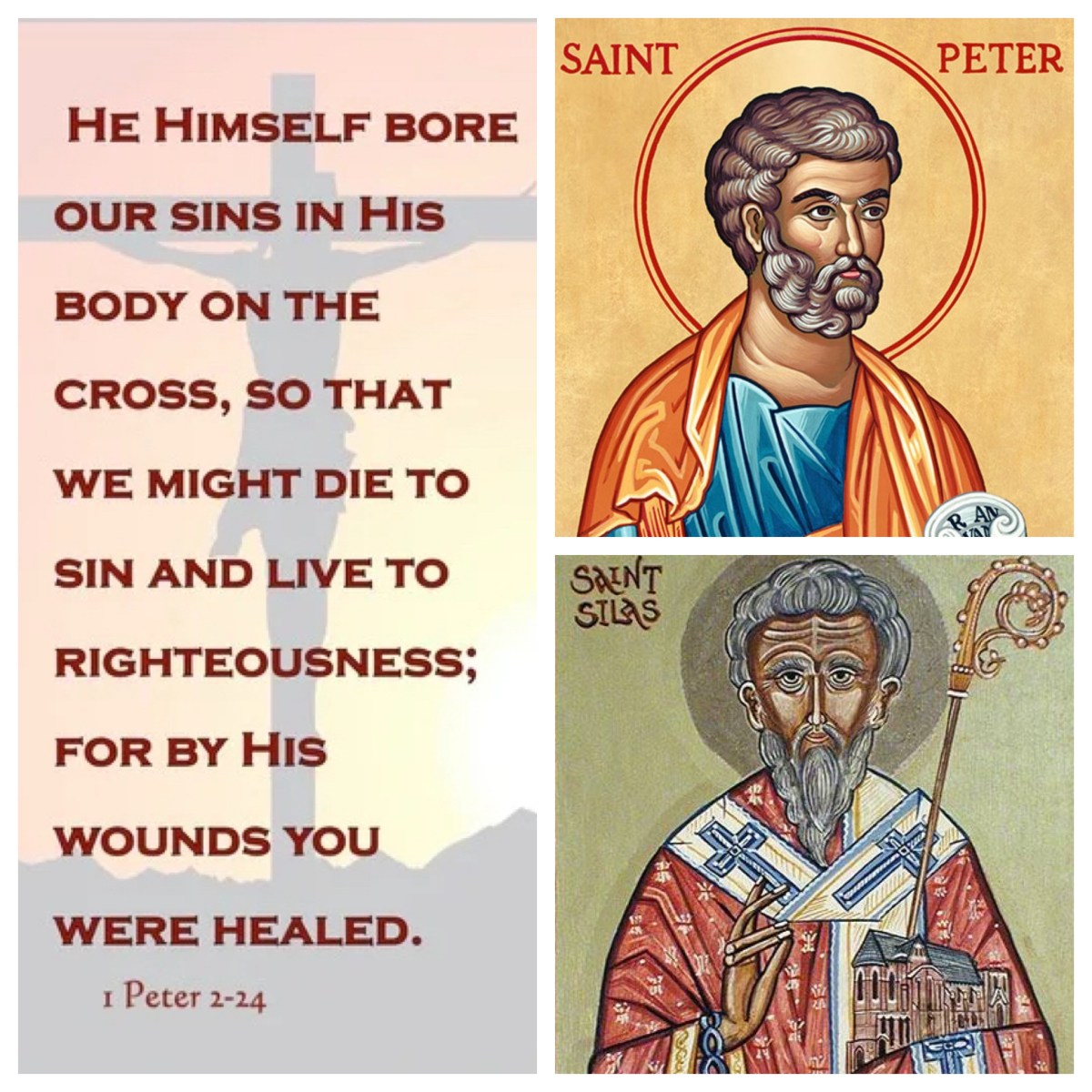
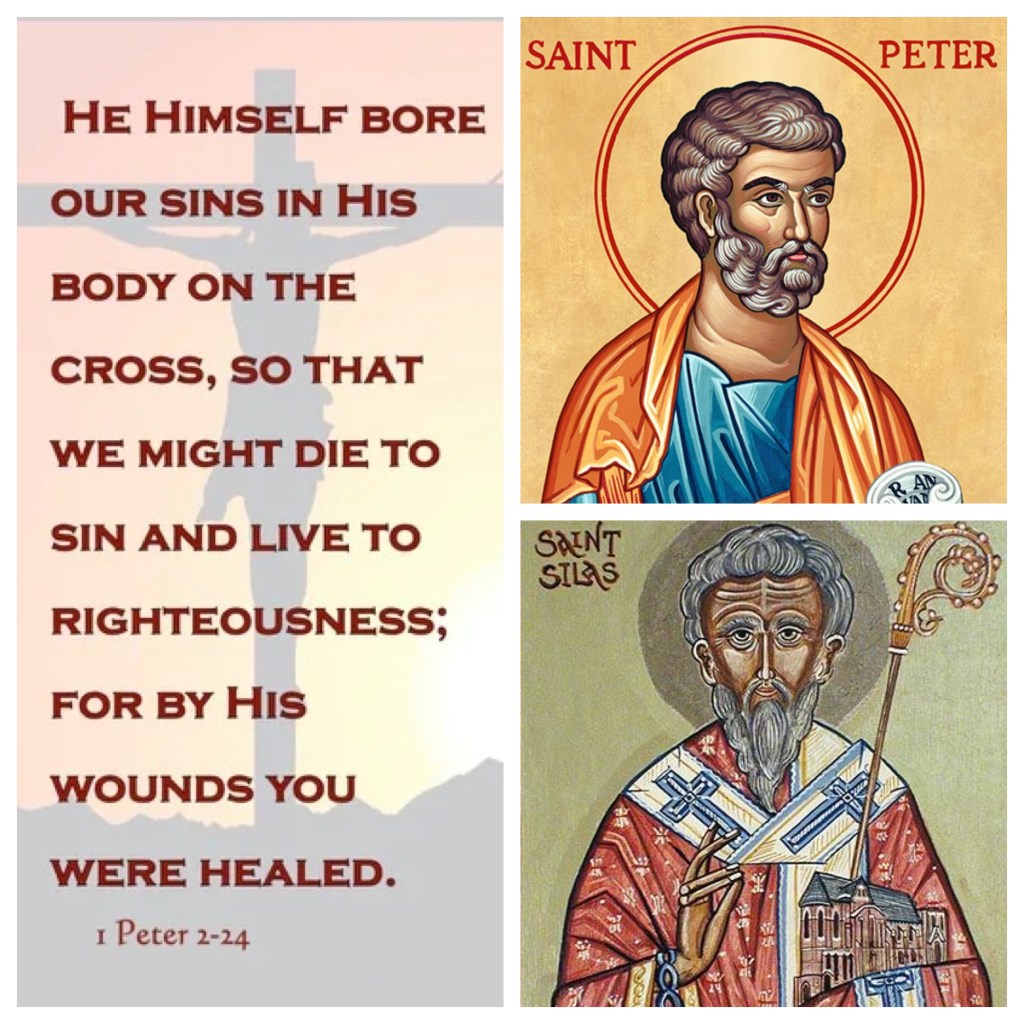
In the Gospel for this coming Sunday, Jesus speaks about the shepherd (John 10:1–10). In the excerpt from this letter which is offered on this coming Sunday (1 Pet 2:19–25), Jesus takes on the role of the lamb, offered up as a sacrificial victim: “he himself bore our sins in his body on the cross” (1 Pet 2:24).
The language and concepts used here relate to ancient practices of sacrifice. They also undergird later Christian understandings of the significance of Jesus and the process of atonement that, it is believed, he effected through his death.

The humility of submission to the violence of sacrificial slaughter is central to the story of the death of Jesus. The lamb is unable to fight back. Chosen for this role, as one who was perfect, without blemish, the lamb can do no other than submit. That humble submission, evident in the lamb, is the vehicle for effecting atonement of sins and a life in righteousness, when found in Jesus—this is the understanding of the cross that has held fast through centuries of theological debate about the death of Jesus. It is an ancient custom, addressing a contemporary need, speaking to current concerns about the proliferation of violence in our world.

So slaves are offered the positive example of Jesus as the model for their submission (2:21–25), in a manner which picks up the cultural and religious Jewish practices of the day and adapts them into the developing Christian context. It demonstrates an awareness of how traditions can be adopted and adapted into new understandings.

By contrast, the instructions to wives are grounded in a reading of scripture which is thoroughly traditional and patriarchal (3:1– 6). In reality, the instructions to wives are based on the expectations of Hellenistic society: reverence, modesty, a quiet spirit, subdued external adornment. They are declared to be “the weaker sex” (3:7) and twice commanded to “accept the authority of their husbands” (3:1, 5).

In fact, the ethics of this letter frequently draw from many elements familiar to Gentiles in the Hellenistic society. Despite the rhetoric of holiness already noted, the believers are not encouraged to live a completely separate life, isolated from wider society. Continued interaction with Gentiles is envisaged at 2:12; believers are to “be ready to make your defence to anyone who demands from you an accounting of the hope that is in you” (3:15). The behaviour of believers should be honourable, and not draw shame upon them; on the contrary, appropriate behaviour will result in the aggressive non-believers being shamed (3:15–16).

In contrast to the letter of James, the brother of Jesus, the specific teachings of Jesus are rarely in view in this letter attributed to Peter, a disciple of Jesus. For James, Jesus taught the righteousness of God and the need for the followers of Jesus to live in a distinctive manner; “true religion” required them “to care for orphans and widows in their distress, and to keep oneself unstained by the world” (James 1:27).

Rather, the ethics of 1 Peter reflect an ethos of temperate behaviour, moderated in a manner which is appropriate to the wider society: “Honour everyone. Love the family of believers. Fear God. Honour the emperor.” (2:7). Although there is a polemic against the base ways of the gentiles, a number of the positive characteristics which were valued within gentile society are also praised in this letter: discipline (1:13; 4:7; 5:7), obedience (1:14, 22; 2:8, 13–14; 3:1, 6) and reverence (3:2, 16).

In short, the ethics of 1 Peter reflect a process of adaptation, in which the Gospel has been accommodated to the cultural patterns of the Hellenistic world. It offers a useful insight into this process, which occurs in all places and all times, as received traditions are incorporated into the life of believers in varied cultural contexts. It is not something to be afraid of; it is something to be acknowledged, understood, and appreciated.
See also

‘Christ died for us’: reflections on sacrifice and atonement

Dealing with the sinful manifestations of human nature is at the heart of Christian doctrine, and theories of atonement regularly grapple with how this is effected. Many books within the New Testament indicate that their authors are grappling with how best to express the central claim of Christianity, that Jesus enables those who follow him to enter into a renewed relationship with God. The letter for this coming Sunday, the Fourth Sunday in Easter, does just this (1 Pet 1:19–25).

However, I can’t see that the New Testament, anywhere, sets forth a fully-developed, single-focussed theory of atonement. There are a range of metaphors used to describe the process, in various places, by various authors: sacrifice, atonement, ransom, expiation/propitiation, liberation/salvation, reconciliation, disarming the powers, and modelling humility, for instance.

In true systematic theology style, over the centuries, various theological writers have plucked verses from various places in the New Testament, and woven together, with little regard for their original context or intention, to form a developed theory that owes more to rationalist deductive argumentation, than it does to biblical texts. That’s the first thing that I distance myself from.

Paul notes that “Christ died for us”. That’s a short and simple way to describe the significance of the death of Jesus; we find it at Rom 5:6,8, 14:15; 1 Cor 8:11, 15:3; 2 Cor 5:14-15; Gal 2:21; and 1 Thess 5:10. That’s five of the seven authentic letters; the matter of the death of Jesus does not figure at all in what is being discussed in Philemon; and in Philippians, the death of Jesus serves to emphasise his humility and obedience (Phil 2:8), and Paul’s main interest is in his this death serves to effect a transformation in believers (Phil 3:21).

This affirmation, “Christ died for us”, forms the foundation for an intricate and complex system of sacrificial atonement theology which is developed beyond the time of the New Testament. These eight times when Paul says, “Christ died for us”, join with a number of other passing comments elsewhere in New Testament texts, to provide the basis for what would become, over time, a detailed understanding of the death of Jesus as a death made on behalf of, and in the place of, believers. An explanation is developed, drawing especially on the Jewish sacrificial system, in which the sacrifices of animals were understood to be the way by which the sins of people were forgiven.

This area of Christian theology—how to understand the death of Jesus—is known as soteriology (relating to “how we are saved”), with a strong emphasis being placed on atonement (that is, what is the mechanism for bringing us back into reconciled relationship with God). The atonement has become a debated and disputed arena. How do we understand this today?

One concern that is often expressed concerns the way that a religious system has a focus on a violent action at the centre of its belief system. Can it be a good thing to celebrate the way that God causes, or at least approves of, the putting to death of Jesus? We have every right to ask critical and penetrating questions about this aspect of our faith.

Another element of the debate is the claim that can be paraphrased as “Jesus died in my place, he was sacrificed for my sins, to save me from hell”. This is the classic way that I hear this view expressed, and it is often described as the substitutionary atonement theory. It depends on, but moves well beyond, the understanding that was inherent in the Jewish sacrificial system.

In my mind, there are a number of points at which this kind of statement about the death of Jesus (often referred to as Penal Substitutionary Atonement, or PSA), narrows the understanding of faith far too much.

For a start, it focuses intensely on a personal dimension, to the detriment of the wider relational, societal, and political dimensions. Easter faith, to me, is broader, more expansive, more encompassing, than just the focus on my personal eternal destiny. I find this communal orientation expressed very strongly in scripture, both in relation to the atonement as well as in many other broader ways. The narrow expression of atonement is based on an understanding of God who is a wrath-filled, vengeance-seeking God, seeking to impact individual lives in a highly judgemental way. I don’t find that perspective in scripture.

Then, the narrow understanding of atonement plays off the will of God over against the actions of a devil figure. This is a problematic element because it contradicts the idea of an all-loving, all-just God. Is all evil in the world to be attributed to a personified devil? What has the allegedly all-powerful and all-loving God done about this?

Such simplistic dualism is problematic, if we just leave it at this. Hebrew scripture steadfastly resists any temptation to sit in a dualistic worldview, and the New Testament continues in that vein, despite pressures from the Hellenistic worldview, as direct heir of the Platonic dualistic schema.

Appreciating the sacrificial dimension of the story of Jesus dying on the cross is important. Jesus went willingly to his death. He did, in the end, offer his life as a sacrifice. The key verse often cited for this understanding is Mark 10:45 (“the Son of Man came not to be served but to serve, and to give his life a ransom for many). Other verses that relate include Rom 3:25-26, Eph 5:2,1 John 2:1-2, 4:10, as well as the whole argument of Hebrews (see especially Heb 2:17, 9:23-28, 10:12, 13:12).

Understanding the death of Jesus as a sacrifice remains at the heart of our Christian faith. The option of taking up a violent path was rejected by Jesus. He did not stir up an uprising against the imperialist Roman overlords, despite opportunities to do so (on Palm Sunday, for instance). He did knowingly offer his life as a sacrifice. After an inner struggle about this matter (Mark 14:32-35 and parallels in the Synoptics), it appears that Jesus went willingly to his death (Mark 14:36, and reflected in the whole prayer that the evangelist crafts in John 17).

The preaching of Jesus in the period prior to his arrest offered a vision of a kingdom in which righteous-justice is dominant and peace is evident (Matt 6:33, 7:21, 21:43, 25:34-36; Mark 12:32-34; Luke 4:16-19, 6:20-21, 12:31-34, 18:24-25). In this preaching, he signalled his key commitments, which are instructive as we consider what he thought he was doing, when he submitted to death. We need to consider these words as we think about the significance of Jesus for our faith, and for how the sinfulness of humanity is dealt with.

The way that Jesus calls us into faithful discipleship is central to this approach. To enter the kingdom means to live in accord with the righteous-justice that Jesus advocates. The greater picture beyond the events of the cross is hugely significant. The cross, the event of the death of Jesus, points beyond to this greater vision. It is the whole life of Jesus, along with his death, which is crucial as we grapple with how Jesus transforms us from “sinful humanity” to “justified and saved” (to use the biblical terms that have become the catchcries in this debate).

His manner of death was consistent with this vision; the complete commitment of Jesus to this vision meant that his death, unjust and violent as it was, provides a glimpse into the way of faithfulness for each of us in our lives. Following the way of Jesus is treading this path of nonviolent affirmation of the greater vision.

*****

See more discussion of specific texts at

and a general overview at