A sermon written by the Rev. Elizabeth Raine for the celebration of Easter Sunday, 9 April 2023, at the Tuggeranong Uniting Church
*****
All four Gospels tell of women, coming to the tomb where Jesus had been lain, early in the morning. In this more intimate narrative of John’s Gospel (John 20:1–18), Mary Magdalene comes alone to the tomb in the dark, not bearing myrrh, not expecting anything. The presence she encounters in the garden is not what she has previously experienced or understood.
When Mary realises that it is Jesus she sees in the garden, she instinctively reaches out to him, only to be rebuffed by the words ‘Do not hold on to me’.
It is both a tender and painful moment that sits between intimacy and distance, love and loss. It reminds us of how it was at the beginning of the pandemic, where the normal, natural instinct to reach out to touch and hold one another became a potential source of danger.
But there was no pandemic in Jerusalem when Mary heard her name being spoken in the unmistakable tones of her beloved teacher and friend, whom she had thought was lost to her forever. Mary’s seeking to touch Jesus would have been the most natural form of greeting in any circumstances, never mind in this extraordinary moment. So why does Jesus respond with what must have felt like a hurtful rejection?
We have the sense that the Gospel is picking up that Mary had a hard time letting go of the physical Jesus. It is no wonder. We all feel like this in our grief. Yet, Jesus is pointing to the broader context of God’s liberating power at work in the Easter story.
John is making the point that the risen Jesus is not a return to the ‘old normal’ but the start of something new. Life is not going to continue as before, whatever Mary’s initial hopes may have been.
The ‘new normal’, which John’s readers were already having to live, did not include Jesus’ physical presence in a recognisable, huggable human body. For a short time, resurrection appearances would convince the disciples that he was, indeed, alive, but the message was that they must not become dependent on him.
*****
“Do not hold onto to me”. Like much of John’s gospel, there is a deeper meaning to the words. John is advising us. Do not cling to the holy as you once knew the holy. The time is here for you to learn, see, hear and perceive anew. Open your consciousness and awake to the dawn of something entirely transformed and transforming.
We can also pick out the events of Simon Peter’s dash towards the tomb with the ‘other disciple’, and the events that unfolded there, as worthy of thinking about. When they entered the space, only the linen was there. We are told that the other disciple “saw and believed”. This is an interesting comment. What did he believe? What exactly did he see that turned his heart from despair to hope? What belief exactly did he come to?
We are told that the disciples still did not understand the scriptures in relation to Jesus’resurrection, yet something clearly happened in their understanding as they left transformed by the encounter.
Surely transformation sits at the core of the mystery of resurrection. It is not a magical replacement of the old with something new, but an innovating change from deep within. We are reminded in this story of the first Easter that God’s action often takes place in the liminal spaces—on the edges of things, at the boundary points between ‘this and that’: despair and hope, hate and love, death and life.
William Brodrick, in a thoughtful reflection used by the Northumbria community, notes that the faithful have to be like candles, “burning between hope and despair, faith and doubt, life and death” and that this is the “disquieting place where people must always find us.”
We need people like Mary who will blunder through the garden blinded by tears but also with a willingness to be curious and open to the impossible. We need people like the male disciples to wonder out loud, stay present in the moment and take risks rather than living life in fear. We need people who somehow generate more hope than we believed could be possible.
While Easter morning brings joy and hope, and a fresh start after grief and brokenness, it also encourages us to be those candles shining brightly between hope and despair in our world. It encourages us to transform and to recognise that the world cannot be the same either in a post-covid era or indeed, a post-resurrection one.
May we not cling on to things that we imagine will keep us safe: may we learn instead to let go in order to findour true selves; and die in order to rise to newness of life.
The period of Lent is forty days—although it actually takes 46 days to get from Ash Wednesday to Easter Sunday. The reason for this is that Lent is reckoned by omitting the six Sundays in this period, since Sundays are not counted in the season of Lent itself. An explanation for this was given in a statement from the Second Vatican Council (1962–1965), reflecting on ancient practice: “The Lord’s Day is the original feast day.… Other celebrations, unless they be truly of greatest importance shall not take precedence over the Sunday which is the foundation and kernel of the whole liturgical year” (Sacrosanctum Concilium, No. 106).
As the forty days draw to a close, I am reflecting on how the experience has been this year. There is always a lot of focus at the end of Lent, for it is then that we move into the high season of Easter, filled with the emotions of Good Friday, the liminal space of Holy Saturday, and the joyful celebrations of Easter Sunday. There is also a focus, somewhat less, at the start of Lent, with Shrove Tuesday—the original Mardi Gras (meaning “Fat Tuesday”) followed by the solemn Ash Wednesday rituals.
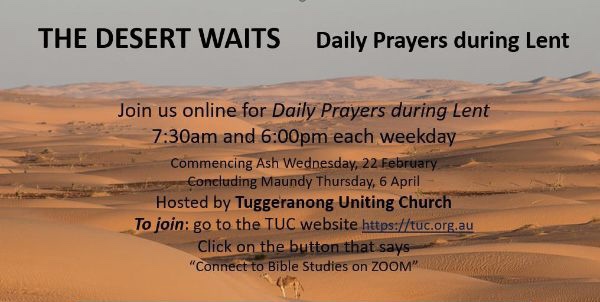
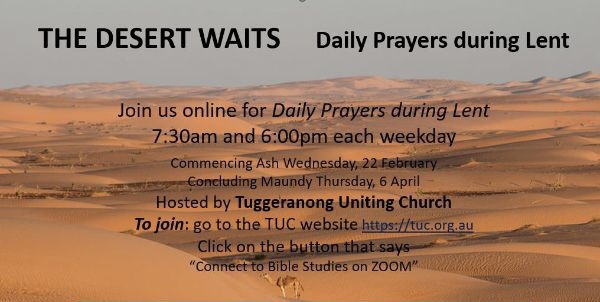
These reflections explain how Lent has been held within the Congregation where I am a member: Tuggeranong Uniting Church, in the southern suburbs of Canberra, in the Australian Capital Territory. Each weekday during Lent, first thing in the morning and then again at the end of the working day, before evening sets in, a group of people from the Congregation, and some beyond, gather online for a brief (8–12 minutes) of prayer and reflection. It is a way of marking the season in a distinctive fashion.
At each gathering, there is an opening prayer, taken from a prayer by Ruth Burgess, published in the Iona liturgical resources: the desert waits. It is a theme that invites us to pause, slow down, listen, and pray. So we hear a short scripture reading, a brief reflection in response, and then listen to a psalm. (There are many wonderful videos of psalms being sung by contemporary artists—the Sons of Korah, Francesca LaRosa, Poor Bishop Hooper, The Psalms Project, Jason Silver, and more). The session ends with a closing prayer and blessing.
The desert waits is also a theme that resonates with a key New Testament story—that of Jesus, in the wilderness for forty days, tested by the devil and sustained by angels. By tradition, it is the Gospel reading for the First Sunday in Lent every year (this year, we heard Matt 4:1–11).
That story, of course, draws deeper from the wells of Hebrew Scripture, where many stories include the time frame of forty days, or forty years. Rain fell during the flood for “forty days and forty nights” (Gen 7:4); then Noah waited for forty days after the tops of mountains were seen after the flood, before releasing a raven (Gen 8:6–7). The people wandered in the wilderness for forty years, to “suffer for their faithlessness” (Num 14:33) at the decree of the Lord, “until all the generation that had done evil in the sight of the Lord had disappeared” (Num 32:13). The spies which Moses sent into the land returned to report to Moses after forty days (Num 13:25).
Moses was said to have spent three consecutive periods of “forty days and forty nights” on Mount Sinai; first, to receive the Torah (Deut 9:9–11), then to beg forgiveness on behalf of the people (Deut 9:25–29), and for a third time seek again God’s forgiveness (Deut 10:10–11). A number of leaders in Israel were said to have reigned for forty years: Eli (1 Sam 4:18), Saul (Acts 13:21), David (2 Sam 5:4), and Solomon (1 Kings 11:42). The prophet Elijah walked for forty days to Mount Horeb, where he meets God “in the sound of sheer silence” (1 Kings 19:12).
All of this indicates that the period of forty days or years was a rounded-out way of describing “a long period of time”—not an accurate reporting of precise days or years, but an indication that whatever was being described was an extended, lengthy period of time. It was a story-teller’s phrase, not an historian’s precise chronicling.
During the extended period of this current Lent, in the online daily prayers each morning being hosted by Tuggeranong Uniting Church, we have traced the theme of wilderness, through a series of readings that commenced in the stories of the ancestors: Abraham and Hagar (Gen 16:7), Hagar and Ishmael (Gen 21:14, 20–21); and Moses on Mount Horeb where he saw the burning bush (Exod 3:1–7).
After that, we spent a week hearing of the travails of the Israelites in the wilderness (Exodus 13–17) and then passages which indicated the extent of the land that was promised to them (Exod 23:31–32; Deut 32:8–10; Joshua 5:6–9; and Joshua 20:7–9) before ending the week with a song about the power of God, seen in creation (Psalm 29:5–11). These stories each morning were coupled each evening with a psalm which was read and then sung, during which our personal reflections were voted.
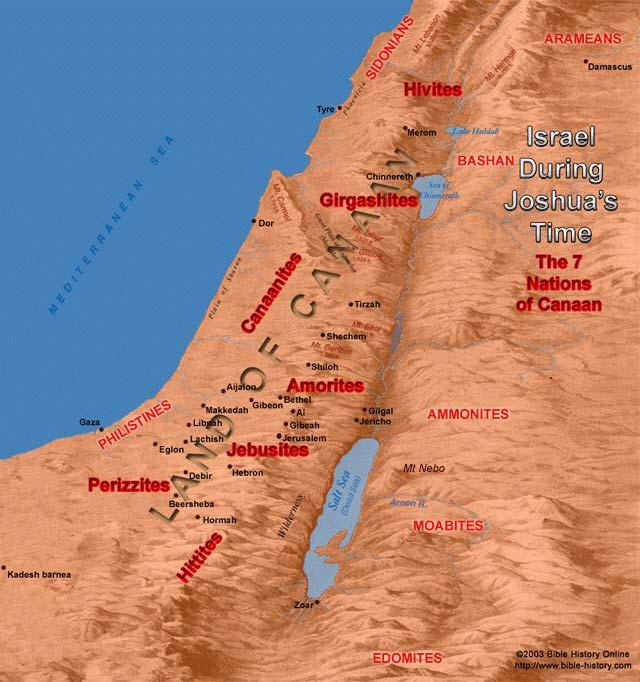
Following that, the focus of morning prayers was on hearing the names of the people who already lived in the land that had been promised to Israel from the time of Abraham onwards: “the Kenites, Kenizzites, Kadmonites, Hittites, Perizzites, Rephaim, Amorites, Canaanites, Girgashites, and Jebusites.
We heard the genealogical list of the descendants of Canaan, the grandson of Noah (Gen 10:1–20), then the promise to Abraham (Gen 18:1, 18–20) and then to Moses (Exod 3:7–10), the instructions given through Moses to “make no covenant with them and show them no mercy” (Deut 20:1–5), and the list of “the kings of the land whom Joshua and the Israelites defeated” (Joshua 12:7–8). Each time, a list of these original peoples was given. Again, a psalm for reflection was matched with these passages.
This list of people already inhabiting the land, but confronted by—and in some cases annihilated by—the invading Israelites, is sobering. For each day during this week, we viewed, firstly, the map of peoples in Canaan, and then the map of peoples on the continent of Australia that we know were here before the British invasion and colonisation of 1788 onwards.
There were many more nations in Australia than there were in Canaan, which is of course understandable since the land mass of the continent is far, far larger than that of Canaan. However, there are very strong resonances between the fate of the First Peoples of Australia and the fate of many of the peoples of Canaan. (The graphic description provided in the battle scenes of Joshua and Judges were not read during the daily prayers; these are available in our Bibles for people to read and reflect on individually.)
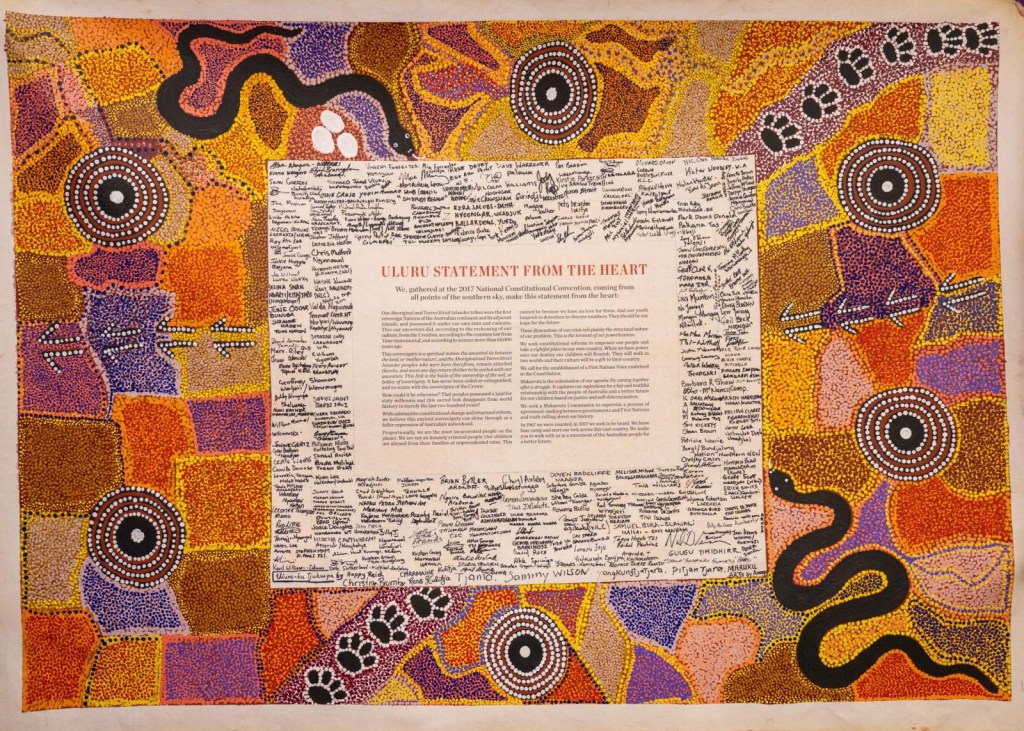
So alongside the map of those First Nations, we began to reflect on the experience of those peoples. We heard how the Uniting Church has described this period of history in the opening clauses of the Revised Preamble to the Constitution of the UCA (adopted in 2009 by the National Assembly). We listened, each day, to Aboriginal singers, singing both in their own languages as well as in English: the late Dr. G. Yunupingu (known as Gurrumul), Frank Yamma, Archie Roach, the group Wildflower, and then Yothu Yindi, singing their key song, “Treaty”. And we heard sentences from the 2017 Statement to the Nation read each day.
After this week of listening to the voices of the indigenous people in the morning prayers, the following week offered a series of reflections with a different psalm sung each day, drawn from the quieter, reflective psalms in which the psalmist reaches out to God to seek support and healing. It is as if these psalms might be sung by the First Peoples, in the light of their experiences of invasion and colonisation, the many massacres that took place, and the intergenerational trauma that resulted.
As we heard these psalms sung, we began also to listen to the series of psalms known as the “Psalms of Ascent”. They are so called because it is believed they were sung by faithful Israelites as they made their pilgrimage to Jerusalem on one of the three annual festivals—the Feast of Unleavened Bread (Passover), the Feast of Weeks (Pentecost), and the Feast of Tabernacles (as listed in Deut 16:16). They begin “in my distress I cry to the Lord” (Ps 120:1), moving on to “I lift up my eyes to the hills” (Ps 121:1), as the outline of the city on Mount Zion appears in the far distance.
We can imagine the pilgrims drawing closer to the walls of the city as the psalmist sings, “I was glad when they said to me, ‘Let us go to the house of the Lord!’l (Ps 122:1), then offers an expression of trust in God (Ps 124:8; 125:1–2) and confidence in God’s house (Ps 127:1). I imagine that, entering the city, the psalmist offers to a heartfelt cry to God from “out of the depths” (Ps 130:1), and as the Temple comes into view, sings, “Let us go to his dwelling place, let us worship at his footstool” (Ps 132:7).
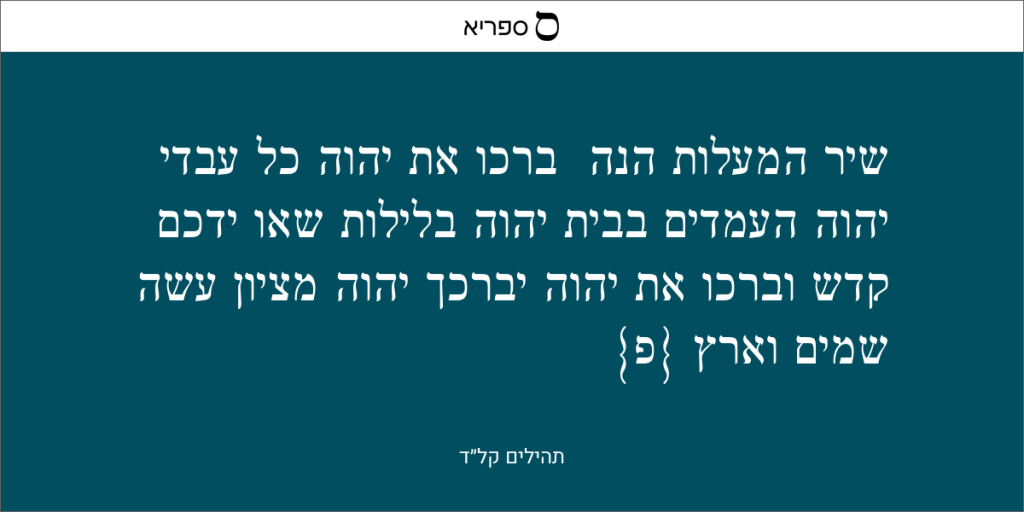
Psalm 134 in Hebrew
As our daily prayers continue, we hear the shortest of all the Psalms of Ascent, with the pilgrims “stand[ing] by night in the house of the Lord”, concluding with the prayer, “may the Lord, maker of heaven and earth, bless you from Zion” (Ps 134:3). As the season of Lent had begun with the theme “the desert waits”, so as we draw near to the end of the season, “the city beckons”. It is in the city that the pilgrims of long ago offered their sacrifices and praised their God. It is in the city that the story of Jesus, recalled especially in the days of Holy Week, reaches its climax.
This brings us to readings which recollect the entry of Jesus himself into the city of Jerusalem (Matt 21:1–11), the week of scenes in the Temple precincts (Matt 21:12—23:39) and nearby (Matt 24:1—26:2), and the hatching of the plot to arrest him (Matt 26:3–5) which would lead to his death, which is recalled as Good Friday ends the period of Lent.
We end daily prayers during Holy Week, on the morning of Maundy Thursday, with a section of Psalm 22. We know this psalm best from the fact that Jesus was said to have begun to say it, as he hung on the cross (Mark 15:34; Matt 27:46). Whether he intended only to speak the first verse, or whether his waning strength meant he could get no further than this, we do not know.
We cannot know whether Jesus intended to end with the words of praise from the later part of the psalm (vv.21b to 31), with an exultant “praise in the great congregation”, proclaiming “his deliverance to a people yet unborn”, as some scholars speculate. More likely, in my thinking, he was content to stay in the despair and agony of the opening section (vv.1–21a), feeling forsaken, his prayers going unanswered, one scorned and mocked, “poured out like water, all of my bones out of joint, my heart like wax, melted within my breast “ (v.14).
The psalm portrays a man, completely human, utterly defeated, with no hope, crushed by events. Both Mark and Matthew report that this is how he ended his life. The end of our Lenten journey takes us to this place of abandonment. It will be the work of Easter to process the powerful emotions generated by this devastating state of being, and move through the testimony offered about the ensuing moments, to come through the tunnel of darkness, into “deliverance [for] a people yet unborn” (v.31). Those days are still ahead.
Psalm 118 is one of the HallelPsalms—six psalms (113 to 118) which are sung or recited on high festival days, such as Passover (Pesach), the Festival of Weeks (Shavuot), and the Festival of Booths (Sukkot), as well as Hanukkah and the beginning of each new month. This final Hallel Psalm, like the other five, is intended to be an uplifting, celebratory song, suitable for the congregation to hear and to sing as a way to inspire and rejoice.
It is no surprise that this psalm is offered by the lectionary for this coming Sunday, Easter Sunday (Ps 118:1–2, 14–24), for this is a day which celebrates with joy the raising of Jesus from the dead (Matt 28:1–10). This psalm is very suited to the celebrations that take place in churches on this high holy day.
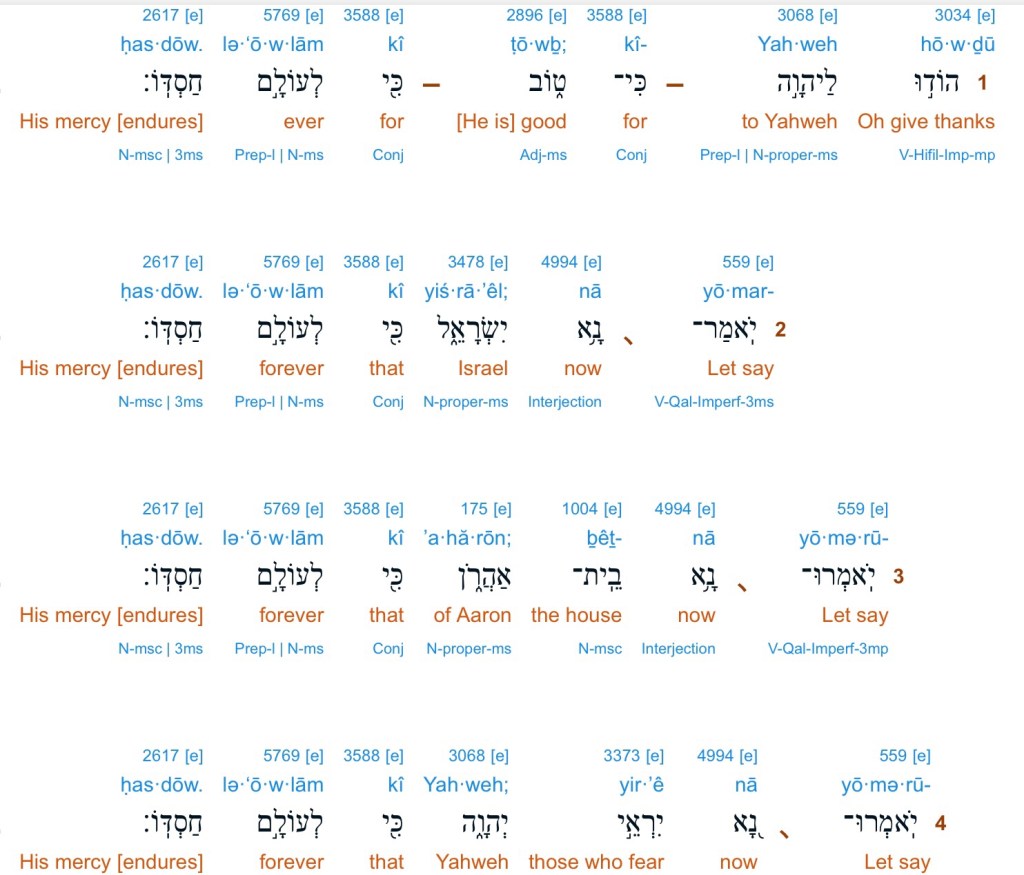
The psalm begins with a call to “give thanks” and an affirmation of the “steadfast love” of the Lord (vv.1-2). The next two verses, following the same pattern are omitted by the lectionary. However, I am thinking that the pattern of the first four verses, calling people to join in the affirmation, “his steadfast love endures forever”, could well be extended from “Israel … the house of Aaron … those who fear the Lord”, to include “let those who know the risen Lord Jesus say, “his steadfast love endures forever”.
God’s steadfast love is a recurrent theme throughout Hebrew Scripture, which often sings praises for “a God merciful and gracious, slow to anger and abounding in steadfast love and faithfulness” (Exod 34:6; 2 Chron 30:8–9; Neh 9:17, 32; Jonah 4:2; Joel 2:13; Ps 86:15; 103:8, 11; 111:4; 145:8–9).
Affirmations of “[God’s] steadfast love” (v.2) are found in psalms (Ps 5:7; 6:4; 13:5; 17:7; 18:50; 21:7; 25:6–7; 25:10; 26:3; and another 100 times) and various narratives (Gen 24:12–14, 27; 32:10; 39:21; Exod 15:13; 20:6; 34:6–7; Num 4:18–19; Deut 5:10; 2 Sam 2:6; 7:15; 15:20; 22:51; 1 Ki 3:6; 8:23; 1 Chron 16:34, 41; 17:13; 2 Chron 1:8; 5:13; 6:14; 6:42; 7:3, 6; Ezra 3:11; 7:28; 9:9; Neh 1:5; 9:17, 32; 13:22).
Many prophets speak about God’s “steadfast love” (Isa 16:5; 54:10; 55:3; 63:7; Jer 9:24; 16:5; 32:18; 33:11; Lam 3:22, 33; Dan 9:4; Hos 2:19; 6:6; 10:12; Joel 2:13; Jonah 4:2; Micah 7:18), and Job also refers to it (Job 10:12).
The pervasive presence of this theme indicates just how central it was to ancient Israelite thought and how integral it was to how God was understood. The idea carries on into New Testament writings through the love that God expresses in Jesus (John 15:9; Rom 8:39; Eph 2:4–7; 1 John 3:1; 4:9) and is manifest through the Spirit (Rom 5:5; Gal 5:22).
However, we should never imagine that the God of love is simply “a New Testament idea”, in contrast to a perceived (completely inaccurate) view of “the God of wrath” in the Old Testament. The idea of divine love is shared in equal measure amongst both testaments. (So, too, we find the idea of divine judgement in both testaments—but that is another story!)
*****
In the selection of verses offered by the lectionary (vv.1–2, 14–24), we encounter some other well-known concepts. The reference to “the chief cornerstone” (v.22) appears also in an oracle of Isaiah, “see, I am laying in Zion a foundation stone, a tested stone, a precious cornerstone, a sure foundation” (Isa 28:16), which continues, “I will make justice the line, and righteousness the plummet” (Isa 28:17).
It is found also in Zechariah’s strident oracle against the shepherds, of whom the prophet says, “of them shall come the cornerstone, out of them the tent peg, out of them the battle bow, out of them every commander. Together they shall be like warriors in battle, trampling the foe in the mud of the streets; they shall fight, for the Lord is with them, and they shall put to shame the riders on horses” (Zech 10:4–5). Clearly, the “cornerstone” (along with “the tent peg” and “the battle bow”) offers a somewhat cryptic reference to an anticipated future leader in Israel.
The “cornerstone” has then been picked up in the New Testament, where it is interpreted as referring to Jesus; in a speech attributed to Peter when he and John were before the Council in Jerusalem because of a “good deed done to someone who was sick” (Acts 4:9), namely, the healing of a man lame from birth (Acts 3:1–10). “This man is standing before you in good health by the name of Jesus Christ of Nazareth, whom you crucified, whom God raised from the dead”, Peter is reported as saying; “this Jesus is ‘the stone that was rejected by you, the builders; it has become the cornerstone.’ There is salvation in no one else, for there is no other name under heaven given among mortals by which we must be saved” (Acts 4:11). This is a critical theological statement placed on the lips of Peter.
In like manner—although less directly, in a more allusive fashion—Jesus equates himself with this “cornerstone” when draws to a close his parable about the vineyard and the tenants who killed all who were sent to them by the master, culminating in the master’s son; at that point in the parable, Jesus curtly concludes, “have you not read this scripture: ‘The stone that the builders rejected has become the cornerstone; this was the Lord’s doing, and it is amazing in our eyes’?” (Mark 12:10–11; Matt 21:42; Luke 20:17). In this citation of the psalm, Jesus has extended to include the following verse, about “the Lord’s doing”, which is a cause for amazement.
We hear that affirmation on Easter Sunday, in the psalm: “this is the Lord’s doing; it is marvellous in our eyes” (Ps 118:23). When included in a Christian liturgy, these words seem very readily to reflect the experience of the first Easter—a marvellous deed, indeed.
The psalm then continues in an upbeat manner, with “this is the day that the Lord has made; let us rejoice and be glad in it” (Ps 118:24), echoing once more an oracle of Isaiah, “Lo, this is our God; we have waited for him, so that he might save us; this is the Lord for whom we have waited; let us be glad and rejoice in his salvation” (Isa 25:9). That oracle includes three elements included in this section of the psalm: joy, at the chosen time, with knowledge of salvation.
The linking of “be glad” with “rejoice” is also common throughout Hebrew Scriptures (1 Chron 16:31; Ps 14:7; 32:11; 40:16; 48:11; 53:6; 70:4; 90:14; 96:11; 97:1; 149:2; Prov 23:24–25; 24:17; Isa 35:1; 65:18; 66:10; Lam 4:21; Joel 2:21, 23; Zech 10:7). The people of Israel were called to joyous praise quite often.
The celebration of the means of salvation is certainly a theme that is relevant to Easter Sunday, when this psalm is offered in the lectionary. It is worth singing and celebrating on this day!
The passage from Acts which is offered by the lectionary this coming Sunday (Acts 10:34–43) is an impassioned speech to Gentiles, by the Jewish man, Peter. It is one of a number of speeches that are found throughout the first two thirds of the book of Acts, in which one of the leaders in the movement that was initiated by Jesus (and would later become “the church”) spoke to others, declaring “the good news about the kingdom of God and the name of Jesus Christ” (8:12; see also 8:25, 35, 40; 13:32; 14:7, 15, 21; 15:7; 16:10; 17:18; 20:24).
These speeches, of course, all come to us from the pen of one person, the author of this work; although they are, in good speech-writing style, shaped to the particular situation at hand, there is nevertheless a consistency of themes, ideas, and language that runs through the speeches which have what me might call an evangelistic purpose—declaring the good news (the evangel) to those who have not yet heard it. Whether it is Peter, Stephen, Philip, or Paul who is speaking, the message is consistent and focussed on Jesus and how he relates to God’s intention for the people being addressed.
So Peter has come, by a sequence of events that Luke wants us to understand were quite miraculous, from Joppa to Caesarea; from the house of the Jewish man Simon, a tanner, with whom he was staying in Joppa (9:43), to the house of Cornelius, a centurion—and thus most likely a Gentile—in Caesarea (10:1–2). That movement, in itself, is quite significant, as Peter moves from his fellow-Jews to the Gentiles. Cornelius was sympathetic to Judaism; he is described as “a devout man who feared God … who gave alms and payed constantly” (10:2), he was, nevertheless, a Gentile; and those of his household were, likewise, Gentiles.
What Peter says in this speech in the Gentile household of Cornelius needs to be understood in the context of the events that have just taken place, and indeed in terms of the whole span of events recounted in this volume. Peter had been called to Caesarea by a vision, in which God spoke directly to Peter (10:9–15)—and Luke,reports that this took place, not once, but three times (10:16). In what God said, Peter was given a message, to declare to others who were part of the movement that he had been leading since Jesus had ascended into heaven (1:6–14).
That message, “what God has made clean, you must not call profane” (10:15) was, in effect a call to Peter to speak to that movement as a prophet. Prophets were anointed by the spirit to declare “the word of the Lord” for the people of their time (1 Sam 19:20, 23; Isa 11:2; 59:21; 61:1; Ezek 2:2; Joel 2:28–29; Micah 3:8; Zech 7:12, referring to “the former prophets”). Indeed, the servant of the Lord himself is guided by the spirit (Isa 42:1). The Spirit actually calls Peter to go with three men who have come searching for him (10:19–20); they lead him to Caesarea, to the house of Cornelius, where he duly delivers this message (10:24–29).
Subsequently, as he speaks in more details to the assembled household, the Spirit falls on all present, as they listen to Peter’s words (10:44). This coming of the Spirit had happened before, and it will happen again, as the story of Acts continues. But there is something striking and significance about this story of the coming of the spirit.
This has happened before. The spirit has twice filled the messianic community gathered in the Jewish capital, Jerusalem (at Pentecost, 2:1-4, and subsequently, 4:31). When the spirit is poured out on the Gentiles (10:45) in this gentile capital, it is already known that this is an act of God; “God declares, I will pour out my Spirit upon all flesh, and your sons and your daughters shall prophesy, and your young men shall see visions, and your old men shall dream dreams” (2:17).
In both previous cases, God had acted through the spirit in relation to Jews. That this current outpouring of the spirit, outside of Judaea, amongst Gentiles, is still an act of God, is emphasised by a series of narrative comments. The Jewish believers present express surprise at “the gift of the holy spirit” (10:45), but the reader already knows that such a gift is from God (2:38, 8:18).
They hear the Gentiles “speaking in tongues” (10:46), a phenomenon already experienced as a divine event in Jerusalem (2:11). Peter draws this connection when he interprets the event: they “received the spirit as we also [did]” (10:47; see 2:38). Peter and his fellow Jews thus “exulted God” (10:47; see 5:13).
Indeed, the Spirit had come to these Gentiles after a striking sequence of events had taken place. Peter had a vision whilst praying in Joppa, that he was no longer to keep separate at table (10:9–16). No longer were Jews to eat separated from Gentiles. God had declared all foods clean (10:15), so separate table fellowship was now overturned. Peter receives this dramatic change to the status quo—and he faithfully acts on it.
Peter and his companions in Joppa share at table with the men from Cornelius (10:23; 11:4–11) and then, when they have travelled to Caesarea, with the household of Cornelius and those who were baptised with him (10:48; 11:12–18). Indeed, the very point of the vision seen by Peter is to establish an inclusive, all-embracing table fellowship in the Jesus movement, open to both Jews and Gentiles, from this point onwards (11:3).
This is a moment when the old is overturned, and the new is implemented. It is a strong moment of transition for the early church. From this time, the good news spreads amongst Gentiles; to the extent that it does, indeed, reach “to the ends of the earth” (see 1:8) by the end of the book. (In saying this, I take the arrival of Paul into Rome in Ch.28 to be a symbol of the fact that, as the good news becomes known in Rome, the centre of the dominant empire of the day, so that message will then be taken out from the city into all the far-flung reaches of the empire—in a sense, “to the ends of the earth”.)
So the story of Peter and Cornelius, narrated in detail in chapter 10 and then reported in summary to the gathering in Jerusalem in chapter 11, is a key turning point in the overall story being told in Acts. (In my research, I describe Acts 8–12 as “the turn to the Gentiles”, the pivot on which the whole story turns.) it is in this dramatic and pivotal context that Peter speaks the words which are offered by the lectionary for the First Reading on Easter Sunday. This speech is worth attending to in some detail.
*****
This speech by Peter begins in the characteristic style of previous speeches, by announcing God as its subject (see 2:16–21, 22; 3:13; 4:24; 5:29–30; 7:2; and see subsequently at 13:16–17; 14:15–17; 15:7, 13–17; 17:23–25; and as a summary, 20:24, 27). I have explored this in other blogs at
The key theme of this speech is the impartiality of God (10:34), an important theme, especially in later scriptural writings. “The Lord your God is God of gods and Lord of lords, the great God, mighty and awesome, who is not partial and takes no bribe”, Moses declares (Deut 10:17). God is one “who shows no partiality to nobles, nor regards the rich more than the poor—for they are all the work of his hands”, Elihu advises Job (Job 34:19).
Later writings concur: “the Lord of all will not stand in awe of anyone, or show deference to greatness … he takes thought for all alike” (Wisd 6:7), and “do not offer [the Lord] a bribe, for he will not accept it … the Lord is the judge, and with him there is no partiality; he will not show partiality to the poor, but he will listen to the prayer of the one who is wronged; he will not ignore the supplication of the orphan, or the widow when she pours out her complaint” (Sir 35:13–17).
This theme of divine impartiality thus reinforces and confirms the message of the vision (10:11–16). Even though the prescriptions of the levitical holiness code where being adhered to by faithful Jews, the vision speaks over those regulations and invites that who see it and hear God’s words into a new manner of being community. Specifically, that vision validated table-fellowship as being consistent with divine impartiality, a key aspect of God’s nature. Things would be different from now on!
Peter explains that this divine impartiality is especially evident in Jesus, whom he affirms as Lord of all (10:36). Peter interprets the whole life of Jesus as the action of God, who anointed him, was with him, raised him and made him manifest (10:37–43). For Peter, the significance of what Jesus did and said was that he was addressing not only Jews, but also Gentiles.
Peter affirms both the apostolic witness: “we are witnesses to all that he did” (10:39,41; see 2:32, 3:15, 5:32) and also the prophetic witness: “all the prophets testify about him” (10:43; see 2:25-31,33–35, 3:18,21–25, 4:25–26). We see here a rhetorical strategy typical of Luke, who has Peter make the exaggerated claim that “all the prophets testify about him” (10:43; see 3:24). These prophets testify to “the forgiveness of sins” which is essential to this proclamation (2:38, 5:31, 13:38).
Peter continues, that Jesus has been “ordained by God” to be the eschatological “judge of the living and the dead” (10:42), a concept which Paul will later express (17:31; cf. 24:15). The speech thus comprises a consistent exposition of God’s activities in Jesus, extensively in the past as well as (briefly) in the future. When we read what Peter says here, alongside what he says in other evangelistic speeches in Acts (chs. 2, 3, 4, 5, and 13), as well as what Stephen says in his long speech (Ch.7) and what Paul says to Jews (Ch.13) and to Gentiles (chs. 14 and 17), we end up with a most comprehensive statement of the Gospel and how it relates to the ways that God had long been at work in Israel.
The author’s interpretation of the events that have taken place in Caesarea draws them into close relationship with the interpretation of Jesus which Peter has given (here, and in earlier speeches in Acts). That is not surprising, since it is the one person (Luke, the alleged author of this work) who has reported all of these speeches—and, in my opinion, has actually created each speech.
Certainly, the speech itself relates to key features in the surrounding scenes involving Peter, a Jewish man, with the Gentile Cornelius, and his Gentile household. The impartial God who has acted through Jesus (10:34–43) is the same God who declares all things clean (10:15), who shows this to Peter (10:28), who gifts Gentiles by pouring out the spirit (10:45), and who is exulted by the people (10:46). It is language about God which interprets the significance of the narrative at each key moment.
The consequence of this dramatic event is noted briefly: “they invited him to remain for some days” (10:48b). Table-fellowship with Gentiles and the breach of the food rules was considered to be the inevitable result of God’s actions (see also 11:15–18). Such hospitality continues to be one of the key markers of the church today. That is the good news which is declared by the Easter event, when we remember that “God raised Jesus from the dead” and we testify that “everyone who believes in him receives forgiveness of sins through his name”.
*****
In this blog I have developed themes, ideas, and analysis that I wrote in my commentary on Acts in the Eerdmans Commentary on the Bible, ed. Dunn and Rogerson (Eerdmans, 2003). I have also explored the theme of the plan of God throughout Luke and Acts in the doctoral research that I undertook in the 1980s, which was published in 1993 by Cambridge University Press as The plan of God in Luke-Acts (SNTSM 76).
Today we begin Holy Week. This is the final part of a longer period leading up to Easter, called Lent. We do this every year, as part of the annual cycle. It is a familiar and comforting ritual for many people of Christian faith.
Holy Week culminates the season of Lent, which is an ancient practice for a Christian people. It lasts for 40 days, serving as a time of preparation for Easter. But whereas Lent is an ancient tradition, Holy Week is a more recent development. Designating the week leading up to Easter as Holy Week most probably comes from the narration of chapters 11 and 12 of Mark’s Gospel, in which Jesus is understood as being in Jerusalem from a Sunday until his last meal on a Thursday.
We can see those time markers embedded in Mark’s account of Jesus’ final days: Sunday – “when they were approaching Jerusalem …” [Mark 11:1] Monday – “on the following day …” [Mark 11:12] Tuesday – “In the morning …” [Mark 11:20] Wednesday – “It was two days before Passover …” [Mark 14:1] Thursday – “On the first day of Unleavened Bread …” [Mark 14:12] Friday – “As soon as it was morning …” [Mark 15:1] Saturday – “When the Sabbath was over …” [Mark 16:1] Sunday – “Early on the first day of the week …” [Mark 16:2]” (Thanks to Greg Jenks for setting this out so clearly in his blog.)
The week starts with Palm Sunday, when Christians remember Jesus entering Jerusalem and the crowds waving palm leaves as he enters the city. Jesus stays near to the city for the remainder of the week. On this day, we remember that event with festive processions and cheerful hymns.
Each day during Holy Week, from Monday to Thursday, many churches hold daily prayers that are pertinent to the week.
On Maundy Thursday, Christians remember Jesus washing his disciples’ feet. His words are recorded in John 13:34, “A new command I give you: Love one another. As I have loved you, so you must love one another.” This gives rise to the name for the day. The Latin for “commandment” is mandatum—hence the name of the day, Maundy.
Some people believe that Lent officially ends at sundown on Maundy Thursday, so they celebrate that with Holy Communion, or with a meal known as an agapé or a “love feast”. It is a remembrance of the last meal that Jesus shared with his followers. Others maintain that Lent continues through into Easter Saturday, until the end of the day just before the empty tomb is discovered.
After Maundy Thursday comes Good Friday, remembering when Jesus was crucified. Why is this day called Good? It comes from the theological evaluation that, on this Friday, Jesus died on the cross “for our sins”, thereby securing our redemption. This is the basis for the “good news” which the Church has proclaimed for centuries.
Churches all around the world normally hold various rituals for people to attend. Roman Catholics have the Adoration of the Cross, the Mass of the Pre-Sanctified, the Stations of the Cross, and Evening Prayers. Anglicans have a three-hour service with reflections on the Last Words of Christ. Many people come for these times of gathering together.
The Stations of the Cross are focused around the events of Good Friday, recalling the various events which took place as Jesus made his way from his trial to his death on the cross. These Stations have been appropriated, in art or through personal creative responses, as ways of moving attention from the story as a singular ‘history’, to the significance of the story and the resonance of the events with universal human experiences.
Next comes Holy Saturday or Easter Eve—a day of vigil, when believers watch, wait and pray. This is an in-between time, a day when time can be spent reflecting back on the traumatic events that have just taken place, and looking forward with hope to the new possibilities that might emerge from those event.
After Holy Saturday, the celebration of Easter Sunday bursts through the gloom and despair with a vibrant message: Jesus is risen, Jesus has conquered death. Counting inclusively, as was done at the time, beginning from Friday, means that Sunday is the third day. So the traditional affirmation is that Jesus rose “on the third day”. This leads into an expression of joy, that the trauma and grief, the uncertainty and fear, are now passed. Life is different; hope is renewed; the future, even if it looks different, will still be viable.
For the next period of time, the Church moves into a new season—the season of Easter, 40 days when the celebration of resurrection continues. And so the cycle continues, death turning into life, despair breaking out into hope, frustration moving into promise.
Easter itself emerged out of the Jewish festival of Passover, for this is the setting of the story about the arrest, trial, and crucifixion of Jesus that is reported in the Gospels (Mark 14:1–25; John 13:1; 18:28; 19:14).
There is a meme that circulates every year at this time, claiming that Waster was originally a pagan celebration, focussed on the fertility goddess Eostre—but this has no basis in fact. It derives from what seemed, to him, to be an educated guess made by the 8th century scholar, Bede, but this is completely incorrect.







 An Informed Faith