“In you all the families of the earth shall be blessed” (Gen 12; Pentecost 2A)

Each year during the Sundays which follow after the festival of Pentecost, the Gospel readings offer a series of stories, encounters, and parables from the Gosepl attributed to Matthew. In parallel to those stories, in the Hebrew Scripture readings, the lectionary offers a sequence of passages telling some of the key moments in the story of Israel, from the narrative books, Genesis, Exodus, Deuteronomy, Joshua, and Judges. These stories run through until the Twenty-Fifth Sunday after Pentecost, in mid-November.

This sequence of passages offers us stories which were told, retold, and probably developed over quite some time by the elders in ancient Israel. They are stories which define the nature of the people and convey key values which were important in ancient Israel. These faithful people from the past stand, for us today, as role models to encourage us, centuries later, in our own journey of faith. They are stories which are worth holding up for our reflection and consideration.

These stories each have the function of an aetiology—that is, a mythic story which is told to explain the origins of something that is important in the time of the storyteller. The online Oxford Classical Dictionary defines an aetiology as “an explanation, normally in narrative form (hence ‘aetiological myth’), of a practice, epithet, monument, or similar.”

Whilst telling of something that is presented as happening long back in the past, the focus is on present experiences and realities, for “such explanations elucidate something known in the contemporary world by reference to an event in the mythical past”.

See https://oxfordre.com/classics/display/10.1093/acrefore/9780199381135.001.0001/acrefore-9780199381135-e-7050;jsessionid=3DB38C42C54D01E1CBFA8682FB55DA4C

The ancestral narratives of Israel (Gen 12–50), as well as the series of books known as “the historical narratives” (Exodus to 2 Kings, Ezra—Nehemiah) are all written at a time much later that the presumed events which they narrate. The final form of the books as we have them most likely date to the Exile or post-exilic times, although pre-existing sources would have been used for many of these stories. (There are specific references to earlier written documents—now lost to us—scattered throughout 1—2 Kings.)

Those older stories were remembered, retold, and then written down, because they spoke into the present experiences of the writers. Common scholarly belief is that the stories found in Gen 12–50 were originally oral tales, that were collected together, told and retold over the years, and ultimately written down in one scroll, that we today call Genesis.

*****
For this coming Sunday (the Second Sunday after Pentecost), we are offered the account of the calling of Abram, who journeys into a new future (Gen 12:1–9). This has been a key passage for Jews throughout the centuries; Abram is remembered and honoured as “the father of the nation”—indeed, as “the father of all nations”; and this passage claims that it was God’s intention to grant the blessing of abundant descendants to Abram and his wife, to fulfil this promise.

The passage is found after the opening 11 chapters, which are often labelled the “Primeval History”, since they recount the creation of the world and the sequence of events which were fundamental for understanding human existence (such as human sinfulness and conflict, the expansion of humanity, the great flood, the growth of tribal entities, and the diversification of languages).

The passage also stands at the head of those stories, originally oral, which were collected because they revealed much about the nature of Israel as a people and as a nation. These chapters tell stories about the patriarchs and their wives (Abram and Sarai, Isaac and Rebekah, Jacob and Leah and Rachel). This particular passage introduces key themes for the people of Israel.

The passage indicates that Abram took his wife Sarai and his nephew Lot with him, “and all the possessions that they had gathered, and the persons whom they had acquired in Haran; and they set forth to go to the land of Canaan” (Gen 12:5). They would also have had the (always unnamed) wife of Lot with them, for their companions would undoubtedly have included both males and females within the extended family grouping. We need to read this ancient aetiology with a contemporary critical awareness. Certainly, the faith of Abram and Sarai and their extended family is a key message conveyed by this passage.

The story explains four important aspects of life and faith for the people of ancient Israel and on into contemporary Judaism: the land is given to this people, the people (of Israel) will become “a great nation”, the name (of Abram) will be blessed, and the descendants of Abram, “all the families of the earth”, will likewise be blessed. These four points—land, pepople, name, descendants—loom large throughout the history of Israel. Indeed, they maintain their potency into the present age—and need to be read and understood with political and cultural sensitivity today.

*****

This passage sounds the initial claim of the people of Israel to the land of Canaan. This was promised by God to Abram and his descendants, we are told. They set out towards that land; “when they had come to the land of Canaan, Abram passed through the land to the place at Shechem, to the oak of Moreh. At that time the Canaanites were in the land. Then the Lord appeared to Abram, and said, ‘To your offspring I will give this land.’ So he built there an altar to the Lord, who had appeared to him.” (Gen 12:5–7). The claim recurs at various points throughout the ensuing narratives, culminating in the conquest narrated in the book of Joshua.

See more on this aspect of the passage at

and on the difficulties involved in the story of invasion and violent colonisation, see

In his commentary on this passage in With Love to the World, the Revd Dr John Jegasothy, a retired Uniting Church Minister originally from Sri Lanka, reflects on this story of journeying to a new land, from his own perspective as an asylum seeker some decades ago. “As a family we had to decide to leave Sri Lanka and migrate to Australia on Special Humanitarian Visa as I was a human rights advocate and death came close. God had a plan for me to be an advocate for refugees here.”

Dr Jegasothy continues, “I look at our journey as a journey like Abram and Sarai undertook. They absolutely trusted in God’s promises and because of their faith they were counted as righteous.” There is an invitation here for each of us to ponder this story, in terms of our own journey of faith. How and when has God called us on to journey into new places or new experiences?

*****

Alongside the claim to the land of Canaan, the story of Gen 12 portrays Abram (and Sarai) as the origin of a multitude of descendants; through them, “all the families of the earth shall be blessed” (12:3). Initially, this claim appears to be quite precarious; after all, the first mention of Sarai indicates that “Sarai was barren; she had no child” (11:29–30).

Later, when Sarai advises Abram, “see that the Lord has prevented me from bearing children; go in to my slave-girl; it may be that I shall obtain children by her” (16:1–2), Abram diligently obeys; he “went in to Hagar, and she conceived; and when she saw that she had conceived, she looked with contempt on her mistress” (16:4). Tensions between the wife, Sarai, and the slave-girl, Hagar, lead to Hager’s flight into the wilderness, where she gave birth to Abram’s son, Ishmael (16:7–16).

Still later, when Abram (now Abraham) sealed the covenant with the Lord God through the ritual of circumcision (17:1–14), he is told that Sarai (now Sarah) will now be blessed by the Lord, for “I will give you a son by her; I will bless her, she shall give rise to nations; kings of peoples shall come from her” (17:16). And in due time—despite the laughter of Sarah (18:12)—Isaac is born (21:1–3).

The lectionary studiously avoids the story of the birth of Ishmael, but provides us with a sequence of passages that recount the promise to Sarah (18:1–15, Pentecost 3A), the banishing of Hagar and Ishmael (21:8–21, Pentecost 4A), and the near-sacrifice of Isaac (22:1–14, Pentecost 5A), before turning to the story of Isaac and his wife Rebekah (Pentecost 6A) and then on to Jacob (with excerpts from chs. 25 to 37, Pentecost 7A to 11A).

After Sarah died, Abraham married Keturah and had six sons with her (25:1–4). He also “gave gifts to the sons of his concubines while he was living” (25:6), so there were other (unnamed) progeny of Abraham. In due time, Abraham and Sarah’s son Isaac and his wife Rebekah gave birth to twins, Jacob and Esau (25:19–26), whilst Ishmael, the son of Abraham and Hagar, was the father of twelve sons who had many descendants (25:12–18), as well as a daughter who was the ancestor of the Edomites. Abraham’s brothers Nahor fathered twelve sons (22:20–24) whilst Haran was the father of Lot (11:27), who himself fathered Moab and Ammon. Many of these descendants continued reproducing, and so the line of Abraham grew and expanded, generation by generation.
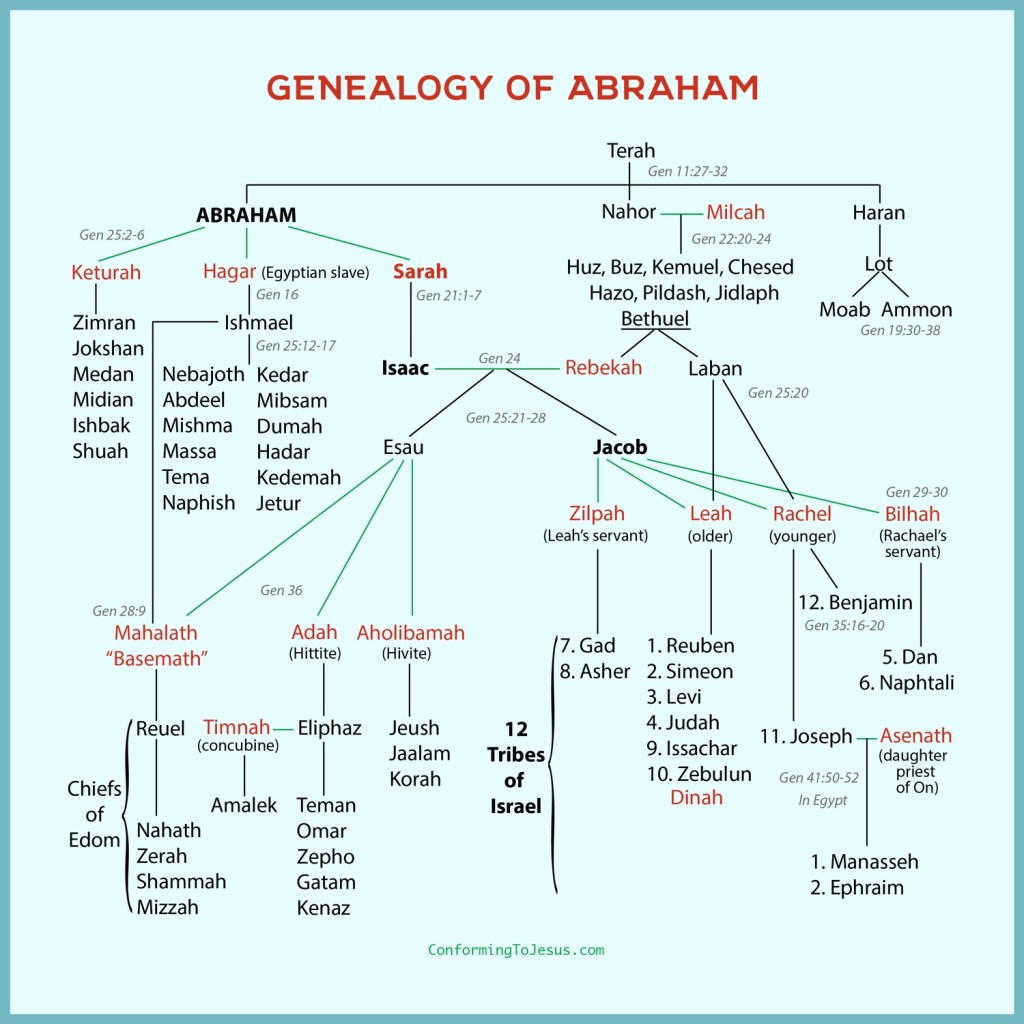
Collectively, this family was responsible for a multitude of descendants, which brings to fulfilment God’s promise to Abraham, “I have made you the ancestor of a multitude of nations; I will make you exceedingly fruitful; and I will make nations of you, and kings shall come from you” (17:5–6). The tenuous moments in the story leave us, as readers, wondering whether this promise would come to fruition; in time, of course, that fulfilment is reported in the Genesis narrative. Abraham does indeed become “father of all nations”, and a key figure in the sagas about Israel that were told and retold throughout the ages.

Our Father in heaven: a pattern for prayer (Luke 11, Matt 6) part I

In the series of Gospel readings offered by the Revised Common Lectionary, there is a break from the sequential readings begun in early January each year. This year—Year A—we began with the early chapters of the Gospel according to Matthew (from 2:1 through to 5:37); but when the season of Lent began, the Gospel readings were taken largely from John, with John and Luke featuring during the Sundays after Easter. Only now, after Trinity Sunday, does the sequential pattern resume.

However, that pattern begins with Matt 9 on the Second Sunday after Pentecost, jumping from where we had left the Gospel back in February, in the middle of the Sermon on the Mount. The missing chapters (5:38 to 9:8) are omitted by the lectionary. Now, the words of Jesus in the Sermon on the Mount are confronting and difficult—but that is no reason to avoid them!

What is omitted is the latter part of the sequence of Antitheses, including the command to love our enemies; teachings on fasting, prayer, and almsgiving; and a series of sayings about assorted matters, each of which presses us to be more intentional and focussed in our discipleship.

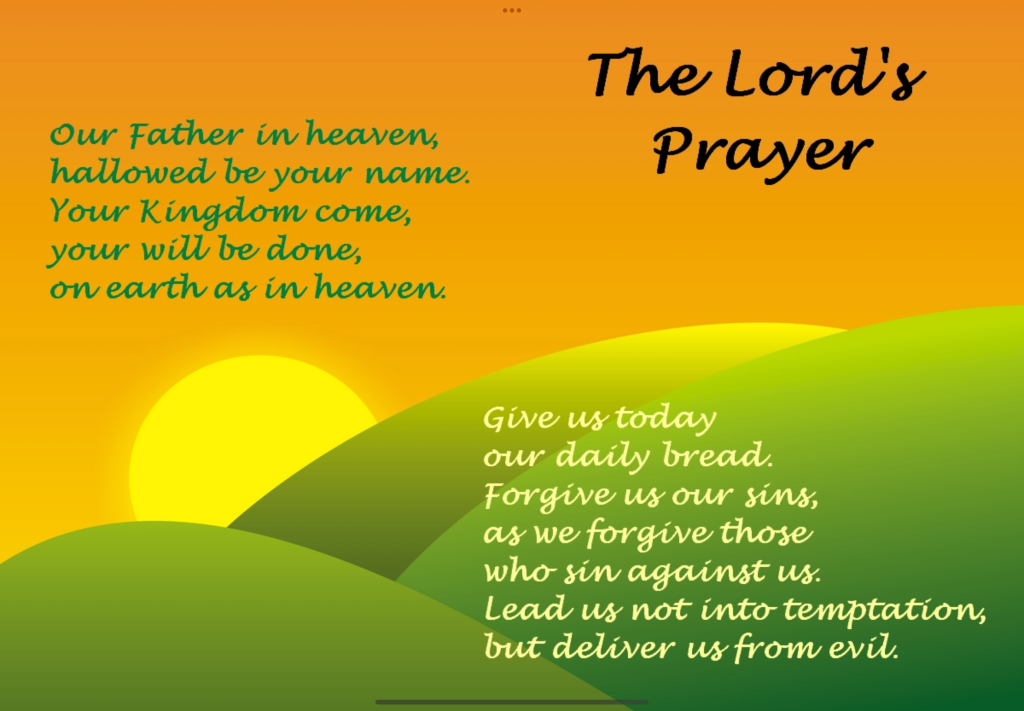
And in the middle of all of that, “pray then in this way”, says Jesus, giving his disciples a set of words (6:9–13) that has come to be known as The Our Father (after its opening phrase) or The Lord’s Prayer (after the one who gave it to his disciples). So before we get too far into the series of readings in the season of Pentecost, I thought I would offer some thoughts about this well-known and much-loved prayer.

Christians are used to praying this prayer on a regular basis, in obedience to the instructions of Jesus recorded in two Gospels: “when you pray, say …” (Luke 11:2; Matt 6:9). This prayer can be considered a succinct primer for prayer, since it contains the key elements of praying.

After an opening adoration of God (“our Father in heaven, holy is your name”), there follows prayers for the world (“your kingdom come, your will be done”), petitions for ourselves (“give us bread for the day, forgive us our sins, do not bring us to the time of trial”), and intercessions for others (“as we forgive those who sin against us”). In the later version of the prayer, a closing benediction is included (“yours is the kingdom, the power, the glory”), ending, of course, with “Amen”. The pattern is clear and concise.

Each element in this prayer is and expression of traditional Jewish piety; every line draws from Hebrew Scripture. Although this prayer is so frequently associated with Jesus, it is not a prayer that is original to him in its content or orientation. The originality of the prayer lies not in its content, but in the way that Jesus has drawn together each element into a cohesive unity.

The structure of the prayer is pleasingly aesthetic. There is an opening address to God (“our father in heaven”) and a closing benedictory phrase (“yours is the kingdom, the power, and the glory”). These phrases frame the who,e prayer; whilst the largest component of the prayer, the inner section, is focussed on us where we are in this present time, the outer frames set our lives into this larger context.

Following the opening phrase, there are three clauses addressed to God (“holy is your name … your kingdom come … your will be done”). These clauses extend the opening address to God, identifying key elements in how we understand God. (See below for further discussion of this.) The third clause is extended with the phrase “on earth as in heaven”, drawing our attention to the close correlation that is expected between the divine and we human beings.

Before the closing phrase, there are three requests made of God, for ourselves (“give us bread for the day … forgive us our sins … do not bring us to the time of trial”) with the second and third phrases extended with an additional phrase (“as we forgive those who sin against us” and “rescue us from the evil one”).

The second extension draws the attention of people who are praying the prayer away from us as people praying (give us, forgive us) to others who are beyond the scope of the group praying—to other people in society with whom we engage day by day.

And the third extension draws the attention of people away from us as people within this material world, to a dimension that is somehow beyond, transcending this world. Reference to “the evil one” raises the spectre (oops!) of the realm of “principalities and powers” (as referred to in the epistles). Life as we know it is not entirely within our own control; there are other forces—both evil, and also good—that impinge upon us. It’s an interesting extension in a prayer which is, at least in the larger middle section, focussed on our here-and-now in this world.

So in my mind, just as the opening and closing phrases balance each other, so these three petitions balance with the three addresses to God in the earlier half of the prayer. The symmetry is not exact, in terms of precise syllables or words used; but the syntactical structure is clearly patterned and pleasingly symmetrical, in my mind.

And then, to make sure that we know that the prayer is ending, we have the tag-line, as it were: “for ever and ever, Amen”. So in my mind, quite often when I pray this prayer, I hear the structure as an invitation to pause, focus on God, remember our needs and remember also others, recall the immediate dimension as well as the transcendent, and then conclude with gratitude to God. The Amen at the end is the typical conclusion to prayer, signalling the agreement of the prayers and all present to what has been prayed.

*****

2

The content of the prayer, as previously noted, draws at every point from Hebrew Scripture. The opening address identifies God as father, and as “hallowed”—a somewhat archaic adjective, rarely used now in common speech, meaning holy, consecrated, sacred, or revered. The related noun, hallow, denoted a saint in older English. The concept of being holy, however, was well- known in ancient Israel, and appears frequently in Hebrew Scripture.

Addressing God as “father in heaven” is found in just a few texts in Hebrew Scriptures: in the cry of “the faithful one”, “you are my Father, my God, and the Rock of my salvation!” (Ps 89:26), in the praises of the psalmist, “Father of orphans and protector of widows is God in his holy habitation” (Ps 68:5), and in the questioning of the prophet Malachi: “have we not all one father? has not one God created us? why then are we faithless to one another, profaning the covenant of our ancestors?” (Mal 2:10).

By contrast, that God’s name is holy is an affirmation found many times in Hebrew Scriptures. God is addressed as holy (Ps 22:3) and God’s name is holy (Ps 30:4; 33:21; 97:12; 103:1; 105:3; 106:47; 111:9; 145:21). “Holy One” is a term applied to God in the Writings (Ps 71:22; 78:41; 89:18; Prov 9:10; Job 6:10; Sir 4:14; 23:9; 53:10; 47:8; 48:20) and by the Prophets (Isa 1:4; 5:19, 24; and a further 24 times; Jer 50:29; Ezek 8:13; Hos 11:9, 12; Hab 1:12; 3:3). When Hannah sings with joy of the son whom she is expecting, she describes God as the Holy One (1 Sam 2:2).

Just as God was holy (Lev 11:44; 19:2; 20:7; 21:8; 1 Sam 2:2; Ps 99:5, 9), so God had called Israel to be a holy people (Exod 19:5–6; Deut 7:6; 14:2; 26:19; 28:9) and to live lives of holiness (Lev 11:45; Ps 77:13). God provided the people with a “holy land” for them to live (Josh 5:15) and there was a “most holy place” in the heart of the Temple where God dwelt (1 Kings 7:50; 1 Chron 6:49). And so, the followers of Jesus are instructed to consider themselves as God’s holy people (1 Cor 3:17; 6:19; Eph 5:25–27; Col 1:22; 3:12; Heb 3:1; 1 Pet 1:13–16; 2:5, 9) and to live accordingly.

“Your kingdom come” also expresses a hope that is central to the Hebrew Scriptures. Israel, of course, eventually adopted the pattern of nations that surrounded it, and appointed a king (1 Sam 8–10)—although not without some wrangling with the prophet Samuel (1 Sam 8:10–18). The various kings of the ensuing centuries each had to reckon with the prophets that were anointed by God and gifted by the Spirit, often to their great frustration!

A number of psalms acknowledge that God is in fact sovereign over Israel, declaring “the Lord is king” (Ps 10:16; 93:1; 96:10; 97:1; 99:1; and see also 1 Chron 16:31). “The Lord sits enthroned over the flood; the Lord sits enthroned as king forever”, says one song (Ps 29:10), amd extending the scope of divine sovereignty, “the Lord, the Most High, is awesome, a great king over all the earth”, is a striking claim in Ps 47:2.

One psalm claims that the kingdom of the Lord “is an everlasting kingdom, and your dominion endures throughout all generations” (Ps 145:13; also Dan 4:3; 7:27). Whilst the prophets who speak about a future kingdom invariably foresee a restoration of the greatness of a Israel in the land (Isa 9:7; 11:1–5; Amos 9:11–15; Obad 1:21), the developing notions relating to the demand for justice-righteousness, the judgement of God, the prediction of a Day when the Lord will act, and the coming of The End are all premised on the sovereignty of the Lord God and a certainty that God will indeed act to bring in a time and a place where God’s ways will guide all. See

For “on earth as in heaven” in the Lord’s Prayer, see

So Jesus stands firmly in that prophetic line of assurance in God’s sovereign power and certainty that God’s kingdom will come for people of all the nations (Mark 9:1; Matt 8:11; 16:28; 24:14; Luke 9:27; 13:29) and, indeed, that this kingdom has come near to Israel through his own message and activities, as he regularly declares (Mark 1:15; Matt 4:17; 10:7; 12:28; Luke 10:9, 11; 11:20). So this line in the prayer expresses both faithful Jewish expectations and typical perspective of Jesus.

See more at