

During Lent we heard a key passage from Romans, much of which is offered again as the Epistle reading for this coming Sunday. It is a passage replete with fundamental theological affirmations (Rom 5:1–11, Lent 3A; Rom 5:1–8, Pentecost 3A). In an earlier blog, we explored two of the key elements that Paul sets out in this passage: being made righteous by faith, a central affirmation for the apostle; and being at peace with God.
In this post, as we revisit this passage for the Third Sunday after Pentecost, we look at other theological aspects of Paul’s writing. Paul writes this letter to a group of faith communities which include both Jews and Gentiles; this is a fundamental commitment in his theology and practice (Rom 3:29; 4:11–12; 9:22–24; 11:11–14; 15:7–13) and the list of names in 16:3–16 indicate that people of both Jewish and Gentile origins were present. Nevertheless, the theological commitments that Paul articulates here have strong Jewish origins.

Access to God’s grace (v.2) is a fundamental element in Paul’s affirmation in Rom 5:1–11, as well as in his whole body of writings. (I am here canvassing just the seven letters generally accepted as authentic to Paul.) God’s grace is what gripped Paul, calling him to his work as apostle, preaching the Gospel, establishing new communities of faith, and nurturing them as new disciples.
It is through Jesus, says Paul, that “we have received grace and apostleship to bring about the obedience of faith among all the Gentiles for the sake of his name” (Rom 1:5; 1 Cor 3:10; 15:10; 2 Cor 1:12; Gal 1:15). That grace is evident in the lives of believers in Corinth (1 Cor 1:4) and Philippi (Phil 1:7); by contrast, the Galatians, in Paul’s eyes, “are so quickly deserting the one who called you in the grace of Christ and are turning to a different gospels (Gal 1:6).
Paul is drawing on his Jewish heritage and the understanding of God in Hebrew Scripture. God’s graciousness was repeatedly offered to the people of Israel (Exod 34:6; Num 6:25; 1 Sam 1:22; 2 Ki 13:23; 2 Chron 30:9; Ezra 7:9; 8:18, 22; Neh 2:8, 18; 9:17, 31).
Prophets declared that God yearned to be gracious (Isa 30:18–19; 63:7; Joel 2:13; Amos 5:15; Jonah 4:2; Zech 1:13), as do the psalmists (Ps 86:15; 103:8; 111:4; 116:5; 135:3; 145:8, 13;147:1). The prophets therefore implore the Lord to manifest that grace (Isa 33:2; Mal 1:9), as do the psalmists (Ps 4:1; 6:2; 9:13;25:16; 26:11; 27:7; 30:10; 31:9; 41:4, 10; 56:1; 67:1; 86:3, 16; 119:58, 132). Grace is a fundamental scriptural concept, integral to the nature of God.
*****
Sharing in the glory of God (v.2) follows; in this regard, Paul also draws from his Jewish heritage. The glory of God is present in the stories that recount the formation of Israel, through the years in the wilderness (Exod 16:6–10; Num 14:22), on Mount Sinai (Exod 24:16–17; Deut 5:22–24), in the Tabernacle (Exod 40:34–35; Lev 9:23; Num 14:10; 16:19, 42; 20:16), and in the temple (1 Ki 8:1–11; 2 Chron 7:1–4).
The psalmists reinforce the notion that the glory resides in the sanctuary (Ps 26:8; 63:2; 102:16; Hag 2:3) and in the land of Israel (Ps 85:9). In some psalms the realm of God’s glory is extended to be “over the waters” (Ps 29:1–4), “over all the earth” (Ps 57:5; 72:19; 97:6; 102:15; 108:5; also Isa 6:3; 24:15–16; 60:1–2; Hab 2:14) and even to “the heavens” (Ps 19:1; 113:4; 148:13; and Hab 3:3).

The concept of God’s glory plays an important role in Paul’s argument in Romans. “All have sinned and fallen short of the glory of God”, Paul brazenly declares (Rom 3:23); some who claim to know God “exchanged the glory of the immortal God for images resembling a mortal human being” (1:23), in contrast to “those who by patiently doing good seek for glory and honour”, to whom “glory and honour and peace” will be given (2:7, 10).
To Abraham, who “grew strong in his faith as he gave glory to God”, his faith would be “reckoned as righteousness” (4:20–22). In God’s time, “the freedom of the glory of the children of God” will given to the creation (8:21). Within the communities of faith in Rome, the imperative of “welcoming one another” is to be done “for the glory of God” (15:7). This glory is God’s gift to people of faith, and indeed to the whole creation.
*****
The next important theological claim, the connection of sufferings and endurance with hope (vv.3–5), is a link that is made elsewhere in Paul’s writings. Paul itemises the sufferings that he has experienced throughout his ministry (2 Cor 6:3–10; 11:24–29; see also 1 Cor 4:9–13; 15:30–32; 2 Cor 12:10; Phil 4:12; 1 Thess 2:2)—all of which fulfils the second element of the call which Luke claims that Paul received from God, “I myself will show him how much he must suffer for the sake of my name” (Acts 9:16).
The hope in God that Paul holds fast throughout those sufferings is also quite clearly expressed (Rom 8:22–25; and especially in 2 Cor 1:3–11). “Rejoice in hope, be patient in suffering”, he advises the Romans (12:12), and he informs them that “whatever was written in former days was written for our instruction, so that by steadfastness and by the encouragement of the scriptures we might have hope” (15:4).
Indeed, the long saga of Israel told in those writings is a story of hoping in the face of sufferings: hoping for the promise declared to Abraham, hoping for liberation whilst in the oppressive conditions of Egypt, hoping to reach the promised land throughout the years of wilderness wandering; and then, centuries later, hoping for release from the second captivity of Exile, and hoping for the restoration and rebuilding of city and land to last long into the future.
Just as story of Israel can be told in terms of hope, so faithful people through the ages sang of hoping in the steadfast love of the Lord (Ps 33:18; 147:11), in the ordinances of the Lord (Ps 119:43) and the word of the Lord (Ps 119:81, 114, 147; 130:5). The invocation to “hope in God” is a regular refrain in the psalms (Ps 42:5, 11; 43:5; 130:7; 131:3). “Happy are those whose help is the God of Jacob, whose hope is in the Lord their God”, says one psalmist (Ps 146:5); another sings “God of our salvation, you are the hope of all the ends of the earth and of the farthest seas” (Ps 65:5).
*****
After grace, glory, and hope, Paul next refers to the gift of the Holy Spirit (v.5), the means by which “God’s live has been poured into our hearts”. In his first letter to Corinth, the activity of the Spirit is a central focus (1 Cor 2:9–16; 3:16; 6:19;12:3–11) and is especially in view in the manifestation of spiritual gifts within the community (1 Cor 14:1–40).
To the Romans, Paul explains that it was “the spirit of holiness” who raised Jesus from death (Rom 1:4) and who now “dwells in you” (Rom 8:11), helping believers “in our weakness” and enabling them to “pray as we ought” (Rom 8:26). He exhorts them to “be ardent in spirit, serve the Lord” (Rom 12:11), to “abound in hope by the power of the Holy Spirit” (Rom 15:13), and “by the love of the Spirit, join me in earnest prayer to God on my behalf” (Rom 15:30).

The Spirit was active throughout Hebrew Scripture. Ezra recalls that “you gave your good spirit to instruct them, and did not withhold your manna from their mouths, and gave them water for their thirst” (Neh 9:20–22). It was the work of the Spirit to release the captives from Egypt, lead them through the challenges of the wilderness, and then bring them into the promised land..
The Spirit which had guided Moses and was then gifted to chosen elders (Num 11:16–25) was subsequently imparted to Joshua (Num 27:18; Deut 34:9) and then to a string of Judges: Othniel (Judg 3:10), Gideon (6:34), Jephthah (11:29), and Samson (13:24–25; 14:6,19; 15:14). Each of these men led their people through dangerous, challenging, and turbulent experiences, as they sought to impose Israelite domination on the peoples already living in Canaan.
And in Exile, as they reflected on the whole sweep of the story of Israel and placed it into a grand cosmic context, the priests gave the Spirit pride of place in their account of creation: “the earth was a formless void and darkness covered the face of the deep, while a wind [or a spirit] from God swept over the face of the waters” (Gen 1:2). The Spirit is present and active in the pages of Hebrew Scripture!
*****
In the following verses, Paul offers a clear salvific interpretation of the death of Jesus when he declares that “Christ died for the ungodly” (v.6), that “while we were still sinners, Christ died for us” (v.8). This is another central element in the theological structure that Paul, throughout his letters, demonstrates. And it, to, can best be understood in the light of the development of thinking throughout the story of Israel.
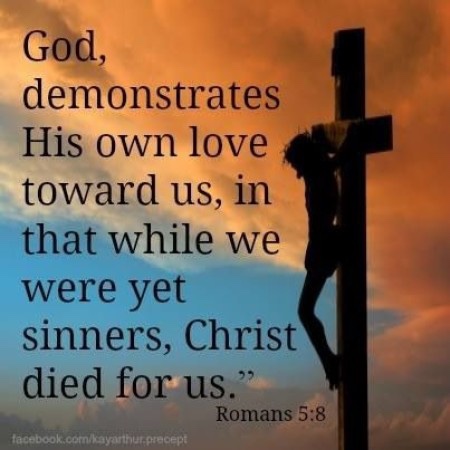
What follows are two striking affirmations about Jesus. The first is that “we have been justified by his blood” (v.9). This appears to have been an early credal-like claim within the early Christian movement; it appears in various forms at Acts 20:28; Rom 3:25; Eph 1:7; 2:13; Col 1:20; Heb 9:14; 10:19; 12:24; 13:12, 20; 1 Pet 1:2, 19; 1 John 1:7; Rev 1:5; 5:9;12:11.
The claim made depends on ancient Hebraic understandings of life and the role that blood plays in that. “You shall not eat flesh with its life, that is, its blood”, Noah is commanded (Gen 9:4); “the life of the flesh is in the blood”, the Lord declares to Moses (Lev 17:11). This understanding undergirds the whole sacrificial system; when sacrifices are made, blood must be shed, for “I have given it to you for making atonement for your lives on the altar; for, as life, it is the blood that makes atonement” (Lev 17:11; also Deut 12:23). Thus, a much later priestly writer is able to claim, “under the law almost everything is purified with blood, and without the shedding of blood there is no forgiveness of sins” (Heb 9:22).
Paul then follows with the assertion that, through the shedding of this blood and the death which ensues, “we will be saved through him from the wrath of God” (v.9). This particular claim brings us to what is seen by many as the most difficult aspect of Christian belief; the heart of the doctrine of the Atonement is based on the premise of endemic human sinfulness which merits the unrelenting wrath of God as punishment. I’ve addressed the difficulties in this view of the human being at
Paul is well aware of the place that “the wrath of God” had in what the prophets spoke about (Isa 1:24; 13:9, 13; 51:17; 63:1–6; Jer 7:20; 18:3–7; 25:15; 32:30–41;42:18–19; 44:6; 50:25; Ezek 7:5–12; 8:18; 13:13–16; 20:8–32; 22:20–22; 36:18; 38:18–19; Dan 8:19; 11:36; Hos 5:10; Amos 1:11–12; Micah 5:10–15; Nah 1:6; Zeph 1:15–18; 2:1–3; Zech 7:12; 8:14). As Nahum succinctly declares,”a jealous and avenging God is the Lord, the Lord is avenging and wrathful” (Nah 1:2).
His argument in his letter to the Romans is premised on the need to find a way to deal with God’s wrath, which is “revealed from heaven against all ungodliness and wickedness” (Rom 1:18). On “the day of wrath … God’s righteous judgement will be revealed” (2:5), such that “for those who are self-seeking and who obey not the truth but wickedness, there will be wrath and fury” (2:8).
Paul asserts that it is not unjust for God to inflict wrath on us (3:5), and so the remedy that he proposes is that God “put forward [Jesus] as a sacrifice of atonement by his blood, effective through faith … to show his righteousness” (3:25). Jesus is the central means by which human sin is dealt with; this is a repeated motif in Paul’s letters, for in five of his seven letters he asserts that “Christ died for us” (Rom 5:6,8; 14:15; 1 Cor 8:11, 15:3; 2 Cor 5:14–15; Gal 2:21; and 1 Thess 5:10). This claim is reminiscent of Jesus’ saying that “the Son of Man came not to be served but to serve, and to give his life a ransom for many” (Mark 10:45).
Certainly, atoning for sin is a central ritual in the Torah (Exod 30:10 and the details set out in Lev 1, 4–5). Thus, “the blood of the covenant” sealed under Moses (Exod 24:8; Heb 9:20) is renewed through Jesus (Mark 14:24; Matt 26:28; Heb 7:22; 8:6–13; 9:15–17; 10:12–17;12:24). Paul is adopting, extending, and reinterpreting this language in the way that he explains the significance of the death of Jesus.
See more at
*****
Throughout the compressed argument of this very rich section, Paul uses multiple images to interpret the significance of the death of Jesus. The final image is reconciliation, drawn from interpersonal relationships: “having been reconciled, we will be saved by his life” (v.10), and that it is “through our Lord Jesus Christ [that] we have now received reconciliation” (v.11).

Reconciliation is to the fore in part of what we know as Paul’s second letter to the Corinthians. It was actually his fourth letter; 1 Cor 5:9 indicates a letter was sent prior to 1 Cor itself, while 2 Cor 2:3–4 and 7:8 indicate a further “painful letter” was sent in between the letters we know as 1 Cor and 2 Cor. He has obviously had a fractious relationship with the believers in Corinth; much of the first long section of this (fourth) letter to them is seeking to repair relationships.
In encouraging the believers in Corinth in the midst of their distress (2 Cor 1:6–7), Paul writes about being “treasure in clay jars” (4:7), not losing heart (4:16), and walking by faith, not sight (5:7). In this context, he sets out a detailed exposition of “the ministry of reconciliation” (5:11–21). What he offers the Corinthians is “the message of reconciliation” (5:19), that they should “be reconciled to God” (5:20), to “become the righteousness of God” (5:21).
This motif of reconciliation is taken up in later letters written by students of Paul. One, writing to “the saints and faithful brothers and sisters in Christ in Colossae”, declares that in Christ, “all the fullness of God was pleased to dwell”, and affirming that “through him God was pleased to reconcile to himself all things, whether on earth or in heaven, by making peace through the blood of his cross” (Col 1:19–20). The reconciliation effected by Jesus, in this view, had a cosmic scope and impact.
Another student, in creating a letter which most likely was originally a circular letter to a number of churches, took this motif as the key to understanding how Jews and Gentiles were both to be included within the people of God. (We know this letter, because of a textual variant in the opening verses, as Ephesians.)
Writing with Gentiles in mind, the author of this letter declares that “now in Christ Jesus you who once were far off have been brought near by the blood of Christ” (Eph 2:13). Accordingly, Christ “is our peace; in his flesh he has made both groups into one and has broken down the dividing wall, that is, the hostility between us” (2:14).
The writer declares that Jesus abolished the law (a statement that goes beyond what Paul ever wrote), “that he might create in himself one new humanity in place of the two, thus making peace, and might reconcile both groups to God in one body through the cross, thus putting to death that hostility through it” (2:15–16). Reconciliation, manifested in social relationships, is the central feature of the church. This is a clear and pertinent application of the view that Paul had expressed in Rom 5:10–11 and 2 Cor 5:11–21.
What a rich passage!

 An Informed Faith