
Jesus has been important ever since his earthly life. Through his teachings, his death, and the experience of resurrection, his early followers recognised his significance. They held together after the crucial events in Jerusalem that brought the earthly life of Jesus to an end. In a sense, Jesus lived on through what they said and did in the ensuing decades … and centuries.
Jesus had a life after his (earthly) life … or, perhaps we might say, Jesus had an afterlife; although, to be more accurate, we might better say, Jesus had many afterlives. In the preaching, serving, writing, singing, drawing, painting, and witness of many later followers of Jesus, he lived on … in ways that each person represented, contextualising Jesus to their own situation, their own experience, their own cultural practices.
So over the centuries there has been Jewish Jesus, Black Jesus, Asian Jesus, African Jesus, White European Jesus, Jesus in song, Jesus in art, Jesus in orthodox doctrine, Jesus in “heretical” understandings, Jesus in Islam, Jesus in Buddhism, Jesus represented and communicated in a myriad of ways.
Australian Anglican priest and biblical scholar, Dr Greg Jenks, has been working for some time to collate a collection of writings which explores some of these “afterlives of Jesus”. The result is a set of three volumes, The Afterlives of Jesus, with contributions from a wide variety of people, providing fascinating insights into the way that Jesus has “lived on” through the centuries.
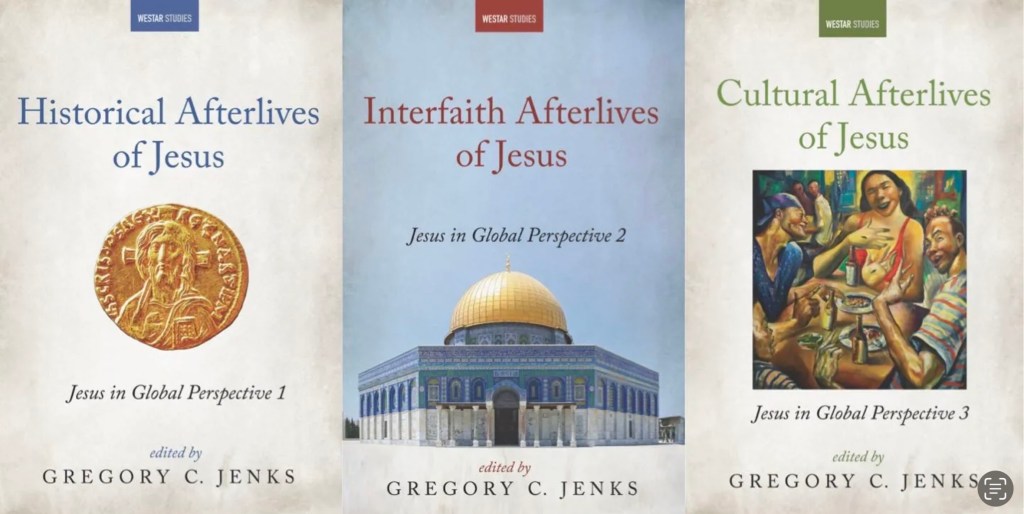
It is a collection of essays which explores the impact of Jesus within and beyond Christianity, including his many afterlives in literature and the arts, social justice, and world religions during the past two thousand years and especially in the present global context.
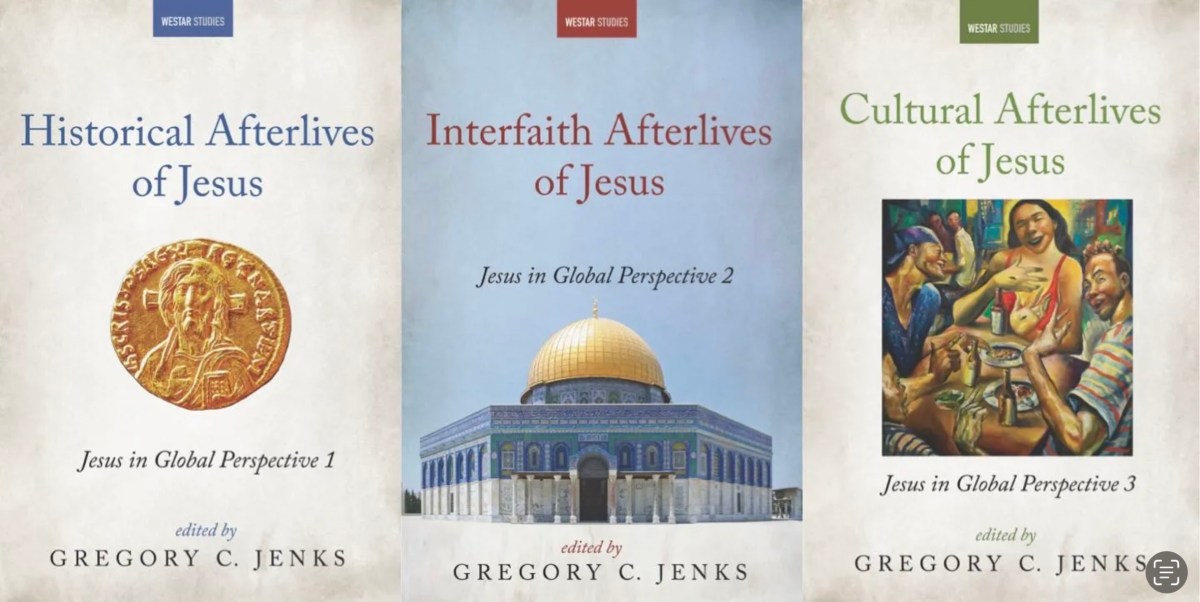
The first volume, Historical Afterlives, focusses on explicitly Christian afterlives, exploring how scripture passages relating to Jesus have been interpreted, as well as how patristic writers, Byzantine coins, mand contemporary social insights engage with Jesus.
In the second volume, Interfaith Afterlives, the focus is on the diverse ways that Jesus was understood in other faith traditions. Jesus has significant afterlives in Islam, Judaism, Hinduism, Ruism and Mormonism, as well as assorted secular afterlives in progressive Christianity.
In volume three, Cultural Afterlives, a range of writers reflect on how Jesus has been proclaimed, appropriated, and adapted into a range of cultures—Indigenous Australian, Māori, Pacific, and Asian Jesus; the “Jesus of King’s Cross”, Jesus in post-colonial art, in comedic film, in feminist understanding.
The contributors include religion scholars from the respective traditions, as well as faith practitioners reflecting on Jesus within their own religious context. While the essays are all grounded in critical scholarship, reflective practice, or both, they are expressed in nontechnical language that is accessible to interested nonspecialists.
Australian theologian Dr Val Webb says that the work offers “a wonderful sweep of ‘afterlives’ that free Jesus of Nazareth from the confines of Christian orthodoxy, a Jesus who has fed the imagination of people, cultures, and contexts far beyond the streets of Jerusalem and Rome.” Professor Monica Jyotsna Melanchthon, of the University of Divinity, observes that “the rich set of afterlives discussed here provoke conversation in terms of our continued life, faith, and reflection on the Jesus of History and the Christ of faith”.
Professor Arthur Dewey, of Xavier University, rejoices that, in reading these volumes, “we slowly begin to realise that Jesus is no longer embalmed in doctrinal winding sheets; he has slipped ecclesial controls and continues his walkabout on this fragile planet.” He continues, “whether reading the Jesus traditions anew through indigenous eyes or recognizing how the tradition itself emerged within the lethal atmosphere of patriarchy, the authors challenge us to nothing less than a radical revisioning of that elusive and alluring figure, dancing in the unnoticed gaps and crevices of our planet”.
Greg Jenks has done a fine job in commissioning and editing the 33 essays included in these three volumes. The contents of each volume and a link to order The Afterlives of Jesus in hardcopy can be found at https://afterlives.org

 An Informed Faith