
Earlier this month, Elizabeth and I attended the regular monthly gathering of Rainbow Christian Alliance (RCA), where rainbow people of faith, who identify with one or more of the letters in LGBTIQA, join with allies to share food, conversation, and prayer, and discuss matters of mutual concern.
This time, the theme for RCA—since it is Pride Month during June—was “Proud of Pride?” Pride Month runs throughout the month of June. It honours the 1969 Stonewall Riots, a tipping point for the then Gay Liberation Movement in the USA.
In response to a police raid of a gay bar, the Stonewall Inn, on 28 June 1969, in Greenwich Village, New York City, members of the gay community began a rolling series of spontaneous protests that were marred by police violence, which generated increasingly aggressive protests in response.
Simultaneous Gay Pride marches were held a year later, in New York, Chicago, and Los Angeles, to remember the Stonewall Riots. That custom has continued each year since, and has grown into Pride Month.
The long-term result of these protests was that gay rights groups sprang up in every major US city, and the decriminalisation of homosexuality (which had already occurred in Illinois in 1962) spread across the fifty states over the next four decades. A similar slow-drip rollout occurred across the states and territories of Australia, from South Australia in 1972, to 1997 in Tasmania, the last state to decriminalise consenting homosexual activity.
Today, Pride Month is a time for celebrations, including pride parades, picnics, parties, workshops, symposia and concerts. It offers an opportunity to “celebrate the diversity of the lesbian, gay, bisexual, transgender and intersex community … to reflect on just how far civil rights have progressed in half a century… and an opportunity to protest discrimination and violence”. (quoted from https://unyouth.org.au/event/global-issues-resources/national-pride-month/)
Those present at the Rainbow Christian Alliance gathering earlier in June engaged in a discussion of the differences between the sin of pride—hubris, according to the ancient Greeks—and the situation of LGBTIQA+ people today, where their expressing of pride in their gender identity or their sexual orientation is encouraged.
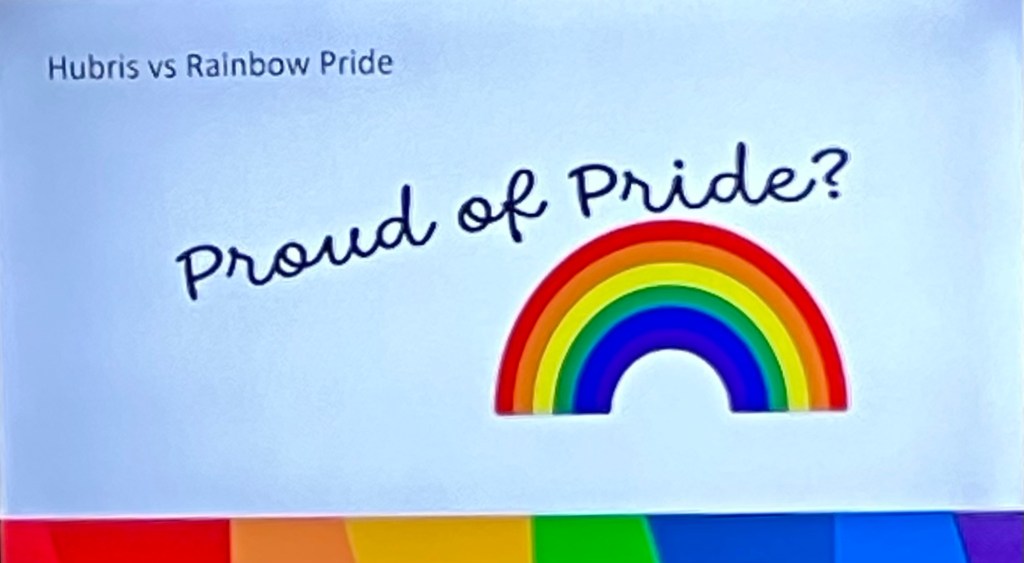
It is my view that the longterm historical prejudice and discrimination that LGBTIQA+ people have experienced—and that many continue to experience today—means that it is quite different for rainbow people. To express pride in their identity is something that is important and necessary for them to do. It is a way of claiming a place as a respected, honoured, and valued member of society.
That is quite different from someone like myself (a cis-gender white straight male, who has experienced so many points of privilege in life) expressing pride. Any expression of pride by myself about my privileges would be hubris; rainbow pride is seeking to redress past wrongs and establish a good and positive place in society for LGBTIQA+ people.
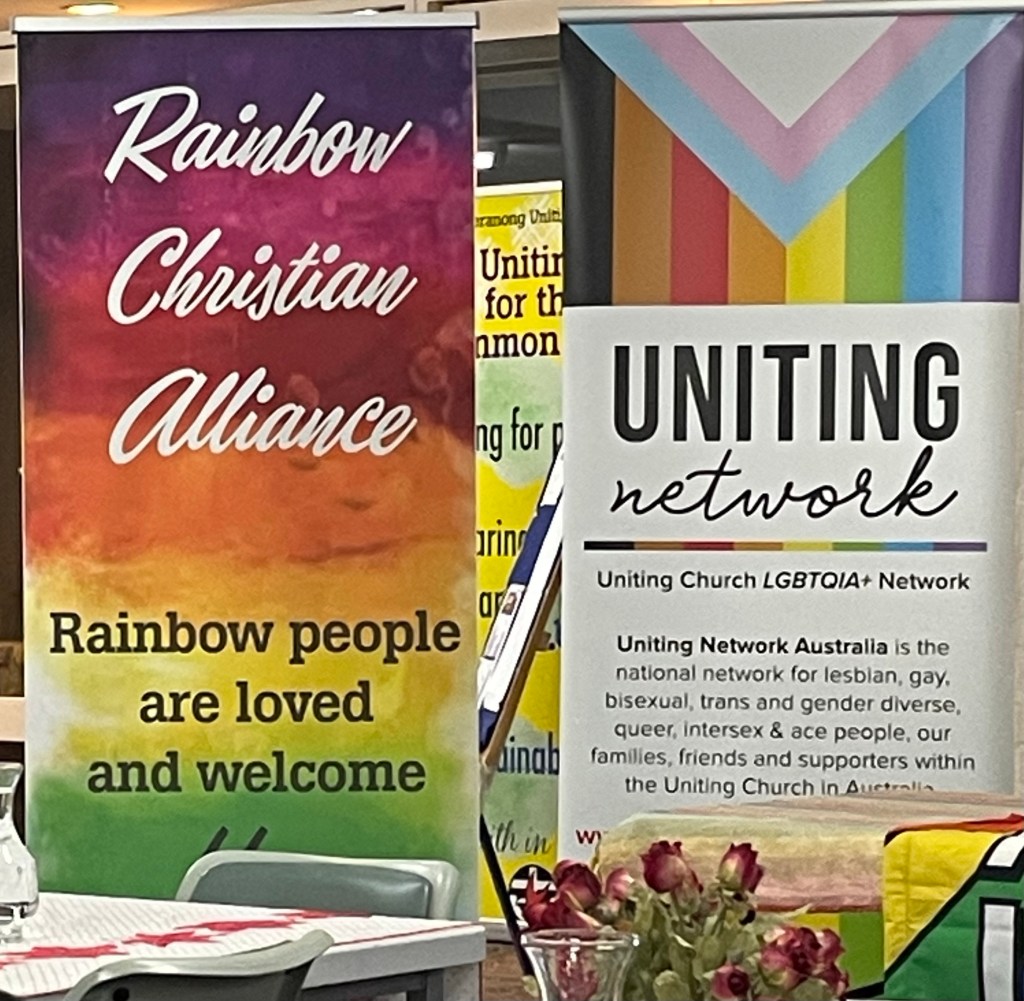
The Rainbow Christian Alliance provides a safe space for people to gather under the umbrella of the church. The importance of this space is evident at every RCA gathering, where friendship, support, compassion, and empathy is always strong. Participants keep coming back because they are valued and respected. Acceptance and affirmation are central to what takes place at each gathering.
As an ally, I find that welcoming rainbow people into the physical space where I worship week by week is complemented by the fact that I always feel welcomed into the emotional “rainbow space” that people create on these Sunday nights. Being able to take part in such a gathering is so important for all of us; there are mutual benefits for all of us.
Many of the people who participate in RCA have had negative experiences, related to their sexuality and/or gender, from family members, and from churches. The churches that give the most grief are of a more conservative theology, and a substantial proportion of those are Pentecostal, but even mainstream churches, Anglican and Catholic alike, have inflicted hurt and perpetrated harm by the way they have dealt with people in their midst who “come out” in relation to their gender identity or sexual preference.
I am glad that the Uniting Church has held a strong line in relation to LGBTIQA+ people. We have consistently grappled with issues of sexuality and, more recently, gender identity, exploring the biblical, theological, and pastoral dimensions with care, compassion, and integrity. That we can offer safe spaces in so many of our Congregations, now, is a small testimony to the determination we have to hold fast to the Gospel, as we best understand: we value, we accept, we include, and we advocate for people across the spectrum, as integral members of our community of faith.
See also

 An Informed Faith