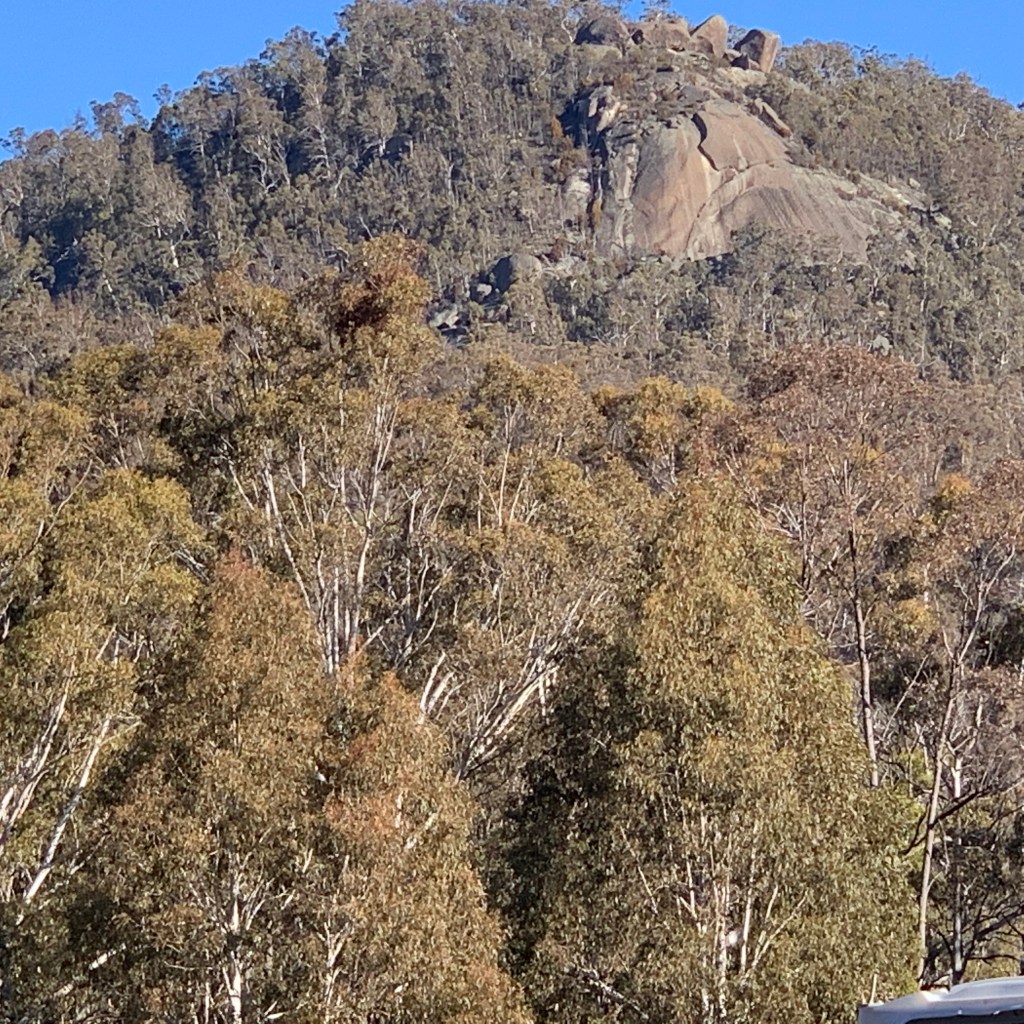
Our Father in heaven: a pattern for prayer (Luke 11, Matt 6) part I

In the series of Gospel readings offered by the Revised Common Lectionary, there is a break from the sequential readings begun in early January each year. This year—Year A—we began with the early chapters of the Gospel according to Matthew (from 2:1 through to 5:37); but when the season of Lent began, the Gospel readings were taken largely from John, with John and Luke featuring during the Sundays after Easter. Only now, after Trinity Sunday, does the sequential pattern resume.

However, that pattern begins with Matt 9 on the Second Sunday after Pentecost, jumping from where we had left the Gospel back in February, in the middle of the Sermon on the Mount. The missing chapters (5:38 to 9:8) are omitted by the lectionary. Now, the words of Jesus in the Sermon on the Mount are confronting and difficult—but that is no reason to avoid them!

What is omitted is the latter part of the sequence of Antitheses, including the command to love our enemies; teachings on fasting, prayer, and almsgiving; and a series of sayings about assorted matters, each of which presses us to be more intentional and focussed in our discipleship.

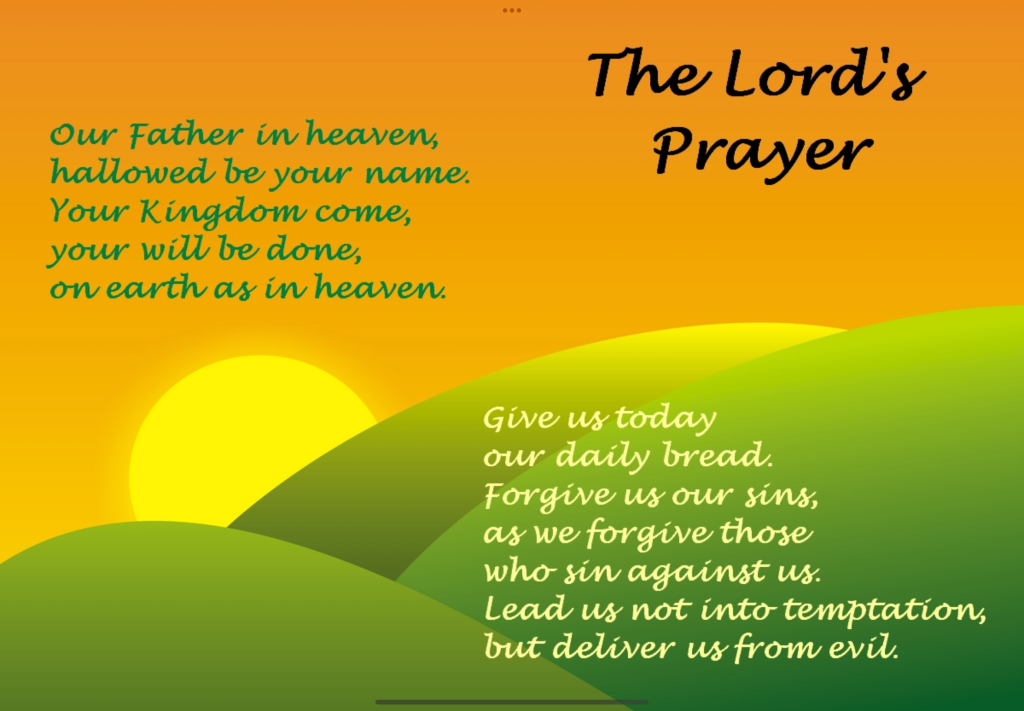
And in the middle of all of that, “pray then in this way”, says Jesus, giving his disciples a set of words (6:9–13) that has come to be known as The Our Father (after its opening phrase) or The Lord’s Prayer (after the one who gave it to his disciples). So before we get too far into the series of readings in the season of Pentecost, I thought I would offer some thoughts about this well-known and much-loved prayer.

Christians are used to praying this prayer on a regular basis, in obedience to the instructions of Jesus recorded in two Gospels: “when you pray, say …” (Luke 11:2; Matt 6:9). This prayer can be considered a succinct primer for prayer, since it contains the key elements of praying.

After an opening adoration of God (“our Father in heaven, holy is your name”), there follows prayers for the world (“your kingdom come, your will be done”), petitions for ourselves (“give us bread for the day, forgive us our sins, do not bring us to the time of trial”), and intercessions for others (“as we forgive those who sin against us”). In the later version of the prayer, a closing benediction is included (“yours is the kingdom, the power, the glory”), ending, of course, with “Amen”. The pattern is clear and concise.

Each element in this prayer is and expression of traditional Jewish piety; every line draws from Hebrew Scripture. Although this prayer is so frequently associated with Jesus, it is not a prayer that is original to him in its content or orientation. The originality of the prayer lies not in its content, but in the way that Jesus has drawn together each element into a cohesive unity.

The structure of the prayer is pleasingly aesthetic. There is an opening address to God (“our father in heaven”) and a closing benedictory phrase (“yours is the kingdom, the power, and the glory”). These phrases frame the who,e prayer; whilst the largest component of the prayer, the inner section, is focussed on us where we are in this present time, the outer frames set our lives into this larger context.

Following the opening phrase, there are three clauses addressed to God (“holy is your name … your kingdom come … your will be done”). These clauses extend the opening address to God, identifying key elements in how we understand God. (See below for further discussion of this.) The third clause is extended with the phrase “on earth as in heaven”, drawing our attention to the close correlation that is expected between the divine and we human beings.

Before the closing phrase, there are three requests made of God, for ourselves (“give us bread for the day … forgive us our sins … do not bring us to the time of trial”) with the second and third phrases extended with an additional phrase (“as we forgive those who sin against us” and “rescue us from the evil one”).

The second extension draws the attention of people who are praying the prayer away from us as people praying (give us, forgive us) to others who are beyond the scope of the group praying—to other people in society with whom we engage day by day.

And the third extension draws the attention of people away from us as people within this material world, to a dimension that is somehow beyond, transcending this world. Reference to “the evil one” raises the spectre (oops!) of the realm of “principalities and powers” (as referred to in the epistles). Life as we know it is not entirely within our own control; there are other forces—both evil, and also good—that impinge upon us. It’s an interesting extension in a prayer which is, at least in the larger middle section, focussed on our here-and-now in this world.

So in my mind, just as the opening and closing phrases balance each other, so these three petitions balance with the three addresses to God in the earlier half of the prayer. The symmetry is not exact, in terms of precise syllables or words used; but the syntactical structure is clearly patterned and pleasingly symmetrical, in my mind.

And then, to make sure that we know that the prayer is ending, we have the tag-line, as it were: “for ever and ever, Amen”. So in my mind, quite often when I pray this prayer, I hear the structure as an invitation to pause, focus on God, remember our needs and remember also others, recall the immediate dimension as well as the transcendent, and then conclude with gratitude to God. The Amen at the end is the typical conclusion to prayer, signalling the agreement of the prayers and all present to what has been prayed.

*****

2

The content of the prayer, as previously noted, draws at every point from Hebrew Scripture. The opening address identifies God as father, and as “hallowed”—a somewhat archaic adjective, rarely used now in common speech, meaning holy, consecrated, sacred, or revered. The related noun, hallow, denoted a saint in older English. The concept of being holy, however, was well- known in ancient Israel, and appears frequently in Hebrew Scripture.

Addressing God as “father in heaven” is found in just a few texts in Hebrew Scriptures: in the cry of “the faithful one”, “you are my Father, my God, and the Rock of my salvation!” (Ps 89:26), in the praises of the psalmist, “Father of orphans and protector of widows is God in his holy habitation” (Ps 68:5), and in the questioning of the prophet Malachi: “have we not all one father? has not one God created us? why then are we faithless to one another, profaning the covenant of our ancestors?” (Mal 2:10).

By contrast, that God’s name is holy is an affirmation found many times in Hebrew Scriptures. God is addressed as holy (Ps 22:3) and God’s name is holy (Ps 30:4; 33:21; 97:12; 103:1; 105:3; 106:47; 111:9; 145:21). “Holy One” is a term applied to God in the Writings (Ps 71:22; 78:41; 89:18; Prov 9:10; Job 6:10; Sir 4:14; 23:9; 53:10; 47:8; 48:20) and by the Prophets (Isa 1:4; 5:19, 24; and a further 24 times; Jer 50:29; Ezek 8:13; Hos 11:9, 12; Hab 1:12; 3:3). When Hannah sings with joy of the son whom she is expecting, she describes God as the Holy One (1 Sam 2:2).

Just as God was holy (Lev 11:44; 19:2; 20:7; 21:8; 1 Sam 2:2; Ps 99:5, 9), so God had called Israel to be a holy people (Exod 19:5–6; Deut 7:6; 14:2; 26:19; 28:9) and to live lives of holiness (Lev 11:45; Ps 77:13). God provided the people with a “holy land” for them to live (Josh 5:15) and there was a “most holy place” in the heart of the Temple where God dwelt (1 Kings 7:50; 1 Chron 6:49). And so, the followers of Jesus are instructed to consider themselves as God’s holy people (1 Cor 3:17; 6:19; Eph 5:25–27; Col 1:22; 3:12; Heb 3:1; 1 Pet 1:13–16; 2:5, 9) and to live accordingly.

“Your kingdom come” also expresses a hope that is central to the Hebrew Scriptures. Israel, of course, eventually adopted the pattern of nations that surrounded it, and appointed a king (1 Sam 8–10)—although not without some wrangling with the prophet Samuel (1 Sam 8:10–18). The various kings of the ensuing centuries each had to reckon with the prophets that were anointed by God and gifted by the Spirit, often to their great frustration!

A number of psalms acknowledge that God is in fact sovereign over Israel, declaring “the Lord is king” (Ps 10:16; 93:1; 96:10; 97:1; 99:1; and see also 1 Chron 16:31). “The Lord sits enthroned over the flood; the Lord sits enthroned as king forever”, says one song (Ps 29:10), amd extending the scope of divine sovereignty, “the Lord, the Most High, is awesome, a great king over all the earth”, is a striking claim in Ps 47:2.

One psalm claims that the kingdom of the Lord “is an everlasting kingdom, and your dominion endures throughout all generations” (Ps 145:13; also Dan 4:3; 7:27). Whilst the prophets who speak about a future kingdom invariably foresee a restoration of the greatness of a Israel in the land (Isa 9:7; 11:1–5; Amos 9:11–15; Obad 1:21), the developing notions relating to the demand for justice-righteousness, the judgement of God, the prediction of a Day when the Lord will act, and the coming of The End are all premised on the sovereignty of the Lord God and a certainty that God will indeed act to bring in a time and a place where God’s ways will guide all. See

For “on earth as in heaven” in the Lord’s Prayer, see

So Jesus stands firmly in that prophetic line of assurance in God’s sovereign power and certainty that God’s kingdom will come for people of all the nations (Mark 9:1; Matt 8:11; 16:28; 24:14; Luke 9:27; 13:29) and, indeed, that this kingdom has come near to Israel through his own message and activities, as he regularly declares (Mark 1:15; Matt 4:17; 10:7; 12:28; Luke 10:9, 11; 11:20). So this line in the prayer expresses both faithful Jewish expectations and typical perspective of Jesus.
See more at
Learning of the land (5): Namadgi, Tharwa, and Tidbinbilla

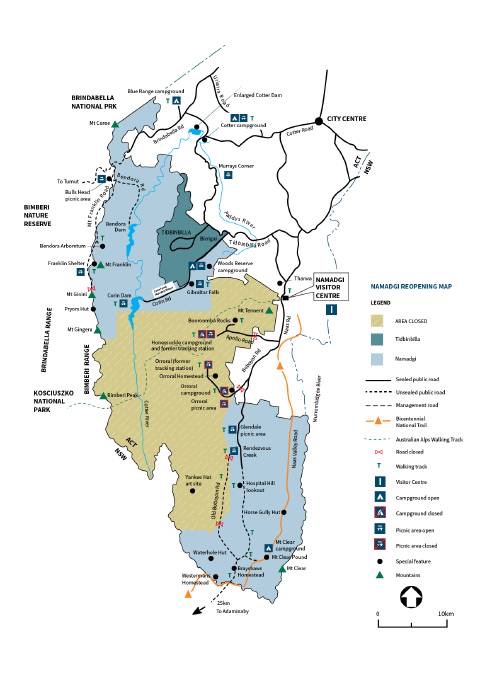
Not far from where we live, to the southwest in what is known as the Brindabella Ranges, there is a large swathe of national park. The Namadgi National Park actually stretches for almost 100 kilometres and it covers just over 100,000 hectares. It is a beautiful “natural” landscape with just a few roads running through it, quite a number of walking trails, and many features of significance.

Because it is so close (the entry point is just a 10km drive from where Elizabeth and I live), we have often ventured into the park for a Sunday afternoon drive; or, as was the case during the pandemic lockdown, for a once-a-week escape from the confines of home and the demands of the ZOOM screen!

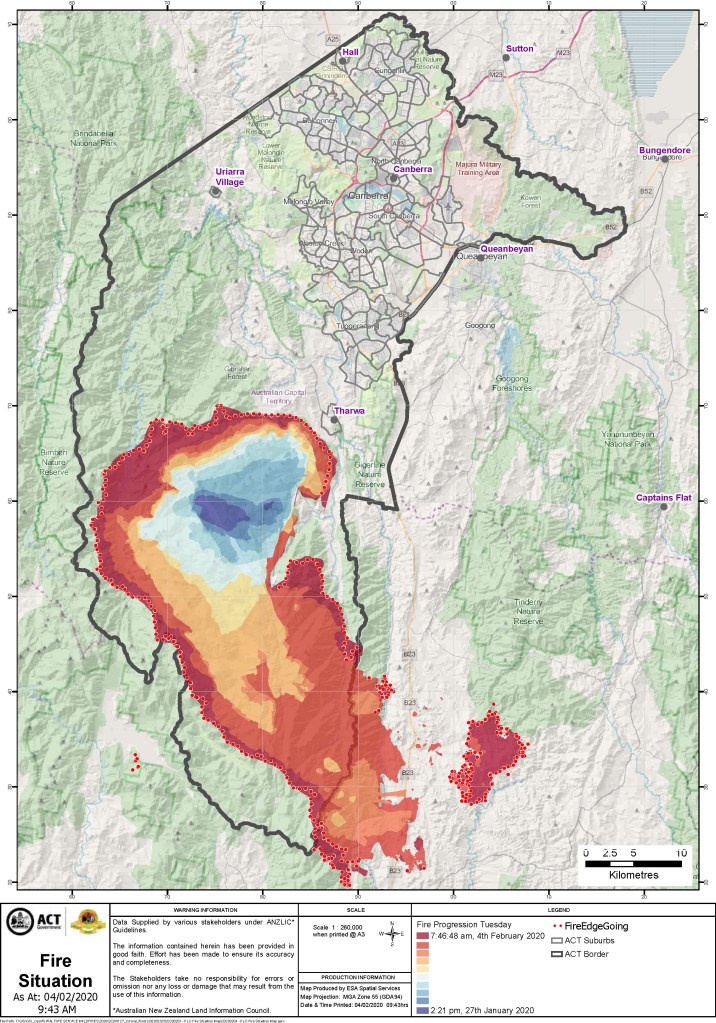
In early 2020, the Orroral Valley bushfire burnt over 80% of Namadgi National Park, or about 86,562 hectares. The fire came perilously close to the urban area where we love, at the southern edge of Canberra. Maps were published showing the danger of embers falling on the suburbs of Gordon and Banks. Plans to evacuate were publicised. We had packed our essentials into a couple of boxes, ready to whisk them away at an early opportunity.

One night, we stood with half of the residents of our street, watching the tops of the Brindabella range mountains that could be seen from our street. There were a number of fires, burning bright in the night. The darkness meant there was no real perspective; the flames, actually 5–6km away, looked like they were just across in the next street. The overhead buzz of planes and copters indicated that the Emergency Services were doing their very best to stop the spread of the fire—as they had been doing for weeks prior to this night.

The fire did not run down the mountain, into the urban area, as it had done in 2003, when a number of suburbs in the south-western area of Canberra were devastated. The memories of that event, scarred deep into the memories of people who had lived in the city longer than we had, were brought back to life in striking and vivid ways, for many we knew.

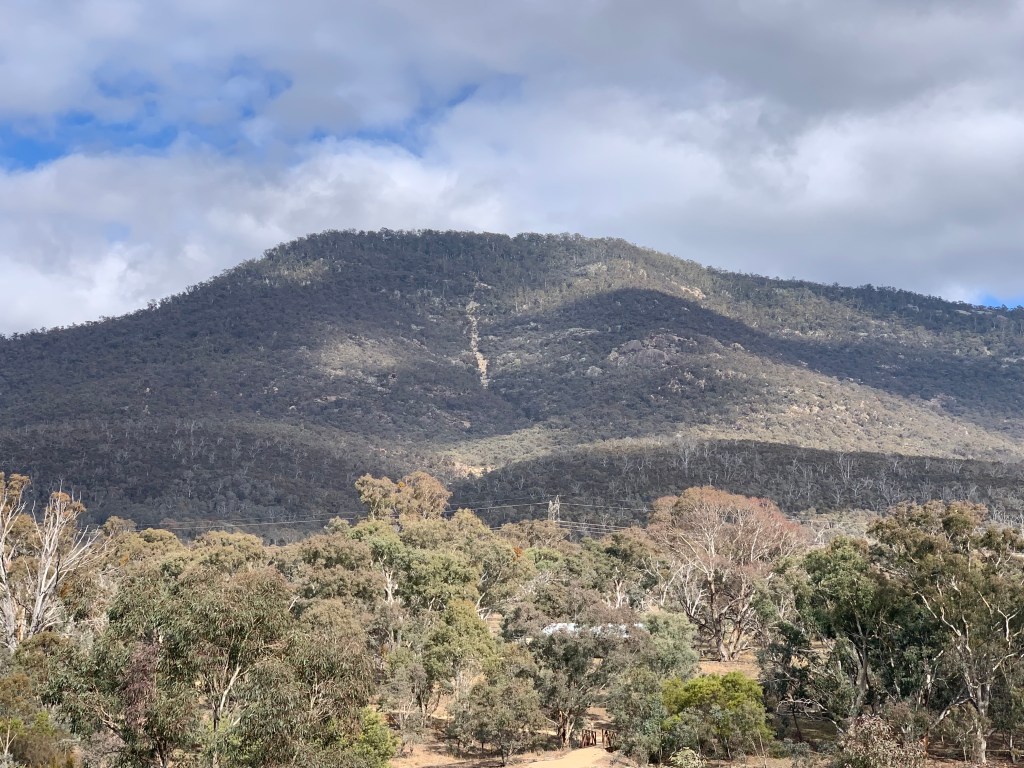
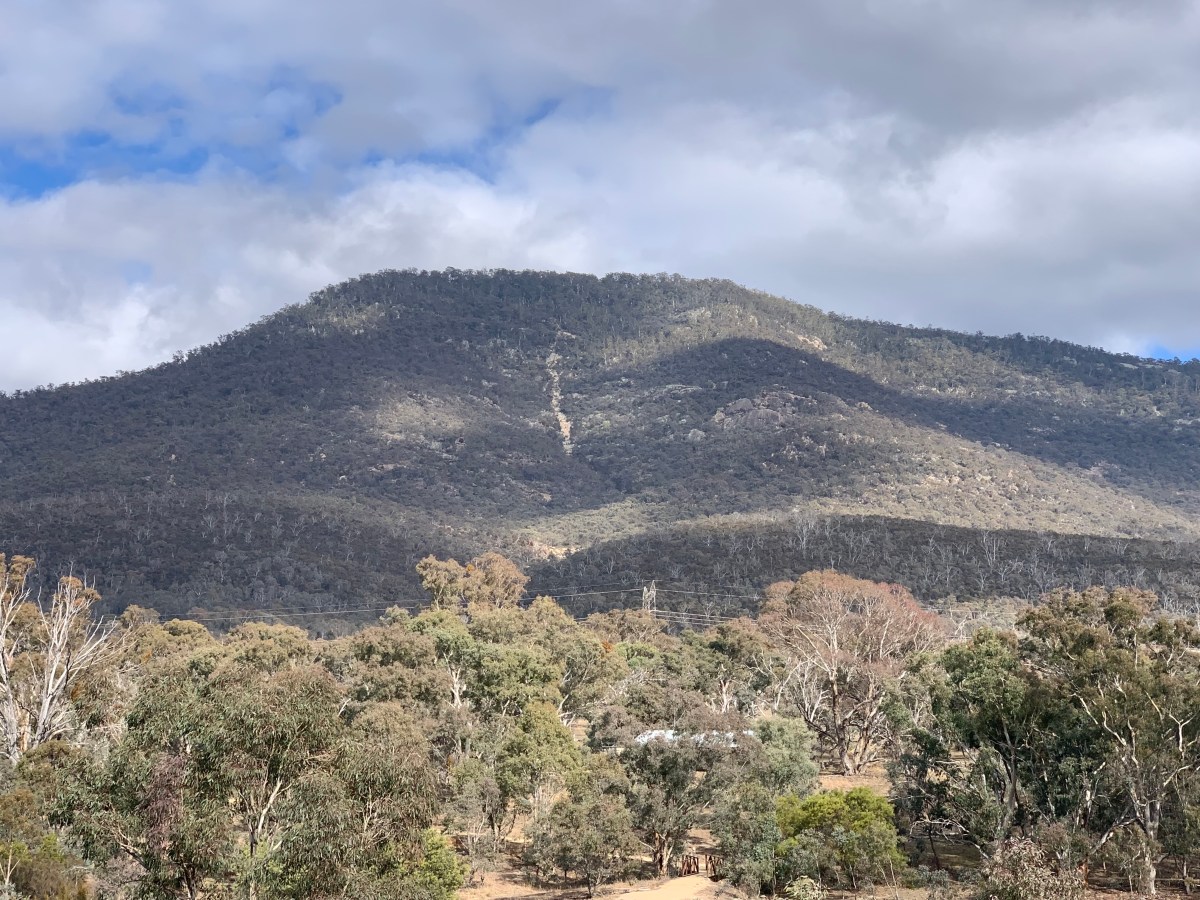
Just past the entry to the national park, the mountain of Tharwa stands high. It was given the name of Mount Tennent early in the colonial period, when British colonisation began. It was named after John Tennant, a bush ranger who lived in a hideout on the mountain behind Tharwa.

Tharwa (Mount Tennant) some months after the 2020 fires

Tennant absconded from his assigned landholder in 1826 and with some others formed a gang which raided local homesteads in the years 1827 and 1828. Eventually he was arrested and transported to Norfolk Island. Tennant was 29 years old when he had been sentenced to transportation to Australia for life in 1823. He arrived in Sydney on 12 July 1824 on the ‘Prince Regent’. Old habits died hard, it would seem. He died in 1837, a year after coming back to Sydney.

Soon after the 2020 bushfire, flooding to the fireground caused significant and widespread damage. The road that ran deep into the national park was closed. Added to the risk of burnt trees falling was the damage done to roads and infrastructure in the floods that occurred some months after the fires. Eventually, the road into the park was opened. We were able to venture back into the bush—to see at close quarters the scarred landscape, the swathes of burnt trees, and the bursts of vibrant green leaves now decorating those burnt trunks.

The savage brutality of what had taken place was evident, from a distance, to those of us who paid attention. Now, at close range, we were able to see just how severe the damage was, as well as how resilient the Australian bush is. New life is bursting forth in so many ways—sadly, not everywhere, as some areas will take much longer to recover—but overall, a picture of verdant health is evident.

******

Archaeological excavation and carbon dating of sites in Tidbinbilla Nature Reserve and Namadgi National Park has confirmed an Aboriginal presence in the ACT region 25,000 years ago. Temperatures in the region would have been several degrees lower 25,000 years ago—similar to the conditions on the summit of Mount Kosciuszko today. In other words, seriously cold!!

Bogong Moths would pass through the area in October on their way from breeding grounds on the plains, up to the mountains to hibernate for the summer. The moths are highly nutritious, easy to collect and were in sufficient numbers to warrant large gatherings. Many Aboriginal people from different clan groups and neighbouring nations gathered here for initiation ceremonies, marriage, corroborees and trade.

In fact Jedbinbilla, which means ‘a place where boys become men’ in Ngunnawal language, is situated adjacent to Tidbinbilla and we are told that it was an important place for young boys to learn the first of three stages of man-hood (gatherer, hunter, warrior).

Archaeological surveys of two of the main access routes to the valley area, the Fishing Gap Trail and the path over Devil’s Gap, have found clear evidence of frequent Aboriginal passage. Gibraltar Rocks is a highly significant spiritual site and a corroboree site has been found near the headwaters of Sheedy’s Creek.

Researchers believe the Tidbinbilla valley floor was the focus of a territorial group that survived on the plentiful supply of possum, ducks, wild turkeys, emus, platypus, kangaroo, fish, yabbies and a range of plants, tubers, seeds and fruit.

When Europeans first arrived in the area in the early 1820s hundreds of Aboriginal people lived here. The population of Aboriginal people increased at various times during the year when people travelled to the region for social gatherings, ceremonies and seasonal food collecting. European settlement had the same impact on Aboriginal communities in the ACT as it did in other parts of Australia. It brought displacement from the land and exposed people to new diseases such as influenza, smallpox and tuberculosis, from which many died. That, to our shame, is an enduring legacy that we forced into the First Peoples.

Aboriginal heritage sites found in this region include burial places, campsites, rock shelters (with or without ochre paintings), stone arrangements, scarred trees, ceremonial grounds, grinding grooves, quarries and sacred places. At times, Aboriginal occupation is also evident at early European sites such as historic homesteads, cemeteries, reserves and old bridle tracks and coach roads. There is lots of information at https://www.tidbinbilla.act.gov.au/learn/tidbinbilla?a=396477

*****

Men’s sites were often found in the higher peaks of the valley. One of the rock shelters is home to ancient rock art found along a pathway to the Gibraltar rock peak, which is a men’s site. While the mountains in Tidbinbilla are also important to Ngunnawal women, women’s sites were found closer to the river system that twisted through the valley. In some women’s places grinding grooves can still be found on the river’s edge.

Often grand geological formations would be significant to the story of place. Many formations can still be seen today which visually reflect the dreaming story of the valley and its important relationship to the people that have survived and thrived within it for thousands of years. An example of this is the shape of a pregnant woman seen through the contours in the western slopes of the valley and found in the centre of the Tidbinbilla valley is a rock that looks like a perched eagle (Maliyan) the creator spirit of the Tidbinbilla dreaming story.

Tidbinbilla was a key place for Ngunnawal ceremonies, with groups from surrounding areas entering through key points such as Gibraltar Peak, where an elder would light a fire to guide people into the valley. Neighbouring language groups travelled to Ngunnawal Country for the purpose of ceremony, lore, marriage arrangements, trade, sharing of seasonal foods and cultural knowledge.

Tidbinbilla was also a place where young men learnt traditional lore/law, and where they were taken into the mountains as they learnt to become men in the traditional way. Similarly, Ngunnawal women carried out their customary ceremonies in the lower areas of the landscape preparing young girls for womanhood. And as we have noted, the mountains surrounding the valley were home in spring to the migrating bogong moths, which were gathered by Ngunnawal people as a source of food. See

https://www.tidbinbilla.act.gov.au/learn/ngunnawal-culture-and-heritage

and

https://www.canberratracks.act.gov.au/heritage-trails/track-1-ngunnawal-country/namadgi-visitor-centre

*****

For earlier posts on learning of country, see

Learning of the land (5): Namadgi, Tharwa, and Tidbinbilla

Not far from where we live, to the southwest in what is known as the Brindabella Ranges, there is a large swathe of national park. The Namadgi National Park actually stretches for almost 100 kilometres and it covers just over 100,000 hectares. It is a beautiful “natural” landscape with just a few roads running through it, quite a number of walking trails, and many features of significance.

Because it is so close (the entry point is just a 10km drive from where Elizabeth and I live), we have often ventured into the park for a Sunday afternoon drive; or, as was the case during the pandemic lockdown, for a once-a-week escape from the confines of home and the demands of the ZOOM screen!

In early 2020, the Orroral Valley bushfire burnt over 80% of Namadgi National Park, or about 86,562 hectares. The fire came perilously close to the urban area where we love, at the southern edge of Canberra. Maps were published showing the danger of embers falling on the suburbs of Gordon and Banks. Plans to evacuate were publicised. We had packed our essentials into a couple of boxes, ready to whisk them away at an early opportunity.

One night, we stood with half of the residents of our street, watching the tops of the Brindabella range mountains that could be seen from our street. There were a number of fires, burning bright in the night. The darkness meant there was no real perspective; the flames, actually 5–6km away, looked like they were just across in the next street. The overhead buzz of planes and copters indicated that the Emergency Services were doing their very best to stop the spread of the fire—as they had been doing for weeks prior to this night.

The fire did not run down the mountain, into the urban area, as it had done in 2003, when a number of suburbs in the south-western area of Canberra were devastated. The memories of that event, scarred deep into the memories of people who had lived in the city longer than we had, were brought back to life in striking and vivid ways, for many we knew.

Just past the entry to the national park, the mountain of Tharwa stands high. It was given the name of Mount Tennent early in the colonial period, when British colonisation began. It was named after John Tennant, a bush ranger who lived in a hideout on the mountain behind Tharwa.

Tennant absconded from his assigned landholder in 1826 and with some others formed a gang which raided local homesteads in the years 1827 and 1828. Eventually he was arrested and transported to Norfolk Island. Tennant was 29 years old when he had been sentenced to transportation to Australia for life in 1823. He arrived in Sydney on 12 July 1824 on the ‘Prince Regent’. Old habits died hard, it would seem. He died in 1837, a year after coming back to Sydney.

Soon after the 2020 bushfire, flooding to the fireground caused significant and widespread damage. The road that ran deep into the national park was closed. Added to the risk of burnt trees falling was the damage done to roads and infrastructure in the floods that occurred some months after the fires. Eventually, the road into the park was opened. We were able to venture back into the bush—to see at close quarters the scarred landscape, the swathes of burnt trees, and the bursts of vibrant green leaves now decorating those burnt trunks.

The savage brutality of what had taken place was evident, from a distance, to those of us who paid attention. Now, at close range, we were able to see just how severe the damage was, as well as how resilient the Australian bush is. New life is bursting forth in so many ways—sadly, not everywhere, as some areas will take much longer to recover—but overall, a picture of verdant health is evident.

******

Archaeological excavation and carbon dating of sites in Tidbinbilla Nature Reserve and Namadgi National Park has confirmed an Aboriginal presence in the ACT region 25,000 years ago. Temperatures in the region would have been several degrees lower 25,000 years ago—similar to the conditions on the summit of Mount Kosciuszko today. In other words, seriously cold!!

Bogong Moths would pass through the area in October on their way from breeding grounds on the plains, up to the mountains to hibernate for the summer. The moths are highly nutritious, easy to collect and were in sufficient numbers to warrant large gatherings. Many Aboriginal people from different clan groups and neighbouring nations gathered here for initiation ceremonies, marriage, corroborees and trade.

In fact Jedbinbilla, which means ‘a place where boys become men’ in Ngunnawal language, is situated adjacent to Tidbinbilla and we are told that it was an important place for young boys to learn the first of three stages of man-hood (gatherer, hunter, warrior).

Archaeological surveys of two of the main access routes to the valley area, the Fishing Gap Trail and the path over Devil’s Gap, have found clear evidence of frequent Aboriginal passage. Gibraltar Rocks is a highly significant spiritual site and a corroboree site has been found near the headwaters of Sheedy’s Creek.

Researchers believe the Tidbinbilla valley floor was the focus of a territorial group that survived on the plentiful supply of possum, ducks, wild turkeys, emus, platypus, kangaroo, fish, yabbies and a range of plants, tubers, seeds and fruit.

When Europeans first arrived in the area in the early 1820s hundreds of Aboriginal people lived here. The population of Aboriginal people increased at various times during the year when people travelled to the region for social gatherings, ceremonies and seasonal food collecting. European settlement had the same impact on Aboriginal communities in the ACT as it did in other parts of Australia. It brought displacement from the land and exposed people to new diseases such as influenza, smallpox and tuberculosis, from which many died. That, to our shame, is an enduring legacy that we forced into the First Peoples.

Aboriginal heritage sites found in this region include burial places, campsites, rock shelters (with or without ochre paintings), stone arrangements, scarred trees, ceremonial grounds, grinding grooves, quarries and sacred places. At times, Aboriginal occupation is also evident at early European sites such as historic homesteads, cemeteries, reserves and old bridle tracks and coach roads. There is lots of information at https://www.tidbinbilla.act.gov.au/learn/tidbinbilla?a=396477

*****

Men’s sites were often found in the higher peaks of the valley. One of the rock shelters is home to ancient rock art found along a pathway to the Gibraltar rock peak, which is a men’s site. While the mountains in Tidbinbilla are also important to Ngunnawal women, women’s sites were found closer to the river system that twisted through the valley. In some women’s places grinding grooves can still be found on the river’s edge.

Often grand geological formations would be significant to the story of place. Many formations can still be seen today which visually reflect the dreaming story of the valley and its important relationship to the people that have survived and thrived within it for thousands of years. An example of this is the shape of a pregnant woman seen through the contours in the western slopes of the valley and found in the centre of the Tidbinbilla valley is a rock that looks like a perched eagle (Maliyan) the creator spirit of the Tidbinbilla dreaming story.

Tidbinbilla was a key place for Ngunnawal ceremonies, with groups from surrounding areas entering through key points such as Gibraltar Peak, where an elder would light a fire to guide people into the valley. Neighbouring language groups travelled to Ngunnawal Country for the purpose of ceremony, lore, marriage arrangements, trade, sharing of seasonal foods and cultural knowledge.

Tidbinbilla was also a place where young men learnt traditional lore/law, and where they were taken into the mountains as they learnt to become men in the traditional way. Similarly, Ngunnawal women carried out their customary ceremonies in the lower areas of the landscape preparing young girls for womanhood. And as we have noted, the mountains surrounding the valley were home in spring to the migrating bogong moths, which were gathered by Ngunnawal people as a source of food. See

https://www.tidbinbilla.act.gov.au/learn/ngunnawal-culture-and-heritage

and

https://www.canberratracks.act.gov.au/heritage-trails/track-1-ngunnawal-country/namadgi-visitor-centre

*****

For earlier posts on learning of country, see