
The stories we are following in the sagas of ancient Israel, during this season after Pentecost, come from a different time, a different place. They reflect different cultures, with different customs, and seemingly different moralities. And they certainly depict the women at the centre of these stories in ways that we would recoil from, if we were to tell stories in our own time, place, and culture.
“Leah’s eyes were lovely, and Rachel was graceful and beautiful” (Gen 29:17). That’s how we are introduced to the two women, sisters, daughters of Laban, who figure in the story offered by the lectionary for this coming Sunday (Gen 29:15–28). Could a more patronising and sexist introduction be given to these two characters? Descriptions of women on the basis of their outward appearance are sure to disturb and anger contemporary readers of this story; judging a woman by her appearance is not a sensible way to proceed!
More than that, however, we find that the older male protagonist in this story, Laban, appears to have very dubious ethical standards. He does not seem to act in accord with the propriety that we, today, would expect. Jacob had been instructed by Isaac “not marry one of the Canaanite women” but rather to take a wife from “one of the daughters of Laban, your mother’s brother” (28:2). Jacob is under instruction; what role does Laban play?
On arrival at Haran, or Paddan-Aram, in “the land of the people of the east” (29:1), Jacob early on indicates his interest in Laban’s daughter Rachel, kissing her (29:11). When Rachel then conveys to her father the fact of his family’s connection to theirs, Laban greets him with joy: “surely you are my bone and my flesh!” (19:14). From that, we might expect honest behaviour will follow.
Jacob flags his interest in Rachel; Laban promises her to him in exchange for seven years of work (29:15–20). Writing in My Jewish Learning, Dr Kristine Henriksen-Garroway, Associate Professor of Hebrew Bible at the Hebrew Union College in Jerusalem, observes that “to marry a woman, a man had to first pay her father a מֹהַר (mohar), ‘bride-price.’ Although Laban allows Jacob to marry Rachel before working off his debt, she only has her first child at the end of the seven-year period.
Dr Henriksen-Garroway explains, “Jacob wishes to marry Rachel, but he has no land or money to speak of; he is a guest in Laban’s house. Marriage is not free, so he offers his own labor as the bride-price (mohar/tirḫatum). While the text makes no mention of his being betrothed first, Jacob’s need to wait until the bride-price is paid in full in order to marry Rachel fits with biblical and ancient Near Eastern practice.”
*****
So Jacob marries Rachel and works for Laban for seven years; after which time, Laban craftily provided Leah as the woman with whom Jacob slept (29:21–22). The language suggests that it is sexual union that is to the forefront of Jacob’s mind (“give me my wife that I may go in to her, for my time is completed”, 29:21), so his lack of awareness appears due to this focus. Had he not slept with Rachel in those seven years?
The NRSV, following the KJV, renders the words of Jacob in this crass manner, “that I may go in to her”. The NIV reports Jacob as saying, “give me my wife; I want to make love with her”; the NASB says, “that I may have relations with her”; and the NLT is much more demure with “so I can sleep with her”.
Whatever translation is used, it is clear that events are driven by the libido of Jacob. He was the “supplanter”, who gained his birthright by bargaining with his brother and deceiving his father. But his time has come; as we read on in the story, it is clear that Laban has always been intent on deceiving Jacob.
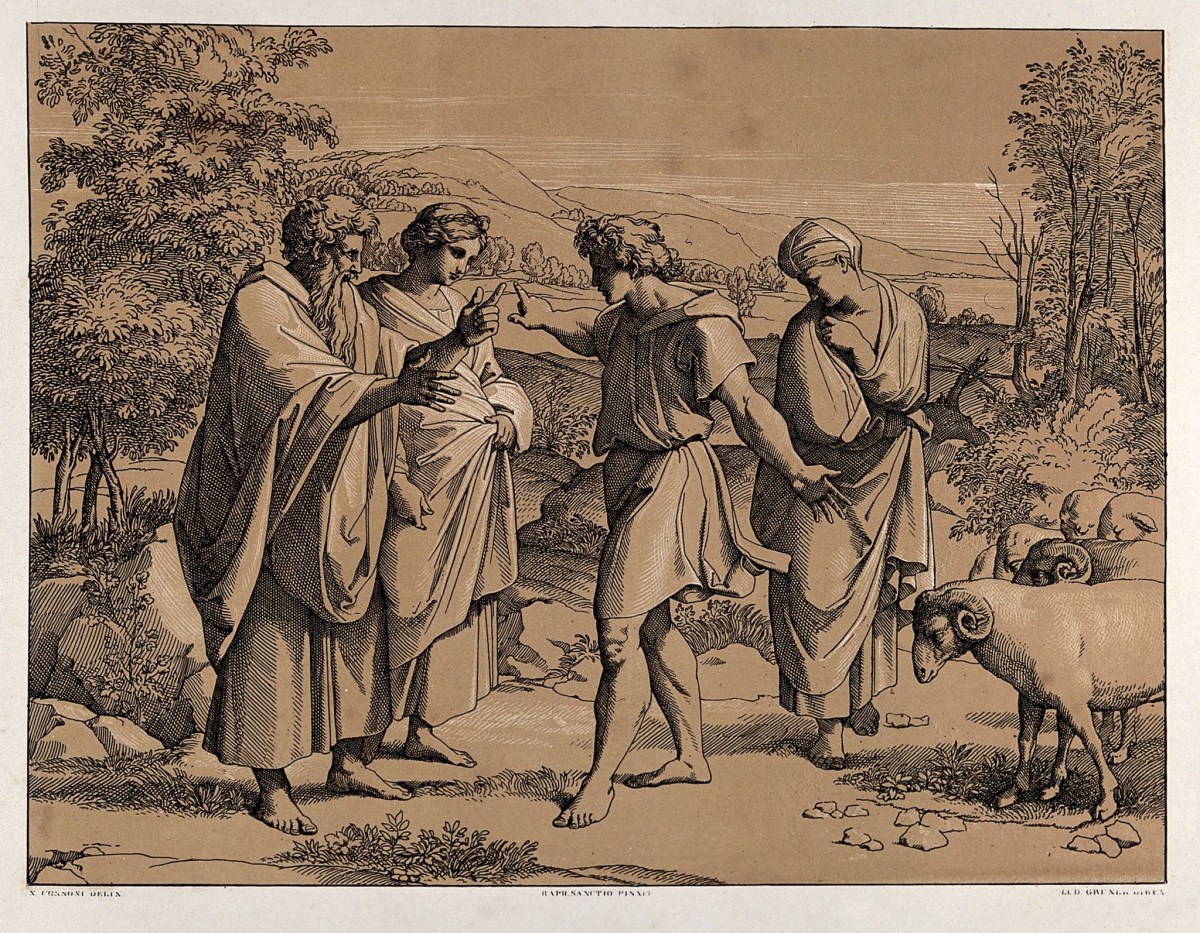
Citing local customs, Laban claims that “giving the younger [daughter] before the firstborn” in marriage was a custom that was “not done in our country” (29:26). Laban manipulates matters so that Jacob, still besotted by Rachel’s grace and beauty, is willing to submit to a further seven years of working for Laban, in order to secure Rachel as his wife, even though he is now married to Leah, who had lovely eyes. Jacob trusts Laban—but why? He has already been deceived once by him.
So, he needs to work for Laban for another “week (of years)”. The text is very matter-of-fact at this point, simply recounting that “Jacob did so, and completed her week; then Laban gave him his daughter Rachel as a wife” (29:28). Dr Henriksen-Garroway notes that “the requirement for Jacob to ‘pay’ to marry Rachel fits with the basic sequence of marriage steps assumed in the Bible and ancient Near East”.
In her further exploration of ancient Israelite marriage customs, she notes that “when a girl’s father agreed to a union between a suiter and his daughter, the suiter often did not have the bride-price handy. This may be one reason for the betrothal period, what the rabbis call ʾerusin (from the root א.ר.שׂ). The girl’s betrothal to the man made her unavailable to other men, but she still lived with her father until the man paid the bride-price.”
This explains Jacob’s seven years of working whilst betrothed to Rachel, who continued to live with Laban, before Laban deceitfully gave him Leah (29:18–20). It also explains the further seven years of working before he actually is given Rachel in marriage (29:27–28). What trust Jacob had—believing Laban, even after that first act of trickery. Would he do the same yet again? Perhaps, as he seems to have had only two daughters, Rachel would be “supplied” to him second time around.
Dr Henriksen-Garroway offers further explanation: “when we look at Laban’s agreement carefully, we can see that he never explicitly accepts Jacob’s proposal or mentioned which of his daughters he is offering”, citing the vagueness of Laban’s earlier comment, “it is better that I give her to you than that I should give her to any other man; stay with me” (29:19).
*****
So, after Jacob had worked his second term of seven years, this time actually for Rachel (29:28), another matter-of-fact statement follows in the NRSV: “Jacob went in to Rachel also, and he loved Rachel more than Leah” (29:30). Once again, other translations use the euphemisms we have earlier noted, in order to soften the crude physical depiction into a more relational understanding.
Yet the story is crassly sexualised—consummating the marital relationship is at the heart of events. Although, to be fair, the production of an heir is an important focus in ancient societies, and an heir for Jacob is necessary to fulfil “the promise that the Lord made on oath … to Abraham, to Isaac, and to Jacob” (Deut 9:5; Exod 32:13). This promise was first announced to Abraham—“I will make of you a great nation” (Gen 12:1, reiterated at 22:17)—then repeated to his son, Isaac (26:4–5, 24) and to his grandson, Jacob (28:13–14; 32:12). So the story continues with a sequence of event that show how this eventuates.
Like his grandfather and his father, Jacob finds that his wife, Rachel, is barren (29:31). In subsequent years, Leah bore him four sons, Reuben, Simeon, Levi, and Judah (29:32–35), and Rachel’s maid Bilhah bore him two sons, Dan and Naphtali (30:4–8), and Leah’s maid Zilpah then bore him two more sons, Gad and Asher (30:9–13), and then Leah bore him two further sons, Issachar and Zebulun (30:16–20) as well as a daughter, Dinah (30:21).
Six boys and one girl, in seven years: Leah fulfils the primary expectation of fertile women in ancient Israel—producing children. That the majority are males is even better! And it is noteworthy that, as Dr Henriksen-Garroway observes, “a wife who cannot produce children might even feel the need to give her husband a surrogate to produce children for her (Gen 16:2, 30:3, 9), since otherwise, they are not fulfilling their function as wife”.
As Leah produces children for Jacob, Rachel remains barren—a stigma in ancient societies, an indication amongst Israelites that God has chosen not to “open her womb”. Barrenness is attributed to the action of God, for he had previously “closed fast all the wombs of the house of Abimelech because of Sarah” (20:18). Perhaps the fact that Jacob had not yet paid off his debt to Laban meant that God would not act to provide a child to this union?
It is only after the seven children had been born to Leah, and the seven years that Jacob was working towards marriage with Rachel had been completed, that we then read, “then God remembered Rachel, and God heeded her and opened her womb; she conceived and bore a son … and she named him Joseph, saying, ‘May the Lord add to me another son!’” (30:22–24).
Later still, after fleeing from Laban and returning at last to Canaan, Rachel becomes mother to a second son, Benjamin (35:16–18), although sadly she dies during this childbirth. Ironically, Benjamin was the only one of “the twelve sons of Israel” (Gen 35:22–26; Exod 28:21; 39:14; 1 Ki 18:31) who gave their names to the regions of Israel (Num 26:52–56) to have been born in that land.
*****
And the one daughter, Dinah, of course has no place in “the twelve tribes of Israel”, named after the twelve sons (by four different women!) that Jacob produced (Gen 49:1–28). Despite the fractured nature of their origins—twelve boys from four mothers, two of whom took fourteen years and one deceitful trick for Jacob to secure—these twelve sons gave their names to “the twelve tribes of Israel” throughout the ensuing saga (Exod 24:4; 28:21; 39:14; Josh 3:12; 4:8; 1 Ki 18:31; Ezra 6:17).
Dinah’s own fate is sombre; she is raped by “Shechem son of Hamor the Hivite, prince of the region”, who when he saw her, “he seized her and lay with her by force” (34:3). He then wishes to marry her, and negotiates to receive the blessing of the men of the city at the gates of the city, who curiously agree, subject to the one condition “that every male among us be circumcised as they are circumcised” (34:22).
However, before this can be finalised, the dishonouring of Dinah is enacted by two of her brothers, Simeon and Levi, who “killed Hamor and his son Shechem with the sword, and took Dinah out of Shechem’s house, and went away”, only to be followed by “the other sons of Jacob [who] came upon the slain, and plundered the city, because their sister had been defiled” (34:25–29).
Jacob is unimpressed at their violent actions; but the reposte of the brothers cannot be answered: “should our sister be treated like a whore?” (34:31). As a result, the whole family returns to Bethel, in southern Canaan (35:1), where Jacob will have a significant religious experience (35:9–15), and his name is changed to Israel.
And the new name of the father, as well as the names of each of the twelve sons, live on throughout the stories told and the scrolls written in Israel—and on through into today.
*****
The image on the front of this post is Jacob accusing Laban for having given him Leah instead of Rachel, a colour lithograph by L. Gruner, after N. Consoni, after Raphael (1483–1520), from the Wellcome Collection, a free online museum and library.

 An Informed Faith