
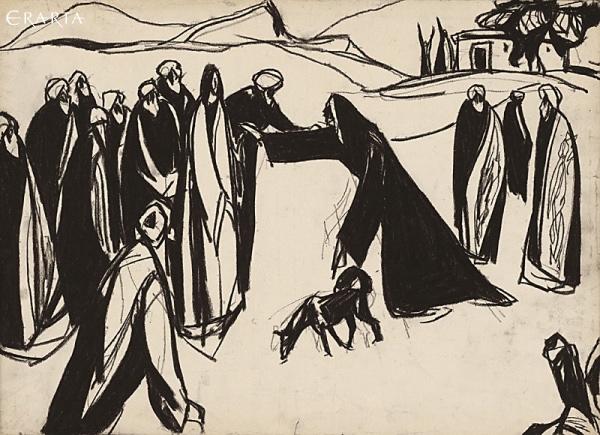
A dialogue sermon on Jesus’ encounter with a Canaanite Woman (Matt 15), written by the Rev. Elizabeth Raine and the Rev. Dr John Squires, and preached by them on Project Reconnect for Sunday 20 August 2023.
The Gospel story we have heard today is an interesting one. It tells of an encounter that took place between Jesus, the disciples and a Canaanite woman, near the ambiguous are of the borders of the lands of Tyre and Sidon. The unnamed woman has come out from there to seek Jesus’ help. Initially repulsed both by Jesus and the disciples, she remains undeterred.
Today, we invite you to join us on an imaginative journey, which may well lead you to think about the story from different perspectives, to engage with different assumptions, and perhaps lead you to different conclusions. We are going to offer you the opportunity to listen in to a conversation about what might have happened that day when Jesus encountered the Canaanite woman.
We will not be listening directly to the conversation between Jesus and the woman—although it will figure in the discussion that takes place. Instead, we will be eavesdropping on a conversation between an acquaintance of the woman, Tamar, and a relative of one of the followers of Jesus, known as Baruch.
Baruch and Tamar are somewhat different people. Tamar is a Canaanite, from the land of Canaan which was taken over by the Israelites who conquered its original inhabitants. Baruch is an Israelite who has become a follower of Jesus, and who has heard a version of the story from his cousin Zebedee. They have accidentally met up in one of the Palestinian market places and have been drawn into a conversation about Jesus’ latest miracle.
So now, please imagine yourself watching this scene.
*****
B: Have you heard of the latest miracle performed by our Lord? Why, he healed the daughter of a Canaanite – and by long distance! A truly remarkable feat.
T: Can I enquire as to the details of this miracle, Baruch? I believe I may have some knowledge of it.
B: Sure. She was an unaccompanied Canaanite woman – a woman without a male relative! I ask you, do these Canaanites have no sense of decorum? She came crying after Jesus and his disciples, all alone, no male to chaperone her, demanding that he heal her daughter. Such presumption!
T: Now just a minute. I object to you pronouncing the word ‘Canaanite’ as if we were a nasty plague of insects. I also do not think you appreciate the desperation of a loving mother, worried about her child.
B: If this Canaanite woman was a decent woman, she would have approached Jesus with her husband, let him do the talking, and remained quiet, eyes down and head bent.
T: What if she was widowed, or her husband did not want to beg a favour of a Jew – after all, it was the Jews who drove many of the Canaanites from their traditional homelands?
B: You must know that Canaan was the land that God promised to the Israelite people. It was foreordained that the Canaanites would have to relinquish it. And rightly so. Just look at some of the dreadful practices they had – worshipping strange gods, boiling baby goats in their mother’s milk – disgusting! All stopped when Israel took over the land.
T: I believe you are exaggerating – both about their practices and whether Israel indeed stopped them. But what right do you have to use this ancient history to belittle this woman? Whatever her ancestors did, it was hardly her fault.
B: I disagree. We all know these things can be passed down from generation to generation. And I reiterate – what was she doing running around alone on the public roadways crying after strange men? And a why would a Canaanite seek help from their Jewish conquerors like that?
T: I believe you know the answer to that. She understood that Jesus was a healer, someone special. I heard she called him “Lord”.
B: Well, there is that. I suppose his fame and reputation had spread far. But this is no excuse for her behaviour, and she must have known that the Messiah was to come only to the Jews!
T: I have heard he made that abundantly clear to the woman – and called her names. I thought a Messiah was meant to love everyone, not to mention have some sympathy with a race that had originally shared a homeland.
B: Nonsense. The Messiah was sent only to the lost sheep of Israel – everyone knows that. And a lone woman shrieking like a mad thing out in public – she deserved to be called names! And for presuming to quarrel with our Lord.
T: Don’t you think calling someone “dog” is rather insulting? Even if it is the Lord who says so? And as the Canaanites were killed or were hustled out of their land by God’s orders, I would think that it is time to make some amends to them. Why shouldn’t the Messiah share the love around a bit? And what would you do if your daughter was demon possessed? Maybe she was right to quarrel with Jesus.
B: Hmmmmm, I see your point. Of course we all want what is best for our children. And the scriptures do occasionally say that God is the God of other people. But you must admit that she behaved in a somewhat irregular way.
T: I am admitting nothing of the sort. This poor woman goes in search for help for her daughter, and she is told to go away, she is scorned for not being a Jew, and called a dog into the bargain. It is to her credit that she persisted with such a rude lot.
B: You are not telling the whole story. She was helped by Jesus, remember?
T: Let me recap as I heard this story. The woman called Jesus ‘Lord’, and asked for help. The disciples wanted her sent away. So Jesus tells her that he is sent only to the lost sheep of Israel. He then informs her that this is because it is wrong to take bread from the children (that is, the Jews) and throw it to the dogs (that is, the Canaanites). Are you honestly telling me she did not have a right to feel insulted?
B: (reservedly) Well, I suppose when you put it that way, you have a point. But still, a woman alone in public, crying out – I am not sure about this at all.
T: Then let me put it another way. If Jesus decided that after all, she had a case, and he decided to help her, then what is your problem? Remember what the law says about caring for widows and the oppressed. Baruch, you place great value in these laws, don’t you? So surely you should be prepared to some sympathy to this woman?
B: I am not entirely convinced. She must have been some sort of sinner or outcast to behave that way.
T: Nonsense. And actually, she behaved exactly like Lady Wisdom in the scroll of Proverbs. Bold, unafraid, in public alone and demanding justice. Are you saying Wisdom is a bad role model? After all, when Jesus did engage her in conversation, he accepted the woman’s argument as the right one and healed her daughter. I have also heard that he called her faith ‘great’.
B: Lady Wisdom? What rubbish. And why would Jesus commend the faith of a Canaanite woman?
T: Well, he did. And I believe that once she had convinced him that her faith was sound, he was making a point to those men in the Jewish faith who didn’t believe. Seems she knew the scripture about the Messiah better than they.
B: I grant you that there may have been extenuating circumstances. But you must understand that in Jewish custom, men do not speak to strange women in public. No wonder Jesus acted the way he did in the first instance.
T: Jesus did not shame her for being a woman. His quarrel with her was the fact she was not an Israelite. You Jews are so exclusive!
B: But he did concede the argument to her.
T: Are you saying then that she changed Jesus’ mind?
B: I suppose I am. I guess she must have been someone pretty special.
T: As I said, just like Wisdom. This woman stuck to her beliefs and cried out for justice. She was persistent, she was not going to be oppressed or pushed to the side. There is great power in the way that this woman acted.
B: She took quite a risk, then, in acting like this.
T: Indeed she did. It is an interesting point, isn’t it? Some people I have heard speaking about Jesus tend to claim that he is always the one who was right; that he will always persuade the other person, always win the debate. But in this instance, it is the woman who seems to be the one who speaks the deepest truth. In the end, Jesus admits that she is right, and he grants her request. Perhaps Jesus was the one who was transformed. So that doesn’t suggest a woman who is an outcast, does it? It suggests a woman brimming over with wisdom and spirit!
B: Well, it is clear that Jesus was affected by her. And I guess it follows that this must be good news for all of those people who aren’t Jews, but who want to follow Jesus.
T: Ah, now I think you are on to something. If the Messiah allows himself to be transformed, just think; if we emulate this, then we could transform our world, not just our two peoples. Think of it. The Canaanites were despised by Israel, whose ancestors took over their land. So the way that the disciples and Jesus responded to her at first, was simply the customary way. Such a response perpetuates resentment and hatred that then runs from people to people, from generation to generation.
B: Yes, I can see that humiliation, resentment, and violence have been passed down by people who do not stop to think that things may have changed, that there may be a better way. Jesus, with his final acceptance of the woman and his gift of healing, has set aside these conventions of ethnic hatred. In his final words, he treats the woman as one of the faithful, and opens up the way for all of us to do the same.
T: That appeals to me, for this is the attitude that can heal these historical rifts and create community. Imagine if our peoples reached out to each other in love and acceptance. And that in spite of a long history of enmity between us, we accepted that we are all equally loved by God, and that our faith and worship could be shared and celebrated together. What is to stop it happening now?
Why is it that we all just cannot talk to one another to heal the hurts of history?
*****
Today there are voices that want us to think that the foreigner or our indigenous and colonised races are a threat –a danger to be kept away, or a problem to be ignored. There are voices that press us to toe the line and follow the well-worn traditions of society and remain comfortable, settled, and unchanging. But the path of discipleship instead takes us to liminal borders and beckons us into an uncertain future. It invites us to question, consider and maybe even change our minds. It calls us to live out our beliefs, to put into practice our ideals, to venture into ambiguous places and to travel along the path less followed. Then maybe, like Jesus, we too will be transformed.
Mercy: doesn’t need to be pristine, nor need to be huge. It doesn’t need to be protected, nor kept in a pot with a lid and a lock – and oh-so-carefully parcelled out to those deemed ‘deserving’. And … just a crumb will do.
Mercy: is not like pie, nor is it mealy-mouthed or stingy. It can’t be measured, cannot help itself cannot be contained. No matter how some try, still, it overspills the tables of power and privilege, subversively escaping in scraps and crumbs that are limitless, boundary-breaking and render tables irrelevant. And … just a crumb will do.
Mercy: is subversive, spilling out for all, even those deemed (by some) as: ‘undeserving’, ‘different’, ‘not one of us’. It re-draws the circle wider than the edges of our imagination. Just a crumb contains more than enough: more grace and love than we will ever need. And … just a crumb will do.
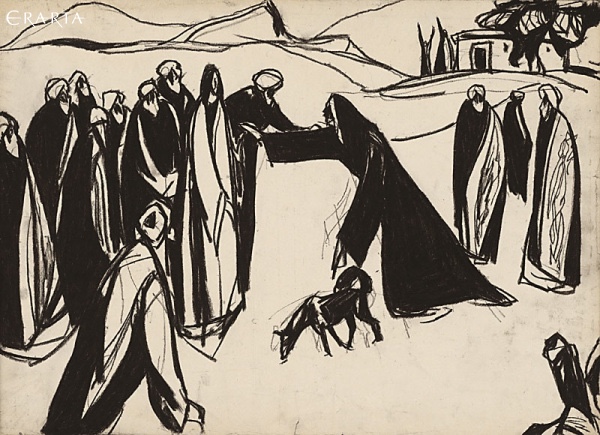
by Peter Gorman (1990)

 An Informed Faith