Limping priests and the counsel of perfection (Gen 32; Pentecost 10A)

When the priests of Judah returned to their homeland after decades in exile, they wrote down their ideal as to how the people should worship God and honour God in their lives. An integral part of that system of worship was the offering of the tamid, the daily sacrifice, “two male lambs a year old without blemish, daily, as a regular offering; one lamb you shall offer in the morning, and the other lamb you shall offer at twilight.” (Num 28:3). The importance of offering a perfect lamb, without any blemish, was paramount.

In parallel with that, every priest also needed to be “perfect”, with no sign of blemish—“not one who is blind or lame, or one who has a mutilated face or a limb too long, or one who has a broken foot or a broken hand, or a hunchback, or a dwarf, or a man with a blemish in his eyes or an itching disease or scabs or crushed testicles”, according to Lev 21:16–24. Yoiks!

Jesus, of course, picks up on this notion of perfection when he counsels a wealthy young man who claims that he keeps all the commandments, “if you wish to be perfect, go, sell your possessions, and give the money to the poor, and you will have treasure in heaven; then come, follow me.” (Matt 19:21). This “counsel of perfection” was then developed by the evolving Christian tradition, specifically impressing upon candidates for the priesthood their need to aspire to that perfection, through vows of chastity, poverty, and obedience.

My own church, the Uniting Church in Australia, fortunately does not require its ministers to be chaste, or even poor—although we do ask for a good measure of obedience. But the image of Ministry which sits firmly with me as the primary one is not that of “being perfect”; rather, it comes from a story in the ancient sagas of the people of Israel—a story about when Jacob wrestled with a man all night.

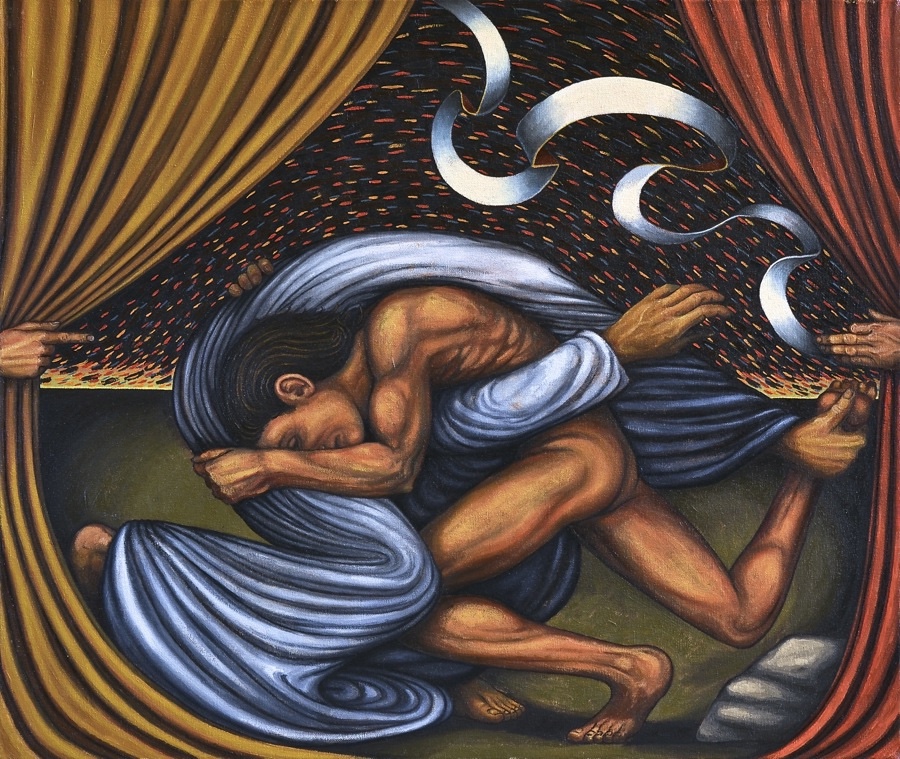
In this story, one of the patriarchs of Israel, Jacob, “wrestled with him until daybreak; and when the man saw that he did not prevail against Jacob, he struck him on the hip socket; and Jacob’s hip was put out of joint as he wrestled with him.” (Gen 32:25). This is the story which the lectionary provides for our consideration this coming Sunday (Gen 32:22–31).

It is in this story that Jacob, the “supplanter”, is given the new name Israel, “he wrestled with God”. The patriarch Jacob, who would give his name to the people Israel, limped, because of the all-night struggle that he had at this ford in the river. One of my teaching colleagues once wrote a paper in which he developed the image of the minister as the limping priest of God. And so it has been, for me; awareness of my own limping, my emotional and psychological wrestling which has caused psychological and emotional limping, has been an important aspect of my own exercise of ministry.

I have reflected on this personal struggle and my consequent “limping”, with the help of some good company, at

I like to think that gaining insight into my own limping, as difficult as that has been, has enabled me to walk with others as they limped, to understand their pain, to provide compassionate companionship along that way. And, sometimes, to hope that people would come to understand their own limping, and see how it had thrown things out of alignment, and how they might attend to that, and rectify wrongs that may have been occasioned by their limping, their distorted walking patterns, their imperfect ways of operating—even as I regularly reflected on my own walk, my own limping, and how that, in turn, impacted the way that I ministered.

This story of the night-long wrestling and the resulting lifelong limping of the patriarch of Israel was not, of course, an account of an historical event. Like all the stories of incidents involving the patriarchs and matriarchs (Abram, Sarah, and Hagar, Isaac and Rebekah, Jacob, Leah, and Rachel, and Joseph) these ancient stories were woven together at the time of Exile for Israel.

They formed an extended narrative that provided a foundational saga for the exiled people, yearning for release from their captivity, a return to their homeland. The saga formed a national mythology, weaving together previously isolated stories that had been passed down from generation to generation, shaped and reworked by skilled storytellers. Together, they created a tapestry that represented the resilience and the hope of the peoples.

Exile in Babylon was a time when the people of Israel, as a whole, had been limping. Invaded and conquered, captured and transported, relocated to an alien landscape amongst a foreign peoples speaking an unknown language and practising strange customs, the people were dislocated, out of joint, and so they limped in their daily lives. (See expressions of their grief in Lamentations, and their anger in Psalms 42–43, 44, and 137.)

The story of Jacob—wrestling with an unknown stranger, struck at the hip, experiencing dislocation, walking with a limp—resonated strongly with them. It was told and retold as “their story”, an oral expression of their personal and national angst. It reminded them that, even in the midst of struggle and opposition, they were still, like Jacob, able to “see God face to face” (Gen 32:30).

*****

That deep level of the myth told and retold by ancient Israelites resonates still with us, today. Opposition and oppression, struggle and the fear of defeat, do not impede the possibility that we might, indeed, “see God face to face”. The story of Jacob at Penuel reminds us of this, and provides a resource for thinking about our own lives, the lives of those we know who are facing challenges, and striving (as Jacob was) to make sense of these experiences.

Jacob wrestled with a man, who turns out to be God. Paul talks about a “thorn in the flesh”, given to him “to keep me from being too elated” (2 Cor 12:7)—although he attributes this to the work of Satan, rather than God. Elsewhere, he encourages the Romans to “be patient in suffering” (Rom 12:12), and informs the Philippians that God “has graciously granted you the privilege … of suffering with Christ” (Phil 1:29).

Paul himself knows about suffering. He catalogues quite a list of what he has endured: imprisonments, floggings, five times being lashed “forty lashes minus one”, three times “beaten with rods”, stoned, becalmed, and shipwrecked; he feared “danger from rivers, danger from bandits, danger from my own people, danger from Gentiles, danger in the city, danger in the wilderness, danger at sea, danger from false brothers and sisters”, and suffered “in toil and hardship, through many a sleepless night, hungry and thirsty, often without food, cold and naked” (2 Cor 11:24–31).

From those many experiences of suffering, Paul is able to affirm that “suffering produces endurance, and endurance produces character, and character produces hope, and hope does not disappoint us, because God’s love has been poured into our hearts” (Rom 5:3–5). It seems that God is able to work through those difficult experiences—“all things work together for good for those who love God” (Rom 8:28). Suffering, therefore, is integral to God’s work with us.

When Luke, decades later, reports the commissioning of Paul, he reports the divine word to Ananias to tell Paul: “I myself will show you how much he must suffer for the sake of my name” (Acts 9:16). The narrative that follows places Paul in danger in a number of times; in looking back over his missionary activities, Luke has Paul note that he was “enduring the trials that came to me through the plots of the Jews” (20:19), and foreseeing that in the future “the Holy Spirit testifies to me in every city that imprisonment and persecutions are waiting for me” (20:23).

In the narrative that follows, Luke notes that Paul is kidnapped (Acts 21:27), beaten (21:30–3; 23:3), threatened (22:22; 27:42), arrested many times (21:33; 22:24, 31; 23:35; 28:16) and accused in lawsuits (21:34; 22:30; 24:1–2; 25:2, 7; 28:4), ridiculed (26:24), shipwrecked (27:41), and bitten by a viper (28:3). The list correlates strongly with Paul’s own words in 2 Cor 11, noted above. And beyond this, Paul has indicated that “after I have gone, savage wolves will come in among you, not sparing the flock” (20:29). Opposition and persecution is endemic in the early stages of the Jesus movement.

Yet all of this takes place under “the whole purpose of God” (20:27)—the overarching framework within which Luke has told the story of Jesus and the movement that grew from his preaching and activities. Luke, like Paul, understands suffering as integral to God’s working in the world. It is a hard message to hear when we are in the midst of the turmoil engendered by suffering; it may be possible, with hindsight, to look back on that suffering and see how good did, in the end, eventuate from it. It seems he was able to see “the face of God” in all of that, as Jacob did long ago at Penuel.

That’s what this story of the wrestling Jacob offered the people of Israel, long remembered from the past telling of stories, now taking on a deeper and more central significance as they returned from the decades of suffering in exile in a foreign land. Out of suffering, something amazingly good is able to emerge. May this ancient story of wrestling and limping, of striving with God and so seeing God “face to face”, offer us the same encouragement in our lives, today.

*****

The cover image, “Jacob wrestling with God” by Jack Baumgartner, if from Image. https://imagejournal.org/artist/jack-baumgartner/jacob-wrestling-with-god/

Nothing but five loaves and two fish (Matt 14; Pentecost 10A)

My post about this week’s Gospel passage is once again indebted to conversations that I have had with my wife Elizabeth about this story, and the surrounding material, in Matthew’s Gospel. She has undertaken much careful research into the way that Matthew redacts his Markan source.

*****

The story that the lectionary invites us to hear this coming Sunday (Matt 14:13–21) is Matthew’s account of “the feeding of the five thousand”, a much-beloved miracle of Jesus. It is also one of a handful of miracle stories that is narrated by all four canonical Gospels (Mark 6:30–44; Matt 14:13–21; Luke 9:12–17; and John 6:1–14).

The set-up for this story is that Jesus and the disciples are surrounded by a large crowd, time is drawing on, and there appears to be no food to eat. The punchline for the miracle is that, whilst at the start there was “nothing but five loaves and two fish”, by the end,,after “all ate and were filled”, there were “twelve baskets full” of leftovers!

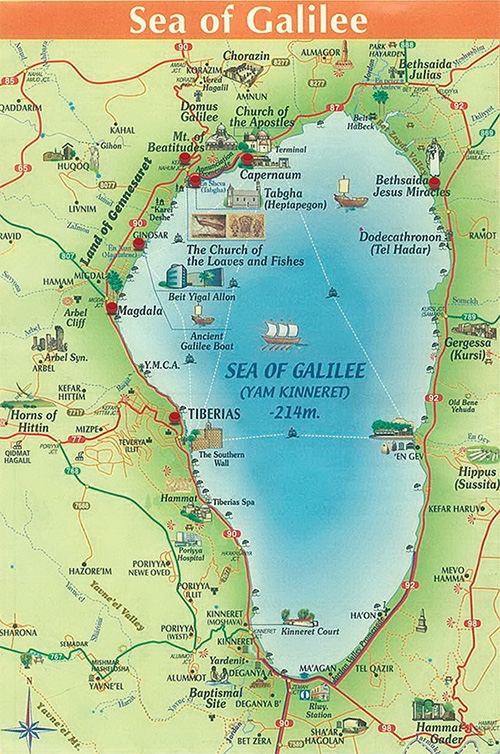
For John, the feeding takes place “on the other side of the Sea of Galilee, also called the Sea of Tiberias” (John 6:1), before Jesus and the disciples cross the Sea of Galilee, back to Capernaum (John 6:16–17). Mark, however, locates this feeding in Jewish territory, after the first trip that Jesus had made to the Decapolis, on “the other side” (Mark 4:35—5:21). Matthew and Luke follow Mark in locating this scene in Jewish territory.

Then, following Mark, Matthew recounts a second feeding, of four thousand, which Mark locates on the Gentile side of the lake (Mark 8:1–10). The geography in Matthew’s narrative of this scene (Matt 15:32–39) is, as we shall see, somewhat vaguer; the incident is, however, the same in most details as that found in Mark. Luke omits all mention of this second feeding, as does John.

The number fed is consistently reported in all four accounts as being five thousand—although there are variations here. John offers this figure as an approximation of the whole crowd present (John 6:10). Mark and Luke both specify that those fed were men only (Mark 6:44; Luke 9:14), whilst Matthew teases out the implications: “those who ate were about five thousand men, besides women and children” (Matt 14:21).

Mark notes that Jesus organised the crowd in smaller groups, sitting on “green grass” (Mark 6:39), noting that “they sat down in groups of hundreds and of fifties” (Mark 6:40). Matthew simply notes that they sat on grass, colour not specified, and makes no reference to sitting in groups (Matt 14:19). This is typical of the way that Matthew omits much of the detailed narrative colouring that Mark regularly reports—such as the groups on the green grass.

So Matthew’s account is somewhat shorter than Mark’s account (seven verses in Matthew, ten verses in Mark). Both accounts, as well as Luke’s version, report the actions of Jesus as he “looked up to heaven, and blessed and broke the loaves, and gave them to his disciples to set before the people” (Mark 6:41; Matt 14:19; Luke 9:16).

This sequence clearly reflects the liturgically-developed pattern (repeated religiously in eucharistic settings over the centuries) of the last supper of Jesus: “he took a loaf of bread, and after blessing it he broke it, gave it to them … then he took a cup, and after giving thanks he gave it to them, and all of them drank from it” (Mark 14:22–23 and parallels; and see also 1 Cor 11:23–25).

The pattern is missing from John’s account, which simply notes that “Jesus took the loaves, and when he had given thanks, he distributed them to those who were seated” (John 6:11). John’s Gospel omits any specific report of eating at that “last supper”, focussing rather on the washing of feet and discussion of Jesus’s imminent departure (John 13).

Johannine allusions to eucharistic practice appear later in chapter 6, after a long sequence of midrashic exposition by Jesus, around the theme of “the living bread … that came down from heaven” (John 6:22–59)—a discourse that we learn, at the end, is set “in the synagogue at Capernaum” (John 6:59)—back on the side of the lake from whence Jesus had departed (John 6:16).

*****

All four stories contain the significant detail that “all ate and were filled; and they took up what was left over of the broken pieces, twelve baskets” (Matt 14:20; see also Mark 6:43; Luke 9:17; John 6:13). Now twelve was an important number for the Jewish people; perhaps the twelve baskets are symbolic for the Jewish people? In which case, we might ponder how much of the story is symbolic, and how much “actually happened”?

To think a little about twelve … There were 12 sons of Jacob (Gen 49:1–28), then 12 tribes of Israel (Deut 27:12–13). On the table in the Tabernacle were placed 12 silver plates, 12 silver dishes, and 12 golden plates (Num 7:84–89), and the breastplate of the priest contained 12 precious stones (Exod 28:21) as emblems of the 12 tribes as they camped round about the Sanctuary. Moses built an altar at the foot of Mount Sinai with 12 pillars (Exod 24:4) and Joshua had the people take 12 stones from the River Jordan to be placed as a memorial to their entry into the land (Josh 4:1–10).

As the story continues in the Gospels, Jesus chose 12 apostles as his inner circle (Mark 3:13–19 and parallels in Matt 10 and Luke 6; and John 6:67–71). Jesus indicates that this signified the link between his movement and the traditions of Israel (Matt 19:28; Luke 22:30; and see James 1:1). And when Jesus feeds the great crowd of 4,000 people beside the Sea of Galilee (Mark 8:1–9), there are twelve baskets of bread left over (Mark 8:19).

And in the final dramatic visions written about the promised future by the aged seer John, the number 12 figures prominently. We see this first in the vision of a woman wearing a crown with 12 stars (Rev 12:1). The number then appears in the architecture of “the holy city Jerusalem coming down out of heaven from God” (Rev 21:10), with its 12 gates with 12 angels and the names of the 12 tribes (Rev 21:12), and its 12 foundations with the names of the 12 apostles (Rev 21:14). Finally, there are 12 pearls on these 12 gates (Rev 21:21) and 12 fruits on the tree of life (Rev 22:2).

Is the emphasis on 12 in this narrative in Mark 6 and Matthew 14 and the other gospels deliberately underlining the Jewish setting, and pointing to the centrality of Jewish matters in the story? It’s a fascinating thought, which is strengthened by the observation that in the accounts of the feeding of the 4,000 (Mark 8:1–10; Matt 15:32–39) there were “seven baskets full” (Mark 8:8; Matt 15:37).

Mark locates this scene “on the other side” of the Sea of Galilee. In this Gospel, Jesus had just been “in the region of the Decapolis” (Mark 7:31), and after this feeding, he returns to Jewish territory on “the other side” (Mark 8:13).

Matthew removes any reference to Jesus being in the Decapolis; after the journey by sea that Jesus undertakes with his disciples to “the other side” (Matt 14:22), Jesus apparently returns immediately to Genessaret, on the western (Jewish) side of the lake (Matt 14:34), and has gone “up the mountain” beside the Sea of Galilee, where “he sat down” (Matt 15:29). That is a strong clue that Jesus is on Jewish territory, teaching and healing.

For Matthew, the second crowd that Jesus feeds is entirely Jewish. For Mark, the crowd that was being fed most likely included many Gentiles, as well as Jews who lived “on the other side”. The significance of seven has been the focus of attention for many interpreters (does it refer to the seven gentile nations which were in the land of Canaan? the seven days of creation? or the seventy nations, 7×10, that are listed as “the nations” at Gen 10:1–32?) Whilst the symbolism of twelve is clear, the symbolism of seven is less obvious.

*****

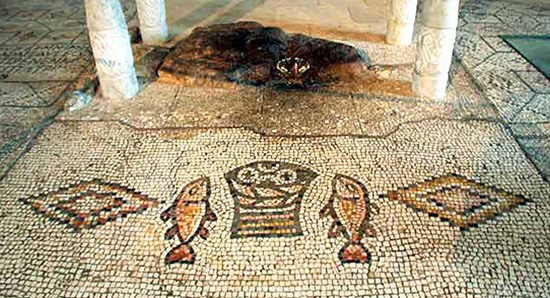
Each account of the feeding of the 5,000 also notes that, as well as the five loaves, there were two fish provided for distribution to the crowd (Mark 6:38; Matt 14:17; Luke 9:13; John 6:9). Only Mark notes that the twelve baskets of leftovers included fish as well as “broken pieces” of bread (Mark 6:41). Interestingly, in Matthew’s account of the feeding of the 4,000, “a few small fish” were provided along with the seven loaves (Matt 15:34).

Mark’s account, presumably known to Matthew, did not mention this detail. Was Matthew unconsciously harmonising the narratives of the two feedings? Certainly, a fish would become an important symbol used by the early Christians (and still seen today) to mark their identity. The Greek word for fish, ichthus, written in capitals as IXTHUS, was used as an acronym to signal faith in Jesus: I (Iēsous, Jesus), X (Christos, Messiah), TH (theou, of God), U (huios, Son), S (sōtēr, Saviour).

Of the four accounts, only John notes that the loaves of bread had been made from barley (John 6:9), perhaps evoking the story of the twenty loaves of barley provided to Elisha to feed a hundred people (2 Kings 4:42–44). And only John included the detail, much beloved by flowery preachers, that the five loaves and two fish were provided by a boy (John 6:9). It adds a simplicity to a wonderfully impressive miracle, perhaps. However, in each of three Synoptic accounts, those loaves and fish simply appear from within the crowd.

*****

Finally, we turn to the way that this feeding story is introduced by the evangelists. All four evangelists note that a large crowd was gathering: “many were coming and going … [Jesus] saw a great crowd” (Mark 6:31, 34; Matt 14:13–14; Luke 9:11; John 6:2, 5). In John’s account, the presence of this “large crowd” leads Jesus simply to ask a straightforward logistical question, “where are we to buy bread for these people to eat?” (John 6:5).

In the Synoptic accounts, it is the disciples who get worried about the numbers present, and advise Jesus to “send the crowd away” so that they can get provisions elsewhere (Mark 6:36; Matt 14:15; Luke 9:12).

In two of the Synoptic narratives, however, the crowd has previously drawn words of compassion from Jesus. Mark reports that “he saw a great crowd and he had compassion for them, because they were like sheep without a shepherd, and he began to teach them many things” (Mark 6:34). Matthew simply notes that Jesus “had compassion for them and cured their sick” (Matt 14:14). It’s a neat pastoral touch, I think, to have Jesus healing, rather than teaching, with this large crowd.

The lack of food at hand signals that the scene is set well away from the towns and villages that Jesus frequented. Indeed, in Mark’s narrative, Jesus had intentionally taken his apostles into a boat and moved away into “a deserted place” (Mark 6:31); Matthew follows Mark in this regard (Matt 14:13). In the biblical tradition, the wilderness plays a pivotal role in the story of the Israelites, freed from captivity in Egypt, yearning for the promise of land and safety still ahead of them.

The wilderness was the place where the character of Israel was forged. It was in the wilderness, throughout that long period of wandering, that they had encounters with the divine, that their identity was shaped, that their foundations as a nation were laid. The stories told in Exodus, Numbers, and Deuteronomy tell of thirst and hunger in the wilderness, encounters with snakes and other trials—as well as the giving of the law, on Sinai, a mountain in the middle of the wilderness.

The journey through the wilderness figured in the songs of Israel. It is regularly recalled in the Psalms (68:7, 78:15-20, 40, 52, 95:8, 106:14-33, 136:16) as well as in various prophetic oracles prophetic oracles (Isaiah 40:3-5, 41:17-20, 43:19-20, Jer 2:6, 31:2-3, Ezekiel 20:8b-21, Hosea 13:4-6, Amos 2:9-10, Wisdom of Solomon 11:1-4) and occasional narrative references. The exodus from Egypt and the subsequent wilderness wandering, provided the foundational story for Israel, from long ago, and still through into the present.

The wilderness was where Israel met God; where Israel’s commitment was tested; where Israel’s faith was shaped. That is where, in the narratives of Mark and Matthew, Jesus expresses his compassion for the crowd and feeds “five thousand men, besides women and children” (Matt 14:21).

Luke, by contrast, has Jesus take his followers to “withdraw privately to a city called Bethsaida” (Luke 9:10), whilst John reports that Jesus “went up the mountain and sat down there with his disciples” (John 6:3), adding the note that “the Passover, the festival of the Jews, was near” (John 6:4)—the second of three Passovers in this narrative (John 2:13; 6:4; 11:55).

The four accounts differ in remarkably few details, overall, indicating either that there was a high level of memory retention by those who told and retold the story orally, before the Gospels took written firm; or else, that some kind of manuscript with an account of this incident (as well as some other stories) was known amongst the followers of Jesus at a relatively early stage of development of the Gospels. Either way, it is an intriguing and informative narrative for us to reflect on this coming Sunday.