Mission and discipleship: training for the kingdom

This blog follows on from the earlier post, “Fostering a culture of ‘an informed faith’”. In that blog, I set out how the Uniting Church’s Basis of Union provides us with a stimulus to foster a culture of “an informed faith”. See https://johntsquires.com/2023/09/17/fostering-a-culture-of-an-informed-faith/

In this blog, I am focussing on an extrapolation from that basis, into an area that is of vital concern for the contemporary church—developing disciples who are well-equipped to engage in the mission of God.

Underlying this paper is an observation that my friend and colleague Craig Mitchell made last year: “When the ‘missional turn’ began to take hold in the UCA, we somehow made an either/or choice to resource mission instead of discipleship. We stopped resourcing local faith formation and education. Today most churches lack a plan for these, yet discipleship is one of the key aims of most councils. It’s like bemoaning the quality of preaching while cutting homiletics or biblical scholarship.”

Craig’s comment is undergirded by the important research he undertook in the course of completing his PhD, written up as (Re)forming Christian Education in Congregations as the Praxis of Growing Disciples for a Missional Church, PhD Thesis, Flinders University, 2018. See https://theses.flinders.edu.au/view/3da42e12-260f-4d92-b78a-51a9d193ee60/1

In this work, Craig explored a number of “intentional learning communities” within the Uniting Church. (The context where I was involved in team ministry with my wife, the Rev. Elizabeth Raine, was one of the “intentional learning communities” that Craig explored.) Craig has made available his conclusions and many resources relating to this research through his website; see https://craigmitchell.com.au/forming-disciples-in-mission/

I begin my own reflections with our current context. It is widely recognised that we are in a changing context for the church. The Christian Church now occupies a new position within society; no longer do we find that the church is considered to be at the centre of society. The old Christendom model of the village church in the centre of the marketplace, where people were to be found each day of the week, where the priest or vicar was the most educated person in the village, is no longer who we are as church.

Indeed, the view of church held by many in society is changing. There are various reasons for this. Certainly, the media has played a role, especially in the years when the Royal Commission has been in the spotlight, and many people in society have lumped all denominations together and tarred us all with the same brush as certain Roman Catholic and Anglican Dioceses and individuals. That’s not fair, to be sure, but it is a reality, unfortunately.

Such stereotyping is easy to do and proves to be the first port of call in many situations. Further steps have been taken by individuals and groups in society, who move from seeing the church as irrelevant, to taking a more antagonistic view of religion, and the church in particular. So we find ourselves in a changed and changing context.

The key questions for many congregations at this time, then, are these: what is the most faithful and most effective form of mission, today, in this changed and changing context? what is the way that we are being called, as the church, to demonstrate that God loves the world—the whole world—and that we are here to serve others at their points of need?

During the years that I served as Presbytery Minister—Wellbeing in the Canberra Region Presbytery, I worked to a set of five key commitments which the Presbytery had identified as key goals. The first two of these were Resourcing Congregations to function in healthy ways and Working with Congregations to discover new futures. Both of these proved to be important for developing a robust understanding and an effective practice of mission.

A fundamental element in the process of strengthening the mission of the church, is to encourage the development of a missional imagination amongst the leadership of each congregation. Such an imagination will approach the life of the congregation in two ways; it will enhance the existing missional commitments of congregations, but will also be working to ensure that local leadership pushes into new areas and adopts new methods of missional engagement.

To have missional imagination means to see, at every step, how the church can be on mission: in the traditional ways, in fresh expressions and new initiatives. This takes some work; I have found that I needed structured experiences to prompt me along the pathway of “developing a missional imagination”.

So I have learnt much about this by taking part in the Mission Shaped Ministry Course, developed in the UK but now widely applied in Australia. And I learnt more about God’s mission and fresh expressions of church as I prepared and led sessions designed to inform, challenge, and develop the missional imagination of those taking part in the course.

This course encourages the learning of new skills (community engagement, community development, creative missional activities). It also requires congregations to consider a re-prioritising away from the established paradigm of “being church”. In the current paradigm that is practised by many churches, Sunday worship and aged care worship enjoy high priority; maintaining established church groups and activities has a medium-high priority; and developing new initiatives is regularly perceived as too difficult and too threatening. This course challenges and invites people to re-order those priorities, and focus on developing new initiatives.

Teaching, they say, is the best way of learning. As a teacher, in tertiary contexts as well as with lay leaders of Congregations, I know that I have learnt much from all those times when I have undertaken preparation for, and then facilitation of, learning experiences for others. And the Uniting Church’s commitment for its ministers to be “lifelong learners” feeds directly into those experiences. I know that I learnt by teaching!

Experiencing, also, is a key element in learning. Reflective practice works best when a person is immersed in a experience, and then steps “outside” of that experience to consider what took place; to reflect on how they felt, how they acted, how they responded to others, what they did that was helpful, what they did that they might do differently next time.

I am grateful that I was taught long ago to be a “reflective practitioner”, and that I have been encouraged—and required—to practise those skills throughout my ministry. Regular supervision with a qualified professional supervisor is a great discipline for developing and extending those skills!

Alongside the importance of teaching and experiencing for the learning process, then, I want to place a further dimension, which encompasses both structured learning opportunities and reflection on experience. That dimension is one that ought to be familiar to anyone who listens regularly to the stories about Jesus that are collected in our Gospels: it is the matter of discipleship.

I fear, however, that the church today has “dropped the ball” with regard to discipleship. Worried about our declining numbers, our ageing buildings, our lack of outreach, our fixation on certain matters of doctrine and church practice, we have overlooked the fundamental element of being a follower of Jesus—a disciple.

The earliest written account of the life of Jesus, which we know as Mark’s Gospel, emphasises the necessity of following Jesus; “follow me” is an important refrain from the beginning of Mark’s story. In three early scenes, the command of Jesus, “follow me”, is met each time with an immediate response: Simon and Andrew follow him (1:17), then James and John follow him (1:19), and then Levi the tax collector follows him (2:14). Each leave what they are doing and follow Jesus.

What is involved in this “following”? The Gospel narratives make it clear that it involved walking along the dusty roadways alongside Jesus; sleeping in the homes offered to the wandering group by sympathetic villagers; eating at table with whomever happened to be present; witnessing the “deeds of power” that Jesus was equipped to undertake; and listening carefully as he taught in parables, offered succinct, pithy sayings, and gave extended discourses as opportunity presented.

“Have you understand all this?”, Jesus asked his followers, impertinently confronting them after having offered a series of parables (Matt 13:51). It’s my favourite question, amongst all the questions that Jesus asked. The response of the disciples (“Yes”) needs surely to be heard with a grain (or more) of salt. Clearly, there was more work for Jesus to do (see Matt 14:26; 15:23; 16:5–12, for subsequent examples of times when the disciples clearly did not understand).

How do we understand all that Jesus offers? The words he speaks after asking that impertinent question (Matt 13:51) contain a vital clue. He speaks about “every scribe who has been trained for the kingdom of heaven” in these words (Matt 13:52). The Greek word translated “trained” is mathēteutheis, from the root word manthanō, meaning “to be a disciple, to be a learner”. And that root word also morphs into the noun, mathētēs, which is regularly translated as “disciple”.

At the heart of discipleship is learning. This is why the first disciples were to follow Jesus—to learn. They learnt by listening (but we know that most learning doesn’t happen from simply listening). They learnt by watching (which has a better success rate—but is still not optimal). They learnt by being involved (which brings an even better result). And then, they learnt by doing, as Jesus sent them out, two by two, “to proclaim the kingdom of God and to heal” (Luke 9:2)—to do, for themselves, precisely those things that he had been doing, and they had been observing.

And, of course, after they returned from this practical experience, “they told Jesus all they had done, and he took them with him and withdrew privately to a city called Bethsaida” (Luke 9:10). I imagine that this was a very vigorous debriefing session as they recounted and reflected on their varied experiences during this period. This is precisely what we now recognise to be excellent pedagogical practice: some orientation, an immersion experience, and then in-depth reflection on what was learnt in that experience. (And then, repeat, and repeat, and repeat!)

Last year, I co-authored an article on mission with my wife, Elizabeth Raine (Minister at Tuggeranong Uniting Church in Canberra). The article was published in Uniting Church Studies vol.24 no.2, pp.43–51, and is available online at

https://drive.google.com/file/d/1QzokSsFEwU-sbrOb7e8DheQIEiw5-ngh/view?pli=1

In that article, we write as follows:

“We believe that mission is something that anyone can do, but it is not something that comes easily and naturally to most people. Training in mission is essential. Being prepared to step outside the familiar and comfortable “box” of church is an essential element—so the right mindset is the first step.

“After that, training can inspire, encourage, refine, and develop missional sensitivities and lead to strong missional practices. But without that commitment to do something different, to reach out of the predictable, to experiment and explore, no mission will occur. Business as usual is a big temptation to many church people; and business as usual can quickly stifle mission (unless mission itself is the “business as usual”).

“So, training in the “how-to” of Messy Church, Godly Play, Fresh Expressions, GodSend, and Mission Shaped Ministry, can indeed inspire and equip people to become missional in their orientation. These courses don’t provide any guarantee, but they do each offer a set of stimuli, challenges, and resources for people to consider how to “do church differently” and hopefully also “engage in mission”.

“There is a clear principle that is often articulated, with which we agree, and which we feel should be stated again and gain. Mission is about the world, not the church. Mission means knowing the community we live in, the society of which we are a part, and the culture(s) that shape(s) us, the expectations and patterns and customs of people.

“Mission means shaping and reshaping the way we “do church” in the light of these matters. The Mission of God is God doing things in the world, and we, as the people of God, joining with that activity. It means going out to others, not expecting others to come in to us. A missional church is not simply a church that opens the doors and expects people to flock in to the wonderful programmes that are on offer. A missional church is one that is always oriented outwards, a church whose people are dispersed, engaged in communities, actively involved in the various needs of people across these communities.”

In the context of the ACT-2 processes, and also in the light of what I have earlier written regarding the “culture of an informed faith”, I think it is imperative that we incorporate within our thinking and planning the essential element that each Congregation (re)commits to being an intentional learning community in which “the continuing witness and service of evangelist, of scholar, of prophet and of martyr” is valued, explores, and acted upon.

Learning from the voices of experience, alongside times of learning from being immersed into experiences and then reflecting on them, provide a rich way to develop discipleship and foster a missional imagination. May it be that one of the outcomes of the ACT-2 process is just such an outcome—a network of intentional learning communities in which missional imagination fostered, from which fresh expressions of church emerge, and through which the kingdom of God is proclaimed and enacted in contemporary Australian society.

*****

See also
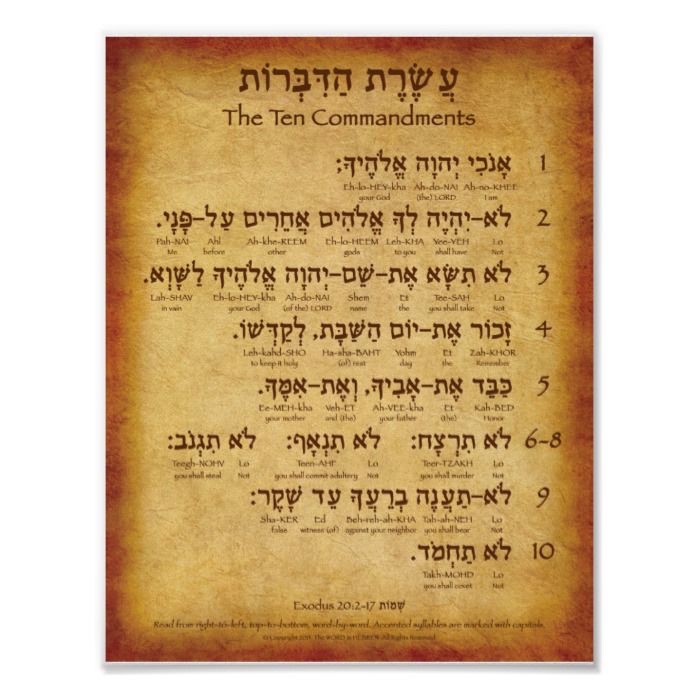
Ten things about the Ten Words (Exod 20; Pentecost 19A)

The Hebrew Scripture reading for this coming Sunday contains a set of well-known words—the Ten Commandments (Exod 20:1–20), given to Moses on Mount Sinai, for him to take down to the people of Israel as their set of guidelines for faithful living within the covenant. That covenant was sealed by God and Moses in the previous chapter (19:1–8).

These words set the pattern for life that the Israelites are to follow. They accept and commit to this way of life, declaring “everything the Lord has spoken we will do” (19:8). Those Ten Commandments are then followed by multiple other commands for living (20:22—23:19). It is these commands that the people are instructed to live by, to which they again make their commitment: “all the words that the Lord has spoken we will do” (24:3).

Moses then confirms this in a very public way: he arranged for “burnt offerings and sacrificed oxen [to be] offerings of well-being to the Lord”, as well as dashing half of the blood from those offerings against the altar he had constructed (24:5–6).

Then we read that Moses “took the book of the covenant, and read it in the hearing of the people; and they said, ‘All that the Lord has spoken we will do, and we will be obedient’” (24:7)—and the remaining half of the blood from the offerings was dashed on the people, who are told “see, the blood of the covenant that the Lord has made with you in accordance with all these words” (24:8).

What do we make of these familiar words? The Ten Commandments are probably one of the most well-known passages in Hebrew Scripture—even if most people would struggle to identify the specific requirements of all ten of the commandments. It’s more “the vibe of the thing” that we recall, rather than the precise words.

Here are ten things about these Ten Commandments that help us to understand and appreciate their significance—both in Judaism, the religion that developed from ancient Israelite practices, as well as in Christianity, which appropriated the stories, songs, oracles, and teachings of Judaism as the foundation for its own development.

1. The description of these commandments. In Judaism, this collection of ten commands is known as the Aseret ha-Dibrot, a Hebrew phrase often translated by Jews today as “Ten Statements” or “Ten Declarations”. This is how this collection of “the words of the covenant” are described at Exod 34:28 (and again at Deut 4:13; 10:4). The second word in that phrase is simply “word”—so we might well think of these ten statements as “Ten Words” spoken by God to provide guidance and instruction to the Israelites.

2. The two versions of these Ten Words. The first version of these words is what we have in Exodus 20. (The lectionary edits the selection offered, omitting verses 5–6 and 10–11, to shorten some of the longer parts.) The second version appears in Deuteronomy 5. There are many similarities between the two versions, although the Deut 5 version is longer. One noteworthy difference is the instruction relating to the sabbath; “remember the sabbath day” (Exod 20:8), contrasted with “observe the sabbath day” (Deut 5:12). The difference in the verb is a just slight nuance of difference.

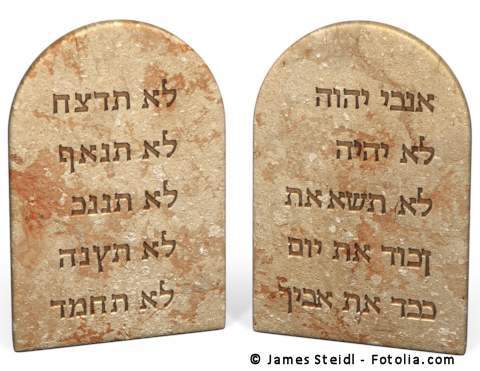
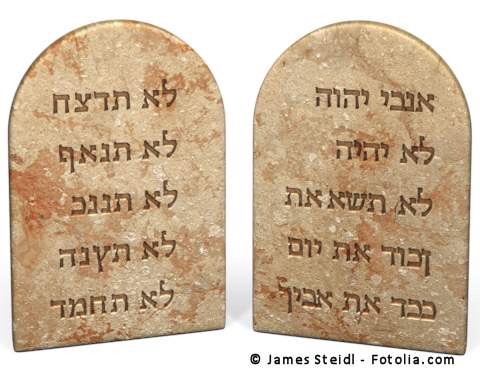
3. Two tablets of stone. Moses is given “two tablets of stone” by God, who informs him that they contain “the law (torah) and the commandment (mitsvah), which I have written for their instruction (horotam, from yara)” (24:12). The Hebrew words used here are part of a larger group of terms which describe all the instructions given throughout the first five books of scripture, the Torah. These tablets are later described as having been written “by the finger of God” (31:8), noting also that “the tablets were the work of God, and the writing was the writing of God, engraved upon the tablets” (32:6).

These two tablets are the ones that are notoriously broken by Moses in his anger when he discovers that the Israelites, in his absence, had made an image of a golden calf (32:19). This leads to the production of a replacement set of stone tablets, which Moses himself wrote under God’s instructions (34:1–4, 28).

These two tablets have most likely influenced the interpretation of the Ten Words as comprising one set of words in which the orientation is towards God (“you shall have no other gods … you shall not make an idol … you shall not make wrongful use of the name of the Lord your God … remember the sabbath day”, 20:2–11) and a second set oriented towards other humans (“honour your father and your mother, you shall not murder, you shall not commit adultery, you shall not steal, you shall not bear false witness against your neighbour, [and] you shall not covet”, 10:12–17). This, in turn, may have been an influence on the later rabbinic exposition (taken up by Jesus) of the Law as requiring love of God and love of neighbour (see Mark 12:28–31 and parallels).

4. How many laws do we have to remember? The natural desire to summarise and synthesise long lists into shorter, more readily remembered lists, may well account for the desire, in this encounter between Jesus and the scribe, to reduce all the commands to two. But there were other aspects involved in this process.

The Rabbis observed that the Torah, the first five books of scripture, actually contain 613 commandments (mitzvoth). There are 248 positive commands (“you shall …”) and 365 negative commands, or prohibitions (“you shall not …”). Collectively, these are known as mitzvoth, commandments; they comprise the Torah, the Law. In strict Jewish households, every one of them must be carefully observed.

However, the Babylonian Talmud (b. Makkoth 23b—24a) reports a rabbinic sermon in which various texts were cited in an attempt to make it easier to remember the central principles of the Torah. Rabbi Simlai declared that David reduced the 613 laws to eleven, citing Psalm 15. After him, Isaiah came, and found the basis in six commandments, quoting Isaiah 35:15-16.

Then the famous Micah triplet is cited, involving just three laws, “do justice, love kindness, walk humbly with your God” (Micah 6:8); before a later section of Isaiah is cited, noting that it proposed just two laws, “maintain justice, and do what is right” (Isa 56:1). Finally, Rabbi Simlai said there was an even shorter way to remember all the laws, and he cited Amos 5:4 as a single command: “seek me and live”.

Rabbi Nahman bar Isaac, however, proposed another prophetic text which provides one statement that summarises the Torah: “the righteous person lives by their faith” (Hab 2:4). This verse, of course, is familiar to Christians from Paul’s citation of it at Rom 1:17 and Gal 3:11.

Another way to summarise the Law is offered by the story of Rabbi Hillel, who is approached by a Gentiles seeking to convert to Judaism. Hillel says to the enquirer, “What is hateful to you, do not do to your neighbor. That is the whole Torah; the rest is the explanation of this—go and study it!” (b.Shabbat 31a). In like manner, when he was asked “which commandment is the most important of all?” (Mark 12:28), Jesus replies by citing two simple words: to love God (Deut 6:5) and to love neighbour (Lev 19:18).

5. Reading these words regularly. The Ten Words are read in full three times each year in Jewish synagogues. Jews follow a one-year lectionary, in which every verse in the first five books of scripture (the Torah, or the Five Books of Moses) is read in sabbath service during the course of the year. The weekly readings (called parashot, or “portions”) begin with Gen 1 and conclude with Deut 34. (The Jewish calendar follows the lunar cycle, and so it has 12 months of 29 or 30 days each, with an extra month added seven times every nineteen years. It’s complicated!)

So the Exodus passage is heard in the week when Exod 18:1—20:23 is read; and later in the year, the Deuteronomy version is heard, when Deut 3:23—7:11 is read. The Ten Words are also read at the Feast of Shavuot, which in the Jewish cycle of festivals is when the giving of the Law (the Ten Words) is remembered.

6. Quoted in the New Testament. The various commandments of these Ten Words are quoted in assorted New Testament passages. Jesus, in Matthew’s Gospel, affirms that all of the Law holds good; he comes to fulfil, not abolish, the Law (Matt 5:17). In the Sermon on the Mount, he specifically interprets—and intensifies—commands relating to murder and adultery, as well as not using God’s name in vain (Matt 5: 21–37).

Elsewhere in this Gospel, Jesus reinforces the importance of honouring parents (Matt 15:14) and of keeping this and further Words (murder, adultery, stealing, and lying, Matt 19:18). Paul likewise affirms that “the one who loves another has fulfilled the law” and “love is the fulfilling of the law” (Rom 13:8–10). In that passage, he cites four of the Ten Words (those relating to adultery, murder, stealing, and covetousness).

Earlier in the letter, he has referred to those words relating to stealing, adultery, and idol worship (Rom 2:21–22). Worshipping God, the first Word, is commended at Matt 4:10 and Luke 4:8; avoiding idol worship is advocated in the letter of the Jerusalem Church (Acts 15:20) and by Paul (1 Cor 6:9–10). The Sabbath is kept by Jesus (Luke 4:16) and Paul (Acts 17:2), as well as at Heb 4:9. Covetousness is condemned by Jesus (Luke 12:15) and Paul (Rom 7:7–11). So all ten of these Ten Words are affirmed in the New Testament—some on a number of occasions.

7. Numbering the list of ten. Judaism, unlike Catholicism and Protestantism, considers “I am the Lord, your God” to be the first “commandment”. Catholicism, unlike Judaism and Protestantism, considers coveting property to be separate from coveting a spouse. Protestantism, unlike Judaism and Catholicism, considers the prohibition against idolatry to be separate from the prohibition against worshipping other gods. No two religions agree on a single way to divide this stream of words into a list of ten distinct commands. So whose list should we follow?

8. Torah as a gift. To the Israelites of the past, as well as to Jews of today, the Torah is experienced as a gift which enriches their lives, not as a crass demand which weighs them down. The relationship that the people of Israel had with God was signalled in the Covenant that is offered to them. Exodus reports that the Lord spoke to Moses, “if you obey my voice and keep my covenant, you shall be my treasured possession out of all the peoples—indeed, the whole earth is mine, but you shall be for me a priestly kingdom and a holy nation” (Exod 19:5–6).

The Covenant is an outworking of this deep and abiding relationship between God and God’s people. That Covenant was not an idealised or abstract idea; it was known and expressed in each of the 613 laws contained within the Hebrew Scriptures. So the Law was considered to be a gift to the people, to be celebrated and valued as much as to be kept (Ps 19:7–11, 40:8, 119:97–104, 169–176). These Ten Words thus play a vital role in the shaping of society so that we live in ways that keep us in covenant relationship with God.

9. The basis of ethics. The Ten Words have formed a solid foundation for ethical principles, not just in Judaism and Christianity, but in wider societies more generally. During the early centuries of the church, these commandments are referenced in various documents, including the second century Didache, and they came to occupy their place in the developing catechism of the church, as Augustine of Hippo indicates in his Questions on Exodus.

The medieval scholastic, Thomas Aquinas, declared in his Summa Theologiae that these commandments provided “the primary precepts of justice and all law, and natural reason gives immediate assent to them as being plainly evident principles”. In his Institutes of the Christian Faith, Jean Calvin provides a detailed consideration of the Ten Commandments. He writes that “God has so depicted his character in the law that if any man [sic.] carries out in deeds whatever is enjoined there, he will express the image of God, as it were in his own life … it would be therefore a mistake for anyone to believe that the law teaches nothing but some rudiments and preliminaries of righteousness by which men [sic.] begin their apprenticeship, and does not also guide them to the true goal, good works.”

Their influence continues into 21st century societies across the globe. Writing in the Desert News (a conservative LDS publication), Paul Edwards proposes that “as long as people yearn for a cohesive and cooperative society that supports familial ties, secures the integrity of personhood and property, shuns petty jealousies and violence, and seeks to treat all alike in the eyes of social authority and before God, then the Ten Commandments — which accomplish these and much more — will continue to be inescapably relevant.”

10. The last word on the Ten Words relates to the last of these ten commandments. It is a curiosity not often commented on—but this last command indicates that these words are directed towards the males in the community, not to everyone, males and females alike. The final command specifies that a person “shall not covet your neighbour’s wife”, and the wording used clearly indicates that these words are directed towards males. It doesn’t say, “you shall not covet your neighbor’s husband”—which is the first indication that the instruction is directed towards men.

Further, we might note that Hebrew is a language in which gender can be indicated in the choice of words; and in this instance, every time the possessive pronoun “your” appears in this commandment, each of those possessive pronouns are masculine. It is your (male) neighbour’s house, your (male) neighbour’s wife, your (male) neighbour’s slave or ox or donkey, or anything that belongs to your (male) neighbour.

And it is noteworthy that there are feminine words used in this commandment (wife and maidservant), so the distinction is being drawn with intention and care. It is the male who possesses house and male slave and ox and donkey, as well as female slave and wife—all are possessions of the male. Which is only to be expected in the patriarchal culture in which these commandments were articulated.

And so, as we hear these Ten Words this coming Sunday, there are many things for us to reflect on!

See also

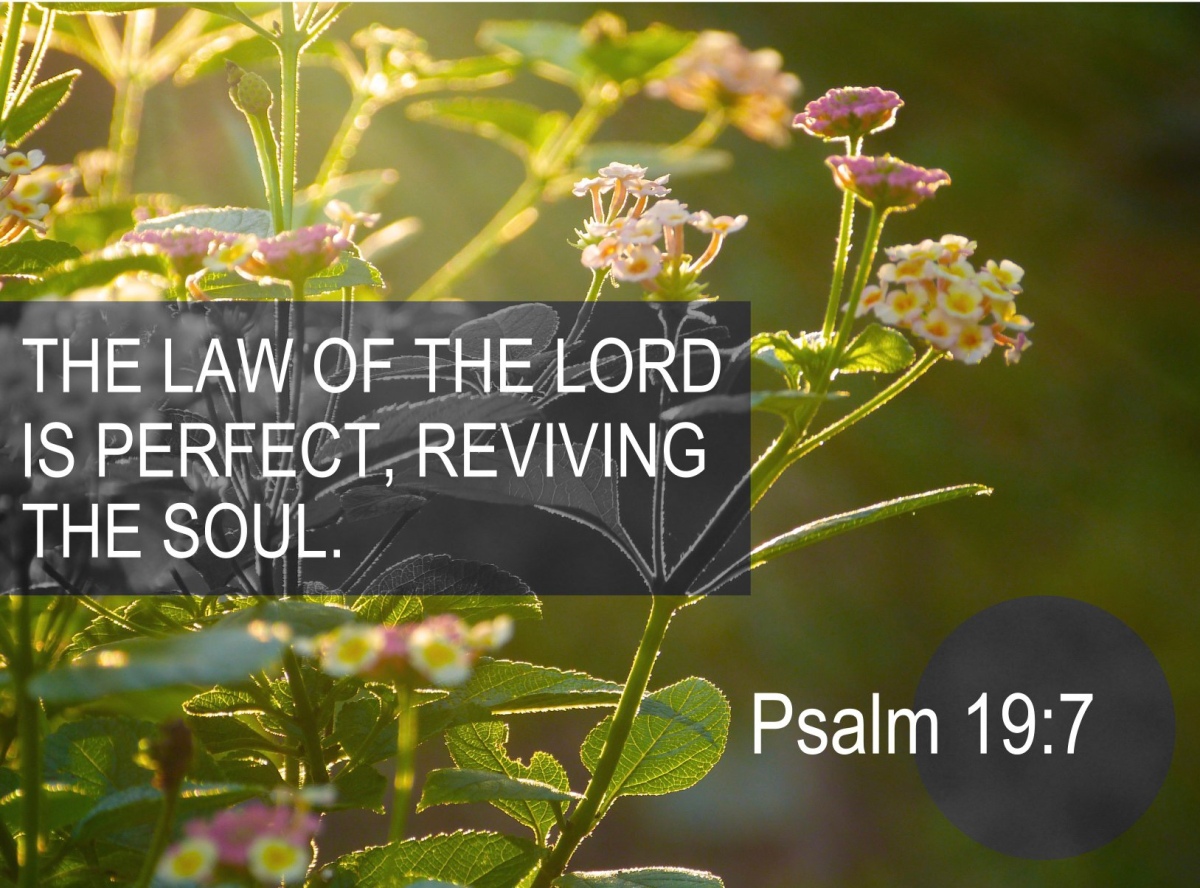
The law of the Lord is perfect (Psalm 19; Pentecost 19A)

The psalm that is offered by the lectionary for this coming Sunday (Psalm 19) contains some very well-known phrases. It deals with the way that we know God, and know about God—through creation, and through scripture. Those two “ways of knowing” form the basis for the later theological development of the notions of “natural revelation” (that we can know about God by observing the world around us) and “scriptural revelation” (that we can know about God by reading and studying the scriptures).

However, in this psalm, although there are two clearly delineated sections (verses 1–6 and 7–13) with a concluding verse 14, there are overlaps and connections between those two sections. Howard Wallace notes that “there are certain connections between the [two] parts of the psalm: word connections (e.g. ‘hid’ and ‘hide’ in vv. 6 and 12; ‘heart’ in vv. 8 and 14) … also the theme of ‘speech’ ties the psalm together (e.g. in vv. 1, 2, and 14, and presumed in the words ‘precepts’ and ‘commandments’)”. He concludes that “these connections invite us to consider the psalm as a unity with the meaning of the whole greater than the sum of the parts.”

See https://hwallace.unitingchurch.org.au/WebOTcomments/LentB/Lent3BExod20Ps19.html

Creation is the focus in the first six verses. The psalmist’s view is fixed on “the heavens”, which are “telling the glory of God” (v.1). In those heavens the Lord “has set a tent for the sun, which comes out like a bridegroom from his wedding canopy, and like a strong man runs its course with joy” (v.4–5)—clearly a description of the daily movement of the sun across the sky (from our perspective), from east to west, as verse 6 then elucidates.

In other psalms, the psalmist praises God for the heavens as the place where “you have set your glory above the heavens” (Ps 8:1); as a consequence, “the Lord has established his throne in the heavens” (Ps 103:19). By contrast with earthly idols—deaf, dumb, blind, immobile, mute—“God is in the heavens” (Ps 115:3–7; 123:1), from where he blesses the house of Israel (Ps 115:12–13).

So a recurrent refrain is, “your steadfast love is higher than the heavens, and your faithfulness reaches to the clouds” (Ps 36:5; 57:10; 108:4). “Be exalted, O God, above the heavens; let your glory be over all the earth” is another repeated prayer (Ps 57:5, 11; 108:5). In the same mode, another psalm rejoices that “your power and your righteousness, O God, reach the high heavens” (Ps 71:19).

However, another psalm declares that God “thundered in the heavens, and the Most High uttered his voice; and he sent out his arrows, and scattered them; he flashed forth lightnings, and routed them” (Ps 18:13–14). These natural elements, in the view of this psalmist, reflect the righteous judgement of the Lord—a view that we would distance ourselves from, today. (See also Ps 50:4–6; 76:7–9.)

By contrast, the rain that poured forth from the heavens when the people of Israel were in the wilderness “restored your heritage when it languished … in your goodness, O God, you provided for the needy” (Ps 68:7–10). So the heavens can be the source of nourishment and refreshment, as another psalm affirms: “he commanded the skies above, and opened the doors of heaven; he rained down on them manna to eat, and gave them the grain of heaven” (Ps 78:23–29).

Along with “the moon and the stars that you have established”, the heavens are seen to be “the work of your fingers” (Ps 8:3). “The Lord made the heavens” (Ps 96:5), “the heavens are yours, the earth also is yours”, other psalms offer, declaring that “the world and all that is in it—you have founded them” (Ps 89:11). It is “by the word of the Lord the heavens were made”, the psalmists sing (Ps 33:6; 102:25; 136:5), providing a bridge which connects both the heavens and the Law of the Lord, as in Psalm 19. Both the creation and the scriptures are the Lord God speaking to humanity.

The Law of the Lord is what shapes the second part of the psalm (verses 7–14). Those verses contain a ringing affirmation of the Torah as “perfect, reviving the soul … sure, making wise the simple … right, rejoicing the heart … clear enlightening the eyes … pure, enduring forever … true and righteous altogether … more to be desired than gold … sweeter also than honey” (Ps 19:7–14).

The terms used here in parallel to describe Torah (law, decrees, precepts, commandment, fear, ordinances) are found regularly in the narrative books to describe the collection of laws (Deut 8:11; 11:1; 1 Ki 2:3; 6:12; 8:58; 2 Ki 17:34–37; 1 Chron 22:13; 28:17; Neh 9:13; 10:29) as well as right throughout Psalm 119. See

https://johntsquires.com/2023/07/13/a-fully-developed-theology-from-just-one-psalm-psalm-119-pentecost-7a-§§4-5/

Such affirmations of Torah sound out insistently throughout the majestically grand doublets of the 176 verses which are artistically-arranged into acrostic stanzas of Psalm 119 (“happy are those … who walk in the way of the Lord … I long for your salvation, O Lord, and your law is my delight”, vv.1, 174). This psalm indicates that the Law shapes the way that the covenant is kept; and the covenant gives expression to the steadfast love and grace of God.

So much is Torah valued, that it apparently offers perfection: “the law of the Lord is perfect” (Ps 19:7), which we might compare with “I have seen a limit to all perfection, but your commandment is exceedingly broad” (Ps 119:96). In this regard, the psalmist’s appreciation for Torah as perfection seems to reflect the priestly desire for people to offer perfect sacrifices, without blemish (Lev 22:21), and Solomon’s desire to build the Temple as a perfect house for God (1 Ki 6:22).

Indeed, such a conception of perfect Torah also resembles the sage’s musings regarding Wisdom: “to fix one’s thought on her is perfect understanding” (Wisdom 6:15), and thoughts found in a prayer attributed to Solomon: “even one who is perfect among human beings will be regarded as nothing without the wisdom that comes from you” (Wisdom 9:6).

Much value is accorded to these words of Torah. As well as calling the law “perfect”, we hear that “the decrees of the Lord are sure” (Ps 19:7), a claim echoed in another psalm (Ps 93:5). The precepts of the Lord that are right (Ps 19:8; see also 119:75, 137, 172) means that one who is faithful and obedient will be led “in right paths” (Ps 23:3) as they pray “put a new and right spirit within me” (Ps 51:10). “The commandment of the Lord is clear” (Ps 19:8) is a claim that informs the later portrayal of those who trace the course of Wisdom “from the beginning of creation … [who] make knowledge of her clear” (Wisd Sol 6:22).

The psalmist extends the adoration of the Law, declaring that “the fear of the Lord is pure” (Ps 19:9), a claim extended in another statement found in wisdom texts, “the fear of the Lord is the beginning of wisdom” (Ps 111:10; Prov 1:7; 9:10; 15:33; Sir 1:18, 27; 19:20). A further elaboration, “the ordinances of the Lord are true and righteous altogether” (Ps 19:9), is the way that Ezra describes the laws given to Moses on Mount Sinai (Neh 9:13). They are righteous (Ps 119:7, 62, 106, 160, 164), good (119:39), the basis of hope (119:43) and comfort (119:52).

The closing affirmation, “more to be desired are they than gold,

even much fine gold; sweeter also than honey, and drippings of the honeycomb” (Ps 19:10), is echoed in “how sweet are your words to my taste, sweeter than honey to my mouth!” (Ps 119:103). By contrast, when Job asks, “where shall wisdom be found? and where is the place of understanding?”, he proposes that “gold and glass cannot equal it, nor can it be exchanged for jewels of fine gold” (Job 28:12–19), and concludes, “the fear of the Lord, that is wisdom; and to depart from evil is understanding” (Job 28:28).

Meditation and prayer is then affirmed in the final verse which brings the psalm to a close: “let the words of my mouth and the meditation of my heart be acceptable to you, O Lord, my rock and my redeemer” (v.14). They echo the plea of another psalm, “hear my prayer, O God; give ear to the words of my mouth” (Ps 54:2).

Yet another psalm affirms that “all the kings of the earth shall praise you, O Lord, for they have heard the words of your mouth” (Ps 138:4), while in another psalm the prayer is, “may my meditation be pleasing to him, for I rejoice in the Lord” (Ps 104:34). Finally, the closing verse of Psalm 19 resonates with a similar affirmation in Psalm 49, “my mouth shall speak wisdom; the meditation of my heart shall be understanding” (Ps 49:3).