In praise of Torah (Psalm 19; Lent 3B)

The compilers of the Revised Common Lectionary have selected a psalm for each Sunday of the year, noting that this has normally been in order to provide a passage that complements the First Reading, which is most often a passage from Hebrew Scripture.

The psalm for this coming Sunday, Psalm 19, was obviously chosen as a companion reading alongside the Hebrew Scripture passage from Exodus 20, which recounts The Ten Words given to Israel, through Moses, when he met with the Lord on Mount Sinai (Exod 20:1–17). For that passage, see

Creation is the focus in the first six verses of the psalm, where the psalmist’s view is fixed on “the heavens”, which are “telling the glory of God” (v.1). In those heavens the Lord “has set a tent for the sun, which comes out like a bridegroom from his wedding canopy, and like a strong man runs its course with joy” (v.4–5)—clearly a description of the daily movement of the sun across the sky (from our perspective), from east to west, as verse 6 then elucidates.

However, at this point the focus changes to Torah. The psalmist expresses a consistently positive attitude towards Torah in verses 7–14. Those verses contain a ringing affirmation of the Torah as “perfect, reviving the soul … sure, making wise the simple … right, rejoicing the heart … clear enlightening the eyes … pure, enduring forever … true and righteous altogether … more to be desired than gold … sweeter also than honey” (Ps 19:7–14).

The terms used here in parallel to describe Torah (law, decrees, precepts, commandment, fear, ordinances) are found regularly in the narrative books to describe the collection of laws (Deut 8:11; 11:1; 1 Ki 2:3; 6:12; 8:58; 2 Ki 17:34–37; 1 Chron 22:13; 28:17; Neh 9:13; 10:29) as well as right throughout Psalm 119. See

Such affirmations of Torah sound out insistently throughout the majestically grand doublets of the longest psalm, Psalm 119. The 176 verses of this psalm, artistically arranged into acrostic stanzas of eight verses at a time, are bracketed by delight and confidence (“happy are those … who walk in the way of the Lord … I long for your salvation, O Lord, and your law is my delight”, vv.1, 174). This psalm indicates that the Law shapes the way that the covenant is kept; and the covenant gives expression to the steadfast love and grace of God.

*****

So much is Torah valued, that it apparently offers perfection: “the law of the Lord is perfect” (Ps 19:7), which we might compare with “I have seen a limit to all perfection, but your commandment is exceedingly broad” (Ps 119:96). In this regard, the psalmist’s appreciation for Torah as perfection seems to reflect the priestly desire for people to offer perfect sacrifices, without blemish (Lev 22:21), and Solomon’s desire to build the Temple as a perfect house for God (1 Ki 6:22).

Indeed, such a conception of perfect Torah also resembles the sage’s musings regarding Wisdom: “to fix one’s thought on her is perfect understanding” (Wisdom 6:15), and thoughts found in a prayer attributed to Solomon: “even one who is perfect among human beings will be regarded as nothing without the wisdom that comes from you” (Wisdom 9:6).
Much value is accorded to these words of Torah. As well as calling the law “perfect”, we hear that “the decrees of the Lord are sure” (Ps 19:7), a claim echoed in another psalm (Ps 93:5). The precepts of the Lord that are right (Ps 19:8; see also 119:75, 137, 172) means that one who is faithful and obedient will be led “in right paths” (Ps 23:3) as they pray “put a new and right spirit within me” (Ps 51:10). “The commandment of the Lord is clear” (Ps 19:8) is a claim that informs the later portrayal of those who trace the course of Wisdom “from the beginning of creation … [who] make knowledge of her clear” (Wisd Sol 6:22).

The psalmist extends the adoration of the Law, declaring that “the fear of the Lord is pure” (Ps 19:9), a claim extended in another statement found in wisdom texts, “the fear of the Lord is the beginning of wisdom” (Ps 111:10; Prov 1:7; 9:10; 15:33; Sir 1:18, 27; 19:20). A further elaboration, “the ordinances of the Lord are true and righteous altogether” (Ps 19:9), is the way that Ezra describes the laws given to Moses on Mount Sinai (Neh 9:13). They are righteous (Ps 119:7, 62, 106, 160, 164), good (119:39), the basis of hope (119:43) and comfort (119:52).

The closing affirmation in this shorter psalm, “more to be desired are they than gold, even much fine gold; sweeter also than honey, and drippings of the honeycomb” (Ps 19:10), is echoed in the longest psalms, “how sweet are your words to my taste, sweeter than honey to my mouth!” (Ps 119:103).

By contrast, when Job asks, “where shall wisdom be found? and where is the place of understanding?”, he proposes that “gold and glass cannot equal it, nor can it be exchanged for jewels of fine gold” (Job 28:12–19), and concludes, “the fear of the Lord, that is wisdom; and to depart from evil is understanding” (Job 28:28).

Wisdom, love, the fear of the Lord, enlightenment, and rejoicing—these are the fruits of Torah, as the psalmist sings. These are the benefits of the law which are to be valued even into our own times, as this Sunday we hear again the words of this ancient psalm and affirm its relevance and importance in the contemporary world.


The stone that the builders rejected (Mark 12; Narrative Lectionary for Lent 3)

The parable of Jesus which is set in this Sunday’s lectionary appears to offer an invitation to adopt a negative approach towards Jews and Judaism. The author of “the good news of Jesus, chosen one” (by tradition, the evangelist Mark) interpreted this story as a polemic against the Jewish authorities who had gathered to hear Jesus teach (Mark 11:27).

As Jesus concludes his parable with a typical rabbinic scripture citation, designed to drive the point home with deep authority (Mark 12:10–11, citing Ps 118:22–23), the narrator comments, “when they realized that he had told this parable against them, they wanted to arrest him, but they feared the crowd; so they left him and went away” (Mark 12:12).

Often in Christian history, that negative portrayal of the Jewish authorities of the first century has been used as the basis for a direct attack on Jews of later times. That’s a very poor line of interpretation that we should ensure we do not follow.

The parable that Jesus tells is set in a vineyard. That’s an age-old symbol for the people of Israel. We can see this most clearly in passages of Hebrew Scripture such as Isaiah 5:1–7 and Psalm 80:7–15; they show how old and enduring this imagery was.

The parable that Jesus tells recounts the hard-hearted way in which the tenants in the vineyard (a traditional symbol for the people of Israel) reject the messengers sent to them by the landowner (seen as a symbol for God), culminating in the atrocious treatment meted out to the landowner’s son (whom we are meant to identify as Jesus, son of God).

The son is put to death. The punchline that Jesus crafts for this parable is potent: the owner of the vineyard “will come and destroy the tenants and give the vineyard to others” (vv.8–9). In Matthew’s parallel version of this parable, Jesus extends this ending to include the clear statement that “those who do not produce the fruits of the kingdom will not inherit the kingdom” (Matt 21:43).

The parable of the vineyard is one of the passages that has been difficult for us to understand accurately. When taken at a literal level, it has led to modern interpretations that are as damaging as they are unfair. The assumption is that the Pharisees and scribes are the ‘bad guys’, and this has led to the belief that Pharisee equals hypocrite. It is disturbing that such a stereotype has found its way into the language of our modern church.

The context of the parable suggests that although its message was aimed at the chief priests and the Pharisees, it does not exclude other Jewish people. The parable is told in one of a number of encounters between Jesus and Jewish leaders (11:27—12:44). Was this a consistent attitude of Jesus?

Equally disturbing is the notion that Jesus here seems to contradict his own teaching about loving one’s enemy and turning the other cheek. He depicts God as the avenging Lord. So what is really happening here?

I don’t think the parable of Jesus is intended to be simply an anti-Jewish polemic, an invitation to deride or dismiss Judaism and Jews.

It is true that, in the Gospel of Matthew, we find Jesus making some strident accusations and engaging in some vigorous debate with the Jewish authorities. But does he really believe that no faithful Jew will ever again enter the kingdom of heaven?

Judaism was in a state of flux as people lived under the continuing oppression of Roman rule. The destruction of the Temple in 70 CE was a pivotal moment. Evidence indicates that, during this time, there were various sectarian groups within Judaism who were contesting with each other for recognition and influence. Instead of making common cause against Rome, they continued to fight each other. Vigorous polemic and robust debate amongst Jews were not uncommon. See

During this period, the Pharisees were becoming increasingly important as an alternative to the Temple cult, and emerging as the dominant Jewish religious movement. Their power base was moved from Jerusalem and spread throughout the area. When the Temple was destroyed, they moved into the vacuum that was created, and became even more dominant.

(From this time on, Pharisees evolved into the “Rabbis”, and they developed the kind of Judaism that became dominant through to the present time. We need to be sensitized to the fact that, for many modern Jews, when we make damning criticisms of the Pharisees, they hear that as a criticism of their Rabbis, and, by extension, of the faith that they practise today.)

The kind of debates that we see in the Gospels—debates where Jesus goes head-on with the Pharisees—need to be understood in this context. Jesus was not “cutting the cord” of his connection with Judaism. He was not rejecting his faith as irrelevant or obsolete.

He was advocating, vigorously and persistently, for the kind of faith that he firmly believed in—and criticisng the Pharisees for their failure, in his eyes, to adhere to all that they taught. He wanted to renew Israel, to refresh the covenant, as the prophets before him had done.

And let’s remember that the accounts that we have of these debates come from years later than when they actually occurred; years that had been strongly shaped by the polemic and antagonism of the intervening decades.

Older academic Christian scholarship and popular evangelical Christian tradition perpetuate the stereotype that the Judaism of the time of Jesus was a harsh, legalistic, rigid religion—a stereotype heightened by an unquestioning acceptance of the New Testament caricature of the Pharisees as hypocritical legalists who made heavy demands but had no soul commitment to their faith. It was claimed that they were the leaders of a static, dying religion.

This stereotype has been completely demolished in recent decades—both through the growing interaction between Christian and Jewish scholarship, and also through a more critical reading of the relevant primary texts. I am very pleased that the church to which I belong, the Uniting Church in Australia, has made it very clear that we do not adhere to these inaccurate and hurtful stereotypes.

In 2009, the UCA national Assembly adopted a Statement which says, amongst other things:

The Uniting Church does not accept Christian teaching that is derogatory towards Jews and Judaism; a belief that God has abolished the covenant with the Jewish people;  supersessionism, the belief that Christians have replaced Jews in the love and purpose of God; and forms of relationships with Jews that require them to become Christian, including coercion and manipulation, that violate their humanity, dignity and freedom.

We do not accept these things.

See https://www.jcrelations.net/article/jews-and-judaism.pdf

Indeed, when we look to Matthew’s Gospel, Jesus does nothing to overturn the Law or to encourage his followers to disregard the Law; he is portrayed as a Jew who keeps Torah to the full. “I have come, not to destroy, but to fulfil the Law”, he says (5:17). See

And in that same section of the Gospel, Jesus is quoted as advocating for a better righteous-justice; a righteous-justice that “exceeds that of the scribes and Pharisees” (5:20). See

Virtually all of his criticisms of the Pharisees in the Synoptic Gospels can be understood within the framework of first century debates over the meaning and application of Law. The memory of Jesus is as a Torah-abiding Jew, who nevertheless stakes out a distinctive position within the context of those contemporary debates.

We should not interpret the parable of Jesus in Mark 12 as an outright condemnation of Judaism as a whole. As he debates the Jewish leadership of his day, he makes strong statements. But let’s not claim that Jesus validates any sense of anti-Jewish or antisemitic attitude.

Unfortunately, these words of Jesus and other parts of the New Testament story have been used throughout the centuries to validate anti-Jewish attitudes, to foster antisemitic hatred of the Jews. It is important for us to remember the real sense of the words of Jesus, and not follow the pathway to bigotry, hatred, persecution, and tragic attempts to annihilate the Jews.

Maintaining faith in God in difficult circumstances (Psalm 22; Lent 2B)

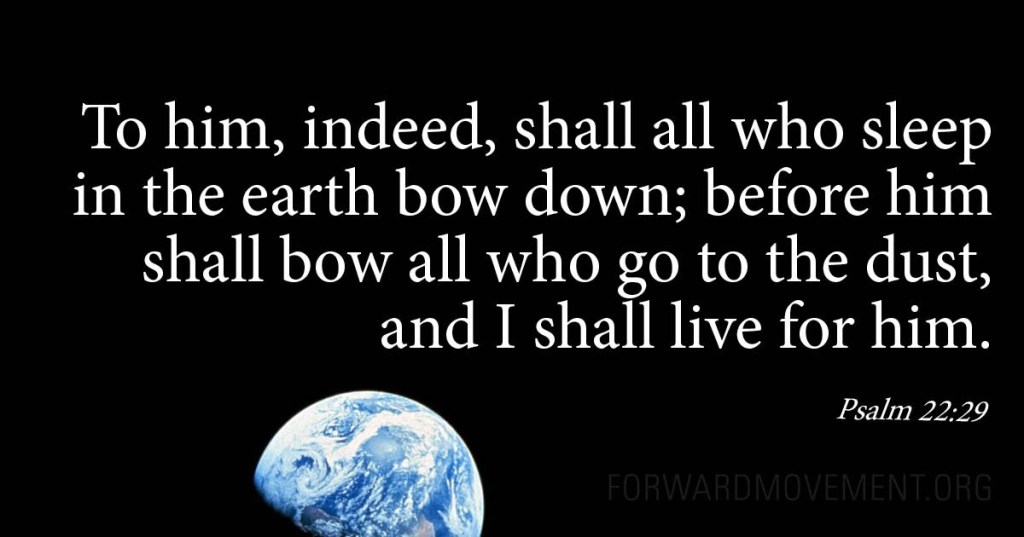
In the psalm that is set for the Second Sunday in Lent (a section of Psalm 22), the psalmist exults the worldwide dominion of the Lord God and sings that “to [the Lord], indeed, shall all who sleep in the earth bow down; before him shall bow all who go down to the dust, and I shall live for him” (Ps 22:29).

This psalm is best known for its opening line, “my God, my God, why have you forsaken me?” (Ps 22:1a), as this is the last word of Jesus as he dies on the cross, at least according to two evangelists (Mark 15:34; Matt 27:46). The psalm is one of the psalms of individual lament, as the psalmist reflects the wretched condition of a person who is suffering unjustly, as the psalmist cries, “why are you so far from helping me, from the words of my groaning? … I am a worm, and not a human … all who see me mock at me; they make mouths at me, they shake their heads …. I am poured out like water, and all my bones are out of joint; my heart is like wax; it is melted within my breast; my mouth is dried up like a potsherd, and my tongue sticks to my jaws; you lay me in the dust of death.” (Ps 22:1, 6, 14–15).

The other psalms usually considered to express individual lament reflect similar ideas: Ps 3 (“O Lord, how many are my foes! many are rising against me), Ps 6 (“be gracious to me, O Lord, for I am languishing”, Ps 13 (“how long will you hide your face from me?), Ps 25 (“I am lonely and afflicted; relieve the troubles of my heart, and bring me out of my distress”), Ps 31 (“my eye wastes away from grief, my soul and body also; for my life is spent with sorrow, and my years with sighing”), Ps 71 (“in your righteousness deliver me and rescue me; incline your ear to me and save me”), Ps 77 (“I think of God, and I moan; I meditate, and my spirit faints”), Ps 86 (“O God, the insolent rise up against me; a band of ruffians seeks my life, and they do not set you before them”), and Ps 142 (“with my voice I cry to the Lord; with my voice I make supplication to the Lord”).

However, the section of the psalm that is offered for this coming Sunday (Ps 22:23–31) comes from the second half of the psalm, where—as is typical of many psalms of lament—the mood turns from internal personal introspection, to an external offering of praise and adoration to God. In each psalm the undergirding assumption is that God does care, God will act, and the trials of the present will be swept away. They are psalms imbued both with the sober reality of the human condition, and an unswerving optimism that faith in God will ensure an ultimate condition of salvation, deliverance, redemption.

Although the psalms offered by the lectionary are chosen each Sunday to provide a companion piece to the Hebrew Scripture passage, this element of this psalm makes it a most fitting accompaniment to the Gospel passage offered this coming Sunday in Lent, as the path that Jesus walks towards the cross is in view during this season.

So the psalmist rejoices. God has dominion over the whole earth: “all the ends of the earth shall remember and turn to the Lord and all the families of the nations shall worship before him; for dominion belongs to the Lord and he rules over the nations” (vv.27–28). This affirmation reflects other parts of Hebrew Scripture where the global reach of God is asserted.

One psalmist calls the ends of the earth “the possession of the Lord” (Ps 2:8), for they “have seen the victory of our God” (Ps 98:3). Both the name and the praise of the Lord “reaches to the ends of the earth” (Ps 48:10), for when God acts to judge the nations, “the it will be known to the ends of the earth that God rules over Jacob” (Ps 59:13). One psalmist declares that God is “the hope of all the ends of the earth and of the farthest seas” (Ps 65:5) and another prays, “may God continue to bless us; let all the ends of the earth revere him” (Ps 67:7).

But in this psalm, the dominion of God reaches beyond this life, to humans who lie in the realm of those who have died. “To him shall all who sleep in the earth bow down; before him shall bow all who go down to the dust” (v.29). A number of other psalms indicate that “in the dust” is where the dead rest (Ps 7:5; 30:9; 90:3; 104:29; likewise Job 10:9; 17:16; 20:11; 21:23–26; 40:12–13).

In Daniel’s grand vision “at the time of the end” (11:40–12:13) he refers to “many of those who sleep in the dust of the earth shall awake, some to everlasting life, and some to shame and everlasting contempt” (12:2). This is a key Hebrew Scripture text which is used in discussions of the resurrection as reported in the New Testament. Clearly, those who “sleep in the dust” are dead.

In the archetypal story that opens Hebrew Scripture, “the dust of the ground” is identified as the source for God’s creation of humanity (Gen 2:7)—and as the place where people’s bodies go when they die. The man Adam is told, “you return to the ground, for out of it you were taken; you are dust, and to dust you shall return.”

God, indeed, “knows how we were made; he remembers that we are dust” (Ps 103:14), and in the end, “all go to one place; all are from the dust, and all turn to dust again” (Eccles 3:20). The Preacher wistfully observes that at the end, “when the years draw near … the silver cord is snapped, and the golden bowl is broken, and the pitcher is broken at the fountain, and the wheel broken at the cistern, and the dust returns to the earth as it was, and the breath returns to God who gave it”, before drawing his inevitable and well-known conclusion, “Vanity of vanities, says the Teacher; all is vanity” (Eccles 12:1, 6–7).

In other passages in the Hebrew Scriptures, those who are dead are located, not in the dust, but in Sheol, in The Pit. These terms each describe the state of the nephesh (the essence of being) of those whose bodies have died. In one psalm, the pit that is dug for “the wicked” describes this place as “the land of silence” (Ps 94:17), while the prophet Ezekiel imagines it as the place where the dead, the “people of long ago” lie “among primeval ruins” (Ezek 26:20).

In Psalm 88, when the psalmist laments “my soul is full of troubles”, they use these and other terms in poetic parallelism to describe their fate: “my life draws near to Sheol; I am counted among those who go down to the Pit; I am like those who have no help, like those forsaken among the dead, like the slain that lie in the grave, like those whom you remember no more, for they are cut off from your hand; you have put me in the depths of the Pit, in the regions dark and deep” (Ps 88:3–6).

In this state, people simply lie in darkness, not living, with no future in view, no hope in store. Job laments, “if I look for Sheol as my house, if I spread my couch in darkness, if I say to the Pit, ‘You are my father,’ and to the worm, ‘My mother,’ or ‘My sister,’ where then is my hope?” (Job 17:13-15). Job also equates entering the Pit with “traversing the River” (Job 33:18), in words that seem to reflect the River Hubur (in Sumerian cosmology) or the River Styx (in Greek cosmology), the place where the souls of the dead cross over into the netherworld.

Other words for Sheol in Hebrew Scripture include Abaddon, meaning ruin (Ps 88:11; Job 28:22; Prov 15:11) and Shakhat, meaning corruption (Isa 38:17; Ezek 28:8). These terms indicate the forlorn, lost, irretrievable nature of this state of being. This is the fate in store for all human beings, whether righteous or wicked; there is no sense of judgement or punishment associated with this state. It is simply a state of non-being.

And yet, even in this state—this state where “my mouth is dried up like a potsherd, and my tongue sticks to my jaws; you lay me in the dust of death” (Ps 22:15)—the psalmist finds hope. They are confident that the Lord God “raises up the needy out of distress” (Ps 107:41) and “lifts up the downtrodden” (Ps 147:5). In like manner, Hannah has sung that the Lord “raises the poor from the dust and lifts the needy from the ash heap” (1 Sam 2:8; also Ps 113:7).

And so the psalmist bursts into praise for what, they are confident, God will do. Calling for their listeners to “praise [the Lord] … glorify him … stand in awe of him” (Ps 22:23), they affirm that God “did not despise or abhor the affliction of the afflicted; he did not hide his face from me, but heard when I cried to him” (v.24) and rejoice that “the poor shall eat and be satisfied” (v.26).

The psalmist is certain not only that “the ends of the earth shall remember and turn to the Lord and all the families of the nations shall worship before him” (v.27), but also that “posterity will serve him; future generations will be told about the Lord, and proclaim his deliverance to a people yet unborn, saying that he has done it” (vv.30–31).

And so, they offer this resounding declaration of hope: “to him, indeed, shall all who sleep in the earth bow down; before him shall bow all who go down to the dust” (v.29). It is that hope which we hear, and affirm, when these closing verses of this psalm (vv.23–31) are read or sung during this coming Sunday’s worship.

A ransom for many: a hint of atonement theology? (Mark 10; Narrative Lectionary for Lent 2)

When Jesus instructed his followers to tread the pathway of humility and submission (Mark 8:34–38; 9:35–37; 10:38–44)—the same pathway that he himself has been following as he walks towards Jerusalem (8:31; 9:31: 10:32–34), he speaks about laying down his own life, just as he urges his followers to lay down their lives (10:45). This has been a regular refrain throughout his teachings.

See https://johntsquires.com/2024/02/17/not-to-be-served-but-to-serve-the-model-provided-by-jesus-mark-10-narrative-lectionary-for-lent-2/

However, in this particular saying, Jesus indicates that the laying- down of his life is to be seen, not just as the model for his followers to emulate, but as “a ransom for many” (10:45). There are two important observations to make about this short statement. The first relates to the word “ransom”; the second will be canvassed in a later post.

Ransom is a term that we associate with the forced kidnapping of a person and the demand for a payment in order for them to be released. This is not the way the term is used in biblical texts, where payment in return for release of a captive is not in view. Rather, the orientation is towards the idea that there is a significant cost involved in the process of ransoming.

The Greek word used in Mark 10:45, lutron, comes from a verb, lutrein, which means “to release”. It was a common term for the payment needed to secure the release of slaves, debtors, and prisoners of war. The noun, translated as ransom, occurs in the Septuagint. It identifies the price paid to redeem a slave or captive (Lev 25:51–52) or a firstborn (Num 18:15). It also indicates the price to be paid as recompense for a crime (Num 35:31–32) or injury (Exodus 21:30). In these instances, it translates the Hebrew word koper, which has the basic meaning of “covering”.

Another form of that word appears in another form in the name of the Great High Holy Day in Judaism—Yom Kippur, the Day of Atonement (see Lev 16:1–34; Num 29:7–11). On that day, as the cloud of incense covers the mercy seat (kapporeth, Lev 16:13), the mercy seat is smeared with the blood of the sacrificed bull (16:14) and then the blood of the goat which provides the sin offering (16:15). According to Leviticus, it is these actions which “shall make atonement (kipper) for the sanctuary, because of the uncleannesses of the people of Israel, and because of their transgressions, all their sins” (16:16).

The process of atonement in the Israelite religion was to cover up, to hide away from view, the sins of the people. This is developed to some degree in the fourth Servant Song of Deutero-Isaiah, when the prophet honours the servant because “he was wounded for our transgressions, crushed for our iniquities” (Isa 53:5). His life was understood as “an offering for sin” (53:10) which “shall make many righteous” (53:11). Indeed, as the Song ends, it affirms that “he bore the sin of many” (53:12). The Song resonates with the language and imagery of righteous suffering as the means of dealing with, and perhaps atoning for, sins.

That notion is further expounded in a later text which provides an account of the way that a righteous man, Eleazar, was martyred as a means of ransoming the nation during the time of upheaval under Antiochus Epiphanes (175–167 BCE). “Be merciful to your people, and let our punishment suffice for them”, he prays; “make my blood their purification, and take my life in exchange for theirs” (4 Macc 6:28–29).

The idea then appears in New Testament texts which describe the effect of the death of Jesus for those who have placed their trust in him. Paul uses ransom language tells the saints that they were “bought with a price” (1 Cor 6:20; 7:23). He also uses apolutrosis, a compound word but from the base word lutrein, to describe the redemption which was accomplished by Jesus, both in a formulaic way (1Cor 1:30) and in a more discursive manner (Rom 3:24; 8:23). The term recurs in later letters which likely were not written by Paul (Col 1:14; Eph 1:7, 14; 4:30), as well as in the Lukan redaction of the final eschatological speech of Jesus (Luke 21:28).

In another later letter attributed to Paul, most likely written by one of his students, we read of “one mediator between God and humans, the man Christ Jesus, who gave himself as a ransom for all” (1 Tim 2:6), using the term lutron. In another later work providing guidance an account of Paul by an author at some remove from him, the book of Acts, Paul was said to have declared of the church that God “obtained [it] with the blood of his own Son” (Acts 20:28).

It was the combination of such passages that led the third century scholar, Origen of Alexandria to develop an idiosyncratic theory of the atonement (the way that Jesus enables God to deal with human sinfulness). Origen’s ransom theory of atonement reads Genesis 3 as an account of Adam and Eve being taken captive by Satan; this state was then inherited by all human beings. The death of Jesus is what enables all humans to be saved; the means for this was that the blood shed by Jesus was the price paid to Satan to ransom humanity (or, in a variant form, a ransom paid by Jesus to God to secure our release).

However, none of these texts—and particularly not Mark 10:45—require this overarching theological superstructure to make sense of what they say. Origen’s ransom theory held sway for some centuries, but was definitively rejected by the medieval scholar Anselm of Canterbury. It is not a favoured theory of atonement in much of the contemporary church (though it is still advocated in various fundamentalist backwaters). Certainly, none of this should be attributed to the saying of Jesus in Mark 10:45. It is far more likely that he is drawing on the Jewish tradition of the righteous sufferer in his words.

Jesus himself draws on various psalms of the righteous sufferer; psalms 22, 27, 31, 69, and 109 would each seem to express the despair and anguish being felt by Jesus in his passion. However, it is the fourth of the four Servant Songs (Isa 42:1–9; 49:1–7; 50:4–11; 52:13–53:12) to which this statement in Mark 10:45 might best be correlated.

The passion narratives that we have in scripture, recounting events leading to the death of Jesus, offer many connections with details of this fourth song (Isa 52:13–53:12). The prophet describes the marred appearance of the Servant (52:14); he is despised, rejected, and suffering (53:3), bearing our infirmities (53:4), and wounded for our transgressions (53:5).

The Servant is led like a lamb to the slaughter (53:7), suffering “a perversion of justice” (53:8), not practising violence or speaking deceit (53:9), and is buried with the rich (53:9). The Servant gives his life as “an offering for sin” (53:10), carrying the iniquities of many (53:11), making them righteous (53:11), bearing the sin of many (53:12), making “intercession for the transgressors” (53:12).

The role that the Servant plays in relation to sin, for the sake of the many, shapes the important saying of Jesus, that “the Son of Man came not to be served but to serve, and to give his life a ransom for many” (Mark 10:45). Jesus, according to Mark, foresees his role as that chosen one, destined to suffer for the sake of many. As we look to the cross, we can see that this was an ominous foreboding.

Not to be served, but to serve: the model provided by Jesus (Mark 10; Narrative Lectionary for Lent 2)

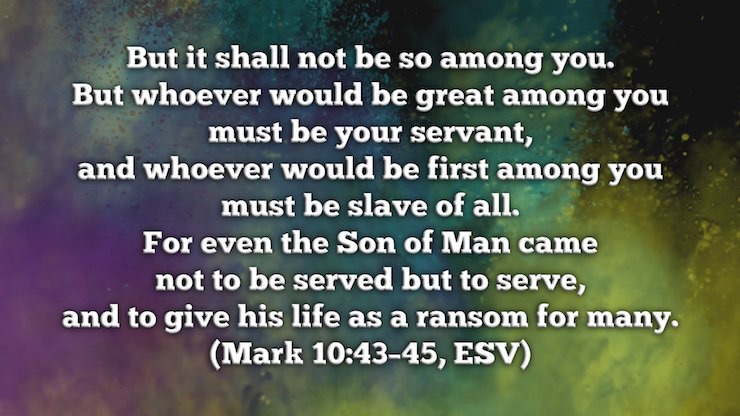
“The Son of Man came not to be served but to serve, and to give his life a ransom for many” (Mark 10:35-45). So Jesus instructs his followers, after a bruising encounter with James and John, two of the leading followers of Jesus (10:35-40) which enraged the rest of the disciples (10:42).

The dispute was over status; James and John wanted to claim the places next to Jesus: “one at your right hand and one at your left, in your glory” (10:37). This was not unusual in the world of that time (indeed, this is still the case in our own times). Public debate that was intended to best the other person was common in ancient Mediterranean societies. Seeking greater honour (higher status) by getting the upper hand, or the last word, in public debate, was common.

In an honour—shame society, such as that in which Jesus, James, and John lived, the culture was characterised by a constant and ongoing “challenge—riposte,” enacted in the public arena. Jesus engaged in such challenges on a regular basis; see the disputations of 2:1-3:6, when Jesus was travelling around Galilee, and later during his time in Jerusalem, in 11:27-12:34.

Such challenge—riposte encounters typically involved the challenger setting forth a claim, through either words or actions; a response to the challenge by the persons who was challenged; then, after further back-and-forth amongst the participants, once the challenge and riposte has run its course, the verdict is declared by the public who was watching the encounter.

(For a clear description of this process, as it applies in Mark 11:27–12:34, using the analysis of Jerome Neyrey and Bruce Malina, see https://www.etsjets.org/files/JETS-PDFs/43/43-2/43-2-pp213-228_JETS.pdf)

At this moment, Jesus critiques the common process of public disputation; he distances himself from the common cultural practice of seeking honour and working for a higher status. Those who lord it over others, who act as tyrants, are not to be the role models for his followers; “it is not so among you; but whoever wishes to become great among you must be your servant, and whoever wishes to be first among you must be slave of all” (10:43–44).

Indeed, Jesus rubs salt into the wound by inferring that James and John were acting like Gentiles (10:52). That was an insult, to be sure, for good Jews (see the sayings attributed the Jesus at Matt 5:47; 6:7, 32).

This was the third time, after demonstrating their misunderstanding of what Jesus was teaching, that his disciples were directly rebuked for their attitude. First, Peter represents the disciples’ lack of clarity about Jesus (8:27–38); then a number of the disciples arguing about being great, and John fails to welcome the activity of a person casting out demons (9:33–48); and now, James and John demonstrate their continued inability to understand the attitude of Jesus towards status (10:35–40).

At least in this last scene, the other ten disciples are angry about what James and John have asked for (10:41). Far too often, on earlier occasions, Jesus has lamented that the disciples failed to understand (4:22, 13; 6:52; 7:18: 8:17, 21; 9:32). It seems that finally, at this moment, things had fallen into place for the disciples. (Or were they simply annoyed at the way the brothers promoted their own interests over the hopes of the other disciples?)

On each of those three occasions of misunderstanding, Jesus responds by correcting the inadequacies displayed by his followers: he refers to the fate that is in store for him in Jerusalem (8:31; 9:31: 10:32–34), and then he indicates that his followers must tread that same pathway of humility and submission (8:34–38; 9:35–37; 10:38–44). See

On this occasion, Jesus goes one step further. His own life—or, more precisely, the laying-down of his own life—is to be seen, not just as the model for his followers to emulate, but as “a ransom for many” (10:45). This will be the focus of a subsequent blog post. See

A ransom for many: a hint of atonement theology? (Mark 10; Narrative Lectionary for Lent 2)

Fairly sourced, fairly traded: a Lenten discipline

It’s the beginning of Lent, a 40-day season in the Christian calendar. In Ash Wednesday services around the world, believers have lined up for the “imposition of ashes” after they joined in prayers confessing their sin and seeking divine forgiveness.

The words of Jesus about “true righteousness” have been read and imbibed: “whenever you give alms, do not sound a trumpet before you … whenever you pray, go into your room and shut the door and pray … when you fast, put oil on your head and wash your face” (Matt 6:1–6, 16–21).

These worshippers may well have listened to the strident call of the prophet Joel, conveying his message from the Lord: “return to me with all your heart, with fasting, with weeping, and with mourning; rend your hearts and not your clothing” (Joel 2:1–2, 12–17), as this is the Hebrew Scriptures passage proposed by the lectionary.

And they have joined with fervent intensity, on this Ash Wednesday, as on every Ash Wednesday, in the words attributed to the shepherd-king, David, after his infamous episode of the murder (of Uriah) and adultery (with Bathsheba), “have mercy on me, O God, according to your steadfast love; according to your abundant mercy blot out my transgressions, wash me thoroughly from my iniquity, and cleanse me from my sin” (Ps 51:1–17). The day begins a period of intense self-reflection and, for many, a time of abstinence from designated items of food or drink.

Perhaps they also heard the exhortation of the apostle Paul: “we urge you also not to accept the grace of God in vain … see, now is the acceptable time; see, now is the day of salvation!” (2 Cor 5:20—6:10). It is the grace of God which undergirds this day, and the Lenten season that follows.

After this intense time of self-reflection, of opening up a life to the forgiveness and grace of God, and of being sent forth with a blessing for the days that lie ahead, one would think that there would be a marked change in the practices of many people of faith, cleansed and renewed, forgiven and restored, in the days of Lent which lie ahead.

And Lent, after all, is a discipline offered by the church to continue that process of self-reflection and of clarifying what is most important: what is “is true, honourable, just, pure, pleasing, commendable”, as Paul elsewhere writes (Phil 4:4). Lent is the season of forty days of personal, and perhaps also social, negation of the desires that impede and damage the inner goodness of who we are as human beings.

Yet I wonder how many of those who have had ashes imposed and prayers heard, have left those Ash Wednesday services and are walking through the season of Lent without really seeking to abandon what is harmful, transform what is questionable, and adopt what is commendable, in their lives? Only they will know, each person, one by one, whether they are doing good this, and how they are doing this.

And I wonder how many of those Ash Wednesday worshippers turn their thoughts during Lent to the great festival which comes at the end of Lent: the celebration of Easter, Christ risen, joyful songs, hallelujahs! And how many start the process of buying the goods that are needed for that celebration, even during the period of self-reflection during Lent? And how many start to scour the shops for bargain chocolate eggs for their children or grandchildren (or great-grandchildren) for Easter Sunday?

Chocolate is one of the (many) places where deep injustice continues to be felt. It is one of the (relatively few) places where decisions made by individuals can have a positive effect. We know that there are great imbalances in the world, with poverty widespread across all countries, with a concentration in Africa (19 of the 20 poorest countries are all located in Africa) and with some of the island nations who are near neighbours of Australia also high on the list.

And, indeed, even in many of the wealthiest of countries (the USA, China, Japan, Germany, the UK, Singapore, even Australia) there are noteable pockets of poverty and disadvantage. And although collectively we might well have the economic capacity to rectify this situation, emotionally there is little if any movement towards such a resolution of the gross inequities that exist.

So chocolate is one of the places we can start, personally, individually, to act with justice. Every small step taken to ameliorate the problems of one small group of people is a step in the right direction, and helps to move us all towards global equity. Knowing where the chocolate we buy comes from, what wages are paid to those who harvest, transport, and process it, is something that we all can do.

Fairtrade is a way to support those who are most vulnerable, those who are most exposed to the impacts of climate change. There are more than 1.9 million farmers and workers in Fairtrade certified producer organisations, in 71 countries in Asia, South America, and Africa—some of the countries that are most at risk because of rising sea levels, the spread of drier desert climates, the increasing number of catastrophic weather events such as floods or bushfires, and other effects of climate change.

47% of all Fairtrade farmers produce coffee, and 41% of all Fairtrade workers produce flowers. But many other products are produced in ways that ensure they are fairly produced and fairly traded: tea, chocolate, sugar, bananas, rice, honey, nuts, vanilla wine—but also textiles and cotton, used in our clothing. There is even, now, a Fairtrade Carbon Credit scheme operating under the auspices of Fairtrade International.

An easily-recognised symbol on products marks them as Fairtrade. This symbol that designates products certified in accordance with Fairtrade Standards.

These Fairtrade Standards require producers to meet minimum social, economic and environmental requirements. In addition, participating organisations are encouraged to provide an ongoing improvement of farmers’ employment conditions or the situation of estate workers. 

In the Fair Trade Lent 2024 resources, we read:

“In a Fair Trade Lent we ask ourselves about an aspect of how we spend our money. We all purchase goods: food, clothes, household products, motorcars etc. Mostly we look for a bargain, pleased with ourselves when we save a dollar or two.

“Fair Trade Lent encourages us to think, not only of our selves when we buy things, but those who produced the goods: miners, farmers, artisans, and factory workers. Were they paid a living wage? Did they work in healthy conditions? Was the means of production environmentally sustainable?”

For more information about Fair Trade, see https://fairtradeanz.org/what-is-fairtrade

For resources relating to a range of areas, see http://www.fta.org.au/resources

For the 2024 Fair Trade Lent resources, see

https://www.canva.com/design/DAF7gUse8uA/xJvCIdE6JD-b48DON6KfSw/edit

You lack one thing: Jesus and a rich man (Mark 10; Narrative Lectionary for Lent 1)

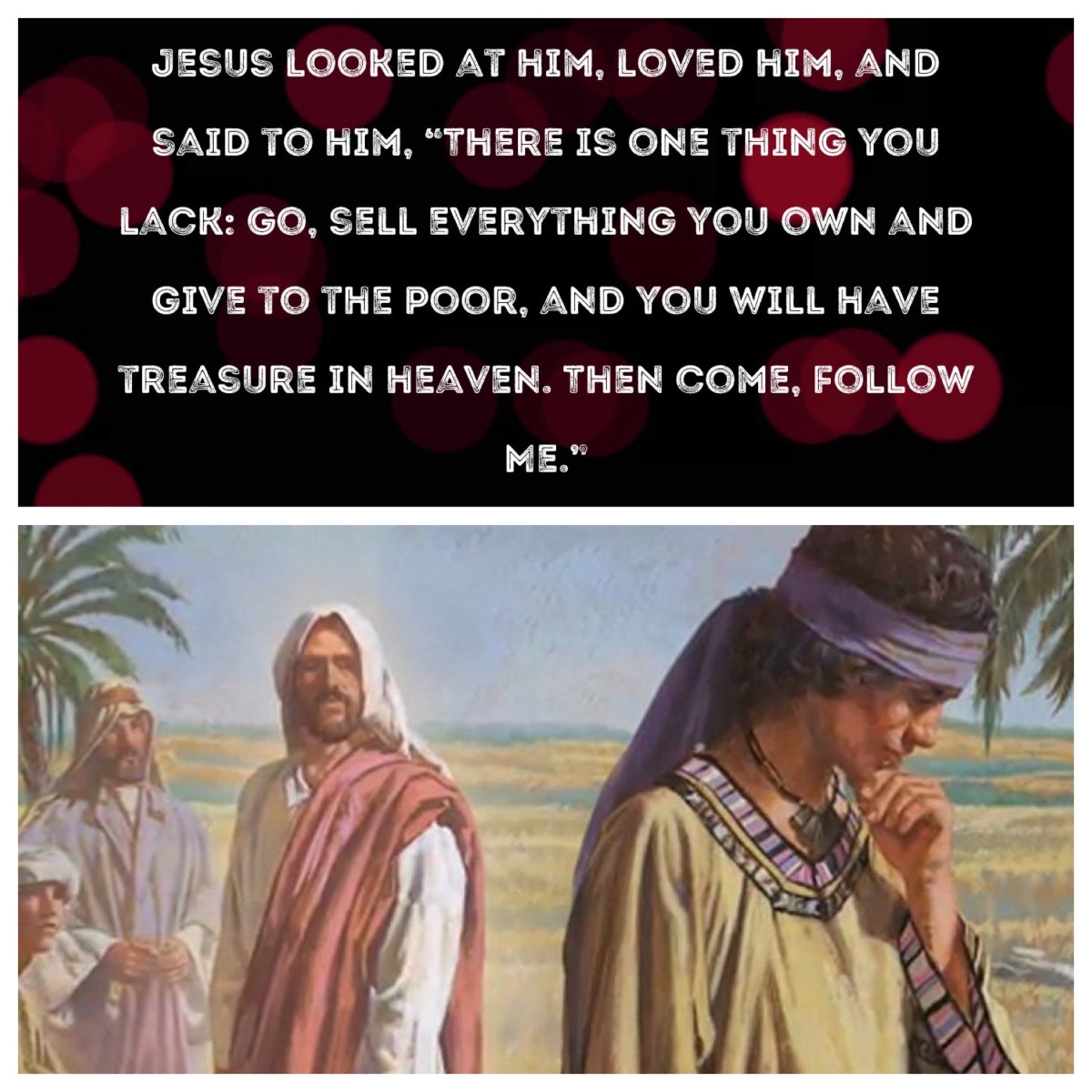
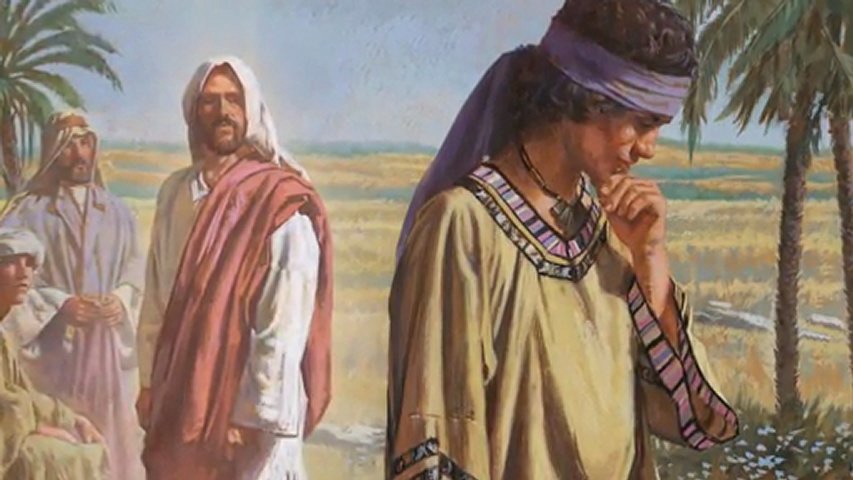
Next Sunday, the first Sunday in Lent, we will hear a Gospel passage in which Jesus sadly informs a man of means who prides himself on keeping all the commandments, that still “you lack one thing: go, sell what you own, and give the money to the poor, and you will have treasure in heaven; then come, follow me” (Mark 10:21).

The man left, shocked and grieving; he could not do what Jesus instructed. Jesus here draws the line of belonging or being alienated from him on the basis of whether a person is able to implement radical actions of obedience. It’s not just a matter of believing—it’s a matter of doing, of implementing radical, practical changes.

Quite some time earlier, Jesus had instructed his followers of that they were to be characterised by an ascetic way of life (6:8–9) as they undertook their public proclamation “that all should repent” (6:12). As Jesus sent them out on mission, “he charged them to take nothing for their journey except a staff—no bread, no bag, no money in their belts— but to wear sandals and not put on two tunics” (6:8–9).

The description given here is often compared with the form of dress of a wandering philosopher, particularly of a Cynic philosopher, renowned for their poverty and dependence on others for food and shelter. The fact that Jesus also instructs his followers to accept hospitality when offered (6:10) but not to stay on if there is no welcome offered (6:11) reinforces the similarities.

On this comparison, see

The teachings of Jesus contain many indications that this way of life is what is expected of those who follow Jesus. He tells them, “if any want to become my followers, let them deny themselves and take up their cross and follow me” (8:34). He then reinforces this after his encounter with the rich man by noting, “how hard it will be for those who have wealth to enter the kingdom of God!” (10:23). Later, in Jerusalem, Jesus concludes a debate with some Pharisees and Herodians with the instruction, “give to the emperor the things that are the emperor’s, and to God the things that are God’s” (12:17).

Beyond Mark’s narrative, Jesus was remembered for sayings in which he taught his followers to “love your enemies, do good, and lend, expecting nothing in return” (Luke 6:35) and “sell your possessions, and give alms” (Luke 12:33; Matt 19:21). “When you give a banquet”, he advised, “invite the poor, the crippled, the lame, and the blind” (Luke 14:13). “You cannot serve God and wealth”, he asserts (Luke 16:13; Matt 6:24). Accumulating possessions is not part of the agenda that Jesus set forth!

David Bentley Hart has written about the encounter between Jesus and the rich man: “Whatever else capitalism may be, it is first and foremost a system for producing as much private wealth as possible by squandering as much as possible of humanity’s common inheritance of the goods of creation. But Christ condemned not only an unhealthy preoccupation with riches, but the getting and keeping of riches as such. The most obvious example of this, found in all three synoptic Gospels, is the story of the rich young ruler, and of Christ’s remark about the camel and the needle’s eye.”

See https://www.plough.com/en/topics/faith/discipleship/what-lies-beyond-capitalism

As we listen to this story, from long ago, in our present context, we can sense how it remains pertinent for us. It remains a challenging word to disciples, caught in the swirl of constant consumption and encouragement to get more, more, more, in our contemporary capitalist society. “Go, sell what you own, and give the money to the poor, and you will have treasure in heaven; then come, follow me.”

The Way: a key motif in Hebrew Scripture (Psalm 25; Lent 1B)

“Good and upright is the Lord; therefore he instructs sinners in the way. He leads the humble in what is right, and teaches the humble his way. All the paths of the Lord are steadfast love and faithfulness, for those who keep his covenant and his decrees.” (Ps 25:8–10) So the psalmist sings, in the psalm that is set for the First Sunday in Lent.

Of course, this short phrase, “The Way”, has a significant place in Christian understanding. When he recounts a key incident in the second volume of his orderly account—namely, the conversion and call of Saul—Luke describes the followers of Jesus as being of “The Way” (9:2). This is a term which he likes; it recurs in four subsequent chapters of Luke’s narrative (18:25; 19:9,23; 22:4; 24:14,22).

Using this term to describe the followers of Jesus makes sense when we consider the thoroughly Jewish character of the early Jesus movement. Luke takes pains to document this thoroughly Jewish ethos, from the opening stories of pregnant women (Luke 1–2), told firmly in the style of Hebrew scripture narrative, through the various occasions where he notes that Jesus was in the synagogue on the sabbath (Luke 4:16; 6:6; 13:10), the many instances where he relates the story of Jesus to scripture passages (Luke 4:21; 7:27; 9:30; 12:52–53; 13:33–35; 19:37–38; 20:9–19; 21:20–24; 22:37) and the way that his second volume traces the way that the followers of Jesus take their message of good news “to the ends of the earth” (Acts 1:8, quoting Isa 42:6; 49:6).

I think that it is most likely that “The Way” as the name of the movement owes its origins to scriptural usage in association with God’s activity. “Lead me, O Lord, in your righteousness because of my enemies”, the psalmist prays; “make your way straight before me” (Ps 5:8). In a song praising God for delivering victory to the King, we read, “This God—his way is perfect; the promise of the Lord proves true; he is a shield for all who take refuge in him” (Ps 18:30). By extension, Luke sees that God is at work in the movement initiated by Jesus and his followers.

This scriptural usage is widespread. The Way figures in a number of psalms. “Good and upright is the Lord; therefore he instructs sinners in the way”, says the psalm proposed for this coming Sunday. “He leads the humble in what is right, and teaches the humble his way” (Ps 25:8–9). The psalmist goes on to explain, “all the paths of the Lord are steadfast love and faithfulness, for those who keep his covenant and his decrees” (Ps 25:8–10).

Other psalmists pray, “Teach me your way, O Lord, and lead me on a level path because of my enemies”(Ps 27:11), and sing, “Wait for the Lord, and keep to his way, and he will exalt you to inherit the land; you will look on the destruction of the wicked” (Ps 37:34). There are many other other psalms which invoke the image of the way of the Lord.

The term is also appropriated in the Dead Sea Scrolls as a means of defining the Qumran community (1QS 9.17-18,21; 10:21; CD 1:13; 2:6). This most likely reflects competing claims for being the authentic keepers of Torah amongst Jewish sects in the latter period of Second Temple Judaism. Members of the community who followed the instruction of The Teacher of Righteous believed that they were keeping faithfully to The Way of the Lord.

A particularly important passage to note is the declaration that opens the second main section of the book of Isaiah—the section which scholars call Deutero-Isaiah. In the opening verses of chapter 40, the prophet addresses the Israelites, in exile in Babylon. Life in the exile was not a happy time for many of the people of Israel. (Psalm 137 is the classic expression of this; note especially the anger expressed in verses 8–9.) The prophet offers them words of comfort and hope.

The people of Israel yearned to return home (Jer 29:10–14; 30:1–31:26). They looked back on the past with longing eyes. They remembered their years in the land which God had given to them. Now, they were living among Babylonians—foreigners, conquerors. Soon, the prophet declares, they would leave behind these memories, and grasp hold of the future that God has for them. In a later statement, he declares that God would “send to Babylon and break down all the bars” (Isa 43:14). God, the prophet declares, is doing a new thing! (43:19).

So in the opening chapter of this section of the book, the return from exile to the land of Israel is announced with a declaration of comfort. “Comfort, O comfort my people, says your God. Speak tenderly to Jerusalem, and cry to her that she has served her term, that her penalty is paid, that she has received from the Lord’s hand double for all her sins” (Isa 40:1–2).

Immediately after this, the prophet declares, “A voice cries out: ‘In the wilderness prepare the way of the Lord, make straight in the desert a highway for our God.’” (Isa 40:3). The way of the Lord, granted to the people who have been faithful throughout the decades in exile, is that they will return to their homeland. The Lord makes a way in the wilderness (43:19), just as in the past God had “dried up the sea, the waters of the great deep; who made the depths of the sea a way for the redeemed to cross over” (51:10)— and so, “the ransomed of the LORD shall return, and come to Zion with singing; everlasting joy shall be upon their heads; they shall obtain joy and gladness, and sorrow and sighing shall flee away” (51:11).

This is, indeed, a powerful promise declared by the prophet. The pathway of justice, the way of understanding (40:14) is not hidden (40:27); indeed, the one chosen to be the servant of the Lord will make known this way, by declaring justice, by persisting with his mission to declare this way, “until he has established justice in the earth” (42:1–4).

It is by speaking through this servant (48:15) that the Lord “teaches you for your own good … leads you in the way you should go” (48:17). The servant’s mission is “to raise up the tribes of Jacob and to restore the survivors of Israel”; as a result, God declares, “I will give you as a light to the nations, that my salvation may reach to the end of the earth” (49:6). This is the way of the Lord for those ancient Israelite people.

Indeed, through the person of the servant, all those who have “turned to [their] own way” will know that “the Lord has laid on him the iniquity of us all” (53:6); “the righteous one, my servant, shall make many righteous, and he shall bear their iniquities” (53:11).

This Way of the Lord, first declared in the late sixth century before the Common Era, is later proclaimed, in that same desert, by the wild desert prophet, John, as he invites people to “prepare the way of the Lord, make his paths straight” in anticipation of the imminent coming of the one chosen by God, Jesus of Nazareth (Mark 1:1–3; Matt 3:1–3; Luke 3:1–6). And the psalm we will hear this coming Sunday also offers a focus on this same Way: for God will teach “those who fear the Lord … the way that they should choose” (Ps 25:12).

The season of Lent 2024 (With Love to the World 17/6)

On Ash Wednesday each year, Christians around the world begin forty days (plus six Sundays) of the season of Lent. This is the focus for the first half of issue 17/6 of With Love to the World.

So often, when the season of Lent comes around each year, preachers inevitably start to talk about our “journey”, and seek to relate our “walk of faith” to the pathway that Jesus trod as he led his disciples, with firm and steadfast resolve, towards Jerusalem—the city where he knew what his fate would be.

Yet we are not tramping determinedly to our death at the end of Lent—at least, I hope we are not! And, in a sense, nor was Jesus. Yes, he would die in Jerusalem; he dies there because of the intersection of the plotting of Jewish leaders (always anxious about prophetic pretenders, as they probably saw him) and the co-operation of Roman authorities (always willing to act harshly to squash potential problems). But each Gospel attests, in its own way, to a life beyond the life that Jesus lived in Galilee and Judea.

Jesus has an ‘afterlife’ that leads him to appear to his followers, charge them with a global mission, and send the Spirit to renew and energise them in that mission. That’s how Matthew, Luke, and John portray what transpired around the time we mark as Easter—each in their own idiosyncratic way.

But this year (2024), we are following the story that the Gospel of Mark tells about Jesus; and we know that this account comes to an abrupt ending, right at the point where the news about Jesus, raised from the dead, is about to be broadcast (Mark 16:7–8). “They said nothing to nobody, for …” [my translation] is one way to render the awkward ending of this earliest Gospel. It is a peculiar way to end the story; many suggest that we may have lost Mark’s intended ending, as this sentence seems to trail off into nothing …

So here we face the question: how do we proclaim the good news that God raised Jesus from the dead, when our primary text (at least for this year) doesn’t report that? Yes, we can find hints in the words of Jesus (Mark 14:28) that are repeated by the young man in the empty tomb (Mark 16:7)—but the Gospel itself does not give us much more than this.

It is as if the author of this earliest written account of Jesus wants to hand the responsibility over to us—invite us to run with the story, to shape for ourselves the words and the actions which bear witness to the reality that Jesus has, indeed, “gone to Galilee”, and that we ourselves have seen him. What is the way that we, having traced the story of Jesus to this point, pick up the story and offer our own testimony to the living one who is in our midst?

In Mark’s Gospel, Jesus asks many questions; so do his followers, and his opponents. (I once counted them: this Gospel has 118 questions, in 668 verses!) I see the ending to Mark as another question—a big question, for us. He is not here. Jesus is risen. How do we proclaim that? How do we share this news? That is the big question addressed to us by this Gospel.

*****

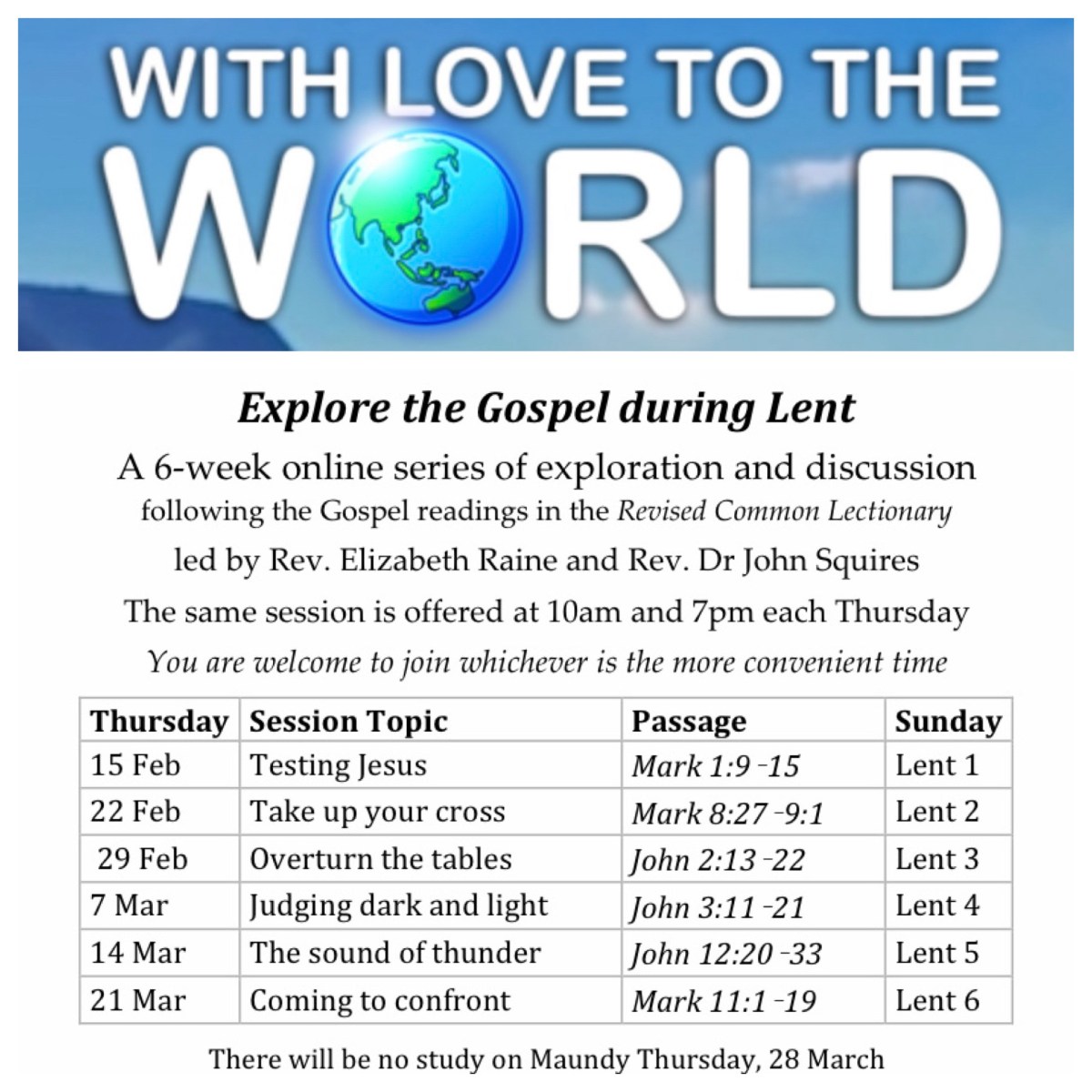
During Lent, you are invited to join an online Bible Study sponsored by With Love to the World, each Thursday, at either 10:00am or 7:00pm.

Forty days, led by the Spirit: Jesus in the wilderness (Mark 1)

This week we once more read and hear the beginning of the story that Mark tells, about the very early stages of the public activity of Jesus. We have already read about John the baptiser during Advent (Advent 2), and heard Mark’s account of the baptism of Jesus (Epiphany 1).

Now, in this week’s Gospel reading (Lent 1), Jesus is baptised, plunged deep into the water, from which he emerges changed (1:9–11), driven into the wilderness, with wild beasts and angels, to be tested (1:12–13), and then announces what his message and mission will be (1:15–15).

This baptism is sometimes regarded as Jesus attesting to a deeply personal religious experience that he had in his encounter with John, who had been preaching his message of repentance with some vigour (1:4-11). His encounter with John deepens his faith and sharpens his commitment.

The relationship between Jesus and John is interesting. In the orderly account of things being fulfilled, which we attribute to Luke, it is clear from the start that John is related to Jesus (Luke 1:36). By tradition, they are considered to be cousins–although the biblical text does not anywhere expressly state this.

It seems also that some of the early followers of Jesus had previously been followers of John himself. This is evidenced in the book of signs, which we attribute to the evangelist John. Andrew, later to be listed among the earliest group of followers of Jesus, appears initially as one of two followers of John (John 1:35-40). They express interest in what John is teaching (John 1:39).

Andrew is the brother of Simon Peter, later acknowledged as the leader of the disciples of Jesus. He tells his brother about Jesus. It is Peter who comes to a clear and definitive understanding of the significance of Jesus, even at this very early stage: “we have found the Messiah” (John 1:41). Andrew and John are thenceforth committed disciples of Jesus.

Was Jesus engaging in “sheep-stealing”? Certainly, the dynamic in the narrative is of a movement shifting away from John the baptiser towards Jesus the Messiah; the juxtaposition of these two religious figures can be seen at a number of points (John 1:20, 29-34, 35-36; see also 3:22-30).

See further thoughts on John the baptiser in John’s Gospel at

and

(And I am looking forward to reading more about John in the most recent book by James McGrath, Christmaker: a life of John the Baptist, published by Eerdmans.)

None of this story relating to John is in view in the account we read in this Sunday’s Gospel. The rapid-fire movement in this opening chapter simply takes us from John, baptising in the Jordan, to Jesus at the Jordan and then in the wilderness, and on into Galilee, beside the lake and in Capernaum (Mark 1:1–45).

See my comments on the character of Mark 1 at

Mark has no concern with exploring the relationship between Jesus and John. He wishes only to indicate that, at the critical moment of the beginning of the public activity of Jesus, it was through contact with John, his message and his actions, that Jesus was impelled into his mission.

The Gospel account moves quickly on from the baptism, to a very different scene, set in the wilderness, where Jesus is tested, challenged about his call (1:12-15). The wilderness was the location of testing for Israel (Exod 17:1-7; Num 11:1-15; Deut 8:2). By the same token, the wilderness was also the place where “Israel tested God” (Num 14:20-23), when Israel grumbled and complained to God (see Exod 14-17, Num 11 and 14). Wilderness and testing go hand-in-hand.

The reference to Jesus being “forty days” in the wilderness evokes both the “forty years” of wilderness wandering for the people of Israel (Exod 16:35; Deut 2:7, 8:2, 29:5; Neh 9:21; Amos 2:10, 5:25), as well as the “forty days” that Moses spent fasting on Mount Sinai (Exod 34:28; Deut 9:9-11,18,25; 10:10).

Forty, however, should be regarded not as a strict chronological accounting, but as an expression indicating “an extended period of time”, whether that be in days or in years. It points to the symbolic nature of the account.

We see this usage of forty, for instance, in the comment in Judges, that “the land had rest forty years” (Judges 5:31, 8:28)–a statement that really means “for quite a long time”. Likewise, Israel was “given into the hands of the Philistines forty years” (Judges 13:1) and Eli the priest served for 40 years (1 Sam 4:18).

David the king reigned for 40 years (2 Sam 5:4, 1 Kings 2:11; 1 Chron 29:27), his son Solomon then reigned for another 40 years (1 Kings 11:42; 2 Chron 9:30), as also did Jehoash (2 Kings 12:1) and his son Jeroboam (2 Kings 14:23). If we take these as precise chronological periods, it is all very neat and tidy and orderly–and rather unbelievable!

Other instances of forty point to the same generalised sense of an extended time. Elijah journeyed from Mount Carmel to Mount Horeb “forty days and forty nights” (1 Kings 19:8), whilst the prophet Ezekiel’s announcement of punishments lasting forty years (Ezekiel 29:10-13) is intended to indicate “for a long time”, not for a precise chronological period. Jonah’s prophecy that there will be forty days until Nineveh is overthrown (Jonah 3:4) has the same force.

So the story of the testing of Jesus for “forty days in the wilderness” is not a precise accounting of exact days, but draws on a scriptural symbol for an extended, challenging period of time.

Details about the conversation that took place whilst Jesus was being tested in the wilderness are provided in the accounts in the Gospels attributed to Matthew (4:1-11) and Luke (4:1-13). This is not the case in Mark, where the much shorter account (1:12-13) focusses attention on the key elements of this experience: the wilderness, testing, wild beasts, angels–and the activity of the Spirit.

For more on Jesus in the wilderness, see

and

The Markan account of this period of testing is typically concise and focussed. The constituent elements in the story continue the symbolic character of the narrative.

The note that “he was with the wild beasts” sounds like the wilderness experience was a rugged time of conflict and tension for Jesus. However, commentators note that the particular Greek construction employed here is found elsewhere in this Gospel to describe companionship and friendly association: Jesus appointed twelve apostles “to be with him” (3:14); the disciples “took him [Jesus] with them onto the boat” (4:36); the man previously possessed by demons begged Jesus “that he might be with him” (5:14); and a servant girl declares to Peter that she saw “you also were with Jesus” (14:67).

If this Greek construction bears any weight, then it is pointing to the companionable, friendly association of the wild beasts with Jesus—a prefiguring of the eschatological harmony envisaged at the end of time, when animals and humans all live in harmony (Isaiah 11:6-9; Hosea 2:18). The wilderness scene has a symbolic resonance, then, with this vision.

Alongside the wild beasts, angels are present—and their function is quite specifically identified as “waiting on him” (1:13). The Greek word used here is most certainly significant. The word diakonein has the basic level of “waiting at table”, but in Markan usage it is connected with service, as we see in the descriptions of Peter’s healed mother-in-law (1:31), the women who followed Jesus as disciples from Galilee to the cross (15:41), and most clearly in the saying of Jesus that he came “not to be served, but to serve” (10:45). The service of the angels symbolises the ultimate role that Jesus will undertake.

Finally, we note that the whole scene of the testing of Jesus takes place under the impetus of the Spirit, which “drove him out into the wilderness” (1:12). This was the place that Jesus just had to be; the action of the Spirit, so soon after descending on him like a dove (1:11), reinforces the importance and essential nature of the testing that was to take place in the wilderness.

And the action of “driving out” is expressed in a word, ekballō, which contains strong elements of force—the word is used to describe the confrontational moment of exorcism (1:34, 39; 3:15, 22-23; 6:13; 9:18, 28, 38). The testing in the wilderness becomes a moment when Jesus comes face to face with his adversary, Satan—and casts his power aside. The more developed dialogues in Matthew and Luke expand on this understanding of the encounter.

Both of the key elements in this reading (baptism and testing) serve a key theological purpose in Mark’s narrative. They shape Jesus for what lies ahead. They signal that Jesus was dramatically commissioned by God, then rigorously equipped for the task he was then to undertake amongst his people. The two elements open the door to the activities of Jesus that follow in the ensuing 13 chapters, right up to the time when the long-planned plot against Jesus, initiated at 3:6, is put into action (14:1-2).

Of course, this story is offered in the lectionary each year on the first Sunday in the season of Lent. It serves as an introduction to the whole season. Jesus being tested in the wilderness points forward, to the series of events taking place in Jerusalem, that culminate in his crucifixion, death, and burial.

The narrative arc of Mark’s Gospel runs from the baptism and wilderness testing, through to death at Golgotha and burial in a tomb. The weekly pattern of Gospel readings during Lent follows a parallel path, from the wilderness testing of Lent 1, to the entry into Jerusalem on Lent 6, the farewell meal on Maundy Thursday, and the death and burial on Good Friday.

That is the path that Jesus trod. That is the way that he calls us to walk.