
On Ash Wednesday each year, Christians around the world begin forty days (plus six Sundays) of the season of Lent. This is the focus for the first half of issue 17/6 of With Love to the World.
So often, when the season of Lent comes around each year, preachers inevitably start to talk about our “journey”, and seek to relate our “walk of faith” to the pathway that Jesus trod as he led his disciples, with firm and steadfast resolve, towards Jerusalem—the city where he knew what his fate would be.
Yet we are not tramping determinedly to our death at the end of Lent—at least, I hope we are not! And, in a sense, nor was Jesus. Yes, he would die in Jerusalem; he dies there because of the intersection of the plotting of Jewish leaders (always anxious about prophetic pretenders, as they probably saw him) and the co-operation of Roman authorities (always willing to act harshly to squash potential problems). But each Gospel attests, in its own way, to a life beyond the life that Jesus lived in Galilee and Judea.
Jesus has an ‘afterlife’ that leads him to appear to his followers, charge them with a global mission, and send the Spirit to renew and energise them in that mission. That’s how Matthew, Luke, and John portray what transpired around the time we mark as Easter—each in their own idiosyncratic way.
But this year (2024), we are following the story that the Gospel of Mark tells about Jesus; and we know that this account comes to an abrupt ending, right at the point where the news about Jesus, raised from the dead, is about to be broadcast (Mark 16:7–8). “They said nothing to nobody, for …” [my translation] is one way to render the awkward ending of this earliest Gospel. It is a peculiar way to end the story; many suggest that we may have lost Mark’s intended ending, as this sentence seems to trail off into nothing …
So here we face the question: how do we proclaim the good news that God raised Jesus from the dead, when our primary text (at least for this year) doesn’t report that? Yes, we can find hints in the words of Jesus (Mark 14:28) that are repeated by the young man in the empty tomb (Mark 16:7)—but the Gospel itself does not give us much more than this.
It is as if the author of this earliest written account of Jesus wants to hand the responsibility over to us—invite us to run with the story, to shape for ourselves the words and the actions which bear witness to the reality that Jesus has, indeed, “gone to Galilee”, and that we ourselves have seen him. What is the way that we, having traced the story of Jesus to this point, pick up the story and offer our own testimony to the living one who is in our midst?
In Mark’s Gospel, Jesus asks many questions; so do his followers, and his opponents. (I once counted them: this Gospel has 118 questions, in 668 verses!) I see the ending to Mark as another question—a big question, for us. He is not here. Jesus is risen. How do we proclaim that? How do we share this news? That is the big question addressed to us by this Gospel.
*****
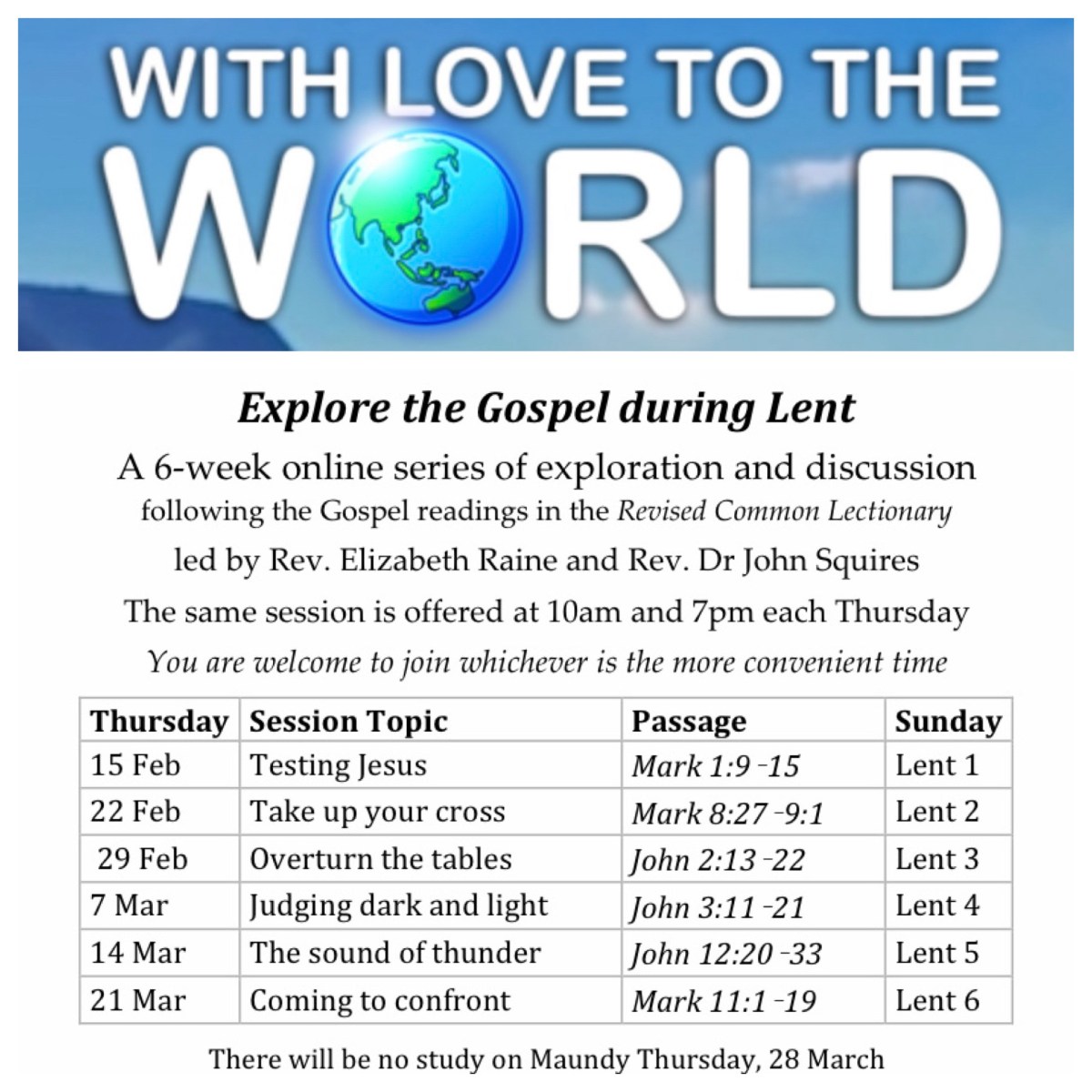
During Lent, you are invited to join an online Bible Study sponsored by With Love to the World, each Thursday, at either 10:00am or 7:00pm.


 An Informed Faith