The end of the ages; the beginnings of the birth pangs (Mark 13; Narrative Lectionary for Lent 5)

The Gospel reading which the Narrative Lectionary proposes for this coming Sunday (Mark 13:1–8, 24–37) is an excerpt from a longer speech, a block of teaching which Jesus delivered to his disciples (13:3–37) some time after they had arrived in the city of Jerusalem (11:1–11). It’s a striking speech, with vivid language and dramatic imagery. As Jesus’ last long speech in this Gospel, it certainly makes a mark!

The speech is delivered beside the towering Temple, built under Solomon, rebuilt under Nehemiah (13:1, 3). That temple was a striking symbol for the people of Israel—it represented their heritage, their traditions, their culture. The Temple was the place where the Lord God dwelt, in the Holy of Holies; where priests received sacrifices, designed to enable God to atone for sins, and offerings, intended to express the people’s gratitude to God; where musicians led the people in singing of psalms and songs that exulted God, that petitioned God for help, that sought divine benevolence for the faithful covenant people.

Or so the story goes; so the scriptures said; so the priests proclaimed. The holiest place in the land that was holy, set apart and dedicated to God. Yet what does Jesus say about this magnificent construction? “Not one stone will be left here upon another; all will be thrown down” (13:2). Jesus envisages the destruction of the Temple. Not only this; he locates that destruction within the context of widespread turmoil and disruption: “nation will rise against nation, and kingdom against kingdom; there will be earthquakes in various places; there will be famines” (13:8). And then, to seal this all, Jesus refers directly to the fact that “the end is still to come” (13:7).

The End. Eight centuries before Jesus, the prophet Amos had declared, “the LORD said to me, ‘the end has come upon my people Israel; I will never again pass them by’” (Amos 8:2). Amos continues, declaring that God has decreed that “on that day … I will make the sun go down at noon, and darken the earth in broad daylight. I will turn your feasts into mourning, and all your songs into lamentation; I will bring sackcloth on all loins, and baldness on every head; I will make it like the mourning for an only son, and the end of it like a bitter day” (Amos 8:9–10).

That image of The Day when the Lord enacts justice and brings punishment upon the earth, because of the evil being committed by people on the earth, enters into the vocabulary of prophet after prophet. Amos himself declares that it is “darkness, not light; as if someone fled from a lion, and was met by a bear; or went into the house and rested a hand against the wall, and was bitten by a snake. Is not the day of the LORD darkness, not light, and gloom with no brightness in it?” (Amos 5:18–20).

Isaiah, just a few decades after Amos, joined his voice: “the Lord of hosts has a day against all that is proud and lofty, against all that is lifted up and high … the haughtiness of people shall be humbled, and the pride of everyone shall be brought low; and the Lord alone will be exalted on that day” (Isa 2:12, 17). He warns the people, “Wail, for the day of the Lord is near; it will come like destruction from the Almighty!” (Isa 13:6).

Isaiah uses a potent image to describe this day: “pangs and agony will seize them; they will be in anguish like a woman in labour” (Isa 13:7). He continues, “the day of the Lord comes, cruel, with wrath and fierce anger, to make the earth a desolation, and to destroy its sinners from it” (Isa 13:8), and later he portrays that day as “a day of vengeance” (Isa 34:8).

Zephaniah, who was active at the time when Josiah was king (640–609 BCE) declares that “the day of the Lord is at hand; the Lord has prepared a sacrifice, he has consecrated his guests” (Zeph 1:7); “the great day of the Lord is near, near and hastening fast; the sound of the day of the Lord is bitter, the warrior cries aloud there; that day will be a day of wrath, a day of distress and anguish, a day of ruin and devastation, a day of darkness and gloom, a day of clouds and thick darkness ” (Zeph 1:14–15).

Habakkuk, active in the years just before the Babylonian invasion of 587 BCE, declares that “there is still a vision for the appointed time; it speaks of the end, and does not lie” (Hab 2:3); it is a vision of “human bloodshed and violence to the earth, to cities and all who live in them” (Hab 2:17).

Later, during the Exile, Jeremiah foresees that “disaster is spreading from nation to nation, and a great tempest is stirring from the farthest parts of the earth!” (Jer 35:32); he can see only that “those slain by the Lord on that day shall extend from one end of the earth to the other. They shall not be lamented, or gathered, or buried; they shall become dung on the surface of the ground” (Jer 35:33). He also depicts this day as “the day of the Lord God of hosts, a day of retribution, to gain vindication from his foes” (Jer 46:10).

And still later (most likely after the Exile), the prophet Joel paints a grisly picture of that day: “the day of the Lord is coming, it is near—a day of darkness and gloom, a day of clouds and thick darkness! Like blackness spread upon the mountains, a great and powerful army comes; their like has never been from of old, nor will be again after them in ages to come. Fire devours in front of them, and behind them a flame burns. Before them the land is like the garden of Eden, but after them a desolate wilderness, and nothing escapes them.” (Joel 2:1-3).

Later in the same oracle, he describes the time when the Lord will “show portents in the heavens and on the earth, blood and fire and columns of smoke; the sun shall be turned to darkness, and the moon to blood, before the great and terrible day of the Lord comes” (Joel 2:30–31). Joel also asserts that “the day of the Lord is near in the valley of decision; the sun and the moon are darkened, and the stars withdraw their shining” (Joel 3:14–15).

*****

The language of The Day is translated, however, into references to The End, in some later prophetic works. In the sixth century BCE, the priest-prophet Ezekiel, writing in exile in Babylon, spoke about the end that was coming: “An end! The end has come upon the four corners of the land. Now the end is upon you, I will let loose my anger upon you; I will judge you according to your ways, I will punish you for all your abominations.” (Ezek 7:2–3).

And again, Ezekiel declares, “Disaster after disaster! See, it comes. An end has come, the end has come. It has awakened against you; see, it comes! Your doom has come to you, O inhabitant of the land. The time has come, the day is near—of tumult, not of reveling on the mountains. Soon now I will pour out my wrath upon you; I will spend my anger against you. I will judge you according to your ways, and punish you for all your abominations.” (Ezek 7:5–8). This day, he insists, will be “a day of clouds, a time of doom for the nations” (Ezek 30:3; the damage to be done to Egypt is described many details that follow in the remainder of this chapter).

Obadiah refers to “the day of the Lord” (Ob 1:15), while Malachi asserts that “the day is coming, burning like an oven, when all the arrogant and all evildoers will be stubble; the day that comes shall burn them up, says the Lord of hosts, so that it will leave them neither root nor branch” (Mal 4:1).

Malachi ends his prophecy with God’s promise that “I will send you the prophet Elijah before the great and terrible day of the Lord comes; he will turn the hearts of parents to their children and the hearts of children to their parents, so that I will not come and strike the land with a curse” (Mal 4:5–6). This particular word is the final verse in the Old Testament as it appears in the order of books in the Christian scriptures; it provides a natural hinge for turning, then, to the story of John the baptiser, reminiscent of Elijah, who prepares the way for the coming of Jesus, evocative of Moses.

Another prophet, Daniel, declares that “there is a God in heaven who reveals mysteries, and he has disclosed to King Nebuchadnezzar what will happen at the end of days” (Dan 2:28), namely, that “the God of heaven will set up a kingdom that shall never be destroyed, nor shall this kingdom be left to another people. It shall crush all these kingdoms and bring them to an end, and it shall stand forever” (Dan 2:44).

Whilst the story of Daniel is set in the time of exile in Babylon—the same time as when Ezekiel was active—there is clear evidence that the story as we have it was shaped and written at a much later period, in the 2nd century BCE; the rhetoric of revenge is directed squarely at the actions of Antiochus IV Epiphanes, who had invaded and taken control of Israel and begun to persecute the Jews from the year 175BCE onwards.

The angel Gabriel subsequently interprets another vision to Daniel, “what will take place later in the period of wrath; for it refers to the appointed time of the end” (Dan 8:19), when “at the end of their rule, when the transgressions have reached their full measure, a king of bold countenance shall arise, skilled in intrigue. He shall grow strong in power, shall cause fearful destruction, and shall succeed in what he does. He shall destroy the powerful and the people of the holy ones.” (Dan 8:23–24). This seems to be a clear reference to Antiochus IV.

Still later in his book, Daniel sees a further vision, of seventy weeks (9:20–27), culminating in the time of “the end” (9:26). In turn, this vision is itself spelled out in great detail in yet another vision (11:1–39), with particular regard given to the catastrophes taking place at “the time of the end” (11:1–12:13; see especially 11:25, 40; 12:4, 6, 9, 13).

This final vision makes it clear that there will be “a time of anguish, such as has never occurred since nations first came into existence” (12:1), when “evil shall increase” (12:3) and “the wicked shall continue to act wickedly” (12:10). The visions appear to lift beyond the immediate context of the Seleucid oppression, and paint a picture of an “end of times” still to come, after yet worse tribulations have occurred.

***

Could these visions of “the end” be what Jesus was referring to, as he sat with his followers on the Mount of Olives, opposite the towering Temple? Later in the same discussion with his disciples, he indicates that “in those days, after that suffering, the sun will be darkened, and the moon will not give its light, and the stars will be falling from heaven, and the powers in the heavens will be shaken” (Mark 13:24). This picks up the language we have noted consistently throughout the prophetic declarations, in Amos, Joel, Isaiah, Habakkuk, Zephaniah, Ezekiel, and Daniel.

The judgement of God, says Jesus, with the “gathering up the elect from the four words, from the ends of the earth to the ends of heaven” (13:27), will be executed by “the Son of Man coming in clouds with great power and glory” (13:25)—language which draws directly from the vision of Daniel concerning “one like the Son of Man, coming with the clouds of heaven” (Dan 7:13).

So the resonances are strong, the allusions are clear. Jesus is invoking the prophetic visions of The Day, The End; the judgement of God, falling upon the wicked of the earth. And he deliberately applies these vivid and fearsome prophetic and apocalyptic traditions to what he says about the Temple.

By linking his teaching directly to the question of four of his disciples, Peter, James, John, and Andrew (Mark 13:3), enquiring about the Temple, Jesus appears to be locating the end of the Temple—its sacrifices and offerings, its psalms and rituals, its wealth and glory … and perhaps also its priestly class—in the midst of the terrible, violent retributive judgements of the Lord God during the days of the end.

The language also resonates with the end section of 2 Esdras, in which God informs “my elect ones” that “the days of tribulation are at hand, but I will deliver you from them”. Those who fear God will prevail, whilst “those who are choked by their sins and overwhelmed by their iniquities” are compared with “a field choked with underbrush and its path overwhelmed with thorns” and condemned “to be consumed by fire” (2 Esdras 16:74–78). (This book claims to be words of Ezra, the scribe and priest who was prominent in the return to Jerusalem in the 5th century BCE, but scholarly opinion is that it was written after the Gospels, perhaps well into the 2nd century CE.)

All of the happenings that are described by Jesus in his teachings whilst seated with his followers outside the Temple (Mark 13:3) can be encapsulated in this potent image: “this is but the beginning of the birth pangs” (13:8). This is imagery which reaches right back to the foundational mythology of Israel, which tells of the pains of childbirth (Gen 3:16). It is language used by prophets (Jer 4:3; 22:23; 49:2; 49:24; Hos 13:13; Isa 21:3; 66:7–8; Micah 4:9; 5:3).

This chapter in Mark’s Gospel, along with the parallel accounts in Luke (chapter 21) and Matthew (chapter 24), are regarded as instances of apocalyptic material. The meaning of apocalyptic is straightforward: it refers to the “unveiling” or “revealing” of information about the end time, the heavenly realm, the actions of God.

Such a focus does not come as a surprise to the careful reader, or hearer, of this Gospel. This style of teaching is consistent with, and explanatory of, the message which the Gospels identify as being the centre of the message proclaimed by Jesus: “The time is fulfilled, and the kingdom of God has come near; repent, and believe in the good news” (Mark 1:14); “repent, for the kingdom of heaven has come near” (Matt 4:17); “I must proclaim the good news of the kingdom of God to the other cities also; for I was sent for this purpose” (Luke 4:43). Each of these distillations of the message is apocalyptic—revealing the workings of God as the way is prepared for the coming of the sovereign rule of God.

Apocalyptic is the essential nature of Jesus’ teachings about “the kingdom of God”. This final speech confirms the thoroughly apocalyptic character of Jesus’ teaching. The parables he tells about that kingdom are apocalyptic, presenting a vision of the promised future that is in view. The call to repent is apocalyptic, in the tradition of the prophets. The demand to live in a way that exemplifies righteous-justice stands firmly in the line of the prophetic call. Such repentance and righteous-just living is as demanding and difficult as giving birth can be.

Mark’s Gospel has drawn to a climax with the same focussed attention to the vision of God’s kingdom, as was expressed at the start. The beginnings of the birth pangs are pointers to the kingdom that Jesus has always had in view. Jesus was, indeed, a prophet of apocalyptic intensity.

*****

I have written another blog that sets this apocalyptic teaching of Jesus into its literary and historical contexts, at

Lifted up in the wilderness (Num 21; John 3; Lent 4B)

A sermon preached by the Rev. Elizabeth Raine in Sunday worship at the Dungog Uniting Church on 10 March 2024.

The passage from Numbers which the lectionary places before us this Sunday (Num 21:4–9) is a strange reading. It is included in the lectionary primarily because it is alluded to in the passage from the Gospel of John, where the lifting up of Christ on the cross is compared to Moses lifting up the serpent in the wilderness (John 3:14–21).

For modern Western ears, this passage contains many unfamiliar or even superstitious concepts, concepts that do not fit with our Christian ideas of a God of love, compassion and forgiveness. Poisonous snakes biting the complaining people, bronze snakes on poles curing the bites – all of this seems to have stepped straight out of a myth.

I have always felt sorry for the Israelites in the story. The Hebrew text itself emphasises the psychological and physical predicament of the people. The Hebrew word translated as ‘impatient’ means a people who are utterly tired, completely discouraged and at the end of their tether – ‘impatient’ doesn’t begin to accurately describe their condition, and neatly lifts the blame for what follows from God onto the people.

And when the people begin to murmur against Moses and God, the retribution is swift. Instead of comforting the people, they are sent a plague of fiery serpents. Just imagine if you complained about the food at a restaurant and the chef’s response was to drop a red belly black on your table.

The punishment seems to be disproportionately harsh. Yet many of the commentators I looked at when preparing for this sermon took the line that Israel deserved to be punished. There seemed to be a calm acceptance that God’s action was good and necessary. I disagree, and the story needs some drastic reinterpreting to begin to make any sense, especially for us in a modern world.

The book of Numbers contains census, itineraries, statutes, rituals and priestly concerns, wilderness stories, and what is known as the ‘murmuring’ tradition. 

Other peculiar things found in Numbers include a talking donkey, the earth opening to swallow up people, fiery creatures, an extremely vengeful God and quarrelling prophets. Perhaps as an antidote to some of the other things, Numbers also contains the beautiful and well-known Priestly Blessing (The Lord bless you and keep you, Num 7:24-26). The promise of land is ever present in the book of Numbers, and the journey, albeit a long and circuitous one, depicts a gradual process of getting to the edge of that land.  

A lot of the material in Numbers is connected directly with the book of Exodus, especially in chapters 16 to 18, and the same journey of Israel in the wilderness is related somewhat differently. When the people’s complaint about the lack of food is heard in Exod 16–17, God provides them with meat, food and water. The God of Numbers is not quite so forgiving or generous.

In Exodus, God’s reaction was stern, but God heard and helped.  But in Numbers, God responds to complaint by killing the Israelites off with a plague of fiery snakes.

I can understand the weariness of the Israelites but I can’t understand the divinely sanctioned plague of snakes. What has changed? Is it God? Is it the people? Is it the author, who perhaps has a nastier and more theologically vindictive imagination than the author of Exodus?

The rabbis in the Targumim believed that the snakes came to teach humility and patience to a people apparently lacking both. The problem with this idea is twofold. First, it is hard to understand what lessons a bitten, and therefore dead person, can actually learn. And the surviving members of his or her family may not be terribly inclined to worship a God who sends such a punishment. 

Secondly snakes, particularly venomous ones, command our full attention. When someone mentions that a snake is nearby, I don’t stop to ask what lesson I can learn from its presence. Instead, I am much more inclined to climb a nearby tree or to run over the top of the nearest person to get away from it.

And what are these snakes? Numbers 21 does not use the common word for snake (nahash) but instead says the creatures are seraphs, a creature better known to us as the winged creatures around the throne of God in Isaiah’s vision: 

In the year that King Uzziah died, I saw the Lord sitting on a throne, high and lofty; and the hem of his robe filled the temple. Seraphs were in attendance above him; each had six wings: with two they covered their faces, and with two they covered their feet, and with two they flew. And one called to another and said: “Holy, holy, holy is the LORD of hosts;
the whole earth is full of his glory”
. (Isa. 6:1-3, NRSV)

These winged fiery creatures were known for their supernatural powers, both destructive and constructive.  The seraphs were the beings who carried the plagues and punishments decreed by the God.  They were also agents of healing and purification, as in the story from Isaiah. These seraphs were seenas fiery, serpent-like creatures, hence their association with venomous snakes.

When the people pray for forgiveness, God does not stop the plague of divinely-sanctioned poisonous seraphs but instead  commands Moses to craft a bronze seraph and raise it on a pole. When someone is bitten by a snaky seraph, they are to lift their eyes to the elevated bronze snake so as not to die from the bite. 

Theologically, this is a problematic solution. At best,  it appears as cheap grace: one glance at a serpent on a stick and all is restored. At worst, it reminds us of superstitious magic or of a healing idol of winged serpent, the type that was left behind in Egypt.

So what are we to do with this story of divine retribution, deadly angels and healing idols on sticks? 

We have seen with covid lockdowns that the wilderness, especially if we find ourselves in it for too long, can become life-draining, not life-giving. We can become worn out and disillusioned, and unsure where our journey is leading us. Our energy sapped, our faith tested, like the Israelites we became prey to self-doubt. 

We may find that deep spiritual and personal reflection spent in times ofwilderness has the downside of our own symbolic fiery seraphs returning to haunt us. Doubt, our past experiences and fears may get in the way as we attempt to move forward. Like the Israelites, we can tend to look downward to find mud and despair, and we miss seeing the stars of hope.

How do we prevent being stuck in the wilderness? 

In John 3, we find a first-century Christian author recycling the myth of Moses’ bronze seraph as a prophecy of the crucified one; the dying victim on a cross who is also the source of new life for those who look to him in faith. 

John’s gospel says the dreadful imagery of a crucified man achieves the same purpose. By looking toward the crucified Christ, the believer looks beyond it to the God who redeems. The symbol of the bronze serpent and the cross are signs of divine involvement in the people’s journey toward understanding, repentance and reconciliation.

In this case it will not just be ‘life’ given to the one who looks up to the Son of Man, but ‘eternal life’. John has taken the imagery of the bronze serpent and given it new meaning and power for the followers of Jesus. 

Most of us will have been overpowered by painful bites in our lives.  But the two lectionary stories today offer us comfort for those times. When we look up, we look to the face of the God who walks with us, who offers comfort to us, who helps restore us to equilibrium and who ultimately saves us.

To look up to Jesus as he is lifted up, is to see God’s healing presence in the world. Paradoxically, hidden in the crucifixion is the redemption and reconciliation of the Son of Man with God’s desire to heal the world. 

May we continue to look up, to see the stars and find hope and redemptionfrom the one who was crucified. And may we experience the love and healing that God intends us to find when we do. Amen.

Learning from the land (6): the Gringai of the northern Hunter area

Late last year, Elizabeth and I moved to Dungog, a rural town with a population of a little over 2,000, nestled amidst the rolling hills beside the Williams River, one of the tributaries that flows into the Hunter River. (The other major tributaries include Moonan Brook, Stewarts Brook, Pages Creek, Pages River, Paterson River, Goulburn River, and Wollombi Brook.)

The town has one picture theatre, one high school, two primary schools, three pubs, five active churches, five sports clubs, and six tennis courts. It is the place where Test cricketer Douglas Walters was born (in 1945) and later married, and where indigenous boxer Dave Sands died, aged 26, in a road accident in 1952.

The traditional lands of the Gringai include an area centred on the place where the town of Dungog is situated, next to the Williams River. It is often said that the name Dungog is derived from a word meaning “clear hills” or “thinly wooded hills” in Gathung, the language spoken by the Gringai . 

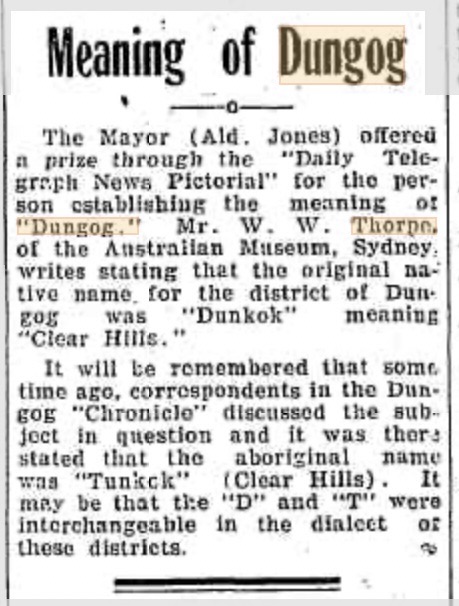
However, this is disputed by historians of the area, who maintain that this was most likely an incorrect explanation introduced in the 1920s. In an attempt to generate a growth in tourism to the town, the then Mayor of Dungog was looking for a perhaps slightly more ‘poetic’ meaning for the name of his town. The Mayor offered a prize through the “Daily Telegraph News Pictorial” for the person establishing the meaning of “Dungog”.

The Dungog Chronicle of 24 May 1927 (see above) reported that “Mr W.W. Thorpe of the Australian Museum, Sydney” declared that the original native name for the district of Dungog was “Dunkok” meaning “Clear Hills”.

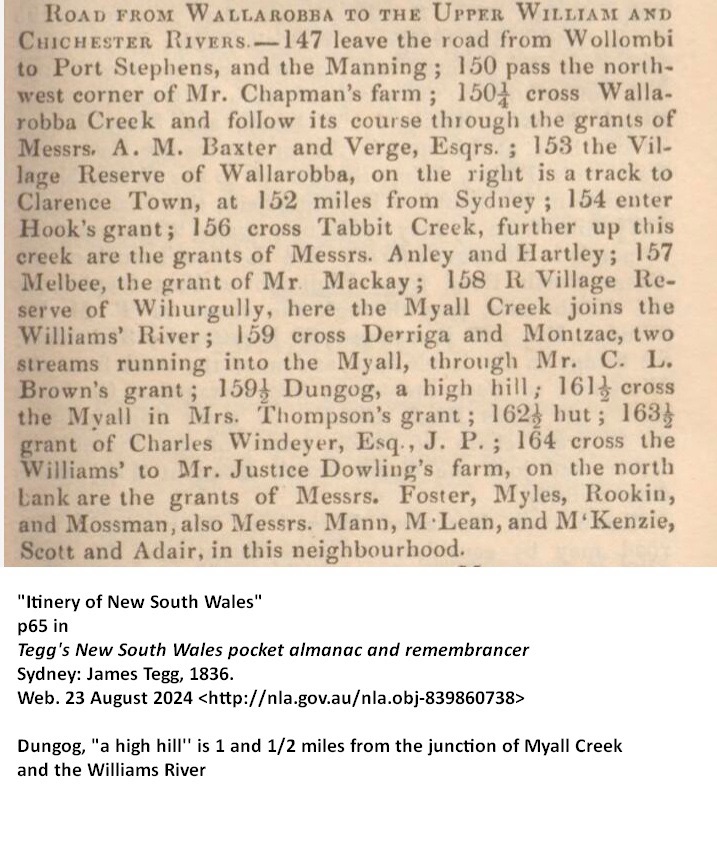
There are, however, references from the 1830s which offers a different explanation. On page 145 of The New South Wales calendar and general post office directory, 1832, there is a detailed description of the route of travel north from Sydney along the road to Wallarobba to what was then known as Upper William, the original name for the British village of Dungog. 

In this directory we are told that at a mile past the Melbee Estate comes the point where “the Myall Creek joins the William’s River”, at which is a “village reserve” called, not Dungog, but Wihurghully. The road then continues “following the course of the Myall, along its western bank” for another mile and a half, when it comes to “Dungog, a high hill, part of the range, dividing the waters of the William and Myall”. So the word was originally the name of a specific location, a high hill, to the east of where the town now sits.

As I have done with each move of recent times, I have taken some time to investigate a little of what is known about the First Peoples of the area to which we have moved. I have been exploring the stories about contact between the invading British colonisers and the First Peoples who have cared for the land from time immemorial.

In years past, I have found stories about people in the places where Elizabeth and I have lived: the Eora peoples of Sydney, where I grew up and lived for decades; the Biripi peoples, on the mid north coast of NSW; and the Noongyar peoples, of Perth, WA. More recently, I have read and learnt about the Ngunnawal, Ngarigo, and Ngambri peoples, whose lands overlapped in the southern of Canberra, where we were living. It is always an enriching process. You can find the link to my blogs about these peoples and their lands at the end of this blog.

This time, the task of investigating and reporting has been somewhat more difficult. The land council for the area where the Gringai lived is based in Karuah, where the Karuah River flows into Port Stephens. As far as I can tell, there are very few people who claim Gringai heritage today in the area. The invading British colonisers, in their insatiable search for land to settle in the early 19th century, were quite thorough, it would seem, in removing from that land those Indigenous people who had lived on it for millennia.

There are scattered references to the Gringai people in the writings of the settlers from the late 19th century. (I am indebted to Noel Downs, who provided me with links to this material.) And it seems that there has been some debate about the precise scope of the lands of the Gringai, and their relationship to the neighbouring nations of the Wonnarua and the Biripi.

A local history site refers to “two major tribal groups of the broader Hunter River Valley and coastal region; the Wonnarua of the Hunter Valley and the Worimi of the Port Stephens coast area” and claims that “the Gringai were not a separate tribe but a sub-group of one of the two region’s tribes, though which one is in some doubt, with perhaps the Wonnarua being the more likely.” See

Working from “land borders” is a very western way of operating; we want to identify and demarcate the lands of one people from another by drawing a clear, precise border. We erect fences around houses, draw lines to mark off states and set up different time zones according to those lines, and have stern staff at the borders of the country to ensure that “undesireables” don’t enter the country. It’s all very precise.

However, Indigenous life was not so squared-off and precise. I remember an Aunty in Wauchope telling us about land not far from where we lived, that was in Biripi country but was considered Dunghutti land, as that was where the two groups of people would meet and yarn and trade—and also where marriages were arranged. This is something that jars to western ears—how can both sets of people “own” the same land?

A better way to go is to be guided by the markers which linguists make from their study of what we know of the languages of the peoples of the First Nations. Linguist Amanda Lissarrague has researched and published A grammar and dictionary of Gathang, in which she explores the links between “the languages of the Birrbay, Guringay and Warrimay peoples”.

These languages, spoken on the northern side of the Hunter River, she identifies as the Lower North Coast (LNC) language also known as Katang, or Guthang. This is distinguished from the Darkinjung and Wanaruah, on the south of the Hunter River, who speak the Lake Macquarie (HRLM) language. 

[Lissarrague’s argument for linking the three groups into the LNC language is technical: “The evidence for linking Wonnarua (M, F), Awabakal (T), Kuringgai (L) and ‘Cammeray’ (M2) is found when one compares verbal inflections and pronoun forms, including bound pronouns, from different sources.” ]

In 1788, Britain established a penal colony at a place that was named Sydney Cove, after Thomas Townshend, the 1st Viscount Sydney. Early in the colonial era, the invading settlers began moving into the region north of Sydney, building on land and claiming the use of that land, citing the grant of land from the British Governor in support of that activity. That inevitably brought them into conflict with the local pIndigenous peoples, who had cared for this land from time immemorial. We now know that this relationship with the land has stretched back at least 60,000 years—perhaps even longer.

The first exploration of the Hunter, Williams and Paterson Rivers by those invading British colonisers had already commenced just 13 years after that initial settlement in Sydney. Convict timber cutters were sent into the area from 1804 onwards, and small land grants at Paterson were made from 1812, and at Clarence Town from 1825.

The Williams River near Dungog

By 1825 most of the prime alluvial land along the lower reaches of the Paterson River had been granted to the settlers amongst the British colonists who prosecuted the increasing invasion of Aboriginal land. This scale of settlement drastically reduced the hunting areas of the Indigenous people, restricted their supply of game and materials, and further exposed them to diseases brought by the British, against which they had little or no immunity.

In 1825, Robert Dawson named the Barrington area after the British Lord Barrington (who had never travelled downunder, of course, to this area). Two young Welshmen, George Townshend (1798–1872) and Charles Boydell (1808–1869), arrived in Australia on 22 March 1826 to take up land grants in the region. They named the Allyn River, the locality of Gresford, and their homesteads, Trevallyn and Camyr Allyn, after places near their homes in Wales.

In 1827, surveyor Thomas Florance named the Chichester River after the city of that name in England. Then, in 1829, George Boyle White explored the sources of the Allyn and Williams rivers. (The origins of the name for the Williams River is uncertain; see the excellent discussion at https://williamsvalleyhistory.org/williams-river-origin/)

Land grants along the Williams River were made to a number of men, including Duncan Mackay, John Verge, and James Dowling (after whom the main street of Dungog is named). Dowling was later to become the second Chief Justice of NSW, serving from 29 August 1837 to 27 September 1844, the day of his death.

The practice of obliterating the Indigenous names by imposing English names is evident in a number of names in the region. The river known as Coqun, meaning “fresh water”, was renamed the Hunter River, after Vice-Admiral John Hunter, the second Governor of NSW (1795–1800). The river known as Yimmang is now known as the Paterson River, named after Colonel William Paterson, who surveyed the area beside the river in 1801. Erringi, meaning “black duck”, was renamed Clarence Town in 1832, after the Duke of Clarence, who had been crowned King William IV in 1830—who, of course, never came to the colonies!

Some Gringai words are retained in the names of the Wangat River and the rural locations of Wallarobba (“rainy gully”), Dingadee (“place for playing games”), Wirragulla (“place of little sticks”), Mindarabbah (“hunter”), and Bolwarra (“high place”).

See https://trove.nla.gov.au/newspaper/article/134093649

See also

https://www.patersonhistory.org.au/museumaboriginal.pdf

A steadfast love that endures forever (Psalm 107; Lent 4B)

“O give thanks to the Lord, for he is good; for his steadfast love endures forever” (Ps 107:1) is the opening sentence of the psalm that is proposed by the lectionary for this coming Sunday, the Fourth Sunday in Lent. The reference to “steadfast love” recurs in verses 8, 15, 21, and 31, as the psalmist recounts key moments in the long story of the people of Israel and invites those hearing their words, “let them thank the Lord for his steadfast love”, before the psalm concludes, “let those who are wise give heed to these things, and consider the steadfast love of the Lord” (v.43).

Elsewhere throughout the psalms there are many references to God’s steadfast love: an affirmation that “with the Lord there is steadfast love, and with him is great power to redeem” (Ps 130:7); a plea, “let your face shine upon your servant; save me in your steadfast love” (Ps 31:16); a note of praise that “steadfast love and faithfulness will meet; righteousness and peace will kiss each other” (Ps 85:10); and the recurring phrase, “his steadfast love endures forever”, throughout the song recalling the acts of God in Ps 136. (The phrase occurs in each of the 26 verses of this psalm, and then around 100 times in the other psalms.)

The English phrase “steadfast love” translates an important Hebrew word, חֶ֫סֶד (hesed). It signifies a love that is loyal, faithful, dependable, and on many occasions, unconditional. The word is applied both to human beings, as they exhibit “steadfast love” to one another, but also—and more often—to God, who shows “steadfast love” to the people of Israel, with whom God was bound in covenant. This is clear from the use of the word in the final verse of Micah’s prophetic words, affirming that God “will show faithfulness to Jacob and unswerving loyalty (hesed) to Abraham, as you have sworn to our ancestors from the days of old” (Mic 7:20).

Moses is reported as having told Israel that “the Lord your God is God, the faithful God who maintains covenant loyalty (hesed) with those who love him and keep his commandments, to a thousand generations” (Deut 7:9). God, speaking through the prophet Nathan, offers assurance that “I will not take my steadfast love (hesed) from him [David], as I took it from Saul, whom I put away from before you” (2 Sam 7:15).

The unnamed prophet (by tradition, Jeremiah) who laments the destruction of Jerusalem and the ravaging of her people includes at the heart of their extended poems the ringing affirmation that “the steadfast love (hesed) of the Lord never ceases, his mercies never come to an end” (Lam 3:22). And then Nehemiah, when he hears about the damage in the city to which the exiles are returning, prays to the Lord, “God of heaven, the great and awesome God who keeps covenant and steadfast love (hesed) with those who love him and keep his commandments” (Neh 1:5; also 9:32).

So the steadfast love of the Lord is celebrated in the foundational sagas of the Israelite people, where it is found in words attributed to key characters such as Jacob (Gen 32:9–10), Moses (Exod 15:13; Num 14:18–19), David (2 Sam 2:6; 15:19–20; 22:51; 1 Chron 16:34), Solomon (1 Ki 3:6; 8:23-24; 2 Chron 1:8; 6:14–15, 42), Ezra (Ezra 7:27–28; 9:9; Neh 9:32) and Nehemiah (Neh 1:5; 13:22).

The Chronicler reports that under David, a specific group was engaged in the Temple “to render thanks to the Lord, for his steadfast love endures forever” (1 Chron 16:41); this continues under Solomon (2 Chron 7:4-6) and is reinstated after the Exile under Nehemiah (Ezra 3:10-11). So there is recurrent noting of the song which is regularly offered to God, “O give thanks to the Lord, for he is good; for his steadfast love endures forever” (1 Chron 16:34; 2 Chron 5:13; 7:3; 20:21; Ezra 3:11; Jer 33:10-11; in Ps 136 and in a number of other psalms).

Furthermore, God is affirmed as being “merciful and gracious, slow to anger, and abounding in steadfast love and faithfulness, keeping steadfast love for the thousandth generation” in a number of books (Exod 34:6; 2 Chron 30:8–9; Neh 9:17, 32; Jonah 4:2; Joel 2:13; Ps 86:15; 103:8, 11; 111:4; 145:8–9).

The compilers of the Revised Common Lectionary have selected a psalm for each Sunday of the year, noting that this has normally been in order to provide a passage that complements the First Reading, which is most often a passage from Hebrew Scripture. In this instance, the portion of the psalm chosen (Ps 107:17-22) appears to match a story told in Numbers, when poisonous serpents are sent by God to punish the complaining Israelites (Num 21:4–9).

The psalm summarises the incident as a time when “some were sick through their sinful ways” (v.17) and “loathed any kind of food” (v.18); this only generally approximates the account of Numbers, in which the people complain that “there is no food and no water, and we detest this miserable food” (Num 21:5). There is no mention in the psalm of the “poisonous [or fiery] serpents” sent by God to punish the people (Num 21:6), simply that “they drew near to the gates of death” (v.18), presumably because they did not eat the “miserable food”, whereas in the narrative of Numbers “many Israelites died” from being bitten by the serpents (Num 21:6).

Certainly, in both the poetry of the psalm and the prose of the narrative account, the people seek relief from the Lord God. The psalmist reports that “they cried to the Lord in their trouble, and he saved them from their distress … he healed them, and delivered them from destruction” (v.19-20). The prayer has been effective, so the song continues with the refrain, “let them thank the Lord for his steadfast love, for his wonderful works to humankind” (v.21) and an encouragement to the people to offer sacrifices and joyful songs (v.21).

In Numbers, it is Moses who offers prayer (Num 21:7), but an additional element is included: the Lord instructs Moses to “make a poisonous [or fiery] serpent, and set it on a pole; and everyone who is bitten shall look at it and live” (Num 21:8). Moses does as instructed, and so “whenever a serpent bit someone, that person would look at the serpent of bronze and live” (Num 21:9). Simply looking at the bronze figure was sufficient to effect healing! (And the narrative gives no indication of the response of the people to such healing, in contrast to the extended joyful response of the psalmist.)

On the language for “poisonous [or fiery] serpent” used in the story told in Numbers, see

As we hear this psalm this coming Sunday, we would do well to recall the joyful response to the way that God has acted, with a steadfast love that endures forever, that the psalmist reports. May this be our experience and our practice as we encounter difficulties in our lives and, through faith and persistence, surmount them and thrive.

The priority of the Torah: love God, love neighbour (Mark 12; Narrative Lectionary for Lent 4)

“You shall love the Lord your God with all your heart, and with all your soul, and with all your strength, and with all your mind” (Deuteronomy 6:5). “You shall love your neighbour as yourself” (Leviticus 19:8). These two commandments are cited in a story about Jesus engaging in a discussion with a scribe, a teacher of the Law, which ends with Jesus saying, “there is no commandment greater than these” (Mark 12:31).

The Narrative Lectionary includes this story (Mark 12:28–34) as the opening section of a longer Gospel passage that is proposed for worship this coming Sunday (12:28–44). It’s a passage that takes us deep into the heart of Torah—those guidelines for living all of life in covenant faithfulness with God. Torah sits at the centre of Judaism. See more on this at

Of course, Jesus hasn’t answered the question precisely in the terms that it was asked; he doesn’t indicate what is “the first” commandment, but which two are “greatest”. It’s like a dead heat in an Olympic race: a race when even a finely-tuned system can’t differentiate between the two winners, even down to one thousandth of a second. Both love of God and love of neighbour are equally important. Joint winners—like that high jump competition a year or two back where the two leading jumpers just decided to share the gold medal, rather than keep competing—and risk not getting gold.

Both commands are biblical commands, found within the foundational books of scripture within Judaism. They were texts that Jewish people, such as Jesus and his earliest followers would have known very well. Each command appears in a significant place within the books of Torah, the first five books of Hebrew Scriptures.

The command to “love God” sits at the head of a long section in Deuteronomy, which reports a speech by Moses allegedly given to the people of Israel (Deut 5:1–26:19). The speech rehearses many of the laws that are reported in Exodus and Leviticus, framing them in terms of the repeated phrases, “the statutes and ordinances for you to observe” (4:1,5,14; 5:1; 6:1; 12:1; 26:16–17), “the statutes and ordinances that the Lord your God has commanded you” (6:20; 7:11; 8:11).

After proclaiming the Ten Commandments which God gave to Israel through Moses (Deut 5:1–21; cf. Exod 20:1–17) and rehearsing the scene on Mount Sinai and amongst the people below (5:22–33; cf. Exod 19:1–25; 20:18–21). Moses then delivers the word which sits at the head of all that follows: “Hear, O Israel: The LORD is our God, the LORD alone. You shall love the LORD your God with all your heart, and with all your soul, and with all your might. Keep these words that I am commanding you today in your heart” (Deut 6:4–6). This, it would seem, is the key commandment amongst all the statutes and ordinances.

These words are known in Jewish tradition as the Shema, a Hebrew word literally meaning “hear” or “listen”. It’s the first word in this key commandment; and more broadly than simply “hear” or “listen”, it caries a sense of “obey”. These words are important to Jews as the daily prayer, to be prayed twice a day—in keeping with the instruction to recite them “when you lie down and when you rise” (Deut 6:7). As these daily words, “love the Lord your God” with all of your being are said, they reinforce the centrality of God and the importance of commitment to God within the covenant people.

The command to “love your neighbour” in Leviticus 19 culminates a series of instructions regarding the way a person is to relate to their neighbours: “you shall not defraud your neighbour … with justice you shall judge your neighbour … you shall not profit by the blood of your neighbour … you shall not reprove your neighbour … you shall love your neighbour” (Lev 19:13–18).

These instructions sit within the section of the book which is often called The Holiness Code—a section which emphasises the word to Israel, that “you shall be holy, for I the Lord your God am holy” (Lev 19:2; also 20:7, 26). Being holy means treating others with respect. Loving your neighbour is a clear manifestation of that ethos. Loving your neighbour exemplifies the way to be a faithful person in covenant relationship with God.

So it is for very good reasons that Jesus extracts these two commandments from amongst the 613 commandments that are to be found within the pages of the Torah. (The rabbis counted them all up—there are 248 “positive commandments”, giving instructions to perform a particular act, and 365 “negative commandments”, requiring people to abstain from certain acts.)

Jesus, of course, was a Jew, instructed in the way of Torah. He knew his scriptures—he argued intensely with the teachers of the Law over a number of different issues. He frequented the synagogue, read from the scroll, prayed to God, and went on pilgrimage to Jerusalem and into the Temple—where, once again, he offered a critique of the practices that were taking place in the courtyard of the Temple (11:15–17).

Then he engaged in debate and disputation with scribes and priests (11:27), Pharisees and Herodians (12:13), and Sadducees (12:18). Each of those groups came to Jesus with a trick question, which they expected would trap Jesus (12:13). Jesus inevitably bests them with his responses (11:33; 12:12, 17, 27). It was at this point that the particular scribe in our passage approached Jesus, perhaps intending to set yet another trap for him (12:28).

So Jesus, good Jew that he was, is well able to reach into his knowledge of Torah in his answer to the scribe. The commandments that he selects have been chosen with a purpose. They contain the essence of the Torah. His answer draws forth the agreement of the scribe—there will be no robust debate now! In fact, in affirming Jesus, the scribe reflects the prophetic perspective, that keeping the covenant in daily life is more important that following the liturgical rituals of sacrifice in the Temple (see Amos 5:21–24; Micah 6:6–8; Isaiah 1:10–17).

The scene is similar to a Jewish tale that is reported in the Babylonian Talmud, a 6th century CE work. In Shabbat 31a, within a tractate on the sabbath, we read: “It happened that a certain non-Jew came before Shammai and said to him, ‘Make me a convert, on condition that you teach me the whole Torah while I stand on one foot.’ Thereupon he repulsed him with the builder’s cubit that was in his hand. When he went before Hillel, he said to him, ‘What is hateful to you, do not to your neighbour: that is the whole Torah, the rest is the commentary; go and learn it.’”

Hillel, of course, had provided the enquiring convert, not with one of the 613 commandments, but with one that summarised the intent of many of those commandments. We know it as the Golden Rule, and it appears in the Synoptic Gospels as a teaching of Jesus (Matt 7:12; Luke 6:31).

Some Jewish teachers claim that the full text of Lev 19:18 is actually an expression of this rule: “You shall not take vengeance or bear a grudge against any of your people, but you shall love your neighbour as yourself: I am the LORD.” Later Jewish writings closer to the time of Jesus reflect the Golden Rule in its negative form: “do to no one what you yourself dislike” (Tobit 4:15), and “recognise that your neighbour feels as you do, and keep in mind your own dislikes” (Sirach 31:15).

Paul clearly knows the command to love neighbours, for he quotes it to the Galatians: “the whole law is summed up in a single commandment, ‘You shall love your neighbour as yourself’” (Gal 5:14), and James also cites it: “you do well if you really fulfill the royal law according to the scripture, ‘You shall love your neighbour as yourself’” (James 2:8). Both writers reflect the fact that this was an instruction that stuck in people’s minds!

And I wonder … perhaps there’s a hint, in these two letters, that the greater of these two equally-important commandments is actually the instruction to “love your neighbour”?

*****

I have provided a more detailed technical discussion of the words used in this passage, and its Synoptic parallels, in this blog:

On the Pharisees and Torah, see

Reading Hebrew Scripture throughout Lent (Exodus 20 and other passages)

We are in the season of Lent, a 40-day season in the Christian calendar when the focus is firmly on the pathway that Jesus trod as he walked towards Jerusalem, where he would meet his fate. The Gospel passages offered by the lectionary include the baptism and testing of Jesus at the start of his ministry (Mark 1), his prediction about what awaits him in Jerusalem (Mark 8), the incident in the temple (in the version told in John 2), his saying about a grain of wheat falling into the ground and dying (John 12), and ultimately his entry into the city to the acclamation of the crowd (Mark 11).

These passages, rightly, attract the attention of preachers during the season of Lent. And each Sunday, a psalm is offered to accompany and often complement the particular Gospel reading for that Sunday. These psalms offer reflections on the nature of God and God’s covenant relationship with the people of God. I have been offering weekly blogposts reflecting on the Gospel and the Psalm for each Sunday.

However, the sequence of Hebrew Scripture passages proposed by the lectionary during Lent also merit our consideration. At this midpoint of the season, it is appropriate to pause and reflect somewhat on the passages that are designated by the lectionary. For this past Sunday, the Ten Words that God gave to Moses (Exodus 20:1–17) were the Hebrew Scriptures passage. These words set out the requirements of the people as they commit to the covenant with the Lord God. I have reflected on this when the passage occurred last year during the season after Pentecost; see

This sequence of passages began with two excerpts from Genesis, in which that covenant is described in passages. In the first passage (Gen 9:8–17), the covenant is made with Noah, “with you and your descendants after you, and with every living creature that is with you, the birds, the domestic animals, and every animal of the earth with you, as many as came out of the ark” (Gen 9:9–10). It is striking that this is not just a covenant with a select group of human beings, but a covenant with the whole of creation—humans and other creatures, “every living creature of all flesh” (Gen 9:15–17).

The Hebrew word translated as “creature” is nephesh, which is a highly significant word. being. In Hebrew, nephesh has a unified, whole-of-person reference, quite separate from the dualism that dominates a Greek way of thinking. It is used to refer to the whole of a human being.

Nephesh appears in the second creation story, where it describes how God formed a man from the dust of the earth and breathed the breath of life into him, and “the man became a living being (nephesh hayah)” (Gen 2:7). It appears also a number of times in the first creation story in Hebrew scripture, where it refers to “living creatures” in the seas (Gen 1:20, 21), on the earth (Gen 1:24), and to “every beast of the earth, and to every bird of the air, and to everything that creeps on the earth, everything that has the breath of life (nephesh hayah)” (Gen 1:30).

The claim that each living creature is a nephesh is reiterated in the Holiness Code (Lev 11:10, 46; 17:11). The fact that all living creatures are nephesh signals the inherent interconnectedness of all creation. The covenant forged in Gen 9 is one that has a cosmic scope.

In the second passage (Gen 17:1–7, 15–16), the covenant is made, or perhaps renewed, with Abraham as “the ancestor of a multitude of nations” (Gen 17:4). The Lord God declares that this covenant relationship is “between me and you, and your offspring after you throughout their generations, for an everlasting covenant, to be God to you and to your offspring after you” (Gen 17:7).

The means for sealing this covenant is circumcision (Gen 17:10–14). The lectionary skips over these verses, which have been critical for Israelites and Jews through the centuries, as circumcision has been one of the central identity markers for those who adhere to the Torah given by God through Moses.

The covenant had been made with Abraham after his meeting with Melchizedek (Gen 15:18), with the cutting of animals to signify this covenant (Gen 15:9–10). In this passage, however, it is the circumcising of all males which confirms this covenant relationship. And the passage makes it clear that it is not Ishmael, the son of Abraham through Hagar (Gen 16:15–16) who will provide the line through which the covenant continues; it will be a son born to Sarai who will provide that continuity (Gen 17:16).

That same covenant is then renewed with that son, Isaac (Gen 17:19, 21) and then with Jacob (Israel) (Gen 35), and later is extended to Moses and the whole people (Exod 19), which is where the Ten Words are given, articulating the terms and conditions of that covenant. Later still, the promise that this covenant is to be renewed with the people again is articulated by Jeremiah (Jer 31).

For my consideration of the covenant with Abraham, see

The passages that follow after this Sunday’s focus on the Ten Words (Exod 20:1–17) continue the theme of covenant. The story of the impatience of the people, in the wilderness after they had left Mount Hor (Num 21:4–9), offers both a warning to those who would breach the covenant—they will die (v.6)—and also a reaffirmation of the centrality of the covenant relationship between Israel and God.

The people recognise that they have sinned (v.7) and thus the punishment has been merited. However, Moses stands as intermediary between the people and the Lord God (v.7), and a reminder of the commitments that the people had made is raised before them (vv.8–9). And as the psalmist sings, it is because of the steadfast love of the Lord (Ps 107:1, 21) that they are healed and saved (vv.19–20). This is the love that undergirds the covenant and drives the relationship of the Lord God with regard to Israel. See

On the following Sunday, the lectionary offers a visit to a familiar and widely-cited passage from the prophet Jeremiah, in which the “new covenant” is canvassed (Jer 31:31–34). In this covenant, God promises that “I will put my law within them, and I will write it on their hearts” (v.33); the blessings continue to be that “I will forgive their iniquity, and remember their sin no more” (v.34).

These terms and conditions reflects the initial covenant, the words of which the people are to “write on the doorposts of your house and on your gates” (Deut 6:9), and which likewise promised that God will forgive iniquity (Num 14:18–20). It seems that what Jeremiah is speaking about is not a new covenant, per se, but a renewal of the covenant made earlier with Noah, Abraham, and then Moses. See

Finally, the Hebrew Scripture passage for the sixth Sunday in Lent (Isa 50:4–9a) is one of the well-known Servant Songs from the second main section of Isaiah (Isa 40—55). There are four Songs of the Servant—three relatively brief (42:1–9; 49:1–7; 50:4–11); and the fourth, best-known within Christian circles, a longer description of the servant who “was despised and rejected by others; a man of suffering and acquainted with infirmity” (Isa 52:13–53:12).

In the second of these songs, Isaiah had looked for “my servant … my chosen … [who] will bring forth justice to the nations … he will faithfully bring forth justice … [he will] establish justice in the earth” (Isa 42:1–4). In this third song, the Servant is described as a teacher, “that I may know how to sustain the weary with a word” (v.4), who would stand up to his adversaries (v.8). So he declares, “I have set my face like flint, and I know that I shall not be put to shame” (v.7), exuding confidence because “he who vindicates me is near” (v.8).

The song provides a firm assurance that the justice for which the Servant is working will, indeed, eventuate. That Servant fulfils the word announced at the start of this prophet’s work; of “the voice … crying in the wilderness” (40:4, 6), the prophet poses the rhetorical,question, “who. did he consult for his enlightenment, and who taught him the path of justice? who taught him knowledge, and showed him the way of understanding?” (40:14).

It is, of course, the Lord God who so instructs the voice in the wilderness (40:9–11, 22–23). And it is the Servant who brings to fulfilment the promises articulated by the prophet, and whom Christians see as being brought to fruition in Jesus of Nazareth—which makes this a most appropriate Hebrew Scripture passage to conclude this sequence of passages offered throughout Lent.

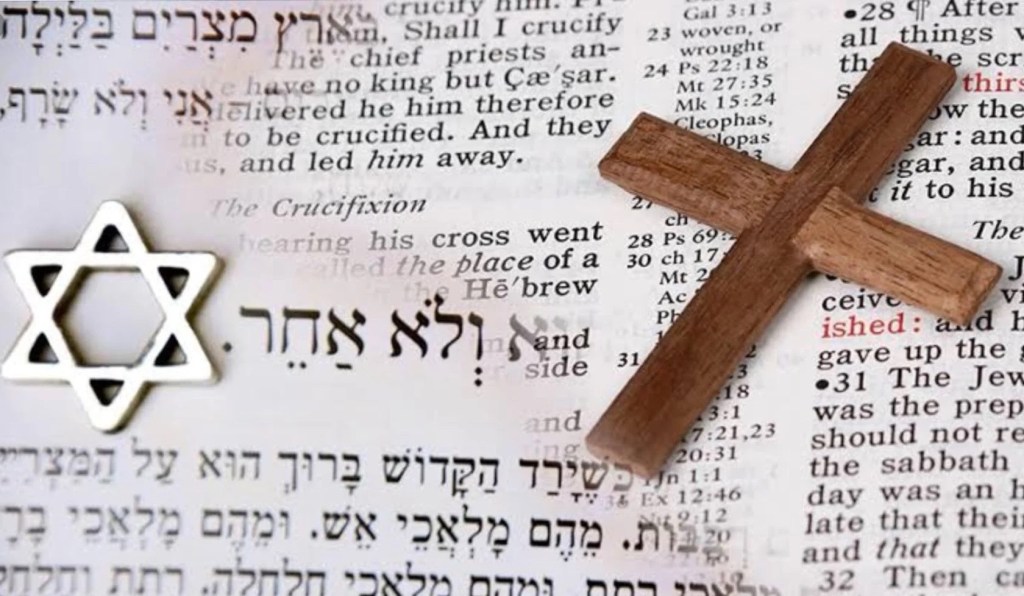
As we look over these passages, we need to remember that we are to be very careful in how we speak about these passages. We do well to remember that we are taking passages from scriptures that are sacred to people of another faith, which existed long before the Christian faith came into being as a system of belief; indeed, long before Jesus himself was born.

We know “in our heads” that Christianity emerged from the Jewish faith—but often we act as if this newly-formed religious system now stands in the place of Judaism, as the body of belief to which the Lord God, the ancient of days, now relates and responds; and that Judaism itself is now obsolete, no longer relevant, superseded. Presenting readings from Hebrew Scripture as if they speak directly and clearly about Jesus, and about us as followers of Jesus, without any reference to what came before him, continues such an attitude.

Judaism is not, of course obsolete; there are still millions of people holding the beliefs of Judaism and keeping the practices of Judaism around the world—in Israel, in the United States, in Australia, and in any other countries. The Jewish faith has not ended; Christian believers have not superceded Jews as God’s chosen people.

God’s covenant with Jewish people continues; as Paul declared so clearly, “God has not rejected God’s people” (Rom 11:1), “the gifts and the calling of God [to Israel] are irrevocable” (Rom 11:29). The covenant traced through these Lenten passages flows on, into the story of Jesus and then of his followers. And whilst “salvation has come to the Gentiles” (Rom 11:11), even so, Paul asserts, “all Israel will be saved” (Rom 11:26), for “as regards election, they are beloved” (Rom 11:28). See more at

https://johntsquires.com/2020/08/10/god-has-not-rejected-his-people-all-israel-will-be-saved-rom-11/

Indeed, there is much in common amongst these two faith. Jews and Christians each orient our belief towards the same God, the God of Abraham and Sarah, of Isaac and Rebekah, the God of Moses, Aaron, and Miriam—those who first entered into covenant with the Lord God. Christians believe that this God is the same as the God of Mary and Jesus, of Peter and Paul, of Priscilla and Phoebe, and the God in whom we believe; and so, that ancient covenant continues on today, not only amongst Jews, but also amongst Christian’s. We need to give due acknowledgement of that reality in our worship and preaching.

Supersessionism is a term used to describe the way that the Church, through the centuries, has simply taken over Jewish elements (such as scripture, the covenant, the Ten Commandments, Pentecost, the Passover Seder—and these specific passages that we are hearing this Lent). We have “baptised” them so that believers have the view that these are Christian elements, without any sense of their Jewish origins—and their continuing place in contemporary Jewish life.

The church to which I belong, the Uniting Church in Australia, adopted a Statement on Jews and Judaism in 2009 (I was on the working group that developed initial material for this) which offered guidance about our theology, exegesis, and preaching. It is in the same vein as many other statements issued by various enlightened denominations around the world, ever since the lead was taken by the Roman Catholic Church in promulgating Nostra Aetate in 1965.

This document repudiated the centuries-old “deicide” charge against all Jews, stressed the religious bond shared by Jews and Catholics, reaffirmed the eternal covenant between God and the People of Israel, and dismissed church interest in trying to baptize Jews. It called for Catholics and Jews to engage in friendly dialogue and biblical and theological discussions to better understand each other’s faith.

The 2009 Uniting Church Statement declares that “The Uniting Church acknowledges with repentance a history of interpretation of New Testament texts which has often failed to appreciate the context from which these texts emerged, viz. the growing separation of Christianity and Judaism with attendant bitterness and antagonism, resulting in deeply rooted anti-Jewish misunderstandings” (para. 9). See https://assembly.uca.org.au/resources/key-papers-reports/item/1704-jews-and-judaism

That’s a key guiding principle for me, as I read and interpret the Gospels—particularly those attributed to John and Matthew, for these books contain texts which have been grossly and inventively distorted and misused by the Church over many centuries, to fuel the false doctrine of supersessionism and thus the hatred of antisemitism. They do provide evidence for the growing separation between Judaism and Christianity, but they should not be used in a supersessionism way or to fuel antisemitism.

The Uniting Church Statement offers concise definitions of supersessionism (“the belief that Christians have replaced Jews in the love and purpose of God”) and antisemitism (“a term coined in imperial Germany during the 1870s by propagandists who did not wish Jews to enjoy equal rights with Christians. Its true political meaning is ‘I am against the Jews’.”). We should take care not to reflect either of these in our interpretation of scripture, during this Lent, or at any time.

David: monk, saint, national hero

As it is St David’s Day today, we are honouring our Welsh heritage, as we remember our various Welsh ancestors:

John’s paternal grandfather, John Squires and his parents (Gilbert Squires and Charlotte Jones) from Monmouthshire;

Elizabeth’s paternal great-great-grandfather, John Griffith and his parents (George Griffiths and Mary Humphries) from Breconshire;

Elizabeth’s paternal great-great-grandmother, Winifred Harris and her parents (David Harris and Miriam Jenkins) from Monmouthshire;

John’s maternal great-great-great-grandfather, William Hoskin, from Pembrokeshire;

and way, way back on Elizabeth’s maternal Lowe line, which reaches back into the aristocracy and eventually back to the royal families of old, there are Welsh ancestors galore from the medieval period!

Today (1 March) is the day in the Christian calendar that is set side to remember Saint David. This Welsh Saint shares his name with the most well-known King of Israel—David, son of Jesse, father of Solomon, ancestor of Jesus, whose reign is said to have lasted for forty years (1010 to 970 BCE), although the biblical term of “forty years” signals something like “a long, long time”, rather than being a precise chronological measurement.

And although the books of 1–2 Kings and 1 Chronicles purport to describe his reign, the actual historical reality of David is buried in the mists of time. Indeed, there is some debate amongst biblical scholars as to whether he did actually exist, or whether he was a literary figure created centuries later to symbolise the alleged might of Israel at an earlier time.

But today is a day devoted to his namesake, Dewi, Bishop of Mynyw. It is said that the birth of Dewi was foretold by an angel thirty years before it took place, both to his father, Sant, a man of the royal house, and to Patrick in Ireland.

Dewi’s mother, Non, also of noble birth, was a great beauty. When Sant saw her on his travels, was enflamed with passion for her and forced her to lie with him. The local ruler threatened to kill the child at birth, but when that day came a violent storm arose, and Non fled for shelter to a chapel by a holy well. The lightning flooded the area with brilliant light, protecting both Non and her baby.

The hagiography about Dewi, developed in the centuries after his life to extol him as a saint, makes the claim that he became a renowned preacher, founding monastic settlements and churches in Wales, Brittany and southwest England (including, possibly, the abbey at Glastonbury). It is said that he made a pilgrimage to Jerusalem, from which he brought back a stone that now sits in an altar at St David’s Cathedral, built on the site of his original monastery.

Such stories come from a book written by Rhygyfarch, an 11th century Bishop in the city of St Davids in Pembrokeshire, who claimed that his work was based on documents found in the cathedral archives. By this time, hagiographies of various saintly figures had been written for some centuries; standard elements included comparing the life of the saint with the life of Jesus, and providing a detailed account of the martyrdom of the saint if they died as a martyr.

The purpose of hagiographical writing was not to preserve “actual history” (not that such a thing is actually possible to access). It is thought that hagiographies provided priests and theologians with models to follow as they preached and wrote. They have a similar function to classical handbooks, as they provide the rhetorical tools necessary to present Christian faith through the example of the saints’ lives.

So “what actually happened to Dewi” is not the point at hand; rather, “how Dewi models faithful discipleship” is the reason for remembering him, telling stories of his life, providing an example for medieval Christians.

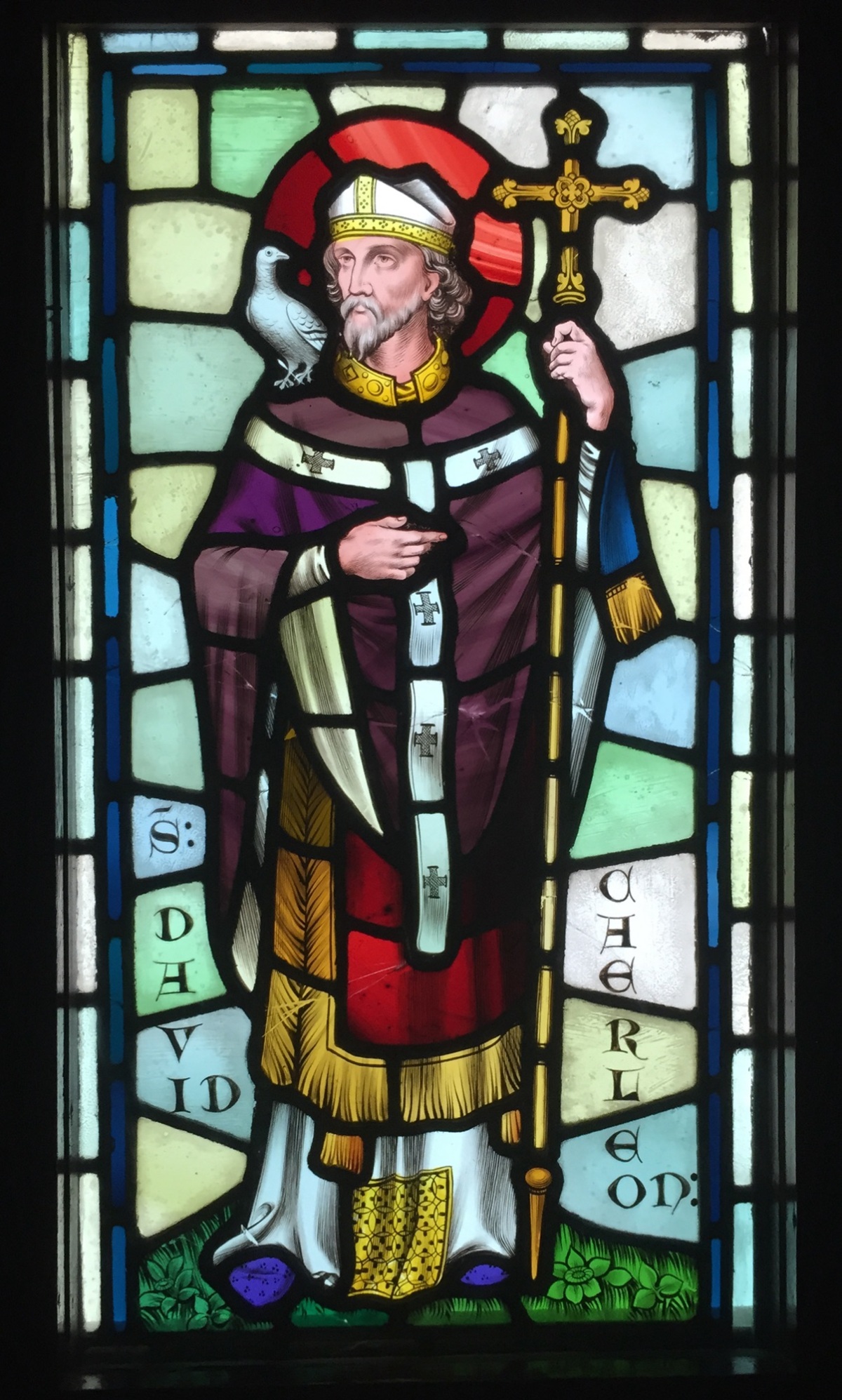
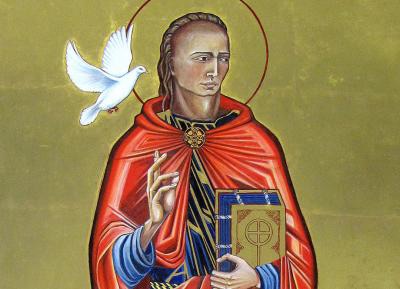
The religious symbol associated with Dewi is a white dove. The story that explains this is that whilst Dewi was preaching at the Synod of Brefi, a mound arose from the ground to form a small hill, and a white dove settled on his shoulder. The sermon, apparently, was a criticism of Pelagianism, a belief that the fall did not introduce original sin, and that human beings can work to achieve perfection in God’s sight.

Dewi was ascetic and vegetarian; he believed that “hard manual labor was the duty of all, thus preferring not to use cattle to help them plow the fields” and imposed on his community “a diet of bread and vegetables, with just a sprinkling of salt, so as not to inflict unnecessary suffering upon any creature by taking its life for food.” (Holly Roberts, Vegetarian Christian Saints, Anjeli Press, 2004, p. 131.)

It is said that he taught the monks of his community how to grow leeks—a vegetable which has become associated with Wales. It’s a tasty vegetable which adds flavour to various meals that we cook, today.

Dewi died peacefully at the end of the 6th century; it is said that the monastery was “filled with angels as Christ received his soul”. His remains were initially placed in the cathedral, but later conflicts meant that they were disrupted and moved. Dewi was canonised as Saint David in 1120 and declared to be the National Saint of Wales. Over 50 churches in South Wales had been dedicated to him before the Reformation.

So today, we give thanks for David: monk, saint, national hero.

See https://www.historic-uk.com/HistoryUK/HistoryofWales/St-David-Patron-Saint-of-Wales/