

The season of Easter stretches over seven weeks, from Easter Sunday to Pentecost Sunday. It takes those of us in the southern hemisphere from the balmy days of autumn into the time when the icy winds arrive and the temperatures drop. During this season, the lectionary replaces the stories from Hebrew Scriptures, and provides us with a diet of stories that tell of the church—stories taken from the Acts of the Apostles.
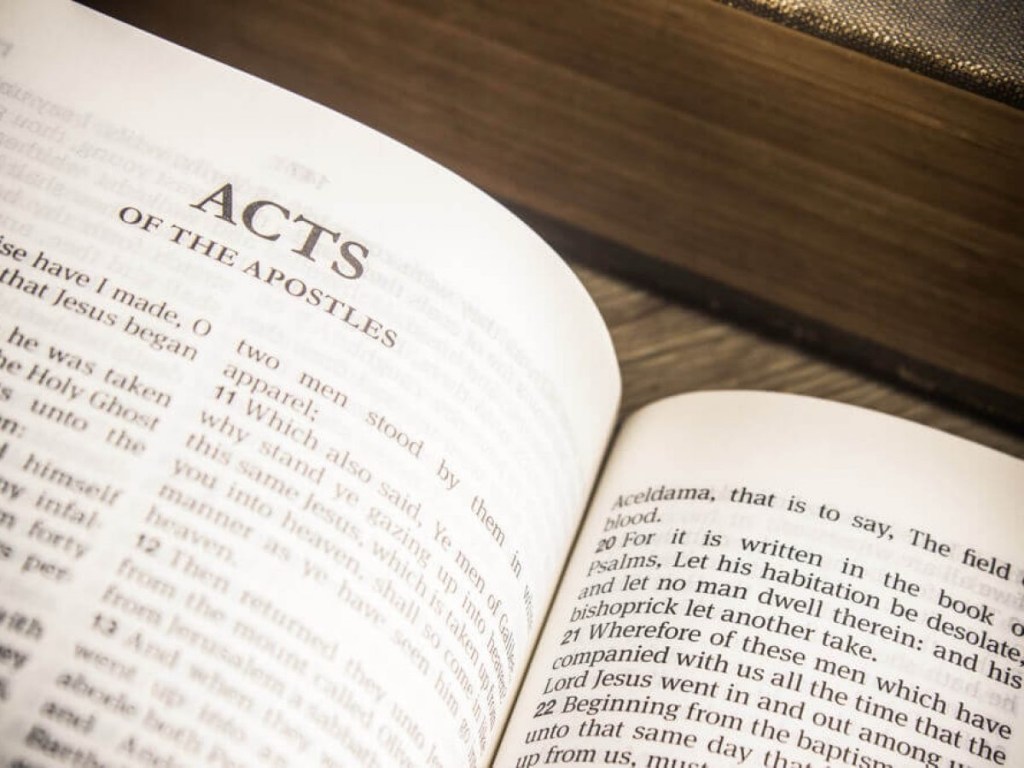
One explanation for replacing Hebrew Scripture passages with excerpts from Acts is that it reminds us that the risen Jesus, whom we celebrate on Easter Sunday, was at work in those early days amongst the first group of believers in Jerusalem, as they formed community together, and that Jesus was proclaimed and attested as people from that community travelled beyond Jewish territory, into the wider Hellenistic (Greek-speaking) world.
So this coming Sunday, the Second Sunday in Easter, we turn to an early chapter of Acts to hear a summary description of the early community of believers in Jerusalem (Acts 4:32–35). The community was still actively involved in Jewish religious life and was continuing to participate in temple rituals (2:46; 3:1; 5:20-21, 42).
The term “Christian” is not used for these people in Acts until Antioch in Syria (11:26). The were originally known as people of “The Way” (9:2; 19:9, 23; 24:14,22). They had formed a messianic Jewish community, since the central affirmation for the believers was that “the Messiah, he is Jesus” (2:36; 3:19–20; 5:42).
This passage provides a reminder of key elements in the life of this messianic Jewish community: unity of purpose (4:32; see 2:42,46), powerful testimony to the resurrection (4:33; see 2:24,32; 3:15; 4:2), and the manifestation of grace (4:33b; see 2:47). The major focus in this summary description is on the first feature, which is introduced with a striking phrase: the believers were “one in heart and soul”, to which is added a repetition of the earlier comment that “for them all things were common” (4:32; see 2:44).

Being “one in heart and soul” is a phrase which evokes the traditional Greek proverbs, “friends have one soul” and “the goods of friends are common property”, which were known since the time of Aristotle (Aristotle, Nicomedian Ethics 9.8.2; Cicero, De officiis 1.16.51; Plutarch, On Brotherly Love 490E, How to Tell a Flatterer 65A and De amic. mult. 96E; Iamblichus, Life of Pythagoras 65A; Dio Chrysostom Oration 34.20; Diogenes Laertius 5.20, 8.10).
The Jewish monastic community of Essenes were described in a similar way by Philo, Every Good Man is Free 85, and Josephus, J.W. 2 §122. It was a common trope, known to hellenised Jews. The first phrase is also reminiscent of the common Deuteronomic reference to “heart and soul” in the exhortation, “the Lord your God is commanding you to observe these statutes and ordinances; so observe them diligently with all your heart and with all your soul” (Deut 26:16; and see also 6:5; 10:12; 11:13; 13:4; 26:16; 30:2,6,10).
Luke, as a hellenised Jew, draws on this tradition to make a strong point about the community in Jerusalem: their unity was their strength. He is writing for Theophilus—a Greek name, meaning “lover of God”—who may indeed have been a real person, a patron who engaged Luke to undertake the collection of sources and careful analysis to which he refers at the start of his work (Luke 1:1–4).
So Luke, writing in Greek, draws both on the Hebrew Scriptures and on Greek ideas as he describes this Jewish messianic community. He writes a number of decades after the time on which he is reporting; he writes with an eye to his patron and an audience of educated Hellenistic readers. It is an idealised picture of the early Jerusalem community; certainly, we know from other sources—letters by Paul and John, especially—that the early communities formed of followers of Jesus had (more than?) their fair share of tension and conflict. They were, after all, only human.
Of course, unity of purpose was not simply a hellenistic ideal; it was also valued in Israelite society. To demonstrate this, the psalm which is proposed by the lectionary for this coming Sunday, Psalm 133, focusses strongly on this theme. It is presumably chosen by the lectionary as a complement to the passage from Acts 4 because of this very theme.

In this short psalm, the central thought concerns “when kindred [brothers and sisters] live together in unity” (v.1). Two images are used to indicate how much this unity is valued. The first image, “like the precious oil on the head, running down upon the beard” (v.2), perhaps evokes the “precious oil” stored in the treasure house of Hezekiah (2 Ki 20:13; Isa 39:2). This is something of immense value.
The second image, “like the dew of Hermon, which falls on the mountains of Zion” (v.3a), references one of the the prominent mountains in the north of Israel, on the border with Syria and modern. Lebanon. Today, it is part of the contested Golan Heights territory. Some scholars consider Mount Hermon to be the site where Jesus was transfigured, in company with Moses and Elijah (Mark 9 and parallels).
In later Jewish tradition, Hermon was said to be the place where the “watchers” amongst the fallen angels descended to earth to take wives amongst human beings. The story appears at Gen 6:1–4 without reference to location; Hermon is specified when the story is retold and developed within “The Book of the Watchers”, in 1 Enoch 6–11 (see 6:6 for the reference to Hermon).
Richard Clifford, in his commentary on the psalms, says: “Though the Mediterranean climate of Palestine had no rainfall from May or June to September, it had dew. Dew was important in the summer and a supplement to rain. Zion was therefore a place of fertility which even in the rainless season has an abundance of dew” (Psalms 73-50; Abingdon, 2003, pp.263-64). The majority of the water supplying modern Israel flows from the melting snow on Mount Hermon down into the River Jordan. See https://www.sciencedirect.com/science/article/abs/pii/0022169490900726
Hermon was a long way from Zion; so the dew of Hermon would not literally fall on Zion. This is a symbol of the unity of the whole nation of Israel. But the mention of Zion in Psalm 133 provides the opportunity for an affirmation that it was on Zion that “the Lord ordained his blessing”, which is immediately specified as “life forevermore” (v.3b). Blessings that last “forevermore” are celebrated in other psalms: “pleasures forevermore” (Ps 16:11), the Lord watching over his people (Ps 121:8) and surrounding them (Ps 125:2), the reign of the faithful sons of David (Ps 132:12), and the holiness of the Lord’s house (Ps 93:5).
The language of “ordaining” is usually applied to the priests (Exod 28:40-41; 29:9, 35; Lev 8:31-36; Num 3:1-3). However, in this psalm, perhaps the allusion is more directly to Solomon’s affirmation that “I am now about to build a house for the name of the Lord my God and dedicate it to him [for various offerings which are listed] … on the sabbaths and the new moons and the appointed festivals of the Lord our God, as ordained forever for Israel” (2 Chron 2:4). The pi almost, like the Chronicler, certainly valued the long term stability that was envisaged for Israel through God’s faithfulness.
During the season of Easter, it is worthwhile to give consideration of the nature of the community of faith to which we belong. What are the key values in this community? How do members of the community demonstrate these values in practical ways? How much is unity of purpose valued? What is done to ensure that diverse voices are valued, even as this focus on unity is maintained? These are good questions which these lectionary passages might invite us to consider this Easter.

 An Informed Faith