

The story of the empty tomb, early in the morning of Easter Sunday, is well known. The story of the appearance of Jesus as a stranger, walking alongside the couple who were heading out of Jerusalem towards the village of Emmaus, is also very well known.
What happened after that? Did the disciples huddle in fear in their house in Jerusalem (as John reports, John 20:19–31)? Did they head north to Galilee, as the young man in the empty tomb had instructed the women to do (Mark 16:7)? Was it in Galilee, on a mountain, that Jesus delivered his “Great Commission” to the eleven (Matt 28:16–20)? Or beside the Sea of Galilee, where some of the disciples had returned, disheartened and focussed on getting back to life as they once knew it, fishing for a living once again, when Jesus surprised them by the fire (John 21:1–14)?
The author of Luke’s Gospel offers us the first two stories in his Gospel: the empty tomb (Luke 24:1–12) and the road to Emmaus (24:13–35). But he does not report any of the subsequent stories we have in these other Gospels. In his narrative, the disciples remain in Jerusalem, forming a community of believers who had gathered in the room where the travellers to Emmaus had returned and were sharing “what had happened on the road” (24:35).
It is noteworthy that in the Lukan narrative, there is no change of scene, no change of characters, no breathing space at all between the return of the Emmaus travellers and the appearance of the risen Jesus. Luke’s narrative simply pushes on immediately to report that “while they were talking about this, Jesus himself stood among them” (v.36).
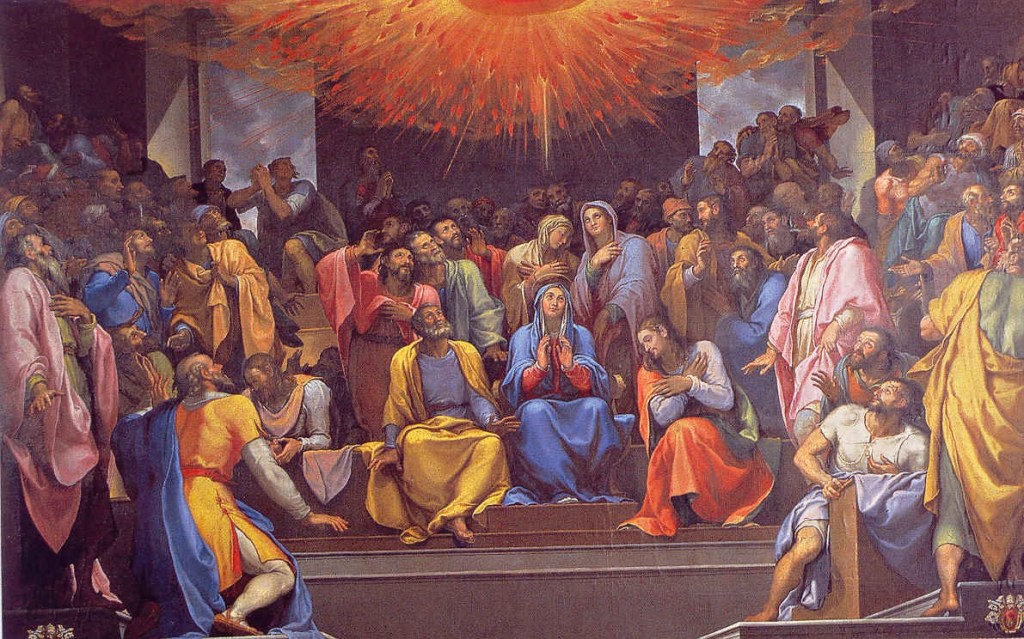
It is what ensues in this scene that forms the passage proposed by the lectionary for this coming Sunday, the Third Sunday of Easter (Luke 24:36–48). This scene is notable for a series of words which Jesus speaks to the group of those who were gathered together at that time—not just “the eleven and their companions” (v.33), but also the travellers returning from Emmaus (v.35).
In this post I will highlight seven words of Jesus that the author of this narrative reports in this final scene of his Gospel. In these seven words, the author of this Gospel both draws together threads from the preceding narrative, bringing this work to a climax, and brings us to the point of anticipating what will follow in the second volume that he writes.

“Peace be with you” (v.36). Peace (Hebrew shalom) was the standard Jewish greeting, as seen in the words of the old Ephraimite man (Judg 19:20), Eli’s word to Hannah (1 Sam1:17), Jonathan’s word to David (1 Sam 20:42), David’s instruction to his messengers to Nabal (1 Sam 25:5–6), and the song of Amasai (1 Chron 12:18).
The blessing of peace is encouraged by the psalmists (Ps 122:8;128:6) and the prophets (Isa 52:7; Nah 1:15), although Jeremiah warns of its abuse by false prophets in his day (Jer 6:14; 8:11–15; 14:13). Paul, of course, incorporates this traditional Hebraic greeting into the start of each of his letters, in the formulaic “grace to you and peace” (Rom 1:7; 1 Cor 1:3; 2 Cor 1:2; Gal1:3; Phil 1:2; 1Thess 1:1; Phlm 3).
Given this widespread usage, it would seem therefore the natural thing for Jesus to say to his friends when he came to them in that room: “peace be with you”.
More than that, Jesus speaking a greeting of peace in the Lukan narrative evokes the double offering of peace in John’s narrative of what may well be seen as the same scene (John 20:19–21). The second word, “Touch me and see” (v.39a), also evokes the scene in John 20, where Jesus showed the ten disciples his hands and his side (John 20:20) and then, a week later, said to Thomas “put your finger here and see my hands; reach out your hand and put it in my side” (John 20:27).

Both Luke and John provide an apologetic demonstration that the resurrection of Jesus involves his earthly body, with Luke providing the clarity of the claim, “a ghost does not have flesh and bones as you see that I have” (Luke 24:39b). This line of argument differs from that found in Paul’s extended discussion of the resurrection, where he notes that whilst a person is “sown a physical body, it is raised a spiritual body” (1 Cor 15:44) and then claims that “flesh and blood cannot inherit the kingdom of God, nor does the perishable inherit the imperishable” (1 Cor 15:50).
The implication of Paul’s line of argument is that the resurrection body of Jesus, whilst it bears the marks of the cross, will nevertheless be in a transformed state—and so will the bodies of believers be, after they are raised to be with Jesus. He states this explicitly in another letter: “he will transform the body of our humiliation that it may be conformed to the body of his glory” (Phil 3:21). That quasi-Platonic contrast between the earthly body of humiliation and the heavenly body of glory seems quite different to the understanding conveyed by Luke.
“Have you anything here to eat?” (v.41) is the third word of the risen Jesus. Only in Luke’s account does the risen Jesus show any interest in consuming food. That is not surprising, since Luke locates the earthly Jesus at table, sharing in a meal, more often than the other evangelists.
Mark tells us that as Jesus sat at dinner (or more accurately, reclined beside then table, leaning on his elbow) in Levi’s house, “many tax collectors and sinners were also sitting with Jesus and his disciples” (Mark 2:15–16; in Matthew’s account, he is renamed as Matthew, Matt 9:10–11).
In Luke’s narrative, this scene is replicated (Luke 5:29–31); yet Jesus also eats with with a Pharisee and a sinful woman (7:36–50); with Pharisees, a lawyer, and scribes (11:37–54); and with tax collectors and sinners (15:1–32; verses 1–2 infer the additional presence of Pharisees and scribes). After he shares a final meal with his closest followers (22:14–38), the risen Jesus then shares a meal with his fellow travellers on arrival in Emmaus (24:30). So this request should not be a surprise!
“Everything written about me must be fulfilled” (v.44) then follows as the fourth word. The fulfilment of prophecy in what is taking place during the lifetime of Jesus is a common claim in all four Gospel narratives, sounding forth from the baptism of Jesus (Mark 1:2 and pars) to the arrest of Jesus (Mark 14:49; Matt 26:53–56) and the events that follow (Luke 22:37; John 19:24, 36–37).
Indeed, the author of Luke’s Gospel has set the whole story of Jesus in relation to Hebrew Scripture, beginning with numerous scriptural allusions in the songs sung by Mary (Luke 1:46–55), Zechariah (1:68–79), and Simeon (2:29–32) and highlighting this in the words that Jesus spoke in his hometown synagogue (4:16–21) and in later sayings (6:20–26; 8:10; 12:52–53; 20:17–18, 41–44). The note of fulfillment sounded in the closing scene of the Gospel (24:44) gathers these threads into a cohesive climax.
For the fifth word, Jesus declares that “repentance and forgiveness of sins” are to be “proclaimed … to all nations, beginning from Jerusalem” (v.47). The activity of proclamation that he undertook during his life (Luke 4:43) was a charge that he gave his followers (9:2, 60;10:8–11). Throughout Acts, those followers continue to proclaim this message (Acts 5:42; 8:5, 35, 40; 9:20; 13:5, 38; 14:21; 15:35–36; 16:10; 17:13, 23).

The message of repentance, sounded both by John the baptiser (Luke 3:3, 8) and by Jesus (Luke 5:32; 13:1–5), is continued by Peter (Acts 2:38; 3:19), Philip (8:32), and by Paul (17:30; 26:19–20). In like manner, Jesus preaches forgiveness (Luke 5:24; 6:37; 7:47–48; 17:3–4), exhorts this as central to prayer (11:4), and exemplifies it even in his dying hour (23:34).23:34). Then, in Acts, forgiveness is indeed proclaimed by Peter (Acts 2:38; 5:31; 8:22; 10:43) and by Paul (13:38; 26:18).

The sixth word of the risen Jesus in Luke’s narrative sounds yet another key Lukan theme. “You are witnesses of these things” (v.48), Jesus tells his followers. The author then begins the second volume of his account by repeating and expanding this commission which Jesus gave his followers: “you will be my witnesses in Jerusalem, in all Judea and Samaria, and to the ends of the earth” (Acts 1:8). The missionary impulse is clear.
Jesus foresees the “opportunity to testify” that his followers will have in the times of trial when they are persecuted, arrested, and “brought before kings and governors because of my name” (Luke 21:12–13). The book of Acts then reports on that testimony is given about Jesus at many places, in the witness offered by Peter (Acts 1:22; 2:32; 3:15; 5:32; 10:39–42) and by Paul (13:31; 20:24; 22:15; 23:11; 26:16).
“I am sending upon you what my Father promised” (v.49). This seventh and final word stands at the end of the Gospel, but does not provide full “closure” to that narrative. Rather, it takes us to the brink, as we anticipate the departure of Jesus (narrated at vv.50–51) and the ongoing work of bearing witness, for which the disciples have just been commissioned (v.48). The author would have us look immediately for the sequel to this Gospel.
And, indeed, the promise is subsequently seen to come to fruition when “the day of Pentecost had been filled to completion, when they were all together in one place” (Acts 2:1, my translation). The promise is fulfilled a second time in the house of Cornelius, when “the gift of the Holy Spirit [was] poured out even on the Gentiles” (Acts 10:45), and Peter rejoices that “God gave them [the Gentiles] the same gift that he gave us [Jews] when we believed in the Lord Jesus Christ” (Acts 11:17).
The Spirit continues as an active presence within all that the followers of Jesus do throughout much of Acts (4:8, 31; 6:10; 7:55; 8:29, 39; 9:17, 31; 10:19, 44–48; 11:12, 15, 24, 28; 13:2, 4, 9, 52; 15:8, 28;16:6–10; 19:6, 21; 20:22–23, 28; 21:4, 11). It is not without reason that some have proposed that “The Acts of the Apostles” would be more accurately named “The Acts of the Holy Spirit”.
Together, then, these seven words of the risen Jesus draw together key strands in the Gospel, anticipate important aspects of Acts, and provide a pivot point from the first volume to its sequel. It is a very rich passage.
See also
and
and
 An Informed Faith