Affirming the kaleidoscopic array of gender identities and sexual orientations: a forthcoming book

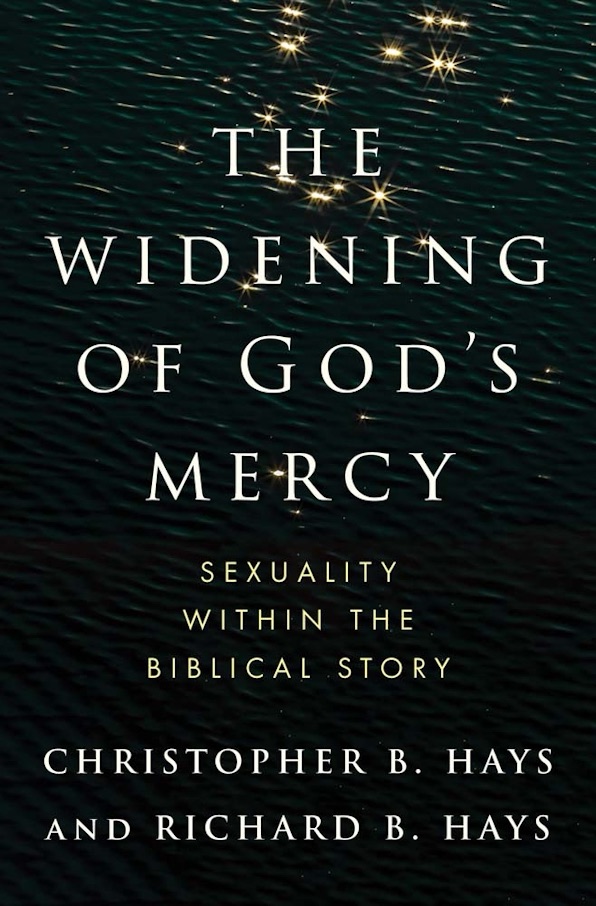
There’s an interesting new book to be published in September: The Widening of God’s Mercy. Sexuality Within the Biblical Story. It is written by two eminent, conservative-ish American professors, Richard Hays and his son Christopher Hays.

Richard Hays is one of the most well-respected NT scholars in the world. He famously argued *against* LGBTQ inclusion in his landmark ethics book, The Moral Vision of the New Testament, 30 years ago. He teaches at Duke Divinity School. He now is a proponent of affirming and inclusion. His son, Christopher Hays, is one of the most well-respected OT/Ancient Near Eastern scholars in the world. He teaches at Fuller Seminary, an institution founded as a strongly conservative seminary, which has become less “conservative” in recent years.

In 1996, Richard Hays wrote about a range of ethical matters in his work The Moral Vision of the New Testament. A number of biblical scholars, theologians and ethicists provided positive reviews of the work, and it has been an important work for students in each of these disciplines.

In chapter 16 of this book, Hays discusses relevant New Testament passages and comes to a conclusion that homosexuality cannot be affirmed by any New Testament text. Reviewing that chapter, American scholar Dr Anna Sieges notes, “His careful argumentation and generous posture toward LGBTQ individuals (by 1996 standards, at least) made the chapter a fan favorite among those who wanted to respectfully and biblically exclude LGBTQ people from public spaces (religious or political) for what they deemed sexual immorality.”

(See “An oft-quoted biblical scholar changes his mind on LGBTQ inclusion in the church”, https://baptistnews.com/article/an-oft-quoted-biblical-scholar-changes-his-mind-on-lgbtq-inclusion-in-the-church/)

Personally, I was surprised that Richard Hays had come to this conclusion about LGBTIQA+ people. I knew him in the 1980s when I was a doctoral student studying at Yale University, where he was a member of Faculty. I took a particularly lively seminar on “War and Peace in the Bible”, where we explored biblical texts and the full sweep of theological and ethical interpretations of this area.

Prof. Hays was consistently careful and compassionate as he explored key texts with critical acumen and a clear connection to contemporary thought. On that basis, as well as personal interactions with him in other contexts, the book was published, I had thought that he would have come to a different conclusion about the biblical texts relating to sexuality and gender. But he did not.

Thirty years later, he is publishing a work in which he argues differently. The book, we are told, will provide an argument for a theological and ethical position that supports, affirms, and encourages LGBTIQA+ people of faith as they exercise their ministries; and also in terms of how we relate to people of diverse secularities and gender indentures in society. It is an encouraging move.

The publisher’s blurb says:

“In this learned and beautifully written book, Richard and Christopher Hays explore a more expansive way of listening to the overarching story that scripture tells. They remind us of a dynamic and gracious God who is willing to change his mind, consistently broadening his grace to include more and more people. Those who were once outsiders find themselves surprisingly embraced within the people of God, while those who sought to enforce exclusive boundaries are challenged to rethink their understanding of God’s ways.

“The authors—a father and son—point out ongoing conversations within the Bible in which traditional rules, customs, and theologies are rethought. They argue that God has already gone on ahead of our debates and expanded his grace to people of different sexualities. If the Bible shows us a God who changes his mind, they say, perhaps today’s Christians should do the same. The book begins with the authors’ personal experiences of controversies over sexuality and closes with Richard Hays’s epilogue reflecting on his own change of heart and mind.”

“I think everyone in Hays’ circles in the 90s knew, to affirm gay people was career-suicide in their institutions. It still kinda is. I’m not suggesting it was deceptive or anything, but I think it’s very hard to imagine a theological conclusion when you subconsciously know you’re whole faith community will not go with you. Fear doesn’t inspire courageous thinking.”

Certainly, within the Uniting Church as a whole, and in formal decisions by councils of the church over the years, we have long accepted, affirmed, and encouraged LGBTIQA+ people within the life of the church.

See

And yes, I am aware that this has been seen as a slow and imperfect process by some, whilst others have fought tenaciously against each step with dogmatic aggression. But formally, and substantially, the Uniting Church has a position that would welcome the argument of Hays and Hays, when it is ultimately published.

*****

I need to note that Prof. Richard Hays was one of the examiners of my PhD thesis in 1988, while Karl Hand wrote a PhD under my supervision in the years 2008 to 2011.

*****

For my discussion of the “clobber texts” that feature so often in this area, see

We declare to you what was from the beginning (1 John 1–2; Easter 2B)

This week, the lectionary starts a series, for the Epistle reading, of selections from the book known as 1 John. By tradition, this work is called a letter (or epistle)—a communication from a specific individual to another individual or to a community of people. But the form of this book raises immediate questions.

There is neither the kind of opening address expected in a letter, nor any form of epistolary conclusion at its end. The opening verses, instead of providing information about the context in which the document came into being, present with urgent rhetorical force the importance of the message which follows. The letter ends quite abruptly, with a stark admonition (5:21)— no discussion of travel plans or the sending of an emissary, no greetings, no final blessing. Is it a book, a letter, or a sermon?

The book clearly has the ethos of a letter, as found in the first person plural of the opening verses (“we declare…we declare…we are writing…”, 1:1–4), the direct address to “little children” (2:1; 3:18; 5:21) and “beloved” (2:7; 4:1, 7), and the repeated assertion that “I write these things” (2:1, 7, 12–14, 26; 5:13). Moral exhortation and doctrinal teaching, elements regarded as being classic component parts of early Christian letters, are interwoven throughout the book without clear distinction.

Yet there appears to be no marshalling of a case and no logical development of thought, such as is found in the carefully-shaped rhetoric of the letters of Paul. At first reading, the letter’s structure is somewhat circular and repetitive, more an extended meditation on “love” (the term appears around fifty times) than a tightly-argued instruction. The tone is often reflective—although there are moments of contention and dispute.

The author of the letter is never named, but the opening verse makes the claim that the letter comes from one who has “heard…seen…looked at and touched” for himself, the very “word of life” (1:1). The inference is that the author has had personal contact with Jesus himself; in the third century, Irenaeus made the definitive claim that the letter was written by “John, the disciple of the Lord” (Against Heresies 3.16.5).

This claim goes beyond any direct assertion within the letter itself; although such a claim might be reinforced by the author’s reiteration of his privileged status as eyewitness (and earwitness): “we have seen it” (1:2), “what we have seen and heard” (1:3), “the message we have heard from him” (1:5), as well as a later reminder: “just as he has commanded us” (3:23).

The frequent use of “from the beginning” (1:1; 2:7, 13, 14, 24; 3:11) might also be taken as a reference back to the teachings of Jesus, mediated through the writing of this author.

Likewise, from the text of the letter itself, its recipients cannot be specifically identified in any meaningful way. There are references to “little children…fathers…young people” (2:12–14) which are formulaic and generalised. They already know the message about Jesus, for they “know him who is from the beginning” (2:13, 14) and have already heard his commandment to “love one another” (2:7; 3:11).

Their situation involves a controversy about how to live in obedience to Jesus; the contrast between darkness and light, love and hate is marked throughout the work (1:5–10; 2:9–11; 3:11–15; 4:20–21). A key idea in this regard is the way that love reaches “perfection” (2:5; 4:12, 17–18) in the lives of believers. This is what the recipients of the letter are to set as their aim.

Set in stark contrast to the believers is “the world”, which is both personified and portrayed as a negative character. The world is full of desire (2:16); those in it do not help a person who is in need (3:17); it hates the believers (3:13) and does not know God (3:1; 4:3–6). The letter ends with the strong assertion that “the whole world lies under the power of the evil one” (5:20). This suggests high tension, even outright conflict, between the people addressed in this letter, and some indeterminate “opponents”.

The sectarian tendencies, already seen in John’s Gospel, appear to have intensified in the situation addressed in this letter. Yet, in the end, “the world” is only temporary (2:17); victory over the world is assured, for it has already come (4:4; 5:3–5). Indeed, the author of this document insists that God’s intention is to save the whole world (2:1–2; 4:9, 14).

The season of Easter 2024 (With Love to the World 17/6)

On Ash Wednesday each year, Christians around the world begin forty days (plus six Sundays) of the season of Lent. This was the focus for the first half of issue 17/6 of With Love to the World. Then, after the pivotal events of Maundy Thursday—Good Friday—Holy Saturday—Easter Sunday, believers trace the fifty days of the season of Easter, until we arrive at Pentecost. These fifty days are the focus for the second half of issue 17/6.

Easter is usually thought of, in contemporary society, as a time for a four-day long weekend—time to travel, Easter camps, the last fling of short-term holidays before the winter cold sets in. And Easter is, indeed, a holiday—in the older sense of “holy day”, when something at the heart of faith is remembered.

But the calendar of the church allocates more than just the four-day long weekend to Easter. The season of Easter stretches over seven weeks, taking those of us in the southern hemisphere from the last balmy days of summer into the time when the icy winds arrive and the temperatures drop. And that extended season, this year, offers us a good opportunity to reflect on the question posed by the story told at the very end of Mark’s Gospel: how is it that Jesus has risen? where is it that we find signs of the risen one?

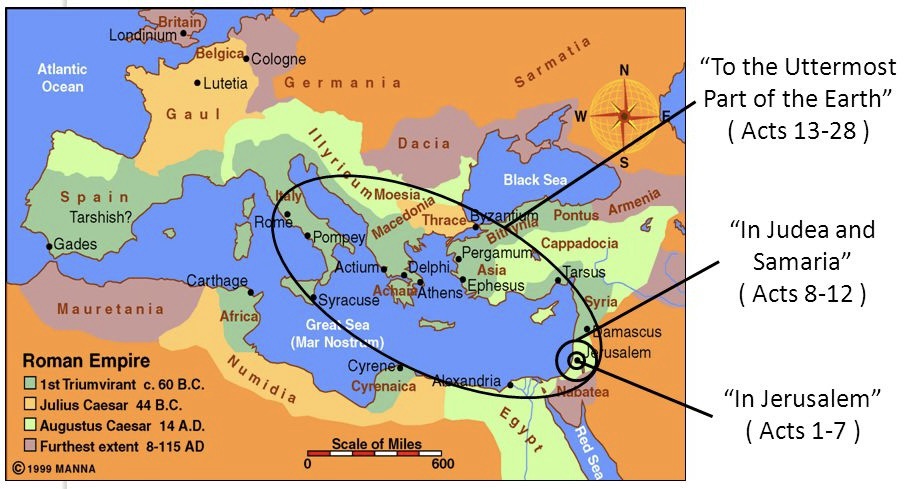
To equip us to consider such questions, the lectionary replaces, for this time, the stories from Hebrew Scriptures, and provides us with a diet of stories that tell of the church—stories taken from the Acts of the Apostles. One explanation for this is that it reminds us that the risen Jesus was at work amongst the first group of believers in Jerusalem, as they formed community together, and that Jesus was proclaimed and attested as people from that community travelled beyond Jewish territory, into the wider Hellenistic (Greek-speaking) world.

So when we are offered readings from Acts, we might consider two different, but related, sets of questions. The first questions are, What do these stories tell us about how we are to “be church” in our own time? What tips might we pick up about being an intentional community, speaking our experience of Jesus in a way that communicates, performing acts of loving care as a testimony to Jesus? These are good, and helpful, questions to consider.

The second set of questions is more along these lines: What do these stories tell us about how Jesus continued to be present, to be at work, amongst those who had first known him in Galilee? We might wonder how we can discern how Jesus is acting in the community in Jerusalem. Perhaps we see him at work in what Philip does in Samaria, or in the vision which Peter sees in Joppa? in the travels of Paul, Barnabas, Silas, Timothy, and other fellow workers in the Gospel, as they preach, nurture, challenge, and equip new followers of Jesus in many places? How does Jesus continue to be at work among us?

This Easter as we read Acts, let us give consideration to both sets of questions: what do we need to do? and, how is Jesus present among us?

*****

During the season of Easter, you are invited to join an online Bible Study sponsored by With Love to the World, each Thursday, at either 10:00am or 7:00pm.