Speak, for your servant is listening (1 Sam 3; Pentecost 2B)

For three months—the first half of the long season “after Pentecost”—the lectionary offers a sequence of passages which comprise some key narratives from the books of Samuel and the early chapters of Kings. These stories recount the development of the monarchy in Israel, with stories of Saul, David, and Solomon, the first three men charged with the responsibility of leading Israel and ensuring that there was justice in the land. “Give the king your justice, O God”, the psalmist sings (Ps 72:1), so that they might rule with justice and righteousness (Ps 99:4; Prov 29:4; Isa 32:1; Jer 23:5). That is what these kings, and their successors, were charged with ensuring.

These stories also engage us with the lives of prophets, Samuel and Nathan—men who were called to speak the word of God. We are told that as the young Samuel grew up, “the Lord was with him and let none of his words fall to the ground; and all Israel from Dan to Beer-sheba knew that Samuel was a trustworthy prophet of the Lord” (1 Sam 3:20–21). Years later, Nathan is commissioned by “the word of the Lord” to “go and tell my servant David, ‘thus says the Lord’” (2 Sam 7:4–5). That is the role of the prophet—to listen to what God says to them, and then to speak forth the word of the Lord to the people of their society.

Samuel, Nathan, and other prophets were particularly called to speak truth to the king and to recall them to the centrality of their role, to ensure that God’s justice was a reality in Israelite society (Isa 42:1–4; 61:1–2; Mic 3:8). We see this when Nathan confronts David (2:Sam 12), when Elijah confronts Ahab and the priests of Baal (1:Ki 18), when Isaiah advises Hezekiah (2 Ki 20), and when Josiah consults Huldah (2 Ki 22; 2 Chron 34).

As we pay attention to the details of the stories, let us remember that these stories are not “history” as we know it today. Rather, they are ancient tales told and retold, passed on by word of mouth and then written down, because of their enduring significance for the people of ancient Israel. Scholars call such stories “myths”, meaning that they convey something of fundamental importance. (We might best define myth as “a traditional story, usually associated with the time of origins, of paradigmatic significance for the society in which it is told”.)

See more on the nature of these stories at

and on the sequence of stories told in Genesis and Exodus, at

Identifying the stories in the narrative books of the Hebrew Scriptures doesn’t mean they are “not true”—rather, it means that we need to read them, not as historically accurate accounts, but as stories which convey fundamentally important ideas. These stories were valued by people of ancient times. They may well offer us, in our own times, insights and guidance of value.

So we read and ponder these stories from old once again, in our time, because we believe that there is wisdom and guidance in the dynamics we see at work in this ancient society. We pay attention to them because we believe that the same Spirit who anointed the kings, and who called and equipped the prophets, is the very Spirit who today meets us, calls us, and equips us.
We begin with a narrative that recounts the call of the young boy, Samuel, to the role of prophet (1 Sam 3:1–10). This series of narratives from Samuel and Kings provide insights into the leadership of the people of Israel in the crucial years when a key transition was taking place, moving from a group of invading tribes, consolidating into a coherent kingdom. Prophets and Kings provided leadership in challenging times.

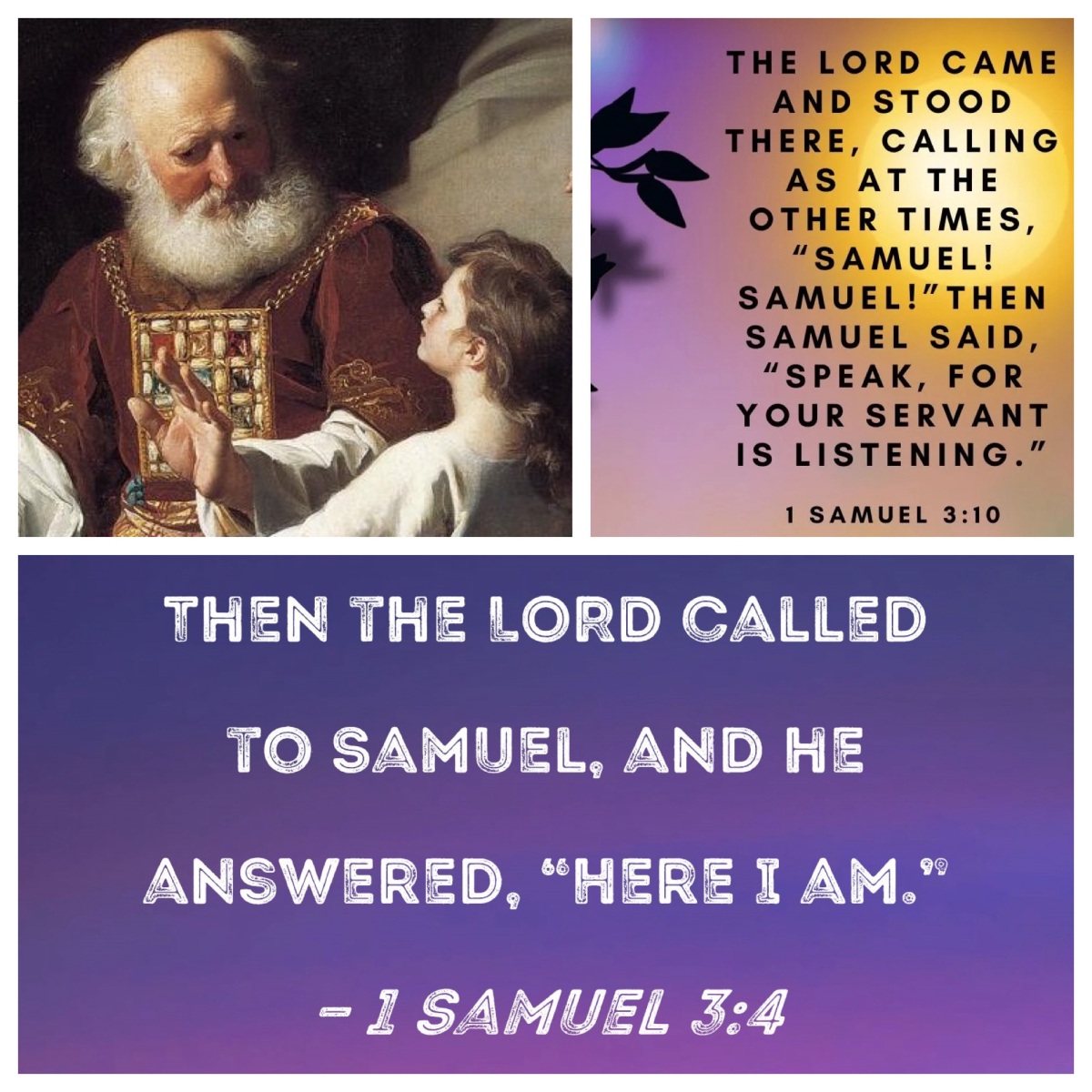
Samuel was the designated prophet whose wisdom guided the people in the early period of the monarchy. This story from the early years of Samuel’s life instructs us as we hear it in later times, to listen to God’s voice, and to respond with obedience. Young Samuel was in the temple, where the elderly Eli was priest. In the evening, while the lamp was still burning, Samuel hears a voice. The voice simply calls his name. “Here I am”, Samuel responds when he hears that voice. He is sure that it is Samuel who is speaking to him—there is nobody else around. Three times, he hears “Samuel”; and three times, he responds “here I am” (vv.4,6,8).

Samuel had been thinking that it was Eli speaking to him; but it was not the priest, it was the voice of the Lord. The story conveys a sense of confusion and unknowing. This reflects something of the uncertainty that people of faith often have with regard to “hearing the voice of the Lord”.

Indeed, the fragility of living by faith without clear and obvious demonstration of he presence of God is signalled in the opening verse: “the word of the Lord was rare in those days; visions were not widespread” (v.1). The poor vision of the elderly priest, Eli (v.2), is a second signal of this uncertainty. The priest cannot see; the child hears but does not understand.

Paying attention to the voice of the Lord is a persistent refrain in Hebrew Scriptures. Indeed, the psalmist rejoices in the clarity of God’s voice: “the voice of the Lord is over the waters; the God of glory thunders, the Lord, over mighty waters; the voice of the Lord is powerful; the voice of the Lord is full of majesty” (Ps 29:3–4). Yet another psalmist recalls the time, in the wilderness, when the people of Israel “grumbled in their tents, and did not obey the voice of the Lord” (Ps 106:25). The people were not always faithful, even though the voice sounded with clarity. They needed reminders of that voice.

In the foundational saga of Israel, Moses is called by the voice of God while tending sheep on Mount Horeb (Exod 3:4). In obedience, he leads the people to freedom—and then informs the people, “if you will listen carefully to the voice of the Lord your God, and do what is right in his sight, and give heed to his commandments and keep all his statutes”, then God promises not to inflict them with disease (Exod 15:26). Later, when Moses has delivered to them “all the words of the Lord and all the ordinances”, the response of the people is an affirmative “all the words that the Lord has spoken we will do” (Exod 24:3).

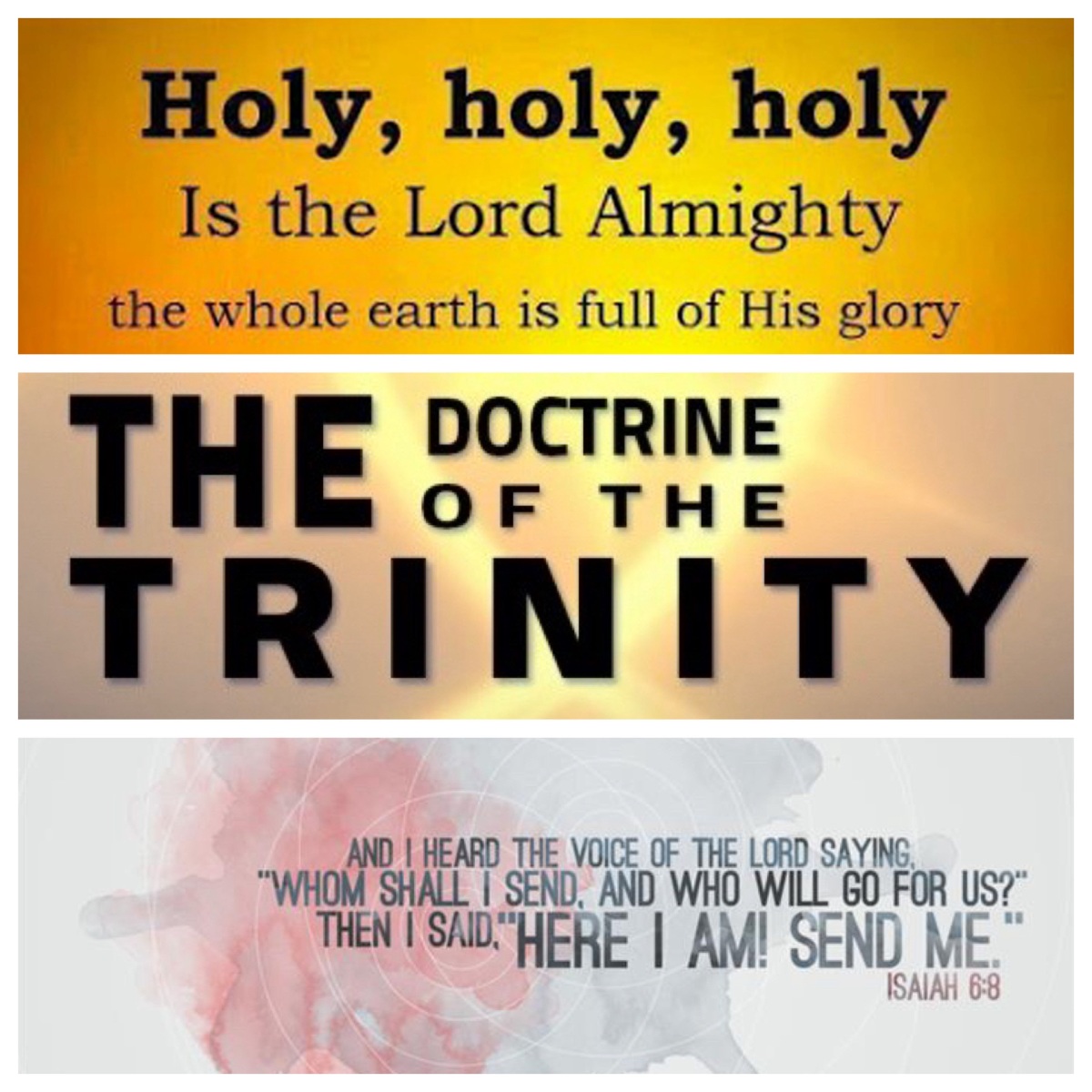
A number of the prophets indicate that they are impelled to declare “the word of the Lord” to a sinful people because they have heard, and are obedient to, “the voice of the Lord”. Isaiah hears the voice of the Lord calling him: “whom shall I send, and who will go for us?” (Isa 6:8). Isaiah is given words of woe to pronounce over the people (Isa 6:9–13); he warns the leaders of Israel, “listen, and hear my voice; pay attention, and hear my speech” (Isa 28:23).

His fellow-southerner, the shepherd Amos, opens his words with the bold declaration, “the Lord roars from Zion, and utters his voice from Jerusalem” (Amos 1:2), before he launches into his long series of oracles against the surrounding nations (Amos 1:3—2:3) and then against Judah and Israel (Amos 2:4–16).

The image of the lord as a roaring lion is used also by Joel, “the Lord roars from Zion, and utters his voice from Jerusalem, and the heavens and the earth shake” (Joel 3:16), while in another oracle he says, “the Lord utters his voice at the head of his army; how vast is his host!” (Joel 2:1). Joel’s words of judgement penetrate to the heart of the evil of the people: the coming day will be “a day of darkness and gloom, a day of clouds and thick darkness!” (Joel 2:2), and so he calls the people to “return to [the Lord] with all your heart, with fasting, with weeping, and with mourning; rend your hearts and not your clothing” (Joel 2:12–13).

Micah also declares, “the voice of the Lord cries to the city (it is sound wisdom to fear your name)” (Mic 6:9) before he lambasts the people for their wickedness: “your wealthy are full of violence; your inhabitants speak lies, with tongues of deceit in their mouths” (Mic 6:12; the whole damning oracle is 6:9–16).

Called as a youth by “the word of the Lord” (Jer 1:4–8), Jeremiah hears the assurance, “I have put my words in your mouth” (Jer 1:9); the prophet later instructs the people, “amend your ways and your doings, and obey the voice of the Lord your God, and the Lord will change his mind about the disaster that he has pronounced against you” (Jer 26:13). Again, he tells them, “obey the voice of the Lord in what I say to you, and it shall go well with you, and your life shall be spared” (Jer 38:20). Eventually, the people affirm, “whether it is good or bad, we will obey the voice of the Lord our God to whom we are sending you, in order that it may go well with us when we obey the voice of the Lord our God” (Jer 42:6).

In the return from exile, both Haggai (Hag 1:12) and Zechariah (Zech 6:15) rejoice that Israel “obeyed the voice of the Lord their God”; but Daniel laments that his people “have not obeyed the voice of the Lord our God by following his laws, which he set before us by his servants the prophets; Israel has transgressed your law and turned aside, refusing to obey your voice” (Dan 9:10).

And yet, various prophets had hesitated when first hearing “the voice of the Lord”. The initial response of Moses is “who am I that I should go to Pharaoh, and bring the Israelites out of Egypt?” (Exod 3:11), followed by a series of further objections that he raises (Exod 3:13; 4:1; 4:10). Amos explains to the priest Amaziah how his call had surprised him: “I am no prophet, nor a prophet’s son; but I am a herdsman, and a dresser of sycamore trees” (Amos 7:14).

Isaiah seeks to excuse himself from the prophetic task: “I am lost, for I am a man of unclean lips, and I live among a people of unclean lips” (Isa 6:5). Jeremiah objects, “truly I do not know how to speak, for I am only a boy” (Jer 1:5). A number of the prophets are, initially at least, reluctant spokespersons for the Lord God.

By contrast, in the story told in 1 Sam 3, after hearing his name spoken by the Lord for a third time, Samuel responds with a declaration of obedience: “speak, for your servant is listening” (v.10). This was just as the priest Eli had instructed him (v.9). Here, Samuel demonstrates careful listening, patience, openness to what he encounters, and complete obedience to that voice.

Just beyond the passage set by the lectionary, the narrator indicates that what will follow will be dramatic and compelling; it will “make both ears of anyone who hears of it to tingle” (v.11). The immediate drama which les ahead will tell of punishment for the sins of the house of Eli. Young Samuel is given his first commission: tell his patron Eli about what lies in store for him. Samuel, in fear and trembling, dutifully does so (v.18); Eli recognises the word of the Lord in the voice of the prophet, and accepts his fate.

The pattern of Samuel’s life is thus set: he will need to summon inner strength, demonstrate commitment to the cause, use clarity of speech, and model integrity of life. The fact that the young Samuel already demonstrated these qualities may well be why this story is remembered and retold. These two stories from the early years of Samuel’s life are remembered in order to instruct those who hear them in later generations, to listen and to obey, to be brave and focussed. And so we, in our time, are to hear the story, reflect on it, and respond appropriately.

Conspiring how to destroy Jesus (Mark 2–3; Pentecost 2A)

For the Gospel passage for this coming Sunday, the lectionary takes us back to the earliest and shortest Gospel—that attributed to Mark. We left the continuous reading of Mark at the end of Epiphany, by which stage we had read most of chapter 1. This week, we pick up that continuous reading with two stories (2:23—3:6). It will stretch out until the feast of The Reign of Christ in late November.

This passage focusses on a group of people who form a central “character” in Mark’s Gospel: the group of Pharisees who regularly appear in conflict with Jesus. There is tension between Jesus and the Pharisees in many passages of Mark’s Gospel.

The German scholar Martin Kähler once described this Gospel as a “passion narrative with an extended introduction” (The So-called Historical Jesus and the Historic, Biblical Christ, 80 n. 11). The passage offered by the lectionary for Sunday contains a crucial clue in this regard.

Although the story that Mark tells has started with hope—fishermen following Jesus, healings taking place, even a tax collector joining the group—there are ominous clouds on the horizon. Questions are raised about the practices of Jesus (2:24). Even though Jesus justifies his actions by quoting scripture (2:25–26), and even though he does a good deed by healing a disabled man (3:5), his questioners appear dissatisfied. A plot is formed, with murderous intention (3:6); the author signals that the life of Jesus is in danger.

These unlikely conspirators—Pharisees, nationalist Jewish teachers, and Herodians, collaborators with the Roman overlords—come together again towards the end of the story (12:13), when the plot to kill Jesus has been reactivated (11:18) and would soon come to fruition (14:1, 10–11). So these ominous clouds hang over the whole story of Jesus and his disciples in Galilee; the first eleven chapters do indeed appear to be “an extended introduction” to the main story: how to destroy Jesus (3:6).

We need to take care as to how we interpret this simmering conflict between Jesus and the Pharisees. The earlier part of the passage for this Sunday provides an important clue, as we shall explore. Most importantly, we should avoid any antisemitic overtones in the way that we deal with this tension.

Christianity has inherited a tradition of regarding the Pharisees as ‘legalistic’ or ‘hard-hearted’ (and many other stereotyped names in common use in the church). This tradition does not take into account the context of the gospels’ writing, and the tense relationship that existed between the early Christians and the various Jewish factions from which many of their numbers came.

Originally, these early groups considered themselves as part of Judaism, which was a many-faceted faith. The early Christians on the whole did not split from Judaism until quite some time after Jesus’ death. Many problems faced the early Christian communities, who were often persecuted by both gentile and Jewish authorities.

Most of the evidence we have from New Testament times outside of the bible does suggest that the Pharisees on the whole did live as they taught, and that they were holy, compassionate and righteous men. Josephus, a first century Jewish writer in the Roman court, describes the Pharisees as “affectionate to each other” and people who “cultivate harmonious relations with the community.” (Josephus, War ii. II9f., 122, 137–42, 152f., 162–6).

It was not uncommon for the laws to be interpreted in various ways. The Pharisees here had one interpretation, Jesus had another. This was normal Jewish behaviour.

The synoptic gospels claim for Jesus the same scripture and the same traditions as the Pharisees. However, these scriptures and traditions are at times interpreted differently by Jesus. The Law must still be obeyed, but how it is to be obeyed was debated. This is crucial to understanding the historical relationship between Jesus and the Pharisees, and to appreciating how Mark portrays that relationship for a particular theological purpose.

Jesus taught in the synagogues. He acknowledged the authority of the Pharisees but challenged their practices: ‘The scribes and Pharisees sit on Moses’ seat; therefore, do whatever they teach you and follow it; but do not do as they do, for they do not practice what they teach’ (Matt 23:2-3). Jesus does not question their authority; but their teachings, their interpretations, are to be questioned.

In Mark’s Gospel, the Pharisees and Jesus engage in a series of debates about various aspects of Jewish law. Early in Mark’s Gospel, questions are asked of Jesus regarding his authority to teach and do what he was doing (Mark 2:3–12; 2:16–17; 2:18–20). In Mark 2:23–28, the Pharisees accuse Jesus’ disciples of violating the Sabbath.

The laws of the Hebrew Bible made it clear that the plucking of grain to assuage hunger was permitted (Deut 23:25). The issue at stake here is that the disciples plucked the grain on the Sabbath, which was technically harvesting (ie plucking the grain and rubbing it in their hands). The specific law they are breaking can be found in Exodus 34:21. Exodus 20:8–11 (paralleled in Deuteronomy 5:14) is of course the “foundational law”.

However, while a hungry wayfarer could pluck grain to eat in a field, this law did not apply on the Sabbath day. The law that is under discussion here is explicitly Exodus 34:21, which forbids any action considered ‘harvesting’ on the Sabbath day. It was not unlawful to eat the grain; just to harvest it. Jews were expected to make such preparations for eating before the Sabbath commenced, which was sundown on Friday, as Exodus 16:23–26 spells out.

These laws are all found in the Torah, or Pentateuch, which constitutes the first five books of the bible. These books were not written by the scribes and Pharisees; rather, they studied these books, and recorded their interpretations (or understandings) in the Mishnah and the Talmud. The laws that the Pharisees followed are therefore found in both the Jewish and the Christian canon of scripture. Jesus only spoke directly about a small percentage of the total laws, yet made it clear that he respected the Law as a whole.

There is no evidence in the gospels to suggest that Jesus encouraged the disciples to break the law. On the contrary, the Jesus of the gospels is a basically a law-abiding Jew, if a somewhat radical one at times. He speaks of following the law in all three synoptic gospels (see Matthew 5:17–19; 25: 31ff; Mark 10:17–23; Luke 18:18–25).

Nowhere in the gospels does Jesus — or anyone else — remark that the law has become an intolerable burden. The religion of Jesus was Judaism. He was born into this religion, was circumcised and obeyed the Law for most of his life. Jesus’ teaching does not oppose Jewish scripture or Jewish teaching. Certainly his interpretation of these could be quite radical at times, and there is no doubt he set out to reform some of the more rigid aspects of Judaism.

Jesus debates the Pharisees using time-honoured debating techniques of pesher and midrash, used often in Rabbinic debate. This is an important component of Jesus’ debate with the Pharisees, and suggests that Jesus had been educated by the Pharisees. It is vital to note that Jesus does not criticise the law as such, but rather the Pharisees’ interpretation of it. He offers a different, better interpretation.

In using and expanding the story of David from the Hebrew Bible Jesus demonstrates his grasp of midrash technique. The point that Jesus is making from this story is that certain circumstances should override the strict letter of the Law. David ate what was not lawful because of his great hunger – the circumstances justified the action. By interpreting this story to apply to the situation of the disciples, Jesus shows his grasp of pesher (interpretation).

We are meant to deduce that the disciples were hungry and in need of food, which took precedence over the demands of the Sabbath. This is why Jesus uses the story he does of King David — it is David’s hunger that justified his breaking of the law.

Even amongst themselves, the Pharisees rarely agreed on the interpretation of any Law — many interpretations exist in the Jewish writings (Mishnah and Talmud) for each Law. In particular the Rabbinic schools of Hillel and Shammai were famous for their disagreements – they rarely interpreted any of the laws the same way.

One other common Christian misconception is that Jesus’ interpretations of the law are always new and very different from any Jewish interpretation. This is simply not the case. In our sample passage, Jesus actually isn’t putting forward a revolutionary principle– a number of rabbis, using Hebrew bible parallels (cf. Exodus 23:12; Deuteronomy 5:14) also stressed that the sabbath was for people as well as for their refreshment after labouring, in a saying found in the Rabbinic writings (Mekilta on Exod, 31:14; b. Yoma 85b) that states “The sabbath is handed over to you, not you to it”.

*****

This blog draws on material in MARKING THE GOSPEL: an exploration of the Gospel for Year B, by Elizabeth Raine and John Squires (self-published 2014). Thanks to Elizabeth for sharpening the analysis of Mark 2 as we wrote this book.

Appropriating the words of an Israelite prophet for a Christian doctrine (Isaiah 6; Trinity B)

Trinity Sunday is one of the very few times in the Christian calendar that a Sunday is named for a doctrine, rather than for a biblical story (Easter, Pentecost, Christmas, and the like). The passages are chosen to encourage us to reflect on the doctrine of the Trinity, as a doctrine that is central to our faith, through selected biblical passages; this year, sections of Isaiah, John, and Romans (with a Psalm chosen to complement these selections).

So this Sunday we are being asked to approach scripture in a way quite different from many other Sundays, when biblical texts are offered for us to consider in their own right. Trinity Sunday, by contrast, pays scant attention to the historical and literary contexts of the chosen texts. Rather, they are selected as isolated “bites” that can be woven together to provide “a biblical basis” for a doctrine that was developed and expressed a number of centuries later.

In this regard, it has similarities with the way that we are encouraged to read selections from the prophets of ancient Israel—taking particular passages which are placed alongside certain Gospel stories because they “illuminate” or “complement” these later texts. The birth of Jesus at Christmas and the death of Jesus at Easter—and the weeks leading up to these days, in the seasons of Advent and Lent, respectively—are the times when this process is most evident.

So the choice of Isaiah 6:1–8 as the First Reading for this coming Sunday, Trinity Sunday, has both of those pressures running in parallel. First, this text is intended to speak from six centuries before Jesus about what people four centuries after Jesus thought about him, God, and the Spirit. That’s a leapfrog over a whole millennium!!

And second, this text is intended to focus our thoughts on the threefold nature of God—Father, Son, and Holy Spirit—through the somewhat fortuitous chanting of “holy, holy, holy” by seraphim in the smoke-filled temple atop Mount Zion (Isa 6:3). The only other place in scripture where this threefold acclamation of divine holiness appears is in the extravagantly symbolic visions of the spirit-infused prophet of Revelation, as he “sees things” in his old age (Rev 4:8).

The chanting of the seraphim in the former book, Isaiah, is the first articulation of a chant which, millennia later, became associated with the triune God, worshipped in Christian liturgies. In my own church, after the presiding minster prompts with the words: “And so we praise you with the faithful of every time and place, joining with the choirs of angels and the whole creation in the eternal hymn”, the people respond, “Holy, holy, holy Lord, God of power and might, heaven and earth are full of your glory. Hosanna in the highest. Blessed is he who comes in the name of the Lord. Hosanna in the highest.” (quoted from The Service of the Lord’s Day in Uniting in Worship 2; Assembly of the Uniting Church in Australia, 2005).

This song has an integral place in the liturgy, not just of the Uniting Church, but of numerous liturgical denominations around the world. It is sung or spoken in the Great Prayer of Thanksgiving, as people offer thanks to God and prepare to receive the sacrament. Its location within the Christian liturgy means that, in the minds of many believers, it is thoroughly Christianised.

And I suspect that the threefold expression, “holy, holy, holy”, is intended to evoke the three-in-one nature of God, as understood in classic Christian theology. Perhaps it is intended to be a subconscious evocation of “Holy God, Holy Son, Holy Spirit” — even though the song itself says nothing about the unity of those three elements?

The author of the latter book, Revelation, quotes this chant in the long sequence of visions that he reports in this book. He says that he was “in the spirit” (1:10; 4:2; 17:3; 21:10), hearing “the voice of many angels” (5:11–12), as four living creatures sing without ceasing, “Holy, holy, holy, the Lord God the Almighty, who was and is and is to come” (4:8). That’s a multiplying of the threefold aspect of God—three times holy, over three eras of time.

The creatures singing this song are “full of eyes in front and behind”, and they variously appear like a lion, an ox, a creature with a face like a human face, and a flying eagle (4:6–7). These strange creatures appear before the prophet then sees “a lamb standing as if it had been slaughtered, having seven horns and seven eyes” (5:6). The scene is quite fantastical.

There follows further, increasingly bizarre, visions: “the lamb” opens a series of seals with associated dramatic events (6:1–17; 8:1), angels are seen to be hold back nature (7:1), one angel speaks forth (7:2–3) and then seven angels each blow their trumpets (8:6—9:14) before another four angels who were “bound at the great river Euphrates” are released in order to wreak vengeance on the earth and on humanity (9:15–21). We are well and truly into the vividly creative inner mind of the prophet, surely.

After all of this, the prophet is offered a scroll by an angel “wrapped in a cloud, with a rainbow over his head; his face was like the sun, and his legs like pillars of fire” (10:1–2). The prophet takes the scroll and eats it (10:8–10); “it was sweet as honey in my mouth, but when I had eaten it, my stomach was made bitter” (10:10). That should hardly have been a surprise; the human digestive system is not intended for such a diet!

Then the prophet is instructed to “prophesy again about many peoples and nations and languages and kings” (10:11)—and he does so in a series of increasingly dramatic, vivid, and bizarre prophecies (chs. 11—22). It’s hardly the stuff that encourages me to think that the vision which included the threefold acclamation of God (4:8) was being considered in a rational way and employed in a constructive process of building a doctrine that would serve the church well over time!

Quite surprisingly, in the midst of this extravagant revelatory exotica, there is a little scene that is strongly reminiscent of the scene in the temple on Mount Zion that Isaiah had described centuries beforehand. An angel with a golden censer “came and stood at the altar; he was given a great quantity of incense to offer with the prayers of all the saints on the golden altar that is before the throne” (Rev 8:3). After this, “the smoke of the incense, with the prayers of the saints, rose before God from the hand of the angel” (8:4) before the angel took the censer and filled it with fire from the altar and “threw it on the earth; and there were peals of thunder, rumblings, flashes of lightning, and an earthquake” (8:5).

The scene that is narrated in Revelation, therefore, might have certain resonances with the scene when the thresholds of the doorway to the Temple building “shook at the voices of those who called, and the house filled with smoke” (Isa 6:4). However, the creative imagination of the later prophet on Patmos (Rev 1:9) has taken him far, far away from the scene of the earlier prophet, Isaiah, in Jerusalem. And he ends up even further away from the process of vigorous debate and philosophical disputation which was the context within which the doctrine of the Trinity was formulated.

Isaiah locates the moment when he sensed his calling to be a prophet precisely when those seraphs sang their song, “holy, holy, holy” (Isa 6:3). “Woe is me”, he cries, explaining that “I am lost, for I am a man of unclean lips, and I live among a people of unclean lips” (6:5a). An intense sense of personal and communal inadequacy grips the prophet.

“Yet”, he continues, “my eyes have seen the King, the Lord of hosts!” (6:5b). This is far from an exposition of the inner nature of God; there is nothing to provide a hint of the doctrine of the Trinity, to be sure. In fact, this vision is similar to that seen by the prophets Amos during the time of Uzziah of Judah and Jeroboam of Israel (Amos 9:1) and Micaiah during the time of Jehoshaphat of Judah and Ahab of Israel (1 Ki 22:19; 2 Chron 18:18), when “coals of fire flamed forth” from the brightness before the Lord God.

In what Isaiah sees in this vision of “the King, the Lord of hosts”, he reports that “one of the seraphs flew to me, holding a live coal that had been taken from the altar with a pair of tongs; the seraph touched my mouth with it” (6:7) and uttered words of cleansing and forgiveness (6:8), followed by a word of commissioning (6:8). The coals are reminiscent of David’s vision of the Lord in his prayer calling for help, as “smoke went up from his nostrils, and devouring fire from his mouth; glowing coals flamed forth from him” (Ps 18:8, 12; 2 Sam 22:9, 13).

This moment during the visionary experience in the smoke-filled Temple grounds the prophet in the realities of his earthly life. The seraphs fly from the envisioned presence of the Lord God to touch the prophet directly in his physical state. There is nothing speculative or metaphysical involved in this sixth century BCE experience, such as we find in the expressions of Trinity that have been formulated since the fourth century CE.

It is noteworthy that the content of the commissioning that Isaiah then hears (6:9–13) is omitted from the verses suggested by the lectionary for Trinity Sunday. This severs the scene in the middle; the charge given to Isaiah is integral to the scene, and should not be omitted! Granted, the words which Isaiah hears are challenging and complex, for he is to “listen, but not comprehend; keep looking, but not understand” (6:9); indeed, he is to “make the mind of this people dull, and stop their ears, and shut their eyes, so that they may not look with their eyes, and listen with their ears, and comprehend with their minds, and turn and be healed” (6:10).
This is sobering. It is also material which could have been considered—indeed, should have been considered—in the process of exploring the essence of God, and articulating the nature of the divine—which is precisely what the doctrine of the Trinity is attempting to do. The God who cleanses and calls (6:7–8) is the same God who challenges and convicts (6:9–10), and who then judges with a ferocious intensity which is born out of a deep integrity (6:11–13).

How long is Isaiah to prophesy his words of challenge? “Until cities lie waste without inhabitant, and houses without people”, the answer comes (6:11); until “vast is the emptiness in the midst of the land” (6:12). For better or worse, we need to reckon with this dimension of God’s nature—and this coming Sunday would have been as good a time as any to ponder it!

So on Sunday during worship, ignore the lectionary, don’t stop at verse 8, and keep reading to the end of the chapter; and then reflect on who this God whom we worship really is.

See also

I will put my spirit within you … I will place you on your own soil (Ezekiel 37; Pentecost B)

In the alternate reading that the Revised Common Lectionary proposes for the festival of Pentecost, this coming Sunday, we find a section from the exilic prophet Ezekiel (Ezek 37:1–14). This is the famous prophecy covering the dead bones, to which the Lord (through Ezekiel) declares, “I will cause breath to enter you, and you shall live. I will lay sinews on you, and will cause flesh to come upon you, and cover you with skin, and put breath in you, and you shall live; and you shall know that I am the Lord” (Ezek 37:5–6).

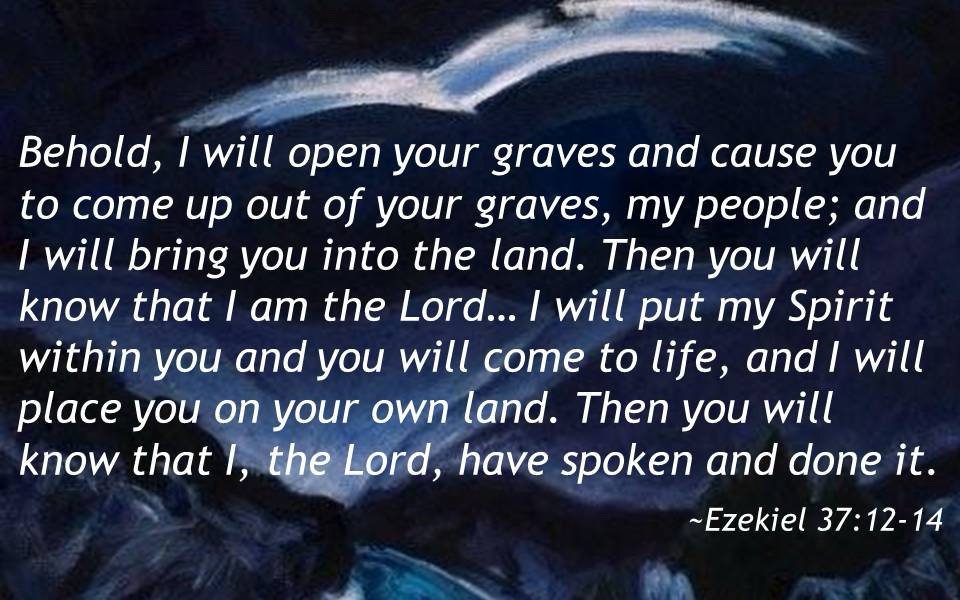
However, this passage also contains words which were filled with hope for the exiled people—but which, in the light of current events in the Middle East, and especially since the eruption of conflict on 7 October last year, are fraught with difficulties. God instructs Ezekiel, “prophesy, and say to them, Thus says the Lord God: I am going to open your graves, and bring you up from your graves, O my people; and I will bring you back to the land of Israel. … I will put my spirit within you, and you shall live, and I will place you on your own soil; then you shall know that I, the Lord, have spoken” (Ezek 37:12,14).

However, this passage also contains words which were filled with hope for the exiled people—but which, in the light of current events in the Middle East, and especially since the eruption of conflict on 7 October last year, are fraught with difficulties. God instructs Ezekiel, “prophesy, and say to them, Thus says the Lord God: I am going to open your graves, and bring you up from your graves, O my people; and I will bring you back to the land of Israel. … I will put my spirit within you, and you shall live, and I will place you on your own soil; then you shall know that I, the Lord, have spoken” (Ezek 37:12,14).

These words are fraught because of the long history of conflict relating to “the land of Israel”—the land to which the exiles would return under the decree of Cyrus of Persia; the land which today is the focus of such controversy and conflicted claims.

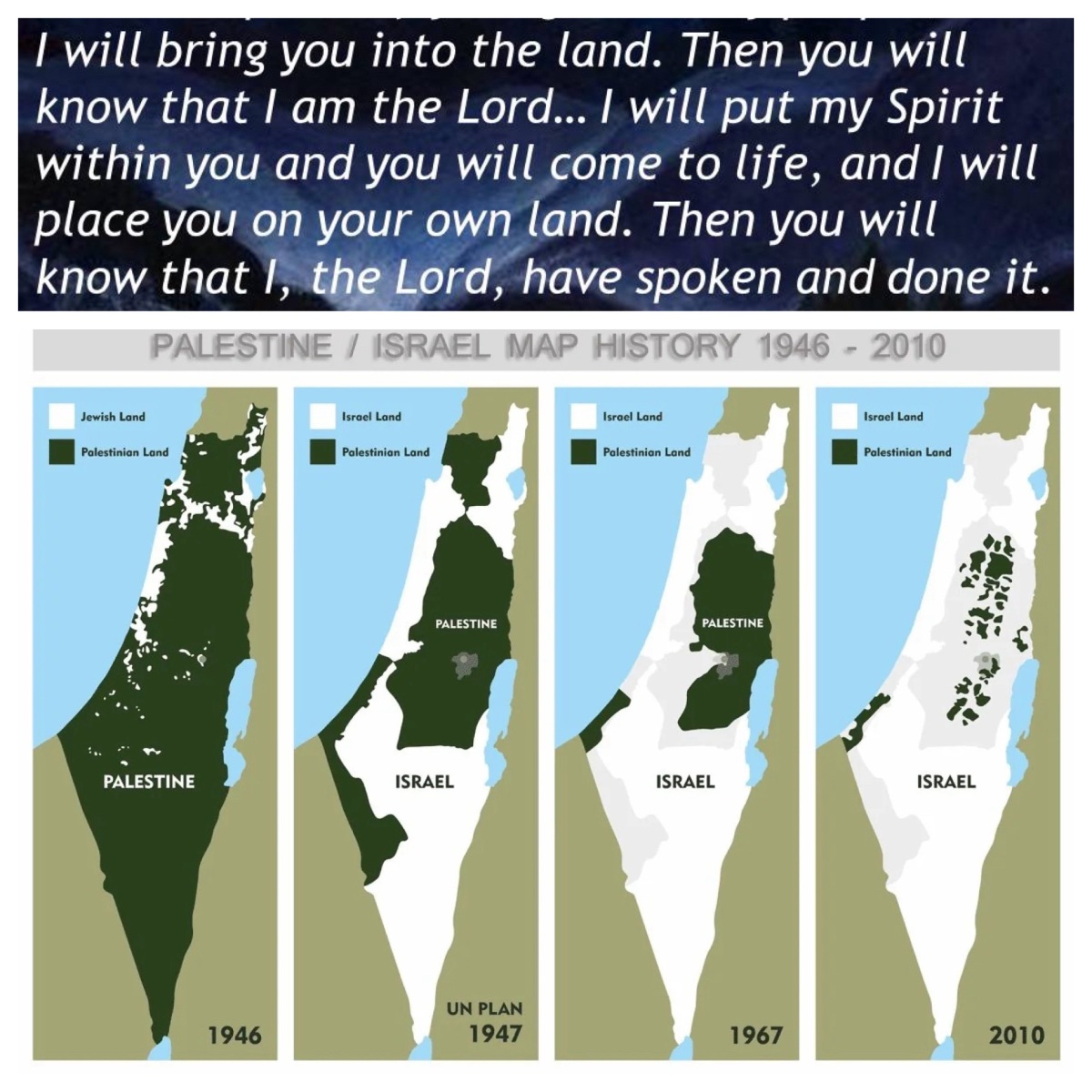
The land marked out for Israel was based on the historical reality that in ancient times Israelites/Jews had lived on that land for centuries until the scattering of all Jews under Roman rule first and second centuries of the Common Era. But since then, Arabs of various origins had held control of the land (see below), and those living there came to be known as Palestinians.

In the early 20th century, the place where Arabs who identified as Palestinians were living was decreed to be the British Mandate of Palestine (1920–1948). The ancient conflicts, it was hoped, would be well in the past. A place for Palestinians in the modern world was, it was thought, now settled. But this was not to be, as we well know today.

In part in response to the horrors of the Shoah, exposed by the ending of World War Two, the modern state of Israel was created in 1948. This was a hugely important, completely justified step to take, give the atrocities of genocide that had been inflicted on Jews in Europe by the Nazi regime of Germany.

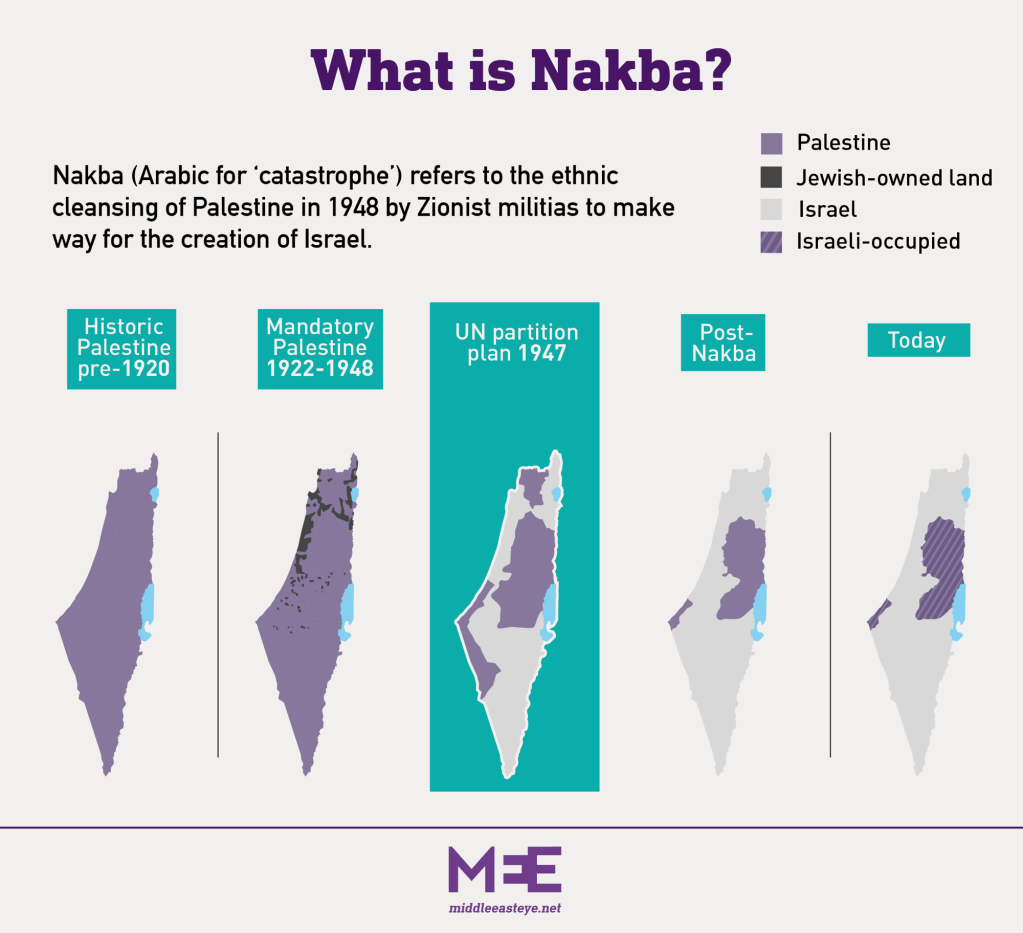
The new nation of Israel took 78% of the area which had been provided for Palestinians in the British Mandate. That this was now Jewish territory was a blessing for Jews, but it was a huge and continuing irritant to Palestinian sensibilities, which is why the period from 1948 onwards is known as the Nakba, the Palestinian Catastrophe. A significant number of Palestinians fled the area declared as Israel, as (in one estimate) over 500 Palestinian villages were repopulated by Jews, becoming refugees with no national identity. That was indeed a catastrophe for those inhabitants.

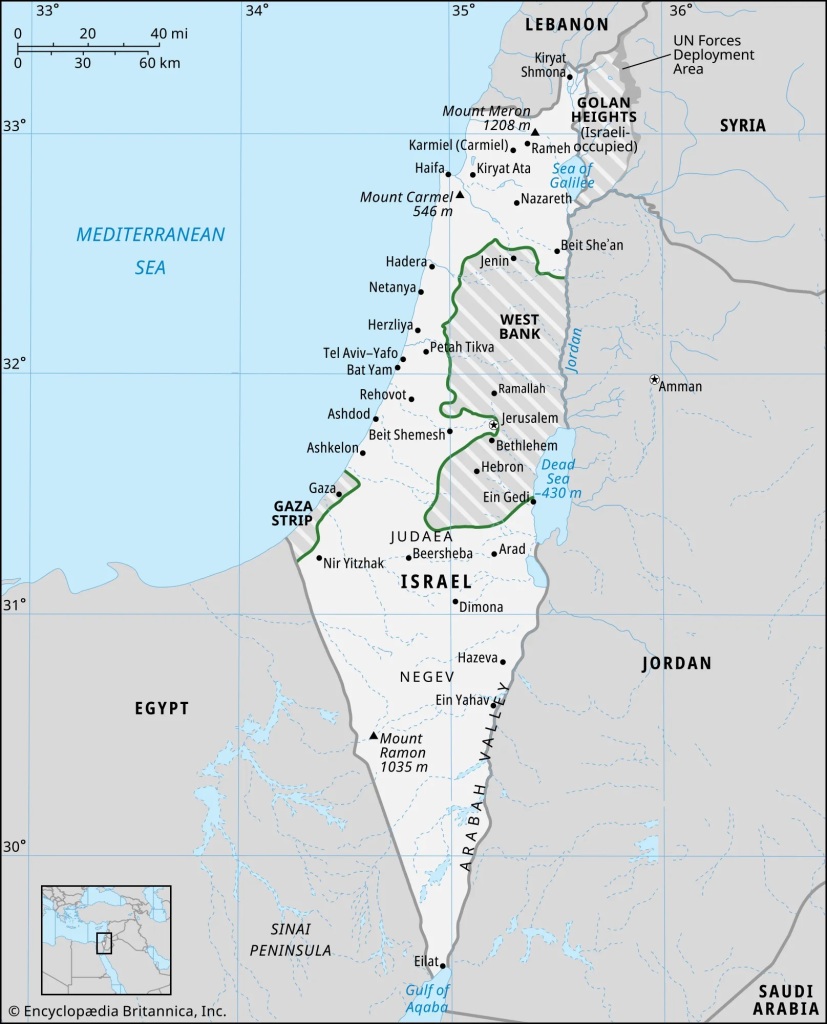
The contested regions of the Gaza Strip (along the east coastline of the Mediterranean Sea) and the West Bank (land immediately to the west of the River Jordan) became known as the Palestinian Territories. They have been disputed territories ever since they were occupied by Israel, two decades later, in the Six-Day War of 1967. In the decades since then, continuing and increasingly aggressive expansion of Israeli settlements into areas where Palestinians were living has greatly exacerbated the situation.

And so those who were dispossessed—and offered the hope of return to “their land”—become the dispossessors of others, to whom that same land was also “their land”; and so the tragic cycle continues.

The biblical texts which claim that God gave land to a chosen people so long ago are not verbatim accounts of “what God said” long ago, nor are they historical reports of actual events. They were written by priests returning from Exile, trying to recapture the period when Israel had some autonomy, because of the strength of its army under various tribal leaders (presented as “kings”). The texts form aetiological tales—that is, they are written as stories at a point in time, purporting to be ancient records, laying the foundation for a claim such as “this is our land, God gave it to us”.

That same land, promised to Abraham, claimed by Moses, is in contention today. It has had a chequered history. The ancient land of Cana an eventually became the land of Israel, then (along with Judaea) part of the Roman province of Syria Palaestina (132–390), and then of the Diocese of the East in the Roman Empire (to 536). What followed the fall of the Roman Empire was a millennium and a half of Muslim rule of this land, first as a part of Bilad al-Sham, the Greater Syria region, under various Caliphates.

The region continued to be part of various organisational configurations under successive Muslim rule, on into the Ottoman Caliphate (from 1517) and then into the modern era, as already noted. (I am not an expert, by any means, of this ancient and medieval history; for this summary, I am dependent on what I read in what I consider to be reputable sources.)

An exaggerated, idealised view of the extent of the land claimed by modern-day Israelis is evident in so many ways in the portrayal of Solomon, who was seen to be filled with “wisdom and knowledge”, and granted “riches, possessions, and honour, such as none of the kings had who were before you, and none after you shall have the like” (2 Chron 1:7–12, especially verses 10 and 12). The biblical figure of Solomon is an exaggerated caricature, a description of an idealised ruler whose existence is actually still a matter of debate amongst ancient historians.

It is also worth noting that the large reach of land that Solomon ruled over, even more extensive than the oft-cited phrase “from Dan to Beersheba” (Judg 20:1; 1 Sam 3:20; 2 Sam 3:10; 17:11; 24:2, 15; 1 Ki 4:25; 1 Chron 21:2; 2 Chron 30:5), did not continue past his death. The hagiographical exaggeration of territory under Solomon is not noted in the period after his death. The narrative books that recount the stories of the kingdoms of Israel, in the north, and Judah, in the south, in the centuries after Solomon, indicate that the scope of those kingdoms was more constrained.

*****

In the light of this, we need to take care when we come across texts in the Hebrew Scriptures which dogmatically and definitively declare that this land belongs to the people of Israel. Indeed, even scripture itself tells the story of the invading colonisers who claimed this land for their own (in the book of Joshua).

So I don’t think it is responsible, today, to lay claim to the whole, extended territory of the land, from the biblical passages noted, as the scope for the modern state of Israel which was created in 1948. There is no justification for the continued aggressive expansion of Israeli settlements in Palestinian areas. So I have sympathy for Palestinians who have lived on the land for thousands of years prior to 1948, as they understand this to be their ancestral land. It has been a continuing Nakba, a catastrophe, for Palestinians over these decades.

I also have sympathy for Jews, both those living in the land of Israel today, as well as those living in diaspora, for whom the land of Israel has a powerful symbolic significance—especially since the Shoah of 1933—1945 and the terrible genocide perpetrated by the Nazis against Jews in so many countries during that period. Granting them land in the area where their ancestors long ago had lived, a homeland that gives them security in the modern world, is important and necessary.

That said, I don’t agree that Palestinians should take matters into their own hands to seek vengeance against people in Israel in the way that they have done, once again, in recent months. In the same manner, nor do I think that the Israeli forces should respond in the aggressive and violent manner that they have done, once again, in recent times, with deaths of women and children, and aid workers, noted on the news with dreadful persistence. Too many people—innocent people—are dying and being injured, making any possible progress towards peace with justice even more difficult each day.

We need to seek once more the peace of these peoples. And we need to find that peace on the basis of justice. Neither terrorist attacks nor military crackdowns will achieve this. They will simply exacerbate a dangerous situation.

How do we deal, today, with the promises of God made long ago? “I will bring you back to the land of Israel. … I will place you on your own soil” (Ezek 37:12,14). We need to tread with care. Perhaps some other texts from both Jewish scripture Christian scripture provide guidance.

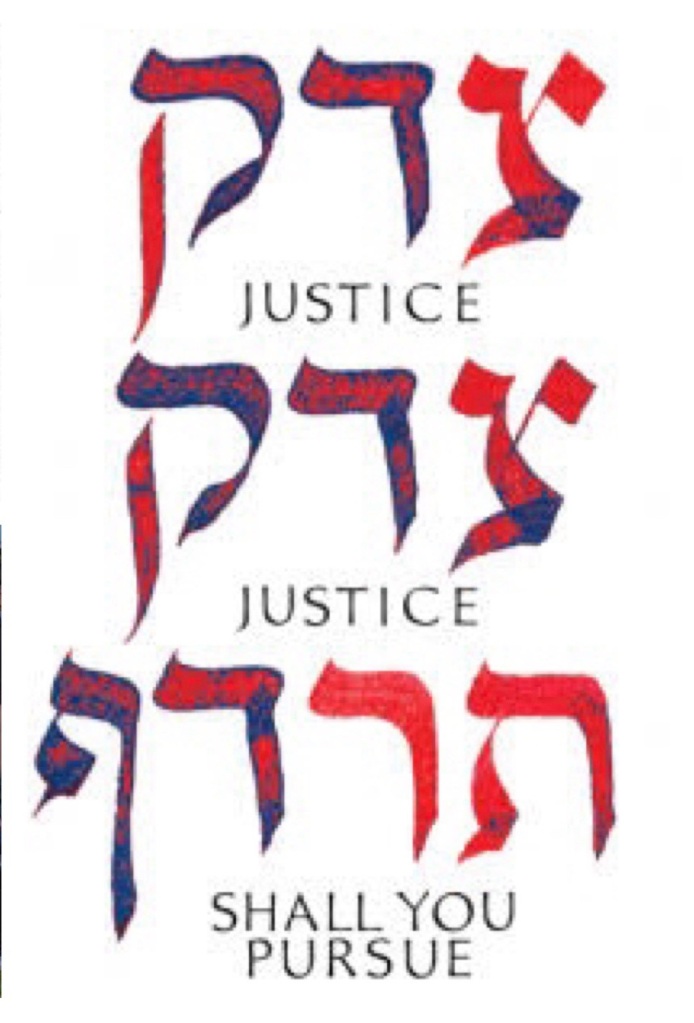
“Depart from evil, and do good; seek peace, and pursue it.” (Psalm 34:14). “Blessed are the peacemakers, for they will be called children of God.” (Matt 5:9). “Justice, and only justice, you shall pursue, so that you may live and occupy the land that the Lord your God is giving you.” (Deut 16:20). “… the weightier matters of the law: justice and mercy and faith. It is these you ought to have practiced …” (Mat 23:23). May these be the principles that guide the leaders of the warring groups in Israel and Palestine today.

Significant days, reflecting Shoah, Independence, Nakba, and 7 October.

This week there are two significant days happening in the Middle East. Yesterday, 14 May, was Yom Ha’atzmaut, Israel Independence Day, the national day for the modern state of Israel. And today, 15 May, is Dhikra an-Nakba (meaning “Memory of the Catastrophe”), a day of great significance for Palestinians, as it commemorates the Nakba, the Palestinian Catastrophe. These days are particularly poignant this year, as the ongoing conflict in Gaza which began on 7 October 2023 has exploded and escalated into a terrible state of entrenched warfare, with far too many unwarranted deaths (overwhelmingly of Palestinians) taking place each day since then.

These two days remember, from different perspectives, that moment when the modern state of Israel was created in 1948. This was achieved by mapping out an area for Jewish settlers to live in, and the simultaneous destruction of Palestinian society and homeland, with the permanent displacement of a majority of Arabs who identified as Palestinians and who had lived in this area for centuries.

The land marked out for Israel was based on the historical reality that in ancient times Israelites/Jews had lived on that land for centuries until the scattering of all Jews under Roman rule first and second centuries of the Common Era. But since then, Arabs of various origins had held control of the land (see below), and those living there came to be known as Palestinians.

In the early 20th century, the place where Arabs who identified as Palestinians were living was decreed to be the British Mandate of Palestine (1920–1948). The ancient conflicts, it was hoped, would be well in the past. A place for Palestinians in the modern world was, it was thought, now settled. But this was not to be, as we well know today.

British Mandate of Palestine, from Britannica.com

In part in response to the horrors of the Shoah, exposed by the ending of World War Two, the modern state of Israel was created in 1948. This was a hugely important, completely justified step to take, give the atrocities of genocide that had been inflicted on Jews in Europe by the Nazi regime of Germany.

The new nation of Israel took 78% of the area which had been provided for Palestinians in the British Mandate. That this was now Jewish territory was a blessing for Jews, but it was a huge and continuing irritant to Palestinian sensibilities, which is why the period from 1948 onwards is known as the Nakba, the Palestinian Catastrophe. A significant number of Palestinians fled the area declared as Israel, as (in one estimate) over 500 Palestinian villages were repopulated by Jews, becoming refugees with no national identity. That was indeed a catastrophe for those inhabitants.

The contested regions of the Gaza Strip (along the east coastline of the Mediterranean Sea) and the West Bank (land immediately to the west of the River Jordan) became known as the Palestinian Territories. They have been disputed territories ever since they were occupied by Israel, two decades later, in the Six-Day War of 1967. In the decades since then, continuing and increasingly aggressive expansion of Israeli settlements into areas where Palestinians were living has greatly exacerbated the situation. And so those who were dispossessed become the dispossessors of others, and the cycle continues.

Map showing Gaza and the West Bank, from Britannica.com

The biblical texts which claim that God gave land to a chosen people so long ago are not verbatim accounts of “what God said” long ago, nor are they historical reports of actual events. They were written by priests returning from Exile, trying to recapture the period when Israel had some autonomy, because of the strength of its army under various tribal leaders (presented as “kings”). The texts form aetiological tales—that is, they are written as stories at a point in time, purporting to be ancient records, laying the foundation for a claim such as “this is our land, God gave it to us”.

That same land, promised to Abraham, claimed by Moses, is in contention today. It has had a chequered history. The ancient land of Canaan eventually became the land of Israel, then (along with Judaea) part of the Roman province of Syria Palaestina (132–390), and then of the Diocese of the East in the Roman Empire (to 536). What followed the fall of the Roman Empire was a millennium and a half of Muslim rule of this land, first as a part of Bilad al-Sham, the Greater Syria region, under various Caliphates.

The region continued to be part of various organisational configurations under successive Muslim rule, on into the Ottoman Caliphate (from 1517) and then into the modern era, as already noted. (I am not an expert, by any means, of this ancient and medieval history; for this summary, I am dependent on what I read in what I consider to be reputable sources.)

An exaggerated, idealised view of the extent of the land claimed by modern-day Israelis is evident in so many ways in the portrayal of Solomon, who was seen to be filled with “wisdom and knowledge”, and granted “riches, possessions, and honour, such as none of the kings had who were before you, and none after you shall have the like” (2 Chron 1:7–12, especially verses 10 and 12). The biblical figure of Solomon is an exaggerated caricature, a description of an idealised ruler whose existence is actually still a matter of debate amongst ancient historians.

It is also worth noting that the large reach of land that Solomon ruled over, even more extensive than the oft-cited phrase “from Dan to Beersheba” (Judg 20:1; 1 Sam 3:20; 2 Sam 3:10; 17:11; 24:2, 15; 1 Ki 4:25; 1 Chron 21:2; 2 Chron 30:5), did not continue past his death. The hagiographical exaggeration of territory under Solomon is not noted in the period after his death. The narrative books that recount the stories of the kingdoms of Israel, in the north, and Judah, in the south, in the centuries after Solomon, indicate that the scope of those kingdoms was more constrained.

Solomon’s reputed empire, based on the exaggerated biblical texts

In the light of this, I don’t think it is responsible to lay claim to the whole, extended territory of the land, from the biblical passages noted, as the scope for the modern state of Israel which was created in 1948. There is no justification for the continued aggressive expansion of Israeli settlements in Palestinian areas. So I have sympathy for Palestinians who have lived on the land for thousands of years prior to 1948, as they understand this to be their ancestral land.

I also have sympathy for Jews, both those living in the land of Israel today, as well as those living in diaspora, for whom the land of Israel has a powerful symbolic significance—especially since the Shoah of 1933—1945 and the terrible genocide perpetrated by the Nazis against Jews in so many countries during that period. Granting them land in the area where their ancestors long ago had lived, a homeland that gives them security in the modern world, is important and necessary.

That said, I don’t agree that Palestinians should take matters into their own hands to seek vengeance against people in Israel in the way that they have done, once again, in recent months. In the same manner, nor do I think that the Israeli forces should respond in the aggressive and violent manner that they have done, once again, in recent times, with deaths of women and children, and aid workers, noted on the news with dreadful persistence. Too many people—innocent people—are dying and being injured, making any possible progress towards peace with justice even more difficult each day.

As John Hanscombe writes in The Echidna, “Just as there are no excuses for Hamas’s October 7 massacres, rapes and hostage-taking, using starvation as a weapon is also abhorrent. Turning a blind eye to attacks on aid convoys, as the Israeli police reportedly did, only pushes the country further into isolation. Two wrongs never make a right.”

See https://www.theechidna.com.au/

We need to seek once more the peace of these peoples. And we need to find that peace on the basis of justice. Neither terrorist attacks nor military crackdowns will achieve this. They will simply exacerbate a dangerous situation.

“Depart from evil, and do good; seek peace, and pursue it.” (Psalm 34:14). “Blessed are the peacemakers, for they will be called children of God.” (Matt 5:9). “Justice, and only justice, you shall pursue, so that you may live and occupy the land that the Lord your God is giving you.” (Deut 16:20). “… the weightier matters of the law: justice and mercy and faith. It is these you ought to have practiced …” (Mat 23:23). May these be the principles that guide the leaders of the warring groups in Israel and Palestine today.

See also

You send forth your spirit, you renew the face of the earth (Psalm 104; Pentecost)

Each year for the Festival of Pentecost, alongside the story from Acts 2, the lectionary places a section from the latter part of Psalm 104 (Ps 104:24–34, 35b). The whole psalm is a stirring poem on the beauty and grandeur of God’s creation, worth reading in full for the grand sweep over earth and seas and sky that it offers.

The section proposed for Pentecost has been chosen, it seems clear, for the two references to the spirit that are included. The first links the spirit with God’s creative work: “you send forth your spirit, they [God’s creatures] are created; and you renew the face of the ground” (v.30).

The second reference (v.29) is less obvious in many English translations. The same word, ruach, is used in this verse as in the following verse. In v.29, God is said to “take away their breath [ruach], [so] they die and return to their dust”. In v.30, at the other end of life, God is said to “send forth your spirit [ruach], [so] they are created”. God’s spirit is given at birth and taken away at death. The same word, ruach, indicates the same divine spirit which imbues all human beings. Rendering it differently in these two consecutive verses is mischievous!

The section of the psalm offered for Pentecost affirms that the many works of God (quaintly translated as “manifold” in the NRSV and the NIV, following the earlier KJV) are created “in wisdom” (v.24). What has come before this verse, as well as what immediately follows it, is all encompassed within this overarching claim that these many works are the fruit of divine wisdom.

The psalm has already identified, as part of God’s creativity, the heavens (vv.2–4) and the earth, with its mountains (vv.5–9); it continues with descriptions of rivers, streams, and rain (vv.10–13; and see more at vv.25–26), noting the various classes of creatures—wild animals (v.11), birds of the air (v.12), cattle and plants (v.14), as well as sea creatures (vv.25–26), leading on to the production of food to nourish humanity—wine, oil, and bread (v.15; and see more at vv.27–28).

The threefold classification of creatures evident in this psalm is found elsewhere in Hebrew Scriptures. In Psalm 8, another psalm which offers praise to God (“how majestic is your name in all the earth”, vv.1,8), those who are placed “under the feet” of human beings are “all sheep and oxen, and also the beasts of the field, the birds of the air, and the fish of the sea, whatever passes along the paths of the seas” (Ps 8:7–8).

This echoes the declaration of God found in the priestly account of creation, after humanity is made “in the image of God”, that humans will have “dominion over the fish of the sea, and over the birds of the air, and over the cattle, and over all the wild animals of the earth, and over every creeping thing that creeps upon the earth” (Gen 1:26, 28). It also resonates with the commitment of God to Noah and his sons, after the great flood, that “the fear and dread of you shall rest on every animal of the earth, and on every bird of the air, on everything that creeps on the ground, and on all the fish of the sea; into your hand they are delivered” (Gen 9:2). The same classification is noted in the prohibitions of idols that Moses delivers to the people of Israel (Deut 4:15–18) and an early speech of Job in response to Zophar (Job 12:7–8).

After the food produced to nourish humanity (v.15), there follows mention of trees, birds, and wild animals (vv.16–18) including lions (vv.21–22); interpersed between these are the sun and the moon (vv.19–20), and concluding with the daily labour of human beings (v.23). All of these are wrapped into the inclusive statement, “O Lord, how many are your works! In wisdom you have made them all; the earth is full of your creatures” (v.24).

All of these elements—heaven and earth, sea and land and sky, birds and animals both domesticated and wild—are included in this listing of God’s creation, made in wisdom, all created by the breath of God (v.30) and all returning to dust when their breath is taken from them (v.29). The psalm draws to a close with a typical stanza of praise (vv.31–34), in which the psalmist sings with joy: “I will sing praise to my God while I have being; may my meditation be pleasing to him” (vv.33b—34a).

It is worth noting that the lectionary—typically—omits the main part of the final verse, in which the psalmist prays, “let sinners be consumed from the earth, and let the wicked be no more” (v.35a). This is a typical petition which is found in a number of psalms (Ps 1:5–6; 9:5, 17; 11:6; 21:9; 28:3–5; 34:21; 37:9, 20; 58:3–10; 59:13; 68:2; 71:13; 75:8–10; 90:7; 101:7–8; 119:119; 129:4; 139:19; 145:20; 146:9; 147:6), so it should not surprise us; the judgement of God was always seen to exist alongside the steadfast love of the Lord in the songs of the psalmists.

Including this verse in the excerpt that we read and hear on Pentecost Sunday both maintains the integrity of the text, and invites the preacher to address the full picture of the deity that is found in the texts of Hebrew Scriptures.

I write these things … that you may know (1 John 5; Easter 7B)

“I write these things to you who believe in the name of the Son of God, so that you may know that you have eternal life” (1 Joh. 5:13). That’s how the author of the work we know as the first letter of John begins the final section of this work, drawing to a close the extended reflection that has been offered in the previous sections, regarding belief in Jesus and what it means for believers.

Of course, as I have already noted, although this work is described as a letter by John, it does not show many characteristics at all of the classic letter style, nor does it anywhere explicitly identify its author as John. The closest we get to an indication that this could have been a letter is in the phrases “little children, I am writing these things” (2:1), “beloved, I am writing you” (2:7), and the immediately-repeated “I am writing to you” (2:8, 12, 13). And the closest we get to any sense of Johannine authorship is the claim for eyewitness status, “what we have seen and heard”, in the opening lines (1:1–4). See more at

The verses that come immediately before this statement are proposed by the lectionary as the Epistle reading for this coming Sunday (1 John 5:9–13). This is the final selection from this letter, which we have been following during the season of Easter. It begins with a reference to “the testimony of God” and continues by declaring that, for believers, this this testimony in “in their hearts” (5:10). Then, the content of the testimony is given: “this is the testimony: God gave us eternal life, and this life is in his Son” (5:11).

The Gospel attributed to the author with the same name that is applied to this letter—John—refers a number of times to the testimony that was given concerning the Son. That testimony begins with John, who “came as a witness to testify to the light, so that all might believe through him; he himself was not the light, but he came to testify to the light” (John 1:7–8). It continues in the words and actions of Jesus himself, as he regularly states (John 3:11, 33; 5:31–36; 8:14, 18; 10:25;18:37).

Testimony comes also through scripture (John 5:39), from the crowd that witnessed the final sign involving Lazarus (12:17), from the work of the Spirit (15:26), by the disciples themselves (15:27)—and by the author of this Gospel himself: “he who saw this has testified so that you also may believe; his testimony is true, and he knows that he tells the truth” (19:35).

This statement towards the end of John’s Gospel is echoed in two statements in the first letter of John. The letter begins with the author’s claim to eyewitness status: “we declare to you what was from the beginning, what we have heard, what we have seen with our eyes, what we have looked at and touched with our hands, concerning the word of life— this life was revealed, and we have seen it and testify to it, and declare to you the eternal life that was with the Father and was revealed to us— we declare to you what we have seen and heard so that you also may have fellowship with us” (1 John 1:1–3).

A second such claim is made in the discussion about God’s love being revealed in the Son; “we have seen and do testify that the Father has sent his Son as the Saviour of the world”, the author maintains (1 John 4:14). This is followed, some verses later, with the statement that “there are three that testify: the Spirit and the water and the blood, and these three agree” (5:7). This is a passage which has been the focus of controversy amongst interpreters, for two reasons.

The first is that it seems to come from nowhere, and lacks consistency with the rest of this letter. The Spirit as witness does echo John 15:26, noted above; as for the other two elements being witnesses, there are no such indications elsewhere in the letter (or the Gospel). And in the letter itself, the affirmation is made just a few sentences later, that the testimony is actually that “God gave us eternal life, and this life is in his Son” (5:11).

The second reason is that there is an extension to this verse that does not appear in many manuscripts; it is very clear that this is a later scribal addition designed to make the initial claim consistent, at least, with the developing orthodox theology of the church. The “three that testify in heaven, the Father, the Word, and the Holy Spirit, and these three are one”, clearly aligns this letter with the theology that is articulated by the Council of Nicea (in 325 CE); the parallelism is signalled in the final phrase, “and there are three that testify on earth”.

The final verse in the selection proposed by the lectionary (5:13) introduced the epilogue for the whole letter (5:13–21), in which key themes of the letter are reprised. This verse itself includes three key Johannine words, which figure prominently in both Gospel and letter: belief, knowledge, and life.

The author addresses those who “believe in the name of the Son of God”, echoing earlier injunctions to “believe in the name of [God’s] Son Jesus Christ and love one another, just as he has commanded us” (3:23), the affirmation that “we have known and believe the love that God has for us” (4:16), and the statement already noted in 5:10.

The author also indicates that they write so that those receiving this letter “may know that you have eternal life”. Knowledge figures earlier in the letter (2:3–4, 13–14, 18, 21, 29; 3:2, 5, 14–16, 19, 24; 4:2, 6, 8, 13; 5:2).

It is also prominent at key moments in the Gospel, when the woman in Samaria convinces the people of her city to know that Jesus “truly is the Saviour of the world” (John 4:42), Peter confesses on behalf of the twelve that “we have come to believe and know that you are the Son of God” (6:69), and Martha affirms that she knows that Lazarus will rise “in the resurrection on the last day”, which leads Jesus to push her further so that she can affirm to him, “I believe you are the Messiah, the Son of God, the one coming into the world” (11:23–27).

Life, eternal life, is what is known (3:14; see also 1:2; 2:25), as the words immediately prior to this affirm: “this is the testimony: God gave us eternal life, and this life is in his Son. Whoever has the Son has life; whoever does not have the Son of God does not have life” (3:11–12).

Life, eternal life, is what Jesus promises and delivers in the Gospel, as is stated in the most famous verse of the Gospel (3:16) and in the two great affirmations by Jesus, “I am the resurrection and the life” (11:25) and “I am the way, the truth, and the life” (14:6), and at many other places (1:4; 3:15, 36; 4:14, 36; 5:21, 24, 26, 29, 39–40; 6:27, 33, 35, 40, 47–48, 51–54, 60–68; 8:12; 10:10–17, 28; 12:50; 17:2–3).

It is also noteworthy that this statement of purpose by the author of the letter closely parallels a statement of purpose made by the author of the Gospel. In the Gospel, the author writes “so that you may come to believe that Jesus is the Messiah, the Son of God, and that through believing you may have life in his name” (John 20:31).

In the letter, the author says, “I write these things to you who believe in the name of the Son of God, so that you may know that you have eternal life” (1 John 5:13). It is a most fitting conclusion to the sequence of passages that we have read from this letter throughout Easter.

The last enemy to be destroyed is death (1 Cor 15; Narrative Lectionary for Easter 7)

Paul’s letter to the Corinthians canvasses a wide range of matters. First, he spends time addressing the serious divisions emerging within the Corinthian community. Paul declares that this matter “has been reported to me by Chloe’s people” (1:11); it is thought that this must have been a verbal report passed on to Paul when he met with a group from Corinth, perhaps slaves, sent by Chloe (about whom nothing else is revealed).

A second matter is introduced by a similar phrase, “it is actually reported…” (5:1), although the informant is not named. Some scholars think that the similarity of wording suggests that this news may also have been conveyed by “Chloe’s people”. A little later on, another matter is introduced by Paul with the phrase, “now concerning the matters about which you wrote” (7:1). Clearly, there had been written correspondence with Paul as well as the verbal report already indicated.

Towards the end of the letter, Paul refers to “the coming of Stephanas and Fortunatus and Achaichus” (16:17). This might suggest that they visited Paul; perhaps they bore a letter from the community (or a section of it), asking for Paul’s opinions about these matters? The fact that their names are Roman names reflecting an educated status, would lend support to this hypothesis.

Regardless of who actually brought this news, Paul is willing to deal with the matters raised, introducing them in turn by the shorthand formula, “now concerning”. Such matters include “food sacrificed to idols” (8:1), “spiritual matters” (12:1), “the collection for the saints” (16:1), and “our brother Apollos” (16:12).

The final theological issue which Paul addresses in his first letter to the Corinthians concerns the resurrection of believers. A rather stronger formula is used to introduce a major theological issue at 15:1: “now I would remind you, brothers and sisters, of the good news that I proclaimed to you…”.

Paul writes at length about this matter, which many scholars regard as the fundamental problem in the Corinthian community of faith, underlying other issues already explored. From comments later in this chapter (15:12, 15:29, and possibly 15:35), it is clear that divergent views about resurrection were held within the community of faith in Corinth. Paul’s response deals with each of them in a theological and rhetorical fashion.

Paul begins dealing with the issue with a series of affirmations concerning the crucifixion and resurrection of Jesus. There is an apologetic tone at the start, as Paul insistently underlines the validity and authority of what he says (15:1–3a). The “good news” which “I proclaimed” is described in technical terms indicating the passing-on of pre-existing tradition: “I received”, “I handed on”, “you received”.

Associated with this is an insistence that the Corinthians “stand” in this news, and must “hold firmly” to it, as the basis for “being saved”.

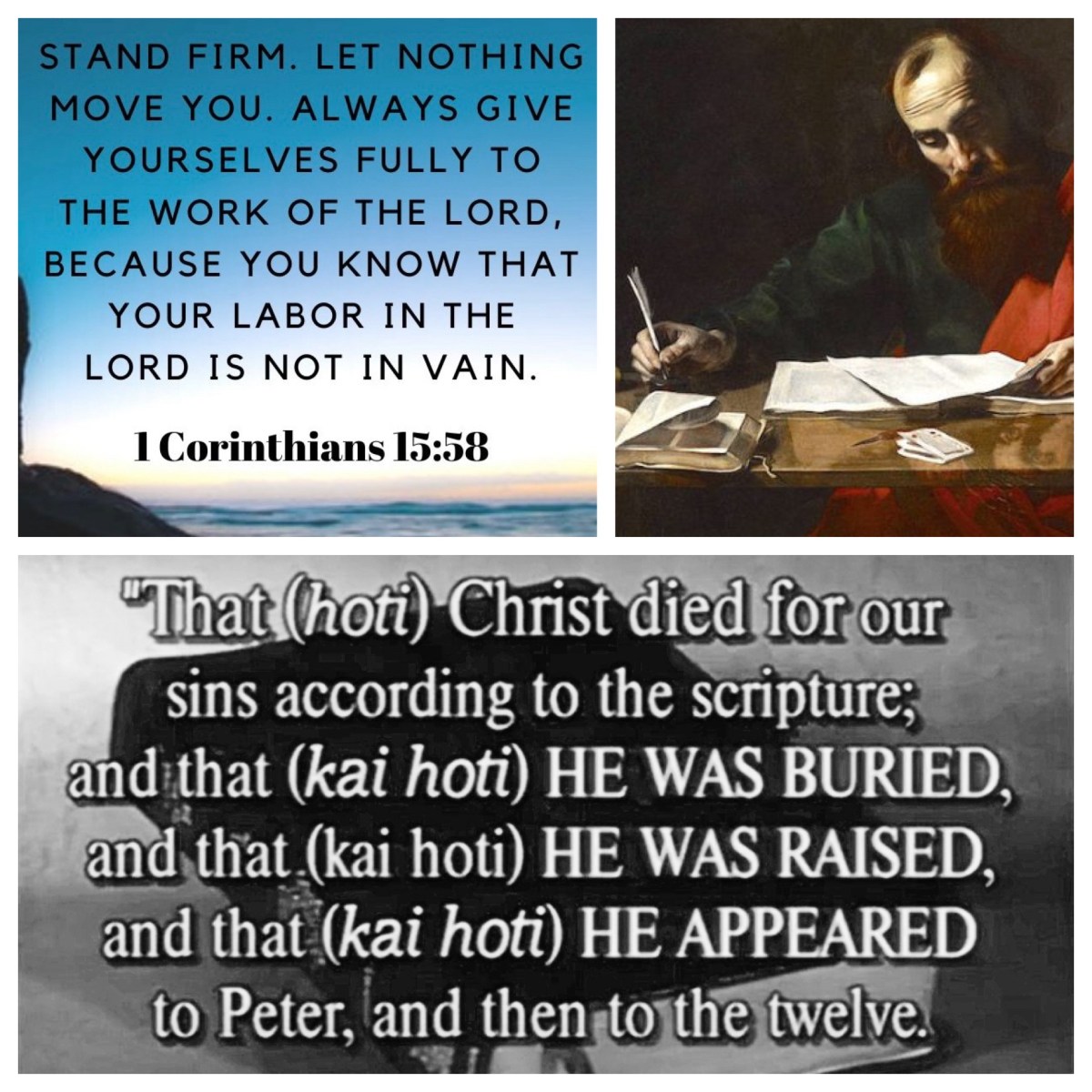
The foundational tradition which he then reports (15:3b–7) is based on an early four-part affirmation of faith: “Christ died…he was buried…he was raised…he appeared”.

The first and third elements are elaborated with the formulaic “in accordance with the scriptures”. The fourth element, the appearances of the risen Jesus, is extended beyond the list received by Paul (to Cephas, the twelve, more than 500, James, all the apostles; 15:5–7) to include Paul himself (“as to one untimely born”, 15:8), leading on to an assertion of Paul’s apostolic credentials and divinely-assisted activities (15:9–11).

The beginning of this lengthy discussion of resurrection reaches back to the “theology of the cross” at the start of the letter by references to the crucifixion and death of Jesus; but Paul does not develop this connection. Instead, he moves straight to the first pastoral situation in Corinth regarding the resurrection (15:12–19).

The “resurrection of the dead” (the Greek word is plural, reflecting a raising of many believers) was a Jewish belief that had developed in preceding centuries; not all Jews accepted it (see Acts 23:6–8) and amongst some Gentiles there was scepticism about the idea (see Acts 17:32).

The community in Corinth contained sceptics (15:12); Paul’s counter-argument attempts to refute their opinion in a series of logic-based steps, beginning with a questioning of the reality of the resurrection of the one person, Jesus (15:13–16) and leading to the conclusion that “your faith is futile” (15:17). He cannot countenance this, so launches into an exposition of what he sees as eschatological realities (15:20–28), explaining the places allocated, at the end, to humans, Jesus, and God.

The rhetorical structure of the first part of this argument (15:21–22) returns to the pattern of juxtaposing two different entities, which Paul has used in earlier sections of the letter. We can see this pattern as follows: for since death came through a human being / the resurrection of the dead has also come through a human being; for as all die in Adam / so all will be made alive in Christ. An expanded version of this argument takes place in Rom 5:12–21.

Paul then continues by explaining that Christ is “the first fruits”, who has “all things put in subjection under his feet” (15:23–27). But Christ himself is subjected to God; finally, God is “all in all” (15:28). Paul has not proven the resurrection as such, but has explained how it fits into his view of the end days.

A second pastoral situation is noted (15:29) but abruptly dismissed with two rhetorical questions; the clear inference is that there is no validity at all in the viewpoint held by those who practice “baptism on behalf of the dead”. Then follows a poetic reflection (15:30–34) in which Paul draws on Hebrew scripture (Isaiah 22:13) and Greek poetry (Menander, Thais) to denounce those who “have no knowledge of God” (15:34).

A third pastoral situation might possibly be indicated at 15:35, although the form employed (a rhetorical question attributed to an indefinite person) was commonly used by a skilled rhetorician to raise an objection which he knew could be raised, allowing it to be dealt with in advance (the same technique is found in Rom 2–6 and 9–11).

The question provides an opportunity for further eschatological teachings about the nature of the resurrection body (15:35–49) and a further display of Paul’s rhetorical prowess.

Once again, the rhetorical structure of the argument provides contrast by juxtaposition, advanced in a sequence of logical steps:

What is sown is perishable / what is raised is imperishable.

It is sown in dishonour / it is raised in glory.

It is sown in weakness / it is raised in power.

It is sown a physical body/ it is raised a spiritual body.

If there is a physical body / there is also a spiritual body.

Thus it is written, “The first man, Adam, became a living being”/ the last Adam became a life-giving spirit.

But it is not the spiritual that is first / but the physical, and then the spiritual.

The first man was from the earth, a man of dust; / the second man is from heaven.

As was the man of dust, so are those who are of the dust; / and as is the man of heaven, so are those who are of heaven.

Just as we have borne the image of the man of dust, / we will also bear the image of the man of heaven.

The symmetry is certainly poetically and rhetorically satisfying.

Some concluding reflections (15:50–58) allow for a final glimpse into the eschatological drama that awaits. The argument now is no longer logic-based, as Paul moves through a sequence of vividly-imagined images in a dramatic rhetorical style. The whole long discussion of this matter ends with the concise ethical exhortation, “be steadfast, immovable” (15:58).

The last word after this word of encouragement is a word of hope-filled assurance to the Corinthians, whom he has criticised so mercilessly at many places throughout the letter: “you know that in the Lord your labor is not in vain” (15:58).