King David and the Ark of the Covenant (2 Sam 6; Pentecost 8B)

For the passage from Hebrew Scripture this coming Sunday, the lectionary offers us selected verses from 2 Sam 6:1–19. Last week, we heard the brief account of how David, the king of Judah, took the city of Jerusalem from its inhabitants, the Jebusites, and was anointed as king of “all Israel” (5:1–10). Next week, we will hear of the promise that God makes to David, that “I will make for you a great name … your throne shall be established forever” (7:1–14).

In between these two pivotal events, establishing beyond doubt that David was both the conqueror supreme of the earlier inhabitants and the progenitor of a dynasty—“the house of David”—that would hold power for centuries to come, we have a curious, yet significant, account relating to The Ark of the Covenant (6:1–19). David uses the Ark to reinforce and undergird his authority; his intention in bringing into the city, Jerusalem, was to confirm absolutely that he was God’s anointed, in Jerusalem, ruling over all Israel.
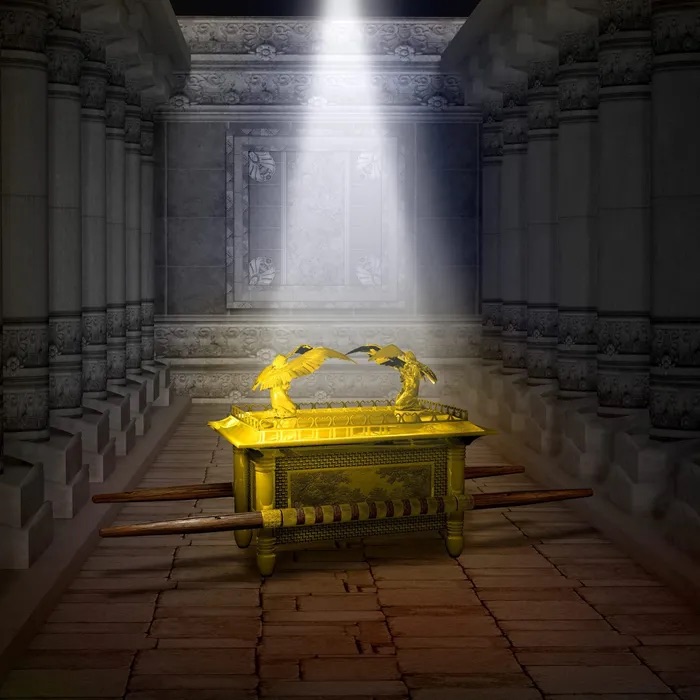
The Ark of the Covenant had long been a focal point for people in Israel. It had travelled with them from the wilderness days (Num 10:33–36), being carried along the way by the Levites (Deut 10:8). In the book of Deuteronomy, it is important because it contained “the book of the law” which Moses had written, and which was to be read to the people of Israel every seven years (Deut 31:9–13; se also Exod 40:20).

Another perspective is offered in the priestly prescriptions relating to the complex system of sacrifices and offerings that was overseen by the priests, that are reported in excruciating detail in Exodus 25—30 and then again in Leviticus 1—7. Here, the significance of the Ark is primarily that it contained the Mercy Seat (Exod 25:17–22). It was the smearing of blood on the Mercy Seat, performed once a year by the High Priest on the Day of Atonement, that secured the forgiveness of all the sins of the people from the past year (Lev 16:1–34; see esp. vv.14–15).

The narrative of Numbers draws these two strands together, when it reports that “when Moses went into the tent of meeting to speak with the Lord, he would hear the voice speaking to him from above the mercy seat that was on the ark of the covenant from between the two cherubim; thus it spoke to him” (Num 7:89). So the significance of the Mercy Seat in the Ark of the Covenant is high.

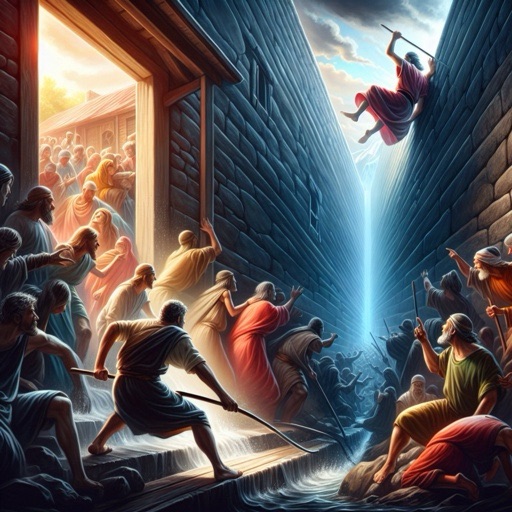
Regardless of the significance invested in the Ark, its presence with the people during the 40 years in the wilderness was important. It appears at the end of that period of time, when Joshua prepares to lead the people into the land of Canaan. On the command of Joshua, “while all Israel were crossing over on dry ground, the priests who bore the ark of the covenant of the Lord stood on dry ground in the middle of the Jordan, until the entire nation finished crossing over the Jordan” (Josh 3:17). The miraculous power of the Ark is thus demonstrated.
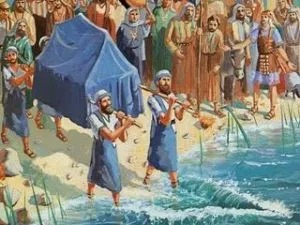
What would it have looked like if there
was photography at the time???

It is referred to only once in the whole of Judges, in the closing scenes, after the abomination perpetrated by the Benjaminites in Gibeah (Judg 19). The Israelites had “inquired of the Lord (for the ark of the covenant of God was there in those days)”, and received the voice of God from the ark, “go up, for tomorrow I will give them into your hand” (Judg 20:27).

Soon after, in the very first battle with the Philistines in 1 Samuel, the Ark was captured. It had been in “the temple of the Lord” at Shiloh when Eli was priest (1 Sam 1:20, 24-28; 3:2–3), but after losing their encounter with the Philistines at Aphek, the Israelites decided to bring the Ark from Shiloh to the battlefield to reverse the result (4:1–4). The presence of the Ark, at first discomforting to the Philistines, was not able to turn the tide; “Israel was defeated, and they fled, … there was a very great slaughter, for there fell of Israel thirty thousand foot soldiers; the ark of God was captured” (4:10–11).
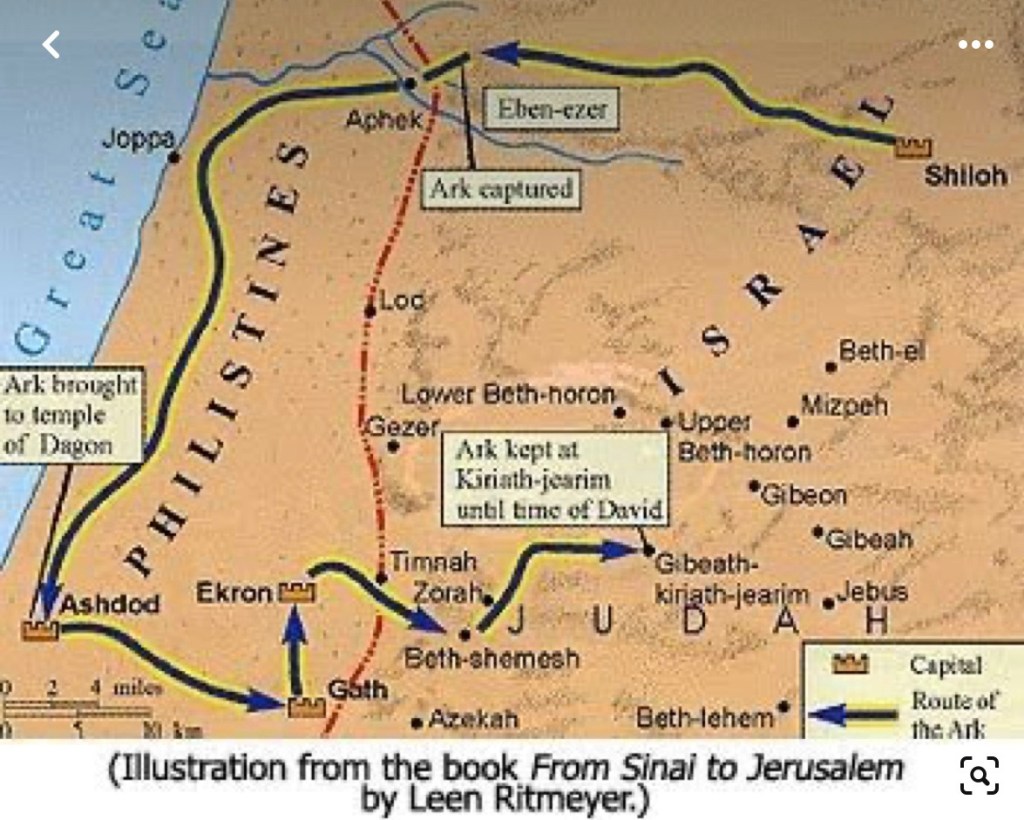
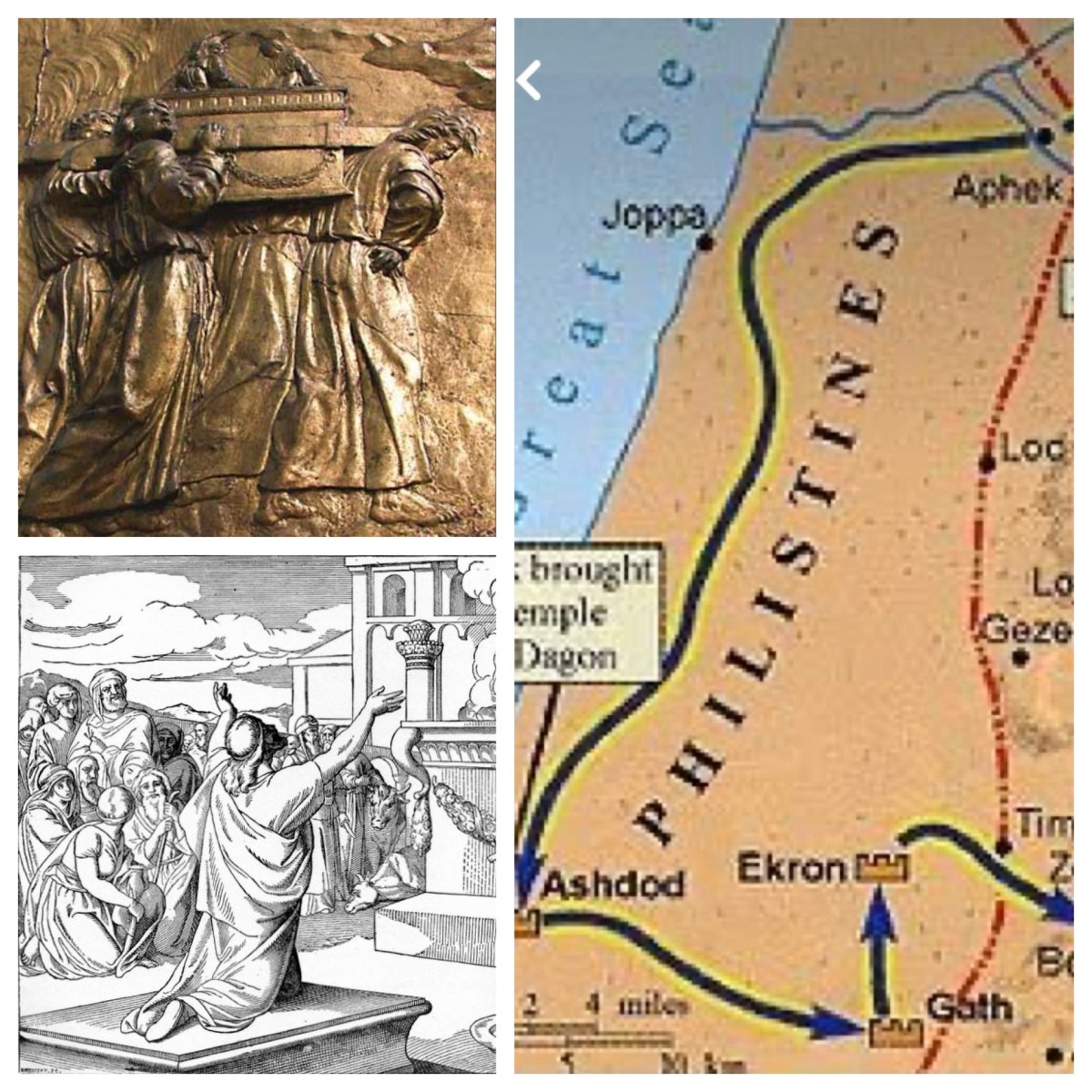
The Ark was sent first to Ashdod (5:1), then to Enron (5:10), before it was returned to Israel seven months later (6:1–16). They had placed inside the Ark “five gold tumours and five gold mice, according to the number of the lords of the Philistines” (6:4–5), “one for Ashdod, one for Gaza, one for Ashkelon, one for Gath, one for Ekron” (6:17). These images served as a guilt offering to the Lord God, in the hope that they would be “healed and ransomed” (6:3).

But the people of Beth-shemesh shied away from having this potent artefact in their village; after all, it has killed seventy descendants of Jeconiah who “did not rejoice with the people of Beth-shemesh when they greeted the ark of the Lord” (6:17). So it was sent on to Kiriath-jearim, where it remained without incident for 20 years (7:1–2).

The Ark then fades from the story during those years, as the narrative turns to the question of kingship (1 Sam 8—10) and Saul is eventually anointed as King (10:1). It remains absent from the accounts of Saul’s battles (1 Sam 11—14) until, out of the blue, Saul calls for the Ark to be brought to Gibeah, in the hill country of Ephraim, where he had made his base (1 Sam 14:16–18), and the particular battle being waged against the Philistines was won (14:23). Presumably it continues its travels with Saul; the next time it is mentioned is in the story we read this week in 2 Sam 6.
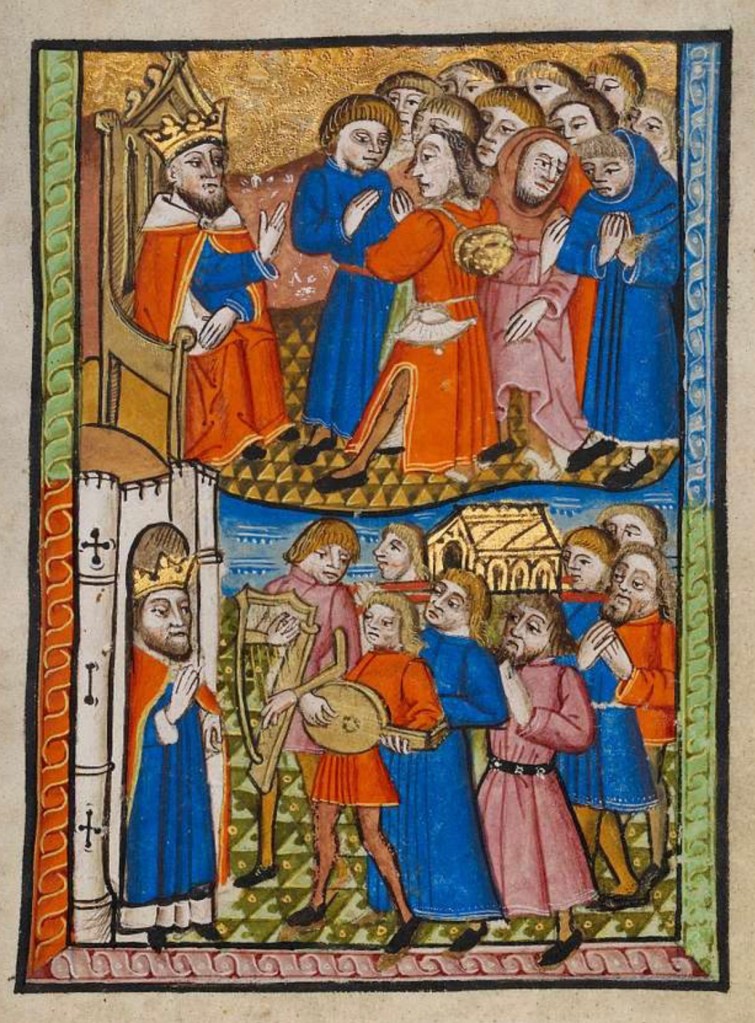
David bringing the Ark into Jerusalem: reproduction of a page
in an illuminated manuscript held by the J. Paul Getty Museum.

In this week’s story, David effects a change in the role played by the Ark. It is brought into Jerusalem and stays grounded there; in due course, a permanent temple will be built on the site under Solomon. When David is forced to flee the city (2 Sam 15:13–18), he takes the Ark with him to the edge of the wilderness (15:23–24), but then orders it to be sent back into the city (15:25–29). The Ark will remain as a symbol of his rule over the city and, indeed, the whole nation.

Writing in With Love to the World, Michael Brown reflects on the militaristic colonizing of King David, as he consolidates and reinforces his dominance. He observes that “David, the just-minted king of an expanded territory was starting something big and new. His royal city, permanent army, and large harem pointed to a very different reign. Yet those who prized the traditions might have queried whether this reign had legitimacy.”

This is where the Ark comes into play. Brown continues, observing that it was now “perfect timing for the ark, languishing in the back blocks but traditionally identified closely with God’s presence, to be brought by David to the new royal city as a symbol of God’s blessing.”

The Ark once again does not feature in the story told in the ensuing chapters, until after David has died (1 Ki 2:10). Once he is king, Solomon “came to Jerusalem where he stood before the ark of the covenant of the Lord; he offered up burnt offerings and offerings of well-being, and provided a feast for all his servants” (1 Ki 3:15). The Ark was due to be superseded by the Temple, in whose inner courtyard the Ark would be placed (1 Ki 6:19).

And so, at the dedication of the Temple, “the priests brought the ark of the covenant of the Lord to its place, in the inner sanctuary of the house, in the most holy place, underneath the wings of the cherubim” (1 Ki 8:6, 21). The narrator declares that “there was nothing in the ark except the two tablets of stone that Moses had placed there at Horeb, where the Lord made a covenant with the Israelites, when they came out of the land of Egypt” (1 Ki 8:9).
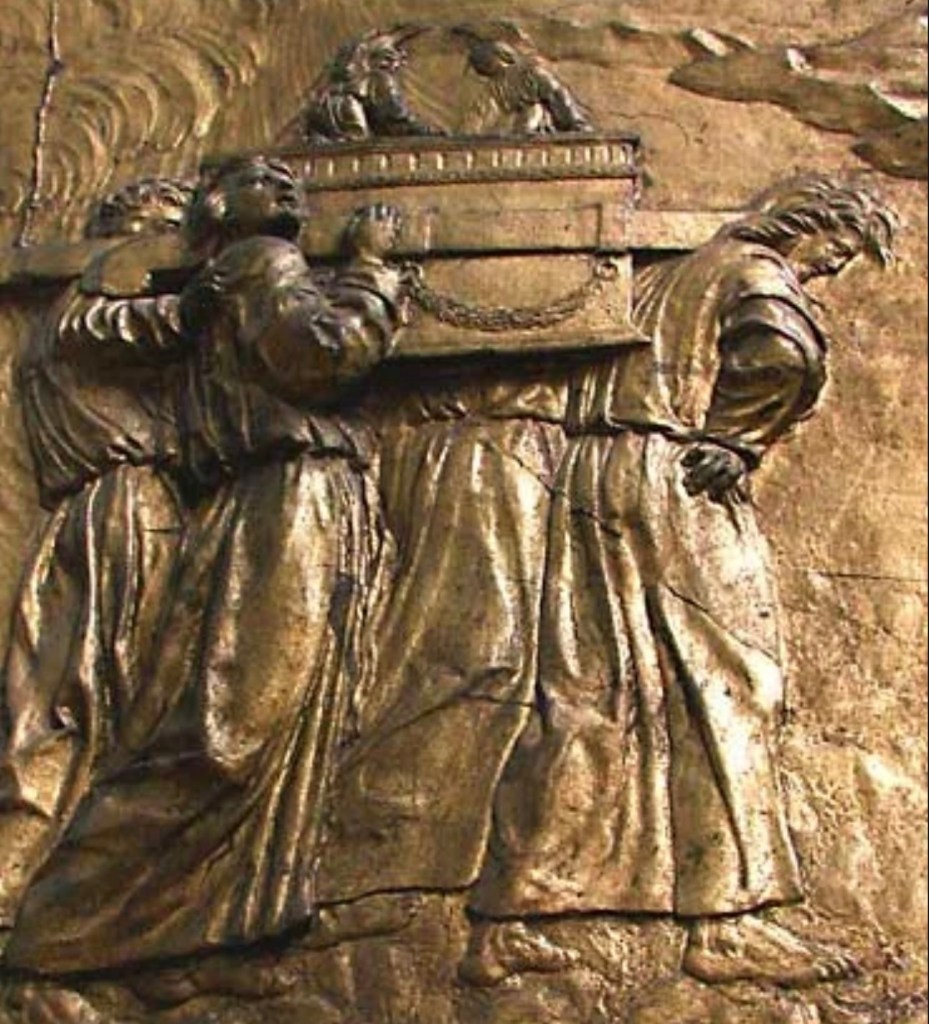
Transporting the Ark of the Covenant, gilded brass relief,
Cathedral of Sainte-Marie, Auch, France.

We hear nothing more of the Ark until centuries later when Jeremiah, in exile, reports the words of the Lord: “when you have multiplied and increased in the land, in those days, they shall no longer say, “The ark of the covenant of the Lord.” It shall not come to mind, or be remembered, or missed; nor shall another one be made.” (Jer 3:16). According to an even later report, Jeremiah himself had taken “the tent and the ark and the altar of incense” and his them in a cave on “the mountain where Moses had gone up and had seen the inheritance of God” (2 Macc 2:1–5, referring to Mount Sinai of Exod 19:16–25; 24:15–18).

Cue the movie featuring Indiana Jones and the raiders of the lost ark … … …

A critical issue for us, from the story of the Ark and how it was used in ancient Israel, is the interplay between political and religious leadership that is portrayed in the Hebrew Bible narratives.What might tgat mean for people of faith today, as we reflect on and live out our faith in the public life of society?

Throughout all ancient societies, religion was very closely linked to the political situation of the particular society. In the years leading up to the story that we hear this coming Sunday, the people of Israel had been engaged in one war after another. Even when the Israelites were settled in the land, they did not have control of the whole of the land of Israel. Only after he has won victory in a number of battles, could David claim to be king of Israel. The story we hear this Sunday was when the whole land had, at last, been placed under his control.

To celebrate, he declares that Jerusalem is to be the capital city, and to commemorate this event, the Ark is brought into the new capital city. From this point onwards, not only is Jerusalem the political capital of Israel, but it is also the place where God dwells, where God is to be found.

David knows that the ruling monarch must be seen to be favoured by God. What better way than to make his chosen capital the centre of the religion of Israel? Any disgruntled Jews from the northern kingdom cannot attack David’s city without seeming to attack God, so David has astutely consolidated his grip on the monarchical power.

In one way, it makes sense to link religious celebration with political victory. This is a natural connection that people have often made throughout history – thanking the god who they worship when a significant military victory is won.

But it is also a dangerous practice. It can lead to political leaders making claims about God being on their side and not on the other side. It can lead to arrogant actions. It can lead to a distortion of religion, when it is pressed into the service of the state. The kings of ancient Israel are not immune to these charges; from Samuel onwards, prophet after prophet had made it very clear that kings frequently put self and power before their obedience to God.

In today’s world there are many instances of corrupt governments and abuse of power, where human rights are ignored and God’s name is abused. Russia, China, Iran, Iraq, Afghanistan, various Middle Eastern countries, Myanmar and some other Asian nations, and quite a number of sub-Saharan African countries come to mind. And even democracies, heading by the United States of America, display indications of the abuse of power and the presence of corruption. The problem is endemic.

As people of faith, we need to be on our guard against the temptation to use our faith to claim superiority or act unethically. Rather, our faith should guide us to act in ways that influence for good the politics of the society in which we live. Only then can we expect the church to inspire and transform the society around us. Only then can we truly be called people of God.

See also

With Love to the World is a daily Bible reading resource, written and produced within the Uniting Church in Australia, following the Revised Common Lectionary. It offers Sunday worshippers the opportunity to prepare for hearing passages of scripture in the week leading to that day of worship. It seeks to foster “an informed faith” amongst the people of God.

You can subscribe on your phone or iPad via an App, for a subscription of $28 per year. Search for With Love to the World on the App Store, or UCA—With Love to the World on Google Play. For the hard copy resource, for just $28 for a year’s subscription, email Trevor at wlwuca@bigpond.com or phone +61 (2) 9747-1369.


Uniting Church reflections during NAIDOC Week 2024: thirty years of covenanting (1994), fifteen years recognising truth (2009)

Every July, NAIDOC Week takes place. It runs from the first Sunday in July (this year, 7July) until the following Sunday (this year, 14 July). The week has a focus on the First Peoples of this continent and its surrounding islands—the Aboriginal and Torres Strait Islanders from the more than 250 nations that existed on this continent and its surrounding islands before the invasion of 1788.

NAIDOC Week has been held for over 50 years, under the auspices of the National Aborigines and Islanders Day Observance Committee (which forms the acronym NAIDOC). The origins of this week are attributed to Aboriginal Christian leader, William Cooper, who called churches to recognise and celebrate Aboriginal and Torres Strait Islander communities in worship services. For many years, congregations across the Uniting Church have recognised and celebrated NAIDOC Week in worship services.

The theme for 2024 is Keep the Fire Burning! Blak, Loud and Proud.

The NAIDOC WEEK website explains the theme:

“This year’s theme celebrates the unyielding spirit of our communities and invites all to stand in solidarity, amplifying the voices that have long been silenced.

“The fire represents the enduring strength and vitality of Indigenous cultures, passed down through generations despite the challenges faced. It is a symbol of connection to the land, to each other, and to the rich tapestry of traditions that define Aboriginal and Torres Strait Islander peoples. As we honour this flame, we kindle the sparks of pride and unity, igniting a renewed commitment to acknowledging, preserving, and sharing the cultural heritage that enriches our nation.

Blak, Loud and Proud encapsulates the unapologetic celebration of Indigenous identity, empowering us to stand tall in our heritage and assert our place in the modern world. This theme calls for a reclamation of narratives, an amplification of voices, and an unwavering commitment to justice and equality. It invites all Australians to listen, learn, and engage in meaningful dialogue, fostering a society where the wisdom and contributions of Indigenous peoples are fully valued and respected.

“Through our collective efforts, we can forge a future where the stories, traditions, and achievements of Aboriginal and Torres Strait Islander communities are cherished and celebrated, enriching the fabric of the nation with the oldest living culture in the world.”

This July during NAIDOC Week the Uniting Church will be marking two significant anniversaries in the life of the church and our relationship with First Peoples. 10 July marks the 30th anniversary of the Covenant between the Uniting Aboriginal and Islander Christian Congress (UAICC) and the Uniting Church in Australia, while mid-July marks the 15th Anniversary of the revised Preamble to the Uniting Church Constitution

The Covenant with the UAICC (Congress) was a result of years of discernment and planning from Aboriginal Christian leaders within the Uniting Church who held a prophetic vision for a more just and healed future. In the Christian faith, the term “covenant” is used to signal a commitment of two parties to each other. In the Bible, a covenant is initially made by the Lord God with Noah, “with you and your descendants after you, and with every living creature that is with you, the birds, the domestic animals, and every animal of the earth with you, as many as came out of the ark” (Gen 9:9–10).

The same covenant is then renewed with Abraham (Gen 17:1–7, 15–16), where Abraham is identified as “the ancestor of a multitude of nations” (Gen 17:4) who would then be party to that covenant in subsequent generations. The covenant is then renewed with Abraham’s son, Isaac (Gen 17:19, 21) and then with Jacob (Israel) (Gen 35:9–15). Later, it is extended to Moses and the whole people (Exod 19:1–4) and sealed in a ceremony involving “the blood of the covenant” (Exod 24:1–8).

Many centuries later, a prophet during the Exile proclaimed that God was promising, “this is the covenant that I will make with the house of Israel after those days, says the Lord: I will put my law within them, and I will write it on their hearts; and I will be their God, and they shall be my people” (Jer 31:31).

That renewed covenant is what Christians believe was enacted by Jesus, when he submitted to death on a cross; dying as a sacrifice, he shed “the blood of the covenant” (Mark 14:24; Matt 26:28; Luke 22:20; 1 Cor 11:25) and is recognised as “the mediator of a better covenant” (Heb 8:6) or “the mediator of a new covenant” (Heb 9:15; 12:24)—even though in terms of the declaration made by Jeremiah, this was actually yet another renewal of the one covenant that God had made and renewed with God’s people over the millennia.

So entering into a covenant in our current time reflects this strong biblical understanding of what a genuine partnership looks like; it is an expression of an intentional promise to seek mutual understanding, to listening and to serve together within a shared life. 

The Assembly of the Uniting Church has offered a reminder of the importance of what took place 30 years ago. The next few paragraphs come from that piece, “Save the Date: 30th Anniversary of the Covenant”, at https://uniting.church/save-the-date-covenant-anniversary/

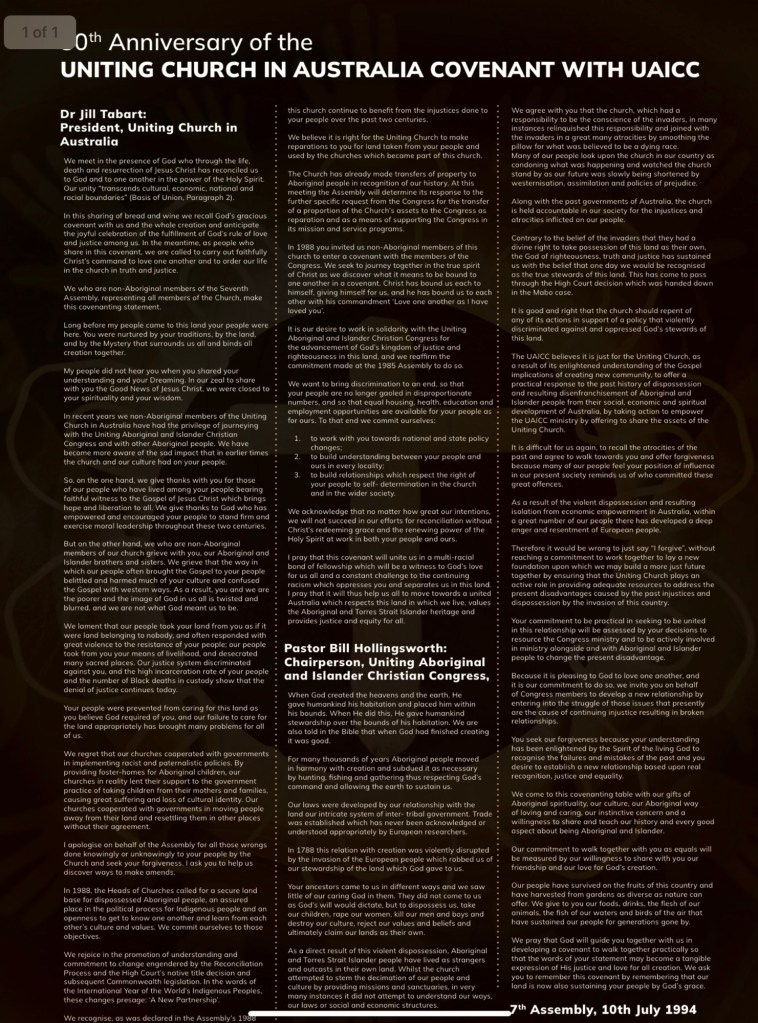
First, it recalls that in May 1988 when the 5th Assembly met, Rev Charles Harris and Rev Dr Djiniyini Gondarra with other UAICC leaders called for a Covenant to bind the UCA and the UAICC together in relationship. This was endorsed by the full Assembly by acclamation. Six years later, the Covenanting Statement was formally signed at the 7th Assembly, on 10 July 1994.

In the Covenanting Statement read at the meeting, then President Dr Jill Tabart formally apologised for the church’s role in colonisation and dispossession of Australia’s First Peoples and committed the church to a new relationship. In response Pastor Bill Hollingsworth, then National Chair of UAICC, offered an inspiring challenge to the church to honour this commitment. (The full text of both speeches is below.)

The statement continues to serve as a formational part of the Uniting Church’s commitments to walking together as First and Second Peoples and to self-determination for First Peoples. 

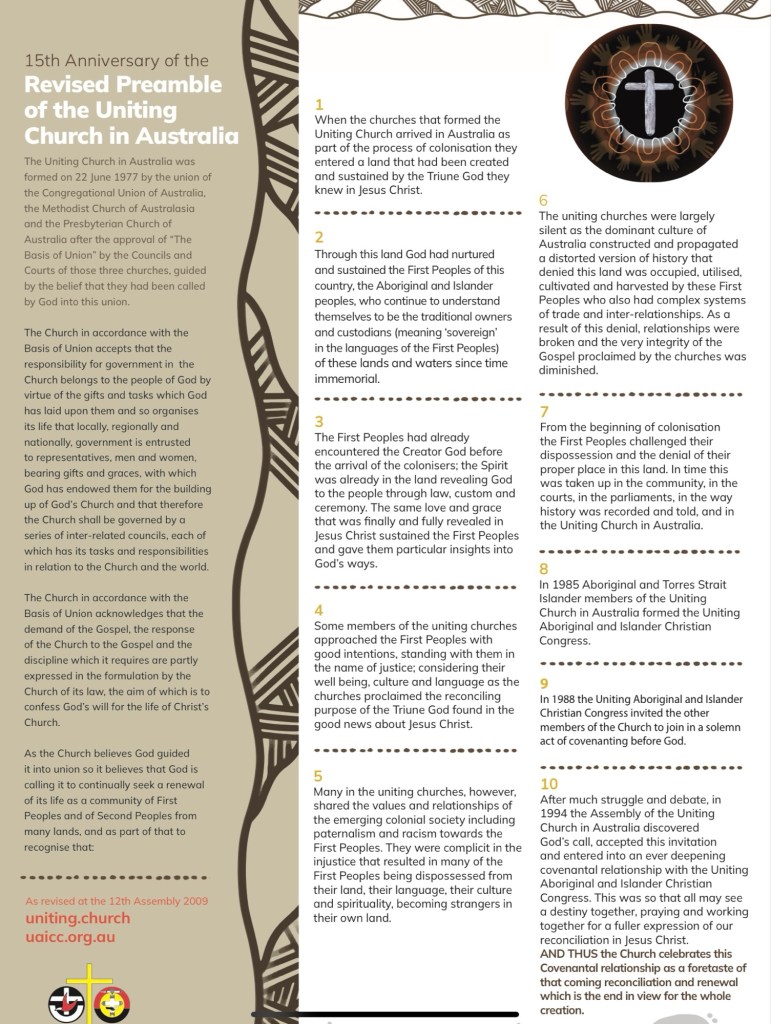
In a significant milestone in the covenant journey, the Uniting Church’s Constitution was revised to include a revised Preamble at the 12th Assembly (15–21 July 2009). The first half of this revised Preamble contains a number of significant statements of truth about the experience of the First Peoples over the past 240 years. (The full text of the revised Preamble is below.)

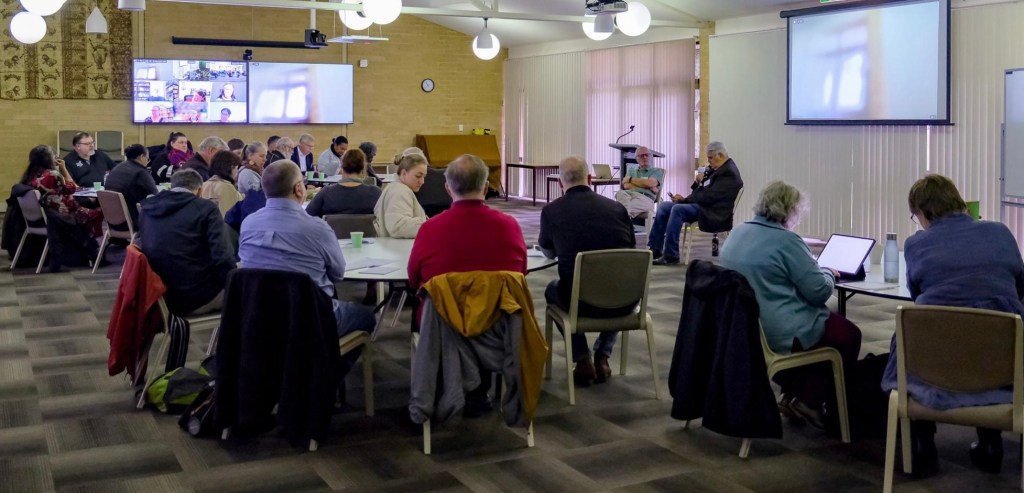
Significantly, the revised Preamble affirms that “The First Peoples had already encountered the Creator God before the arrival of the colonisers; the Spirit was already in the land revealing God to the people through law, custom and ceremony” (Preamble, para. 3). A conference reflecting on the Preamble has just been held in Sydney.

The declaration made in paragraph 3 of the revised Preamble provides a fundamental theological affirmation which undergirds both our present respect for First Peoples, and our understanding that a relationship with and an understanding of God are not limited to western Christian perceptions of the divine.

This has been an important step for the Uniting Church to take, moving out from the concept that God’s covenant love is offered to a narrow group of people with a particular way of expressing their commitment to God through Jesus (mediated by Western culture, Enlightenment thinking, and Protestant ethic), and that rather this covenant love is offered with grace and hope to people of all times, in all places, in many and varied ways, reflecting the wide diversity of human identities and experiences.

And so, just as we have accepted within Christianity that the God we know in Jesus was active in relationship with human beings for many centuries before the time of Jesus—through the covenant with the people of Israel, as the Hebrew Scriptures attest—so we can agree that God was in relationship with the peoples of the continent we call Australia and the islands which surround it, “in time beyond our dreaming”, in Daramoolen … in Tjukurrpa … in Alcheringa. This is the truth that we now recognise and affirm—and it’s an important affirmation to make!

The NSW.ACT Synod has various resources relating to NAIDOC WEEK 2024 at https://www.nswact.uca.org.au/resources/naidoc-week-resources-for-your-church/

For my thoughts from two years ago about the resonances between “Uniting Church theology” and the themes of NAIDOC WEEK over the years, see

The head of John and the politics of ancient Judea (Mark 6; Pentecost 8B)

The passage we explore today takes us into the world of politics in ancient Judea. It is the story of Herod, Herodias, and John the baptiser (Mark 6:14–29). The Herod in this story is Herod Antipas, the son of Herod the Great, who features in Matthew’s account of the birth of Jesus, as the ruler ordering the killing of “all the children in and around Bethlehem who were two years old or under” (Matt 2:16). He is the same Herod to whom Jesus was sent in the course of his trial before Pilate—at least, according to Luke’s account (Luke 23:6–12).

Just as the birth and death of Jesus are each immersed in the politics of the day, so too the death of John the Baptist is best understood in terms of the politics of the day. The story appears at this point, midway through Mark’s narrative, even though John had been beheaded at the command of Herod Antipas some time earlier (Mark 6:17).

Luke, in fact, locates the arrest of John immediately after reporting his baptising and preaching activity “in the wilderness” (Luke 3:1–20), before mentioning, in a brief aside, that Herod had beheaded John (Luke 9:9).

Mark, once again, provides us with plentiful details about the incident: Herod’s protection of John (Mark 6:20), that he liked to listen to John (6:21), his granting of a wish to his daughter Herodias (6:22), the consultation Herodias then had with her mother (6:24), the grief of Herod when he had to adhere to his promise to fulfil the wishes of Herodias (6:26), and the reverent disposal of John’s body by his disciples (6:29). Matthew reports each of these elements, with far fewer words—although he does add that John’s disciples, after burying his body, “went and told Jesus” (Matt 14:12).

Luke omits all of these details, noting only the arrest and the beheading of John in terse narrative comments. John makes no mention at all of Herod, and in his Gospel the figure of the Baptist serves primarily to point to Jesus as Messiah (John 1:6–8, 15, 19–28, 29–34; 3:25–30; 5:33; 10:41). John the evangelist knows that John was baptising (3:23), in apparent competition with the disciples of Jesus (4:1–2); perhaps these were the disciples of John who left him to follow Jesus (1:35–42)? The evangelist also knows that he was arrested (3:24), but reports nothing of his death.

So Mark offers a rich narrative with many details. It seems that this was a story “doing the rounds” at the time. The story criticised Herod—who was not popular among the Jews. Telling the story gave an indirect way to criticise him, albeit in an indirect way. The “hero” of the story—John, who tragically meets his death—is the polar opposite of Herod. John was austere, ascetic, and obedient to God; Herod was profligate, extravagant, and ran his territory of Galilee according to Roman custom.

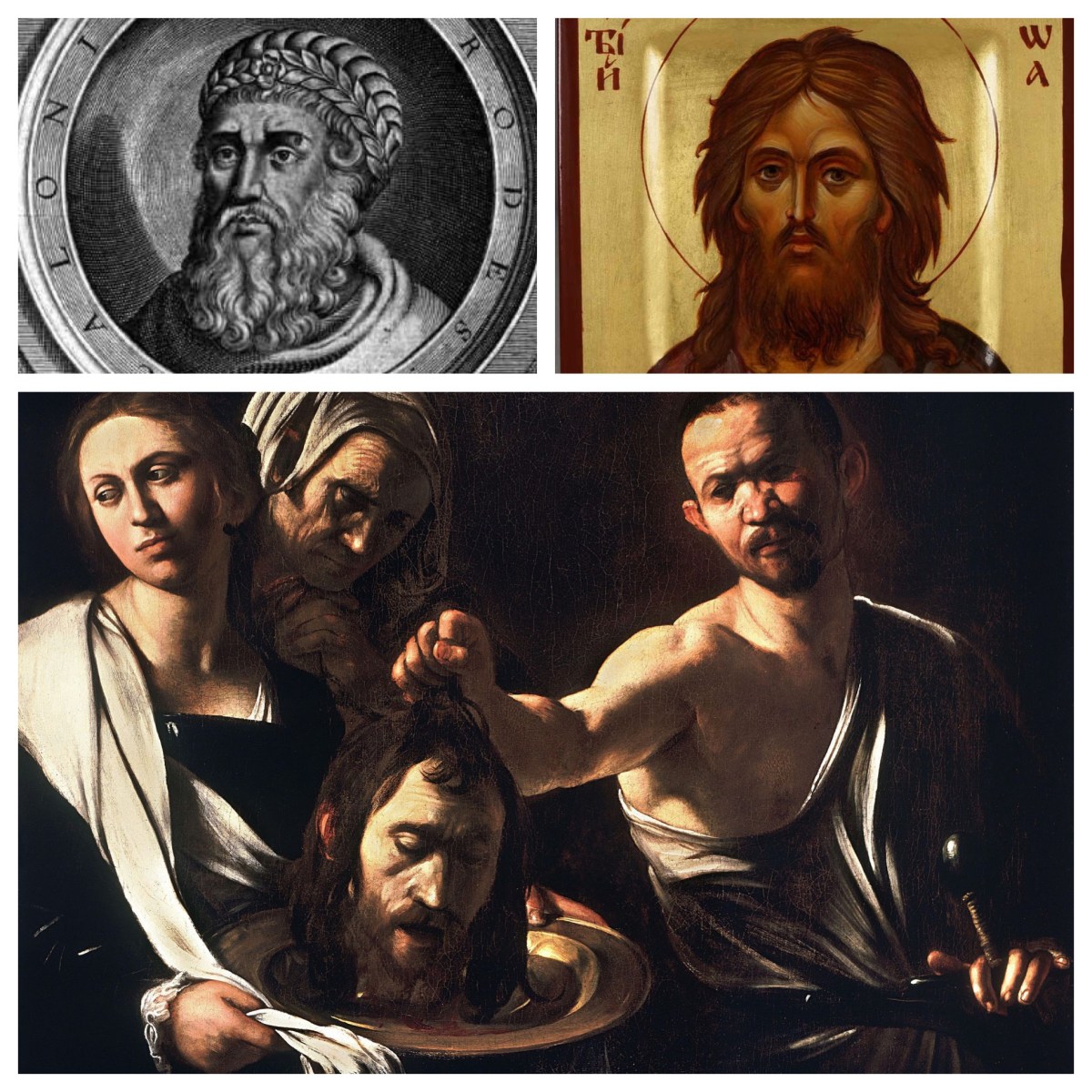
Herod and John

One detail that neither Mark, nor the other evangelists, includes, is that the Hebrew name of Herodias, the daughter of Herod Antipas, was Salome—the name by which she is best known in subsequent art and literature. Salome’s “dance of the seven veils” (another detail absent from the Gospel narratives!) is renowned, having inspired paintings by Titian and Moreau, an 1891 play by Oscar Wilde, a 1905 opera by Richard Strauss, and a 1953 film starring Rita Hayworth.

Indeed, in his recent book Christmaker (Eerdmans, 2024), Prof. James McGrath observes that “the best-known elements of the story—the dance of Salome, the promise of Herod, and John’s head on a platter—are the ones about which a historian has the most reason to be sceptical” (p.116).

James McGrath with his book on John, Christmaker

In fact, even in a number of manuscripts (from the 500s onwards, and especially in the Latin versions), the name of the woman we find named in our Bibles as Herodias (6:22) is missing; in these, she is called “the daughter of Herodias” (and thus the granddaughter of Herod Antipas). But this is a minor point compared to some other factors.

So what do we make of this story? Why has Mark chosen to tell it?

Three Herods: untangling the knots

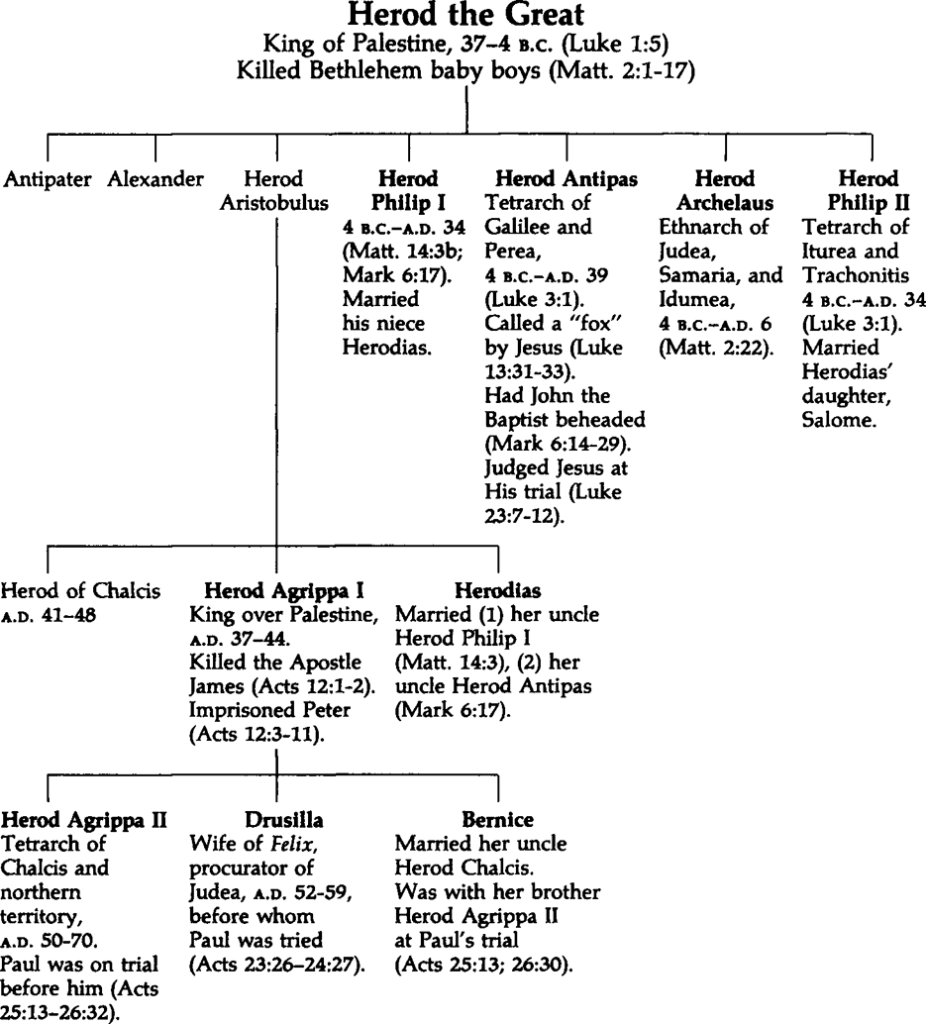
The Herod who appears in this story that Mark and Josephus each tell is one of three Herods mentioned in the New Testament. What follows is an attempt to untangled the knots of history and make clear where each Herod fits.

We begin with the Roman general Pompey leading Roman troops into Jerusalem in 63 BCE. Pompey granted Hyrcanus II the throne, under Roman oversight; Hyrcanus II ruled until 40 BCE. As a Roman protectorate, Judea had the right to have a king. Hyrcanus was a Hasmonean, a member of a priestly family that had worked itself into a position of power in Jerusalem after the revolt in the time of Antiochus Epiphanes (175—167 BCE).

The revolutionary activity of the Maccabees, led by a priest, Mattathias, and his five sons, sought to expel the foreigners from Israel. When Antiochus had a pagan symbol placed into the holy Temple, “Mattathias and his sons tore their clothes, put on sackcloth, and mourned greatly” (1 Macc 2:14). In the face of orders from the king’s officers, Mattathias declared, “I and my sons and my brothers will continue to live by the covenant of our ancestors. Far be it from us to desert the law and the ordinances. We will not obey the king’s words by turning aside from our religion to the right hand or to the left” (1 Macc 2:20–22).

The family of Mattathias and their followers were given the Hebrew name Maccabees, meaning hammer—reflecting the hammer blows they struck, again and again, against their enemies. From 167 BCE they fought an armed insurgency which eventually brought victory over the Seleucids in 164 BCE. For a time, Jews would rule Israel once again.

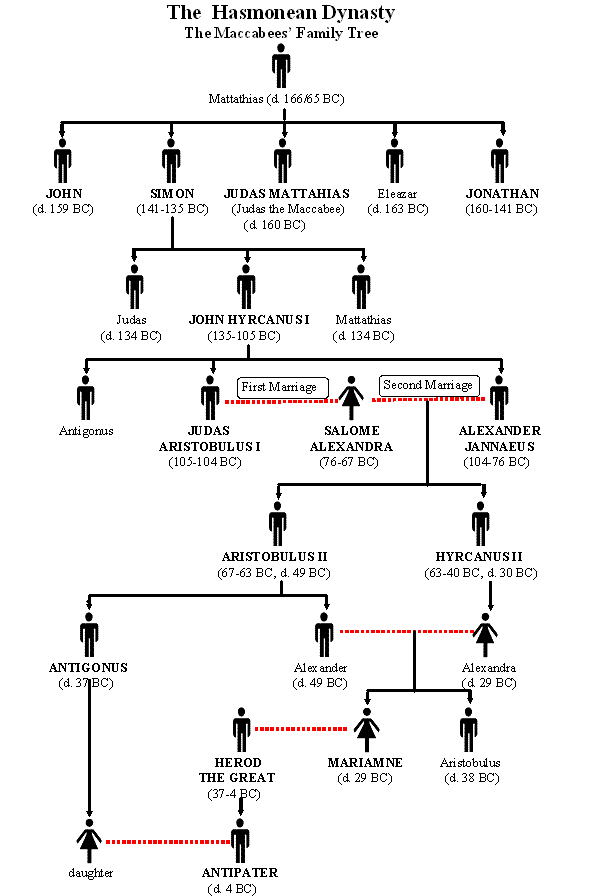
The Hasmonean dynasty

The family given the name Maccabees had at its centre a number of descendants of Hashmon (referred to by Josephus as Asmoneus at Jewish Antiquities 12.265). Thus the string of rulers drawn from this family for the ensuing century, until 63 BCE, are known as the Hasmoneans. The first three rulers from this family were sons of Mattathias: Judah (164–160), his youngest brother Jonathan (160–142), and then his oldest brother Simon (142–134). Each, in turn, moved the religious and cultural practices away from the initial zealous intention to restore Torah and Temple to Israel.

The Hasmoneans believed they should not only sit on the throne of Judah, but also exercise the responsibilities of the High Priest. Claiming this religious leadership was not in accord with the tradition that the priests came from the descendants of Aaron, the brother of Moses, descending through the tribe of Levi (Num 1:48–54; 1 Chron 6:48; 2 Chron 13:10–12; Ezek 44:15). That the Hasmonean high priests were not priests in this precise lineage was a problem for the more traditional members of Israelite society, and would foster discontent and rivalry amongst various groups with Israelite society.

In the midst of growing discontent and instability, in 40 BCE the Roman Senate declared Herod of Idumea to be “King of the Jews”. One of Herod’s many wives was Marianne, the granddaughter of both Aristobulus II and Hyrcanus II. (Aristobulus’s son, Alexander, had married Alexandria, the daughter of Hyrcanus. They were the parents of Marianne.) So he had married into the Hasmonean family.

It is said that Antigonus, the brother of Alexander and son of Aristobulus, had cut off Hyrcanus’s ears to make him unsuitable for the High Priesthood, so Antigonus ruled for three years in defiance of Rome’s decree. Herod, with the support of Mark Anthony, seized power in 37 BCE and held power until his death in 4 BCE. Hasmonean rule was at an end; Herod was an Idumean, the son of an Idumean man, Antipater, who served in the court of Hyrcanus II, and his wife Cypros, from a Nabatean Arab princess. He has been raised as a Jew, but to many Jews he was not a Jew, but an Idumean (the kingdom that had evolved from the Edomites, to the south of Judah).

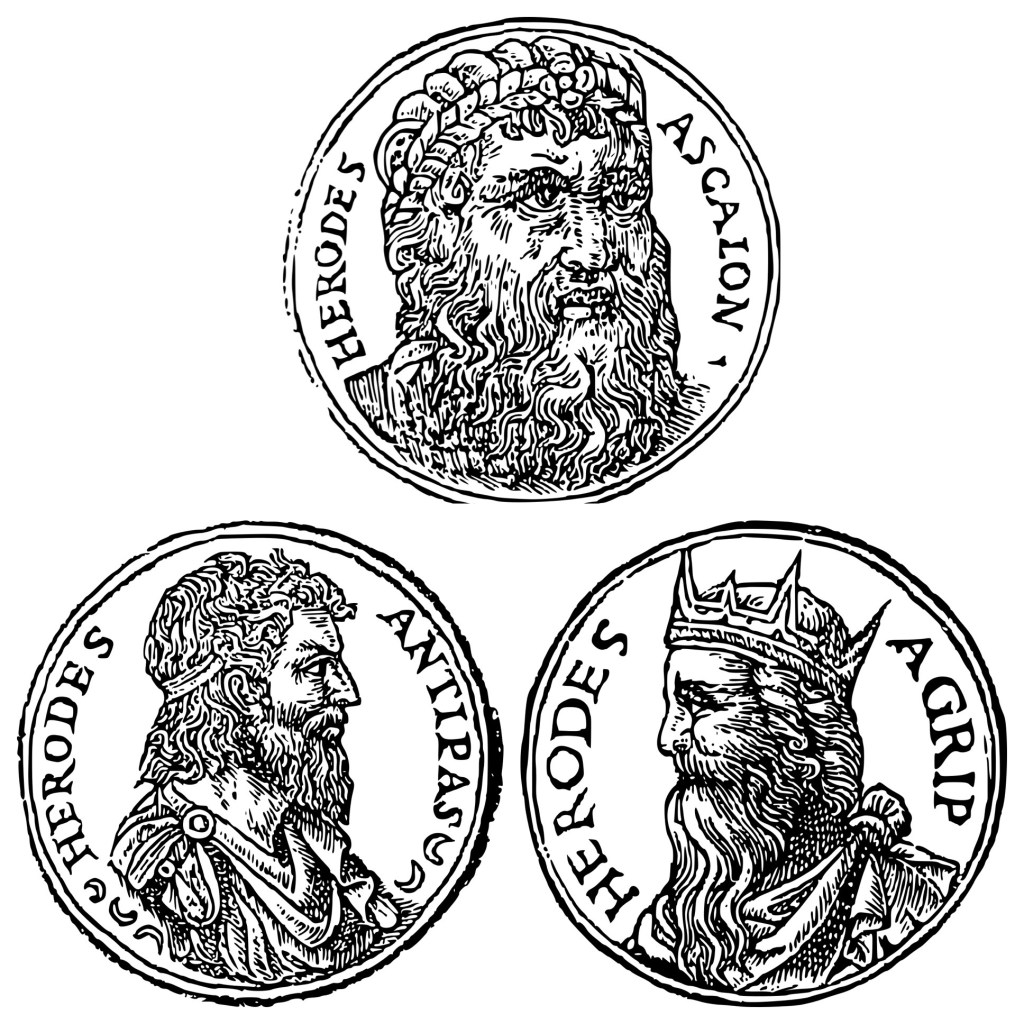
Herod the Great (top), titled “Herod Ascalon”
in light of the tradition that he was born in Ashkelon;
one of his younger sons, Herod Antipas (bottom left),
and his grandson through Aristobulus,
Herod Agrippa (bottom right)

Later, after the death of Herod, one third of his kingdom (the region of Galilee) came under the control of Herod Antipas, the son of Herod the Great and one of his wives, Malthace, from Samaria. Herod senior was “Herod the Great”, the king who, according to Matthew, ordered the slaughter of all males born in Israel (Matt 2:16–18).

The Herodian family

Herod Antipas, his son, was, according to Mark, the ruler who, against his better judgement, ordered the beheading of John the baptiser (Mark 6:17–29). Herod Agrippa was another member of the family, a grandson of King Herod by another of his wives, Mariamne, who ruled as King of Judea from 41 to 44 CE. He appears as “King Agrippa” in Acts 24—25, when Paul is brought to Caesarea, the seat of government, to be judged by Agrippa, his consort Bernice, and the Roman Governor Festus.

So today’s story from Mark 6 involves the middle Herod, Herod Antipas. His relationship with John the Baptist is what lies at the heart of the account in Mark 6.

Why did Herod put John to death?

We actually have two detailed accounts of the death of John. Mark, as we have seen, portrays Herod as equivocating. He tries to move the primary responsibility of John’s death away from Herod, by interspersing his daughter and her request. Perhaps Mark feels the need to excuse the Roman-supported ruler of the time, to avoid having the Jesus movement portrayed as a terrorist movement?

After all, even though Jesus was clearly crucified under orders from the Roman Governor, Pilate (Mark 15:15), Mark does have Pilate bow to the pressure of the crowd that is calling out “crucify him”, by asking the question, “what evil has he done?” (15:12–14). It is Mark who provides our earliest source for placing the blame on the chief priests”, who had stirred up the crowd to press for Jesus to be crucified (15:10–11). So if there an apologetic purpose in the passion narrative—blame the Jews, excuse the Romans–then is a similar apologetic happening in the story of John’s death?—blame Herodias, excuse Herod.

There is an account written later than Mark, by the Jewish historian Flavius Josephus, in his history of the Jews, which he wrote under Roman patronage in the latter decades of the first century CE. Here, Josephus pins the blame squarely on Herod.

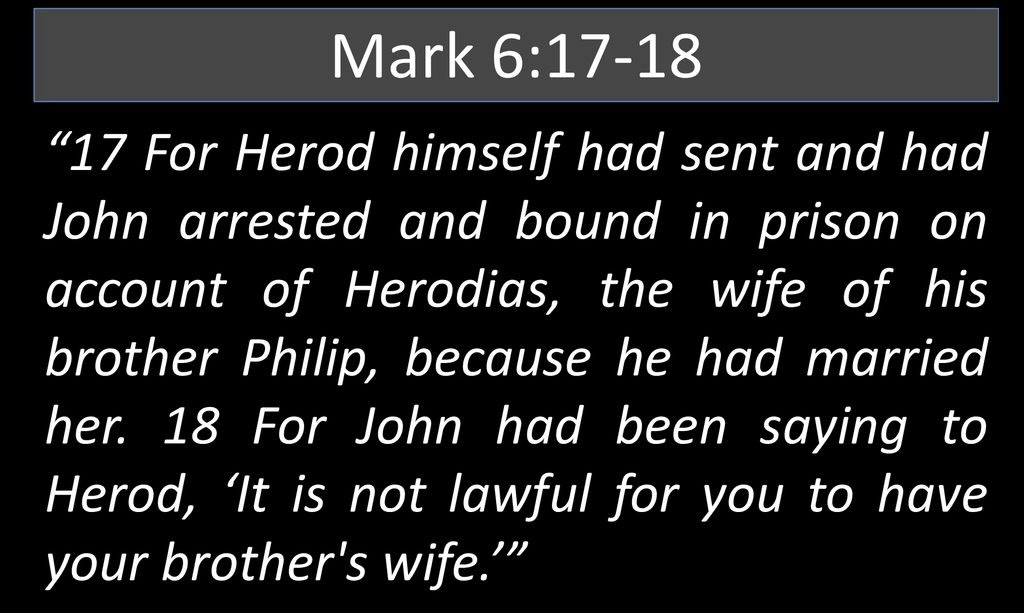
Herod Antipas had divorced his first wife Phasael, who was the daughter of the king of Nabataea. Herod Antipas then married Herodias, who had previously been married to Herod’s half-brother Herod II. John was publically critical of this (Mark 6:18; Matt 14:4; Luke 3:18).

John’s criticisms of Herod’s divorce and subsequent marriage did not sit well with Herod. John’s popularity meant that he was persuading many others to this negative view of Herod. Indeed, God later vindicates the criticisms made by John, according to Josephus, who says that God punished Herod by his later defeat in battle. Josephus writes:

“Herod had put him to death, though he was a good man and had exhorted the Jews to lead righteous lives, to practise justice towards their fellows and piety towards God, and so doing to join in baptism.

“In [John’s] view this was a necessary preliminary if baptism was to be acceptable to God. They must not employ it to gain pardon for whatever sins they committed, but as a consecration of the body implying that the soul was already thoroughly cleansed by right behaviour.

“When others too joined the crowds about him, because they were aroused to the highest degree by his sermons, Herod became alarmed. Eloquence that had so great an effect on mankind might lead to some form of sedition, for it looked as if they would be guided by John in everything that they did.

“Herod decided therefore that it would be much better to strike first and be rid of him before his work led to an uprising, than to wait for an upheaval, get involved in a difficult situation and see his mistake. Though John, because of Herod’s suspicions, was brought in chains to Machaerus, the stronghold that we have previously mentioned, and there put to death, yet the verdict of the Jews was that the destruction visited upon Herod’s army was a vindication of John, since God saw fit to inflict such a blow on Herod.” (Jewish Antiquities 18.116–19)

Josephus sides with God, in arguing that Herod did the wrong thing by putting John to death—and he paid for it later on. Mark sides a little more with Herod, in seeking to excuse him and shift the blame elsewhere.

So we might well ponder: How do we respond to the idea that as they tell the story of John and Herod, both the evangelist Mark, and Flavius Josephus have apologetic purposes? Josephus puts the blame on Herod. Mark shapes the story to excuse certain people and shift the blame to others. Does this cause us to question the historical value of these texts? Are we more inclined to believe Mark rather than Josephus? or the other way around? Why might that be?

John and the prophetic tradition

The fact that Herod finds John to be of interest is rather unusual. As a ruler under Roman control, he might be expected to want to repress Jewish voices, to ensure that order is kept in society. And yet, Herod has a Jewish heritage, and would know of the importance of the voice of the prophets within that heritage.

Nathan called out David for his adultery (2 Sam 12). Elijah spoke boldly against King Ahab (1 Ki 17–19, 21) and King Ahaziah in Samaria (2 Ki 1). Elisha spoke out to King Jehoram (2 Ki 3). Amos spoke out against King Jeroboam (Amos 7). Isaiah declared the word of the Lord to Hezekiah (2 Ki 20).

Haggai likewise guided Zerubbabel, the governor of Judah, after the exile (Hag 1) and at the same time Zechariah was making declarations to King Darius of Persia (Zech 7). The role of the prophet was to be an essential, irritant in the ears of rulers, to be the niggling (and perhaps even booming) voice in the ears of rulers.

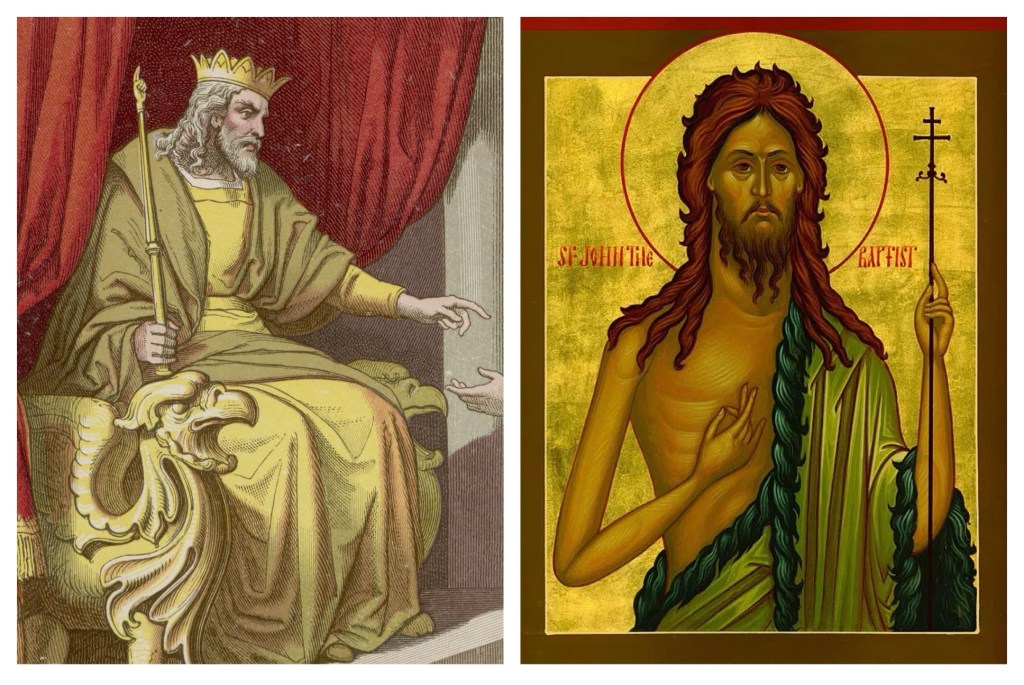
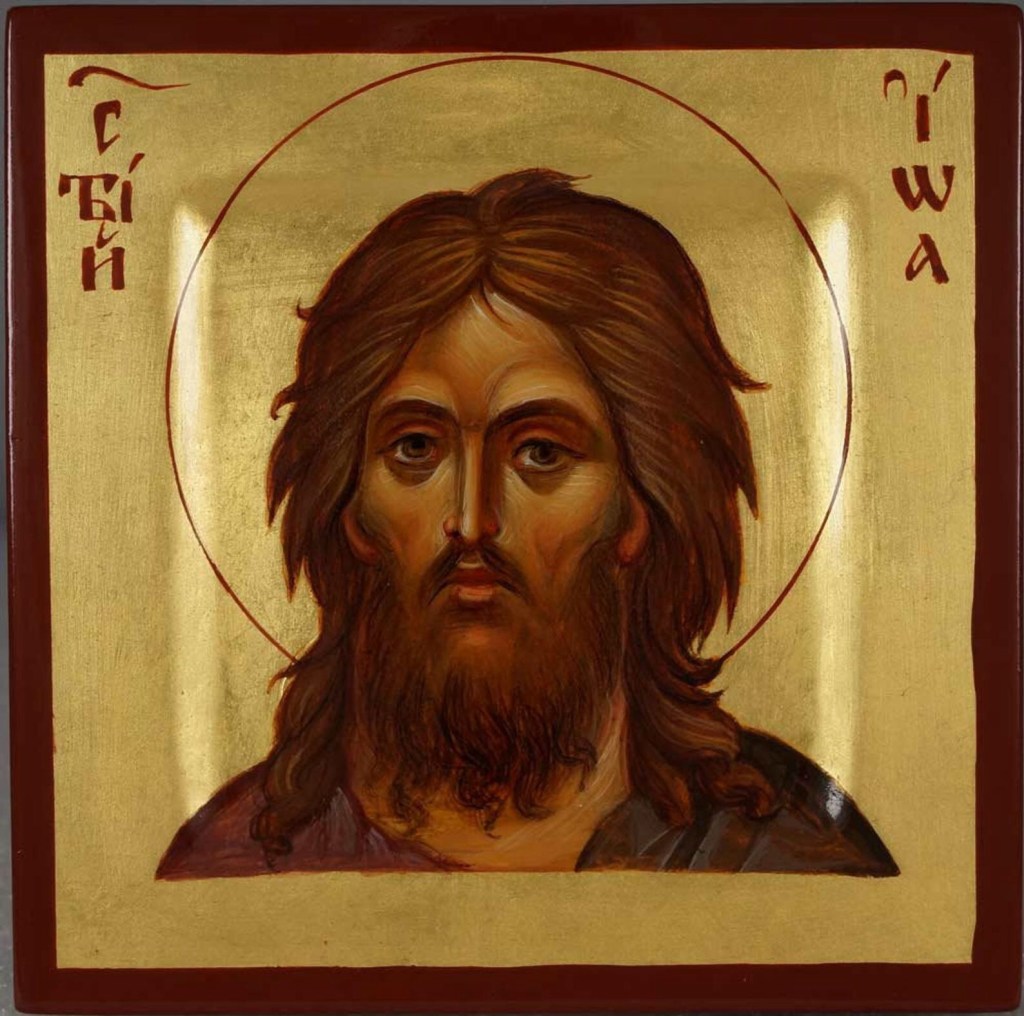
A depiction of John

John stands, it would seem, in that tradition. Not only was he an irritant to “people from the whole Judean countryside and all the people of Jerusalem” (Mark 1:5), calling them to repentance and baptizing them as they confessed their sins. He was also, according to this story, an irritant to the ruler of the time—Herod Antipas. Herod, Mark says, regarded John as “a righteous and holy man” (6:20)—high praise indeed. Herod, Mark says, “protected” John and “liked to listen to him” (6:20). And yet, he is persuaded to arrest and then behead John, not of his own initiative, but by keeping the promise he had made to Herodias (6:26–28).

We have noted briefly that the stories of the death of John and the death of Jesus have certain similarities. John functioned as a prophet, apparently speaking to those in power. Jesus also conducted himself in a prophetic manner, speaking about the kingdom which God was going to bring in—although he talked about this, not directly to those in power, but to the people of Galilee and, ultimately, of Jerusalem.

John’s popularity was his undoing; it seemed that many liked to listen to John and accepted his criticisms of Herod and Herodias. Jesus’s popularity was also his undoing. Large crowds had followed Jesus since early in Galilee (2:13; 3:20, 32; 4:1; 5:21; 24, 30–31; 6:34; 7:14; 8:1–2, 34; 9:14–15, 25; 10:1, 46; 11:18; 12:37).

The Jewish leadership in Jerusalem were offended at the teachings they heard from Jesus in the temple; “they wanted to arrest him, but they feared the crowd” (Mark 12:12). in similar fashion, Mark notes that those priests and scribes “were afraid of the crowd, for all regarded John [the Baptist] as truly a prophet” (11:32).

In many churches today, “good discipleship” or “being a good Christian” would seem to be equated with “being a good citizen”. John provides a model that steps out of the bounds of “good citizenship”. Is this a model for us to consider? For instance, in the Code of Ethics and Ministry Practice in my own church (the Uniting Church in Australia), section 6.2 states that “It is unethical for Ministers deliberately to break the law or encourage another to do so. The only exception would be in instances of political resistance or civil disobedience.”

Ministers have been arrested for protesting against laws that they believe, as a matter of conscience, to be unethical, or against their principles. They are standing in the tradition of John and the prophets before him—although nobody who has done this has, to my knowledge, been beheaded like John was!!

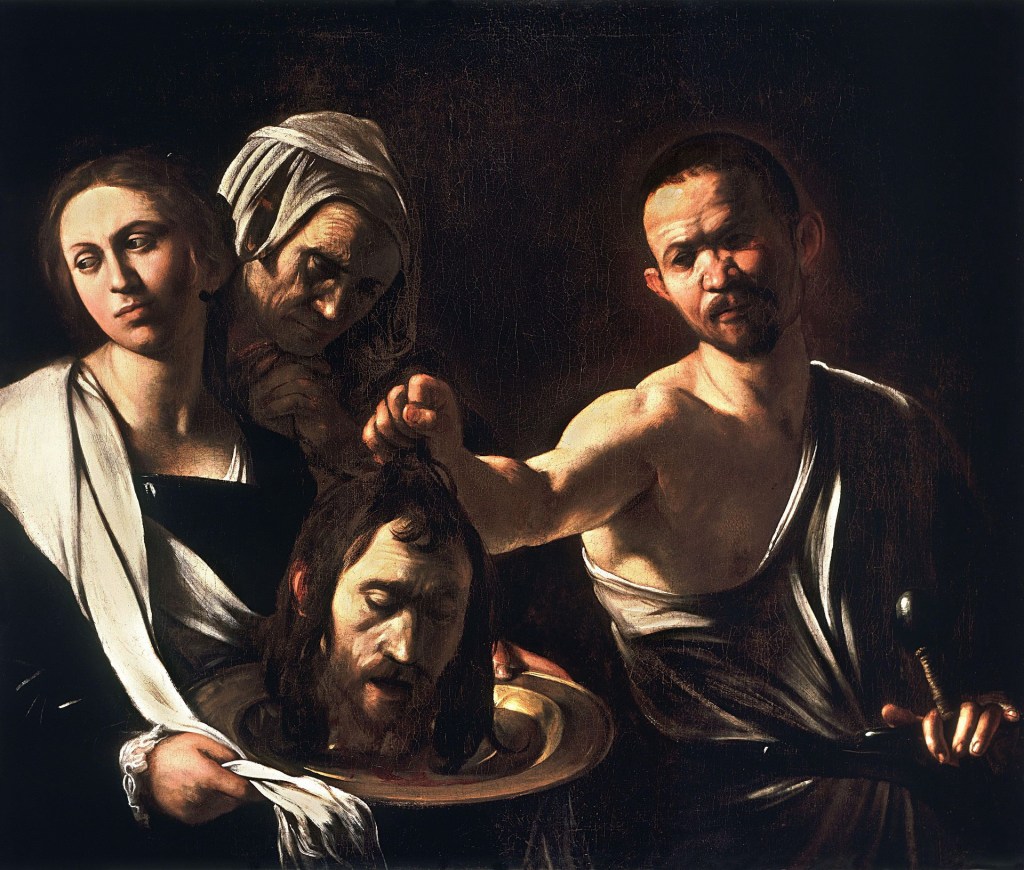
The famous painting of Caravaggio,
Salome with the Head of John the Baptist
(c. 1607–1610; National Gallery, London)

David took the stronghold of Zion, which is now the city of David (2 Sam 5; Pentecost 7B)

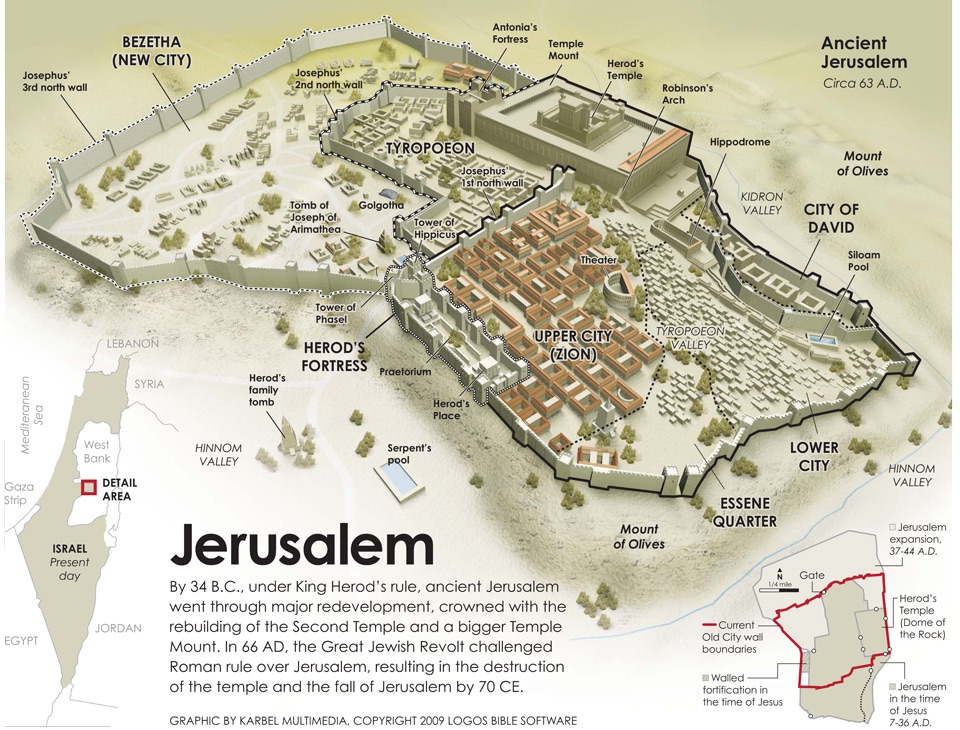
Jerusalem. It features in the passage that is proposed by the lectionary for reading and reflection in worship this coming Sunday (2 Sam 5:1–10). Jerusalem. The name of the city evokes all manner of responses.

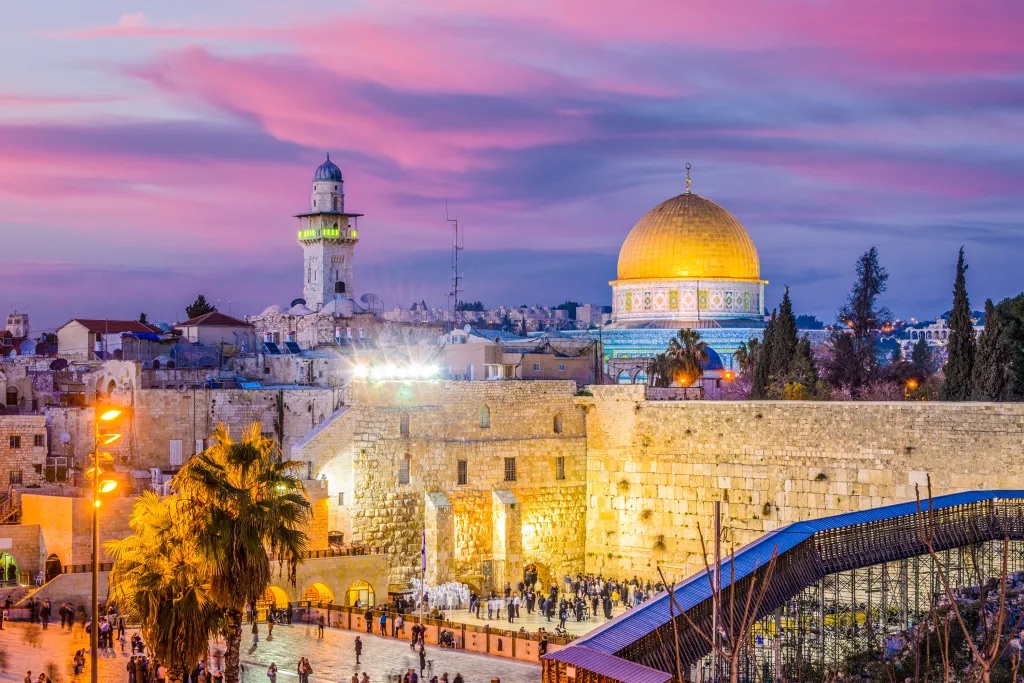
In our own time, Jerusalem has been the focal point for bitterly-contested claims about land. On a high point in the city, the sacred Jewish site of Mount Zion, on a base which formed the foundation for the Temple built two millennia ago, sits the gleaming gold dome of a Muslim holy building. It has been contested territory for decades, ever since the modern state of Israel was established. Today, both Israeli Jews and Palestinian Muslims claim Jerusalem as the capital city of their contested territory.

Jerusalem has significance in Jewish tradition as the place where Abraham was said to have been tested by a command to sacrifice his son, Isaac (Gen 22), where David based his kingdom over a united Judah and Israel (2 Sam 5), where Solomon built a temple to the Lord God (1 Ki 3:1; 8:1–9:25), and where the returning exiles came to focus their rebuilding of religion and society after their years in Babylon (Ezra 1—3; Neh 7—8). The more highly conservative of Jews today anticipate that, when the Messiah comes, he will oversee the rebuilding of the Temple in Jerusalem.

Jerusalem also has significance in Islam, as the last place visited by the Prophet Mohammed before he ascended into the heavens (Quran 17:1), as well as being a key place in the events to take place at the end of the world. The city is called Al-Quds, meaning “the noble, sacred place”. It is reported that Mohammed instructed faithful people to make pilgrimages to three places: Mecca, Medinah, and Jerusalem. The Dome of the Rock, with its golden-topped mosque, is a stunning reminder of the importance of the city to Muslims.

And Jerusalem has gained central significance in Christianity because it was the place where Jesus was arrested, tried, crucified, and buried (Mark 14—15 and parallels); where, in some traditions, his earliest disciples laid claim to having seen him alive (Luke 24:33–53; John 20:19–29); and where, according to Luke’s orderly narrative, the first gathering of “apostles and elders” made decisions about “what God had done … among the Gentiles” (Acts 15:6–29).

So the passage for this coming Sunday (2 Sam 5:1–10) touches on a deeply symbolic element of the story, not only of ancient Israelite religion and modern Judaism, but also of contemporary Christian and Muslim sensitivities about Jerusalem.

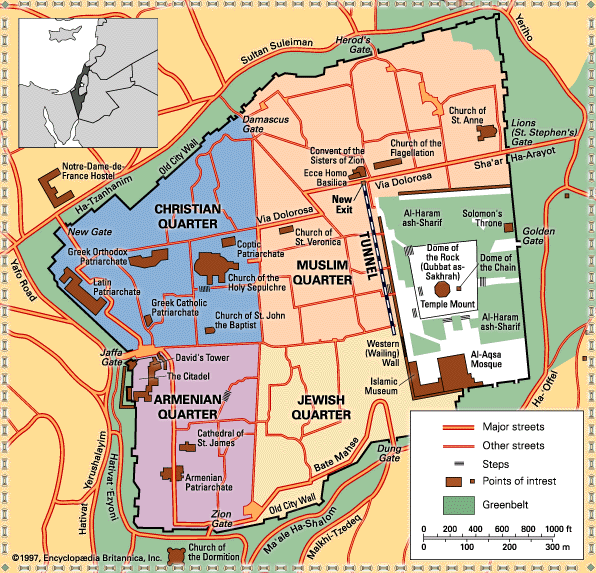
The city of Jerusalem in 1997, showing the quarters
allocated to Jews, Christians, Muslims, and Armenians
(Encyclopedia Britannica)

The history-like narratives that form the books in the extended series of Exodus, Numbers, Joshua, Judges, 1–2 Samuel, and 1–2 Kings tell the story, mythologised and valorised, of the development of Israel from its early days. These narratives most likely originated as oral stories, told and retold over the years, coming into written form many centuries after they were first told. We have access to these stories only through the written compilation that we have in Hebrew Scripture, most likely finalised in the time leading up to or during the exiles of the people of Israel and Judah from the 7th and 6th centuries BCE.

The lectionary selection this Sunday (2 Sam 5:1–10) tells of the taking of Jerusalem by the army of King David, soon after the elders of Israel had anointed him as king (2 Sam 5:3). His rule, we are told, would last for another 33 years; coming after the seven years that he had already ruled Judah, this would make for forty years as king (2 Sam 5:4-5). And in these biblical narratives, “forty years” is the way of describing “a long, long time”. The dominance of David over his kingdom is signalled in this claim.

In listening to this passage, we need to remember that we are not dealing with a precise and accurate historical account of David’s taking control of the city of Jerusalem; not that such an objective factual account could ever exist, for all “history” is told from a specific perspective, and other perspectives on the same events are equally possible and valid. So this is an account from a later time, told to explain and justify the place that Jerusalem has held amongst “the house of David”, the people of Israel.

The city forms a stronghold for David, as he consolidates his power. This is but one in a number of battles that David engaged in, beginning with his his centre-stage role in the ongoing war against the Philistines, when he slew the giant Goliath (1 Sam 17). David held power through years of wrangling with Saul, before his dominance was secured. His earlier years as ruler of the united kingdom continued to be unsettled. The narrator cites a song that was later sung about these two kings, as their troops battled each other, as well as mutual enemies: “Saul has killed his thousands, and David his ten thousands” (1 Sam 21:11).

After fighting the Philistines, Saul has 85 priests of Nob slaughtered (22:1–19); David leads his men in “raids on the Geshurites, the Girzites, and the Amalekites … leaving neither man nor woman alive” (27:8–11). He did battle once again with the Philistines (29:1–11); the narrator then provides a list of the many towns “where David and his men had roamed” (30:27–31). Presumably in those places they had murdered and pillaged as well.

2 Sam 8–12 lists ongoing battles in which David features: attacking the Philistines yet again (8:1), then the Moabites (8:2), the Syrians under Hadadezer of Zobah (8:3–8), the Edomites (8:13–14), the Ammonites (10:14) and the Arameans (10:15–19), and then the Ammonites once again (12:26–31). The conquest of Jerusalem from the Jebusites that features in the passage we read this coming Sunday (2 Sam 5:1–10) is but one of many armed conflicts that David leads.

It is ironic that the name of the city, Jerusalem, most likely means “city of peace”; the word combines two Semitic roots, yry, meaning “foundation”, and shlm, meaning “peace”. The name signifies that the city provides the foundation for peace. Yet the city was (and sadly, today, continues to be) anything but a city of peace. Even in his day, David used the site as a means to his own political ends; he takes the city from its Jebusite inhabitants and builds a foundation where God’s holiness could be reinforced and celebrated.

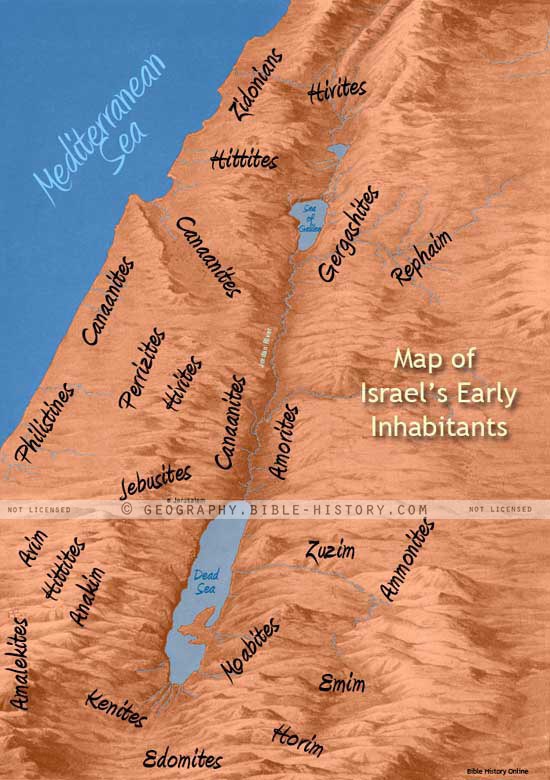
The Jebusites had long been the inhabitants of the city named in scripture as Jerusalem. This people appear with regularity in the list of peoples who were “the inhabitants of the land” that was initially, so the story goes, promised to Abraham and his descendants: “to your descendants I give this land, from the river of Egypt to the great river, the river Euphrates, the land of the Kenites, the Kenizzites, the Kadmonites, the Hittites, the Perizzites, the Rephaim, the Amorites, the Canaanites, the Girgashites, and the Jebusites” (Gen 15:18–21).

In the book of Exodus, the Lord God declares of the Israelites in Egypt, “I know their sufferings, and I have come down to deliver them from the Egyptians, and to bring them up out of that land to a good and broad land, a land flowing with milk and honey, to the country of the Canaanites, the Hittites, the Amorites, the Perizzites, the Hivites, and the Jebusites” (Exod 3:7–8; see also 3:17; 13:5; 23:23; 33:2; 34:11).

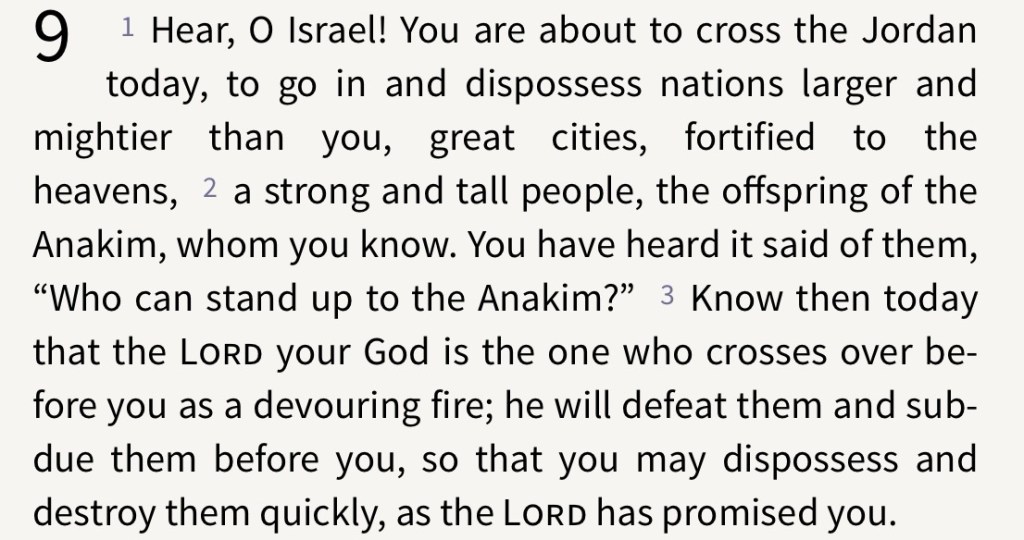
Numbers 32 then purports to give a detailed account, in advance, of the various kingdoms and their cities that will be conquered and divided up amongst the twelve tribes of Israel, as they capture them, dispossess the people (see v.39), and rename the towns and villages. The command to “dispossess” the people of their land runs through Moses’s long speech that is reported in Deuteronomy (see Deut 7:17; 9:1–3; 11:1–3; 12:29; 31:3).

Deuteronomy 9:1–3

The instructions are clear: “You must demolish completely all the places where the nations whom you are about to dispossess served their gods, on the mountain heights, on the hills, and under every leafy tree. Break down their altars, smash their pillars, burn their sacred poles with fire, and hew down the idols of their gods, and thus blot out their name from their places. You shall not worship the Lord your God in such ways.” (Deut 12:2–4).

Before this speech, as they stand on the threshold of the land of Canaan, the people were hesitant about entering; it was reported, “the people [in Canaan] are stronger and taller than we; the cities are large and fortified up to heaven” (Deut 1:28). The Lord God chastens them and insists they press ahead to enter the land, where they will find “a land with fine, large cities that you did not build, houses filled with all sorts of goods that you did not fill, hewn cisterns that you did not hew, vineyards and olive groves that you did not plant” (Deut 6:10–11). For will give this all to them.

The book of Joshua then recounts the forceful invasion of the tribes of Israel into the land of Canaan, when list of the peoples whom “the living God who without fail will drive out from before you” includes “the Canaanites, Hittites, Hivites, Perizzites, Girgashites, Amorites, and Jebusites” (3:10; see also 12:8; 24:11). The violence perpetrated in this invasion and conquest is made clear by incident after incident in this book and then in the following book of Judges. It was a violent time indeed.

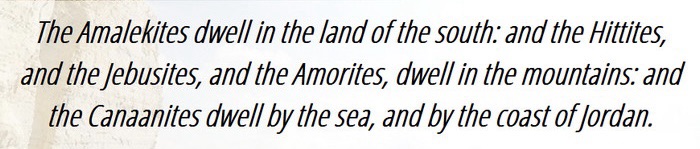
The Jebusites are amongst the peoples identified in the genealogical lists of Genesis as the descendants of Canaan (Gen 10:15–18); in Numbers, we learn that “the Amalekites live in the land of the Negeb; the Hittites, the Jebusites, and the Amorites live in the hill country; and the Canaanites live by the sea, and along the Jordan” (Num 13:29).

At one point in the narrative relating to Joshua, the Israelites engaged in battle with the king of Jerusalem and four other kings (Josh 10:1–5); they were put to death (Josh 10:23–27) and the boundary if the land of the people of Judah was said to have gone “up by the valley of the son of Hinnom at the southern slope of the Jebusites (that is, Jerusalem)” (Josh 5:8). However, the account of the towns of Judah concludes with the note that “the people of Judah could not drive out the Jebusites, the inhabitants of Jerusalem; so the Jebusites live with the people of Judah in Jerusalem to this day” (Josh 15:63).

Then, when the book of Judges was compiled, a similar note was included to the effect that “the Lord was with Judah, and he took possession of the hill country … [but] the Benjaminites did not drive out the Jebusites who lived in Jerusalem; so the Jebusites have lived in Jerusalem among the Benjaminites to this day” (Judg 1:19, 21).

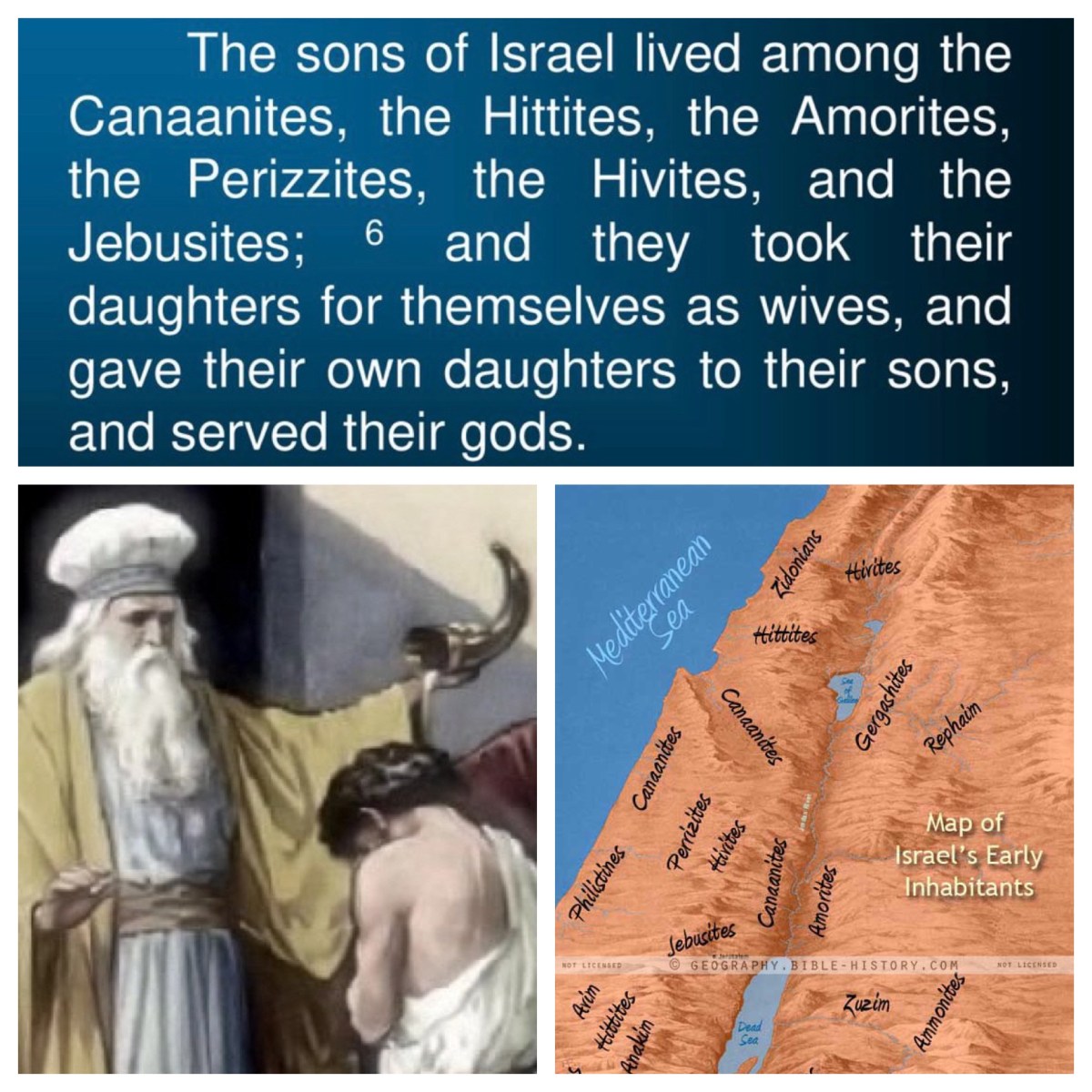
As an explanation as to how “the Israelites did what was evil in the sight of the Lord, forgetting the Lord their God, and worshiping the Baals and the Asherahs” (Judg 3:7), the author of this narrative explains that “the Israelites lived among the Canaanites, the Hittites, the Amorites, the Perizzites, the Hivites, and the Jebusites; and they took their daughters as wives for themselves, and their own daughters they gave to their sons; and they worshiped their gods” (Judg 3:5–6).

So when David comes to the city, the narrative preserved in the scriptures of the Israelites clearly records that he led his army into the city to take “the stronghold of Zion” and to proclaim that it “is now the city of David” (2 Sam 5:7). Hebrew Scripture makes it abundantly clear that the Israelites took over control of this remaining Canaanite settlement by force, just as earlier generations of Israelites had invaded and conquered the people of the wider territory of Canaan, and then waged war against the Philistines.

The narrative had earlier reported that the youthful David, after he had fought and killed the Philistine giant, Goliath, had taken Goliath’s head in triumph into Jerusalem (1 Sam 17:54). However, at this point the narrative had not recorded the transfer of power in Jerusalem from the Jebusites to the Israelites. So this claim is a somewhat anachronistic note, most likely influenced by the understanding that Jerusalem would become the central location of importance for David’s kingdom. (It would be like an Australian talking about going to Canberra in the late 19th century, years before the city was established in 1913.)

A depiction of 2 Sam 5:8

In this Sunday’s passage, as David’s Israelite troops approach the city, a curious declaration is made by the local inhabitants, the Jebusites, that any people marked by the imperfection of impurities—the blind, the lame—will be barred from it (v.8). An article on the Jebusites in the Jewish Encyclopedia refers to “a midrash quoted by Rashi on II Sam. v. 6” which explained that “the Jebusites had in their city two figures—one of a blind person, representing Isaac, and one of a lame person, representing Jacob—and these figures had in their mouths the words of the covenant made between Abraham and the Jebusites.” If that was the case, then the Jebusites were presumably trusting in these idols to ensure the security of their city against the Israelite invaders.

See https://www.jewishencyclopedia.com/articles/8542-jebusites

Another view is summarised by Daniel Gavron in his article on “History of Jerusalem: Myth and Reality of King David’s Jerusalem”, in the Jewish Virtual Library. Gavron notes that the eminent Israeli scholar Yigael Yadin had proposed that the people with disabilities were actually to be used as the “first line of defence” against David and his troops.

Yadin draws on the connection between the Jebusites and the ancient Hittite kingdom, noting that there is evidence that soldiers in that kingdom were required to swear an oath of loyalty to the king; should they fail in that loyalty, they would become lame or blind or deaf. So the threat posed by the blind or the lame was to be met by the soldiers of David by their attacking the city—they were used as taunts by David to provoke his men to attack.

See https://www.jewishvirtuallibrary.org/myth-and-reality-of-king-david-s-jerusalem#google_vignette

It is worth noting, perhaps, that the blind and the lame form part of a large cluster of unclean people who were prohibited from bring offerings to the holy God in the Temple (Lev 21:16–18). They are also those whom, according to Jeremiah, the Lord God will come to gather exiles “from the farthest parts of the earth, among them the blind and the lame, those with child and those in labour, together; a great company, they shall return here” (namely, to Jerusalem; Jer 31:8).

Then, of course, they are amongst those who attest to the way that the power of God is at work in Jesus: “the blind receive their sight, the lame walk, the lepers are cleansed, the deaf hear, the dead are raised, and the poor have good news brought to them” (Matt 11:5; Luke 7:22). Blind and lame came to Jesus by the Sea of Galilee (Matt 15:30–31) and in the Temple in Jerusalem (Matt 21:14); and Jesus instructs his followers, “when you give a banquet, invite the poor, the crippled, the lame, and the blind” (Luke 14:13; also 14:21). They form part of the signs of the kingdom of God which is breaking into the world through Jesus.