
Under the guidance of the lectionary, we have been following a pathways which has deviated from the story of “the beginning of the good news of Jesus, Messiah” (which we know as the Gospel of Mark) that we have been following each Sunday since Pentecost. For the moment, we read and hear excerpts from “the book of signs”, which contains just some of “the many things that Jesus did” (which we know as the Gospel of John).
We have read or heard the account that John gives of when Jesus “took the loaves, and when he had given thanks, he distributed them to those who were seated; so also the fish, as much as they wanted” (John 6:1–13). From that day, we have then been guided to follow the extensive discourse that Jesus gives to a crowd that “went to Capernaum looking for Jesus” (John 6:25–71).
First, we heard a passage that ends with the first of seven I AM declarations made by the Johannine Jesus, “I am the bread of life” (6:24–35). Then, in the next section of that discourse, we encountered an elaborated exposition of that “bread of life” (6:35–51). This Sunday we hear about the disputes that this teaching generated with the Judaean authorities (6:51–58), and then the following Sunday takes us to the final section of the discourse where Jesus then has to deal with dissent from his own disciples (6:56–69).
The passage for this coming Sunday (John 6:51–58) is introduced, as we saw in the previous blog on this discourse, with a restatement of the theme that Jesus had what has just been declared: first, the primary affirmation about Jesus: “I am the living bread that came down from heaven” (v.51a); followed by the consequence for those who believe in him: “whoever eats of this bread will live forever” (v.51b)—and then a further step, following this summary, with and immediate extension of the argument: “the bread that I will give for the life of the world”, Jesus declares, “is my flesh” (v.51c).
Whilst a superficial, or impatient, reading of this chapter reacts with “here we go again, ‘I am the bread of life’ yet again”, a more careful reading will reveal to us the developments and new elements that are being added into the discourse at each reiteration of this fundamental claim. This restatement does just that.
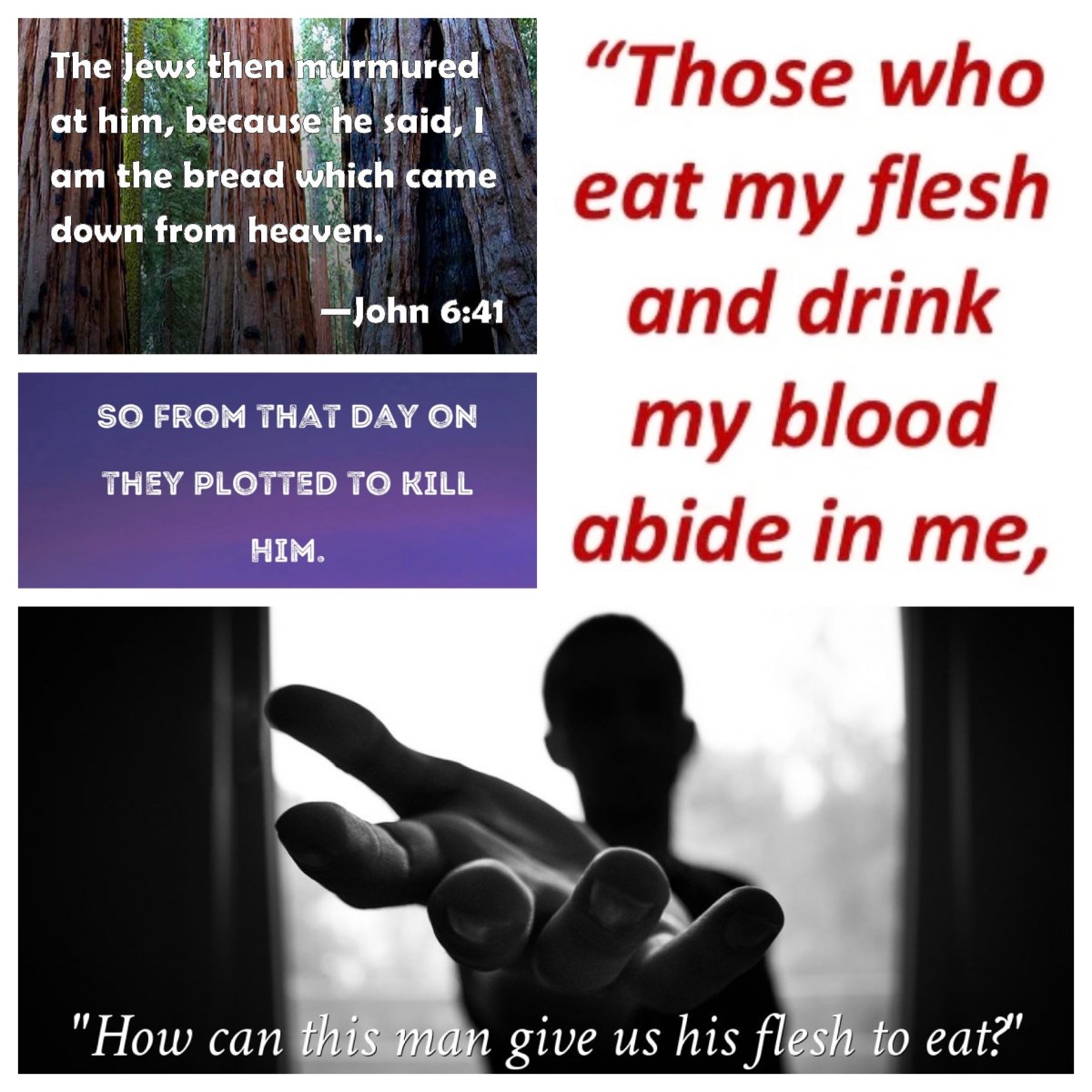
A strong response to the statement of Jesus made in v.51 comes immediately. Most contemporary translations refer to “the Jews” when they report the immediate kickback: “[they] disputed among themselves, saying, ‘How can this man give us his flesh to eat?’” (v.52).
It’s a fair question, I reckon, since it’s a curious, and confronting, thing for Jesus to say. Who talks about giving his own flesh to others for them to eat?
I am reminded of the criticism of the Christians made in the early centuries of the movement. Second century Roman writer Suetonius wrote that “Nero inflicted punishment on the Christians, a sect given to a new and mischievous religious belief” (Suetonius, The 12 Caesars, Nero Claudius Caesar, XVI). A similar comment is found in the Annals of Tacitus: “Nero fastened the guilt and inflicted the most exquisite tortures on a class hated for their abominations, called Christians by the populace” (Tacitus, Annals 15.44).
In a third century work written by Minucius Felix we gain a glimpse of the accusation of cannibalism being levelled against the Christians, in a “story about the initiation of young novices” (Octavius 30). Minucius Felix reports the criticism that an infant, “covered over with meal, that it may deceive the unwary, is placed before him who is to be stained with their rites” (that is, before the person about to be baptised).
He continues with a description of the alleged horrors: “this infant is slain by the young pupil, who has been urged on as if to harmless blows on the surface of the meal, with dark and secret wounds”, and then gives a graphic description of what ensues: “thirstily … they lick up its blood; eagerly they divide its limbs; by this victim they are pledged together; with this consciousness of wickedness they are covenanted to mutual silence.” It’s quite a take on what believers know as the celebration of Holy Communion.
(We will come back to the strangely-different language and the distinctive Eucharistic resonances of the discourse of the Johannine Jesus in John 6 in my blog on next week’s lectionary passage.)
Who are these “Jews” who are criticizing Jesus in this way? I have already noted (in my blog on John 6:1–15) that most translations describe this latter group simply as “the Jews”. The Greek word used, however, can equally be translated as “the Judeans”. It’s a preferable option, I believe, as it avoids having a sense of antisemitism creep into our understanding of the text, every time we hear “the Jews” criticising and arguing with Jesus.
To be fair to the whole population of Judaea at the time, however, I’ll refer to them as “Judaean leaders”, as it seems clear that this is the particular group that is generating and exacerbating the conflict.
In doing so, I am taking the lead from D. Moody Smith, who argues that that the way the word is used in the fourth Gospel means that it should be translated as “a group of Jewish leaders who exercise great authority among their compatriots and are especially hostile to Jesus and his disciples … it refers to certain authorities rather than to the people as a whole.” See D. Moody Smith, “Judaism and the Gospel of John”, accessible at https://www.bc.edu/content/dam/files/research_sites/cjl/sites/partners/cbaa_seminar/Smith.htm
The sixth chapter of John’s Gospel offers a series of encounters that reveal misunderstanding, antagonism, and conflict in the ways that people relate to Jesus, even whilst he sets forth this significant teaching that he is “the bread of life” (6:35, 48). To be sure, the earlier interactions between Jesus and “the crowd” (6:24–40) appear to be amenable, offering Jesus the opportunity to explain himself.
However, when this group of Judaean leaders come into the foreground (v.41), this become more tense. The antagonism of these leaders is palpable. This mood continues through their complaining (vv.41–51) and disputing (vv.52–58), on into the complaining of the disciples of Jesus (v.60–65) and the rejection of Jesus by some of them (vv.66–71).
We have already met opponents of Jesus very early in John’s narrative. Indeed, in the prosaic interpolation into the poetic prologue, even before the story proper begins, there is a clear indication of looming opposition to Jesus: “the world did not know him … his own people did not accept him” (1:10–11).

Early in the narrative that John the evangelist presents, a group of Judaean leaders had questioned John the baptiser, asking him “who are you?” (1:19); then they had questioned Jesus, “what sign can you show us?” (2:18). These questions are not necessarily antagonistic. (You could read them as a form of “appreciative enquiry”.)
The explicit opposition to Jesus from these Judaean leaders emerges, however, after he has healed on the sabbath (5:10). Here, the narrator declares that these Judaean leaders “started persecuting Jesus” (5:16) and indeed “were seeking all the more to kill him” because of what he was saying (5:18). From this point on, the conflict just deepens.
After they began to complain about Jesus (6:41) and quarrel about him (6:52), these leaders have success: “many of his disciples turned back and no longer went about with him” (6:66). They intensify their opposition, “looking for an opportunity to kill him” (7:1), intimidating people to silence (7:13), further questioning the teaching of Jesus (7:35–36; 8:22, 57; 10:24), accusing him of being a Samaritan (8:48) and possessed by a demon (8:48, 52; 10:20)—although not everyone holds this view (10:19, 21) and there are indeed Judaean leaders who “believed in him” (11:45; 12:11).
Twice the Judaean leaders take up stones to kill Jesus (8:59; 10:31–33; 11:8), accusing him of blasphemy in “making yourself God” (10:33, alluding back to their assessment of 5:18). Their success in persecuting the followers of Jesus is reflected in the observation that they “had already agreed that anyone who confessed Jesus to be the Messiah would be put out of the synagogue” (9:22; and see later references at 12:52; 16:2). The plot to kill Jesus is finalised when Pharisees and priests combine, in the face of the greatest sign performed by Jesus, in raising Lazarus from death (11:46–53).

Where these Judaean leaders stand in relation to Jesus and the truth that he declares (1:14, 17; 8:23, 40, 45–47; 14:6; 18:37) is clear from the division outlined in the vehement vitriol of the debate in chapter 8. “You are from below, I am from above”, Jesus tells them; “you are of this world, I am not of this world” (8:23). Not content with this (characteristically Johannine) dualistic assessment, he then confronts them with the clear reality, as he sees it: “I told you that you would die in your sins, for you will die in your sins unless you believe that I am he” (8:24).
I read the whole sequence of scenes in this Gospel, from the wedding in Cana, with its implicit criticism of “the Jewish rites of purification” (2:1–11), through the heated debates of chs. 5—8, the high drama of the multi-scene conflict with Jewish leaders and “expulsion from the synagogue” in ch.9, on into the plot of ch.11, as a story that reflects the position of the followers of Jesus who comprised the community in which this book was eventually written.
This group of people (what Raymond Brown called “the community of the beloved disciple”) had been rejected by their fellows, expelled from their community of faith, because of their views about Jesus. They had become yet another sectarian group in the mixture of late Second Temple Judaism, which then bled into early Rabbinic Judaism.
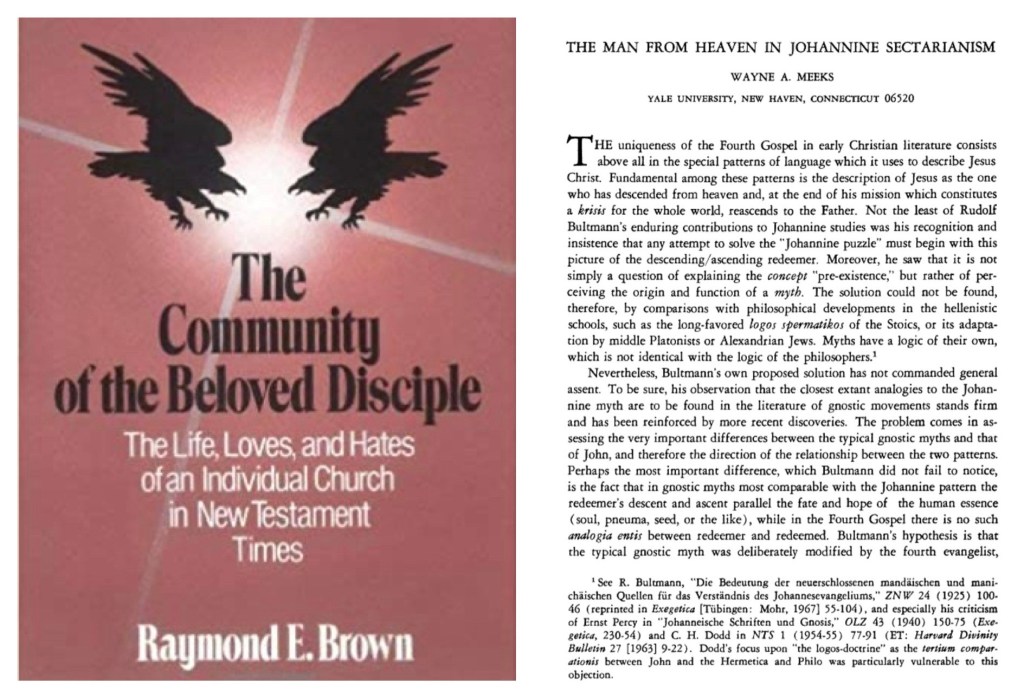
It is this “Johannine sectarianism”, as Wayne Meeks called it, which explains the bruising debates in this Gospel; Jesus, “the man from heaven”, as Meeks styles him, is being remembered as “standing up for the truth” in the face of intense criticism, by a group of people who had been pillaged and persecuted for standing up for what they saw as “the truth”. They had become outsiders; some of them had met death for the stand they took. This was what it meant for them to be faithful to Jesus.
So in the Johannine story of Jesus, the Judaean authorities, and the disciples of Jesus, the die is cast; the antagonism is set. Jesus will head to his death and his followers also will experience “an hour … when those who kill you will think that by doing so they are offering worship to God” (16:2). The fate that is in store for Jesus is the same fate for his followers.
Using the commonplace image of “a grain of wheat [that] falls into the earth and dies” (12:24), Jesus appears to foreshadow his imminent death; “the hour has come for the Son of Man to be glorified” (12:23) is the way that the Johannine Jesus refers to his death (7:39; 11:4; 12:16, 28–33; 13:31–33; 17:1–5).
He follows the saying about the grain of wheat dying, only to “bear much fruit”, with an assertion about his followers: “those who love their life lose it, and those who hate their life in this world will keep it for eternal life” (12:25; the language reflects Mark 8:35; Matt 10:39; 16:25; Luke 9:24; 17:33). The way of Jesus is also the way of his followers.
(At this point, we might want to reflect on how appropriate for us—or how distant from us—this portrayal of Jesus is. How much do I know, personally, of the opposition and conflict that puts my very life in peril, because of what I believe and how I live? In this light, the Johannine Jesus and the community faithful adhered to his way can appear to be alien from the comfortable existence of so many Christians—myself included—in the western world.)
The final verse of this section (not included in the lectionary selection, 6:51–58) is a surprise: “he said these things while he was teaching in the synagogue at Capernaum” (6:59). The chapter had begun on “the other side of the Sea of Galilee, also called the Sea of Tiberias” (v.1), where Jesus had fed the large crowd, before moving “across the sea to Capernaum” (v.17), where Jesus had walked on the water.
When those left on “the other side” of the sea saw the crowd across the lake, “they got into the boats and went to Capernaum looking for Jesus” (v.24), where they found him, engaging him in discussion (v.25). The mention of the synagogue in 6:59 provides a pivot for the narrative then to focus on the disciples, who had been with Jesus “on the other side” (v.3) and then in the boat (vv.6–7). What ensues (v.60 onwards) then maintains a focus on Jesus interacting with the disciples. On which, see next week’s blog …
See previous blogs at
and on the whole sequence of this chapter
 An Informed Faith