Ten Things about the Greatest Commandment(s) (Mark 12; Pentecost 24B)

The Gospel reading for this coming Sunday contains some very well-known words of Jesus, which we remember as “the greatest commandment” (Mark 12:28–34). Here are ten things worth knowing about these words.

ONE.   The greatest commandment identified by Jesus comes from Hebrew Scripture. When Jesus says that the greatest commandment is to “love the Lord your God”, he is repeating words from the start of a long section in Deuteronomy, which reports a speech by Moses allegedly given to the people of Israel (Deut 5:1–26:19). The speech retells many of the laws that are reported in Exodus and Leviticus, framing them in terms of the repeated phrases, “the statutes and ordinances for you to observe” (4:1,5,14; 5:1; 6:1; 12:1; 26:16–17), “the statutes and ordinances that the Lord your God has commanded you” (6:20; 7:11; 8:11).

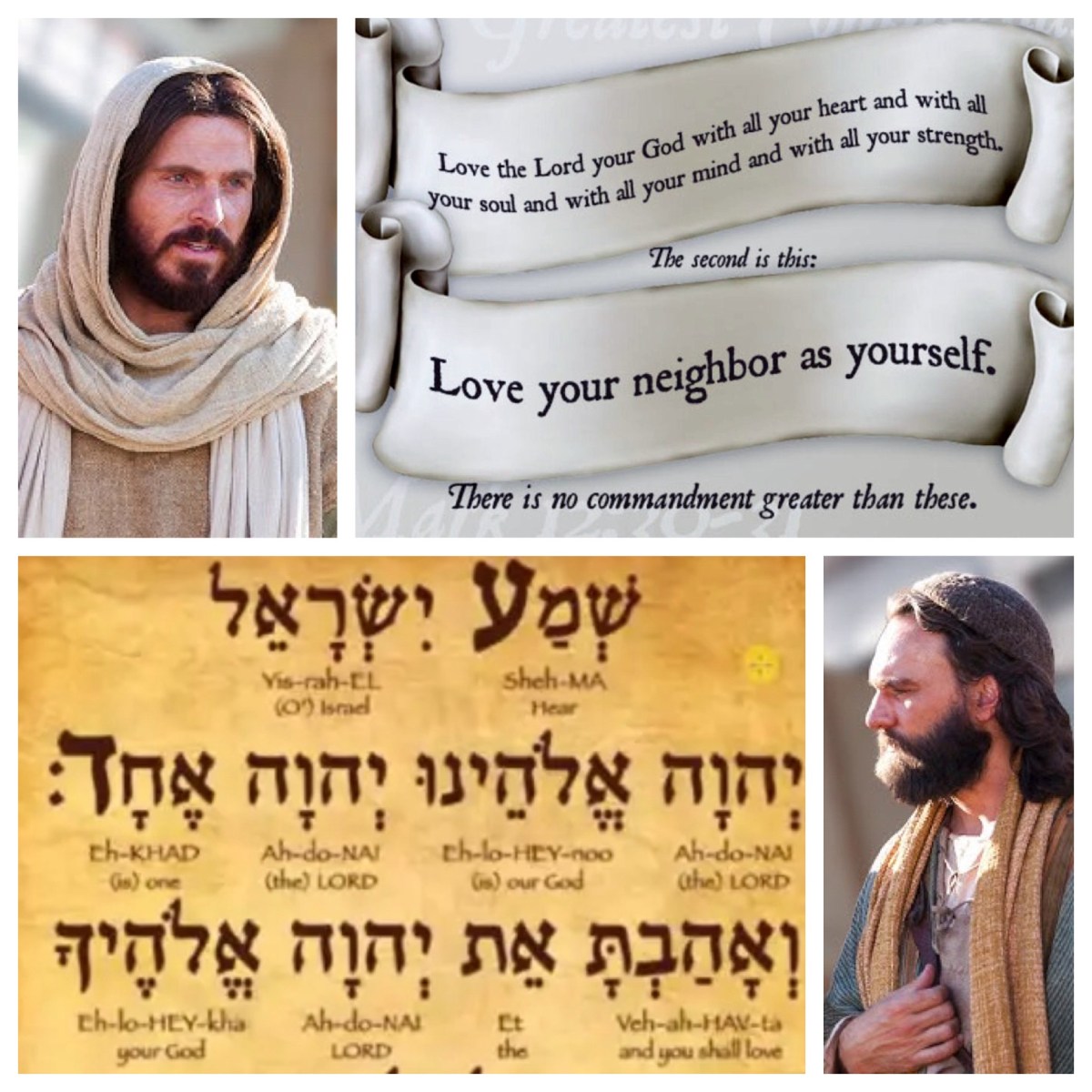
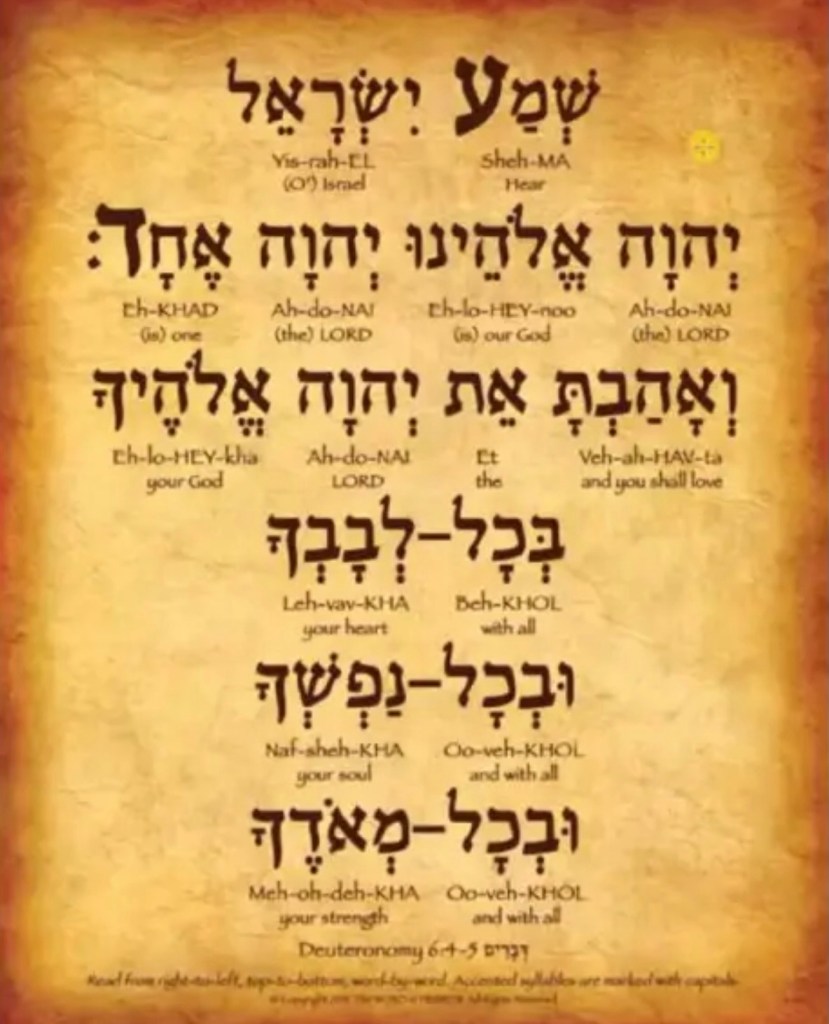
After proclaiming the Ten Commandments which God gave to Israel through Moses (Deut 5:1–21; cf. Exod 20:1–17) and rehearsing the scene on Mount Sinai and amongst the people below (5:22–33; cf. Exod 19:1–25; 20:18–21), Moses then delivers the word which provides the heading of all that follows: “Hear, O Israel: The Lord is our God, the Lord alone. You shall love the Lord your God with all your heart, and with all your soul, and with all your might. Keep these words that I am commanding you today in your heart” (Deut 6:4–6). Love, it would seem, is the key commandment amongst all the statutes and ordinances found in this book.

These words are known in Jewish tradition as the Shema, a Hebrew word literally meaning “hear” or “listen”. It’s the first word in this key commandment; and more broadly than simply “hear” or “listen”, it carries a sense of “obey”. These words are important to Jews as the daily prayer, to be prayed twice a day—in keeping with the instruction to recite them “when you lie down and when you rise” (Deut 6:7). As these daily words, “love the Lord your God” with all of your being are said, they reinforce the centrality of God and the importance of commitment to God within the covenant people.
TWO.   The original version of this commandment in Deuteronomy 6 has three parts: “with all your heart, and with all your soul, and with all your might” (Deut 6:4). This is typical of Jewish speech; repetition, using different words which are related to the same concept, expressing the importance of what is being said; and especially, repetition in groups of three. So, the prophet Micah urges people to “do justice,  love kindness, and walk humbly with God” ( Mic 6:8). Second Isaiah praises those messengers who proclaim peace, bring good news, and announce salvation (Isa 52:7). 

The psalmist exhorts the people to “tell of his salvation … declare  his glory … his marvelous works among all the peoples” (Ps 96:2-3). And the priestly authors of the creation story identifies all living creatures created by God in the threefold “fish of the sea … birds of the air … and every living thing that moves upon the earth” (Gen 1:28). That’s kind of like an ancient version of our “animal—mineral—vegetable” classification, I guess.

So the prayer of Deut 6:4 adheres to a widespread and longstanding literary feature in ancient Hebrew, of using three words in parallel. Just how parallel they are, we will now explore.
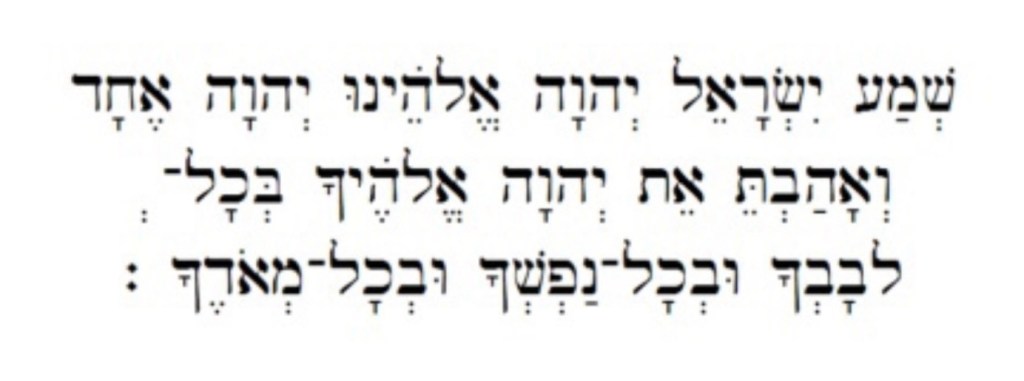
THREE.   With all your heart: The Hebrew word translated as heart is לֵבָב, lebab. It’s a common word in Hebrew Scripture, and is understood to refer to the mind, will, or heart of a person—words which seek to describe the essence of the person. It is sometimes described as referring to “the inner person”. The word appears 248 times in the scriptures, of which well over half (185) are translated as “heart”. 

Many of those occurrences are in verses which contrast heart with flesh—that is, “the inner person” alongside “the outer person”. For example, the psalmists declare that “my flesh and my heart may fail, but God is the strength of my heart and my portion forever” (Ps 73:26), and “my heart and my flesh sing for joy to the living God” (Ps 84:2b), whilst the prophet Ezekiel refers to “foreigners, uncircumcised in heart and flesh” (Ezek 44:7,9). When used together, these two terms (heart and flesh) thus often refer to the whole person, the complete being. 

The Hebrew word lebab, heart, is rendered by the Greek word, kardia, in Mark 12:30. That word can refer directly to the organ which circulates blood through the body; but it also has a sense of the central part of a being—which is variously rendered as will, character, understanding, mind, and even soul. These English translations are attempting to grasp the fundamental and all-encompassing. It seems that this correlates well with the Hebrew word lebab, which indicates the seat of all emotions for the person.
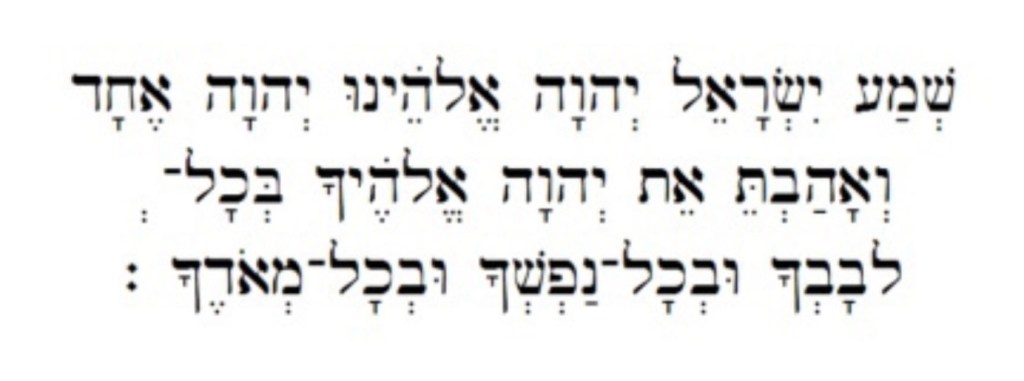
FOUR.   With all your soul: The second Hebrew word in the commandment articulated in Deut 6:4 is נֶפֶשׁ, nephesh. This is another common Hebrew word, appearing 688 times in Hebrew Scripture, of which the most common translation (238 times) is “soul”; the next most common translation is “life” (180 times). The word is thus a common descriptor for a human being, as a whole. 

However, to use the English word “soul” to translate nephesh does it a disservice. We have become acclimatised to regarding the soul as but one part of the whole human being—that is the influence of dualistic Platonic thinking, where “body and soul” refer to the two complementary parts of a human being. In Hebrew, nephesh has a unified, whole-of-person reference, quite separate from the dualism that dominates a Greek way of thinking.

Nephesh appears a number of times in the first creation story in Hebrew scripture, where it refers to “living creatures” in the seas (Gen 1:20, 21), on the earth (Gen 1:24), and to “every beast of the earth, and to every bird of the air, and to everything that creeps on the earth, everything that has the breath of life (nephesh hayah)” (Gen 1:30). It is found also in the second creation story, where it likewise describes how God formed a man from the dust of the earth and breathed the breath of life into him, and “the man became a living being (nephesh hayah)” (Gen 2:7). The claim that each living creature is a nephesh is reiterated in the Holiness Code (Lev 11:10, 46; 17:11). 

The two words, nephesh and lebab, appear linked together many times. One psalmist exults, “my ‘heart’ is glad, and my ‘soul’ rejoices” (Ps 16:9a), whilst another psalmist laments, “how long must I bear pain in my ‘soul’, and have sorrow in my ‘heart’ all day long?” (Ps 13:2). Proverbs places these words in parallel in sayings such as “wisdom will come into your ‘heart’, and knowledge will be pleasant to your ‘soul’” (Prov 2:10), and “does not he who weighs the ‘heart’ perceive it? does not he who keeps watch over your ‘soul’ know it?” (Prov 24:12). In Deuteronomy itself, the combination of “heart and soul” appears a number of times (Deut 4:29; 10:12; 11:13, 18; 13:3; 26:16; 30:2, 6, 10), where it references the whole human being. 

In each of these instances, rather than taking a dualistic Greek approach (seeing “heart” and “soul” as two separate components of a human being), we should adopt the integrated Hebraic understanding. Both “heart” and “soul” refer to the totality of a human being. The repetition is a typical Hebraic style, using two different words to refer to the same entity (the whole human being). The repetition underlines and emphasises the sense of totality of being.
FIVE.   With all your might: The third Hebrew word to note in Deut 6:5 is מְאֹד, meod, which is usually translated as “might” or “strength”. Its basic sense in Hebrew is abundance or magnitude; it is often rendered as an adverb, as “very”, “greatly”, “exceedingly”, or as an adjective, “great”, “more”, “much”. The function of this word, “might” or “strength”, in Deut 6:5 is to reinforce the totality of being that is required to love God. 

In light of this, we could, perhaps, paraphrase the command of Deuteronomy as love God with all that you are—heart and soul, completely and entirely. Love God with “your everythingness” (to coin a word). There’s a cumulative sense that builds as the commandment unfurls—love God with all your emotions, all your being, all of this, your entire being.

We find the same threefold pattern in the description of King Josiah, who reigned in the eighth century (640–609 BCE): “before him there was no king like him, who turned to the Lord with all his heart, with all his soul, and with all his might, according to all the law of Moses; nor did any like him arise after him” (2 Kings 23:25). Most often, however, it is used as an intensifier, attached directly to another term, providing what we today would do in our computer typing by underlining, italicising, and bolding a key word or phrase.

Rendering this Hebrew word in Greek—as the translators of the Septuagint did—means making a choice as to what Greek word best explicated the intensifying sense of the Hebrew word, meod. The LXX settled on the word δύναμις, usually translated as power (the word from which we get, in English, dynamic, and dynamite). Dynamis often has a sense of physical strength and capacity, and that resonates well with the sense of the Hebrew term as it is used in Deut 6:5. So the LXX has dynamis as the third element in the Shema commandment.
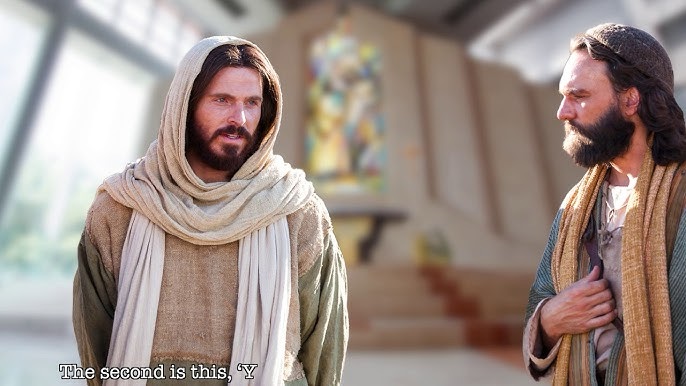
SIX.   In the version we find at Mark 12, Jesus adds a fourth element: with all your mind. Where does this addition come from? Centuries before Jesus, an ancient scribe wrote an account of events in his society in a time long before his life. He reports the instruction that King David spoke to his chosen successor, his son, Solomon: “set your mind and heart to seek the Lord your God” (1 Chron 22:19). He reinforces that in a later address, telling Solomon to “know God and serve [the Lord] with single mind and willing heart” (1 Chron 28:9). The book of Proverbs (attributed by tradition to Solomon) then advocates both attending to the mind (Prov 22:17; 23:12, 19) and “inclining your heart” towards God (Prov 2:2; 3:1–6; 4:4, 20–23; 6:21; 7:3) as integral parts of the life of faith.

The injunction of David is echoed in the way that Jesus extends the traditional commandment to “love the Lord your God with all your heart, and with all your soul, and with all your might” (Deut 6:5), adding “and with all your mind” (Mark 12:30). There are scriptural resonances underpinning this addition made by Jesus.

SEVEN.   The combined effect of these four phrases in the version of the command that Jesus speaks in Mark 12 is telling: Jesus instructs his followers that life with him requires a complete, total, fully-immersed commitment. He conveys this quite directly in other sayings: to a grieving person, “follow me, and let the dead bury their own dead” (Matt 8:22; Luke 9:60); to a farmer, “no one who puts a hand to the plow and looks back is fit for the kingdom of God” (Luke 9:62); and to a rich man, “go, sell what you own, and give the money to the poor, and you will have treasure in heaven; then come, follow me” (Mark 10:21 a d parallels).

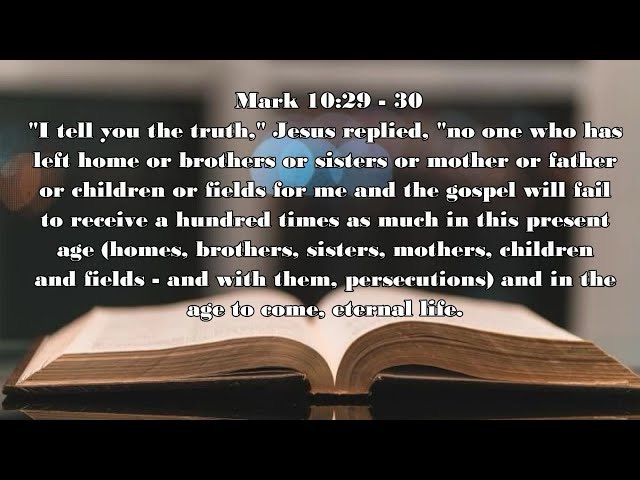
Jesus also declares that “whoever loves father or mother more than me is not worthy of me; and whoever loves son or daughter more than me is not worthy of me; and whoever does not take up the cross and follow me is not worthy of me” (Matt 10:37–38; Luke 14:26–27), leading to his claim that those who have left “house or brothers or sisters or mother or father or children or fields, for my sake and for the sake of the good news” will indeed receive “eternal life in the age to come” (Mark 10:29–30). Discipleship is full-on!
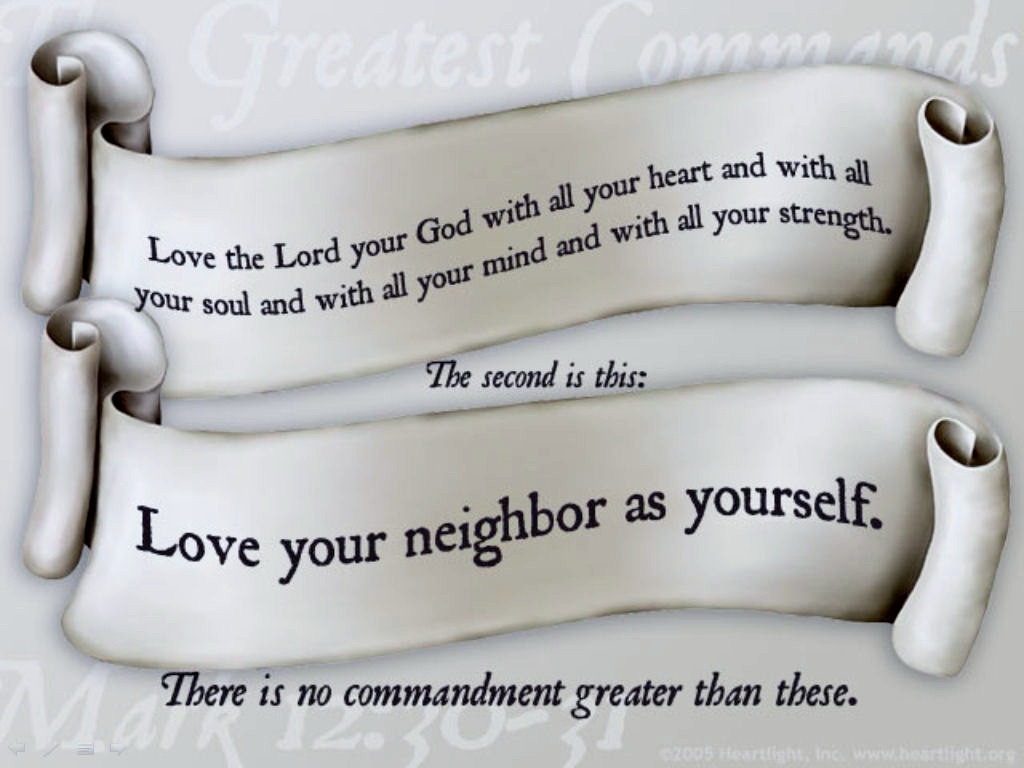
EIGHT.   Jesus then adds a second ”great commandment”, which also comes from Hebrew Scripture. As a good Jew, Jesus was well able to reach into his knowledge of Torah in his answer to the scribe who had asked him “which commandment is the first of all?”. The commandments that he selects have been chosen with a purpose. They contain the essence of the Torah: love God, love your neighbour. His answer draws forth the agreement of the scribe; in affirming Jesus, the scribe reflects the prophetic perspective, that keeping the covenant in daily life is more important that following the liturgical rituals of sacrifice in the Temple (see Amos 5:21–24; Micah 6:6–8; Isaiah 1:10–17). 

The scene is similar to a Jewish tale that is reported in the Babylonian Talmud, a 6th century CE work. In Shabbat 31a, within a tractate on the sabbath, we read: “It happened that a certain non-Jew came before Shammai and said to him, ‘Make me a convert, on condition that you teach me the whole Torah while I stand on one foot.’ Thereupon he repulsed him with the builder’s cubit that was in his hand. When he went before Hillel, he said to him, ‘What is hateful to you, do not to your neighbour: that is the whole Torah, the rest is the commentary; go and learn it.’”

Hillel, of course, had provided the enquiring convert, not with one of the 613 commandments, but with one that summarised the intent of many of those commandments. We know it as the Golden Rule, and it appears in the Synoptic Gospels as a teaching of Jesus (Matt 7:12; Luke 6:31). 

Some Jewish teachers claim that the full text of Lev 19:18 is actually an expression of this rule: “You shall not take vengeance or bear a grudge against any of your people, but you shall love your neighbour as yourself: I am the Lord”. Later Jewish writings closer to the time of Jesus reflect the Golden Rule in its negative form: “do to no one what you yourself dislike” (Tobit 4:15), and “recognise that your neighbour feels as you do, and keep in mind your own dislikes” (Sirach 31:15).
NINE.   Love of God is a thread running right through both testaments of scripture. The command is repeated in later chapters of Deuteronomy (10:12; 11:1; 13:3; 30:6) and in Joshua (22:5; 23:11). It is then picked up in all three Synoptic Gospels (Mark 12:30; Matt 22:37; Luke 10:27; 11:42) and echoed by Paul (Rom 8:28 and perhaps 2 Thess 3:5). 

Finally, this claim is developed by the author of 1 John, who focusses on love as integral to the nature of God, declaring that “God is love” (1 John 4:16) and “love is from God” (4:7); and then explains that such love is expressed in the way that believers “love one another [for] if we love one another, God lives in us, and his love is perfected in us” (4:11–12), or that “the love of God is this, that we obey his commandments” (5:3); and that “those who do not love their brothers and sisters” are “not from God” (3:10; see also 4:19–20). 

And so, the bold declarations are made that “whoever obeys [Christ’s] word, truly in this person the love of God has reached perfection” (2:5), and that “those who love God must love their brothers and sisters also” (4:21). In this way, the two commands to love are knitted together most completely.

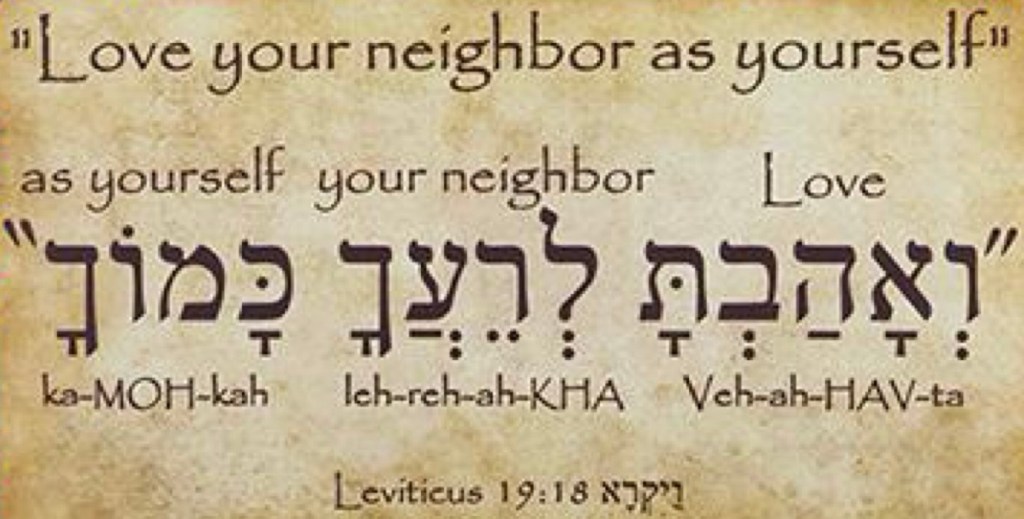
TEN.   Love of neighbour is also a consistent theme throughout scripture. After the command to “love your neighbor as yourself” (Lev 19:18), the Torah specifies that “the alien who resides with you shall be to you as the citizen among you; you shall love the alien as yourself” (19:34). Israelites are commanded not to defraud a neighbour (19:13), judge a neighbour “with justice” (19:15), not profit “by the blood of your neighbour” (19:16) and to deal justly with the neighbour in matters of  commerce (25:14–15). The word of Moses in Deuteronomy is clear in the command to “open your hand to the poor and needy neighbour in your land” (Deut 15:11).

The book of Proverbs likewise counsels “do not plan harm against your neighbour who lives trustingly beside you” (Prov 3:29), “do not be a witness against your neighbor without cause, and do not deceive with your lips” (24:28), and warns that “like a war club, a sword, or a sharp arrow is one who bears false witness against a neighbour” (25:18). Its advice is, “better is a neighbour who is nearby than kindred who are far away” (27:10b). 

Paul clearly knows the command to love one’s neighbour, for he quotes it to the Galatians: “the whole law is summed up in a single commandment, ‘You shall love your neighbour as yourself’” (Gal 5:14), and to the Romans: “the commandments … are summed up in this word, ‘Love your neighbor as yourself.’ Love does no wrong to a neighbor; therefore, love is the fulfilling of the law.” (Rom 13:9–10).

James also cites it: “you do well if you really fulfill the royal law according to the scripture, ‘You shall love your neighbour as yourself’” (James 2:8). Both writers reflect the fact that this was an instruction that stuck in people’s minds! And I wonder … perhaps there’s a hint, in these two letters, that the greater of these two equally-important commandments is actually the instruction to “love your neighbour”?
So it is for very good reasons that Jesus extracts these two commandments from amongst the 613 commandments that are to be found within the pages of the Torah. (The rabbis counted them all up—there are 248 “positive commandments”, giving instructions to perform a particular act, and 365 “negative commandments”, requiring people to abstain from certain acts.)

Jesus, of course, was a Jew, instructed in the way of Torah. He knew his scriptures—he argued intensely with the teachers of the Law over a number of different issues. He frequented the synagogue, read from the scroll, prayed to God, and went on pilgrimage to Jerusalem and into the Temple—where, once again, he offered a critique of the practices that were taking place in the courtyard of the Temple (11:15–17). 

Then he engaged in debate and disputation with scribes and priests (11:27), Pharisees and Herodians (12:13), and Sadducees (12:18). Each of those groups came to Jesus with a trick question, which they expected would trap Jesus (12:13). Jesus inevitably bests them with his responses (11:33; 12:12, 17, 27). It was at this point that the particular scribe in our passage approached Jesus, perhaps intending to set yet another trap for him (12:28). We have seen how masterful Jesus was, in engaging with—and besting in debate—this scribe in the way he responded to him. These two “greatest commandments” have endured for centuries!

See also
God’s care for the widow; the widow’s care for the prophet (1 Kings 17; Narrative Lectionary for Pentecost 24C)

This blog explores the passage which the Narrative Lectionary offers for this Sunday (1 Kings 17:1–24), in which the prophet Elijah is introduced. But let me begin with Jesus.

Jesus was a Jew, raised in the manner of his time, taught to read Torah, the scrolls which held prime place in his religion. He was schooled in the detailed requirements of the Law which expressed commitment to the covenant made by the Lord God with ancestors of old (Noah, Abraham, Jacob, David). He actively participated in the practice of prayer and study which occurred in the synagogues and the rituals of offerings and sacrifices that took place in the Temple in Jerusalem.

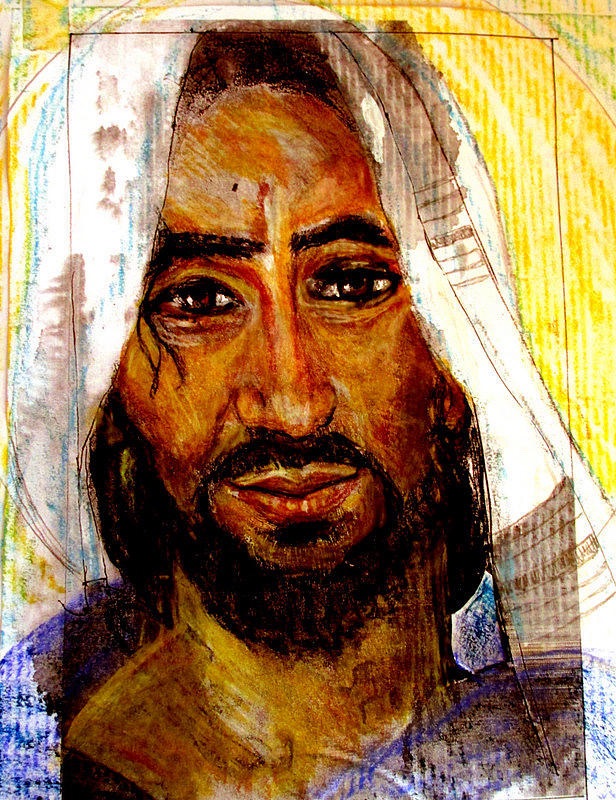
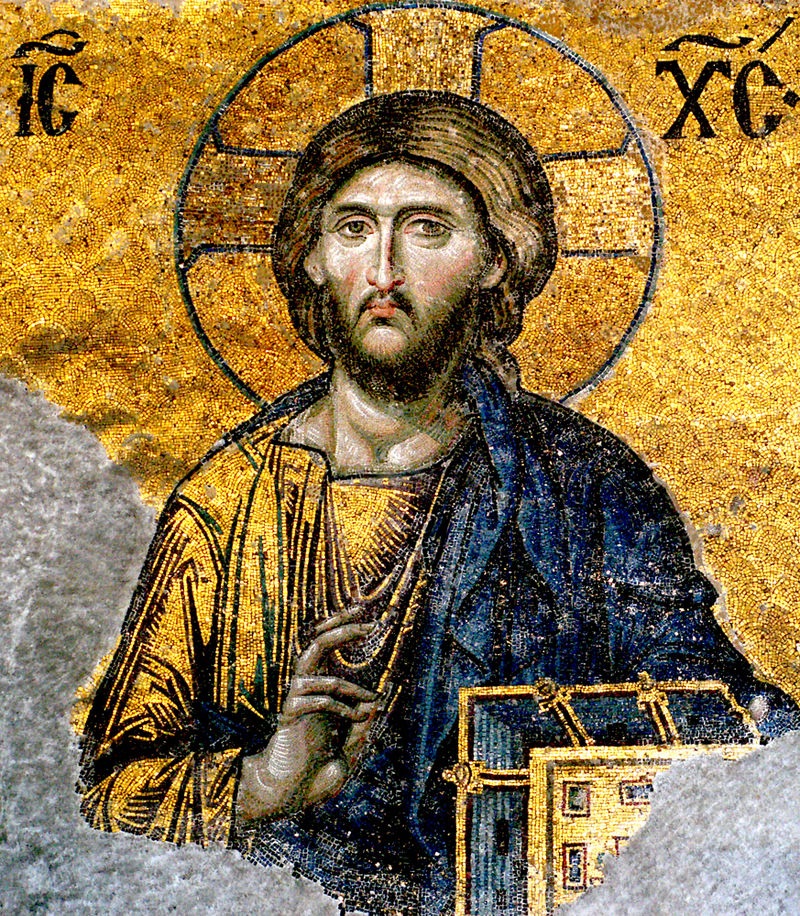
A depiction of Jesus the Jew

As an adult, Jesus broke with his family and began to exercise an itinerant ministry, travelling from place to place with a small, but growing, group of followers, dependant upon the hospitality of those who welcomed him to the villages and towns he visited. In this regard, Jesus was following the practice of prophets in the traditions of the Israelites who travelled from place to place, not settling anywhere. Both Elijah and Elisha lived in this manner; Elijah was known as “hairy man, with a leather belt around his waist” (2 Ki 1:8). 

This mode of living, of course, was adopted by John the Baptist, who was “clothed with camel’s hair, with a leather belt around his waist, and he ate locusts and wild honey” (Mark 1:6). And, of course, there are indications that Jesus—and some of his own disciples—had been followers of John before he launched into his own public mission. Jesus continued the message proclaimed by John, to “repent, for the kingdom of heaven has come near” (Matt 3:2; 4:17) and he continued the emphasis of John to “bear fruits worthy of repentance” (Matt 3:8–10; 7:17–20)  and to share one’s own clothing and food with others who are lacking these essentials of life (Luke 3:11; 12:42; and see Matt 25:34–40). 

For more on how Jesus and John are related, see the groundbreaking work of Prof. James McGrath in Christmaker, which I have reviewed at 


As an adult, Jesus travelled from village to village, preaching his intense message that “the kingdom of God” was drawing near, fervently calling people to repent of their sins and commit completely to the ethical way of living that Torah required. It was all in for Jesus, both in terms of what he preachers, and in terms of how he lived—there was no halfway point for him!

In this regard, Jesus shared the key characteristics of a wild-eyed, desert-dwelling, fiery apocalyptic preacher, vigorously proclaiming the imminent coming of the reign of God. This itinerant, apocalyptic Jesus was resolutely Jewish, standing in the tradition of a string of earlier wild-eyed, rhetorically powerful prophetic figures: Elijah, Nathan, Isaiah, Jeremiah, Joel, Malachi—and his own relative and mentor, John the baptiser. 

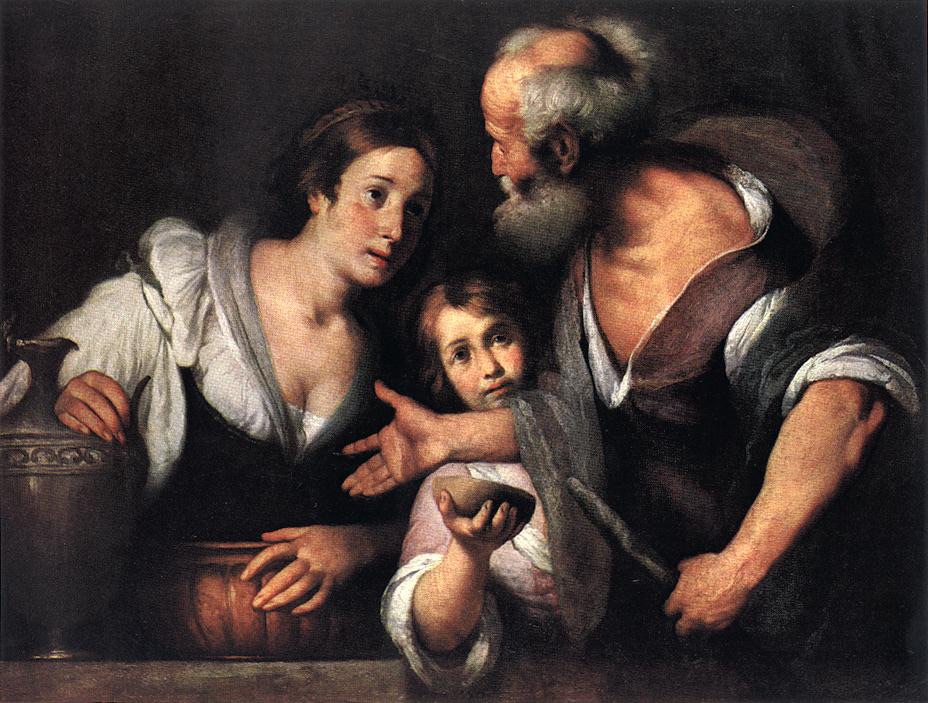
A depiction of Elijah the Tishbite, “a hairy man”

It is Elijah the Tishbite whom we meet in the passage which the Narrative Lectionary offers for this Sunday (1 Kings 17:1–24)—Elijah, who is later described as “a hairy man, with a leather belt around his waist” (2 Ki 1:8). This initial portrayal of Elijah is nested within the accounts of that long period of time when Israel was ruled by kings, when prophets functioned as the conscience of the king and the voice of integrity within society. 

Elijah operated during the period when Ahab ruled Israel; he figures in various incidents throughout the remainder of 1 Kings—most famously, in the conflict with the prophets of Baal which came to a showdown on Mount Carmel (1 Ki 18), and then later in his confrontation with Ahab and his wife Jezebel, over the matter of Naboth’s vineyard (1 Ki 21). Like Jesus, Elijah was no shrinking violet!

Elijah first appears in the narrative of kings, seemingly out of nowhere, at the beginning of this lectionary passage (1 Ki 17)—just as he disappears from sight when he hands over his role to his successor, Elisha, and as “a chariot of fire and horses of fire separated the two of them”, Elijah ascends in a whirlwind into heaven (2 Kings 2:1–15).

So in 1 Kings 17, Elijah predicts a drought and takes himself into the desert, where ravens fed him food and he drank from the wadi, until the wadi dried up (vv.1–6). Elijah did as he was commanded and travelled out of Israel, to the neighbouring region of Sidon (v.7). Is this start of Elijah’s public activity mirrored, centuries later, in the account of Jesus retreating into the wilderness near the Jordan, before his public activity got underway?

However, whilst Jesus meets the tempter, Elijah meets a widow who, despite being unnamed, is nevertheless well known in Christian circles because Jesus himself, according to Luke, refers to her in a keynote sermon. This took place when he came to his hometown on Nazareth, and was given opportunity to speak in the synagogue (Luke 4:14–30). After reading from the scroll of Isaiah, Jesus refers to stories of two prophets—Elijah and Elisha—and honours this particular widow amongst “the many widows in Israel at the time of Elijah” (Luke 4:25–26). These verses form the short subsidiary reading which the Narrative Lectionary places alongside 1 Kings 17.

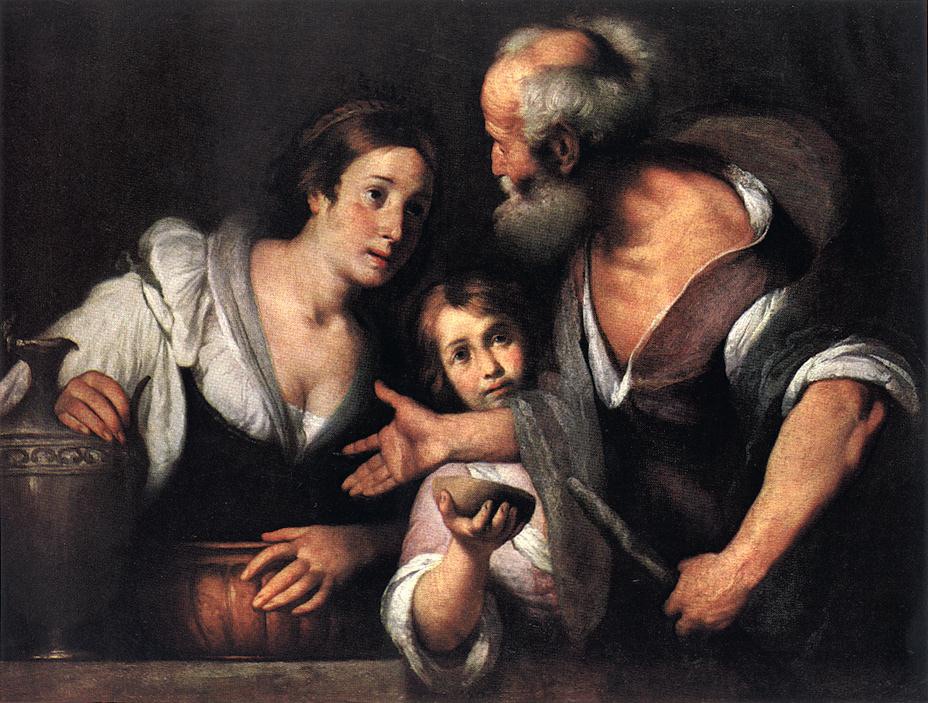
The widow offers hospitality to the prophet. Hospitality was a fundamental cultural practice in ancient Israel; there are many stories of the hospitality offered by people such as Abraham (Gen 18:1–15), Rahab (Josh 2:1–16), and David (2 Sam 9:7–13), and hospitality offered earlier to Moses in Midian (Exod 2:15–25), here to Elijah in Zarephath (1 Ki 17:10–24), and later Elijah in Shunem (2 Ki 4:8–17). Welcoming hospitality is commanded in relation to aliens in Israel (Lev 19:33–34) and is advocated in relation to exiles returning to the land (Isa 58:7). The passage from 1 Kings 17 that is proposed by the Narrative Lectionary well exemplifies this practice. The widow had very little; and yet she finds enough to provide for Elijah, in a display of warm hospitality to this foreign Israelite in her territory. 

Hospitality had a fundamental significance in the cultural practices of the day. Writing in Bible Odyssey, Peter Altman notes that “hospitality serves as an underlying core value for how the characters in the Hebrew Bible should treat others, for they, too, understood the precarious nature of life as an outsider”.

See https://www.bibleodyssey.org/articles/hospitality-in-the-hebrew-bible/

In the same resource, Carolyn Osiek notes that this value continues strongly throughout New Testament books, which are “full of images and stories of guests received, both those already known as friends and those strangers who are taken in and transformed into guests. Among nomadic tribes, the guest comes under the protection of the host, who guarantees inviolable safety. The important elements of hospitality include the opportunity for cleansing dusty feet, scented oil to soften dried skin and mask odors of the road, food, shelter, security, and companionship.”

See https://www.bibleodyssey.org/articles/hospitality-in-the-new-testament/

Gerd Theissen, a German New Testament scholar, has proposed that the message of Jesus was spread by itinerants within the early Jesus movement who travelled from village to village with their message. They were dependent on those who received them for hospitality and lodging, in literal obedience to what Jesus had told his disciples (Mark 6:10–11; see also Matt 10:41 and Didache 11:1, 4–6). Jesus and his followers were living in complete obedience to “the Son of Man [who] has nowhere to lay his head” (Matt 8:20; Luke 9:58). In a sense, they are also continuing the pattern which we see in this story of Elijah, as he travels to Sidon during the famine, receiving hospitality from the widow of Zarephath. 

Widows in ancient Hebrew society were in a perilous position. In a strongly patriarchal society, the patronage of a man was vital: a man as husband and provider, a man as father and protector, a man as the household head. Children without fathers—orphans—as well as women without husbands—widows—were in equally perilous situations. They were vulnerable people, often at risk of being mistreated and exploited, of being pushed to the edge of society and being forgotten. They could well be the desolate who needed housing (Ps 68:6).

In the Hebrew Scriptures there are regular exhortations and instructions to the people to take care of widows and orphans, the key classes of vulnerable people in that society: “you shall not mistreat any widow or fatherless child” (Exod 22:22) and the instruction to gather a tithe of produce and invite “the Levite, the foreigner, the fatherless, and the widow to come and eat and be filled” (Deut 14:28–29). Even in ancient society, vulnerable people needed protection.

More that this, the Torah provides that the widow and the fatherless child were to included along with the sojourner in celebratory moments in Israel, at the Feast of Weeks (Deut 16:9–12) and the Feast of Booths (Deut 16:13–15). This was also to be the practice when the men were in the field harvesting; they were to leave some for gleaning by ”the alien, the orphan, and the widow” (Deut 24:19–22); and similar prescriptions govern the time when tithing (Deut 26:12–13; also 14:28–29).

Not everyone adhered to these prescriptions. Among the prophets, Isaiah proclaims God’s judgement on those who “turn aside the needy from justice … and rob the poor of my people”, including the way that they exploit the fatherless and widows (Isa 10:1–2). Likewise, Ezekiel includes those who “have made many widows” in Israel amongst those who will experience the full force of God’s vengeance (Ezek 22, see verse 25). He observes that “the sojourner suffers extortion in your midst; the fatherless and the widow are wronged in you” (Ezek 22:7). Jeremiah encourages the people of Jerusalem with a promise that God will allow them to continue to dwell in their land if they “do not oppress the sojourner, the fatherless, or the widow, or shed innocent blood in this place … or go after other gods” (Jer 7:5–7). 

Accordingly, the people of Israel would regularly have sung, in the words of the psalmist, “the Lord watches over the sojourners; he upholds the widow and the fatherless, but the way of the wicked he brings to ruin” (Ps 146:9). Care for widows was central to the life of holiness required amongst the covenant people. This psalm reminds them of that claim on their lives.

And so the brother of Jesus, James, writes that “religion that is pure and undefiled before God, the Father, is this: to care for orphans and widows in their distress, and to keep oneself unstained by the world” (James 1:27), summing up a strong thread running through Israelite religion and on into Second Temple Judaism. See more on widows in biblical texts at 

In 1 Kings 17, the first two key incidents that we are told of regarding Elijah both involve this widow: the widow who offers hospitality to Elijah, and the widow whose son had died, but whom Elijah brought back to life. In the first scene, the tables are turned on the typical biblical view of widows, as vulnerable and in need of protection. Here,it is the widow who serves and nourishes the prophet at his time of need. In another evocation of what Jesus taught, we see the humble exalted, the man of power brought down to a position of dependence, perhaps?

Both scenes involving the widow of Zarephath, a non-Israelite, are evoked in the stories about Jesus: first, the generosity of the widow, offering hospitality out of her meagre provisions, is echoed in the positive words Jesus spoke about widows giving in the temple (Mark 12:41–44; and see also Luke 18:1–8).

Second, the raising of the widow’s son from the dead is paralleled in the story Luke tells about Jesus when he visited Nain (Luke 7:10–17). That story ends with the people declaring, “A great prophet has risen among us!” and “God has looked favorably on his people!” (Luke 7:16). The story of Elijah bringing the widow’s son back to life ends in similar fashion, as the woman confesses, “Now I know that you are a man of God, and that the word of the Lord in your mouth is truth” (1 Ki 17:24). The prophetic vocation of both Jesus and Elijah is confirmed by their performing such a deed. And that is precisely the point in mind as the narrator introduces the prophet Elijah to us in these two stories.

Ten Things about the Christian Faith (for Reformation Day) part 3

For Reformation Sunday I am exploring Ten Things about the Christian Faith that I think are significant. In the first post I considered Jewish heritage, Hellenistic contextualisation, and a state religion leading to Christendom. In the,second post, I commented on various influences on theology over time, the central tension of words and deeds, the growing dominance of the Global South, and Eastern Orthodox commitment to tradition and creeds. In this final post, my attention turns to post-Christendom weakening in the West, ecumenical and interfaith developments, and bearing witness to faith in sensitive ways for the present.

VIII

An emphasis on right belief and holiness of life exists in the churches of the Western world, just as in the churches of Eastern Orthodoxy. Various Western churches were the dominant force in Christianity for many centuries, from the days of Constantine’s Roman Empire to the high point of colonisation. However, the dominant factor over the past century in Western churches has been the gradual weakening of the bonds between Christian faith and the governing of society, with the consequent marginalising of faith communities and faith commitments across society. This is often viewed in terms of the demise of Christendom in these societies, but also in terms of opening up new possibilities for understanding and expressing faith in a contemporary way. In this regard, the dynamics that are at work in these developments share much with the dynamics at play in the various Reformations that took place four and five centuries ago.

This focus on fresh expressions is often undergirded by reference to the biblical passages which portray small communities of faith, meeting in homes, offering a counter-cultural alternative to the dominant state-supported religious activities. Paul sends greetings to communities in the houses of Philemon (Palm 1-2), Priscilla and Aquila (Rom 16:3-5; those greetings are reciprocated in 1 Cor 16:19), and Nympha (Col 4:15), and perhaps also to other house churches in Rome (Rom 16:6-15). 

Luke’s portrayal of the early days of the movement in Jerusalem, although idealised and written over half a century later, nevertheless maintains the view of believers meeting in houses (Acts 2:46; 5:42; see also Paul at 20:20). And those communities of believers are recognised as being distinctive gatherings by those outside the communities.

IX

An important development throughout the 20th century has been for various churches to seek to work together. Presbyterian Churches began this process in 1875, when the Alliance of the Reformed Churches throughout the World holding the Presbyterian System was formed in London. Then, also in London, the International Congregational Council was formed in 1891. Those two groups joined together in 1970, during the heady days of strong commitment to ecumenism across the churches, to form the World Alliance of Reformed Churches (WARC). In 2010, the WARC joined with a smaller, strongly Calvinist group, the Reformed Ecumenical Council, to form the World Communion of Reformed Churches.


Over the past century, Orthodox, Anglican, and Protestant churches have sought to work together, forming ecumenical councils on a global basis (the World Council of Churches, formed in 1948) as well as national and locally. Although not formally a part of the WCC, since the Second Vatican Council (1962—1965) the Roman Catholic Church has been actively working with other denominations in local, regional, and national forums. Developments from this ecumenical impetus have led also in recent decades to a strong focus on developing interfaith relationships, especially in contexts that are strongly multicultural and multifaith.

It is the prayer of Jesus in John 17 which is most often cited in relation to the development of ecumenical organisations and relationships. In that prayer, Jesus prays for those who believe because of the word of the disciples, “may they be one, just as we are one, I in them and you in me, that they may become completely one, so that the world may know that you have sent me and have loved them even as you have loved me” (John 17:22–23). 

Other biblical texts which undergird this commitment are the affirmation that there is “one body and one Spirit … one Lord, one faith, one baptism, one God and Father of all” (Eph 4:4–6), and the Pauline claim that “we are all one in Christ” (Gal 3:28).

Faithful discipleship in the contemporary world thus calls people of faith to bear witness to their faith in words and deeds. Especially since the 19th century, Reformed churches have largely inherited a strong commitment to “make disciples”, in keeping with the “Great Commission” of Jesus (Matt 28:16–20). Some Roman Catholic Churches share this commitment. However, an aversion to excessive aggressive proselytism and forced conversion is widespread in some quarters of the church as a whole, even though in other streams within Christianity this is still seen as the primary responsibility of believers. 

So there is a final contrast within Christianity at this point. Seeking to contextualise the expression of faith in ways that connect with and communicate to the contemporary world is seen by a number of believers as paramount, whilst others hold to the primacy of traditional expression of belief, liturgy, and discipleship. The tension between these approaches is often tangible.

Bearing witness in both word and deed is commended by Paul, “I will not venture to speak of anything except what Christ has accomplished through me to win obedience from the Gentiles, by word and deed”

 (Rom 15:18) and in a later Paul-inspired letter, “whatever you do, in word or deed, do everything in the name of the Lord Jesus, giving thanks to God the Father through him” (Col 3:17). In another letter, believers are encouraged to “be ready always to make your defense to anyone who demands from you an accounting for the hope that is in you” (1 Pet 3:15).

For myself, I think it is important to note that nowhere in the New Testament is any person coercively pushed to “make a decision”; indeed, in most encounters involving Jesus and another he is invitational, not proselytising. Paul only becomes verbally aggressive with those who are already followers of Jesus, whose actions and words he considers to be unethical and contrary to his understanding of the Gospel. 

In relation to those who are not yet committed to faith in Jesus or are finding their way in the early days of such a faith, Paul seeks to be “gentle among you, like a nurse tenderly caring for her own children”, behaving “like a father with his children, urging and encouraging you and pleading that you lead a life worthy of God” (1 Thess 2:7, 11–12). That is a model we would do well to emulate today.

For part 1, see

and for part 2,

Ten Things about the Christian Faith (for Reformation Day) part 2

For Reformation Sunday I am exploring Ten Things about the Christian Faith that I think are significant. In the first post I considered Jewish heritage, Hellenistic contextualisation, and a state religion leading to Christendom. In this post, I am commenting on various influences on theology over time, the central tension of words and deeds, the growing dominance of the Global South, and Eastern Orthodox commitment to tradition and creeds. In the third post, my attention turns to post-Christendom weakening in the West, ecumenical and interfaith developments, and bearing witness to faith in sensitive ways for the present.

IV

Alongside the two testaments of scripture and the fact that Christianity became The State Religion in the fourth century, other factors have influenced Christianity over time. Theological developments have been shaped by the logic and ethos of medieval insights and reasoning. Reformers  the end of the medieval period were well-schooled in such learnings. Spiritual practices have been developed by the monastic practices of desert mothers and fathers, the theological orthodoxy promoted by liturgical leadership in gathered communities, and environmental insights from the Celtic connections with nature. In more recent centuries there has been spirited engagement with debates generated by the Enlightenment, evolving scientific and philosophical understandings, commitments to multicultural societies, and deeper interfaith engagements.

My own church, the Uniting Church in Australia (which draws on the Reformed heritage of Congregationalism and Presbyterianism) has a very clear statement about constructive engagement with influences in the wider society, in the Basis of Union for the UCA. This document signals the importance of entering into “the inheritance of literary, historical and scientific enquiry which has characterised recent centuries” and affirms the value of “contact with contemporary thought” and engaging with “contemporary societies”. It “gives thanks for the knowledge of God’s ways with humanity which are open to an informed faith”, and thus commits the church “to sharpen its understanding of the will and purpose of God by contact with contemporary thought” (para. 13).

Along with such careful thinking about the faith, living out the imperatives of faith in a just and ethical manner in the context of the challenges and opportunities of society of the day is something that is regularly modelled in scripture—as Moses commands the people of Israel (Deuteronomy), as Jesus instructs his disciples (Matt 5–7; Luke 6), and as the voices of Paul, James, John, Peter, and the anonymous writer of Hebrews invariably exhort and guide those who receive their writings in each of the letters attributed to them. Living by faith means living in a just and fair way.

V

Our Christian faith contains an ongoing tension between orthodoxy (right thinking) and orthopraxis (right behaviour)—or words and deeds, as an older paradigm expressed it. This is a tension between believing the “correct doctrine” of the faith, on one hand, and living in a way that is faithful to the teaching of the faith, on the other hand. This tension can be manifest in the different emphases found in different expressions of Christian faith. It was a tension that drove Luther to criticize the Pope for the various practices that had developed, over many centuries, within the Roman Catholic Church. How could right belief (orthodoxy) be expressed in such corrupt behaviour? 

The same tension can also undergird some intense debates that occur, both within denominations and across denominations, about specific matters. A commitment to seeking justice in the social and political arenas has particular influenced many Christians to resist unhealthy forces at work in society, often through nonviolent means. This course of action is often rejected by those holding strongly to the “correct doctrine” view of the faith.

Nevertheless, prophets in Israel of times past had expressed the central importance of demonstrating justice in society. The Torah includes the clear instruction, “you shall not render an unjust judgment; you shall not be partial to the poor or defer to the great: with justice you shall judge your neighbour” (Lev 19:15) and Moses enjoins the people, “justice, and only justice, you shall pursue” (Deut 16:20). Later, Jesus placed “justice and mercy and faith” amongst “the weightier matters of the law” (Matt 23:23). Justice is central to Christian faith.

VI

In recent centuries, two important developments have been evident in relation to Christianity. One is the deepening and strengthening of Christian faith in countries where this faith was introduced during the time of European colonial expansion. (Most of these countries are in the southern hemisphere, so this group is often referred to now as the Global South.) These countries largely inherited forms of Christianity that were shaped by the various reformers and Reformed denominations in the European countries which undertook colonisation of these countries. 

For these people, expressions of faith tend to be focussed on orthodoxy, where correct belief or “the truth” is paramount, and living a clearly demarcated life of faith, or “holiness”, is greatly desired. The growth of this element in a number of denominations in the Western world means that it is this Global South perspective which dominates them. It has a very strong debt to the ways that reformers, in various places, over various decades, highlighted what they saw as they “right way” to express belief, often as a counter to practices seen as corrupt and ideas seen as “unbiblical”.

Often it is the Pastoral Epistles which are cited in support of this type of Christianity, with their references to “the standard of sound teaching that you have heard from me, in the faith and love that are in Christ Jesus” (2 Tim 1:13), and “guard the good treasure entrusted to you, with the help of the Holy Spirit living in us” (2 Tim 1:14). Sound teaching is also referenced in the first letter to Timothy, “the sound teaching that conforms to the glorious gospel of the blessed God” (1:Tim 1:10–11; also 4:6), while the letter to Titus refers to “the word that is trustworthy in accordance with the teaching” that Titus is told will ensure “sound doctrine” (Tit 1:9).

VII

Reformed Churches form the third major stream in Christianity, with Roman Catholicism being the second stream, derived from Orthodoxy Christianity, whose churches often lay claim to being the oldest and most authentic forms of Christianity. Within the Orthodox churches, the social and theological dominance of the church has continued into the present era, as reflected in the Pastoral Epistles and the national churches formed during the early centuries of Christian expansion.

In each church within Orthodox Christianity, the culture and the language of the region where the church is located play a leading role in the life of the community of faith. Tradition exercises a prominent role in Orthodox churches, and the voices of selected church fathers from the early centuries are prioritised. Decisions made in the ecumenical councils of the church from the first, at Nicea in 325, to the seventh, also at Nicea in 787, play a significant role in Orthodox churches. Scripture is placed alongside these councils in terms of its governing authority.

Early indications that credal statements will figure prominently in Christianity can be found in scriptural passages which offer short, succinct affirmations creed, such as 1 Tim 2:5–6, foreshadowing the first and second sections of the Apostles Creed; Phil 2:5–11, describing Jesus with some phrases that appear in that Creed; and 1 Tim 3:16, a precursor of the third section of the Apostles Creed. The passing on of tradition, likewise, is already evident in the formation of the Torah, and is specifically noted by Paul in relation to Christian teachings at 1 Cor 11:2;  11:23; and 15:1–5.

For the first blog, see

… and for the final blog,

Ten Things about the Christian Faith (for Reformation Day) part 1

On the last day of October each year, churches in the Reformed tradition celebrate Reformation Sunday. 31 October is chosen to remember the day, in 1517, when Martin Luther “nailed his theses” to the door of All Saints’ Church in Wittenberg in Saxony. That action is widely regarded as “the start of the Reformation”, which saw many churches in Europe separate from Roman Catholicism, the dominant expression of Christianity across Europe. 

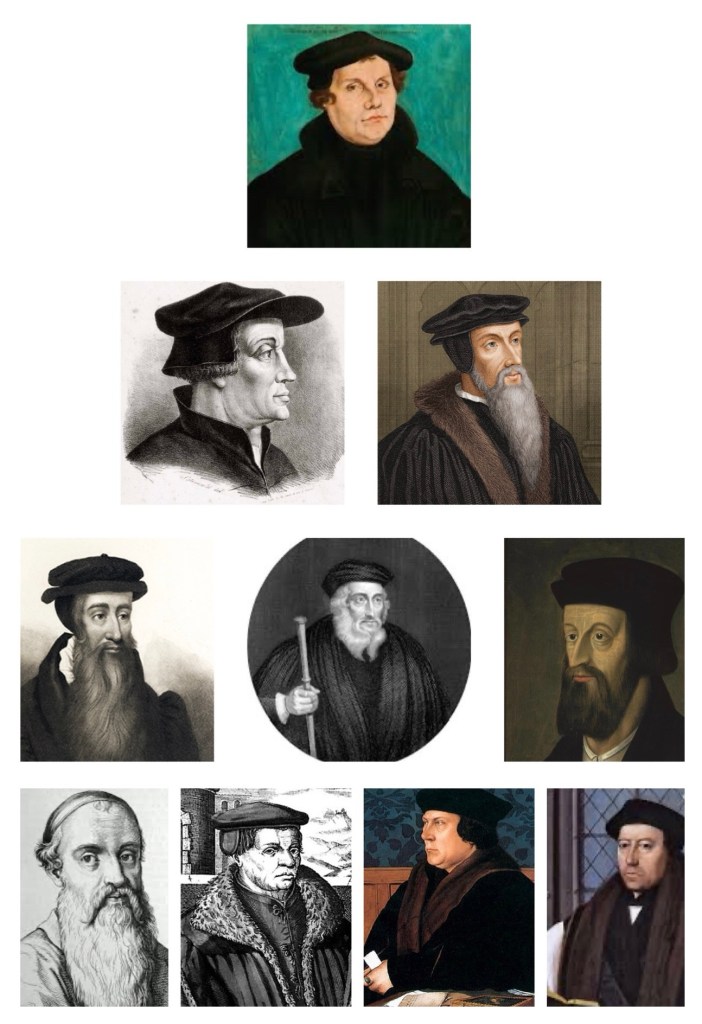
Of course, historians today note that there had been earlier movements which led to the reformation of assorted churches, led by John Wycliffe in England and Jan Hus in Bohemia. But it is Martin Luther in Germany, along with later figures such as Frenchman Jean Calvin, Scotsman John Knox, and Ulrich Zwingli in Switzerland, who are regarded as key figures in the various Reformations that took place. (And in England, the actions of King Henry VIII, driven by his peculiar personal needs, must also be considered; although whether the Church of England is formally a Reformed church is hotly contested!)

Assorted reformers.
Cheery bunch, aren’t they?

Reformed Churches share much with other branches of Christianity, as well as having certain distinctives which set them apart. One of those key distinctive s has to do with the centrality and overarching significance of scripture in the life of the church. So in this post I aim to set out what I consider to be ten key aspects of Christianity, with some observations about how they might be seen to derive from biblical texts—although I think the actual relationship in each case is more complex and sophisticated than just quoting a couple of “proof texts”. 

So, here is my take on Ten Things about the Christian Faith that I think are significant. I will,explore, in this post, Jewish heritage, Hellenistic contextualisation, and a state religion leading to Christendom. In the next post, I will consider various influences on theology over time, the central tension of words and deeds, the growing dominance of the Global South, and Eastern Orthodox commitment to tradition and creeds. In the third post, my attention turns to post-Christendom weakening in the West, ecumenical and interfaith developments, and bearing witness to faith in sensitive ways for the present.

I

Our Christian faith does not exist in a vacuum. For a start, it draws on the long heritage of Judaism, from the sagas telling of ancient days in Mesopotamia and Canaan, through the development of Israelite society, culture, and religion, listening to the voices of prophets and sages, on into the period of the Second Temple, laying the foundation for Judaism itself, and including then the time when Jesus, James, Paul, and others lived. All of these Jewish elements have influenced and shaped elements of the Christian faith.

The clearest example of this must surely be when Jesus is asked “which commandment is the first of all” (Mark 12:28). Jesus draws from his Jewish heritage, quoting, “you shall love the Lord your God with all your heart, and with all your soul, and with all your strength, and with all your mind” (Deut 6:5), and then following up with a second commandment, also from Hebrew scripture, “you shall love your neighbour as yourself” (Leviticus 19:8). 

Another striking instance comes at the start of Paul’s major theological statement, his letter to the Romans. In this letter he sets out the message about the gospel that he preaches, declaring  that it is “the power of God for salvation to everyone who has faith, to the Jew first and also to the Greek” (Rom 1:16). His summary of that gospel, “in it the righteousness of God is revealed through faith for faith”, is based on words from a minor Israelite prophet, Habakkuk, who declared, “The one who is righteous will live by faith” (Rom 1:17, citing Hab 2:4b).

There are many other instances which could be cited to show how Hebrew scripture and Israelite religious practices are at the heart of the books of the New Testament. Amongst the reformers, the Hebrew Scriptures have an assured place in the canon—although Luther was renowned for his vituperative criticisms of Jews and Judaism. (They misunderstood God and faith, he maintained.) Overall, the way that Hebrew Scriptures provide a bedrock for later developments in Christian thinking is clear to the key reformers.

II

Those developments are evident to modern interpreters in the ways that the books of the New Testament expressed faith. The second testament provides the first example of how Christian faith has been contextualised in different ways in various eras. New Testament Gospels and Letters and many of the patristic works in ensuing centuries have been influenced by the philosophical wisdom and rhetorical finesse which dominated the Hellenistic world. The interplay between the heritage and traditions of Judaism and the culture and practices of Hellenism is an important dynamic within these writings. Awareness of this interplay when reading any particular passage can lead to a deeper understanding of its message, as the word of God for their time and for our time. In making that affirmation, the claim of the centrality of scripture made by the reformers is being drawn upon. 

An obvious illustration of the interplay at work in contextualisation is the contrast between two speeches of Paul, which are reported in Acts. Speaking in a synagogue to a Jewish audience in Antioch of Pisidia, Paul refers, understandably, to the Hebrews Scriptures (Acts 13:33–41). A week later, he quotes Isaiah 42:6; 49:6 (“a light for the Gentiles”) (Acts 13:46–48). 

In Athens, by contrast, speaking at the Areopagus to a group of Greek philosophers, Paul draws from “some of your own poets” (Acts 17:28) when he quotes from Cretica by Epimenides (“in him we live and move and have our being”) and then a line found in the Phaenomena by Aratus (“we are also his offspring”). What is quoted depends on what the audience knows; a simple indication of how contextualisation works.

III

The development of Christendom through the positioning of Christianity as the state religion of Roman society, from the fourth century onwards, has left an indelible mark on Christianity. For centuries after Constantine adopted this religion, Christian leaders have considered Christianity to be The State Religion. This has been the case in societies in many places and later times, especially in a number of European countries and their colonies. Even in the Reformation, the creation of new churches did not mean that there was a break between the State and the new Church. Lutheranism, and a number of other Reformed Churches, became the State religion of their countries!

The dynamic of how the Christian faith relates to the formal structures and patterns in governing society is thus a factor which has shaped and informed expressions of Christianity over the centuries. Words of Paul in his letter to the Romans are often cited as the basis for this development: “let every person be subject to the governing authorities; for there is no authority except from God, and those authorities that exist have been instituted by God” (Rom 13:1). That’s a somewhat simplistic application of this text to later situations. Even this longest letter of Paul, often regarded as his theological magnum opus, was contextual and contingent, as chapters 14—16 demonstrate.

Alongside this, a later letter claiming the authority of Paul speaks of a struggle “against the rulers, against the authorities, against the cosmic powers of this present darkness, against the spiritual forces of evil in the heavenly places” (Eph 6:12), while the final book of the New Testament provides a vivid, dramatic polemic against the Roman Empire, portrayed as “the great whore who is seated on many waters, with whom the kings of the earth have committed fornication, and with the wine of whose fornication the inhabitants of the earth have become drunk” (Rev 17:1–2). Church—State relationships are complex.

… more to come …

… and still more …

Holy, blameless, undefiled …  exalted and made perfect forever (Heb 7; Pentecost 23B)

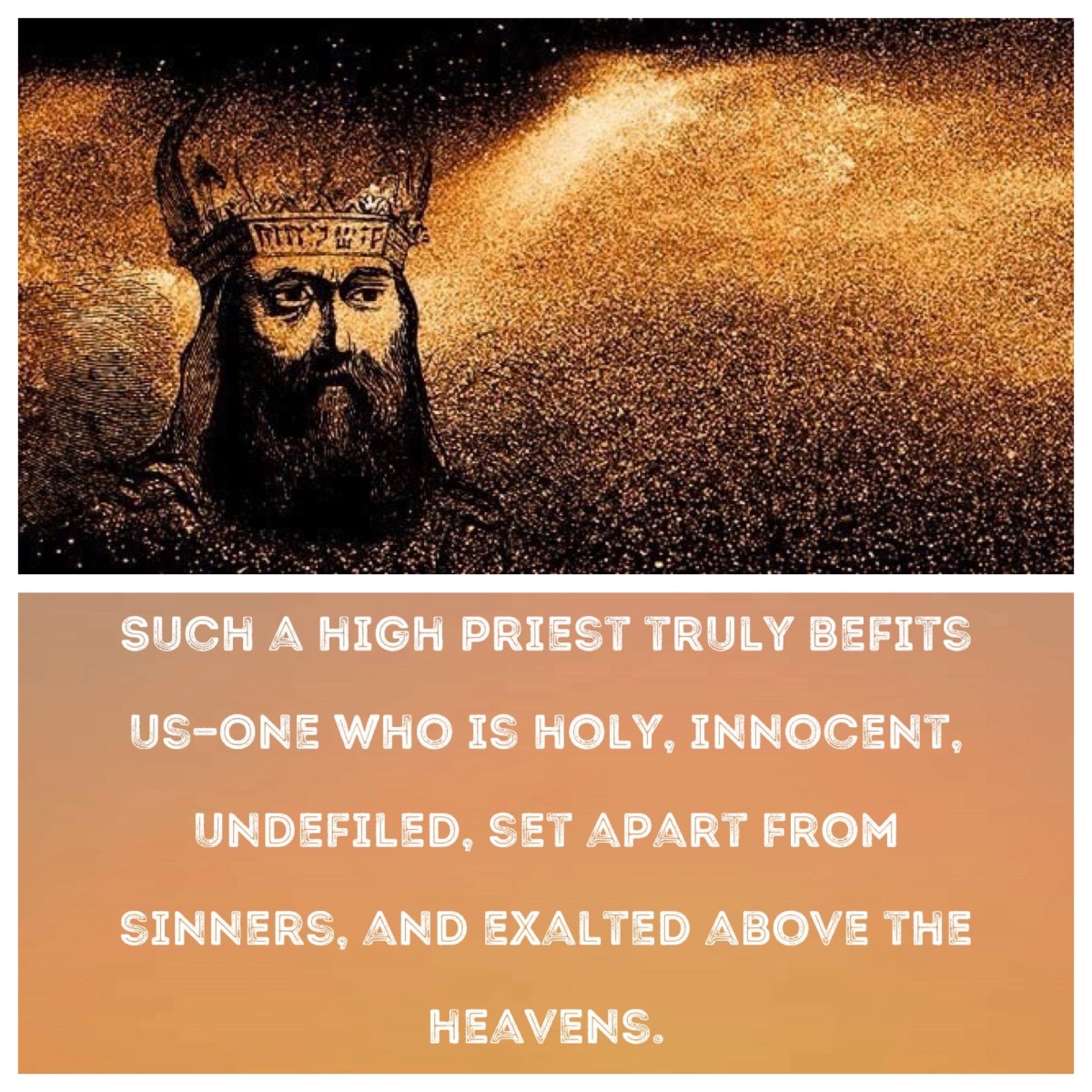
“Holy, blameless, undefiled, separated from sinners, and exalted above the heavens … [one] who has been made perfect forever.” That’s how the unknown author of the book of Hebrews describes Jesus (Heb 7:26, 28). That’s an incredibly high state of being that is described—an almost unattainable perfection of life. How, then, might we relate to such a person?

To understand why Jesus is described as holy and made perfect, we first turn to the heritage of the author of this “letter to the Hebrews”. In Israelite religion, the idea of being perfect was integral to the appreciation of God. We find this expressed at various places in Hebrew Scripture. “This God—his way is perfect”, the psalmist sings (Ps 18:30; echoed also at Deut 32:4; 2 Sam 22:31; Job 37:16), and in another psalm, “the law of the Lord is perfect, reviving the soul” (Ps 19:7). It is later echoed by Paul, who claims that “the will of God” is “good and acceptable and perfect” (Rom 12:2).  

So, too, is the state of being holy a central element of God’s being; “Holy One” is one of the ways that God is addressed God in the Writings (Ps 71:22; 78:41; 89:18; Prov 9:10; Job 6:10; Sir 4:14; 23:9; 53:10; 47:8; 48:20) and by the Prophets (Jer 50:29; Ezek 8:13; Hos 11:9, 12; Hab 1:12; 3:3). This is especially the case in Isaiah, where “the Holy One of Israel” is addressed 29 times, by First Isaiah (Isa 1:4 to 37:23), Second Isaiah (Isa 40:25 to 55:5), and Third Isaiah (Isa 60:9, 14).

This, also, is echoed in  New Testament texts. The mighty saviour, promised to Israel, would come to lead the people to serve God “in holiness and righteousness before him all our days” (Luke 1:69, 75). Jesus is addressed by demons as “the Holy One of God” (Mark 1:45; Luke 4:34) and by Simon Peter (John 6:69). The followers of Jesus are then instructed to live as God’s holy people (1 Cor 3:17; 6:19; Eph 5:25–27; Col 1:22; 3:12; Heb 3:1; 1 Pet 1:13–16; 2:5, 9); Paul prays for the Thessalonians, that God may “strengthen your hearts in holiness that you may be blameless before our God and Father” (1 Thess 3:13).

Of course, holiness (qodesh) was a central element of piety in ancient Israel, exemplified by the Holiness Code of Leviticus (Lev 11:44–45; 19:2; 20:7–8). The code was to be overseen by the priests, who were to “make a distinction between the unclean and the clean” (Lev 11:47; 20:25; cf. Ezek 22:26; 44:23). Accordingly, they were consecrated, set apart as holy (Exod 40:13; Lev 16:32; 21:10), so that the people as a whole might be deemed to be “holy people” (Deut 7:6; 14:2, 21; 28:9). Holiness was a fundamental requirement of the priests.

Accordingly, every priest needed to be “perfect” (tamim), with no sign of blemish—“not one who is blind or lame, or one who has a mutilated face or a limb too long, or one who has a broken foot or a broken hand, or a hunchback, or a dwarf, or a man with a blemish in his eyes or an itching disease or scabs or crushed testicles”, according to Lev 21:16–24. These perfect priests were charged with offering to God the tamid, the daily sacrifice, of “two male lambs a year old without blemish, daily, as a regular offering”, each and every day (Num 28:3).

The temple itself that Solomon built was required to be perfect (1 Ki 6:22), and for the sacrifice of wellbeing to be offered there “to be acceptable it must be perfect, there shall be no blemish in it” (Lev 22:21). The prescriptions of Leviticus maintain the need for all faithful people to bring an offering or sacrifice that is “acceptable” (Lev 1:4; 7:18; 19:5–8; 22:17–21, 26–30); for a sacrifice of wellbeing “to be acceptable it must be perfect; there shall be no blemish in it” (Lev 22:21). That was the role of the priests: to examine carefully the animals being brought for sacrifice, to ensure that they were “perfect” (tamim). So a state of perfection was required of both priests and their victims. 

Of course, the author of Hebrews sets the perfection of Jesus into a distinctive framework, for he asserts early in this book that God, in “bringing many children to glory”, has made Jesus, “the pioneer of their salvation, perfect through sufferings” (Heb 2:10). It is through “the sprinkled blood” of Jesus, “the mediator of a new covenant”, that “the spirits of the righteous [are] made perfect” (Heb 12:23–24). 

The perfect nature of Jesus comes through his submission and obedience, evidenced in the “prayers and supplications, with loud cries and tears”, which he offered “to the one who was able to save him from death” (Heb 5:7–8). The end result is that he was “made perfect [and] became the source of eternal salvation for all who obey him, having been designated by God a high priest according to the order of Melchizedek” (Heb 5:9–10).

On the priesthood of Mechizedek and that of Jesus, see 

In applying these two terms, holy and perfect, to Jesus, the author of Hebrews is locating him within the ambit of the priests. The addition of two further terms, blameless and undefiled, intensifies this sense, but relates to another aspect of the comparison. The command not to defile oneself occurs at two key places in the levitical prescriptions. It stands at the conclusion of the long list of animals, birds, and fish which are categorised as either unclean or clean, as “the living creature that may be eaten and the living creature that may not be eaten” (Lev 11:43–44). It is also a repeated injunction in the section concerning sexual relations (Lev 18:20–30).

The same command appears in the instruction, “you shall not defile the land in which you live, in which I also dwell” (Num 35:34; reiterated at Deut 21:23). The prophet Ezekiel understands that the person “who is righteous and does what is lawful and right” is the one who “does not defile his neighbour’s wife” (Ezek 18:5–6, 14–15) and that the people of Israel are to “not defile yourselves with the idols of Egypt” (Ezek 20:7, 18,   31). 

The Hebrew term tamim, which is often translated as perfect, but also as blameless, is related to the word used for the daily sacrifice, tamid. It contains a strong sense of being whole, perfect, undefiled, without defect or blemish. It is applied numerous times throughout Leviticus to the various animals which are to be offered in sacrifice to God; they are all to be “without blemish” (Lev 1:3, 10; 3:1, 6, 9; 4:3, 23, 28, 32; and many more times). So in Hebrews, the application to Jesus of the words blameless and undefiled relates him most specifically to the sacrificial victims rather than to the priests.

We see this most intensely in the apologetic argumentation of Hebrews 9—10, where the death of Jesus is portrayed as “the sacrifice of himself” (9:26), “a single sacrifice for sins” (10:16) in “the offering of [his] body” (10:10), “a single offering [by which] he has perfected for all time those who are sanctified” (10:14), which “he offered once to bear the sins of many” (10:28). These statements all relate Jesus to the “perfect offering” of his life, “the power of an indestructible life” (7:16). 

For this reason—that he is the perfect sacrifice—he is understood to have been the final definitive offering; “he has appeared once for all at the end of the age to remove sin by the sacrifice of himself” (Heb 9:27). The author of Hebrews particularly emphasises this “once for all” element; “this he did once for all when he offered himself” (7:27); “he entered once for all into the Holy Place, not with the blood of goats and calves, but with his own blood, thus obtaining eternal redemption” (9:12). 

As a result, the author claims, “we have been sanctified through the offering of the body of Jesus Christ once for all” (10:10). This then undergirds the author’s criticism of the repeated sacrifices offered under “the law”, which “can never … make perfect those who approach” (10:1–4). This leads, then, to a supercessionist view of Judaism—a route that I refuse to take.

I offer more consideration of the supercessionism which results from this line of argument in posts on the Hebrews readings in the lectionary in coming weeks.

Two other phrases that are applied to Jesus by the author of Hebrews are striking. As well as being holy and perfect, blameless and undefiled, Jesus is portrayed as being “separated from sinners” and “exalted above the heavens” (Heb 7:26). Both these phrases contribute to a high view of Jesus. We can understand something of their significance by delving, once again, into Hebrew Scripture.

It is a refrain of many of the more conservative theological preachers that people are separated from God by their sin. God does not wish for us to sin, and stands look from us when we do sin, so the argument goes. It is the very nature of God to be “separated from sinners”. This understanding is indeed reflected in the past by the way that the ancient Israelite cult was set up. 

The tabernacle, as the place where God resided, was to be kept as a sacred, holy, set-apart place, which the priests were to oversee. Leviticus includes the clear instruction, “you shall keep the people of Israel separate from their uncleanness, so that they do not die in their uncleanness by defiling my tabernacle that is in their midst” (Lev 15:11). The “uncleanness” of the people—their sinfulness because of the ways they disobeyed the Torah—was to be dealt with through the system of sacrifices and offerings made to the Lord God, to deal with their sin.

The clear affirmation of the post-exilic prophet whose words are collected in the third section of Isaiah is that “your iniquities have been barriers between you and your God, and your sins have hidden his face from you so that he does not hear” (Isa 59:2). The way forward is to seek a path of reconciliation and forgiveness with God, to overcome these barriers. 

Presenting Jesus as “separated from sinners” places him in the position of God; this equates him with the holy God, the blameless one, pure and undefiled, who stands apart from sinners even whilst offering a way for those sinners to seek forgiveness of sin and reconciliation with God.

This high view is intensified in the further description of Jesus as “exalted above the heavens” (Heb 7:26). Long before Jesus, David had prayed to God, rejoicing in “the greatness, the power, the glory, the victory, and the majesty” that belong to God (1 Chron 29:11). This prayer continues, “for all that is in the heavens and on the earth is yours; yours is the kingdom, O Lord, and you are exalted as head above all”. The psalmists reflect this conception of God as “exalted above the heavens” (Ps 57:5, 11; 108:5). This is reflected directly in Heb 7:26.

So Jesus stands with God, in the holy place, exalted in the heavens, separated from sinners; and yet, as priest, he oversees the process that brings sinful people back into relationship with God; and as the sacrificial offering itself, he sheds his blood in order to enable this forgiveness and reconciliation to take place. The imagery is rich and complex, even if the logic of Jesus as God, priest, and victim all-in-one, is somewhat hard to grasp.

O hear in heaven, your dwelling place (1 Kings 5, 8; Narrative Lectionary for Pentecost 23C)

This blog draws heavily from a sermon that I preached at St Ninians Uniting Church in Canberra, ACT, on 22 August 2021.

*****

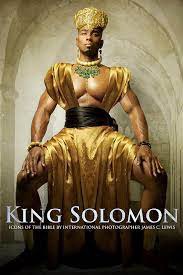
As we follow the Narrative Lectionary, we now come to Solomon’s prayer of dedication as the Temple is completed. The passage proposed by the lectionary begins with a short excerpt (1 Ki 5:1–5) reporting the intention that Solomon had, “to build a house for the name of the Lord my God”, referring to the instruction that God gave his father David, “your son, whom I will set on your throne in your place, shall build the house for my name” (1 Ki 5:5).

We then hear excerpts from Solomon’s long, long prayer of dedication which he offered at the opening of the temple ( 1 Kings 8:27–30, 41–43). If you have time (just a few extra minutes) it is worth reading the whole 61 verses of this chapter, which includes all of Solomon’s prayer. As you do, you might note the repeated address of Solomon to God, “O hear in heaven your dwelling place” (verses 30, 32, 36, 39, 43, 45, 49), his regular invoking of “your name” (verses 33, 35, 41–44, 48), and his petition to “forgive the sin of your people Israel” (verses 30, 34, 36, 39, 50). 

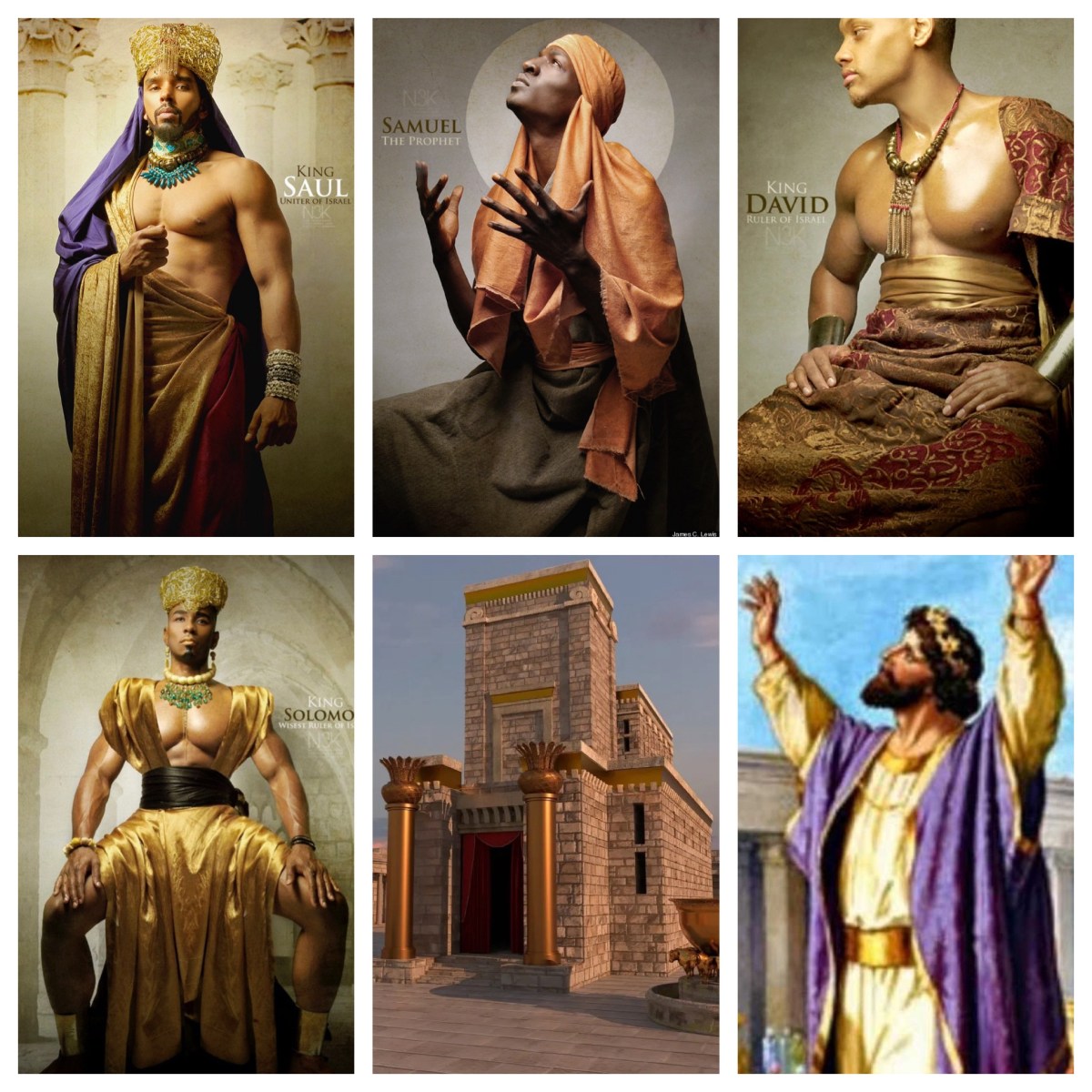
The narratives of the early decades of the United Kingdom began with Samuel in 1 Samuel; when we arrive at Solomon in 1 Kings, we have reached the zenith of this period in Israel’s history. The books of 1—2 Samuel have told about about Saul and David, the first two Kings of Israel; the prophets Samuel and Nathan; David’s battles with the Philistines, including the enemy giant Goliath, and his beloved companion Jonathan; and the unfortunate Absalom, one of David’s sons, as well as his wives Michal and Bathsheba. So this coming Sunday, we come to King Solomon, the third king of Israel.

These stories reveal the character of the leaders in Israel in telling ways. These stories reveal that these leaders were human; they acted in ways that were devious, unscrupulous, scheming, manipulative, emotional, hard-headed, self-serving, and deeply flawed. All of this, from these ancient texts—as if we didn’t already know this from our own observations of leaders in our own situation! 

When Solomon, son of David, was installed as king of Israel after the death of his father (1 Kings 2), God made a promise to Solomon: “I give you a wise and discerning mind; no one like you has been before you and no one like you shall arise after you” (1 Ki 3:12). And in the passage proposed for this coming Sunday, we see this wisdom displayed, as Solomon gathers people for the opening of the Temple (1 Ki 8).

Under Solomon, Israel was said to stretch from the Euphrates to Egypt (1 Ki 4:21), the largest amount of land of all kings (and the extent that is, controversially, claimed by extremist Zionists today). The lengthy prayer that Solomon prays is equally grand; he recalls the many acts of God and the response of God’s people, and repeatedly presses God to “hear in heaven” and forgive, judge, act, and maintain their cause. 

So this is a high, holy moment: the greatest king of Israel, Solomon, prays to dedicate the grand religious building, the Temple, on the top of the highest hill in Jerusalem, the capital city of the kingdom at the point of its greatest influence and power. At this moment of dedication “Solomon assembled the elders of Israel and all the heads of the tribes, the leaders of the ancestral houses of the Israelites, before King Solomon in Jerusalem, to bring up the ark of the covenant of the Lord out of the city of David, which is Zion” (1 Ki 8:1). The presence of then Ark evoked his father, David, and his taking of the city from the Jebusites. Solomon was making clear that he was seen to be standing in that fine tradition.

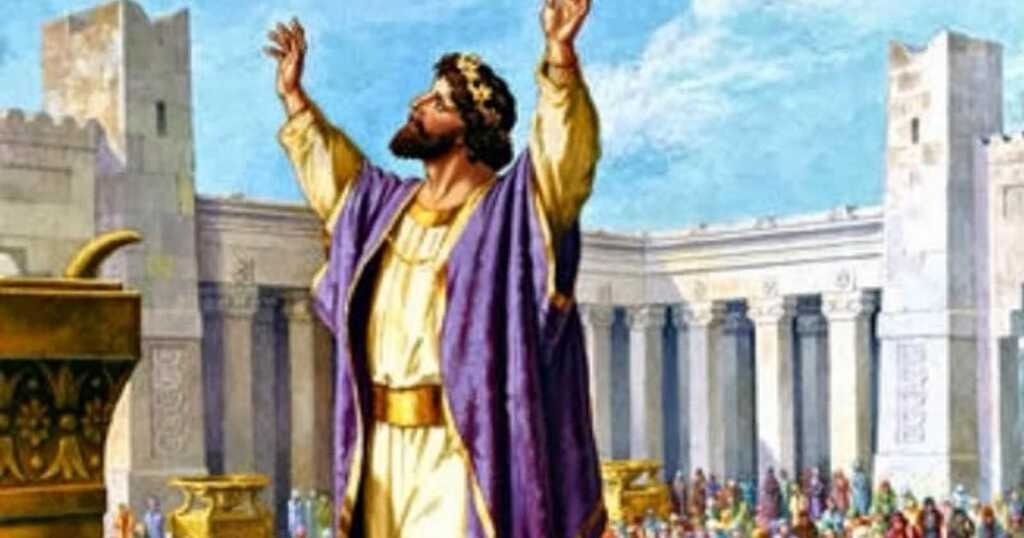
So “the priests brought the ark of the covenant of the Lord to its place, in the inner sanctuary of the house, in the most holy place, underneath the wings of the cherub. And when the priests came out of the holy place, a cloud filled the house of the Lord” (1 Ki 8:1–10). This is indeed serious stuff: the king, with all of his court, with all the elders, with the heads of each of the 12 tribes; and with the priests, with the ark of the covenant. All assembled at the place where Solomon, king in all his majesty and power, had arranged for a temple to be built. “Then Solomon stood before the altar of the Lord in the presence of all the assembly of Israel, and spread out his hands to heaven” (1 Ki 8:22), and prays a long prayer of blessing for the new edifice.

Now, Solomon, I am sure you are thinking, is remembered as the wise one. “The wisdom of Solomon”, we say. Jesus relates how “the Queen of the south [the Queen of Sheba] came from the ends of the earth to hear the wisdom of Solomon” (Matt 12:42). In 2 Chronicles 1, God says to Solomon, “because you have asked for wisdom and knowledge for yourself … wisdom and knowledge are granted to you” (2 Chr 1:11). 

And later, King Solomon is said to have “excelled all the kings of the earth in riches and in wisdom. And all the kings of the earth sought the presence of Solomon to hear his wisdom, which God had put into his mind. Every one of [those kings] brought silver and gold, so much, year by year” (2 Chron 9:22–24).

This wonderfully wise, insightful, discerning man, Solomon—bearing a name derived from the Hebrew for peace, “shalom”—became a powerhouse in the ancient world. But he did not always live as a man of peace. indeed, he used his 4,000 horses and chariots and 12,000 horsemen to good effect; we read that “he ruled over all the kings from the Euphrates to the land of the Philistines and to the border of Egypt” (2 Chron 9:26). 

Solomon was remembered as king over the greatest expanse of land claimed by Israel in all of history. Solomon was a warrior. And warrior-kings were powerful, tyrannical in their exercise of power, ruthless in the way that they disposed of rivals for the throne and enemies on the battlefield alike. Think Alexander the Great. Think Charlemagne. Think Genghis Khan. Think William the Conqueror. Solomon reigned for 40 years—a long, wealthy, successful time. 

Yet in the passage we hear this Sunday Solomon appears not as a powerful king. Rather, he is a humble person of faith. He stands before all the people, raises his arms, and prays to the God who is to be worshipped in the Temple that he had erected. He is a person of faith, in the presence of his God, expressing his faith, exuding his piety.

Now, the prayer of Solomon goes for thirty solid verses; there are eight different sections in this prayer. The lectionary has mercy on us this Sunday; we are offered just two of those sections, a mere seven of the thirty verses. We have heard the shortened version! In these two sections of this prayer, Solomon identifies two important features of the newly-erected Temple.  The first is that the fundamental reason for erecting this building is to provide a focal point, where people of faith can gather to pray to God (2 Ki 8:23–30).

Perhaps we may be used to hearing about the Temple in Jerusalem in fairly negative terms. Jesus cleared the Temple of the money changers and dove sellers who were exploring the people. He predicted the destruction of the Temple during the cataclysmic last days. For centuries, people from all over Israel were required to bring their sacrifices to the priests in the Temple, to offer up the firstborn of their animals and the firstfruits of their harvest. The Temple cult was seen as a harsh, primitive religious duty, imposing hardships on the people. The priests, the elites who ran the Temple, lived well off the benefits of all of these offerings. 

I could offer you a counter argument to each of these criticisms; but today I simply want to note that Solomon, in his prayer of dedication, makes it clear that the fundamental purpose of the Temple was to provide a house of prayer, a place where the people of God could gather, knowing that they were in the presence of God, knowing that the prayers that they offer would be heard by God and would lead to God’s offering of grace, forgiving them for their inadequacies and failures.

The Temple was to be a place of piety for the people. It was to foster the sense of connection with God. It was to deepen the life of faith of the people. It was to strengthen their covenant relationship with the Lord God.

All of which can be said for us, in our own times, about the building that we each come to each Sunday, to worship. The church is a place of piety and devotion for us, the people of God. It helps us to foster the sense of connection with God. It helps us to deepen our lives of faith. It encourages us to strengthen our covenant relationship with the Lord God through the new covenant offered in grace by Jesus. Ideally, that’s what the church is to be.

So we read in the first part of Solomon’s Temple prayer. For the people of ancient Israel, standing in the shadow of this wonderful new building, the prayer might encourage a strong sense of self identity, blessed to be part of the people of God. Of course, it could also develop narrow nationalism, a jingoistic praising of the greatness of Israel, extolling their identity as the chosen nation, the holy people, the elect of God. 

The Temple invited the people of God to meet the God of the people, to pray, to sing, to offer signs of gratitude and bring pleas and petitions—in short, to keep the covenant, to show that they are keeping the covenant, to be satisfied that they are keeping the covenant, as they worship. It had a strong, positive purpose for the people.

But that is not where the prayer ends. The second key element of Solomon’s prayer that the lectionary offers us today (2 Ki 8:41–43) is striking. It also relates to prayer. But it is not the prayer of the people of God, covenant partners with the Lord God. It is about the prayer of “a foreigner, who is not of your people Israel, [who] comes from a distant land because of your name”. This is a striking and dramatic element to include in this dedication prayer before all the people. 

Solomon prays to God, imploring God to “hear in heaven your dwelling place and do according to all for which the foreigner calls to you, in order that all the peoples of the earth may know your name and fear you, as do your people Israel, and that they may know that this house that I have built is called by your name.” 

Now that is an incredible prayer for the King of Israel to pray! It reflects an openness to the world beyond the nation, an engagement with the wider geopolitical and social relatives of the world at that time. Solomon was not an isolationist. He was not inwardly focussed on his nation. He had an outwards orientation. He did not want the Temple simply to foster a holy huddle, shut off from the world. He had other intentions. He wanted the Temple to be a holy place, a place of welcome and invitation, open to people from across the region, from far beyond the territory of Israel—a gathering place for all the peoples.

That was the vision that Solomon set forth for his people. That was not always the way that the Temple actually did function, we know. But that was the foundational vision—articulated by Solomon, remembered by the scribes, included in the narrative account of the kings, placed in a strategic position at the opening and dedication of the Temple. It is a vision which speaks, both to the people of Israel, but also to people of faith today, in the 21st century world.

So I have a whole cluster of questions in my mind, as a result of pondering this aspect of the prayer of Solomon. What happens in our temples? in our churches? How do we foster relationship with God in our prayers in this place? Who do we expect to find in our temples, our places of worship? Who would be most surprising to find in our places of worship? What prayers might come from those we least expect to come into our places of worship, when they do join with us in worship, to pray? How might we position ourselves, so that “foreigners”, people most unexpected to us, can feel welcomed to come into our church, be at home in our midst, make a connection with God? What do we need to do differently? What do we need to stop doing? What do we need to start doing?

We need to take seriously the claim that when we hear scripture read and expounded, we encounter God speaking to us. My own church has a Basis of Union in which it is stated that “The Word of God on whom salvation depends is to be heard and known from Scripture appropriated in the worshipping and witnessing life of the Church” (Uniting Church Basis of Union, para 5). That applies not only to Gospels and letters in the book of the new covenant, the New Testament, but also to narratives and psalms and prophetic works in Hebrew Scriptures, attesting to the earlier covenant. God speaks to us, as we hear and appropriate this scripture.

Our best response to this prayer of this discerning man of wisdom, warrior-king Solomon, offered as the Temple is dedicated, could well be for us to live our lives in response to that vision of what a place of worship and a community of worship might be—and shape a place open to all, a people welcoming of all who wish to come and make connection with God.

A king forever (Narrative Lectionary for Pentecost 22C; 2 Sam 7)

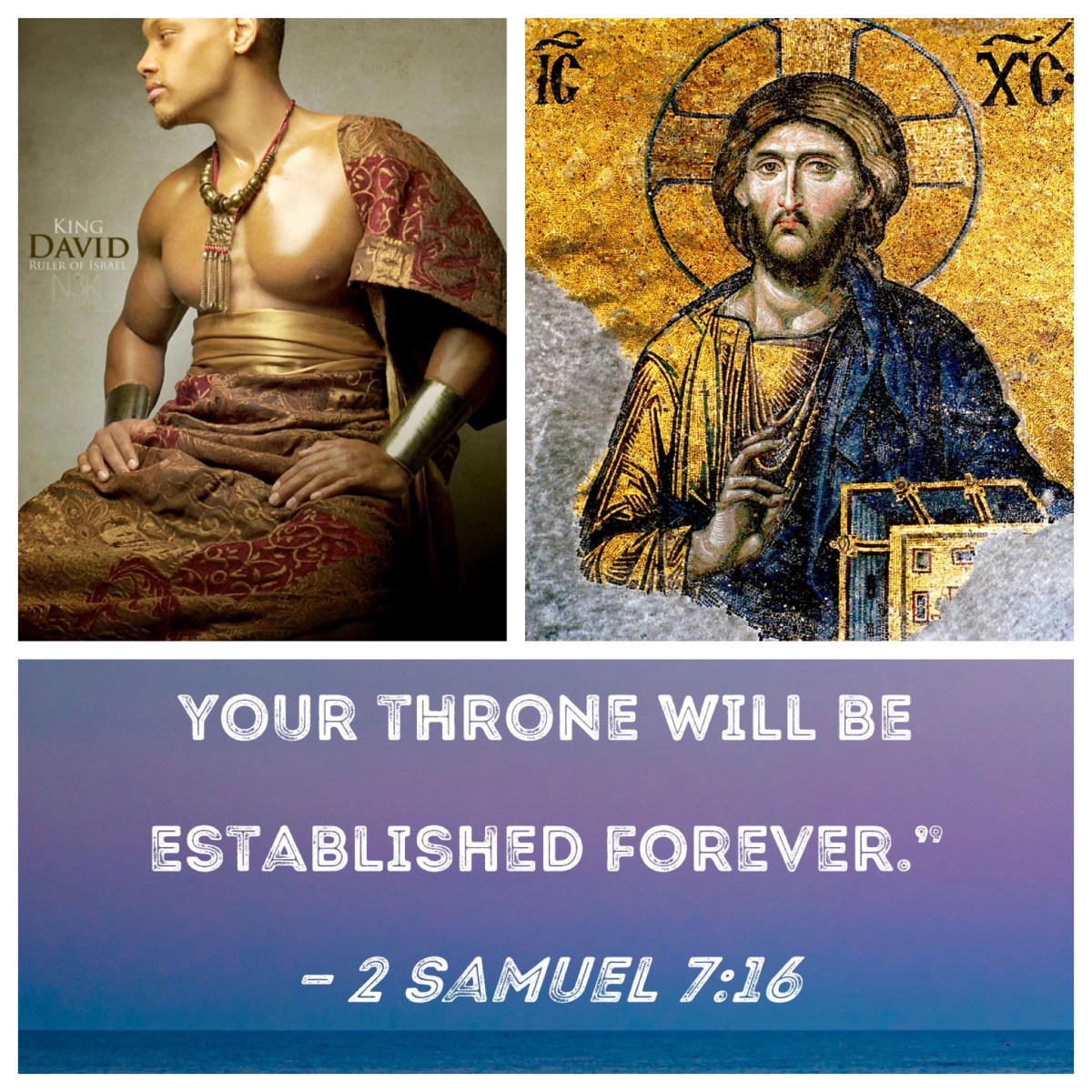
A king forever. That is the promise of these well-known words in 2 Samuel 7, which we will hear and reflect on in worship this coming Sunday. They are significant words for Jews; they are also significant words for Christians, for they have informed the way that followers of Jesus would talk about him. The words are given initially to David, only the second king of Israel, but the one who would provide descendants to sit on the throne for half a millennium. 

The words of the prophet Nathan, given to him (as he says) by the Lord God, are reported and remembered over those centuries as validation of the power of those kings, even though so many of them “did evil in the sight of the Lord” (as later verses in the historical narratives of Israel report). God stood by those leaders over many generations, consistently reminding the people of their responsibility to adhere to the covenant, affirming them at moments when their faith is evident, and rebuking them at times when that is not the case. 

These words have been remembered further by Christians, who see that in Jesus, God has sent “the King of the ages” (1 Tim 1:17), to whom “belong the glory and the power forever and ever” (1 Pet 4:11; also Rom 16:26; Eph 3:21). This is in accord with the “eternal purpose that [God] has carried out in Christ Jesus our Lord” (Eph 3:11), to lead believers to “eternal life” (Luke 10:25; John 17:3; Rom 5:21; 6:23).

Of course, in those words which Nathan speaks to David, we recognise the play on words that occurs. David understands God to be promising a “house” which is “a house of cedar” (v.7), but God actually intends to establish “offspring after you … his kingdom” (v.12).

The word “house” is used fifteen times in 2 Samuel 7, where it has three different meanings. It refers to David’s palace (vv.1–2), to the temple of the Lord God (vv.5–7, 13), and then to David’s dynasty (vv.11, 16, 18–19, 25–27, 29). The story promises a stable future for generations to come. So the motif of a kingdom that lasts “forever” is linked both with the affirmation that there will be a king “forever”, and also with the belief that the covenant with Israel will last “forever”. That there will be a king “forever” is integral to God’s promise to David that “your throne shall be established forever” (2 Sam 7:16), repeated by the Chronicler, “when your days are fulfilled to go to be with your ancestors, I will raise up your offspring after you, one of your own sons, and I will establish his kingdom … and I will establish his throne forever” (1 Chron 17:11–12).

The kingdom that will last “forever” is introduced by God’s words in 2 Samuel 7, where God promises David that “your house and your kingdom shall be made sure forever before me” (2 Sam 7:16). The Chronicler also repeats this promise, quoting God as saying of David, “I will confirm him in my house and in my kingdom forever, and his throne shall be established forever” (1 Chron 17:14).

Affirmation of a covenant that will last forever is found in a number of psalms. “The Lord our God … is mindful of his covenant forever, of the word that he commanded, for a thousand generations, the covenant that he made with Abraham, his sworn promise to Isaac, which he confirmed to Jacob as a statute, to Israel as an everlasting covenant” (Ps 105:7–10).

The covenant is noted in a number of psalms. “The friendship of the Lord is for those who fear him, and he makes his covenant known to them”, sings the psalmist (Ps 25:14). “I have made a covenant with my chosen one, I have sworn to my servant David”, God sings in another psalm; “I will establish your descendants forever, and build your throne for all generations” (Ps 89:3–4). 

King David as depicted by photographer James C. Lewis
in his series, Icons of the Bible, in which he depicts
key biblical characters as people of colour

In this same psalm, God affirms that, even if the children of David “forsake my law and do not walk according to my ordinances”, God will punish them, but “forever I will keep my steadfast love for him, and my covenant with him will stand firm … I will not violate my covenant, or alter the word that went forth from my lips” (Ps 89:28, 34). That covenant is to last “forever” (Ps 111:9).

The ultimate message, then, is that God will stand by the leaders of Israel, punishing them, forgiving them, loving them at each step along the way. A promise to sustain a king and a kingdom “forever”, by virtue of a covenant that lasts “forever”, undergirds this reality for the people of Israel. The modern nation state of Israel has adopted this confident assertion, although without any critical appreciation of the context and the purpose of this promise in antiquity. The dreadful results of this unthinking adoption of the mantra that “God is always with us” is playing out in the many deaths, injuries, and sadness that is taking place in Gaza, even today.

Of course, in the traditional understanding of Christianity, the “forever” component has been taken up in the application of 2 Samuel 7 to Jesus of Nazareth. Jesus is acclaimed as “Son of David” in the Synoptic Gospels (Mark 10:47–48; 12:35; Luke 3:31; 18:38–39; and especially in Matt 1:1, 20; 9:27; 12:23; 15:22; 20:30–31; 21:9, 15; 22:42). This claim is also noted at John 7:42; Rom 1:3; 2 Tim 2:8; Rev 3:7; 5:5; 22:16). The heritage of David lives on in these stories.

This particular son of David, as Christian understanding develops, was understood to be king “forever”; “he will reign over the house of Jacob forever, and of his kingdom there will be no end” (Luke 1:31–33). The covenant that he has renewed and enacted with the people of God is “forever” (Heb 9:15; 12:20); and the kingdom that he proclaimed and for which we hope will also be “forever” (2 Pet 1:11). 

In the late first century document that we know as letter to the Ephesians, for instance, the resurrected Jesus is seen as seated at the right hand of God “in the heavenly places, far above all rule and authority and power and dominion, and above every name that is named” (Eph 1:20–21). That place of authority for Jesus is envisaged as stretching into eternity, “not only in this age but also in the age to come” (1:20), and as encompassing all places, for God “has put all things under his feet and has made him the head over all things” (1:22). 

The global and eternal rule of Christ is here clearly articulated. The statement by the writer that God “seated [Jesus] at his right hand in the heavenly places, far above all rule and authority and power and dominion” (1:20–21) has inspired the development of the imagery of Christ as Pantocrator (Greek for “ruler of all”) in Eastern churches, both Orthodox and Catholic.

Jesus Christ Pantocrator
(detail from a mosaic in Hagia Sophia, Istanbul)

This line of thinking has culminated in the festival of the Reign of Christ, which has been celebrated in the Roman Catholic Church since it was introduced by Pope Pius XI in 1925. It has since been adopted by Lutheran, Anglican, and various Protestant churches around the world, and also, apparently, by the Western Rite parishes of the Russian Orthodox Church Outside Russia. 

1925 was a time when Fascist dictators were rising to power in Europe.  I have read that “the specific impetus for the Pope establishing this universal feast of the Church was the martyrdom of a Catholic priest, Blessed Miguel Pro, during the Mexican revolution”; see Today’s Catholic, 18 Nov 2014, at 

The article continues, “The institution of this feast was, therefore, almost an act of defiance from the Church against all those who at that time were seeking to absolutize their own political ideologies, insisting boldly that no earthly power, no particular political system or military dictatorship is ever absolute. Rather, only God is eternal and only the Kingdom of God is an absolute value, which never fails.”

The scriptures puncture the pomposity of powerful kings, and subversively present Jesus as the one who stands against all that those kings did. This festival provides a unique way of reflecting on the eternal kingship of Jesus. It offers a distinctive way for considering how the kingship bestowed upon David has been understood to last “forever”.

Accusing God: Job and the psalmist (Job 23; Psalm 22; Pentecost 21B)

“My God, my God, why have you forsaken me?”, the psalmist laments, in words familiar to us from their strategic occurrence in the foundational Christian story, as Jesus hangs, dying, upon the cross (Mark 15:34). “Why are you so far from helping me, from the words of my groaning?”, they continue, in their resentful tone (Psalm 22:1).

The lectionary offers us the first 15 verses of this psalm for this coming Sunday—no doubt to stand as a companion piece alongside the equally resentful and accusatory words of Job, “today also my complaint is bitter” (Job 23:2). Job, as we know, was “blameless and upright, one who feared God and turned away from evil” (Job 1:2). Even after adversity struck him, he maintained his faith in God—and his integrity, as his wife observes (2:9).

Last week, the psalmist offered by the lectionary to stand alongside the opening scenes in the story of Job was Psalm 26, in which the psalmist assures God that “I have walked in my integrity, and I have trusted in the Lord without wavering” (Ps 26:1, 11), listing the ways in which he has lived this out: “I walk in faithfulness to you; I do not sit with the worthless, nor do I consort with hypocrites; I hate the company of evildoers and will not sit with the wicked; I wash my hands in innocence and go around your altar, O Lord, singing aloud a song of thanksgiving and telling all your wondrous deeds” (Ps 26:3–7).

Accordingly, the psalmist beseeches God to vindicate them (26:1), to “redeem me and be gracious to me” (26:11), asking God “not sweep me away with sinners nor my life with the bloodthirsty” (26:9), and assuring God that “in the great congregation I will bless the Lord” (26:12).

Job maintains his integrity throughout his adversities, matching the psalmist as a person of integrity. Of course, Job is simply a character in the story that is being told; the opening words, “there once was a man” are the ancient equivalent of our “once upon a time”, and “the land of Uz” is an imaginary land. This story is a fable, and those who originally heard it would know this from the opening salvo.

But that doesn’t mean that it is all make-believe and of consequence; for the story is told to tap into some deep human experiences and emotions. The figure of Job is a representative figure; his story is told to represent those of us who, like Job, know the experience of deep pain and great personal loss, when all of his family, servants, and animals were lost, and when his body was covered with boils. Job lived in great pain, physical and psychological. In all this, we are told, “Job did not sin or charge God with wrongdoing” (Job 1:22).


Ilya Repin, Job and His Friends, 1869 

Job’s three friends try to turn his thoughts away from his personal suffering, by proposing that this was just how God worked, and Job simply had to accept the situation. One friend, Eliphaz, has been waxing lyrical about God in the previous chapter; “if you return to the Almighty, you will be restored”, he assures Job, piously advising this righteous and upright man, “if you remove unrighteousness from your tents … then you will delight yourself in the Almighty, and lift up your face to God” (Job 22:23–26). 

In response, Job laments, “his hand is heavy despite my groaning” (Job 23:2). Blaming God for the sufferings being experienced is a common human trait. How can a person believe in a God who inflicts such suffering—or, at least, allows it to happen unchecked? So, in a clever doubling back on a beloved psalm, Job declares his case against this deity: “I go forward, he is not there; or backward, I cannot perceive him; on the left he hides, and I cannot behold him; I turn to the right, but I cannot see him” (Job 23:8–9; cf. Ps 139:7–12).

These two Hebrew Scripture passages, from the neighbouring books of Job and Psalms, do not inspire hope and engender a light, optimistic feeling. Rather, they take us deep into the pit of human disenchantment with life. Although they both face the same issue of suffering, each one of them deals with this situation in a different way. 

The psalm is one of the psalms of individual lament, as the psalmist reflects the wretched condition of a person who is suffering unjustly, crying out, “why are you so far from helping me, from the words of my groaning? … I am a worm, and not a human … all who see me mock at me; they make mouths at me, they shake their heads …. I am poured out like water, and all my bones are out of joint; my heart is like wax; it is melted within my breast; my mouth is dried up like a potsherd, and my tongue sticks to my jaws; you lay me in the dust of death.” (Ps 22:1, 6, 14–15). 

In other songs included in the Book of Psalms, various psalmists lament on behalf of the people, in “psalms of communal lament”, such as Psalms 44, 60, 74, 79, 80, 85, 86, and 90; or they bemoan their own personal situation, in the psalms of individual lament, such as this psalm, as well as Psalms 3, 6, 13, 25, 31, 71, 77, 86, and 142. In the face of God’s seeming inaction and unresponsiveness to pleading prayers, the psalmists seem to say, what is there to do, other than to lament? 

Why? Why? Why? is Job’s constant question.

Later, Elihu will rebuke Job, turning his incessant questioning back on him: “God is greater than any mortal. Why do you contend against him, saying, ‘He will answer none of my words’? For God speaks in one way, and in two, though people do not perceive it.” (33:12–14). “Far be it from God that he should do wickedness, and from the Almighty that he should do wrong”, Elihu contends (34:10). “Surely God does not hear an empty cry, nor does the Almighty regard it”, he maintains (35:13). 

The claim that God is not just is an outrage to Elihu. He turns to the inscrutable nature of God: “Surely God is great, and we do not know him; the number of his years is unsearchable” (36:26). “The Almighty—we cannot find him”, Elihu maintains; “he is great in power and justice, and abundant righteousness he will not violate” (37:23).

Yet Job will not budge. Finally, after a blistering speech from the Lord himself, out of the whirlwind (38:1–41:34), in which the deity makes it clear that Job cannot pretend to have any comprehension of the ways that God operates, Job backs down. He responds, sarcastically: “I know that you can do all things, and that no purpose of yours can be thwarted” (42:2), and then delivers his coup-de-grace: “therefore I despise myself, and repent of dust and ashes” (42:6). Job throws in the towel; it is all hopeless; he can never win.

The psalmist does not, however, follow the same trajectory. As is so often the case in psalms of lament, what begins with accusations, wailings, and despair, eventually turns to promise, and then to hope, and faith. Before that—in the fifteen verses that the lectionary allocates for this Sunday—the psalmist rattles off a list of hurts and difficulties: they are scorned, mocked, and despised (vv.6–8), feeling trapped and monstered by the baying dogs (v.16) and the encircling “strong bulls of Bashan” (vv.12–13; perhaps the accusations of Amos 4:1 and Jer 22:20–23 are evoked here?). 

With a series of striking metaphors, the psalmist details their personal distress, manifested in physical ways: “I am poured out like water, and all my bones are out of joint; my heart is like wax; it is melted within my breast; my mouth is dried up like a potsherd, and my tongue sticks to my jaws; you lay me in the dust of death … my hands and feet have shriveled; I can count all my bones” (Ps 22:14–17). 

Yet this psalmist moves to express a firm assurance that God is “holy, enthroned on the praises of Israel”; in times past, “in you our ancestors trusted; they trusted, and you delivered them; to you they cried, and were saved; in you they trusted, and were not put to shame” (v.3–5). “Do not be far from me”, they plead, “for trouble is near and there is no one to help” (v.11). And then, in the part of the psalm not included in what the lectionary offers for this Sunday, they plead, “deliver my soul from the sword, my life from the power of the dog! save me from the mouth of the lion!” (vv.20–21).

Confident that God will indeed respond, the psalmist exhorts his companions to praise God, stand in awe of him, and pay their vows to God (vv.23–25). So the psalm ends with verses that are strongly evocative of the great prayers of praise and thanksgiving (vv.25–31; cf. PSs 95–100 and 145–150). The psalmist is embued with confidence and trust in the one who has dominion over all, ruling over the nations (v.28). Such confidence differentiates the psalmist from Job; it is almost as if the singer of this song has joined forces with the friends of Job who, in the face of his persistently mournful complaints, defends the Lord God and exalts God. 

Bildad had assured Job, “God will not reject a blameless person, nor take the hand of evildoers. He will yet fill your mouth with laughter, and your lips with shouts of joy” (8:20–21). Yet that is not Job’s experience. When Zophar considered the limits of God, he found there are none. “Can you find out the deep things of God?” he asks; “Can you find out the limit of the Almighty? It is higher than heaven—what can you do? Deeper than Sheol—what can you know? Its measure is longer than the earth, and broader than the sea” (Job 11:7–9). Job will not accept this affirmation of faith, either. Eliphaz had assured Job, “Is not God high in the heavens? See the highest stars, how lofty they are!” (Job 22:12). Once again, Job will demur; that is not his experience.

So Job will not be persuaded. “My foot has held fast to his steps”, he asserts; “I have kept his way and have not turned aside; I have not departed from the commandment of his lips; I have treasured in my bosom the words of his mouth” (Job 23:11–12). Yet this faithful, upright, righteous man is frustrated by the supreme and unfettered sovereignty of God: “he stands alone and who can dissuade him? what he desires, that he does” (Job 23:13). All he has left is to complain and accuse, to bewail and lament. He will not accept the blandishments of his friends; he will not follow the path taken by the psalmist.

If we sit simply with the accusatory speech of Job and the lamentations of the psalmist—and do not try to “rescue” the situation with a closing word of hope—then we are sitting with Job, and with countless human beings, in despair, without hope. That is the existential situation. That is where these passages call us to be: in solidarity with the suffering, with empathy for the hurting, offering compassion to the wounded, not offering an excuse or seeking an easy way out. That is of the essence of ministry, of pastoral ministry. Can we sit with Job and the psalmist, and do that, I wonder? 

In her sermon on Job 23 (preached in the midst of the pandemic), my wife Elizabeth Raine said:

“We need to sit as long as we can with those who have suffered and are suffering from injustice and immense suffering. And perhaps, as we ponder our own tragedies, and the fate of the uncounted and unnamed men, women and children who have died in war or ethnic violence, or pray for the current victims of poverty, famine and disease in our world, we might find our thoughts connecting with experiences and the suffering of Job.”

See

For more on Job, that I wrote three years ago while reflecting on this book in the midst of the COVID. pandemic, see 

As long as he lives, he is given to the Lord (1 Sam 1–2; Narrative Lectionary for Pentecost 21C)

We continue our readings in the books of scripture which tell of the origins and early periods of Israel. After hearing from Genesis and Exodus, we turn this week and in following weeks to stories in the books of Samuel and the early chapters of Kings. This part of the extended narrative we have in scripture recounts the development of the monarchy in Israel, with stories of Saul, David, and Solomon, the first three men charged with the responsibility of leading Israel and ensuring that there was justice in the land.

Alongside that is the story of Samuel, the first of a long line of prophets, gifted and called by God to declare God’s will to the people of Israel.  The stories in the two volumes of Samuel and the following two volumes of Kings also engage us with the lives of prophets, Samuel and Nathan —men who were called to speak the word of God. “Give the king your justice, O God”, the psalmist sings (Ps 72:1), so that they might rule with justice and righteousness (Ps 99:4; Prov 29:4; Isa 32:1; Jer 23:5). That is what these kings, and their successors, were charged with ensuring.

We are told that as the young Samuel grew up, “the Lord was with him and let none of his words fall to the ground; and all Israel from Dan to Beer-sheba knew that Samuel was a trustworthy prophet of the Lord” (1 Sam 3:20–21). Years later, Nathan is commissioned by “the word of the Lord” to “go and tell my servant David, ‘thus says the Lord’” (2 Sam 7:4–5). That is the role of the prophet—to listen to what God says to them, and then to speak forth the word of the Lord to the people of their society.

Samuel, Nathan, and other prophets were particularly called to speak truth to the king and to recall them to the centrality of their role, to ensure that God’s justice was a reality in Israelite society (Isa 42:1–4; 61:1–2;  Mic 3:8). We see this when Nathan confronts David (2 Sam 12), when Elijah confronts Ahab and the priests of Baal (1:Ki 18), when Isaiah advises Hezekiah (2 Ki 20), and when Josiah consults Huldah (2 Ki 22; 2 Chron 34).

This Sunday the Narrative Lectionary invites us to hear the story which tells of the arrival of Samuel into the world (1 Samuel 1:9–11, 19–20; 2:1-10). We meet Hannah right at the start of this passage, as the childless wife of Elkanah, whose other wife, Peninnah, had been blessed with children, both sons and daughters (1 Sam 1:1–2).

In a culture where children were seen as blessing from the Lord, this left Hannah in a difficult situation. Although Elkanah gave Hannah “a double portion, because he loved her, though the Lord had closed her womb” (1:5), nevertheless Peninnah “used to provoke her severely, to irritate her, because the Lord had closed her womb” (1:6)—to the extent that “Hannah wept and would not eat” (1:7).

We are presented with these individuals in a narrative which appears to be an historical account of a real ancient family. However, the nature of the text is somewhat different. Jewish scholar Lillian Klein argues that Peninnah “is probably a literary convention, a foil for the independence and goodness of Hannah, and should be regarded as such”. She proposes that “Peninnah represents a woman who accepts social paradigms without examining them, thus acting out the type of jealousy between co-wives known from the matriarchal texts of Genesis.” See her article in the Jewish Women’s Archive at 

https://jwa.org/encyclopedia/article/peninnah-bible

We need to remember that these stories are not to be regarded as  “history” as we know it today. Rather, they are ancient tales told and retold, passed on by word of mouth and then written down, because of their enduring significance for the people of ancient Israel. Scholars call such stories “myths”, meaning that they convey something of fundamental importance. (We might best define myth as “a traditional story, usually associated with the time of origins, of paradigmatic significance for the society in which it is told”.)

See more on the nature of these stories at 

and on the sequence of stories told in Genesis and Exodus, at 

Identifying the stories in the narrative books of the Hebrew Scriptures, including the story of Hannah, as “myths” does not mean they are “not true”—rather, it means that we need to read them, not as historically accurate accounts, but as stories which convey fundamentally important ideas. These stories were valued by people of ancient times. They may well offer us, in our own times, insights and guidance of value.

So we read and ponder these stories from old once again, in our time, because we believe that there is wisdom and guidance in the dynamics we see at work in this ancient society. We pay attention to them because we believe that the same Spirit who anointed the kings, and who called and equipped the prophets, is the very Spirit who today meets us, calls us, and equips us.

“In due time Hannah conceived and bore a son”, the narrator informs us (1 Sam 1:20a). The name of the child, in typical biblical narrative style, is Samuel, which she explains as given because “I have asked him of the Lord” (1:20b). After he is born, Hannah sings a wonderful song, praising God for how God has been at work. In this song, she gives thanks for the birth of her son, and praises God especially for God’s care for “the poor”, as she sings how the Lord “raises up the poor from the dust; he lifts the needy from the ash heap” (1 Sam 2:8; also Ps 113:7). 

Hannah is so grateful for all that God has done, that she offers Samuel to the Lord; “as long as he lives, he is given to the Lord”, she declares (1 Sam 1:28). The song that she then sings is a striking psalm of praise to God (1 Sam 2:1–10); Christian readers will particularly notice the similarities that this psalm has with Mary’s song of praise before Jesus was born (Luke 1:46–55). For a comparison of the Song of Hannah (1 Sam 2) with the later Song of Mary (Luke 1), see 

The child born to Hannah, Samuel, will grow and develop to become a most important figure in the story of Israel. When Samuel was an adult, he served as the “court prophet” alongside the first two kings of Israel—Saul, whom he anointed (1 Sam 10:1) and then David, whom he also anointed (1 Sam 16:13). He spoke wise words concerning the appointment of a king in Israel, warning the people about what such a powerful leader would do:

“He will take your sons and appoint them to his chariots and to be his horsemen, and to run before his chariots; and he will appoint for himself commanders of thousands and commanders of fifties, and some to plow his ground and to reap his harvest, and to make his implements of war and the equipment of his chariots. He will take your daughters to be perfumers and cooks and bakers. He will take the best of your fields and vineyards and olive orchards and give them to his courtiers. He will take one-tenth of your grain and of your vineyards and give it to his officers and his courtiers. He will take your male and female slaves, and the best of your cattle and donkeys, and put them to his work. He will take one-tenth of your flocks, and you shall be his slaves.” (1 Sam 8:11–17).

And that, of course, is what successive kings did—especially the third king, Solomon, whose empire was extensive and whose army and court required massive resources to support them. Samuel was a wise prophet, indeed!

Both psalmists and prophets declared that the king was charged with the responsibility of leading Israel and ensuring that there was justice in the land. “Give the king your justice, O God”, the psalmist sings (Ps 72:1), so that they might rule with justice and righteousness (Ps 99:4; Prov 29:4). Isaiah looks to the time when “a king will reign in righteousness, and princes will rule with justice” (Isa 32:1; see also Jer 23:5). But the particular calling of the prophet, chosen and anointed by God, was to speak the word of God to the people—and, when required, to the king. This was a weighty responsibility!

We are told that as the young Samuel grew up, “the Lord was with him and let none of his words fall to the ground; and all Israel from Dan to Beer-sheba knew that Samuel was a trustworthy prophet of the Lord” (1 Sam 3:20–21). As prophet, Samuel was to listen to what God says to him, and then to speak forth the word of the Lord to the people of his society—and in particular, to speak truth to the king and to recall them to the centrality of their role, to ensure that God’s justice was a reality in Israelite society (Isa 42:1–4; 61:1–2;  Mic 3:8). 

So the story we hear this Sunday stands as a foundational tale for all that transpired in Israel over the coming centuries: in periods of growth and abundance, in periods of conflict and turmoil, through exile and return, through rebuilding and restoring Jerusalem and the Temple. 

Samuel played a pivotal role at the beginning of this sequence; his story, and his words, have been remembered, repeated, recorded, and read over the centuries, because they still speak to us of the importance of justice and integrity in society.

The pattern of Samuel’s life was set from his early years: he would need to summon inner strength, demonstrate commitment to the cause, use clarity of speech, and model integrity of life. He presumably learnt much of this from his own mother, whose dedication in her actions, along with the words of her song, demonstrate these qualities in abundance. The stories from the early years of Samuel’s life (1 Sam 1–3) are remembered in order to instruct those who hear them in later generations, to listen and to obey, to be brave and focussed. And so we, in our time, are to hear the story, reflect on it, and respond appropriately.

For more on the child Samuel, and his call, see