
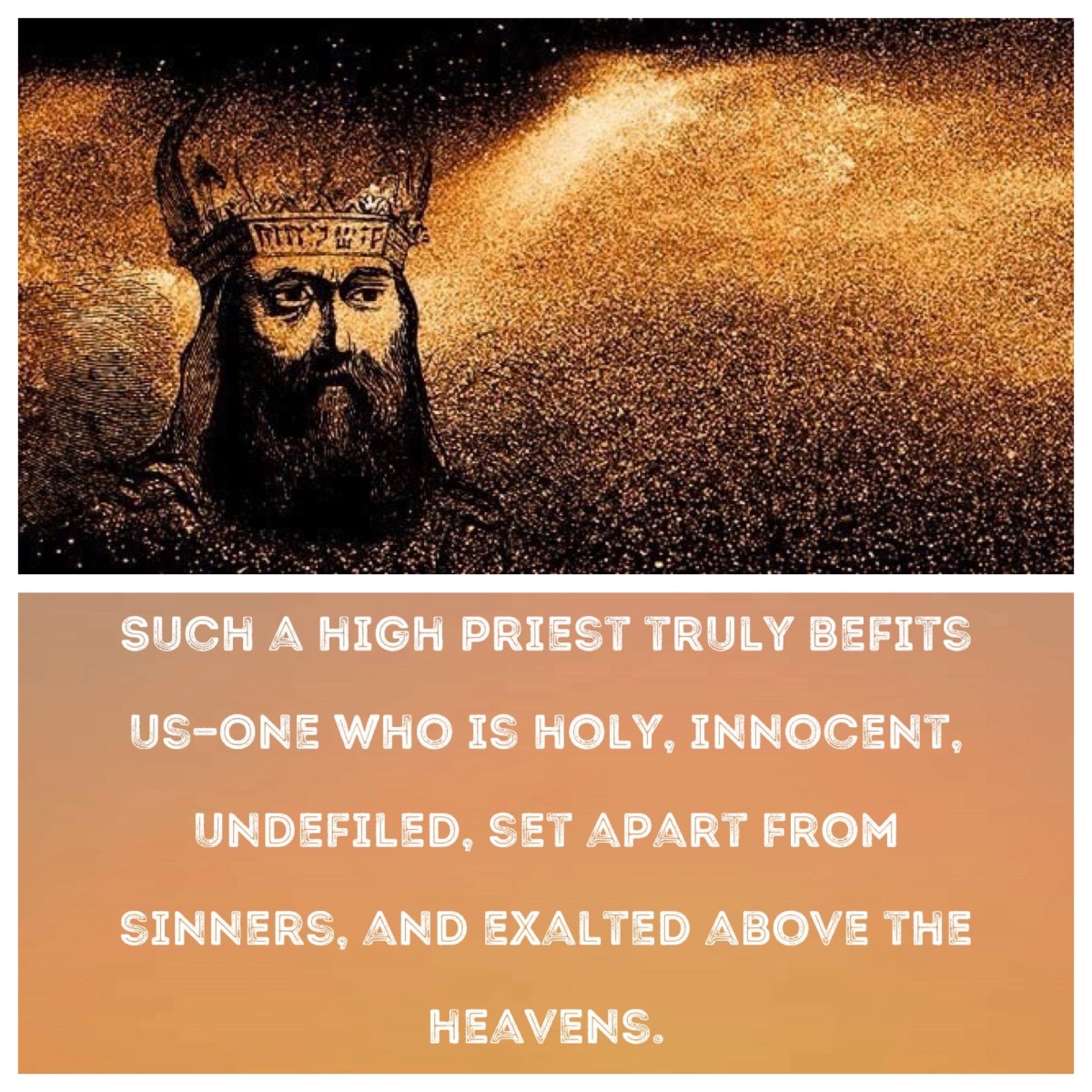
“Holy, blameless, undefiled, separated from sinners, and exalted above the heavens … [one] who has been made perfect forever.” That’s how the unknown author of the book of Hebrews describes Jesus (Heb 7:26, 28). That’s an incredibly high state of being that is described—an almost unattainable perfection of life. How, then, might we relate to such a person?
To understand why Jesus is described as holy and made perfect, we first turn to the heritage of the author of this “letter to the Hebrews”. In Israelite religion, the idea of being perfect was integral to the appreciation of God. We find this expressed at various places in Hebrew Scripture. “This God—his way is perfect”, the psalmist sings (Ps 18:30; echoed also at Deut 32:4; 2 Sam 22:31; Job 37:16), and in another psalm, “the law of the Lord is perfect, reviving the soul” (Ps 19:7). It is later echoed by Paul, who claims that “the will of God” is “good and acceptable and perfect” (Rom 12:2).
So, too, is the state of being holy a central element of God’s being; “Holy One” is one of the ways that God is addressed God in the Writings (Ps 71:22; 78:41; 89:18; Prov 9:10; Job 6:10; Sir 4:14; 23:9; 53:10; 47:8; 48:20) and by the Prophets (Jer 50:29; Ezek 8:13; Hos 11:9, 12; Hab 1:12; 3:3). This is especially the case in Isaiah, where “the Holy One of Israel” is addressed 29 times, by First Isaiah (Isa 1:4 to 37:23), Second Isaiah (Isa 40:25 to 55:5), and Third Isaiah (Isa 60:9, 14).
This, also, is echoed in New Testament texts. The mighty saviour, promised to Israel, would come to lead the people to serve God “in holiness and righteousness before him all our days” (Luke 1:69, 75). Jesus is addressed by demons as “the Holy One of God” (Mark 1:45; Luke 4:34) and by Simon Peter (John 6:69). The followers of Jesus are then instructed to live as God’s holy people (1 Cor 3:17; 6:19; Eph 5:25–27; Col 1:22; 3:12; Heb 3:1; 1 Pet 1:13–16; 2:5, 9); Paul prays for the Thessalonians, that God may “strengthen your hearts in holiness that you may be blameless before our God and Father” (1 Thess 3:13).
Of course, holiness (qodesh) was a central element of piety in ancient Israel, exemplified by the Holiness Code of Leviticus (Lev 11:44–45; 19:2; 20:7–8). The code was to be overseen by the priests, who were to “make a distinction between the unclean and the clean” (Lev 11:47; 20:25; cf. Ezek 22:26; 44:23). Accordingly, they were consecrated, set apart as holy (Exod 40:13; Lev 16:32; 21:10), so that the people as a whole might be deemed to be “holy people” (Deut 7:6; 14:2, 21; 28:9). Holiness was a fundamental requirement of the priests.
Accordingly, every priest needed to be “perfect” (tamim), with no sign of blemish—“not one who is blind or lame, or one who has a mutilated face or a limb too long, or one who has a broken foot or a broken hand, or a hunchback, or a dwarf, or a man with a blemish in his eyes or an itching disease or scabs or crushed testicles”, according to Lev 21:16–24. These perfect priests were charged with offering to God the tamid, the daily sacrifice, of “two male lambs a year old without blemish, daily, as a regular offering”, each and every day (Num 28:3).
The temple itself that Solomon built was required to be perfect (1 Ki 6:22), and for the sacrifice of wellbeing to be offered there “to be acceptable it must be perfect, there shall be no blemish in it” (Lev 22:21). The prescriptions of Leviticus maintain the need for all faithful people to bring an offering or sacrifice that is “acceptable” (Lev 1:4; 7:18; 19:5–8; 22:17–21, 26–30); for a sacrifice of wellbeing “to be acceptable it must be perfect; there shall be no blemish in it” (Lev 22:21). That was the role of the priests: to examine carefully the animals being brought for sacrifice, to ensure that they were “perfect” (tamim). So a state of perfection was required of both priests and their victims.
Of course, the author of Hebrews sets the perfection of Jesus into a distinctive framework, for he asserts early in this book that God, in “bringing many children to glory”, has made Jesus, “the pioneer of their salvation, perfect through sufferings” (Heb 2:10). It is through “the sprinkled blood” of Jesus, “the mediator of a new covenant”, that “the spirits of the righteous [are] made perfect” (Heb 12:23–24).
The perfect nature of Jesus comes through his submission and obedience, evidenced in the “prayers and supplications, with loud cries and tears”, which he offered “to the one who was able to save him from death” (Heb 5:7–8). The end result is that he was “made perfect [and] became the source of eternal salvation for all who obey him, having been designated by God a high priest according to the order of Melchizedek” (Heb 5:9–10).
On the priesthood of Mechizedek and that of Jesus, see
In applying these two terms, holy and perfect, to Jesus, the author of Hebrews is locating him within the ambit of the priests. The addition of two further terms, blameless and undefiled, intensifies this sense, but relates to another aspect of the comparison. The command not to defile oneself occurs at two key places in the levitical prescriptions. It stands at the conclusion of the long list of animals, birds, and fish which are categorised as either unclean or clean, as “the living creature that may be eaten and the living creature that may not be eaten” (Lev 11:43–44). It is also a repeated injunction in the section concerning sexual relations (Lev 18:20–30).
The same command appears in the instruction, “you shall not defile the land in which you live, in which I also dwell” (Num 35:34; reiterated at Deut 21:23). The prophet Ezekiel understands that the person “who is righteous and does what is lawful and right” is the one who “does not defile his neighbour’s wife” (Ezek 18:5–6, 14–15) and that the people of Israel are to “not defile yourselves with the idols of Egypt” (Ezek 20:7, 18, 31).
The Hebrew term tamim, which is often translated as perfect, but also as blameless, is related to the word used for the daily sacrifice, tamid. It contains a strong sense of being whole, perfect, undefiled, without defect or blemish. It is applied numerous times throughout Leviticus to the various animals which are to be offered in sacrifice to God; they are all to be “without blemish” (Lev 1:3, 10; 3:1, 6, 9; 4:3, 23, 28, 32; and many more times). So in Hebrews, the application to Jesus of the words blameless and undefiled relates him most specifically to the sacrificial victims rather than to the priests.
We see this most intensely in the apologetic argumentation of Hebrews 9—10, where the death of Jesus is portrayed as “the sacrifice of himself” (9:26), “a single sacrifice for sins” (10:16) in “the offering of [his] body” (10:10), “a single offering [by which] he has perfected for all time those who are sanctified” (10:14), which “he offered once to bear the sins of many” (10:28). These statements all relate Jesus to the “perfect offering” of his life, “the power of an indestructible life” (7:16).
For this reason—that he is the perfect sacrifice—he is understood to have been the final definitive offering; “he has appeared once for all at the end of the age to remove sin by the sacrifice of himself” (Heb 9:27). The author of Hebrews particularly emphasises this “once for all” element; “this he did once for all when he offered himself” (7:27); “he entered once for all into the Holy Place, not with the blood of goats and calves, but with his own blood, thus obtaining eternal redemption” (9:12).
As a result, the author claims, “we have been sanctified through the offering of the body of Jesus Christ once for all” (10:10). This then undergirds the author’s criticism of the repeated sacrifices offered under “the law”, which “can never … make perfect those who approach” (10:1–4). This leads, then, to a supercessionist view of Judaism—a route that I refuse to take.
I offer more consideration of the supercessionism which results from this line of argument in posts on the Hebrews readings in the lectionary in coming weeks.
Two other phrases that are applied to Jesus by the author of Hebrews are striking. As well as being holy and perfect, blameless and undefiled, Jesus is portrayed as being “separated from sinners” and “exalted above the heavens” (Heb 7:26). Both these phrases contribute to a high view of Jesus. We can understand something of their significance by delving, once again, into Hebrew Scripture.
It is a refrain of many of the more conservative theological preachers that people are separated from God by their sin. God does not wish for us to sin, and stands look from us when we do sin, so the argument goes. It is the very nature of God to be “separated from sinners”. This understanding is indeed reflected in the past by the way that the ancient Israelite cult was set up.
The tabernacle, as the place where God resided, was to be kept as a sacred, holy, set-apart place, which the priests were to oversee. Leviticus includes the clear instruction, “you shall keep the people of Israel separate from their uncleanness, so that they do not die in their uncleanness by defiling my tabernacle that is in their midst” (Lev 15:11). The “uncleanness” of the people—their sinfulness because of the ways they disobeyed the Torah—was to be dealt with through the system of sacrifices and offerings made to the Lord God, to deal with their sin.
The clear affirmation of the post-exilic prophet whose words are collected in the third section of Isaiah is that “your iniquities have been barriers between you and your God, and your sins have hidden his face from you so that he does not hear” (Isa 59:2). The way forward is to seek a path of reconciliation and forgiveness with God, to overcome these barriers.
Presenting Jesus as “separated from sinners” places him in the position of God; this equates him with the holy God, the blameless one, pure and undefiled, who stands apart from sinners even whilst offering a way for those sinners to seek forgiveness of sin and reconciliation with God.
This high view is intensified in the further description of Jesus as “exalted above the heavens” (Heb 7:26). Long before Jesus, David had prayed to God, rejoicing in “the greatness, the power, the glory, the victory, and the majesty” that belong to God (1 Chron 29:11). This prayer continues, “for all that is in the heavens and on the earth is yours; yours is the kingdom, O Lord, and you are exalted as head above all”. The psalmists reflect this conception of God as “exalted above the heavens” (Ps 57:5, 11; 108:5). This is reflected directly in Heb 7:26.
So Jesus stands with God, in the holy place, exalted in the heavens, separated from sinners; and yet, as priest, he oversees the process that brings sinful people back into relationship with God; and as the sacrificial offering itself, he sheds his blood in order to enable this forgiveness and reconciliation to take place. The imagery is rich and complex, even if the logic of Jesus as God, priest, and victim all-in-one, is somewhat hard to grasp.

 An Informed Faith