

The lectionary does some curious things. Sometimes it offers us passages which have been chopped up into small bits, excerpts from a longer narrative. Sometimes it leaves out just a verse or two, usually because it seems to be expressing something “difficult” or “distasteful” to modern sensibilities. Many times, it provides us week-after-week of stories about men, and leaves out so many of the stories in the Bible about women.
We have experienced all of this over the last five months, since the Festival of Pentecost, as we have read and heard stories and poems and songs: twelve weeks of narrative telling of the days of the prophets Samuel and Nathan, with the kings Saul, David, and Solomon; and then eleven weeks largely of poetry from the Wisdom Literature.
Now, for the last-but-one Sunday in the long season stretching out after Pentecost, the lectionary does another strange thing. It takes us right back to the beginning of the narrative sequence, to the story which tells of the arrival of Samuel into the world. We meet Hannah right at the start of this passage, as the childless wife of Elkanah, whose other wife, Peninnah, had been blessed with children, both sons and daughters.
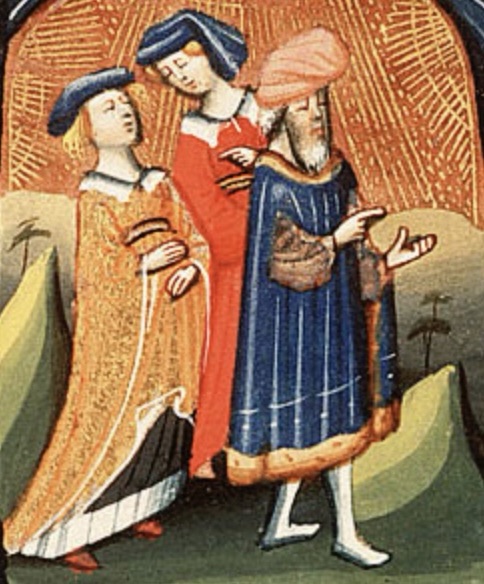
from a 15th century illuminated manuscript
In a culture where children were seen as blessing from the Lord, this left Hannah in a difficult situation. Although Elkanah gave Hannah “a double portion, because he loved her, though the Lord had closed her womb” (1 Sam 1:5), nevertheless Peninnah “used to provoke her severely, to irritate her, because the Lord had closed her womb” (1:6)—to the extent that “Hannah wept and would not eat” (1:7).
We are presented with these individuals in a narrative which appears to be an historical account of a real ancient family. However, the nature of the text is somewhat different. Jewish scholar Lillian Klein argues that Peninnah “is probably a literary convention, a foil for the independence and goodness of Hannah, and should be regarded as such”. She proposes that “Peninnah represents a woman who accepts social paradigms without examining them, thus acting out the type of jealousy between co-wives known from the matriarchal texts of Genesis.” See her article in the Jewish Women’s Archive at
https://jwa.org/encyclopedia/article/peninnah-bible
When we began reading the stories from the book of Samuel, back in June, I proposed that these stories were not to be regarded as “history” as we know it today. Rather, they are ancient tales told and retold, passed on by word of mouth and then written down, because of their enduring significance for the people of ancient Israel. Scholars call such stories “myths”, meaning that they convey something of fundamental importance. (We might best define myth as “a traditional story, usually associated with the time of origins, of paradigmatic significance for the society in which it is told”.)
See more on the nature of these stories at
and on the sequence of stories told in Genesis and Exodus, at
Identifying the stories in the narrative books of the Hebrew Scriptures, including the story of Hannah, as “myths” does not mean they are “not true”—rather, it means that we need to read them, not as historically accurate accounts, but as stories which convey fundamentally important ideas. These stories were valued by people of ancient times. They may well offer us, in our own times, insights and guidance of value.
So we read and ponder these stories from old once again, in our time, because we believe that there is wisdom and guidance in the dynamics we see at work in this ancient society. We pay attention to them because we believe that the same Spirit who anointed the kings, and who called and equipped the prophets, is the very Spirit who today meets us, calls us, and equips us.
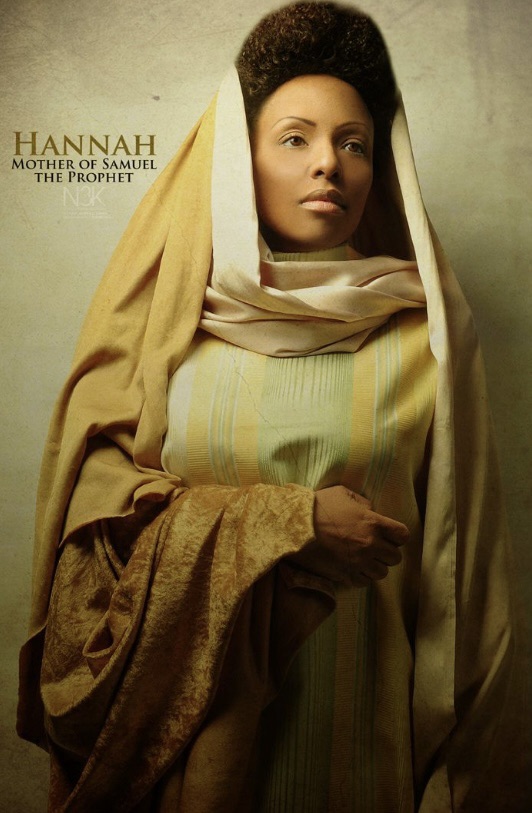
James C. Lewis, in which he depicts biblical characters
as they were—as “persons of colour”.
“In due time Hannah conceived and bore a son”, the narrator informs us (1 Sam 1:20a). The name of the child, in typical biblical narrative style, is Samuel, which she explains as given because “I have asked him of the Lord” (1:20b). After he is born, Hannah sings a wonderful song, praising God for how God has been at work. In this song, she gives thanks for the birth of her son, and praises God especially for God’s care for “the poor”, as she sings how the Lord “raises up the poor from the dust; he lifts the needy from the ash heap” (1 Sam 2:8; also Ps 113:7). Hannah is so grateful for all that God has done, that she offers Samuel to the Lord; “as long as he loves, he is given to the Lord”, she declares (1 Sam 1:28).
My wife has preached a fine sermon on Hannah and her place in this story, for Project Reconnect. See
For a comparison of the Song of Hannah (1 Sam 2) with the later Song of Mary (Luke 1), see
The child born to Hannah, Samuel, will grow and develop to become a most important figure in the story of Israel. When Samuel was an adult, he served as the “court prophet” alongside the first two kings of Israel—Saul, whom he anointed (1 Sam 10:1) and then David, whom he also anointed (1 Sam 16:13). He spoke wise words concerning the appointment of a king in Israel, warning the people about what such a powerful leader would do:
“He will take your sons and appoint them to his chariots and to be his horsemen, and to run before his chariots; and he will appoint for himself commanders of thousands and commanders of fifties, and some to plow his ground and to reap his harvest, and to make his implements of war and the equipment of his chariots. He will take your daughters to be perfumers and cooks and bakers. He will take the best of your fields and vineyards and olive orchards and give them to his courtiers. He will take one-tenth of your grain and of your vineyards and give it to his officers and his courtiers. He will take your male and female slaves, and the best of your cattle and donkeys, and put them to his work. He will take one-tenth of your flocks, and you shall be his slaves.” (1 Sam 8:11–17).
And that, of course, is what successive kings did—especially the third king, Solomon, whose empire was extensive and whose army and court required massive resources to support them. Samuel was a wise prophet, indeed!
Both psalmists and prophets declared that the king was charged with the responsibility of leading Israel and ensuring that there was justice in the land. “Give the king your justice, O God”, the psalmist sings (Ps 72:1), so that they might rule with justice and righteousness (Ps 99:4; Prov 29:4). Isaiah looks to the time when “a king will reign in righteousness, and princes will rule with justice” (Isa 32:1; see also Jer 23:5). But the particular calling of the prophet, chosen and anointed by God, was to speak the word of God to the people—and, when required, to the king. This was a weighty responsibility!
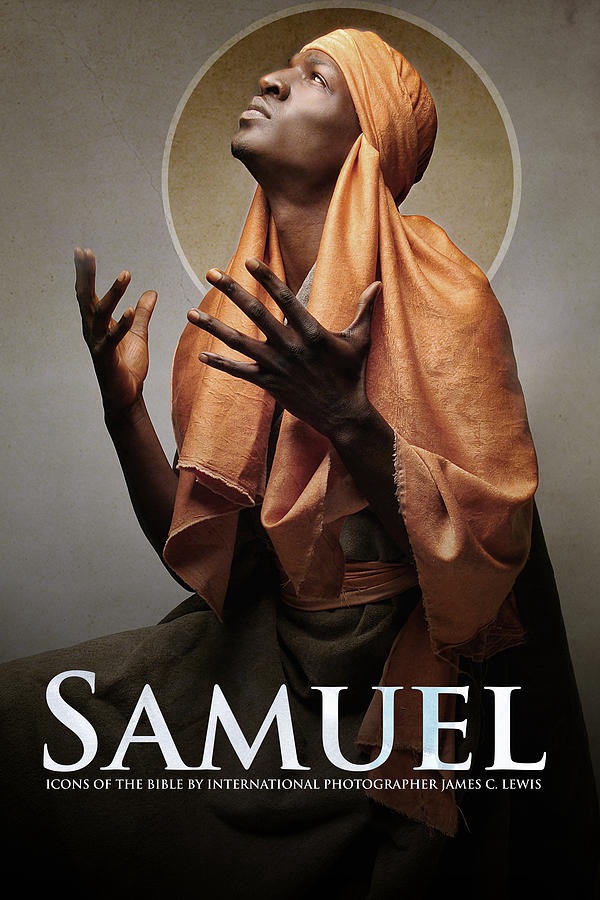
James C. Lewis, in which he depicts biblical characters
as they were—as “persons of colour”.
We are told that as the young Samuel grew up, “the Lord was with him and let none of his words fall to the ground; and all Israel from Dan to Beer-sheba knew that Samuel was a trustworthy prophet of the Lord” (1 Sam 3:20–21). As prophet, Samuel was to listen to what God says to him, and then to speak forth the word of the Lord to the people of his society—and in particular, to speak truth to the king and to recall them to the centrality of their role, to ensure that God’s justice was a reality in Israelite society (Isa 42:1–4; 61:1–2; Mic 3:8).
So the story we hear this Sunday stands as a foundational tale for all that transpired in Israel over the coming centuries: in periods of growth and abundance, in periods of conflict and turmoil, through exile and return, through rebuilding and restoring Jerusalem and the Temple.
Samuel played a pivotal role at the beginning of this sequence; his story, and his words, have been remembered, repeated, recorded, and read over the centuries, because they still speak to us of the importance of justice and integrity in society.
The pattern of Samuel’s life was set from his early years: he would need to summon inner strength, demonstrate commitment to the cause, use clarity of speech, and model integrity of life. He presumably learnt much of this from his own mother, whose dedication in her actions, along with the words of her song, demonstrate these qualities in abundance. The stories from the early years of Samuel’s life (1 Sam 1–3) are remembered in order to instruct those who hear them in later generations, to listen and to obey, to be brave and focussed. And so we, in our time, are to hear the story, reflect on it, and respond appropriately.
For more on the child Samuel, and his call, see

 An Informed Faith