

The covenant is a key theme of the Hebrew Scriptures. God’s commitment to covenant takes us deep into the abiding relationship between God and God’s people. That covenant had been offered initially to Noah, and to all living creatures (Gen 9), before it was subsequently renewed (and reshaped) by being offered to Abraham (Gen 15, 17), as mentioned here (Ps 105:9). That same covenant is renewed with Isaac (Gen 17) and then with Jacob (Israel) (Gen 35), and later is extended to Moses and the whole people (Exod 19), and later still to the people again through Jeremiah (Jer 31). It is this last reference to the covenant which forms the basis for the Narrative Lectionary passages for this coming Sunday.
Jeremiah was called to be a prophet at an early age (Jer 1:4–10); some commentators consider him to be in his early 20s, while others note that the distinctive Hebrew word used in this passage indicates he was in his teens. When he heard God declare to him, “I appointed you a prophet to the nations”, the NRSV translation says that the young man replied, “Ah, Lord God! Truly I do not know how to speak, for I am only a boy” (1:6).
Actually, when they say he replied, “Ah”, he was using a Hebrew word that actually means “alas” or “woe is me” (see also 4:10; 14:13: 32:17; and also Joel 1:15). Strong’s Concordance says this is “a primitive word expressing pain”—so, more like “ouch!!!” So perhaps it’s better to think of his response as more like “oh no, oh no, oh nooooo—I couldn’t possibly do that! no way at all!!”. Jeremiah just did not want this gig at all. See my sermon on this passage at
Yet Jeremiah faithfully carried out the task committed to him; it is thought that he was active from the mid-620s in Judah, through into the time of exile in Babylon, from 587 BCE onwards—that is, over four decades—although Jeremiah himself was exiled, not into Babylon, but into Egypt (Jer 43:1–7).
The task he was given when called to be a prophet was to declare the coming judgment of God on the people of Israel, for continuing to ignore their covenant commitments. The Lord tells him, “I will utter my judgments against them, for all their wickedness in forsaking me; they have made offerings to other gods, and worshiped the works of their own hands” (1:16). As encouragement, he urges the young man to “gird up your loins; stand up and tell them everything that I command you” (1:17).
So Jeremiah is given a daunting task. “Woe is me”, he declares (4:13)—or sometimes, “woe to us”—which become common phrases in Jeremiah’s oracles (4:31; 6:4; 10:19; 13:27; 15:10; 22:13; 23:1; 45:3; 48:46). It is the same term that we find in Isaiah’s call (Isa 6:5) and oracles (Isa 24:16), Hosea’s declarations (7:13; 9:12), Micah’s prophecies (Mic 7:1), and Ezekiel’s utterances (Ezek 13:18; 16:23; 24:6, 9). All lament the imposition of divine justice in ways that wreak havoc amongst the people.
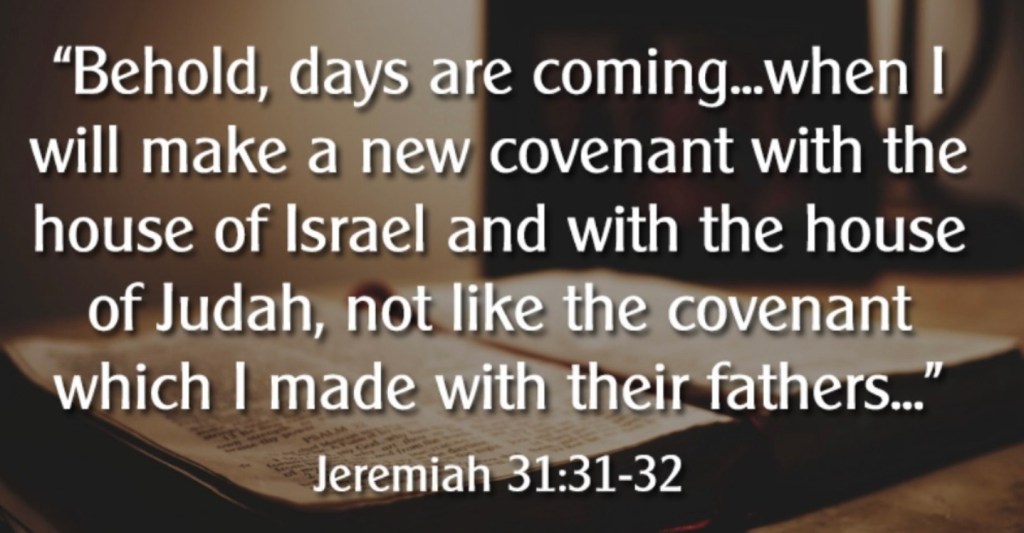
Yet in the midst of his despair, Jeremiah sees hope: “the days are surely coming, says the Lord, when I will restore the fortunes of my people, Israel and Judah, says the Lord, and I will bring them back to the land that I gave to their ancestors and they shall take possession of it” (30:3). In this context, Jeremiah indicates that the Lord “will make a new covenant with the house of Israel and the house of Judah … I will put my law within them, and I will write it on their hearts; and I will be their God, and they shall be my people” (31:31–34).
The renewal of the covenant was not a new idea in the story of Israel. God had entered into covenants with Abraham, the father of the nation (Gen 15:1–21) and before that, in the story of Noah, with “you and your descendants after you, and with every living creature that is with you … that never again shall all flesh be cut off by the waters of the flood” (Gen 9:8–11). The covenant given to Moses on Mount Sinai (Exod 19:1–6), accompanied by the giving of the law (Exod 20:1–23:33), is sealed in a ceremony by “the blood of the covenant” (Exod 24:1–8).
The covenant with the people that Moses brokered is renewed after the infamous incident of the golden bull (Exod 34:10–28), then under Joshua at Gilgal, as the people enter the land of Canaan after their decades of wilderness wandering (Josh 4:1–24). It is renewed again in the time of King Josiah, after the discovery of “a book of the law” and his consultation with the prophet Huldah (2 Chron 34:29–33), and it will be renewed yet again after the exiled people of Judah return to the land under Nehemiah, when Ezra read from “the book of the law” for a full day (Neh 7:73b—8:12) amd the leaders of the people made “a firm commitment in writing … in a sealed document” which they signed (Neh 9:38–10:39).
However, the particular expression of renewal that Jeremiah articulates will prove to be critical for the way that later writers portray the covenant renewal undertaken by Jesus of Nazareth (1 Cor 11:25; Luke 22:20; 2 Cor 3:6–18; Heb 8:8–12). Especially significant is the claim that this renewed covenant “will not be like the covenant that I made with their ancestors when I took them by the hand to bring them out of the land of Egypt—a covenant that they broke” (Jer 31:32), for God “will put my law within them, and I will write it on their hearts; and I will be their God, and they shall be my people” (31:33). It is a covenant which has “the forgiveness of sins” at its heart (31:34)— precisely what is said of the “new covenant” effected by Jesus (Matt 26:28; and see Acts 5:31; 10:43; 13:38; 26:18).
To signal his confidence in this promised return, Jeremiah buys a field in his hometown of Anathoth from his cousin Hanamel (32:1–15). The narrator notes that “the army of the king of Babylon was besieging Jerusalem, and the prophet Jeremiah was confined in the court of the guard that was in the palace of the king of Judah, where King Zedekiah of Judah had confined him” (32:2–3). Nevertheless, the purchase serves to provide assurance that the exiled people will indeed return to the land of Israel; “houses and fields and vineyards shall again be bought in this land” (32:15).
Jeremiah exhorts the people to “give thanks to the Lord of hosts, for the Lord is good, for his steadfast love endures forever!” (33:11), because in the places laid waste by the Babylonians, “in all its towns there shall again be pasture for shepherds resting their flocks … flocks shall again pass under the hands of the one who counts them, says the Lord” (33:12–13). As the people return to the land, the Lord “will cause a righteous Branch to spring up for David; and he shall execute justice and righteousness in the land” (33:15). The title “Son of David” is later applied to Jesus in three Gospels (Mark 10:47–48; Matt 1:1; 12:23; 15:22; 21:9, 15; Luke 18:38–39).
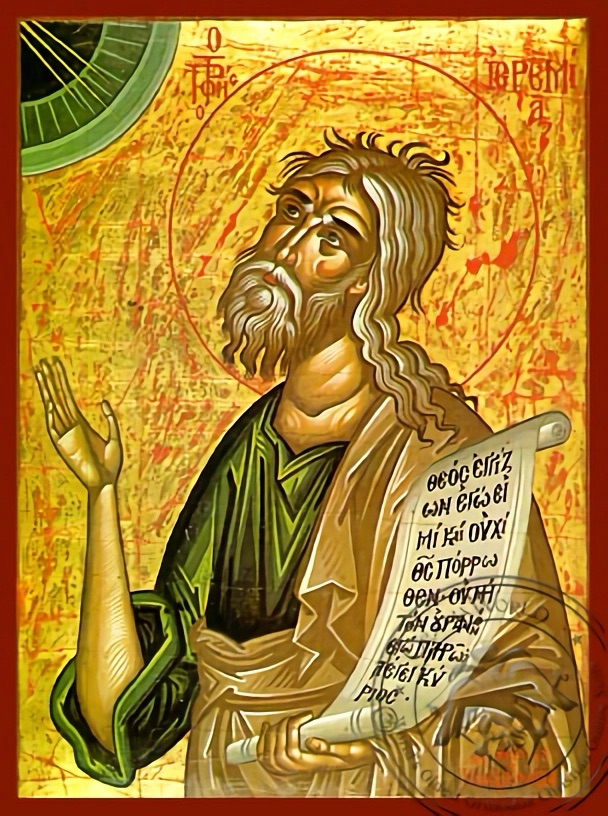
As Jeremiah was “prevented from entering the house of the Lord” (36:5), he dictated his prophecies to a scribe named Baruch (36:4) and instructed Baruch to “read the words of the Lord from the scroll that you have written at my dictation” (36:6). The scroll is important, for it conveys a message that “great is the anger and wrath that the Lord has pronounced against this people” (36:7).
Baruch does read from the scroll to “all the people in Jerusalem and all the people who came from the towns of Judah to Jerusalem” (36:9–10); eventually, the scroll makes its way into the inner court, where it is read to the king (36:20–21). In response, piece by piece, King Jehoiakim methodically burns the scroll (36:23–26), so Jeremiah repeated the process with Baruch (36:32). This sequence of events is included in the selection of verses proposed by the Narrative Lectionary, presumably to give the specific narrative context for the oracle about “the new covenant” which is the primary theological focus for this coming Sunday.
Subsequently, the prophet was imprisoned in the court of the guard (37:11–21) and then in a cistern (38:1–6), before being rescued from the cistern, on the king’s orders, by Ebed-melech the Ethiopian (38:7–13). Life was certainly not easy for Jeremiah the prophet! Eventually, the city of Jerusalem is taken captive by the Babylonians (39:1–3), members of the royal family are slaughtered (39:6), the king is blinded and taken into exile (39:7), the city is plundered and destroyed (39:8), and “the rest of the people who were left in the city” were taken in the deportation to Babylon, with the exception of just “some of the poor people who owned nothing” (39:9–10). The misery of Jeremiah is shared right across the population.
In one final twist, the Narrative Lectionary suggests reading the verses from ch.36—the capture of the city and the exile to Babylon—before ch.31—the promise of a new covenant. This reversal of order is an interpretive ploy to infer that, despite the misery and trials of Jeremiah, his message offered hope to his people. It’s a hope that would not be made manifest for the exiles for five decades. In a Christian context, as we have seen, it’s a hope that is seen to be fulfilled in Jesus. And perhaps the context of this coming Sunday being the Festival of the Reign of Christ, it’s an orientation that points to the enduring reign of Christ, in contrast to the limited rule of Zedekiah of Judah, and indeed of Nebuchadrezzar of Babylon.

 An Informed Faith