
This coming Sunday is the first day in a new year-at least, as the church marks the years. Rather beginning on the first day of January (for the calendar month) or of July (for the financial year), the church year begins with the season of Advent. The season stretches over four weeks and serves as preparation for the joyous celebration of Christmas, marking the birth of Jesus. So this coming Sunday in worship, it would be quite appropriate to wish other people a happy new year!
It is the custom more generally in society to make “New Year resolutions”—even if such resolutions rarely last weeks, or even days, into the new year. In keeping with that custom, perhaps it could be appropriate for people of faith to use the words of the psalm proposed by the lectionary for this coming Sunday, the First Sunday in Advent.
In Psalm 25, the psalmist sets out a clear view of what it is that God expects of people of faith. First, the psalmist begins by offering their “soul” to God, declaring “O my God, in you I trust” (vv.1–2). The Hebrew word translated as “soul” in v.1 is nephesh. This is a common Hebrew word, appearing 688 times in Hebrew Scripture, of which the most common translation (238 times) is “soul”; the next most common translation is “life” (180 times). The word is thus a common descriptor for a human being, as a whole.
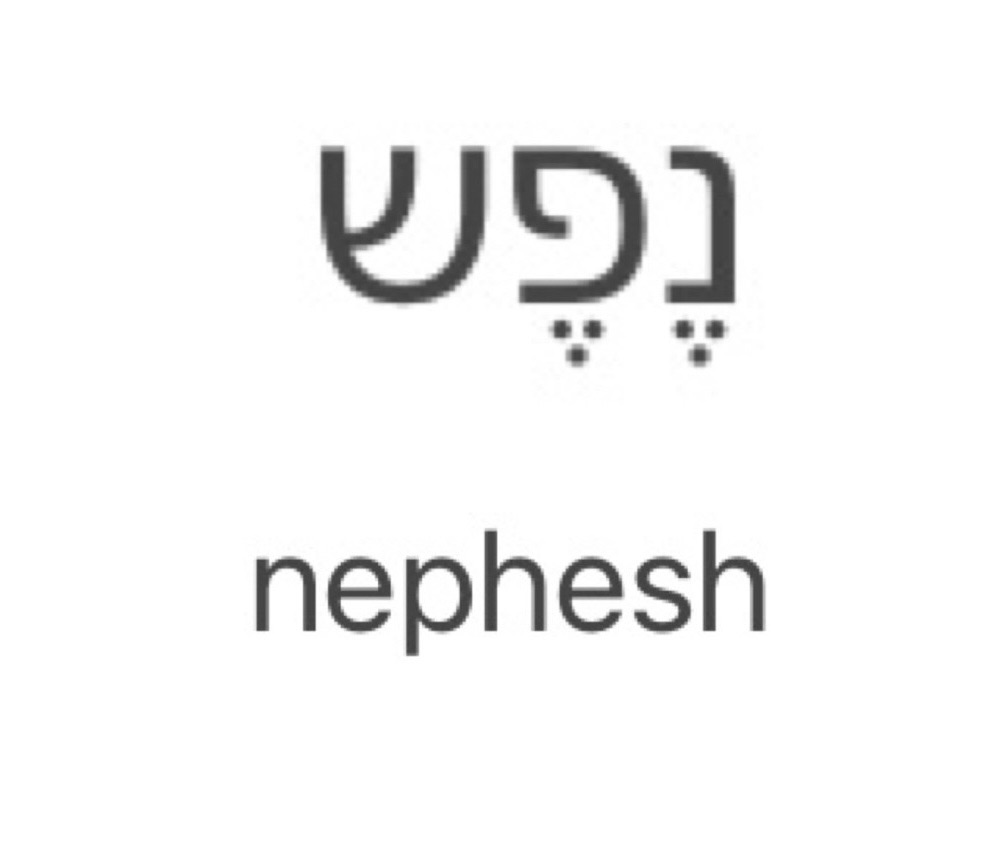
However, to use the English word “soul” to translate nephesh does it a disservice. We have become acclimatised to regarding the soul as but one part of the whole human being—that is the influence of dualistic Platonic thinking, where “body and soul” refer to the two complementary parts of a human being. In Hebrew, nephesh has a unified, whole-of-person reference, quite separate from the dualism that dominates a Greek way of thinking.
Nephesh appears a number of times in the first creation story in Hebrew scripture, where it refers to “living creatures” in the seas (Gen 1:20, 21), on the earth (Gen 1:24), and to “every beast of the earth, and to every bird of the air, and to everything that creeps on the earth, everything that has the breath of life (nephesh hayah)” (Gen 1:30). It is found also in the second creation story, where it likewise describes how God formed a man from the dust of the earth and breathed the breath of life into him, and “the man became a living being (nephesh hayah)” (Gen 2:7). The claim that each living creature is a nephesh is reiterated in the Holiness Code (Lev 11:10, 46; 17:11).
The concept of nephesh is a foundational understanding in Hebraic thought: the nephesh is the totality of existence for every creature, including humans. In our psalm for this Sunday, then, the psalmist offers their whole being to God, placing trust in God. This is a fine model for us to consider and emulate throughout the whole of the year: discipleship is a whole-of-being thing.
An attitude of trust towards God permeates the psalms. “Those who know your name put their trust in you”, one psalmist affirms, “for you, O Lord, have not forsaken those who seek you” (Ps 9:10). Another psalmist sings “I trust in you, O Lord; I say, ‘You are my God’; my times are in your hand” (Ps 31:14–15). A third psalmist affirms, “I am like a green olive tree in the house of God; I trust in the steadfast love of God forever and ever” (Ps 52:8). In yet another psalm, the writer sings “when I am afraid, I put my trust in you … in God I trust; I am not afraid” (Ps 52:3–4, 10–11).
One psalmist evokes the remembrance of trusting people in the past: “in you our ancestors trusted; they trusted, and you delivered them; to you they cried, and were saved; in you they trusted, and were not put to shame” (Ps 22:4–5). Another declares that they “trusted in your steadfast love; my heart shall rejoice in your salvation” (Ps 13:5), while yet another states “I have walked in my integrity, and I have trusted in the Lord without wavering” (Ps 26:1). Trust is a foundational element in our faith.
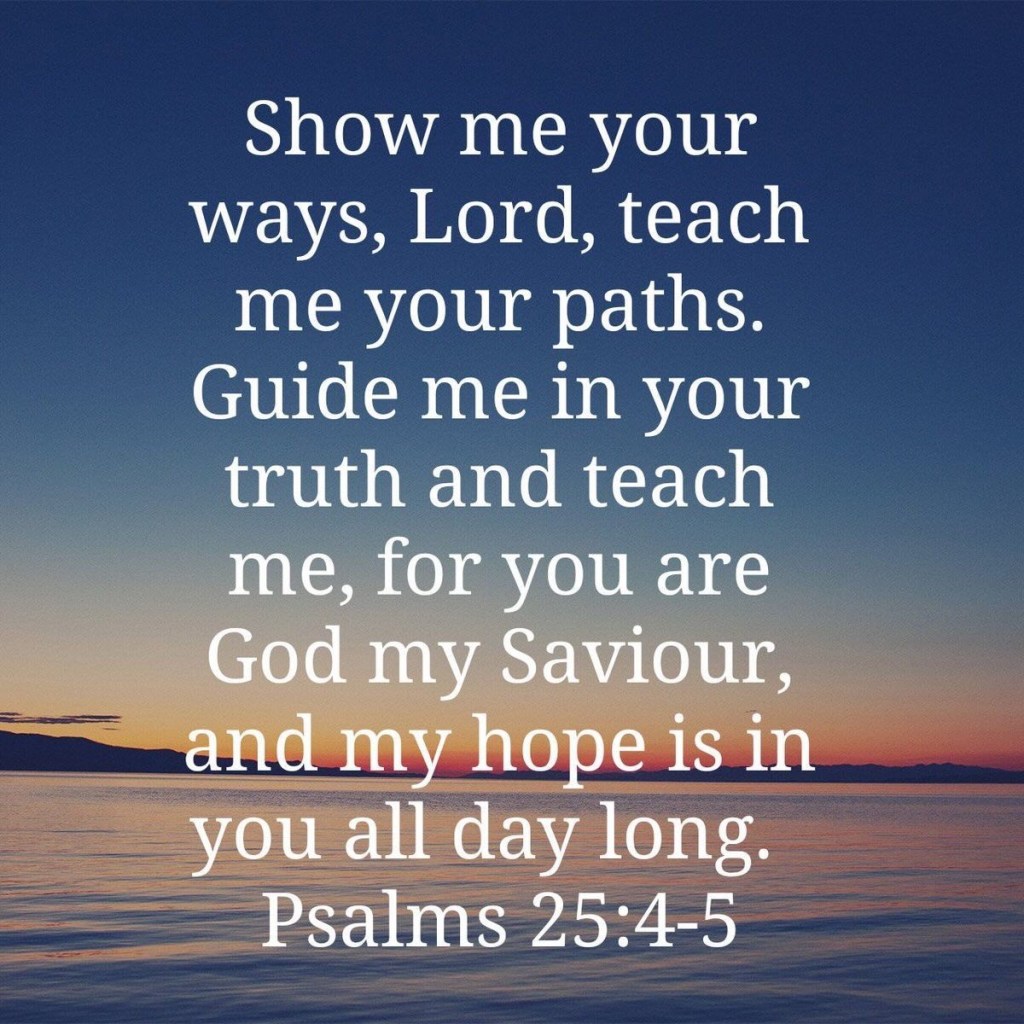
Then, the author of Psalm 25 prays for the ways in which they might know God’s ways: “make me to know your ways, O Lord; teach me your paths; lead me in your truth, and teach me” (vv.4–5). The paths of the Lord are probably best-known from the much-beloved Psalm 23, in the opening sequence of affirmations that the Lord “makes me lie down in green pastures … leads me beside still waters … restores my soul … [and] leads me in right paths” (Ps 23:2–3).
This psalmist later explains that “the paths of the Lord are steadfast love and faithfulness for those who keep his covenant and his decrees” (Ps 25:10). Another psalmist affirms, “my steps have held fast to your paths; my feet have not slipped” (Ps 17:5); yet another, in a well-known refrain, sings “word is a lamp to my feet and a light to my path” (Ps 119:195). In like manner, another psalm rejoices that “you show me the path of life; in your presence there is fullness of joy” (Ps 16:11).
Keeping to the path of the Lord requires knowing, and adhering to, the commandments of Torah, so one psalmist prays, “teach me to do your will, for you are my God; let your good spirit lead me on a level path” (Ps 143:10). In the longest psalm of all—an extended song of praise for Torah—the psalmist sings, “give me understanding, that I may keep your law and observe it with my whole heart; lead me in the path of your commandments, for I delight in it” (Ps 119:34–35). The prayer of Psalm 25, “make me to know your ways, O Lord; teach me your paths” reinforces the centrality of Torah obedience in the psalms.
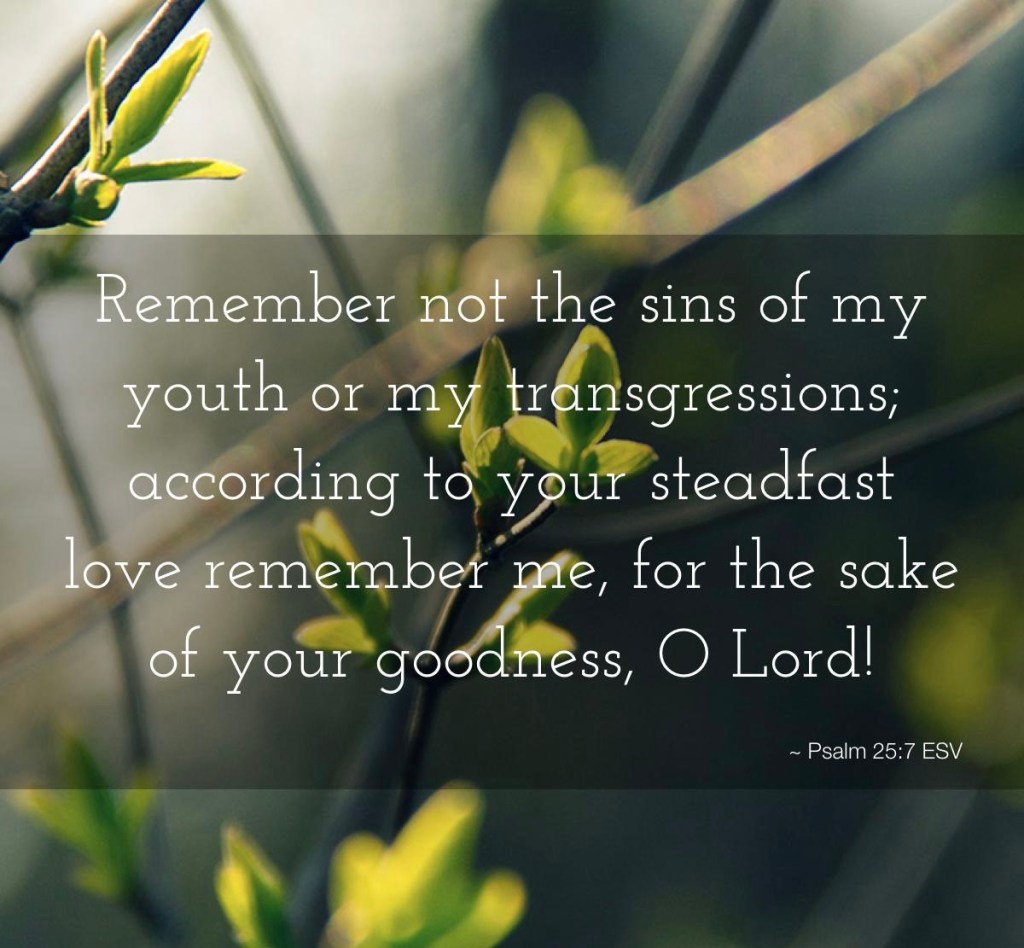
Third, the psalm includes a short prayer seeking forgiveness: “do not remember the sins of my youth or my transgressions; according to your steadfast love remember me, for your goodness’ sake, O Lord!” (v.7). The petition is repeated a few verses later: “for your name’s sake, O Lord, pardon my guilt, for it is great” (v.11). Some psalms contain verses which echo this prayer: “consider my affliction and my trouble, and forgive all my sins” (Ps 25:8); “help us, O God of our salvation, for the glory of your name; deliver us, and forgive our sins, for your name’s sake” (Ps 79:9).
Other psalms offer an affirmation that God does, indeed, forgive: “when deeds of iniquity overwhelm us, you forgive our transgressions” (Ps 65:3); “if you, O Lord, should mark iniquities, Lord, who could stand? but there is forgiveness with you, so that you may be revered” (Ps 130:3–4); “bless the Lord, O my soul, and do not forget all his benefits—who forgives all your iniquity, who heals all your diseases” (Ps 103:2–3); “happy are those whose transgression is forgiven, whose sin is covered” (Ps 32:1).
Forgiveness is of the essence of the Lord God, who is “is slow to anger, and abounding in steadfast love, forgiving iniquity and transgression” (Exod 34:6–8; Num 14:18; Neh 9:17b; Ps 145:8–9; Joel 2:13; Jonah 4:2; see also 2 Kings 13:23; 2 Chron 30:9). In one of the central episodes in the life of the Israelites, after they had made a golden calf, Moses pleads with God for forgiveness (Exod 32:32); after God had punished those who sinned in this episode by sending a plague (Exod 32:35), God is declared to be “abounding in steadfast love and faithfulness, keeping steadfast love for the thousandth generation, forgiving iniquity and transgression and sin”, and the covenant is renewed (Exod 34:6–10).
Seeking forgiveness was central to the life of ancient Israelites, and continued on to be important in Second Temple Judaism. Indeed, it is this prayer for forgiveness which is taken up in the prayer that Jesus taught his disciples: “forgive us our sins, for we ourselves forgive everyone indebted to us” (Luke 11:4), or in what was likely an earlier version: “forgive us our debts, as we also have forgiven our debtors” (Matt 6:12).
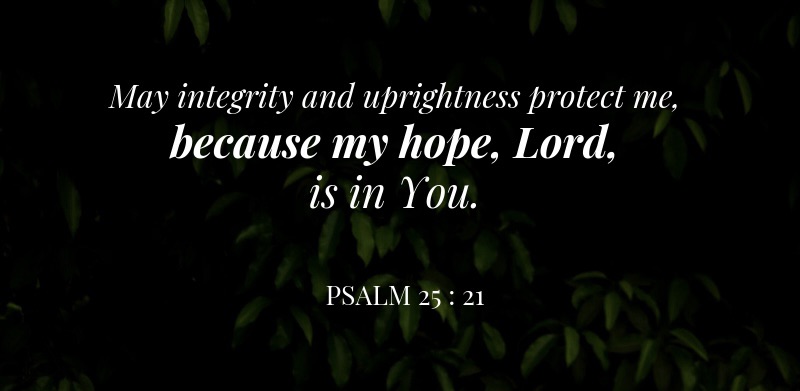
Finally, towards the end of the psalm, the psalmist prays, “may integrity and uprightness preserve me, for I wait for you” (v.21). Integrity and uprightness figure in other psalms. “I will walk with integrity of heart within my house”, one psalmist sings, “I will not set before my eyes anything that is base” (Ps 101:2–3), while another declares, “I have walked in my integrity, and I have trusted in the Lord without wavering” (Ps 26:1).
So one psalmist prays, “judge me, O Lord, according to my righteousness and according to the integrity that is in me” (Ps 7:8), while another affirms that the precepts of the Lord “are established forever and ever, to be performed with faithfulness and uprightness” (Ps 111:8). In another psalm we learn that “the Lord is righteous; he loves righteous deeds; the upright shall behold his face” (Ps 11:7), while another psalm declares that “justice will return to the righteous and all the upright in heart will follow it” (Ps 94:15). The motif of uprightness permeates these songs of faith.
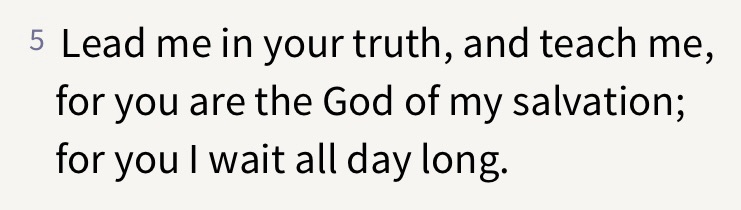
When the psalmist sings, “for you I wait all day long” (Ps 25:5), they are reflecting a common attitude across many psalms, waiting for the Lord: “I wait for the Lord, my soul waits” (Ps 130:5–6), “it is for you, O Lord, that I wait; it is you, O Lord my God, who will answer” (Ps 38:15); “for God alone my soul waits in silence, for my hope is from him” (Ps 62:5). So the psalmist encourages others, “be strong, and let your heart take courage, all you who wait for the Lord” (Ps 31:24) and affirms that “those who wait for the Lord shall inherit the land” (Ps 37:9).
Such waiting is in no way a passive statement being, for such waiting, as we have seen, involves the whole being (the nephesh) in active obedience to Torah and a deliberate intention to live in an upright way. This same attitude could well inform the way that we, today, live as people of faith.
I think this is a great psalm to read and hear at the start of the (church) year. It offers us a number of ways to ground our faith and live as faithful disciples in today’s world. If you don’t regularly include a reading of a psalm in your worship liturgy, this Sunday is a really good day to do that!

 An Informed Faith