

The orderly account of the things coming to fulfilment (which we know as the Gospel of Luke) tells us much more about the beginnings of Jesus (his conception, birth, and early days) than the other Gospels. The passage offered by the lectionary as the psalm for this Sunday, the second Sunday in Advent, is one such text.
It’s a well-known and familiar passage, and although it is proposed as “the Psalm” for this Sunday, it is found in the New Testament—in the long first chapter of this Gospel, which leads into the Christmas story. The passage offered (Luke 1:68–79) comprises the text of a psalm-like song that is often called The Benedictus, after the opening phrase of the song in the Latin translation.
The song occurs after the birth of John, son of Elizabeth and Zechariah (recounted in 1:57–58). This is a surprise pregnancy for Elizabeth, who was described as being “barren”, and with Zechariah is noted as “getting on in years” (a better translation would be “of advanced years”) (1:7). During the announcement of the imminent birth of a child (1:8–20), Zechariah had questioned the declaration of the angel Gabriel, asking “How will I know that this is so? For I am an old man, and my wife is getting on in years” (1:18). For this lack of faith in what Gabriel has said, Zechariah is struck dumb (1:20).
Being muted by the action of the deity was the experience of the prophet Ezekiel, immediately after the vision that he saw which initiated his public prophetic activity. Before he could speak to the people, Ezekiel was given a scroll, which he was told to eat, and then he was informed by the Lord that “I will make your tongue stick to your palate so that you will become dumb and be unable to reprove them, for they are a rebellious people” (Ezek 3:26). Only after this experience can he prophesy to the people of Israel.
Zechariah’s experience mirrors the experience of Ezekiel. When Zechariah is eventually enabled to speak again, after the birth of his son, he offers the wonderful hymn of praise which forms this Sunday’s psalm— the Benedictus, so called from its appearance in the Latin text of the Roman Mass, Benedictus (in the original Greek text, it is eulogētēs; in English translation, this becomes “blessed”).
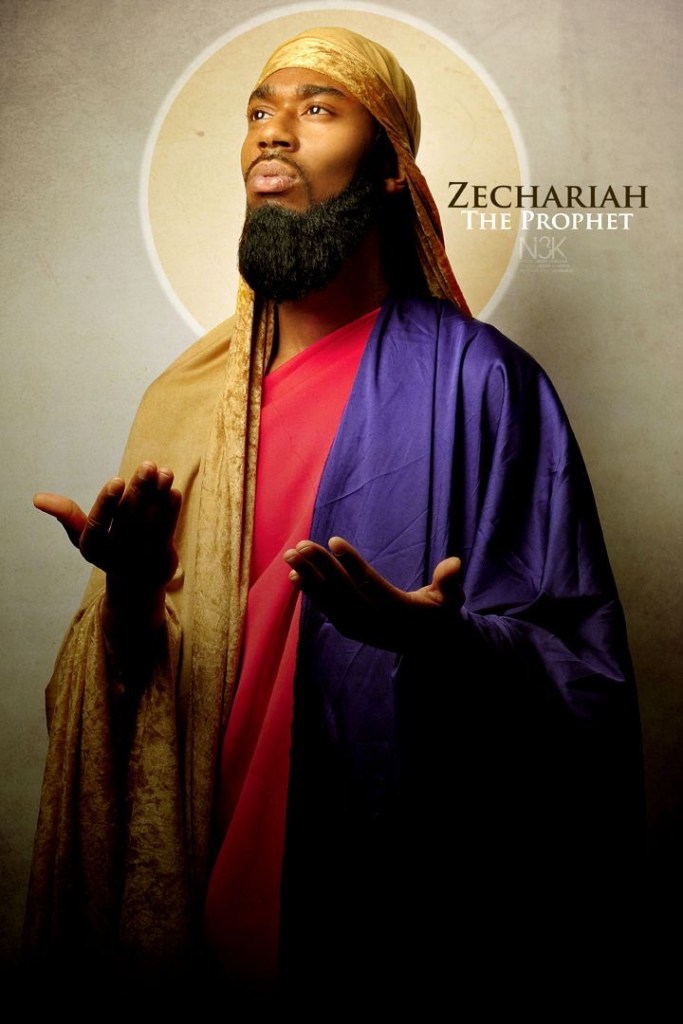
by photographer James C. Lewis
Zechariah, we are told, “was filled with the Holy Spirit” and spoke words described by Luke as “this prophecy” (Luke 1:67). This places Zechariah in the long line of prophets inspired by the Spirit to speak with boldness to the people. God’s Spirit is active in many of these scenes early in this Gospel; Mary is “overshadowed” by the Spirit (1:35), whilst Zechariah and Elizabeth are both “filled” with the Spirit (1:41, 1:67). Simeon is “righteous and devout” (2:25); the Spirit “rested on him” (2:25), then “revealed to him” the words he then speaks (2:26) before “guiding him … into the temple” (2:27).

This is the same Spirit that has been active since the moment of creation (Gen 1:2), that was breathed into human beings (Gen 2:7), and that infuses every one of the creatures brought into being in God’s wonderful creation (Ps 104:24–30). It is this Spirit that has endowed individuals with leadership (Exod 31:2–3; Num 11:25–26; Deut 34:9; and a number of judges) and which has inspired prophets to proclaim the word of the Lord (Isa 61:1; Ezek 2:2; Joel 2:28–29).
The words sung by Zechariah resonate richly with words from scripture. This is part of the technique being employed by the author of this Gospel in these opening two chapters, when, to set the scene firmly within Second Temple Judaism, he tells the story in ways reminiscent of the ancestral narratives of the Hebrew Scriptures, and has the main characters (Zechariah, Mary, and later Simeon) sing in the style of Hebraic psalms.
Some scholars refer to the Septuagintal style of Luke 1–2, because of the many ways that the Greek of these chapters reflect the Greek of the LXX. Other scholars refer to the Semitisms of Luke, here and in other places in his Gospel. A detailed and complex analysis by Albert Hogeterp and Adelbert Denaux, Semitisms in Luke’s Greek, can be read at https://api.pageplace.de/preview/DT0400.9783161553370_A33723451/preview-9783161553370_A33723451.pdf
Luke, of course, was writing many decades after the events he reports; he certainly wasn’t present at the time, and it is most unlikely that any of the people he refers to as his sources (Luke 1:2) were witnesses to them. Nevertheless, we could accept Luke’s portrayal of these two people as at least feasible. Zechariah was, with Elizabeth, “righteous before God” (Luke 1:6); as a priest, he served in the temple (Luke 1:8–9), and so would have known well the psalms. The form of the song he sang correlates with various psalms of praise; although in my mind, it was Luke who created this song and placed it on the lips of Zechariah, just as he did with the many speeches he includes in his Gospel and especially in Acts.
Zechariah would also have heard regular readings from Torah in temple worship, which is evident in the description of both Elizabeth and Zechariah as “living blamelessly according to all the commandments and regulations of the Lord” (1:6). This knowledge, along with his familiarity with the words of the Nevi’im (the prophets), is evident in what he sings in this song. Indeed, there is specific reference in the song to what has happened “as [God] spoke through the mouth of his holy prophets from of old” (v.70).
What Zechariah is singing about is, in a sense, a rich fulfilment of older prophetic texts (but there are many references to narrative and psalms, as well). In particular, he sings about how God has been at work, and is at work, in events of the time, just as Mary had done so earlier in this chapter in her song known as the Magnificat (Luke 1:46–55). On this, see
In the next two posts I will consider these scriptural references and allusions; see
and

 An Informed Faith