
One of the passages offered by the lectionary for this Sunday, the second Sunday in Advent, is a well-known and familiar passage, and although it is proposed as “the Psalm” for this Sunday, it is found in the New Testament—in the long first chapter of this Gospel, which leads into the Christmas story. The passage offered (Luke 1:68–79) comprises the text of a psalm-like song that is often called The Benedictus, after the opening phrase of the song in the Latin translation.
The whole song resonates in every line with words, ideas, concepts from the Hebrew Scriptures. Luke, of course, was writing many decades after the events he reports; he certainly wasn’t present at the time John was born, and it is most unlikely that any of the people he refers to as his sources (Luke 1:2) were witnesses to this. Rather, it is sensible for us to consider that this song was placed in the mouth of Zechariah, drawing extensively from the Hebrew Scriptures.
The blessing which opens the song (v.68) has the standard form of blessings found in prayers by Jews in antiquity, through until today; they begin with a phrase of blessing: “Blessed are you, O Lord our God …”. Blessed are You, O Lord our God, Ruler of the universe, Who brings forth bread from the earth is prayed before a meal. Blessed are You, o Lord our God, Ruler of the universe, who creates the fruit of the vine is prayed before drinking wine. Zechariah begins in this pattern, “Blessed be the Lord God of Israel”, before proceeding to indicate how God has been at work.
Another key scriptural element in his song comes when Zechariah refers to God as “Most High” (v.76). This way of describing God is found in a prayer of Abraham (Gen 14:22), where he seems to have adopted it from King Melchizedek of Salem, who is introduced as “priest of God Most High” (Gen 14:18–20). It is repeated by Balaam in his oracle (Num 24:15–16), once in the lengthy Song of Moses (Deut 32:8), and once in the lengthy Song attributed to David at the end of his life (2 Sam 22:14).
Prophets who used this phrase included Isaiah, once (Isa 14:14), Hosea, once (Hos 11:7), the author of Lamentations (Lam 3:35, 38), and Daniel (Dan 4:24–25; 5:17, 21; 7:18, 21, 25–27), who appears to have picked up this phrase from King Nebuchadnezzar (Dan 3:26; 4:2, 17, 34). The phrase is most common in the psalms, where it appears 23 times (for instance, Ps 7:17; 9:2; 21:7; 46:4; 47:2; 50:14; 57:2; 91:1, 9; 97:9; 106:7; 107:11). The same appellation then appears in eight other places in the New Testament (Mark 5:7; Luke 1:32, 35; 6:35; 8:28; Acts 7:48; 16:17; and Heb 7:1, referring back to King Melchizedek).

The focus of this song, as is the case also in the song sung earlier by Mary, as well as in each of the missionary speeches reported in Acts 2–17, is on “what God has done”, a theme of significance throughout Luke and Acts—as I have argued in my PhD thesis, The plan of God in Luke—Acts (1993), and in my commentary on Acts in the Eerdman’s Commentary on the Bible (2003).
Three times in this song Zechariah mentions the redemptive power of God, who “has looked favorably on his people and redeemed them” (v.68), “saved [the people] from our enemies and from the hand of all who hate us” (v.71), and “rescued [them] from the hands of our enemies” (v.74). Calling God “Redeemer” is typical of Second Isaiah (Isa 41:14; 43:14; 44:6, 24; 47:4; 48:1, 17; 49:7, 26; 54:5, 8) and continues in Third Isaiah (Isa 59:20; 60:16; 63:16). It is also found in other books (Job 19:1, 25; Ps 19:14; 78:35; Jer 50:34).
God is identified as Saviour (2 Sam 22:3; Ps 17:7; 106:21; Isa 43:3, 11; 45:15, 21; 49:26; 60:16; 73:8; Hos 13:4) and praised as one who saves (1 Sam 10:19; 14:39; Ps 34:18; 37:40) and also rescues (Ps 34:17, 19; 37:40; 97:10; Amos 3:12). The language on the lips of Zechariah is thoroughly scriptural.
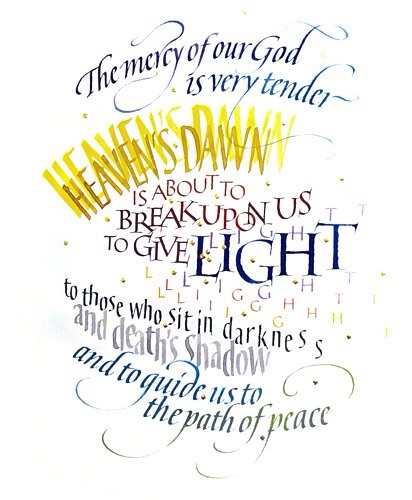
Alongside this, there are two references in this song to the mercy of God, as Zechariah sings of “the tender mercy of our God” (v.78) and rejoiced that God “has shown the mercy promised to our ancestors” (v.72). In the ancestral narratives of Israel, mercy is noted as a quality of God by Jacob (Gen 43:14), David (2 Sam 24:14; 1 Chron 21:13), and Nehemiah (Neh 1:11). Of course, involved in the ritual of worship in the Tabernacle and then in the Temple is the sprinkling of sacrificial blood on the “mercy seat” in the holy place (Lev 16:2, 12–14); the seeking of mercy from the Lord was at the heart of the annual Day of Atonement ritual.
Even as they call the people to account for their sins, prophets occasionally proclaim the mercy of God (Isa 30:18; 55:7; 60:10; 63:7; Jer 31:20; 33:26; 42:12; Ezek 39:25; Dan 9:9; Hos 2:19; 14:3). Daniel instructs his companions, Hananiah, Mishael, and Azariah, “to seek mercy from the God of heaven” (Dan 2:18) while in Zechariah’s first vision the angel pleads with the Lord for mercy (Zech 1:12).
Many times in the psalms there are prayers seeking God’s mercy: “be mindful of your mercy, O Lord” (Ps 25:6); “do not, O Lord, withhold your mercy from me” (Ps 40:11); “let your mercy come to me, that I may live” (Ps 119:77); and most famously, in the prayer attributed to David after he had committed adultery and murder, “have mercy on me, O God, according to your steadfast love; according to your abundant mercy blot out my transgressions” (Ps 51:1). In the fifth Song of Ascents, the psalmist pleads, “have mercy upon us, O Lord, have mercy upon us, for we have had more than enough of contempt” (Ps 123:3).

Then, when Luke has Zechariah describe this mercy as a “tender mercy”, it may well be that the words of Hosea are in mind: “how can I give you up, Ephraim? how can I hand you over, O Israel? … my heart recoils within me; my compassion grows warm and tender. I will not execute my fierce anger; I will not again destroy Ephraim” (Hos 11:8–9). It is a touching moment in the prophet’s words; and a nice touch in the song that Luke places in the mouth of Zechariah.
See also

 An Informed Faith