

This coming Sunday and the following Sunday, the lectionary suggests that we read and hear a well-known section of Paul’s letter to the believers in Corinth. In this chapter (1 Cor 12:1–31), Paul addresses the nature of the community that has been formed by those who formerly were “pagans … led astray to idols” (12:2) and have now have come to believe that “Jesus is Lord” (v.3) and desire to follow his way in their lives through offering their gifts in service (vv.4–7).
What follows in this chapter—and in the subsequent ones that the lectionary proposes on the Sundays ahead—provides a good basis for considering fundamental matters of faith and discipleship throughout the season of Epiphany. It is, after all, a season focussed on revelation; and Paul’s words are quite revealing!
Actually, they are not just Paul’s words (although that is how we usually refer to them). Paul collaborated in the writing of many of his letters—of the seven agreed authentic letters, only two are written by Paul alone. The others are written in association with Timothy (2 Cor, Phil, 1 Thess and Phlm), Silvanus (1 Thess), and Sosthenes (1 Cor). So it is words from this last letter, co-written with Sosthenes, that the creators of the lectionary are offering us during the season of Epiphany.

In opening this letter, Sosthenes and Paul tell the Corinthians that they write to “give thanks” (1:4) and also to “appeal to you” (1:10); and later, to “admonish you as my beloved children” (4:14). The constructive approach that they bring is made clear in the opening prayer of thanksgiving (1:4–9). Writing in chapter four, the author (here, presumably Paul) exhorts the Corinthians: “I appeal to you, then, be imitators of me” (1 Cor 4:16; see also 1 Thess 1:6). The letter contains many points of appeal, exhortation, encouragement—and also challenge, correction, and criticism!
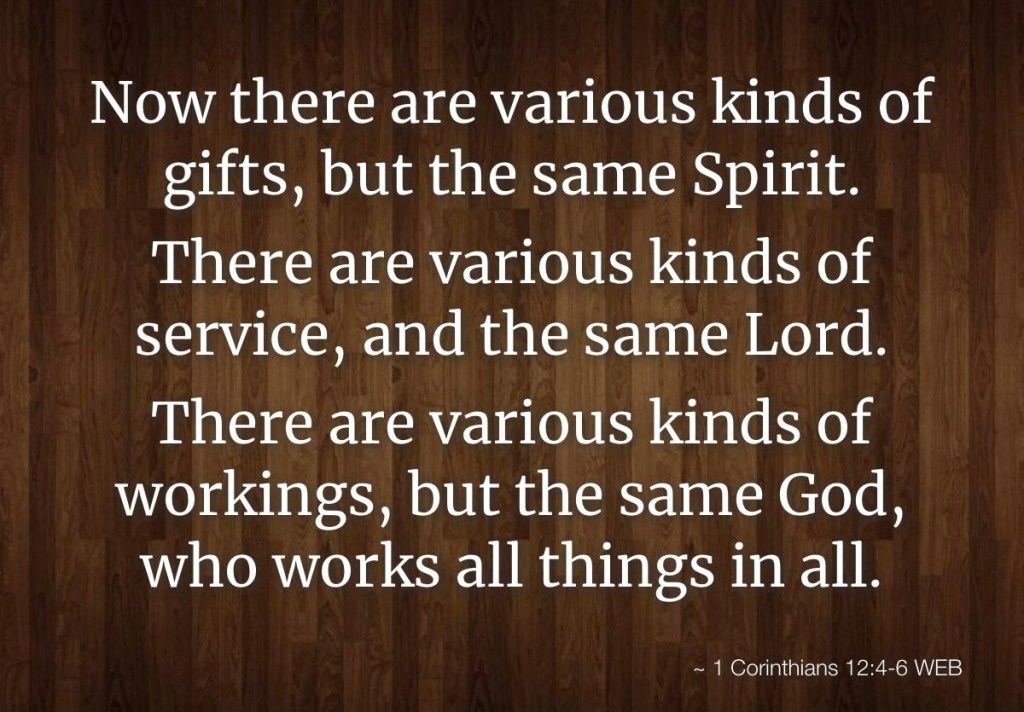
This coming Sunday we focus on verses 1–11 of chapter 12. This is an instance of exhortation and encouragement (in the later part of the chapter, which we read and hear on the following Sunday, challenge and correction will occur). In these verses, Paul considers the diversity of expressions of faith that can be found in the faith community in Corinth—as, indeed, there are in many other communities of faith. He notes the diversity of gifts, the various ways of providing service, and the range of activities undertaken by “those who are sanctified in Christ Jesus, called to be saints” (1 Cor 1:2).
Each gift, service, or activity, however, has a common origin. It is “the same Spirit” who grants the diversity of gifts evident in the community (12:4), “the same Lord” who is the motivator for the array of offering service by those believers (v.5), and “the same God” who activates all of the activities that is evident in Corinth (v.6).
It is worth noting that an alternative way to translate this might be “the same God who energizes all of the expressions of energy”. The Greek words being translated as “activate” and “activities” relate to the central idea of energy; indeed, the foundational word is ἐνεργήμα, which when transliterated letter-for-letter results in “energēma”, from which we get the English word “energy”. So the Spirit is presented as an active, dynamic force, which is at work in a lively, tireless, and vital fashion.
In this passage, Paul places a particular emphasis on the unity that is—or at least, should be—a key feature of the group of people who are joined together by the common affirmation, “Jesus is Lord” (v.3). He affirms that the gifts, acts of service, and activities expressed by those people “are activated by one and the same Spirit” (v.11a). It is that Spirit who “allots to each one individually just as the Spirit chooses” (v.11b).
The irony, however, is that in the eleven chapters preceding this passage, there have been multiple signs of the many ways in which disagreement, conflict, division, and factionalism mark the community of believers in Corinth. There have been ethical breaches, instances of sexual misbehaviour, diverse views regarding marriage and related issues, and mistreatment of fellow members of the community who are seen as “weak” by some who perhaps regard themselves as “strong”. Has the Spirit be so energizing that the disruptions caused by the Spirit’s activity have promulgated all of these problems?
Further, the critical issues which Paul addresses in the chapters immediately following, in the later part of the letter (1 Cor 12–14), arise out of the highly spontaneous, seemingly chaotic situation that characterised worship in Corinth. How the Spirit was active—energizing—those who worship in this gathering! It was anything but a reverent gathering of people unified by their faith; it was a chaotic frenzy of activity and words, if Paul’s severe wording is to be believed.

Such worship had more the nature of a dialogue between conversation partners, rather than a monologue delivered by one person to a group of silent listeners. We can see this in a simple way, with the references to “interpreters” in what Paul writes to the Corinthians. Whilst there are people who contribute words of prophecy, pray in tongues, or speak in tongues (1 Cor 14), in each case there is the need for someone to interpret these phenomena. It seems that many things were happening simultaneously, creating a frenzied cacophony during worship. If we see the energizing of the Spirit as a disruptive force, then much disruption has occurred!
For my reflections on the disruptive work of the Spirit in Corinth, see
So in 1 Cor 12, Paul adapts an image which was extensively used in political discussions about the city state (“the body is one and has many members”, 12:12) as well as what may be a reference to a developing baptismal liturgy within the early church (“we were all baptised into one body”, 12:13) and a very early creedal statement (“Jesus is Lord”, 12:3).
The work of the Spirit was supposed to provide a range of gifts for the mutual benefit of all involved in the community. Paul provides a list of just such gifts in verses 8–10. He notes wisdom, knowledge, faith, healing, miracles, prophecy, discernment, tongues, and interpretation of tongues. This should not be taken as an exhaustive list; in other places, Paul refers to other gifts, such as teaching, exhorting, giving,leading, and offering compassion (Rom 12:7–8), as well as power and assistance later in this chapter (1 Cor 12:28).
He also identifies some offices exercised by people alongside gifts already noted, as he concludes this same discussion of gifts: “Are all apostles? Are all prophets? Are all teachers? Do all work miracles? Do all possess gifts of healing? Do all speak in tongues? Do all interpret?” (1 Cor 12:29–30). Similar offices are noted in a later letter written in the name of Paul: “apostles … prophets … evangelists … pastors … teachers”, all,of which are said to be “to equip the saints for the work of ministry” (Eph 4:11–12).
Nor should this list of 1 Cor 12:8–10 be regarded as a prioritising of such gifts by the order in which they are listed. In fact, the concluding comment of v.11 specifically places all of the gifts noted on the same level, each equally “activated by the one and the same Spirit” and “allocated … just as the Spirit chooses”. We should affirm that today; all gifts for service come from the same source.

 An Informed Faith