
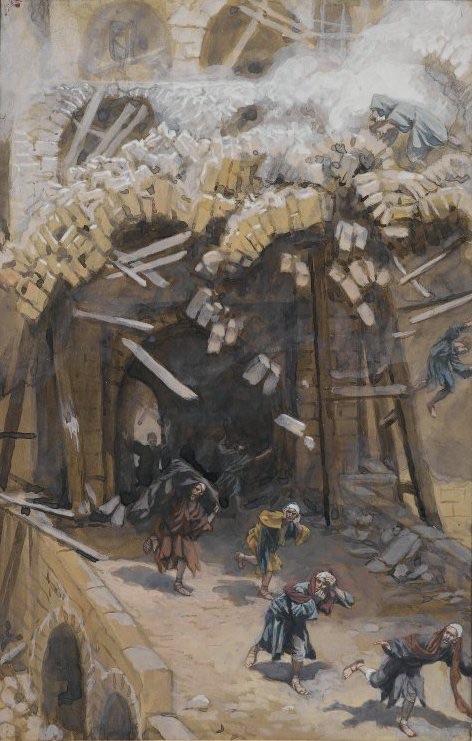
This blog relates to a part of the passage from Luke 13 offered in the Narrative Lectionary this coming Sunday, Lent 2. It also appears in the Revised Common Lectionary for the following Sunday, Lent 3.
In John’s Gospel, there is an extended narrative that concerns a resident of Jerusalem who was born blind, and lived his life into adulthood as a blind man. John reports that this man sat every day, begging for assistance, beside the pool of Siloam (John 9:1-41).
In this story, when Jesus encounters the man, he spat onto the ground to make mud, rubbed it on the man’s eyes, and told him to “wash in the pool of Siloam (which means ‘sent’)” (9:6–7a). The man obeyed Jesus, “he went and washed and came back able to see” (9:7b). This healing formed the basis for the controversy that ensued.
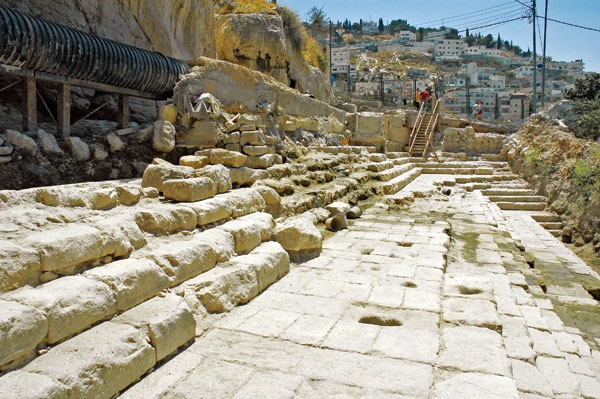
in a recently-opened site in Jerusalem
The Pool of Siloam is said to have had a significant history dating back to King Hezekiah’s reign in the late 8th century BCE. Hezekiah was worried that the water supply to Jerusalem would be interrupted during the seige of the city that was expected from the Assyrians that were pressing south (2 Ki 18:13; Isa 36:1). Hezekiah needed to act. He did so by commissioning a long tunnel (over 500 metres) to take water underground from the Gihon Spring, the main source of water for the city, all the way to the city’s southern end.
At the end of his life, his death is recorded in this manner: “The rest of the deeds of Hezekiah, all his power, how he made the pool and the conduit and brought water into the city, are they not written in the Book of the Annals of the Kings of Judah?” (2 Ki 20:20). This conduit and the pool that it fed were his crowning achievement. The pool is the Pool of Siloam.
The Pool of Siloam takes its place in Christian tradition because of the story of John 9. It was neglected, however, after the Romans destroyed Jerusalem in 70 CE. Centuries later, Byzantine-era Christians built a commemorative church at what they believed was the pool’s location, near the City of David’s southern end. Yet, in 2004, sewer construction unexpectedly revealed the actual Second Temple period pool, about 200 meters south of the Byzantine site. The whole structure was “225 feet long, with corners that are slightly greater than 90 degrees, indicating a trapezoidal shape, with the widening end oriented toward Tyropoeon valley”, according to the Biblical Archaeology Society. See
We find in Luke’s Gospel a reference to a Tower of Siloam (Luke 13:4). This is the only reference in the New Testament—indeed, the only reference in any ancient document—to this tower. Speculation as to its location, height, and function have abounded: was it part,of the aqueduct built to,transport the water? a pillar supporting a porch beside the pool? a fortress built by the Romans as part of their defensive network around the city? I suspect the definitive answer will never be known.
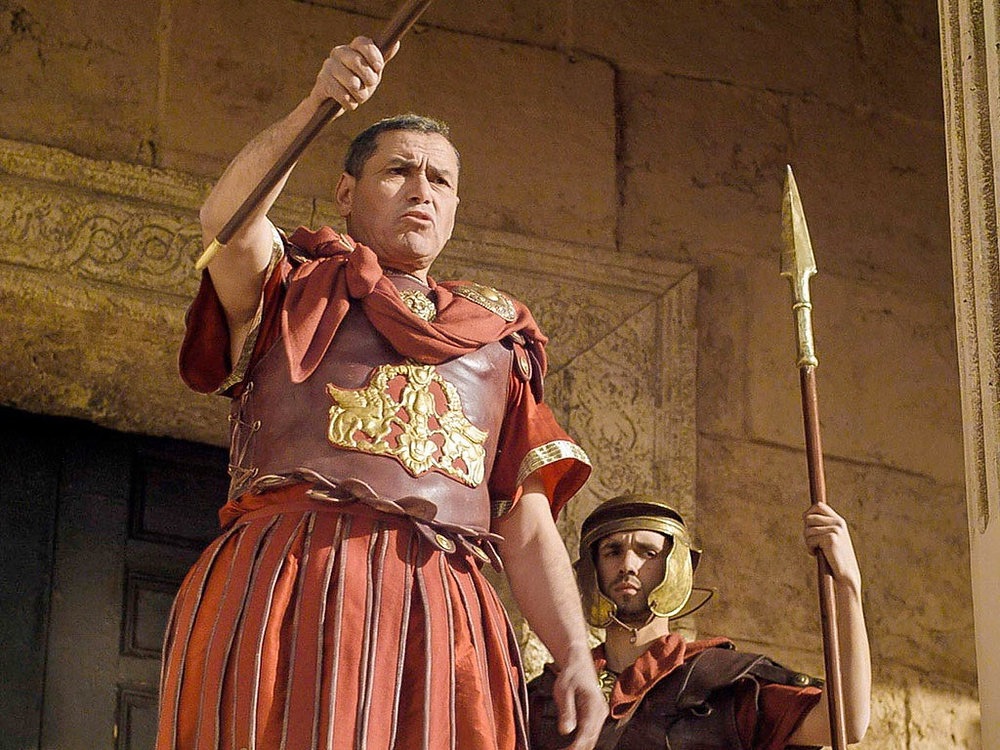
Other elements mentioned by Jesus in the passage, however, are plausibly historical: the existence of Pontius Pilate, of course, and his mistreatment of people under his charge—in this case, the Galileans whom he had slaughtered and whose blood was then mixed with the sacrifices they were offering (Luke 13:1). Pilate’s regular cruelty towards the Jews places him in the company of other Roman governors of the region who consistently acted against any local discontent with imperial military force. Josephus provides evidence for the actions of various governors.
Coponius acted against an uprising led by Judas in 6 CE; Cuspius Fadus was involved in an incident involving the vestments of the high priest (in the mid-40s CE). Ventidius Cumanus was embroiled in a series of incidents (48–52 CE) while Antonius Felix regularly deployed his soldiers to disperse Jewish gatherings because of the emergence of the Sicarii (52–60 CE). Of Albinus (62–64 CE) Josephus declared “there was no form of wickedness which he omitted”, Jewish War 2.272; 62–64 CE). This sequence of Jewish—Roman antagonism culminated under Gessius Florus (mid-60s CE), with Josephus scathingly noting that Albinus seemed “a most excellent man by comparison” with Florus (Jewish War 2.277).
Because Pilate was governor for a full decade (26–36 CE), he was involved in a number of documented actions against Jewish people. On Pilate and the incident with the ensigns, see Josephus, Jewish War 2.169–174; Antiquities of the Jews 18.55–59. On Pilate’s refusal to remove some dedicated gilt shields, see Philo, Legatio ad Gaium, 38. On the time when Pilate appropriated Temple funds for the construction of an aqueduct, see Josephus, Jewish War 2.175–177; Antiquities of the Jews 18.60–62.
American scholar Bart Ehrman argues that Pilate “was a brutal, ruthless ruler with no concerns at all for what the people he governed thought about him or his policies. He was violent, mean-spirited, and hardheaded. He used his soldiers as thugs to beat the people into submission, and he ruled Judea with an iron fist.” (See https://www.patheos.com/blogs/rationaldoubt/2019/05/pilate-released-barabbas-really/) The claim that on one occasion he mixed the blood of murdered Galileans with sacrificial blood thus appears to be quite plausible.
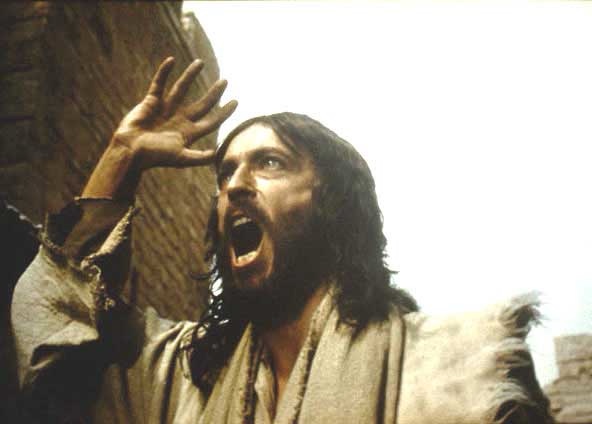
The other historical element in this passage is surely the warning of Jesus: “unless you repent, you will all perish just as they did” (13:3,5). Although the popularised caricature of Jesus today is that of “gentle Jesus, meek and mild”, the historical reality was surely that Jesus was a fierce apocalyptic-style preacher, calling people to repentance in the light of the imminent coming of the kingdom of God.
This portrayal of Jesus is clear from the start of Mark’s Gospel (“the time is fulfilled, and the kingdom of God has come near; repent, and believe in the good news”, Mark 1:15) to its end (“they will see ‘the Son of Man coming in clouds’ with great power and glory; then he will send out the angels, and gather his elect from the four winds, from the ends of the earth to the ends of heaven”, Mark 13:26–27; and then “beware, keep alert; for you do not know when the time will come”, Mark 13:33).
It is picked up with persistence through Luke’s narrative. Jesus declares “I have come to call not the righteous but sinners to repentance” (Luke 5:32) and rejoices that “there is joy in the presence of the angels of God over one sinner who repents” (15:10). He tells a powerful parable about the importance of repenting (16:19–31; see v.30) and shares in table fellowship with a prominent sinner, Zacchaeus, who publicly declares exactly how he has repented and changed his ways (19:1–10; see v.8).
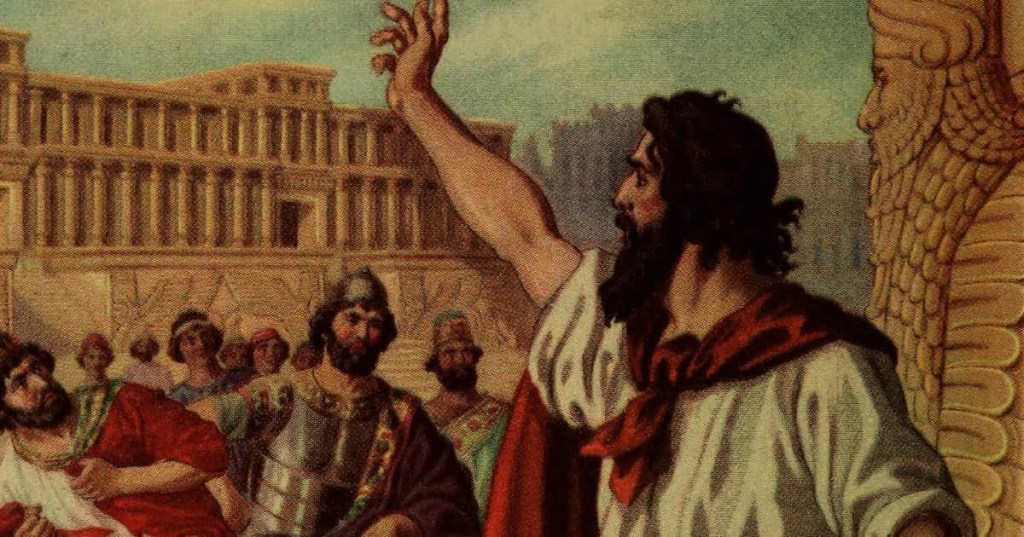
Preaching repentance and calling the people to seek forgiveness from the Lord is the central task in the commission given to so many prophets. “Come, let us return to the Lord”, cries Hosea (Hos 6:1), “put on sackcloth and lament, you priests”, Joel demands (Joel 1:13). “You did not return to me” is the consistent accusation raised against Israel by Amos (Amos3:6,8,9,10,11), and so he called the people to “seek good and not evil … hate evil and love good, and establish justice in the gate;” (Amos 5:14–15).
“Zion shall be redeemed by justice, and those in her who repent, by righteousness”, says Isaiah (Isa 1:27), declaring that “[the Lord] expected justice, but saw bloodshed; righteousness, but heard a cry!” (Isa 5:7). The same message of repentance is echoed by Jeremiah (Jer 3:12–14; 22:1–5), Ezekiel (Ezek 14:6–8; 18:30–32), and Zechariah (Zech 1:1–6). And the whole farcical story of Jonah is told to underline the importance of the prophet holding fast to the charge to “cry out against [the city], for their wickedness has come up before me” (Jonah 1:2; and see 3:3–5).
Jesus stands in this long line of prophetic voices. He declares the need for repentance, and says that forgiveness will be offered to those who repent. Repentance, in turn, brings salvation. This is the heart of the mission of Jesus; “the Son of Man came to seek out and to save the lost” (Luke 19:10).
The declaration that salvation has come to the house of Zacchaeus (19:9) indicates how what we prophesied of Jesus before his birth is now being fulfilled: “the Lord God of Israel … has looked favorably on his people and redeemed them”, the people has been “saved from our enemies”, they have been given “the knowledge of salvation … by the forgiveness of their sin”, and so “the dawn from on high [has broken] upon us” (1:68–79).
So this passage of the two incidents—mingled blood and a collapsed tower—although found only in Luke’s Gospel, nevertheless sounds some key elements in the story of Jesus. The call to repentance is highlighted by these two dramatic stories. It is a clear warning to those following Jesus and listening to him: “unless you repent, you will all perish”. It is a warning to us, today, as well. Preaching on this passage requires fortitude; hearing and receiving it in faith requires obedience and commitment.
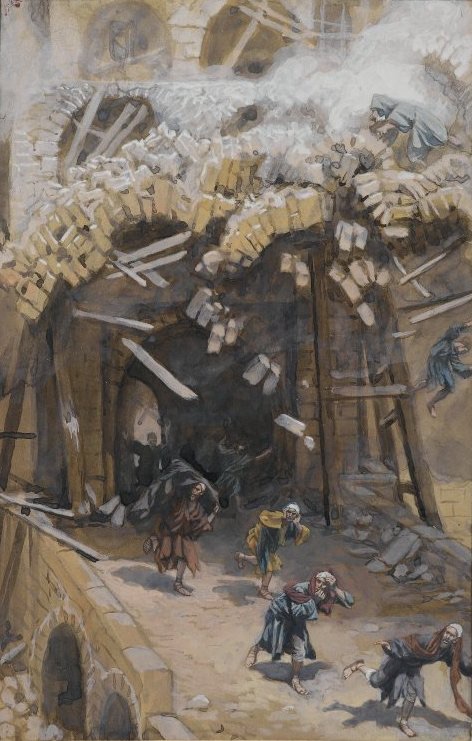
(from the Brooklyn Museum collection)
 An Informed Faith