
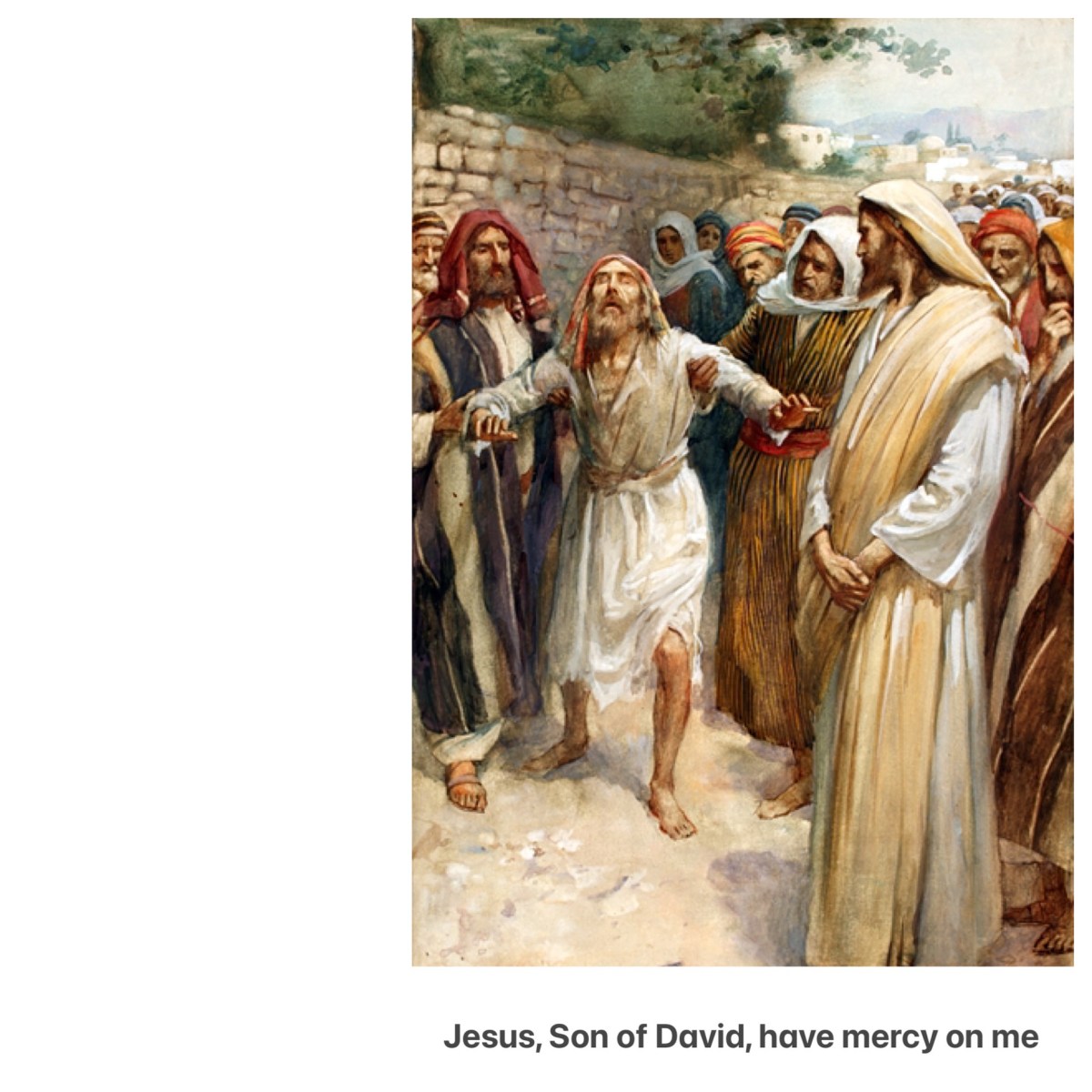
The man sits on the ground, beside the road leading into Jericho. Sensing what was happening, who was passing by, what was being spoken about; unable to use his eyes, he was undoubtedly attentive through his listening ears, through the sounds he could hear, as well as the fragrances he could smell. Because of this, he knew the identity of the person passing by, so he calls out with confidence, “Jesus, Son of David, have mercy on me” (Luke 18:38).

Jesus pauses, engages with the man, and responds to his plea. “Receive your sight; your faith has saved” (18:42). The man, all of a sudden, could see; all was clear, so he took his place among those following Jesus on the way (18:43).
This incident takes place towards the conclusion of the lengthy journey that Jesus undertook with his disciples, from Galilee in the north (4:14, 31; 5:17; 8:1, 26, 40), through Samaria (9:51–56; 17:11–19) and into Jericho (18:35; 19:1) en route to Jerusalem (19:11, 28, 41). That journey had I commenced soon after Jesus had been transfigured on the top of a mountain (9:28–36). This striking event, at which Moses and Elijah appeared, pointed towards the exodon (NRSV, “departure”) which Jesus “was about to accomplish at Jerusalem” (9:31).
The essence of that exodon is revealed by Jesus in the words he speaks to his disciples both immediately prior to, and soon after, his transfiguration. Before, he declares “the Son of Man must undergo great suffering, and be rejected by the elders, chief priests, and scribes, and be killed, and on the third day be raised” (9:22). After, he provides a brief summary: “the Son of Man is going to be betrayed into human hands” (9:45). The journey to Jerusalem would be a journey to his death. When this journey is almost at an end, Jesus returns to this teaching, reminding them “we are going up to Jerusalem, and everything that is written about the Son of Man by the prophets will be accomplished” (18:31).
At the start of the journey, the disciples had exhibited a thorough and complete lack of understanding at the teaching of Jesus. Luke provides a succinct threefold declaration that “they did not understand this saying; its meaning was concealed from them, so that they could not perceive it”, before noting that “they were afraid to ask him about this saying” (9:45).
Over the course of the journey, Jesus has taught, healed, told parables, and cast out demons, all of which (we might imagine) could have alerted the disciples to the true nature of the mission of Jesus. So, when the group approaches Jericho, Jesus reminded them of his earlier words, giving more extensive details about what this entails: “he will be handed over to the Gentiles; and he will be mocked and insulted and spat upon; after they have flogged him, they will kill him, and on the third day he will rise again” (18:32–33).
Whilst the disciples were completely ignorant at the start of the journey—at the end, sadly, they were apparently none the wiser. Luke again offers a succinct threefold exposé of the continued ignorance of this group: “they understood nothing about all these things; in fact, what he said was hidden from them, and they did not grasp what was said” (18:34).
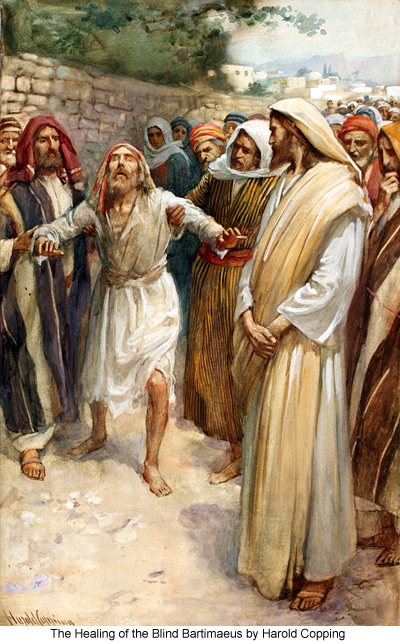
So the healing of the blind man functions as an enacting of the teaching of Jesus; it is a moment of revealing that Jesus was, no doubt, hoping would become evident to his followers. As the blind man hear the noise of a nearby crowd, he enquires and is told, “Jesus of Nazareth is passing by” (18:37). The man, it seems, does not share the ignorance or hesitancy of the disciples; he immediately reaches out to the man passing by, calling out “Jesus, Son of David, have mercy on me!” (18:38), and then repeating the plea when he was told to be quite (18:39).

The request, “have mercy on me”, sounds much like a prayer to God; it exactly echoes the prayer in a psalm attributed to the penitent adulterer-murderer, David (“have mercy on me, O God, according to your steadfast love”; Ps 51:1) as well as the cry of the pilgrim travellers heading towards Jerusalem (“have mercy upon us, O Lord, have mercy upon us”; Ps 123:3) and another psalm ascribed to the time “when David fled from Saul in a cave” (“be merciful to me, O God, be merciful to me, for in you my soul takes refuge”; Ps 57:1). This phrase has, of course, become the basis of a much-repeated prayer amongst pious Christians: “Lord, have mercy on me”.
Indeed, God’s mercy is acknowledged in many psalms—most notably in the well-known affirmation, “surely goodness and mercy shall follow me all the days of my life” (Ps 23:6), but also in another dozen places (Ps 25:6; 40:11; 69:16; 79:1; 86:15; 103:4; 111:4; 116:5; 119:77, 156; 123:2–3; 145:8). God’s mercy is integral to the repeated biblical affirmation, “the Lord is merciful and gracious, slow to anger and abounding in steadfast love” (Ps 103:8; see also Exod 34:6; Neh 9:17; Ps 86:15; 145:8; Joel 2:13; Jon 4:2).
The man by the road knows of this divine mercy, and believes he will receive it from Jesus. He stands as a striking contrast to those walking with Jesus along the road who, despite an extended time of learning from Jesus, fail to understand him. This man knows exactly what Jesus offers, and he pleads for it. And the immediate response from Jesus was to restore his sight, affirming “your faith has saved you”(18:42)—the same affirmation given to the woman who, before he had set out on this journey, had anointed his feet (7:50).
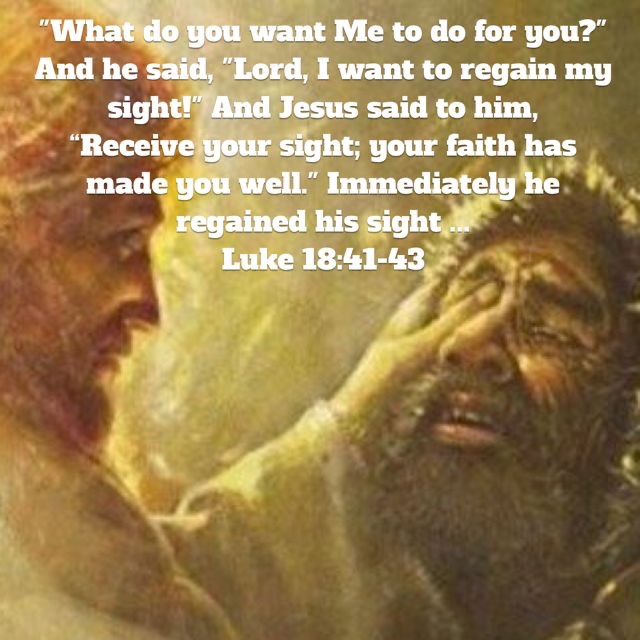
The conclusion to the story is clear and impactful: “he regained his sight and followed him, glorifying God; and all the people, when they saw it, praised God” (18:43). This man responds to the actions of Jesus as he “followedm him”; he joins those already following him, his committed disciples (5:11, 27–28; 7:9; 9:11, 23, 57–62; 14:27; 18:22, 28), as they walk into Jerusalem.
The man’s response of “glorifying God” shows that he knows the source of the power that Jesus had to heal. It replicates the response of the paralytic man who had been healed by Jesus (5:25). The response of the crowd, “praising God”, echoes the words of Simeon over the infant Jesus soon after his birth (2:28), and anticipates the response of the centurion at the very moment of the death of Jesus (23:47). It also resonates with the responses of the crippled woman (13:13) and the Samaritan leper (17:15), each of whom recognises the divine source of the power manifested by Jesus.

 An Informed Faith