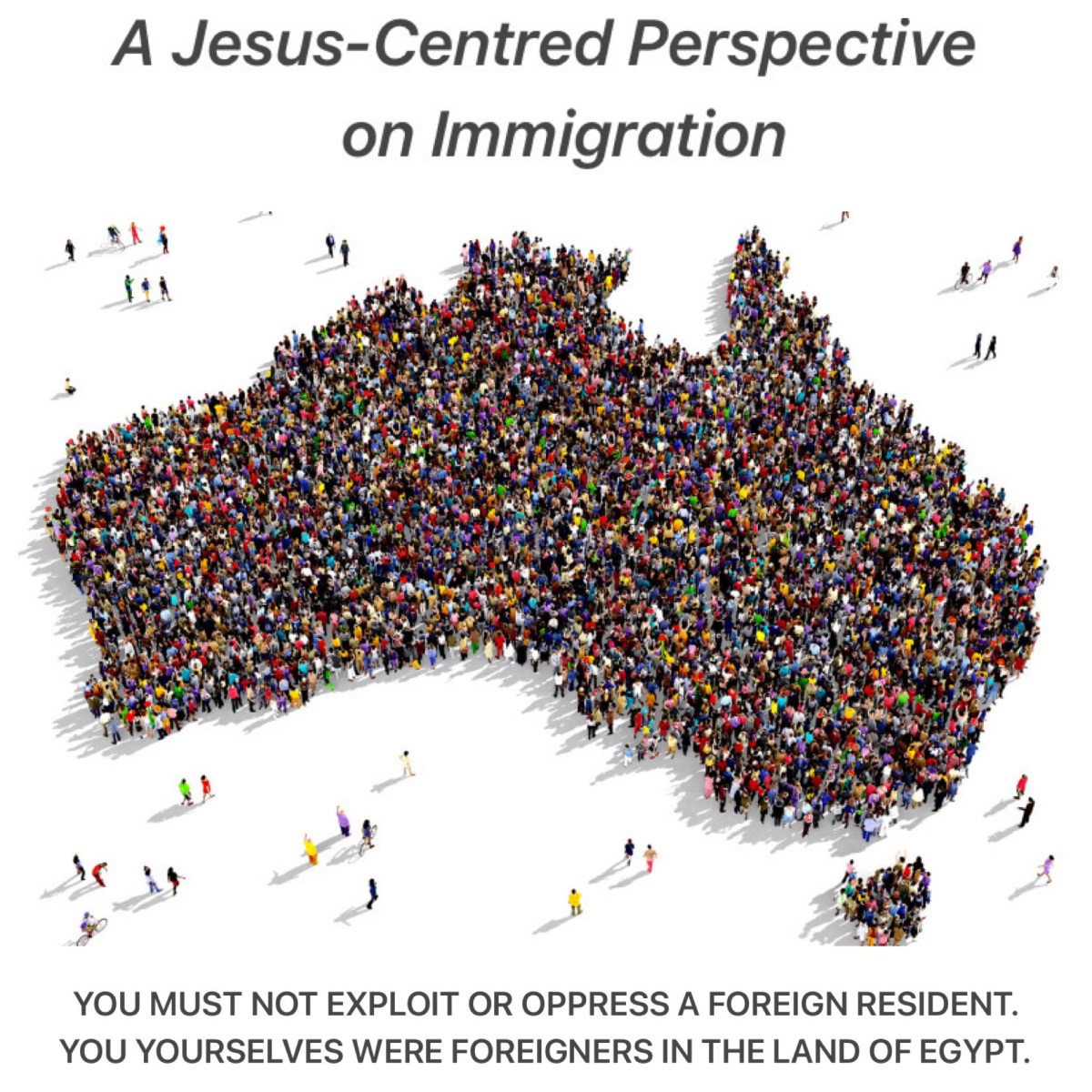
A Jesus-Centred Perspective on Immigration

This is a blog written by a guest blogger, the Rev. Pablo Nunez. Pablo is minister of the Ballina Uniting Church and Moderator-Elect of the NSW.ACT Synod of the Uniting Church in Australia. It is particularly pertinent for today, when xenophobic fascists are trying to mobilise people to “protest against immigration” in Australia. Thanks to Pablo for permission to reproduce his words here.

If you pause for a moment and look around Australia, what do you see? Beaches that take your breath away. Red dirt that stains your shoes and stretches your imagination. Cities alive with languages, smells, and flavours from all over the world. And at the heart of it all, the world’s oldest continuous culture, Aboriginal and Torres Strait Islander peoples, who have lived here, cared for this land, and told its stories for thousands of years.

That’s the starting point. Before we speak about immigration, we need to say out loud: every single non-Indigenous person in Australia is here because of migration. Some of us came by ship generations ago, some by plane more recently. Some came fleeing war, some chasing opportunity, some brought by chains, others by choice. But none of us, apart from our First Nations brothers and sisters, can truly call ourselves original to this land.

And if that’s true, then the way we talk about migration in Australia has to begin with humility.

*****

Jesus Was a Migrant

The story of Jesus is not a neat, polished tale of a man who lived in one safe place his whole life. From the beginning, his life was marked by displacement. Born in Bethlehem, raised in Nazareth, taken as a refugee to Egypt because a violent ruler wanted him dead. Jesus knew what it meant to live in a strange land. He knew what it was to flee under the cover of night, to live with uncertainty, to depend on the hospitality of others.
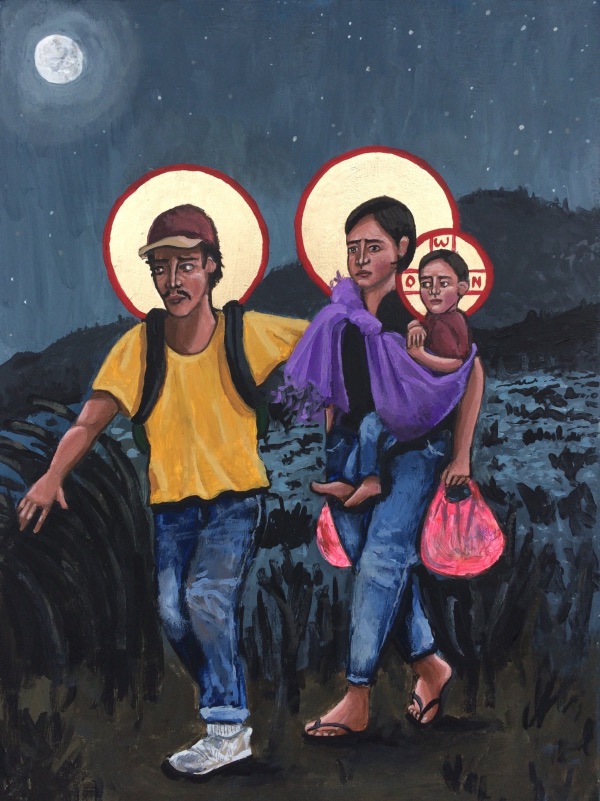

La Sagrada Familia by Kelly Latimore

Later, as an adult, Jesus would walk dusty roads from village to village, never truly at home, saying: “Foxes have dens and birds have nests, but the Son of Man has no place to lay his head” (Luke 9:58). He was, in every sense, a migrant—on the move, without fixed security, dependent on God and others.

So when Christians think about immigration, we don’t start with politics or economics. We start with Jesus. And Jesus says something radical: when you welcome the stranger, you welcome me (Matthew 25:35).

*****

Migration Is in Our Blood

Sometimes in Australia we talk about immigration as if it’s something unusual or threatening. But migration is the story of us all. Think about it:

  • The Irish came during the potato famine.
  • The Chinese came during the gold rush.
  • Italians and Greeks came after the war, bringing pasta, olives, and coffee that changed our food culture forever.
  • Pacific Islanders have brought love for family, music, faith and more than a few sports’ stars.
  • Vietnamese families arrived in the 1970s, rebuilding their lives after war and giving us the joy of pho and banh mi.
  • More recently, African communities have brought strength, music, and resilience born from hard journeys.
  • Latin Americans, like myself, came in different waves, some fleeing dictatorships, some chasing new opportunities, and we bring rhythms, faith, and fire for life.

Australia today is richer—economically, socially, culturally, spiritually—because of migrants. We wouldn’t be who we are without them. And the truth is, most of our favourite things—our food, our music, our sport—carry a migrant story. Even Vegemite was invented by a man whose parents came from Switzerland.

Migration is not an interruption to the Australian story—it is an essential part of the Australian story.

*****

The Gift of the Stranger

Here’s the thing about migrants: they don’t just bring their skills, their recipes, and their music. They also bring gifts we desperately need but often overlook.

Migrants remind us of courage—because leaving your homeland is never easy. They remind us of resilience—because starting again from scratch takes grit. They remind us of generosity—because most migrants know what it’s like to have little, and so they share what they have.

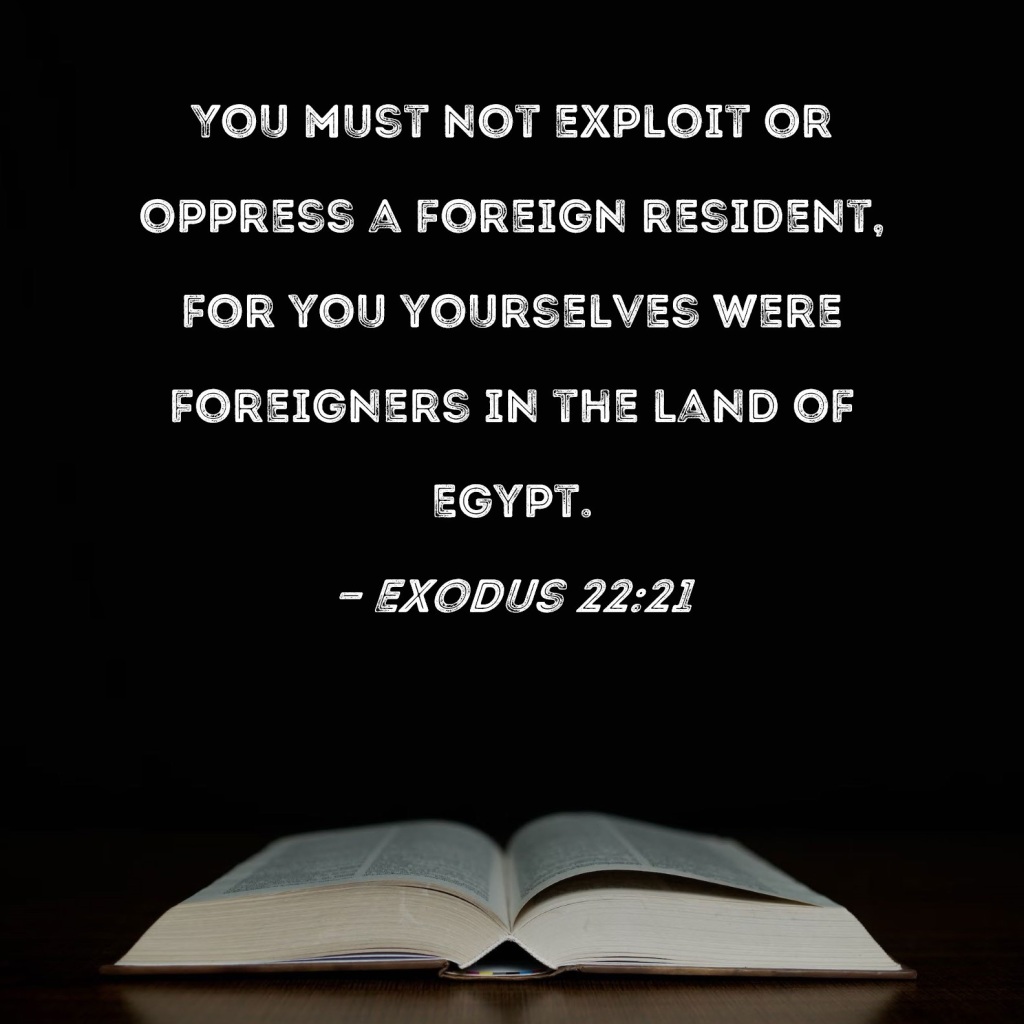
And, most profoundly, migrants remind us of God. Over and over in Scripture, God appears through the stranger. Abraham entertains three mysterious travellers and realises he’s been hosting God (Genesis 18). The Israelites are told: “Do not oppress the foreigner, because you yourselves were foreigners in Egypt” (Exodus 22:21). And then Jesus himself comes as the refugee child.

To welcome the stranger is to make room for God.
*****

A Personal Word

I carry this personally. I wasn’t born in Australia. My family story, like many of yours, is one of packing up, crossing borders, learning a new language, and trying to fit into a place where you don’t always feel you belong.

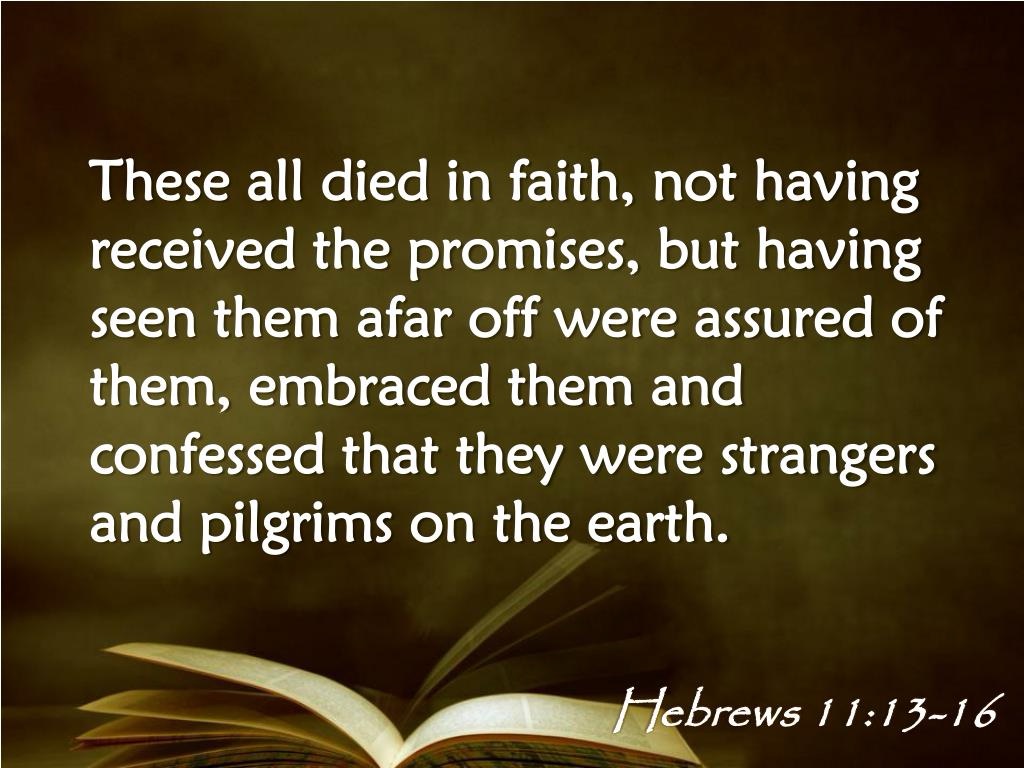
And yet, what I’ve discovered is that this tension—this experience of not quite belonging—actually brings me closer to the heart of God. Because faith is, at its core, a migrant journey. Hebrews 11 describes all the great heroes of faith as “foreigners and strangers on earth, longing for a better country—a heavenly one.”

In that sense, migration is not only Australia’s story, it’s the Christian story. We are all on the move, walking toward God’s promised future.
*****

A Challenge for the Church

But here’s the challenge: in Australia, conversations about immigration often get reduced to fear. Fear of boats. Fear of “the other.” Fear that there won’t be enough jobs or houses or space.

Jesus calls us to a different way. If every person is made in the image of God, then every migrant is not a threat but a gift. If Jesus himself was a refugee, then to reject the refugee is, in some sense, to reject Jesus. And if the Spirit of God is at work in every culture, then immigration is not about us “helping them,” but about recognising the Spirit who comes to us through them.

This means the Church in Australia has a prophetic role: to remind our nation of its migrant story, to model hospitality, and to show that love is bigger than fear.

What if every church treated migrants not as projects, but as partners? What if we saw multicultural worship not as a challenge, but as a glimpse of Revelation 7:9—a great multitude from every nation, tribe, people, and language worshipping before the throne? What if we stopped seeing immigration as a “problem” and started seeing it as a mirror of the kingdom of God?
*****

Building Our Legacy

Friends, Australia is at its best when it remembers its migrant heart. Our legacy will not be built on shutting doors, but on opening tables. On meals shared. On friendships made. On seeing the image of God in one another.

And the Church must lead the way. Because when we welcome the migrant, we are not only welcoming a neighbour—we are welcoming Christ into our lives in new perspectives and possibilities. A new life. A better life.
So let’s be people who celebrate our heritage, acknowledge our debt to First Nations peoples, and embrace the truth that every migrant—past, present, and future—brings a gift from God.

Australia’s modern story is migration. The Church’s story is migration. The Gospel’s story is migration. And in all of it, Jesus is the one who walks with us, the migrant Messiah, calling us to follow him into a kingdom where every tribe and tongue has a place at the table.

The Rev. Pablo Nunez, Moderator-Elect,
Synod of NSW.ACT, Uniting Church in Australia
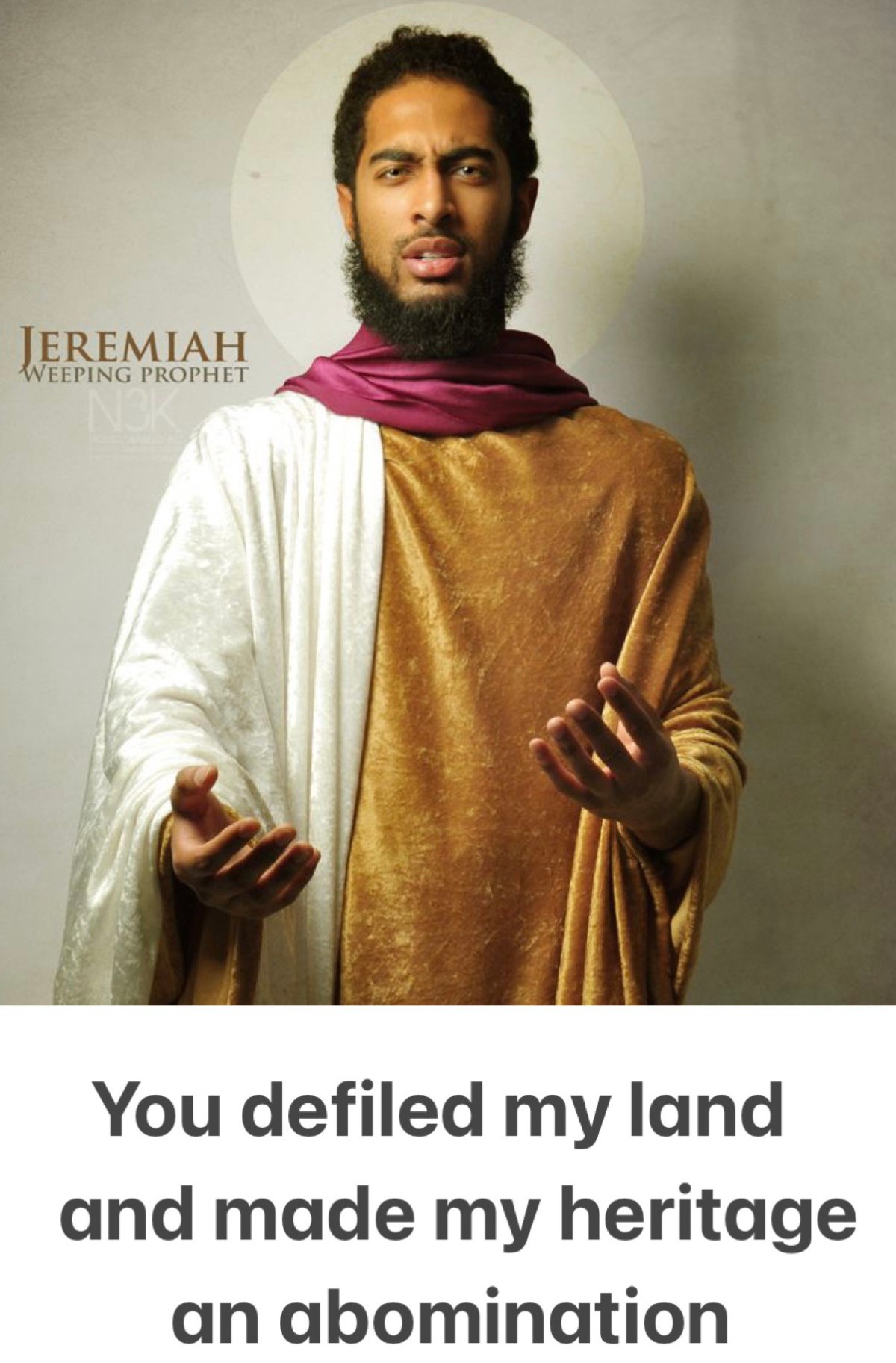
You defiled my land and made my heritage an abomination (Jer 2; Pentecost 12C)

Last week we began reading and hearing sections of the long book of Jeremiah. Of the first three major prophets, First Isaiah (the actual Isaiah the prophet) fills 39 chapters. The book of the exilic prophet Ezekiel is 48 chapters long; Jeremiah’s book has a mammoth 52 chapters. (The only book longer is Psalms, with an unbeatable 150 chapters.)

Jeremiah makes a most substantial contribution to Israelite society and Hebrew Scripture. It is good, I believe, that we have eight consecutive weeks, no less, to consider what he had to say. (And in the middle of that, the lectionary inserts Lamentations—a work traditionally associated with Jeremiah, even if not actually written by him.)

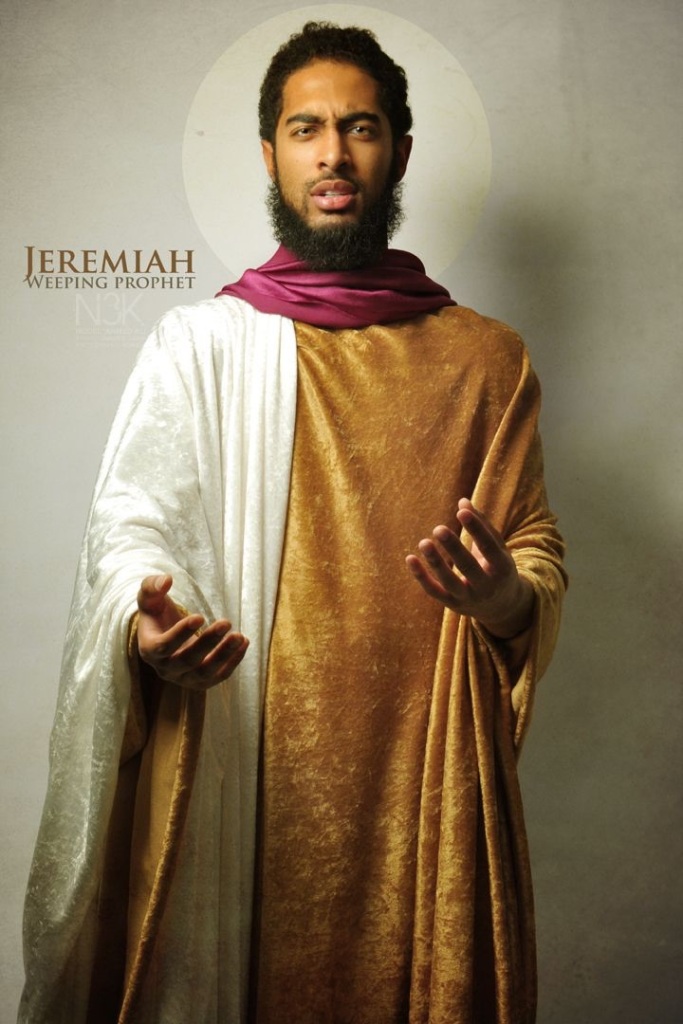
A depiction of the prophet Jeremiah, from the Icons of the Bible collection by photographer James C. Lewis
see https://elizabethokoh.com/in-conversation-with-james-c-lewis-international-photographer-awakening-a-generation/

We need to allow Jeremiah and his fellow prophets to speak their prophetic words without rushing all-too-quickly to say that they are “predicting Jesus” in what they say (a common misuse of Hebrew Scripture texts); or, indeed, that we say something like, “well that’s how it was back then, but things changed when Jesus came, and it’s now all different—we don’t need these texts any more”. That is the bad heresy of supercessionism (which the church, sadly, has perpetrate and advocated for at various times in its history).

On supercessionism, see https://johntsquires.com/tag/supersessionism/

So it’s best that we hear each passage, week by week, and seek to understand each of them in their own own integrity, paying due attention to the particular historical, cultural, religious, and sociological contexts in which it was first spoken and/or written. So my commentary on each Jeremiah passage will seek to focus in this way as we explore what is offered by the lectionary.

Jeremiah 2 comes immediately after the narrative of the call of the young Jeremiah (1:4–10) and the initial words of the Lord that he hears, pointing to the disaster that is looming as the Assyrians press down from the north onto the kingdom of Israel (1:11–19). Jeremiah reports the stern condemnation of the Lord God, who makes note of “all their wickedness in forsaking me”; he cites, in particular, making offerings to other gods and worshipping idols (“the works of their own hands”) (1:16).

Into this situation, the prophet is commanded to speak three oracles (2:1–3; 4–9; 10–13), perhaps originating at different times, but brought together here for a strongly theological purpose. The lectionary chooses to offer just the second and the third oracles; the first, a brief reminiscence of how disaster has come upon the once-faithful nation (2:1–3), sets the scene for the fiercer words of the following two oracles.

“I remember the devotion of your youth, your love as a bride”, the Lord God has sung (2:2); yet “your ancestors … went far from me”, he accuses, noting that “they went after worthless things, and became worthless themselves” (2:2, 5). Israel has not exhibited the fidelity expected; they have not kept the marital vow to “love and cherish”, in our modern terms. 

So in this second oracle (2:4–9), the Lord condemns Israel in the strongest of terms; even though he brought them “into a plentiful land to eat its fruits and its good things”, their transgressions were such that, as he declares, “you defiled my land, and made my heritage an abomination” (2:7). An abomination!—strong words, indeed.

For more on “abominations” in Hebrew Scripture, see

All knowledge of the Law which was given to guide the people has been lost (2:8). There is, it seems, no longer any hope that the people can maintain their part of the covenant agreement. Their lives are lived in disdain and rejection of all God has hoped for them—all that their ancestors had committed to in the covenant.

We might well infer, then, that judgement is inevitable. The stridency of punishment for such an “abomination” is reminiscent of the punishments promised when the “abominations” of sexual misconduct are canvassed in Torah (see Lev 18:1–23). There, any such actions will have the result that “the land will vomit you out for defiling it” (18:28) and “whoever commits any of these abominations shall be cut off from their people” (18:29).

In these two results—the loss of the land and disconnection from the people—we see the severing of two of the foundational promises recorded in the ancestral saga, when Abraham was promised both a land, and a great nation, in response to his obedience (Gen 12:1–2).

With no land, and a fractured people, this ancestral promise is in tatters. For many more verses, words of condemnation of the idolatrous state of Israel pour forth: “have you not brought this upon yourself by forsaking the Lord your God, while he led you in the way?” (2:17); “on every high hill and under every green tree you sprawled and played the whore” (2:20); “where are your gods that you made for yourself?” (2:28); “on your skirts is found the lifeblood of the innocent poor” (2:34); “you have played the whore with many lovers” (3:1); “you have the forehead of a whore, you refuse to be ashamed” (3:3). The Lord God is incessant in his denunciations.

Yet God does not wish for this situation to continue. At the end of this lengthy tirade, the prophet poses the question of God: “will he be angry forever, will he be indignant to the end?” (3:5). The answer to this comes in the very next oracle: a call for repentance, with the divine assurance that “I will not look on you in anger, for I am merciful, says the Lord; I will not be angry forever” (3:12), followed by the promise that “I will give you shepherds after my own heart, who will feed you with knowledge and understanding” (3:15). The lengthy oracle of judgment does indeed lead to the possibility of forgiveness and restoration (3:15–18). 

And so the fundamental dynamic of the whole long book of oracles spoken by Jeremiah is set forth. Intense, persistent, excoriating condemnation; followed by soothing, loving assurances of grace. For chapter after chapter. Decade after decade. Through all manner of trials. Until the prophet words of the prophet cease (Jer 51:64). 

By offering this passage for preachers in the 21st century, the lectionary invites us to consider how these ancient words from so long ago, in such a different cultural context, might yet still speak to us as “the word of the Lord”. In writing in With Love to the World about the passages from Jeremiah in the lectionary, the Rev. Dr Monica Melanchthon, Associate Professor of Hebrew Bible at Pilgrim Theological College in the University of Divinity, asks some pertinent questions:

How do you go about applying the role of the ancient Israelite prophet to your own life and experience? 

What aspects of Jeremiah’s call speak to you the most? Why?

How might the sins of the Israelites in Jeremiah 2 be parallel to modern day Christian living?

and then, How might this text guide your reactions to prophetic warnings in the current world?

Building towards the Creed (7): in conclusion

Looking back over the series of posts I have offered on these earlier credal-like passages found in scripture, I wonder: to what extent have these scripture passages influenced, or contributed to, the wording of the Nicene Creed? Some of them have provided phrases which are taken up in the earlier Apostles Creed, and then adopted by the writers of the Nicene Creed. Some phrases may be alluded to in the Nicene Creed.

However, much of that creed either draws on other comments and descriptions in scripture which are not explicitly credal in their original context; or they reflect the way in which the patristic champions of “orthodoxy” were reflecting on, and developing theologically, the story of Jesus, often in the context of disagreements and debates about particular issues that had emerged since the times in which scripture was written.

The lines that we might trace between these scriptural credal-fragments and the fully-developed Nicene Creed are faint and fragile. A full consideration of how the “non-credal” elements of scripture have informed the Creed is a larger project, beyond the narrow focus I have brought to this series of posts.

The Nicene Creed is undoubtedly a rich and complex document. A number of factors beyond scripture itself have obviously contributed to its development. As Bob Cornwall comments, “as this is a rather extensive statement, history demonstrates that over time early Christians found it necessary to address issues of the day that required more extensive definitions.” See https://www.bobcornwall.com/2025/01/confessing-apostolic-faithnicene-creed.html

On the Nicene Creed in the Uniting Church

I close this series of posts by noting that in the Basis of Union of the Uniting Church in Australia, it is stated that this church accepts this creed as an authoritative statement of faith, “framed in the language of [its] day and used by Christians in many days, to declare and to guard the right understanding of that faith”.

As a minister in the Uniting Church, I am instructed—and long have been committed—to undertake “careful study of [this] creed and to the discipline of interpreting [its] teaching in [this] later age”. That’s far more than the “regular rote reciting” of the Creed that I noted in my last post.

I think for me the Creed has its place as one valid perspective on faith, and although the Council that adopted this saw it as a way of narrowing faith and eliminating other options, I don’t. I do not believe that I am bound by decisions made in 325CE without subjecting them to critical scrutiny and reasoned interpretation. In fact, the Creed should be a basis from which I launch broader and more extensive explorations of matters of faith!

One thing that is very important to me is that a critical and thoughtful approach to the creeds is reflected in the specific wording employed in paragraph 9 of the UCA Basis of Union. This paragraph presents two complementary aspects of the place of creeds in our faith. On the one hand, it specifically notes the authoritative status and doctrinal function that these creeds enjoy within the church.

That’s certainly how the Creed has been seen, and used, over the centuries. It’s almost like it shuts down debate; simply “believe these words” and you are “in”, but “question these ideas” and you are at risk of being declared “outside”. So the Creed, in this view of things functions as a gate; and priests and ministers are the gatekeepers, ensuring the purity of orthodoxy.

Alongside that, however, para. 9 of the Basis of Union notes that the creeds were “framed in the language of their day” and then it commits UCA ministers and instructors “to careful study of these creeds and to the discipline of interpreting their teaching in a later age”.

That’s a clear indication that we need to do the work that is necessary to contextualise the words of the creed and explore carefully how they might be relevant for today. Simply standing and reciting the precise words, week after week, does not come anywhere near to doing this work. We need to dig down into and beyond the words themselves.

Both the authoritative status of the creeds as witnesses to faith, and critical interpretation of the words of the creeds within the present context, are valued in paragraph 9. And that’s as it should be: recognising historical significance of the words, but noting how important it is to contextualise them for our time. (And that’s what we need to do with all parts of the Bible, as well.)

*****

See previous posts at

Building towards the Creed (6): what Nicaea left out

This year, 2025, marks 1700 years since the Council of Nicaea was held. The Council was called by the Roman emperor Constantine; he invited bishops (local church leaders) from around the Roman Empire, to meet in in his imperial palace in Nicaea, Bythinia (in modern-day Turkey). They met in council from May to July in 325CE. The traditional account of the Council was that 318 bishops attended; most came from eastern churches, with only a small number from western churches. Despite this lopsided representation, the council is known as the first of a series of Ecumenical Councils, allegedly representing the worldwide church.

The end result of the Council was a Creed which bears the name of the meeting place: the Nicene Creed. Half a century later, this creed was expanded at the Council of Constantinople in 381 CE—another council called by the Roman emperor, who was by then Theodosius. What came from this council was the Nicene-Constantinopolitan Creed came to be widely adopted as a foundational expression of the Christian faith. Although various elements in the creed have been interpreted in a variety of ways, it has featured in the ancient churches of the East and the West, and in more recent centuries of the North and South.

However: any mention of the radical life to which Jesus calls disciples is omitted from the two earliest affirmations of faith—the Apostles Creed and the Nicene Creed. In finding a place within the power structures of the Roman Empire, the church fathers left out this aspect of the faith which they confessed. As Chris Budden wrote,

“The teachings of Jesus were a bit of an embarrassment to the [4th century] church and its relationship with power. The creeds which were developed at that time say almost nothing about the real life of Jesus or his teachings. Jesus is a saviour figure rather than one whose life and teachings matter.” (Chris Budden, Why Indigenous Sovereignty Should Matter To Christians, Wayzgoose, 2018, page 62).

The church fathers focussed on “other worldly” matters. Jesus became something of a super man, swooping down from on high to rescue humans from the mess of life and take them to a heavenly home, rather than a prophetic sage active within the gritty realities of earthly life, confronting injustice and living with compassion and grace.

What would a revised Creed look like, if we were to shape one today so that it identified and expressed the essential teachings of Jesus? I have pondered this over the last few years, and have a few suggestions to make.

If we follow the short, staccato precision of the earliest Creed, the Apostles Creed, we could insert something like:

Loving God and loving neighbour,

living in faith and working for justice,

he lived as he taught his followers to live,

praying for the coming of God’s rule here and now.

That’s short and sweet, summing up a lifetime’s teaching in four lines. In my mind, it has the virtue of citing the “two great commandments” that Jesus highlighted, using the key term “justice”, aligning words with deeds, as Jesus exhorted, and focussing on the rule of God, which was the topic for many of the parables and sayings uttered by Jesus.

But this probably fails to do justice to the full range of teachings that are placed on the lips of Jesus in the Gospels (or, at least, in the three Synoptic Gospels).

If we prefer the more expansive developments that unfold in later versions of credal affirmation, we could propose something like:

We rejoice that he came to give

sight for the blind, 

mobility for the lame,

acceptance for the outcast, 

and good news for the poor.

We remember that he guided us

to turn the other cheek and walk the extra mile,

to lend to those in need, expecting nothing in return,

to do to other people what we would have them do to us.

As we walk the way of Jesus, 

who was put to death on a cross,

yet raised back up to life,

we take up our cross, 

and lay down our lives;

we seek to love God with all of our being

and to love others as our neighbours.

In Jesus, we can see what the reign of God looks like;

in following him, we proclaim that reign in our lives,

we yearn that justice will mark all that we do,

and we celebrate the gift of life in abundance

as we work together for the common good.

Yes, that is much longer; it tries to pick up various phrases from scripture which might resonate with us today. It touches on a number of the teachings and sayings of Jesus which are valued within the church. A more expansive creed like this might provide a more realistic statement and a more effective teaching resource for the church today, perhaps? 

An interesting aspect of this process is that it forces you to make some choices amongst the array of words attributed to Jesus … it forces you to show your hand with regard to your own personal “canon within the canon” or ” red letter verses” in the teaching of Jesus. 

You can see what I chose. I wonder what you would choose?

*****

See previous posts at

and the final post at

Building towards the Creed (5): the Pastoral Epistles

This year, 2025, marks 1700 years since the Council of Nicaea was held. I am posting a series of blogs about the way that the New Testament texts contributed (or didn’t contribute) to the formulation that emerged from that First Ecumenical Council, as it is often styled. In earlier posts I explored affirmations in Paul and the Synoptic Gospels, a section of the letter to the Colossians, and the opening verses of the letter to the Hebrews and the Gospel attributed to John.

In this blog I turn to the Pastoral Epistles, which are often cited in support of a Christianity which is grounded in doctrinal statements about “the faith” These three letters contain regular references to “the faith” (1 Tim 3:9, 13; 4:1, 6; 5:8; 6:10, 12, 21; 2 Tim 2:19; 4:7; Tit 1:1, 4, 13; 3:15) and “the truth” (1 Tim 2:4; 3:13; 4:3; 6:5; 2 Tim 2:18, 25; 3:7–8; 4:4; Tit 1:1, 14). In 2 Timothy there are references to “the word of truth” that needs to be “rightly explained” (2 Tim 2:15) and “the standard of sound teaching that you have heard from me” (2 Tim 1:13), and an injunction to “guard the good treasure entrusted to you, with the help of the Holy Spirit living in us” (2 Tim 1:14). 

Sound teaching is also referenced in 1 Timothy, “the sound teaching that conforms to the glorious gospel of the blessed God” (1:Tim 1:10–11; also 4:6), while the letter to Titus refers to “the word that is trustworthy in accordance with the teaching” that Titus is told will ensure “sound doctrine” (Tit 1:9). These three letters clearly envisage a truth that can be conveyed in proportional statements.

So we find that “the mystery of our religion” can be summed up in six succinct claims about Jesus: that he was “revealed in flesh, vindicated in spirit, seen by angels, proclaimed among Gentiles, believed in throughout the world, taken up in glory” (1 Tim 3:16). 

Whilst the Nicene Creed affirms that Jesus “became human”, the only other element of this six-part credal statement that it reflects is the final clause, which underlies the statement that Jesus “ascended into heaven and is seated at the right hand of the Father … [he] will come again in glory to judge the living and the dead”. There’s nothing here about the salvation that Jesus brings,  despite this being a central Pauline theme (Rom 5:9–10; 10:9–10; 1 Cor 1:18; 15:1–2; 1 Thess 5:9–10) which is referenced in the Nicene Creed in the phrase “for us and for our salvation he came down from heaven”. 

The credal declaration of 1 Tim 3:16 declares that Jesus was “vindicated in spirit”. Although the word used is the same, these seems quite different from the way that the Spirit is referred to in the Nicene Creed, “we believe in the Holy Spirit, the Lord, the Giver of life” (and more). Again, the description of the Spirit in the Nicene Creed has taken various isolated scriptural “proof texts” about the Spirit and woven them into a cohesive “systematic theology” of that person of the Trinity.

It is noteworthy, though, that in 1 Timothy the Spirit has elsewhere been co-opted to become the guarantor of orthodoxy (“guard the good treasure entrusted to you, with the help of the Holy Spirit living in us”,  2 Tim 1:14), and the agent of an ecclesial ritual (God saved us “through the water of rebirth and renewal by the Holy Spirit”, Tit 3:4–6). The Spirit gifts “power … and self-discipline” (2 Tim 1:7), quite a different role from the gifts that are noted in the authentic letters by Paul. Whilst the Nicene Creed declares that the Spirit “has spoken through the prophets”, there is nothing to indicate that the Spirit has a role in guaranteeing orthodoxy.

The two letters Timothy each contain another short credal-like passage, both of which have some loose relationship to the Nicene Creed. The first is “there is one God; there is also one mediator between God and humankind, Christ Jesus, himself human, who gave himself a ransom for all” (1 Tim 2:5–6a). One God, the title Christ Jesus, and the affirmation of his humanity are each reflected in the Nicene Creed, but other phrases have no clear and direct correlation. 

The claim that Christ gave himself as “a ransom for all” most likely echoes the saying attributed to Jesus at Mark 10:45, “the Son of Man came not to be served but to serve, and to give his life a ransom for many”. This, in turn, is believed to be echoing a description of the function performed by “the righteous one, my servant” in the fourth of the four Servant Songs. At the end of this song, the claim is made that the servant “shall make many righteous bearing iniquities or being a ransom and he shall bear their iniquities” (Isa 53:11). 

Although there is no direct reference in the Nicene Creed to bearing iniquities or being a ransom for sin, it is said of Jesus that “for us and for our salvation he came down from heaven”, and that “for our sake he was crucified”. The phrase “for our sake” is considered by various commentators to have an allusion to the process of salvation.

Perhaps the inclusion of this phrase in the Creed was intended to pick up Paul’s affirmation that “for our sake he made him to be sin who knew no sin, so that in him we might become the righteousness of God” (2 Cor 5:21). This, in turn, has statements behind it like “Christ died for our sins in accordance with the scriptures” (1 Cor 15:3), he “loved me and gave himself for me” (Gal 2:20), and he  “gave himself for our sins to set us free from the present evil age” (Gal 1:4). So it does allude in a weak way to a scriptural idea.

The motif of salvation is, of course, at the very centre of Paul’s authentic writings (1 Cor 1:18; Rom 5:9–10; 10:9–19) and in later letters written in his name (Eph 2:5, 8; 1 Tim 2:3–4; 2 Tim 1:8–10; Tit 3:5). In the Creed, by contrast, whilst it is offered as a bare statement, the words move on quickly to other matters. Salvation receives but a passing note; quite a contrast to the way that Paul places it at the heart of his message. He tells the Romans that “now that we have been justified by his blood, will we be saved through him” (Rom 5:9), and the Thessalonians that he was “speaking to the Gentiles so that they may be saved” (1 Thess 2:16).

The second credal-like passage, in 2 Tim 2:11–13, begins with a concept that is more closely related to Paul’s own ruminations on baptism (Rom 6:1–11) than to any element in the Nicene Creed. “If we have died with him, we will also live with him”, the statement in 2 Tim 2 begins; “if we endure, we will also reign with him; if we deny him, he will also deny us; if we are faithless, he remains faithful—for he cannot deny himself.”

This poetic fragment, introduced with “the saying is sure”, sounds more like a sermonic reflection on and extension of the Romans passage. Perhaps “we look for the resurrection of the dead and the life of the world to come”, in the Nicene Creed, might point to some of this sermon in reflection, but the Creed is tighter and more focussed in its statement. Again, the allusion is weak and brief.

But perhaps the intention of those who formed the Creed was simply to note, but not expand on or explain, these central elements of the faith? Perhaps the Creed is actually a fourth century dot-point style bulletin, a list of keynotes that are to be mentioned and that require more detailed and expanded exploration? In which case, it is is study sessions exploring these central,elements of “the faith” which ultimately have much more value, in my opinion, that the rote reciting of these dot-points on a regular basis. Or is my reformed bias showing here??

*****

See previous posts at

and subsequent posts at

Building towards the creed (4): the Fourth Gospel

Each canonical Gospel ends with an account of the death of Jesus and his burial; the discovery of the empty tomb and subsequent appearances to various followers; and, in one case—that of Luke—an explicit account of his ascending into heaven. (Both Matthew, in its closing scene, and John, in one of the words of the risen Jesus, offer hints about this event without attempting to describe it.) 

The Nicene Creed certainly acknowledges this, albeit in a staccato shorthand manner: “on the third day he rose again in accordance with the scriptures; he ascended into heaven and is seated at the right hand of the father”. It then goes on to describe future events yet to take place: “he will come again in glory to judge the living and the dead, and his kingdom will have no end”. 

These statements draw from isolated verses found in a range of different contexts: various sayings attributed to Jesus, some statements made in Acts and some letters, and inferences drawn from Revelation. They are collated into a succinct, cohesive set of affirmations. It’s a very early instance of a method that became widespread throughout the centuries: weaving isolated “proof texts” into a single “systematic theology”.

However, the Creed turns a blind eye to much of what is told in the various Gospels, in terms of what Jesus said and did, who he encountered and what it meant to respond to his command to “follow me”, where he spent his time and what essential teachings he conveyed. These things were important to the Gospel writers—but not, it would seem, to the framers of the Creed. Perhaps they simply assumed these things from knowledge of the Gospel? But this would not explain why other aspects of the New Testament texts are, as we have seen, directly referenced within the Creed. Some selective editing was at work! See

The one exception to this might well be the thread running through the fourth Gospel, in which the series of conflicts that Jesus has with authorities in Judea revolve around the status of Jesus and his relationship to God. This issue sits at the heart of John’s Gospel, and it is also at the centre of the concerns reflected in the Nicene Creed.

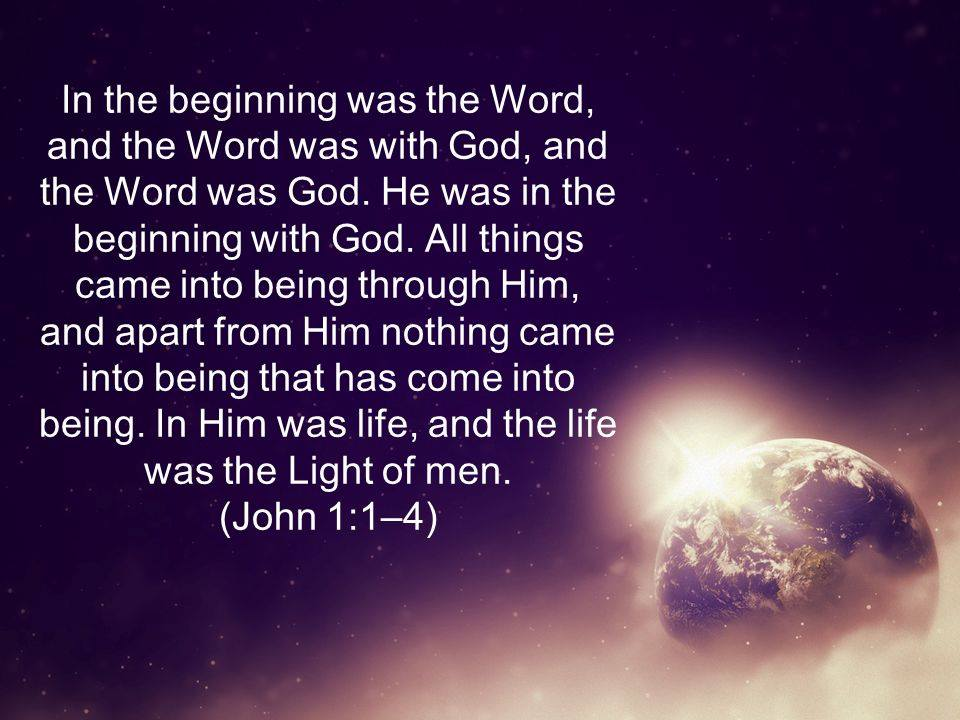
In the Prologue to this Gospel, as we have seen, the pre–existent Logos, the word made flesh, Jesus Christ, is the one who “makes God known” (1:1, 14, 17-18). Jesus “speaks the words of God” (3:34; 8:47; 12:50; 14:8–10; 17:14), gives teaching which is “from God” (7:16–18; 14:24; 17:7–8), makes known “everything that I have heard from my Father” (15:15), utters words of “spirit and life” (6:63, 67). For the author of this Gospel, Jesus is, indeed, the Word who was always with God (1:1).

There are some striking claims made about Jesus in this Gospel, which relate directly to the Creed. Beside the Sea of Tiberias, Simon Peter affirms that, in Jesus, “we have come to believe and know that you are the Holy One of God” (John 6:69). Later, in Bethany, it is Martha who expresses what Peter had said (in the Synoptic Gospels) at Caesarea Philippi, “I believe that you are the Messiah, the Son of God”, before continuing with a characteristically Johannine addition, “(you are) the one coming into the world” (John 11:27).

It is worth exploring, however, how some of the other statements spoken about Jesus in this Gospel were made in contexts of dispute and disagreement. In the first half of the Gospel, the leaders in Jerusalem hear a series of teachings from Jesus and respond with surprise and a growing antagonism.

These leaders witnessed the healing of a lame man by Jesus and heard his claims about his authority (ch.5), leading them to accuse him of “making himself equal to God” (5:18). They heard him speak about himself as “the living bread which came down from heaven” (ch.6), although the key response in this chapter is not from the authorities, but from those following Jesus: “this teaching is difficult; who can accept it?” (6:60).

As Jesus teaches during the Festival of Booths (ch.7), “the chief priests and Pharisees sent temple police to arrest him” (7:32), but this threat was not carried through, for the temple police report back with their observation, “never has anyone spoken like this!” (7:46). Jesus continues with a further speech, claiming “I am the light of the world” (8:12; also 9:5). Is this a deliberate echo of the “pillar of fire by night” that gave light to the travelling Israelites (Exod 13:21; Neh 9:12, 18)? Certainly, looking forward from John’s Gospel, there is a clear allusion to this claim in the credal affirmation that Jesus is “Light from light”.

After Jesus makes this claim, the debate with the authorities intensifies with Jesus accusing them, “you are from your father the devil, and you choose to do your father’s desires” (8:44) and the authorities responding, “are we not right in saying that you are a Samaritan and have a demon?” (8:48). This scene ends with the first threat to stone Jesus (8:59).

Then, after some Pharisees take the lead in interrogating a man who had been healed from his blindness by Jesus (ch.9), they reviled Jesus with the statement, “we are disciples of Moses; we know that God has spoken to Moses, but as for this man, we do not know where he comes from” (9:28–29). The antagonism continues, focussed around the identity of Jesus. In a further speech, Jesus then claims “I am the gate for the sheep”, lambasting those who came before him (presumably the Jewish authorities and their precursors) as “thieves and bandits”, declaring that “the sheep did not listen to them” (10:7–8). 

Jesus intensifies matters still further when he appropriates the shepherd, a well-known image for leadership amongst the Jews (Jer 3:15, 23:4; Ezek 34:1–12; Ps 78:70–72), claiming that “I am the good shepherd” (John 10:11, 14). Again, he is accused by some of being possessed by a demon, although not all agree (10:19–21), and again there is a threat to stone him (10:31). His words are provocative: “the Father and I are one” (10:30). The response is equally incendiary: “you, though only a human being, are making yourself God” (10:33). 

Yet again, Jesus avoids being arrested (10:39), but what he does next seals the deal in the mind of his powerful opponents. Responding to a plea to travel to Bethany, where his beloved friend Lazarus was ill, Jesus arrives to find him dead and in his tomb (ch.11). The narrator reports that Jesus made a sweeping claim for himself: “I am the resurrection and the life” (11:25)—the last of seven “I am” statements in this Gospel, which cumulatively provide a significant case for the unique significance of Jesus. For the author of this Gospel, Jesus is “the only Son, who is close to the Father’s heart” (1:18) who has been “made equal with God” (5:18); indeed, the Johannine Jesus claims explicitly, “the Father and I are one” (10:30).

To demonstrate that he is indeed “the resurrection”, Jesus called Lazarus out of the tomb—as a result of which, “many of the Jews therefore, who had come with Mary and had seen what Jesus did, believed in him” (11:45). Some of them, however, “went to the Pharisees and told them what he had done” leading to a meeting of the council which determined to put him to death (11:46–53). And so the decision is made, and the path is set. 

Soon after, the narrator reports that “Jesus, knowing that the Father had given all things into his hands, and that he had come from God and was going to God, got up from the table, took off his outer robe, and tied a towel around himself” (13:3–4). Later, Jesus told his followers that “now the Son of Man has been glorified, and God has been glorified in him. If God has been glorified in him, God will also glorify him in himself and will glorify him at once” (16:27). 

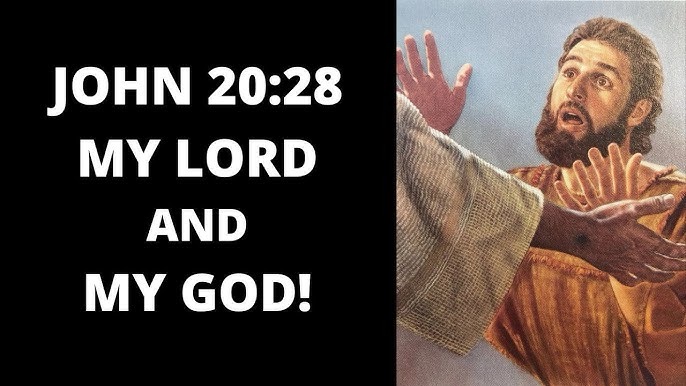
Then, after his death—and his resurrection from that death—Thomas utters the definitive Johannine declaration about, Jesus: “My Lord and my God!” (20:28). There can be no doubt, for this evangelist, about that claim. (No Synoptic author comes close to attributing any such claim to Jesus.) Again, the Nicene Creed echoes this in its assertion that Jesus is “true God from true God … of one being with the Father”.

It is worth recalling the antagonistic context in which Jesus makes some of his best-known and much-beloved affirmations. It is also worth noting that the Council that made the decisions about the wording of the Nicene Creed was also an environment of highly-contested disagreements. Why, the tale is told of one member who used physical violence to restrain another, echoing the conflicts of John 5–11. At least in this regard, those who wrote the Creed were faithful to the aggressive methos and polemical tone of scripture!

This Gospel thus follows a very different pathway from that offered by the Synoptics Gospels, which relentlessly orient the focus of the reader or hearer onto what Jesus said and did in Galilee, and then what was said and done to Jesus in Jerusalem. And the Nicene Creed, of course, happily ran headlong along the pathway opened up by the fourth Gospel, and, as we have noted, left the many significant elements of the body of each of the Synoptic Gospels to be noted, almost as afterthoughts, in a short sequence of punctiliar comments: he “became incarnate … was made human … was crucified under Pontius Pilate … suffered death and was buried”.

See previous posts at

and subsequent posts at

Building towards the Creed (3): the preludes of Hebrews and John’s Gospel

This year, 2025, marks 1700 years since the Council of Nicaea was held. I am posting a series of blogs about the way that the New Testament texts contributed (or didn’t contribute) to the formulation that emerged from that First Ecumenical Council, as it is often styled. The first post explored some one-phrase credal-like affirmations in Paul and the Synoptic Gospels; the second post examined a section of the letter to the Colossians.


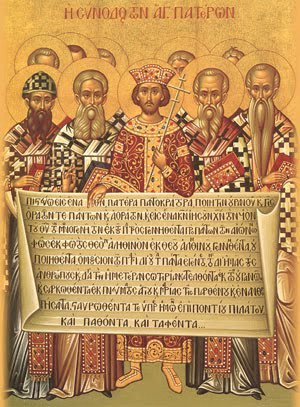
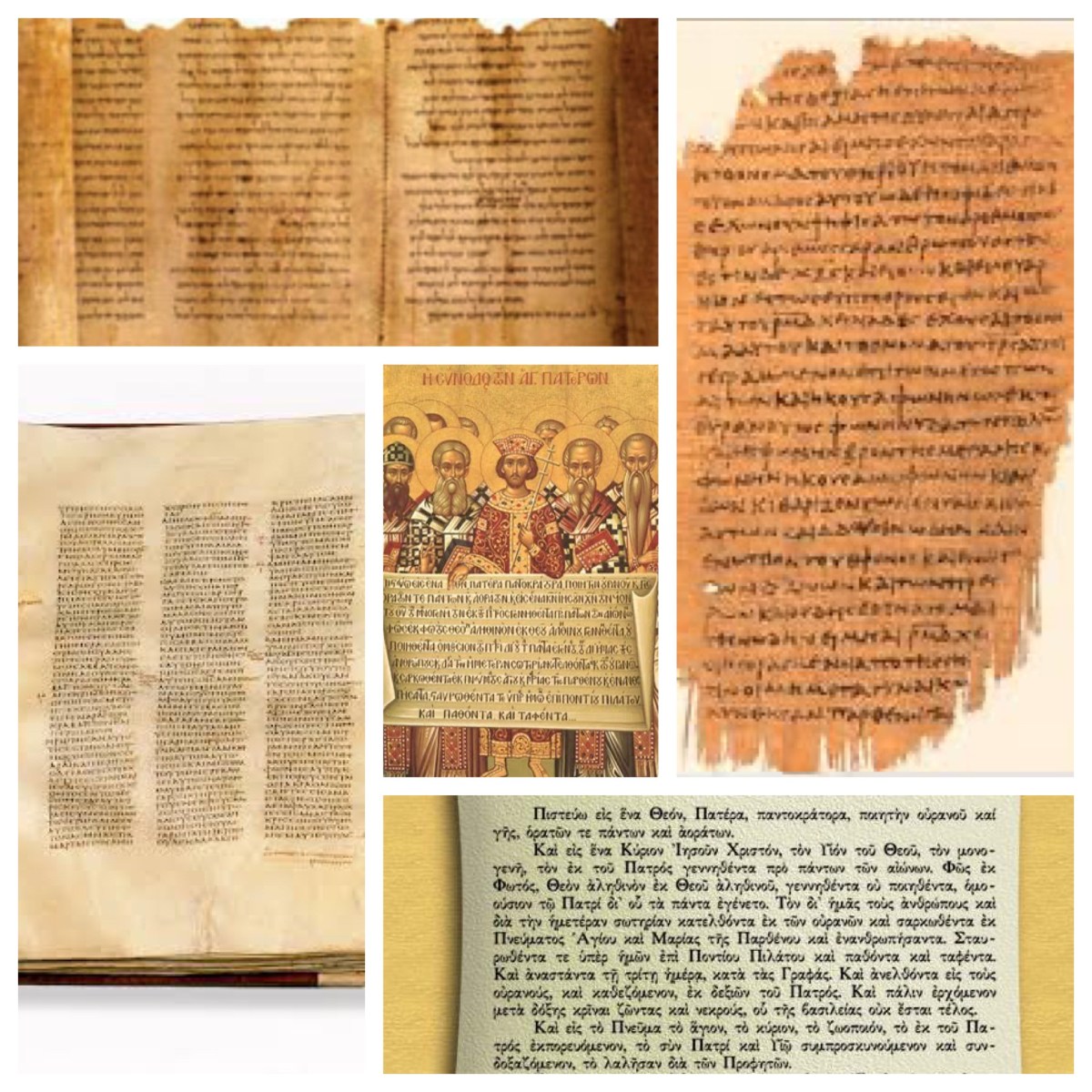
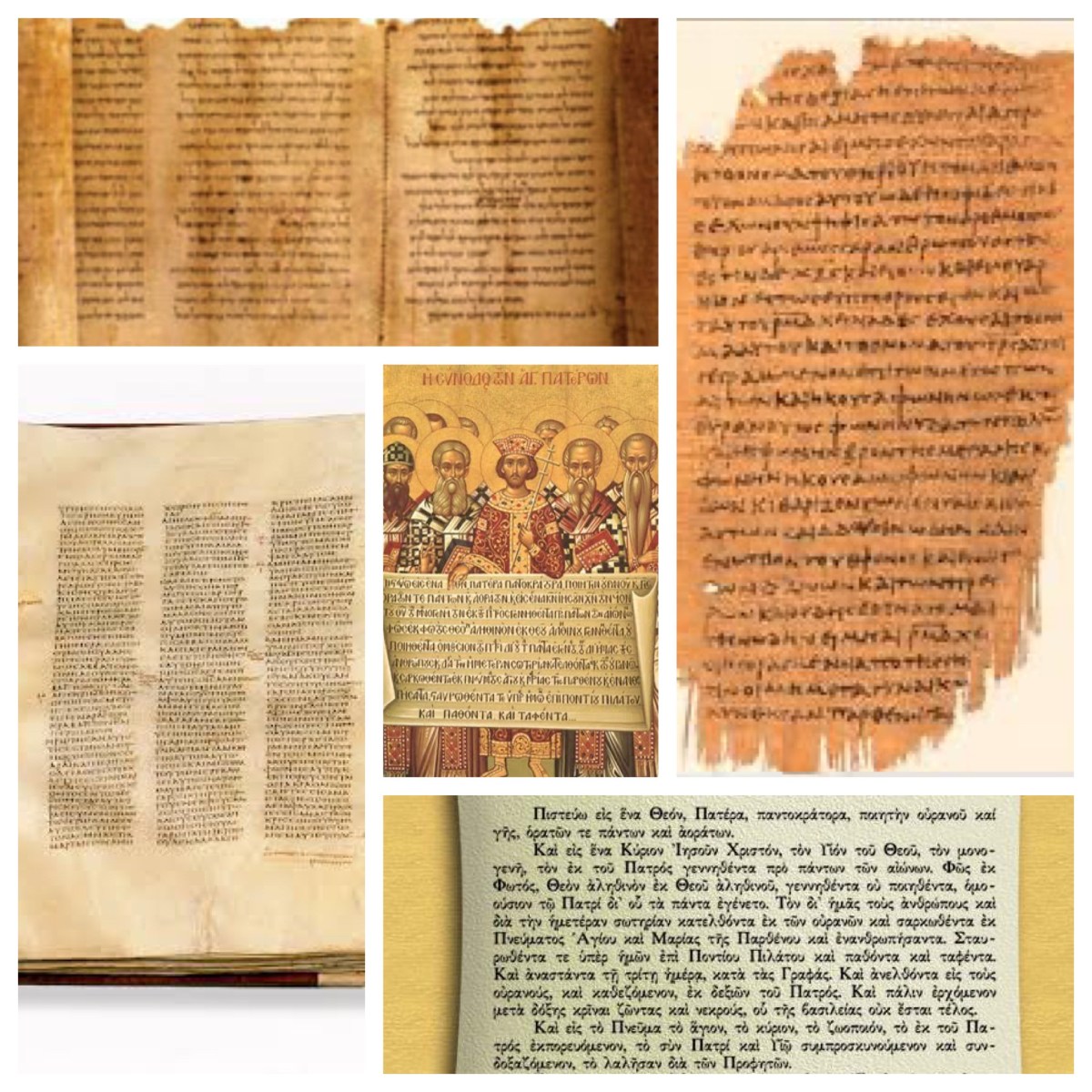
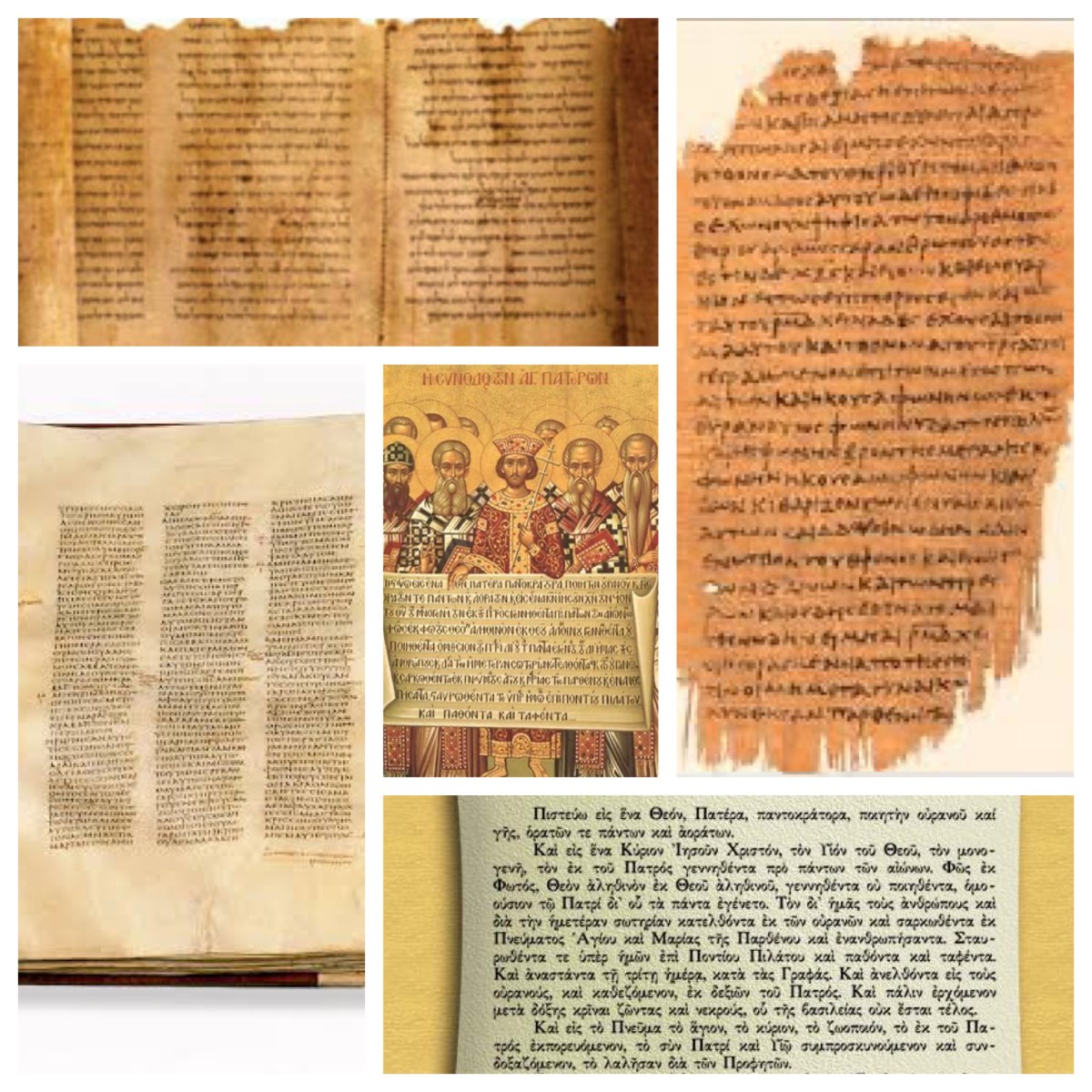
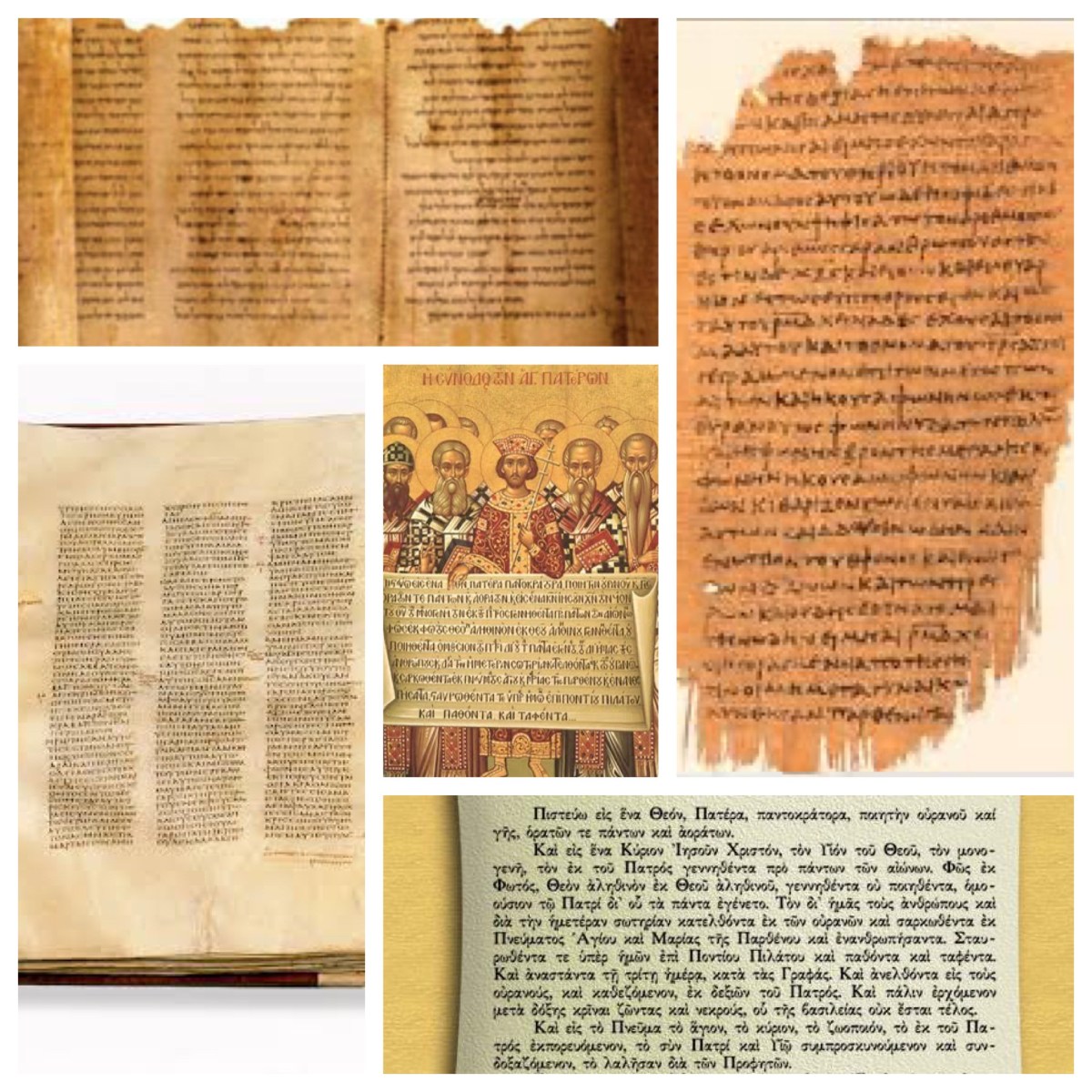
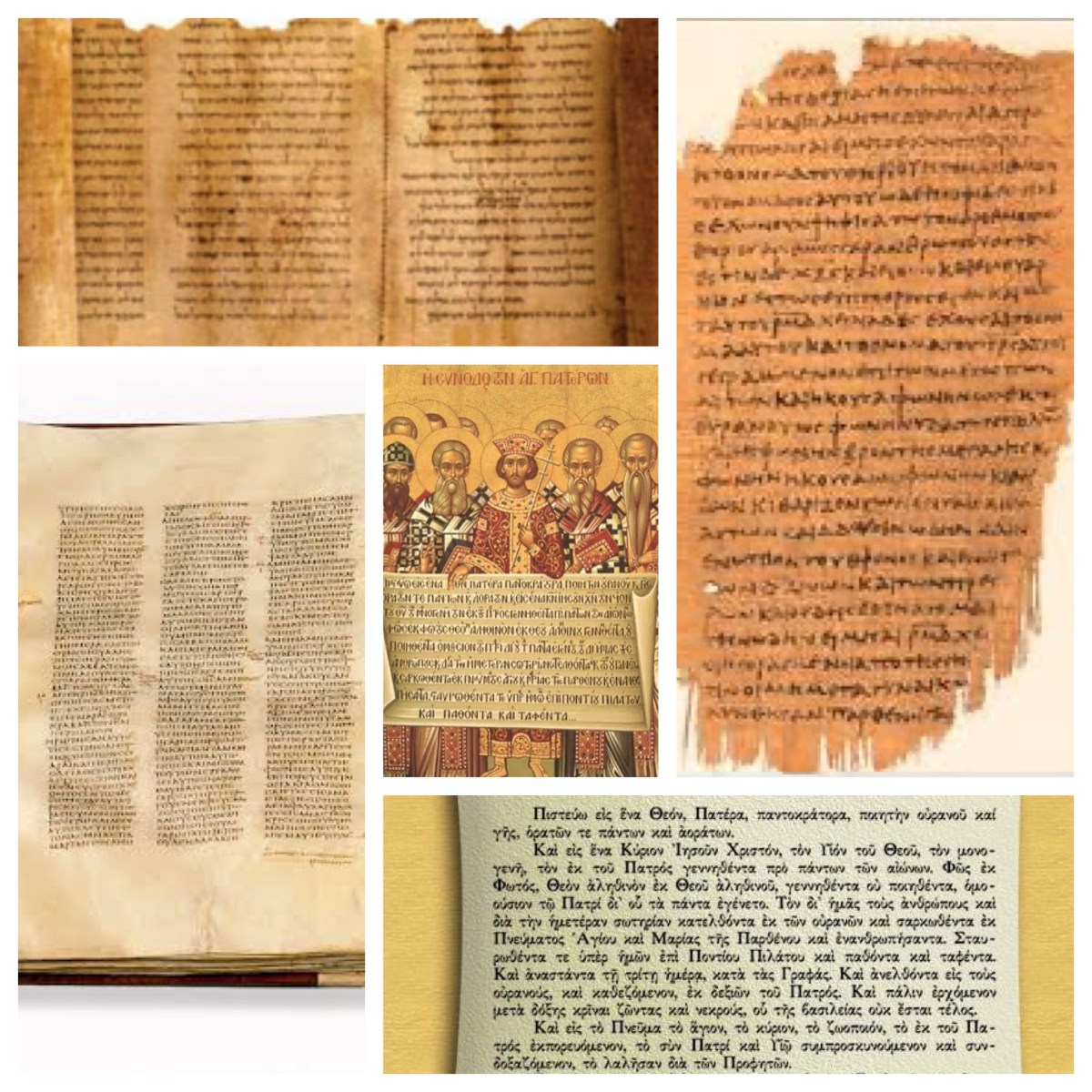
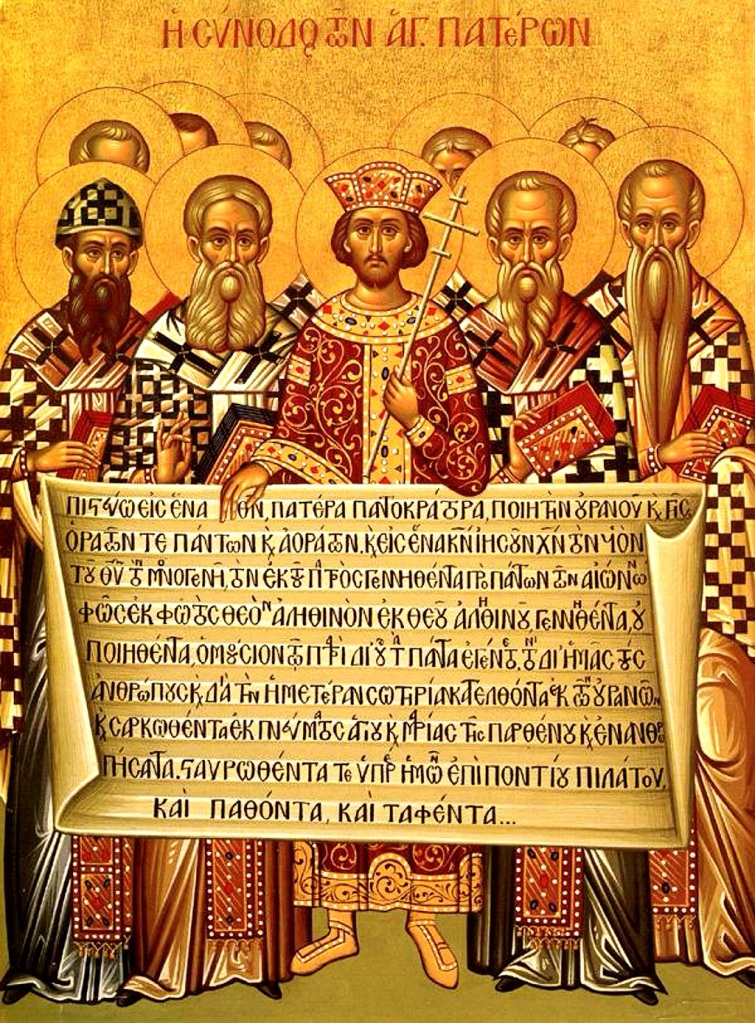
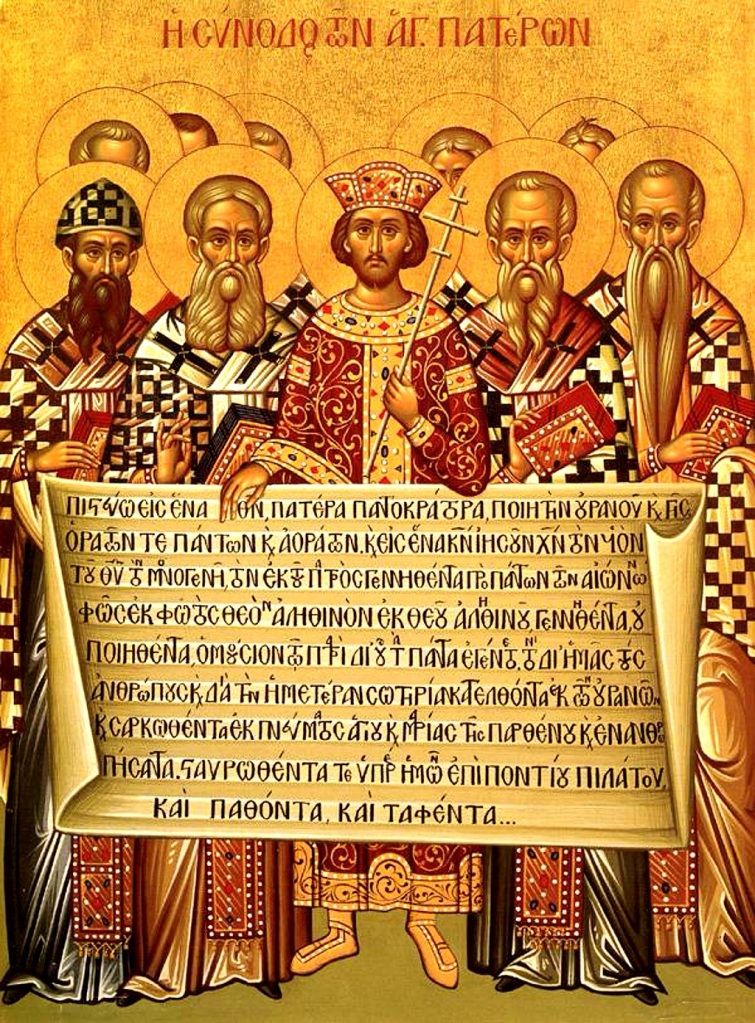
Icon depicting Constantine the Great, accompanied
by some of the bishops of the First Council of Nicaea (325),
holding the Niceno-Constantinopolitan Creed of 381.
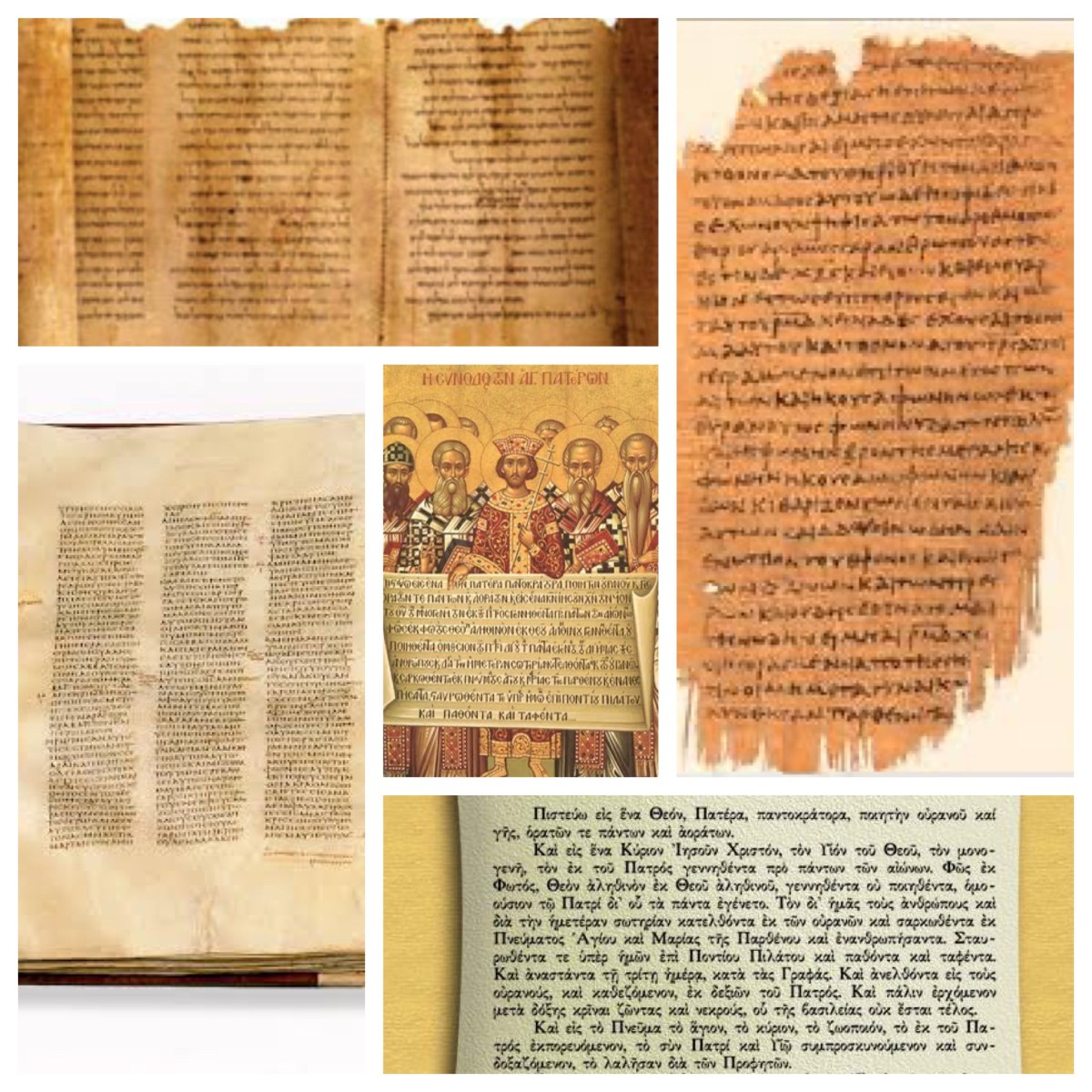
First line of main text in Greek: Πιστεύω εἰς ἕνα Θ[εό]ν, πατέρα παντοκράτορα, ποιητὴν οὐρανοῦ κ[αὶ] γῆς. Translation: “I believe in one God, the Father the Almighty, Maker of heaven and earth.”

We have looked at 1 Corinthians and a scene in the Synoptic Gospels, as well as a passage in Colossians that draws significantly on Wisdom texts to explain the importance of Jesus. There are other places in the New Testament which make quite explicit use of the Wisdom literature as they take ideas about Lady Wisdom—as co-creator with God, as revealed and teacher of things from God—and apply them directly to Jesus. In the course of doing this, of course,  Wisdom loses her feminine identity, as it is subsumed in the masculine figure of Jesus (as we have already seen in Colossians). In the first few centuries of the church, Patriarchy Rules!!

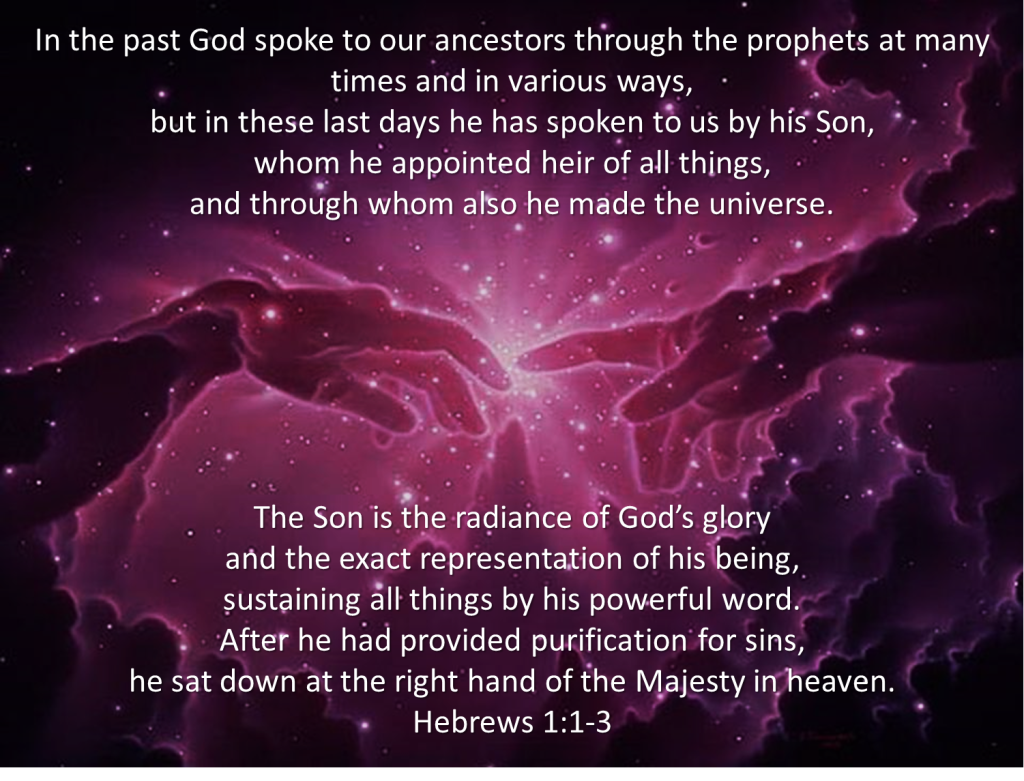
The two places where this use of Wisdom motifs can be seen are in the opening verses of the letter to the Hebrews (Heb 1:1–4) and in the majestic poetic prologue to John’s Gospel (John 1:1–18). In both cases, Jesus is the speaking forth of God, as Wisdom was; and in both cases, Jesus is seen to have been present with God at the creation of the world, and active in the creative process, as Wisdom was.

In the prologue to Hebrews, its anonymous author declares that God, who “long ago spoke to our ancestors in many and various ways by the prophets” has more recently, “in these last days … spoken to us by a Son” (Heb 1:1), one who “sustains all things by his powerful word” (Heb 1:3). In the prologue to the fourth Gospel, the John who is attributed as its author similarly declares that the pre–existent Logos (John 1:1), revealed as “the Word [who] became flesh” (John 1:14), was the one who “makes God known” (John 1: 17–18). 

These statements mirror the affirmations made in earlier Jewish texts about Wisdom. According to Proverbs, her declaration is very public: “Wisdom cries out in the street; in the squares she raises her voice; at the busiest corner she cries out; at the entrance of the city gates she speaks” (Prov 1:20–22; see also 8:1–3). What she speaks bears the mark of God’s teachings; her words are noble, true, what is right, and completely righteous (Prov 8:6–8).

As she speaks, teaching her children, she “gives help to those who seek her” (Sir 4:11). As he writes of Wisdom in a later time, Ben Sirach describes how “in the assembly of the Most High she opens her mouth, and in the presence of his hosts she tells of her glory” (24:1–2). In her words is wisdom for life and instruction for souls (51:25–26).

The motif of “word” then runs consistently throughout the fourth Gospel: Jesus “speaks the words of God” (John 3:34; 8:47; 12:50; 14:8–10; 17:14), gives teaching which is “from God” (7:16–18; 14:24; 17:7–8), makes known “everything that I have heard from my Father” (15:15), utters words of “spirit and life” (6:63, 67). For the author of this Gospel, Jesus is, indeed, the Word who was always with God (1:1). It is a striking appropriation of the role that Wisdom has played, according to these earlier texts. 

Turning back to the prologue to this Gospel, we note that Jesus is portrayed not only as the speaking-forth of God as “the word”, but also as the one who manifests glory, “the glory as of a father’s only son, full of grace and truth” (John 1:14). Indeed, the glory shown by Jesus had been evident centuries earlier, as was attested in the words of Isaiah (John 12:41).

This claim about Jesus resonates with the description of Wisdom as “a pure emanation of the glory of the Almighty” (Wisdom Sol 7:25). Indeed, the motif of “glory” hearkens back to wilderness stories in Exodus and Numbers and receives its clearest New Testament expression, in relation to Jesus, at Col 1:15–20, as we have previously seen.

The imagery of “glory” is taken up and then intensified in the prologue of Hebrews, where Jesus is seen as “the reflection of God’s glory and the exact imprint of God’s very being” (Heb 1:3). Indeed the Wisdom of Solomon, the figure of Wisdom was portrayed in majestic terms as “a breath of the power of God … a reflection of eternal light, a spotless mirror of the working of God, and an image of [God’s] goodness” (Wisd Sol 7:25–26). Hebrews itself echoes the language of the Wisdom of Solomon.

The person of Wisdom, a reflection of God, the exact imprint of God, emanating directly from the Almighty, had earlier been described in Proverbs as being “set up, at the first, before the beginning of the earth” (Prov 8:30), taking part with the deity in the acts of creation. The poetry builds through repetition and ever-expanding circle of influence; when “he established the heavens, I was there”, she says; “when he drew a circle on the face of the deep, when he made firm the skies above, when he established the fountains of the deep, when he assigned to the sea its limit … when he marked out the foundations of the earth” (Prov 8:27–29). In all these acts of creation, Wisdom was beside the Lord, “daily his delight, rejoicing before him always, rejoicing in his inhabited world and delighting in the human race” (Prov 8:30–31).

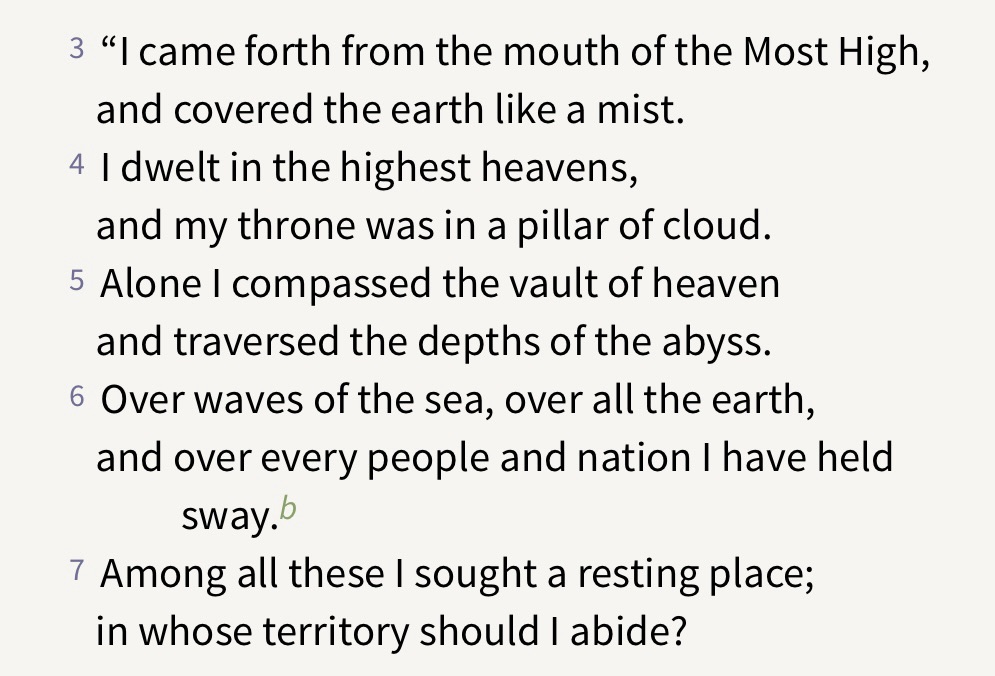
This affirmation leads on to the claim that Wisdom “pervades and penetrates all things” (Wisd Sol 7:24) and “renews all things … [she] passes into holy souls and makes them friends of God, and prophets” (Wisd Sol 7:27). She “reaches mightily from one end of the earth to the other, and she orders all things well” (Wisd Sol 8:1). Likewise, Jesus son of Sirach writes in a song of Wisdom that she “came forth from the mouth of the Most High, and covered the earth like a mist” (Sir 24:3), expanding on this in a sequence of grand claims: “I dwelt in the highest heavens, and my throne was in a pillar of cloud. Alone I compassed the vault of heaven and traversed the depths of the abyss. Over waves of the sea, over all the earth, and over every people and nation I have held sway.” (Sir 24:6).

And so, just as Wisdom has been with God since the beginning, working with God in every phase of creation, the claim is then made for Jesus, the Word,  that he was “in the beginning with God” (John 1:2), and that “all things came into being through him, and without him not one thing came into being” (John 1:3). The co-creative role of Wisdom has been claimed for the Word, the sole creator of the world.

And, indeed, the presence of this Word throughout all the world is expressed in another characteristic Johannine image, as the Word comes as “the light of all people” a light which “shines in the darkness”, the “true light” which “enlightens everyone” (John 1:4–5, 9). This is picked up with focussed clarity in the claims later put onto the lips of Jesus, “I am the light of the world” (8:12; 9:5; and see 12:35–36, 46).

So there is a clear and direct trajectory in Jewish documents, from the scriptural text of Proverbs, through the Intertestamental texts of the Wisdom of Solomon and Ben Sirach, into the New Testament texts as indicated. And from there, into the credal structures of the emerging patristic church, affirming that belief in Jesus entails acknowledgement that he is “the only Son of God, eternally begotten of the Father, God from God, Light from Light, true God from true God, begotten, not made, of one being with the Father”. Whilst some of the precise terminology and its relationship to the biblical texts might be debated, the line of development (from Wisdom, to Word, to creed) is clear.

All of which makes it rather striking that so much of the second section of the Nicene Creed is devoted to articulating a line of thought that draws from a relatively small collection of biblical texts, whilst almost completely ignoring the vast majority of what the New Testament bears witness to: the life of Jesus, his teachings, his fervent sense of justice, his passionate desire to reform and renew Judaism, and the miraculous deeds attributed to him.

The richness of meaning and wideness of scope of so many stories and teachings and passages within the New Testament is reduced and narrowed to a small collection of words in the creed. The creed itself is largely focussed on matters heavenly, speculative, and philosophical. Such is the nature of the Nicene Creed.

*****

See earlier posts at

and subsequent posts at

Building towards the Creed (2): Colossians

This year, 2025, marks 1700 years since the Council of Nicaea was held. I am posting a series of blogs about the way that the New Testament texts contributed (or didn’t contribute) to the credal formulation that emerged from that First Ecumenical Council, as it is often styled. The first post explored some one-phrase credal-like affirmations in Paul and the Synoptic Gospels. In this post the focus is on a section of the letter to the Colossians.


Icon depicting Constantine the Great, accompanied
by some of the bishops of the First Council of Nicaea (325),
holding the Niceno-Constantinopolitan Creed of 381.
First line of main text in Greek: Πιστεύω εἰς ἕνα Θ[εό]ν, πατέρα παντοκράτορα, ποιητὴν οὐρανοῦ κ[αὶ] γῆς. Translation: “I believe in one God, the Father the Almighty, Maker of heaven and earth.”

Alongside the very short credal affirmations found in 1 Corinthians and the Caesarea Philippi scene in the Synoptic Gospels (see first post), another place in the New Testament where language from the scriptural traditions of Judaism is used to shape an affirmation of what is believed about Jesus is in the first chapter of the letter to the Colossians.

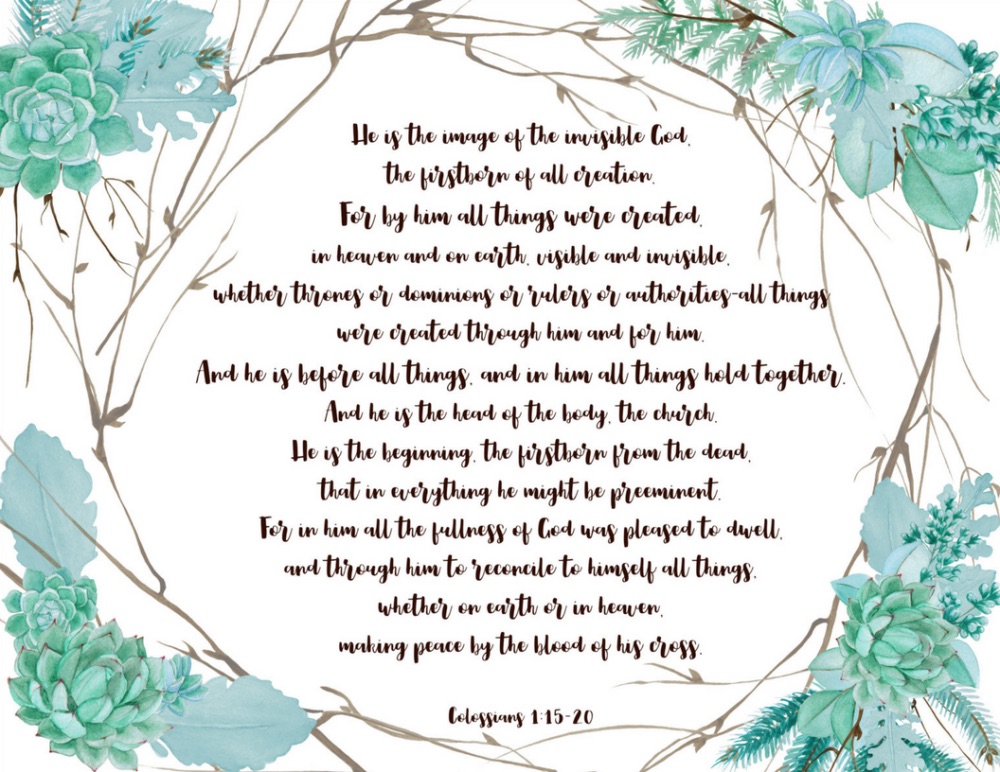
Col 1:15–20 provides us with a more complex example of what we might consider to be a creed “before Nicaea”. It provides some of the material for the developed theological confession of Jesus that the Nicene Creed uses (as just noted).

The author of this letter (claiming to be Paul, 1:1, although I am not convinced it was actually by him) begins with the expected words of greeting (1:1–2) and prayer of thanksgiving (1:3–8). The prayer morphs into a prayer of intercession for the Colossians (1:9–12), cycling back into an expression of thanks to “the Father” (1:12) for what he has done through “his beloved Son” (1:13–14). 

This thanksgiving then morphs seamlessly (in the original Greek, there is no sentence break) into an extended affirmation about Jesus, “the image of the invisible God, the firstborn of all creation … the head of the body, the church … the beginning, the firstborn from the dead …[in whom] all the fullness of God was pleased to dwell” (1:15–20).

This is quite an extension to the expression of thanks; the sentence in Greek actually begins in v.9 and continues through multiple subordinate clauses to v.20! It offers a relatively early consideration of “the person and work of Jesus Christ”, as later systematic theology writers would label it. It is a complex and intricate affirmation of faith.

The main thrust of this early creed, if we can call it that, can best be understood by giving consideration to the way this it draws on Jewish elements—specifically, the Wisdom material found in parts of Hebrew Scripture. Jesus is portrayed very much in the manner of Lady Wisdom, as we encounter her in scripture in Proverbs 8, and then in the deuterocanonical works of Ben Sirach (Ecclesiaticus) and the Wisdom of Solomon.

In Colossians, of course, the attributes of the female Wisdom are applied directly to the male Jesus. Jesus is here described as the agent of God’s creative powers: “in him all things in heaven and on earth were created … all things have been created through him and for him” (Col 1:16). In the same way, in Proverbs Wisdom herself is said to have declared that “ages ago I was set up, at the first, before the beginning of the earth … when [the Lord] established the heavens, I was there … when he marked out the foundations of the earth, then I was beside him, like a master worker” (Prov 8:22–31). 

In the Wisdom of Solomon, Wisdom is described as “the fashioner of all things” (Wisd Sol 7:22), “a breath of the power of God” who “pervades and penetrates all things”(7:24–25), who was “present when you [God] made the world” (9:9), whose “immortal spirit is in all things” (12:1). 

In Ben Sirach, Jesus, son of Sirach, declares that “Wisdom was created before all other things” (Sir 1:4), that at the very first she “came forth from the mouth of the Most High, and covered the earth like a mist” (Sir 24:3), and “compassed the vault of heaven and traversed the depths of the abyss” (24:5) as she undertook her creative works, distinguishing one day from another and appointing “the different seasons and festivals” (33:7–8).

Jesus Christ, as the one who is “before all things” (Col 1:17), reiterates what Wisdom declared, that “before the mountains had been shaped, before the hills, I was brought forth—when [the Lord] had not yet made earth and fields, or the world’s first bits of soil” (Prov 8:25–26).

So Jesus is the one who has “first place in everything” (Col 1:18), just as the works of Wisdom can be traced “from the beginning of creation” (Wisdom Sol 6:22). The importance of these Wisdom writings for what is stated in Col 1 is clear. (The same writings underpin the theological affirmations made about Jesus in Heb 1:1–4 and John 1:1–18; on which, see later posts.)

The passage in Colossians also indicates that believers are “transferred … into the kingdom of [God’s] beloved son” (Col 1:13); they are rescued (1:13) and redeemed (1:14) by the work of Jesus. In similar fashion, the Wisdom of Solomon contains a long section praising Wisdom who was actively involved in human affairs from when “she delivered him [Adam] from his transgression” (Wisd Sol 10:1), saved the people at the Exodus, and guided the Conquest and settlement in the land. It was Wisdom who punished the Canaanites (12:3–11), sinful Israelites (12:19–22), and the Egyptians (12:23–27), as well as all idolators (13:1—14:31).

A similarly lengthy poem praising the works of Wisdom occurs in chapters 44 to 50 of Ben Sirach, extending all to the way to Simon, son of Onias (high priest in the early C3rd BCE), just as the creative work of Jesus is noted in the Nicene Creed (“through him all things were made”, so his salvific work is also briefly described (“for us [all] and for our salvation he came down from heaven“).

These fleeting references draw on the way in which scripture has used the Wisdom literature— although, of course, all four Gospels and many Epistles note the forgiving, saving, delivering work of Jesus. It is, in fact, the bedrock of the developing patristic theology of the time between the New Testament and the early Ecumenical Councils. 

*****

See the first post at

and subsequent posts at

Building towards the Creed (1): Corinth and Caesarea Philippi

This year, 2025, marks 1700 years since the Council of Nicaea was held. The Council was called by the Roman emperor Constantine; he invited bishops (local church leaders) from around the Roman Empire, to meet in in his imperial palace in Nicaea, Bythinia (in modern-day Turkey).

Those bishops met in council from May to July in 325CE. The traditional account of the Council was that 318 bishops attended; most came from eastern churches, with only a small number from western churches. Despite this lopsided representation, the council is known as the first of a series of Ecumenical Councils, allegedly representing the worldwide church.

The end result of the Council was a Creed which bears the name of the meeting place: the Nicene Creed. Half a century later, this creed was expanded at the Council of Constantinople in 381 CE—another council called by the Roman emperor, who was by then Theodosius.


Icon depicting Constantine the Great, accompanied
by some of the bishops of the First Council of Nicaea (325),
holding the Niceno-Constantinopolitan Creed of 381.
First line of main text in Greek: Πιστεύω εἰς ἕνα Θ[εό]ν, πατέρα παντοκράτορα, ποιητὴν οὐρανοῦ κ[αὶ] γῆς. Translation: “I believe in one God, the Father the Almighty, Maker of heaven and earth.”

What came from this council was the Nicene-Constantinopolitan Creed came to be widely adopted as a foundational expression of the Christian faith. Although various elements in the creed have been interpreted in a variety of ways, it has featured in the ancient churches of the East and the West, and in more recent centuries of the North and South.

Where does this creed come from? There are some passages in scripture which have a “credal-like” quality. Might consideration of those sections of scripture lead us to understand what drove those fourth century bishops to formulate such a creed? I begin by considering two relevant passages where the early “credal-like” statement is very short. 

First: Corinth

The starting point for me would be in an early New Testament document, the first (extant) letter to the Corinthians, which Paul and Sosthenes wrote to the community of faith in Corinth in the middle of the fifth century (as we count time).

Paul and Sosthenes wrote addressing a situation where factionalism, dubious morality, unrestrained chaos in worship, theological divisions, and differing approaches to cultural practices threatened the very existence of a cohesive faith community. Seeking a common denominator that all could commit to and focus on as their bedrock, they proposed “Jesus is Lord” (1 Cor 12:3) as a foundational affirmation. 

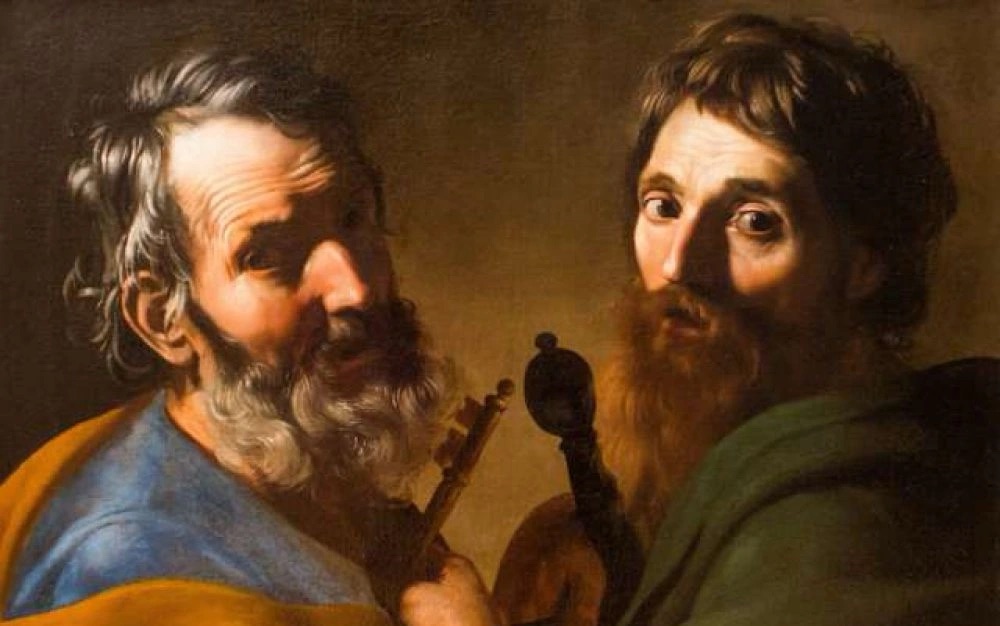
A contemporary imagining of Paul and Sosthenes

This confession describes Jesus using a term with significance in Hebrew Scripture (“who is God except the Lord?”, Ps 18:31). Later commentators have observed that within the Roman imperial context, the Emperor functioned in the manner of a Lord—although the precise claim that Christians were forced to say “Caesar is Lord” is not substantiated by any extant ancient document.

So the first credal statement in the early years of the movement that Jesus initiated was born in the midst of conflict, as a way to bring cohesion and unity. We know, however, from subsequent correspondence involving believers in Corinth (letters known as 2 Corinthians and 1 Clement) that this rhetorical effort was a failure; conflict and divisions continued within the community throughout the remainder of the first century CE. Later, at the Council of Nicaea, the tile “Lord” was applied both to Jesus (“the m

Next: Caesarea Philippi

Nevertheless, other writers in that early Jesus movement adopted a similar strategy, writing short, succinct statements which they believed would serve to unite disparate factions. In the earliest extant written account of the public activities of Jesus, Simon Peter tells Jesus, “you are the Messiah” (Mark 8:29). This was a simple Jewish affirmation, referring to one who had been anointed for a task as a prophet. We have indications of this for Elisha (1 Ki 19:16) and for an unnamed post-exilic prophet (Isa 61:1).

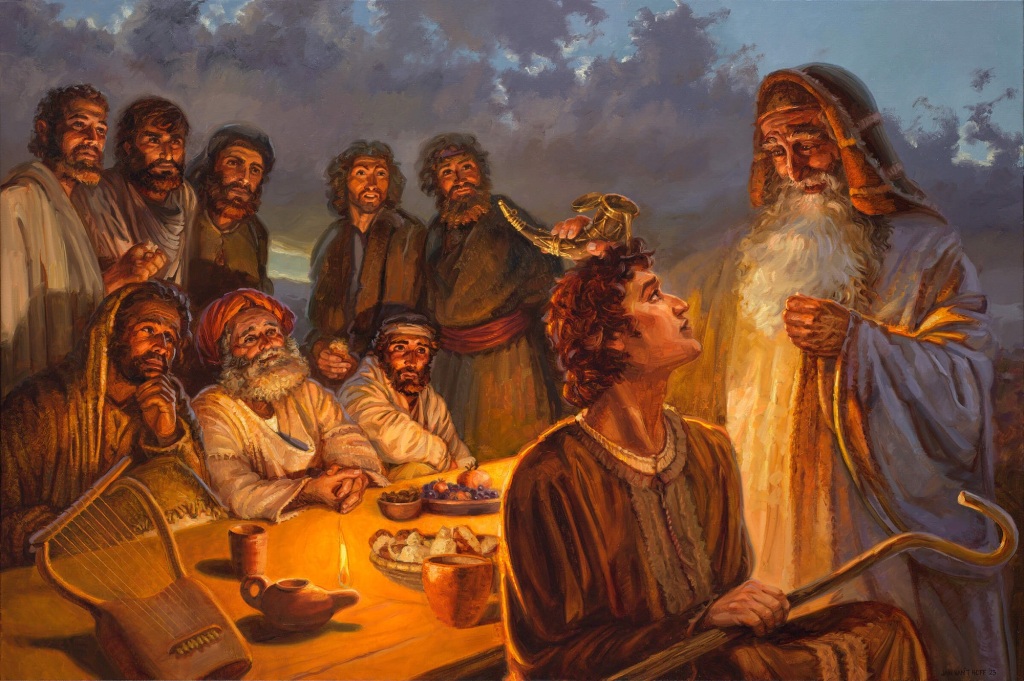
An imaginative depiction of David being anointed as king

Anointing was also used in the installation of kings: Saul (1 Sam 10:1–2; 15:7), David (1 Sam 16:13, in Israel; 2 Sam 2:1–7, in Judah; 5:1–5, 17; 12:7; 23:1, over all Israel), Solomon (1 Ki 1:38–40, 45), Jehu (2 Ki 9:1–3, 6, 12), Joash (2 Ki 11:12), Jehoahaz (2 Ki 23:30), and all of David’s descendants (Ps 18:50; 45:7; 89:20–21, 38–39, 49–51; 132:10, 17). 

Drawing from this Jewish heritage to make this confession makes sense, given that Jesus and Simon Peter were both Jewish men, and the incident that provoked this response by Peter took place on Jewish land—amongst “the villages of Caesarea Philippi”, on the northernmost edge of Israel.

A later writer took this confession—another very early creed, if you like—and expanded it just a little. “You are the Messiah, the Son of the living God”, Peter declares, in Matthew’s version of the incident (Matt 16:16).

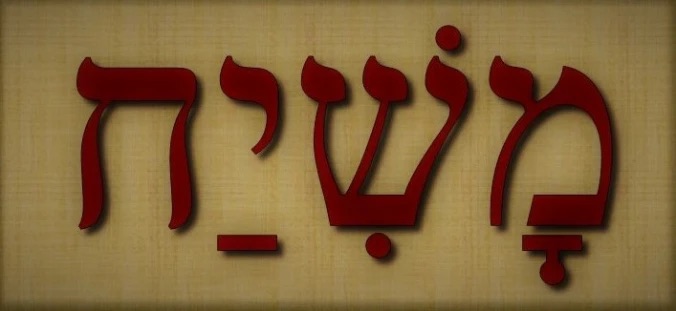
Messiah in Hebrew

Just as “Messiah” was a well-known term in Hebrew Scripture, so too “living God” is applied to the God of Israel in narratives (Deut 5:26; Josh 3:10; 1 Sam 17:26, 36; 2 Ki 19:4, 16, repeated at Isa 37:4, 16), prophets (Jer 10:10; 23:36; Dan 6:20, 26; Hos 1:10), and in psalms (Ps 42:2; 82:2). The use of a scriptural title to describe the significance of Jesus is thus an early credal affirmation. 

The scriptural title of Messiah appears in the Nicene Creed in the Greek equivalent, Christ, when the second part of the creed is introduced: “We believe in one Lord Jesus Christ”, before proceeding to use other terms for the exalted nature of Jesus as “eternally begotten of the Father; God from God, Light from Light, true God from true God; begotten not made, one in being with the Father”. These phrases are taken from parts of scripture that are not credal as such, but which reflect on the nature of Jesus in a developed theological manner. We will explore them in later posts.

*****

See