Antisemitism: yes, it’s about legislation—but more, it’s about our culture

It’s less than a week since the tragic mass shooting at Bondi Beach. In the days since then, we have seen very public displays of shock, grief, fear, anger, blame, rage, and other strong emotions. So many comments rip over into recrimination and dehumanisation. It’s been savage. Alongside all of this, there has also been a deep admiration for those who attempted to stop the shooting by intervening—at the cost of their lives, in one instance, and incurring significant wounds, in another case. 

There have been all manner of suggestions about what should be done to address the reasons for this happening—even as the relevant authorities undertake their careful, methodical work of investigating who, how, and why this came to pass. The Federal Government has already flagged changes to the gun laws in force around the country, and more recently has signalled that legislation will be introduced to tighten the application of “hate speech” laws. These responses are important, and good. We can only hope that the parliaments concerned—Federal and State—all work cohesively to adopt them expeditiously.

But I don’t believe that a legislative response—as important, and necessary, as that is—will address the root cause of the issue that everyone is regarding as the villain in the situation. It’s about more than what our laws say. Laws are important; they set the bounds beyond which words and actions are deemed to be unacceptable in our society. Laws, put into place by legislation which parliaments enact, provide the outer framework of society. Our laws signal who we are as a society: what we value, what we disdain, what we will not tolerate. (That’s why politicians are necessary; they staff the parliaments that do this essential work on our behalf.)

But there is more to be said. Addressing antisemitism is not just a matter of legislation, or politics. It is a matter of culture; the features of our common life which are deeply embedded in who we are, and which are expressed in our attitudes, our words, and our actions. It is our culture which needs addressing.

1

We have heard widespread public rhetoric about “antisemitism”. It has, indeed, been a growing refrain since the events of 7 October 2023 in Gaza and Israel, but has been almost at saturation point since the tragic event at Bondi Beach on 14 December 2025. It is quite clear that there has been a significant rise in the number of antisemitic events since October 2023, culminating in the death of 15 Jews and significant injuries to another 40 or so at Bondi. 

A lot of that rhetoric seems to assume that the upsurge of antisemitism over the past two years has caught us by surprise; it is a shock, a terrible result of protests about what has been happening in Gaza in recent times, an unprecedented feature of Australian society as the politics of far away have infiltrated and impacted our domestic scene. But that is not the case. Whilst the number of intensity of these antisemitic events has indeed risen in that time, this is not a new experience for Jewish people in Australia.

 Antisemitism has been present in Australian society for decades. For 12 years I was part of the Uniting Church National Dialogue with the Jewish Community (2000–2012). Elizabeth joined me as a member for the last six of those years. For some time, I was the UCA co-chair of the Dialogue. The Jewish co-chair was usually the late Jeremy Jones, a renowned advocate for Jews in Australia. See https://uniting.church/an-introduction-to-the-uca-jewish-dialogue/

Every six months when we met, Jeremy would report on the rates of antisemitic incidents. It was constant, distressing, and unacceptable. He had begun collating such incidents in 1989. In 2004, he published an article, entitled “Confronting Reality: Anti-Semitism in Australia Today”, in the Jewish Political Studies Review (vol.16 no.3/4, Fall 2004, pp.89–103). The thesis he developed was clear; despite the view that Australia has been “not only accepting but welcoming of Jews … In recent years, however, there has been a growing acknowledgment both of the presence of anti-Semitism in Australia, and that it is the responsibility of political and moral leadership to confront it.” See https://www.jstor.org/stable/25834606

A decade later, in a 2013 report on “Antisemitism in Australia” published by the Executive Council of Australian Jewry, he noted that “During the twelve months ending September 30, 2013, 657 reports were recorded of incidents defined by the Human Rights and Equal Opportunity Commission (now the Australian Human Rights Commission) as ‘racist violence’ against Jewish Australians.” The kinds of incidents that he tabulated “included physical assault, vandalism – including through arson attacks – threatening telephone calls, hate mail, graffiti, leaflets, posters and abusive and intimidatory electronic mail”. 

There can be no doubt that antisemitism was firmly ingrained in Australian society at that time. Indeed, as Jeremy Jones noted, the figures reflected “a twenty one per cent increase over the previous twelve month period, and sixty-nine percent above the average of the previous 23 years.” See https://www.ecaj.org.au/wordpress/wp-content/uploads/2019/03/2013-ECAJ-Antisemitism-Report.pdf

Indeed, I well recall what security measures were in place on those occasions when I visited a Jewish synagogue in the Eastern Suburbs of Sydney, starting almost 30 years ago. I was teaching a course entitled “The Partings of the Ways”, exploring how Christianity separated from Judaism. One element in the course was to attend Jewish worship, and meet with the rabbi for a question-and-answer session. Rabbi Jeffrey Kamins of Temple Emanuel was always very amenable to spending time with the class in this way. (He also came to North Parramatta to give a guest lecture in the class each year.)

Entry into the synagogue was through a security gate at the front, in the middle of a high, strong security fence that surrounded the building and grounds. A security guard checked each of us before permitting entry. Once inside, we received wonderfully warm hospitality; but the first impression was rather chilling. The reason for that, even back in the 1990s, was that Jewish synagogues recognised that they needed to implement these security measures to ensure the safety of worshippers. Antisemitic incidents—angry words, slogans painted on walls, and physical attacks—were being experienced by Jews on a regular basis. Antisemitism was, unfortunately, alive and well.

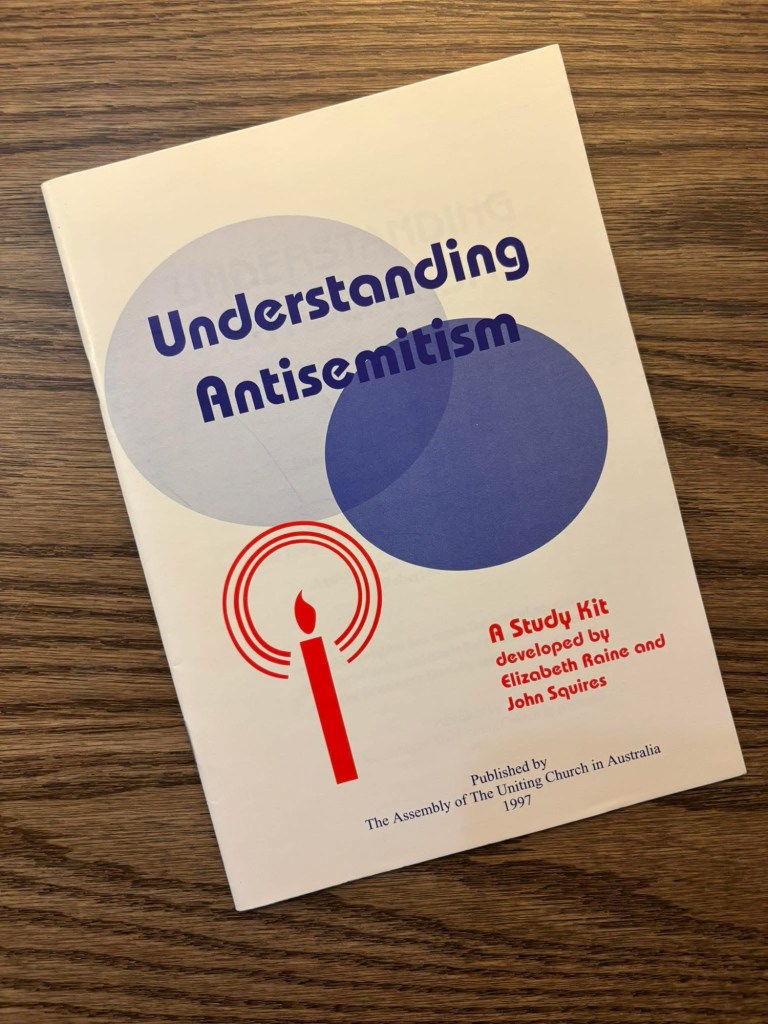
In fact, in 1997, the Uniting Church National Assembly had adopted a statement about our relationships with Jewish people, which explicitly included a rejection of antisemitism and encouraged church members to become informed about such matters.

In the course of preparing that statement, Elizabeth and I were charged with preparing a resource, which the Assembly published as a study with ten sessions, and which was disseminated across the church.

I wonder how many congregations made use of this resource? We certainly used many elements of it in our regular teaching over the years.

The resource is available online at https://illuminate.recollect.net.au/nodes/view/11763?

2

Some voices now, in 2025, are placing the responsibility for what happened at Bondi firmly on the shoulders of the Federal Government, arguing that they knew about the dangers of antisemitism but “did nothing”. Albanese should resign, they say. It was his fault that this tragedy happened. He has blood on his hands. It’s strong stuff.

I wonder. We have had many Prime Ministers over the past 25 years, since I first started hearing those regular reports about antisemitism from Jeremy Jones.  I wonder why other PMs have not been equally accused of inaction, like Albanese. What did John Howard do? Or Kevin Rudd? Or Julia Gillard? Or Tony Abbott? Or Malcolm Turnbull? Or Scott Morrison? 

All of these Prime Ministers did, in fact, the same as Albanese: recognising that antisemitism existed, they supported low level anti-racism programmes, and blithely went on with their political business of elections, budgets, legislation, and the argy-bargy of Question Time. Little has changed over all that time. Antisemitic incidents have continued to take place. And how many of the people now making loud noises about the Bondi Beach event had actually been agitating five, ten, or twenty years ago about antisemitism?

And it is not entirely clear that it was, in fact, antisemitism which fuelled the terrible events at Bondi Beach. Carrick Ryan, who spent years working as a Federal Agent from the NSW Joint Counter Terrorism Team, has written that he sees this as “an act of terrorism perpetrated by mad men possessed by a dangerous ideology”. 

His view is that “Jihadists do not have a political goal. They are inspired by a toxic interpretation of their faith that encourages them to die in an act of violence against any perceived enemy of their faith.” He argues that “it is simply absurd to suggest they have been influenced by pro-Palestinian university protesters, Greens politicians, or even ‘anti-Zionist’ conspiracy theorists.”

“The men who conducted these attacks”, he maintains, “would have despised those activists as much as anyone on the political right, and as I have tried to explain to many activists who have attempted to romanticise Hamas as heroic freedom fighters, the future they are aspiring to is very different.” It’s not about antisemitism, so much as it is it an expression of religious fanaticism.

See https://www.facebook.com/100045908673621/posts/pfbid0aiSGrfYkvvq9v9wznY71nwac3z3ep88T7XdVLvLfrTzVi7kRAvAEfWRqCkpfJ4fyl/

3

However, it is not only antisemitism which has been growing. Islamophobic incidents have increased consistently as the Muslim population of Australia has grown. Deakin and Monash Universities are collaborating to compile an annual Islamophobia Report, documenting such incidents since 2014. The latest report notes that the number of Islamophobic incidents has increased significantly since 7 October 2023. You can read the reports at https://islamophobia.com.au

There are numerous other incidents involving First Nations people, Afghanis, Asians, Sudanese, and all manner of diverse ethnic minorities which have all continued in the same period, spiking in numbers at particular times, with the same minimalist level of government response.  All Together Now is an independent not-for-profit organisation and registered charity, founded in 2010, that holds to a vision of a “racially equitable Australia”. They work towards this vision “by imagining and delivering innovative and evidence based projects that promote racial equity”. Their website declares “we are community driven, we utilise partnered approaches, and our work is intersectional”.

As All Together Now draws together a range of studies, it reports that “40% of children experience racism in schools … 43% of non-white Australian employees commonly experience racism at work …there is still a culture of systemic racism in Australian sports … studies have exposed systemic and structural forms of racism in policing, the justice system and child protection, leading to discrimination, violence and death of people of colour and First Nations People”. All the studies they cite are referenced and hyperlinked on their website at https://alltogethernow.org.au/racism/racism-in-australia/

Our society has fostered far too many intolerant, aggressively-hostile individuals who feel they have a right to speak and act in these ways.

4

The Bondi event and its repercussions are not simply a partisan political matter, as so many loud voices are currently proclaiming. It is a cultural phenomenon; the “right” to criticise, slander, marginalise, and attack Jews … and Muslims … and First Peoples … and other minorities … has been taken for granted by an increasing proportion of the population. They have, of course, been egged on by extremist politicians who seize every opportunity to foster racism.

Antisemitism, and Islamophobia, and all forms of racism, together form a deeply-embedded cultural phenomenon, for which we are all responsible. Politicians have a role to play (and wouldn’t it be good if a bipartisan approach could be consistently made) but all of us have things we can, and should, do, each and every day.

Calling out racist, islamophobic, or antisemitic language is one thing we could aim for. Intervening in low-level incidents is another, when it appears safe to do so. Supporting the education of children and young people with programmes which inculcate social responsibility, ethical behaviour, and respectful interactions with others is important. Joining groups which are advocating for justice for minority groups which are marginalised is something that people could do. Writing to state and federal members of parliament about issues of concern in these areas is also something that people could do. 

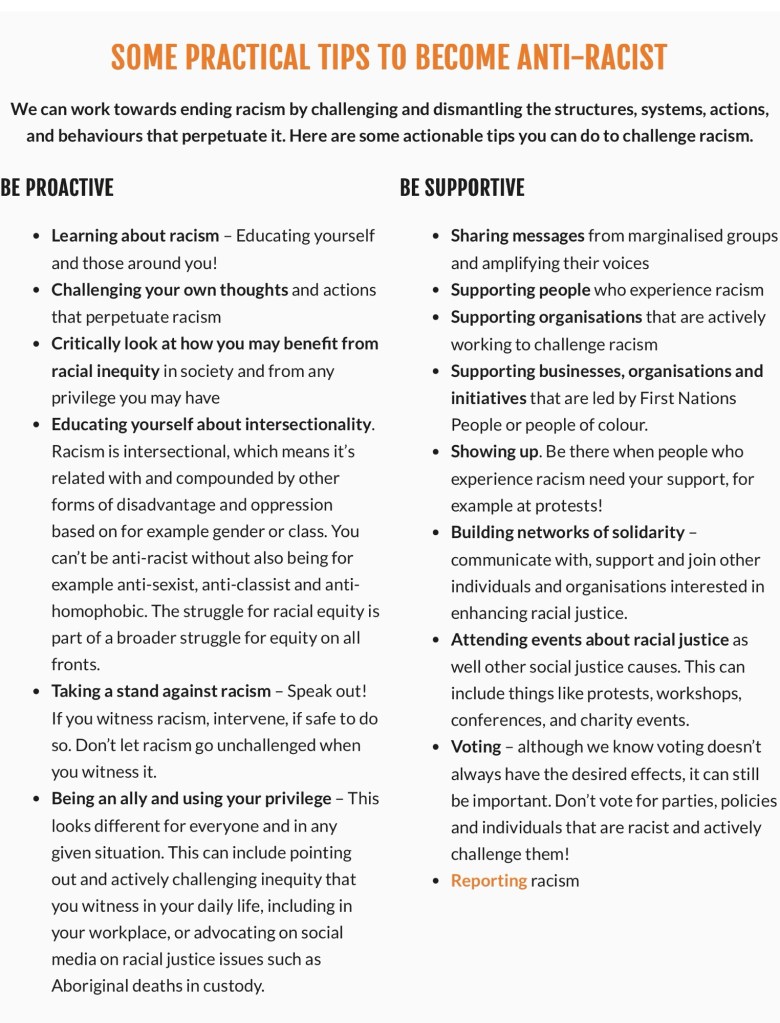
All Together Now has a helpful collection of “Practical Tips to Become Anti-Racist” as well as a useful guide with links to further resources. We would all do well to read, ponder, and implement the kinds of things that they advocate.

https://alltogethernow.org.au/wp-content/uploads/2023/09/Free-Resource-How-to-become-an-anti-racist.pdf

*****

For my earlier reflections on this tragic event, “They are part of the whole of us”, see

They are part of the whole of us

What has happened at Bondi Beach is a tragedy. Many are grieving, many are injured; many will be traumatised, many will be more anxious and more afraid of life in Australian society. Amongst other things, it might give us pause to consider who we are, together, as a society.

The black-clad figure on the bridge at Bondi Beach
in Sydney, Australia, shooting into Archer Park,
where a Hanukkah celebration was taking place

Jewish people are an integral part of contemporary Australian society. There was a handful of Jews on the ships of the First Fleet (estimates range from eight to sixteen people), arriving here in 1788. A Jewish burial society (Chevra Kadisha) was established in 1817. The first Jewish marriage took place in 1832. Jews have served as members of parliament, as justices in various courts, as Governor-Generals, as military officers, as surgeons and nurses and police officers, as actors and artists and journalists and business people, indeed in all areas of society. They have contributed in so many ways to making our society what it is today: diverse, welcoming, hardworking, tolerant. 

Muslims people are an integral part of contemporary Australian society. Muslims from Makassar (Sulawesi, Indonesia) had traded with the First Peoples of the northern part of the Australian continent for centuries before 1788. Some married First peoples and over time the Macassars contributed to the developing culture of the First Peoples. Muslims sailors and convicts came on ships in the early decades of British colonisation onwards. Muslims later came from India and Pakistan to provide transport, labour, and support in the building of essential infrastructure in the vast inland desert area of the continent like the Overland Telegraph Line and the Ghan Railway. Later Muslim migration occurred especially from Albania, Bosnia, Lebanon, Afghanistan, Iraq, Sudan, and Somalia. They have all brought their vibrant cultures with them and become an important part of contemporary Australian society.

I have known many Jews through my ministry in the eastern suburbs of Sydney and participation in the Uniting Church’s dialogue with the Jewish community. I have also known some Muslims through the relationships built between United Theological College and ISRA, the Islamic Studies organisation that, like UTC, is now an integrated part of Charles Sturt University. All of these Muslim people and these Jewish people are honest, ethical, law-abiding, dedicated, creative, intelligent, compassionate people. They would each be horrified at what has taken place at Bondi Beach yesterday. 

I know a number of Jewish people who are horrified at the policies of the current Israeli government, and who are working in various ways to find peace with justice in the fraught environment of Gaza, the West Bank, and the illegal settlements. What is happening in the Middle East is the result of distorted extremist fundamentalist views that are not held by the vast majority of Jews living in Israel, or Jews living in Diaspora around the world. Israeli government actions do not represent general Jewish viewpoints.

The best of who we are today as a society is because, in part, of the persistent, faithful, dedicated contribution of both Jews and Muslims over the centuries. They are part of the whole of us, and we are all interrelated to and interdependent on Jews and Muslims in so many positive ways. We should not let the scare tactics and dog whistling of marginal voices in our society blight our minds and lead us to snap judgements about “all Muslims” or “all Jews”. We would do best to stand with those who grieve and commit to working to ensure peace, safety, and respect in Australian society.


The Coexist image was created
by Polish graphic designer
Piotr Młodożeniec in 2000

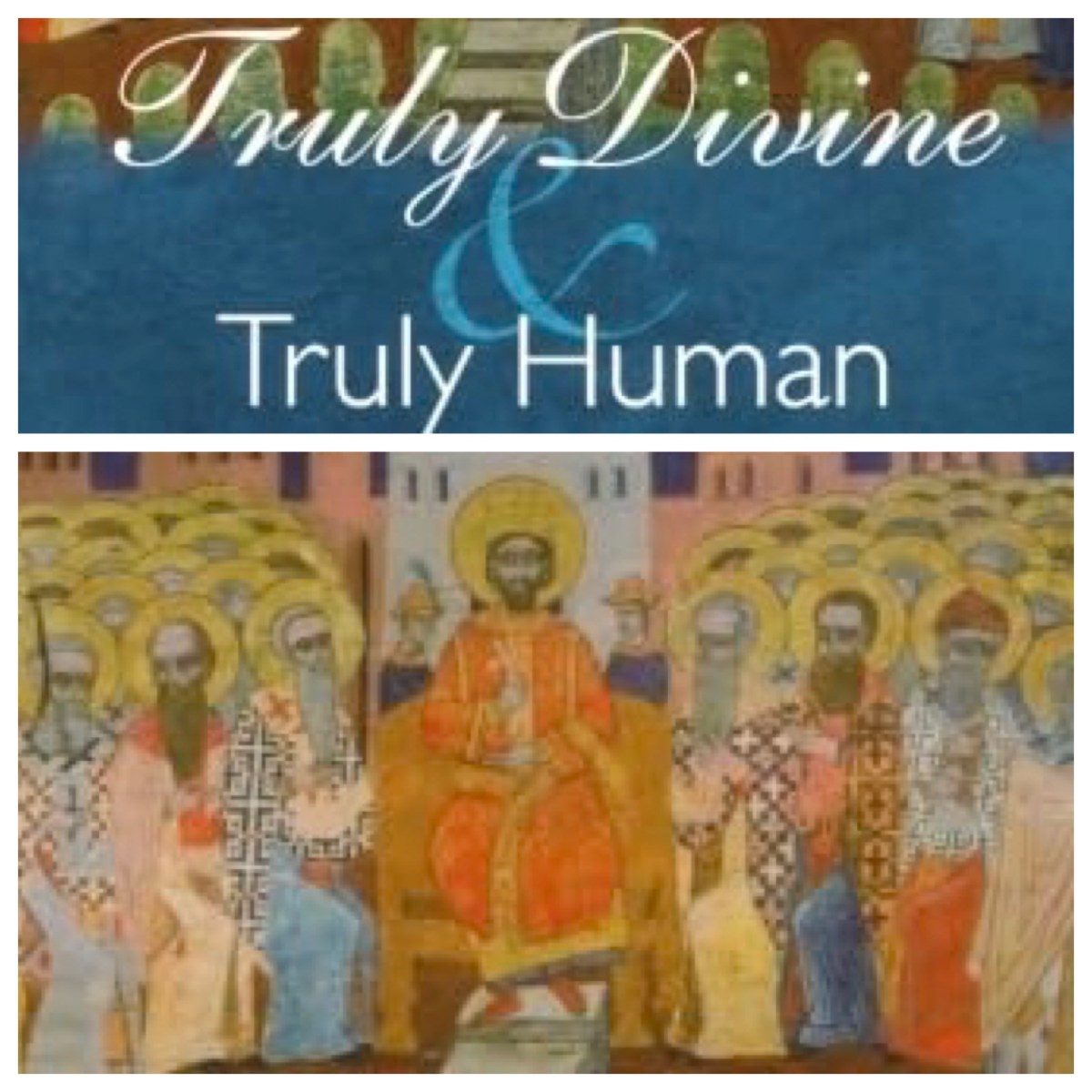
Truly God and truly human: the reason for the season

The Chalcedonian Creed was adopted at the Council of Chalcedon in 451 in Asia Minor as a response to certain heretical views concerning the nature of Christ. It sets forth a complex philosophical understanding of Jesus as incarnate Word of God, “truly God and truly [hu]man”.

This expression of the nature of Jesus, two-wrapped-into-one, is the theological understanding that underlies the story that is told and retold each Christmas season. This is the real “reason for the season”, surely.

In the light of this creed, and the clear admonitions that it offers, I present my contribution to Christmas caroling—to be sung to a very familiar tune, Hark the herald angels sing  (7.7.7.7.D and refrain). Perhaps if we sing this regularly, the complex concepts of orthodox theology might be more widely known??

1

God the Word, Lord Jesus Christ,

Perfect in the Godhead, he;

Truly God and truly human,

perfect in humanity.

Reasonable in body and soul,

consubstantial, present, whole:

First Begotten as Godhead,

now with us in faithfulness:

God, the Word, Lord Jesus Christ,

This is the one whom we confess.

2

Inconfusedly he came, 

pure, unchangeable, was he.

Indivisible he lives, 

quite inseparable is he.

Whilst distinct, his natures stand,

for each nature does retain

each their property unique;

mystery of God, filioque!

Both concur in one Person, 

One Subsistence, in the Son.

3

As the prophets have declared,

as the holy fathers say,

as the Lord himself has taught us,

so we faithfully do say:

God the Word, Lord Jesus Christ,

Perfect in the Godhead, thrice,

Truly God and truly man,

Perfect in humanity.

These two natures do concur,

One Subsistence, in the Son.

*** *** *** ***

Sing it, sisters and brothers!!

For another light-hearted take on the Chalcedonian theology, see 

The text of the Chalcedonian Creed (in English translation, reflecting the original gendered language, typical of the time) reads as follows:

We, then, following the holy Fathers, all with one consent, teach men to confess one and the same Son, our Lord Jesus Christ, the same perfect in Godhead and also perfect in manhood; truly God and truly man, of a reasonable soul and body; consubstantial with us according to the manhood; in all things like unto us, without sin; begotten before all ages of the Father according to the Godhead, and in these latter days, for us and for our salvation, born of the virgin Mary, the mother of God, according to the manhood; one and the same Christ, Son, Lord, Only-begotten, to be acknowledged in two natures, inconfusedly, unchangeably, indivisibly, inseparably; the distinction of natures being by no means taken away by the union, but rather the property of each nature being preserved, and concurring in one Person and one Subsistence, not parted or divided into two persons, but one and the same Son, and only begotten, God the Word, the Lord Jesus Christ, as the prophets from the beginning have declared concerning him, and the Lord Jesus Christ himself taught us, and the Creed of the holy Fathers has handed down to us. 

Expectations: a key theme for Advent

What follows is a piece that I wrote a few weeks back for Ruminations, the quarterly journal of Saltbush, which is a ministry that resources rural and regional Uniting Churches in the Synod of NSW and the ACT. I wrote it just at the time when “expectations” were swirling around the church; I’m publishing it now as the theme of Expectations seems to be most appropriate for the season of Advent.

*****

The Synod of NSW.ACT has recently met, and given consideration to “The Presbytery Project”, which has the subtitle “Future Directions for the People of God on the Way”. The expectations surrounding the move to the Three Presbyteries Model are no doubt clear: sharing of resources, mobilising of personnel, collaboration of teams, hope for the future.

Just after that meeting, the Synod of Victoria and Tasmania met and adopted their vision for the future, entitled the “Faithful Futures Project”. It is setting expectations in that Synod; it aims “to prepare the Uniting Church in Victoria and Tasmania for the next 10 to 15 years”. And, of course, right across Australia, the church has been pondering the outcomes of the 2024 Assembly, when the Act2 Project was received and its proposals adopted. Already newly-constituted Commissions are meeting, planning the steps ahead in their respective areas. No doubt they have expectations about what they will achieve.

Indeed, even in my small rural church, we have had a recent process in which people have shared “what I hope for this church”, learning about better ways to be welcoming, and setting out steps for mission in the local community. And the Presbytery in which I live has a neat slogan on its website, declaring that it seeks to “Live by Faith, be Known by Love, and be a Voice of Hope”.

Expectations abound at every level!

Jesus was no stranger to the basic human element of “expectations”. He didn’t know about the anticipatory joy of an expectant parent, looking to the birth of their child. He presumably was a stranger to the bubbling internal expectations that mount when you have just two months before you start that “dream job” that you have just been offered. And I am not sure that he ever took part in a day-long, facilitated workshop of setting forth the “purpose, mission, and values” of a faith community!

But Jesus knew about expectations. The earliest account of his adult life tells us that his first words in public were words of expectation: “the time is fulfilled, and the kingdom of God has come near” (Mark 1:15). In another account of his life, he is reported as saying “the kingdom of God is not coming with things that can be observed; … in fact, the kingdom of God is among you” ( Luke 17:20-21). That surely must have set his followers agog as they scurried to determine just how this expectation of the coming kingdom was, in fact, now present among them.

Indeed, Jesus lived at a time when expectations were running high amongst his people. This was not a new thing. In the foundational story of the Exodus from Egypt, it is said that Moses offered words of expectation to the people: “Do not be afraid, stand firm, and see the deliverance that the Lord will accomplish for you today; for the Egyptians whom you see today you shall never see again” (Exod 14:13).

The scrolls containing the words of the prophets, which faithful Jews would have known quite well, were full of words of expectation: “the days are coming when all that is in your house will be carried off to Babylon”, announced Isaiah (Isa 39:16); “the days are surely coming, says the Lord, when I will make a new covenant with the house of Israel and the house of Judah”, said Jeremiah, during that exile (Jer 31:31); “I am coming to gather all nations and tongues”, declared an anonymous prophet after the people had returned from Babylon (Isa 66:18). Each important step in the story of Israel had been prophetically signalled by a word of expectation. 

And by the time of Jesus, after centuries of continuing foreign rule, and after a series of uprisings, defeats, compromises, and plots to regain control, expectations continued to run amok amongst the Jewish population. For some, the expectation was that they would someday regain political control of their land (the zealots and political revolutionaries of the day). For others, the expectation took shape in a vision of “the sons of light” waging a final cataclysmic battle against “the sons of darkness” (as in one of the Dead Sea Scrolls). Still others held to the word of the Lord, “I am sending my messenger to prepare the way before me, and the Lord whom you seek will suddenly come to his temple” (Mal 3:1). 

It was this latter expectation that had gripped John, as he carried out his programme of calling people to repentance and baptising them in the river. And as he did so, the man from Nazareth came and submitted himself for baptism. “Behold the Lamb of God, who takes away the sin of the world!” one later writer claimed that he said (John 1:20).  His expectations had come to pass in ways that perhaps even he had not thought possible.

The followers of Jesus certainly had expectations about him. “Are you the one who is to come?”—the question that John had sent his followers to ask of Jesus (Matt 11:3; Luke 7:19)—soon became their question. Expectations about what Jesus would achieve abounded. “We had hoped that he was the one to redeem Israel”, two of his followers mused, soon after he had been put to death (Luke 24:21). That was some expectation, to be sure! 

Some of those not as enchanted by the way of Jesus also had expectations about him. “How long will you keep us in suspense? If you are the Messiah, tell us plainly”, they taunted him (John 10:24). Hovering somewhere around Jesus was the expectation that he might in fact be the figure long hoped-for, come to redeem Israel. And even as he hung in the cross, he was again mocked and taunted: “He saved others; he cannot save himself. Let the Messiah, the King of Israel, come down from the cross now, so that we may see and believe” (Mark 15:31–32). Again, that expectation that he was someone significant—or that he thought he was someone significant—is in play. Just what might we expect from this Galilean stirrer? 

The path that Jesus trod both met expectations, but also failed to meet expectations. He did achieve something significant; but he did not do so in the way that was most surely expected. He would redeem Israel; but only by giving his life. He would be shown to be Messiah; but not on the clouds of glory—rather, on a rough wooden cross. “Truly this man was God’s Son!”, the Roman soldier is claimed to have said as he witnessed this cruel death (Mark 15:39).

Perhaps Judas had unreasonably  high expectations about Jesus; he was one of the inner group that travelled with him, ate with him, learnt from him, and began to carry out the mission that Jesus had given them (Luke 9:1–6). And yet his expectations took a sharp turn; we don’t know what drove him to betray Jesus with a kiss, nor do we know what expectations he had about what would eventuate from that. His sad end (Matt 27:3–6; compare Acts 1:18–19) perhaps reflects his recognition—tragically, too late—that his expectations regarding Jesus were doomed to fail.

And let’s not get too caught up in the complexities of the apocalyptic expectations that swirled around at the time—expectations that Jesus addressed, and redefined, in one of his longer teaching sessions (Mark 13:5–37). On the one hand, he is clear that something unexpected and yet long yearned-for will indeed take place (“they will see ‘the Son of Man coming in clouds’ with great power”, Mark 13:26). The expectations people held in relation to him were justified, it would seem.

And yet, he warns his followers to “beware that no one leads you astray” with specific timetables (13:5), advising them that chaotic times of cosmic upheaval are nothing “but the beginning of the birth pangs” (13:8), there will be suffering that will need to be faced and endured (13:19), and insisting that “about that day or hour no one knows” (13:32), that “you do not know when the time will come” (13:33, 35). Expectations may be raised, hopes may be high; but resolution is not easily attained.

So how do we deal with expectations? “Managing expectations” has entered the language both of business practice and of personal psychology. We need to be wary of setting expectations too high. Thinking about how all nations will flock to Jerusalem is setting expectations too high. They didn’t, and they won’t (especially today, in the fiery political landscape of Israel and Palestine). So too is expecting that everyone will see clearly that Jesus, the Messiah, is the Son of God who is the one to perform miracles at will and the one to redeem all of Israel and all of the nations—that, too, is unrealistic. We haven’t seen this, and he hasn’t redeemed everyone at all. Life continues on despite the failure to meet such high expectations.

And in similar fashion, setting expectations too low is something we should avoid. The young adult comes home from their first attempt at sitting for a drivers license, and proudly announces “I got it!” Dad looks up, amazed, and responds, “Wow! I really didn’t think you’d get it this time”. The expectation was set low, the triumph evaporates all-so-quickly. We need to manage our expectations: not too high, not too low.

And what of expectations we might have for our church community? Have you talked together in your congregation or faith community about what you hope for? what you would love to see happen? what you could work together to try to achieve? what you can pray for, bringing reason and knowledge into your words of hope and expectation to God? 

We should have expectations; we should talk about our expectations; and most importantly, we should be working together to see how we might achieve those expectations, and make them become a reality. Sometimes that can be a hard thing to do. Nevertheless, it is central to our life together.

As for expectations in our own personal spiritual life: that’s another area to consider carefully. We all have our familiar daily or weekly practices. They may be shaped by years of loving care and devoted repetition; we may be growing into a particular spiritual practice as we return to it consistently over time; or we may be now just “trying something new” in our spiritual life. Whatever the case may be, we have expectations about what that spiritual practice will do for us, and how it will help nurture our life of discipleship. We should identify our personal expectations and see how we are moving towards achieving them.

At the end of three of the Gospels, there are words that Jesus is reported as saying as he appeared, after his resurrection, to his followers. These words set the expectations for his followers. Matthew reports his words, “make disciples of all nations, baptizing them in the name of the Father and of the Son and of the Holy Spirit, and teaching them to obey everything that I have commanded you” (Matt 28:19–20). In these words, Jesus offers a clear set of expectations. 

Luke reports that he said “you are witnesses of these things”, of all that he has told them, so he offers them a command which contains an expectation: “stay here in the city until you have been clothed with power from on high” (Luke 24:48–49). In the subsequent volume written by Luke, the expectation and the charge is clear: “you will receive power when the Holy Spirit has come upon you; and you will be my witnesses in Jerusalem, in all Judea and Samaria, and to the ends of the earth” (Acts 1:8).

Most simply of all, John has Jesus say to the disciples, “peace be with you … as the Father has sent me, so I send you … receive the Holy Spirit” (John 20:21–22). Whichever Gospel account we prioritise for ourselves, the charge is clear—and the sense of expectation is strong. And so may it be for us,  day after day, as we walk the way of Jesus, full of expectation!