The Bruyns of Brown Street (9)—Ellen Esther Bruyn (concluded)

This post concludes the story of the land and house which Elizabeth and I purchased in Dungog a few years ago. I have traced the early landholders for this property (1848–1858), Daniel and Sarah Bruyn and their family (from 1858 to 1882) and then two of their children, Daniel Justin Bryan (d.1912) and his sister, Ellen Bruyn. In this blog, the story continues to the people who bought house in 1969, the Finneys.

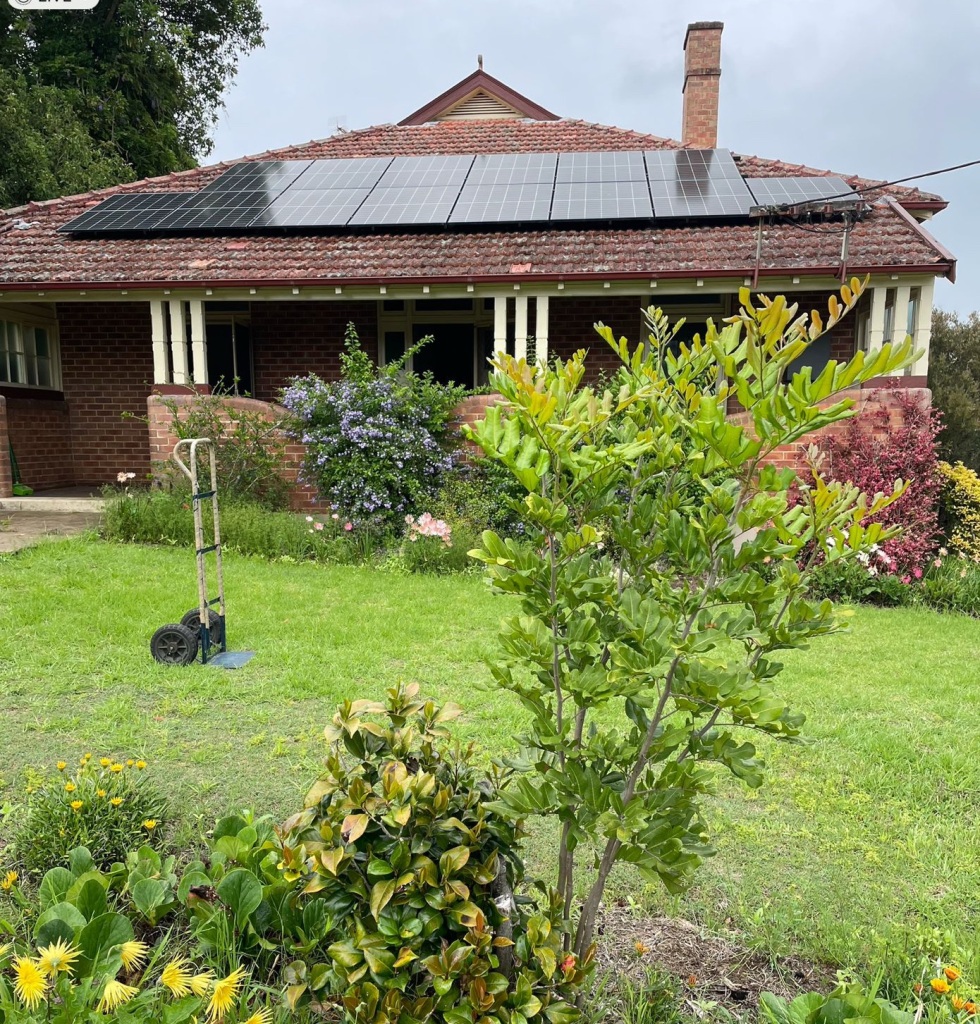
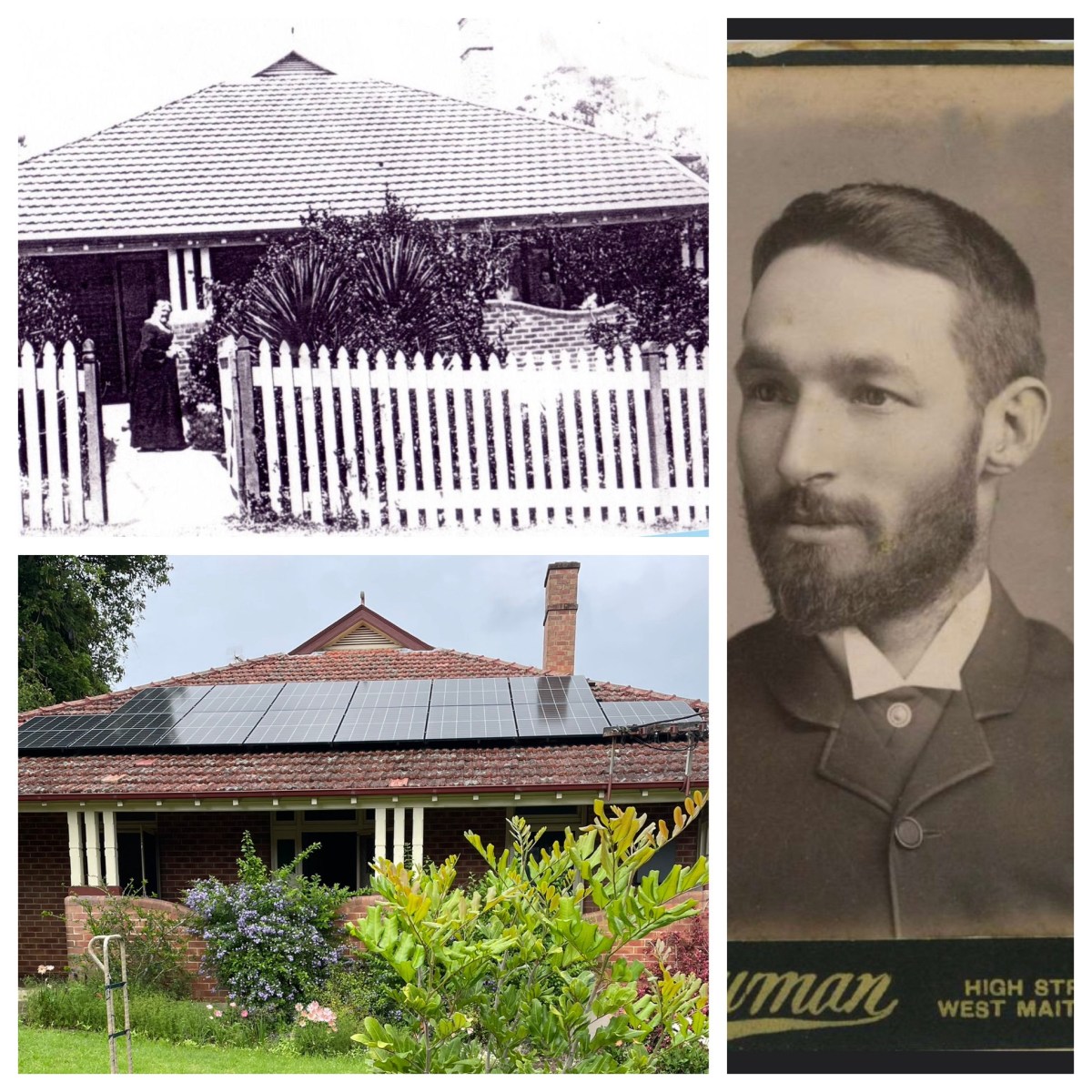
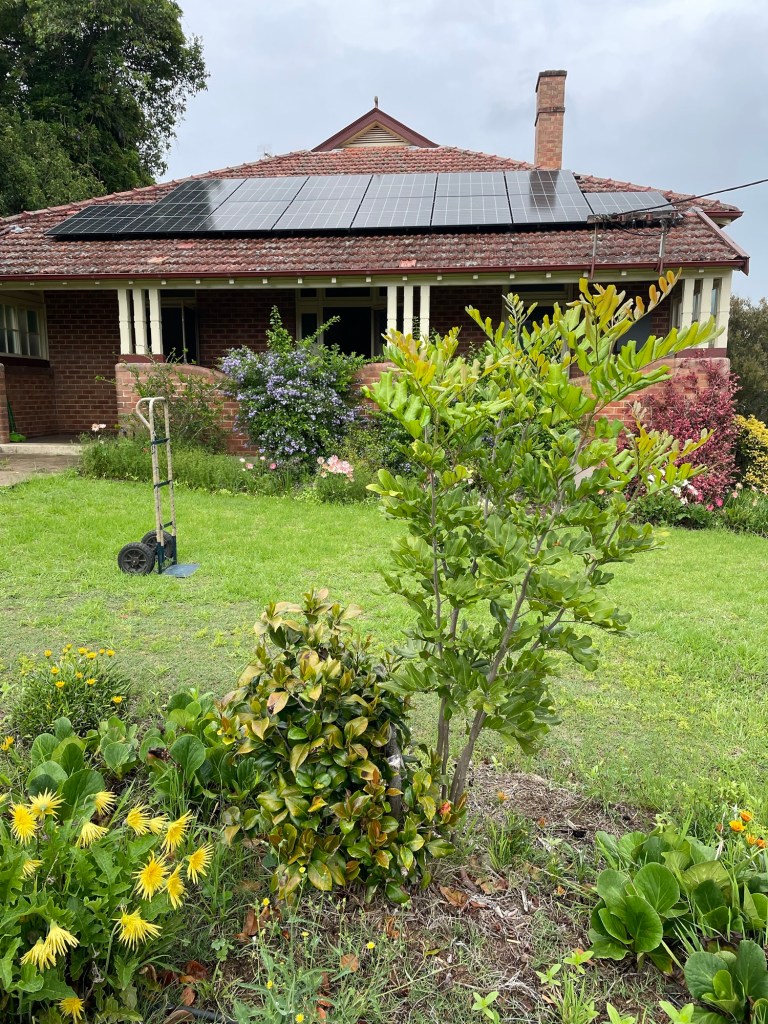
28 Brown St Dungog in November 2023, on the day we moved in
(as the moving trolley attests!!)

An interesting report in the Sydney Daily Telegraph of Tuesday 14 June 1927, p.18, entitled ARE WINTERS MILDER, quotes a “Mrs. [sic.] Ellen Bruyn, who has spent 71 years at Dungog” as declaring that “the winters of late years had be come milder, and the summers hotter, and drier”. It is interesting to see such an early observation relating to what we know now to be human-exacerbated climate change, as the average annual temperature is rising at a worrying level.

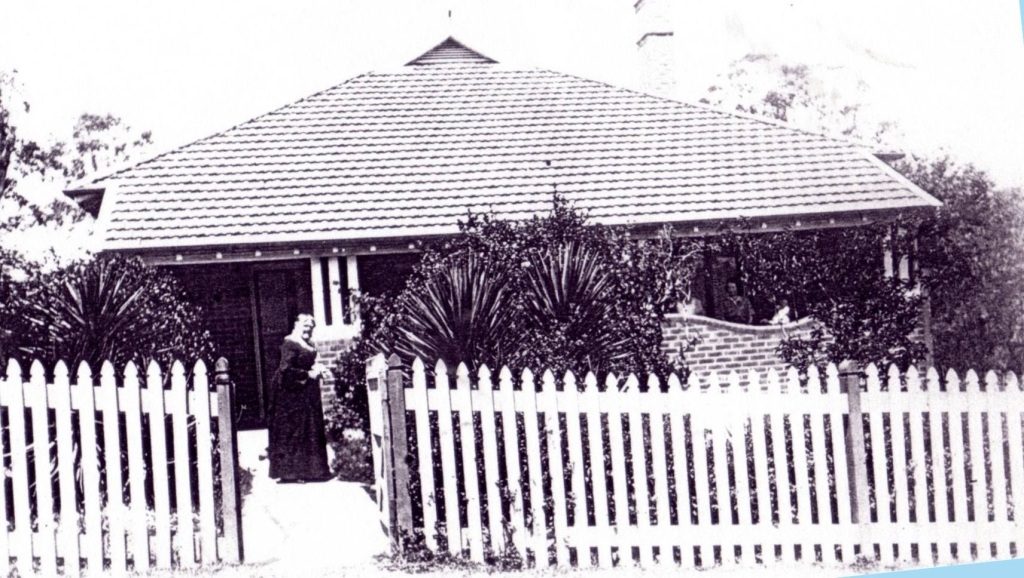
The Telegraph notes that “she quoted no thermometer readings to support her contention, but said she could speak with personal experience of the seasons, coupled with her observations of the less rigorous effects of recent winters upon vegetation in the gardens which adorn her residence.” Indeed: that would be the cottage garden at the front of her property, that is evident in the one photo of the house that is extant, as noted earlier.

Ellen Bruyn’s Will

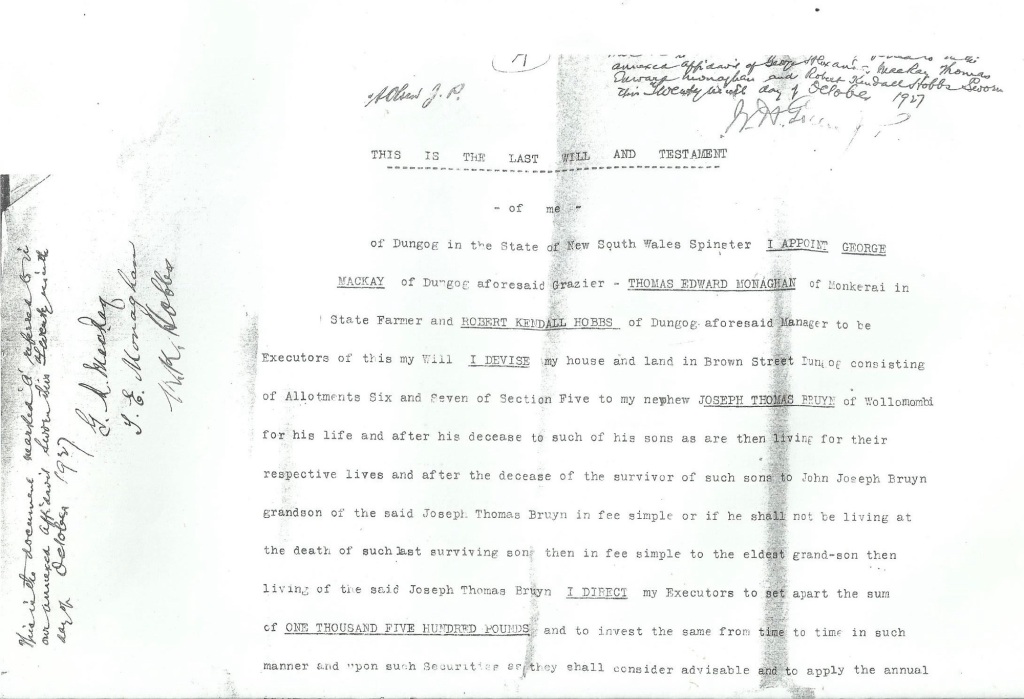
Ellen’s father had died intestate. Her property and goods were not to be caught in the same way; on 4 August 1925 Ellen Bruyn, then aged 85 years, made her Last Will and Testament, in which she appointed George Alexander Mackay, Thomas Edward Monaghan and Robert Kendall Hobbs the Executors. Just two years and two months later, on 2nd October 1927, Ellen Bruyn died. Probate was subsequently granted on 1 November 1927.

The first page of Ellen Bruyn’s Last Will and Testament

In an article in the Dungog Chronicle of Tuesday 4 October 1927, page 2, tribute was paid to Ellen Bruyn. “During her life-time Miss Bruyn was known far and wide for her benevolent nature and broad-minded charities. None that ever besought her help went away empty-handed.”

Reports of her estate indicate this extensive benevolence, with a lengthy report in the Sydney Morning Herald of Friday 4 Nov 1927, on p.6, providing details. The article is headed simply LATE MISS E. BRUYN. It notes that she left an estate “of the net value of £20,106”. A similar notice in the Maitland Weekly Mercury of 3 Nov 1927, p.5, reports that “the estate of the late Miss Ellen Bruyn, of Dungog, who died last month, aged 88, has been valued for probate purposes at £20,116”. The calculator provided by the Reserve Bank of Australia indicates that in 2023 this sum of money would be worth $1,932,438.79.

This was managed by a Trust established by the appointment of as George Alexander Mackay, Thomas Edward Monaghan and Robert Kendall Hobbs as Executors and Trustees in Ellen Bruyn’s 1925 will. Between 1932 and 1941, all three Trustees died; in February 1942 George Mackay, Donald Reay Mackay and Robert John Alison were appointed as “Trustees of the Will of the said Ellen Bruyn in the place of the deceased original Trustees”.

In this 1942 process, the components of the 1925 will forming the Trust were specified, in particular, as “£1000 secured by Memorandum of Mortgage 18 Dec 1928 for land at Heydon St Mosman; £1700 fixed deposit with Commercial Banking Company; £67.14.3 on account with Commercial Banking Company; Land in Brown Street Dungog on which is erected a dwelling house and other improvements being Lots 6 and 7 of Section 5 Town of Dungog; Vacant land in Mackay Street Dungog being Lots 4 and 5 Section 5 Town of Dungog”.

As far as the distribution of various elements of this estate was concerned, the SMH article provides specific details. It first notes that Ellen had “devised certain lands in Mackay-street, Dungog, to the local council, to be held by them in trust as a play and recreation ground for children; if, after a period of 20 years, the council did not think it advisable to use them as such, the lands were to be sold, and the net proceeds paid to the funds of the Roman Catholic Church at Dungog.” In 2024, the Council still maintains land on Mackay Street which is called Bruyn Park; it abuts the southern end of Jubilee Park, which runs along the western boundary of the Brown Street property once owned by the Bruyns.

Furthermore, Ellen took care to provide for her family, as “she devised certain real estate and £1500 to maintain it to her nephew, Joseph Thomas Bruyn, and his sons, £1500 each to her three sisters, Margaret Monaghan, Elizabeth Ann Cooke, and Sarah Malvina Lawless, and their daughters”.

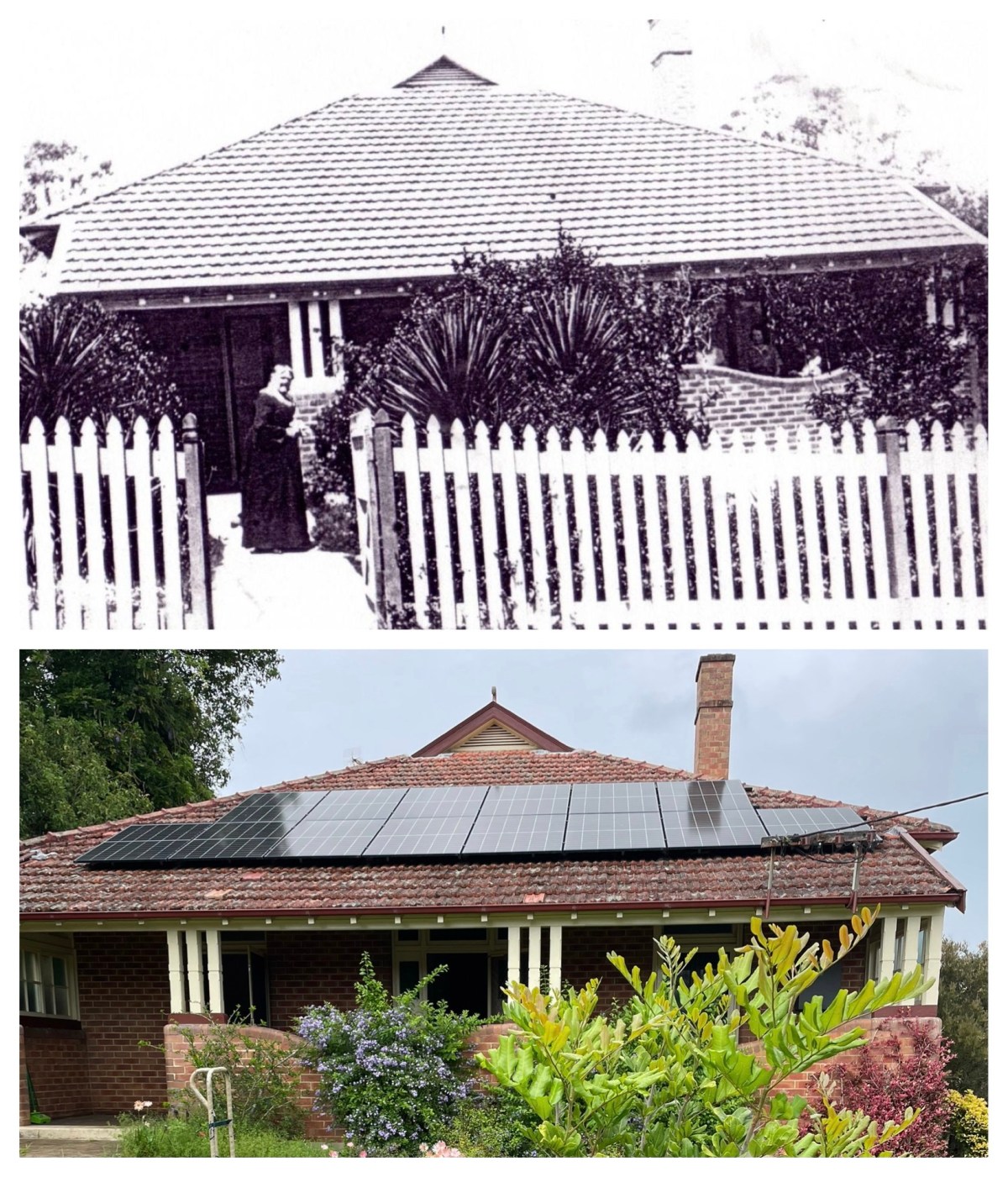
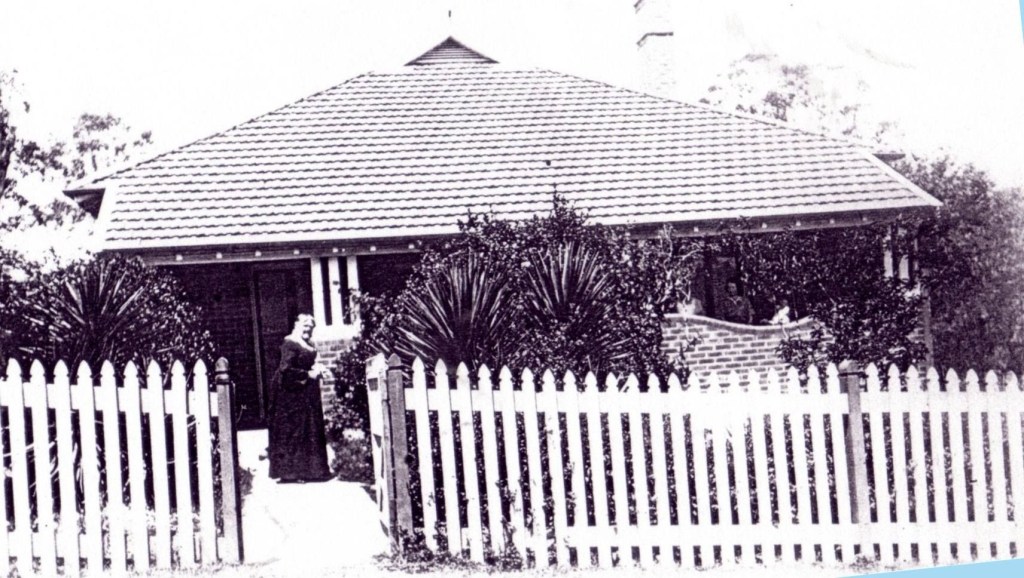
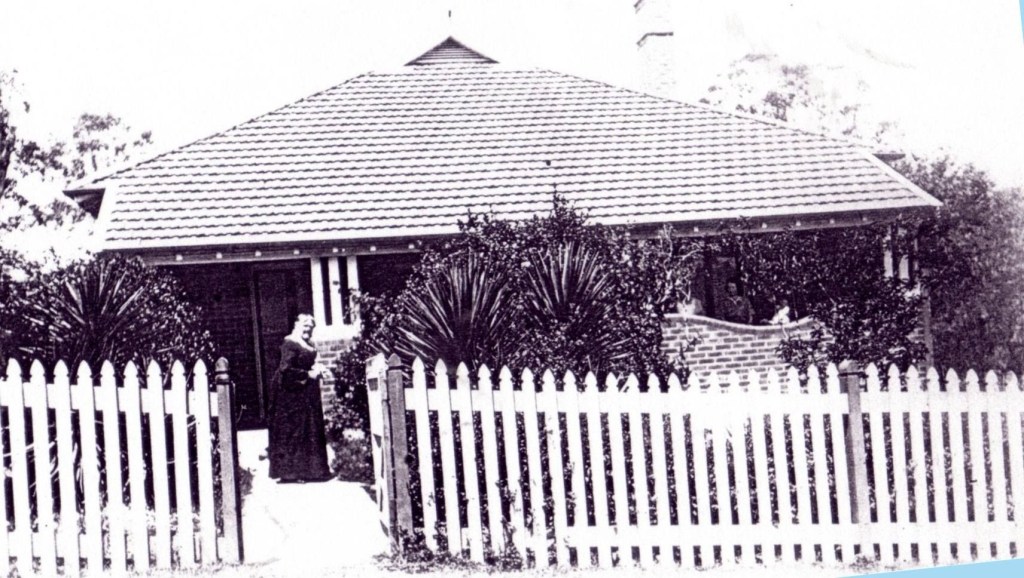
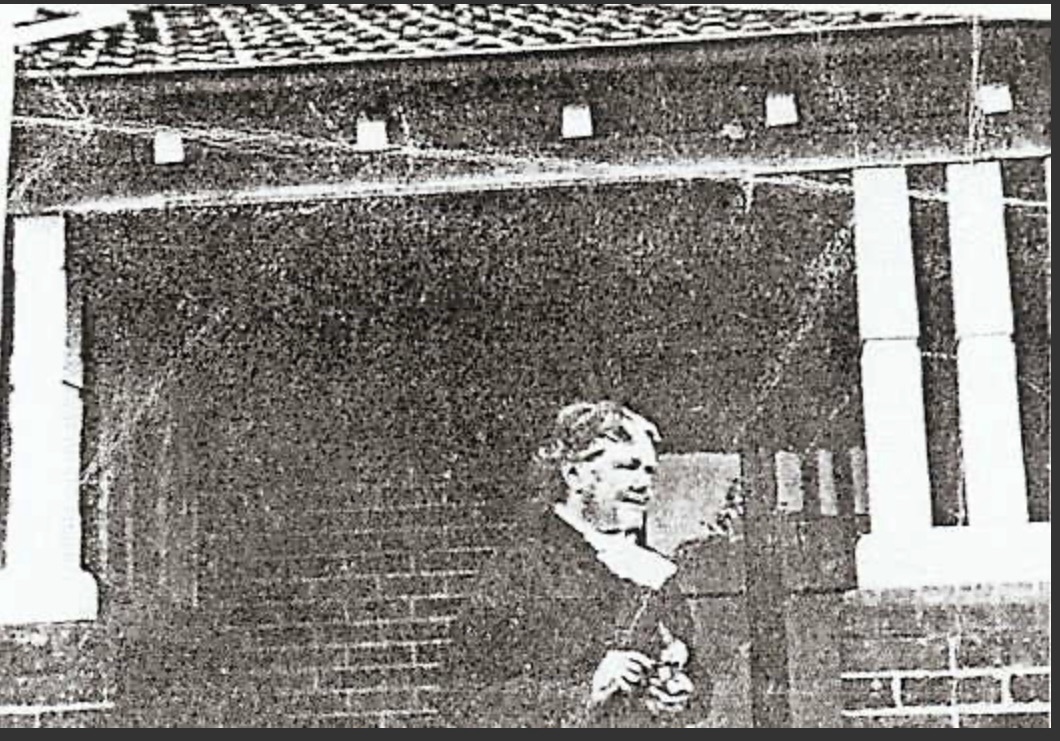
Ellen outside her house in Brown St Dungog;
perhaps within the last decade before her death?

The various charitable organisations that Ellen remembered in her will are signalled through this list of bequests: “£1000 to the Deaf and Dumb Institution conducted by the Dominican Nuns at Waratah, £500 to the Sisters of St. Joseph at Lochinvar, £500 to the Dr. Murray Catholic Orphanage at West Maitland, Waitara Foundling Home conducted by the Sisters of Mercy, £1000 to the Dungog Cottage Hospital”.

In addition, Ellen had directed that “the interest from the investment of £200 [was to be used] for the upkeep of the graves in the local cemetery of herself and relatives of the name of Bruyn for a period of 25 years from the date of her death; at the expiration of that period the £200 to be paid to the local Roman Catholic Church; £100 to the Roman Catholic curate at Dungog, and the residue of her estate to relatives and others”.

Dungog Cottage Hospital

One significant matter identified in this will relates to the Dungog Hospital. Daniel had been appointed as one of the foundation members of the hospital committee in 1891. Ellen must have been actively involved in the years after Hospital Cottage was opened in 1892. One item in her will was that she bequeathed “£1000 to Dungog Hospital, the interest to be used for 20 years and then the principal to go to the committee” (Sydney Catholic Press, Thursday 13 October 1927, p.41).

The original Dungog Cottage Hospital building

Annual distributions in accordance with this bequest are reported in the Dungog Hospital reports over the two decades after Ellen’s death. The Dungog Chronicle reported that £17/10/- (three months interest) was paid in Sept 1929; however, over a period of years, there was no interest paid, occasioning legal communications regarding the accumulated amounts that had not been paid.

From 1939, interest was paid more regularly: £71/3/10 in Aug 1939, £43/-/- in May 1940, £7/12/- and £4/15/- in Sept 1941, £44/5/9 and £136/6 in Sept 1942, as well as “an advance of subsidy for £28/6/8 and a special grant of £1/15/-“, followed by £10/1/9 in Oct 1942, £8/5/- in Feb 1943, “the usual subsidy of £28/6/8 … and a further amount of £51/6/8, being arrears of subsidy for the year commencing 1/7/42”. This presumably satisfied the accumulated amount due that had not been paid in earlier years.

The Hospital then received £45/4/5 in Sept 1943, £28/-/- in Sept 1944, £27/15/9 in May 1945, £23/18/9 in Oct 1945, £10/1/9 in June 1946, £47/-/- in Aug 1946, £31/16/9 in Feb 1947, £16/14/- in April 1947, and £23/9/6 in Aug 1947. In that month, the Hospital Board was advised that “the 20-year period of this investment in house properly at Mosman expires on 2/10/1947, and the matter has been placed in the hands of the Hospital’s Honorary Solicitors, Messrs. Borthwick and Wilson”.

Nevertheless, £11/2/4 was received in Jan 1948, £12/2/10 in June 1948, and £12/7/9 in July 1948. The income over the years had been generated through an investment in a property in Mosman; the property now needed extensive repairs, so at the Jan 1949 meeting, “it was moved by Messrs. Scott and Irwin that a copy of the Commission’s letter be forwarded to Messrs. Borthwick and Wilson and that they be requested to instruct solicitors for the Bruyn Trustees to take necessary action as set out in the Commission’s letter”.

A further £12/7/9 was paid in Sept 1949, while “Hospital’s Honorary Solicitors have been requested to instruct the Solicitors for the Bruyn Trustees to take necessary steps to obtain consent of the Moratorium Court to sell the property prior to its being offered for auction sale”.

In July 1951, the Secretary advised the Board that “a cheque for £111/1/3 had been received through Messrs Enright Son and Atkin, being rent received from Messrs. Richardson & Wrench Ltd., from 2/7/1948 to 18/6/1951, less collection charges, exchange, repairs, and rates”.

In July 1953, “£52/13/5, being rent collected in connection with the Bruyn Bequest”, was received. This was the last payment that has been found through reports accessed in Trove’s collection of newspapers.

The Sale of Brown Street

The last act of the Trustees of the Ellen Bruyn Bequest, in 1969, was to place the property on Brown Street up for sale. The documentation received relating to the Brown Street property for the period from 1927 to 1969 concludes with a document that notes the various changes in personnel in those Trustees, and a 1969 Conveyance. It is most likely that the property was rented out for this period of time, thereby bringing in a regular income to the Trust.

On 30 June 1967, George Dark was appointed Trustee in place of George Mackay and Donald Reay Mackay, joining Robert John Alison as continuing Trustee. Then, on 8 April 1968, these Trustees appointed the Public Trustee “to accept the trusts of the will accordingly”. The trusts were comprised of “Land in Brown Street, Dungog on which is erected a dwelling house and other improvements being Lots 6 and 7 of Section 5 Town of Dungog; Special Bonds Series “I” due September 1970 $1,600 Treasury Bonds held by the Commercial Banking Co.; Commonwealth Treasury Bonds August 1975 — 5 — $1,400; Current Account Commercial Banking Co. of Sydney Limited Dungog — $13.15”.

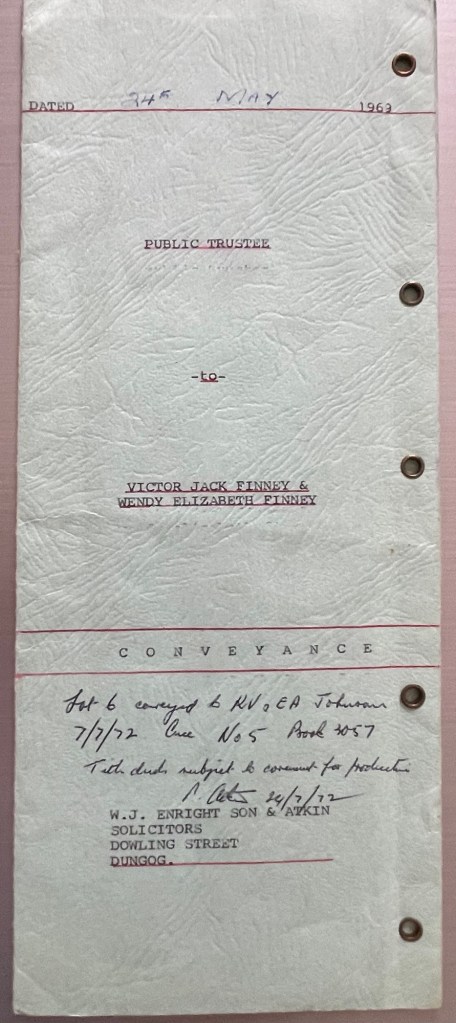
And so it was that in 1969, Victor Jack Finney and Wendy Elizabeth Finney purchased this property. In a Conveyance dated 24th May 1969, between “the Public Trustee as Trustee of the will of Ellen Bruyn, late of Dungog, Spinster deceased, and Victor Jack Finney of Dungog, Evaporator Operator, and Wendy Elizabeth Finney of Dungog, his wife”, Lot No. Seven of Section No. Five and Lot No. Six of Section No. Five were purchased for three thousand five hundred dollars. A new set of owners would, in time, move into the house and begin a new era.

For earlier blogs, see

The Bruyns of Brown Street (8)—Ellen Esther Bruyn (continued)

I am continuing the story of the land and house which Elizabeth and I purchased in Dungog a few years ago, after having traced the early landholders for this property (1848–1858), Daniel and Sarah Bruyn and their family (from 1858 to 1882) and then two of their children, Daniel Justin Bryan (d.1912) and his sister, Ellen Bruyn.

At some point in the latter part of the period of growth in the town of Dungog in the late 19th and early 20th century, the solid double/brick building that still sits on the Bruyn’s land in Brown St was built. Its style reflects certain Arts and Craft features of the late 19th century; although compared to the extravagance of some Arts and Crafts buildings, it is modest in its scope, which most likely reflects the life and tastes of Ellen Bruyn.

Ellen Bruyn outside the house in Brown St

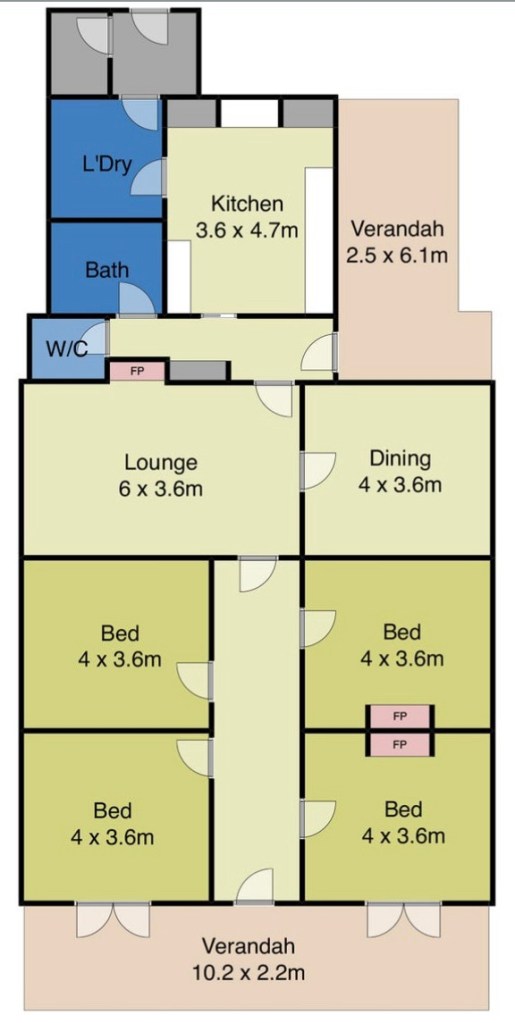
The original double-brick building has six equal-sized rooms coming off a central hallway, each with a single window, high ceilings, and picture rails about 8 feet from the floor. There are fireplaces in three rooms.

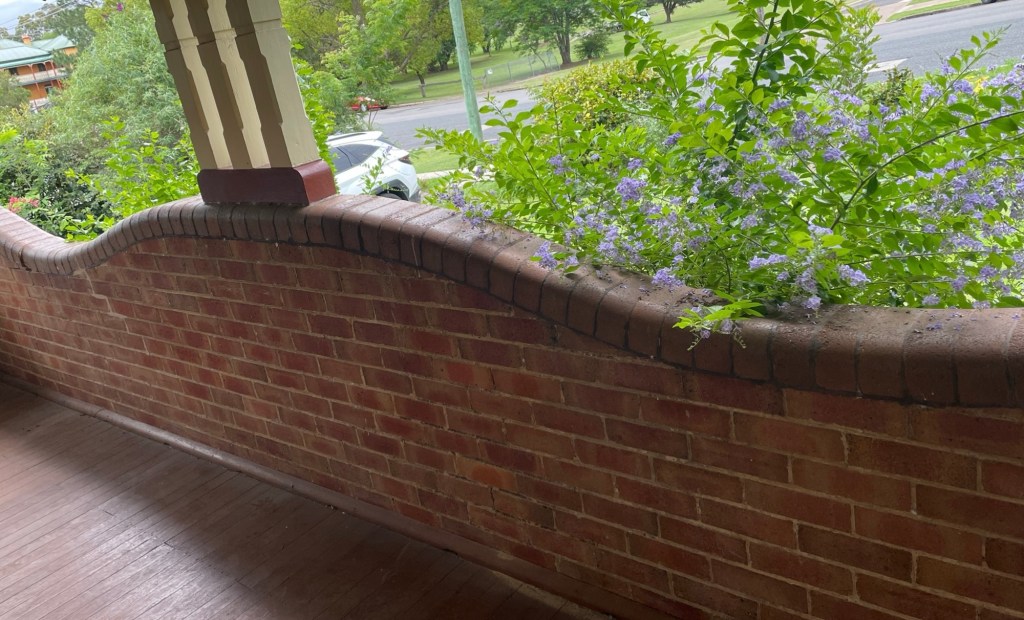
The house has a verandah at the front with fine curved brickwork, and what appears (under the later additions) to have been a back verandah which would have led to a kitchen and washing tub in an outhouse. There is no bathroom in the brick structure; indoor plumbing was only beginning in the richer urban areas in the late 19th century, and slowly spread into the homes of those who could afford it in the early decades of the 20th century. The present house has a mid-20th century addition at the rear which includes all rooms requiring plumbing (kitchen, toilet, bathroom, and laundry).

The floor plan of the current house

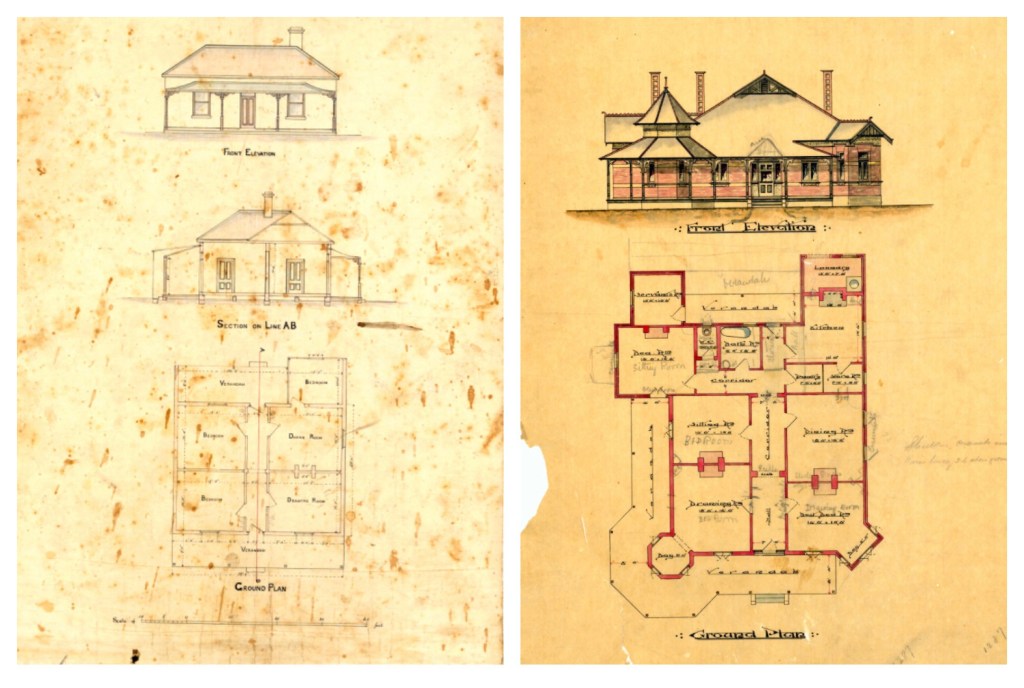
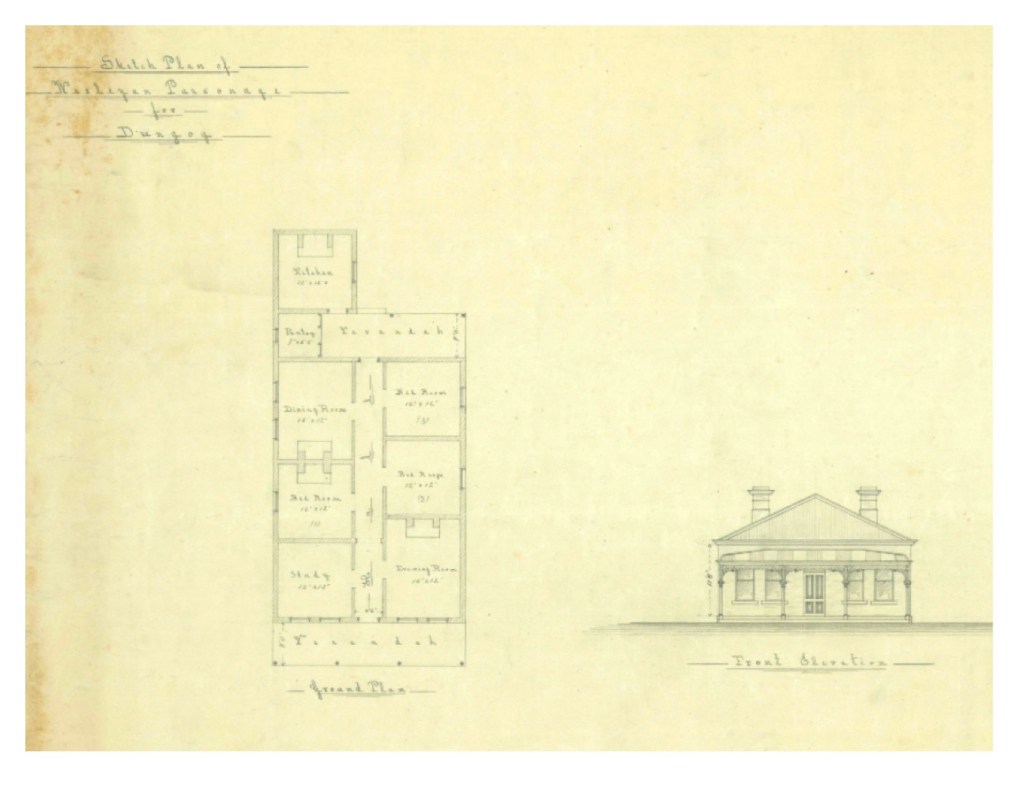
Elizabeth has found architect plans for buildings of a similar (if more modest) layout in the online “Living History” archives of Newcastle University. These include plans drawn up by the first architect of the area, John W. Pender, who designed a residence for Mr. J. Quigan, built in West Maitland in 1875; the Wesleyan Parsonage in Dungog, completed in 1878; and a residence for D. Logan Esq., built in Bolwarra in 1909. All three properties share a similar floor plan, which in turn is close to the Brown St layout.

Pender’s plans for houses for Mr. J. Quigan (1875, left)
and D. Logan Esq. (1908, right)
Pender’s plans for the Wesleyan Parsonage in Dungog (1878)

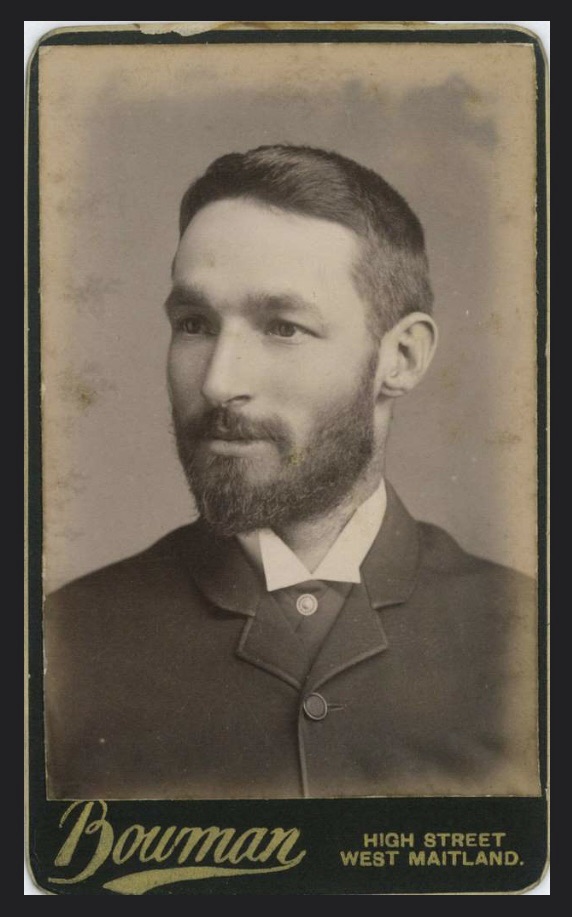
In the 1880s, the youthful trainee architect J. Warren Scobie (1863—1946) served his apprenticeship in West Maitland with Pender, the sole architect in the area at that time. He must have been influenced by Pender’s design habits. Les Reedman, in Early Architects of the Hunter Region (2008) reports that “Scobie designed every type of building in the Hunter and as far as the Queensland border and Gunnedah” (p.118). After the 1893 flood, he designed the Lorn Embankment; “according to his theory, designed the bank to conform to the fall of the river after the 1893 flood” (Reedman, p.119).

Scobie designed buildings in Maitland, including the 1889 Town Hall; Lorn, including Flagstaff, where he lived, Stockton (where he lived for some of the 1910s); two churches in Largs; 10 out of the 28 hotels built in the Cessnock—Kurri Kurri Coalfields in the early 20th century; and in Gloucester, Gunnedah, and Dungog.

A writer with the pen-name “Nemo” (meaning “nobody”), contributing news of the Dungog Presbyterian Church in the Maitland Mercury of 29 January 1905, p.16, waxes lyrical in reporting that in Dungog “Presbyterianism … has built itself a new religious home; a neat, choice design, not pretentious, not elaborate, but just fit for its purpose. It is good to look at. It makes one feel like being in church, its position is of the best, and it is now one of the chief ornaments of the town. It is a sort of poem in architecture, the happy inspiration of Mr. J. Warren Scobie of this town [that is, Maitland] and built by Mr. Noad of the East.” A detailed and fawning description of the building concludes the article.

A portrait of the younger J. Warren Scobie

An article in the Maitland Mercury of Friday 24 January 1913, p.2, tells of the new shop erected for Mr. E. Grierson. “The appearance of Dungog suggests to the casual observer that it must possess a number of enterprising and progressive business men, inasmuch as the principal buildings are as substantial as they are attractive and suggests an unmistakable air of solidity”, the article begins.

It notes that Mr. Grierson “bought a commanding block of land … on the west side of Dowling Street, adjoining Mr Brighton’s terrace, and let a contract to Amos Moore to put him up the best shop Dungog can boast of. Amos, working under the plan of that capable Maitland architect, Mr J. Warren Scobie, who has completed excellent work in this district got busy on the job.” Scobie is known as the architect of some grand homes in the area which share stylistic features with the Brown St house.

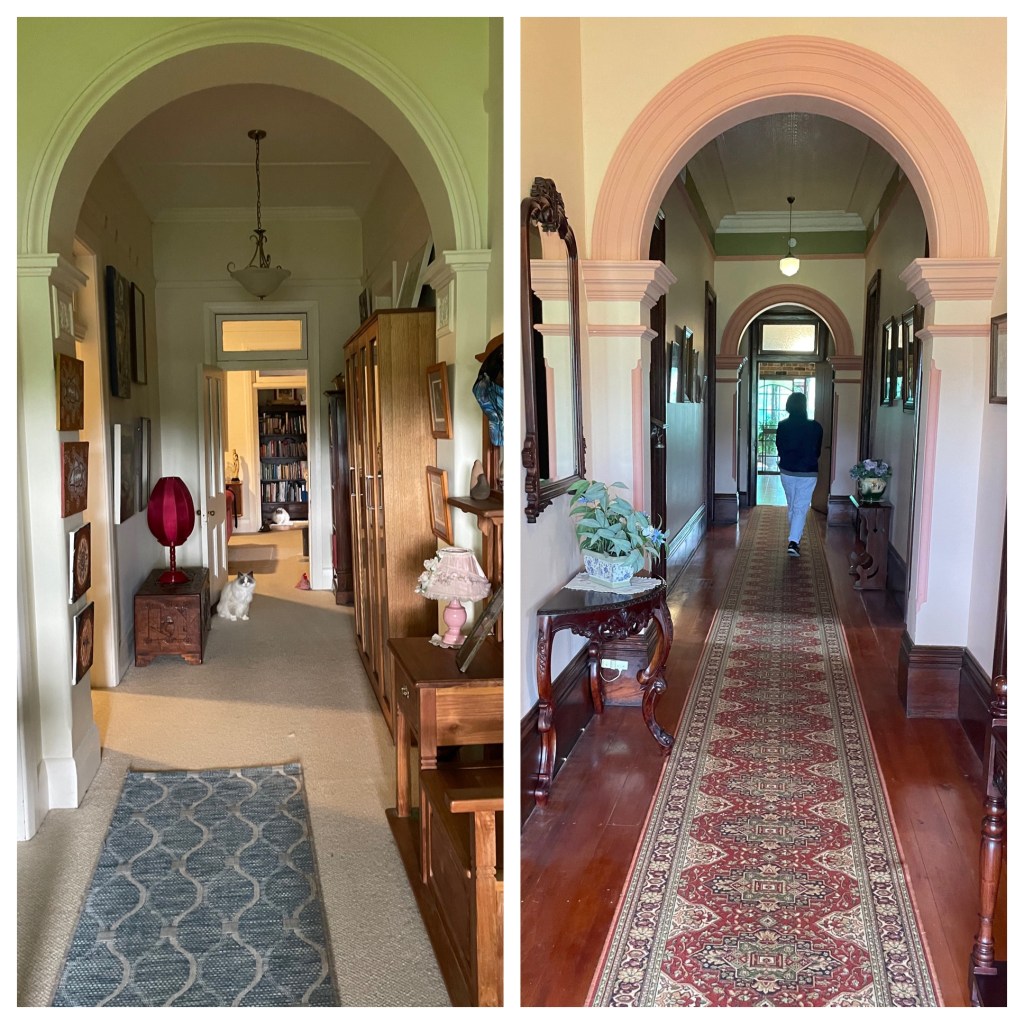
A house in Paterson which was designed by J. Warren Scobie, named Kalimna, was recently put on the market (early 2024). The online photographs indicate that this 1902 double-brick residence shares with the Brown St double-brick residence a reasonably similar floorplan and a number of close similarities in details. These include French doors opening out to the front of the house from both front rooms, high ceilings, the design of the fireplaces, a wide central hallway with arches, and doors into the side rooms which are offset along the hallway.

The hallways of the Brown St house (left) and Kalimna (right)

Could it be that Scobie designed this house for the Bruyns? It is a strong hypothesis, we feel, although in the absence of the papers relating to the design of the Brown St house, it can never be definitively confirmed. Kalimna is more extravagant, but stylistically and structurally very similar.

Dungog’s population had been growing rapidly, rising from 436 in 1881 to 878 in 1891 and 1169 in 1898. With more people, came more traffic, and more wear and tear on road surfaces. A paragraph in the Dungog section of the “District News” in the Maitland Mercury for Tuesday 3 August 1880, p.7, had reported that “Brown-Street, which has long needed something to be done to it, is at last being formed thirty feet wide, and the contractor seems to be making a good job of it. The expense has been defrayed by private subscription, as we were unable to obtain Government money, although it is really a work of necessity.”

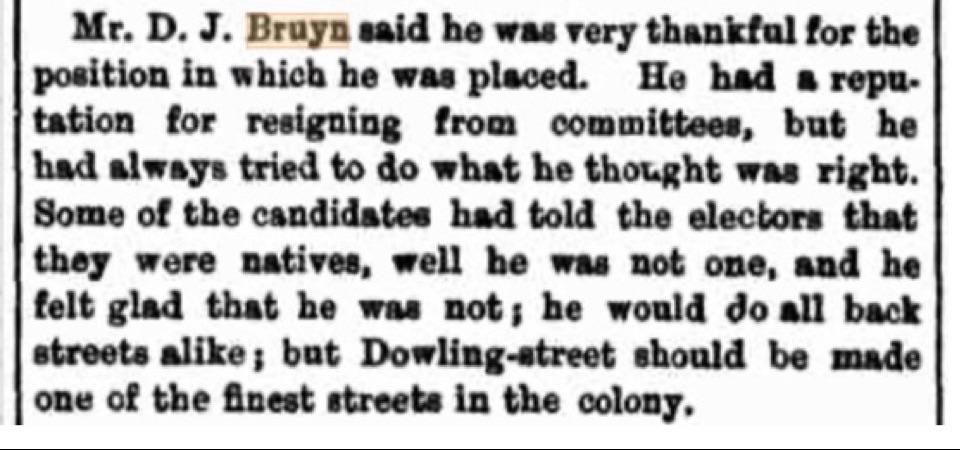
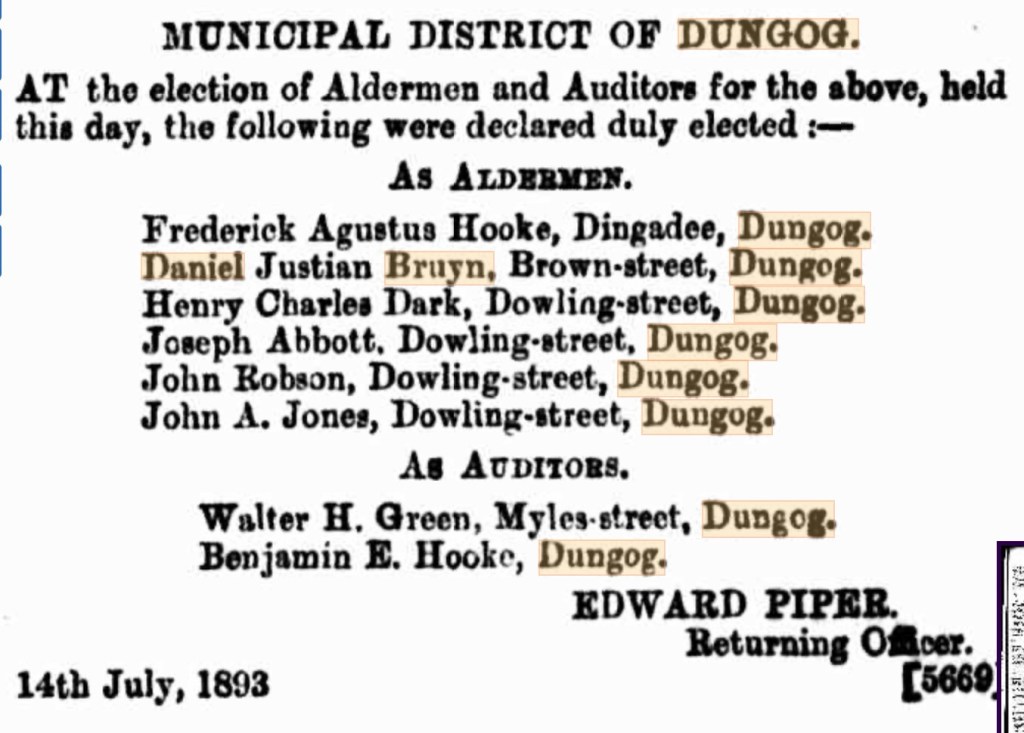
The Maitland Mercury of Tuesday 18 July 1893, p.5, reported that after the 1893 municipal election, the newly-elected councillors (and those defeated at the ballot) each gave a speech to the gathered crowd. Ellen’s brother, Daniel Justin Bruyn, one of the successful candidates, said “he was very thankful for the position in which he was placed”.

The Maitland Mercury’s report of Daniel Bruyn’s speech
after he was elected as an Alderman in 1893.

In an obvious reference to the state of the roads, the new Councillor Daniel Justin Bruyn said that “he would do all back streets alike; but Dowling-street should be made one of the finest streets in the colony”. Still, into the present day, the matter of road maintenance continues to be a concern for residents of the Dungog Shire; and Brown St itself has quite its share of potholes!

The house in November 2023

For earlier blogs, see

and for the final blog, see

The Bruyns of Brown Street (7)—Ellen Esther Bruyn

In exploring the history of the land and house which Elizabeth and I purchased in Dungog a few years ago, I have already noted the early landholders for this property, and investigated the life of Daniel and Sarah Bruyn and their family after Daniel purchased the land in 1858.

When Daniel died intestate in 1882, all of his property was made over to his son, Daniel Justin Bruyn, whose life has already been canvassed. A few months later, we find that the land he received from his father in Brown St had been purchased by his sister, Ellen Bruyn. This is her story.

Ellen Esther Bruyn was born in in the later months of 1839 in Smethwick, Metropolitan Borough of Sandwell, West Midlands, England, the second daughter of Daniel Joseph Bruyn, a Blacksmith (1796—1882), born in Roscommon, Ireland, migrated to England, and Sarah Helen Nichols (1807—1882), whom he married on 5 Feb 1837 (to 4 May 1882) in West Bromwich, Staffordshire. Ellen was the fourth child born to Daniel and Sarah; a further three children were born in subsequent years.

The family travelled to France in about 1845, where two of those children were born, including Daniel Justin Bruyn. After a rise of unrest in France, they returned four years later to England. They came to the Colony of New South Wales in 1856 as assisted migrants. Daniel and Sarah arrived in the Colony on board the Commodore Perry on 1 May 1856 with their children Margaret, Ellen, Elizabeth, Daniel and Sarah. (The eldest child, Joseph, travelled to the Colony a few years later.)

We have seen that Ellen had a sizeable inheritance on the death of her brother, Daniel Justin Bruyn. He had accumulated cash and property over the years, with a thriving business as a Grazier on the lands that he had purchased to the northwest of Dungog. That was given over to her, added to the land that was already under her name.

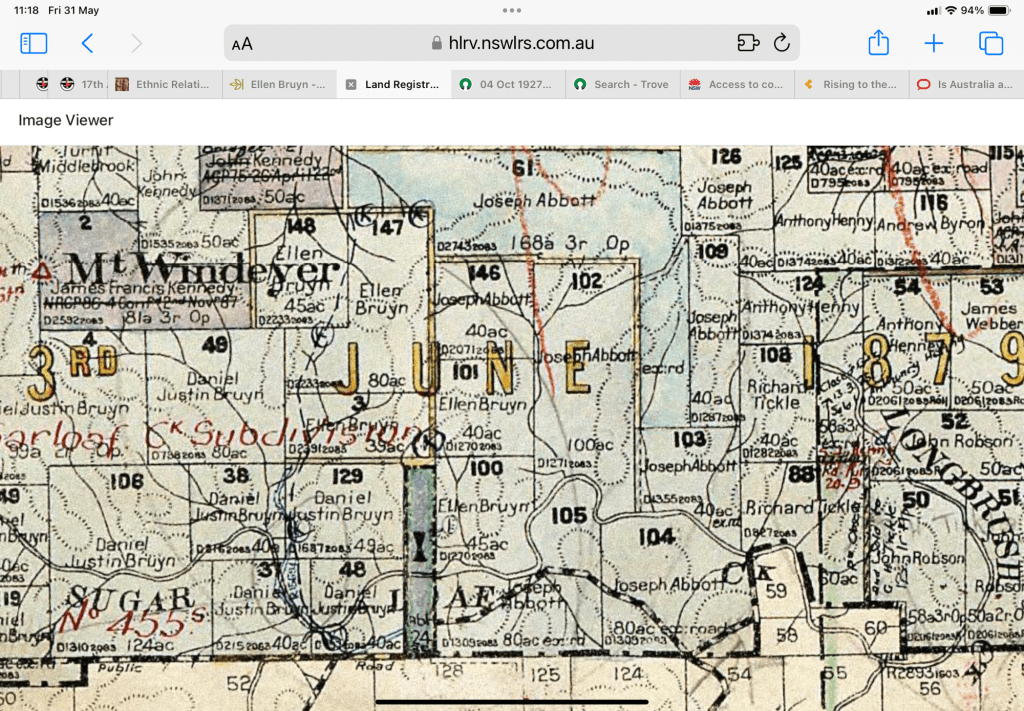
Map of the Parish of Tillegra showing
the property owned by Ellen Bruyn

An 1894 survey map for the Parish of Tillegra contains Lots which are registered in the name of Ellen Bruyn: Lots 100 (45 acres), 101 (40 acres), 3 (39 acres), 147 (80 acres), and 148 (45 acres)—a total of 249 acres. This land was located immediately next to land in north-eastern section of the many Lots owned by Ellen’s brother, Daniel Justin, so it is reasonable to suppose that it formed a part of the one large farm stretching along much of the Dungog—Tillegra parish boundary.

So Ellen had a large portfolio to oversee, what with her own land and the land she had received on the death of brother Daniel. She managed this property well over the following decades, using the land to maintain a strong economic position throughout her life. Ellen continued to live in the house in Brown Street where she had spent the latter years of her childhood as well as the early decades of her adult life.

At some point late in the 1890s or, more likely, in the first decade or so of the 20th century, a substantial brick dwelling was built on this site, replacing what was an earlier family home. The 1913 Electoral Roll for Dungog lists “Bruyn, Ellen, Dungog, domestic duties” as a resident. A photo (undated, perhaps in the 1910s?) shows Ellen in her mature years in the garden at the front of this house.

The double brick house on the land in Brown St, where the Bruyn family had lived since the 1850s. The lady in the (undated) photo is Ellen Bruyn, who had owned the land since 1883.
The house appears relatively new; could this be early in the 20th century, or even a few years earlier?

The exterior of the house looks relatively unchanged even today. The sweeping curve of the verandah bricks and the path from the front fence leading to an offset entry can be seen. At the other end of the front verandah, it is evident that there are some people standing there, although identification of individuals is not possible. The front garden reflects a substantial investment of time and care from Ellen over the years.

Ellen was a single woman who never married. There are clear indications that Ellen’s bachelor brother, Daniel Justin, had lived in a room in this house over the years before he took his own life in 1912. Daniel had been a well-respected member of the Dungog community. Ellen herself was evidently very involved in charitable and community matters locally—the distribution of funds from her will indicated this very clearly.

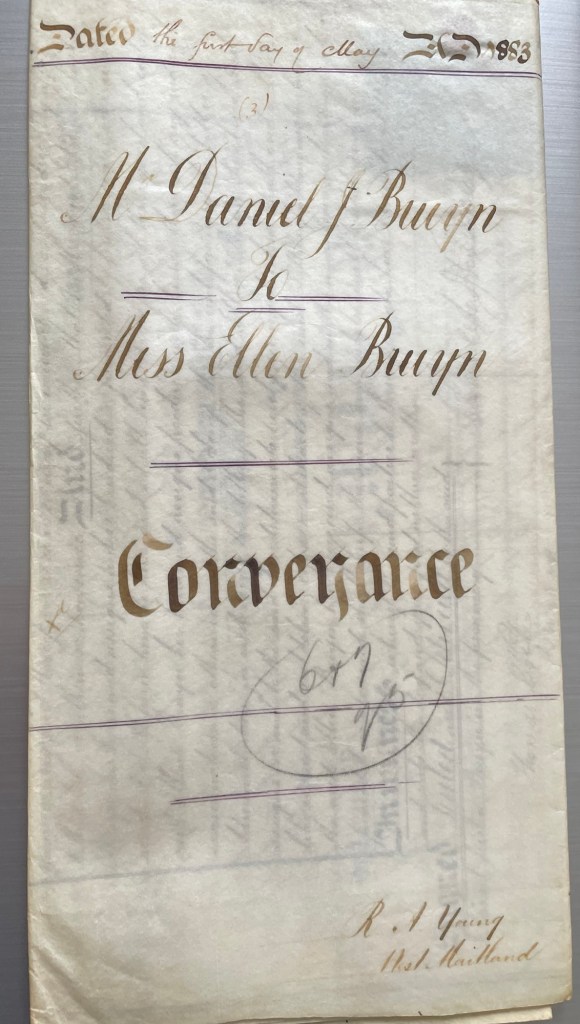
The 1883 Conveyance passing the title of the property
from Daniel Bruyn to his sister Ellen

A Conveyance dated 31 May 1883 between Ellen Bruyn of Dungog, Spinster, and Daniel Justin Bruyn of Dungog, Blacksmith, indicates that Allotment No. Seven of Section No. Five and Allotment No. Six of Section No. Five were sold for the sum of two hundred pounds. Ellen would live there as the owner of the house for almost half a century, until her death in 1927. That property had been made over to Daniel Jnr soon after the death of his father, Daniel Snr, and he subsequently put it up for public auction.

Ellen must have pleased to be the owner of the house that she had been living in for years, as well as the adjacent block of land. Why she had to pay this amount to her brother when she was just as much a child of Daniel and Sarah as he was, is a mystery. The gendered bias in 19th century society would, of course, have meant that the property of the father would normally pass to his son after his death, unless another course of action was specified. Obviously, such an alternative had not been set out by Daniel Snr. So Daniel Justin Bruyn inherited the family home in Brown St, and then his sister Ellen Bruyn bought it off him.

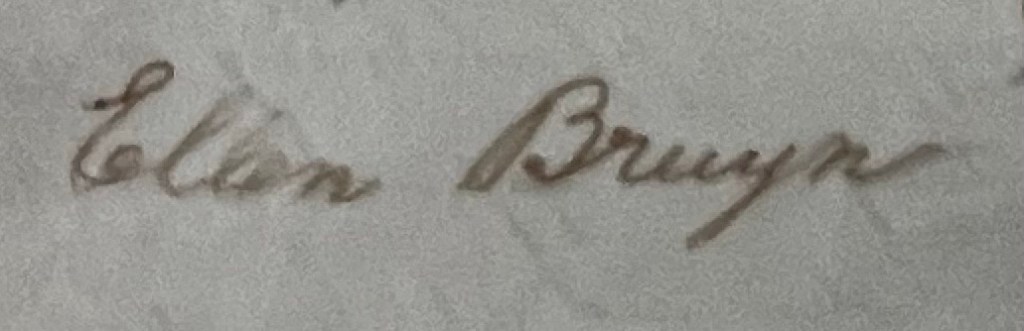
Ellen’s signature on the 1883 Conveyance

Ellen lived in the houses on this property for many decades—from the 1860s until her death in 1927. Over this time, she would have seen the town of Dungog grow and develop over the years. In her study of towns and buildings in the region, Grace Karskens writes that Governor Darling “published regulations for town planning in 1829 which directed that streets be laid out in a grid pattern, and emphasised uniformity and regularity, wide streets, half-acre allotments, and that buildings were to beset well back” (Dungog Shire Heritage Study: Thematic History, 1986, p.51). This set the pattern for numerous country towns, including Dungog.

This neat, orderly development continued for some decades. Karskens notes that “the second half of the nineteenth century was generally a boom-time for the major towns in Dungog Shire, and thus also a period of physical consolidation and community growth” (p.63).

The pattern that she observes in the 1860s was certainly evident in Dungog: “neat, solid government buildings, such as police stations, watch houses, post offices and court houses, all built to indicate a civilized and well-ordered society. Rows of stores and offices were built by merchants, professional people, banks and businessmen along the main streets, slowly filling up the grids laid down by surveyors forty years before.” (p.63).

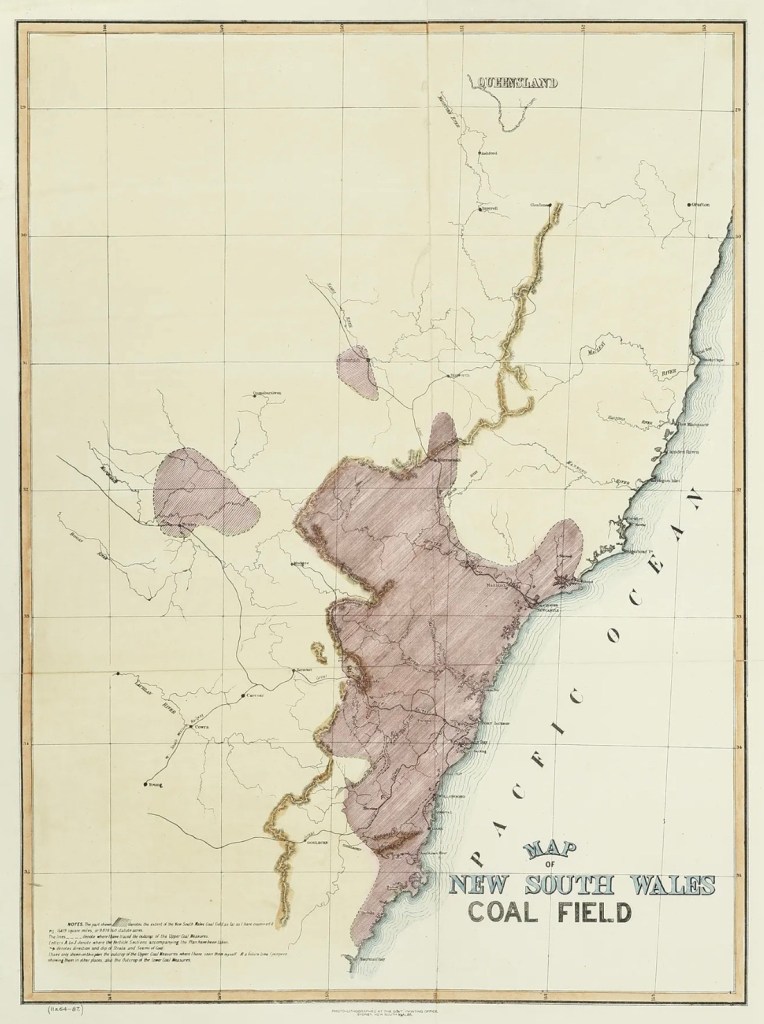
Karskens cites an unidentified press clipping held in the Newcastle Local History Library when she observes that “during the 1850s, Dungog, like Clarence Town, benefited from a position on the route to the Peel River and Gloucester goldfields, and this was repeated during the 1880s with the finds at Wangat (within the Shire), Whispering Gully and Barrington” (p.80).

An 1887 map showing the area of NSW designated as coalfield

She reports that “an anonymous correspondent writing in 1888 listed the town’s businesses as including three banks, four hotels, four large general stores, three butchers, three bakers, a coachmaker, wheelwrights, three blacksmiths, a hairdresser, a fancy tailor, boot makers, three saddle and harness makers and four churches, a weekly newspaper and ‘a School of Arts a credit to any town’.” (p.81). Included among those three blacksmiths, of course, was Daniel Joseph Bruyn, Ellen’s father.

Growth in the town continued year by year. Karskens notes that “Dungog Cottage Hospital was opened in 1892 in a small (two-roomed) ornate Italianate brick building in Hospital Street at the western end of town” (p.82) and in the following year the town was proclaimed a Municipality and elections were held for councillors for the first Dungog Municipal Council. The new council would have responsibility for services in the town of Dungog and the rest of the newly-formed shire.

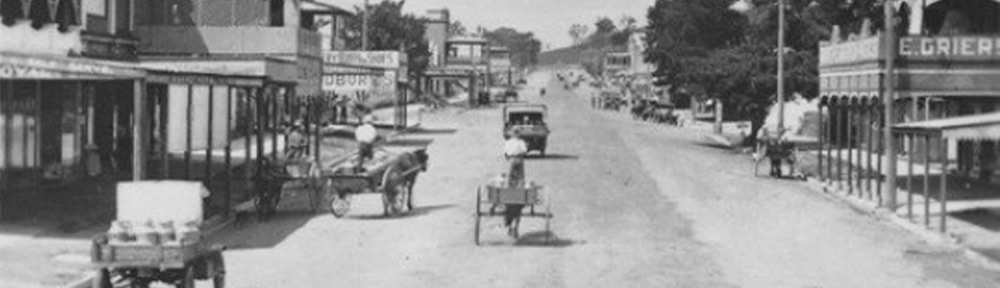
Along Dowling St, the new buildings included the Roman Catholic Church and Presbytery (1880s, now Tall Timbers Motel and the Information centre), an Italianate Post Office (1874, with a less dramatic facade added some decades later), the Oddfellows Hall (1881, now the Dungog Medical Practice), the ornate CBC bank and residence (1884, now a private residence), Centennial Hall (1888, now a cafe), the Bank Hotel (an 1891 conversion of a former residence), the Skillen and Walker Terrace (1895, four two-story shops-and-residences with a central archway), the School of Arts (1898, now the Historical Society), and the Angus and Coote building (1911).

Dowling St, Dungog, early in the 20th century

After the death of her father in 1883, Ellen Bruyn had bought the land in Brown Street where the family had lived for around 30 years. As the town continued to grow, a number of significant buildings were erected near to this residence. On the corner of Brown and Dowling Sts, Dark’s Store was built in 1877 and expanded in each of 1896, 1900 and finally in 1920. It came to be called “the hall of Commerce” and housed the largest store in Dungog. Opposite this was the striking Coolalie, built in 1895 as the home of Henry Charles Dark.

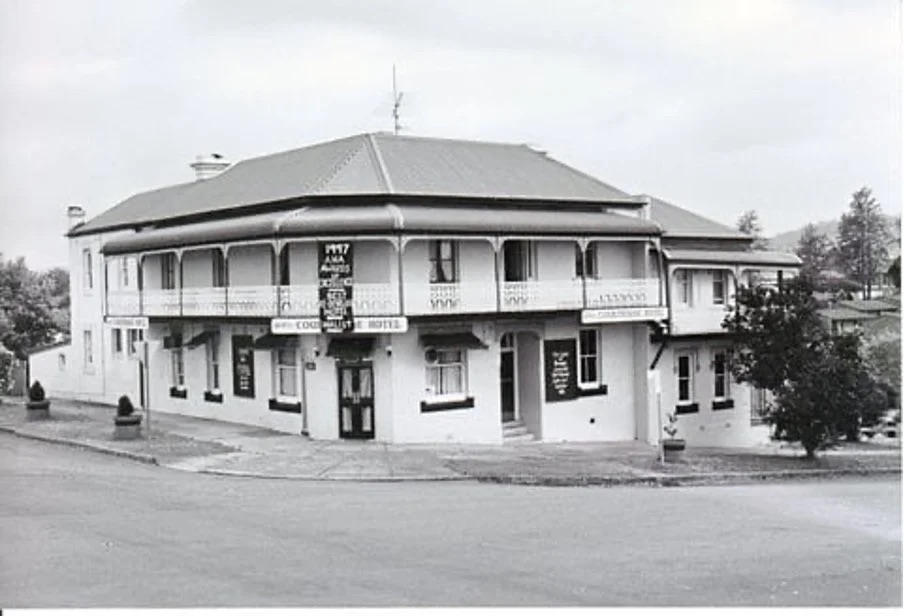
The Court House Hotel (later renamed the Settlers Arms), the earliest hotel in Dungog

In Brown Street itself, Dungog’s oldest hotel, the Court House Hotel, now the Settler’s Arms (pictured above), had been trading since the 1850s. On the top of the hill, the Roman Catholic Convent of St Joseph was built in 1891, a Parish Hall in 1913, and a new Church in 1933, six years after Ellen died. As a devout Catholic, she would have been a regular attendee at the Church on Dowling St and, in later years, at Parish events in the Hall on Brown St. On the eastern end of Brown St, the James Theatre was opened in 1918; to the west of the Bruyn residence, a large and impressive Memorial Hall (now the RSL club) was built in 1919.

The James Theatre, Dungog, in the 1950s
(from https://www.newcastleherald.com.au/story/
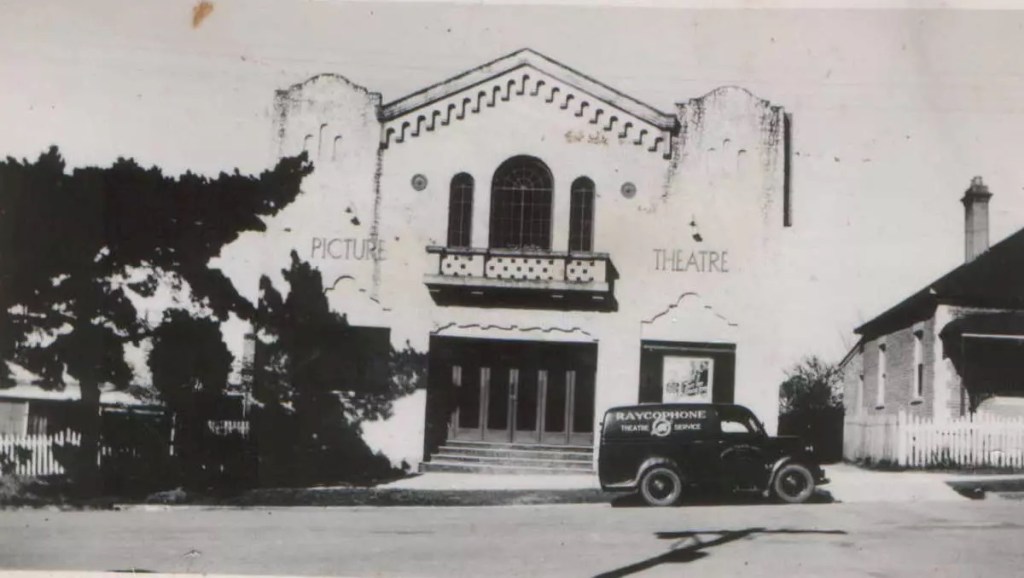
1208160/dungog-cinema-celebrates-100-years/)

(The information about these buildings is taken largely from Michael Williams’ 2011 publication, Ah, Dungog! A brief survey of its charming houses and historic buildings.)

So the hypothesis that Elizabeth and I have developed is that, after she had bought the property in Brown St in 1883, with the older family home on it, Ellen Bruyn had a new double-brick house built on Lot 6.

Which opens the next stage as the story continues … … …

and see earlier blogs at

The Bruyns of Brown Street (6)—Daniel Justin Bruyn (continued)

In exploring the history of the land and house which Elizabeth and I purchased in Dungog a few years ago, I have already noted the early landholders for this property, and investigated the life of Daniel and Sarah Bruyn and their family after Daniel purchased the land in 1858. When Daniel died intestate in 1882, all of his property was made over to his son, Daniel Justin Bryan, whose life we have considered. We turn now to his death.

On 22 September 1886, Daniel Justin Bruyn had made his last Will and Testament “whereby he gave devised and bequeathed all his property of whatsoever nature and wheresoever situate to his sister Ellen Bruyn absolutely and appointed the said Ellen Bruyn the sole Executrix thereof”. On 1 November 1912 Daniel Justin Bruyn died, and that will came into effect.

A Coroner’s Inquest for Daniel Justyn Bruyn of Dungog was held by Walterus Le Brun Brown, J.P., on 2 November 1912. The report of the inquest notes that “cash or property possessed by deceased” was “probably over £10,000”. That equates to around $1.45 million in 2023.

Probate for the estate of Daniel Justin Bryan was granted on 26 February 1913. Daniel had never married and had no descendants; as his will prescribed, this collection of property and cash became the possession of Ellen Bruyn. That was a happy result for her in very sad circumstances. The death of Daniel Justin Bruyn, however had a deeper tragedy at its heart.

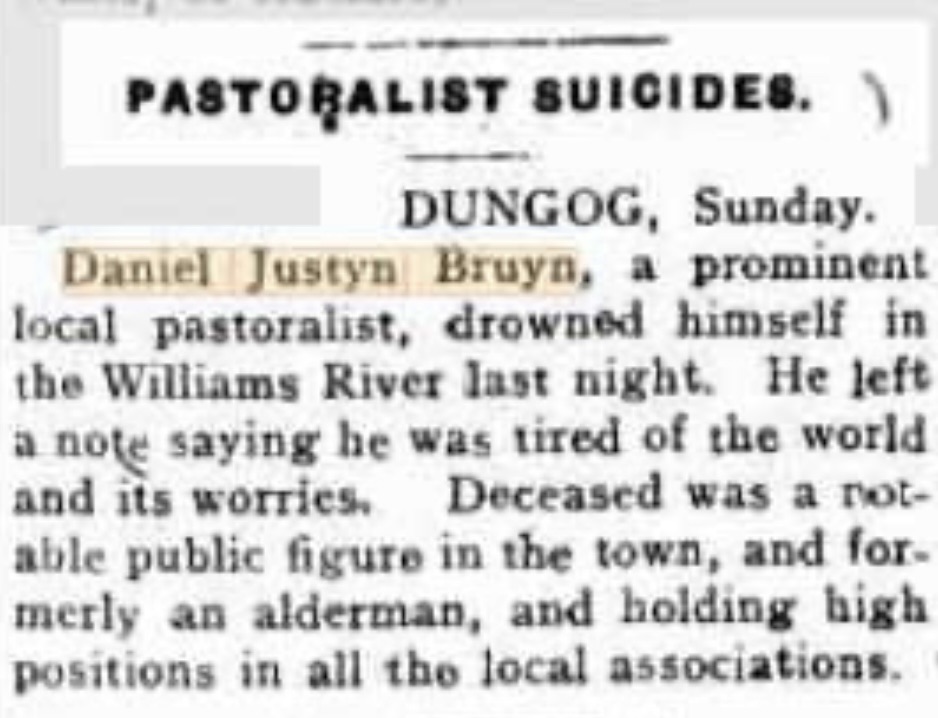
The Bathurst National Advocate stated the matter plainly, in a brief report published on Monday 4 November 1912, under the heading PASTORALIST SUICIDES: “Daniel Justin Bruyn, a prominent local pastoralist, drowned himself in the Williams River last night. He left a note saying he was tired of the world and its worries. Deceased was a notable public figure in the town, and formerly an alderman, and holding high positions in all the local associations.”

Note of death by suicide in the Bathurst National Advocate

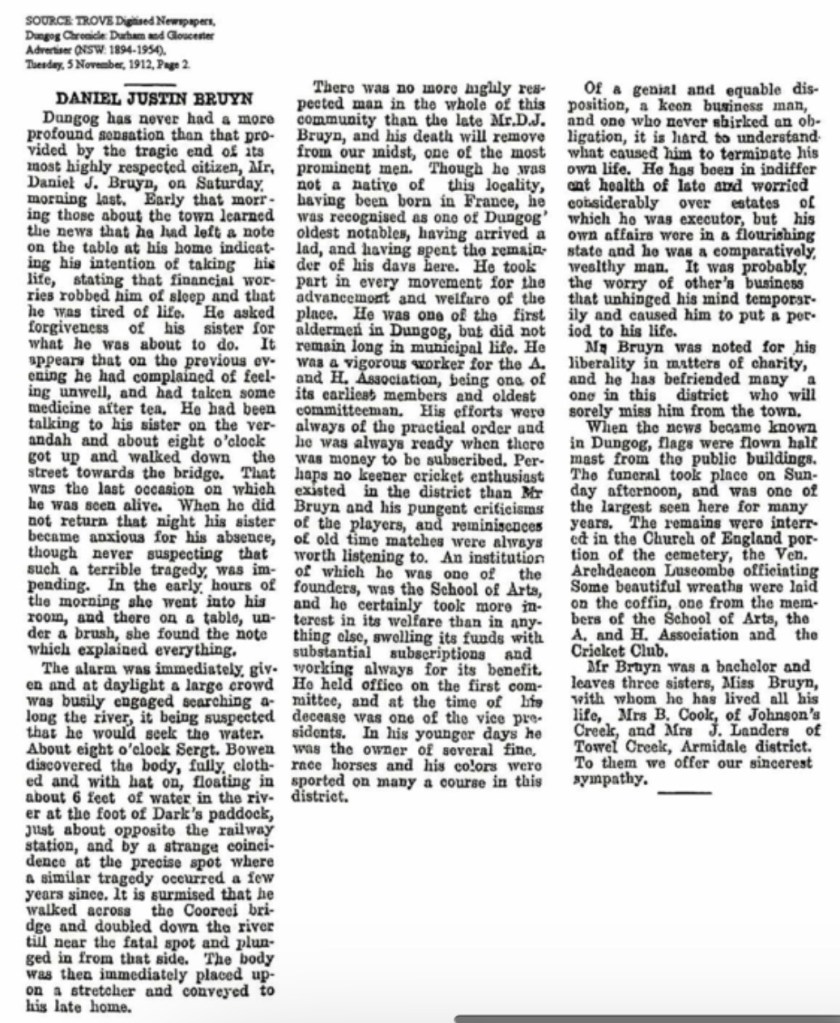
The next day, the Dungog Chronicle provided a much fuller obituary which provided details of the incident and demonstrated just how high a regard was had for Mr Bruyn in the town (Tuesday, 5 November, 1912, Page 2). “Dungog has never had a more profound sensation than that provided by the tragic end of its most highly respected citizen, Mr. Daniel J. Bruyn, on Saturday morning last”, it began.

“Early that morning those about the town learned the news that he had left a note on the table at his home indicating his intention of taking his life, stating that financial worries robbed him of sleep and that he was tired of life”, it continued. It then offered this sad commentary: “He asked forgiveness of his sister for what he was about to do.”

The Chronicle had been advised that “on the previous evening he had complained of feeling unwell, and had taken some medicine after tea. He had been talking to his sister on the verandah and about eight o’clock got up and walked down the street towards the bridge. That was the last occasion on which he was seen alive.”

This is the verandah at the front of the house when we moved in, late 2023. Could this have been the same verandah referred to in the obituary of Daniel Justin Bruyn?

This report indicates that Daniel Bruyn did spend time living in the house at Brown Street with his sister, at least at this stage of his life. As both were unmarried, and as the house was ideally placed in the centre of town—next to Dark’s burgeoning general store on Dowling Street, near to the School of Arts where the Municipal Council met—it would make sense for Bruyn of Sugarloaf to have his base in Brown St for such town activities.

Indeed, as the report states, when his sister Ellen “became anxious for his absence … in the early hours of the morning she went into his room, and there on the table, under a brush, she found the note which explained everything”. It continues by noting that upon discovery of Mr. Bruyn’s body, he was “immediately placed upon a stretcher and conveyed to his late home”—that is, the residence in Brown St that he had so recently left.

And, as we have seen, when he was elected to Dungog Council in 1893, his residence is listed as Brown Street. (Michael Williams, in his extensive survey of the historic buildings of Dungog, notes that street numbers were not used until the 1960s; see Ah! Dungog, 2011, p.11.)

The detailed report of Daniel Bruyn’s death in the Dungog Chronicle of 5 November 1912 noted that once his note was discovered and the alarm was raised, “at daylight a large crowd was busily engaged in searching along the river, it being suspected that he would seek the water.”

Sure enough, the report continues, “about eight o’clock Sergt. Bowen discovered the body, fully clothed and with hat on, floating in about 6 feet of water in the river at the foot of Dark’s paddock, just about opposite the railway station, and by a strange coincidence at the precise spot where a similar tragedy occurred a few years since. It is surmised that he walked across the Cooreei bridge and doubled down the river till near the fatal spot and plunged in from that side.” (The Cooreei Bridge crosses the Williams River about a kilometre out of town, on the road that connects Dungog with Stroud.)

The report continues with words that emphasise the regard felt for the deceased: “There was no more highly respected man in the whole of this community than the late Mr.D.J. Bruyn, and his death will remove from our midst, one of the most prominent men … he was recognised as one of Dungog’s notables.” Then, musing on the manner of his death, it opines, “of a genial and equable disposition, a keen business man, and one who never shirked an obligation, it is hard to understand what caused him to terminate his own life.”

The full obituary for Daniel Justin Bruyn, published by
the Dungog Chronicle just four days after his death

The report further offers comments on the character of Mr. Bruyn: he was “noted for his liberality in matters of charity, and he has befriended many a one in this district who will sorely miss him from the town.” The report notes the fitting tribute paid to Daniel Justin Bruyn: “when the news begame known in Dungog, flags were flown half mast from the public buildings”.

In pondering a possible reason for this suicide, the article offers a hypothesis, noting that Daniel Bruyn “has been in indifferent health of late and worried considerably over estates of which he was executor, but his own affairs were in a flourishing state and he was a comparatively wealthy man. It was probably the worry of other’s business that unhinged his mind temporarily and caused him to put a period to his life.” The truth of this hypothesis, however, will never be able to be ascertained.

A correspondent in the Maitland Daily Mercury on Wednesday 6 Nov 1912, p.2, further expresses the dismay of the locals at the news of Daniel’s death: “to say that Dungog and district were struck dumb when it became known that Mr. Daniel Justin Bruyn had left a note expressing his intention to end his life, is putting the truth very mildly. The deceased was about the last person anyone would have expected to do such an act. He was a very quiet man of a retiring disposition, and as far as an onlooker could see had less worry than most people. He was more universally trusted than most men, as proved by the number of wills in which he was appointed an executor, and it is thought that his troubles were not his own, but were those which he voluntarily shouldered for others.”

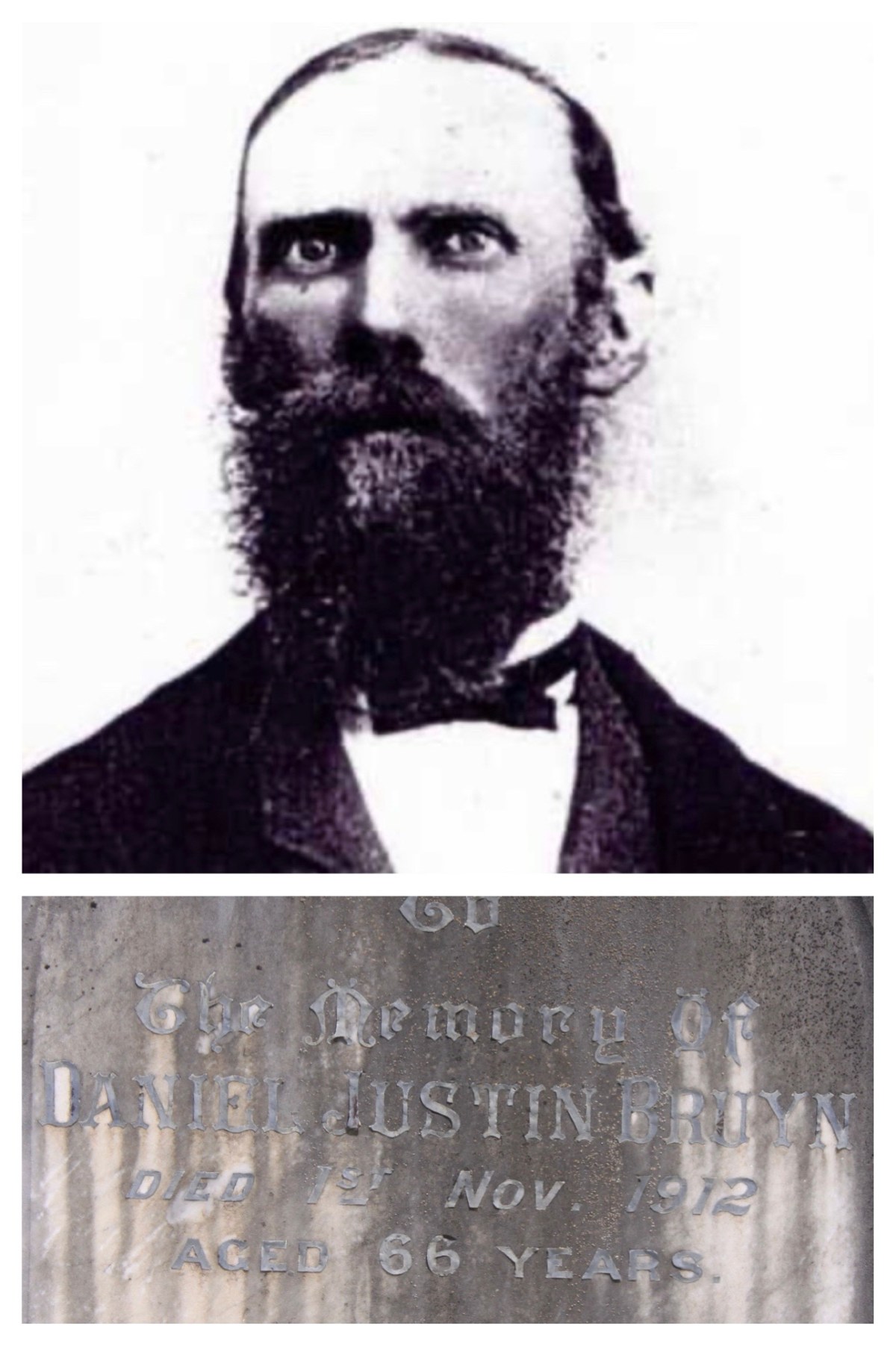
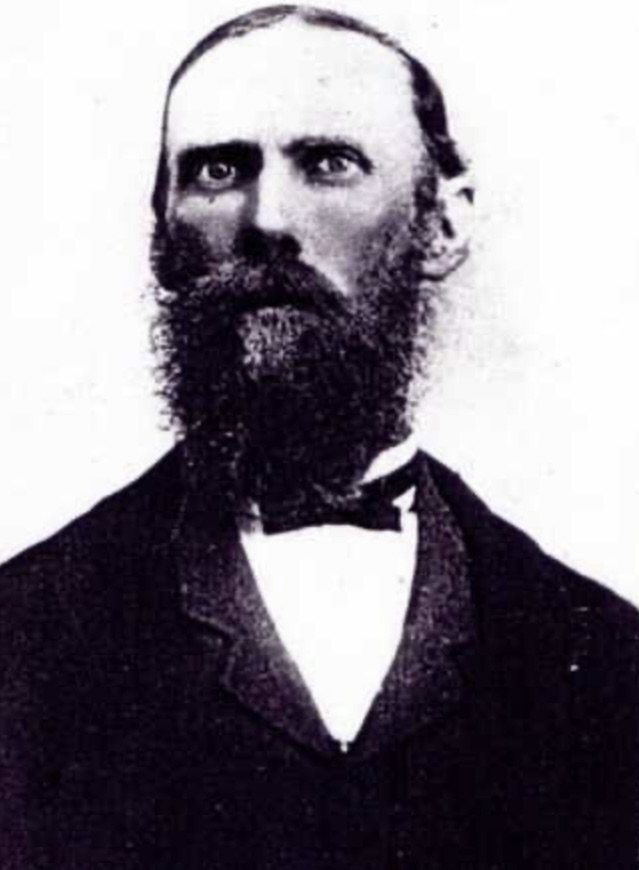
Daniel Justin Bruyn (1847—1912)

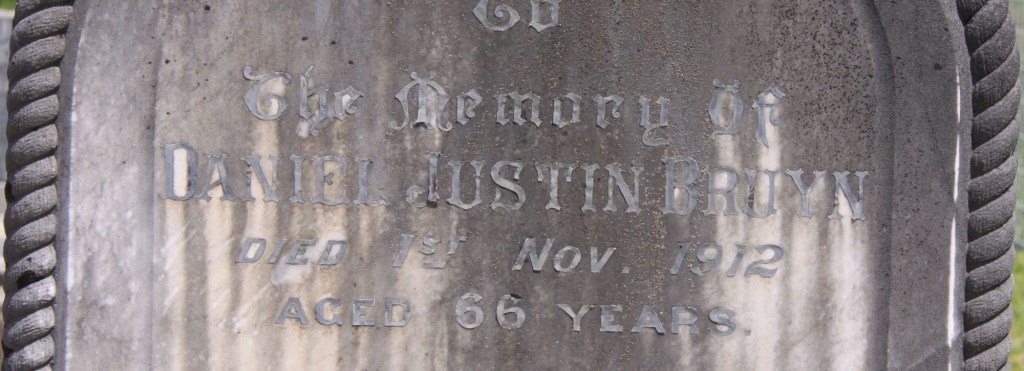
Of the funeral of Daniel Justin Bruyn, the Dungog Chronicle notes that, as might be expected, it was “one of the largest seen here for many years”. The Anglican minister, the Ven. Archdeacon Luscombe, officiated, and wreaths were laid on the coffin from organisations including the School of Arts, the A. and H. Association, and the Cricket Club. Three of his sisters remained: Ellen Bruyn in Brown St, Elizabeth Cook of Johnson’s Creek north of Stroud Road, and Sarah Landers of Towel Creek in the Armidale district.

Our particular story will continue with Daniel’s sister, Ellen Bruyn … … …

For earlier posts, see

For the story of Ellen Bruyn, see

Image of the invisible God, firstborn of creation (Pentecost 6C; Col 1)

The lectionary continues to offer us passages from epistles attributed to Paul. After working our way through Galatians—which Paul, I believe, most definitely did write—this coming Sunday we continue the sequence of passages from Colossians, which I am not convinced was written by Paul, even though the letter claims that it was written by Paul (Col 1:1).

The passage for this coming Sunday (1:15–28) is one of the places in this letter where there are significant theological developments beyond the theology found in the seven “authentic” letters of Paul: Romans, 1 & 2 Corinthians, Galatians, Philippians, 1 Thessalonians, and Philemon (this order, by the way, moves from the longest to the shortest of these letters).

The letter has begun with the expected words of greeting (1:1–2) and prayer of thanksgiving (1:3–8). The prayer morphs into a prayer of intercession for the Colossians (1:9–12), cycling back into an expression of thanks to “the Father” (1:12) for what he has done through “his beloved Son” (1:13–14). All of this adheres to the pattern that is found in most of Paul’s letters (although Galatians has omitted any thanksgiving from the beginning of the letter—Paul is too angry with them!).

This thanksgiving for the Son then morphs seamlessly (in the original Greek, there is no sentence break) into an extended affirmation about Jesus, “the image of the invisible God, the firstborn of all creation … the head of the body, the church … the beginning, the firstborn from the dead …[in whom] all the fullness of God was pleased to dwell” (1:15–20).

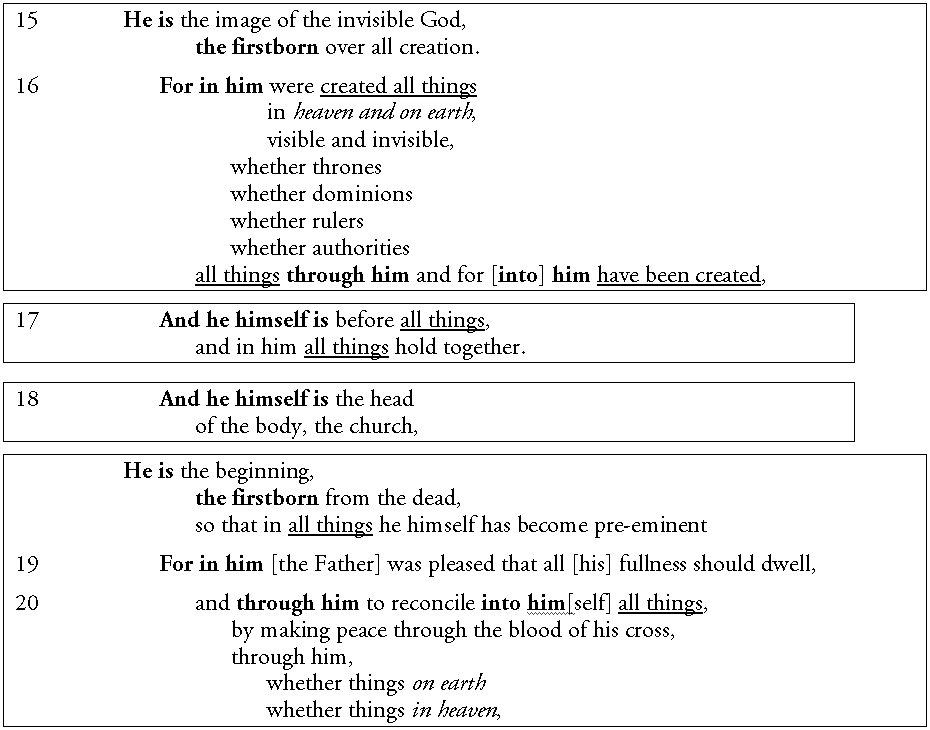
This is quite an extension to the expression of thanks; the sentence in Greek actually begins in v.9 and continues through multiple subordinate clauses to v.20! It has a lovely structure beauty, which is clearly evident in the Greek text; not so much, unfortunately, in most English translations. (Indeed, it is nigh-impossible to convey the structure in a poetic manner in a language other than the original.) The best structure exposition I have found of it looks like this:

The structure of Col 1:15–20, as outlined by Andrew Fountain
in “The song hidden in Colossians”, Newlife Church Toronto;
see https://nlife.ca/audio/colossians-pt4

This poetic passage also stands as significant theological affirmation. It offers a relatively early consideration of “the person and work of Jesus Christ”, a crucial theme which later systematic theology writers would explore and develop, using this and other passages of scripture as foundations for a complex and intricate affirmation of this key element of Christian faith.

The main thrust of this passage can best be understood by giving consideration to the way this it draws on Jewish elements—specifically, the Wisdom material found in parts of Hebrew Scripture. Jesus is portrayed very much in the manner of Lady Wisdom, as we encounter her in scripture in Proverbs 8, and then in the deuterocanonical works of Ben Sirach (Ecclesiaticus) and the Wisdom of Solomon. In Colossians, of course, the attributes of the female Wisdom are applied directly to the male Jesus.

Jesus is here described as the agent of God’s creative powers: “in him all things in heaven and on earth were created … all things have been created through him and for him” (Col 1:16). In the same way, in Proverbs Wisdom herself is said to have declared that “ages ago I was set up, at the first, before the beginning of the earth … when [the Lord] established the heavens, I was there … when he marked out the foundations of the earth, then I was beside him, like a master worker” (Prov 8:22–31). 

The creative power of Wisdom

In the Wisdom of Solomon, Wisdom is described as “the fashioner of all things” (Wisd Sol 7:22), “a breath of the power of God” who “pervades and penetrates all things”(7:24–25), who was “present when you [God] made the world” (9:9), whose “immortal spirit is in all things” (12:1). 

Jesus, son of Sirach, declares that “Wisdom was created before all other things” (Sir 1:4), that at the very first she “came forth from the mouth of the Most High, and covered the earth like a mist” (Sir 24:3), and “compassed the vault of heaven and traversed the depths of the abyss” (24:5) as she undertook her creative works, distinguishing one day from another and appointing “the different seasons and festivals” (33:7–8).

Jesus Christ, as the one who is “before all things” (Col 1:17), reiterates what Wisdom declared, that “before the mountains had been shaped, before the hills, I was brought forth—when [the Lord] had not yet made earth and fields, or the world’s first bits of soil” (Prov 8:25–26).

So Jesus is the one who has “first place in everything” (Col 1:18), just as the works of Wisdom can be traced “from the beginning of creation” (Wisdom Sol 6:22). The importance of these Wisdom writings for what is stated in Col 1 is clear. (The same writings underpin the theological affirmations made about Jesus in Heb 1:1–4 and John 1:1–18.)

The passage in Colossians also indicates that believers are “transferred … into the kingdom of [God’s] beloved son” (Col 1:13); they are rescued (1:13) and redeemed (1:14) by the work of Jesus. In similar fashion, the Wisdom of Solomon contains a long section praising Wisdom who was actively involved in human affairs from when “she delivered him [Adam] from his transgression” (Wisd Sol 10:1), saved the people at the Exodus, and guided the Conquest and settlement in the land. It was Wisdom who punished the Canaanites (12:3–11), sinful Israelites (12:19–22), and the Egyptians (12:23–27), as well as all idolators (13:1—14:31). A similarly lengthy poem praising the works of Wisdom occurs in chapters 44 to 50 of Sirach, extending all to the way to Simon, son of Onias (high priest in the early C3rd BCE). 

So Jesus brings to a high point much of what had been hoped for, and spoken about, in the figure of Wisdom. All of this is now seen to reside in him, “the image of the invisible God, the firstborn of all creation … the head of the body, the church … the beginning, the firstborn from the dead …[in whom] all the fullness of God was pleased to dwell” (1:15–20). It’s a remarkable testimony.

Wisdom, by Sara Beth Baca

This year we are to celebrate 1700 years since the Nicene Creed was created. The development in theological understanding of Jesus that is found in these verses in Colossians, drawing from Hebrew scriptures of past centuries, continues apace in the ensuing centuries, as Christian writers draw more and more from neo-platonic philosophy to develop what eventually becomes a full suite of Christian doctrines—including a series of affirmations about Jesus.

It is worth noting that, just as the creative work of Jesus is noted in the Nicene Creed (“through him all things were made”), so his salvific work is also briefly described (“for us [all] and for our salvation he came down from heaven“). These fleeting references draw on the way in which scripture has used the Wisdom literature— although, of course, all four Gospels and many Epistles note the forgiving, saving, delivering work of Jesus. Colossians plays its part in attesting to this. It is, in fact, part of the bedrock of the developing patristic theology which emerged over the centuries between the New Testament and the early Ecumenical Councils. 

I’m planning to write some more blogs about credal affirmations found within scripture, and how they inform (or not) the Nicene Creed, in the context of this global celebration of 1700 years since Nicaea. Stay tuned!

The Bruyns of Brown Street (5)—Daniel Justin Bruyn

In exploring the history of the land and house which Elizabeth and I purchased in Dungog a few years ago, I have already noted the early landholders for this property, and investigated the life of Daniel and Sarah Bruyn and their family after Daniel purchased the land in 1858. When Daniel died intestate in 1882, all of his property was made over to his son, Daniel Justin Bryan, whose life we now consider.

Daniel Justin Bruyn was born in France. His parents, Joseph and Sarah, had married in 1837 in West Bromwich, Staffordshire, where four children were born in the years 1837 to 1842. The family travelled to France, perhaps seeking to use there the skills that Daniel Snr had as a Blacksmith. Two children were born there; Mary died within a year, Daniel Jnr was born on 26 May 1847, at Graville, Le Havre, Seine.

After four years the family returned to England because of the unrest relating to industrialisation. Another daughter was born; the family then migrated to the Colony of New South Wales in 1856 and settled in Dungog, where Daniel purchased land and established his Blacksmith business.

Daniel Justin Bruyn was eleven years of age when his father purchased the land in Brown St; presumably he lived with the family there for some time after they moved into the building that was erected there, at some stage between 1858 and 1866, as noted previously.

Grevilles 1872 Post Office Directory lists both Daniel Bryun, Blacksmith, of Brown St, Dungog, and Joseph Bruyn, farmer, “near Dungog”. Joseph was the firstborn son of Daniel. At some point after this, Daniel Justin Bruyn began to purchase land holdings to the north of Dungog.

Daniel Justin Bruyn

On 11 Sept 1879, Daniel Justin Bruyn is listed as selecting 234 acres in Dungog, Al. No. 76-37754, C.P. No. 73–9338. On 19 April 1883 Daniel Justin Bruyn made application to be registered as “Proprietor by Transmission” of land in Dungog, as the Administrator of the intestate estate of Daniel Bruyn, deceased. The land was 3 acres, Lots 1, 2, and 3, of Section 32, Town of Dungog; this was on the northern side of Hooke St, between Abelard and Eloisa Streets. (There are residential building on these lots today.)

On 1 September 1892 Daniel Justin Bruyn made application for 79 1/2 acres at Tillegra; on 1 February 1893, 78 3/4 acres was granted to him. On 20 October 1892 he made application for 77 acres at Dungog; on 1 February 1893, 65 1/4 acres was granted to him. It is also reasonable to assume, from a piece of evidence noted below, that Daniel had a room in the house at Brown Street where his sister lived. That was his base when he was in town, it would seem.

In a series of Electoral Rolls (1895, 1900, 1904) Daniel Justin Bryun, Grazier, is listed as living at Sugarloaf. In 1905, he is listed as having 15 horses and 190 cattle (and no sheep) on his property at Sugarloaf Creek.

A survey map of the area, dated 9 January 1894, designates seven properties in his name running along the northern boundary of the Parish of Dungog, adjacent to the Parish of Tillegra, to the south of the current Sugarloaf Road, and west of the Longbrush Gully. Another survey map for the Parish of Tillegra places him as owner of a further fourteen Lots running in parallel to his Dungog Parish holdings.

In the Parish of Dungog, running east to west, Bruyn owned Lots 128 (50 acres) and 134 (73 acres), adjacent to each other; then stretching west from them, Lots 52 (234 acres), 50 (40 acres), 136 (40 acres), 53 (120 acres), and 151 (65 acres). This final Lot was the penultimate Lot before the boundary with the Parish of Lewinsbrook, covering the area between Dungog and Gresford. The total acreage of these seven Lots is 622 acres.

The holdings of Daniel Justin Bruyn in the Sugarloaf region, running along the northern boundary
of the Parish of Dungog

In addition, on the other side of the Parish boundary, in the Parish of Tillegra, there is another, more extensive, collection of Lots in the name of Daniel Justin Bruyn. Running east to west, he owned Lots 48 (40 acres), 129 (49 acres), 37 (40 acres), 38 (40 acres), 49 (80 acres), 106 (114 acres), 4 (99 acres), 149 (40 acres), 119 (40 acres), 137 (40 acres), 138 (40 acres), 55 (78 acres), 145 (40 acres), and 55 (78 acres)! The total acreage of these Lots is 818 acres.

The holdings of Daniel Justin Bruyn in the Sugarloaf region
on the southern border of the Parish of Tillegra,
adjacent to his holdings in the Parish of Dungog

The Sugarloaf Creek meanders its way through the easternmost half of the Lots in the Parish of Tillegra. A survey map declares that all of these Lots were part of a larger area, Gloucester Coldfield, that was proclaimed on 3rd June 1879. Together, the 1,440 acres of these Lots form a very significant landholding. To the east of Daniel’s landholdings, another series of Lots totalling 249 acres bear the name of his sister, Ellen Bruyn.

In the Dungog Chronicle of 30 August 1898, p.3, a notice appeared relating to a proposed “public meeting for the purpose of petitioning the Minister for Works, through the Member for Durham, to construct a road between Gresford and Dungog”. There are 14 signatories to this notice, including that of Daniel J. Bruyn, indicating that “a public meeting [is] to be held at the Council Chambers on THURSDAY NEXT, at 8 p.m.”

As one owning property in the Sugarloaf Creek area, Daniel Bruyn obviously had a vested interest. It is clear that the petition for the construction of this road was successful, as a road today does wind its way through the beautiful hills in the area between Gresford and Dungog, and through some of the land once owned by Daniel Justin Bruyn.

Scenery on the Sugarloaf Road from Dungog to Gresford, 2024

Not only did Daniel Justin Bruyn die a wealthy man, however; he died also a highly-regarded and well-respected member of the Dungog community. His obituary (see below) indicated that he was a Trustee of the Dungog Hospital, a Municipal Alderman, a Justice of the Peace, a longterm committee member of the A. and H. Association, and one of the founders of the Dungog School of Arts. He followed the local cricket team with enthusiasm, and owned a number of horses that he raced in the local area.

On 17 November 1891, the Government Gazette (p.9023) contained a notice from the Department of Lands of the appointment of Joseph Abbott, George Alexander McKay, Vincent Carlton, John Robson, and Daniel Justin Bruyn, as “Trustees of the land at Dungog, viz. portion 135, parish of Dungog, county of Dungog, dedicated 15th September 1891, for hospital site”.

Notice from the NSW Government Gazette of 7 Nov 1891

The Dungog Cottage Hospital was opened on Hospital Hill in 1892 and the site, now much expanded, has provided local hospital and medical services since that time.

The Dungog Cottage Hospital building

On 21 July 1893, the Government Gazette (p.5663) contained a notice of the election of Frederick Agustus Hooke, Dingadee, Dungog; Daniel Justian [sic.] Bruyn, Brown-street, Dungog; Henry Charles Dark, Dowling-street, Dungog; Joseph Abbott, Dowling-street, Dungog; John Robson, Dowling-street, Dungog; and John A. Jones, Dowling-street, Dungog, as Aldermen of the Municipal District of Dungog.

1893 Government Gazette announcement

Then, on 8 February 1896, the Government Gazette (p.1022) contained a notice of the election of Frederick Augustus Hooke and Daniel Justin Bruyn, as Aldermen of the Municipal District of Dungog. Three years later, on 13 February 1899, the Government Gazette (p.1415) contained a notice of the election of Frederick Augustus Hooke, Daniel Justin Bruyn, and John McLauchlin, as Aldermen of the Municipal District of Dungog.

Extracts from the Dungog Chronicle of 1896 and 1989, announcing the election of Alderman for the Municipality of Dungog

On 4 May 1901, the Maitland Mercury (p.3) reported that Daniel Justin Bruyn was amongst a list of “gentlemen appointed to them commission of the Peace” (that is, as a Magistrate, or a Justice of the Peace).

On 22 September 1886, Daniel Justin Bruyn had made his last Will and Testament “whereby he gave devised and bequeathed all his property of whatsoever nature and wheresoever situate to his sister Ellen Bruyn absolutely and appointed the said Ellen Bruyn the sole Executrix thereof”. On 1 November 1912 Daniel Justin Bruyn died, and that will came into effect. So Ellen received a significant amount of property, as we have seen.

The Register of Coroner’s Inquests for 2 November 1912 lists an inquest for Daniel Justyn Bruyn of Dungog, held by Walterus Le Brun Brown, J.P., which notes that “cash or property possessed by deceased” was “probably over £10,000”. That equates to around $1.45 million in 2023.

to be continued … … …

*****

See earlier posts at

and subsequent posts at