Skip to content

An Informed Faith

John T Squires

An Informed Faith

Category: An Orderly Account: Gospel of Luke

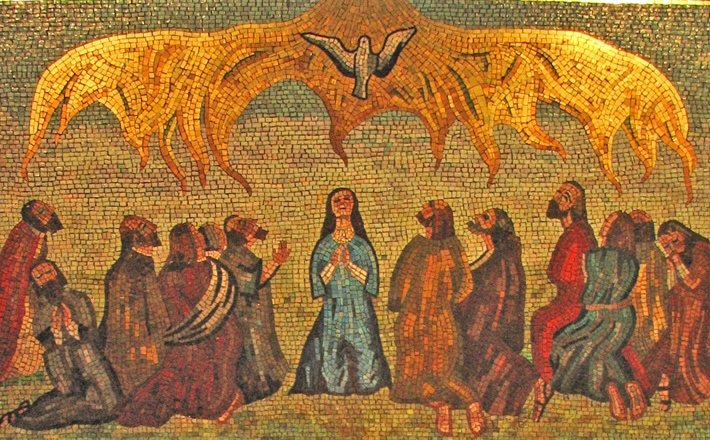
What does this mean? Wind and fire, tongues in the temple, on Pentecost Sunday (Acts 2; Pentecost)

What does this mean? Wind and fire, tongues in the temple, on Pentecost Sunday (Acts 2; Pentecost)

This Sunday is the festival of Pentecost. It falls fifty days after Easter Sunday, and brings the season of Easter to a rousing conclusion. Every year, a reading from Acts 2 is scheduled. This is the account in the second volume of the orderly account of things being fulfilled that we know as the book of Acts.

Pentecost was one of the annual festivals of the Jewish people; it was known as the Festival of Harvest (Exod 23:16) or Festival of Weeks (Exod 34:22; Num 28:26-31; Deut 16:9-12). It was a significant time for Jewish people, being linked with the giving of the Law to Israel through Moses (Exodus 19–24).

The particular significance for Luke of what happened on this festival day is evident initially from its placement in the narrative as the first major event reported at length, as well as from the portentous introduction it receives, literally, “in the complete filling-up of the day of Pentecost” (2:1). The phrase recalls Luke 9:51, a similarly momentous phrase in the Gospel.

Many of the elements of this story will recur in later sections of the narrative, confirming the programmatic significance of the Pentecost account for the whole of Acts. This scene thus performs a function for Acts similar to that of Luke 4:16-31, which establishes the pattern for Jesus’ ministry in Galilee (Luke 4-9) and Jerusalem (Luke 19-21).

*****

The initial action, as narrated, is a portent, comprising miraculous phenomena both auditory (“a sound like the rush of wind”, 2:2) and visual (“there appeared to them tongues as of fire”, 2:3). Such portents would be understood by any reader, in the hellenistic context, as being divine in origin. For Jews, these phenomena might evoke scriptural resonances from the story of Moses on Mount Sinai, when God gave the Ten Commandments, accompanied by thunder, lightning, thick cloud, smoke, and violent shaking of the mountain (Exodus 19:16-19).

Initially, those gathered are said to be “filled with the spirit” (2:4). In Hebrew Scripture, the spirit is known as a manifestation of God’s actions in relation to Israel, guiding selected leaders (Moses, Num 11:16-17; Joshua, Deut 34:9; Othniel, Judg 3:10; Gideon, Judg 6:34; David, 1 Sam 16:17) and inspiring various prophets (Saul, 1 Sam 10:6; 19:23-24; Isa 42:1; 61:1; Ezek 37:1; Micah 3:8).

The spirit granted specific gifts (Num 11:25; Deut 34:9; Dan 4:8-18; Prov 1:23; Joel 2:28-29) and will rest upon the future Davidic leader (Isa 11:2-5). The Priestly writer attributed the spirit with a role in creation (Gen 1:1-2; see also Job 33:4) and the Psalmist envisioned the spirit as playing an eschatological role (Ps 104:30). 

Luke has noted the strategic role of the spirit in the lives of Jesus (Luke 4:1) and John the baptiser (Luke 1:15), as well as of John’s parents (Elizabeth, Luke 1:41; Zacharias, Luke 1:67). The giving of the spirit at Pentecost thus stands in continuity with God’s actions in Israel; it also prefigures the state of many individuals later in the narrative of Acts (4:8; 6:3,5; 7:55; 9:17; 11:24; 13:9; and cf. 18:25). The Pentecost narrative signals that the spirit is to be an integral factor in leadership of the messianic movement.

The action of the spirit immediately results in ecstatic phenomena, as “they began to speak in different tongues” (2:4). This phenomenon recurs in Caesarea (10:46) and in Ephesus (19:6). Often, the gift of tongues has been taken as being the key element in this narrative. In the light of the comment of the bystanders (2:7-8), it cannot be doubted that Luke understands the phenomenon to be “xenoglossy”, that is, the way that individuals miraculously spoke publically in identifiable foreign languages.

This is different from the “glossolalia”, or speaking in unknown languages in a private prayer-like communication with God, which Paul reports in 1 Cor 12-14; although it is entirely plausible that Luke has reinterpreted such a phenomenon as “xenoglossy” for his own purposes (Wilson 1973:121-122). For Luke, the foreign languages which were spoken begin to fulfil Jesus’ prediction that the message was to be preached in every nation (Luke 24:47-48; Acts 1:8). This is the programme which now begins to be implemented in Acts; the spirit of prophecy gives an empowering for witness (Turner in Marshall and Peterson 1998:327-348).

*****

Luke 24:53 leads us to expect the location of the Pentecost story to be in the temple; certainly, it soon becomes explicit that events occur in Jerusalem (2:5). The ”Jews, devout men (sic.) from all the nations under heaven” who are present are identified as having come to live in Jerusalem from the nations at the eastern end of the Mediterranean basin (2:9-11), in four quadrants with Jerusalem at the centre.

The scene already points to events later in Acts; although the particular setting is the Jewish context of festive Jerusalem, this gathering from the nations surrounding Jerusalem foreshadows the wider awareness of the Gospel which is to come. However, for the moment, the focus remains strictly Jewish, both in terms of the individuals who are present (“Jews”, 2:5) and in terms of how the story echoes the prophetic vision of the eschatological gathering of the nations (see Isa 2:2-4; 34:1-4; 42:1-6; 43:8-9; 45:20-23; 49:22-23; 52:7-10; 55:1-5; 60:1-7,11,14; 62:1-2; 66:18-24. At Isa 11:12 it is ”the outcasts of Israel and the dispersed of Judah” who are gathered.)

It is a deliberate narrative decision to portray God acting amidst this gathering of diaspora Jews. For the crowd of pilgrims the precise action narrated is unexpected and is capable of diverse interpretations (“all were amazed”, 2:12; “others sneered”, 2:13).

Peter offers what, for Luke, is the definitive interpretation: “this is what was spoken by the prophet” (2:16). In speaking in this way, Peter not only refers to the prophetic words of Joel, but also functions himself as a prophet, in that he sets forth the divine perspective on the events that are taking place. What has taken place is what God said he would do “in the last days” (2:16-17). The event has deep and enduring significance.

*****

The speech offers an interpretation of the phenomena which have just been experienced, through recourse to scripture (2:14-21). This is Peter’s second speech and, like his first, it is grounded in scripture. Fulfilment of prophecy which is reported here is a strong thematic strand which runs throughout Acts. It is the most explicit of a range of ways in which scripture figures in his narrative; for Luke, scripture is the matrix which will provide full understanding of the events he narrates.

The citation of “what was spoken through the prophet Joel” in 2:17-21 already contains more than adequate points of connection with the immediate context: reference to the spirit (2:17,18; see 2:4), prophecy (2:17; this appears to be the force of 2:7-11), and wonders (2:19; again, this describes 2:2-4).

It will also provide points of connection with subsequent events in other places: male prophets (11:28; 21:10-11); female prophets (21:9); the seeing of dreams and visions (9:10; 10:3,10-12; 12:9; 16:9; 18:9; 22:17-18; 23:11; 27:23) and the granting of salvation to those who “call on the name of the Lord” (4:12; 16:31). This scripture citation thus has a strategic significance in terms of the ensuing narrative.
The particular version of the scriptural text that Luke cites intensifies these connections with the immediate events, thereby highlighting the way he wishes them to be interpreted. The emphatic “God says” (2:17) makes explicit the intention of the prophetic oracle, that these phenomena are divinely given (“I will pour out my spirit”, 2:17; “I will give wonders”, 2:19).

In Luke’s version of the text, the divine gift of prophecy is (2:17) is repeated in the phrase “and they will prophesy” after the reiteration of “I will pour out my spirit” (2:18), and the divine portents are emphasised through the inclusion of signs after the reference to wonders in 2:19. Each of these gifts recur throughout the narrative of Acts: prophecy at 11:28; 19:6; 21:9-11, and signs and wonders at 4:30; 5:12; 6:8; 14:3; 15:12.

Finally, the inclusion of a reference to “in the last days” (2:17) heightens the significance of the event as the beginning of eschatological fulfilment. The interpretation which Luke has Peter provide thus uses language about God to elucidate the inner significance of the Pentecost phenomena. Interpreting the tongues and wonders as divine gifts provides a paradigm for understanding subsequent occurrences of such features in the later narrative.

*****

Towards the end of his speech, Peter uses a number of terms to interpret the manifestation of the spirit. It is said to be “poured out” at Pentecost (2:33). The same term recurs in the description of events in Caesarea (10:45). The parallelism between events in Jerusalem and Caesarea is reinforced when Peter declares that “they received the holy spirit as we also did” (10:47; see also 11:15,17). However, it is not just this one subsequent event which is patterned on the Pentecost Day experience. The terminology of “receiving the spirit” (2:38) occurs not only in Caesarea (10:47), but also in Samaria (8:15,17,19) and Ephesus (19:2), as well as Jesus’ own case (2:33).

Peter describes the spirit as a gift (2:38); he continues to interpret the spirit in this way in later speeches (5:32; 10:45; 11:17; 15:8). Peter also notes that such a gift is the fulfilment of the promise (2:33,39) which was spoken of by Jesus (Luke 24:49; Acts 1:4). He associates it with the forgiveness of sins, not only in his Pentecost speech (2:38) but also in subsequent speeches (5:31; 10:43); the same link is made by Paul in Pisidian Antioch (13:38). Thus, the Pentecost narrative introduces the central elements of the role accorded to the spirit in the ensuing narrative.

This blog is based on a section of my commentary on Acts in the Eerdmans Commentary on the Bible, ed. Dunn and Rogerson (Eerdmans, 2003).

See also https://johntsquires.com/2019/06/03/ten-things-about-pentecost/
Unknown's avatarAuthor John T SquiresPosted on May 27, 2020May 11, 2021Categories An Orderly Account: Gospel of LukeTags Luke, Pentecost, scripture, theologyLeave a comment on What does this mean? Wind and fire, tongues in the temple, on Pentecost Sunday (Acts 2; Pentecost)

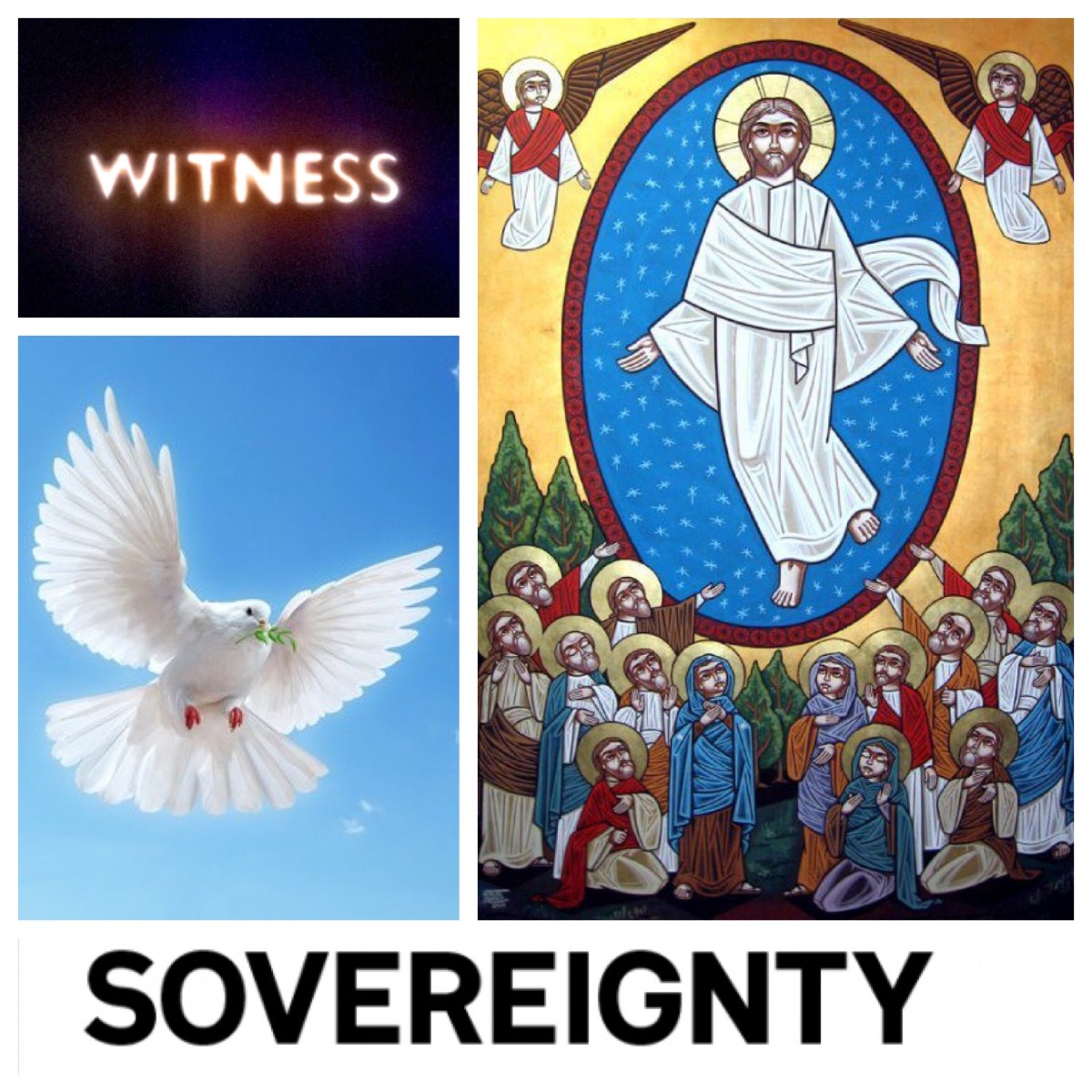
Is this the time? Sovereignty, Spirit, and witness (Acts 1; Easter 7A)

Is this the time? Sovereignty, Spirit, and witness (Acts 1; Easter 7A)

This Sunday (the seventh Sunday in the season of Easter) we return to an early section of the second volume of the orderly account that, by tradition, is attributed to Luke. The narrative offers an expanded version of the ascension of Jesus (Acts 1:6-11), an event already reported in brief in the first volume (Luke 24:50-53) but here repeated with additional details.

The ascension forms the pivotal moment in Luke’s narrative; it is the hinge between the two volumes, and attention is drawn to the ascension and exaltation of Jesus at a number of points elsewhere (Luke 9:51; 22:69; Acts 2:33; 3:21; 5:31; 7:56). Luke expands this second narrative account of the ascension through the explicit recording of words spoken on that occasion: the last words of Jesus to his followers, and the words of the two angel-like men to the followers of Jesus after his ascension.

The dialogue between Jesus and his disciples raises the central theological issue of sovereignty (the kingdom of God). The disciples ask “Lord, (may we ask) if you will at this time restore sovereignty to Israel?” (1:6) — quite rightly, for the issue of sovereignty was central to Jesus’ preaching (1:3). Here, however, the orientation of the question is concerned with the sovereignty of Israel. Jesus replies with three clear affirmations, which stand as his last words before he ascends into heaven.

The first affirmation of Jesus in 1:8 turns the question away from Israel, back to the primary theme of God’s sovereignty, with the clear declaration that the times and seasons are under the sovereignty of God who has “set them by his own authority” (1:7). Rather than the political independence of Israel, it is God’s unfettered freedom to act in history which is crucial to his enterprise.

The second affirmation, “you will receive power when the holy spirit has come upon you” (1:8), is a promise which reinforces the key role of the spirit, as divine agent, throughout this volume (beginning with the events of 2:1-4).

The third affirmation introduces the important motif of witness (1:22; 2:32; 3:15; 4:33; 5:32; 10:39,41,43; 13:31; 22:15,18,20; 23:11; 26:11,22) and provides a condensed geographical summation of the course of the ensuing events: “in Jerusalem [1:12-8:3] and in all Judaea and Samaria [8:4-12:25] and to the end of the earth [13:1 onwards]”.

What does “the end of the earth” refer to? A contemporary Jewish work, the Psalms of Solomon 8:15, may suggest that it refers to Rome, it is preferable to see the reference as drawn from Isa 49:6, a verse cited at Luke 2:32 and Acts 13:47. It is thus a poetic statement about the extensive scope of the ensuing events. These departing words of the Lukan Jesus neatly conjoin the geographical pattern and theological foundation of Acts: from Jerusalem outwards, the divine spirit will enable followers of Jesus to bear witness to the sovereignty of God.

Two men in white robes then appear (1:10), evokes similar appearances in earlier chapters: the two men in the tomb (Luke 24:4), the transfigured Jesus in the company of two scriptural figures (Luke 9:29-31). The prominence they have at this point establishes the important role of such epiphanies throughout Acts. The words spoken to the followers of Jesus who witness his ascension stress that his return will be in the same manner as his departure (1:11), although no detailed description is provided (cf. 1 Thess 4:16; Mark 13:27; Matt 24:31).

Ten days separate the ascension (forty days after Passover, 1:3) from the day of Pentecost (2:1, fifty days after Passover). Only two things are told of these ten days; already the process of selectivity which shaped Luke’s Gospel can be seen in his second volume. Thus, we learn only that the community had gathered on the day of ascension (1:12-14) and that at some stage in these days a replacement was found for Judas Iscariot (1:15-26).

Luke’s report of the regathering of the community (1:12-14) establishes key features of this community. Firstly, since they returned to Jerusalem immediately after the ascension (1:12), the focus remains on Jerusalem, which retains its pre-eminent position as the birthplace of the movement. Any gathering of believers elsewhere is incidental to the single-minded picture painted by Luke, of the Jerusalem community as the movement’s place of origin. This is the only community which matters for Luke at this moment.

Secondly, the description reveals that this was a community that met continuously during these ten days (“these [the eleven] all were unanimously attending constantly to prayer with the women and Mary the mother of Jesus and his siblings”, 1:14). The constant and communal nature of their meetings will later become important in Luke’s narrative; for the moment, the emphasis rests on the line of continuity between Jesus and this group.

Those present here in Jerusalem relate to those who journeyed with Jesus, in Galilee: the women (Luke 8:2-3), the family of Jesus (Luke 8:19), and the inner group of named male followers who are identified as apostles (Luke 6:14-16; ‘the twelve’ of Luke 8:1).

The specific reference to the inclusion of women within the community continues a particular interest already unveiled in Luke’s Gospel (Luke 8:1-3; 10:38-42; 23:49,55-56); it is subsequently explicitly noted throughout the second volume (Acts 5:14; 8:3,12; 9:2; 17:4,12).

This blog is based on a section of my commentaryn on Acts in the Eerdmans Commentary on the Bible, ed. Dunn and Rogerson (Eerdmans, 2003).

Unknown's avatarAuthor John T SquiresPosted on May 19, 2020May 11, 2021Categories An Orderly Account: Gospel of LukeTags Acts, Luke, scriptureLeave a comment on Is this the time? Sovereignty, Spirit, and witness (Acts 1; Easter 7A)

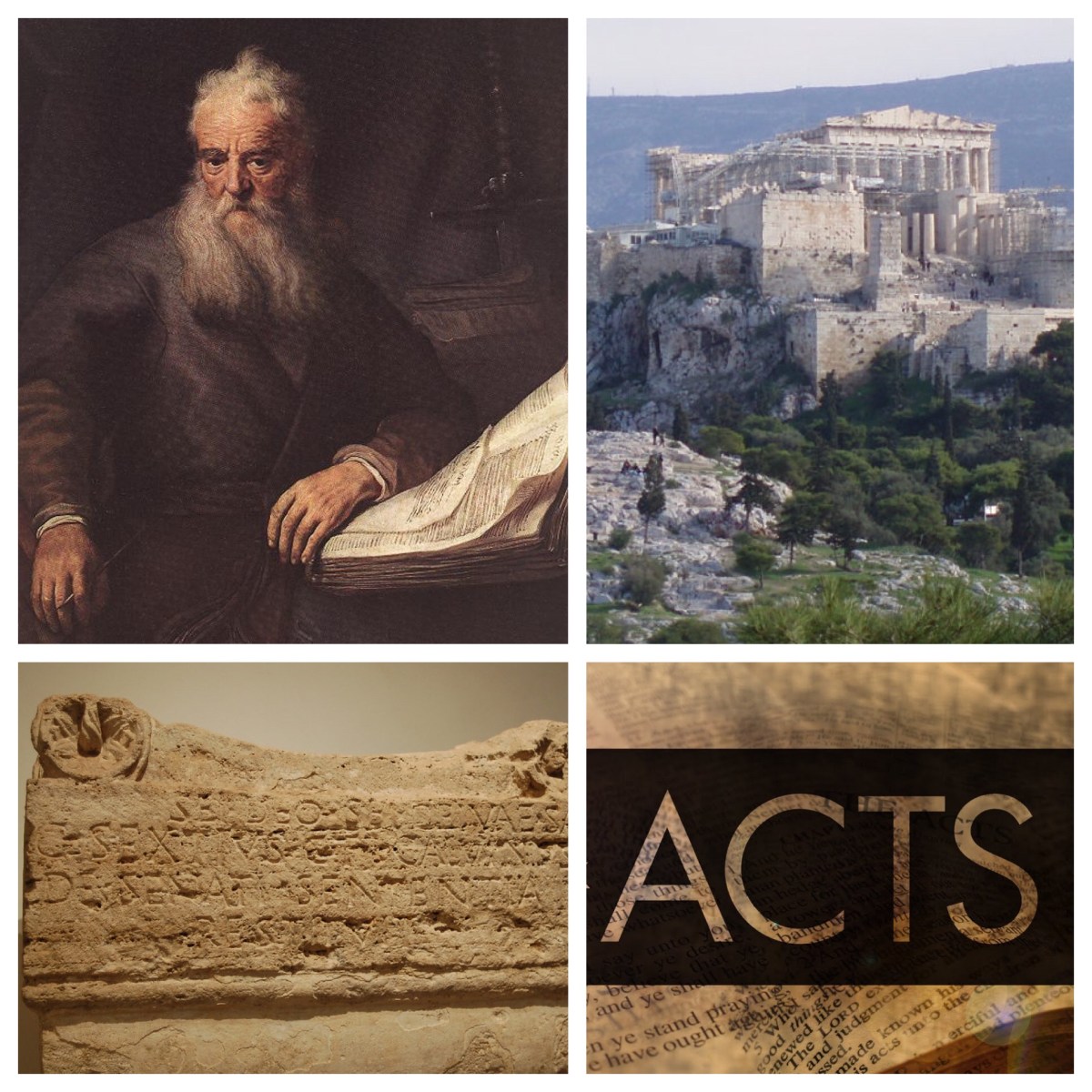
The unknown God, your own poets, and the man God chose: Paul on the Areopagus (Acts 17; Easter 6A)

The unknown God, your own poets, and the man God chose: Paul on the Areopagus (Acts 17; Easter 6A)

This Sunday (the sixth Sunday in the season of Easter) the lectionary offers us Luke’s account of Paul’s speech on the Areopagus. This famous speech represents a key moment in the story of the early Jesus movement. Many speeches before it in Acts have been delivered to Jews and Godfearers, gathered in synagogues. Now, by contrast, Paul stands before Gentiles—although his listeners initially thought that he was something of a “babbler”, telling frivolous novelties.

In this speech, Paul seeks to convince the Athenians of his beliefs—he is engaged in the task of apologetics—expounding, explaining, and defending his beliefs to others. The speech is, of course, a thoroughly Lukan creation, which most likely owes its shape to the development of preaching in Hellenistic Judaism. (We have various examples in works from the centuries or two before, and after, Paul.)

As Paul attempts to persuade his audience, he seeks to move them from what they can agree upon to what he wishes them to believe; this is the nature of apologetic preaching. He presents as thoughtful, relevant, respectful, and persuasive—an excellent role model for contemporary preachers!

Paul quotes, not from his own Jewish scripture, as he usually did in synagogues; he begins with a reference to the “altar to an unknown God” (17:23) and later refers to “your own poets” (17:28). That is a key apologetic move; contextualise your words, start with what is known to be in common between speaker and audience.

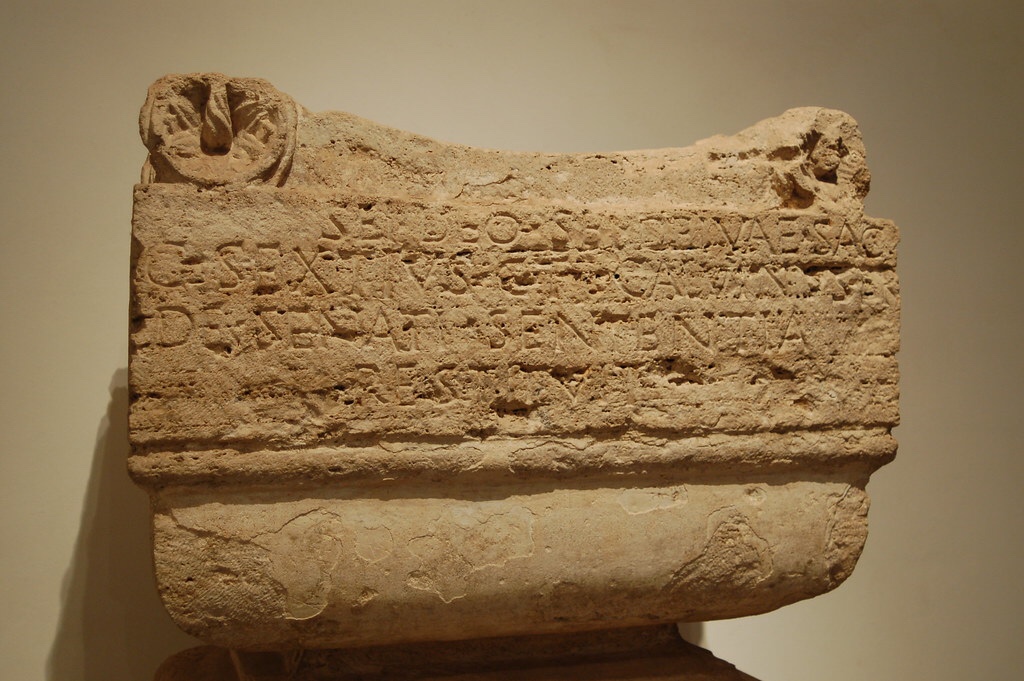
An altar which refers to an “unknown God”.
It was found in 1820 on the Palatine Hill of Rome.
It contains an inscription in Latin that says:
SEI·DEO·SEI·DEIVAE·SAC
G·SEXTIVS·C·F·CALVINVSPR
DE·SENATI·SENTENTIA
RESTITVIT
Either for a god or a sacred goddess,
Caius Sextius Calvinus, son of Gaius,
praetor by order of the Senate
restored this.

Indeed, the argument of this speech is thoroughly connected with the audience, drawn from the two leading schools of Epicurus and the Stoics (17:18). Paul declares his belief in the providential care of God for all humanity. Stoics and Epicureans held strongly opposing views on the question of divine providence: the Stoics exalted fate as pre-eminent, whilst the Epicureans dismissed it as an illusion. Luke’s apologetic strategy has Paul pitch his speech on the basis of the Stoic view.

The speech begins, in proper rhetorical style, with an “eager seizing of goodwill”, or captatio benevolentiae (17:22). Then Luke has Paul identify the “unknown God” of the altar (17:23) as “the God who made the earth and all things in it” (17:24; cf. 4:24; 14:15). God functions as the subject of the speech which follows; God’s actions encompass everything from the creation (17:24) to repentance (17:30).

There are three substantive claims made in this speech: first, that God relates to humanity through creation (17:24-26); second, that humanity searches for God and finds fulfilment by dwelling in the divine being (17:27-28); and then, third, that we can know directly by the way that God relates to us through Jesus (17:29-31).

Paul’s polemic against idols (17:24, 29) repeats a motif already sounded in Stephen’s speech (7:48); the theme would have been familiar to the philosophers (Heraclitus, Ep. 4; Seneca, Ep. 95.48). This is another indication of the calculated apologetic strategy that Luke attributes to Paul in this speech.

The final reported sentence in the speech adds to this a reference to God’s eschatological judgement, that time when he will establish a day for judgement (17:31). This is a transformation of Peter’s earlier assertion concerning the final days (3:19-21,26). Such judgement will be on the basis of righteousness, a term used infrequently by the Lukan Paul (13:10, 38-39; 24:25), although it is so important in some of Paul’s letters.

Reference to Jesus in this speech is truncated to the abrupt “man whom he chose” who will execute judgement on that day (17:31). Jesus is not even identified by name! In previous speeches, God has related to humanity through events in the history of Israel (Paul, 13:17-22; see also Stephen’s speech, 7:1-53) but pre-eminently through Jesus (see 2:22-36 and 13:23-39). In Paul’s Areopagus speech, God’s relationship to humanity is described, without reference to Jesus, in terms of God’s creative and systematising activity (17:24-26), humanity’s quest for God (17:27), and the consequent indwelling of human beings in the divine being (17:28).

The speech is radically different from earlier speeches in Acts, in two ways: God’s presence is described in philosophical rather than historical terms, and the texts cited to support the argument are drawn from Greek writers rather than the Jewish scriptures. “Your own poets” (17:28) introduces a quotation from Aratus (Phaenom. 5, cited by Eusebius, Prep. Evang. 666b) whilst there are affinities with Stoic writers in the clause “in him we live and move and have our being” (Dio Chrysostom, Or. 12.27-28).

The claim about the antiquity of the beliefs which Paul articulates has been a consistent element in his previous speeches in Acts, although it is usually couched in terms of the fulfilment of prophecy because of his Jewish audiences (see 13:33-37).

However, this speech still has features in common with the earlier speeches of Acts — for each speech interprets human existence in terms of being in relation to God, whether that be expressed in Jewish terms or hellenistic terms. Paul’s Areopagus speech is thus a notable variant of the established pattern — yet it must be regarded as nothing more than a variant, since it still uses language about God to shape the message.

The response to Paul’s speech in Athens follows the pattern seen throughout Paul’s journeys to this point, namely, a divided response of acceptance and rejection (see 13:4-12). A subtle difference here is the reversal of order; rather than first noting those who show interest in Paul’s message, Luke draws attention to those who mocked (17:32a), before providing more details concerning those who sought to know more (17:32b) and those individuals—Dionysius, Damaris, and others unnamed—who believed (17:34).

Some scholars note the distinctive nature of this speech, and the rejection by some, and consider that it therefore indicates Paul’s failure in Athens. This, they maintain, led to a new missionary strategy which is articulated in 1 Corinthians. They cite 1 Cor 2:1-2, “I did not come proclaiming the mystery of God to you in lofty words or wisdom … I decided to know nothing among you except Jesus Christ, and him crucified” as an expression of Paul’s rejection of philosophical argumentation, as we see in the Areopagus speech.

I don’t agree. Rather, this account emphasises Paul’s success in the cultural capital of Greece. That’s why Luke has crafted this scene so carefully. Athens was an important intellectual centre. The Gospel now has a foothold in the wider hellenised world. It is clearly reaching out beyond Judaism. Paul continues on his way to Rome (28:14), and thus enables the good news to reach to “the ends of the earth” (1:8).

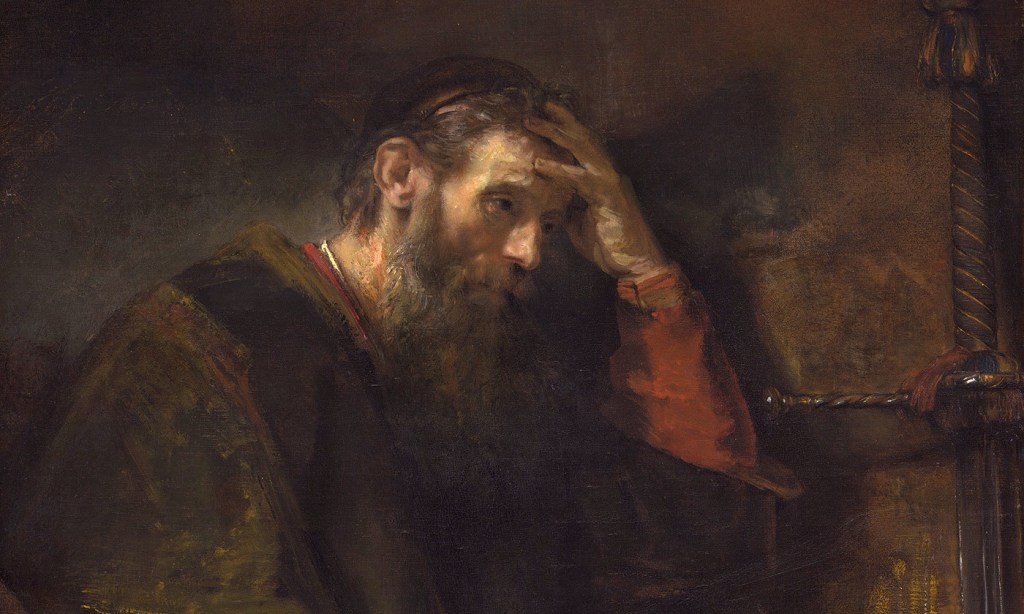
Detail from The Apostle Paul
by Rembrandt van Rijn (c1675),
held by the National Gallery of Art


This blog is based on a section of my commentary on Acts in the Eerdmans Commentary on the Bible, ed. Dunn and Rogerson (Eerdmans, 2003).

For a fine reflective prayer on this passage by Sarah Agnew, see http://praythestory.blogspot.com/2020/05/to-god-we-do-not-know.html

Unknown's avatarAuthor John T SquiresPosted on May 11, 2020May 11, 2021Categories An Orderly Account: Gospel of LukeTags Acts, mission, scriptureLeave a comment on The unknown God, your own poets, and the man God chose: Paul on the Areopagus (Acts 17; Easter 6A)

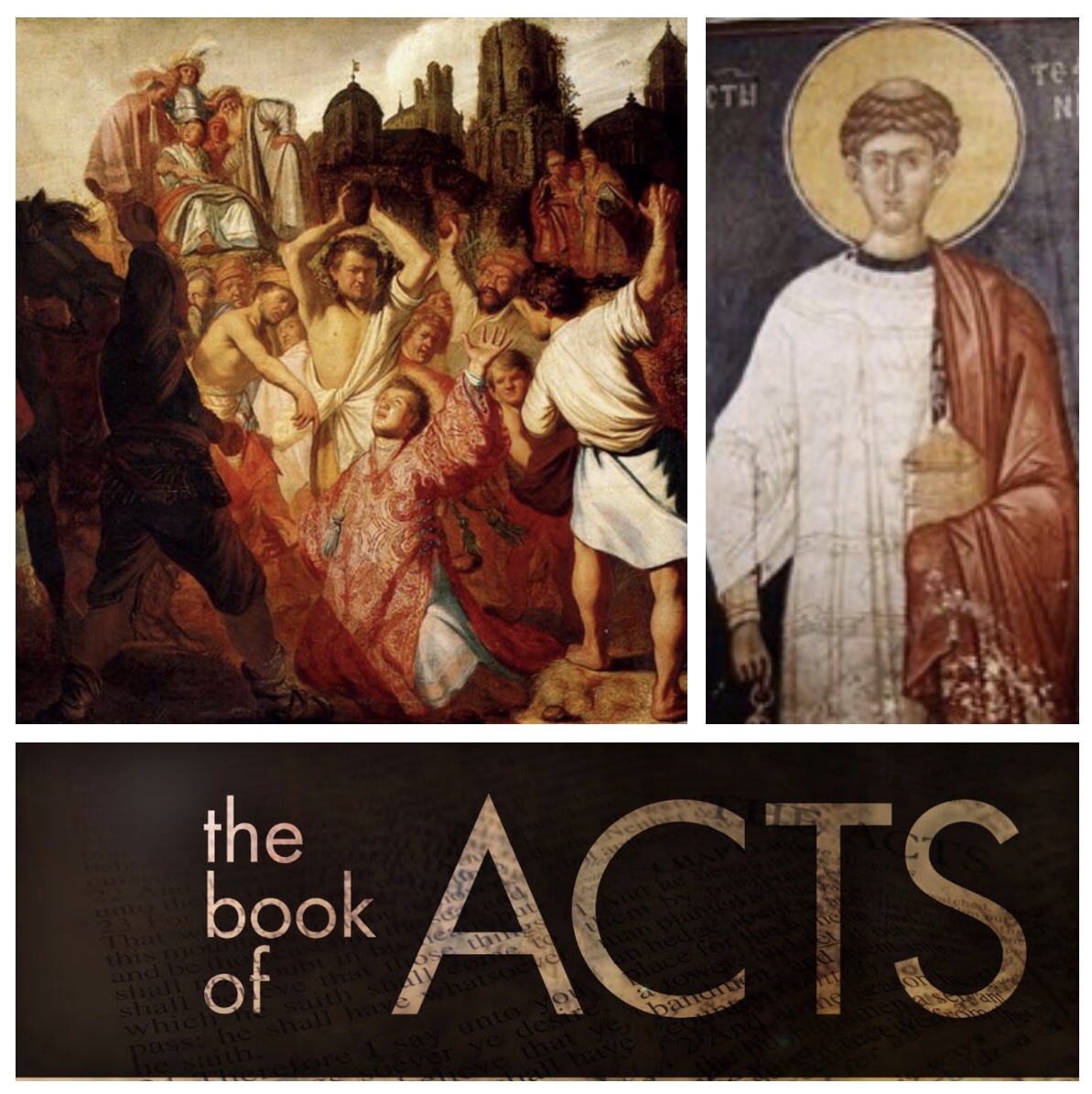
The heavens opened: the witness of Stephen (Acts 7; Easter 5A)

The heavens opened: the witness of Stephen (Acts 7; Easter 5A)

The passage from Acts that is set for this coming Sunday (the fifth Sunday in the season of Easter) tells of Stephen, who is remembered as the first Christian martyr. The word “martyr” comes from the Greek word martus, meaning “witness”. Yet it also signifies a person willing to die for their faith. This passage recounts how that death took place, and reinforces the witness offered by Stephen.

Stephen had been introduced earlier in Acts as one of the Seven who were selected by the apostles as being “full of the Spirit and of wisdom” (6:3). He was additionally noted as being a person “filled with the spirit” (6:5); that description recurs here (7:55). Stephen experiences an epiphany in which he sees “the glory of God” (7:55), which aligns him with Abraham (7:2), as well as “Jesus standing at the right hand of God” (7:55-56). Stephen is one of many witnesses to the nature of God.

Stephen is also, and more strikingly, aligned with Jesus. When Stephen describes seeing the heavens opening, he evokes the scene of Jesus’ baptism (“the heaven was opened”, Luke 3:21). Like Jesus, Stephen was given a perspective that took him, metaphorically, right into the heart of God. Unlike Jesus, however, whose deeper insight came at the start of his public activities, Stephen gains that insight after his speech, and immediately before the moment of his death.

This claim by Stephen, that he saw heaven opened, evokes not only the baptism of Jesus, but also the moment at the death of Jesus when the curtain of the Temple is ripped in two (Luke 23:45). It evokes the “open door” in heaven seen at the start of the apocalyptic visions by the ageing, exiled John (Rev 4:1), and directly repeats the phrase found much later in those visions (Rev 19:11, when the white horse appears).

Furthermore, Luke reports that Stephen dies in a way that strongly evokes his particular account of how Jesus died on the cross. Stephen’s words about the heavenly Son of Man “standing at the right hand of God” are strikingly reminiscent of the apocalyptic vision which Jesus paints at his trial (“the Son of Man … at the right hand of the power of God”; Luke 22:69). Stephen’s prayer, “receive my spirit”, recalls the last words of Jesus (“into your hands I commend my spirit”; Luke 23:46).

As Stephen cries “in a loud voice” (7:60) he reminds us of the same cry by Jesus as he dies (Luke 23:46, which itself is a quotation of Psalm 31:46). Stephen’s last cry, a petition that the Lord overlook this sin (7:60), is similarly evocative of the Lukan Jesus’ forgiveness of those who crucified him (“Father, forgive them”, Luke 23:34).

This first martyr follows the pathway already established by Jesus. He bears witness to his faith, even as he dies. And as Luke has clearly interpreted the death of Jesus as God’s predetermined action (2:23, 4:28), this similar description of Stephen’s death has at least overtones of divine authorisation. Stephen dies, as faithful witness to God, in accord with the will of God.

******

The lectionary provides us with just this short section of text, focussed on the death of Stephen. It might be worth your while, this week, to look back to what is reported in the narrative, immediately before this death. Stephen had been arrested—the manner of this arrest, by means of a plot by the authorities (6:11-12) who set up false witnesses (6:13-14) as he was questioned by the high priest (7:11), also mirrors the pattern of events recounted in relation to Jesus.

In response to the question of the high priest, Stephen delivers a long speech (7:1-53). It is by far the longest speech of all those included in the book of Acts. By means of this speech, Luke matches the divinely-given qualities of Stephen (6:3,5,8,10) with his testimony to the acts of God in the history of Israel.

Like every speech in Acts, this was written by Luke, the compiler of the orderly account of things being fulfilled. So the speech begins in typical Lukan fashion by defining the subject as God (7:2; cf. 2:17; 3:13; 5:30); the phrase used here, “the God of glory”, is drawn from scripture (Ps 29:3). The speech which follows rebuts the charges laid against Stephen; it demonstrates that, far from speaking “blasphemous words against God” (6:11), Stephen has a fulsome understanding of God’s place in Israel’s history.

At the end of his speech, Stephen takes up the charge of the false witnesses, that he spoke “against the holy place” (6:13). Luke has Stephen quote scripture (7:49-50, citing Isa 66:1-2) in order to show that his criticism of the temple (God’s “place of rest”, 7:49) arises from within Jewish tradition itself.

There are numerous scriptural allusions and quotations in this speech by Stephen. In general, this seems similar to the earlier speeches by Peter, although the precise function of these scriptural elements is somewhat distinctive in this speech. Here, scripture functions as historical narrative, whereas elsewhere in Acts it provides prophecies to be fulfilled. (The exceptions within the speech are the prophecies of 7:6,7 which are fulfilled at 7:9-16,36 respectively.)

Luke has Stephen provide a detailed rehearsal of significant parts of Israel’s history, by focussing in turn on Abraham (7:2-8), Joseph (7:9-16) and Moses (7:17-44). Then, after making brief mention of Joshua (7:45a), David (7:45b-46) and Solomon (7:47), Stephen moves to the climactic claim of the speech (7:48-53).

Lengthy recitals of key features of Israel’s history are already found in Hebrew Scripture (Deut 26; Josh 24; Neh 9; Psalms 78; 105; 106; 135; 136; Ezek 20). In the present instance, the effect of the long recital of the earlier part of Israel’s history is twofold. First, the historical recital reinforces Stephen’s Jewish credentials. When he begins to speak critically of the temple, and of the Jerusalem authorities, it is clear that he does so from within the Jewish tradition. Stephen is not an outsider, but an insider, offering a prophetic critique.

Second, the historical recital provides insight into a further layer of God’s providential activity. Earlier speeches by Peter have interpreted the events of the life, death, resurrection and ascension of Jesus as being within the divine providence (we saw this in previous weeks, in 2:14-41).

Various features of the narrative have revealed the active involvement of God in the events that take place in the Jerusalem community. Now, the undergirding plan of God is revealed within the long history of Israel. The line of continuity is strengthened between each layer; God is at work in the Jerusalem community, as in the life of Jesus, as in the history of Israel. Such is the testimony that Stephen offers.

There is one final feature of the section of Acts set for this Sunday. As the crowd prepares to stone Stephen, dragged him out of the city and laying down their coats, we are told that the coast fall “at the feet of a young man named Saul” (7:58). And this young man, Saul, we then learn, “approved of their killing him” (8:1a). Who is this man? He comes back into the story as persecutor (8:3; 9:4), then convert (9:17-19a), then preacher (9:19b-22), travelling evangelist (13:1-3); he was subsequently known as Paul (13:9), and acknowledged as an apostle (14:4, 14).

*****

This blog is based on a section of my commentary on Acts in the Eerdmans Commentary on the Bible, ed. Dunn and Rogerson (Eerdmans, 2003).

See also https://johntsquires.com/2019/12/26/stephen-deacon-and-prophet-martyr-and-disciple/

Unknown's avatarAuthor John T SquiresPosted on May 7, 2020May 11, 2021Categories An Orderly Account: Gospel of LukeTags Acts, scriptureLeave a comment on The heavens opened: the witness of Stephen (Acts 7; Easter 5A)

Grace towards all the people: another mark of community (Acts 2; Easter 4A)

Grace towards all the people: another mark of community (Acts 2; Easter 4A)

In this season of Easter, we are following passages from the second volume of the book of Acts, the second volume in the orderly account which, by tradition, is attributed to Luke. We have followed, in previous weeks, Peter’s speech to the crowd which had gathered in Jerusalem on the Festival of Pentecost (Acts 2:1).

In the passage set for this Sunday (the fourth Sunday in the season of Easter), we see how Peter’s speech and the response which follows from it leads to the expansion of the community within Jerusalem. I have already reflected on the four marks of the church that we might discern from Acts 2:42. This blog continue on, to explore other characteristics of the gathering that are noted in this short but rich section of text.

There is a public dimension to what the believers are doing. Members of the community are to be found both in the temple and in their homes (2:46). Even though Luke writes after the destruction of the temple (Luke 19:41-44; 21:20-24), he knows well the prominent role of the temple in Jerusalem and accurately locates the messianic community as continuing faithful to the temple cult.

Thus, their public presence in the temple (2:46) continues unabated throughout the first section (3:1,11; 5:12,20,21,42). Such a practice is continued by Paul, both in the Jerusalem temple (21:26-30, a single event which is recounted at 22:17; 24:6,18; and 26:21) as well as in other public places (for instance, in Philippi, 16:13; the Athenian agora, 17:17; and the Areopagus, 17:19). Paul tells elders from Epehsus that he was regularly “proclaiming the message to you and teaching you publicly and from house to house” (20:20).

Roman historians who wrote in the decades after Luke’s writing described members of this community as “a class of men given to a new and mischievous superstition” (Suetonius, Life of Nero 16) and as adherents of a “detestable superstition” who were “hated for their shameful deeds” (Tacitus, Annals 15.44). Still later, Christian apologists defended Christians against criticisms that they were secretive, and therefore not to be trusted (Minucius Felix, Octavius 8.1-4; Origen, Against Celsus 1.1,23; 3.50,55; 4.23; 8.2,17,49).

It may be that Luke’s insistence on the public witness of the community meets this type of objection if it was already being raised late in the first century CE. The practice of private meetings in their homes is likewise continued throughout Judaea and Samaria (8:3) and, as would be expected of a religious association, in dispersion communities in Caesarea (10:30; 11:12-14; 21:8) and Philippi (16:34). Paul continues this twofold pattern, for his activities typically take place “in public and from house to house” (20:20).

The community is further described as “having grace towards the whole of the people” (NRSV “having the goodwill of all the people”, 2:47). This introduces another term which will have significance in the narrative of Acts: charis. The NRSV translates this as “goodwill”; but the usual rendering of this Greek word is “grace”. What does it mean, if we translate it in this way, in this passage?

Grace is referenced in the third summary description of the community (4:33), where it is related to the testimony of the apostles. In 2:47 it is linked with the inner life of the community as they “ate their food with glad and generous hearts, praising God and having grace towards the whole of the people”.

Grace is a characteristic which also marks Stephen, enabling him to perform “great wonders and signs” (6:8); in his speech, he notes that God ascribed grace to Moses (7:10) and to David (7:46). It is this grace of God which is evident in the growing community in Antioch (11:23) and continues to be a characteristic of the community in Iconium, where once again it is evident through the signs and wonders granted by God (14:3).

Such grace is regarded as the means of salvation (15:11) which enables people to believe that Jesus is Messiah (18:27-28). This same grace of God is attested by Paul throughout his ministry (20:24,32). It thus forms another of the characteristics of messianic communities in Jerusalem and beyond. And by extension, it ought also to characterise the church of the 21st century–at least, if we want to remain faithful to the intentions of Jesus, who established the movement which was initially known as The Way, and the communities of faith in ensuing decades, which reinforced and enriched the movement as it grew into an institution, which we now call The Church.

Thus, we see that in providing this careful description of the community of messianic Jews in Jerusalem from the day of Pentecost onwards, Luke has shaped it to introduce a number of key characteristics of the messianic communities that he will describe in later chapters. Along with the miraculous events of Pentecost and the speech of Peter, this summary description performs a programmatic role in the narrative. It offers us a picture which could serve as a model for how we live as church today.

For reflections on grace as central to the life of the church, see https://johntsquires.com/2019/09/29/gracious-openness-and-active-discipleship-as-key-characteristics-of-church-membership/

For reflections on grace as integral to the ministry of Jesus, see https://johntsquires.com/2019/10/10/was-none-of-them-found-to-return-and-give-praise-to-god-except-this-foreigner-luke-17/

and https://johntsquires.com/2019/02/19/the-beloved-physician-the-lover-of-god-and-loving-our-enemies-luke-6/


This blog is based on a section of my commentary on Acts in the Eerdmans Commentary on the Bible, ed. Dunn and Rogerson (Eerdmans, 2003).

See also https://johntsquires.com/2020/04/16/what-god-did-through-him-peters-testimony-to-jesus-acts-2/

https://johntsquires.com/2020/04/14/what-god-did-through-him-proclaiming-faith-in-the-public-square-acts-2/

https://johntsquires.com/2020/04/20/repent-and-be-baptised-peters-pentecost-proclamation-acts-2/

https://johntsquires.com/2020/04/28/teaching-fellowship-bread-and-prayers-the-marks-of-community-acts-2/

Unknown's avatarAuthor John T SquiresPosted on May 1, 2020May 11, 2021Categories An Orderly Account: Gospel of LukeTags Acts, community, scripture1 Comment on Grace towards all the people: another mark of community (Acts 2; Easter 4A)

Teaching, fellowship, bread and prayers: the marks of community (Acts 2; Easter 4A)

Teaching, fellowship, bread and prayers: the marks of community (Acts 2; Easter 4A)

In this season of Easter, we are following passages from the second volume of the book of Acts, the second volume in the orderly account which, by tradition, is attributed to Luke. We have followed, in previous weeks, Peter’s speech to the crowd which had gathered in Jerusalem on the Festival of Pentecost (Acts 2:1).

In the passage set for this Sunday (the fourth Sunday in the season of Easter), we see how Peter’s speech and the response which follows from it leads to the expansion of the community within Jerusalem (Acts 2:42-47). That community is, in the mind of the author of this two-volume work, the key successor to the movement that was initiated by Jesus, when he gathered people around him, taught them and heralded them, and challenged them to become his disciples–to follow him along the way that he was walking. And, in time, those followers did become known as members of “The Way” (Acts 9:2; 18:25; 19:9,23; 22:4; 24:14,22).

The community of Jews who gather in this initial scene, are those who perceive Jesus as Messiah. This community, as it is described here, has various characteristics, which are set forth in a summary description of the community (2:42-47). Many of these characteristics recur in the six “summary descriptions” of the community which are found in this early section of this work, revolving around Jerusalem (4:4; 4:32-35; 5:12-16; 5:41-42; 6:7; 8:1b-3).

The concluding verses of chapter 2 thus continue the programmatic role which we have seen in Peter’s speech (and which we will note in the Pentecost event). The community gathers for four inter-related aspects of their common life which are introduced in the first verse (2:42): the teaching of the apostles, fellowship, the breaking of bread and prayers. These four aspects, and associated ideas, provide a programmatic description of the messianic Jewish communities in Jerusalem and beyond, into our own time. They could be considered to be four marks of the church which might be relevant for our time.

It is important to note that, in my understanding, what the author of the orderly account is providing, is not a factual historical account of the early community of faith that formed in Jerusalem. The author, as far as is indicated, was never a member of that community, nor is there any indication that the author drew on first-hand accounts of that community from anyone who belonged to it. (You might be able to draw such a conclusion from the reference to “eyewitnesses and servants of the word” Luke 1:1-4, but there is no other evidence to support this hypothesis.)

Indeed, the descriptions of what took place in Jerusalem are always offered from an external, editorial, out-of-the-story vantage point — by contrast with some later sections (the so-called “we sections”) where the author appears to insert himself into the narrative and give the appearance of being personally involved in the events being narrated. (Whether he was, or not, is a matter for another time.)

Rather, in my understanding, the author of the orderly account is providing a visionary description, an idealised account, a picture that was intended to inspire, instruct, enthuse, and even challenge the people to whom the work was addressed, an audience most likely in the later decades of the first centrist, a half-century after the time of Jesus and the origins of this movement. We have a picture of the church in its “golden age” which stands as close to the reality of the church in that period, as any of the modern fairy tales or ancient myths stand in relation to ordinary human life as we know it.

It is not history. But it is a picture which can instruct and enthuse us, today.

The first aspect, the teaching of the apostles (2:42), is not only a private matter but also a public phenomenon (4:2; 5:25,42), which will soon make the community notorious. This is made clear when the chief priest notes that “your teaching has filled Jerusalem” (5:28), despite the priests’ commands to stop. Later in Acts, the focus for this typical apostolic activity shifts to Paul (15:35; 17:19; 18:11; 21:11); in his farewell speech, Paul summarises his work as “proclaiming … and teaching” (20:20), whilst in his closing scene Luke notes that Paul’s time under arrest in Rome was characterised by “preaching … and teaching” (28:31).

The content of this teaching in the early stages concerns the resurrection of the dead (4:2) and the claim that Jesus is Messiah (5:42). From the pattern of the speeches in this section we may also reasonably conclude that Luke intends us to understand the explication of scripture as part of the apostles’ teaching (see 2:16-21,25-28,34-35; 3:22-25; cf. 4:25-26). Each of these elements continue in the teaching of Paul, who affirms the resurrection (17:18,32; 23:6; 24:15,21), confesses Jesus as Messiah (9:22; 17:3; 18:5; 28:31), and uses scripture to explain the significance of Jesus (13:33-36; 17:2-3; 26:22-23).

One interesting feature of the current situation that we are facing, with prohibitions on gathering together for worship, hearing and reflecting on scripture, praying and singing together, is that we are still seeing multiple ways in which church communities are gathering online, making the most of opportunities to bear witness to the faith and share the good news with people, through Facebook Live, YouTube streaming, ZOOM gatherings, and using other apps. The public expression of the teaching of the church continues, in new ways, through new media, even at this time.

Fellowship is identified as the second aspect of the community (2:42). The precise term koinonia occurs only here in Acts; however, the notion of sharing or togetherness which is inherent in it is evident in other ways. Members of the community gather with one mind (2:46) in a way that will consistently characterise the community (4:24; 5:12; 15:25). They meet day by day (2:46), as is evident from the immediately ensuing events.

Paul subsequently emulates this pattern of daily meetings in Beroea (17:11), Athens (17:17) and Ephesus (19:9). The Jerusalem community is described by means of a philosophical ideal, as “having all things in common” (2:44).

We find this idea expressed in Greek writers (Aristotle, Nicomedian Ethics 9.8.2; Cicero, De officiis 1.16.51; Plutarch, On Brotherly Love 490E, How to Tell a Flatterer 65A and De amic. mult. 96E; Iamblichus, Life of Pythagoras 65A; Dio Chrysostom Ora­tion 34.20; Diogenes Laertius 5.20, 8.10). The Essenes were described in a similar way by Philo, Every Good Man is Free 85, and Josephus, J.W. 2 §122. The first phrase is also reminiscent of the common Deuteronomic reference to ‘heart and soul’ (Deut 6:5; 10:12; 11:13; 13:4; 26:16; 30:2,6,10).

This ideal is reinforced by the role models that Luke provides—the positive role model, Joseph Barnabas (4:36-37), and the negative role models, Ananias and Sapphira (5:1-11). That it remains an ideal, however, is evident from the larger movement of early Christian history.

And also, for us today, in the period of restrictions on gathering that we are experiencing, any sense of gathering together, being of one heart and mind, having all things in common, is something that we cannot actually live out. At least, not in terms of physical contact and close interpersonal connections. But if not in person, at least through online and phone connections, we can continue to share in fellowship with one another.

The third aspect, the breaking of bread (2:42,46), was a custom of Jesus (Luke 9:16; 22:19; 24:35). While 2:46 makes it clear that this was a daily practice of the Jerusalem community, there is no further reference to the breaking of bread in this section. However, the sharing of meals is inferred at various points in the ensuing narrative (10:23; 11:12; 16:14-15,34; 18:7). Later references demonstrate that “the breaking of bread” remained a practice of Paul, at least in Troas (20:7) and on board ship (27:35).

Maintaining the practice of breaking bread whilst living in a society where gathering together in person is not permitted, is a challenge. My own denomination (the Uniting Church in Australia) has determined that it is possible to celebrate the sacrament of the Lord’s Supper, through online worship services, with appropriate preparations and instructions provided. Not every denomination, however, has moved to that practice.

By contrast, the fourth aspect of prayers (2:42) remains thoroughly characteristic of the community in Jerusalem (1:14; 4:31; 6:4,6; 12:5,12) as well as the community established in Antioch (13:3; 14:23). Prayer is practised by other leaders in the movement which Jesus initiated: by Stephen (7:59), Peter (3:1; 8:15 with John; 9:40; 10:9; 11:5), Cornelius (10:4,30-31), and Paul (9:11; 16:25; 20:36; 21:5; 22:17; 28:8).

These prayers indicate that God is engaged within the narrative of the story, as the recipient of petitions and thanksgivings. They signal the firm link between the various messianic communities and the divine realm. The prayers of the community also indicate the continuity that runs from the life of Jesus, for he was frequently to be found at prayer (Luke 3:21; 5:16; 6:12; 9:18,28-29; 10:21-22; 11:1; 22:31-32,41-42,44; 23:34,46). In this regard, as in other ways, Jesus stands as a clear role model for all those who follow in the movement which he initiated.

And this fourth mark of the church, of continuing to offer prayers, is one that we can continue to practise, today, even in this period of social distancing and self-isolating.


This blog is based on a section of my commentary on Acts in the Eerdmans Commentary on the Bible, ed. Dunn and Rogerson (Eerdmans, 2003).

See also https://johntsquires.com/2020/04/16/what-god-did-through-him-peters-testimony-to-jesus-acts-2/

 https://johntsquires.com/2020/04/14/what-god-did-through-him-proclaiming-faith-in-the-public-square-acts-2/

https://johntsquires.com/2020/04/20/repent-and-be-baptised-peters-pentecost-proclamation-acts-2/


Unknown's avatarAuthor John T SquiresPosted on April 28, 2020May 11, 2021Categories An Orderly Account: Gospel of LukeTags Acts, community, scripture1 Comment on Teaching, fellowship, bread and prayers: the marks of community (Acts 2; Easter 4A)

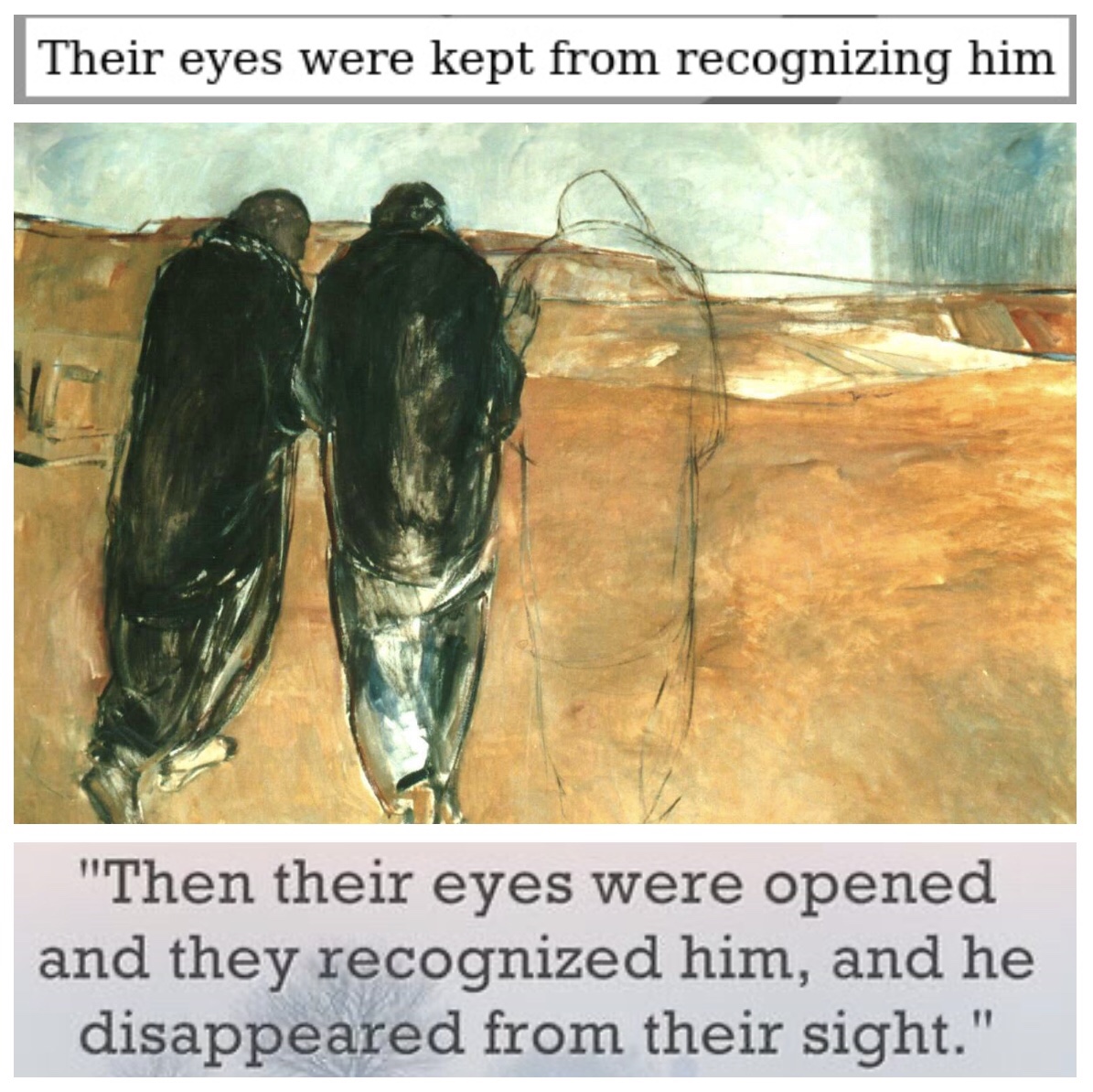
Their eyes were kept from recognizing him … then their eyes were opened, and they recognized him; and he vanished from their sight (Luke 24; Easter 3A)

Their eyes were kept from recognizing him … then their eyes were opened, and they recognized him; and he vanished from their sight (Luke 24; Easter 3A)

In a room in Jerusalem, followers of Jesus gather behind closed doors, their fears intensified by events (John 20:19). They are not connected in any way with the news that had begun to percolate through the city. They are behind locked doors, because their fear was dominating their every thought, their every move.

Thomas was not with them. He was elsewhere; not bound by his fear, not huddled behind locked doors. As we heard his story last week, it may well be that he found some certainty, for himself, after the tragic events of the days around Passover. Perhaps he had moved on, back into his life. But the others were gripped by that fear, that uncertainty.

We know, from our vantage point, that those believers were gripped by fear, even though the most amazing story was being recounted, about what had happened to their leader. The tomb was empty, the body was gone. Some were saying they had seen him, alive. But the group in Jerusalem were unaware, it would seem, of any such dramatic news.

That was the case with others, too. On the road to Emmaus, two followers of Jesus lament that their hopes were shattered (Luke 24:21). They are completely unaware of the identity of the stranger who walks with them; they are caught in their own grief and despair at what they had seen happen.

They knew there had been a betrayal, and a trial; they heard the baying crowd, screaming “crucify him”, they saw a savage whipping. He was nailed to the cross, a savage torture, and they could not bear to watch any more.

He was taken down, they were told, and placed in the tomb. That was it, as far as they were concerned. The movement had ended. Their hopes were all dashed. They were out of there, leaving Jerusalem, heading to Emmaus.

So, on the road, they walk from the fateful city: shoulders stooped, cheeks moist with tears, hearts heavy with grief. A stranger falls into step alongside them. A conversation begins, halting, careful, sensitive. Their deep hopelessness is surely understood by the stranger walking with them. He is gentle. They are grief-stricken. We all know those kinds of conversations: words almost too heavy to utter, sadness from the very depths of distress and despair.

Some days earlier, Thomas had uttered prophetic words, before the critical events had occurred, when he cried, “Lord, we do not know where you are going. How can we know the way?” (John 14:5). That speaks for how the disciples were feeling, after the crucifixion and burial of Jesus. That most certainly points to how the two travellers, on the road to Emmaus, were feeling, that day, as they walked, and talked, with this enigmatic stranger. They did not know which way they were now going. They did not have any sense of joy, or anticipation, about what lay ahead.

The stranger engaged them in a way that led them back, deeper, into what they had hoped for. He talked, asked questions, shared scriptures, offered insight. They told the story, as they knew it, deep in grief, locked into the events of that terrible Friday and the grief of early morning after Sabbath (Luke 24:22-24). They could not hear, could not comprehend, the insights he offered. He pressed hard, berated them as foolish, explained what had happened (24:25-27); but deaf to his words, blind to his presence, they were caught in their unknowing.

Could this sense of fear, uncertainty, and hopelessness, be a point of connection with the story, for us for this current period? In this time of global pandemic, we are in a period of waiting, not knowing, a time of deepened fear and broken hopes. We look around and see that things are different, so, so different, now. We may be afraid for what will happen next. We do not know what is sure and certain, what is transient and passing. Life has suddenly looked so different.

The two on the road arrive at Emmaus arrive and find their home. At this point, they do something quite amazing. They reach out in hospitality, although their hearts are breaking, and they are emotionally tired and worn. As their companion prepares to walk on to his next destination, they implore this stranger—still unknown, still unrecognised to them—to stay with them, to sit at table, to share a meal (24:29).

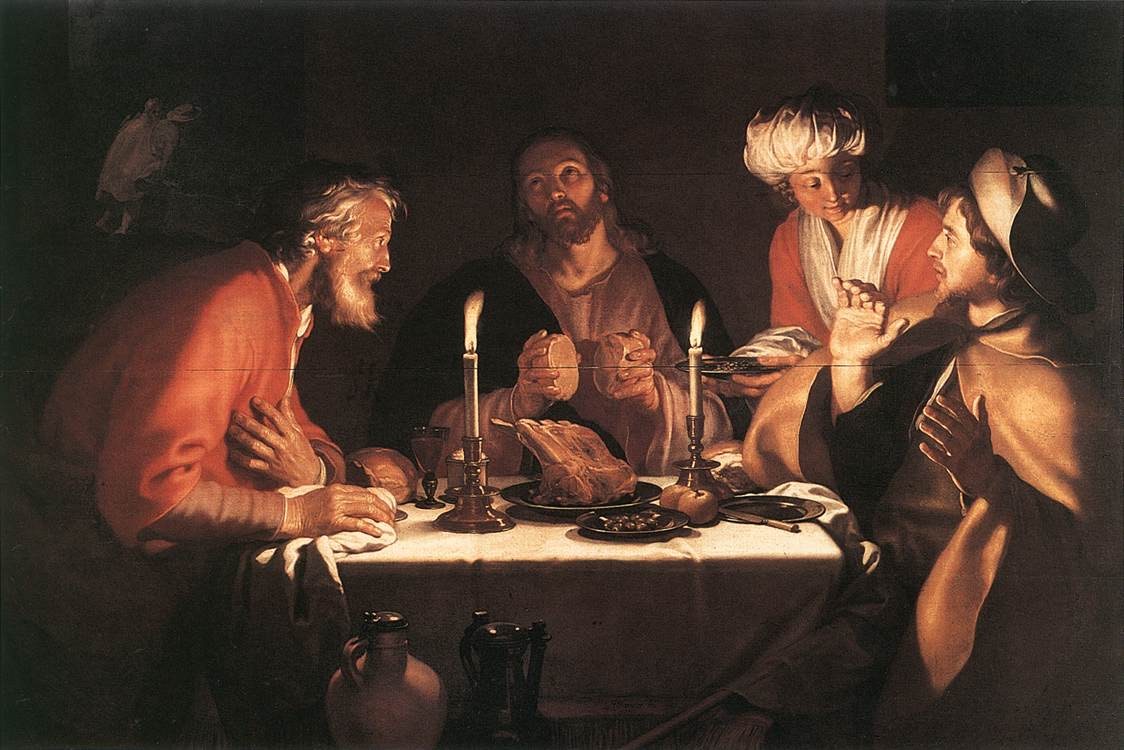
That was the moment; that was the time, when the familiar actions pierced the darkness of their despair: he took bread, blessed it, broke it, and gave it to them (24:30). He was in their home; he was guest, they were hosts. Yet he undertook the role of host: they were now in his place, his home.

Rembrandt Emmaus Supper

And as he spoke the words, the familiar words, a recognition dawned in their minds, a hope began to be rekindled, the green shoots of joy began to grow in the midst of their grief (24:31). Could this really be? Could this be the man of Nazareth? The one on whom our hopes depended? The “prophet mighty in deed and word before God and all the people” (24:19)? Yes, the familiar words and actions indicated so. He was, indeed, alive!

It was the breaking of bread which was the transforming event; it was “then their eyes were opened”. In the ordinary and mundane world, suddenly they were aware they were in the presence of God. It was then that the relationship moved into maturity. He was back with them!

Yet at precisely at this moment of recognition, the stranger disappeared from their sight (24:31). The stranger, now known as Jesus, now encountered as risen one. Yet at this moment, they found themselves alone: alone with the certainty of their new-found faith, but together with their leader. And together with others who, in other places, at other times, would experience the same recognition: a flash of awareness, surging joy, and then the sudden disappearance.

Let us remember, then, that precisely at the moment when maturity seemed in view, when the relationship was created: Jesus disappears! Why did Jesus ‘vanish from their sight’? How disturbing that must have been for the disciples!

Perhaps this reminds us, that sooner or later, they were going to have to press on and discover the way ahead for themselves. Those two disciples needed to develop their understanding in relationship with Jesus, but they also needed to go on alone themselves. He couldn’t be around forever. It was impossible for them to hold onto the Jesus they knew.

So too, for all of us, mystical experiences come and go. Moments of assurance are often fleeting. Inspiration is short lived. But despite this, God invites us to remember, and by remembering we create new memories and new possibilities. And as this story notes, hospitality is the open door to enter into a maturity of faith and to gain an expanded vision of what is possible.

And so, at last, the story reaches its climax: not in the spiritual ecstasy of full engagement with Jesus, but rather, returning back home, approaching the gathered group of disciples, zealous to share the excitement of what they had experienced (24:33). “Hey people, look at us; we’ve been changed!! Remember what we were like when we left you? Now we are back, and look what has happened to us!!!”

So the travellers return, expecting to be the missionaries, sharing the gospel, recounting their amazing experience. Out of the darkness of grief and loss, they have moved on to a joyful encounter, to a renewed faith. That’s a sign of hope and encouragement for us, in this period of waiting, unknowing, fearing the worst, hoping for the best. There is the promise of a way out of this current scenario.

The travellers return to Jerusalem, they want to share their excitement, to share that Jesus is alive, to strategise for ways to spread that good news with others. It was time to be identifying with the needy, proclaiming the gospel, being on mission, doing ministry amongst the people.

They have experienced the mission of God, on the road to Emmaus; they know that God has intervened into the passage of history and raised from the dead the once-crucified Jesus. “Were not our hearts burning within us while he was talking to us on the road, while he was opening the scriptures to us?”, they reflect (24:32). Overflowing with enthusiasm, they want to tell out this news for all to hear! They wanted to tell about the mission of God, at work in the world.

And yet, when they approached the group remaining in Jerusalem, the travellers find they are listening to the stories of the crowd who stayed home – and they too have experienced the mission of God, they too know that God has intervened into the passage of history and raised from the dead the once-crucified Jesus. For they, too, have seen him! (24:34). Overflowing with enthusiasm, they want to tell the travellers from Emmaus what they have experienced!

Might it be, that in these strange, unsettling times, in the midst of continuing uncertainty, in the centre of our unknowing, we might hold to this story? Might we be open to this insight: God comes to us in strange, unpredictable, mysterious ways. May Jesus be present to us, in our unknowing, and enable our eyes to recognise, our hearts to burn, our minds to comprehend. Even now, in this strange, unsettling time. Especially now, in this strange, unsettling time!

As we wait in our homes, as we hope for what will transpire, and we look with faith to the future, may there be a sense that our journey forwards in faith leads us into unexpected delights and enabling encounters, which lead us on to daunting, unforeseen pathways, which become energising, enabling pathways for us all.

So go, journey, travel onwards as the people of the risen one;
i
n the midst of the ordinary, be attentive to the mystery;
to the opportunity of the moment, bring gifts and resources;
a
t the time of encounter, be open to the story;
an
d may the stranger that is Jesus
guide you, confront you, serve you, equip you
to go forth with God’s blessing, to love and to serve.
In the name of Christ: Amen.

Unknown's avatarAuthor John T SquiresPosted on April 21, 2020April 18, 2023Categories An Orderly Account: Gospel of LukeTags Easter, Luke, scriptureLeave a comment on Their eyes were kept from recognizing him … then their eyes were opened, and they recognized him; and he vanished from their sight (Luke 24; Easter 3A)

Repent and be baptised: Peter’s Pentecost proclamation (Acts 2; Easter 3A)

Repent and be baptised: Peter’s Pentecost proclamation (Acts 2; Easter 3A)

In this season of Easter, we are following passages from the book of Acts, the second volume in the orderly account which, by tradition, is attributed to Luke. The passage set for this Sunday (the third Sunday in the season of Easter) focusses on the end of the speech that Peter made to the crowd which had gathered in Jerusalem on the Festival of Pentecost (Acts 2:1). This speech comes to a climax in his description of Jesus: both Lord and Messiah, God has made him, this Jesus (my literal translation of Acts 2:36).

The claim that Jesus is Messiah will play a central role in the ensuing narrative, as this is argued — often strenuously — by Peter in Jerusalem (3:20; 5:42); by Paul in Damascus (9:22), Thessalonika (17:3) and Corinth (18:5); by Apollos in Ephesus (18:28) and — it is inferred — by Philip in Samaria (8:5). (I am translating the word Christos as Messiah to emphasise how it would have been understood in a first century Jewish context.)

Throughout Acts, Jesus is typically known by the title Jesus, Messiah (2:38; 3:6; 4:10; 8:12; 9:34; 10:36;48; 16:18; 28:31; Messiah Jesus at 24:24; Lord Jesus, Messiah at 11:17; 15:26). Those who believe this about Jesus form communities that are messianic; eventually, they come to be known as messianists, usually translated as “Christians” (11:26; 26:28).

From this climactic description, Peter is prompted to prescribe the desired response from his listeners in Jerusalem (2:37-41). There are two elements in what Peter calls for.

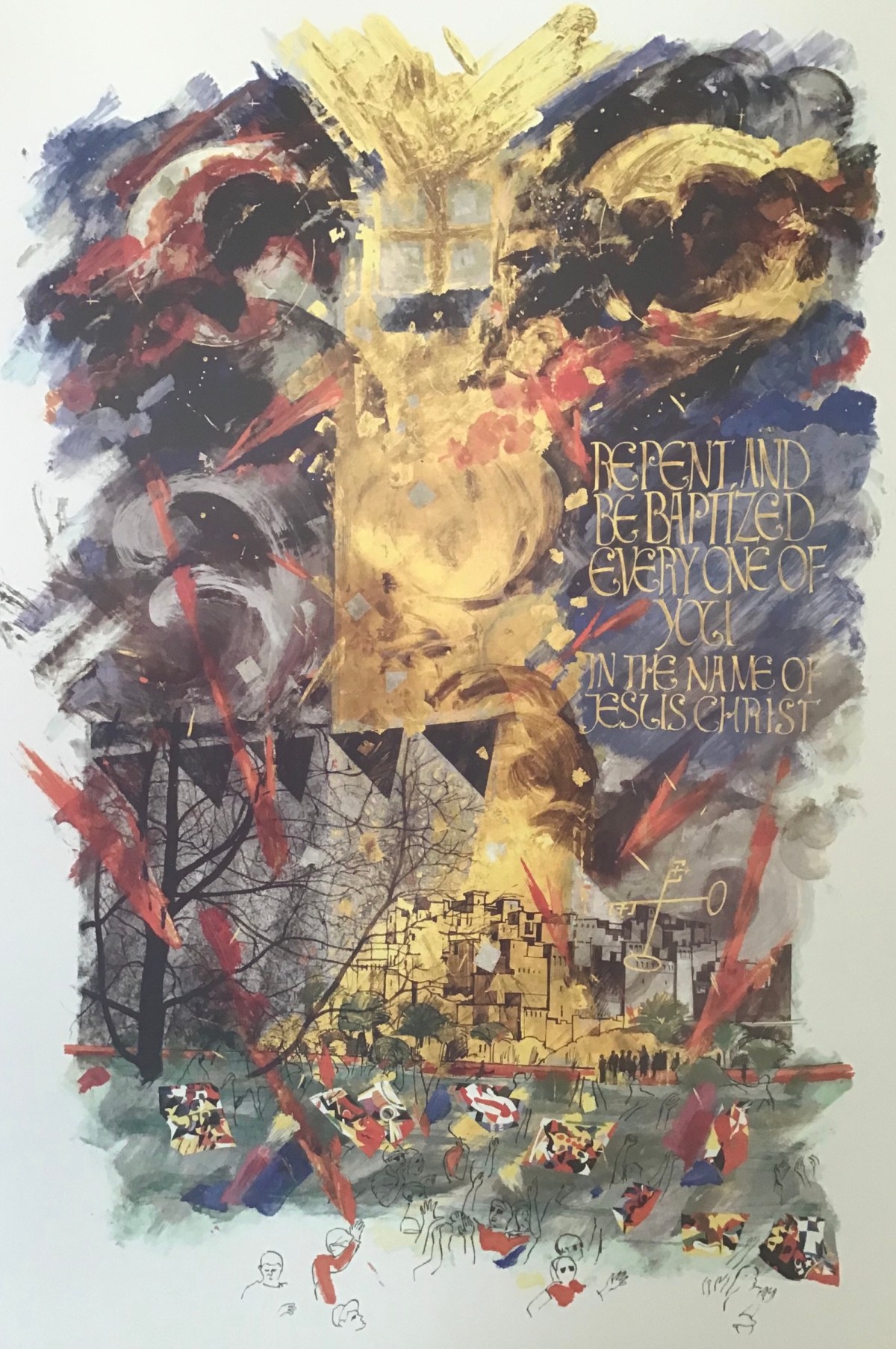
First, Peter instructs his listeners to repent (2:38). By urging this on his listeners, Peter seeks a response of complete and total transformation—for that is what is meant by the Greek word that is usually translated “repent”. To repent is not simply to say “I am sorry, I will try harder”; rather, it means to “change my mind”, to replace it with something entirely new (that is the literal sense of the word). Accepting the message of good news concerning Jesus means turning our lives upside-down (see Acts 17:6).

Such a call to repentance is a standard element in prophetic discourse (see Deut 30:1-3; 1 Kgs 8:46-53; Isa 1:16-20,27-29; and many times; Jer 3:11-14; 4:1-2; 18:11; 22:1-7; 50:4-5; Dan 9:3-19; Hosea 5:14-15; 6:1-3; Joel 1:13-14; 2:12-13; Amos 4:6-11; 5:4,6; Jonah 1:1-2; 3:1-5; Micah 6:6-8; Zech 1:1-6; Mal 3:6-7). Peter’s use of this typical prophetic style establishes a pattern which will recur often at the end of his speeches (3:19; 5:31-32; 8:22; 10:43; cf. 11:18), as well as in some by Paul (17:30; 20:21; 26:20).

Peter also calls for his listeners to be baptised (2:38), signalling an action which occurs immediately (2:41) as well as at key moments later in the narrative — notably during the ‘turn to the Gentiles’ (8:12,16,37-38; 9:18; 10:48) and the journeys of Paul (16:15,33; 18:8; 19:5). Baptism (being dunked in water), along with forgiveness and being filled with the Spirit, are three ways of signifying the complete transformation that is required by repentance.

The large number of people who responded to this call (v.41) may well be a typical exaggeration, found often in Luke’s writings—notice, for example, how many times “all” the people say or do something (Acts 3:11, 4:16, 9:35, 17:21, 19:10, 19:17, 22:12, 26:4). Luke, of course, is writing five or six decades later, looking back through rose-coloured glasses, to the “golden days” of the church. But the basic message is clear: encountering Jesus leads to a transformed life.

The people’s response, as described in 2:41, is both favourable (they received his word) and abundant (about three thousand souls). This, too, is a pattern which will be repeated — but also significantly modified — in later incidents in Acts, when many will accept the apostolic message, but others will reject it (see 13:4-12).

So the end of Peter’s speech sets up a pattern that will be repeated in various places, by various groups of people, as the story continues in this second volume of the orderly account—a pattern that has provided the foundation, across the centuries, for how people might respond, in faith, to the message about Jesus.

This blog is based on a section of my commentary on Acts in the Eerdmans Commentary on the Bible, ed. Dunn and Rogerson (Eerdmans, 2003).

The illustration is by Donald Jackson, from the Gospel and Acts volume of The Saint John’s Bible (Order of Saint Benedict, 2005)

See also https://johntsquires.com/2020/04/16/what-god-did-through-him-peters-testimony-to-jesus-acts-2/ and https://johntsquires.com/2020/04/14/what-god-did-through-him-proclaiming-faith-in-the-public-square-acts-2/

Unknown's avatarAuthor John T SquiresPosted on April 20, 2020April 19, 2023Categories An Orderly Account: Gospel of LukeTags Acts, Easter, scripture1 Comment on Repent and be baptised: Peter’s Pentecost proclamation (Acts 2; Easter 3A)

What God did through him: Peter’s testimony to Jesus (Acts 2; Easter 2A)

What God did through him: Peter’s testimony to Jesus (Acts 2; Easter 2A)

We are now in the season of Easter. It stretches for fifty days, from Easter Sunday up to Pentecost Sunday. Throughout this season, in place of a reading from Hebrew Scriptures, we follow passages from the book of Acts, the second volume in the orderly account which, by tradition, is attributed to Luke.

We saw earlier that the passage set for this Sunday (the second Sunday in the season of Easter) places Peter in the public square, making a speech to the crowd which had gathered in Jerusalem on the Festival of Pentecost (Acts 2:1). See https://johntsquires.com/2020/04/14/what-god-did-through-him-proclaiming-faith-in-the-public-square-acts-2/

In his speech, Peter interprets the phenomena of the day, articulates the significance of Jesus, and describes the nature of the community. This blog post focussed on the middle element, the significance of Jesus.

The body of the the speech concerns the life of Jesus (2:22-36). Peter frames his words about Jesus with a clear declaration about his significance, using the what God did through him at beginning and end (2:22,36). That God acts in and through Jesus is directly specified both at the beginning of the body of the speech (mighty works and wonders and signs which God did through him, 2:22) and at the conclusion of the speech (both Lord and Messiah, God has made him, this Jesus …, 2:36). (The Greek text is precisely parallel in these verses. The same Greek verb can be translated as “do” or “make”.)

Peter refers to the delivering up of Jesus by the predetermined plan and foreknowledge of God (2:23); this important Lukan motif is repeated by the Jerusalem community (4:28), Gamaliel (5:39) and Paul (13:36; 20:27). The precise means of this delivering up is stated starkly by Peter: you crucified him (2:23); this is repeated in a gradually refined form over subsequent speeches (“you killed”, 3:15; 5:30; “they put him to death”, 10:39; “they asked Pilate to have him killed”, 13:27-28).

This does not, however, invalidate the divine plan; for God acts further in Jesus, now described as whom God raised (2:24). The same claim is made again at 3:15; 5:30; 10:40; 13:30; 17:31. This resurrection validates all that Jesus had said, and done, during his life in Galilee and Jude. The death and resurrection of Jesus thus stand, together, at the very centre of “the plan of God”.

Peter also describes Jesus in terms of how he fulfilled prophecy (2:25-31,33-35). For Luke, as Peter demonstrates, the life of Jesus can readily be understood in terms of the ancient “God-talk” of scriptural prophecy. Prophetic testimony provides another means of validation.

Peter first quotes Psalm 16:8-11 (Acts 2:25-28) to interpret the risen Jesus as incorruptible; verse 10 is repeated in a modified form by Peter at Acts 2:31 and by Paul at Acts 13:35. Then Peter quotes Psalm 110:1 (Acts 2:34-35) to substantiate the claim that Jesus can be acclaimed as Messiah.

This application of scripture to Jesus is a persistent element in subsequent speeches, not only those given by Peter (3:18,21-26; 10:43), but also in speeches by Stephen (7:2-50), Philip (8:32-35), James (15:16-18) and Paul (13:27,29,33-37; 14:15; 17:11; 23:5; 24:14; 26:22-23; 28:23,25-27).

This continues a quite notable feature of the Lukan account of Jesus’ “inaugural sermon” in Capernaum (Luke 4:18-21), in which the blended citation of Isa 58:6; 61:1-2 is said to be fulfilled by Jesus’ presence in the synagogue. It is a consistent Lukan motif that God’s plan can be known by means of scripture (God speaking through the prophets) which is coming to fruition in the events being narrated.

Peter supports the claims made concerning Jesus with the apostolic witness (this Jesus God raised; of him we all are witnesses, 2:32). This witness complements and continues the ancient prophetic witness. It is another means of validating Jesus. The elements in this speech are typical of the pattern which is followed in subsequent speeches. Peter often refers to the witness of the apostles (3:15; 5:32; 10:39,41). Paul also refers to this in his speech in Pisidian Antioch (13:31), and he is subsequently identified as a specially chosen witness (22:15; 26:16).

The speech that Luke places on the mouth of Peter, on the day of Pentecost, thus provides a paradigm for subsequent speeches. Luke has reconstructed the preaching of the apostles and ensured that they are remembered as having provided a consistent message. We reflect on that on this Sunday, during the season of Easter.

This blog is based on a section of my commentary on Acts in the Eerdmans Commentary on the Bible, ed. Dunn and Rogerson (Eerdmans, 2003). I have also explored the theme of the plan of God at greater depth in my doctoral research, which was published in 1993 by Cambridge University Press as The plan of God in Luke-Acts (SNTSM 76).

Unknown's avatarAuthor John T SquiresPosted on April 16, 2020May 11, 2021Categories An Orderly Account: Gospel of LukeTags Acts, scripture4 Comments on What God did through him: Peter’s testimony to Jesus (Acts 2; Easter 2A)

What God did through him: proclaiming faith in the public square (Acts 2; Easter 2A)

What God did through him: proclaiming faith in the public square (Acts 2; Easter 2A)

We are now in the season of Easter. It stretches for fifty days, from Easter Sunday up to Pentecost Sunday. Throughout this season, in place of a reading from Hebrew Scriptures, we follow passages from the book of Acts, the second volume in the orderly account which, by tradition, is attributed to Luke.

The passage set for this Sunday (the second Sunday in the season of Easter) places Peter in the public square, making a speech to the crowd which had gathered in Jerusalem on the Festival of Pentecost (Acts 2:1). This is but the first of many such speeches, delivered by Peter and other followers of Jesus, in public locations. It is also a striking example of “public theology”, articulating the Gospel in the public arena.

Peter: orator and prophet

There are many speeches reported in Acts. This speech, attributed to Peter, sets a pattern for those ensuing speeches. In form, it follows hellenistic rhetorical conventions, even though Peter was a Jew and is later described as being “uneducated and ordinary” (4:13). This speech, like all others in Acts, was undoubtedly written by Luke; it is not a verbatim report of what Peter said.

Luke wasn’t present for this speech, or the others he has included in Acts. He operated in the style of hellenistic historians, who crafted words appropriate for the speaker and the occasion (Thucydides, Hist. 1.22.1). Even though Peter was a mere Jewish fisherman, it is important for Luke to present him as a polished Hellenistic orator.

Peter’s speech is the first in a sequence of speeches in Acts in which, as a whole, the larger story of Jesus and Israel is linked with the events that are taking place. This is how Luke conveys the way the apostles preached—emphasising things that were of importance to him. What they actually said, we cannot know.

Luke has Peter speak as one with the authority of a prophet; the word translated simply as addressed (NRSV) is an unusual term (apephtheggxato, 2:4) which is best translated as declaimed, to convey the seriousness of the occasion (see also 26:25). Peter is portrayed as a prophet—he utters inspired intelligent utterance, as the prophets did.

Within the speech itself, Peter states that he speaks with frankness (2:29), a quality reminscent of the prophets, but also used to describe a valued way of speaking amongst philosophers (see, for instance, Dio Chrysostom, Oration 32.11 and 77/78.37; Diogenes Laertius, Lives 2.122-123 [on Simon the cobbler] and 6.69 [on Diogenes the Cynic]). Such frank speech is to be understood as coming from God. It is noted again after Pentecost, when in response to the community’s prayer to God, the ground shakes and community members are “filled with the spirit” and speak with “frankness” (4:31).

The same frankness is also noted in the preaching of Peter and John (4:13), the teaching of Apollos (18:26) and the proclamation of Paul (9:27-28; 19:8; 28:31; with Barnabas, 13:46 and 14:3). Divinely-bestowed frankness of speech thus typifies the leaders of the messianic communities.

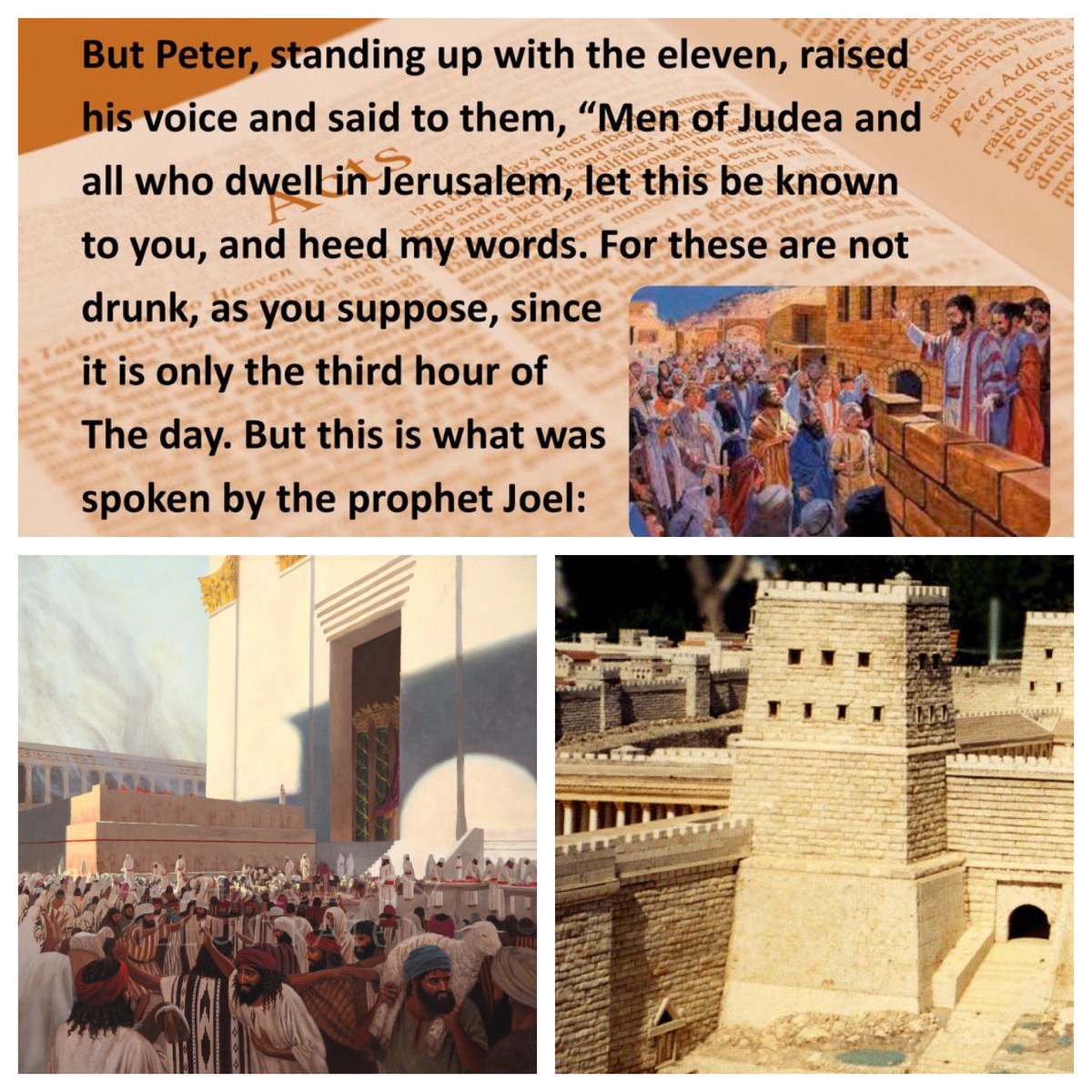
Peter is giving this speech in a public place: the Temple in Jerusalem, most likely in an outer court, where many pilgrims had gathered because of the Festival of Pentecost. His public proclamation of the story of a Jesus is important for Luke, as he recounts the ways that the early community of believers lived and bore witness to their faith.

Towards the end of the second volume of the orderly account, the book of Acts, that other great public orator, Paul, makes a striking declaration about his activities: these things were not done in a corner, he asserts, as he makes his defence before King Agrippa, his consort Queen Berenice, and the Roman Governor, Porcius Festus (26:26). Interestingly, the same unusual verb we noted to describe Peter as he spoke at Pentecost, is used of Paul at this point; in speaking before the authorities, he “declaims” (apophtheggomai, 26:25).

The words attributed to Paul, these things were not done in a corner, were actually well-known in the Hellenistic world, as a Greek proverb. (It is cited by Plato, Gorgias 485CE, Aulius Gellius, Attic Nights 10.16-18, and Epictetus, Diss. 1.29.54-57.) In the mind of the author of the two volumes of this orderly account, this is a key feature of the activity undertaken by Peter, Paul, and all who were leaders within those early communities. It was a faith that was consistently and unashamedly proclaimed in public.

On the day of Pentecost, Peter’s prophetic role had placed him in a position of leadership within the community, as well as propelling him to public prominence. His speech provides a foundational model for this kind of public prophetic leadership. In this speech, Peter interprets the phenomena of the day, articulates the significance of Jesus, and describes the nature of the community. This Sunday’s reading focusses on the middle item of these three features. The other elements are taken up on subsequent Sundays during Easter.

For a further blog post on Peter’s testimony to Jesus in this speech, see https://johntsquires.com/2020/04/16/what-god-did-through-him-peters-testimony-to-jesus-acts-2/

This blog is based on a section of my commentary on Acts in the Eerdmans Commentary on the Bible, ed. Dunn and Rogerson (Eerdmans, 2003).


Unknown's avatarAuthor John T SquiresPosted on April 14, 2020April 13, 2023Categories An Orderly Account: Gospel of LukeTags Acts, Easter, scripture4 Comments on What God did through him: proclaiming faith in the public square (Acts 2; Easter 2A)

Posts pagination

Previous page Page 1 … Page 16 Page 17 Page 18 … Page 22 Next page

The Book of Origins

  • Leaving Luke . . . Meeting Matthew
  • Matthew: tax collector, disciple, apostle, evangelist—and “scribe trained for the kingdom”? (Matt 9; Pentecost 2A)
  • For our instruction … that we might have hope (Rom 15, Isa 11, Matt 3; Advent 2A)
  • The origins of Jesus in the book of origins: Matthew 1 (Advent Year A)
  • Now the birth of Jesus the Messiah took place in this way (Matthew 1; Advent 4A)
  • Descended from David according to the flesh (Rom 1; Advent 4A)
  • A young woman? A virgin? Pregnant? About to give birth? (Isa 7:14 in Matt 1:23; Advent 4A)
  • More on Mary (from the Protoevangelium of James)
  • Tales from the Magi (the Revelation of the Magi)
  • Herod waiting, Herod watching, Herod grasping, holding power (Matt 2; Christmas 1A)
  • Herod was infuriated, and he sent and killed all the children (Matt 2; Christmas 1A)
  • Repentance for the kingdom (Matt 4; Epiphany 3A)
  • Proclaiming the good news of the kingdom (Matt 4; Epiphany 3A)
  • Teaching in “their synagogues” (Matt 4; Epiphany 3A)
  • Teaching the disciples (Matt 5; Epiphany 4A)
  • Blessed are you: the Beatitudes of Matthew 5 (Epiphany 4A)
  • An excess of righteous-justice (Matt 5; Epiphany 5A)
  • You have heard it said … but I say to you … (Matt 5; Epiphany 6A)
  • The missing parts of the Sermon on the Mount (Matt 6 and 7; Epiphany Year A)
  • Our Father in heaven: a pattern for prayer (Luke 11, Matt 6) part III
  • Our Father in heaven: a pattern for prayer (Luke 11, Matt 6) part II
  • Our Father in heaven: a pattern for prayer (Luke 11, Matt 6) part I
  • “Go nowhere among the Gentiles” (Matt 10:5): the mission of Jesus in the book of origins (Pentecost 3A)
  • “Even the hairs of your head are all counted.” (Matt 10:30; Pentecost 4A)
  • Come to me, take my yoke, I will give you rest (Matt 11; Pentecost 6A)
  • Parables: the craft of storytelling in the book of origins (Matt 13; Pentecost 7A)
  • The righteous-justice of God, a gift to all humanity (Romans; Year A)
  • Let anyone with ears, hear! (Matt 13; Pentecost 8A)
  • Chopping and changing: what the lectionary does to the parables of Matthew (Pentecost 7–9A)
  • Nothing but five loaves and two fish (Matt 14; Pentecost 10A)
  • Liminal experiences and thin places (Matt 14; Pentecost 11A)
  • It’s all in the geography. Jesus, the Canaanite woman, and border restrictions (Matt 15; Pentecost 12A)
  • A rock, some keys, and a binding: clues to the identity of Jesus (Matt 16; Pentecost 13A)
  • An invitation that you just cannot … accept! (Pentecost 19A)
  • Towards Palm Sunday (Matt 21): Passover and politics
  • Towards Palm Sunday (Matt 21): Riding on a donkey (or two) as the crowd shouts ‘Hosanna’
  • Towards Palm Sunday (Matt 21): Waving branches, spreading cloaks
  • Towards Palm Sunday (Matt 21): Acclaiming the king, anticipating the kingdom
  • Producing the fruits of the kingdom (Matt 21; Pentecost 19A)
  • Darkness, weeping, and gnashing of teeth: the scene of judgement (Matt 22; Pentecost 20A)
  • The greatest and first commandment … and a second, like it (Matt 22)
  • On these two commandments hang all the law and the prophets (Matt 22; Pentecost 22A)
  • Sitting on the seat of Moses, teaching the Law—but “they do not practice what they teach” (Matt 23; Pentecost 23A)
  • Discipleship in an apocalyptic framework (Matt 23–25; Pentecost 23–26A)
  • A final parable from the book of origins: on sheep and goats, on judgement and righteous-justice (Matt 25; Pentecost 26A)
  • Scripture debate and disputation in the wilderness (Matt 4; Lent 1A)
  • Testing (not temptation) in the wilderness (Matt 4; Lent 1A)
  • Practising righteous-justice: alms, prayer, and fasting (Ash Wednesday)
  • Forcing scripture to support doctrine: texts for Trinity Sunday (2 Cor 13, Matt 28; Trinity A)

An Orderly Account: Luke and Acts

  • “An orderly account”: a quick guide to Luke and Acts
  • Costly discipleship, according to Luke
  • Did Luke write the first “orderly account” about Jesus?
  • With one eye looking back, the other looking forward: turning to Luke’s Gospel I (Year C)
  • Leaving out key moments, so they can appear later in the story: turning to Luke’s Gospel III (Year C)
  • “A light for the Gentiles, salvation to the ends of the earth”: turning to Luke’s Gospel II (Year C)
  • The scriptural resonances in the Annunciation (Luke 1; Advent 4B)
  • Magnificat: the God of Mary (Luke 1) is the God of Hannah (1 Sam 2) (Advent 4C)
  • “To give knowledge of salvation”: Luke’s portrayal of John the baptiser (Luke 3; Advent 2C)
  • On angels and virgins at Christmastime (Luke 2; Christmas Day B)
  • A light for revelation to the Gentiles and for glory to your people Israel (Luke 2; Christmas 1B)
  • John the baptiser’s call for ethical, faithful living (Luke 3; Advent 3C)
  • A Testing Time: forty days in the wilderness (Luke 4)
  • Sacred place and sacred scripture: forty days in the wilderness (2)
  • Scripture fulfilled in your hearing (Luke 4:16-30; Epiphany 3C, 4C)
  • Jesus and conventional Jewish piety (Luke 4:16; Epiphany 3C)
  • Jesus, scripture and experience (Luke 4:17, 21; Epiphany 3C)
  • The holistic spirit-inspired mission of Jesus (Luke 4:18–19; Epiphany 3C)
  • Jesus, the widow of Sidon and the soldier of Syria: representatives of the community of faith (Luke 4:25–27; Epiphany 4C)
  • Two prophets of Israel, the widow of Sidon and the soldier of Syria: an inclusive community of Jews and Gentiles (Luke 4:25–27; Epiphany 4C)
  • Leave everything, follow Jesus (Luke 5:1-11; Epiphany 5C)
  • On a level place, with a great crowd (Luke 6; Epiphany 6C)
  • Blessed are you … poor, hungry, weeping … (Luke 6; Epiphany
  • The plain, the synagogue, and the village (Luke 6, 4 and 1; Epiphany 6C)
  • Bless—Love—Forgive—and more. The teachings of Jesus (Luke 6; Epiphany 6C, 7C)
  • The beloved physician, the lover of God, and loving our enemies (Luke 6; Epiphany 7C)
  • Perfect, or merciful? The challenge Jesus poses (Matt 5, Epiphany 7A; Luke 6, Epiphany 7C)
  • Jesus and his followers at table in Luke’s “orderly account”
  • Before Transfiguration Sunday, the stories of the dying slave and the grieving widow (Luke 7; Epiphany 9C; Proper 4C)
  • What have you to do with me, Jesus? (Luke 8; Pentecost 2C)
  • Bringing his ‘exodos’ to fulfilment (Luke 9; Transfiguration C)
  • Setting his face to go to Jerusalem (Luke 9:51, 13:33, 17:11, 19:11; Lent 2C)
  • Through Samaria, heading to Jerusalem (Luke 9; Pentecost 3C)
  • Sent out in Samaria, proclaiming the kingdom (Luke 10; Pentecost 4C)
  • Listening and learning at the feet of Jesus (Luke 10; Pentecost 6C)
  • Mary and Martha: models of women following and learning from Jesus (Luke 10; Pentecost 6C)
  • There is need of only one thing. Or, maybe, two. (Luke 10; Pentecost 6C)
  • Where have all the women gone? Women in the movement initiated by Jesus (Luke 10; Pentecost 6C)
  • On earth, as in heaven: the key to The Lord’s Prayer (Luke 11; Pentecost 7C)
  • Sins or trespasses? Trial or temptation? Thine or yours? The prayer that Jesus taught (Luke 11; Pentecost 8C)
  • “Where your treasure is, there your heart will be also” (Luke 12; Pentecost 8C)
  • Coming to grips with the judgement of God (Luke 12 and Isaiah 5; Pentecost 10C)
  • She stood up straight and they were put to shame (Luke 13; Pentecost 11C)
  • Jerusalem, Jerusalem: holy city, holy calling (Luke 13; Lent 2C)
  • Disturbing discipleship: exploring the teachings of Jesus in Luke 14 (Pentecost 12C to 13C)
  • Disreputable outsiders invited inside: parables in Luke 14 (Pentecost 12C, 13C)
  • The discomfort of ambiguity (Luke 15; Lent 4C)
  • Human sinfulness and divine grace (Jeremiah 4; Luke 15; 1 Timothy 1; Pentecost 14C)
  • Shrewd? dishonest? manipulative? or contributing to the common good? (Luke 16; Pentecost 15C)
  • Lazarus and the rich man (Luke 16; Pentecost 16C)
  • Faith the size of a mustard seed (Luke 17; Pentecost 17C)
  • Was none of them found to return and give praise to God except this foreigner? (Luke 17; Pentecost 18C)
  • Unjust judge, shameless widow (Luke 18; Pentecost 19C)
  • In defence of the Pharisees: on humility and righteousness (Luke 18; Pentecost 20C)
  • Zacchæus: patron saint of change and transition (Luke 19; Pentecost 21C)
  • “When these things begin to take place … your redemption is drawing near” (Luke 21; Advent 1C)
  • “Be alert at all times, praying that you may have the strength … to stand before the Son of Man” (Luke 21; Advent 1C)
  • Look up to the sky? Look down to your feet! (Luke 20; Pentecost 22C)
  • Don’t take it at face value: on former things and new things
  • Don’t take it at face value: on what lies behind and what lies ahead (Lent 2C)
  • The death, resurrection and ascension of Jesus in Luke’s “orderly account”
  • What do you see? What do you hear? (Luke 19; Palm Sunday C)
  • Holy Week: the week leading up to Easter
  • Sacrificial death and liberating life: at the heart of Easter
  • Ministry and Mission in the midst of change and transition (Luke 21:13; Pentecost 23C)
  • Easter in Christian tradition and its relation to Jewish tradition
  • A time in-between the times, a space in no-space.
  • The tomb is empty. He is not here. He is risen. (Luke 24; Easter Sunday)
  • He Is Not Here Day
  • Discovering new futures … letting go of the old
  • The moment of recognition: walking … talking … listening … understanding … (Luke 24; Easter evening; Easter 3A)
  • Ten things about Pentecost (Acts 2)
  • The cross-cultural nature of the early Jesus movement
  • From Learners to Leaders: deepening discipleship in Luke’s “orderly account”
  • Constantly devoting themselves to prayer (Acts 1; Easter 7A)
  • You will be my witnesses (Acts 1; Easter 7A)
  • Judas: reconsidering his part in the Easter story (Acts 1; Easter 7B)
  • Pentecost, the Spirit, and the people of God (Acts 2; Pentecost B)
  • What God did through him: Peter’s testimony to Jesus (Acts 2; Easter 2A)
  • What God did through him: proclaiming faith in the public square (Acts 2; Easter 2A)
  • Repent and be baptised: Peter’s Pentecost proclamation (Acts 2; Easter 3A)
  • The church in Acts: Times of refreshing (Acts 3; Easter 3B)
  • Boldly proclaiming “no other name” (Acts 4; Easter 4 B)
  • The church in Acts: Unity, testimony, and grace (Acts 4; Easter 2B)
  • We must obey God rather than human authority (Acts 5; Easter 2C)
  • Edging away from the centre (Acts 8; Easter 5B)
  • What happened after Philip met the Ethiopian? (Acts 8; Easter 5B)
  • The calling of Saul and the turn to the Gentiles: modelling the missional imperative (Acts 8—12; Easter 3C)
  • People of ‘The Way’ (Acts 9; Easter 3C)
  • You will be told what you are to do (Acts 9; Easter 3C)
  • Resurrection life, economic responsibility, and inclusive hospitality: markers of the Gospel (Acts 9)
  • Another resurrection! (Acts 9; Easter 4C)
  • Even to the Gentiles! (Acts 10; Easter 6B)
  • Even to the Gentiles (Acts 11; Easter 5C)
  • On literary devices and narrative development (Acts 16; Easter 7C)
  • The unknown God, your own poets, and the man God chose: Paul on the Areopagus (Acts 17; Easter 6A)
  • Paul, Demetrius and Damaris: an encounter in Athens (Acts 17:16-17,22–34)
  • Lydia, Dorcas, and Phoebe: three significant strategic leaders in the early church
  • An Affirmation for Our Times
  • I make prayers on your behalf (Letters to Luke #1; Year C)
  • I rejoice in the gift of writing (Letters to Luke #2; Year C)
  • How exciting it was! (Letters to Luke #3; Year C)
  • I write briefly (Letters to Luke #4; Year C)
  • I am happy to report that we have held another reading (Letters to Luke #5; Year C)
  • I was astonished to receive your brief note (Letters to Luke #6; Year C)
  • Leaving Luke . . . Meeting Matthew

Scripture and Theology

  • The Word of God, Scripture, and Jesus Christ
  • Marrying same-gender people: a biblical rationale
  • Discernment
  • Interpreting the creeds “in a later age”
  • Affirming the Teachings of Jesus
  • To articulate faith contextually
  • Let your gentleness be known to everyone
  • What can we know about the birth of Jesus?
  • “An orderly account”: a quick guide to Luke and Acts
  • Costly discipleship, according to Luke
  • In the wake of the verdict about Pell …
  • Another Time, Another Place: towards an Australian Church
  • Holy Week: the week leading up to Easter
  • Sacrificial death and liberating life: at the heart of Easter
  • The death, resurrection and ascension of Jesus in Luke’s “orderly account”
  • Easter in Christian tradition and its relation to Jewish tradition
  • The cross-cultural nature of the early Jesus movement
  • Jesus and his followers at table in Luke’s “orderly account”
  • Once again: affirming our diversity, celebrating joyous marriages
  • Ten things about Pentecost (Acts 2)
  • The Paraclete in John’s Gospel: exploring the array of translation options (John 14, 15, 16)
  • “Do you believe in the Triune God?”
  • The DNA of the UCA (part I)
  • The DNA of the UCA (part II)
  • Harness the passion, but restrain the rhetoric. Musing on the role model which Paul offers in Galatians.
  • Providing for the exercise by men and women of the gifts God bestows upon them: lay people presiding at the sacraments in the Uniting Church
  • Freedom and unity: themes in Galatians
  • Australian Religious Leaders support renewable energy
  • Human sexuality and the Bible
  • Dividing the unity, splintering the connections: more ACC agitation
  • Giving Voice, Telling Truth, Talking Treaty: NAIDOC 2019
  • Advocacy and Climate Change, Growth and Formation, Treaty with First Peoples: Synod 2019
  • Climate Change: a central concern in contemporary ministry
  • On earth, as in heaven: the key to The Lord’s Prayer (Luke 11; Pentecost 7C)
  • Ramping up the rhetoric, generating guilt and provoking panic: the failed strategy of conservatives in the UCA (part I)
  • Ramping up the rhetoric, generating guilt and provoking panic: the failed strategy of conservatives in the UCA (part II)
  • Ramping up the rhetoric, generating guilt and provoking panic: the failed strategy of conservatives in the UCA (part III)
  • International Day of the World’s Indigenous Peoples
  • In the wake of the verdict (and appeal decision) relating to Pell …
  • Where will we find hope? When will we see justice?
  • Supporting the Climate Strike
  • Gracious openness and active discipleship as key characteristics of church membership
  • Please Leave ?? No — Please Stay !!
  • Stones singing and rivers vibrating … a liturgy for Holy Communion
  • Faith in Action: a religious response to the Climate Emergency (Part One)
  • Faith in Action: a religious response to the Climate Emergency (Part Two)
  • Faith in Action: a religious response to the Climate Emergency (Part Three)
  • Celebrating Transitions: into a strange and graceful ease … (part one)
  • Celebrating Transitions: into a strange and graceful ease … (part two)
  • We wait, and hope, and grieve, anticipating …
  • On the move. A reflection on Christmas.
  • Reflecting on faith amidst the firestorms
  • This is the world we live in, this is the Gospel we believe in
  • Giving up? Or going deep? The opportunity of Lent
  • Passing the peace, sharing the elements, greeting the minister
  • When you come together … reflections on community in the midst of a pandemic
  • Holy Week: a week set apart, in a time set apart.
  • It was on that night that everything came to a head. Maundy Thursday Reflections.
  • Sacrificial Death: to give his life. Good Friday Reflections
  • Liminal Space: waiting and not knowing. Holy Saturday Reflections
  • Liberating Life: a new way of being. Easter Sunday Reflections
  • It’s been just over a month—but there have been lots of learnings!
  • Not this year. So what about next year?
  • The times, they are are a-changin’.
  • When we come together (2) … values and principles in the midst of a pandemic
  • It’s been two months under restrictions—what will our future look like? (1)
  • It’s been two months under restrictions—what will our future look like? (2)
  • Saying sorry, seeking justice, walking together, working for reconciliation
  • Worship like the first Christians. What will our future look like? (3)
  • Pentecost: the spirit is for anyone, for everyone.
  • Racism and Reconciliation
  • Paul’s vision of “One in Christ Jesus” (Gal 3:28) and the Uniting Church
  • In memory of James Dunn (1939–2020)
  • Black Lives Matter. Now—and Then.
  • Hiroshima and Nagasaki (1945), and the commitment to seek peace (2020)
  • Sexuality and Gender Identity Conversion Practices Bill: A Christian Perspective
  • Always Was, Always Will Be. #NAIDOC2020
  • The Lectionary: ordering the liberty of the preacher
  • Women in the New Testament (1): the positive practices of Jesus and the early church
  • Women in the New Testament (2): six problem passages
  • Reflections on a significant anniversary
  • What do we know about who wrote the New Testament Gospels? (1)
  • What do we know about who wrote the New Testament Gospels? (2)
  • What do we know about who wrote the letters attributed to Paul? (3)
  • What do we know about who wrote the letters in the name of the apostles? (4)
  • Revelation: a complex and intricate world of heavenly beings and exotic creatures
  • Why the Christmas story is not history (1): the “nativity scene” and the Gospels
  • Why “the Christmas story” is not history (2): Luke 1-2 and Matthew 1-2
  • Advent Greetings from Canberra Region Presbytery
  • Honours. Honestly?
  • Celebrations in Canberra (in the Uniting Church Presbytery)
  • Enough is Enough!
  • Earth Day 2021
  • From BC (Before COVID) to AD (After the Disruption)
  • The identity of the Uniting Church
  • #IBelieveHer: hearing the voice of women (Easter Day; John 20)
  • An Affirmation for Our Times
  • The missional opportunity of Trinity Sunday
  • The Murugappans of Biloela
  • World Refugee Day 2021: “when I was a stranger, you welcomed me”
  • The climate is changing; the planet is suffering; humanity is challenged.
  • 20 years on, and the shame continues: the Palapa, the Tampa, and “children overboard”
  • Rosh Hashanah: Jewish New Year
  • Remembering John Shelby Spong (1931–2021)
  • International Day of Indigenous Peoples
  • A Safe Place for Rainbow Christians
  • Working with First Peoples and advocating for them
  • Jesus, growing, learning: a review of ‘What Jesus Learned from Women’
  • “The exercise by men and women of the gifts God bestows upon them”: celebrating women in leadership in the Uniting Church
  • On vaccinations, restrictions, and fundamentalism
  • We are buying more debt, pain, and death: a case against nuclear-powered submarines
  • World Rivers Day (27 September)
  • Affirming and inclusive passages from scripture
  • The challenge of COVID-19 to Social Ethics as we know them
  • Mental Health Day, 10 October
  • The shame continues: SIEV X after 20 years
  • What does it mean to be Protestant in the Contemporary World?
  • Eye of the Heart Enlightened: words for the opening of the Parliamentary Year (2023)
  • Saltiness restored: the need for innovation. An Ordination Celebration.
  • God of all the tribes and nations
  • A Day of Mourning, ahead of Invasion Day (26 January)

Life during COVID 19

  • Passing the peace, sharing the elements, greeting the minister
  • When you come together … reflections on community in the midst of a pandemic
  • Pastoral Letter to Canberra Region Presbytery on COVID-19 pandemic
  • Pastoral Letter to the Canberra Region Presbytery of the Uniting Church in Australia. 31 March 2020
  • Liminal Space: waiting and not knowing. Holy Saturday Reflections
  • It’s been just over a month—but there have been lots of learnings!
  • Not this year. So what about next year?
  • The times, they are are a-changin’.
  • When we come together (2) … values and principles in the midst of a pandemic
  • It’s been two months under restrictions—what will our future look like? (1)
  • It’s been two months under restrictions—what will our future look like? (2)
  • Worship like the first Christians. What will our future look like? (3)
  • Pastoral Letter to Canberra Region Presbytery: June 2020
  • “Greet one another” (2 Cor 13). But no holy kissing. And no joyful singing. (Trinity Sunday A)
  • When you come together (3) … wait for one another (1 Cor 11)
  • Going “back” to church—what will our future look like? (4)
  • Minimising risks in the ongoing reality of COVID-19
  • Pastoral Letter to Canberra Region Presbytery—September 2020
  • Reimagining—the spirit of our times
  • Coping in the aftermath of COVID-19: a global perspective, a local response
  • From BC (Before COVID) to AD (After the Disruption)
  • Values and Principles in the context of a pandemic (revisited)

The First Peoples of Australia

  • The sovereignty of the First Peoples of Australia
  • Affirming the Sovereignty of First Peoples: undoing the Doctrine of Discovery
  • On Covenant, Reconciliation, and Sovereignty
  • Learning of the land (1): Eora, Biripi, Whadjuk Noongar
  • Learning of the land (2): Ngunnawal, Namadgi and Ngarigo
  • The profound effect of invasion and colonisation
  • “Endeavour by every possible means … to conciliate their affections”
  • “We never saw one inch of cultivated land in the whole country”
  • “They stood like Statues, without motion, but grinn’d like so many Monkies.”
  • “Resembling the park lands [of a] gentleman’s residence in England”
  • On Remembering: Cook and Flinders (and Trim), Bungaree and Yemmerrawanne
  • “They are to be hanged up on trees … to strike the survivors with the greater terror.”
  • So, change the date—to what?
  • Learning of the land (3): Tuggeranong, Queanbeyan, and other Canberra place names
  • Learning from the land (4): Naiame’s Nghunnhu—fishtraps at Brewarrina
  • We are sorry, we recognise your rights, we seek to be reconciled
  • Reconciliation on the land of Australia: learning from the past
  • Reconciliation on the land of Australia: Bennelong and Yemmerrawanne
  • Reconciliation on the land of Australia: Bungaree and Mahroot
  • Reconciliation on the land of Australia: Cora Gooseberry and Biddy Giles
  • Reconciliation on the land of Australia: “these are my people … this is my land”.
  • Reconciliation on the land of Australia: living together with respect
  • Dark deeds in a sunny land: the exposé offered by John B. Gribble
  • This is the proper way: no climbing
  • “They appear’d to be of a very dark or black colour”. Cook, HMS Endeavour, and the Yuin people and country.
  • “Three canoes lay upon the beach—the worst I think I ever saw.” James Cook at Botany Bay, 29 April 1770
  • Saying sorry, seeking justice, walking together, working for reconciliation
  • Racism and Reconciliation
  • “We weigh’d and run into the Harbour”. Cook, the Endeavour, and the Guugu Yimithirr
  • Black Lives Matter. Now—and Then.
  • James Cook, the Endeavour, twelve turtles and the Guugu Yimithirr (3)
  • James Cook: Captain? Discoverer? Invader? Coloniser? Cook, the Endeavour, and Possession Island.
  • Always Was, Always Will Be. #NAIDOC2020
  • Invasion and colonisation, Joshua 3 and contemporary Australia (Pentecost 23A)
  • This whispering in our hearts: potent stories from Henry Reynolds
  • A vision, a Congress, and a struggle for justice
  • What’s in a name? Reconciliation ruminations
  • NAIDOC WEEK 2021
  • Heal Country: the heart of the Gospel (for NAIDOC WEEK 2021)
  • The Spirit was already in the land. Looking back on NAIDOC WEEK (2017–2021)
  • Working with First Peoples and advocating for them
  • World Rivers Day (27 September)
  • Eye of the Heart Enlightened: words for the opening of the Parliamentary Year (2023)
  • God of all the tribes and nations
  • A Day of Mourning, ahead of Invasion Day (26 January)

Paul

  • The calling of Saul and the turn to the Gentiles: modelling the missional imperative (Acts 8—12; Easter 3C)
  • The unknown God, your own poets, and the man God chose: Paul on the Areopagus (Acts 17; Easter 6A)
  • Freedom and unity: themes in Galatians
  • Paul’s vision of “One in Christ Jesus” (Gal 3:28) and the Uniting Church
  • Descended from David according to the flesh (Rom 1; Advent 4A)
  • Reckoning what is right (Romans 4; Lent 2A) part one
  • Reckoning what is right (Romans 4; Lent 2A) part two
  • Original Sin? or Innate Goodness? (Genesis 2, Romans 5; Lent 1A)
  • We have obtained access to this grace (Romans 5, Pentecost 3A)
  • Dead to sin and alive to God (Romans 6; Pentecost 4A)
  • The best theology is contextual: learning from Paul’s letter to the Romans (Year A)
  • The righteous-justice of God, a gift to all humanity (Romans; Year A)
  • Paul and the Law, sin and the self (Rom 7; Pentecost 6A)
  • Paul, the law of the Spirit, and life in the Spirit (Rom 8; Pentecost 7A)
  • Paul, the spirit of adoption, and the “Abba, Father” prayer (Rom 8; Pentecost 8A)
  • Sighs too deep for words: Spirit and Scripture in Romans (Rom 8; Pentecost 9A)
  • Praying to be cursed: Paul, the passionate partisan for the cause (Rom 9:3; Pentecost 10A)
  • A deeper understanding of God, through dialogue with “the other” (Romans 10; Pentecost 11A)
  • God has not rejected his people. All Israel will be saved. (Rom 11; Pentecost 12A)
  • The rhetoric of the cross (1 Cor 1; Epiphany 3A)
  • The paradox of “the word of the cross” in Corinth (1 Cor 1; Epiphany 4A)
  • Who has known the mind of the Lord? (1 Cor 2; Epiphany 5A)
  • “We do not lose hope” (2 Corinthians; Pentecost 3B—6B)
  • For our instruction … that we might have hope (Rom 15, Isa 11, Matt 3; Advent 2A)
  • When you come together (3) … wait for one another (1 Cor 11)
  • A new creation: the promise articulated by Paul (2 Cor 5; Pentecost 6B)
  • “Greet one another” (2 Cor 13). But no holy kissing. And no joyful singing. (Trinity Sunday A)
  • Paul the travelling philosopher (1 Thessalonians; Pentecost 21–25A)
  • The sincerest form of flattery? Or a later, imperfect imitation? (2 Thessalonians; Pentecost 21C to 23C)
  • To the saints [not just in Ephesus] who are faithful (Ephesians 1; Pentecost 7B)
  • Declare boldly the gospel of peace, put on the armour of God (Ephesians 6; Pentecost 13B)
  • To the saints [not just in Ephesus] who are faithful (Ephesians 1; Pentecost 7B)
  • Making (some) sense of the death of Jesus (Colossians 2; Pentecost 7C)
  • No longer as a slave: Paul, to Philemon, about Onesimus (Pentecost 13C)
  • An example to those who come to believe (1 Timothy 1; Pentecost 14C)
  • Human sinfulness and divine grace (Jeremiah 4; Luke 15; 1 Timothy 1; Pentecost 14C)
  • A ransom for all: a formulaic claim (1 Tim 2; Pentecost 15C)
  • On godliness, dignity, and purity: the life of faith in 1 Timothy (Epiphany 16C)
  • In the name of the apostle … (2 Timothy, Pentecost 17B to 21B)
  • Rightly explaining the word of truth (2 Tim 2:15; Pentecost 18C)
  • Guard the good treasure entrusted to you (2 Tim 1; Pentecost 17C)
  • What does it mean to say that the Bible is inspired? (2 Tim 3:16; Pentecost 19C)
  • On care for orphans and widows (James 1; Pentecost 14B)
  • Fulfilling the Law (James 2; Pentecost 16B)
  • Wisdom from ages past for the present times (Leviticus, Jesus, James, and Paul) (Pentecost 15B, 23B)
  • The wisdom from above (James 3; Pentecost 18B)
  • The ‘word of exhortation’ that exults Jesus as superior (Hebrews 1; Pentecost 20B)
  • A great high priest who “has passed through the heavens” (Hebrews 4; Pentecost 23B)
  • A priest forever, “after the order of Melchizedek” (Hebrews 5; Pentecost 21B)
  • The perfect high priest who mediates “a better covenant” (Hebrews 9; Pentecost 23B)
  • The superior high priest who provides “the better sacrifices” (Hebrews 9; Pentecost 24B)
  • The assurance of hope in “the word of exhortation” (Hebrews 10: Pentecost 25B)
  • Strangers and foreigners on the earth (Hebrews 11; Pentecost 9C)
  • Jesus, the pioneer and perfecter of faith (Hebrews 11–12; Pentecost 10C)
  • Jesus, justice, and joy (Hebrews 12; Pentecost 11C)
  • I will not be afraid; what can anyone do to me? (Hebrews 13; Pentecost 12C)
  • A new birth into a living hope (1 Peter 1; Easter 2A)
  • The living and enduring word of God (1 Peter 1; Easter 3A)
  • ‘Christ died for us’: reflections on sacrifice and atonement
  • Christ suffered for you, leaving you an example (1 Peter 2; Easter 4A)
  • On suffering as a virtue (1 Peter 3; Easter 6A)
  • The spirit of glory is resting on you (1 Peter 4–5; Easter 7A)

The Beginning of the Good News: Mark

  • The Lectionary: ordering the liberty of the preacher
  • Forty days, led by the Spirit: Jesus in the wilderness (Mark 1; Lent 1B)
  • The kingdom is at hand; so follow me. The Gospel according to Mark (Year B)
  • The more powerful one who is coming (Mark 1; Advent 2B)
  • The whole city? (Mark 1; Year B). Let’s take that with a grain of salt
  • “Let’s get down to business”: beginning the story of Jesus (Mark 1; Epiphany 3B)
  • Textual interplay: stories of Jesus in Mark 1 and the prophets of Israel (Year B)
  • 1: Where has Mark gone ?
  • 2 Mark: collector of stories, author of the passion narrative
  • 3 Mark: placing suffering and death at the heart of the Gospel
  • 4 The structure of the passion narrative in Mark
  • Reading the crucifixion as a scene of public shaming
  • In his house, out of his mind (Mark 3; Pentecost 2B)
  • The kingdom, God’s justice, an invitation to all (Mark 4; Pentecost 3B)
  • Mark: a Gospel full of questions (Mark 4; Pentecost 4B)
  • On ‘twelve’ in the stories of the bleeding woman and the dying child (Mark 5; Pentecost 5B)
  • On not stereotyping Judaism when reading the Gospels (Mark 5; Pentecost 5B)
  • Just sandals and a staff—and only one tunic (Mark 6; Pentecost 6B)
  • Shake off the dust that is on your feet (Mark 6; Pentecost 6B)
  • What’s in, and what’s out (Mark 6; Pentecost 8B)
  • Stretching the boundaries of the people of God (Mark 7; Pentecost 15B, 16B)
  • Wash your hands (Mark 7; Pentecost 14B)
  • On Jesus and Justa, Tyre and Decapolis (Mark 7; Pentecost 16B)
  • Disturbance, disruption, and destabilising words (Mark 8; Lent 2B)
  • Transfigured lives—in the here and now (Mark 9 and 1 Kings 2; Epiphany 6B)
  • The paradoxes of discipleship (Mark 8; Pentecost 17B)
  • Giving priority to “one of these little ones” (Mark 9; Pentecost 19B)
  • Boundary lines and the kingdom of God (Mark 9–10; Pentecost 18B to 20B)
  • Not to be served, but to serve: the model provided by Jesus (Mark 10; Pentecost 21B)
  • A ransom for many: a hint of atonement theology? (Mark 10; Pentecost 21B)
  • Seeing and believing as Jesus passes by (Mark 10; Pentecost 22B)
  • Love God, love neighbour: prioritising the Law (Mark 12; Pentecost 23B)
  • Love with all that you are—heart and soul, completely and entirely (Deut 6 in Mark 12; Pentecost 23B)
  • Jesus, the widow, and the two small coins (Mark 12; Pentecost 24B)
  • The beginnings of the birth pangs (Mark 13; Pentecost 25B)
  • Towards the Coming (Mark 13; Advent 1B)

The Book of Signs

  • In the beginning … the Prologue and the book of signs (John 1; Christmas 2B)
  • Living our faith in the realities of our own times … hearing the message of “the book of signs”
  • John (the baptizer) and Jesus (the anointed) in the book of signs (the Gospel of John; Epiphany 2A)
  • Righteous anger and zealous piety: the incident in the Temple (John 2; Lent 3B)
  • Raise up a (new) temple: Jesus and “the Jews” in the fourth Gospel (John 2; Lent 3B)
  • The serpent in the wilderness (John 3, Num 21; Lent 4B)
  • The complex and rich world of scriptural imagery in ‘the book of signs’ (John 3; Lent 4B)
  • The Pharisee of Jerusalem and the woman of Samaria (John 3 and 4; Lent 2–3A)
  • “How can anyone be born after having grown old?” The questions of Nicodemus (John 3; Lent 2A)
  • On the Pharisees: “to help the people to understand the Law”
  • From the woman at the well to a Byzantine saint: John 4, St Photini, and the path to enlightenment (Lent 3A)
  • A well, two mountains, and five husbands (John 4; Lent 3A)
  • Speaking out for equality: a sermon for Lent 3A
  • Misunderstanding Jesus: “they came to make him a king” (John 6; Pentecost 9B)
  • Claims about the Christ: affirming the centrality of Jesus (John 6; Pentecost 9B—13B)
  • In the most unlikely company: confessing faith in Jesus (John 9; Lent 4A)
  • In the most unlikely way … touching the untouchable (John 9; Lent 4A)
  • We do not know how it is that he now sees (John 9; Lent 4A)
  • Perception is everything: a sermon on John 9 (Lent 4A)
  • I am the gate for the sheep (John 10; Easter 4A)
  • The Father and I are one (John 10; Easter 4C)
  • Reading scripture with attention to its context (John 11, Year A)
  • Flesh and bones, spirit and life (Ezek 37, Psalm 130, Rom 8, John 11, Lent 5A)
  • Holding out for hope in the midst of turmoil (John 11; Lent 5A)
  • Yes, Lord, I believe—even in the midst of all of this! (John 11; Lent 5A)
  • We wish to see Jesus (John 12; Lent 5B)
  • Love one another: by this everyone will know (John 13; Easter 5C)
  • “I am the way” (John 14): from elitist exclusivism to gracious friendship? (Easter 5A)
  • The Paraclete in John’s Gospel: exploring the array of translation options (John 14, 15, 16)
  • Father, Son, and Disciples (I): the *real* trinity in John’s Gospel (John 17; Easter 7A,B,C)
  • Father, Son, and Disciples (II): the *real* trinity in John’s Gospel (John 17; Easter 7A,B,C)
  • #IBelieveHer: hearing the voice of women (Easter Day; John 20)
  • In defence of Thomas: a doubting sceptic? or a passionate firebrand? (Easter Sunday)
  • Hands and fingers: the work of God (John 20; Easter 2A)
  • The third time that Jesus appeared to the disciples (John 21; Easter 3C)
  • Back to the lake, back to fishing: a late resurrection story (John 21; Easter 3C)
  • “See what love the Father has given us”: the nature of 1 John (1 John 3; Easter 3B)
  • “We know love by this, that he laid down his life for us” (1 John 3; Easter 4B)
  • “In this is love: that God sent his son” (1 John 4; Easter 5B)
  • “The one who believes that Jesus is the Son of God” (1 John 5; Easter 6B)
  • Images drawn from the past, looking to the future, as a message for the present (Revelation; Easter, Year C)
  • “Worthy is the lamb that was slaughtered”: a paradoxical vision (Rev 5; Easter 3C)
  • With regard to Revelation … and the “great multitude that no one could count” in Rev 7 (Easter 4C)
  • With regard to Revelation … and the “great multitude that no one could count” in Rev 7 (Easter 4C)
  • A new heaven and a new earth … musing on Revelation 21 (Easter 5C, 6C)
  • I will offer a sacrifice and call on the name of the Lord (Psalm 116; Easter 3A)

The Basis of Union

  • What I really like about the Basis of Union
  • What is missing from the Basis of Union?
  • Alongside the Basis of Union, there was the Statement to the Nation
  • Fresh words and deeds
  • The Word of God, Scripture, and Jesus Christ
  • The sovereignty of the First Peoples of Australia
  • Affirming the Sovereignty of First Peoples: undoing the Doctrine of Discovery
  • On Covenant, Reconciliation, and Sovereignty
  • Forty four years on …

Marriage and the Uniting Church

  • Marrying same-gender people: a biblical rationale
  • A diversity of religious beliefs and ethical understandings
  • Marriage and the matter of being vital to the life of the church
  • Seven Affirmations
  • Recognising Pain, Working for Reconciliation
  • The “additional marriage liturgy” for Uniting Churches
  • An Explainer, in nine easy steps
  • Marriage of same gender people: a gift to the whole Church
  • Let your gentleness be known to everyone
  • The Uniting Church is not a political democracy
  • So, what just happened? (An Explainer, Updated)
  • A Prayer for the Uniting Church in Australia
  • “When you suffer, the whole body of Christ suffers”
  • Affirmations we can make together
  • Once again: affirming our diversity, celebrating joyous marriages

Archives

  • December 2025
  • November 2025
  • October 2025
  • September 2025
  • August 2025
  • July 2025
  • June 2025
  • May 2025
  • April 2025
  • March 2025
  • February 2025
  • January 2025
  • December 2024
  • November 2024
  • October 2024
  • September 2024
  • August 2024
  • July 2024
  • June 2024
  • May 2024
  • April 2024
  • March 2024
  • February 2024
  • January 2024
  • December 2023
  • November 2023
  • October 2023
  • September 2023
  • August 2023
  • July 2023
  • June 2023
  • May 2023
  • April 2023
  • March 2023
  • February 2023
  • January 2023
  • December 2022
  • November 2022
  • October 2022
  • September 2022
  • August 2022
  • July 2022
  • June 2022
  • May 2022
  • April 2022
  • March 2022
  • February 2022
  • January 2022
  • December 2021
  • November 2021
  • October 2021
  • September 2021
  • August 2021
  • July 2021
  • June 2021
  • May 2021
  • April 2021
  • March 2021
  • February 2021
  • January 2021
  • December 2020
  • November 2020
  • October 2020
  • September 2020
  • August 2020
  • July 2020
  • June 2020
  • May 2020
  • April 2020
  • March 2020
  • February 2020
  • January 2020
  • December 2019
  • November 2019
  • October 2019
  • September 2019
  • August 2019
  • July 2019
  • June 2019
  • May 2019
  • April 2019
  • March 2019
  • February 2019
  • January 2019
  • December 2018
  • November 2018
  • October 2018
  • September 2018
  • August 2018
  • July 2018

Archives

Recent Comments

Karen M Brown O.A.M.'s avatarKaren M Brown O.A.M. on Wisdom from ages past for the…
John T Squires's avatarJohn T Squires on Controversy, Context, and Crea…
No Perfect Witnesses… on Controversy, Context, and Crea…
What the Nicene Cree… on Building towards the Creed (6)…
karencj's avatarkarencj on In the squares she raises her…

Posts

January 2026
M T W T F S S
 1234
567891011
12131415161718
19202122232425
262728293031  
« Dec    

Recent Posts

  • “The young woman will conceive and bear a son”: a sign that is vague, nebulous, and longterm
  • Antisemitism: yes, it’s about legislation—but more, it’s about our culture
  • They are part of the whole of us
  • Truly God and truly human: the reason for the season
  • Expectations: a key theme for Advent

Recent Comments

Karen M Brown O.A.M.'s avatarKaren M Brown O.A.M. on Wisdom from ages past for the…
John T Squires's avatarJohn T Squires on Controversy, Context, and Crea…
No Perfect Witnesses… on Controversy, Context, and Crea…
What the Nicene Cree… on Building towards the Creed (6)…
karencj's avatarkarencj on In the squares she raises her…

Archives

  • December 2025
  • November 2025
  • October 2025
  • September 2025
  • August 2025
  • July 2025
  • June 2025
  • May 2025
  • April 2025
  • March 2025
  • February 2025
  • January 2025
  • December 2024
  • November 2024
  • October 2024
  • September 2024
  • August 2024
  • July 2024
  • June 2024
  • May 2024
  • April 2024
  • March 2024
  • February 2024
  • January 2024
  • December 2023
  • November 2023
  • October 2023
  • September 2023
  • August 2023
  • July 2023
  • June 2023
  • May 2023
  • April 2023
  • March 2023
  • February 2023
  • January 2023
  • December 2022
  • November 2022
  • October 2022
  • September 2022
  • August 2022
  • July 2022
  • June 2022
  • May 2022
  • April 2022
  • March 2022
  • February 2022
  • January 2022
  • December 2021
  • November 2021
  • October 2021
  • September 2021
  • August 2021
  • July 2021
  • June 2021
  • May 2021
  • April 2021
  • March 2021
  • February 2021
  • January 2021
  • December 2020
  • November 2020
  • October 2020
  • September 2020
  • August 2020
  • July 2020
  • June 2020
  • May 2020
  • April 2020
  • March 2020
  • February 2020
  • January 2020
  • December 2019
  • November 2019
  • October 2019
  • September 2019
  • August 2019
  • July 2019
  • June 2019
  • May 2019
  • April 2019
  • March 2019
  • February 2019
  • January 2019
  • December 2018
  • November 2018
  • October 2018
  • September 2018
  • August 2018
  • July 2018

Categories

  • 15th Assembly
  • A Book of Origins: Gospel of Matthew
  • An Orderly Account: Gospel of Luke
  • Australian society
  • Convicted: Convict Ancestors
  • Environment
  • Family History
  • First Peoples in Australia
  • Hebrew Scripture
  • Hebrews
  • James
  • Living in Canberra
  • Narrative Lectionary
  • Paul
  • Peace with Justice
  • Psalms
  • Scripture and Theology
  • The Beginning of the Good News: Mark
  • The Book of Signs: the Gospel of John
  • The Hebrew Prophets
  • Uncategorized

Meta

  • Create account
  • Log in
  • Entries feed
  • Comments feed
  • WordPress.com
An Informed Faith Start a Blog at WordPress.com.
An Informed Faith
Start a Blog at WordPress.com.
  • Subscribe Subscribed
    • An Informed Faith
    • Join 259 other subscribers
    • Already have a WordPress.com account? Log in now.
    • An Informed Faith
    • Subscribe Subscribed
    • Sign up
    • Log in
    • Report this content
    • View site in Reader
    • Manage subscriptions
    • Collapse this bar
 

Loading Comments...