I am continuing my reflections on a set of words (Luke 6:9–13) that has come to be known as The Our Father (after its opening phrase) or The Lord’s Prayer (after the one who gave it to his disciples). Previous posts were at
What of “the kingdom, the power, and the glory”? These terms are thoroughly scriptural, being found through the pages of Hebrew Scripture. Although not in the earliest manuscripts of either Matthew’s or Luke’s version of The Lord’s Prayer, the closing doxology is found in the text of the Didache (which I think was a second century document) and makes its way into later manuscripts of the canonical documents. That most likely signals that there was an oral tradition that this phrase was in use in later times, so later scribes felt the need to write it back into the words attributed to Jesus.
In scripture, it is not only the kingdom, the power, the glory which is prayed for—there is also the greatness, the majesty, and the victory which is sought, as well as riches and honour. The key text which draws all of these terms together, and places them into a prayer addressing God, is when David assembles “all the officials of Israel, the officials of the tribes, the officers of the divisions that served the king, the commanders of the thousands, the commanders of the hundreds, the stewards of all the property and cattle of the king and his sons, together with the palace officials, the mighty warriors, and all the warriors” (1 Chron 28:1) and addresses them as they prepare to commence work on building the Temple of the Lord in Jerusalem.
After delivering detailed plans for the building to his son Solomon (1 Chron 28:11–19)—plans which had been revealed to him by the Lord—David commissions Solomon for the task, presents him to the people, and then prays a prayer of blessing: “Blessed are you, O Lord, the God of our ancestor Israel, forever and ever. Yours, O Lord, are the greatness, the power, the glory, the victory, and the majesty; for all that is in the heavens and on the earth is yours; yours is the kingdom, O Lord, and you are exalted as head above all. Riches and honour come from you, and you rule over all. In your hand are power and might; and it is in your hand to make great and to give strength to all. And now, our God, we give thanks to you and praise your glorious name.” (1 Chron 29:10–13).
Kingdom, power, and glory are also collected together in Psalm 145: “All your works shall give thanks to you, O Lord, and all your faithful shall bless you. They shall speak of the glory of your kingdom, and tell of your power, to make known to all people your mighty deeds, and the glorious splendor of your kingdom” (Ps 145:10–12). It is God who holds the attributes of power and glory in overseeing God’s kingdom.
These terms were also terms used to honour (and, indeed, flatter!) human kings; the prophet Daniel addresses King Nebuchadnezzar in similarly extravagant terms: “You, O king, the king of kings—to whom the God of heaven has given the kingdom, the power, the might, and the glory, into whose hand he has given human beings, wherever they live, the wild animals of the field, and the birds of the air, and whom he has established as ruler over them all—you are the head of gold” (Dan 2:37–38).
However, the more common use of such flowery ascriptions of might and power are addressed to God, the king (as we have seen above). It is God who exercises power (Exod 15:6; 32:11; Num 11:23; Deut 4:34; 26:8; Ps 21:13; 130:7; 147:5; Isa 10:33; Jer 16:21; Dan 5:23; Nah 1:3).
It is also God in whom glory rests, as many stories on the narrative books attest (Exod 16:7, 10; 24:16–17; 40:34–35; Lev 9:6, 23; Num 14:10, 21; 16:19, 42; 20:6; Deut 5:24; 1 Ki 8:11; 1 Chron 16:28–29; 2 Chron 5:14; 7:1–3). The psalmists also acknowledge the glory of God (Ps 8:1; 24:8–10; 26:8; 29:1–3; 96:7–8; 102:15–16; 104:31; 113:4; 138:5; 148:13). The glory of the Lord is manifest to prophets (Isa 2:19–21; 6:3; 10:16–18; 24:23; 40:5; 42:8; 58:8; 59:19; 60:1–2; 61:3; Ezek 1:28; 3:12, 23; 9:3; 10:4, 18–19; 11:23; 43:4–5: 44:4; Hab 2:14; Zech 2:8).
In telling the story of Jesus, who preaches “the kingdom of God” and indicates that it has come near in him (Mark 1:14; Luke 17:20), the Gospels make note of the power of Jesus (Mark 5:30; 6:2; Matt 11:20; 13:54; Luke 4:14, 36; 5:17; 6:19; 8:46; 19:37; John 10:18) as well as his glory (Luke 2:32; 9:32; John 1:14; 2:11; 8:54; 12:41; 17:5, 22–24).
So the concluding doxology in the longer version of the prayer, ascribing the kingdom, the power, and the glory to God, is both a fitting scriptural conclusion as well as consistent with Jesus’s own perceptions of his role in God’s overarching plan of salvation.
I am continuing my reflections on the passage where Jesus says “pray then in this way”, giving his disciples a set of words (6:9–13) that has come to be known as The Our Father (after its opening phrase) or The Lord’s Prayer (after the one who gave it to his disciples). The first post is at
“Give us bread for the day” has often been seen to be evoking the story embedded within the foundational myth (establishing the central identity) of the people of Israel, when the Lord provided manna to the people whilst they journey in the wilderness (Exod 16; Num 11); further reference is made to this manna in additional books of Hebrew scripture (Deut 8:3, 16; Neh 9:20; Ps 78:24).
That gift of manna, striking in the wilderness experience, was also provided to the Israelites when they camped at Gilgal, on the verge of entering into the land of Canaan (Josh 5:10–12). The story has a potency that makes it an essential element in the identity of Israel: it is a nation which trusts in the gracious provisions of God.
Jesus continues that attitude; God is the one who will provide when something is asked for (Mark 11:24; Matt 7:7, 11; 9:38; Luke 10:2; 11:9, 13; John 14:13; 15:7, 16; 16:23). Consistent with that, asking for “bread for the day” is an appropriate prayer to offer.
The next petition raises other questions. Differences in the Greek terms used in the early versions of this prayer point to the matter; is it “forgive us our sins” or “cancel the debts we owe”? On the different words used, see
Of course, forgiveness is part of the “gospel” of Hebrew Scriptures; the claim that God forgives is found in numerous places. Abraham wrangles with God to forgive Sodom (Gen 18:16–33); Moses pleads, successfully, with the Lord to forgive Israel after their rebellion in the wilderness (Num 14:1–25), and less successfully after the incident involving the golden statue of a calf (Exod 32:30–35). Jeremiah foresees that within the new covenant given by God, forgiveness will be offered (Jer 31:34).
A refrain in a number of places is that “the Lord is slow to anger, and abounding in steadfast love, forgiving iniquity and transgression” (sin” (Exod 34:6–8; Num 14:18; Neh 9:17b; Ps 145:8–9; Joel 2:13; Jonah 4:2; see also 2 Kings 13:23; 2 Chron 30:9). King Solomon prays for God to forgive the people (1 Ki 8:33–40; 2 Chron 6:18–40), the psalmist prays for forgiveness (Ps 25:18; 79:9), and so do some prophets (Ezek 16:63; Dan 9:19; Amos 7:2). Jesus’ prayer petition for God to forgive, in the central prayer he taught, continues this motif.
The associated clause of the prayer, instructing us to follow the example of God and forgive the sins of others, also reflects enduring Israelite understandings. Joseph forgives his brothers (Gen 50:15–21), David forgives Abigail (1 Sam 25:26–28, 32–35). Jesus exhorts his followers to forgive seven times (Luke 17:1–4) or seventy times seven (Matt 18:21–22), and is remembered as the one who came to forgive sins (Mark 2:10; Matt 9:6; Luke 5:24; 23:34), and so this clause of the pray is consistent with that.
If the prayer is about asking God to cancel debts,rather than forgive sins, then another theme in Hebrew Scripture is drawn in by Jesus. The release of slaves and the cancelling of debts was meant to be practised in society every fifty years during the year of Jubilee (Lev 25:8–17; see esp. v.13). Luke explicitly signals this theme in the opening speech of Jesus that he alone reports: “the Spirt of the Lord is upon me … to proclaim release to the captives and recovery of sight to the blind, to let the oppressed go free, to proclaim the year of the Lord’s favour” (4:18–19). The reference to “the year of the Lord’s favour” is commonly taken to be an indication of the Jubilee.
The practice of the Jubilee is, however, dubious. The levitical prescriptions appear to be the ideal that the priests hoped for; actual evidence that this was ever implemented in Israelite society is lacking. Indeed, it is suggested that while the people were in Exile, the land of Israel would “lie desolate”, and “enjoy its sabbath years” (Lev 26:34), providing recompense for all those years when “it did not have on your sabbaths when you were living in it” (Lev 26:35).
Nevertheless, Jesus may well be instructing his followers to pray that this will be a reality in society; that the people “shall proclaim liberty throughout the land to all its inhabitants”, and that those who had been taken to work elsewhere would return “to your property and every one of you to your family” (Lev 25:10). His prayer indicates that he wanted his followers to implement this practice in their lives.
The phrases “save us” and “deliver us” introduce the next two petitions. “Save me” or “save us” is the cry of psalmists (Ps 6:4: 7:1; 22:21; 31:2, 16; 44:6; 54:1; 55:16; 57:3; 59:2; 69:1; 71:2–3; 80:2; 86:16; 106:47; 109:26; 119:94, 146; 142:6; 143:9), and most famously in the Hallel psalm, Psalm 118, in the context of various phrases repeated in Christian worship on a regular basis: “This is the day that the Lord has made; let us rejoice and be glad in it. Save us, we beseech you, O Lord! O Lord, we beseech you, give us success! Blessed is the one who comes in the name of the Lord.” (Ps 118:24–26).
Prophets also cry out for God to save them (Isa 25:9; 33:22; 36:18; 37:20; Jer 17:14), as do the elders of Israel (1 Sam 4:3), the people of Israel (1 Sam 7:8), and the kings David (1 Chron 16:35) and Hezekiah (2 Ki 19:19).
“Deliver me” or “deliver us”, likewise, is a prayer addressed to God by Jacob (Gen 32:10), the people of Israel (Judg 10:15), the friends of Daniel (Dan 3:17), and time and time again by the psalmists (Ps 3:7; 6:4; 7:1; 25:20; 31:1, 15; 39:8; 40:13; 43:1; 51:14; 59:1–2; 70:1–2; 79:9; 106:4; 109:21; 119:170; 120:2; 140:1; 144:11). As Ben Sirach prays in the latter stages of his closing poem, “may he he entrust to us his mercy, and may he deliver us in our days!” (Sir 50:24).
“The time of trial” is a phrase found only in this prayer (Matt 6:13; Luke 11:4) and in the prayer which Jesus is said to have prayed in the Garden of Gethsemane (Mark 14:38; Matt 26:41; Luke 22:40, 46). However, the notion of being tested or put on trial is common in scripture. Moses reminds the Israelites of “what the Lord God did to Pharaoh and to all Egypt, the great trials that your eyes saw” as they wandered in the wilderness (Deut 7:18–19; 29:2–3).
Speaking about the righteous, the psalmist asserts that “the Lord will not abandon them to their power, or let them be condemned when they are brought to trial” (Ps 37:33), whilst the poet who wrote Lamentations reflects that in the invasion of Jerusalem the wrathful God “has besieged and enveloped me with bitterness and tribulation” (Lam 3:5), and Jib poetically reflects, “what are human beings, that you make so much of them, that you set your mind on them, visit them every morning, test them every moment?” (Job 7:17–18).
Several commentators point to the similarity between the request in the prayer taught by Jesus for God to “save us in the time of trial” and that found in later rabbinic teaching in the Babylonian Talmud. In the tractate Berakot, one is encouraged to ask the Lord, “Lead me not into error, nor into iniquity, nor into temptation nor into disgrace” (b. Ber. 60b).
Various prophets describe what took place in Israel, as they were invaded and conquered, and what they foresee in the future, when the Day of the Lord comes, in graphic terms that depict intense trials and tribulations. That is picked up in apocalyptic passages in New Testament texts. Being saved from such trials is in view when Jesus indicates that God will ensure that the apocalyptic trials that he foresees will come to an end (Mark 13:20; Matt 24:22). The seer of Patmos assures the church in Philadelphia that “because you have kept my word of patient endurance, I will keep you from the hour of trial that is coming on the whole world to test the inhabitants of the earth” (Rev 3:10).
Likewise, the phrase “the evil one” is absent from Hebrew Scripture, but the notion of evil is present throughout—from the garden of Eden, where Adam and Eve flaunt the ban on their eating fruit from “ the tree of the knowledge of good and evil” (Gen 2:15–17; 3:1–7), through the forty years when Israel,was condemned to “wander in the wilderness for forty years, until all the generation that had done evil in the sight of the Lord had disappeared” (Num 32:13), and the generations under the Judges when “the Israelites did what was evil in the sight of the Lord” (Judg 2:11; 3:7, 12; 4:1; 6:1; 9:23; 10:6; 13:1).
In their debate with Samuel regarding the need for a king in Israel, the people confess “the evil of demanding a king for ourselves” (1 Sam 12:19); this comes to fruition again and again in the following centuries. Under Jeroboam, son of Solomon, his wife prophesies against him, declaring that “you have done evil above all those who were before you” (1 Ki 14:9); under his brother Rehoboam, the people of Judah “did what was evil in the sight of the LORD; they provoked him to jealousy with their sins that they committed, more than all that their ancestors had done” (1 Ki 14:22).
The same formulaic denunciation then condemns almost all of the northern kingdom kings who follow: Nadal at 1 Ki 15:25–26; Baasha at 1 Ki 15:33–34; Zimri at 1 Ki 16:15–20; Omri at 1 Ki 16:25–28; Ahab at 1 Ki 16:29–30, 22:37–40; Ahaz at 1 Ki 22:51–53; Jehoram at 2 Ki 3:1–2; Ahaziah at 2 Ki 8:26–27; Jehoash at 2 Ki 13:10–13; Jeroboam II at 2 Ki 14:23–29; Zechariah at 2 Ki 15:8–12; Menahem at 2 Ki 15:17–22; Pekahaiah at 2 Ki 15:23–26; Pekah at 2 Ki 15:27–31; and Hoshea at 2 Ki 17:1–4. In other words, almost all of the kings of Israel! (Of course, the work comes from those telling the story in the southern kingdom.)
The notion of a personified “evil one” does not emerge until much closer to the time of Jesus. Satan was originally “an adversary” to Balaam (Num 22:22–23), David (1 Sam 29:4; 2 Sam 19:22; 1 Chron 21:1), Solomon (1 Ki 11:14, 23–25) and the high priest Joshua in the time of return from Exile under Darius of Persia (Zech 3:1–10). In Jewish literature in the ensuing centuries—1 Enoch, Jubilees, 2 Enoch—the adversary develops into an evil personage.
Most famously, the accuser from the heavenly court, delegated by God to prosecute the case against Job (Job 1:6–12; 2:2–8), would eventually become Satan, tester of Jesus (Mark 1:13), a fallen heavenly being (Luke 10:18) who is “deceiver of the whole world” (Rev 12:9; 20:2–3), and “the evil one” from whom Jesus instructed that we should pray to be delivered. He thus draws deep from the wells of his Jewish heritage in these petitions—“deliver us … save us”.
The Narrative Common Lectionary offers, as one option for the next four Sundays, a sequence on The Lord’s Prayer. “Pray then in this way”, says Jesus, giving his disciples a set of words (Matt 6:9–13) that has come to be known as The Our Father (after its opening phrase) or The Lord’s Prayer (after the one who gave it to his disciples).
Christians are used to praying this prayer on a regular basis, in obedience to the instructions of Jesus recorded in two Gospels: “when you pray, say …” (Luke 11:2; Matt 6:9). This prayer can be considered a succinct primer for prayer, since it contains the key elements of praying.
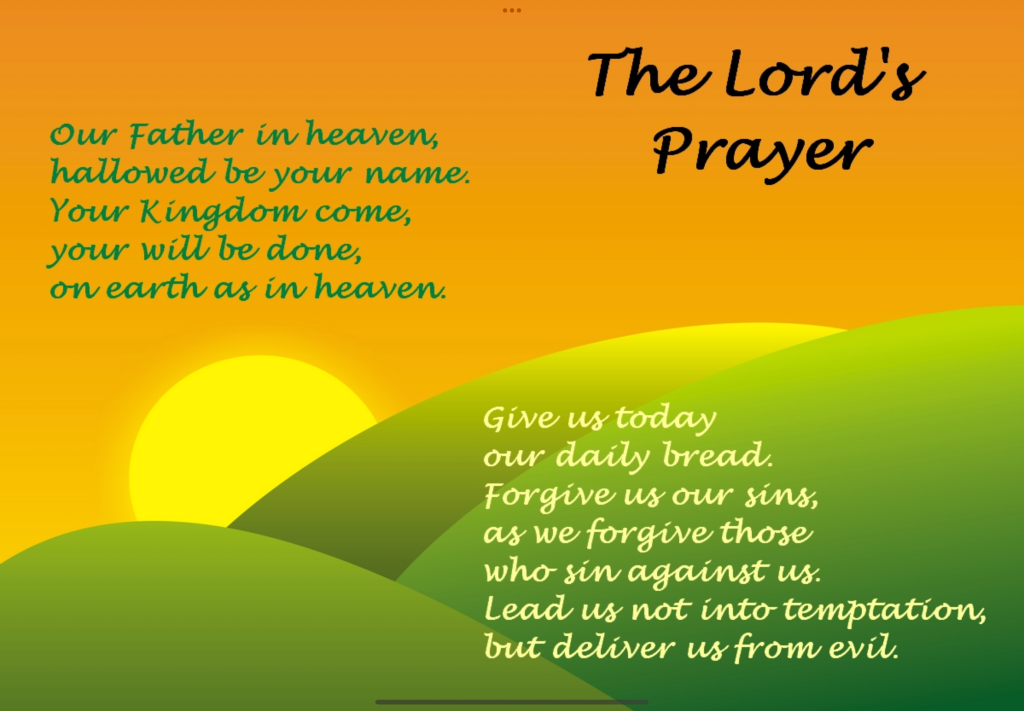
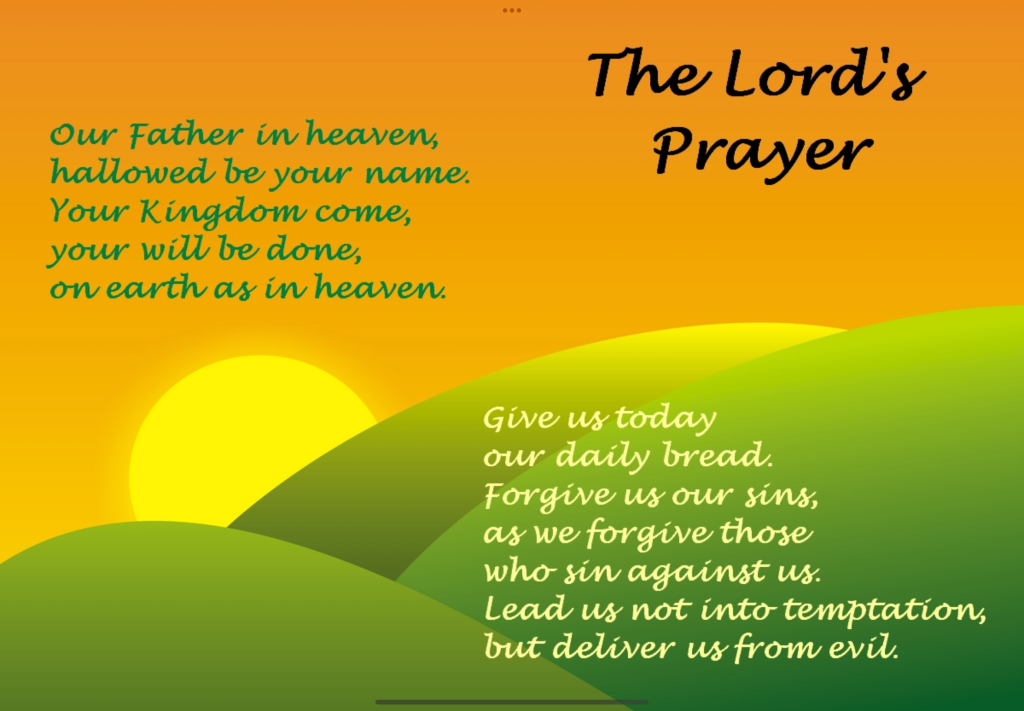
After an opening adoration of God (“our Father in heaven, holy is your name”), there follows prayers for the world (“your kingdom come, your will be done”), petitions for ourselves (“give us bread for the day, forgive us our sins, do not bring us to the time of trial”), and intercessions for others (“as we forgive those who sin against us”). In the later version of the prayer, a closing benediction is included (“yours is the kingdom, the power, the glory”), ending, of course, with “Amen”. The pattern is clear and concise.
Each element in this prayer is and expression of traditional Jewish piety; every line draws from Hebrew Scripture. Although this prayer is so frequently associated with Jesus, it is not a prayer that is original to him in its content or orientation. The originality of the prayer lies not in its content, but in the way that Jesus has drawn together each element into a cohesive unity.
The structure of the prayer is pleasingly aesthetic. There is an opening address to God (“our father in heaven”) and a closing benedictory phrase (“yours is the kingdom, the power, and the glory”). These phrases frame the who,e prayer; whilst the largest component of the prayer, the inner section, is focussed on us where we are in this present time, the outer frames set our lives into this larger context.
Following the opening phrase, there are three clauses addressed to God (“holy is your name … your kingdom come … your will be done”). These clauses extend the opening address to God, identifying key elements in how we understand God. (See below for further discussion of this.) The third clause is extended with the phrase “on earth as in heaven”, drawing our attention to the close correlation that is expected between the divine and we human beings.
Before the closing phrase, there are three requests made of God, for ourselves (“give us bread for the day … forgive us our sins … do not bring us to the time of trial”) with the second and third phrases extended with an additional phrase (“as we forgive those who sin against us” and “rescue us from the evil one”).
The second extension draws the attention of people who are praying the prayer away from us as people praying (give us, forgive us) to others who are beyond the scope of the group praying—to other people in society with whom we engage day by day.
And the third extension draws the attention of people away from us as people within this material world, to a dimension that is somehow beyond, transcending this world. Reference to “the evil one” raises the spectre (oops!) of the realm of “principalities and powers” (as referred to in the epistles). Life as we know it is not entirely within our own control; there are other forces—both evil, and also good—that impinge upon us. It’s an interesting extension in a prayer which is, at least in the larger middle section, focussed on our here-and-now in this world.
So in my mind, just as the opening and closing phrases balance each other, so these three petitions balance with the three addresses to God in the earlier half of the prayer. The symmetry is not exact, in terms of precise syllables or words used; but the syntactical structure is clearly patterned and pleasingly symmetrical, in my mind.
And then, to make sure that we know that the prayer is ending, we have the tag-line, as it were: “for ever and ever, Amen”. So in my mind, quite often when I pray this prayer, I hear the structure as an invitation to pause, focus on God, remember our needs and remember also others, recall the immediate dimension as well as the transcendent, and then conclude with gratitude to God. The Amen at the end is the typical conclusion to prayer, signalling the agreement of the prayers and all present to what has been prayed.
*****
2
The content of the prayer, as previously noted, draws at every point from Hebrew Scripture. The opening address identifies God as father, and as “hallowed”—a somewhat archaic adjective, rarely used now in common speech, meaning holy, consecrated, sacred, or revered. The related noun, hallow, denoted a saint in older English. The concept of being holy, however, was well- known in ancient Israel, and appears frequently in Hebrew Scripture.
Addressing God as “father in heaven” is found in just a few texts in Hebrew Scriptures: in the cry of “the faithful one”, “you are my Father, my God, and the Rock of my salvation!” (Ps 89:26), in the praises of the psalmist, “Father of orphans and protector of widows is God in his holy habitation” (Ps 68:5), and in the questioning of the prophet Malachi: “have we not all one father? has not one God created us? why then are we faithless to one another, profaning the covenant of our ancestors?” (Mal 2:10).
By contrast, that God’s name is holy is an affirmation found many times in Hebrew Scriptures. God is addressed as holy (Ps 22:3) and God’s name is holy (Ps 30:4; 33:21; 97:12; 103:1; 105:3; 106:47; 111:9; 145:21). “Holy One” is a term applied to God in the Writings (Ps 71:22; 78:41; 89:18; Prov 9:10; Job 6:10; Sir 4:14; 23:9; 53:10; 47:8; 48:20) and by the Prophets (Isa 1:4; 5:19, 24; and a further 24 times; Jer 50:29; Ezek 8:13; Hos 11:9, 12; Hab 1:12; 3:3). When Hannah sings with joy of the son whom she is expecting, she describes God as the Holy One (1 Sam 2:2).
Just as God was holy (Lev 11:44; 19:2; 20:7; 21:8; 1 Sam 2:2; Ps 99:5, 9), so God had called Israel to be a holy people (Exod 19:5–6; Deut 7:6; 14:2; 26:19; 28:9) and to live lives of holiness (Lev 11:45; Ps 77:13). God provided the people with a “holy land” for them to live (Josh 5:15) and there was a “most holy place” in the heart of the Temple where God dwelt (1 Kings 7:50; 1 Chron 6:49). And so, the followers of Jesus are instructed to consider themselves as God’s holy people (1 Cor 3:17; 6:19; Eph 5:25–27; Col 1:22; 3:12; Heb 3:1; 1 Pet 1:13–16; 2:5, 9) and to live accordingly.
“Your kingdom come” also expresses a hope that is central to the Hebrew Scriptures. Israel, of course, eventually adopted the pattern of nations that surrounded it, and appointed a king (1 Sam 8–10)—although not without some wrangling with the prophet Samuel (1 Sam 8:10–18). The various kings of the ensuing centuries each had to reckon with the prophets that were anointed by God and gifted by the Spirit, often to their great frustration!
A number of psalms acknowledge that God is in fact sovereign over Israel, declaring “the Lord is king” (Ps 10:16; 93:1; 96:10; 97:1; 99:1; and see also 1 Chron 16:31). “The Lord sits enthroned over the flood; the Lord sits enthroned as king forever”, says one song (Ps 29:10), amd extending the scope of divine sovereignty, “the Lord, the Most High, is awesome, a great king over all the earth”, is a striking claim in Ps 47:2.
One psalm claims that the kingdom of the Lord “is an everlasting kingdom, and your dominion endures throughout all generations” (Ps 145:13; also Dan 4:3; 7:27). Whilst the prophets who speak about a future kingdom invariably foresee a restoration of the greatness of a Israel in the land (Isa 9:7; 11:1–5; Amos 9:11–15; Obad 1:21), the developing notions relating to the demand for justice-righteousness, the judgement of God, the prediction of a Day when the Lord will act, and the coming of The End are all premised on the sovereignty of the Lord God and a certainty that God will indeed act to bring in a time and a place where God’s ways will guide all. See
So Jesus stands firmly in that prophetic line of assurance in God’s sovereign power and certainty that God’s kingdom will come for people of all the nations (Mark 9:1; Matt 8:11; 16:28; 24:14; Luke 9:27; 13:29) and, indeed, that this kingdom has come near to Israel through his own message and activities, as he regularly declares (Mark 1:15; Matt 4:17; 10:7; 12:28; Luke 10:9, 11; 11:20). So this line in the prayer expresses both faithful Jewish expectations and typical perspective of Jesus.
The passage from Acts that was proposed for last Sunday (Acts 17) and that proposed for this coming Sunday (Acts 18) come from the third main section of Acts, where the narrative tells of how Paul and various co-workers established messianic communities in towns throughout Asia Minor and around the Aegean Sea.
These communities contain many elements of the pattern of community life which has become evident in the earlier sections of Acts. In particular, this section consolidates the inclusive character of the community, for each newly-established assembly comprises Gentiles as well as Jews. In this way the section particularly builds on what has been established in the previous section.
In Corinth this week, as in Thessalonica last week, the tensions that exist between Jews and Gentiles in this community are evident. Paul had been travelling with Timothy and Silas, as we saw last week in Thessalonica; they had left him in Beroea (Acts 17:14) while he went on to Athens (17:16–34) and then to Corinth (18:1). Corinth was just 60km from Athens; it was a strategic trading city because of its two ports, one on each side of the isthmus. The old city had been sacked by the Romans in 146 BCE; they rebuilt it and declared it a colony in 44 BCE.
Whilst in Corinth, Paul meets with a new set of co-workers, Aquila and Priscilla (18:2). This married couple is well-known from Paul’s letters, where the mention of the female, in the shortened form, Prisca, in first place ahead of Aquila, is noteworthy (Rom 16:3; 2 Tim 4:19; see also 1 Cor 16:19). Luke notes that they are Jews who had recently moved from Italy to Corinth, as a result of the expulsion of Jews from Rome under Claudius (18:2); this probably took place in 49 CE (Suetonius, Claudius 25.4).
They work as tentmakers (18:3), an occupation often considered to indicate significant means (however, an alternative reading, that tentmakers were craftspeople of lower social status, is offered by some interpreters). This shared trade means that they can provide both hospitality and a place for Paul to carry out his trade whilst he is in Corinth. When Paul travels on, they accompany him to Syria (18:18) and Ephesus (18:19), where they remain while Paul continues on further; in Ephesus they instruct Apollos (18:26).
Paul’s familiar pattern (18:1–6) is evident as he argues in the synagogue on the sabbath, in an attempt to persuade his audience (18:4). As Paul here bears witness (18:5), a typical activity of his (20:21), he fulfils the promise made by Jesus (1:8), as also did Peter (2:32; 5:32). Paul’s message is the familiar refrain: “the Messiah, he is Jesus” (18:5; see 9:22; 17:3). Just as this claim provided the foundations for the community in Jerusalem (2:36), so in Corinth the declaration that Jesus is Messiah will form the basis for the Corinthian assembly.
Paul collaborated in the writing of many of his letters—of the seven agreed authentic letters, only two are written by Paul alone. The others are written in association with Timothy (2 Cor, Phil, 1 Thess and Phlm), Silvanus (1 Thess), and Sosthenes (1 Cor). It is an excerpt from this latter letter that the creators of the lectionary, in their wisdom, have offered us for this coming Sunday (1 Cor 1:10–18), alongside the short report (Acts 18:1–4) of Paul’s visit to Corinth.
Sosthenes and Paul tell the Corinthians that they write to “give thanks” (1 Thess 1:4) and also to “appeal to you” (1:10); and later, to “admonish you as my beloved children” (4:14). The constructive approach that they bring is made clear in the opening prayer of thanksgiving (1:4–9).
In the passage we hear this Sunday (1 Cor 1:10–18), there is an unequivocal statement about what undergirds the constructive intention that Sosthenes and Paul bring as they write. It is “the cross of Christ” (1:18) that shapes the discussion and directions that Paul will present to the believers in Corinth in the ensuing 16 chapters. (This letter is longer than all other Pauline letters, except for Romans—also 16 chapters in length.)
Acts reports that Paul left Corinth in company with Priscilla and Aquila (Acts 18:18), moving to Ephesus, in which city the letter to Corinth was written (1 Cor 16:8). There is no further mention of Sosthenes, although the co-authorship of 1 Corinthians might suggest that Sosthenes also left his home town of Corinth—at least for a time, to escape the persecution he had experienced there.
Sosthenes, like Crispus, would have been high-status in the Jewish community in Corinth. Sosthenes and Paul indicate that they have received other high-status visitors from Corinth, travelling to Ephesus: Stephanas, Fortunatus, and Achaicus (16:17), as well as “the people from Chloe” (1:11)—were they, perhaps, slaves from the household in which Chloe was patron? Female patrons, of course, were known at the time—witness Phoebe (Rom 16:1–2), and see the excellent overview of Marg Mowczko at https://margmowczko.com/new-testament-women-church-leaders/
So Paul and Sosthenes were well-informed as they write this letter to the Corinthians. There are problems aplenty in Corinth. In the few verses set for this coming Sunday, they write about division and the quarrels that have resulted. They plead for agreement and unity. They remind the Corinthians about baptism.
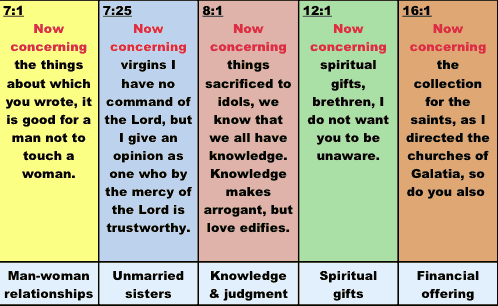
In subsequent chapters, they will range over a long list of matters, often introducing them with the formulaic “now concerning …” (7:1, 25; 8:1; 12:1; 16:1, 12). That formula may suggest they are responding to specific information brought by their visitors. It certainly points to vigorous discussions about a number of matters where there were divergent opinions amongst the Corinthians.
So, in verse 18, the last verse of the selection offered for this Sunday, Sosthenes and Paul sound out the key theme of this letter, which is about the cross of Christ: “foolishness to those who are perishing, but to us who are being saved it is the power of God” (1 Cor 1:18). The verses immediately following develop this motif of the paradox inherent in the cross with rhetorical finesse.
Given the reference to an earlier letter to the Corinthians (1 Cor 5:9), there may already have been discussion of the cross of Christ—either in that letter, or in a presumed response from the Corinthians, or in personal discussions and sermons during the period that Paul and others were in Corinth. Acts 18 indicates that Paul was there for 18 months, along with Aquila and Priscilla, Silas and Timothy, as well Titus Justus, a godfearer and Crispus, the leader of the synagogue (archisynagogos), and also Sosthenes, also identified as a leader of the synagogue (archisynagogos) who was seized and beaten in the presence of Gallio, the proconsul (Acts 18:17). Was the cross the focus of any of his preaching during this 18 months? It seems quite a plausible speculation.
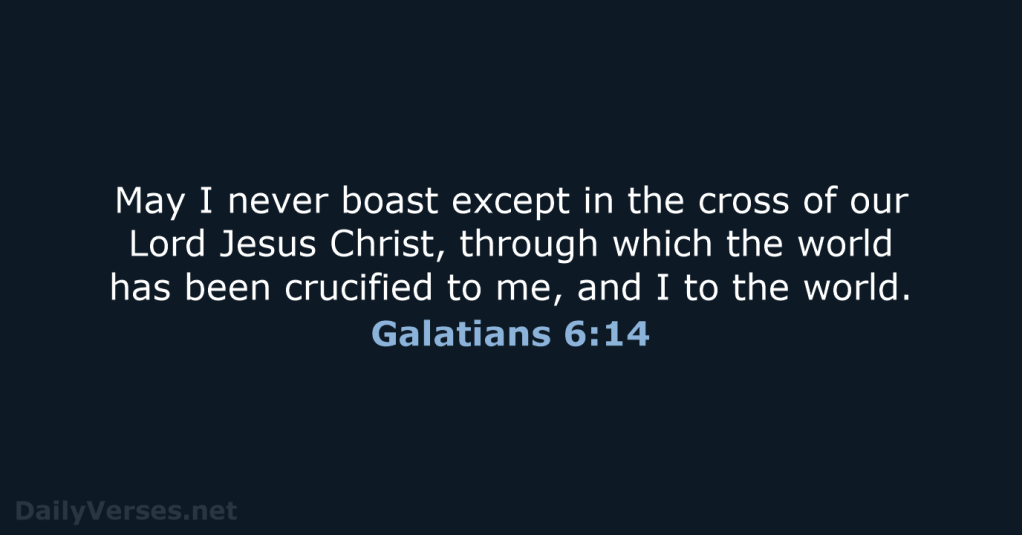
“The cross” is certainly a theme that was sounded by Paul in his preaching and his writing. He had written to the Galatians, “may I never boast of anything except the cross of our Lord Jesus Christ, by which the world has been crucified to me, and I to the world” (Gal 6:14).
He had written to the Philippians, urging them to “have the same mind” as Christ Jesus, who “humbled himself and became obedient to the point of death—even death on a cross” (Phil 2:8), and warning them that those who opposed Paul’s preaching were “enemies of the cross” (Phil 3:18).
He would later inform the Corinthians that he models his own ministry on that of Christ; “he was crucified in weakness, but lives by the power of God; for we are weak in him, but in dealing with you we will live with him by the power of God” (2 Cor 13:4)—just as he had told the Galatians that “I have been crucified with Christ; and it is no longer I who live, but it is Christ who lives in me” (Gal 2:19–20).
He would also later exhort the believers in Rome to see their baptism as the means by which they were linked with Jesus in his death and resurrection, instructing them that “our old self was crucified with him so that the body of sin might be destroyed, and we might no longer be enslaved to sin” (Rom 6:3–6). In the central theological argumentation of this important letter, Paul places the cross as the means by which the good news is known: “God proves his love for us in that while we still were sinners Christ died for us” (Rom 5:8).
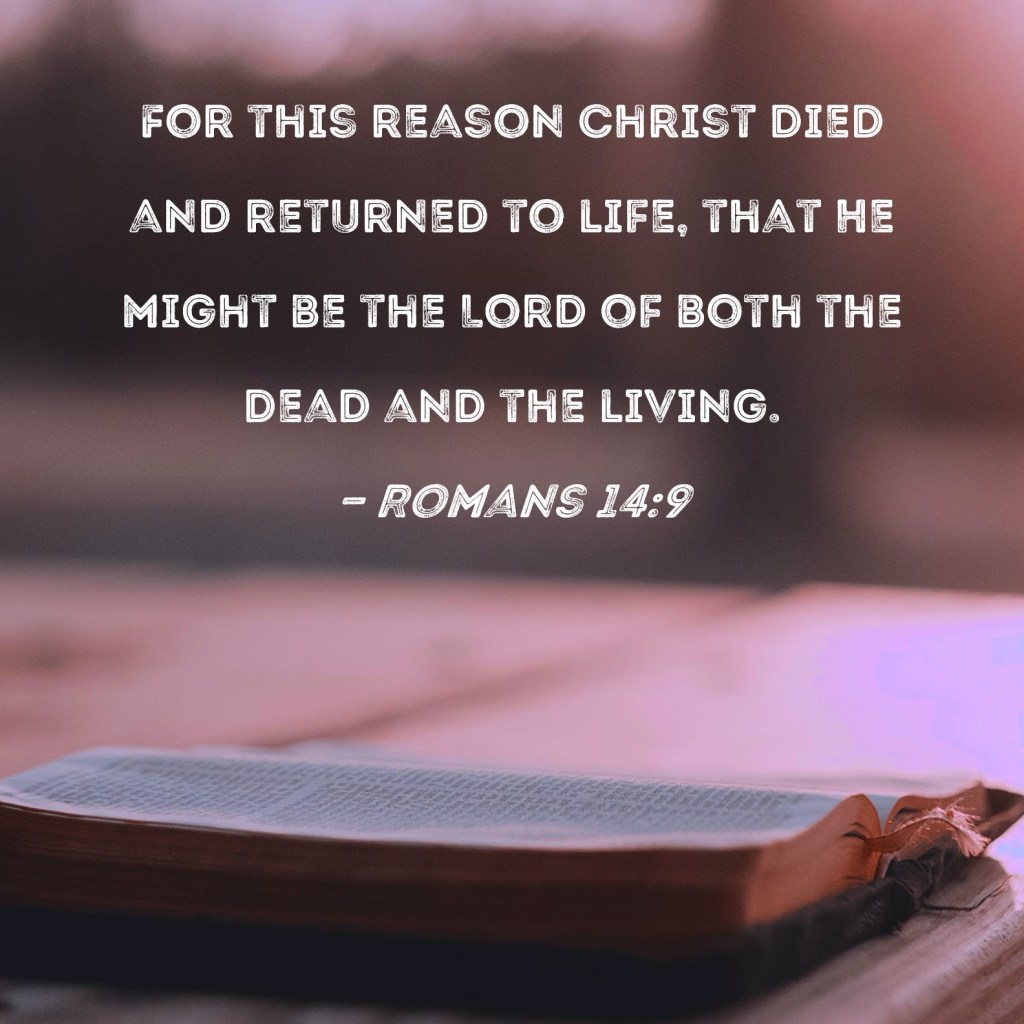
He would remind them that “Christ died and lived again, so that he might be Lord of both the dead and the living” (Rom 14:9), and he deals with the conflict in Rome between weak and strong by proposing that the quarrelling parties follow the pattern established by Christ, who “did not please himself; but, as it is written, ‘The insults of those who insult you have fallen on me’” (Rom 15:3). The cross informed his instructions to the Romans for their daily living.
The same process is employed in the earlier letter to the Corinthians. The cross is the benchmark for understanding how believers are to behave, how they are to relate to one another, and how the community that they form is to be described. All of this is worked out in the first two chapters of the letter (1 Cor 1:18–31; 2:1–12).
There, Paul will remind the Corinthians that “we proclaim Christ crucified, a stumbling block to Jews and foolishness to Gentiles” (1:23), that “I decided to know nothing among you except Jesus Christ, and him crucified” (2:2), and that the paradoxical wisdom that is at the heart of the story of Jesus, “none of the rulers of this age understood this; for if they had, they would not have crucified the Lord of glory” (2:8).
For this passage, however, the message is focussed on the centrality of the cross, as the way that God (in Paul’s mind) has chosen to communicate with the people of his time.
The readings from Acts that are proposed for this Sunday (Acts 17) and the following Sunday (Acts 18) come from the third main section of Acts, where the narrative tells of how Paul and various co-workers established messianic communities in towns throughout Asia Minor and around the Aegean Sea.
These communities contain many elements of the pattern of community life which has become evident in the earlier sections of Acts, in Jerusalem (1:12—6:7) and in the household of Cornelius (10:1—11:18). In particular, this section consolidates the inclusive character of the community, for each newly-established assembly comprises Gentiles as well as Jews. In this way the section particularly builds on what has been established in the previous section.
Thessalonica, the capital of the Roman province of Macedonia, was a port city strategically situated on the Egnatian Way, the main transport link between Rome and the eastern part of the empire. It was an important trading post in Greece, second only to Corinth.
Evidence of its cosmopolitan nature includes an Egyptian settlement, a strong Jewish presence, and a Samaritan community in the city. Religion was a part of everyday life, and so worship of all manner of gods and goddesses thrived. There were also schools to learn philosophy, travelling preachers, and synagogues for worshipping Yahweh.
Paul, Silas and Timothy arrived in Thessalonica in the year 50 CE. The account in Acts 17 indicates that they went to the synagogue, as was Paul’s custom (17:1–2) where Paul declared that the Jewish scriptures pointed to Jesus as Messiah (Acts 17:2–3). In Thessalonica, the tensions that exist between Jews and Gentiles in this community are evident. Arguing with the synagogue attenders (17:2) was a practice in evidence in Paul’s subsequent synagogue visits (17:17; 18:4,19; 19:8) as well as in the assembly in Troas (20:7,9) and when he is before Felix (24:25).
Paul bases his argument in the Hebrew scriptures (17:2), as was done earlier by Philip (8:35), Peter (2:25–31) and Paul himself (13:33–37). Paul’s message contains elements which are familiar, not only from his own speeches, but also from those of Peter and Jesus. First of all, he states that “the Messiah must suffer” (17:3; see 3:18) “and be raised from the dead” (17:3; see 5:30, 10:40). Then, Paul defines the Messiah as “Jesus whom I proclaim to you” (17:3; see 2:36). The author of Acts thus shapes Paul’s message so that it stands in clear continuity with the message that has been proclaimed from Pentecost onwards, reported in the preceding chapters of Acts.
This message brings success amongst the devout Greeks and leading women, who believe (17:4). Success amongst godfearers has already occurred in Antioch (13:43,50) and Philippi (16:14), and will occur in Athens (17:17) and Corinth (18:7). Women of high social status become believers in Antioch (13:50), Philippi (the description of Lydia’s trade in 16:14 infers such high status) and Beroea (17:12). Again, the author of Acts shapes the narrative to reflect consistency of method and result.
However, a pattern of divided response (see 13:4–12) continues, for opposition is stirred up by Jews who exhibit jealousy (17:5), like those who were similarly antagonistic in Jerusalem (5:17) and Antioch (13:45), and like Paul himself when he was a persecutor (22:3–4). Paul and Silas are brought before the politarchs (17:6); Luke accurately employs an uncommon term which inscriptional evidence suggests was reserved for city authorities in Macedonia only.
A long list of such historical accuracies in Acts 13—28 can be cited (the most comprehensive list is provided in Colin Hemer’s 1989 work, The Book of Acts in the Setting of Hellenistic History). This does not, however, remove concerns about Luke’s inaccuracies at times (see 5:36–37 for a most obvious anachronistic reference), nor does it negate the claim that Luke’s own interests shape the way that he presents and interprets events in his narrative. Thus, the accusations levelled against Paul and Silas reflect Lukan motifs.
In particular, “turning the world upside down” (17:6) has been a common theme in Luke’s story of Jesus (Luke 1:46–55; 6:20–26; 9:23–24;13:30; 14:7–11; 16:19–31; 18:9–14; 22:25–26). Acting contrary to Roman practice (17:7) was a charge levelled against Paul and Silas in Philippi (16:20–21); Paul later defends himself against this charge in Caesarea (25:8).
Paul’s own description of his time in Thessalonica refers to the “distress and persecution” which he experienced (1 Thess 3:7); this appears to concur with Luke’s account of opposition there. By contrast, Paul comments that the Thessalonian converts “turned to God from idols” (1 Thess 1:9) and uncharacteristically fails to quote from Hebrew Scripture in his letter to them, suggesting that they were a wholly gentile community of believers. This differs from Luke’s account of the community’s origins from the synagogue.
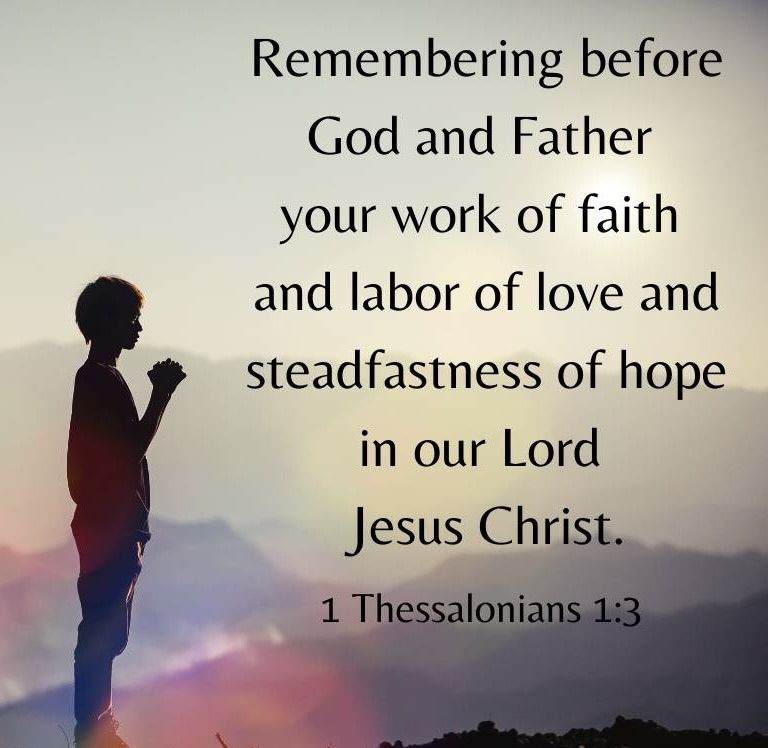
In the opening thanksgiving of this letter (1:1–8), Paul characterizes the Thessalonians as undertaking a “work of faith and labour of love and steadfastness of hope in our Lord Jesus Christ” (1:8). These terms summarise the key issues to be addressed later in that letter; all three return at 1 Thess 5:8, where Paul exhorts the Thessalonians to “be sober, and put on the breastplate of faith and love, and for a helmet the hope of salvation”.
Paul writes more about the faith of the Thessalonians at 3:1–10; he commends them for their love at 3:6 and 4:9–10, and prays for it to increase at 3:12. He strengthens them in their hope at 2:19 and 4:13–18. Also in the thanksgiving, he affirmed them for being “imitators of us and of the Lord” (1:6)—a central motif in Paul’s theology (see 1 Cor 4:16; 11:1; Gal 4:12; Phil 1:7; 3:13–15; 2 Thess 3:7; 2 Tim 1:13).
The language which Paul uses in this letter (and especially in chapter 2) is reminiscent of discussions of rhetoricians and philosophers of the time, a number of whom were accused of having base motives, an interest in self-promotion and a desire for immediate financial rewards!
In particular, Paul’s itinerant way of life could easily leave him open to such a criticism. How he defends himself is similar to the way that the better class of philosophers and rhetoricians of the day tried to defend themselves. My own doktorvater, Prof. Abraham Malherbe, demonstrated how there are many resonances, for instance, with Oration 32 by the second century writer, Dio of Prusa (nicknamed Chrysostom, “golden mouthed”, for his own skill in oratory).
This Sunday, the lectionary proposes a selection of verses from Acts 3, containing most (but not all) of a speech by Peter (Acts 3:12–19). That speech (3:12–26) follows an account of how Peter heals a lame man (3:1–11); a miracle that provides a specific instance of the “many wonders and signs” which the apostles performed (2:43). In this blog, I will range beyond these explore the speech in its context.
As this particular healing takes place in the grounds of the temple (3:2), the heart of the Jewish capital, Jerusalem. Peter and John come to the temple to pray (3:1), in keeping with both the community practice of prayer (2:42) and of regularly attending the temple (2:46). The temple remained a focal point for prayer until its destruction in 70 CE.
The juxtaposition of the lame man and the temple setting is striking. Lame animals were decreed to be unsuitable as offerings to God (Deut 15:21; Mal 1:8,13) and lame people were amongst those forbidden from drawing near to offer sacrifice in the temple (Lev 21:18; 2 Sam 5:8). Yet amongst the prophets, the lame are included among the outcasts gathered by God as the faithful remnant (Jer 31:8; Mic 4:6-7; Zeph 3:19), and the vision of the return of the redeemed to Zion (Isa 35:1–10) includes the assertion that “the lame shall leap like a deer” (Isa 35:6).
Jesus has followed in this prophetic tradition by healing the various categories of outcast; by his activity, “the blind receive their sight, the lame walk, the lepers are cleansed, the deaf hear, the dead are raised, the poor have good news preached to them” (Luke 7:22, par Matt 11:5; see also Luke 4:18; Matt 15:30–31; 21:14).
In parables told only by the Lukan Jesus, the lame are included in the outcasts invited to the banquets (Luke 14:13,21). This compares with the account of how Mephibosheth, the lame grandson of Saul, son of Jonathan, ate regularly at the table of King David (2 Sam 4:4; 9:1–13).
Although no account of a specific healing of a lame person is found in Luke’s Gospel (cf. John 5:1–9), the healing of this lame man (the first specific healing incident in Acts) places the apostles in continuity with Jesus who heals the lame (Luke 7:22). A similar healing is later performed by Paul (14:8–10), whilst Philip is described as healing “many others who were paralysed or lame” (8:7).
The lame man’s expectation that he would receive alms (3:2–3) is reasonable. Caring for the needy was integral to Jewish piety (Deut 15:7–11). By the hellenistic period, almsgiving had become highly valued as a religious duty (Sir 3:30; 7:10; 29:9–12; 40:24; Tob 4:7–11,16; 12:8–10; 14:8–11; cf. Matt 6:2–4). The Lukan Jesus commended almsgiving (Luke 11:41; 12:33) and subsequent characters in Acts practice almsgiving—notably, Cornelius (Acts 10:2,4,31) and Paul (24:17).
However, as Peter and John “look intensely” at the man (3:4; on such intense scrutiny, see 14:9), they sidestep this responsibility, for the focus in this account is to be on their exercise of divine power. Peter commands the man to stand, revealing that his power comes from “the name of the Messiah, Jesus of Nazareth” (3:6).
This name has already been declared as the source of salvation (2:21) and forgiveness (2:38); “the name” remains a constant emphasis in the ensuing scenes (3:16; 4:7,10,12,17–18,30; 5:40-41) and appears subsequently in connection with proclamation (8:12; 9:15–16,27–28; 10:43; 15:14,17; 21:13), baptism (8:16; 10:48; 19:5; 22:16) and exorcism (16:18; 19:13,17).
As Peter raises up the lame man (3:7), he is healed and strengthened, and enters the temple (3:8). The healed man immediately recognises the source of this miracle, for he is portrayed as “praising God” (3:8,9). The man joins himself with the community members whose regular life is typified by an attitude of praise towards God (2:47). Seeing this healing, the people show “wonder” (3:10), a questioning attitude also displayed towards Jesus (Luke 4:36; 5:9), and “amazement” (3:10), a more insightful appreciation of the incident, as also displayed towards Jesus (Luke 5:26).
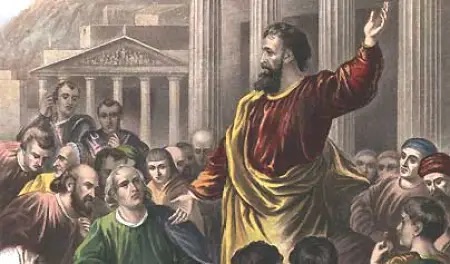
Having reported the healing, Luke shifts his focus to Peter, who addresses the people, providing an interpretation of what has taken place, just as he did on the day of Pentecost. Peter’s third speech (3:12–26) begins by accusing the people of thinking “as if by our own power or piety we have made him walk” (3:12). Peter asserts that it is God—“the God of Abraham and Isaac and Jacob, the God of our ancestors” (3:13)—who has enabled the miracle.
The speech echoes key elements of Peter’s Pentecost speech. The healing took place in the name of “the Messiah, Jesus of Nazareth” (3:6; see 2:36). Jesus is the one whom God glorified (3:13) and God raised (3:15; see 2:24); he is the one of whom the apostles are witnesses (3:15; see 2:32) for of him they “see and know” (3:16).
Peter also says that Jesus is the suffering Messiah, in fulfilment of “what God announced beforehand through the mouth of all the prophets” (3:18). This extends the fulfilment of prophecy from Jesus’ resurrection (2:25–31) and exaltation (2:34–35) to his crucifixion. Paul makes the same affirmation, that the suffering of the Messiah fulfils scripture, at 26:23. So the speech both reprises and develops the explicit things said about Jesus in 2:22–36, as well as the prophetic and apostolic witness which characterises the apostolic proclamation.
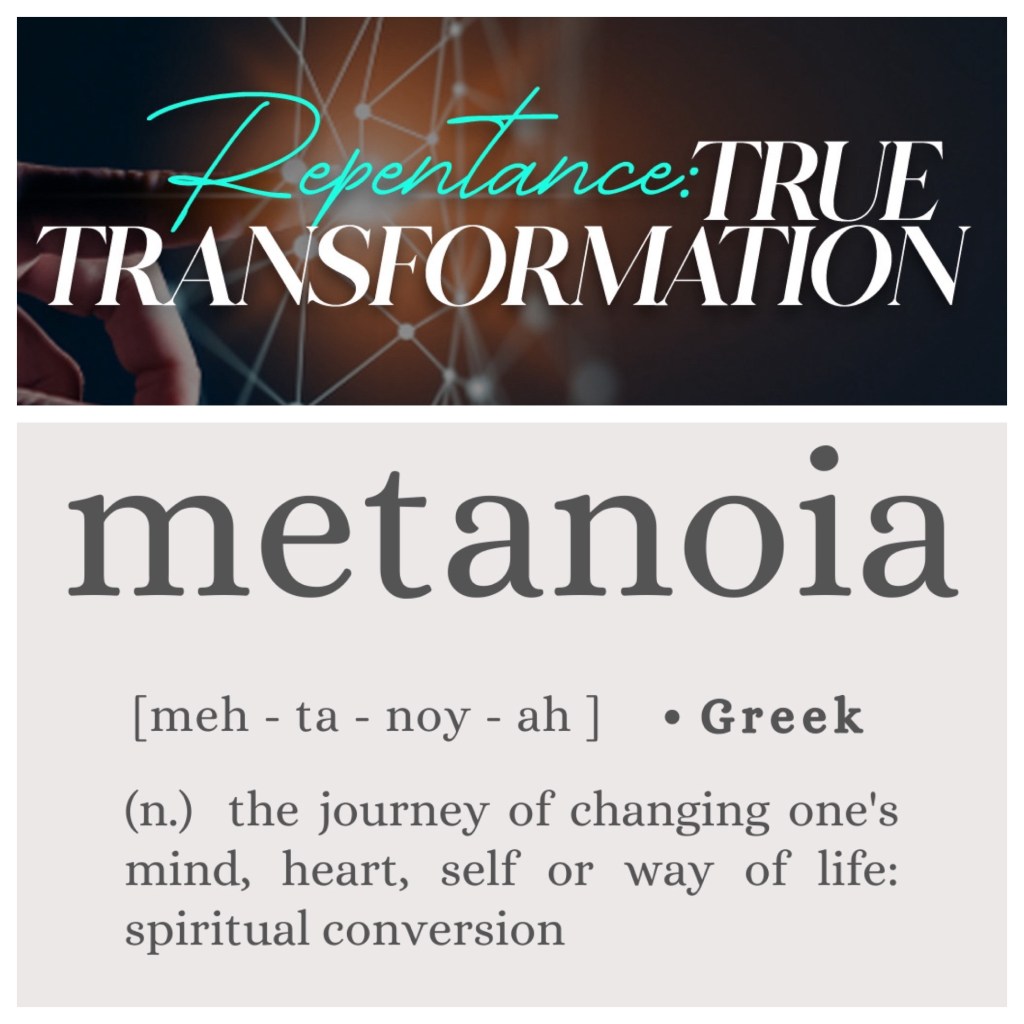
Luke has Peter call for a response of repentance (3:19), as he did at 2:37–39. Repentance is an integral element in the eschatological scenario. The eschatological hope for the coming times had often been proclaimed by Jesus (Luke 4:43; 9:26-27; 10:1–16; 12:49–56; 13:22–30; 17:20–37; 19:11–27; 21:5–36). This continues as an essential element in the apostolic proclamation.
Luke reports Peter as describing this future time in some detail (3:19–21). God is in control of this process: God will wipe out sins (3:19b) because people will have already repented and turned to God (3:19a); “times of refreshing” will come “from the presence of the Lord” (3:20a); and God will then send the appointed Messiah (3:20b).
After this, during an interim period, the ascended Jesus remains in heaven (cf. 1:11; 2:33), awaiting “the time of universal restoration” which will implement what God has long ago promised (3:21). The delay occasioned by this waiting does not mean that God has lost control of events, however. Jesus remains in heaven by divine decree; the word “must”, 3:21, indicates this.
The “times of refreshing” may refer to Jesus’ teaching that “the Lord will cut short the end” (Mark 13:20, but omitted in Luke 21); the sense of “refreshing” is of a breathing space before the next event in sequence takes place (see Exod 8:15). The “time of universal restoration” transcends the earlier question of the disciples concerning the restoration of the kingdom to Israel (1:6); here, restoration has a universal scope. This is the broadest expression of eschatological hope in all of Acts.
This time of restoration may thus correlate with the eschatological events which Peter has already reported at 2:17-21 (citing Joel 2:28-32; see also Mal 4:5-6); and which is later mention in Peter’s Caesarea speech (10:42) and in Paul’s Areopagus speech (17:31). On these occasions, however, the description of that time is limited to noting the role that Jesus will perform, as the one “ordained” (10:42) or “appointed” (17:31; cf. 3:20) to carry out God’s judgement. This speech thus provides the most detailed look into the promised future time of judgement and redemption.
The time of universal restoration which Peter declares is that which “God spoke through the mouth of his holy prophets” (3:21; cf. Luke 1:70). The way that Peter here expresses the future role of Jesus evokes the prophetic words of Mary (Luke 1:54–55) and Zechariah (Luke 1:68–75). Justice and salvation will come about at this time.
It is this still-awaited future act of God which provides the springboard for Peter’s demand for repentance (3:19). Peter concludes his speech by urging the people to “turn, each one, from your sins because God raised up his son and sent him as a blessing to you” (3:26, as a fulfilment of the promise to Abraham cited in 3:25).
Conflict erupts, however, when the authorities object that Peter is teaching the people, primarily (in their eyes) about the resurrection of the dead (4:2). Luke has already documented the opposition of the Sadducees to this idea (Luke 20:27-40). Here, they join with the priests and the temple police, the same group which Luke noted as having plotted against Jesus (Luke 22:4) and arrested him (Luke 22:52).
Together, they initiate the arrest of Peter and John (4:1-3). This is the first of many scenes of judicial conflict in Acts; the pattern has already been established in the story of Jesus (Luke 22:47-23:25). A very brief second summary description of the community (4:4) follows, picking up from 2:41 the motif of increasing numbers within the messianic community.
The story of the empty tomb, early in the morning of Easter Sunday, is well known. The story of the appearance of Jesus as a stranger, walking alongside the couple who were heading out of Jerusalem towards the village of Emmaus, is also very well known.
What happened after that? Did the disciples huddle in fear in their house in Jerusalem (as John reports, John 20:19–31)? Did they head north to Galilee, as the young man in the empty tomb had instructed the women to do (Mark 16:7)? Was it in Galilee, on a mountain, that Jesus delivered his “Great Commission” to the eleven (Matt 28:16–20)? Or beside the Sea of Galilee, where some of the disciples had returned, disheartened and focussed on getting back to life as they once knew it, fishing for a living once again, when Jesus surprised them by the fire (John 21:1–14)?
The author of Luke’s Gospel offers us the first two stories in his Gospel: the empty tomb (Luke 24:1–12) and the road to Emmaus (24:13–35). But he does not report any of the subsequent stories we have in these other Gospels. In his narrative, the disciples remain in Jerusalem, forming a community of believers who had gathered in the room where the travellers to Emmaus had returned and were sharing “what had happened on the road” (24:35).
It is noteworthy that in the Lukan narrative, there is no change of scene, no change of characters, no breathing space at all between the return of the Emmaus travellers and the appearance of the risen Jesus. Luke’s narrative simply pushes on immediately to report that “while they were talking about this, Jesus himself stood among them” (v.36).
It is what ensues in this scene that forms the passage proposed by the lectionary for this coming Sunday, the Third Sunday of Easter (Luke 24:36–48). This scene is notable for a series of words which Jesus speaks to the group of those who were gathered together at that time—not just “the eleven and their companions” (v.33), but also the travellers returning from Emmaus (v.35).
In this post I will highlight seven words of Jesus that the author of this narrative reports in this final scene of his Gospel. In these seven words, the author of this Gospel both draws together threads from the preceding narrative, bringing this work to a climax, and brings us to the point of anticipating what will follow in the second volume that he writes.
“Peace be with you” (v.36). Peace (Hebrew shalom) was the standard Jewish greeting, as seen in the words of the old Ephraimite man (Judg 19:20), Eli’s word to Hannah (1 Sam1:17), Jonathan’s word to David (1 Sam 20:42), David’s instruction to his messengers to Nabal (1 Sam 25:5–6), and the song of Amasai (1 Chron 12:18).
The blessing of peace is encouraged by the psalmists (Ps 122:8;128:6) and the prophets (Isa 52:7; Nah 1:15), although Jeremiah warns of its abuse by false prophets in his day (Jer 6:14; 8:11–15; 14:13). Paul, of course, incorporates this traditional Hebraic greeting into the start of each of his letters, in the formulaic “grace to you and peace” (Rom 1:7; 1 Cor 1:3; 2 Cor 1:2; Gal1:3; Phil 1:2; 1Thess 1:1; Phlm 3).
Given this widespread usage, it would seem therefore the natural thing for Jesus to say to his friends when he came to them in that room: “peace be with you”.
More than that, Jesus speaking a greeting of peace in the Lukan narrative evokes the double offering of peace in John’s narrative of what may well be seen as the same scene (John 20:19–21). The second word, “Touch me and see” (v.39a), also evokes the scene in John 20, where Jesus showed the ten disciples his hands and his side (John 20:20) and then, a week later, said to Thomas “put your finger here and see my hands; reach out your hand and put it in my side” (John 20:27).
Both Luke and John provide an apologetic demonstration that the resurrection of Jesus involves his earthly body, with Luke providing the clarity of the claim, “a ghost does not have flesh and bones as you see that I have” (Luke 24:39b). This line of argument differs from that found in Paul’s extended discussion of the resurrection, where he notes that whilst a person is “sown a physical body, it is raised a spiritual body” (1 Cor 15:44) and then claims that “flesh and blood cannot inherit the kingdom of God, nor does the perishable inherit the imperishable” (1 Cor 15:50).
The implication of Paul’s line of argument is that the resurrection body of Jesus, whilst it bears the marks of the cross, will nevertheless be in a transformed state—and so will the bodies of believers be, after they are raised to be with Jesus. He states this explicitly in another letter: “he will transform the body of our humiliation that it may be conformed to the body of his glory” (Phil 3:21). That quasi-Platonic contrast between the earthly body of humiliation and the heavenly body of glory seems quite different to the understanding conveyed by Luke.
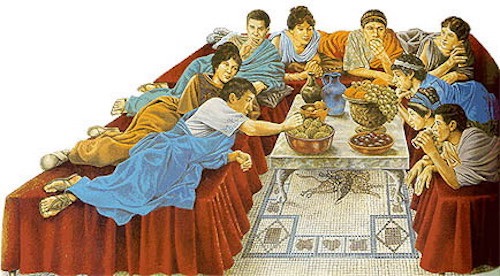
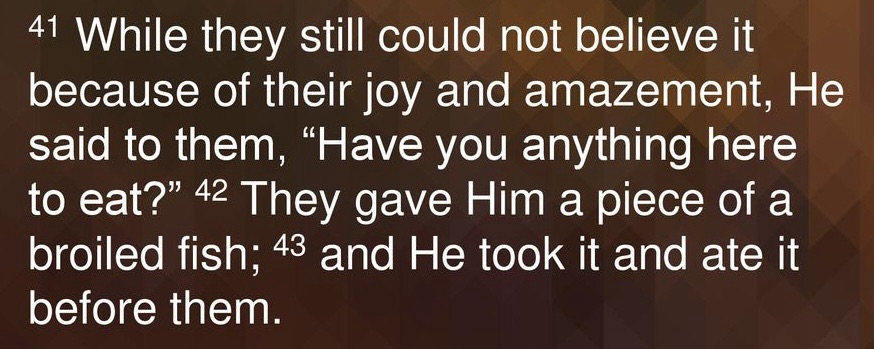
“Have you anything here to eat?” (v.41) is the third word of the risen Jesus. Only in Luke’s account does the risen Jesus show any interest in consuming food. That is not surprising, since Luke locates the earthly Jesus at table, sharing in a meal, more often than the other evangelists.
Mark tells us that as Jesus sat at dinner (or more accurately, reclined beside then table, leaning on his elbow) in Levi’s house, “many tax collectors and sinners were also sitting with Jesus and his disciples” (Mark 2:15–16; in Matthew’s account, he is renamed as Matthew, Matt 9:10–11).
In Luke’s narrative, this scene is replicated (Luke 5:29–31); yet Jesus also eats with with a Pharisee and a sinful woman (7:36–50); with Pharisees, a lawyer, and scribes (11:37–54); and with tax collectors and sinners (15:1–32; verses 1–2 infer the additional presence of Pharisees and scribes). After he shares a final meal with his closest followers (22:14–38), the risen Jesus then shares a meal with his fellow travellers on arrival in Emmaus (24:30). So this request should not be a surprise!
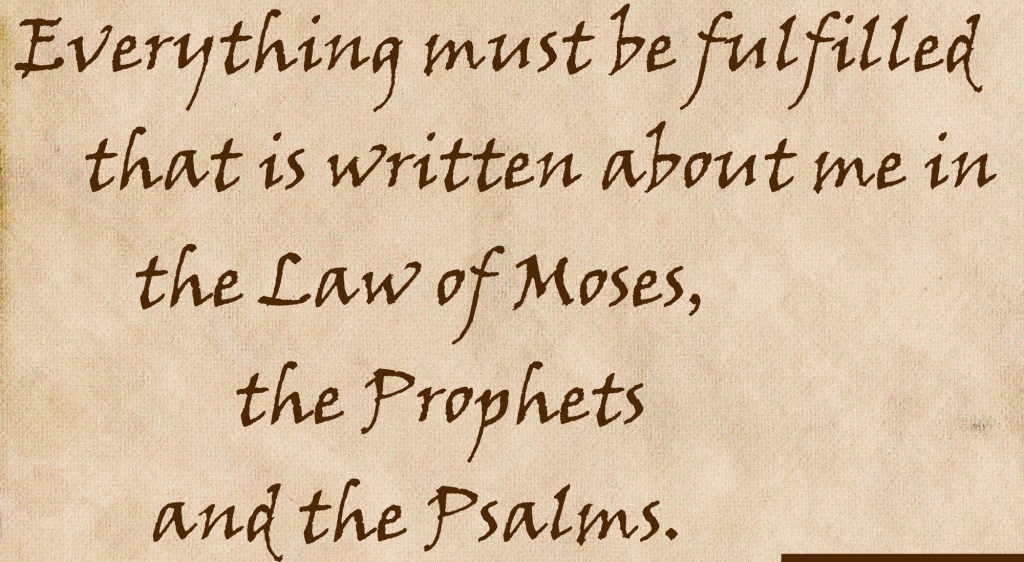
“Everything written about me must be fulfilled” (v.44) then follows as the fourth word. The fulfilment of prophecy in what is taking place during the lifetime of Jesus is a common claim in all four Gospel narratives, sounding forth from the baptism of Jesus (Mark 1:2 and pars) to the arrest of Jesus (Mark 14:49; Matt 26:53–56) and the events that follow (Luke 22:37; John 19:24, 36–37).
Indeed, the author of Luke’s Gospel has set the whole story of Jesus in relation to Hebrew Scripture, beginning with numerous scriptural allusions in the songs sung by Mary (Luke 1:46–55), Zechariah (1:68–79), and Simeon (2:29–32) and highlighting this in the words that Jesus spoke in his hometown synagogue (4:16–21) and in later sayings (6:20–26; 8:10; 12:52–53; 20:17–18, 41–44). The note of fulfillment sounded in the closing scene of the Gospel (24:44) gathers these threads into a cohesive climax.
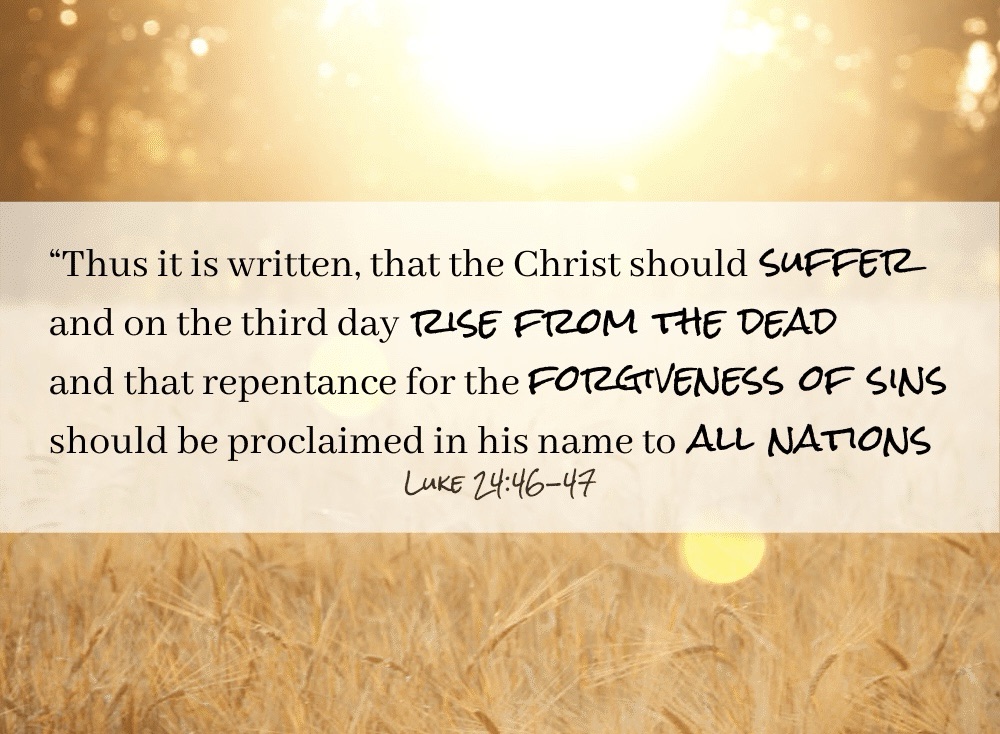
For the fifth word, Jesus declares that “repentance and forgiveness of sins” are to be “proclaimed … to all nations, beginning from Jerusalem” (v.47). The activity of proclamation that he undertook during his life (Luke 4:43) was a charge that he gave his followers (9:2, 60;10:8–11). Throughout Acts, those followers continue to proclaim this message (Acts 5:42; 8:5, 35, 40; 9:20; 13:5, 38; 14:21; 15:35–36; 16:10; 17:13, 23).
The message of repentance, sounded both by John the baptiser (Luke 3:3, 8) and by Jesus (Luke 5:32; 13:1–5), is continued by Peter (Acts 2:38; 3:19), Philip (8:32), and by Paul (17:30; 26:19–20). In like manner, Jesus preaches forgiveness (Luke 5:24; 6:37; 7:47–48; 17:3–4), exhorts this as central to prayer (11:4), and exemplifies it even in his dying hour (23:34).23:34). Then, in Acts, forgiveness is indeed proclaimed by Peter (Acts 2:38; 5:31; 8:22; 10:43) and by Paul (13:38; 26:18).
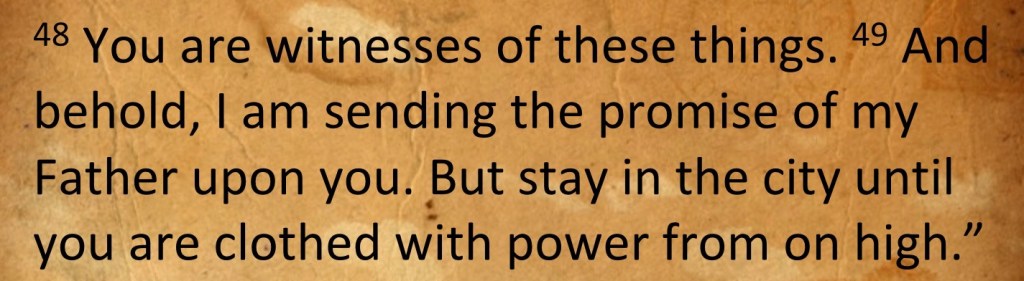
The sixth word of the risen Jesus in Luke’s narrative sounds yet another key Lukan theme. “You are witnesses of these things” (v.48), Jesus tells his followers. The author then begins the second volume of his account by repeating and expanding this commission which Jesus gave his followers: “you will be my witnesses in Jerusalem, in all Judea and Samaria, and to the ends of the earth” (Acts 1:8). The missionary impulse is clear.
Jesus foresees the “opportunity to testify” that his followers will have in the times of trial when they are persecuted, arrested, and “brought before kings and governors because of my name” (Luke 21:12–13). The book of Acts then reports on that testimony is given about Jesus at many places, in the witness offered by Peter (Acts 1:22; 2:32; 3:15; 5:32; 10:39–42) and by Paul (13:31; 20:24; 22:15; 23:11; 26:16).
“I am sending upon you what my Father promised” (v.49). This seventh and final word stands at the end of the Gospel, but does not provide full “closure” to that narrative. Rather, it takes us to the brink, as we anticipate the departure of Jesus (narrated at vv.50–51) and the ongoing work of bearing witness, for which the disciples have just been commissioned (v.48). The author would have us look immediately for the sequel to this Gospel.
And, indeed, the promise is subsequently seen to come to fruition when “the day of Pentecost had been filled to completion, when they were all together in one place” (Acts 2:1, my translation). The promise is fulfilled a second time in the house of Cornelius, when “the gift of the Holy Spirit [was] poured out even on the Gentiles” (Acts 10:45), and Peter rejoices that “God gave them [the Gentiles] the same gift that he gave us [Jews] when we believed in the Lord Jesus Christ” (Acts 11:17).
The Spirit continues as an active presence within all that the followers of Jesus do throughout much of Acts (4:8, 31; 6:10; 7:55; 8:29, 39; 9:17, 31; 10:19, 44–48; 11:12, 15, 24, 28; 13:2, 4, 9, 52; 15:8, 28;16:6–10; 19:6, 21; 20:22–23, 28; 21:4, 11). It is not without reason that some have proposed that “The Acts of the Apostles” would be more accurately named “The Acts of the Holy Spirit”.
Together, then, these seven words of the risen Jesus draw together key strands in the Gospel, anticipate important aspects of Acts, and provide a pivot point from the first volume to its sequel. It is a very rich passage.
The account of how Peter heals a lame man (3:1–11) is the passage proposed by the Narrative Lectionary for the Third Sunday in Easter this year. This healing provides a specific instance of the “many wonders and signs” which the apostles performed (2:43).
As this particular healing takes place in the grounds of the temple (3:2), the focus remains on the heart of the Jewish capital. Peter and John come to the temple to pray (3:1), in keeping with both the community practice of prayer (2:42) and of regularly attending the temple (2:46). The temple remained a focal point for prayer until its destruction in 70 CE.
The juxtaposition of the lame man and the temple setting is striking. Lame animals were decreed to be unsuitable as offerings to God (Deut 15:21; Mal 1:8,13) and lame people were amongst those forbidden from drawing near to offer sacrifice in the temple (Lev 21:18; 2 Sam 5:8). Yet amongst the prophets, the lame are included among the outcasts gathered by God as the faithful remnant (Jer 31:8; Mic 4:6-7; Zeph 3:19), and the vision of the return of the redeemed to Zion (Isa 35:1–10) includes the assertion that “the lame shall leap like a deer” (Isa 35:6).
Jesus has followed in this prophetic tradition by healing the various categories of outcast; by his activity, “the blind receive their sight, the lame walk, the lepers are cleansed, the deaf hear, the dead are raised, the poor have good news preached to them” (Luke 7:22, par Matt 11:5; see also Luke 4:18; Matt 15:30–31; 21:14).
In parables told only by the Lukan Jesus, the lame are included in the outcasts invited to the banquets (Luke 14:13,21). This compares with the account of how Mephibosheth, the lame grandson of Saul, son of Jonathan, ate regularly at the table of King David (2 Sam 4:4; 9:1–13).
Although no account of a specific healing of a lame person is found in Luke’s Gospel (cf. John 5:1–9), the healing of this lame man (the first specific healing incident in Acts) places the apostles in continuity with Jesus who heals the lame (Luke 7:22). A similar healing is later performed by Paul (14:8–10), whilst Philip is described as healing “many others who were paralysed or lame” (8:7).
The lame man’s expectation that he would receive alms (3:2–3) is reasonable. Caring for the needy was integral to Jewish piety (Deut 15:7–11). By the hellenistic period, almsgiving had become highly valued as a religious duty (Sir 3:30; 7:10; 29:9–12; 40:24; Tob 4:7–11,16; 12:8–10; 14:8–11; cf. Matt 6:2–4). The Lukan Jesus commended almsgiving (Luke 11:41; 12:33) and subsequent characters in Acts practice almsgiving—notably, Cornelius (Acts 10:2,4,31) and Paul (24:17).
However, as Peter and John “look intensely” at the man (3:4; on such intense scrutiny, see 14:9), they sidestep this responsibility, for the focus in this account is to be on their exercise of divine power. Peter commands the man to stand, revealing that his power comes from “the name of the Messiah, Jesus of Nazareth” (3:6).
This name has already been declared as the source of salvation (2:21) and forgiveness (2:38); “the name” remains a constant emphasis in the ensuing scenes (3:16; 4:7,10,12,17–18,30; 5:40-41) and appears subsequently in connection with proclamation (8:12; 9:15–16,27-28; 10:43; 15:14,17; 21:13), baptism (8:16; 10:48; 19:5; 22:16) and exorcism (16:18; 19:13,17).
As Peter raises up the lame man (3:7), he is healed and strengthened, and enters the temple (3:8). The healed man immediately recognises the source of this miracle, for he is portrayed as “praising God” (3:8,9). The man thus joins himself with the community members whose regular life is typified by an attitude of praise towards God (2:47).
Later in the account, even the people will praise God, recognising that God has been at work in this incident (4:21). At this point, their response is one of “wonder” (3:10), a questioning attitude also displayed towards Jesus (Luke 4:36; 5:9), and “amazement” (3:10), a more insightful appreciation of the incident, as also displayed towards Jesus (Luke 5:26).
The companion passage that is offered by the Narrative Lectionary alongside acts 3 is a short excerpt from Mark 6. If you’d like to explore some of the key elements in this passage—“take nothing for [the] journey except a staff; no bread, no bag, no money”, “if any place will not welcome you and they refuse to hear you, as you leave, shake off the dust that is on your feet as a testimony against them”, and “casting out many demons”—see
The season of Easter stretches over seven weeks, from Easter Sunday to Pentecost Sunday. It takes those of us in the southern hemisphere from the balmy days of autumn into the time when the icy winds arrive and the temperatures drop. During this season, the lectionary replaces the stories from Hebrew Scriptures, and provides us with a diet of stories that tell of the church—stories taken from the Acts of the Apostles.
One explanation for replacing Hebrew Scripture passages with excerpts from Acts is that it reminds us that the risen Jesus, whom we celebrate on Easter Sunday, was at work in those early days amongst the first group of believers in Jerusalem, as they formed community together, and that Jesus was proclaimed and attested as people from that community travelled beyond Jewish territory, into the wider Hellenistic (Greek-speaking) world.
So this coming Sunday, the Second Sunday in Easter, we turn to an early chapter of Acts to hear a summary description of the early community of believers in Jerusalem (Acts 4:32–35). The community was still actively involved in Jewish religious life and was continuing to participate in temple rituals (2:46; 3:1; 5:20-21, 42).
The term “Christian” is not used for these people in Acts until Antioch in Syria (11:26). The were originally known as people of “The Way” (9:2; 19:9, 23; 24:14,22). They had formed a messianic Jewish community, since the central affirmation for the believers was that “the Messiah, he is Jesus” (2:36; 3:19–20; 5:42).
This passage provides a reminder of key elements in the life of this messianic Jewish community: unity of purpose (4:32; see 2:42,46), powerful testimony to the resurrection (4:33; see 2:24,32; 3:15; 4:2), and the manifestation of grace (4:33b; see 2:47). The major focus in this summary description is on the first feature, which is introduced with a striking phrase: the believers were “one in heart and soul”, to which is added a repetition of the earlier comment that “for them all things were common” (4:32; see 2:44).
Being “one in heart and soul” is a phrase which evokes the traditional Greek proverbs, “friends have one soul” and “the goods of friends are common property”, which were known since the time of Aristotle (Aristotle, Nicomedian Ethics 9.8.2; Cicero, De officiis 1.16.51; Plutarch, On Brotherly Love 490E, How to Tell a Flatterer 65A and De amic. mult. 96E; Iamblichus, Life of Pythagoras 65A; Dio Chrysostom Oration 34.20; Diogenes Laertius 5.20, 8.10).
The Jewish monastic community of Essenes were described in a similar way by Philo, Every Good Man is Free 85, and Josephus, J.W. 2 §122. It was a common trope, known to hellenised Jews. The first phrase is also reminiscent of the common Deuteronomic reference to “heart and soul” in the exhortation, “the Lord your God is commanding you to observe these statutes and ordinances; so observe them diligently with all your heart and with all your soul” (Deut 26:16; and see also 6:5; 10:12; 11:13; 13:4; 26:16; 30:2,6,10).
Luke, as a hellenised Jew, draws on this tradition to make a strong point about the community in Jerusalem: their unity was their strength. He is writing for Theophilus—a Greek name, meaning “lover of God”—who may indeed have been a real person, a patron who engaged Luke to undertake the collection of sources and careful analysis to which he refers at the start of his work (Luke 1:1–4).
So Luke, writing in Greek, draws both on the Hebrew Scriptures and on Greek ideas as he describes this Jewish messianic community. He writes a number of decades after the time on which he is reporting; he writes with an eye to his patron and an audience of educated Hellenistic readers. It is an idealised picture of the early Jerusalem community; certainly, we know from other sources—letters by Paul and John, especially—that the early communities formed of followers of Jesus had (more than?) their fair share of tension and conflict. They were, after all, only human.
Of course, unity of purpose was not simply a hellenistic ideal; it was also valued in Israelite society. To demonstrate this, the psalm which is proposed by the lectionary for this coming Sunday, Psalm 133, focusses strongly on this theme. It is presumably chosen by the lectionary as a complement to the passage from Acts 4 because of this very theme.
In this short psalm, the central thought concerns “when kindred [brothers and sisters] live together in unity” (v.1). Two images are used to indicate how much this unity is valued. The first image, “like the precious oil on the head, running down upon the beard” (v.2), perhaps evokes the “precious oil” stored in the treasure house of Hezekiah (2 Ki 20:13; Isa 39:2). This is something of immense value.
The second image, “like the dew of Hermon, which falls on the mountains of Zion” (v.3a), references one of the the prominent mountains in the north of Israel, on the border with Syria and modern. Lebanon. Today, it is part of the contested Golan Heights territory. Some scholars consider Mount Hermon to be the site where Jesus was transfigured, in company with Moses and Elijah (Mark 9 and parallels).
In later Jewish tradition, Hermon was said to be the place where the “watchers” amongst the fallen angels descended to earth to take wives amongst human beings. The story appears at Gen 6:1–4 without reference to location; Hermon is specified when the story is retold and developed within “The Book of the Watchers”, in 1 Enoch 6–11 (see 6:6 for the reference to Hermon).
Richard Clifford, in his commentary on the psalms, says: “Though the Mediterranean climate of Palestine had no rainfall from May or June to September, it had dew. Dew was important in the summer and a supplement to rain. Zion was therefore a place of fertility which even in the rainless season has an abundance of dew” (Psalms 73-50; Abingdon, 2003, pp.263-64). The majority of the water supplying modern Israel flows from the melting snow on Mount Hermon down into the River Jordan. See https://www.sciencedirect.com/science/article/abs/pii/0022169490900726
Hermon was a long way from Zion; so the dew of Hermon would not literally fall on Zion. This is a symbol of the unity of the whole nation of Israel. But the mention of Zion in Psalm 133 provides the opportunity for an affirmation that it was on Zion that “the Lord ordained his blessing”, which is immediately specified as “life forevermore” (v.3b). Blessings that last “forevermore” are celebrated in other psalms: “pleasures forevermore” (Ps 16:11), the Lord watching over his people (Ps 121:8) and surrounding them (Ps 125:2), the reign of the faithful sons of David (Ps 132:12), and the holiness of the Lord’s house (Ps 93:5).
The language of “ordaining” is usually applied to the priests (Exod 28:40-41; 29:9, 35; Lev 8:31-36; Num 3:1-3). However, in this psalm, perhaps the allusion is more directly to Solomon’s affirmation that “I am now about to build a house for the name of the Lord my God and dedicate it to him [for various offerings which are listed] … on the sabbaths and the new moons and the appointed festivals of the Lord our God, as ordained forever for Israel” (2 Chron 2:4). The pi almost, like the Chronicler, certainly valued the long term stability that was envisaged for Israel through God’s faithfulness.
During the season of Easter, it is worthwhile to give consideration of the nature of the community of faith to which we belong. What are the key values in this community? How do members of the community demonstrate these values in practical ways? How much is unity of purpose valued? What is done to ensure that diverse voices are valued, even as this focus on unity is maintained? These are good questions which these lectionary passages might invite us to consider this Easter.
This week we move on from the Gospel story, into the narrative of “the things fulfilled among us” that is attributed, by tradition, to Luke, the author of a Gospel and a sequel that we call the Acts of the Apostles. We will hear four excerpts from this second volume in the coming weeks.
I have already offered some exploration of the first parts of the passage on offer for this Sunday, in Acts 1:1–11. See
In this blog, we turn to the earliest reported gathering of the community in Jerusalem.
The list of those meeting in the upper room of the house in Jerusalem (Acts 1:12–14) includes both eleven of the twelve already identified (Luke 6:14–16) as well as “certain women, including Mary the mother of Jesus, as well as his brothers” (Acts 1:14). That is consistent with the notes of women who followed Jesus in Galilee (Luke 8:1–3; 23:27, 49) as well as the presence of his brothers (Luke 8:19–21). The community which met together “constantly devoting themselves to prayer” was a gender-inclusive group.
Luke uses a hugely significant Greek word here; the word homothumadon. This is a word used only 12 times in the New Testament, with most of those occurrences in the Book of Acts, and one in Romans. Luke uses it to help us understand the uniqueness of the Christian community. It is most often translated as “all together”.
Luke initially tells of how “they were all together in the upper room” (1:12), forty days after the resurrection of Jesus—the day when Jesus ascended into heaven. Ten days later, they were all together once again, in the precincts of the Temple (2:1), along with devout Jews from all the nations surrounding Israel (2:9–11).
Then in the days following, as “they devoted themselves to the apostles’ teaching and fellowship, to the breaking of bread and the prayers” (2:42), they continued to be all together; “they spent much time together in the temple, they broke bread at home and ate their food with glad and generous hearts, praising God” (2:46).
And still later, the community of believers came together to welcome Peter and John, after their hearing before the authorities, and “they raised their voice to God all together in prayer” (4:24). And then again, some days later, “they were all together in Solomon’s porch” in the Temple precinct (5:12). Gathering together, meeting in unity, was a key characteristic of the early community of Jesus followers.
As the story continues, Phillip travelled north out of Judea into the region of Samaria, where he was preaching to the Samaritans. Here, Luke comments: “the people were all together listening to those things which Philip spoke” (8:6).
Then, some time later, after Saul had his Damascus Road experience and Peter had his vision of all foods being declared clean, after Paul and Silas and Barnabas had been travelling amongst the Gentiles sharing the good news, we read that there was a gathering of church leaders in Jerusalem, who conferred together, “the apostles and the elders, with the consent of the whole church, being assembled together as one, decided to choose … representatives and send them to you, along with our beloved Barnabas and Paul” (15:22,25).
So the point is, with each step along the way, this little community of assorted disciples, was all together … or, of one accord, in another translation.
Homothumadon is a compound of two words, homo meaning “in unison” and thumos meaning “temperament, emotion of the mind, the principle of life, feeling and thought.” One scholar writes that there is a musical sense to this word, where it suggests notes being brought into harmony together, under the masterful hand of the conductor. The role of the conductor is to ensure that flutes and cellos, drums and violas, trumpets and clarinets, are all making their distinctive contribution to the end result—the piece of music being performed for the audience to enjoy.
Perhaps another appropriate image, today, might be of the way that the artist sets out a palette of colours to be used in painting, and as the creative activity gets underway, those various shades and hues and colours are mixed together in such a way as to produce an intricate, complex, and aesthetically pleasing end result: a work of art.
That is how Christian community is to function. That is what we are to be, as the people of God in the place where we gather. Homothumadon denotes the unity of a group who have the same passion, who share the one persuasion, who are of the same mind, of one accord, with one purpose.
I suggests both a harmony of feelings as well as singleness of purpose. However, while i refers to a group acting as one, it does not mean lack of diversity. It means cooperation in the midst of diversity.
The word first appears in Greek literature from 500 years before the time of Jesus (in the plays of the dramatist Aristophanes, the treatises of the philosopher Plato, the oratory of the general Demosthenes) and was used in the political sphere to describe the visible, inner unity of a group which drew together when facing a common duty or danger. The New International Dictionary of New Testament Theology emphasises that “the unanimity is not based on common personal feelings but on a cause greater than the individual”.
In a sermon I gave on this passage, I noted that believers today stand with Peter and the disciples and the women and the brothers of Jesus in a liminal place, a place on the edge. We are leaving behind the old, reaching out to the new. The dramatic events of Pentecost, that we will recall in a week’s time, invite us to move to the future, and to change ourselves in a renewed commitment to our faith and our mission.
These words from the book of Acts challenge us not to simply continue our present practices and beliefs unchanged, but to hear a new message and a new way of being. We are being asked to change ourselves, to let go of what we find reassuring, and step out in faith into the chaos represented by the Spirit of God. We are being asked to be all together, to ‘act of one spirit’, to unite for the common good. May we be up to the challenge!
This blog is based on a section of my commentary on Acts in the Eerdmans Commentary on the Bible, ed. Dunn and Rogerson (Eerdmans, 2003). I have also explored the theme of the plan of God at greater depth in my doctoral research, which was published in 1993 by Cambridge University Press as The plan of God in Luke-Acts (SNTSM 76).















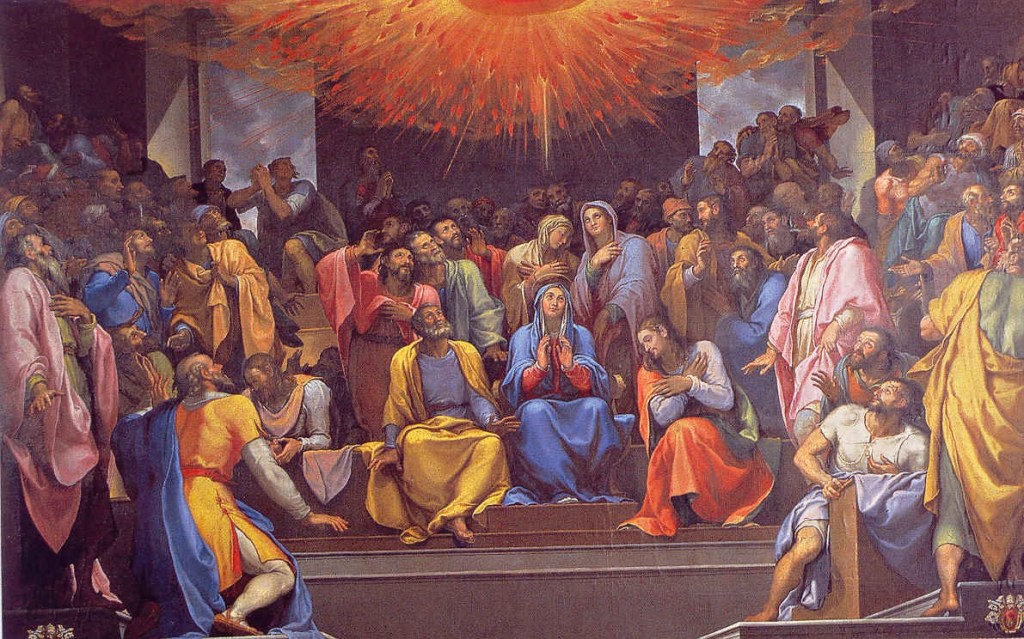








 An Informed Faith