Skip to content

An Informed Faith

John T Squires

An Informed Faith

Category: An Orderly Account: Gospel of Luke

Through Samaria, heading to Jerusalem (Luke 9; Pentecost 3C)

Through Samaria, heading to Jerusalem (Luke 9; Pentecost 3C)

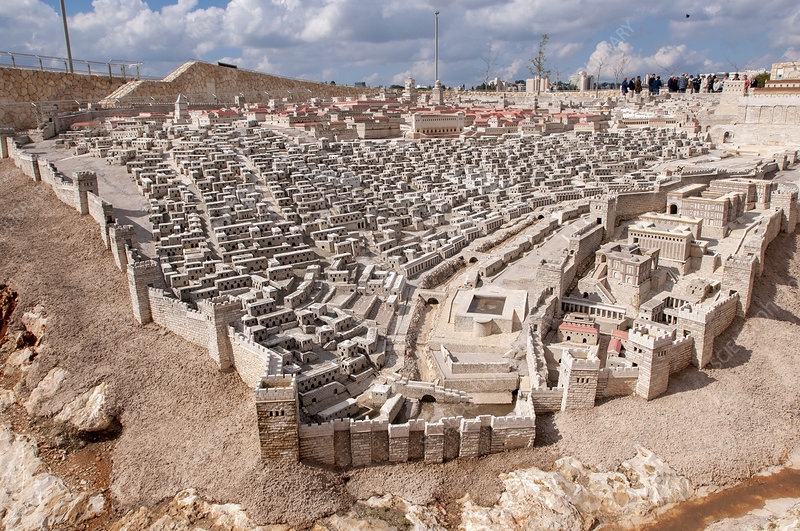
Jesus came from Nazareth in Galilee, in the northern region of Israel. His childhood and much of his adult life was lived in Galilee. Like many others of his time, that life included trips to Jerusalem, the city where kings had ruled; where the Temple sat at the pinnacle of Mount Zion; where sacrifices and offerings were presented to God; where festivals were celebrated, sins were forgiven, gratitude was expressed, psalms were sung.
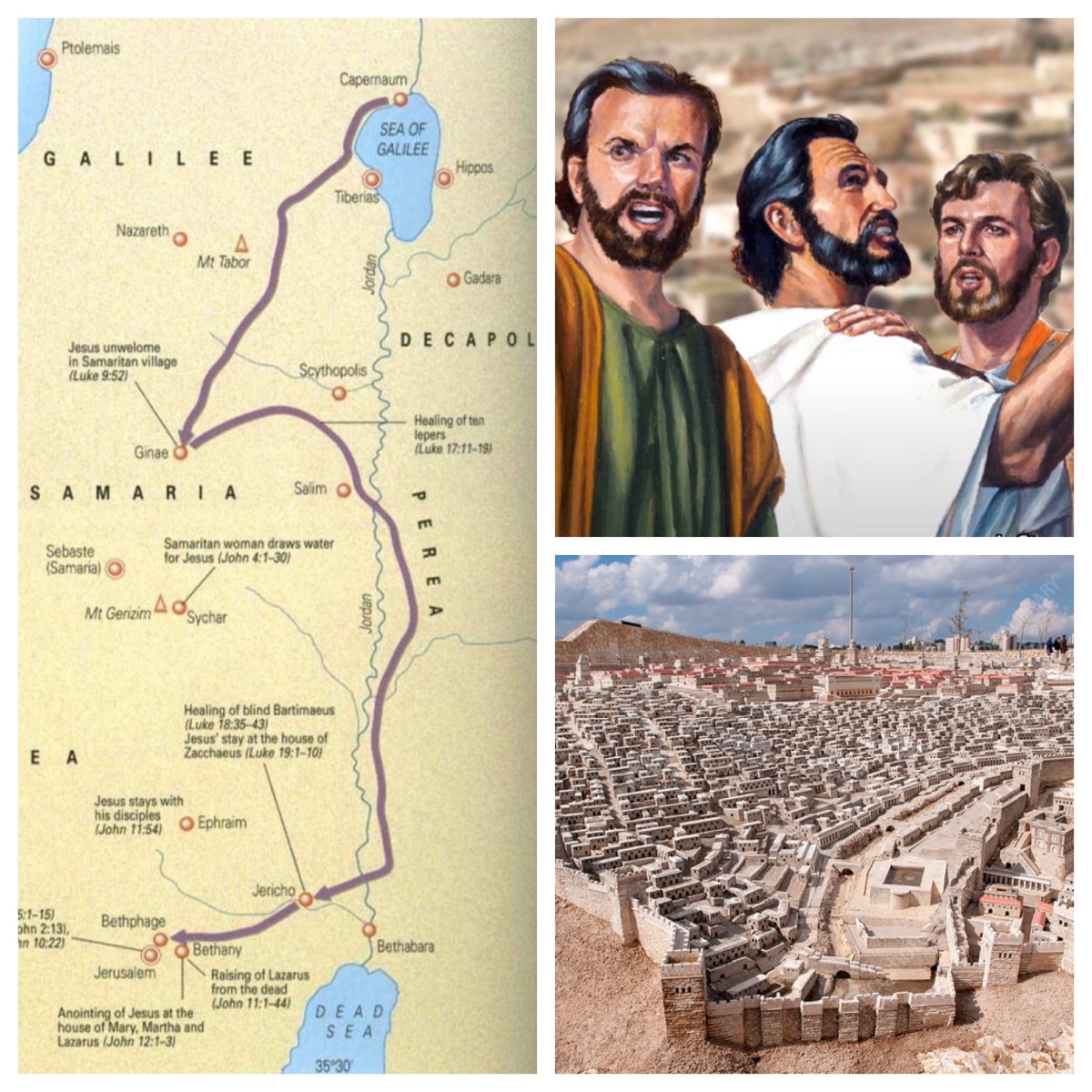
But Jesus spent most of his time in Galilee, in the northern region of Israel, visiting the synagogues, encountering people on the streets, spending time at table with various people. There was a moment in time, however, when he made the decision to go to Jerusalem. It was a momentous decision; indeed, it would be a fatal decision, as it turned out. But at the time, nobody knew that would be the case. He had travelled south to Jerusalem, and then returned north to Galilee, on occasions before. But this time would be different. His disciples didn’t know that. Did Jesus himself have any inkling about this?

Towards Jerusalem

In the reading that the lectionary offers for this coming Sunday (Luke 9:51–62), we hear that Jesus “set his face to go to Jerusalem” (Luke 9:51). Then follows quite a saga, as that journey unfolds over ten full chapters. Matthew and Mark, by contrast, simply report that “he left that place [Galilee] and went to the region of Judea and beyond the Jordan” (Mark 10:1; Matt 19:1). Short, simple, quick. Yet Luke makes a big deal of it. It was a momentous decision.

As Mark reports Jesus’s journey to Jerusalem, he notes that “crowds again gathered around him; and, as was his custom, he again taught them” (Mark 10:1). But what he taught is not evident; Mark does not report many more details. Instead, Jesus is suddenly “in the region of Judea, beyond the Jordan” (Mark 10:1), back where he was first baptised (Mark 1:5). Soon, he would enter the city and then the Temple (Mark 11:11–15). It all takes place quite rapidly.

By contrast, in Luke’s orderly account of the things that have been fulfilled amongst us, the journey to Jerusalem, which begins at Luke 9:51 (“when the days drew near for him to be taken up, he set his face to go to Jerusalem”) takes ten full chapters to narrate. Jesus sets his face to Jerusalem at 9:51. He does not actually begin to approach Jerusalem until 19:11. Even then, his entry to the city is drawn out; Jesus tells a parable (19:11–27), rides down from the Mount of Olives on a donkey (19:28–38), and weeps over the city (19:39–44); then when he enters the city, he goes immediately to the temple (19:45).

Luke takes almost ten full chapters to narrate the journey that Jesus took, with his disciples, including much material that is found only in his narrative. What he taught on that journey, who he encountered on the road, and those whom he healed and exorcised along the way, are all reported by Luke. On this journey in Luke’s Gospel, see

https://johntsquires.com/2022/03/08/setting-his-face-to-go-to-jerusalem-luke-951-1333-1711-1911-lent-2c/

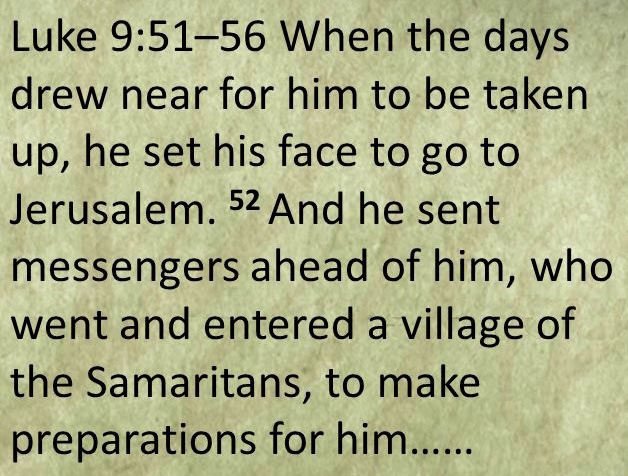
The decision Jesus makes to travel to Jerusalem is reported in terms of weighty theological significance (9:51-56). “When the days drew near for him” might literally be rendered, “in the filling up to completion of the days”; the verb is an intensifying compound of pleroō, meaning to come to fruition or to be filled up.
Pleroō is the same verb used at the start of Luke’s narrative, at 1:1, where it also has a heavy theological sense (the things that God was bringing to fulfilment or completion). It also appears at the end of the narrative, when Jesus refers everything written about him “in the law of Moses and the prophets and the psalms” being fulfilled in accord with divine necessity (24:44).

The word appears also within the body of Luke’s narrative in relation to the fulfilment of scripture (4:21), the fulfilment of the time of the nations (21:24), and the fulfilment of the kingdom (22:16). And quite significantly, the exact same phrase introduces Luke’s account of the day of Pentecost (Acts 2:1). It is a signal that something very important is taking place.

The compound verb sumpleroo, which Luke uses at 9:51 and also at Acts 2:1, appears four times in the Septuagint, an early Greek translation of Hebrew Scripture. All four times it refers to the destruction of Jerusalem in 587BCE, and the seventy years that it lay fallow before the Israelites could return. So it is used with a weighty theological significance there, underlining its importance when it appears in Luke’s account.

(The other use of this compound verb is at Luke 8:23, in the account of the journey across the lake, when the boat in which Jesus and his disciples were sailing “was filling with water, and they were in danger” (8:23). The sense here is more prosaic—water is swamping the boat—but perhaps the linking of this word with “and they were in danger” points to the risk that Jesus was taking as he ventured across the lake, into Gentile lands, where he encounters the man possessed by a Legion of demons. See https://johntsquires.com/2022/06/14/what-have-you-to-do-with-me-jesus-luke-8-pentecost-2c/)

The phrase translated as “to be taken up” is analēmpsis, which could also be translated as “ascension”; the verb is used of Jesus rising into the clouds at Acts 1:2, 11, 22. This, of course, is the climactic moment at the end of the Gospel (Luke 24:50–51) and the opening scene of the second volume (Acts 1:6–11). That scene is in view from this earlier place in the narrative.

And when we read that Jesus “set his face to go to Jerusalem” (9:51), the language indicates a steely resolve, a fixed determination, to head towards the city. The verb used here is found in the LXX to refer to God’s determination (Lev 17:10; 20:3–8; 26:17; Ezek 14:8; 15:7) and it forms a consistent refrain in God’s directions to the prophet Ezekiel (Ezek 4:3, 7; 6:2; 13:17; 20:46; 21:2; 25:2; 28:21; 29:2; 35:2; 38:2). Jesus turns to Jerusalem with a fixed prophetic intent; when he arrives in the city, it is “a visitation from God” (19:44).
Through Samaria

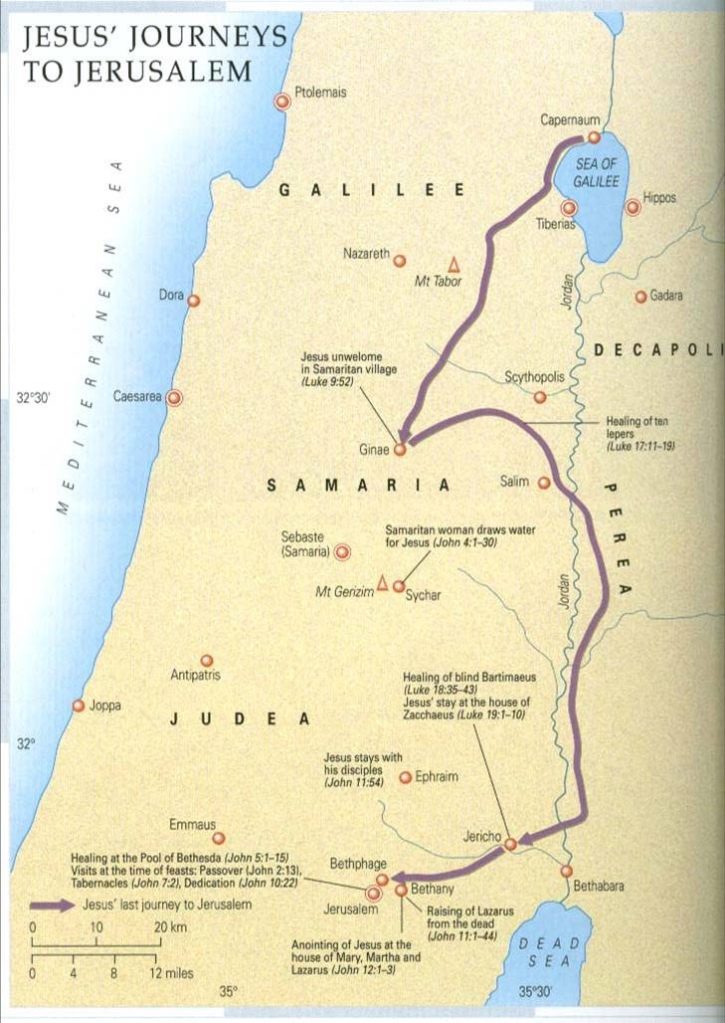
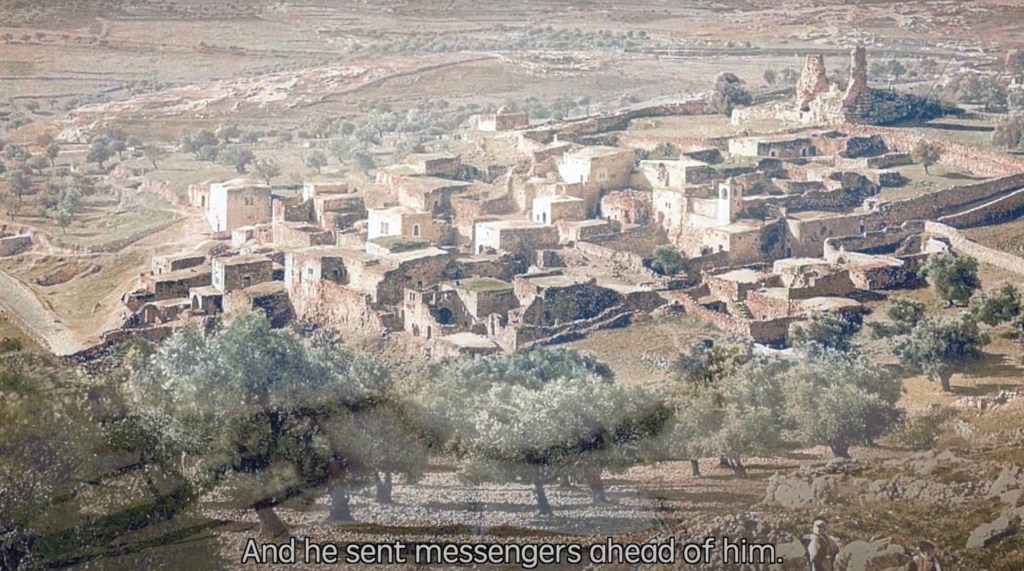
The determination that Jesus had to press on, heading south through Samaria, towards Jerusalem, is picked up by his disciples. Although some are sent on ahead into Samaria to make preparations from his coming, when Jesus and his group arrive, they encounter resistance from the Samaritans (9:52–53). It is presumed that the Samaritans, reflecting traditional antagonism between the two regions (as is reported at John 4:9), were not willing to provide hospitality to one known to be heading to the southern capital.
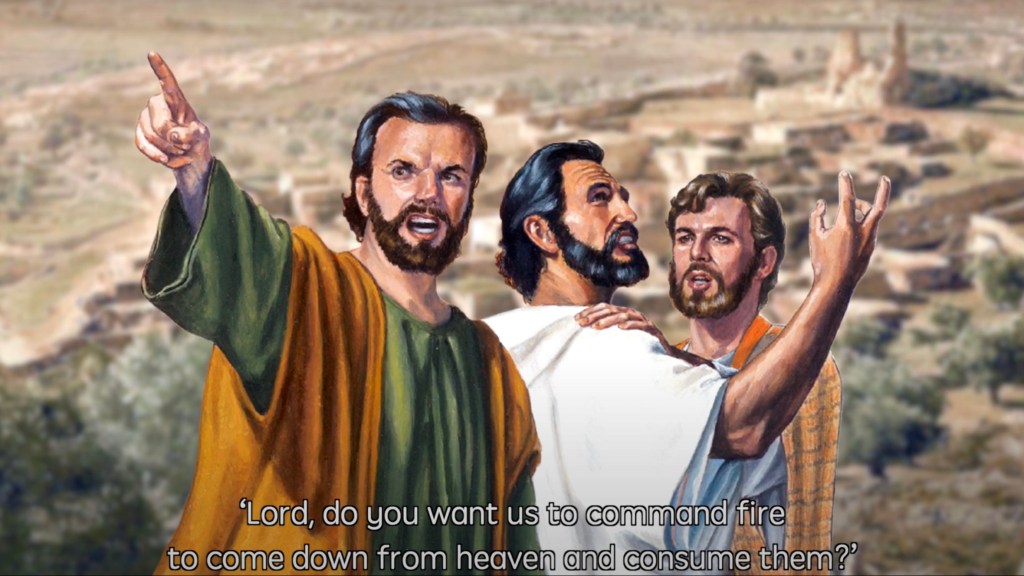
Incensed by this lack of support for their band as they made their way through the region, James and John said, “Lord, do you want us to command fire to come down from heaven and consume them?” (9:54). Their cry evoked a scene from the time of the king, Ahaziah, as two separate groups of fifty soldiers were consumed by fire when Elijah petitioned the Lord, “let fire come down from heaven and consume you and your fifty [men]” (2 Kings 1:10, 12). God had acted with vengeance in the past; surely God would do the same once more, the disciples presumably reasoned.
God did not intervene. Jesus was not pleased. He rebuked them (9:55) and they moved on to the next village. The comparison with Elijah is deemed inappropriate, at least at this point. (Later manuscripts from the medieval period add an explanation as to why Jesus rebukes them: “the Son of Man has not done to destroy the lives of human beings, but to save them”. The addition follows the form of the saying of Jesus recorded at Mark 10:45, and the substance of the saying at John 3:17. There are, however, no similar sayings in Luke’s narrative.)

The final section of the passage offered by the lectionary focuses on the singularity of purpose required to follow Jesus. The call to follow (implicit at 5:10–11; explicit at 5:27; 9:23; see also 14:27; 18:22) is here intensified by the collating together of three originally independent sayings of Jesus.
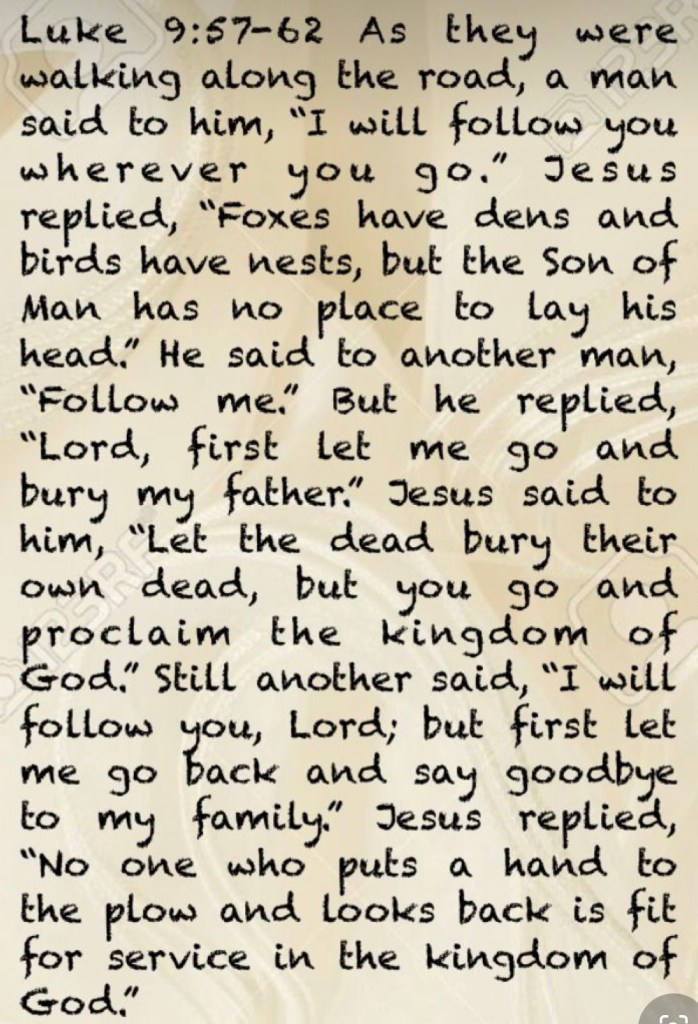
The first and third sayings are spoken in response to an approach to Jesus, “I will follow you”. The first occurrence (9:57) is an absolute statement; it evokes the response, “foxes have holes, and birds of the air have nests; but the Son of Man has nowhere to lay his head” (9:58). That is the same response which Jesus gave to a scribe who utters the same affirmation in Capernaum, much earlier in Jesus’s time in Galilee, in Matthew’s account (Matt 8:20).

The third occurrence (9:61) is conditional; “let me first say farewell to those at my home.” The response from Jesus, “no one who puts a hand to the plow and looks back is fit for the kingdom of God” (9:62) is found only in Luke’s narrative. The saying evokes the scene where Elisha is called by Elijah, but seeks to say farewell to his father and mother before following (1 Kings 9:19–21). Elijah permitted this last act of familial duty, before Elisha “set out and followed Elijah, and became his servant” (1 Kings 19:21).

Jesus, by contrast, will not countenance any conditional response; it must be a total commitment, if you wish to follow him. “Whoever comes to me and does not hate father and mother, wife and children, brothers and sisters, yes, and even life itself, cannot be my disciple”, he would later say (14:26). Refusing to allow the person to “look back” perhaps has in mind what happened to Lot’s wife, who “looked back and she became a pillar of salt” (Gen 19:26).

The middle saying of Jesus is a call spoken directly to one person, “follow me”, which is met by a conditional response: “first let me go and bury my father” (9:59). This response is also linked with the first response (“foxes have holes …”) in Matthew’s account (8:19–22). Jesus, of course, is unwilling to accept such a conditional response; he demands full and intense loyalty. (The words of Jesus, responding to Peter at Luke 18:29, verify this.) His rejoinder in both accounts is to “let the dead bury their own dead” (Luke 9:62; Matt 8:22); in Matthew, it is linked with the charge to “go and proclaim the kingdom of God.”

The call to follow Jesus will be put to the test immediately after this, when seventy of the followers of Jesus are sent out, two-by-two, charged to “cure the sick who are there, and say to them, ‘The kingdom of God has come near to you’” (10:9). That part of the story is what is provided by the lectionary for the Sunday after this coming Sunday (so see next week’s blog!).
Unknown's avatarAuthor John T SquiresPosted on June 20, 2022June 21, 2022Categories An Orderly Account: Gospel of LukeTags scripture; theology; Luke; journey; Jerusalem; Samaritans; discipleshipLeave a comment on Through Samaria, heading to Jerusalem (Luke 9; Pentecost 3C)

What have you to do with me, Jesus? (Luke 8; Pentecost 2C)

What have you to do with me, Jesus? (Luke 8; Pentecost 2C)

This coming Sunday is the second Sunday after Pentecost. This is the longest season in the church’s year, stretching all the way from Pentecost Sunday (two weeks ago in early June) to the Reign of Christ (on the 24th Sunday after Pentecost, at the end of November). Each Sunday during this season, the lectionary offers a set of readings from the prophets in Hebrew Scriptures, some letters of the New Testament, and the orderly account of the things fulfilled amongst us, which we know as the Gospel according to Luke.

On the prophets, see https://johntsquires.com/2022/06/13/the-voice-of-the-lord-in-the-words-of-the-prophets-the-season-of-pentecost-in-year-c/

We have already launched into reading and hearing from Luke’s orderly account in the Sundays of Epiphany, earlier in the year, and in some of the Sundays in the seasons of Lent and Easter. From this Sunday, we hear passages from chapter 8 onwards, culminating in the final speech of Jesus to his followers in chapter 21.

The story for this Sunday tells of the encounter between Jesus as a man possessed by demons. At the moment of encounter, the man cries out a question which stands at the head of all we will read over the coming six months: what have you to do with me, Jesus, son of the Most High God? (Luke 8:28). That is a good question to pose as we read and hear each of the selections from the orderly account that we will encounter in coming weeks.

As Jesus sets his face towards Jerusalem (9:51–56), what does he have to do with us? As Jesus teaches in the house of Mary and Martha (10:38–42), what does this have to do with us? As he teaches about prayer (11:1-13), tells parables about the right use of wealth (12:13–21; 16:1–13; 16:19–31), the generous hospitality of an open table (14:1–14), the gracious welcoming-back of the one who was lost (15:11-32), we should ask: what do you have to do with us, Jesus?

As Jesus receives the gratitude of a returning healed Samaritan (17:11–19), tells of the persistence of a widow (18:1-8), or enters the house of a reformed chief tax collector (19:1–10), we should ponder: what do you have to do with us, Jesus? When he enters the temple, debates with others (20:27–38), and speaks of the time still to come (21:5–19), we ask once more: what do you have to do with us, Jesus?

*****

The Other Side

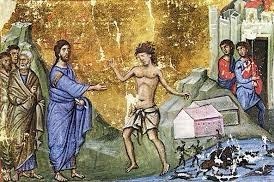
Jesus encounters this demon-possessed man “on the other side” (Luke 8:22). He has crossed the lake and arrived at “the country of the Gerasenes, which is opposite Galilee” (8:26). His activity to this point has been amongst his own people, in Galilee (4:14, 31; 5:17), in Nazareth (4:16), Capernaum (4:31; 7:1), in synagogues in various towns (4:15, 33; 6:6; inferred in 8:1; and the textual variant of 4:44, Galilee, is surely to be preferred).

People in Galilee approached him to be healed or exorcised (4:40–41); others from Judea and Jerusalem had come to Galilee to hear him and be healed (6:17). Even some from “the coast of Tyre and Sidon”, to the northwest, beyond the land of Israel, had come (6:17). And in the story of the healing of the centurion’s son (7:1–10), Jesus has some contact—albeit at a distance, mediated through Jewish elders—with the Gentile centurion. To Jews and Gentiles alike, Jesus was much in demand!

By crossing the lake (8:22–25), Jesus steps onto Gentile territory—the Decapolis—and engages directly with non-Jews; not only this man (8:27), but “people [who] came out to see what had happened” (8:35), “all the people of the surrounding country of the Gerasenes” (8:37). When these people, “seized with great fear”, asked Jesus to leave, he obliged; “he got into the boat and returned” (8:37), back to the Jewish side of the lake.

Nevertheless, the word about Jesus was “out” amongst the Gentiles; indeed, as Jesus had commanded the exorcised man to return home and “declare how much God has done for you” (8:38), so the man was “proclaiming throughout the city how much Jesus had done for him” (8:39).

The phrase prefigures Luke’s later declaration about “all that Jesus did and taught” (Acts 1:1, summarising the whole of the Gospel story), and the apostolic proclamations of “all that God had done with them” (Paul and Barnabas in Antioch, Acts 14:27; in Jerusalem, 15:4, 12) and “the things that God had done among the Gentiles through his ministry” (Paul in Jerusalem, 21:19). It also echoes the earlier affirmation of Elizabeth, “what the Lord has done for me when he looked favorably on me” (Luke 1:25) and the song of Mary, “the Mighty One has done great things for me” (1:49).

The man is thus the first active evangelist operating independently in Luke’s orderly account—proclaiming the good news even before the twelve are sent out “to proclaim the kingdom of God and to heal” (9:1–6), even before the seventy-two are similarly despatched, two-by-two, to declare “the kingdom of God has come near to you” (10:1–12).

*****

Signs of uncleanness

In exorcising the demons from the man in “the country of the Gerasenes”, Jesus encounters a man who is outside the boundaries of the people of God. There are a number of markers which indicate how “unclean” or “impure” this man would have been regarded by faithful Jews like Jesus and his followers. The location was outside the holy land of Israel (8:26); this is the first marker.

In a later rabbinic document, the Mishnah, a complex map of holiness was set forth, beginning with the statement that “there are ten grades of holiness: the land of Israel is holier than all other lands” (m.Kelim 1.6). (This discussion moves through the series of holiness grades, culminating with the statement that “the Holy of Holies is holier, for only the high priest, on Yom Kippur, at the time of the service, may enter it”; m.Kelim 1.9.) Assuming that this later understanding also applied earlier, at the time of Jesus, then his venturing across the lake was moving into unholy territory.

(Jerome Neyrey provides an extensive discussion of “clean/unclean, pure/polluted, holy/profane”, in his article on “the idea and system of purity”, at https://www3.nd.edu/~jneyrey1/purity.html

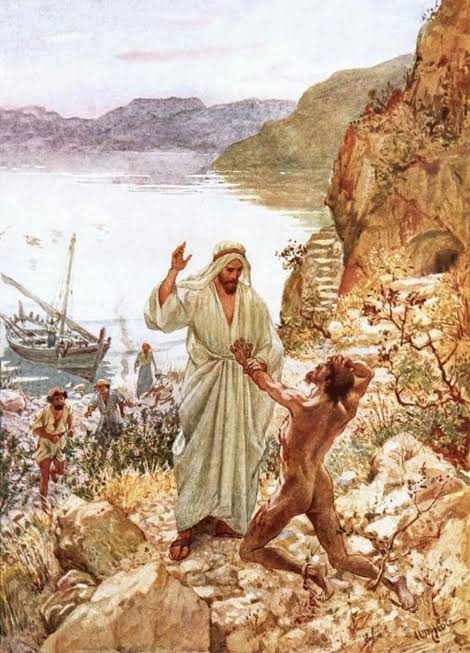
The man whom Jesus encountered was naked (8:27), another marker of his state of uncleanness. Being naked is linked with an unsatisfactory state of being in one of the stories found at the beginning of the scrolls of the Torah. The man (Adam, son of the earth) and the woman (Eve, source of life) experience this revelation after eating “the fruit of the tree that is in the middle of the garden” (Gen 3:1–6), “the eyes of both were opened, and they knew that they were naked; and they sewed fig leaves together and made loincloths for themselves” (Gen 3:7).

In stories following in later scrolls, nakedness may be portrayed negatively and linked with shame (Noah at Gen 9:22–23; the mother of Jonathan, 1 Sam 20:30), sinfulness (Jerusalem at Lam 1:8; Isa 47:3), poverty (Deut 28:48; Isa 58:7), violence (Hab 2:12–17), or sexual immorality (Ezek 16:36–38; 23:27–31; Hos 2:2–10; Nah 3:4–5). And in Roman society (the dominant culture within which the Gospel of Luke was written), nudity could be used as a powerful social constraint; a master could make a slave naked “for the explicit purpose of shaming them and reinforcing the power they maintain over them”. See http://www.humanitiesresource.com/classical/articles/roman_sexuality.htm

The man who approached Jesus “did not live in a house but in the tombs” (8:27). Dead bodies were a prime source of conveying uncleanness (Lev 21:1–3); so “those who touch the dead body of any human being shall be unclean seven days” (Num 19:11; see also Haggai 2:13). Living amidst the tombs where dead bodies were laid ensured that, under the prescriptions of the Torah, the man was perpetually unclean (Num 19:16), and thus should be avoided.

The man was “kept under guard and bound with chains and shackles which he would tear apart and break free (8:29). This description suggests a supernatural strength, but perhaps also signifies a refusal to be bound by the expectations of custom, with such reckless, violent behaviour. Certainly the demons which possessed the man have guided him to behave in ways that would be considered “anti-social”; so, he was not quite unclean in the ritual sense, but his actions placed him outside the expected patterns of society.

The anti-social behaviour of the man is intensified in Mark’s longer account; “night and day among the tombs and on the mountains he was always howling and bruising himself with stones” (Mark 5:5). This detail is omitted in Luke’s version. However, Luke does report that the man was “driven by the demon [singular] into the wilderness” (Luke 8:29. The wilderness, of course, was the place for testing—of Israel (Exod 15:25–26; Deut 8:16; Ps 95:8–9); of Jesus (Luke 4:1–13), of Paul (2 Cor 11:26).

Indeed, it was not just one demon that had possessed the man; “many demons had entered him” (8:30), which explains his incredible strength and his actions outside the expected social norms. The man himself labelled these demons Legion—a clear allusion to the Roman army cohort of a legion, which at this time would have been 5,600 men, armed and ready to fight. The level of uncleanness in this man, therefore, possessed by so many demons, was immense. (The name of the demon is likewise Legion at Mark 5:9; Matthew omits this identification.)

Finally, the symbolism of sending the demons into “a large herd of swine [which] was feeding” on the nearby hillside (8:32) is potent. Pigs, of course, were anathema to Jews; “the pig, because it divides the hoof but does not chew the cud, is unclean for you” (Deut 14:8; likewise, Lev 11:7). From one person with numerous markers of uncleanness, the demons are sent into a group of animals that are clearly and definitively unclean. The making-unclean effect of Legion is transferred into the hapless already-unclean swine, who then plunge into the sea.

The sea, of course, for the people of Israel, is another marker of the territory beyond—a place of threat and danger. Israelites were not seafaring people; their natural habitat was wilderness and rocky hills. The sea was a dangerous place (Ps 30:1; 69:1–3). Only God could control the sea and the evil it symbolized (Ps 65:5–7; 77:19; 89:9; 93:3–4; Exod 14:15–16; Isa 51:10). The sea was the home for Leviathan, the great sea monster (Isa 17:12; 27:1; 51:9–10).

The prophet Daniel relates his vision of “the four winds of heaven stirring up the great sea, and four great beasts came up out of the sea” (Dan 7:2–3)—those four beasts, it is understood, represent the political and military threats to Israel from the four great empires. So, sending the unclean swine, now possessed by the Legion of demons, into dangerous sea, represents a complete cleansing and restoration of the man.

Luke alone intensifies this moment in the story, as the demons begged Jesus “not to order them to go back into the abyss” (8:31). The abyss is identified in deutero-canonical literature with “Hades in the lowest regions of the earth” (Tobit 13:2), the opposite extreme from the heavens (Sirach 1:3; 16:18; 24:5). In Revelation, the word is translated “bottomless pit”, the source of a plague of locusts (Rev 9:1–11) and the home of the Beast (Rev 11:7; 17:8) and the place where “the dragon, that ancient serpent who is the Devil and Satan” is thrown at the end (Rev 20:1–3).

Do the pigs actually plunge all the way down into abyss? This is left to the imagination of the hearer or reader of the story.

*****

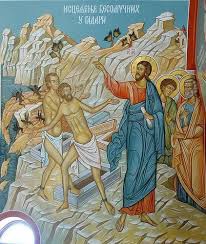
Luke has received the story of the encounter between this man and Jesus in the earlier account of Jesus that we attribute to Mark (Mark 5:1–20). As Luke uses this narrative as a key source for his orderly account, he has here maintained the structure and most of the details of Mark’s narrative. Matthew also has this story (Matt 8:28–34), but he has significantly reduced the narrative—and there’d are two men, not one, who emerge from the tombs (Matt 8:28).

Mark has Jesus return to Jewish territory after this encounter (5:21), but then make a second foray across the lake to the other side (6:45; he returns to Jewish land again at 8:13). During that second trip, there are significant events relating to the way that Jesus stretches the boundaries of the people of God.

See https://johntsquires.com/2021/08/24/stretching-the-boundaries-of-the-people-of-god-mark-7-pentecost-14b-15b/

Luke omits all of that second journey, and the key events included in Mark’s account of that second trip: the discussion about “the tradition of the elders” (Mark 7:1–23), the encounters between Jesus, the Syrophoenician woman, and the deaf man (7:24–37), and feeding the 4,000 (8:1–10). Instead, Luke concentrates the visit of Jesus to Gentile territory entirely within this single narrative, telling of the casting out of demons from the unclean man in “the country of the Gerasenes, opposite Galilee” (Luke 8:26).

This single story contains all that we need to know about the attitude of Jesus towards “unclean” Gentiles. In one encounter, the massed forces of demonic opposition are engaged, subdued, and dispatched—the shackled man is unchained, the legion of unclean demons is sent into unclean swine, the swine dive into the chaos of the menacing, swirling sea, and the man is restored to right relationships.

Indeed, this man is the first to receive a commission from Jesus to “declare how much God has done for you”. His testimony to his encounter with Jesus begins a community of disciples “on the other side”. The good news is spreading far already, at this early stage of the public activity of Jesus!

Unknown's avatarAuthor John T SquiresPosted on June 14, 2022June 14, 2022Categories An Orderly Account: Gospel of LukeTags scripture; theology; Luke; Acts; purity; exorcismLeave a comment on What have you to do with me, Jesus? (Luke 8; Pentecost 2C)

The kingdom is non-binary: reflections on Acts 8 and related passages

The kingdom is non-binary: reflections on Acts 8 and related passages

This is the reflection that the Rev. Elizabeth Raine gave at the monthly gathering of Rainbow Christian Alliance at the Tuggeranong Uniting Church on Sunday 12 June 2022.

*****

You may well be asking yourself the question: Why would I start a reflection with a title “the Kingdom is binary”? Good question and I am glad you asked it.

I know this story of the eunuch has probably familiar to you and has been done to death in many circles. But I thought it worth revisiting and looking at why it was such a big deal. 

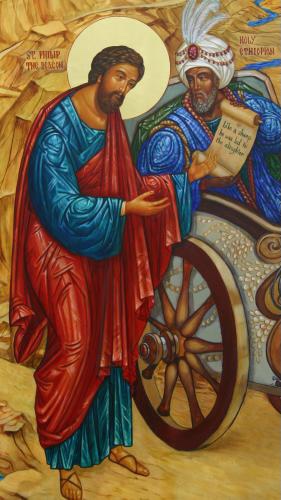
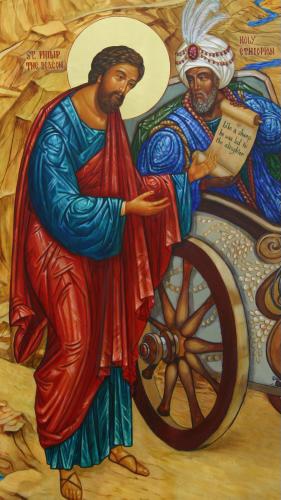
So we will start by considering Acts 8. The backdrop is one of great violence. The story of Phillip and the Ethiopian eunuch comes after the stoning of Stephen. Saul, the instigator of this act, has launched a campaign of terror against Christians. Peter and John are waging their own campaign of oppression against alleged wicked magicians. Saul’s dramatic conversion follows in the next chapter. But before Saul’s conversion, we have this curious story of the Ethiopian eunuch.

Why is it here and how are we to read it? In its own way, this story is as dramatic as Paul’s conversion. We find Phillip, one of the apostles, chasing down an Ethiopian chariot. Even for the first century, it’s a bizarre image, and one that has some danger attached to it – after all, the Ethiopian eunuch is a high ranking official in the Ethiopian court and could order violence against this stranger pursuing him. 

But as luck would have it, the official just happens to be studying Isaiah in his chariot, giving Philip the opportunity to explain that the redemption Isaiah anticipates has come in Jesus. The official is convinced by Philip’s understanding, they happen upon a convenient water source and the limousine screeches to a halt. The official says “What is there to prevent me from being baptized?” 

To us, it probably seems a reasonable question. But just imagine for a moment the sort of prejudices that might have been present in the first century….

Well, there are a number of things we need to be clear about, Mr Official, before proceeding. There is the tiny matter that you are a gentile from beyond the bounds of the empire, and you are alien to us and we have heard that your people are enemies of the empire. And we cannot be sure of your attitude to scripture, or how you plan to use it. And your place of work – do you still plan to continue in that den of iniquity they call a court in Ethiopia? And of course, there is the little detail of your dubious gender. You are, without doubt, in a minority of people of dubious sexual orientation, and Deuteronomy 23:1 clearly states that you should be excluded from God’s people. It’s so important for people to know their place, and yours is, well … not the same as ours. We need to have a few decades of dialogue about your place — you can just wait over there.

Fortunately for the eunuch, Luke tells us that this is not the response he got from Philip, who did baptise him, and the text says that the eunuch then went on his way rejoicing.

So why is this story such a big deal? In the Hebrew Bible or OT, Deuteronomy 23:1 states that “no one who has been emasculated [i.e. had their genitalia removed] by crushing or cutting may enter the assembly of the Lord”.

The words used here are very stern—emasculating, severing, crushed. So by virtue of this definition, our friend the eunuch would be barred from participating in the faith. In the ancient world, eunuchs – that is, anyone whose genitalia looked different or whose genitalia were made different – were thought to suffer from a disability. After all, they couldn’t father children, which was the primary aim of life in the Ancient Near East and a source of social shame.

Before Luke challenged this notion, it had already been taken up by the prophet Isaiah. In Isaiah 56, the prophet states:

Let no foreigner who is bound to the Lord say, The Lord will surely exclude me from his people.’ And let no eunuch complain, ‘I am only a dry tree.’ For this is what the Lord says: ‘To the eunuchs who keep my Sabbaths, who choose what pleases me, and hold fast to my covenant—to them I will give within my temple and its walls a memorial and a name better than sons and daughters; I will give them an everlasting name that will endure for ever.

Just to give some background to this text, it was written after the exile in Babylon and the chance for the exiled Jews to return to their ancient homeland had been extended by the Persian king. This raised the question of who was welcome in this soon to be reestablished community and religious environment. Was the old to be adhered to?

Isaiah says no, God is doing a new thing, and everyone is welcome in this community. The kingdom of God is open to all. Isaiah is presenting a unifying theme for not only Israel, but anyone else who wants entry into God’s kingdom.Salvation is available to all in this fully inclusive religious community.

Luke, who uses the prophet Isaiah heavily in his narratives about Jesus and the early church, uses the story of Philip and the eunuch to demonstrate how this particular part of Isaiah’s prophecy is being fulfilled. Luke underscores this by hisdescription of the Holy Spirit, who pushed Philip right out of his familiar comfort zoneto a new places with different practices.

This encounter will ultimately reform the early church as it currently exists into a new and diverse assembly, where genderdoes not matter, where sexual orientation does not matter and where the state of someone’s genitalia does not matter. It is indeed a radical move. God is doing a new thing, here it has sprung up, and all are welcome in this blossoming out of the kingdom of God.

This is a Holy Spirit that demands the church think in new ways. It refuses to allow tradition, familiarity and ‘comfortableness’ to get in its way of a radical inclusiveness.It does not allow us to lapse into ‘what we have always known’ and let our thinkingbe dominated by past beliefs, factual errors, misunderstandings and downright bigotry.

The last passage I want to look at is from the gospel of Matthew, in Matthew 19:12, Jesus says:

For there are eunuchs who were born that way, and there are eunuchs who have been made eunuchs by others – and there are those who choose to live like eunuchs for the sake of the kingdom of heaven. The one who can accept this should accept it.’

What are the implications of what Jesus is saying here? Firstly, we note that Jesus acknowledges that people are born eunuchs—is he describing intersex people here perhaps? It is an acknowledgement that the binary male and female paradigm does not always apply in society or even the kingdom.

Jesus is probably also describing boys who were carried off into captivity and castrated as they were brought into the service of the conquerors (Dan 1:3). Others were simply sold into slavery and either set to guard harems or made eunuchs to keep them in an ever-present state of societal shame and subordination.

Lastly, some decide to chose celibacy, or become eunuchs for the sake of God’s kingdom. Jesus’ statement, simple as it is, acknowledges all of these “eunuchs” have a place in the kingdom.

Jesus has effectively destabilized the normative categories of his time, ‘queering’ scripture in relation to gender, sexuality, and roles in society. J. D. Hester (in “Eunuchs and the Postgender Jesus: Matthew 19:12 and Transgressive Sexualities”, Journal for the Study of the New Testament 28.1 (2005): 13–40) asserts that the only way to read this Matthean pericope today is the inclusion of those who transgress normative categories of gender and sexuality.

Hester believes that the eunuch was a social identity radically undermining the foundational assumptions used to reinforce the conservative heterosexist reading of the Bible, precisely because eunuchs and their social identity threatened the allegedly sacred boundaries between male and female. Jesus, by affirming the inclusion of eunuchs in the kingdom is stating the kingdom itself is non-binary.

What would we do today when confronted by our modern-day equivalents of eunuchs and Ethiopians? Do we show such people the love of God and actively welcome them into our church, community and country? 

See the UCC ad Ejector Pew:

The church has not been good at hiding our prejudices. The church claims to accept everyone equally, but the reality is the traditional church likes some folk better than others, finding some people to be cleaner, more articulate, more socially acceptable than others.

But while sometimes we might despair and think that people cannot change, churches cannot change, and even perhaps that society cannot change, I ask you to remember that if this was true, we should remove a good percentage of our New Testament, as many of the letters we treasure were written by a man who not only changed from being a persecutor but was also converted to become a zealot for those he persecuted.

That the Uniting Church now has a task group to prepare an apology for the harm done to LGBTQI people is a sign of hope, and also hopefully a sign that the kingdom is finally inching its way into reality.

*****

See also

A Safe Place for Rainbow Christians
Moving ahead as an inclusive, respectful community
Clobbering the clobber passages
Affirming and inclusive passages from scripture
Unknown's avatarAuthor John T SquiresPosted on June 12, 2022June 12, 2022Categories An Orderly Account: Gospel of LukeTags scripture; theology; Acts; LGBTIQA+; sexuality; inclusiveLeave a comment on The kingdom is non-binary: reflections on Acts 8 and related passages

After Pentecost (3): the mysterious case of the disappearing Holy Spirit (part two)

After Pentecost (3): the mysterious case of the disappearing Holy Spirit (part two)

We have already noted that the Spirit is explicitly absent from the narrative of Acts, from after Paul is arrested in Jerusalem (21:22–28:31). It is only in the closing scene, in Rome, that the Spirit is again mentioned. This is quite unlike the earlier concentrations of references to the Spirit, both in the Gospel and in earlier sections of Acts.

https://johntsquires.com/2022/06/07/after-pentecost-2-the-mysterious-case-of-the-disappearing-holy-spirit-part-one/

We have explored—and dismissed—some possible explanations for this mysterious disappearance of the Spirit in this final section of Acts. What other explanations might there be?

Perhaps the notion of a divine spirit, so integral to Jewish thinking, was strange and incomprehensible in the hellenistic world? Could this have led Luke to be reticent to refer to the spirit in this later, more strongly hellenistic section of his work?

The key problem with such an hypothesis, however, is that belief in spirits was actually widespread throughout the hellenistic world; there is indication of this from centuries prior to the first century in works such as Cicero’s De Natura Deorum (and see a comprehensive survey of occurrences in Greek literature in https://www.academia.edu/8368040/The_Term_Demon_in_Greek_Literature)

See also https://www.britannica.com/topic/Hellenistic-religion/Beliefs-practices-and-institutions and https://www.theoi.com/greek-mythology/personifications.html

Further, as already noted, the interactions that Jesus had with unclean spirits during his ministry in Galilee indicates that this perspective held strong during the first century even within Judaism. In an earlier post, we noted that Jesus confronted the spirits in a man in the synagogue in Capernaum (4:33), in a demon-possessed man the country of the Gerasenes (8:29), in the daughter of Jairus, a leader of the synagogue (8:55), in the boy convulsing because of an unclean spirit (8:39, 42), and in the woman crippled for eighteen years (13:11). See https://johntsquires.com/2022/06/02/towards-pentecost-2-the-spirit-in-the-story-of-jesus/

*****

Another possible explanation for the disappearance of the Spirit after chapter 21 could be in the fact that the missionary activity of Paul came to an end with his arrest in the Jerusalem Temple. From this point onwards, there is no reporting of the speeches that Paul made to persuade people to believe in the good news of Jesus; rather, we hear series of apologetic speeches which Paul delivers to the various Roman authorities who are charged with dealing with him once he has been brought before them.

Paul speaks apologetically—that is, he defends himself and his beliefs, and also advocates for a better understanding of the beliefs and practices of The Way—in speeches that he delivers before a large crowd in Jerusalem (22:3–21), the Jewish Council and Roman Tribune in Jerusalem (23:1–6), Governor Felix and his wife Drusilla in Caesarea (24:10–21), Governor Festus in Caesarea (25:8–12), and finally King Agrippa, his consort Berenice, and Governor Festus in Caesarea (26:1–32). Luke explicitly notes that Paul offers a “defence” at (22:1; 14:10; 25:8, 16; 26:2, 24). His final speeches to the Jewish leaders in Rome (28:17–20, 25–28) also have the nature of a defence.

The techniques evident in these speeches (attributed to Paul, but clearly written and shaped by the author of the orderly account) reflect a high level of educational attainment and rhetorical finesse. Why would the Spirit be needed, we might ask, when the education of the speaker (mediated via the educated writer of the work) sufficed?

So a reasonable explanation could be that, because of the prowess that Paul demonstrated in his apologetic speeches, the inspiration of the Spirit was not needed. Certainly, the crowd in Jerusalem interrupted him to mock him: “up to this point they listened to him, but then they shouted, ‘Away with such a fellow from the earth! For he should not be allowed to live’.” (22:22). But Felix was persuaded by what Paul said (24:22–23); Festus was convinced by his argument (25:12, 25), noting the great learning that he displays (26:24); Agrippa wonders, “Are you so quickly persuading me to become a Christian?” (26:28), and then determines that “this man is doing nothing to deserve death or imprisonment” (26:31). Paul is presented as a most persuasive orator.

So perhaps we might argue that this whole section of Acts, where Paul speaks with rhetorical finesse and convinces Roman authorities, provides a strong vindication of words that Jesus spoke, much earlier in the Gospel, when he assures his followers that “when they bring you before the synagogues, the rulers, and the authorities … the Holy Spirit will teach you at that very hour what you ought to say” (12:11–12). Such public speaking is both spirit-inspired and learned.

Finally, we might observe that, whilst it is true that Paul is no longer on the front foot, travelling freely, preaching and establishing churches in numerous locations, and nurturing new believers, Paul is nevertheless still actively pursuing the theological agenda that Luke has outlined from early in his writings.

Simeon has declared that the child Jesus will bring “a light for revelation to the Gentiles” (Luke 2:32) and Luke has cited Isaiah’s words that “all flesh shall see the salvation of God” (3:6, quoting Isa 40:5). Gentile receptivity to the good news is affirmed in many places: in the report that Jesus attracted “a great multitude of people from all Judea, Jerusalem, and the coast of Tyre and Sidon” (6:17; the people from the coast would clearly have been Gentiles); in the instructions that Jesus gives in his parables to “go out into the roads and lanes, and compel people to come in, so that my house may be filled” (14:23); in the closing declaration of Jesus, “that repentance and forgiveness of sins is to be proclaimed in his name to all nations” (24:47); and in other places in between these key markers.

Even though Paul is now prisoner, he is continuing the commission first given centuries before to The Servant: “I have set you to be a light for the Gentiles, so that you may bring salvation to the ends of the earth” (13:47, citing Isa 49:6). The narrative trajectory, as Paul travels from Jerusalem via Caesarea to Rome, is integral to Luke’s perception that the story demonstrates how Peter and John, Paul and his companions “will be my witnesses in Jerusalem, in all Judea and Samaria, and to the ends of the earth” (1:8). This geography reveals the theology at play: when Paul reaches Rome, he is at the centre of the Empire that reaches “to the ends of the earth”.

The story ends with Paul in Rome, spending two years proclaiming, debating, persuading, and we might well assume also guiding, nurturing and discipling. The fact that he is a prisoner under Roman arrest, not a travelling preacher, does not matter. The work of the Holy Spirit is continuing. The offer of salvation to the Gentiles (28:28) fulfils the ancient promise of the Spirit (28:25). Are we right, then, in deducing that the Spirit, barely mentioned explicitly in the final eight chapters, has been implicitly at work in all that has transpired? It seems the best possible understanding, to me.

*****

Earlier posts are at

https://johntsquires.com/2022/06/01/towards-pentecost-1-the-revived-activity-of-the-spirit/
https://johntsquires.com/2022/06/02/towards-pentecost-2-the-spirit-in-the-story-of-jesus/
https://johntsquires.com/2022/06/03/towards-pentecost-3-the-spirit-in-the-story-of-the-early-jesus-movement/
https://johntsquires.com/2022/06/05/after-pentecost-1-the-spirit-falls-on-gentiles-and-guides-future-journeys/

Unknown's avatarAuthor John T SquiresPosted on June 8, 2022June 8, 2022Categories An Orderly Account: Gospel of LukeTags apologetics, scripture; theology; Luke; Acts; spirit; PentecostLeave a comment on After Pentecost (3): the mysterious case of the disappearing Holy Spirit (part two)

After Pentecost (2): the mysterious case of the disappearing Holy Spirit (part one)

After Pentecost (2): the mysterious case of the disappearing Holy Spirit (part one)

We have seen how important the Spirit is within the orderly account that Luke provides, telling the story of Jesus and the movement he began.

See

https://johntsquires.com/2022/06/02/towards-pentecost-2-the-spirit-in-the-story-of-jesus/
https://johntsquires.com/2022/06/03/towards-pentecost-3-the-spirit-in-the-story-of-the-early-jesus-movement/
https://johntsquires.com/2022/06/05/after-pentecost-1-the-spirit-falls-on-gentiles-and-guides-future-journeys/

Yet the Spirit is explicitly absent from the narrative after Paul is arrested in Jerusalem (21:22–28:31), apart from a brief note at 28:25. This is quite unlike the earlier concentrations of references to the Spirit, both in the Gospel and in earlier sections of Acts.

One obvious way to explain this is to refer to the pattern of occurrences of the Spirit in the Gospel: a concentration of activity by the Spirit in the opening chapters, some further references to the Spirit in the next half dozen chapters, but then silence until the scene where the dying Jesus hands over his spirit to the Father. The pattern in the Gospel, it would seems, is to establish that the life of Jesus as a whole is Spirit-led, and then leave that as assumed in the ongoing narrative.

Could that pattern then be followed in Acts? The early concentration of activity by the Spirit in Jerusalem establishes that the life of discipleship is similarly Spirit-led in what is told in the ensuing chapters.

This may be an attractive explanation; but it doesn’t deal with the observation we have made, that there are many explicit references to the activity of the Spirit, not just in the first few chapters, but right through the first three sections of Acts (into chapter 21). If Pentecost was to inform all that followed, why do these references to the Spirit still occur in the narrative?

A second explanation might be drawn from the fact that the story after chapter 21 moves explicitly and entirely into a hellenistic context.

Paul’s earlier activity had seen him regularly engaging with Jews in their synagogues: in Antioch (13:14–15, 43, 44), Iconium (14:1), Thessalonians (17:1–3), Beroea (17:10–11), Athens (17:16–17), Corinth (18:4) and Ephesus (18:19 and again in 19:8–10). The “place of prayer” by the river in Philippi (16:13) was, most likely, also a place of gathering for Jews. This section of Acts culminates with Paul visiting the Jerusalem Temple and taking part in a purification ceremony there (21:17–36, when he is arrested).

From this point onwards, as Paul is under Roman arrest, he is arraigned before various local authorities: first before Claudius Lysias, the tribune in Jerusalem (21:31–3, 22:23–29), then the High Priest Ananias, his lawyer, Tertullus, and Governor Felix, in Caesarea (23:31–23), then Felix and his wife Drusilla (23:24–26), then two years later before Governor Festus (25:1–12), and finally, still in Caesarea, before King Agrippa, his consort, Bernice, and the Roman Governor, Festus (25:13–26:32).

Eventually, he is sent to Rome, because of his claim to be a Roman citizen (22:25–29; this was already signalled earlier in the narrative, in Philippi, at 16:35–39). The preponderance of Roman officials and scenes where Paul’s case is being considered by these authorities may militate against references to the Holy Spirit in these scenes. Paul is a prisoner, under Roman authority, being scrutinised as to his ultimate fate. The Spirit is absent from this process. The scenes are secular, it might be claimed, not related to the mission of preaching the good news.

However, it should be noted that the context of chapters 13–21 was not exclusively Jewish. Paul engages with Gentiles in various locations: early on, with Gentiles in Antioch (13:48), “a great number of both Jews and Greeks” in Iconium (14:2), a priest of Zeus in Lystra (14:13), and “the Gentiles” throughout the regions traversed in chapters 13–14 (14:27: 15:3); on a later journey, with “a great many of the devout Greeks and not a few of the leading women” in Thessaloniki (17:4) and “not a few Greek women and men of high standing” in Beroea (17:12).

In two cities (Athens and Ephesus), Paul’s primary interaction is with Gentiles: with Epicureans and Stoics in Athens (17:18–21), with Demetrius the silversmith and others of that trade in Ephesus (19:24–27), with a large crowd of Artemis worshippers (19:28–34), and eventually with the town clerk of Ephesus (19:35–41).

It is true that, in both cities, Paul also visits the synagogue (17:17; 19:8). However, no Jew living in the Diaspora could escape the ubiquitous influence of hellenistic culture and customs. As the tribune in Jerusalem poses the question to Paul, when he addresses him, presumably in Greek: “Do you know Greek?” (21:37). Of course Paul did—as did countless thousands of other educated Jews!

The Jews in the synagogues in Athens and Ephesus—and, indeed, in every synagogue which Paul and his companions visited in chapters 13 to 20—were Diaspora Jews, living in ways that had been markedly influenced by the dominant hellenistic culture of the past three centuries. These were not “Jews of the homeland” (and even there, hellenistic influences were evident); they were Jews who had accommodated and acculturated to life in the Greco-Roman Diaspora.

So proposing a clear cut dichotomy to differentiate between Jews and Gentiles, between Jewish contexts and Hellenised contexts, does not hold water. Applying such an analysis to Acts fails to explain the absence of the Spirit in chapters 21–28.

How else might this be explained? See the next blog post …

Unknown's avatarAuthor John T SquiresPosted on June 7, 2022June 7, 2022Categories An Orderly Account: Gospel of LukeTags apologetics, scripture; theology; Luke; Acts; spirit; PentecostLeave a comment on After Pentecost (2): the mysterious case of the disappearing Holy Spirit (part one)

After Pentecost (1): the Spirit falls on Gentiles and guides future journeys

After Pentecost (1): the Spirit falls on Gentiles and guides future journeys

A critical moment in the narrative that Luke shapes in the second volume of his orderly account (the Acts of the Apostles) comes when the spirit falls on the Gentile believers in Caesarea (10:44–45; 11:15–16). This event is specifically portrayed as a complementary event alongside the falling of the Spirit on Jews in Jerusalem on the Day of Pentecost (2:1–4). In his initial report of this event in Caesarea, Luke states that “the circumcised believers who had come with Peter were astounded that the gift of the Holy Spirit had been poured out even on the Gentiles, for they heard them speaking in tongues and extolling God” (10:45–46).

The activity of the Spirit is noted at various places in this sequence of events. The Spirit guides Peter to meet the men sent by Cornelius and travel with them to Caesarea (10:19; 11:12). In reporting the arrival of messengers from Cornelius (11:11-12), Peter notes simply that “the spirit said to me to go with them without criticism” (11:12; cf. 10:19-20). His omission of many details (character traits, travel details, conversation and personnel; even, surprisingly, the name of Cornelius) places the focus on the role of the spirit.

Peter’s version of the outpouring of the holy spirit is short on factual reporting, as it were; he simply states that the spirit fell on them (11:15). His report abounds in interpretation of the significance of the event, however. The earlier narrative of this event has already noted that the spirit was given as a gift (10:45); Peter now reinforces the divine source of this gift as that which God gave them (11:17; see 10:45).

This gift fulfils the prophetic word of Jesus, that “John baptised with water, but you will be baptised with holy spirit” (11:16, quoting 1:5; cf. the similar, but longer, saying of John at Luke 3:16). Twice Peter parallels this act of the spirit on “them” (Gentiles) with the events that happened to “us” (Jews) at Pentecost, when he notes that the spirit “fell on them just as on us at the beginning” (11:15), and when he states that “God gave them the same gift that he gave us who believe” (11:17). This leads to the clear conclusion, “God has given even to the Gentiles the repentance that leads to life” (11:18).

After Peter’s sermon in Caesarea and the gifting of the Spirit to the Gentiles (Acts 10-11), the Spirit guides Barnabas and Paul to Seleucia and onwards (13:2) and then later guides Paul away from Asia Minor, towards Macedonia (16:6–7).

At this key moment of decision, three injunctions are given; each one is from a divine source. The first of these, an instruction not to speak in the southern region of Asia, comes from the Holy Spirit (16:6). The second direction, a prohibition against any attempt to head north and enter Bithynia, comes from the same spirit, here described as “the spirit of Jesus” (16:7).

The third divine interjection takes place at Troas, where a vision is seen in the night with a petition to “come across into Macedonia” (16:9). Being guided by the Spirit and seeing visions are common occurrences in Acts. The nature of such phenomena has already been established as divine in origin (2:14-21); the move into Macedonia is thus in accord with the divine will. What takes place, as Paul travels relentlessly with various companions (13:4–21:17) is all driven by the Spirit (13:2, 4).

Much later, Paul’s final visit to Jerusalem and his subsequent arrest takes place under the guidance of the Spirit (20:22–23; 21:11). The story of this movement, then, is of multiple events inspired and propelled by the Spirit over these years.

It is curious, then, that the Spirit is explicitly absent from the narrative after Paul is arrested in Jerusalem (21:22–28:31). It is only in the closing scene, in , that the Spirit is again mentioned—and here in terms of the Spirit being the source of the prophetic oracle (28:25) which Paul quotes from Isaiah (28:26–27, citing Isa 6:9–10). This is quite unlike the earlier concentrations of references to the Spirit, both in the Gospel and in earlier sections of Acts.

What is the explanation for this mysterious disappearance of the Spirit in this final section of Acts?

Read on in the next blog …

*****

See earlier posts at

https://johntsquires.com/2022/06/01/towards-pentecost-1-the-revived-activity-of-the-spirit/
https://johntsquires.com/2022/06/02/towards-pentecost-2-the-spirit-in-the-story-of-jesus/
https://johntsquires.com/2022/06/03/towards-pentecost-3-the-spirit-in-the-story-of-the-early-jesus-movement/
Unknown's avatarAuthor John T SquiresPosted on June 5, 2022June 7, 2022Categories An Orderly Account: Gospel of LukeTags scripture; theology; Luke; Acts; spirit; PentecostLeave a comment on After Pentecost (1): the Spirit falls on Gentiles and guides future journeys

Towards Pentecost (3): the Spirit in the story of the early Jesus movement

Towards Pentecost (3): the Spirit in the story of the early Jesus movement

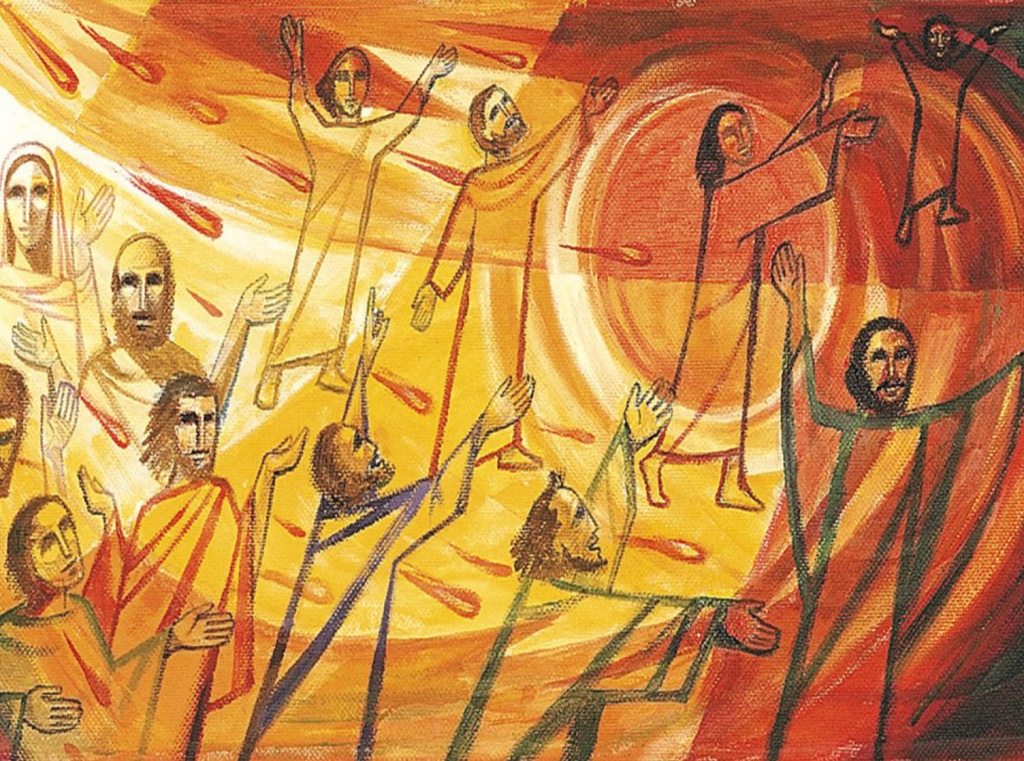
The Spirit is the motivating, energising force that lights the fire of enthusiasm amongst the followers of Jesus in the early days after his ascension (Acts 1:6–11). In his orderly account of the things coming to fulfilment, Luke makes this clear when he reports what takes place on the Day of Pentecost, when the Spirit fell upon the followers of Jesus “gathered in one place … all of them were filled with the Holy Spirit and began to speak in other languages, as the Spirit gave them ability” (Acts 2:1–4).

Soon after that experience, Peter speaks to the gathered crowd, interpreting the portentous events of the day by relating them to Joel 2:28–32, “God declares, I will pour out my spirit upon all flesh” (Acts 2:14–21). Later in this speech, Peter affirms that Jesus, “being exalted at the right hand of God, and having received from the Father the promise of the Holy Spirit, he has poured out this that you both see and hear” (2:33).

From Pentecost onwards, the Spirit is active; Luke regularly and consistently notes the presence of the Spirit throughout the events that follow. Specific leaders within the early church are said to be “filled with the Spirit”: Peter (4:8), Stephen (6:3, 5; 7:55), Paul (9:17; 13:9), and Barnabas (11:24). This phrase signals the reactivation of the Spirit in ways that evoke the time, before the birth of Jesus, when key figures were “filled with the Spirit” (1:35, 41, 67), and at the start of the public activity of Jesus, when he was “filled with the Spirit” (4:1, 14).

Indeed, in the early period, the whole community in Jerusalem is filled with the spirit: “they were all filled with the Holy Spirit and spoke the word of God with boldness” (4:31). Beyond Judea, the Spirit guides Philip to travel with the Ethiopian eunuch on the wilderness road to Gaza (8:29, 39), inspires Agabus to prophesy in Antioch (11:28), and probably also is active through the “burning enthusiasm” of the preaching of Apollos in Ephesus (18:25).

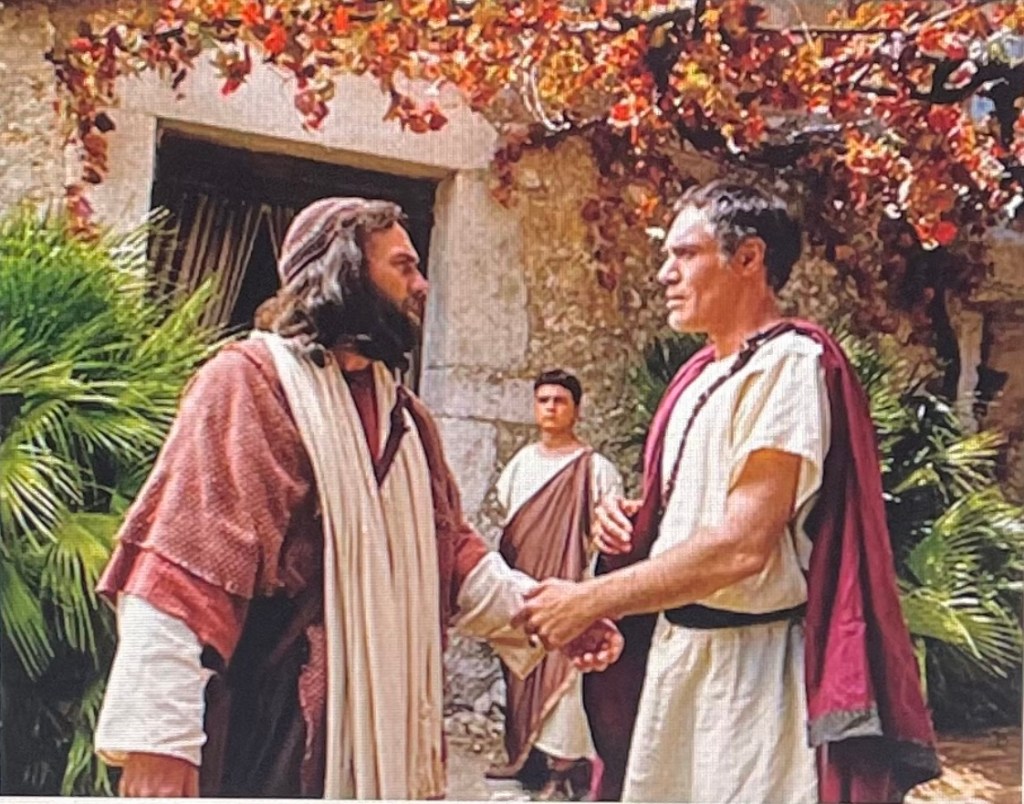
When the persecutor Saul has his dramatic encounter on the road to Damascus, a disciple in that city named Ananias is pivotal in the story. In a vision, he is commanded to go to where the blinded Saul is staying, and say to him, “Brother Saul, the Lord Jesus, who appeared to you on your way here, has sent me so that you may regain your sight and be filled with the Holy Spirit” (9:17). As Saul regains both sight and appetite (9:18–19), so he is now open to the work of the Spirit in what he does.

Later on, in Antioch, “while they were worshiping the Lord and fasting, the Holy Spirit said, ‘Set apart for me Barnabas and Saul for the work to which I have called them’” (13:2). Accordingly, “being sent out by the Holy Spirit” (13:4), Barnabas and Saul begin their travels, preaching and performing miracles to people in the eastern Mediterranean.

See also

https://johntsquires.com/2022/06/01/towards-pentecost-1-the-revived-activity-of-the-spirit/
https://johntsquires.com/2022/06/02/towards-pentecost-2-the-spirit-in-the-story-of-jesus/
https://johntsquires.com/2021/05/19/pentecost-the-spirit-and-the-people-of-god-acts-2-pentecost-b/
Unknown's avatarAuthor John T SquiresPosted on June 3, 2022June 3, 2022Categories An Orderly Account: Gospel of LukeTags scripture; theology; Luke; Acts; spirit; PentecostLeave a comment on Towards Pentecost (3): the Spirit in the story of the early Jesus movement

Towards Pentecost (2): the Spirit in the story of Jesus

Towards Pentecost (2): the Spirit in the story of Jesus

1 The Spirit at the start of the story of Jesus

As we read the whole story that has been compiled by Luke, in his orderly account, we note that the Spirit plays a key role from the very beginning. The first person we meet in Luke’s narrative is Zechariah the priest, a man devoted to the service of God in the Temple (1:8–9). Zechariah himself will later be filled with the Spirit (1:67) and sing of what God will do through his son, John (1:68–79)—although first he will be struck dumb (1:20, 22), because he did not believe the words of the angel, that his son would be “filled with the Holy Spirit” (1:15) and go before God “with the spirit and power of Elijah” (1:17). Zechariah’s spirit-filled song is possible after he is miraculously able to speak once more (1:64).

His wife, Elizabeth, expresses an attitude of deep faith in God, accepting her surprise pregnancy as “what the Lord has done for me” (1:25). They are both described as “righteous before God” (1:6). Elizabeth maintains her faith throughout her pregnancy; she herself is “filled with the Spirit” (1:41) as she sings a blessing over her relative Mary (1:42–45).

Mary, demonstrates a similar faith as she submits to a similar fate, bearing a child, with the words, “here am I, the servant of the Lord” (1:38). She articulates the traditional hopes and expectations of the people in a spirit-inspired song known as the Magnificat (1:46–55; compare 1 Sam 2:1–10). Mary is “overshadowed” by the Spirit (1:35), just as Zechariah and Elizabeth had both been “filled” with the Spirit (1:41, 1:67).

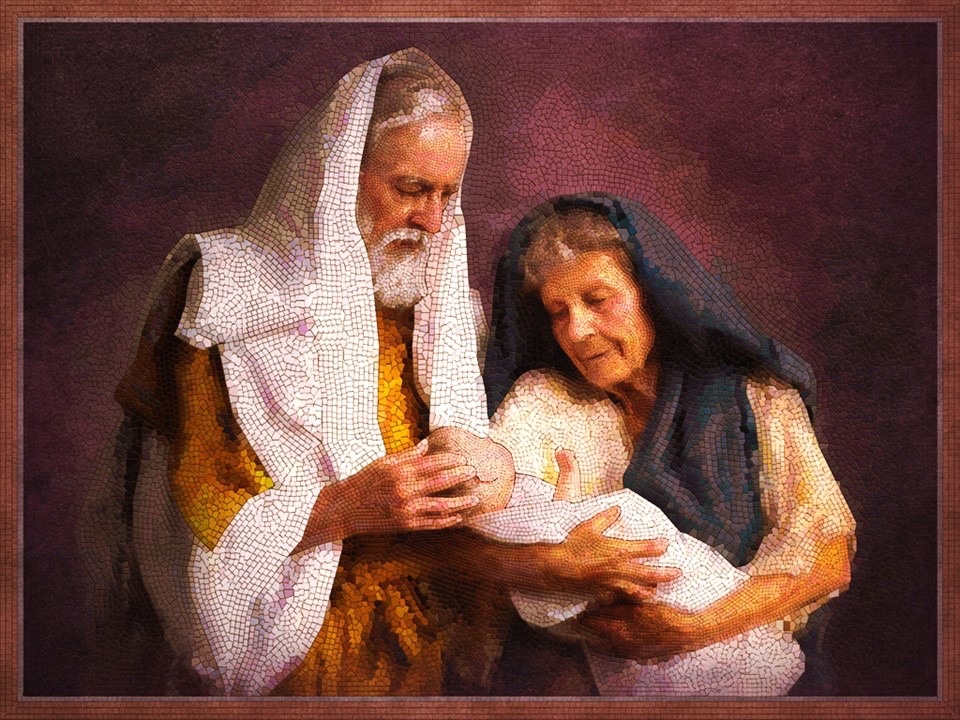
After Mary’s child is born, he is taken to the Temple where Simeon sings another song (2:29–32, known as the Nunc dimittis, or the Song of Simeon). His song continues the strongly Jewish tone of the earlier songs of Zechariah, Mary, and Elizabeth. Simeon is “righteous and devout, looking forward to the consolation of Israel” (2:25); the Spirit “rested on him” (2:25), then “revealed to him” the words he then speaks (2:26) before “guiding him … into the temple” (2:27).

Alongside Simeon in the Temple, Mary and her husband Joseph encounter the prophet Anna (2:38). As she is a prophet, her words (although not reported directly by Luke) are likewise spirit-inspired (as are all prophetic utterances), as she “began to praise God and to speak about the child to all who were looking for the redemption of Jerusalem” (2:38). The hopes of the Jewish tradition are strong and clear.

The sense of deeply devoted and strongly conventional Jewish piety continues in the reports of the early years of Jesus. It is only in Luke’s Gospel that we find the information that Jesus was circumcised after eight days (2:21), that his mother was subsequently purified and brought offerings to the Temple (2:22–24), that the family made Passover pilgrimage to Jerusalem (2:41) and that Jesus showed an early interest in discussing matters of the Law (2:42-51). The child, Luke reports, grew in wisdom and divine favour (2:40, 52)—surely indications that the Spirit has been active in these scenes which provide an entry into the story that Luke tells in the following chapters.

This is the same Spirit that has been active since the moment of creation (Gen 1:2), that was breathed into human beings (Gen 2:7), and that infuses every one of the creatures brought into being in God’s wonderful creation (Ps 104:24–30). It is this Spirit that has endowed individuals with leadership (Exod 31:2–3; Num 11:25–26; Deut 34:9; and a number of judges) and which has inspired prophets to proclaim the word of the Lord (Isa 61:1; Ezek 2:2; Joel 2:28–29).

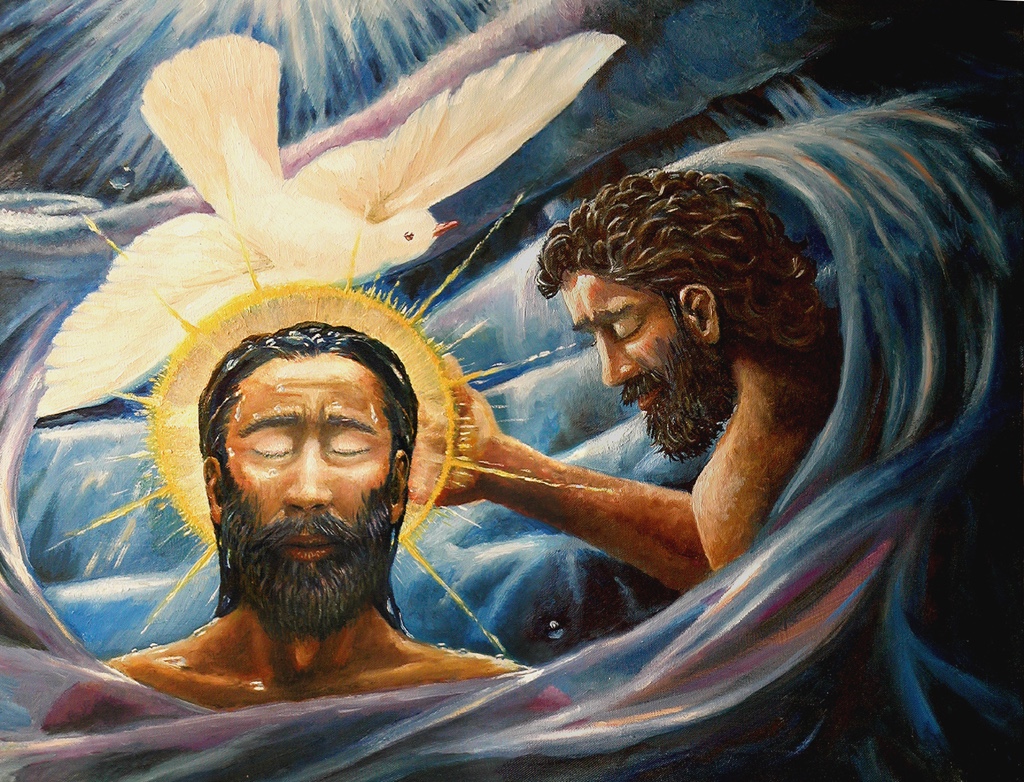
And it is this Spirit which impels the adult Jesus into action. John the baptiser declares that the one coming after him will baptise ”with the Holy Spirit and with fire” (3:16); soon after, Luke reports that “when Jesus also had been baptized and was praying, the heaven was opened, and the Holy Spirit descended upon him in bodily form like a dove” (3:21–22).

Almost immediately, “Jesus, full of the Holy Spirit, returned from the Jordan and was led by the Spirit in the wilderness, where for forty days he was tested by the devil” (4:1–2). After those forty days, “Jesus, filled with the power of the Spirit, returned to Galilee” (4:14), where he taught in synagogues. In the synagogue in Nazareth, Jesus read from the prophet Isaiah, claiming that the prophetic words applied directly to him: “The Spirit of the Lord is upon me, because he has anointed me to bring good news to the poor … today this scripture has been fulfilled in your hearing” (4:18, 21).

The opening chapters of Luke’s long narrative clearly put the Spirit on centre stage. The Spirit has not been quenched, as Josephus appears to indicate. The Spirit is still active!

2 The Spirit throughout the story of Jesus

We have noted the concentration of references to the spirit in the opening chapters of Luke’s orderly account. The guiding presence of the spirit in Luke 3:16–4:21 indicates that the public activities of the adult Jesus that follow are all to be understood as being guided, impelled, and shaped by the activity of the Spirit.

References to the Holy Spirit in the body of the Lukan story of Jesus (from 4:31 to 24:53) are, by comparison, relatively sparse. More frequent are the references to the evil spirits with whom Jesus engages, at least in the earlier stages of the story that Luke tells: the spirits in a man in the synagogue in Capernaum (4:33), in a demon-possessed man the country of the Gerasenes (8:29), in the daughter of Jairus, a leader of the synagogue (8:55), in the boy convulsing because of an unclean spirit (8:39, 42), and in the woman crippled for eighteen years (13:11).

Jesus understands that what he hears about from the seventy that he sent out to “cure the sick who are there, and say to them, ‘The kingdom of God has come near to you’” (10:9) is, in fact, the cosmic conflict of which these individual exorcisms are an integral part: “I watched Satan fall from heaven like a flash of lightning. See, I have given you authority to tread on snakes and scorpions, and over all the power of the enemy; and nothing will hurt you” (10:18–19).

Luke reports that Jesus “rejoiced in the Holy Spirit” on hearing reports from the seventy (10:21). He understands that “if it is by the finger of God that I cast out the demons, then the kingdom of God has come to you” (11:20). The conflict with spirits and demons is integral to the Spirit-inspired mission that he had announced in his programmatic sermon in Nazareth (4:18–21). That conflict continues throughout the ensuing chapters, as the spirit-filled Jesus grapples with the unclean spirits possessing human beings.

The gift of the Spirit which Jesus knew is, he says, available to those who ask in faith: “if you then, who are evil, know how to give good gifts to your children, how much more will the heavenly Father give the Holy Spirit to those who ask him!” (11:13). It is not just Jesus who is endowed by the Spirit; those who follow Jesus and ask in faith will also be spirit-gifted. So Jesus assures his followers that, “when they bring you before the synagogues, the rulers, and the authorities … the Holy Spirit will teach you at that very hour what you ought to say” (12:11–12).

There is just one further reference to spirit in Luke’s Gospel, at the very end of Jesus’ life, when his final words from the cross (quoting a psalm) are, “Father, into your hands I commend my spirit” (23:46, quoting Ps 31:5). Jesus goes to his death with certainty, knowing his fate, assured that he will be received by God as he seemingly chooses his time of death at the climactic moment in the story.

Complementing that handing over of the spirit is the promise by the risen Jesus, speaking to his disciples just before he ascends into heaven, declaring to them that “you will receive power when the Holy Spirit has come upon you” (Acts 1:8). The Spirit then returns to the forefront of the narrative concerning the early movement of followers of Jesus and the communities of messianic believers that they establish around the eastern Mediterranean world. We will trace that in a subsequent blog post.

Unknown's avatarAuthor John T SquiresPosted on June 2, 2022June 1, 2022Categories An Orderly Account: Gospel of LukeTags scripture; theology; Luke; Acts; spirit; PentecostLeave a comment on Towards Pentecost (2): the Spirit in the story of Jesus

Towards Pentecost (1): the revived activity of the Spirit

Towards Pentecost (1): the revived activity of the Spirit

Towards the end of the first century CE, the Jewish historian and apologist, Flavius Josephus, wrote a two-volume treatise rebutting the criticism of Judaism which had been made by Apion Pleistoneices, an Egyptian writer of the early first century, who was famous for his breadth of knowledge and ostentatious oratory.

In the course of his analysis of the claims of Apion, Josephus deals with the works that form scripture for the Jews—22 books “which contain the records of all the past times which are justly believed to be divine” (Josephus, Against Apion 1.38). Josephus makes the claim that the authors of these works were “prophets that have written the original and earliest accounts of things as they learned them from God himself by inspiration; and writing down what happened in their own times in a very exact manner also” (1.37). These works, says Josephus, cover the time from Moses to Artaxerxes; he regards them as divinely-inspired, accurate and reliable.

He distinguishes them from a series of later works, which set out events in subsequent decades. Of these, he makes this claim: “our history has been written since Artaxerxes very thoroughly, but it has not been considered of equal authority with the earlier records by our forefathers, because there has not been an exact succession of prophets since that time” (Josephus, Against Apion 1.41). This last claim–the lack of prophets in recent centuries–has resonated in the histories of Judaism, and Christianity; it led to the notion that prophecy ended because the Spirit had become inactive.

In this context, it is striking to note the way that Luke starts his orderly account of the things that have come to fulfilment amongst us (the two volumes we know as the Gospel according to Luke, and the Acts of the Apostles). The Holy Spirit plays a central, active role in these writings. In the first volume of his orderly account, Luke highlights the Spirit at key places in the narrative, beginning even before the conception and birth of Jesus.

The events reported in the second volume are generated from the dramatic intervention of the Spirit into the early community formed by the followers of Jesus after his ascension. The story of that intervention—known to us as the coming of the Spirit on the Day of Pentecost—is told early in Acts (2:1-42). Jews from around the eastern Mediterranean are gathered in Jerusalem for the annual festival (2:1-13), when the Spirit comes upon them. This is the event that is remembered each year, in the calendar of the church, at Pentecost (this year, on Sunday 5 June).

A second story of the coming of the Spirit is told at a later point in Acts—after Peter sees a vision in which God declares all food clean, and he is summoned to the home of the Gentile centurion, Cornelius, in Caesarea (10:1-33). As Peter preaches to the Gentiles, the Spirit falls on them, “just as it had upon us [Jews] at the beginning (11:15). The importance of the Spirit in Luke’s account of the early movement cannot be underestimated. The significance for the church today of the Spirit’s empowering presence at Pentecost is likewise high.

The Spirit, of course, was not a new concept to the people,of Israel, for the Spirit had already been active throughout the stories told by the people of Israel about their ancestors. It was the same Spirit who was seen to be active in the creation of the world (Gen 1:1–2; Job 33:4; Ps 104:30; Isa 42:5) who then guides selected leaders within Israel. The Spirit is active in stories about Moses (Num 11:16–17); Joshua (Deut 34:9); Othniel (Judg 3:10); Gideon (Judg 6:34); and David (1 Sam 16:17).

The Spirit inspires prophecy (1 Sam 10:6, 19:23–24; Ezek 37:1; Joel 2:28–29; Mic 3:8), enables the interpretation of dreams by Joseph (Gen 41:38) and Daniel (Dan 4:8,18, 5:1), and gives other specific gifts to Israel (Num 11:25; Deut 34:9; Dan 4:8–18; Prov 1:23).

The qualities of the Spirit will characterise the coming Messianic figure envisaged by the prophet Isaiah (Isa 11:2–5). This idea is taken up later in Isaiah in descriptions of the Servant (Isa 42:1–4; 61:1–7). In second Isaiah the Spirit is promised as a gift to the people who are led by the Servant (Isa 42:5; 44:3; 48:16; 59:21). Third Isaiah recalls the time of Moses as a period when the Spirit was given to Israel (Isa 63:11–14).

So Luke stands firmly within the tradition of the people of Israel—the tradition of Jesus himself—as he narrates the story of Jesus, and his followers, in the two volumes of his orderly account. The story of Pentecost is a climactic and pivotal moment in that narrative. We need to see it in relation to what has come before it, and also what follows on after it.

This is the first in a series of posts relating to Pentecost, exploring the role of the Spirit in the two volumes of Luke’s orderly account (Luke-Acts). Stay tuned for more each day … … …

*****

… and see previous posts at

https://johntsquires.com/2020/05/29/pentecost-the-spirit-is-for-anyone-for-everyone/

and

https://johntsquires.com/2021/05/19/pentecost-the-spirit-and-the-people-of-god-acts-2-pentecost-b/

and

https://johntsquires.com/2020/05/27/what-does-this-mean-wind-and-fire-tongues-in-the-temple-on-pentecost-sunday-acts-2/

and

https://johntsquires.com/2019/06/03/ten-things-about-pentecost/
Unknown's avatarAuthor John T SquiresPosted on June 1, 2022June 2, 2022Categories An Orderly Account: Gospel of LukeTags scripture; theology; Luke; Acts; spirit; PentecostLeave a comment on Towards Pentecost (1): the revived activity of the Spirit

The focus on Luke’s “orderly account” during this year

The focus on Luke’s “orderly account” during this year

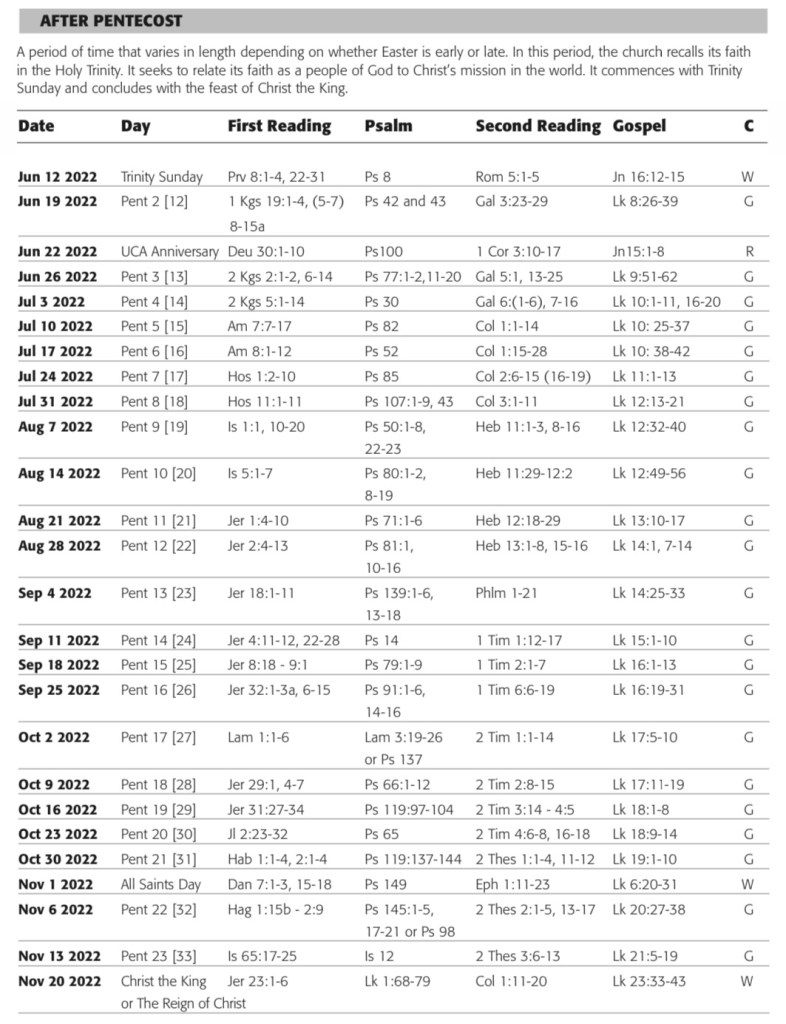
The Christian church follows a pattern of seasons throughout the year, forming what is known as the “liturgical year”. Each Sunday, in worship, a set of scripture passages are designated, to provide a rich diet of readings for reflection. The readings follow a pattern for each year, in which designated parts of scripture are provided.

You can see the pattern of readings in the coming months in this schedule:

This year is known as Year C, and during this year it is the longest version of the story of Jesus, an orderly account of the events that have been fulfilled among us, which is provided for our weekly Gospel passages.

This orderly account, offered to a person named lover of God (in Greek, Theophilus), we are told, was written so that this Theophilus might know the certainty concerning the things about which you have been instructed (Luke 1:1–4).

Of course, we know this as the Gospel according to Luke. And we know that the author of this work (unnamed in the actual text; by tradition, known as Luke) also wrote a companion volume, in which we hear accounts of how the followers of Jesus bore witness to him in Jerusalem, in all Judea and Samaria, and to the ends of the earth (Acts 1:8).

In introducing his,work, the author of this orderly account notes that he received accounts from eyewitnesses and servants of the word which he investigated carefully over an extended period of time, before constructing the orderly account designed to make known the certainty of the story that he tells (Luke 1:1–4).

(In making this claim, I am translating the Greek often rendered as “from the beginning” in 1:3 as “over an extended period of time”; and the word rendered as “the truth” in 1:4 as, more accurately, “the certainty”.)

As we read and ponder stories from Luke’s orderly account, we do well to remember that Mark’s beginning story was one of the sources used by Luke. Comparisons with the earlier Markan version will identify differences which may well be significant. Has Luke intentionally modified a turn of phrase, or reshaped a story outline, or even relocated a particular incident to a different point in the overall story? Or are the differences just minor, insignificant, of no major importance? Those questions stand, week by week, as we work through the stories offered in the lectionary.

In like manner, we will need to recognise that this Gospel is but “the first book” addressed to Theophilus (Acts 1:1), and so the way that the story unfolds in later chapters, after the time of Jesus, through the actions and words of key followers, as told in the second volume, which we know as the Acts of the Apostles, will inform the way we approach and understand the orderly account of the years of Jesus, told in the Gospel.

So as we read, we would do well to have one eye, as it were, looking back, to the sources used by the author—the Gospel of Mark, and the hypothetical Q source of sayings of Jesus, and perhaps others—looking to see how the author of the orderly account has tweaked and massaged and ordered his material. (This is doing what scholars call redaction criticism; paying attention to the redactional work of the person editing all the material into a cohesive whole.)

And as we read, we would also do well to have the other eye metaphorically looking forward to the second volume by the same author. We do this in order to pay attention to the way that what has happened in later decades, as reported in this second volume, and on up to the time when the author was writing, has shaped and influenced the way the earlier story of Jesus is told. (This is paying attention to the social context of the author and the way that earlier material is reported in ways influenced by that context.)

So reading this orderly account requires attention to a number of elements, with one looking back to sources, to see how they are used in telling the story of Jesus, as the other eye looks forward to subsequent events, to see how they influence the story of Jesus. And as we read, and reflect, we may well note a number of key features that characterise this orderly account and which take us to the heart of matters which, to the author, are of vital importance.

I am currently working as Editor to a resource that is published four times a year, With Love to the World, which contains short commentaries for the biblical passages offered each week, as well as a short prayer, a song for singing, and a question to spark discussion about the passage if used in a group setting. It’s a helpful, user-friendly resource that is used by thousands of people each day.

With Love to the World can be ordered as a printed resource for just $24 for a year’s subscription (see http://www.withlovetotheworld.org.au/wp-content/uploads/2020/07/Ordering-and-paying-for-Website-7.vii_.2020.pdf) or it can be accessed on phones and iPads via an App, for a subscription of $24.49 per year (go to the App Store or Google Play).

Unknown's avatarAuthor John T SquiresPosted on May 31, 2022May 28, 2022Categories An Orderly Account: Gospel of LukeTags interpretation, scripture, theologyLeave a comment on The focus on Luke’s “orderly account” during this year

Posts pagination

Previous page Page 1 … Page 8 Page 9 Page 10 … Page 22 Next page

The Book of Origins

  • Leaving Luke . . . Meeting Matthew
  • Matthew: tax collector, disciple, apostle, evangelist—and “scribe trained for the kingdom”? (Matt 9; Pentecost 2A)
  • For our instruction … that we might have hope (Rom 15, Isa 11, Matt 3; Advent 2A)
  • The origins of Jesus in the book of origins: Matthew 1 (Advent Year A)
  • Now the birth of Jesus the Messiah took place in this way (Matthew 1; Advent 4A)
  • Descended from David according to the flesh (Rom 1; Advent 4A)
  • A young woman? A virgin? Pregnant? About to give birth? (Isa 7:14 in Matt 1:23; Advent 4A)
  • More on Mary (from the Protoevangelium of James)
  • Tales from the Magi (the Revelation of the Magi)
  • Herod waiting, Herod watching, Herod grasping, holding power (Matt 2; Christmas 1A)
  • Herod was infuriated, and he sent and killed all the children (Matt 2; Christmas 1A)
  • Repentance for the kingdom (Matt 4; Epiphany 3A)
  • Proclaiming the good news of the kingdom (Matt 4; Epiphany 3A)
  • Teaching in “their synagogues” (Matt 4; Epiphany 3A)
  • Teaching the disciples (Matt 5; Epiphany 4A)
  • Blessed are you: the Beatitudes of Matthew 5 (Epiphany 4A)
  • An excess of righteous-justice (Matt 5; Epiphany 5A)
  • You have heard it said … but I say to you … (Matt 5; Epiphany 6A)
  • The missing parts of the Sermon on the Mount (Matt 6 and 7; Epiphany Year A)
  • Our Father in heaven: a pattern for prayer (Luke 11, Matt 6) part III
  • Our Father in heaven: a pattern for prayer (Luke 11, Matt 6) part II
  • Our Father in heaven: a pattern for prayer (Luke 11, Matt 6) part I
  • “Go nowhere among the Gentiles” (Matt 10:5): the mission of Jesus in the book of origins (Pentecost 3A)
  • “Even the hairs of your head are all counted.” (Matt 10:30; Pentecost 4A)
  • Come to me, take my yoke, I will give you rest (Matt 11; Pentecost 6A)
  • Parables: the craft of storytelling in the book of origins (Matt 13; Pentecost 7A)
  • The righteous-justice of God, a gift to all humanity (Romans; Year A)
  • Let anyone with ears, hear! (Matt 13; Pentecost 8A)
  • Chopping and changing: what the lectionary does to the parables of Matthew (Pentecost 7–9A)
  • Nothing but five loaves and two fish (Matt 14; Pentecost 10A)
  • Liminal experiences and thin places (Matt 14; Pentecost 11A)
  • It’s all in the geography. Jesus, the Canaanite woman, and border restrictions (Matt 15; Pentecost 12A)
  • A rock, some keys, and a binding: clues to the identity of Jesus (Matt 16; Pentecost 13A)
  • An invitation that you just cannot … accept! (Pentecost 19A)
  • Towards Palm Sunday (Matt 21): Passover and politics
  • Towards Palm Sunday (Matt 21): Riding on a donkey (or two) as the crowd shouts ‘Hosanna’
  • Towards Palm Sunday (Matt 21): Waving branches, spreading cloaks
  • Towards Palm Sunday (Matt 21): Acclaiming the king, anticipating the kingdom
  • Producing the fruits of the kingdom (Matt 21; Pentecost 19A)
  • Darkness, weeping, and gnashing of teeth: the scene of judgement (Matt 22; Pentecost 20A)
  • The greatest and first commandment … and a second, like it (Matt 22)
  • On these two commandments hang all the law and the prophets (Matt 22; Pentecost 22A)
  • Sitting on the seat of Moses, teaching the Law—but “they do not practice what they teach” (Matt 23; Pentecost 23A)
  • Discipleship in an apocalyptic framework (Matt 23–25; Pentecost 23–26A)
  • A final parable from the book of origins: on sheep and goats, on judgement and righteous-justice (Matt 25; Pentecost 26A)
  • Scripture debate and disputation in the wilderness (Matt 4; Lent 1A)
  • Testing (not temptation) in the wilderness (Matt 4; Lent 1A)
  • Practising righteous-justice: alms, prayer, and fasting (Ash Wednesday)
  • Forcing scripture to support doctrine: texts for Trinity Sunday (2 Cor 13, Matt 28; Trinity A)

An Orderly Account: Luke and Acts

  • “An orderly account”: a quick guide to Luke and Acts
  • Costly discipleship, according to Luke
  • Did Luke write the first “orderly account” about Jesus?
  • With one eye looking back, the other looking forward: turning to Luke’s Gospel I (Year C)
  • Leaving out key moments, so they can appear later in the story: turning to Luke’s Gospel III (Year C)
  • “A light for the Gentiles, salvation to the ends of the earth”: turning to Luke’s Gospel II (Year C)
  • The scriptural resonances in the Annunciation (Luke 1; Advent 4B)
  • Magnificat: the God of Mary (Luke 1) is the God of Hannah (1 Sam 2) (Advent 4C)
  • “To give knowledge of salvation”: Luke’s portrayal of John the baptiser (Luke 3; Advent 2C)
  • On angels and virgins at Christmastime (Luke 2; Christmas Day B)
  • A light for revelation to the Gentiles and for glory to your people Israel (Luke 2; Christmas 1B)
  • John the baptiser’s call for ethical, faithful living (Luke 3; Advent 3C)
  • A Testing Time: forty days in the wilderness (Luke 4)
  • Sacred place and sacred scripture: forty days in the wilderness (2)
  • Scripture fulfilled in your hearing (Luke 4:16-30; Epiphany 3C, 4C)
  • Jesus and conventional Jewish piety (Luke 4:16; Epiphany 3C)
  • Jesus, scripture and experience (Luke 4:17, 21; Epiphany 3C)
  • The holistic spirit-inspired mission of Jesus (Luke 4:18–19; Epiphany 3C)
  • Jesus, the widow of Sidon and the soldier of Syria: representatives of the community of faith (Luke 4:25–27; Epiphany 4C)
  • Two prophets of Israel, the widow of Sidon and the soldier of Syria: an inclusive community of Jews and Gentiles (Luke 4:25–27; Epiphany 4C)
  • Leave everything, follow Jesus (Luke 5:1-11; Epiphany 5C)
  • On a level place, with a great crowd (Luke 6; Epiphany 6C)
  • Blessed are you … poor, hungry, weeping … (Luke 6; Epiphany
  • The plain, the synagogue, and the village (Luke 6, 4 and 1; Epiphany 6C)
  • Bless—Love—Forgive—and more. The teachings of Jesus (Luke 6; Epiphany 6C, 7C)
  • The beloved physician, the lover of God, and loving our enemies (Luke 6; Epiphany 7C)
  • Perfect, or merciful? The challenge Jesus poses (Matt 5, Epiphany 7A; Luke 6, Epiphany 7C)
  • Jesus and his followers at table in Luke’s “orderly account”
  • Before Transfiguration Sunday, the stories of the dying slave and the grieving widow (Luke 7; Epiphany 9C; Proper 4C)
  • What have you to do with me, Jesus? (Luke 8; Pentecost 2C)
  • Bringing his ‘exodos’ to fulfilment (Luke 9; Transfiguration C)
  • Setting his face to go to Jerusalem (Luke 9:51, 13:33, 17:11, 19:11; Lent 2C)
  • Through Samaria, heading to Jerusalem (Luke 9; Pentecost 3C)
  • Sent out in Samaria, proclaiming the kingdom (Luke 10; Pentecost 4C)
  • Listening and learning at the feet of Jesus (Luke 10; Pentecost 6C)
  • Mary and Martha: models of women following and learning from Jesus (Luke 10; Pentecost 6C)
  • There is need of only one thing. Or, maybe, two. (Luke 10; Pentecost 6C)
  • Where have all the women gone? Women in the movement initiated by Jesus (Luke 10; Pentecost 6C)
  • On earth, as in heaven: the key to The Lord’s Prayer (Luke 11; Pentecost 7C)
  • Sins or trespasses? Trial or temptation? Thine or yours? The prayer that Jesus taught (Luke 11; Pentecost 8C)
  • “Where your treasure is, there your heart will be also” (Luke 12; Pentecost 8C)
  • Coming to grips with the judgement of God (Luke 12 and Isaiah 5; Pentecost 10C)
  • She stood up straight and they were put to shame (Luke 13; Pentecost 11C)
  • Jerusalem, Jerusalem: holy city, holy calling (Luke 13; Lent 2C)
  • Disturbing discipleship: exploring the teachings of Jesus in Luke 14 (Pentecost 12C to 13C)
  • Disreputable outsiders invited inside: parables in Luke 14 (Pentecost 12C, 13C)
  • The discomfort of ambiguity (Luke 15; Lent 4C)
  • Human sinfulness and divine grace (Jeremiah 4; Luke 15; 1 Timothy 1; Pentecost 14C)
  • Shrewd? dishonest? manipulative? or contributing to the common good? (Luke 16; Pentecost 15C)
  • Lazarus and the rich man (Luke 16; Pentecost 16C)
  • Faith the size of a mustard seed (Luke 17; Pentecost 17C)
  • Was none of them found to return and give praise to God except this foreigner? (Luke 17; Pentecost 18C)
  • Unjust judge, shameless widow (Luke 18; Pentecost 19C)
  • In defence of the Pharisees: on humility and righteousness (Luke 18; Pentecost 20C)
  • Zacchæus: patron saint of change and transition (Luke 19; Pentecost 21C)
  • “When these things begin to take place … your redemption is drawing near” (Luke 21; Advent 1C)
  • “Be alert at all times, praying that you may have the strength … to stand before the Son of Man” (Luke 21; Advent 1C)
  • Look up to the sky? Look down to your feet! (Luke 20; Pentecost 22C)
  • Don’t take it at face value: on former things and new things
  • Don’t take it at face value: on what lies behind and what lies ahead (Lent 2C)
  • The death, resurrection and ascension of Jesus in Luke’s “orderly account”
  • What do you see? What do you hear? (Luke 19; Palm Sunday C)
  • Holy Week: the week leading up to Easter
  • Sacrificial death and liberating life: at the heart of Easter
  • Ministry and Mission in the midst of change and transition (Luke 21:13; Pentecost 23C)
  • Easter in Christian tradition and its relation to Jewish tradition
  • A time in-between the times, a space in no-space.
  • The tomb is empty. He is not here. He is risen. (Luke 24; Easter Sunday)
  • He Is Not Here Day
  • Discovering new futures … letting go of the old
  • The moment of recognition: walking … talking … listening … understanding … (Luke 24; Easter evening; Easter 3A)
  • Ten things about Pentecost (Acts 2)
  • The cross-cultural nature of the early Jesus movement
  • From Learners to Leaders: deepening discipleship in Luke’s “orderly account”
  • Constantly devoting themselves to prayer (Acts 1; Easter 7A)
  • You will be my witnesses (Acts 1; Easter 7A)
  • Judas: reconsidering his part in the Easter story (Acts 1; Easter 7B)
  • Pentecost, the Spirit, and the people of God (Acts 2; Pentecost B)
  • What God did through him: Peter’s testimony to Jesus (Acts 2; Easter 2A)
  • What God did through him: proclaiming faith in the public square (Acts 2; Easter 2A)
  • Repent and be baptised: Peter’s Pentecost proclamation (Acts 2; Easter 3A)
  • The church in Acts: Times of refreshing (Acts 3; Easter 3B)
  • Boldly proclaiming “no other name” (Acts 4; Easter 4 B)
  • The church in Acts: Unity, testimony, and grace (Acts 4; Easter 2B)
  • We must obey God rather than human authority (Acts 5; Easter 2C)
  • Edging away from the centre (Acts 8; Easter 5B)
  • What happened after Philip met the Ethiopian? (Acts 8; Easter 5B)
  • The calling of Saul and the turn to the Gentiles: modelling the missional imperative (Acts 8—12; Easter 3C)
  • People of ‘The Way’ (Acts 9; Easter 3C)
  • You will be told what you are to do (Acts 9; Easter 3C)
  • Resurrection life, economic responsibility, and inclusive hospitality: markers of the Gospel (Acts 9)
  • Another resurrection! (Acts 9; Easter 4C)
  • Even to the Gentiles! (Acts 10; Easter 6B)
  • Even to the Gentiles (Acts 11; Easter 5C)
  • On literary devices and narrative development (Acts 16; Easter 7C)
  • The unknown God, your own poets, and the man God chose: Paul on the Areopagus (Acts 17; Easter 6A)
  • Paul, Demetrius and Damaris: an encounter in Athens (Acts 17:16-17,22–34)
  • Lydia, Dorcas, and Phoebe: three significant strategic leaders in the early church
  • An Affirmation for Our Times
  • I make prayers on your behalf (Letters to Luke #1; Year C)
  • I rejoice in the gift of writing (Letters to Luke #2; Year C)
  • How exciting it was! (Letters to Luke #3; Year C)
  • I write briefly (Letters to Luke #4; Year C)
  • I am happy to report that we have held another reading (Letters to Luke #5; Year C)
  • I was astonished to receive your brief note (Letters to Luke #6; Year C)
  • Leaving Luke . . . Meeting Matthew

Scripture and Theology

  • The Word of God, Scripture, and Jesus Christ
  • Marrying same-gender people: a biblical rationale
  • Discernment
  • Interpreting the creeds “in a later age”
  • Affirming the Teachings of Jesus
  • To articulate faith contextually
  • Let your gentleness be known to everyone
  • What can we know about the birth of Jesus?
  • “An orderly account”: a quick guide to Luke and Acts
  • Costly discipleship, according to Luke
  • In the wake of the verdict about Pell …
  • Another Time, Another Place: towards an Australian Church
  • Holy Week: the week leading up to Easter
  • Sacrificial death and liberating life: at the heart of Easter
  • The death, resurrection and ascension of Jesus in Luke’s “orderly account”
  • Easter in Christian tradition and its relation to Jewish tradition
  • The cross-cultural nature of the early Jesus movement
  • Jesus and his followers at table in Luke’s “orderly account”
  • Once again: affirming our diversity, celebrating joyous marriages
  • Ten things about Pentecost (Acts 2)
  • The Paraclete in John’s Gospel: exploring the array of translation options (John 14, 15, 16)
  • “Do you believe in the Triune God?”
  • The DNA of the UCA (part I)
  • The DNA of the UCA (part II)
  • Harness the passion, but restrain the rhetoric. Musing on the role model which Paul offers in Galatians.
  • Providing for the exercise by men and women of the gifts God bestows upon them: lay people presiding at the sacraments in the Uniting Church
  • Freedom and unity: themes in Galatians
  • Australian Religious Leaders support renewable energy
  • Human sexuality and the Bible
  • Dividing the unity, splintering the connections: more ACC agitation
  • Giving Voice, Telling Truth, Talking Treaty: NAIDOC 2019
  • Advocacy and Climate Change, Growth and Formation, Treaty with First Peoples: Synod 2019
  • Climate Change: a central concern in contemporary ministry
  • On earth, as in heaven: the key to The Lord’s Prayer (Luke 11; Pentecost 7C)
  • Ramping up the rhetoric, generating guilt and provoking panic: the failed strategy of conservatives in the UCA (part I)
  • Ramping up the rhetoric, generating guilt and provoking panic: the failed strategy of conservatives in the UCA (part II)
  • Ramping up the rhetoric, generating guilt and provoking panic: the failed strategy of conservatives in the UCA (part III)
  • International Day of the World’s Indigenous Peoples
  • In the wake of the verdict (and appeal decision) relating to Pell …
  • Where will we find hope? When will we see justice?
  • Supporting the Climate Strike
  • Gracious openness and active discipleship as key characteristics of church membership
  • Please Leave ?? No — Please Stay !!
  • Stones singing and rivers vibrating … a liturgy for Holy Communion
  • Faith in Action: a religious response to the Climate Emergency (Part One)
  • Faith in Action: a religious response to the Climate Emergency (Part Two)
  • Faith in Action: a religious response to the Climate Emergency (Part Three)
  • Celebrating Transitions: into a strange and graceful ease … (part one)
  • Celebrating Transitions: into a strange and graceful ease … (part two)
  • We wait, and hope, and grieve, anticipating …
  • On the move. A reflection on Christmas.
  • Reflecting on faith amidst the firestorms
  • This is the world we live in, this is the Gospel we believe in
  • Giving up? Or going deep? The opportunity of Lent
  • Passing the peace, sharing the elements, greeting the minister
  • When you come together … reflections on community in the midst of a pandemic
  • Holy Week: a week set apart, in a time set apart.
  • It was on that night that everything came to a head. Maundy Thursday Reflections.
  • Sacrificial Death: to give his life. Good Friday Reflections
  • Liminal Space: waiting and not knowing. Holy Saturday Reflections
  • Liberating Life: a new way of being. Easter Sunday Reflections
  • It’s been just over a month—but there have been lots of learnings!
  • Not this year. So what about next year?
  • The times, they are are a-changin’.
  • When we come together (2) … values and principles in the midst of a pandemic
  • It’s been two months under restrictions—what will our future look like? (1)
  • It’s been two months under restrictions—what will our future look like? (2)
  • Saying sorry, seeking justice, walking together, working for reconciliation
  • Worship like the first Christians. What will our future look like? (3)
  • Pentecost: the spirit is for anyone, for everyone.
  • Racism and Reconciliation
  • Paul’s vision of “One in Christ Jesus” (Gal 3:28) and the Uniting Church
  • In memory of James Dunn (1939–2020)
  • Black Lives Matter. Now—and Then.
  • Hiroshima and Nagasaki (1945), and the commitment to seek peace (2020)
  • Sexuality and Gender Identity Conversion Practices Bill: A Christian Perspective
  • Always Was, Always Will Be. #NAIDOC2020
  • The Lectionary: ordering the liberty of the preacher
  • Women in the New Testament (1): the positive practices of Jesus and the early church
  • Women in the New Testament (2): six problem passages
  • Reflections on a significant anniversary
  • What do we know about who wrote the New Testament Gospels? (1)
  • What do we know about who wrote the New Testament Gospels? (2)
  • What do we know about who wrote the letters attributed to Paul? (3)
  • What do we know about who wrote the letters in the name of the apostles? (4)
  • Revelation: a complex and intricate world of heavenly beings and exotic creatures
  • Why the Christmas story is not history (1): the “nativity scene” and the Gospels
  • Why “the Christmas story” is not history (2): Luke 1-2 and Matthew 1-2
  • Advent Greetings from Canberra Region Presbytery
  • Honours. Honestly?
  • Celebrations in Canberra (in the Uniting Church Presbytery)
  • Enough is Enough!
  • Earth Day 2021
  • From BC (Before COVID) to AD (After the Disruption)
  • The identity of the Uniting Church
  • #IBelieveHer: hearing the voice of women (Easter Day; John 20)
  • An Affirmation for Our Times
  • The missional opportunity of Trinity Sunday
  • The Murugappans of Biloela
  • World Refugee Day 2021: “when I was a stranger, you welcomed me”
  • The climate is changing; the planet is suffering; humanity is challenged.
  • 20 years on, and the shame continues: the Palapa, the Tampa, and “children overboard”
  • Rosh Hashanah: Jewish New Year
  • Remembering John Shelby Spong (1931–2021)
  • International Day of Indigenous Peoples
  • A Safe Place for Rainbow Christians
  • Working with First Peoples and advocating for them
  • Jesus, growing, learning: a review of ‘What Jesus Learned from Women’
  • “The exercise by men and women of the gifts God bestows upon them”: celebrating women in leadership in the Uniting Church
  • On vaccinations, restrictions, and fundamentalism
  • We are buying more debt, pain, and death: a case against nuclear-powered submarines
  • World Rivers Day (27 September)
  • Affirming and inclusive passages from scripture
  • The challenge of COVID-19 to Social Ethics as we know them
  • Mental Health Day, 10 October
  • The shame continues: SIEV X after 20 years
  • What does it mean to be Protestant in the Contemporary World?
  • Eye of the Heart Enlightened: words for the opening of the Parliamentary Year (2023)
  • Saltiness restored: the need for innovation. An Ordination Celebration.
  • God of all the tribes and nations
  • A Day of Mourning, ahead of Invasion Day (26 January)

Life during COVID 19

  • Passing the peace, sharing the elements, greeting the minister
  • When you come together … reflections on community in the midst of a pandemic
  • Pastoral Letter to Canberra Region Presbytery on COVID-19 pandemic
  • Pastoral Letter to the Canberra Region Presbytery of the Uniting Church in Australia. 31 March 2020
  • Liminal Space: waiting and not knowing. Holy Saturday Reflections
  • It’s been just over a month—but there have been lots of learnings!
  • Not this year. So what about next year?
  • The times, they are are a-changin’.
  • When we come together (2) … values and principles in the midst of a pandemic
  • It’s been two months under restrictions—what will our future look like? (1)
  • It’s been two months under restrictions—what will our future look like? (2)
  • Worship like the first Christians. What will our future look like? (3)
  • Pastoral Letter to Canberra Region Presbytery: June 2020
  • “Greet one another” (2 Cor 13). But no holy kissing. And no joyful singing. (Trinity Sunday A)
  • When you come together (3) … wait for one another (1 Cor 11)
  • Going “back” to church—what will our future look like? (4)
  • Minimising risks in the ongoing reality of COVID-19
  • Pastoral Letter to Canberra Region Presbytery—September 2020
  • Reimagining—the spirit of our times
  • Coping in the aftermath of COVID-19: a global perspective, a local response
  • From BC (Before COVID) to AD (After the Disruption)
  • Values and Principles in the context of a pandemic (revisited)

The First Peoples of Australia

  • The sovereignty of the First Peoples of Australia
  • Affirming the Sovereignty of First Peoples: undoing the Doctrine of Discovery
  • On Covenant, Reconciliation, and Sovereignty
  • Learning of the land (1): Eora, Biripi, Whadjuk Noongar
  • Learning of the land (2): Ngunnawal, Namadgi and Ngarigo
  • The profound effect of invasion and colonisation
  • “Endeavour by every possible means … to conciliate their affections”
  • “We never saw one inch of cultivated land in the whole country”
  • “They stood like Statues, without motion, but grinn’d like so many Monkies.”
  • “Resembling the park lands [of a] gentleman’s residence in England”
  • On Remembering: Cook and Flinders (and Trim), Bungaree and Yemmerrawanne
  • “They are to be hanged up on trees … to strike the survivors with the greater terror.”
  • So, change the date—to what?
  • Learning of the land (3): Tuggeranong, Queanbeyan, and other Canberra place names
  • Learning from the land (4): Naiame’s Nghunnhu—fishtraps at Brewarrina
  • We are sorry, we recognise your rights, we seek to be reconciled
  • Reconciliation on the land of Australia: learning from the past
  • Reconciliation on the land of Australia: Bennelong and Yemmerrawanne
  • Reconciliation on the land of Australia: Bungaree and Mahroot
  • Reconciliation on the land of Australia: Cora Gooseberry and Biddy Giles
  • Reconciliation on the land of Australia: “these are my people … this is my land”.
  • Reconciliation on the land of Australia: living together with respect
  • Dark deeds in a sunny land: the exposé offered by John B. Gribble
  • This is the proper way: no climbing
  • “They appear’d to be of a very dark or black colour”. Cook, HMS Endeavour, and the Yuin people and country.
  • “Three canoes lay upon the beach—the worst I think I ever saw.” James Cook at Botany Bay, 29 April 1770
  • Saying sorry, seeking justice, walking together, working for reconciliation
  • Racism and Reconciliation
  • “We weigh’d and run into the Harbour”. Cook, the Endeavour, and the Guugu Yimithirr
  • Black Lives Matter. Now—and Then.
  • James Cook, the Endeavour, twelve turtles and the Guugu Yimithirr (3)
  • James Cook: Captain? Discoverer? Invader? Coloniser? Cook, the Endeavour, and Possession Island.
  • Always Was, Always Will Be. #NAIDOC2020
  • Invasion and colonisation, Joshua 3 and contemporary Australia (Pentecost 23A)
  • This whispering in our hearts: potent stories from Henry Reynolds
  • A vision, a Congress, and a struggle for justice
  • What’s in a name? Reconciliation ruminations
  • NAIDOC WEEK 2021
  • Heal Country: the heart of the Gospel (for NAIDOC WEEK 2021)
  • The Spirit was already in the land. Looking back on NAIDOC WEEK (2017–2021)
  • Working with First Peoples and advocating for them
  • World Rivers Day (27 September)
  • Eye of the Heart Enlightened: words for the opening of the Parliamentary Year (2023)
  • God of all the tribes and nations
  • A Day of Mourning, ahead of Invasion Day (26 January)

Paul

  • The calling of Saul and the turn to the Gentiles: modelling the missional imperative (Acts 8—12; Easter 3C)
  • The unknown God, your own poets, and the man God chose: Paul on the Areopagus (Acts 17; Easter 6A)
  • Freedom and unity: themes in Galatians
  • Paul’s vision of “One in Christ Jesus” (Gal 3:28) and the Uniting Church
  • Descended from David according to the flesh (Rom 1; Advent 4A)
  • Reckoning what is right (Romans 4; Lent 2A) part one
  • Reckoning what is right (Romans 4; Lent 2A) part two
  • Original Sin? or Innate Goodness? (Genesis 2, Romans 5; Lent 1A)
  • We have obtained access to this grace (Romans 5, Pentecost 3A)
  • Dead to sin and alive to God (Romans 6; Pentecost 4A)
  • The best theology is contextual: learning from Paul’s letter to the Romans (Year A)
  • The righteous-justice of God, a gift to all humanity (Romans; Year A)
  • Paul and the Law, sin and the self (Rom 7; Pentecost 6A)
  • Paul, the law of the Spirit, and life in the Spirit (Rom 8; Pentecost 7A)
  • Paul, the spirit of adoption, and the “Abba, Father” prayer (Rom 8; Pentecost 8A)
  • Sighs too deep for words: Spirit and Scripture in Romans (Rom 8; Pentecost 9A)
  • Praying to be cursed: Paul, the passionate partisan for the cause (Rom 9:3; Pentecost 10A)
  • A deeper understanding of God, through dialogue with “the other” (Romans 10; Pentecost 11A)
  • God has not rejected his people. All Israel will be saved. (Rom 11; Pentecost 12A)
  • The rhetoric of the cross (1 Cor 1; Epiphany 3A)
  • The paradox of “the word of the cross” in Corinth (1 Cor 1; Epiphany 4A)
  • Who has known the mind of the Lord? (1 Cor 2; Epiphany 5A)
  • “We do not lose hope” (2 Corinthians; Pentecost 3B—6B)
  • For our instruction … that we might have hope (Rom 15, Isa 11, Matt 3; Advent 2A)
  • When you come together (3) … wait for one another (1 Cor 11)
  • A new creation: the promise articulated by Paul (2 Cor 5; Pentecost 6B)
  • “Greet one another” (2 Cor 13). But no holy kissing. And no joyful singing. (Trinity Sunday A)
  • Paul the travelling philosopher (1 Thessalonians; Pentecost 21–25A)
  • The sincerest form of flattery? Or a later, imperfect imitation? (2 Thessalonians; Pentecost 21C to 23C)
  • To the saints [not just in Ephesus] who are faithful (Ephesians 1; Pentecost 7B)
  • Declare boldly the gospel of peace, put on the armour of God (Ephesians 6; Pentecost 13B)
  • To the saints [not just in Ephesus] who are faithful (Ephesians 1; Pentecost 7B)
  • Making (some) sense of the death of Jesus (Colossians 2; Pentecost 7C)
  • No longer as a slave: Paul, to Philemon, about Onesimus (Pentecost 13C)
  • An example to those who come to believe (1 Timothy 1; Pentecost 14C)
  • Human sinfulness and divine grace (Jeremiah 4; Luke 15; 1 Timothy 1; Pentecost 14C)
  • A ransom for all: a formulaic claim (1 Tim 2; Pentecost 15C)
  • On godliness, dignity, and purity: the life of faith in 1 Timothy (Epiphany 16C)
  • In the name of the apostle … (2 Timothy, Pentecost 17B to 21B)
  • Rightly explaining the word of truth (2 Tim 2:15; Pentecost 18C)
  • Guard the good treasure entrusted to you (2 Tim 1; Pentecost 17C)
  • What does it mean to say that the Bible is inspired? (2 Tim 3:16; Pentecost 19C)
  • On care for orphans and widows (James 1; Pentecost 14B)
  • Fulfilling the Law (James 2; Pentecost 16B)
  • Wisdom from ages past for the present times (Leviticus, Jesus, James, and Paul) (Pentecost 15B, 23B)
  • The wisdom from above (James 3; Pentecost 18B)
  • The ‘word of exhortation’ that exults Jesus as superior (Hebrews 1; Pentecost 20B)
  • A great high priest who “has passed through the heavens” (Hebrews 4; Pentecost 23B)
  • A priest forever, “after the order of Melchizedek” (Hebrews 5; Pentecost 21B)
  • The perfect high priest who mediates “a better covenant” (Hebrews 9; Pentecost 23B)
  • The superior high priest who provides “the better sacrifices” (Hebrews 9; Pentecost 24B)
  • The assurance of hope in “the word of exhortation” (Hebrews 10: Pentecost 25B)
  • Strangers and foreigners on the earth (Hebrews 11; Pentecost 9C)
  • Jesus, the pioneer and perfecter of faith (Hebrews 11–12; Pentecost 10C)
  • Jesus, justice, and joy (Hebrews 12; Pentecost 11C)
  • I will not be afraid; what can anyone do to me? (Hebrews 13; Pentecost 12C)
  • A new birth into a living hope (1 Peter 1; Easter 2A)
  • The living and enduring word of God (1 Peter 1; Easter 3A)
  • ‘Christ died for us’: reflections on sacrifice and atonement
  • Christ suffered for you, leaving you an example (1 Peter 2; Easter 4A)
  • On suffering as a virtue (1 Peter 3; Easter 6A)
  • The spirit of glory is resting on you (1 Peter 4–5; Easter 7A)

The Beginning of the Good News: Mark

  • The Lectionary: ordering the liberty of the preacher
  • Forty days, led by the Spirit: Jesus in the wilderness (Mark 1; Lent 1B)
  • The kingdom is at hand; so follow me. The Gospel according to Mark (Year B)
  • The more powerful one who is coming (Mark 1; Advent 2B)
  • The whole city? (Mark 1; Year B). Let’s take that with a grain of salt
  • “Let’s get down to business”: beginning the story of Jesus (Mark 1; Epiphany 3B)
  • Textual interplay: stories of Jesus in Mark 1 and the prophets of Israel (Year B)
  • 1: Where has Mark gone ?
  • 2 Mark: collector of stories, author of the passion narrative
  • 3 Mark: placing suffering and death at the heart of the Gospel
  • 4 The structure of the passion narrative in Mark
  • Reading the crucifixion as a scene of public shaming
  • In his house, out of his mind (Mark 3; Pentecost 2B)
  • The kingdom, God’s justice, an invitation to all (Mark 4; Pentecost 3B)
  • Mark: a Gospel full of questions (Mark 4; Pentecost 4B)
  • On ‘twelve’ in the stories of the bleeding woman and the dying child (Mark 5; Pentecost 5B)
  • On not stereotyping Judaism when reading the Gospels (Mark 5; Pentecost 5B)
  • Just sandals and a staff—and only one tunic (Mark 6; Pentecost 6B)
  • Shake off the dust that is on your feet (Mark 6; Pentecost 6B)
  • What’s in, and what’s out (Mark 6; Pentecost 8B)
  • Stretching the boundaries of the people of God (Mark 7; Pentecost 15B, 16B)
  • Wash your hands (Mark 7; Pentecost 14B)
  • On Jesus and Justa, Tyre and Decapolis (Mark 7; Pentecost 16B)
  • Disturbance, disruption, and destabilising words (Mark 8; Lent 2B)
  • Transfigured lives—in the here and now (Mark 9 and 1 Kings 2; Epiphany 6B)
  • The paradoxes of discipleship (Mark 8; Pentecost 17B)
  • Giving priority to “one of these little ones” (Mark 9; Pentecost 19B)
  • Boundary lines and the kingdom of God (Mark 9–10; Pentecost 18B to 20B)
  • Not to be served, but to serve: the model provided by Jesus (Mark 10; Pentecost 21B)
  • A ransom for many: a hint of atonement theology? (Mark 10; Pentecost 21B)
  • Seeing and believing as Jesus passes by (Mark 10; Pentecost 22B)
  • Love God, love neighbour: prioritising the Law (Mark 12; Pentecost 23B)
  • Love with all that you are—heart and soul, completely and entirely (Deut 6 in Mark 12; Pentecost 23B)
  • Jesus, the widow, and the two small coins (Mark 12; Pentecost 24B)
  • The beginnings of the birth pangs (Mark 13; Pentecost 25B)
  • Towards the Coming (Mark 13; Advent 1B)

The Book of Signs

  • In the beginning … the Prologue and the book of signs (John 1; Christmas 2B)
  • Living our faith in the realities of our own times … hearing the message of “the book of signs”
  • John (the baptizer) and Jesus (the anointed) in the book of signs (the Gospel of John; Epiphany 2A)
  • Righteous anger and zealous piety: the incident in the Temple (John 2; Lent 3B)
  • Raise up a (new) temple: Jesus and “the Jews” in the fourth Gospel (John 2; Lent 3B)
  • The serpent in the wilderness (John 3, Num 21; Lent 4B)
  • The complex and rich world of scriptural imagery in ‘the book of signs’ (John 3; Lent 4B)
  • The Pharisee of Jerusalem and the woman of Samaria (John 3 and 4; Lent 2–3A)
  • “How can anyone be born after having grown old?” The questions of Nicodemus (John 3; Lent 2A)
  • On the Pharisees: “to help the people to understand the Law”
  • From the woman at the well to a Byzantine saint: John 4, St Photini, and the path to enlightenment (Lent 3A)
  • A well, two mountains, and five husbands (John 4; Lent 3A)
  • Speaking out for equality: a sermon for Lent 3A
  • Misunderstanding Jesus: “they came to make him a king” (John 6; Pentecost 9B)
  • Claims about the Christ: affirming the centrality of Jesus (John 6; Pentecost 9B—13B)
  • In the most unlikely company: confessing faith in Jesus (John 9; Lent 4A)
  • In the most unlikely way … touching the untouchable (John 9; Lent 4A)
  • We do not know how it is that he now sees (John 9; Lent 4A)
  • Perception is everything: a sermon on John 9 (Lent 4A)
  • I am the gate for the sheep (John 10; Easter 4A)
  • The Father and I are one (John 10; Easter 4C)
  • Reading scripture with attention to its context (John 11, Year A)
  • Flesh and bones, spirit and life (Ezek 37, Psalm 130, Rom 8, John 11, Lent 5A)
  • Holding out for hope in the midst of turmoil (John 11; Lent 5A)
  • Yes, Lord, I believe—even in the midst of all of this! (John 11; Lent 5A)
  • We wish to see Jesus (John 12; Lent 5B)
  • Love one another: by this everyone will know (John 13; Easter 5C)
  • “I am the way” (John 14): from elitist exclusivism to gracious friendship? (Easter 5A)
  • The Paraclete in John’s Gospel: exploring the array of translation options (John 14, 15, 16)
  • Father, Son, and Disciples (I): the *real* trinity in John’s Gospel (John 17; Easter 7A,B,C)
  • Father, Son, and Disciples (II): the *real* trinity in John’s Gospel (John 17; Easter 7A,B,C)
  • #IBelieveHer: hearing the voice of women (Easter Day; John 20)
  • In defence of Thomas: a doubting sceptic? or a passionate firebrand? (Easter Sunday)
  • Hands and fingers: the work of God (John 20; Easter 2A)
  • The third time that Jesus appeared to the disciples (John 21; Easter 3C)
  • Back to the lake, back to fishing: a late resurrection story (John 21; Easter 3C)
  • “See what love the Father has given us”: the nature of 1 John (1 John 3; Easter 3B)
  • “We know love by this, that he laid down his life for us” (1 John 3; Easter 4B)
  • “In this is love: that God sent his son” (1 John 4; Easter 5B)
  • “The one who believes that Jesus is the Son of God” (1 John 5; Easter 6B)
  • Images drawn from the past, looking to the future, as a message for the present (Revelation; Easter, Year C)
  • “Worthy is the lamb that was slaughtered”: a paradoxical vision (Rev 5; Easter 3C)
  • With regard to Revelation … and the “great multitude that no one could count” in Rev 7 (Easter 4C)
  • With regard to Revelation … and the “great multitude that no one could count” in Rev 7 (Easter 4C)
  • A new heaven and a new earth … musing on Revelation 21 (Easter 5C, 6C)
  • I will offer a sacrifice and call on the name of the Lord (Psalm 116; Easter 3A)

The Basis of Union

  • What I really like about the Basis of Union
  • What is missing from the Basis of Union?
  • Alongside the Basis of Union, there was the Statement to the Nation
  • Fresh words and deeds
  • The Word of God, Scripture, and Jesus Christ
  • The sovereignty of the First Peoples of Australia
  • Affirming the Sovereignty of First Peoples: undoing the Doctrine of Discovery
  • On Covenant, Reconciliation, and Sovereignty
  • Forty four years on …

Marriage and the Uniting Church

  • Marrying same-gender people: a biblical rationale
  • A diversity of religious beliefs and ethical understandings
  • Marriage and the matter of being vital to the life of the church
  • Seven Affirmations
  • Recognising Pain, Working for Reconciliation
  • The “additional marriage liturgy” for Uniting Churches
  • An Explainer, in nine easy steps
  • Marriage of same gender people: a gift to the whole Church
  • Let your gentleness be known to everyone
  • The Uniting Church is not a political democracy
  • So, what just happened? (An Explainer, Updated)
  • A Prayer for the Uniting Church in Australia
  • “When you suffer, the whole body of Christ suffers”
  • Affirmations we can make together
  • Once again: affirming our diversity, celebrating joyous marriages

Archives

  • January 2026
  • December 2025
  • November 2025
  • October 2025
  • September 2025
  • August 2025
  • July 2025
  • June 2025
  • May 2025
  • April 2025
  • March 2025
  • February 2025
  • January 2025
  • December 2024
  • November 2024
  • October 2024
  • September 2024
  • August 2024
  • July 2024
  • June 2024
  • May 2024
  • April 2024
  • March 2024
  • February 2024
  • January 2024
  • December 2023
  • November 2023
  • October 2023
  • September 2023
  • August 2023
  • July 2023
  • June 2023
  • May 2023
  • April 2023
  • March 2023
  • February 2023
  • January 2023
  • December 2022
  • November 2022
  • October 2022
  • September 2022
  • August 2022
  • July 2022
  • June 2022
  • May 2022
  • April 2022
  • March 2022
  • February 2022
  • January 2022
  • December 2021
  • November 2021
  • October 2021
  • September 2021
  • August 2021
  • July 2021
  • June 2021
  • May 2021
  • April 2021
  • March 2021
  • February 2021
  • January 2021
  • December 2020
  • November 2020
  • October 2020
  • September 2020
  • August 2020
  • July 2020
  • June 2020
  • May 2020
  • April 2020
  • March 2020
  • February 2020
  • January 2020
  • December 2019
  • November 2019
  • October 2019
  • September 2019
  • August 2019
  • July 2019
  • June 2019
  • May 2019
  • April 2019
  • March 2019
  • February 2019
  • January 2019
  • December 2018
  • November 2018
  • October 2018
  • September 2018
  • August 2018
  • July 2018

Archives

Recent Comments

Michelle's avatarMichelle on Why Jesus never did, and never…
John T Squires's avatarJohn T Squires on Why Jesus never did, and never…
Michelle's avatarMichelle on Why Jesus never did, and never…
Karen M Brown O.A.M.'s avatarKaren M Brown O.A.M. on Wisdom from ages past for the…
John T Squires's avatarJohn T Squires on Controversy, Context, and Crea…

Posts

February 2026
M T W T F S S
 1
2345678
9101112131415
16171819202122
232425262728  
« Jan    

Recent Posts

  • A Reflection for A Day of Mourning 2025
  • “The young woman will conceive and bear a son”: a sign that is vague, nebulous, and longterm
  • Antisemitism: yes, it’s about legislation—but more, it’s about our culture
  • They are part of the whole of us
  • Truly God and truly human: the reason for the season

Recent Comments

Michelle's avatarMichelle on Why Jesus never did, and never…
John T Squires's avatarJohn T Squires on Why Jesus never did, and never…
Michelle's avatarMichelle on Why Jesus never did, and never…
Karen M Brown O.A.M.'s avatarKaren M Brown O.A.M. on Wisdom from ages past for the…
John T Squires's avatarJohn T Squires on Controversy, Context, and Crea…

Archives

  • January 2026
  • December 2025
  • November 2025
  • October 2025
  • September 2025
  • August 2025
  • July 2025
  • June 2025
  • May 2025
  • April 2025
  • March 2025
  • February 2025
  • January 2025
  • December 2024
  • November 2024
  • October 2024
  • September 2024
  • August 2024
  • July 2024
  • June 2024
  • May 2024
  • April 2024
  • March 2024
  • February 2024
  • January 2024
  • December 2023
  • November 2023
  • October 2023
  • September 2023
  • August 2023
  • July 2023
  • June 2023
  • May 2023
  • April 2023
  • March 2023
  • February 2023
  • January 2023
  • December 2022
  • November 2022
  • October 2022
  • September 2022
  • August 2022
  • July 2022
  • June 2022
  • May 2022
  • April 2022
  • March 2022
  • February 2022
  • January 2022
  • December 2021
  • November 2021
  • October 2021
  • September 2021
  • August 2021
  • July 2021
  • June 2021
  • May 2021
  • April 2021
  • March 2021
  • February 2021
  • January 2021
  • December 2020
  • November 2020
  • October 2020
  • September 2020
  • August 2020
  • July 2020
  • June 2020
  • May 2020
  • April 2020
  • March 2020
  • February 2020
  • January 2020
  • December 2019
  • November 2019
  • October 2019
  • September 2019
  • August 2019
  • July 2019
  • June 2019
  • May 2019
  • April 2019
  • March 2019
  • February 2019
  • January 2019
  • December 2018
  • November 2018
  • October 2018
  • September 2018
  • August 2018
  • July 2018

Categories

  • 15th Assembly
  • A Book of Origins: Gospel of Matthew
  • An Orderly Account: Gospel of Luke
  • Australian society
  • Convicted: Convict Ancestors
  • Environment
  • Family History
  • First Peoples in Australia
  • Hebrew Scripture
  • Hebrews
  • James
  • Living in Canberra
  • Narrative Lectionary
  • Paul
  • Peace with Justice
  • Psalms
  • Scripture and Theology
  • The Beginning of the Good News: Mark
  • The Book of Signs: the Gospel of John
  • The Hebrew Prophets
  • Uncategorized

Meta

  • Create account
  • Log in
  • Entries feed
  • Comments feed
  • WordPress.com
An Informed Faith Start a Blog at WordPress.com.
An Informed Faith
Start a Blog at WordPress.com.
  • Subscribe Subscribed
    • An Informed Faith
    • Join 259 other subscribers
    • Already have a WordPress.com account? Log in now.
    • An Informed Faith
    • Subscribe Subscribed
    • Sign up
    • Log in
    • Report this content
    • View site in Reader
    • Manage subscriptions
    • Collapse this bar
 

Loading Comments...