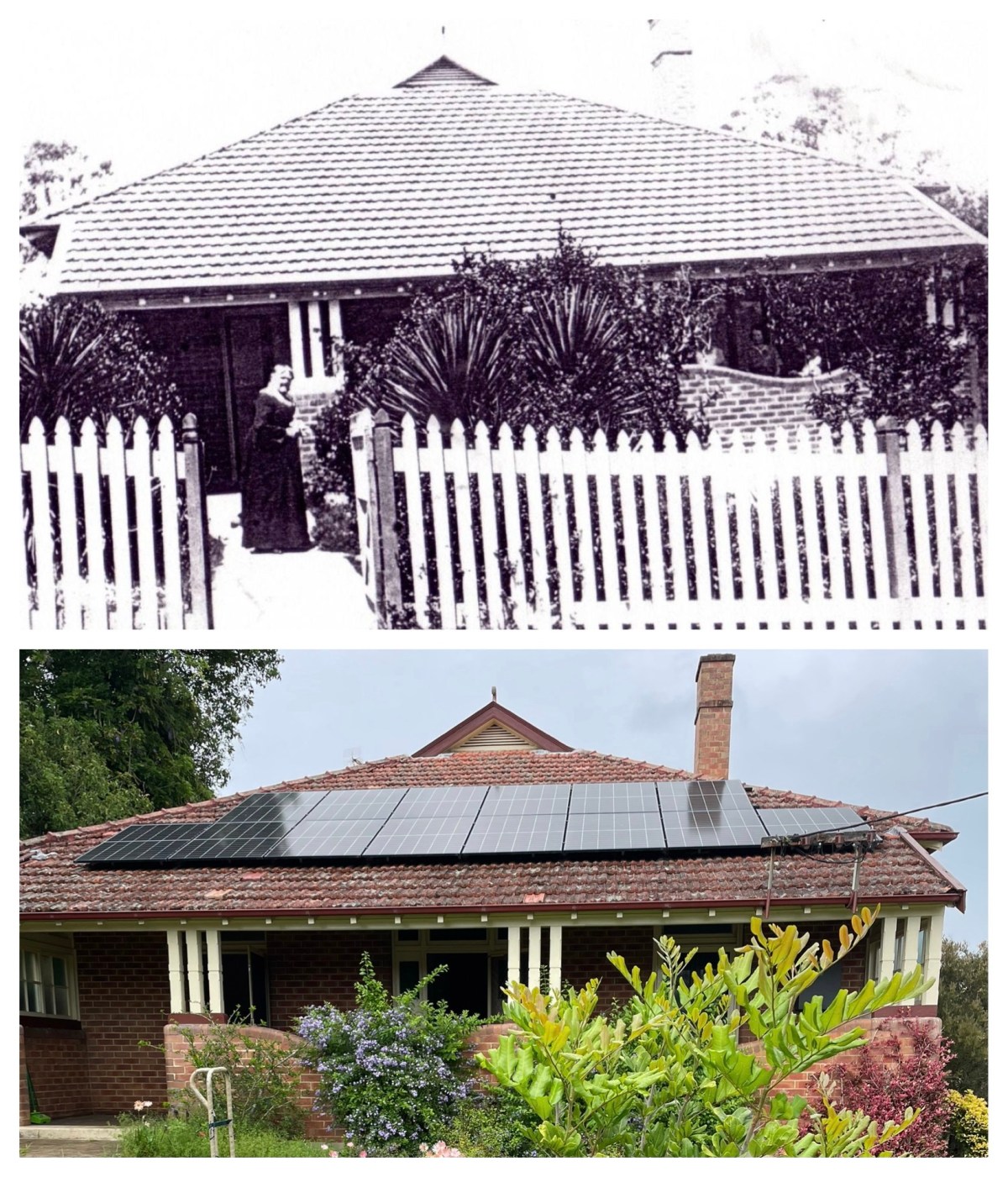
The Bruyns of Brown Street (9)—Ellen Esther Bruyn (concluded)

This post concludes the story of the land and house which Elizabeth and I purchased in Dungog a few years ago. I have traced the early landholders for this property (1848–1858), Daniel and Sarah Bruyn and their family (from 1858 to 1882) and then two of their children, Daniel Justin Bryan (d.1912) and his sister, Ellen Bruyn. In this blog, the story continues to the people who bought house in 1969, the Finneys.
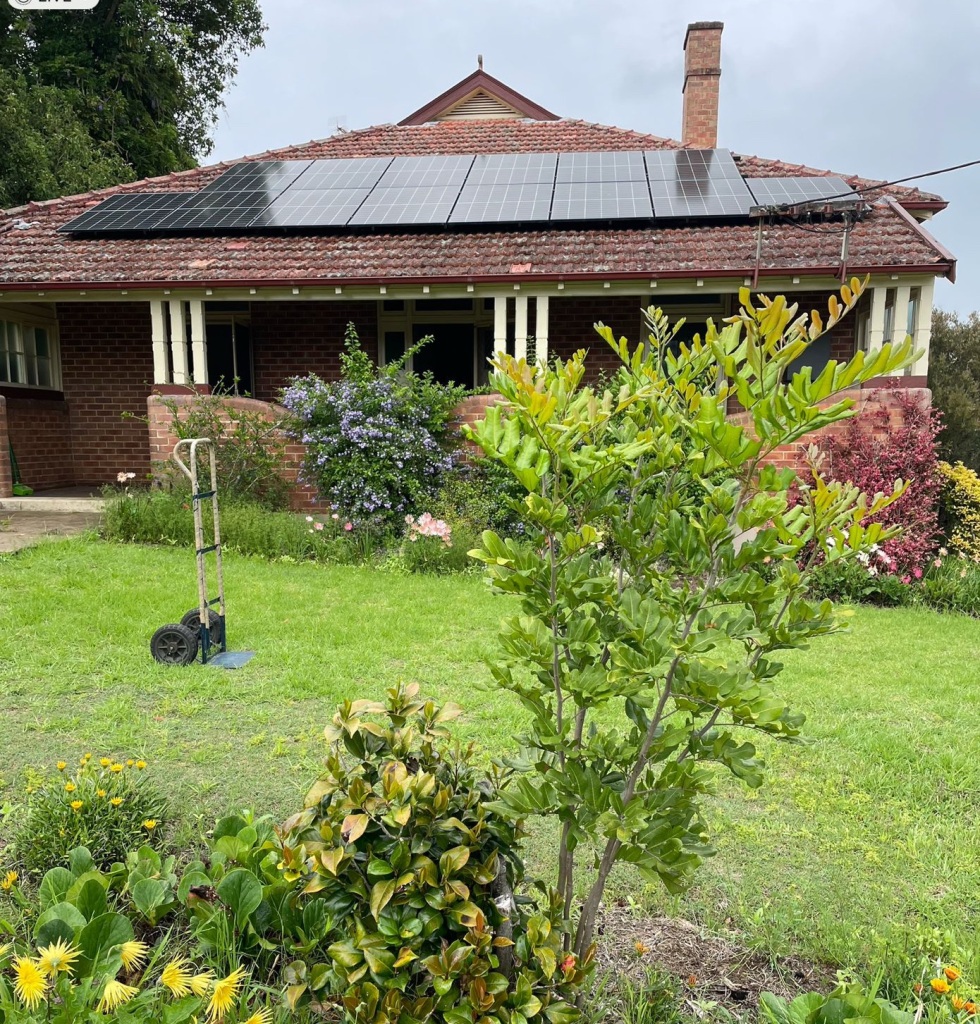
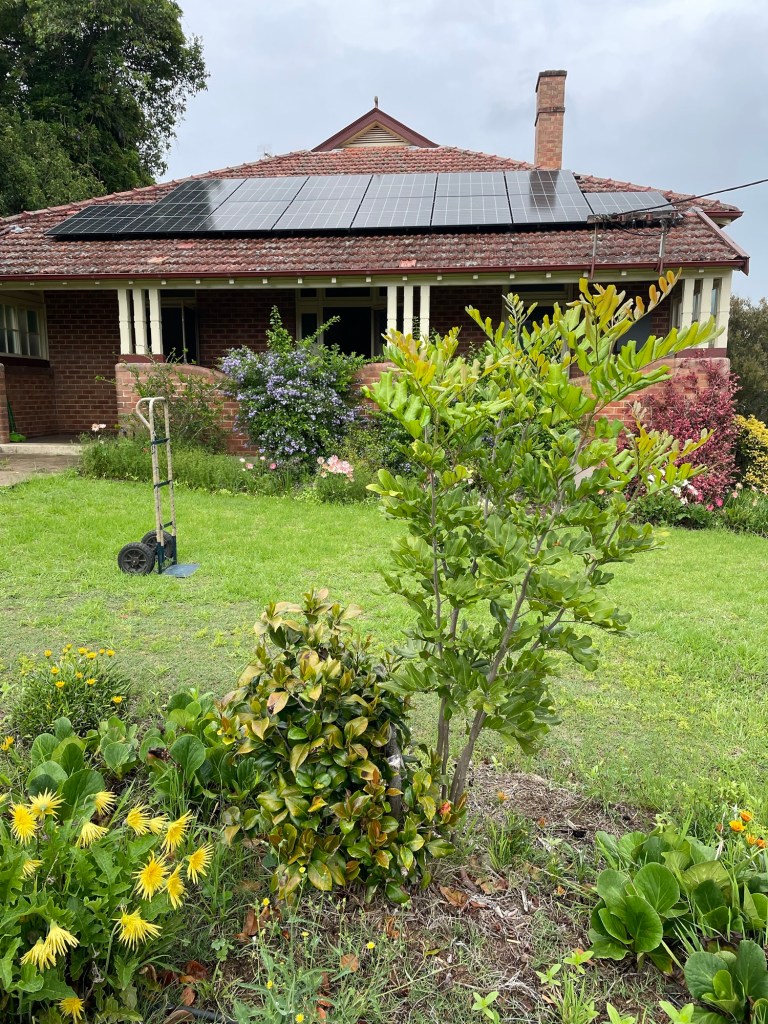
28 Brown St Dungog in November 2023, on the day we moved in
(as the moving trolley attests!!)

An interesting report in the Sydney Daily Telegraph of Tuesday 14 June 1927, p.18, entitled ARE WINTERS MILDER, quotes a “Mrs. [sic.] Ellen Bruyn, who has spent 71 years at Dungog” as declaring that “the winters of late years had be come milder, and the summers hotter, and drier”. It is interesting to see such an early observation relating to what we know now to be human-exacerbated climate change, as the average annual temperature is rising at a worrying level.

The Telegraph notes that “she quoted no thermometer readings to support her contention, but said she could speak with personal experience of the seasons, coupled with her observations of the less rigorous effects of recent winters upon vegetation in the gardens which adorn her residence.” Indeed: that would be the cottage garden at the front of her property, that is evident in the one photo of the house that is extant, as noted earlier.

Ellen Bruyn’s Will

Ellen’s father had died intestate. Her property and goods were not to be caught in the same way; on 4 August 1925 Ellen Bruyn, then aged 85 years, made her Last Will and Testament, in which she appointed George Alexander Mackay, Thomas Edward Monaghan and Robert Kendall Hobbs the Executors. Just two years and two months later, on 2nd October 1927, Ellen Bruyn died. Probate was subsequently granted on 1 November 1927.
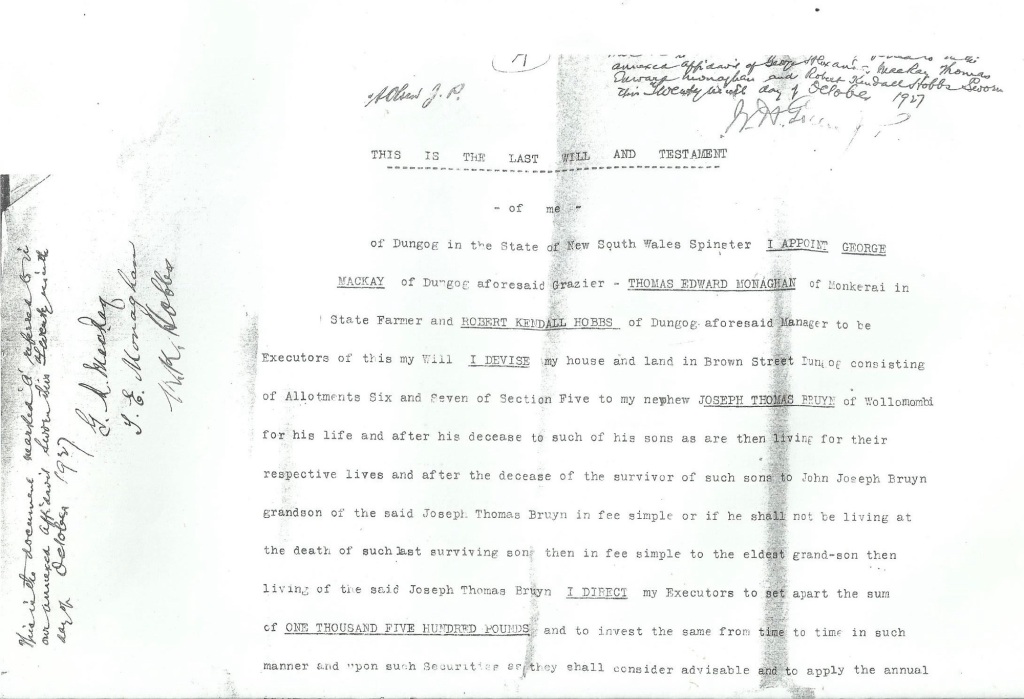
The first page of Ellen Bruyn’s Last Will and Testament

In an article in the Dungog Chronicle of Tuesday 4 October 1927, page 2, tribute was paid to Ellen Bruyn. “During her life-time Miss Bruyn was known far and wide for her benevolent nature and broad-minded charities. None that ever besought her help went away empty-handed.”

Reports of her estate indicate this extensive benevolence, with a lengthy report in the Sydney Morning Herald of Friday 4 Nov 1927, on p.6, providing details. The article is headed simply LATE MISS E. BRUYN. It notes that she left an estate “of the net value of £20,106”. A similar notice in the Maitland Weekly Mercury of 3 Nov 1927, p.5, reports that “the estate of the late Miss Ellen Bruyn, of Dungog, who died last month, aged 88, has been valued for probate purposes at £20,116”. The calculator provided by the Reserve Bank of Australia indicates that in 2023 this sum of money would be worth $1,932,438.79.

This was managed by a Trust established by the appointment of as George Alexander Mackay, Thomas Edward Monaghan and Robert Kendall Hobbs as Executors and Trustees in Ellen Bruyn’s 1925 will. Between 1932 and 1941, all three Trustees died; in February 1942 George Mackay, Donald Reay Mackay and Robert John Alison were appointed as “Trustees of the Will of the said Ellen Bruyn in the place of the deceased original Trustees”.

In this 1942 process, the components of the 1925 will forming the Trust were specified, in particular, as “£1000 secured by Memorandum of Mortgage 18 Dec 1928 for land at Heydon St Mosman; £1700 fixed deposit with Commercial Banking Company; £67.14.3 on account with Commercial Banking Company; Land in Brown Street Dungog on which is erected a dwelling house and other improvements being Lots 6 and 7 of Section 5 Town of Dungog; Vacant land in Mackay Street Dungog being Lots 4 and 5 Section 5 Town of Dungog”.

As far as the distribution of various elements of this estate was concerned, the SMH article provides specific details. It first notes that Ellen had “devised certain lands in Mackay-street, Dungog, to the local council, to be held by them in trust as a play and recreation ground for children; if, after a period of 20 years, the council did not think it advisable to use them as such, the lands were to be sold, and the net proceeds paid to the funds of the Roman Catholic Church at Dungog.” In 2024, the Council still maintains land on Mackay Street which is called Bruyn Park; it abuts the southern end of Jubilee Park, which runs along the western boundary of the Brown Street property once owned by the Bruyns.

Furthermore, Ellen took care to provide for her family, as “she devised certain real estate and £1500 to maintain it to her nephew, Joseph Thomas Bruyn, and his sons, £1500 each to her three sisters, Margaret Monaghan, Elizabeth Ann Cooke, and Sarah Malvina Lawless, and their daughters”.
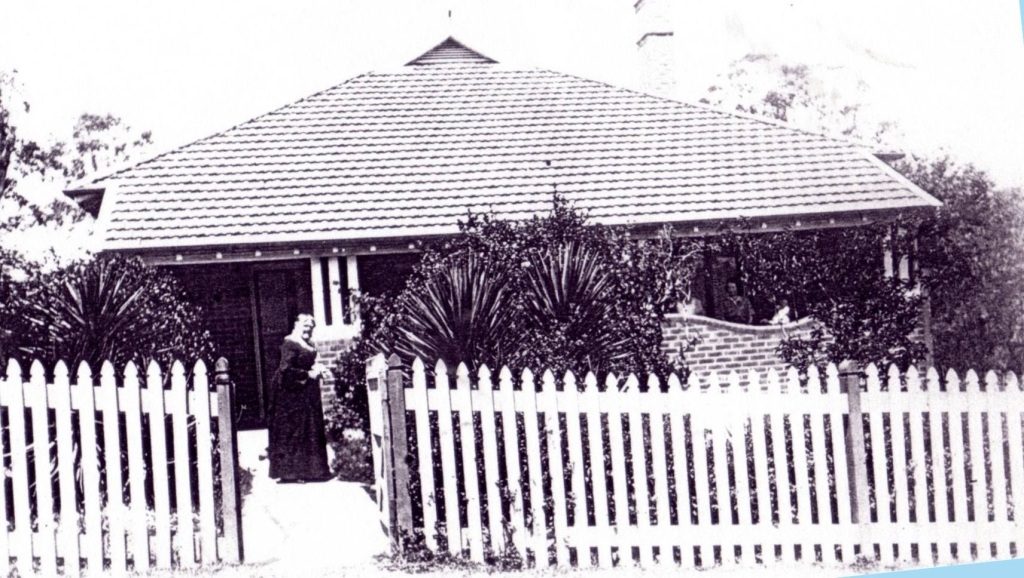
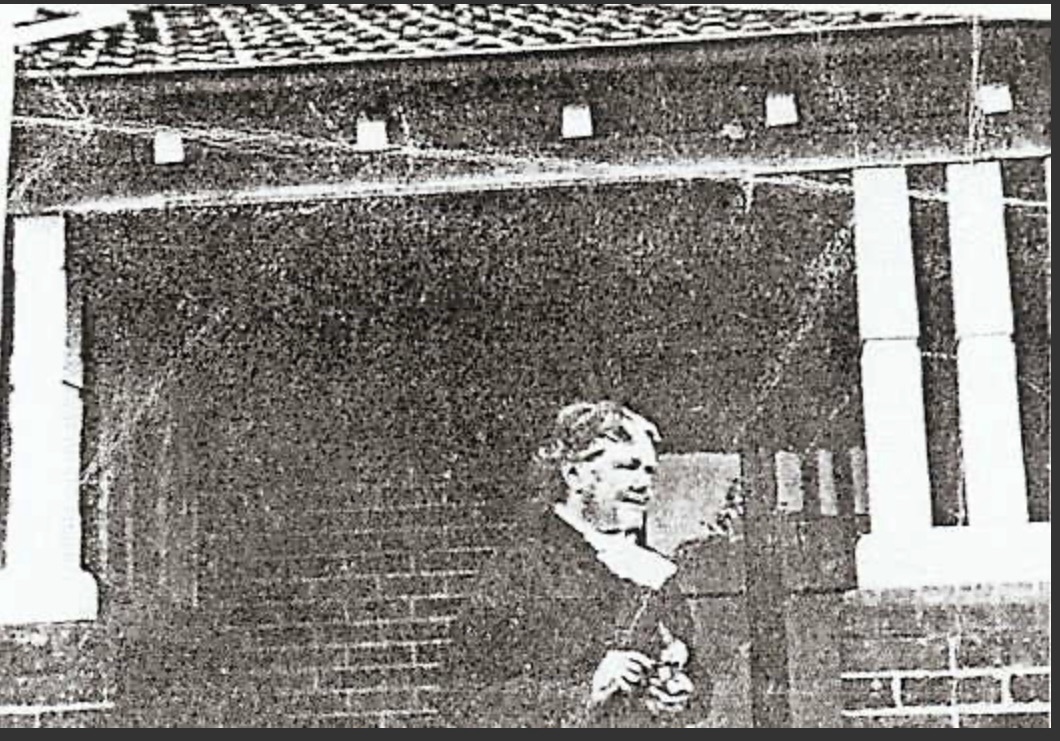
Ellen outside her house in Brown St Dungog;
perhaps within the last decade before her death?

The various charitable organisations that Ellen remembered in her will are signalled through this list of bequests: “£1000 to the Deaf and Dumb Institution conducted by the Dominican Nuns at Waratah, £500 to the Sisters of St. Joseph at Lochinvar, £500 to the Dr. Murray Catholic Orphanage at West Maitland, Waitara Foundling Home conducted by the Sisters of Mercy, £1000 to the Dungog Cottage Hospital”.

In addition, Ellen had directed that “the interest from the investment of £200 [was to be used] for the upkeep of the graves in the local cemetery of herself and relatives of the name of Bruyn for a period of 25 years from the date of her death; at the expiration of that period the £200 to be paid to the local Roman Catholic Church; £100 to the Roman Catholic curate at Dungog, and the residue of her estate to relatives and others”.

Dungog Cottage Hospital

One significant matter identified in this will relates to the Dungog Hospital. Daniel had been appointed as one of the foundation members of the hospital committee in 1891. Ellen must have been actively involved in the years after Hospital Cottage was opened in 1892. One item in her will was that she bequeathed “£1000 to Dungog Hospital, the interest to be used for 20 years and then the principal to go to the committee” (Sydney Catholic Press, Thursday 13 October 1927, p.41).
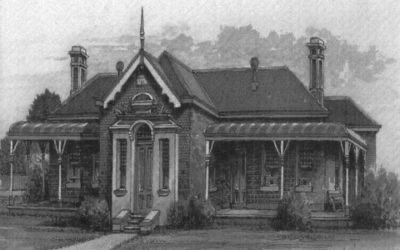
The original Dungog Cottage Hospital building

Annual distributions in accordance with this bequest are reported in the Dungog Hospital reports over the two decades after Ellen’s death. The Dungog Chronicle reported that £17/10/- (three months interest) was paid in Sept 1929; however, over a period of years, there was no interest paid, occasioning legal communications regarding the accumulated amounts that had not been paid.

From 1939, interest was paid more regularly: £71/3/10 in Aug 1939, £43/-/- in May 1940, £7/12/- and £4/15/- in Sept 1941, £44/5/9 and £136/6 in Sept 1942, as well as “an advance of subsidy for £28/6/8 and a special grant of £1/15/-“, followed by £10/1/9 in Oct 1942, £8/5/- in Feb 1943, “the usual subsidy of £28/6/8 … and a further amount of £51/6/8, being arrears of subsidy for the year commencing 1/7/42”. This presumably satisfied the accumulated amount due that had not been paid in earlier years.

The Hospital then received £45/4/5 in Sept 1943, £28/-/- in Sept 1944, £27/15/9 in May 1945, £23/18/9 in Oct 1945, £10/1/9 in June 1946, £47/-/- in Aug 1946, £31/16/9 in Feb 1947, £16/14/- in April 1947, and £23/9/6 in Aug 1947. In that month, the Hospital Board was advised that “the 20-year period of this investment in house properly at Mosman expires on 2/10/1947, and the matter has been placed in the hands of the Hospital’s Honorary Solicitors, Messrs. Borthwick and Wilson”.

Nevertheless, £11/2/4 was received in Jan 1948, £12/2/10 in June 1948, and £12/7/9 in July 1948. The income over the years had been generated through an investment in a property in Mosman; the property now needed extensive repairs, so at the Jan 1949 meeting, “it was moved by Messrs. Scott and Irwin that a copy of the Commission’s letter be forwarded to Messrs. Borthwick and Wilson and that they be requested to instruct solicitors for the Bruyn Trustees to take necessary action as set out in the Commission’s letter”.

A further £12/7/9 was paid in Sept 1949, while “Hospital’s Honorary Solicitors have been requested to instruct the Solicitors for the Bruyn Trustees to take necessary steps to obtain consent of the Moratorium Court to sell the property prior to its being offered for auction sale”.

In July 1951, the Secretary advised the Board that “a cheque for £111/1/3 had been received through Messrs Enright Son and Atkin, being rent received from Messrs. Richardson & Wrench Ltd., from 2/7/1948 to 18/6/1951, less collection charges, exchange, repairs, and rates”.

In July 1953, “£52/13/5, being rent collected in connection with the Bruyn Bequest”, was received. This was the last payment that has been found through reports accessed in Trove’s collection of newspapers.

The Sale of Brown Street
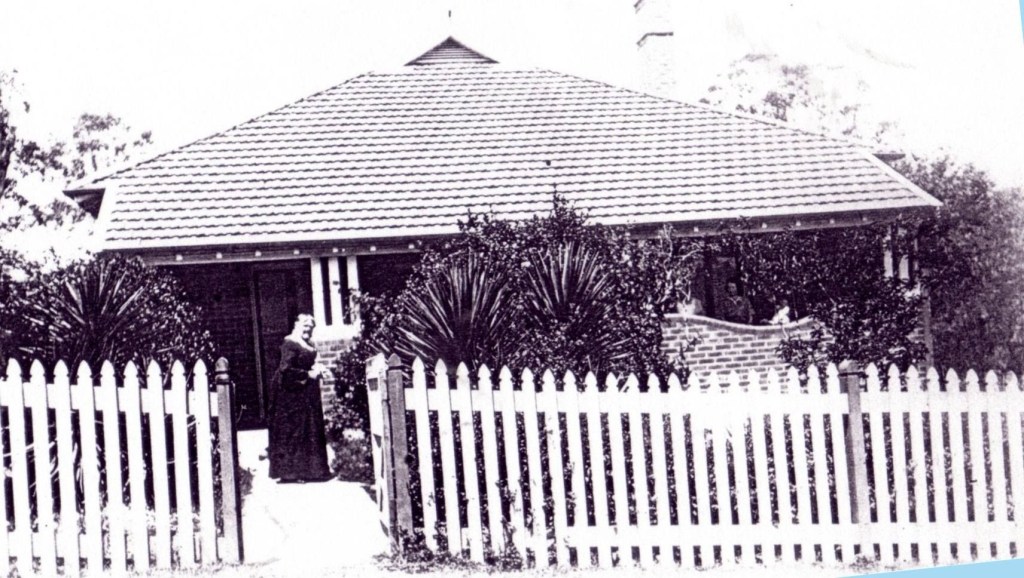
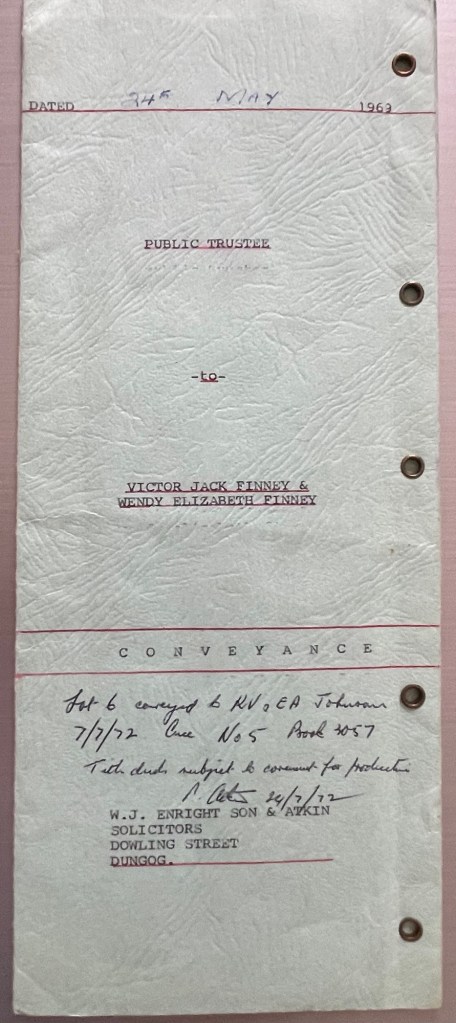
The last act of the Trustees of the Ellen Bruyn Bequest, in 1969, was to place the property on Brown Street up for sale. The documentation received relating to the Brown Street property for the period from 1927 to 1969 concludes with a document that notes the various changes in personnel in those Trustees, and a 1969 Conveyance. It is most likely that the property was rented out for this period of time, thereby bringing in a regular income to the Trust.

On 30 June 1967, George Dark was appointed Trustee in place of George Mackay and Donald Reay Mackay, joining Robert John Alison as continuing Trustee. Then, on 8 April 1968, these Trustees appointed the Public Trustee “to accept the trusts of the will accordingly”. The trusts were comprised of “Land in Brown Street, Dungog on which is erected a dwelling house and other improvements being Lots 6 and 7 of Section 5 Town of Dungog; Special Bonds Series “I” due September 1970 $1,600 Treasury Bonds held by the Commercial Banking Co.; Commonwealth Treasury Bonds August 1975 — 5 — $1,400; Current Account Commercial Banking Co. of Sydney Limited Dungog — $13.15”.

And so it was that in 1969, Victor Jack Finney and Wendy Elizabeth Finney purchased this property. In a Conveyance dated 24th May 1969, between “the Public Trustee as Trustee of the will of Ellen Bruyn, late of Dungog, Spinster deceased, and Victor Jack Finney of Dungog, Evaporator Operator, and Wendy Elizabeth Finney of Dungog, his wife”, Lot No. Seven of Section No. Five and Lot No. Six of Section No. Five were purchased for three thousand five hundred dollars. A new set of owners would, in time, move into the house and begin a new era.
For earlier blogs, see
The Bruyns of Brown Street (8)—Ellen Esther Bruyn (continued)

I am continuing the story of the land and house which Elizabeth and I purchased in Dungog a few years ago, after having traced the early landholders for this property (1848–1858), Daniel and Sarah Bruyn and their family (from 1858 to 1882) and then two of their children, Daniel Justin Bryan (d.1912) and his sister, Ellen Bruyn.

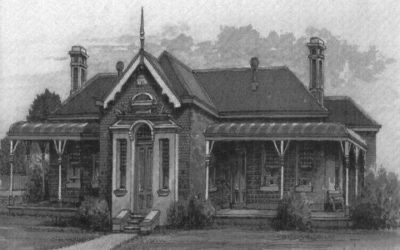
At some point in the latter part of the period of growth in the town of Dungog in the late 19th and early 20th century, the solid double/brick building that still sits on the Bruyn’s land in Brown St was built. Its style reflects certain Arts and Craft features of the late 19th century; although compared to the extravagance of some Arts and Crafts buildings, it is modest in its scope, which most likely reflects the life and tastes of Ellen Bruyn.

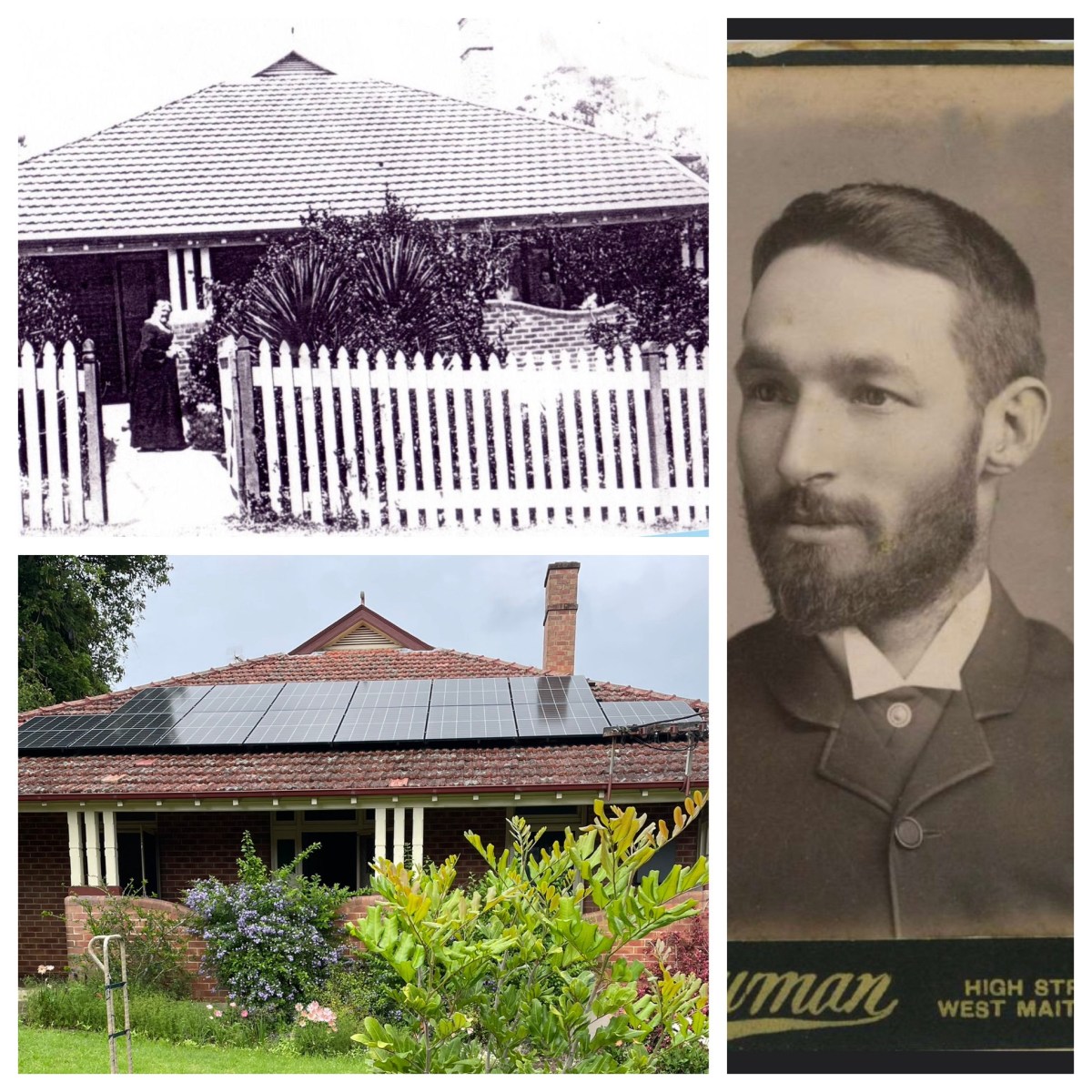
Ellen Bruyn outside the house in Brown St

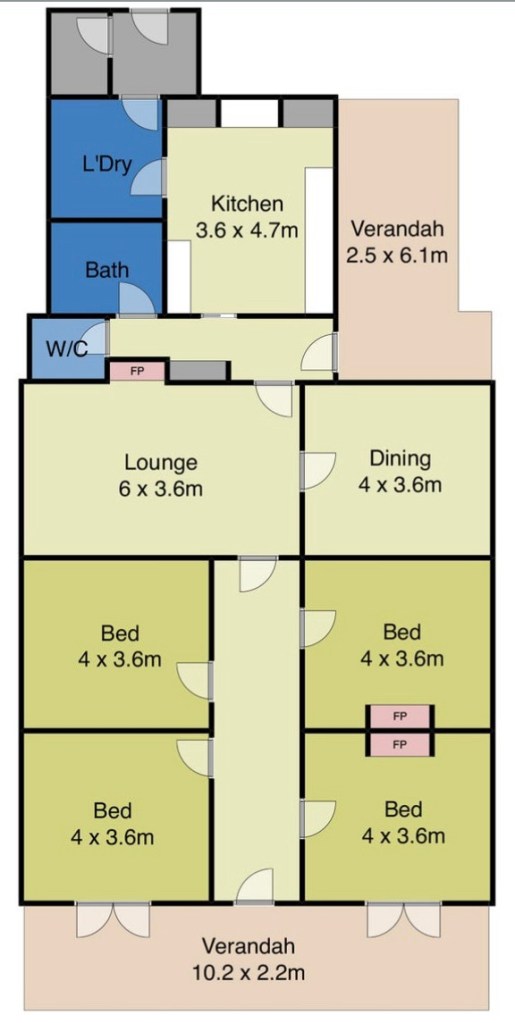
The original double-brick building has six equal-sized rooms coming off a central hallway, each with a single window, high ceilings, and picture rails about 8 feet from the floor. There are fireplaces in three rooms.

The house has a verandah at the front with fine curved brickwork, and what appears (under the later additions) to have been a back verandah which would have led to a kitchen and washing tub in an outhouse. There is no bathroom in the brick structure; indoor plumbing was only beginning in the richer urban areas in the late 19th century, and slowly spread into the homes of those who could afford it in the early decades of the 20th century. The present house has a mid-20th century addition at the rear which includes all rooms requiring plumbing (kitchen, toilet, bathroom, and laundry).

The floor plan of the current house

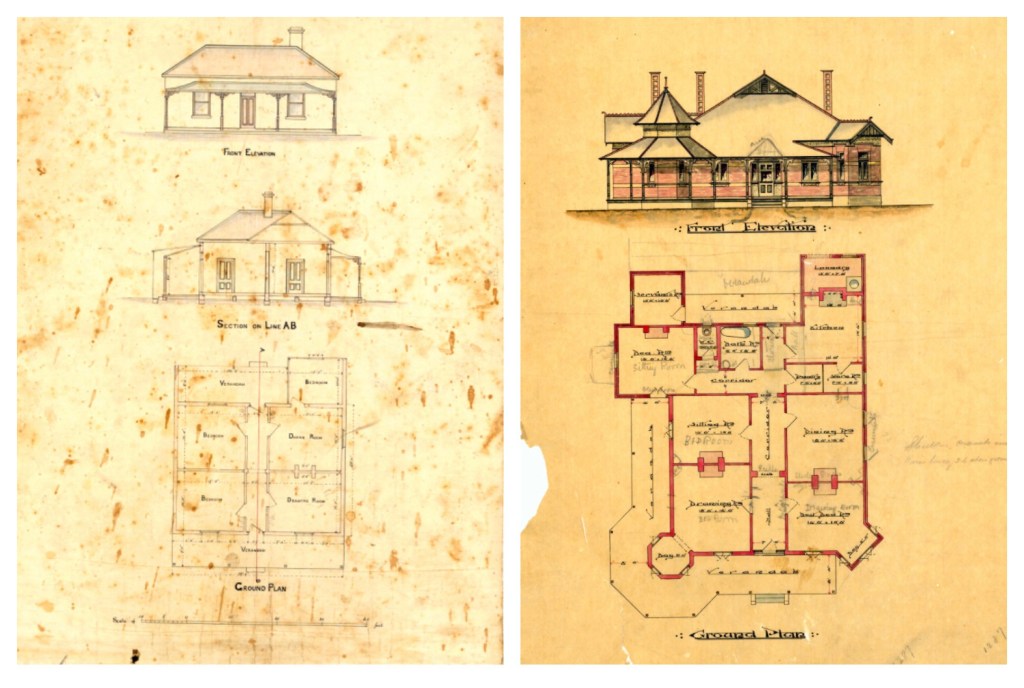
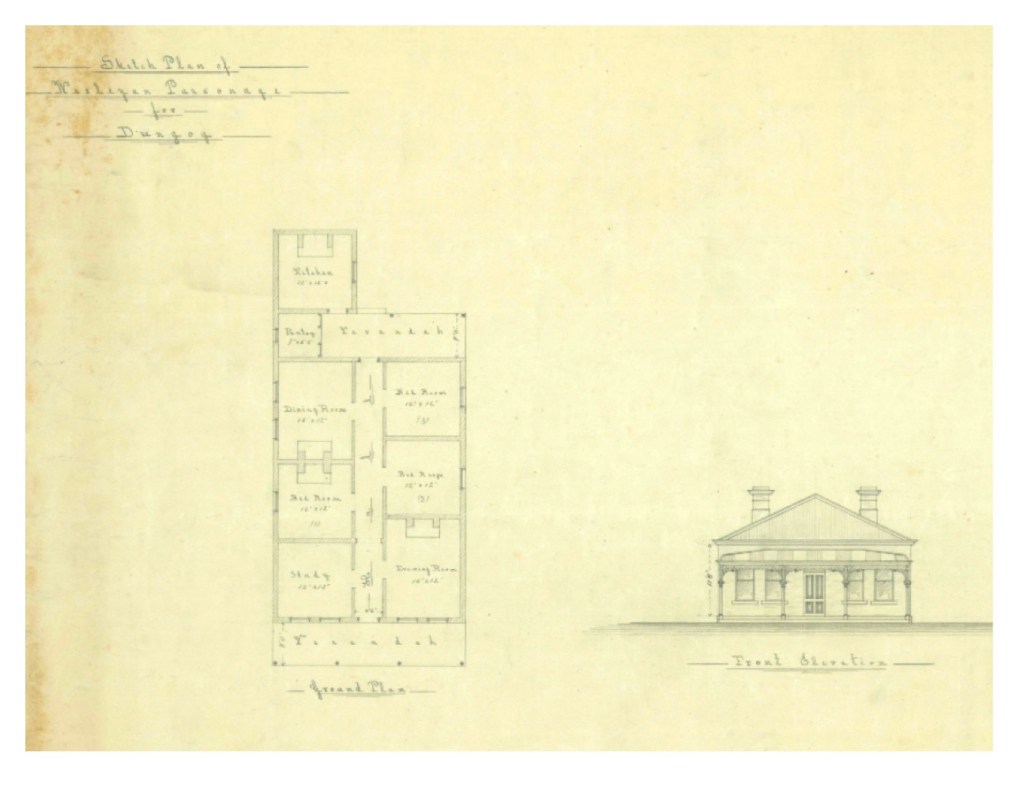
Elizabeth has found architect plans for buildings of a similar (if more modest) layout in the online “Living History” archives of Newcastle University. These include plans drawn up by the first architect of the area, John W. Pender, who designed a residence for Mr. J. Quigan, built in West Maitland in 1875; the Wesleyan Parsonage in Dungog, completed in 1878; and a residence for D. Logan Esq., built in Bolwarra in 1909. All three properties share a similar floor plan, which in turn is close to the Brown St layout.

Pender’s plans for houses for Mr. J. Quigan (1875, left)
and D. Logan Esq. (1908, right)
Pender’s plans for the Wesleyan Parsonage in Dungog (1878)

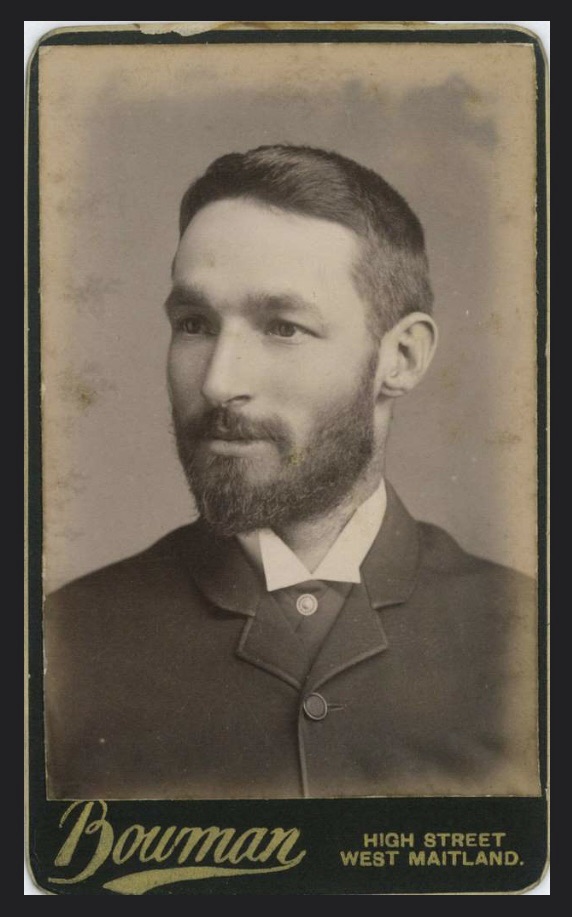
In the 1880s, the youthful trainee architect J. Warren Scobie (1863—1946) served his apprenticeship in West Maitland with Pender, the sole architect in the area at that time. He must have been influenced by Pender’s design habits. Les Reedman, in Early Architects of the Hunter Region (2008) reports that “Scobie designed every type of building in the Hunter and as far as the Queensland border and Gunnedah” (p.118). After the 1893 flood, he designed the Lorn Embankment; “according to his theory, designed the bank to conform to the fall of the river after the 1893 flood” (Reedman, p.119).

Scobie designed buildings in Maitland, including the 1889 Town Hall; Lorn, including Flagstaff, where he lived, Stockton (where he lived for some of the 1910s); two churches in Largs; 10 out of the 28 hotels built in the Cessnock—Kurri Kurri Coalfields in the early 20th century; and in Gloucester, Gunnedah, and Dungog.

A writer with the pen-name “Nemo” (meaning “nobody”), contributing news of the Dungog Presbyterian Church in the Maitland Mercury of 29 January 1905, p.16, waxes lyrical in reporting that in Dungog “Presbyterianism … has built itself a new religious home; a neat, choice design, not pretentious, not elaborate, but just fit for its purpose. It is good to look at. It makes one feel like being in church, its position is of the best, and it is now one of the chief ornaments of the town. It is a sort of poem in architecture, the happy inspiration of Mr. J. Warren Scobie of this town [that is, Maitland] and built by Mr. Noad of the East.” A detailed and fawning description of the building concludes the article.

A portrait of the younger J. Warren Scobie

An article in the Maitland Mercury of Friday 24 January 1913, p.2, tells of the new shop erected for Mr. E. Grierson. “The appearance of Dungog suggests to the casual observer that it must possess a number of enterprising and progressive business men, inasmuch as the principal buildings are as substantial as they are attractive and suggests an unmistakable air of solidity”, the article begins.

It notes that Mr. Grierson “bought a commanding block of land … on the west side of Dowling Street, adjoining Mr Brighton’s terrace, and let a contract to Amos Moore to put him up the best shop Dungog can boast of. Amos, working under the plan of that capable Maitland architect, Mr J. Warren Scobie, who has completed excellent work in this district got busy on the job.” Scobie is known as the architect of some grand homes in the area which share stylistic features with the Brown St house.

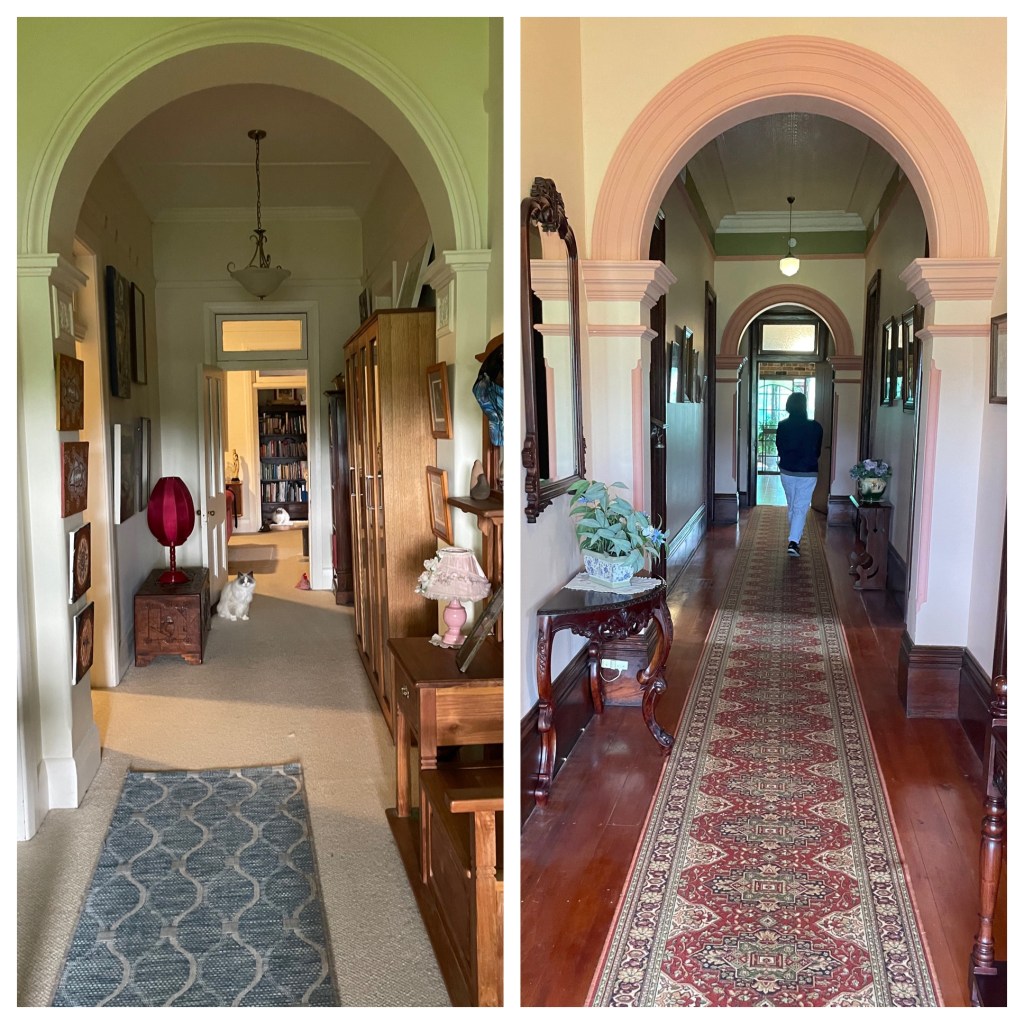
A house in Paterson which was designed by J. Warren Scobie, named Kalimna, was recently put on the market (early 2024). The online photographs indicate that this 1902 double-brick residence shares with the Brown St double-brick residence a reasonably similar floorplan and a number of close similarities in details. These include French doors opening out to the front of the house from both front rooms, high ceilings, the design of the fireplaces, a wide central hallway with arches, and doors into the side rooms which are offset along the hallway.

The hallways of the Brown St house (left) and Kalimna (right)

Could it be that Scobie designed this house for the Bruyns? It is a strong hypothesis, we feel, although in the absence of the papers relating to the design of the Brown St house, it can never be definitively confirmed. Kalimna is more extravagant, but stylistically and structurally very similar.

Dungog’s population had been growing rapidly, rising from 436 in 1881 to 878 in 1891 and 1169 in 1898. With more people, came more traffic, and more wear and tear on road surfaces. A paragraph in the Dungog section of the “District News” in the Maitland Mercury for Tuesday 3 August 1880, p.7, had reported that “Brown-Street, which has long needed something to be done to it, is at last being formed thirty feet wide, and the contractor seems to be making a good job of it. The expense has been defrayed by private subscription, as we were unable to obtain Government money, although it is really a work of necessity.”

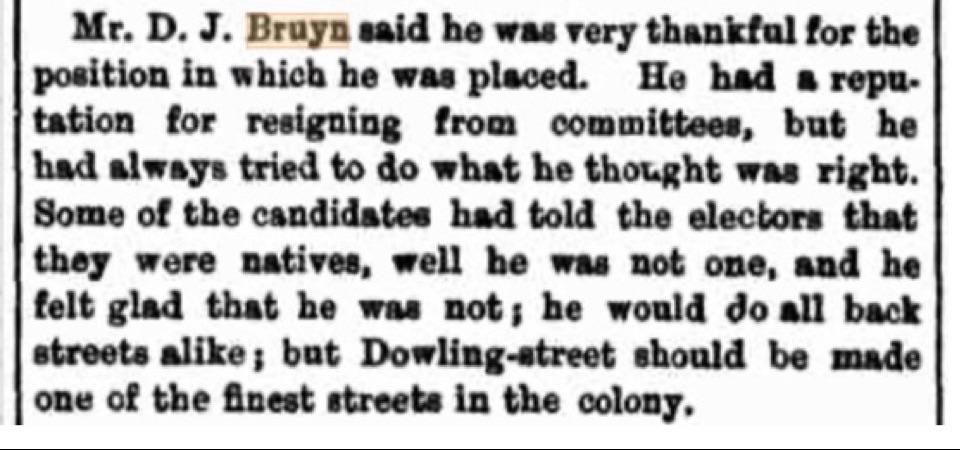
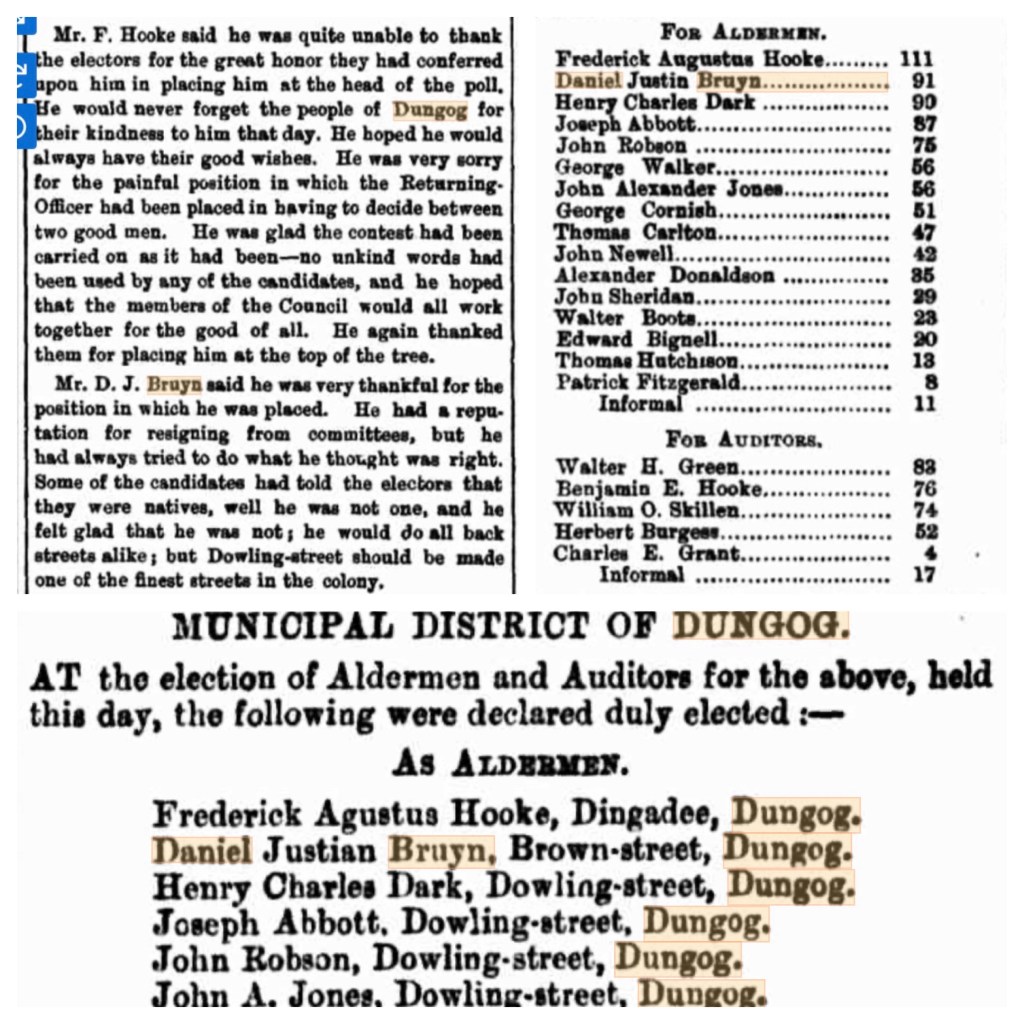
The Maitland Mercury of Tuesday 18 July 1893, p.5, reported that after the 1893 municipal election, the newly-elected councillors (and those defeated at the ballot) each gave a speech to the gathered crowd. Ellen’s brother, Daniel Justin Bruyn, one of the successful candidates, said “he was very thankful for the position in which he was placed”.

The Maitland Mercury’s report of Daniel Bruyn’s speech
after he was elected as an Alderman in 1893.

In an obvious reference to the state of the roads, the new Councillor Daniel Justin Bruyn said that “he would do all back streets alike; but Dowling-street should be made one of the finest streets in the colony”. Still, into the present day, the matter of road maintenance continues to be a concern for residents of the Dungog Shire; and Brown St itself has quite its share of potholes!

The house in November 2023

For earlier blogs, see
and for the final blog, see

The Bruyns of Brown Street (7)—Ellen Esther Bruyn

In exploring the history of the land and house which Elizabeth and I purchased in Dungog a few years ago, I have already noted the early landholders for this property, and investigated the life of Daniel and Sarah Bruyn and their family after Daniel purchased the land in 1858.

When Daniel died intestate in 1882, all of his property was made over to his son, Daniel Justin Bruyn, whose life has already been canvassed. A few months later, we find that the land he received from his father in Brown St had been purchased by his sister, Ellen Bruyn. This is her story.

Ellen Esther Bruyn was born in in the later months of 1839 in Smethwick, Metropolitan Borough of Sandwell, West Midlands, England, the second daughter of Daniel Joseph Bruyn, a Blacksmith (1796—1882), born in Roscommon, Ireland, migrated to England, and Sarah Helen Nichols (1807—1882), whom he married on 5 Feb 1837 (to 4 May 1882) in West Bromwich, Staffordshire. Ellen was the fourth child born to Daniel and Sarah; a further three children were born in subsequent years.

The family travelled to France in about 1845, where two of those children were born, including Daniel Justin Bruyn. After a rise of unrest in France, they returned four years later to England. They came to the Colony of New South Wales in 1856 as assisted migrants. Daniel and Sarah arrived in the Colony on board the Commodore Perry on 1 May 1856 with their children Margaret, Ellen, Elizabeth, Daniel and Sarah. (The eldest child, Joseph, travelled to the Colony a few years later.)

We have seen that Ellen had a sizeable inheritance on the death of her brother, Daniel Justin Bruyn. He had accumulated cash and property over the years, with a thriving business as a Grazier on the lands that he had purchased to the northwest of Dungog. That was given over to her, added to the land that was already under her name.

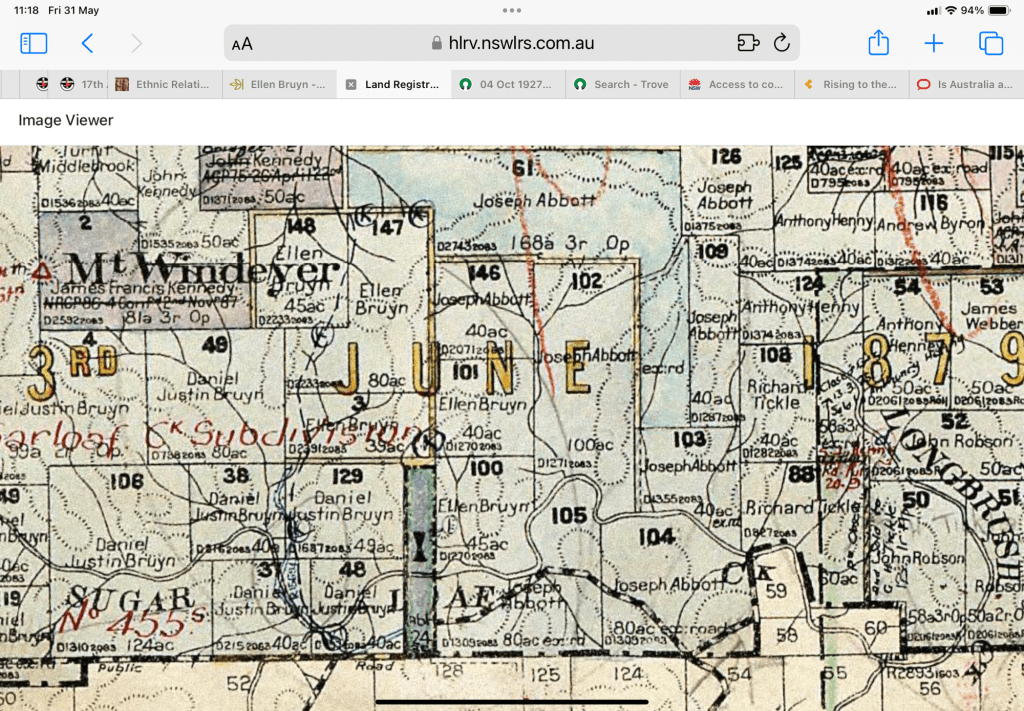
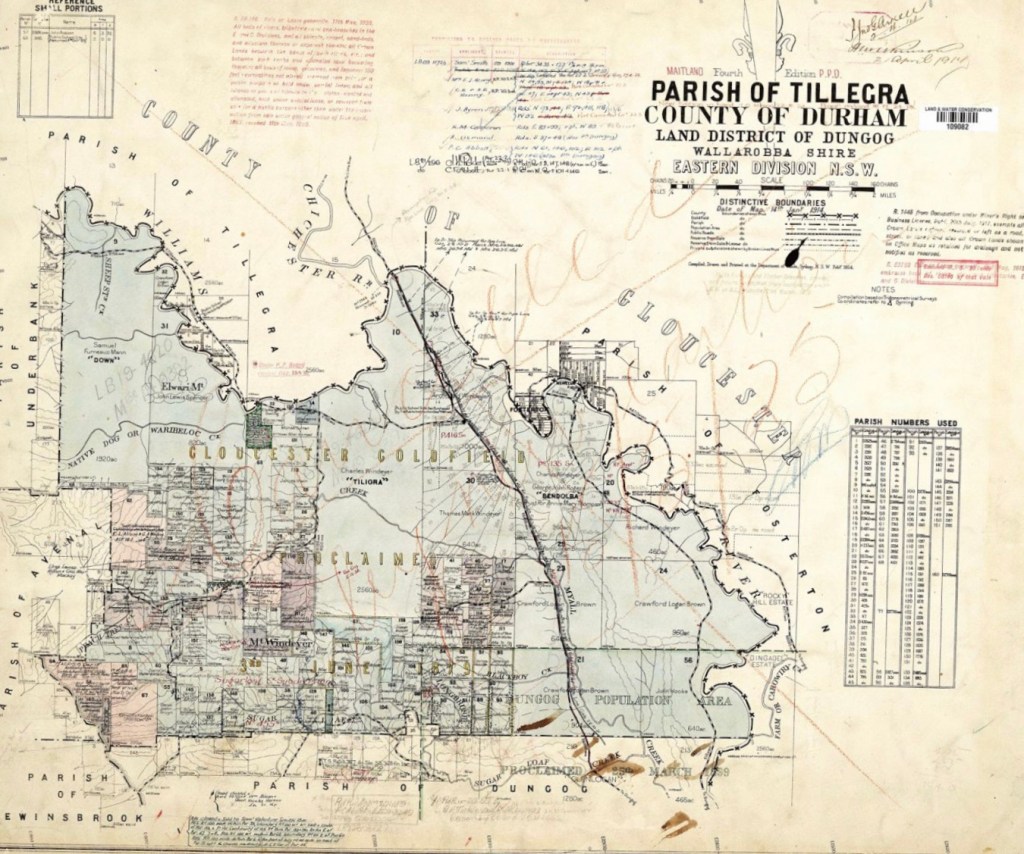
Map of the Parish of Tillegra showing
the property owned by Ellen Bruyn

An 1894 survey map for the Parish of Tillegra contains Lots which are registered in the name of Ellen Bruyn: Lots 100 (45 acres), 101 (40 acres), 3 (39 acres), 147 (80 acres), and 148 (45 acres)—a total of 249 acres. This land was located immediately next to land in north-eastern section of the many Lots owned by Ellen’s brother, Daniel Justin, so it is reasonable to suppose that it formed a part of the one large farm stretching along much of the Dungog—Tillegra parish boundary.

So Ellen had a large portfolio to oversee, what with her own land and the land she had received on the death of brother Daniel. She managed this property well over the following decades, using the land to maintain a strong economic position throughout her life. Ellen continued to live in the house in Brown Street where she had spent the latter years of her childhood as well as the early decades of her adult life.

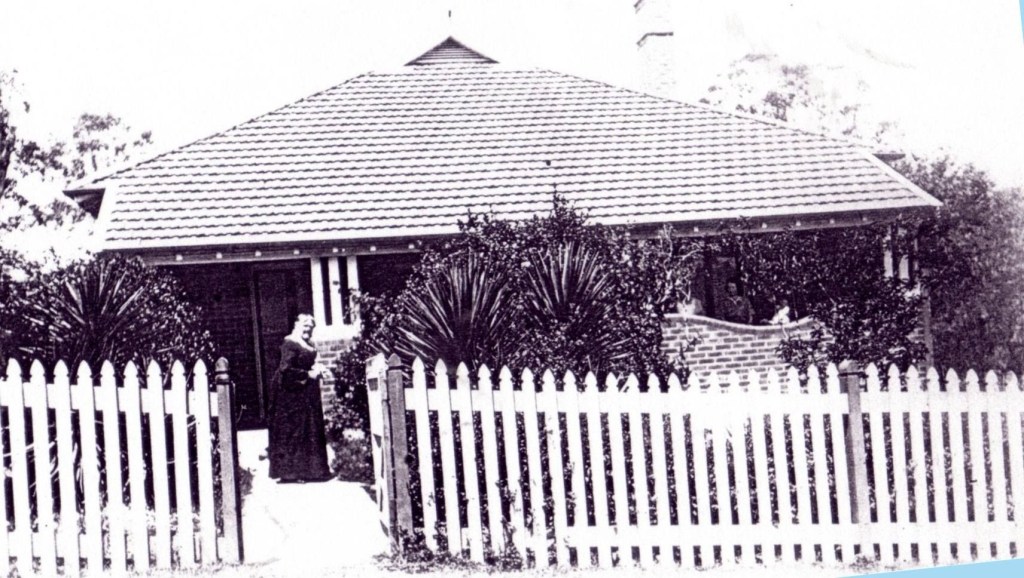
At some point late in the 1890s or, more likely, in the first decade or so of the 20th century, a substantial brick dwelling was built on this site, replacing what was an earlier family home. The 1913 Electoral Roll for Dungog lists “Bruyn, Ellen, Dungog, domestic duties” as a resident. A photo (undated, perhaps in the 1910s?) shows Ellen in her mature years in the garden at the front of this house.

The double brick house on the land in Brown St, where the Bruyn family had lived since the 1850s. The lady in the (undated) photo is Ellen Bruyn, who had owned the land since 1883.
The house appears relatively new; could this be early in the 20th century, or even a few years earlier?

The exterior of the house looks relatively unchanged even today. The sweeping curve of the verandah bricks and the path from the front fence leading to an offset entry can be seen. At the other end of the front verandah, it is evident that there are some people standing there, although identification of individuals is not possible. The front garden reflects a substantial investment of time and care from Ellen over the years.

Ellen was a single woman who never married. There are clear indications that Ellen’s bachelor brother, Daniel Justin, had lived in a room in this house over the years before he took his own life in 1912. Daniel had been a well-respected member of the Dungog community. Ellen herself was evidently very involved in charitable and community matters locally—the distribution of funds from her will indicated this very clearly.

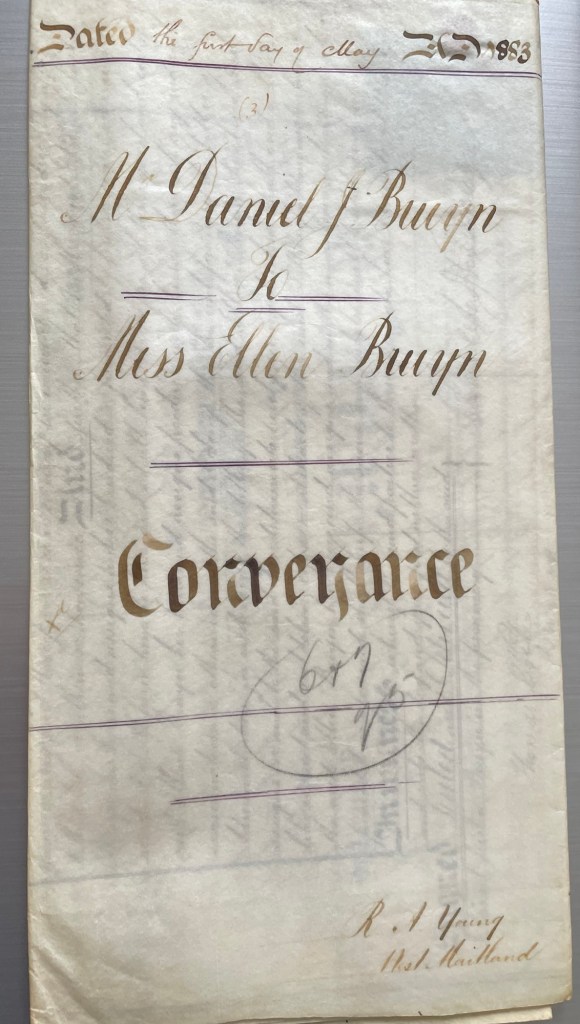
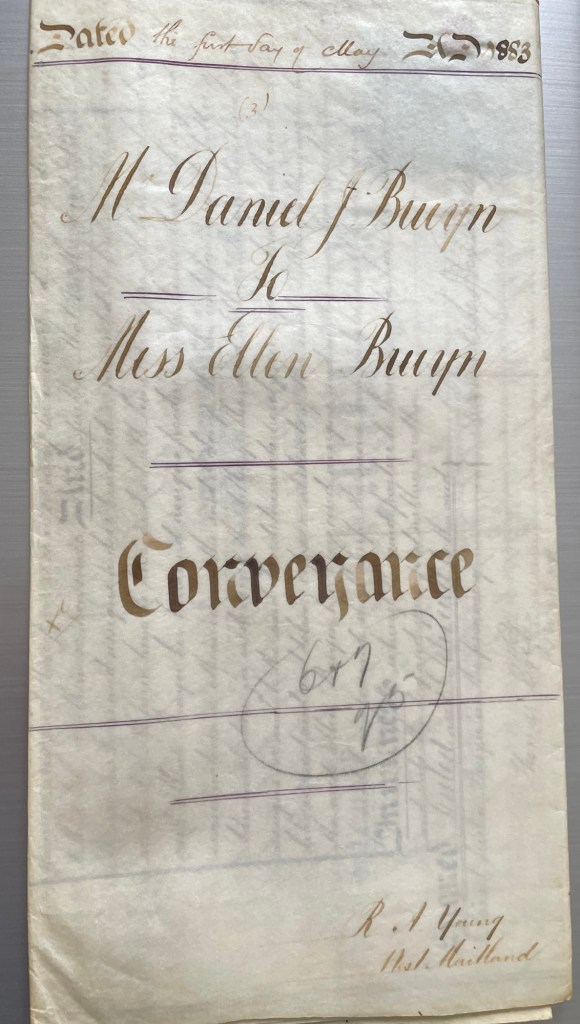
The 1883 Conveyance passing the title of the property
from Daniel Bruyn to his sister Ellen

A Conveyance dated 31 May 1883 between Ellen Bruyn of Dungog, Spinster, and Daniel Justin Bruyn of Dungog, Blacksmith, indicates that Allotment No. Seven of Section No. Five and Allotment No. Six of Section No. Five were sold for the sum of two hundred pounds. Ellen would live there as the owner of the house for almost half a century, until her death in 1927. That property had been made over to Daniel Jnr soon after the death of his father, Daniel Snr, and he subsequently put it up for public auction.

Ellen must have pleased to be the owner of the house that she had been living in for years, as well as the adjacent block of land. Why she had to pay this amount to her brother when she was just as much a child of Daniel and Sarah as he was, is a mystery. The gendered bias in 19th century society would, of course, have meant that the property of the father would normally pass to his son after his death, unless another course of action was specified. Obviously, such an alternative had not been set out by Daniel Snr. So Daniel Justin Bruyn inherited the family home in Brown St, and then his sister Ellen Bruyn bought it off him.

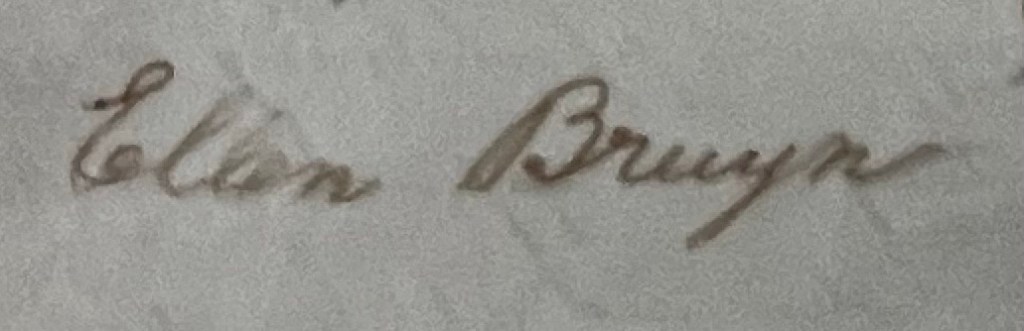
Ellen’s signature on the 1883 Conveyance

Ellen lived in the houses on this property for many decades—from the 1860s until her death in 1927. Over this time, she would have seen the town of Dungog grow and develop over the years. In her study of towns and buildings in the region, Grace Karskens writes that Governor Darling “published regulations for town planning in 1829 which directed that streets be laid out in a grid pattern, and emphasised uniformity and regularity, wide streets, half-acre allotments, and that buildings were to beset well back” (Dungog Shire Heritage Study: Thematic History, 1986, p.51). This set the pattern for numerous country towns, including Dungog.

This neat, orderly development continued for some decades. Karskens notes that “the second half of the nineteenth century was generally a boom-time for the major towns in Dungog Shire, and thus also a period of physical consolidation and community growth” (p.63).

The pattern that she observes in the 1860s was certainly evident in Dungog: “neat, solid government buildings, such as police stations, watch houses, post offices and court houses, all built to indicate a civilized and well-ordered society. Rows of stores and offices were built by merchants, professional people, banks and businessmen along the main streets, slowly filling up the grids laid down by surveyors forty years before.” (p.63).

Karskens cites an unidentified press clipping held in the Newcastle Local History Library when she observes that “during the 1850s, Dungog, like Clarence Town, benefited from a position on the route to the Peel River and Gloucester goldfields, and this was repeated during the 1880s with the finds at Wangat (within the Shire), Whispering Gully and Barrington” (p.80).

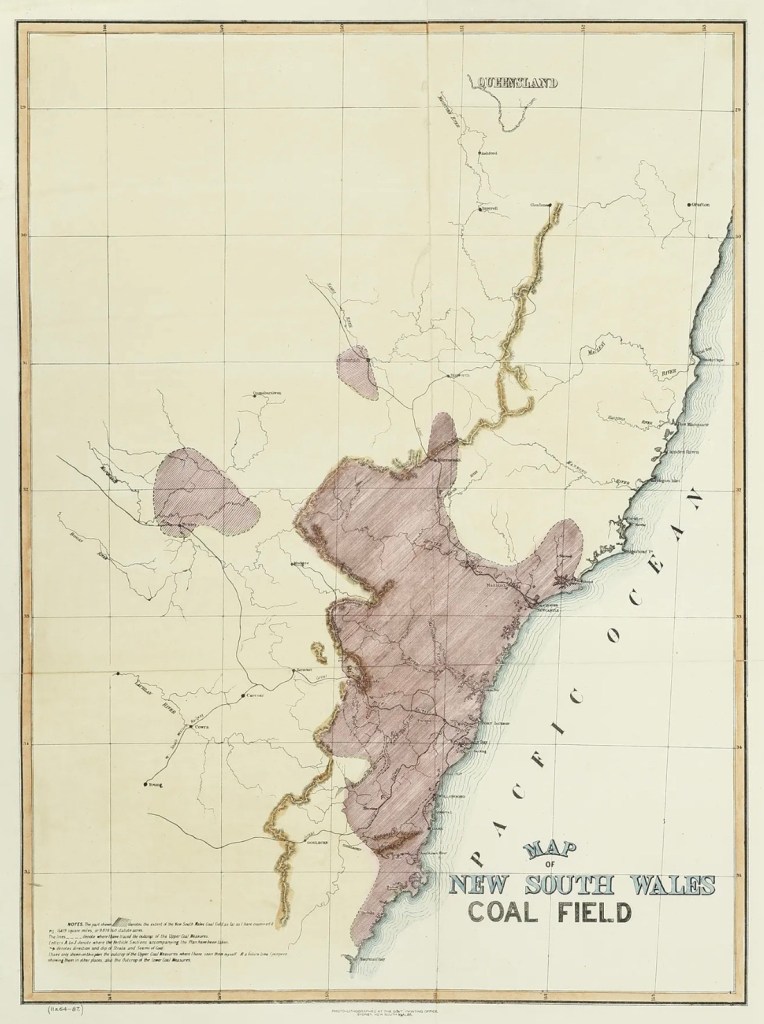
An 1887 map showing the area of NSW designated as coalfield

She reports that “an anonymous correspondent writing in 1888 listed the town’s businesses as including three banks, four hotels, four large general stores, three butchers, three bakers, a coachmaker, wheelwrights, three blacksmiths, a hairdresser, a fancy tailor, boot makers, three saddle and harness makers and four churches, a weekly newspaper and ‘a School of Arts a credit to any town’.” (p.81). Included among those three blacksmiths, of course, was Daniel Joseph Bruyn, Ellen’s father.

Growth in the town continued year by year. Karskens notes that “Dungog Cottage Hospital was opened in 1892 in a small (two-roomed) ornate Italianate brick building in Hospital Street at the western end of town” (p.82) and in the following year the town was proclaimed a Municipality and elections were held for councillors for the first Dungog Municipal Council. The new council would have responsibility for services in the town of Dungog and the rest of the newly-formed shire.

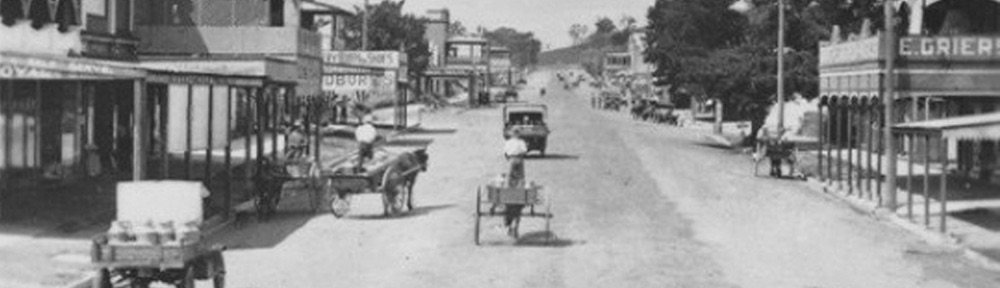
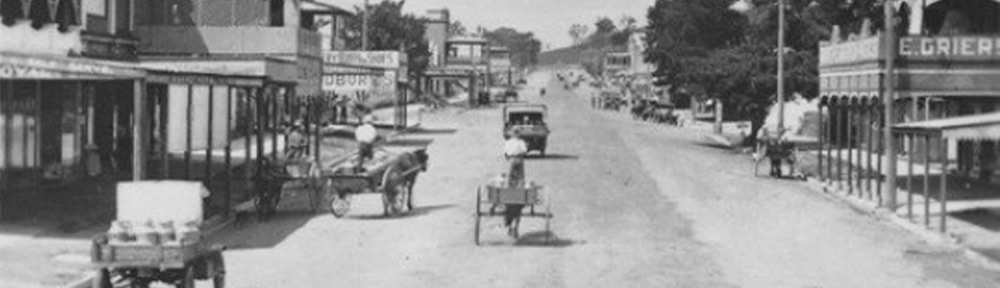
Along Dowling St, the new buildings included the Roman Catholic Church and Presbytery (1880s, now Tall Timbers Motel and the Information centre), an Italianate Post Office (1874, with a less dramatic facade added some decades later), the Oddfellows Hall (1881, now the Dungog Medical Practice), the ornate CBC bank and residence (1884, now a private residence), Centennial Hall (1888, now a cafe), the Bank Hotel (an 1891 conversion of a former residence), the Skillen and Walker Terrace (1895, four two-story shops-and-residences with a central archway), the School of Arts (1898, now the Historical Society), and the Angus and Coote building (1911).

Dowling St, Dungog, early in the 20th century

After the death of her father in 1883, Ellen Bruyn had bought the land in Brown Street where the family had lived for around 30 years. As the town continued to grow, a number of significant buildings were erected near to this residence. On the corner of Brown and Dowling Sts, Dark’s Store was built in 1877 and expanded in each of 1896, 1900 and finally in 1920. It came to be called “the hall of Commerce” and housed the largest store in Dungog. Opposite this was the striking Coolalie, built in 1895 as the home of Henry Charles Dark.

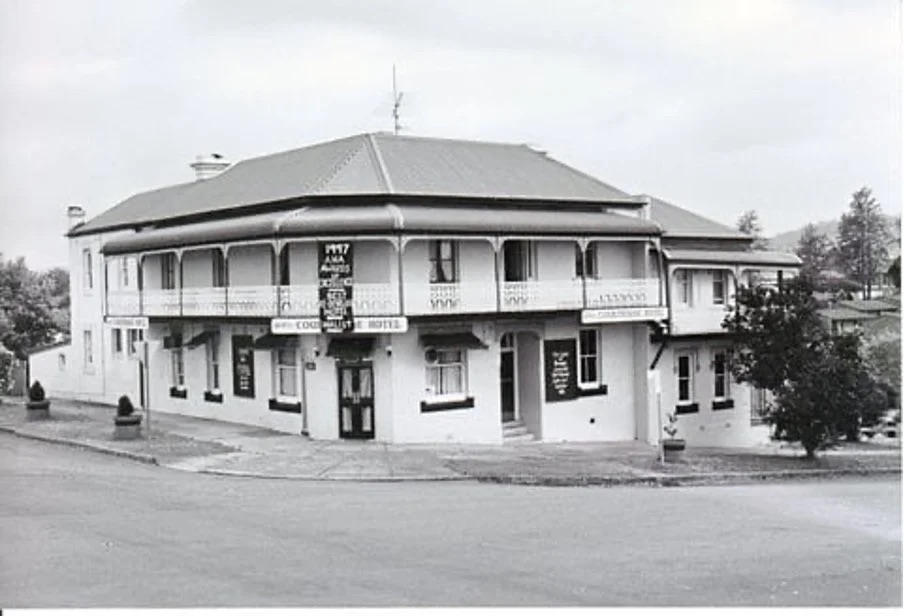
The Court House Hotel (later renamed the Settlers Arms), the earliest hotel in Dungog

In Brown Street itself, Dungog’s oldest hotel, the Court House Hotel, now the Settler’s Arms (pictured above), had been trading since the 1850s. On the top of the hill, the Roman Catholic Convent of St Joseph was built in 1891, a Parish Hall in 1913, and a new Church in 1933, six years after Ellen died. As a devout Catholic, she would have been a regular attendee at the Church on Dowling St and, in later years, at Parish events in the Hall on Brown St. On the eastern end of Brown St, the James Theatre was opened in 1918; to the west of the Bruyn residence, a large and impressive Memorial Hall (now the RSL club) was built in 1919.

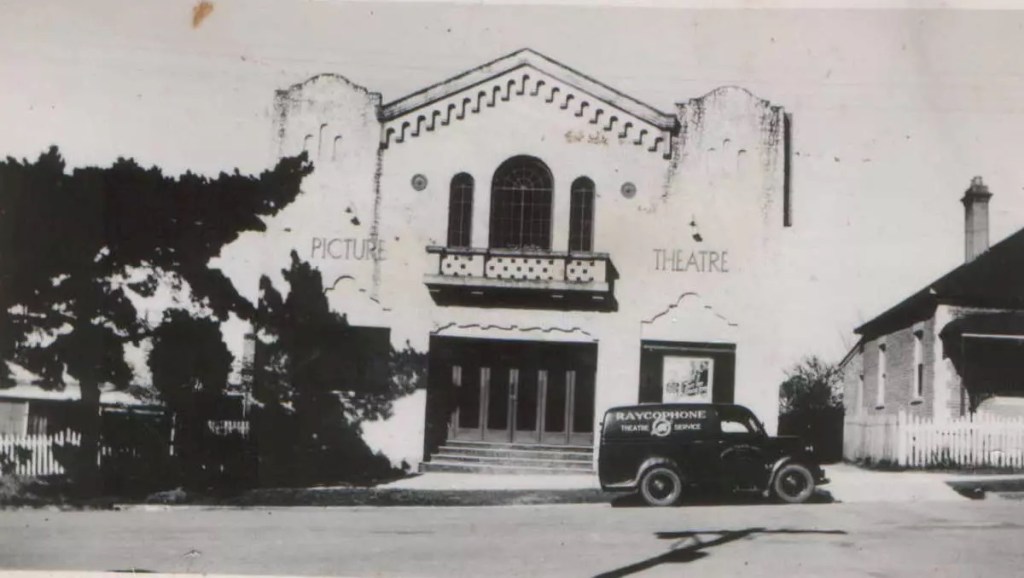
The James Theatre, Dungog, in the 1950s
(from https://www.newcastleherald.com.au/story/
1208160/dungog-cinema-celebrates-100-years/)

(The information about these buildings is taken largely from Michael Williams’ 2011 publication, Ah, Dungog! A brief survey of its charming houses and historic buildings.)

So the hypothesis that Elizabeth and I have developed is that, after she had bought the property in Brown St in 1883, with the older family home on it, Ellen Bruyn had a new double-brick house built on Lot 6.

Which opens the next stage as the story continues … … …

and see earlier blogs at

The Bruyns of Brown Street (6)—Daniel Justin Bruyn (continued)

In exploring the history of the land and house which Elizabeth and I purchased in Dungog a few years ago, I have already noted the early landholders for this property, and investigated the life of Daniel and Sarah Bruyn and their family after Daniel purchased the land in 1858. When Daniel died intestate in 1882, all of his property was made over to his son, Daniel Justin Bryan, whose life we have considered. We turn now to his death.

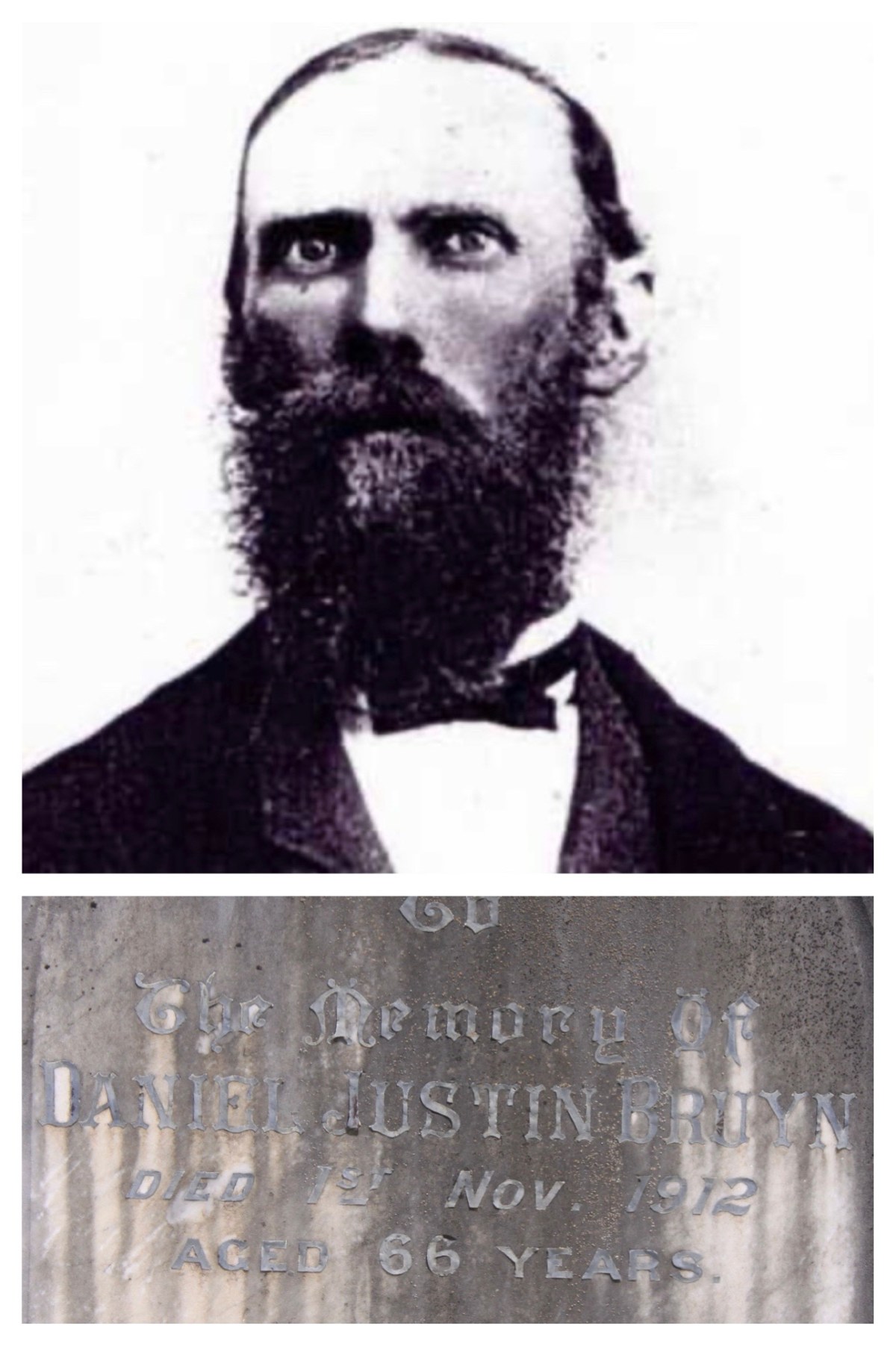
On 22 September 1886, Daniel Justin Bruyn had made his last Will and Testament “whereby he gave devised and bequeathed all his property of whatsoever nature and wheresoever situate to his sister Ellen Bruyn absolutely and appointed the said Ellen Bruyn the sole Executrix thereof”. On 1 November 1912 Daniel Justin Bruyn died, and that will came into effect.

A Coroner’s Inquest for Daniel Justyn Bruyn of Dungog was held by Walterus Le Brun Brown, J.P., on 2 November 1912. The report of the inquest notes that “cash or property possessed by deceased” was “probably over £10,000”. That equates to around $1.45 million in 2023.

Probate for the estate of Daniel Justin Bryan was granted on 26 February 1913. Daniel had never married and had no descendants; as his will prescribed, this collection of property and cash became the possession of Ellen Bruyn. That was a happy result for her in very sad circumstances. The death of Daniel Justin Bruyn, however had a deeper tragedy at its heart.

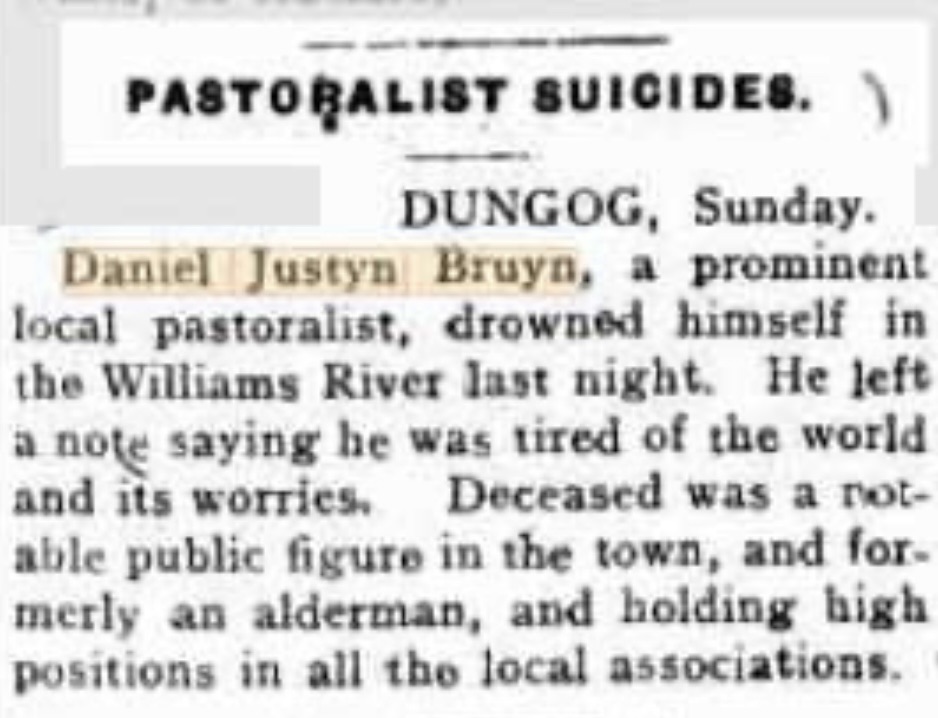
The Bathurst National Advocate stated the matter plainly, in a brief report published on Monday 4 November 1912, under the heading PASTORALIST SUICIDES: “Daniel Justin Bruyn, a prominent local pastoralist, drowned himself in the Williams River last night. He left a note saying he was tired of the world and its worries. Deceased was a notable public figure in the town, and formerly an alderman, and holding high positions in all the local associations.”

Note of death by suicide in the Bathurst National Advocate

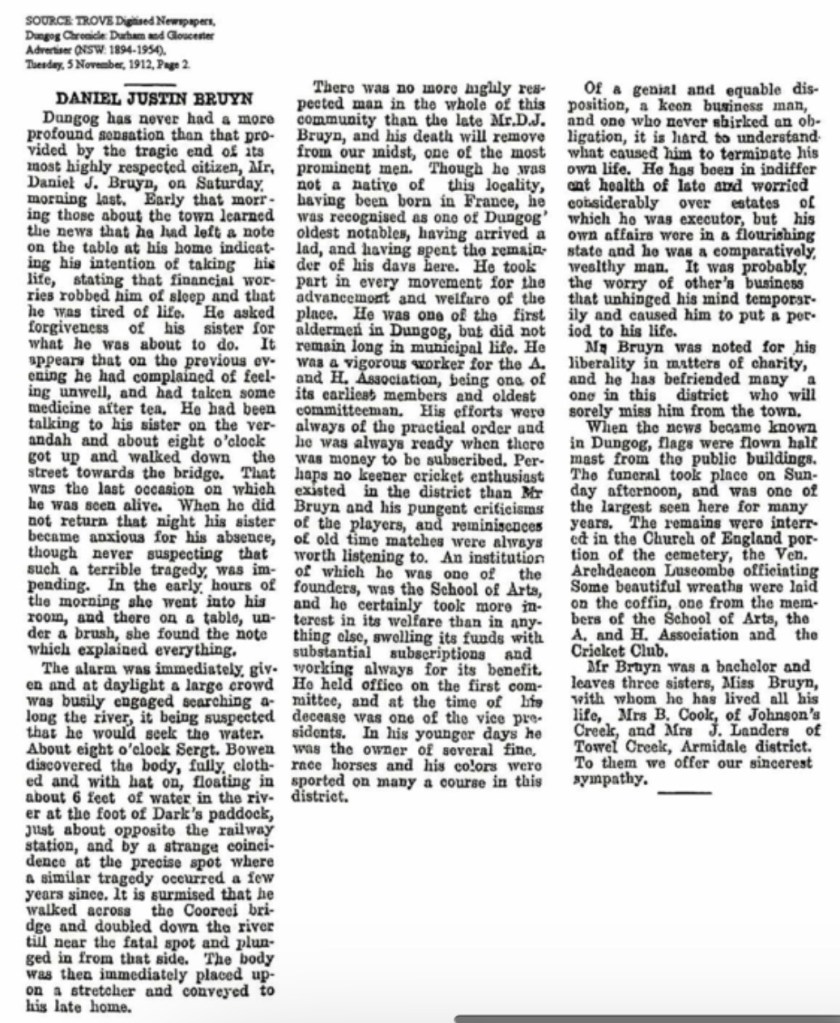
The next day, the Dungog Chronicle provided a much fuller obituary which provided details of the incident and demonstrated just how high a regard was had for Mr Bruyn in the town (Tuesday, 5 November, 1912, Page 2). “Dungog has never had a more profound sensation than that provided by the tragic end of its most highly respected citizen, Mr. Daniel J. Bruyn, on Saturday morning last”, it began.

“Early that morning those about the town learned the news that he had left a note on the table at his home indicating his intention of taking his life, stating that financial worries robbed him of sleep and that he was tired of life”, it continued. It then offered this sad commentary: “He asked forgiveness of his sister for what he was about to do.”

The Chronicle had been advised that “on the previous evening he had complained of feeling unwell, and had taken some medicine after tea. He had been talking to his sister on the verandah and about eight o’clock got up and walked down the street towards the bridge. That was the last occasion on which he was seen alive.”

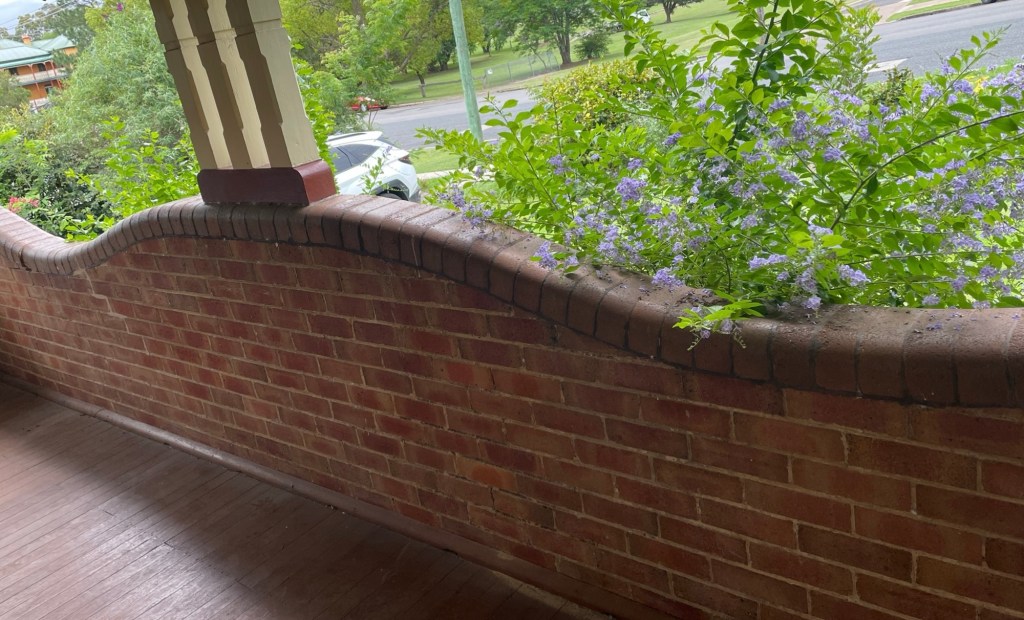
This is the verandah at the front of the house when we moved in, late 2023. Could this have been the same verandah referred to in the obituary of Daniel Justin Bruyn?

This report indicates that Daniel Bruyn did spend time living in the house at Brown Street with his sister, at least at this stage of his life. As both were unmarried, and as the house was ideally placed in the centre of town—next to Dark’s burgeoning general store on Dowling Street, near to the School of Arts where the Municipal Council met—it would make sense for Bruyn of Sugarloaf to have his base in Brown St for such town activities.

Indeed, as the report states, when his sister Ellen “became anxious for his absence … in the early hours of the morning she went into his room, and there on the table, under a brush, she found the note which explained everything”. It continues by noting that upon discovery of Mr. Bruyn’s body, he was “immediately placed upon a stretcher and conveyed to his late home”—that is, the residence in Brown St that he had so recently left.

And, as we have seen, when he was elected to Dungog Council in 1893, his residence is listed as Brown Street. (Michael Williams, in his extensive survey of the historic buildings of Dungog, notes that street numbers were not used until the 1960s; see Ah! Dungog, 2011, p.11.)

The detailed report of Daniel Bruyn’s death in the Dungog Chronicle of 5 November 1912 noted that once his note was discovered and the alarm was raised, “at daylight a large crowd was busily engaged in searching along the river, it being suspected that he would seek the water.”

Sure enough, the report continues, “about eight o’clock Sergt. Bowen discovered the body, fully clothed and with hat on, floating in about 6 feet of water in the river at the foot of Dark’s paddock, just about opposite the railway station, and by a strange coincidence at the precise spot where a similar tragedy occurred a few years since. It is surmised that he walked across the Cooreei bridge and doubled down the river till near the fatal spot and plunged in from that side.” (The Cooreei Bridge crosses the Williams River about a kilometre out of town, on the road that connects Dungog with Stroud.)

The report continues with words that emphasise the regard felt for the deceased: “There was no more highly respected man in the whole of this community than the late Mr.D.J. Bruyn, and his death will remove from our midst, one of the most prominent men … he was recognised as one of Dungog’s notables.” Then, musing on the manner of his death, it opines, “of a genial and equable disposition, a keen business man, and one who never shirked an obligation, it is hard to understand what caused him to terminate his own life.”

The full obituary for Daniel Justin Bruyn, published by
the Dungog Chronicle just four days after his death

The report further offers comments on the character of Mr. Bruyn: he was “noted for his liberality in matters of charity, and he has befriended many a one in this district who will sorely miss him from the town.” The report notes the fitting tribute paid to Daniel Justin Bruyn: “when the news begame known in Dungog, flags were flown half mast from the public buildings”.

In pondering a possible reason for this suicide, the article offers a hypothesis, noting that Daniel Bruyn “has been in indifferent health of late and worried considerably over estates of which he was executor, but his own affairs were in a flourishing state and he was a comparatively wealthy man. It was probably the worry of other’s business that unhinged his mind temporarily and caused him to put a period to his life.” The truth of this hypothesis, however, will never be able to be ascertained.

A correspondent in the Maitland Daily Mercury on Wednesday 6 Nov 1912, p.2, further expresses the dismay of the locals at the news of Daniel’s death: “to say that Dungog and district were struck dumb when it became known that Mr. Daniel Justin Bruyn had left a note expressing his intention to end his life, is putting the truth very mildly. The deceased was about the last person anyone would have expected to do such an act. He was a very quiet man of a retiring disposition, and as far as an onlooker could see had less worry than most people. He was more universally trusted than most men, as proved by the number of wills in which he was appointed an executor, and it is thought that his troubles were not his own, but were those which he voluntarily shouldered for others.”

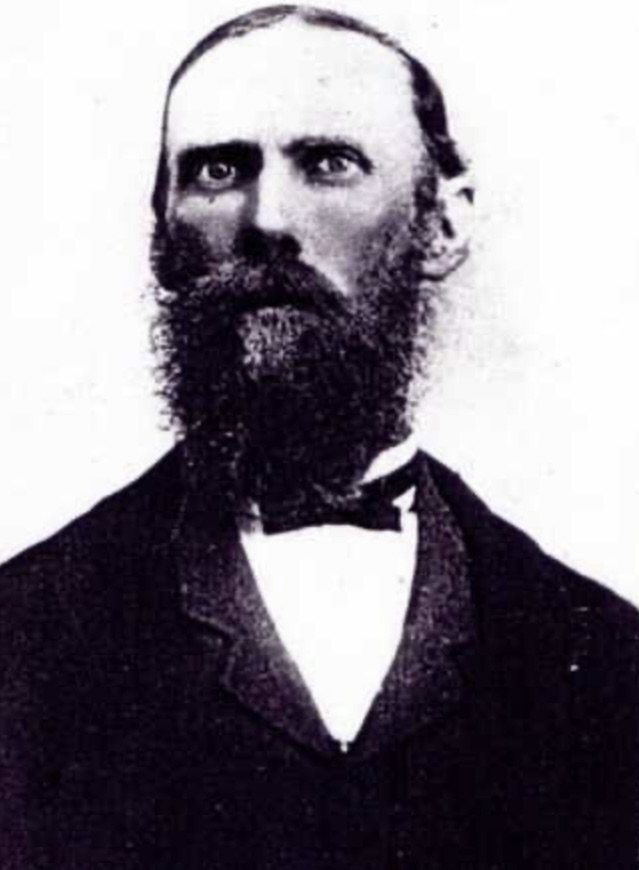
Daniel Justin Bruyn (1847—1912)

Of the funeral of Daniel Justin Bruyn, the Dungog Chronicle notes that, as might be expected, it was “one of the largest seen here for many years”. The Anglican minister, the Ven. Archdeacon Luscombe, officiated, and wreaths were laid on the coffin from organisations including the School of Arts, the A. and H. Association, and the Cricket Club. Three of his sisters remained: Ellen Bruyn in Brown St, Elizabeth Cook of Johnson’s Creek north of Stroud Road, and Sarah Landers of Towel Creek in the Armidale district.

Our particular story will continue with Daniel’s sister, Ellen Bruyn … … …

For earlier posts, see
For the story of Ellen Bruyn, see
The Bruyns of Brown Street (5)—Daniel Justin Bruyn

In exploring the history of the land and house which Elizabeth and I purchased in Dungog a few years ago, I have already noted the early landholders for this property, and investigated the life of Daniel and Sarah Bruyn and their family after Daniel purchased the land in 1858. When Daniel died intestate in 1882, all of his property was made over to his son, Daniel Justin Bryan, whose life we now consider.

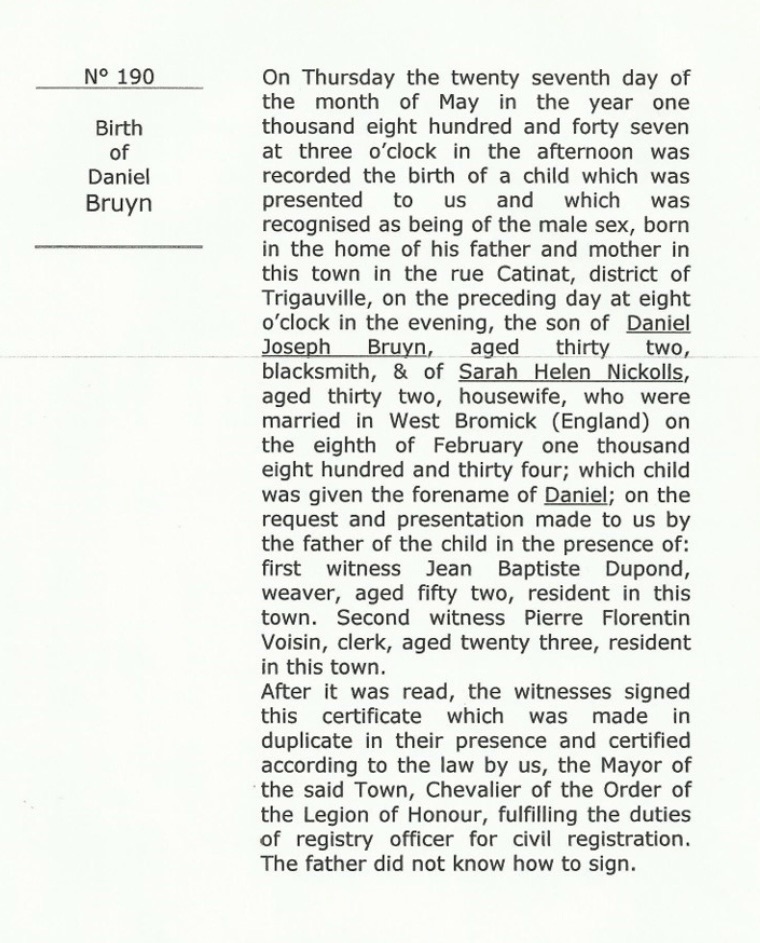
Daniel Justin Bruyn was born in France. His parents, Joseph and Sarah, had married in 1837 in West Bromwich, Staffordshire, where four children were born in the years 1837 to 1842. The family travelled to France, perhaps seeking to use there the skills that Daniel Snr had as a Blacksmith. Two children were born there; Mary died within a year, Daniel Jnr was born on 26 May 1847, at Graville, Le Havre, Seine.

After four years the family returned to England because of the unrest relating to industrialisation. Another daughter was born; the family then migrated to the Colony of New South Wales in 1856 and settled in Dungog, where Daniel purchased land and established his Blacksmith business.

Daniel Justin Bruyn was eleven years of age when his father purchased the land in Brown St; presumably he lived with the family there for some time after they moved into the building that was erected there, at some stage between 1858 and 1866, as noted previously.

Grevilles 1872 Post Office Directory lists both Daniel Bryun, Blacksmith, of Brown St, Dungog, and Joseph Bruyn, farmer, “near Dungog”. Joseph was the firstborn son of Daniel. At some point after this, Daniel Justin Bruyn began to purchase land holdings to the north of Dungog.

Daniel Justin Bruyn

On 11 Sept 1879, Daniel Justin Bruyn is listed as selecting 234 acres in Dungog, Al. No. 76-37754, C.P. No. 73–9338. On 19 April 1883 Daniel Justin Bruyn made application to be registered as “Proprietor by Transmission” of land in Dungog, as the Administrator of the intestate estate of Daniel Bruyn, deceased. The land was 3 acres, Lots 1, 2, and 3, of Section 32, Town of Dungog; this was on the northern side of Hooke St, between Abelard and Eloisa Streets. (There are residential building on these lots today.)

On 1 September 1892 Daniel Justin Bruyn made application for 79 1/2 acres at Tillegra; on 1 February 1893, 78 3/4 acres was granted to him. On 20 October 1892 he made application for 77 acres at Dungog; on 1 February 1893, 65 1/4 acres was granted to him. It is also reasonable to assume, from a piece of evidence noted below, that Daniel had a room in the house at Brown Street where his sister lived. That was his base when he was in town, it would seem.

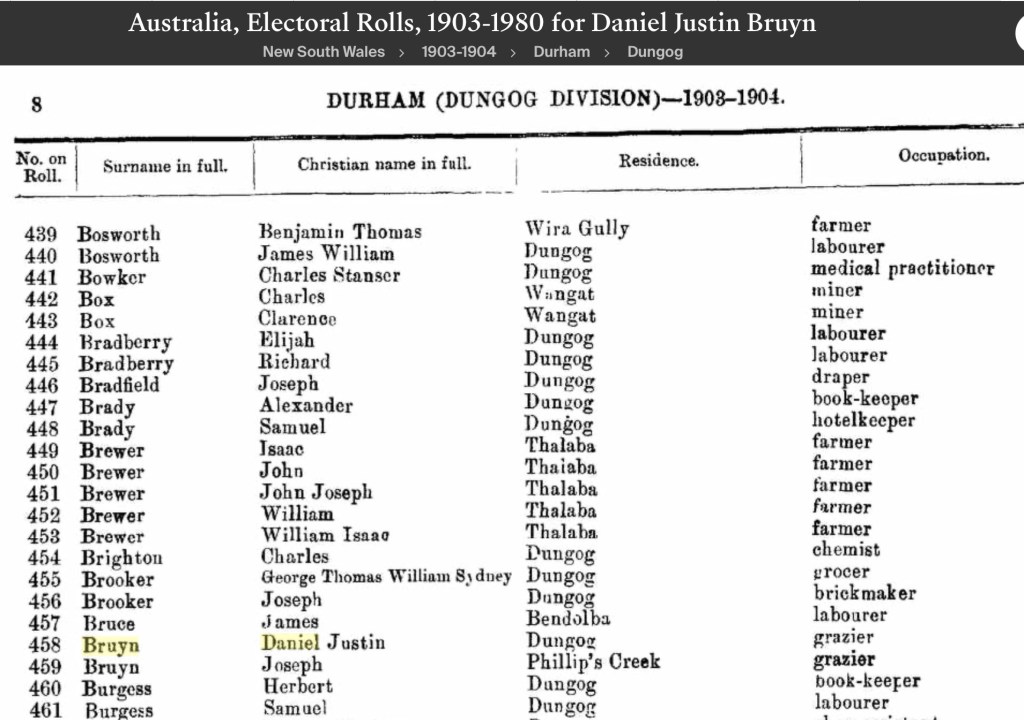
In a series of Electoral Rolls (1895, 1900, 1904) Daniel Justin Bryun, Grazier, is listed as living at Sugarloaf. In 1905, he is listed as having 15 horses and 190 cattle (and no sheep) on his property at Sugarloaf Creek.

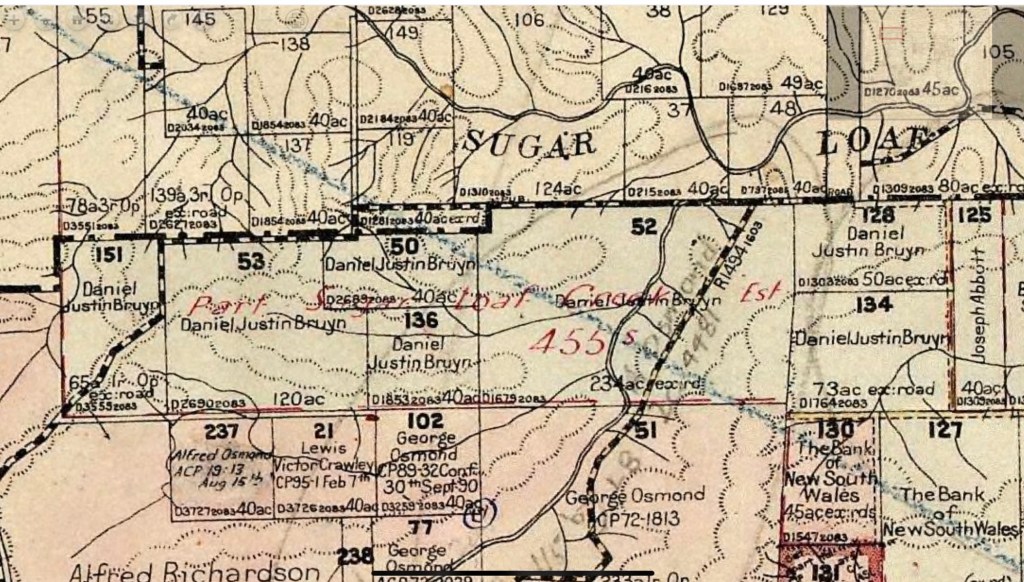
A survey map of the area, dated 9 January 1894, designates seven properties in his name running along the northern boundary of the Parish of Dungog, adjacent to the Parish of Tillegra, to the south of the current Sugarloaf Road, and west of the Longbrush Gully. Another survey map for the Parish of Tillegra places him as owner of a further fourteen Lots running in parallel to his Dungog Parish holdings.

In the Parish of Dungog, running east to west, Bruyn owned Lots 128 (50 acres) and 134 (73 acres), adjacent to each other; then stretching west from them, Lots 52 (234 acres), 50 (40 acres), 136 (40 acres), 53 (120 acres), and 151 (65 acres). This final Lot was the penultimate Lot before the boundary with the Parish of Lewinsbrook, covering the area between Dungog and Gresford. The total acreage of these seven Lots is 622 acres.

The holdings of Daniel Justin Bruyn in the Sugarloaf region, running along the northern boundary
of the Parish of Dungog

In addition, on the other side of the Parish boundary, in the Parish of Tillegra, there is another, more extensive, collection of Lots in the name of Daniel Justin Bruyn. Running east to west, he owned Lots 48 (40 acres), 129 (49 acres), 37 (40 acres), 38 (40 acres), 49 (80 acres), 106 (114 acres), 4 (99 acres), 149 (40 acres), 119 (40 acres), 137 (40 acres), 138 (40 acres), 55 (78 acres), 145 (40 acres), and 55 (78 acres)! The total acreage of these Lots is 818 acres.

The holdings of Daniel Justin Bruyn in the Sugarloaf region
on the southern border of the Parish of Tillegra,
adjacent to his holdings in the Parish of Dungog

The Sugarloaf Creek meanders its way through the easternmost half of the Lots in the Parish of Tillegra. A survey map declares that all of these Lots were part of a larger area, Gloucester Coldfield, that was proclaimed on 3rd June 1879. Together, the 1,440 acres of these Lots form a very significant landholding. To the east of Daniel’s landholdings, another series of Lots totalling 249 acres bear the name of his sister, Ellen Bruyn.

In the Dungog Chronicle of 30 August 1898, p.3, a notice appeared relating to a proposed “public meeting for the purpose of petitioning the Minister for Works, through the Member for Durham, to construct a road between Gresford and Dungog”. There are 14 signatories to this notice, including that of Daniel J. Bruyn, indicating that “a public meeting [is] to be held at the Council Chambers on THURSDAY NEXT, at 8 p.m.”

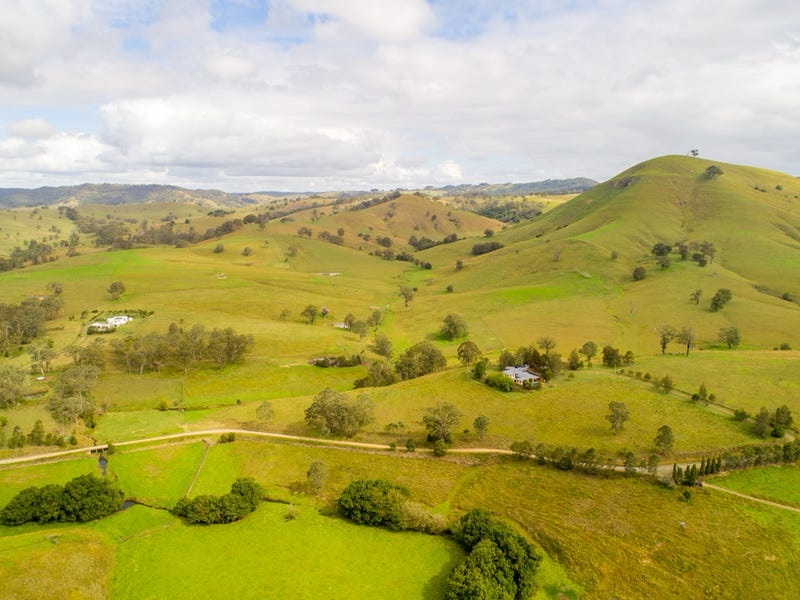
As one owning property in the Sugarloaf Creek area, Daniel Bruyn obviously had a vested interest. It is clear that the petition for the construction of this road was successful, as a road today does wind its way through the beautiful hills in the area between Gresford and Dungog, and through some of the land once owned by Daniel Justin Bruyn.

Scenery on the Sugarloaf Road from Dungog to Gresford, 2024

Not only did Daniel Justin Bruyn die a wealthy man, however; he died also a highly-regarded and well-respected member of the Dungog community. His obituary (see below) indicated that he was a Trustee of the Dungog Hospital, a Municipal Alderman, a Justice of the Peace, a longterm committee member of the A. and H. Association, and one of the founders of the Dungog School of Arts. He followed the local cricket team with enthusiasm, and owned a number of horses that he raced in the local area.

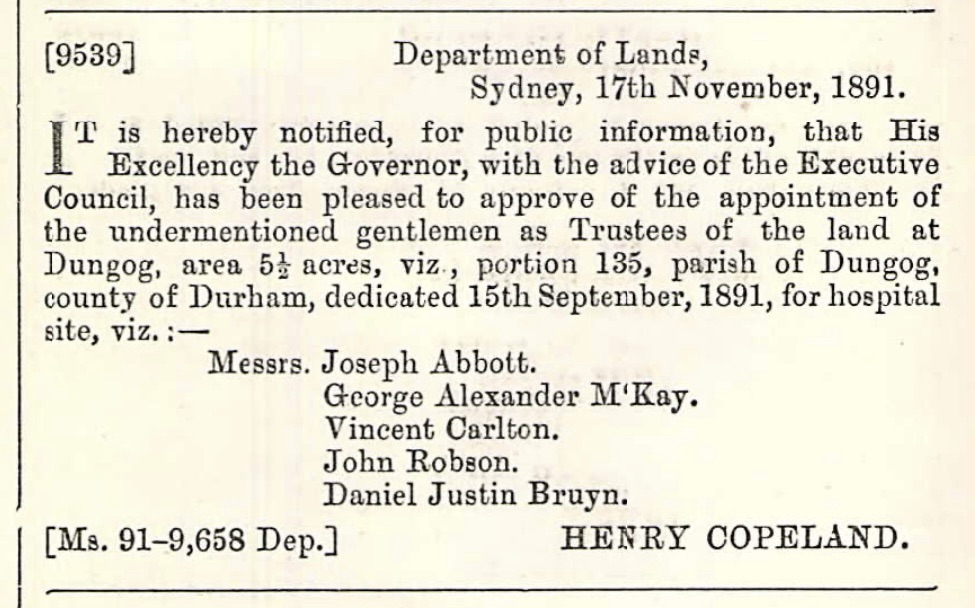
On 17 November 1891, the Government Gazette (p.9023) contained a notice from the Department of Lands of the appointment of Joseph Abbott, George Alexander McKay, Vincent Carlton, John Robson, and Daniel Justin Bruyn, as “Trustees of the land at Dungog, viz. portion 135, parish of Dungog, county of Dungog, dedicated 15th September 1891, for hospital site”.

Notice from the NSW Government Gazette of 7 Nov 1891

The Dungog Cottage Hospital was opened on Hospital Hill in 1892 and the site, now much expanded, has provided local hospital and medical services since that time.

The Dungog Cottage Hospital building

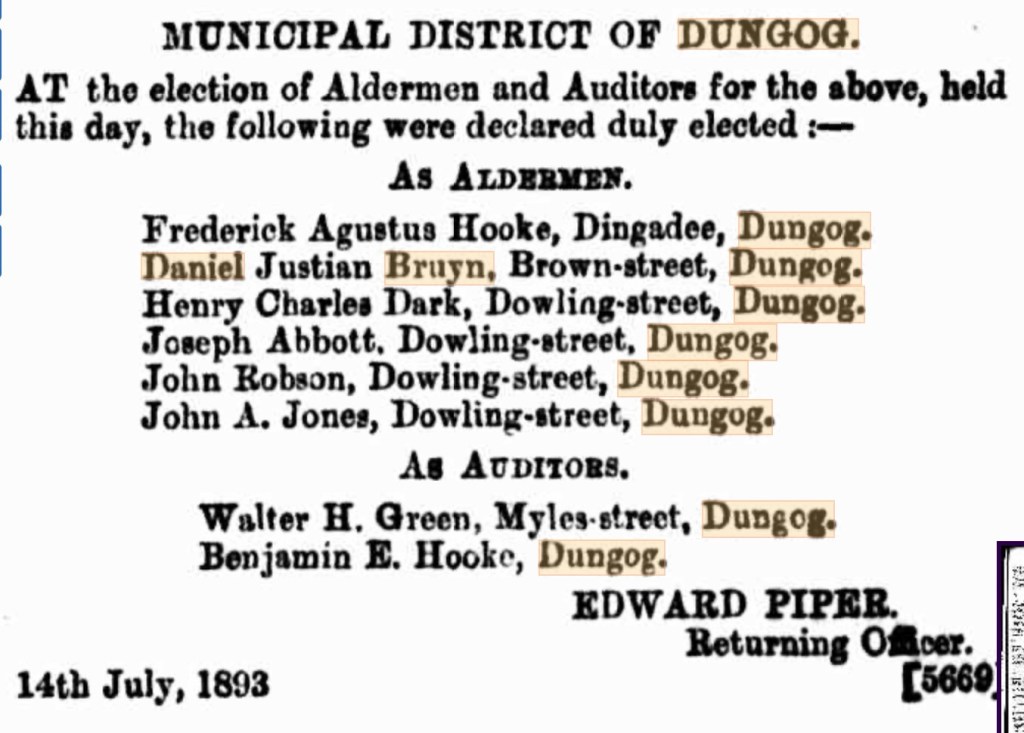
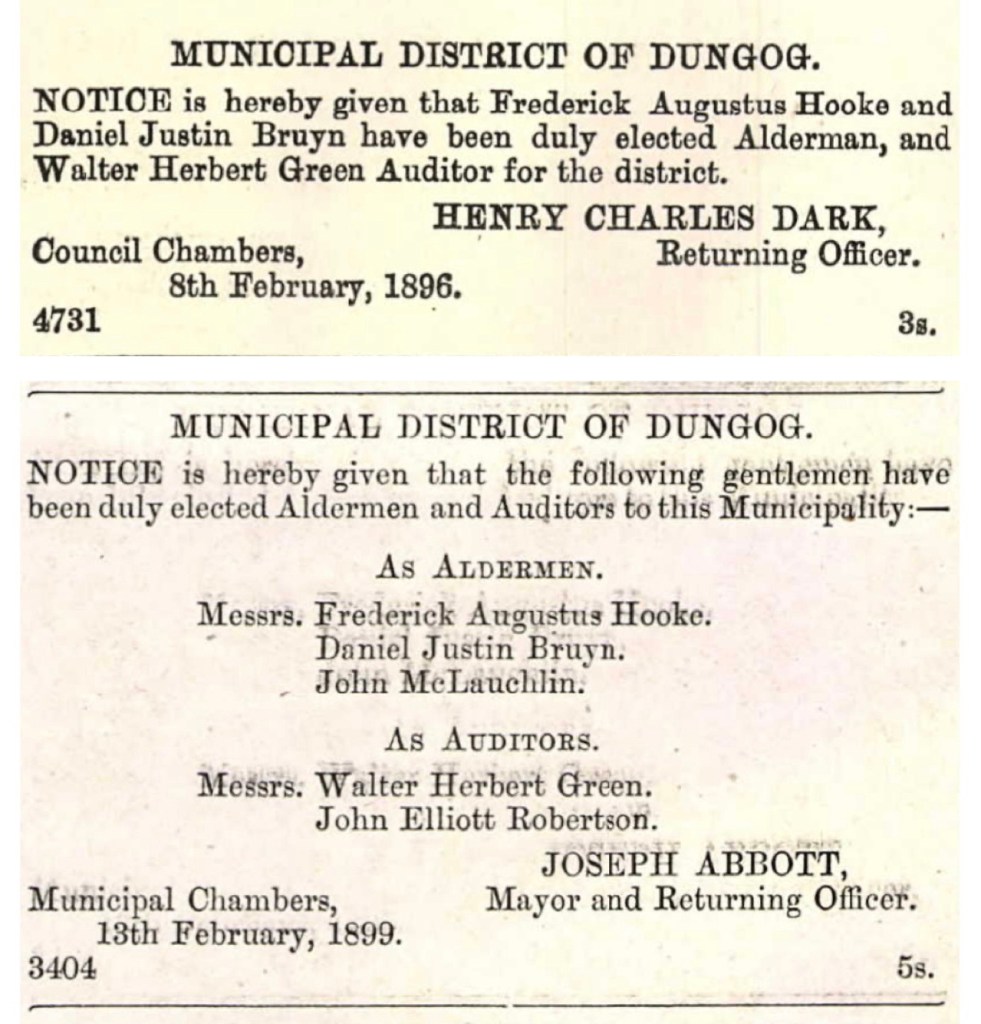
On 21 July 1893, the Government Gazette (p.5663) contained a notice of the election of Frederick Agustus Hooke, Dingadee, Dungog; Daniel Justian [sic.] Bruyn, Brown-street, Dungog; Henry Charles Dark, Dowling-street, Dungog; Joseph Abbott, Dowling-street, Dungog; John Robson, Dowling-street, Dungog; and John A. Jones, Dowling-street, Dungog, as Aldermen of the Municipal District of Dungog.

1893 Government Gazette announcement

Then, on 8 February 1896, the Government Gazette (p.1022) contained a notice of the election of Frederick Augustus Hooke and Daniel Justin Bruyn, as Aldermen of the Municipal District of Dungog. Three years later, on 13 February 1899, the Government Gazette (p.1415) contained a notice of the election of Frederick Augustus Hooke, Daniel Justin Bruyn, and John McLauchlin, as Aldermen of the Municipal District of Dungog.

Extracts from the Dungog Chronicle of 1896 and 1989, announcing the election of Alderman for the Municipality of Dungog

On 4 May 1901, the Maitland Mercury (p.3) reported that Daniel Justin Bruyn was amongst a list of “gentlemen appointed to them commission of the Peace” (that is, as a Magistrate, or a Justice of the Peace).

On 22 September 1886, Daniel Justin Bruyn had made his last Will and Testament “whereby he gave devised and bequeathed all his property of whatsoever nature and wheresoever situate to his sister Ellen Bruyn absolutely and appointed the said Ellen Bruyn the sole Executrix thereof”. On 1 November 1912 Daniel Justin Bruyn died, and that will came into effect. So Ellen received a significant amount of property, as we have seen.

The Register of Coroner’s Inquests for 2 November 1912 lists an inquest for Daniel Justyn Bruyn of Dungog, held by Walterus Le Brun Brown, J.P., which notes that “cash or property possessed by deceased” was “probably over £10,000”. That equates to around $1.45 million in 2023.

to be continued … … …

*****

See earlier posts at

and subsequent posts at

The Bruyns of Brown Street (4)—Daniel, Sarah, and family (cont.)

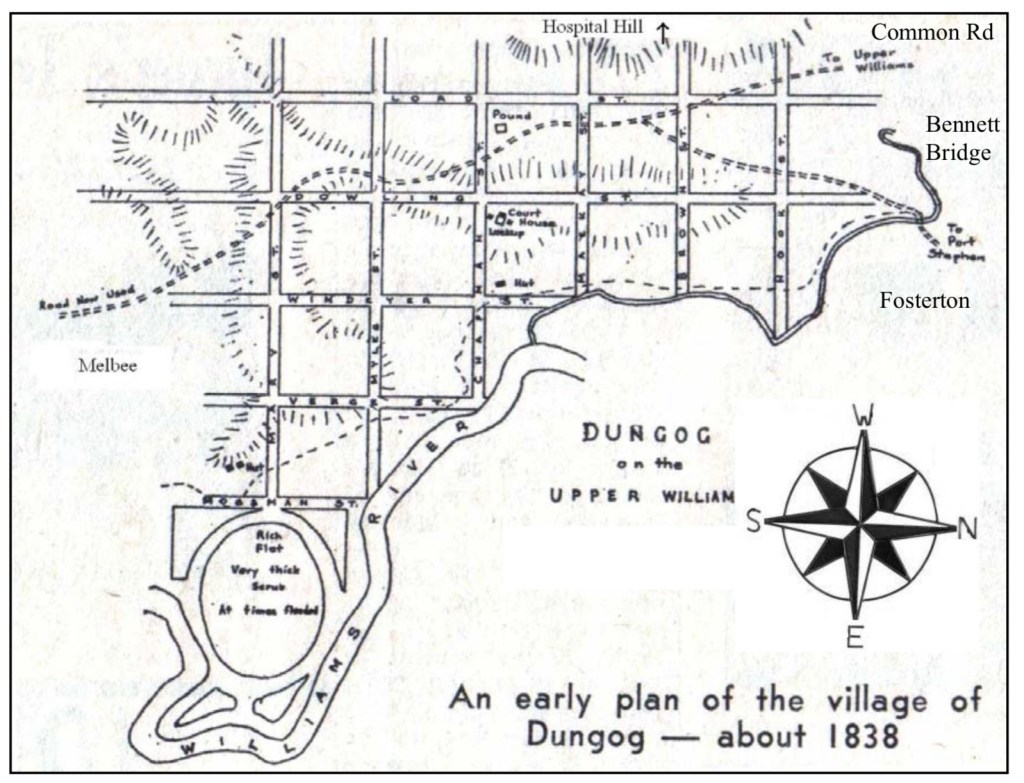
The land on which the house that we currently own and live in, on Brown Street, Dungog, was part of the original area of land in the town of Dungog that was made available in 1838 to settlers by the Governor of the Colony of New South Wales, Sir George Gipps.

Of course, this land and the surrounding region had been the land of the Gringai people for millennia; but once the British government started sending convicts to this continent, and began the process of claiming the land from the Indigenous people, the British system of law, and of land and property, became dominant as new settlements were opened up for the incoming settlers.

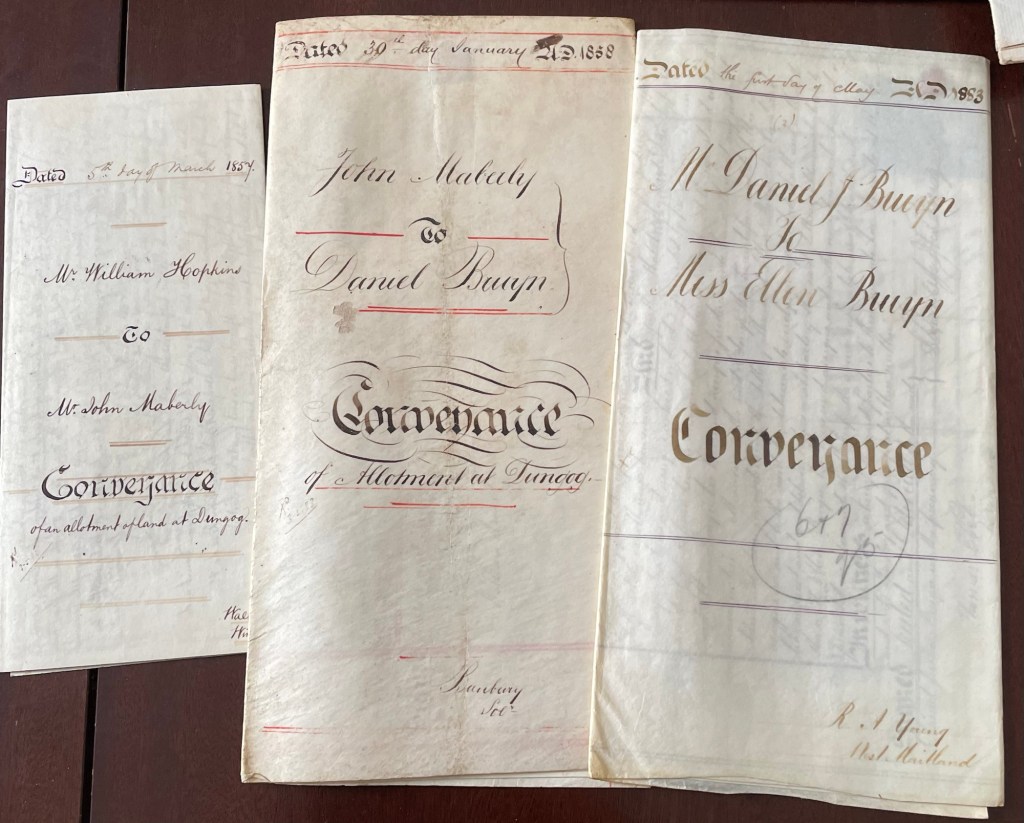
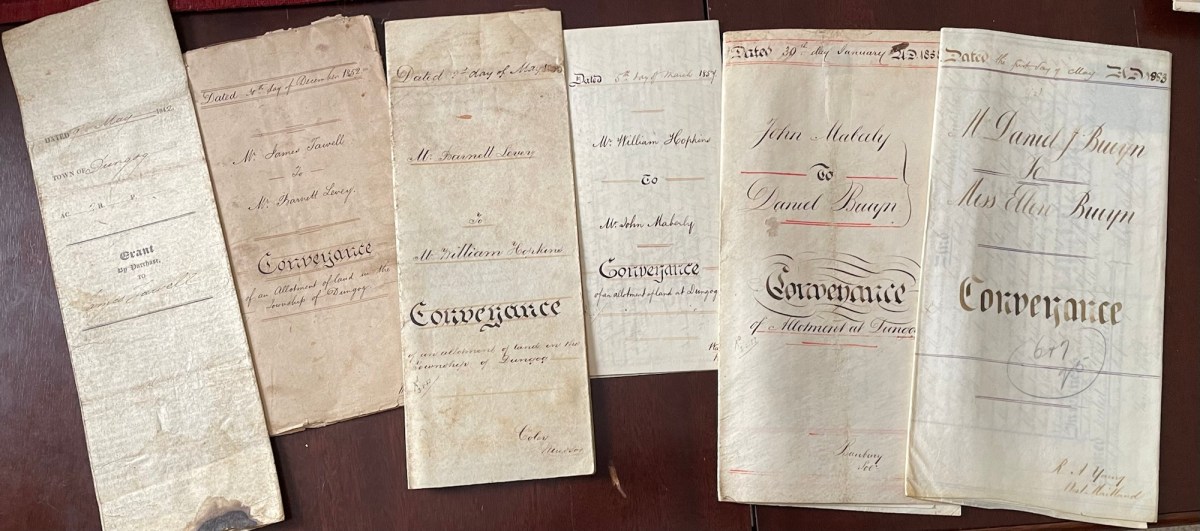
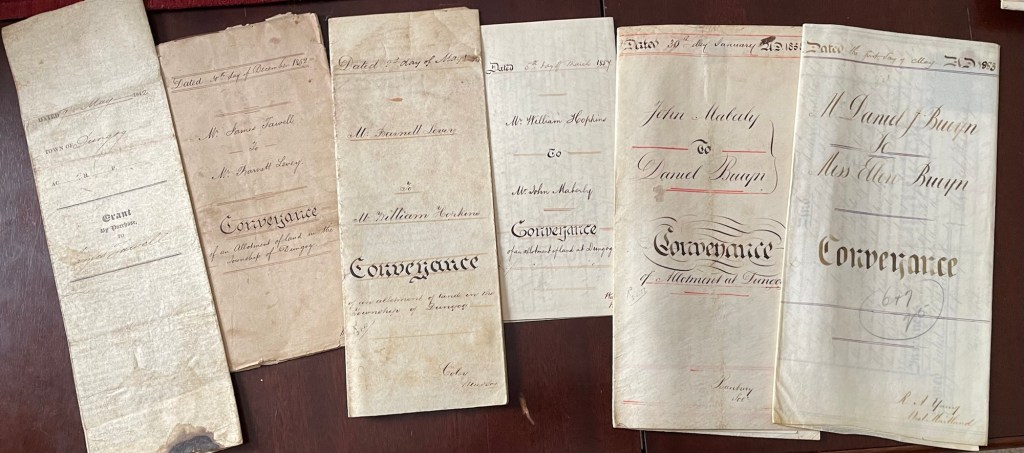
A bundle of documents which we received when we purchased the property provides information about the sequence of owners, from 1842, when the land was bought by James Fawell, up to 1969, when it was bought by Victoria Jack and Wendy Elizabeth Finney. These documents show that it was owned by a series of men in the middle of the 19th century: James Fawell (1852), Barnet Levey (1852), William Hopkins (1855), John Maberly (1857), and then Daniel Bruyn (1858).

The series of legal documents
relating to the Brown St property

When Daniel Bruyn purchased the land in 1858, two years after arriving on New South Wales, it meant that he could provide a home for his family in Dungog, as well as a site to conduct his business as a Blacksmith. When Daniel Snr died intestate in 1882, all of his property was made over to his son, Daniel Justin Bryan; a few months later, the land he held in Brown St had been purchased by his daughter, Ellen Bruyn. She lived in the house until her death in 1927.

What do we know of the life of the Bruyn family? In the obituary to Miss Ellen Bruyn after her death, published in the Dungog Chronicle of Tuesday 4 October 1927, p.2, we read: “In the memorable flood of 1857, the [Bruyn] family had to be rescued from their home, which, although situated at a comparatively high level, was inundated by the swirling waters. It was the year that eight of the ill-fated Ross family were swept to death from their home on Melbee flat.”

The Bruyn family survived the flood. The names of the members of the Ross family who died in this flood are listed in a report of the inquest held on 1 September 1857, namely: “George Ross, aged 39 years; Mrs. Ross, aged 27 years; William Ross, aged 9 years; Mary Jane Ross, aged 7 years; John Ross, aged 6 years; Elizabeth Ross, aged 4 years; Julia Ross, aged 1 year and 9 months.” (Maitland Mercury, Thursday 3 September 1857, p.2)

The obituary to Ellen Bruyn also reports that “The Bruyn family played an important part in Dungog’s progress, and were prominently identified with every forward movement. They experienced many of the trials and hardships inseparably associated with the early pioneering days, and saw many thrilling happenings.” That’s a very nice tribute to them all—and it would be fascinating to know more about some of these “thrilling happenings”!

We know far more about men in society in the 19th and 20th centuries than we do about women; not only were male occupations more public (“a woman’s place is in the home”, as the sexist, but generally accurate, saying went in those days), but the bias towards males overall is evident in so many ways.

Newspapers articles do report the contributions of women to some charitable and community events and organisations; but it is predominantly the men who serve on Council, buy and sell property, conduct professions and trades, and are in what were seen, at that time, to be leadership roles in the community.

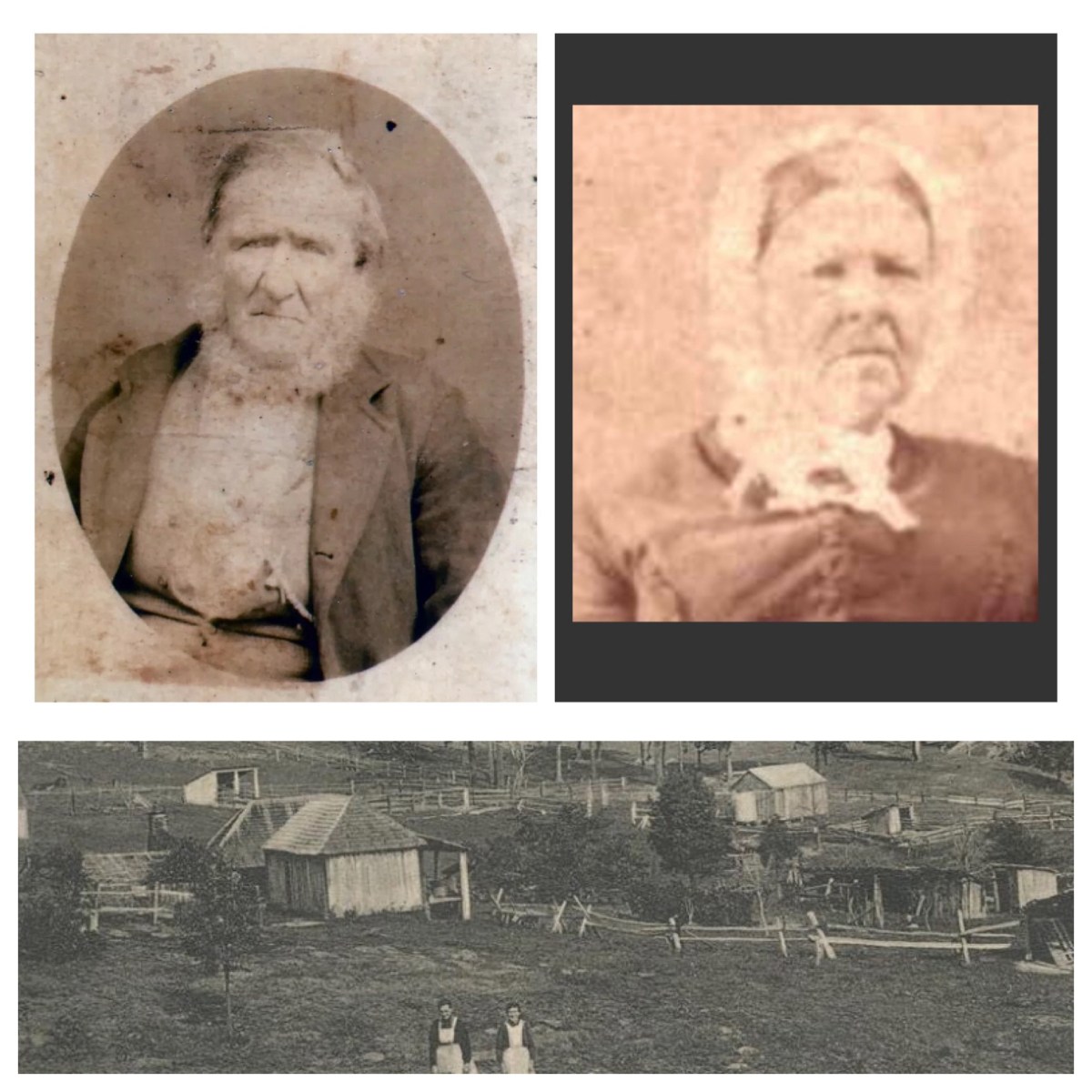
Daniel and Sarah Bruyn, late in their lives

So not much more cannot be said about Sarah Bruyn other than, as a faithful wife and mother of six children, she would have organised and run the Bruyn household with efficiency and diligence. She should always be considered to be there—albeit “in the shadows”—when her husband, Daniel Joseph Bruyn, is mentioned.

And fortuitously, as we shall see, her spinster daughter Ellen would be noted more often in the newspapers of the day and even on property registers (as an adult she owned land adjacent to the holdings of her brother, Daniel Justin). Through her compassion, diligence, and concentrated effort, she was able to make bequests in her will that both reflected her community involvements and that had a life of their own, for two decades and more, for the good of the community. Did she inherit these traits from her mother, perchance?

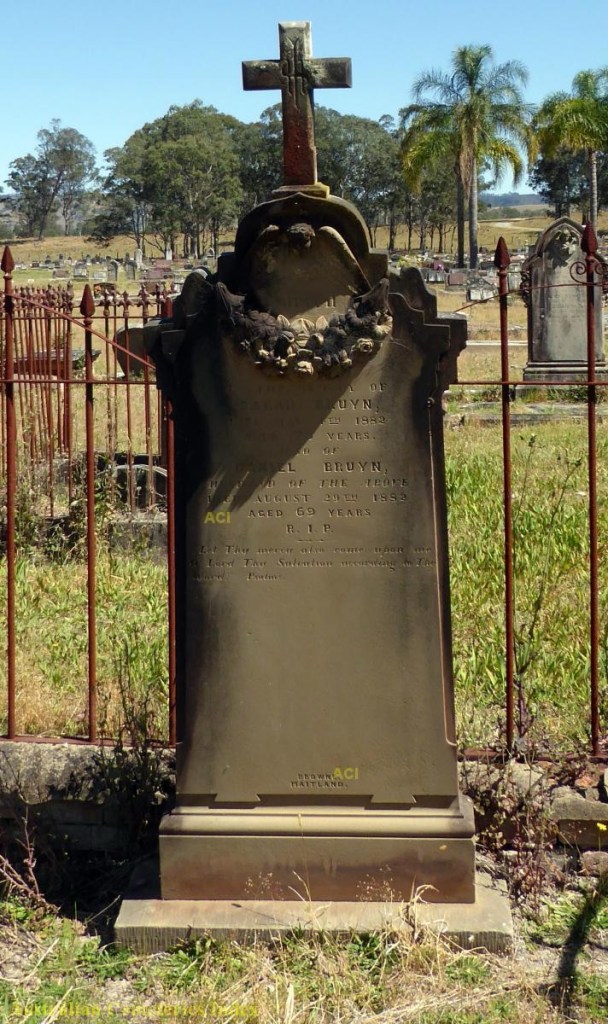
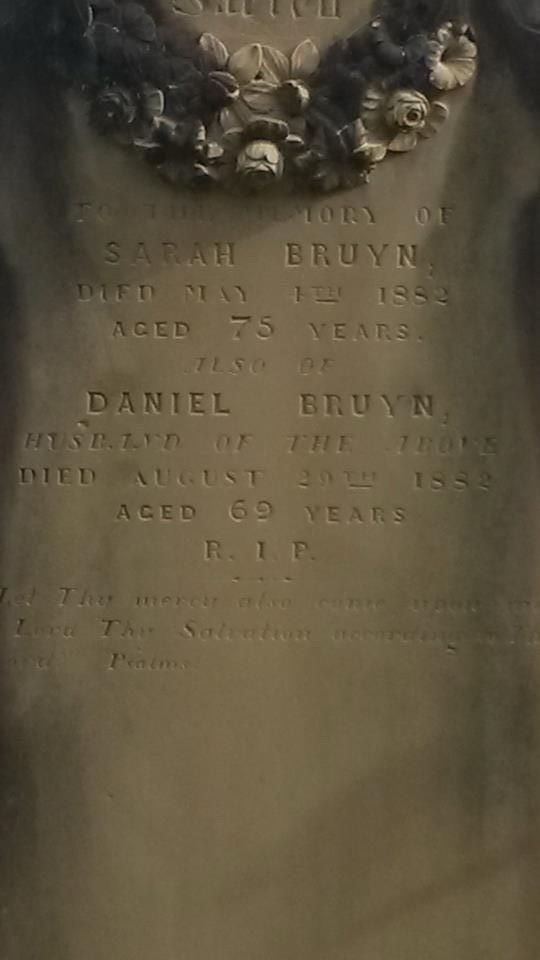
At the age of 75, the mother of the Bruyn family, Sarah Ellen Bruyn, died on 4 May 1882; her husband Daniel Joseph Bruyn died soon after on 29 August 1882. They are both buried in the Dungog Cemetery.

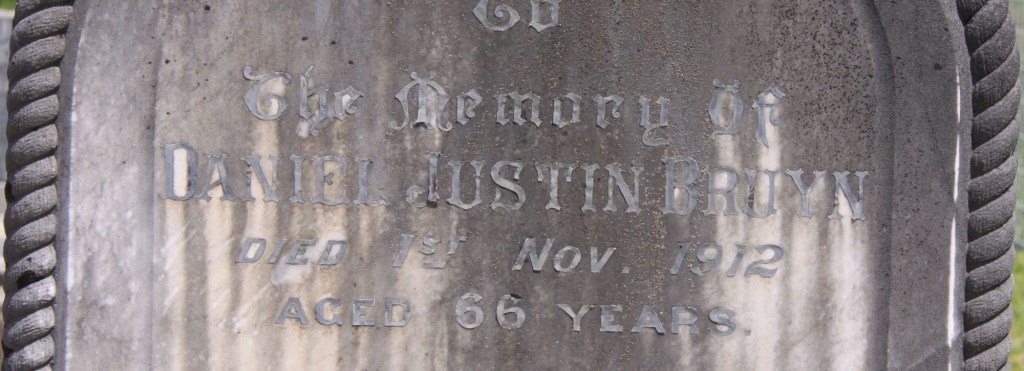
The tombstone for Daniel and Sarah Bruyn
in the Dungog Cemetery
The inscriptions on the tombstone of Daniel and Sarah Bruyn

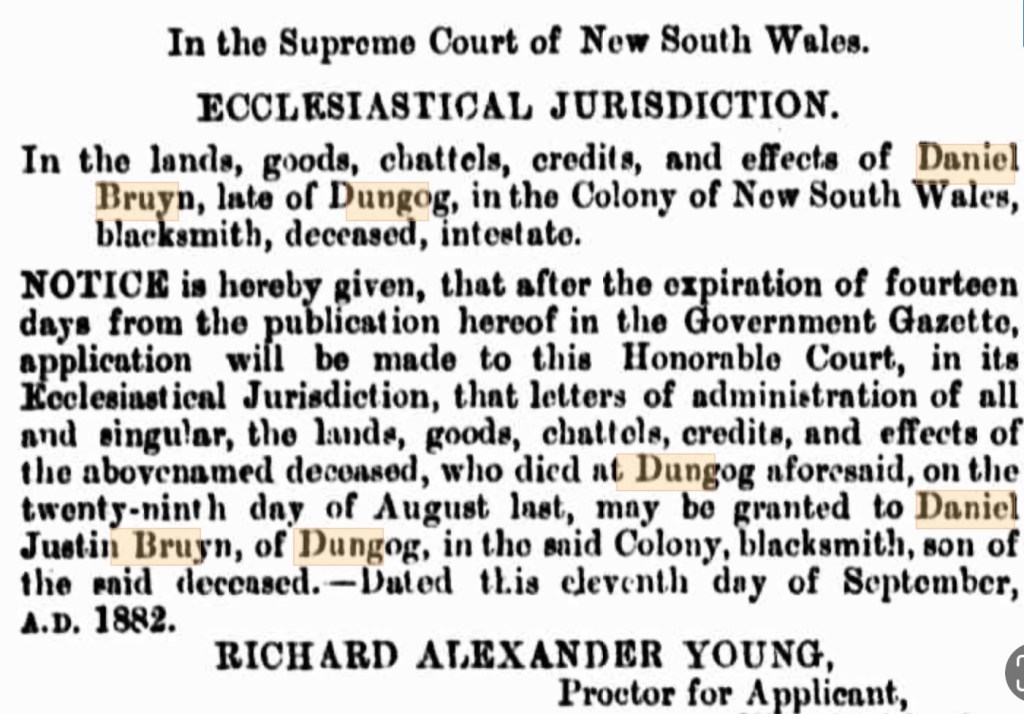
Daniel died intestate, so there were legal matters to be dealt with. In the first instance, all of the property held by Daniel Joseph Bruyn was to be given over to his son, Daniel Justin Bruyn. The Dungog Chronicle included the following notice:

In the Supreme Court of New South Wales ECCLESIASTICAL JURISDICTION. In the land, goods, chattels, credits, and effects of Daniel Bruyn, late of Dungog, in the Colony of New South Wales, blacksmith, deceased, intestate.

NOTICE is hereby given, that after the expiration of fourteen days from the publication hereof in the Government Gazette, application will be made to this Honorable Court, in its Ecclesiastical Jurisdiction, that letters of administration of all and singular, the lands, goods, chattels, credits, and effects of the abovenamed deceased, who died at Dungog aforesaid, on the twenty-ninth day of August last, may be granted to Daniel Justin Bruyn, of Dungog, in the said Colony, blacksmith, son of the said deceased.—Dated this eleventh day of September, A.D. 1882.

RICHARD ALEXANDER YOUNG, Proctor for Applicant, West Maitland. By W. J. Fergusson, 136, Pitt-street, his Agent. 6023 6s. 6d.

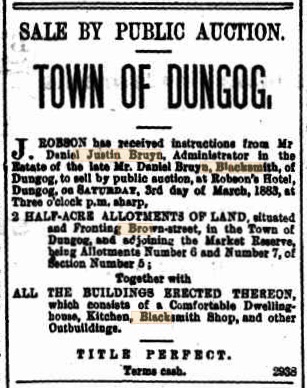
It appears that plans were made for this to be duly executed, as a notice in the classified advertising of the Maitland Mercury of Sat 24 Feb 1883, p.7, indicates that the two blocks of land in Brown St are to be sold be auction:

SALE BY PUBLIC AUCTION.

J. ROBSON has received instructions from Mr Daniel Justin Bruyn, Administrator in the Estate of the late Mr. Daniel Bruyn, Blacksmith, of Dungog, to sell by public auction, at Robson’s Hotel, Dungog, on Saturday, 3rd day of March, 1883, at Three o’clock p.m. sharp, 2 HALF-ACRE ALLOTMENTS OF LAND, situated and Fronting Brown-street, in the Town of Dungog, and adjoining the Market Reserve, being Allotments Number 6 and Number 7, of Section Number 5; Together with ALL THE BUILDINGS ERECTED THEREON, which consists of a Comfortable Dwellinghouse, Kitchen, Blacksmith Shop, and other Outbuildings. TITLE PERFECT. Terms cash. 2938

This notice certainly shows that buildings had been erected on the land and were in use well before 1883.

The next piece of information about this property comes from the next Conveyance contained in the bundle of documents we received when purchasing our land. That Conveyance, dated 1 May 1883 (two months after the auction day) indicates that Ellen bought the two blocks of land from her brother Daniel for £160.

“Conveyance dated 31st day of May 1883 … between Ellen Bruyn of Dungog, Spinster, and Daniel Justin Bruyn of Dungog, Blacksmith, Allotment No. Seven of Section No. Five and Allotment No. Six of Section No. Five. Two hundred pounds”.

Before we explore the story of Ellen Bruyn, we need to give due consideration to the life of Daniel Justin Bruyn.

And so to the next chapter in this story … … …

*****

See earlier posts at

and subsequent posts at

The Bruyns of Brown Street (3)—Daniel, Sarah, and the Bruyn family

The land on which the house that we currently own and live in, on Brown Street, Dungog, was part of the original area of land in the town of Dungog that was made available in 1838 to settlers by the Governor of the Colony of New South Wales, Sir George Gipps.

Of course, this land and the surrounding region had been the land of the Gringai people for millennia; but once the British government started sending convicts to this continent, and began the process of claiming the land from the Indigenous people, the British system of law, and of land and property, became dominant as new settlements were opened up for the incoming settlers.

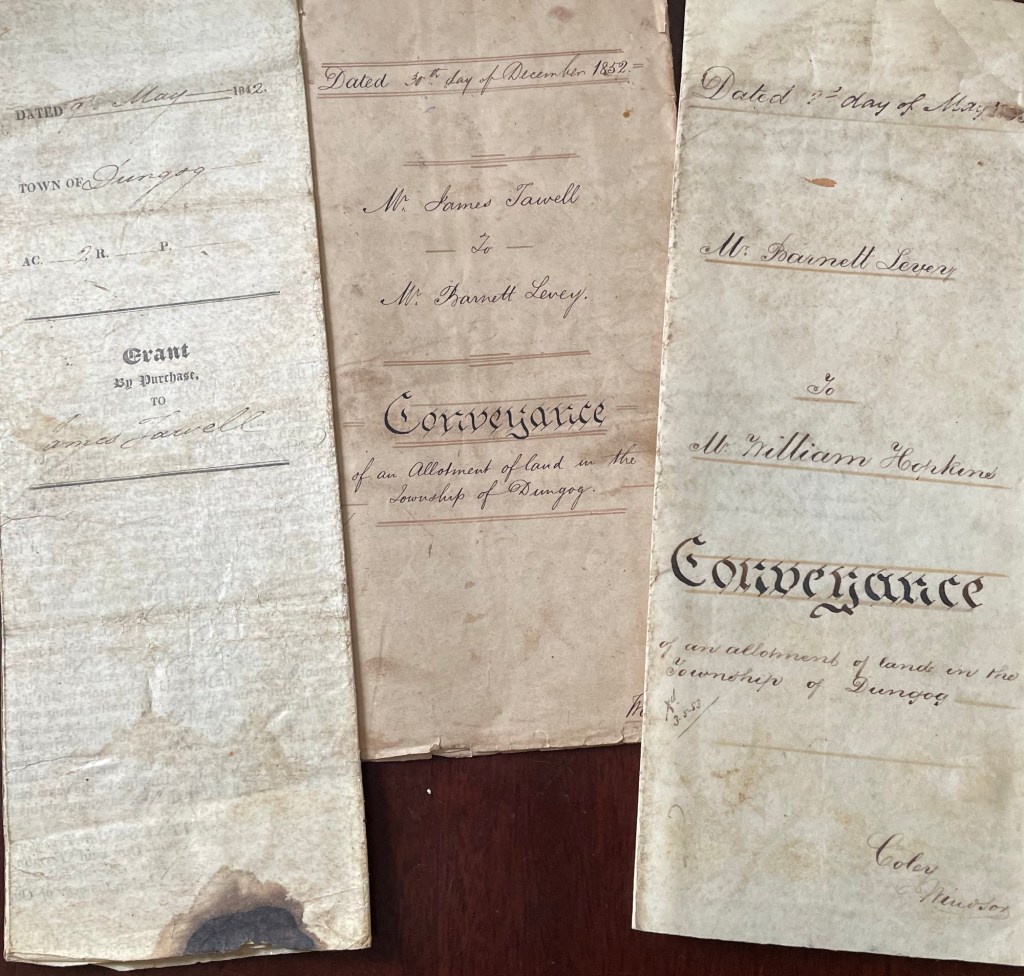
A bundle of documents which we received when we purchased the property provides information about the sequence of owners, from 1842, when the land was bought by James Fawell, up to 1969, when it was bought by Victor Jack and Wendy Elizabeth Finney. These documents show that it was owned by a series of men in the middle of the 19th century: James Fawell (1852), Barnet Levey (1852), William Hopkins (1855), John Maberly (1857), and then Daniel Bruyn (1858).

Three Conveyances, dated from 1857, 1858, and 1883,
relating to the land in Brown St, Dungog

Daniel Bruyn obtained ownership of the land in 1858. A Conveyance dated 30th January 1858, between John Maberly of Windsor, Boot and Shoe Maker, and Daniel Bruyn of Dungog, Blacksmith, reports that “Allotment No. Seven of Section No. Five in the Town of Dungog” changed hands for the price of Fifty three pounds ten shillings. The land would stay in his hands until he died.

What do we know of this man and his family? Daniel Joseph Bruyn was born in Roscommon, Ireland, in the closing years of the 18th century. He migrated to England, and married Sarah Ellen Nichols on 5 February 1837 in West Bromwich, Staffordshire. Sarah had been born in 1807. Daniel’s occupation was Blacksmith.

A number of children were born to Daniel and Sarah in England: Joseph (1837—1905) and Margaret (Dec 1837—1928), both in Birmingham, Warwickshire; Ellen Esther (1839—1927) and Elizabeth Ann (1842—1929), both in Smethwick, Staffordshire.

At that point of time, the current County boundaries were different; Smethwick today is a suburb of the huge city of Birmingham, population now 1.142 million; but in the 1830s it was a small village four miles away from the centre of the town of Birmingham, population then 183,000.

The family travelled to France, where two children were born. A daughter, Mary, arrived in 1845 but died within a year. A son, Daniel Jnr, was born on 26 May 1847, at Graville, Le Havre, Seine. After four years the family returned to England, due to a surge of unrest in French society. Some claims have been made that people were upset about foreigners taking the jobs of French Citizens; many foreigners sought to escape and it is said that most left without their belongings and being paid. Certainly, unemployment and the cost of living was rising, fuelling such unrest.

The Library of Congress Guides contains the following report about the broader political situation of the time:

“The Revolution of 1848, or February Revolution, ended the Orléanist rule and brought in the period of the Second Republic. During this time, many countries in Europe were undergoing revolutions that sought to topple conservative monarchies with liberal democracies … This era also coincided with a deep interest in socialism in France. The Saint Simonian movement was at its height by now. There was a mood of general discontent … Paris became a battleground between numerous factions … equally opposed to one another.

“Election results were not to the satisfaction of the radicals (the popular vote elected moderate and conservative candidates) and as a result the so-called “June Days” erupted, a short-lived civil war in Paris. The rebellion was put down by General Cavaignac, but it took months for the Assembly to come up with a constitution. When it was finally agreed upon it was quite liberal and provided a four-year term President chosen by universal male suffrage. They chose Louis-Napoléon Bonaparte (nephew to Napoléon I) to be president of the Second Republic.”

Taken from https://guides.loc.gov/women-in-the-french-revolution/revolutions-rebellions/1789-1830-1848#:~:text=The%20Revolution%20of%201848%2C%20or,conservative%20monarchies%20with%20liberal%20democracies.

Back in England, another daughter, Malvenia (1850—1938) was born in Smethwick, Staffordshire. It seems that Malvenia was also known as Sarah; at her marriage to John Landers of Dungog in 1871 she is identified as “Sarah Malvina Bruen”. They moved to the New England region, and the Electoral Roll for 1930, 12 years after John’s death, lists “Landers, Sarah Malvina, Castle Doyle road, Armidale, home duties”.

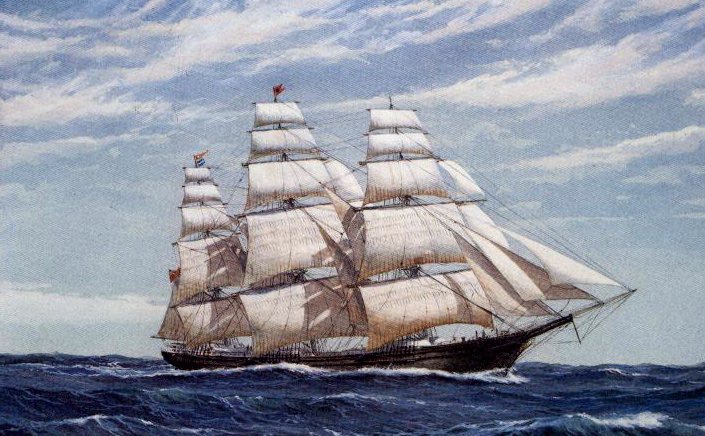
The Commodore Perry. It was launched in 1854;
in 1856 it brought immigrants to Australia and returned to England with gold and wool. The February 1856 voyage which brought the Bruyn family to the Colony was completed in just over 72 days, an excellent time for those times.

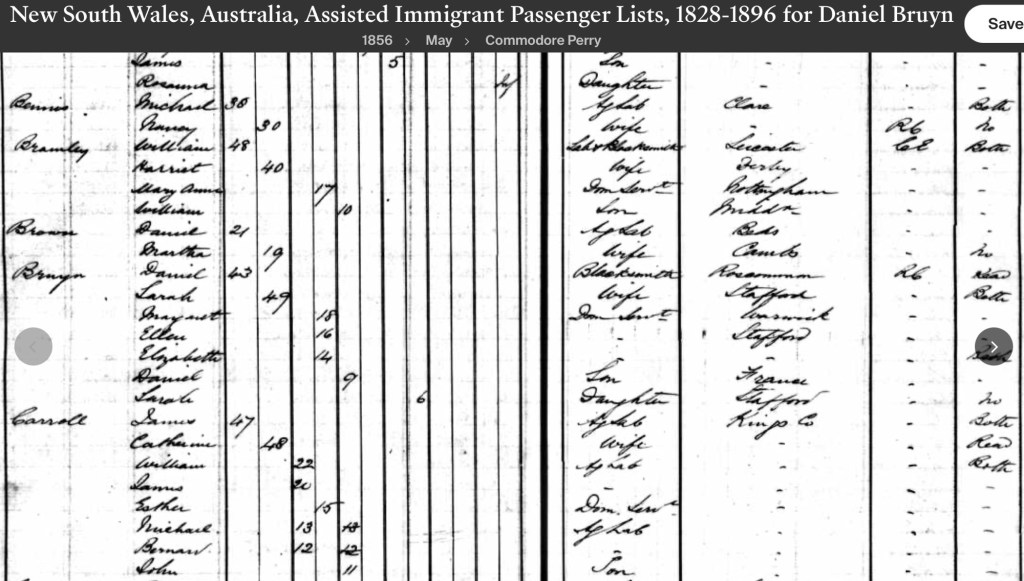
The family came to the Colony of New South Wales in 1856 as assisted migrants. Daniel and Sarah arrived on board the Commodore Perry on 1 May 1856 with their five children. The list of immigrants on this ship lists “Daniel Bruyn age 43, Sarah Bruyn age 49, Margaret age 18, Ellen age 16, Elizabeth age 14, Daniel age 9, Sarah age 6”.

Their eldest child Joseph (then aged 19) did not travel with them, although he does appear in New South Wales a few years later. Joseph had been born to Daniel and Sarah prior to their marriage. He was born with his mother’s surname, as Joseph Nichols, and later married under that name.

Joseph Nicholls was 22 when he and his wife and children arrived on the Daphne 1859 as the Nicholls family (Daniel Bruyn was the person who assisted this immigration). Once off the ship Joseph, his wife and children changed their name to Bruyn. Sadly, Joseph and Mary lost four of their children to Diphtheria in March 1866 (Sarah Jane, Ellen, Frederick, and Thomas).

Daniel and Sarah Bruyn, later in life

Within two years of arriving in Australia, the Bruyns had moved to Dungog and settled in the town. Some comments in the Dungog Chronicle of Tuesday 4 October 1927, p.2, report that on arrival in Sydney in 1856, “the family came direct to Dungog, arriving here on May 24th.” However, in an interview with Ellen, one of the daughters, conducted many decades later in the last year of her life, the Sydney Daily Telegraph of Tuesday 14 June 1927 reported her as saying that when they came to Australia “they all joined in the gold rush at Hanging Rock” (p.18).

At Hanging Rock in the Armidale region to the northwest of Sydney, gold had been discovered in 1851; by February the next year, 27 cradles were operating with some 200 diggers searching for their fortune. Panning continued for some decades; at its peak there were several thousand people living at Hanging Rock. It is entirely feasible that the Bruyn family had gone there for a brief period in 1856—1857, but I have found no other evidence to substantiate this claim made by Ellen in this 1927 interview.

The same report continues, reporting that the Bruyn family “occupied a house, long since demolished, then owned by Mr. Campbell that stood at the rear of Mrs. M. A. Dark’s present home, and almost opposite the residence that Miss Bruyn occupied for the past few decades.” (This extract is from an obituary to Miss Ellen Bruyn after her death in 1927.)

The residence of Mrs. Dark which is noted in this report would be Coolalie, on Dowling Street; it is referred to as her house because her husband, Henry Charles Dark, had died in 1901, and so it would be known in 1927 as “Mrs Dark’s home”. The house to the rear would have been opposite the land on Brown Street that is the focus of our explorations.

The Mr. Campbell referred to here could be Dougall Campbell, who was a convict assigned in 1828 to Mr. John Hooke. (Hooke gave his name to Hooke St on the northern end of the town; he had been granted 2560 acres in 1828.) If so, we may presume that by the 1850s, Campbell had received his Certificate of Freedom and had become a reputable citizen of the town, as many former convicts have done across the continent.

Just two years after arriving in Dungog, Daniel Bruyn became the owner of “Allotment No. Seven of Section No. Five in the Town of Dungog”. In a Conveyance dated 30 January 1858 between John Maberly of Windsor, Boot and Shoe Maker, and Daniel Bruyn of Dungog, Blacksmith, the transfer was effected for a price of fifty three pounds ten shillings.

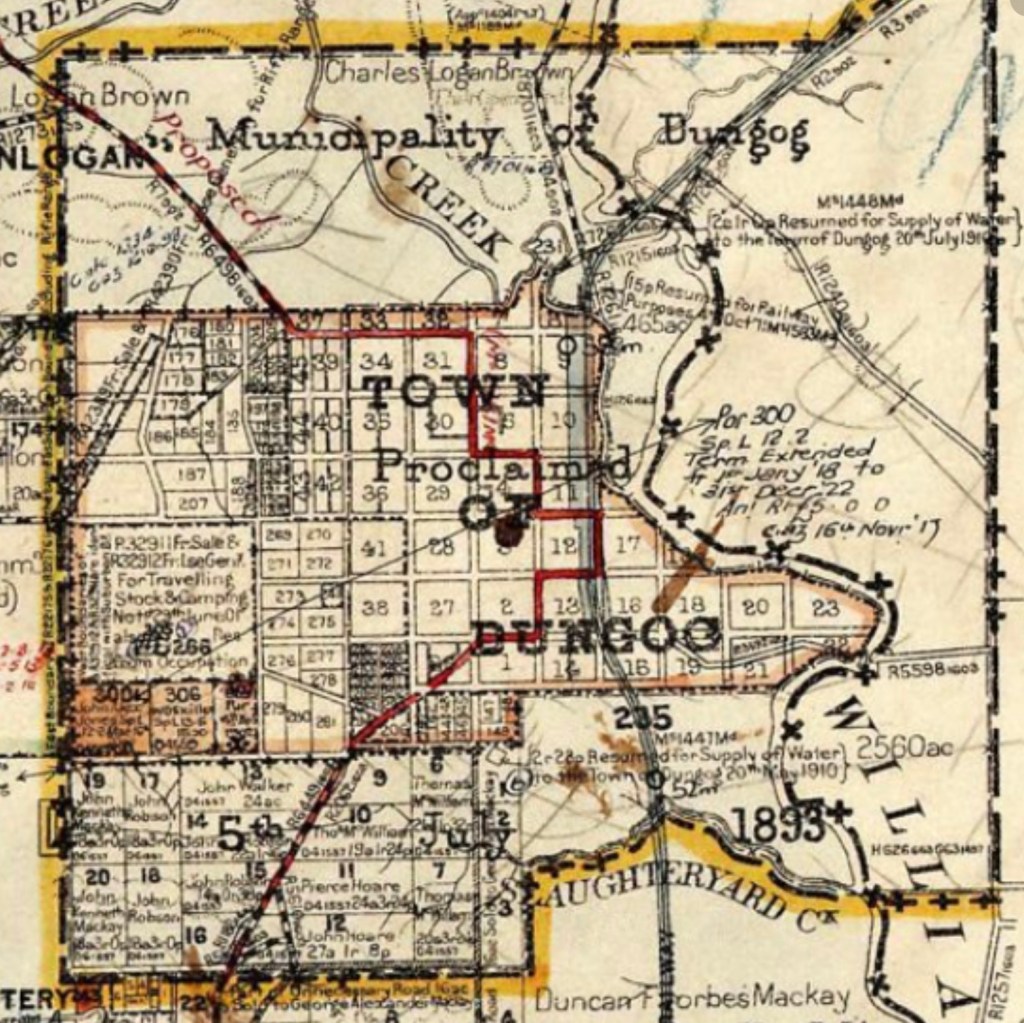
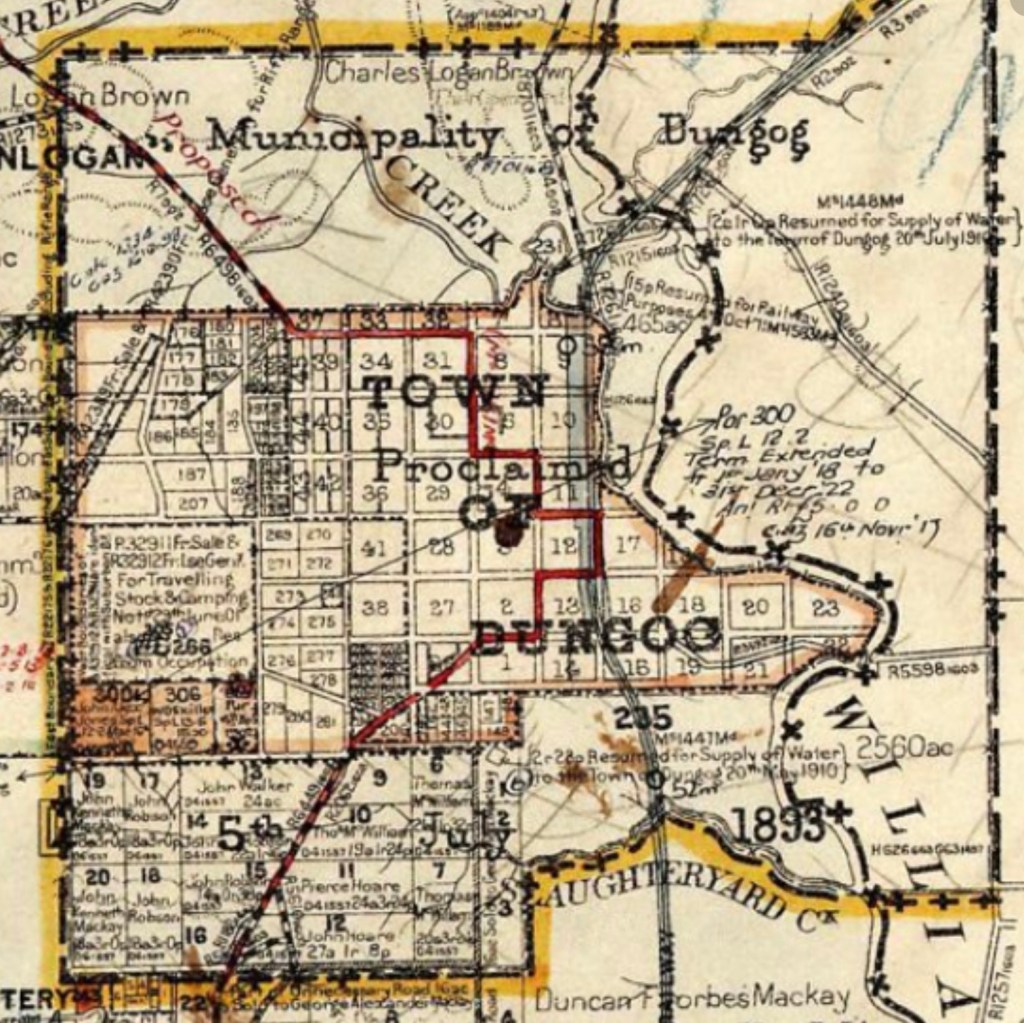
Section 5 in the Town of Dungog can be seen marked just below the WN of the word TOWN on this survey map

The land, facing Brown Street, would stay in the hands of the Bruyn family for over a century—from 1858 to 1968; although, as we shall see, members of the Bruyn family lived there only until 1927. There is good evidence that Daniel conducted his business as a Blacksmith on this property during the two decades or so that the family lived here.

It is not clear when the family moved from the residence behind Mrs. Dark’s home, mentioned in the 1927 obituary of Ellen Bruyn, onto the property across the road where there was a “residence that Miss Bruyn occupied for the past few decades” (until her death in 1927). It is reasonable to hypothesise that the family came to Dungog, found housing in Mr Campbell’s property, purchased the land in Brown Street, had a house built on that land, and then moved in to that building. How soon after the 1858 purchase of this land this move took place, is not known.

It is certainly clear that at some stage Joseph Bruyn also had a foundry built where he could carry out his business as a Blacksmith. One mention of Bruyn’s blacksmithing business comes in a 1934 report of reminiscences by “Mr. Hewlitt Tate, of Lithgow”, in the Dungog Chronicle of Friday 5 January 1934, p.5, entitled DUNGOG’S FIRST BLACKSMITH.

Mr Tate recalls that “The first blacksmith in Dungog, I was led to believe, was Thomas Smith, father of Johnny Smith who was wheelwright in Dungog 70 years ago. He has been dead between 80 and 90 years. Mother used to tell us boys about her grandfather riding over to Stroud when he was sent for by the A.A. Company, to do any special blacksmithing. Mother was then 12 or 13 years of age.

“I remember the late Mr. Kehoe, an old blacksmith, of Dungog, telling us boys that he was in Dungog before the late Mr. Bruyn. Then there was an old Mr. Arrowsmith who used to live along the Stroud road about half a mile the other side of the river.”

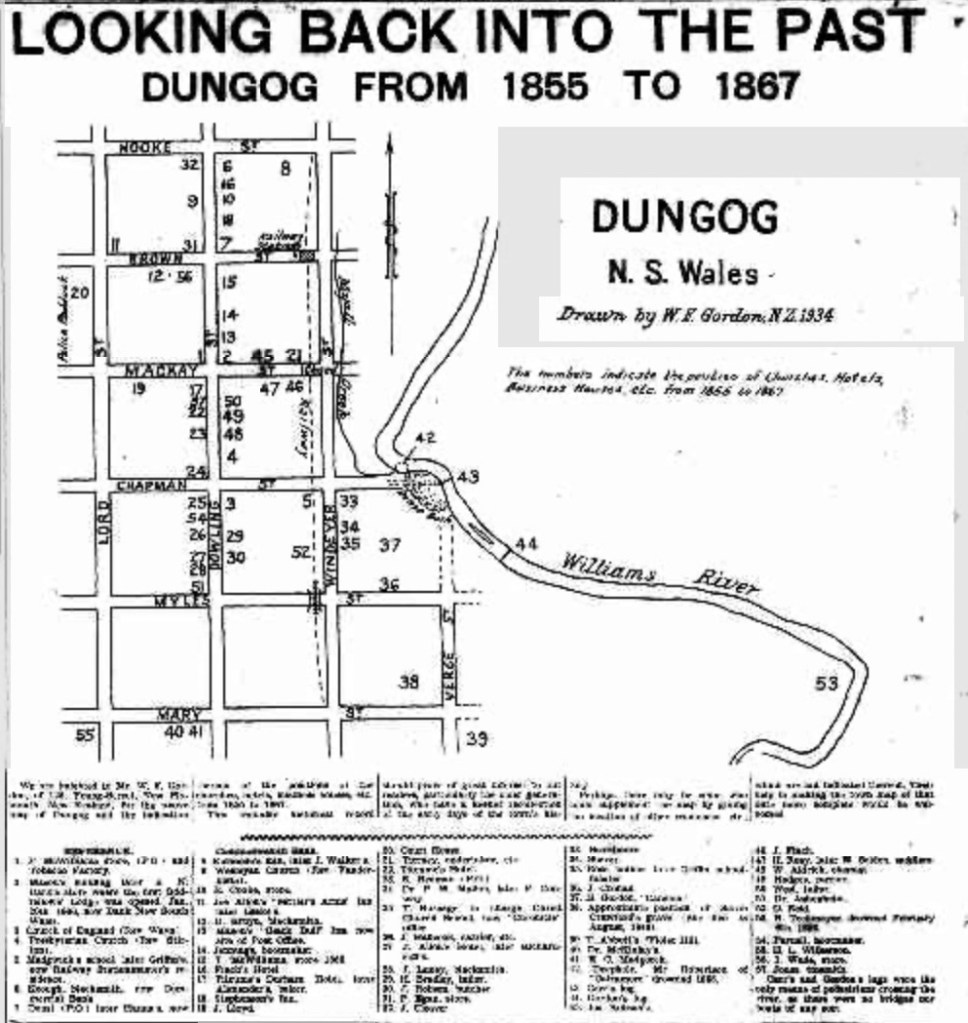
Some months later, on Tuesday 17 July 1934, the Dungog Chronicle published a hand-drawn map entitled LOOKING BACK INTO THE PAST: DUNGOG FROM 1855 TO 1867. Key businesses are indicated on the map by numerical coding. In the relevant block of Brown St, on the corner of Dowling St, #56 designates “J. Wade, store”, which was established by John Wade in 1866.

An article in the Australian Dictionary of Biography describes Wade as “an active member of the Methodist Church, Wade was conference representative and circuit steward at Dungog, and later at Ashfield and Mosman. He helped to found the Dungog School of Arts with an abiding friend Rev. Dr J. E. Carruthers who served at that town in 1871–73. Wade was also a founder (1881) and chairman of the Williams River Steam Navigation Co. Ltd. As a Protectionist, he twice unsuccessfully contested the Legislative Assembly seat of Durham.”

Wade’s store was later bought by H.C. Dark and was developed to become the largest general store in Dungog. The present long and imposing two-story building was built in 1897 and extended in 1917.

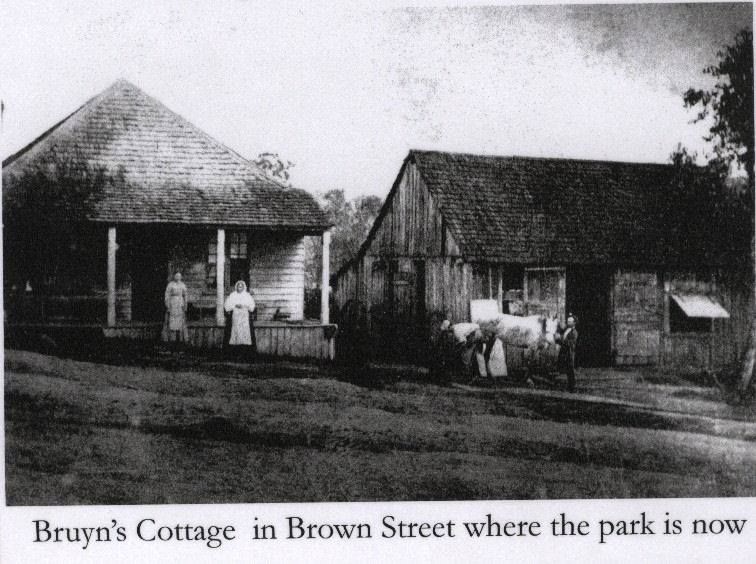
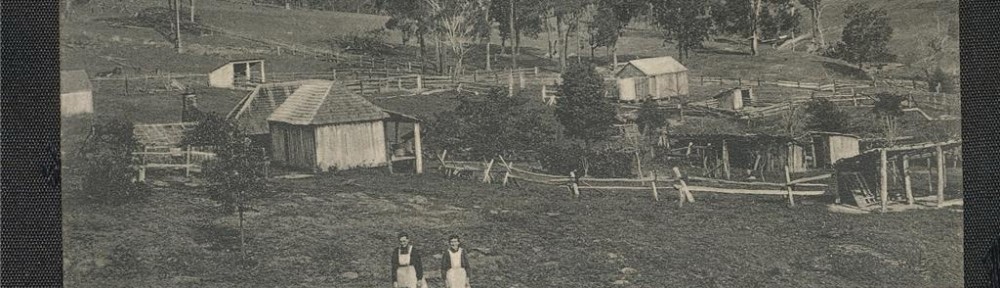
In 1866, however, Wade’s store would have been a much more modest building. Immediately adjacent to that on the LOOKING BACK INTO THE PAST map is #12, “D. Bruyn, blacksmiths”. An undated image entitled “Bruyn’s Cottage in Brown Street where the park is now” appears to show a family house with white posts, next to a building that most likely was the foundry for Bruyn.

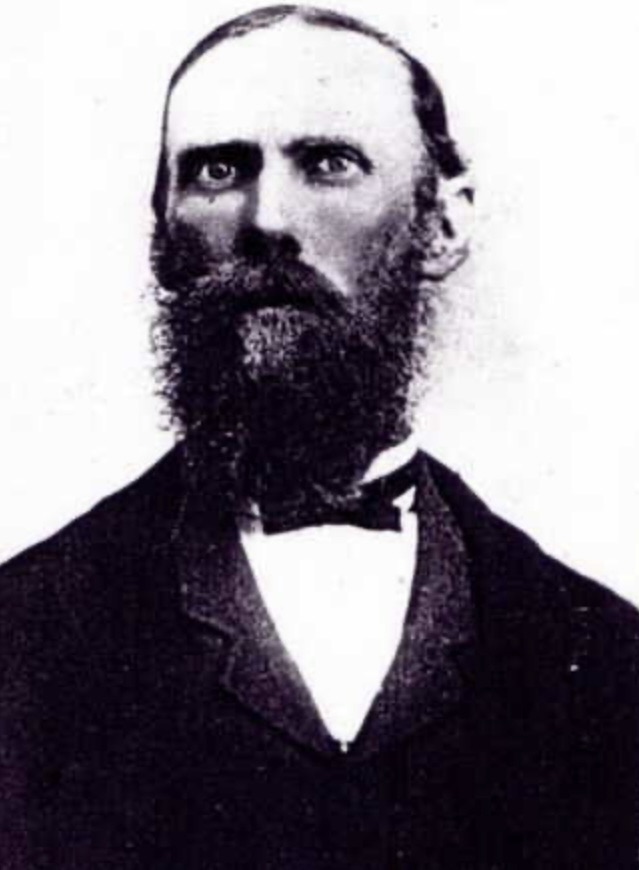
Outside the house are two women (perhaps Sarah and one of her daughters?), while outside the putative foundry are two horses, one held by an apparently-bearded man (perhaps Daniel Bruyn himself?). Certainly, and unsurprisingly given the fashion, a photo of Daniel Bruyn late in his life shows him sporting a generous set of muttonchops and beard.

A decade later than the 1934 publication of this map, the Dungog Chronicle Friday 19 October, 1943 (p.5) published an article entitled “Early Recollections of Dungog” by a person styling themselves simply “Ex-Dungogite”. The recollections in this article includes a discussion of trades in the town. The author notes that “Mr. J. Tierney carried on wheel-wrighting in a general way with which he combined the undertaking business. Mr. Jno Smith, succeeded by Mr. Thos. Gurr, was also in the wheel-wrighting trade in another part of the town.”


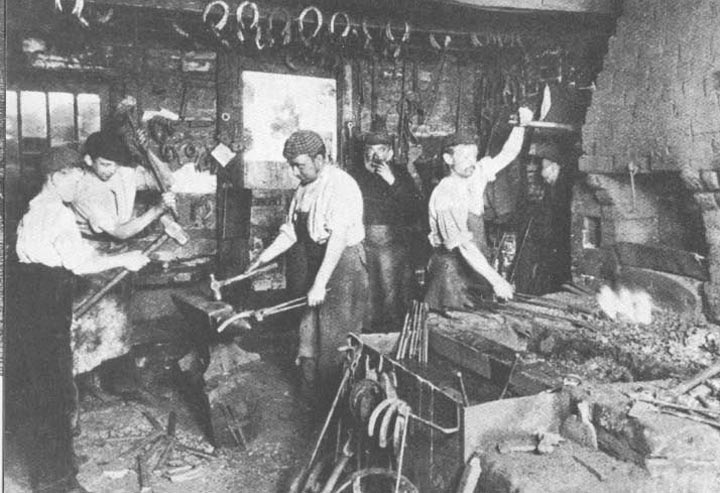
A photograph of a Victorian Blacksmith’s Shop, from The Victorian Web at. https://victorianweb.org/history/work/blacksmith.html
The commentary attached to this photograph notes that “blacksmiths had a place among the working classes, and these men worked with their hands and arms in a hot, grimy smithy. Blacksmiths, who have a history that goes back thousands of years, however, had a far higher economic and social position than farm or factory workers. As highly skilled artisans, they also managed to remain independent and in demand until well into the twentieth century when the automobile destroyed many of their opportunities for work. Even then, these skilled iron workers often morphed into auto mechanics just as a century earlier some had become pioneeering engineers.”

With regard to blacksmiths, the author notes that “Mr. J. Keogh was a general blacksmith in the Main Street, while Mr. D. Bruyn carried on a similar business in the hollow in Brown street … Mr. J. Luney first conducted a blacksmithing business in the allotment occupied at present by the newspaper office. He afterwards removed farther up the street.” The town was well-served by blacksmiths—including Daniel Bruyn “in the hollow in Brown street”, on the property he had bought in 1858.

(The writer also speculates that “Miss Ellen Bruyn, if still existant as I trust she is and still well, notwithstanding her sum of honorable years — must be the oldest Dungog resident.” Writing in 1943, the “Ex-Dungogite” appears unaware of Ellen Bruyn’s death, at the age of 88 years, some 16 years earlier.)

To be continued … … …

*****

See earlier posts at

and subsequent posts at

The Bruyns of Brown Street (2): Early Landholders in Brown Street

Continuing the story of the half-acre block in the centre of the town which Elizabeth and I bought five years ago; the block which has the house that we are now living in.

It turns out that we are just the latest in a line of people who have owned this particular block since soon after it was put up for sale, under the land ownership system of the invading British colonisers, in 1842. We know that this land had been Gringai land for millennia prior to the arrival of the British. We know also that they systematically and relentlessly marginalised the First Peoples and laid claim to the land, both locally, and indeed right across the continent we now know as Australia.

We know the names of the previous owners of this block under British colonial law from the legal documentation that came with the title to the land. And we have been able to find something about each of these owners through searching the internet and sifting the material we have found.

The set of documents from the 19th century
relating to land in Brown St, Dungog, which we acquired
when we purchased the house and land.

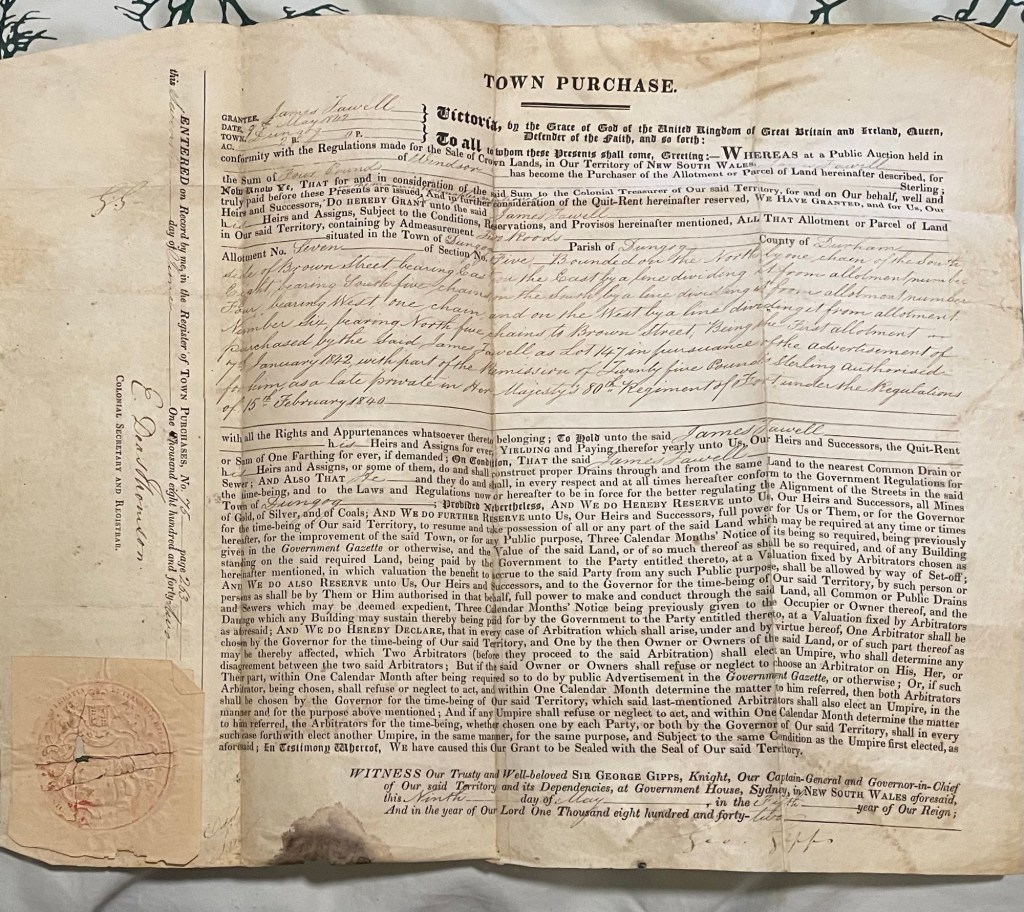
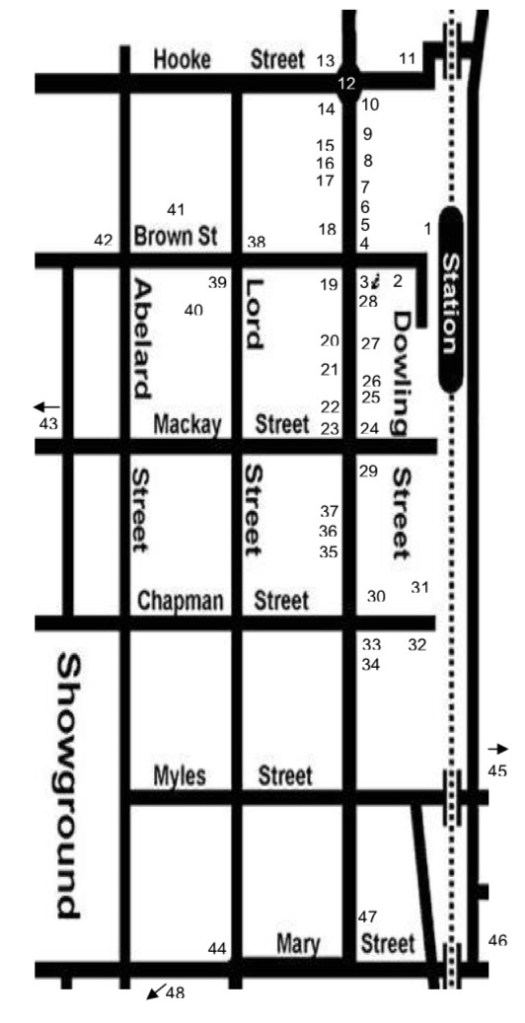
The block of land which we recently bought was originally bought under the system of colonial landholding by James Fawell on 9 May 1842. It cost him £4.0.0. The legal documentation identifies it as “Lot No. Seven Section No. Five in the Town of Dungog”. Section Five is the block bounded by Dowling, Brown, Lord, and Mackay Streets. Dowling St runs along the ridge beside the Williams River, and it developed early into the street of commerce for the town.

The land on Brown St that James Fawell bought is described in the legal documentation as “two roods situate in the Town of Dungog County of Durham, bounded on the North by one chain of the South side of Brown Street, bearing East on the East by a line dividing it from allotment number eight, bearing South five chains on the South by a line dividing it from allotment number four, bearing West one chain and on the West by a line dividing it from allotment number six, bearing North to Brown Street”.

The 1842 document granting land in Brown Street,
Dungog, to James Fawell

All of this means it was a long block, fronting Brown St, a little more than 20 metres (one chain) wide and just over 100 metres (five chains) wide. In total, the “two roods” equates to half an acre (since one rood equals a quarter-acre).

After Fawell bought the land at Public Auction in 1842, there were a number of owners of the land over the ensuing years. The land was purchased by Barnett Levey (in 1852), sold to William Hopkins (in 1855), then sold to John Maberly (in 1857), and in the next year (1858) to Daniel Bruyn.

There is no indication from the legal papers that any of these owners either built a house on the land, or lived on the land. Indeed, Daniel Bruyn is the first owner to be identified as being “of Dungog”; those before him, apart from Fawell, all lived in Windsor. This reflects what is known of Dungog in the mid—19th century.

Throught the 1800s, it seems that there was relatively little building west of Lord St. The main populated area was on Dowling St and within a block either way on its various cross streets (Hooke, Brown, Mackay, Chapman, Myles, and Mary). One John Wilson, born in Dungog in 1854, is said to have described the town as a “sea of bush and scrub, with a house here and there”, and with bullock teams and drays having “to wend their way between stumps and saplings”.

A photo of early Dungog, from History in the Williams River Valley

Even in 1892, at the opening of Dungog Cottage Hospital on Hospital Hill to the west, the trek up was largely through open countryside. Boosted by the development of the dairy industry from the 1890s, Dungog grew more rapidly; as with all towns north of Newcastle, a further boost occurred with the arrival of the railway in 1911.

Indeed, many of the finest houses and commercial buildings still standing in the town were built from the end of the nineteenth century, into the first two decades of the twentieth century. Coolalie (206 Dowling St) and Coimbra (72 Dowling St), as well as the then Angus & Coote building (146–148 Dowling St) and the Dark stores (184–190 Dowling St) all date from this period of expansion. Which may well provide a clue regarding the house eventually built on our Brown St block of land.

Dowling St, Dungog, around 1910; photo from
History of the Williams River Valley

Who were these five men who owned, in turn, Lot Seven in Section Five of the Town of Dungog, over the 16 years from 1842 to 1858? All had their origins in England. I have been able to find out some basic information about some of them, and with some educated hunches, perhaps also about the others. It seems to me that, with the exception of the fifth of these five men, each of them bought the property in order to leverage their possession to increase their finances. Certainly, each time the land was sold, it brought a profit to the seller.

James Fawell purchased the block of land on 9 May 1842 for £4. The Grant by Purchase document states that he was using “part of the Remission of Twenty five Pounds Sterling Authorised for him as a late private in Her Majesty’s 80th Regiment of Foot under the Regulations of 15th February 1840”. This was a regiment raised in 1793 in Staffordshire; it saw action in Flanders and the Netherlands and it was part of the British force that expelled Napoleon from Egypt in 1801. The Regiment served in India from 1803 to 1817.

In May 1836 a detachment of the Regiment, led by Major Narborough Baker, left Gravesend as the guard on the convict ship Lady Kennaway. It arrived in Sydney in October 1836. 25 further detachments followed as convict guards on convict ships in the next two years. Fawell must have come to the Colony in this capacity.

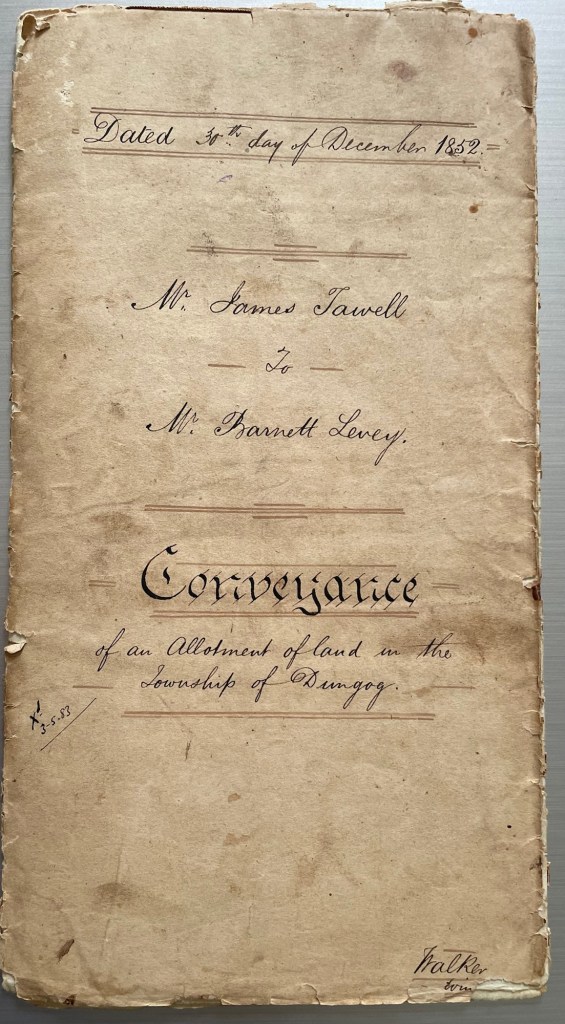
Fawell owned the land for a decade. A Conveyance dated 30 December 1852 reports that James Fawell of Windsor, Settler, sold this land to Barnett Levey of Windsor, Innkeeper, for Nine Pounds Sterling.

The 1852 Conveyance of the Brown St land
from James Fawell to Barnett Levey

Who was Barnett Levey? Was he one of the four children of Barnett Levey (1798–1837), theatrical entrepreneur, first free Jewish settler in NSW ?

For an account of the life of Barnett Levey snr, see https://bondistories.com/category/colonial-history/
The signature of Barnett Levey on the 1852 Conveyance

It is an unusual name; so if this hunch is correct, Barnett jnr was born 1827 and listed in the 1828 Census with his parents. He later worked as a Teacher (1870–1896) and he died in 1907.

(Information taken from https://www.wikitree.com/wiki/Levey-87)

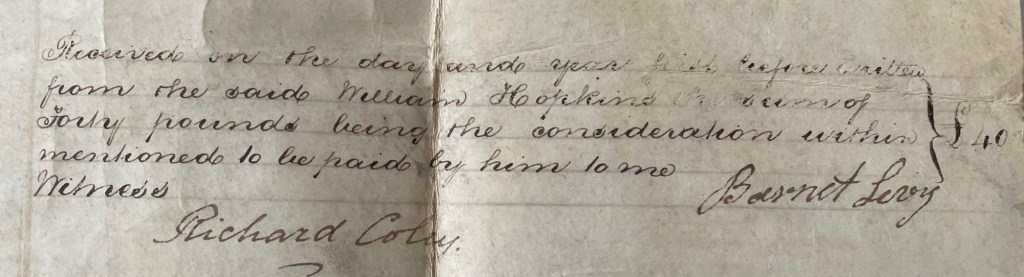
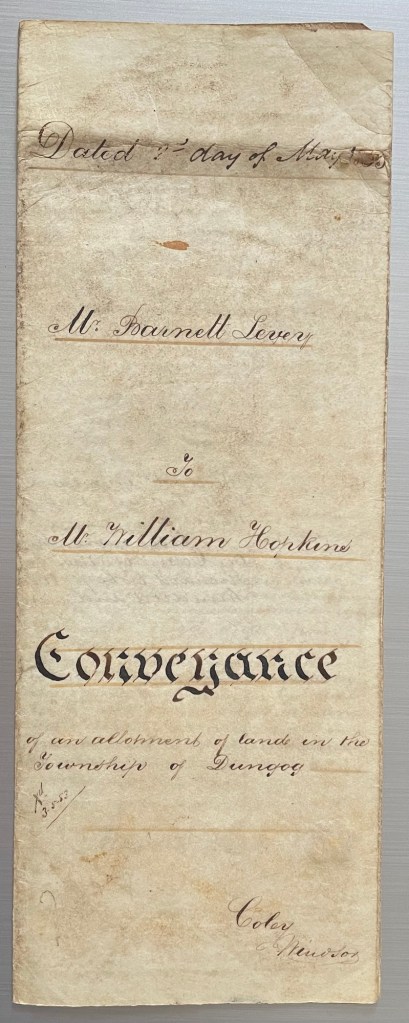
The next owner was William Hopkins. Levey held the land for less than three years; a Conveyance dated 2 May 1855 documents the transaction between Barnet Levey of Windsor, Dealer, and William Hopkins of Windsor, Miller. The land cost Hopkins Forty Pounds Sterling, so Levey had received more than three times what he paid for the land in 1852.

The 1855 Conveyance transferring the Brown St land
from Barnett Levey to William Hopkins

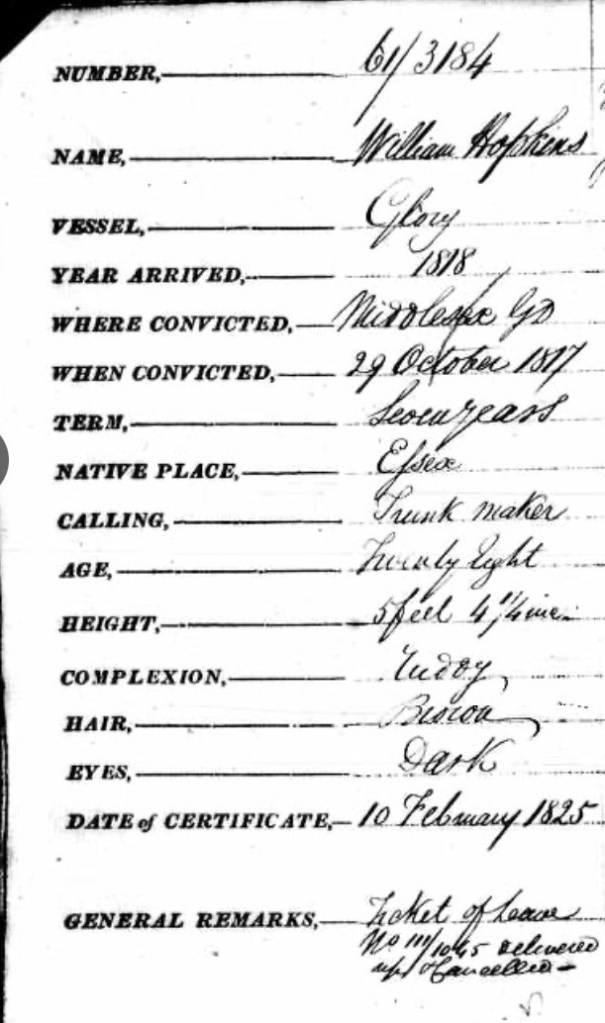
Was the purchaser of this land William Hopkins, Miller, of Windsor, who established the Fitz Roy Steam Flour Mill at 309 George Street, Windsor in the 1840s? If so, it would mean that this land was once owned by a convict who gained his Certificate of Freedom on 10 February 1825.

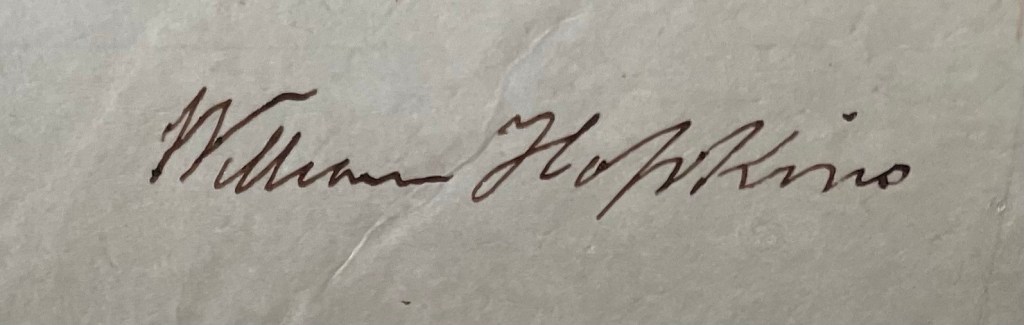
This William Hopkins was born in the late 1790s. He was indicted for stealing, on the 17th of October, one coat, value 20s., the goods of Henry Moule. He was (again) indicted for stealing, on the 17th of October, one tea-pot, value 5s; and two spoons, value 2s , the goods of Charles Moody. Hopkins was convicted at Middlesex Gaol Delivery for a term of 7 years on 29 October 1817. He was aged 22.

The signature of William Hopkins on the 1855 Conveyance

Hopkins was one of 170 convicts transported on the ship ‘Glory’, which departed in May 1818 and arrived in the Colony on 14 Sept 1818. At age 26, Hopkins was free by servitude, and became a landholder at Wilberforce. His wife at this time was Susannah Lisson, born in 1796; their children were William, 2, born in the colony, and Ann, 11 months, also born in the colony. William died and was buried on 30 Jan 1862.

(These details about William Hopkins are taken from https://australianroyalty.net.au/tree/purnellmccord.ged/individual/I76736/William-Hopkins)

The 1825 Certificate of Freedom for William Hopkins

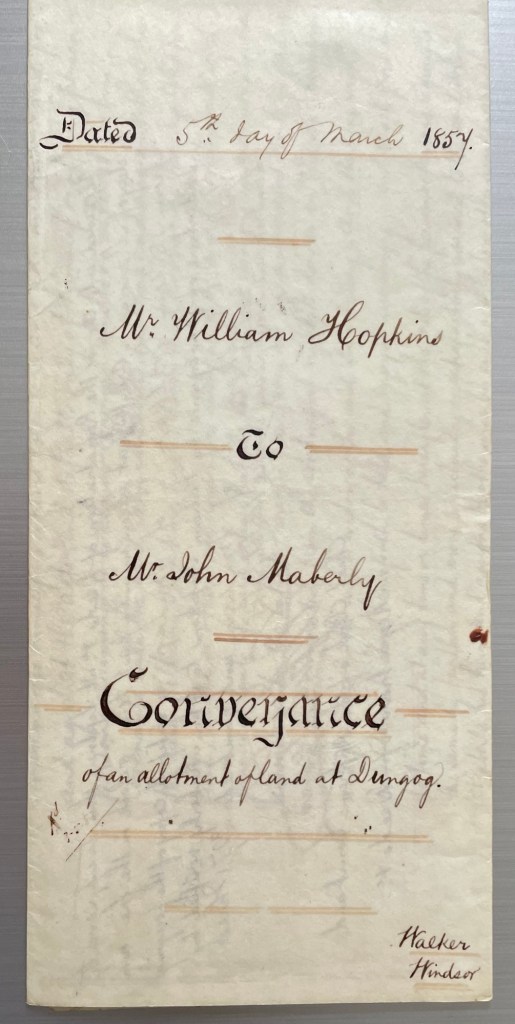
The land then had two further owners in quick succession: John Maberly in 1857, and in the next year, 1858 Daniel Bruyn. A Conveyance dated 5th day of March 1857, between William Hopkins of Windsor, Miller, and John Maberly of Windsor, Boot and Shoe Maker, states that Allotment No. Seven of Section No. Five was sold at Public Auction by Mr John Boulton Laverack, Auctioneer, for the sum of Fifty Pounds. Hopkins thus made Ten Pounds in the space of 22 months when he sold the land.

The 1857 Conveyance transferring the Brown St land
from William Hopkins to John Maberly.

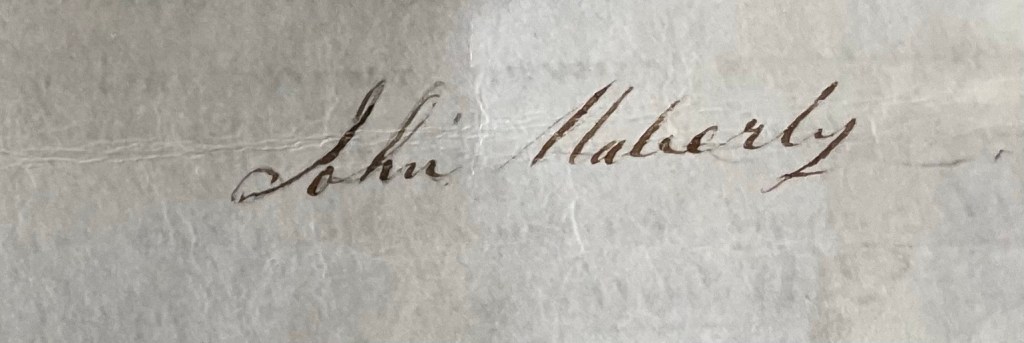
John Rogers Maberly (1827–1860) was the son of convict John Maberly, a carpenter, who arrived in the Colony in 1830 on the Nithsdale), and Elizabeth Rogers. He was born on 14 Oct 1827 in Lambourne, West Berkshire and married Mary Ann Miller (1831–1918) in 1849. John Maberly died of heart disease on 18 Oct 1860 at Windsor; Mary Ann later married William Stubbs at Richmond on 21 June 1866. Stubbs was the son of William Stubbs (1796–1852), who came to the Colony on the Coromandel in 1802.

(Information taken from https://www.wikitree.com/wiki/Maberly-21)

The signature of John Maberly on the 1857 Conveyance

There is also another document from 1857, a Bond of Indemnity from William Hopkins to John Maberly in relation to Rebecca Levy, widow of Barnett Levy.

Within less than a year, Maberly had sold the land. In a Conveyance dated 30 January 1858 between John Maberly of Windsor, Boot and Shoe Maker, and Daniel Bruyn of Dungog, Blacksmith, the transfer was effected for a price of fifty three pounds ten shillings.

The first three Conveyances

The land would stay in the Bruyn family for the next 110 years. What, then, do we know about Daniel Bruyn?

Ah, well, that’s a story for another time … … …

See earlier blog at

and subsequent posts at

The Bruyns of Brown Street (1): Establishing the Town of Dungog

A little over five years ago, Elizabeth and I bought land in Dungog. It was a half-acre block in the centre of the town; the block which has the house that we are have been living in, now, for just over 18 months. It turns out that we are just the latest in a line of people who have owned this particular block.

We know the names of the previous owners of this block from the legal documentation that came with the title to the land. And we have been able to find something about each of these owners—from the person who was originally granted the land in 1842, right up to the people who bought the house and land in 1969, from whose deceased estate we bought the house and land a few years back. We have found this through searching the internet and sifting the material we have found.

The block of land in Brown St was part of the original area of land in the town that was made available in 1838 to settlers by the Governor of the Colony of New South Wales, Sir George Gipps. Of course, this land and the surrounding region (like all land that had been granted to the invading British colonisers) had been the land of the Indigenous people of the area for millennia.

As I have done with each move of recent times, I have taken some time to investigate a little of what is known about the First Peoples of the area to which we have moved. I have been exploring the stories about contact between the invading British colonisers and the First Peoples who have cared for the land from time immemorial.

The First Peoples of this area are the Gringai. The traditional lands of the Gringai include an area centred on the place where the town of Dungog is situated, next to the Williams River. It is thought that the name Dungog is derived from a word meaning “clear hills” in the Gringai language. I have explored what we know of the Gringai and this area in my earlier blogs

Once the British government started sending convicts to this continent, and began the process of claiming the land from the Indigenous people, the British system of law, and of land and property, became dominant as new settlements were opened up for the incoming settlers.

(In the following four paragraphs, I am quoting from https://mhnsw.au/guides/land-grants-guide-1788-1856/)

“In 1825 the sale of land by private tender began (Instructions to Governor Brisbane, 17 July 1825, HRA 1.12.107-125). There were still to be grants without purchase but they were not to exceed 2,560 acres or be less than 320 acres unless in the immediate vicinity of a town or village.

“On 5 September 1826, a Government order allowed Governor Darling to create the limits of location. Settlers were only permitted to take up land within this area. A further Government order of 14 October 1829 extended these boundaries to an area defined as the Nineteen Counties.

“In a despatch dated 9 January 1831, Viscount Goderich instructed that no more free grants (except those already promised) be given. All land was thenceforth to be sold at public auction (HRA 1.16.22) and revenue from the sale of land was to go toward the immigration of labourers.

“Following this, land was sold by public auction without restrictions being placed on the area to be acquired. After 1831 the only land that could be made available for sale was within the Nineteen Counties. This restriction was brought about to reduce the cost of administration and to stem the flow of settlers to the outer areas.”

The Nineteen Counties in which settlement by British colonists was permitted as from 1829. Squatters, however, soon began “squatting” on lands outside the Nineteen Counties.

The first county, Cumberland, had been established soon after the British colony was established, in June 1788. a second county, Northumberland, was proclaimed in 1804. By 1820, nine counties had been established: Roxburgh, Northumberland, Durham, Westmoreland, Cumberland, Argyle, Camden, Ayr and Cambridge. The town of Dungog would be established in the Durham County, named after John George Lambton, First Earl of Durham (1792–1840).

The nine counties in 1832

In 1829, when the establishment of the nineteen counties was decreed to be the limits of settlement, the original Durham County was divided into two, with Gloucester County taking the eastern half of the original county. The dividing boundary was the Williams River, with Dungog lying just to the west of the river in County Durham. (Durham County in the UK was the place where Elizabeth’s family, the Raine family, had originated.)

Durham and Gloucester counties in 1886

The Census of 1857 indicated that Dungog village had 25 houses and a population of 126 people. By 1861 the population had grown to 458 people. The town had begun some decades earlier, in 1838, when a fully surveyed plan of land for sale in Dungog was advertised in the Sydney Gazette. Initially, land was sold at a “Minimum price” of “£2 sterling per acre”. In 1839, a further parcel of half acre and other sized allotments were offered for sale at £4 per acre.

The 1838 plan can be seen as an example of the early colonial government’s attempts to create an English-style model of small villages and surrounding estates. The central area of the village was divided into a number of sections, each separated by a street. The first grant of land in the area had been made a decade earlier, to John Hooke, of Parramatta, in July 1828.

Map of the 1838 plan for Dungog, reproduced from Ah! Dungog

The block of land which we recently bought was originally bought under the system of colonial landholding by James Fawell on 9 May 1842. It cost him £4.0.0. The legal documentation identifies it as “Lot No. Seven Section No. Five in the Town of Dungog”. Section Five is the block bounded by Dowling, Brown, Lord, and Mackay Streets. Dowling St runs along the ridge beside the Williams River, and it developed early into the street of commerce for the town.

All four streets are named after early British settlers in the town. Dowling St bears the name of James Dowling, who was granted land in 1828. Dowling became the second Chief Justice of NSW, serving from 29 August 1837 to 27 September 1844, the day of his death.


The Hon. Sir James Dowling;
engraving by Henry Samuel Sade, c. 1860

Mackay St is named after D.F. Mackay, whose grant of 640 acres was made in 1829. Mackay took up the position of Superintendent of Prisoners and Public Works in Newcastle.

Lord St carries the name of John Lord, whose land (2560 acres) had been designated, in 1829, to be granted to Archibald Mosman; in 1836 it was re-allocated to John Lord. (Mosman did purchase land in the area in 1837, but sold it a year later and moved to Glen Innes.)

Streets in the central area of the “grid” for the Town of Dungog. Taken from a Tourist Pamphlet (the numbers refer to key buildings) at https://williamsvalleyhistory.org/epub_docs/Tourist%20pamphlet%20-%20A3%20June%202012.pdf

Brown Street, it seems, carries the name of one Crawford Logan Brown, a Scotsman who in 1829 had been granted 1280 acres at Dungog by the then Governor, Sir Ralph Darling.

Brown’s estate was named Cairnsmore. In 1836 he added to his grant with a purchase of 640 acres at a cost of £160. In addition to Cairnsmore at Williams River, Crawford L. Brown also owned land at Patrick Plains known as Blackford. He exemplifies the expansionary style of those privileged to obtain grants—and to have convict labour assigned to them—under the British colonial system.

Crawford Logan Brown served as a Magistrate at Dungog from 1845 until his death on 13th December 1859 in Dungog. An interesting—and startling—anecdote known about him is that in January 1846, whilst serving as Magistrate, he sentenced his own assigned servant Thomas Fry to two years in irons. This sentence was punishment for an assault that Fry had made on Brown himself!

An extract from a late 19th century survey map
of the Parish of Dungog, showing the grid plan
and numbered Lots in the Town of Dungog.

There will be more of the story told in a series of blogs to follow, focussing in on the history of the people, the land, and the house on the property that we currently occupy … … …

*****

See subsequent blogs at

William and Sarah Stubbs, and the Coromandel: remembering, 220 years later

It is 220 years ago today (13 June) since the East India ship Coromandel arrived in the Colony of New South Wales. The ship was captained by Master Alex Stirling and the welfare of all on board was the responsibility of the Ship’s Surgeon, Charles Throsby. The Coromandel had been built in India in 1793 and was owned by Reeve and Green.

In late 1801, the Coromandel was chartered by the Commissioners of Transport in London for the purpose of transporting male convicts, along with a group of free settlers, to the Colony. Also chartered at the same time, for the same purpose, was the ship Perseus, whose Captain was John Davison, with the Ship’s Surgeon being W.S. Fielding.

A painting of the Coromandel

Both ships set out from Portsmouth on 8 February 1802, but it was a false start; after a delay of some days because of the weather, they sailed through the Spithead and into the English Channel on 12 February.

On board the Coromandel were 138 male convicts; 20 civilians provided by the Commissioner to serve as the guards of the prisoners; and a number of free settlers, with their families. On board the Perseus were 114 male convicts; 16 civilians provided by the Commissioner to serve as the guards of the prisoners; and another group of free settlers.

80 of the convicts that sailed on the Coromandel had been held on convict hulks at Gravesend, near the mouth of the River Thames, in terrible conditions. The remainder of the convicted men from various English prisons had been brought to Portsmouth to join the ship.

Six of the free settlers on the Coromandel were married men and with children: James and Jane Davison, with two sons; George Hall and Mary Smith, with one daughter and three sons; John Howe and Frances Ward, with two daughters; Andrew Johnston and Mary Beard, with five sons; William Stubbs and Sarah Wingate, with a son and two daughters; and John Turnbull and Ann Warr, with two sons and two daughters. Also on board were James Mein and his wife Susannah Skene (but without their two children) and Andrew Mein, unmarried.

*****

During the voyage that they undertook to the Colony, all three Stubbs children, as well as a number of other passengers, contracted scarlet fever. Sadly, both Andrew Mein and the youngest Johnston child, Alexander, died of scarlet fever during the voyage.

These men had decided to accept an offer from the English government, set out in a document of January 1798, which George Hall had acquired while living in London. It reads as follows:

We whose names are undersigned acknowledge that, at our own request, we offered ourselves as settlers to go out to N.S.W. with our families on the following terms:

To have our passage found and our families victualled by the Government during the voyage. On our arrival in the Colony we have a grant of 100 acres of land at Port Jackson, or fifty acres at Norfolk Island.

To be victualled and clothed free from the Public Stores for a term of twelve months after being put in possession of our allotments, and to be allowed the labour of two prisoners maintained by the Government for the same term.

After which term we and our families are to be no further expense to the Crown. Likewise we have the same proportion of stock, such grain and agricultural tools as have been furnished to other settlers, together with such other assistance as the Governor need judge proper to afford us.

Outfit for men: 1 jacket, 1 shirt, pair of trousers, pair of shoes, 1 hat.
ditto for women: 1 Jacket, 1 petticoat, 1 shift, pair shoes, 1 cap, 1 handkerchief, Children as above on stores.

In a character reference for William Stubbs, which he brought with him on the journey, five men who knew him certified that he was “a man of honest deportment, of a quiet and industrious disposition and well affected to the excellent constitution of our country”.

*****

The Coromandel departed Portsmouth on 8th February 1802 and arrived in Port Jackson on 13 June 1802. It is said that this was the fastest time for this voyage between 1788 and 1819; it is also noteworthy that the Coromandel was the first convict ship to sail direct to Port Jackson without landing anywhere en route. The Perseus did not arrive in Port Jackson until 4 August 1802.

On 9 August 1802, Philip Gidley King, the third Governor of the Colony, wrote to the Transport Commissioners to inform them that:

The healthy state in which the Coromandel and Perseus arrived requires my particularly pointing out the masters of those ships to your notice. It appears by the log books, surgeon’s diaries and the unanimous voice of every person on board those ships of the utmost kindness to the convicts.

King continued with his positive appraisal of these ships’ journeys:

This, with the proper application of the comforts Government had so liberally provided for them and the good state of health all the people were in, induced the master of the Coromandel to proceed without stopping at any port. He arrived here in four months and one day, bringing every person in a state of high health, and fit for immediate labour; and although it appears that the Perseus necessarily stopped at Rio and the Cape, yet the convicts were in as good condition as those on board the Coromandel; nor can I omit the great pleasure felt by myself and the other visiting officers at the grateful thanks expressed by the prisoners and passengers for the kind attention and care they had received from the masters and surgeons.

*****

After disembarking, William Stubbs took his family to the Hawkesbury River region, about 45 miles northwest of the small settlement known as Sydney. He took up a grant of 100 acres at Crescent Reach. The other freemen and their families also travelled to this area, where they had each been given grants of land in the region known as Portland Head. The land granted to Stubbs was, unbeknownst to him, liable to flooding.

In time, the men from the Coromandel would join with others settled in the region to erect a chapel where they could gather to worship in accordance with their Reformed faith. That church building (erected in 1809) still exists; it lays claim to being the oldest Christian church still standing in Australia, and the first non-conformist church built in the Colony. The name chosen for the church, Ebenezer, means “God is our help”.

Ebenezer Uniting (formerly Presbyterian) Church

See https://www.ebenezerchurch.org.au

But before this, and after the Stubbs family had arrived at their land grant and William had cleared his land and planting crops, the Stubbs farm and home was raided by people of the the local Aboriginal clan four times in 12 months. It is thought, now, that a cave on a neighbouring property was a sacred site for the local Aboriginal people. At the time, this would not have been known by Stubbs or by those granting the land to him.

Relations between blacks and whites at this time, early in the development of the British colony, were, understandably, very tense; after all, the British families had been given grants to settle the area which had been the country of the Dharug people for millennia.

A local history website notes that “The river, which they [the Dharug] called Derrubbin, was a focal point as a source of food, i.e. fish, eels, water birds, and mussels, and transport, in their bark canoes. Yams, a staple food, grew along the banks of the river. On the sandstone platforms they engraved images of animals and mythological figures and in the rock shelters they displayed their ochre and charcoal art. The Hawkesbury was also a source of stones for axes and pebbles for making barbs, points and scrapers.” See http://westernsydneylibraries.nsw.gov.au/hawkesbury/history.html

In the early years of the Colony, in June 1789, Lieutenant Watkin Tench had sailed up the Hawkesbury River with Captain Arthur Phillip. Tench observed that “Natives were found on the banks in several parts, many of whom were labouring under the smallpox”. Smallpox, introduced by the British settlers, would prove to be a major factor in drastically reducing the Aboriginal population; one estimate is that amongst the Dharug people, up to 70% of the population died in the outbreak of 1789. See https://www.nma.gov.au/defining-moments/resources/smallpox-epidemic

An engraving of British officers visiting an Aboriginal woman in 1789
(from the collection of the National Library of Australia)

Another way of disrupting the Aboriginal population came from the settlers erecting houses and building fences on the land granted to them, and planting crops and running animals on their newly-established farms. In this way, British settlers interfered with the traditional lifestyle of the local people—whether unwittingly, or intentionally. And by fencing off part of the land that was so important to the culture and spirituality and lifestyle of the Dharug people, Stubbs and his fellow settlers had confronted the central element of Aboriginal culture: the land. “Aboriginal people feel a belonging to land rather than ownership of it. They respect it and refer to it as their mother.”

See https://www.cumberland.nsw.gov.au/history-and-land

*****

The scene was set for a conflict, between the longstanding traditional custodians of the land, respecting the land as their Mother, and the newly-arrived colonists, eager to replicate the best of life that they had known in the Mother Country. In this place, as in countless places across the continent, as British colonists settled on the land, they were regarded by those long- present as invaders, taking away the close knit connection between people and country.

It is said that 16 white settlers were murdered by the Dharug people during the early period of white settlement on the land around the Hawkesbury river. The number of Dharug people killed in these battles is not known. Certainly, by April 1805, Governor King had warned that “the natives … have in an unprovoked and inexcusable manner lately committed the most brutal murder on some defenceless settlers”. He instructed that if approached by the indigenous inhabitants, “the settlers are required to assist each other in repelling those visitors”. Relations had become antagonistic and brittle.

The Hawkesbury a river, a drawing by William Bradley
(from his journal A Voyage to New South Wales,
c.1802, Mitchell Library)

It is reported that on 28 May 1805, the Stubbs house was plundered of all its contents by Dharug people. The next day, William crossed the river in a canoe; it capsized, he struggled to swim to the bank, but was unable to do so. His eight-year old son, William, witnessed the drowning.

Because all the food in the house had been taken in the raid on the house, William’s wife, Sarah, had travelled to Parramatta to obtain provisions for the family. On her return, she discovered that she was now a widow with four small children to raise—William, Sarah, and Elizabeth, who were each born in England; and Keturah, who had been born in the Colony at Portland Head, just two months earlier, on 31 March 1804.

The Sydney Gazette and New South Wales Advertiser of Sunday 2 Jun 1805 reported the sequence of events of these two days in great detail (see the extract below).
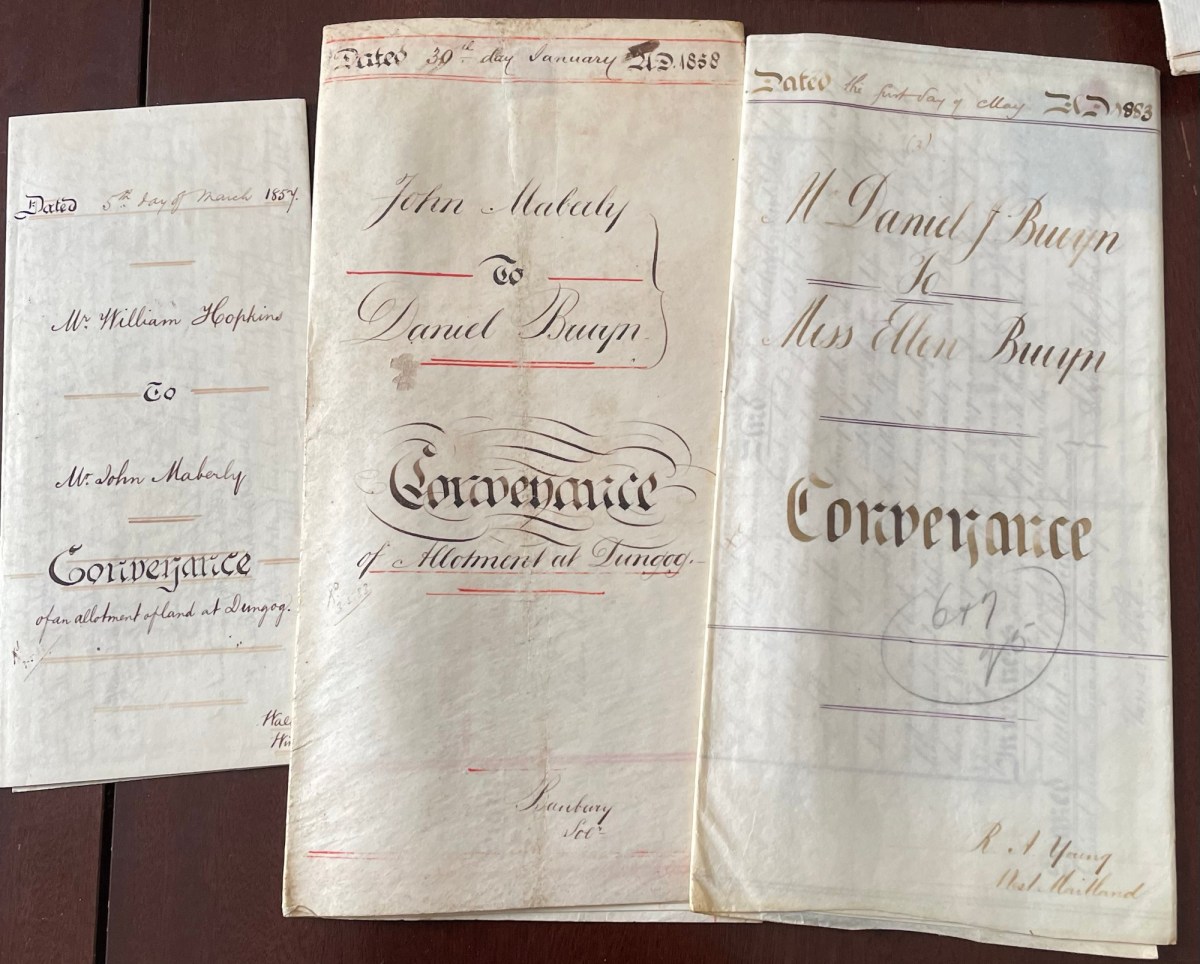
Sarah Stubbs was initially dependent on the goodwill and support of friends. With a young family to raise, however, it is no surprise that she soon would marry again. Her second husband was James Painter, a carpenter who had travelled to the Colony on the Sirius, the flagship of the First Fleet. They had no children.

Each of Sarah’s children married at St Matthew’s Church of England in Windsor. William and Elizabeth were married on the same day in 1819, and Keturah two years later in 1821. On 12 August 1822, Sarah married Thomas Yarwood, a convict from a Cheshire, who had been transported to the Colony on the Indefatigable in 1814. Elizabeth’s husband, Jeremiah Sullivan, was also a convict, transported from Cork City, Ireland, on the Three Bees in 1814. William and Keturah married children of convicts.
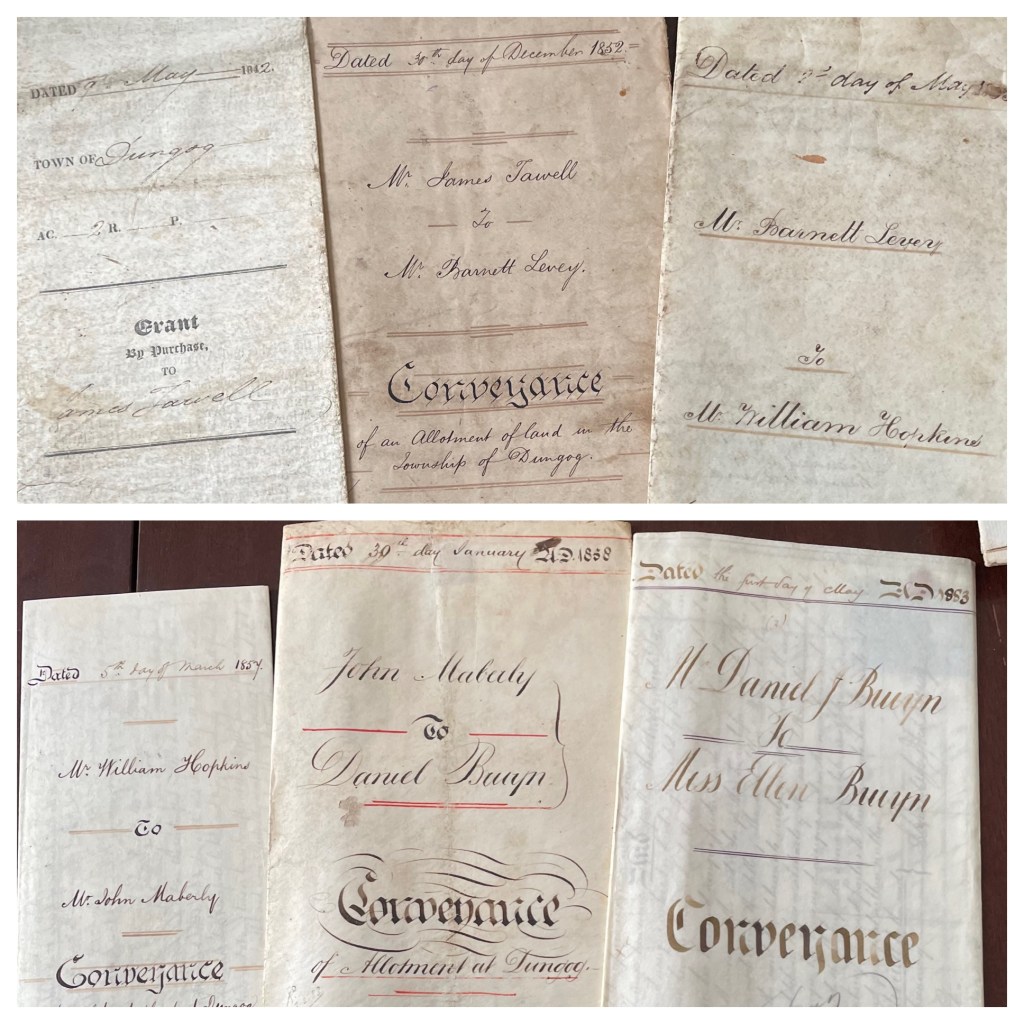
All four Stubbs children had children of their own, producing 33 grandchildren for Sarah, although five died in childhood, and six were born after Sarah’s death in December 1838. Son-in-law Thomas Woods (Yarwood) had died the year before her, in August 1837; it is saidthat he died at the hands of the Dharug clan in yet another raid that ended badly for the freed-convict-became-landholder.
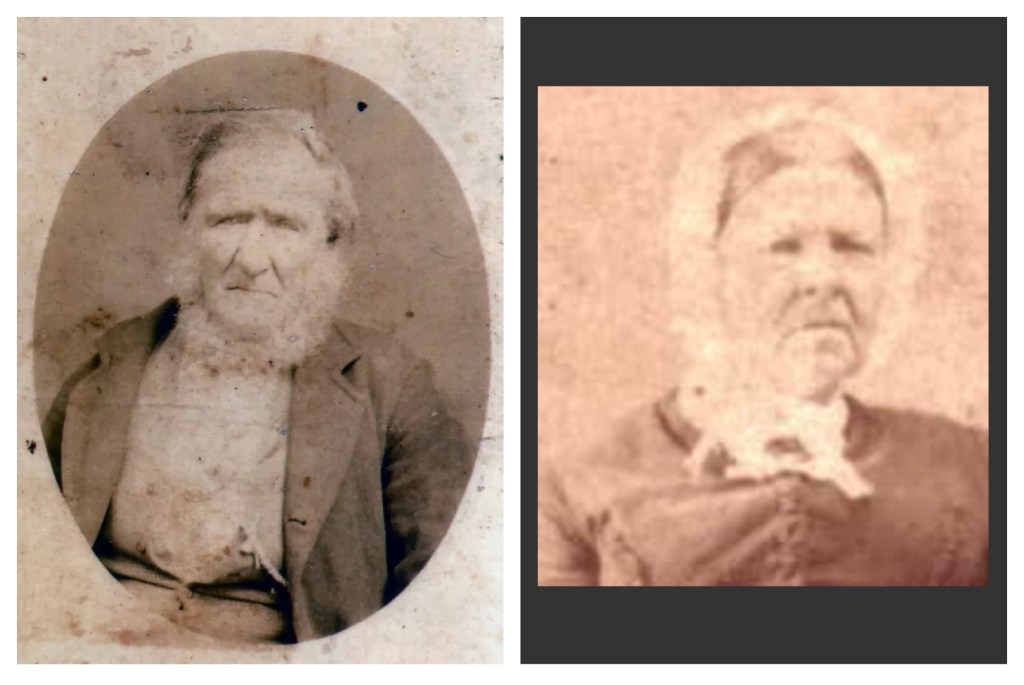
The line of descent from William and Sarah continued through Sarah and Thomas Yarwood, who changed his surname to Woods; then through their son, William James Woods (1833–1915), who married Annie Keenan (1837–1913); their daughter, Ada Sarah Woods (1861–1941), who married William Owen Newbury (1850–1915); and on to their daughter, Mabel Newbury (1901–1998), who married Fred Lowe (1889–1971).

*****

Descendants of Sarah Stubbs and Thomas Woods (Yarwood)
at the 2015 Stubbs Family Reunion at Ebenezer Church

Information about the annual Stubbs reunion at Ebenezer Church is at https://freepages.rootsweb.com/~stubbs1802/genealogy/

*****

ACCIDENTAL DEATH.

On Wednesday se’nnight Wm. Stubbs, a settler on the River Hawkesbury, was unfortunately drowned in crossing that river in a canoe ; a second person was accompanying him, and when in about the center the vehicle unexpectedly upset, and the above unfortunate man depending on his ability to swim on shore, advised his companion not to quit the boat, as it would be sure to drift, on the banks. He did so, and saved his life and Mr. Stubbs, after very nearly gaining the shore, unfortunately became entangled among a cluster of reeds, from which unable to extricate himself, it was his fate to perish in the presence of one of his children, who witnessed the melancholy disaster from the bank.

The accident is the more afflicting, as the deceased leaves a widow and large family to deplore his untimely fate ; the circumstances that led to which still heighten the calamity. The house was the day before surrounded by natives, at whose appearance Mrs. Stubbs being excessively alarmed, she fled towards the river side, and would have precipitated herself into the stream, had she not been prevented by assurances from one of the natives that she or her infants should not be harmed.

They afterwards gutted the house of its whole contents, and retreated with the plunder, and as soon as the deceased was made acquainted with what had happened, were closely pursued towards the Mountains, but in vain, as no single article of the property was recovered. As not a requisite to comfort remained to the family, Mrs. Stubbs set out that night for Parramatta, in order to procure a few requisites more immediately wanting ; and during her absence the unfortunate event of her husband’s death took place.

In addition to the lamentable circumstances that tend to multiply embarrassment upon the above unfortunate family, we have feelingly to mention, that within the space of twelve months they have been four times bitterly distressed by hostile natives, who have at either time stripped them of domestic comforts or “swept their fields before them.”

The poor child who sadly witnessed the dying struggles of an unfortunate parent is a fine boy, nearly eight years old; and eldest of four helpless Orphans in the dispensation of the Divine Will left to deplore a father’s loss. For poignant affliction, happy for the unfortunate, Heaven still provides by bestowing its bounties upon some among the many, who by the most delightful application give testimony, that all Mankind are not insensible of what they owe to Providence, and when distress like this presents her claim to sensibility, generously step forward to discharge the debt.

The Sydney Gazette and New South Wales Advertiser, Sunday 2 Jun 1805, Page 2.

*****

Sources:

https://www.freesettlerorfelon.com/convict_ship_coromandel_1802.htm

https://www.freesettlerorfelon.com/convict_ship_perseus_1802.htm

https://australianroyalty.net.au/tree/purnellmccord.ged/individual/I52434/William-Stubbs

The Story of William Stubbs and Sarah Wingate, a Coromandel 1802 Family (vol. 1)

The Children of William Stubbs and Sarah Wingate, a Coromandel 1802 Family (vol. 2)